MIXED METHOD
RESEARCH DESIGN
Institute of Education and Research
University of Dhaka
PRESENTING BY……..
2
MD. RASEL
SARDER(12171)
MD. TARIKUL
ISLAM(12111)
WE WILL DISCUSS ABOUT……
 Definition of Mixed Method Research
 Basic Characteristic of Mixed Method
Research
 When we conduct a Mixed Method Study
 Reason for using Mixed Method
 The types of Mixed Method Research
 Steps for conducting a Mixed Method
Research
 Criteria for Evaluating a Mixed Method Study
 Some Strength and Weakness of the M.M.S
QUANTITATIVE
AND
QUALITATIVE
RESEARCH
QUANTITATIVE RESEARCH
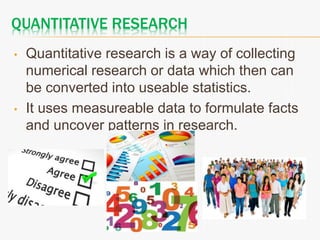
• Quantitative research is a way of collecting
numerical research or data which then can
be converted into useable statistics.
• It uses measureable data to formulate facts
and uncover patterns in research.
QUALITATIVE RESEARCH
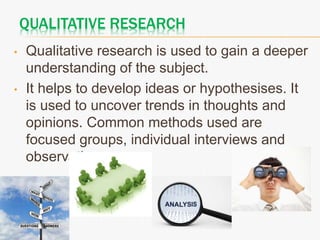
• Qualitative research is used to gain a deeper
understanding of the subject.
• It helps to develop ideas or hypothesises. It
is used to uncover trends in thoughts and
opinions. Common methods used are
focused groups, individual interviews and
observations
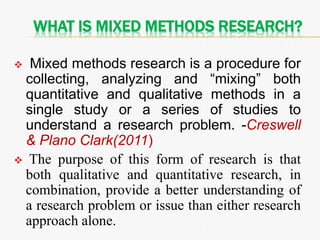
WHAT IS MIXED METHODS RESEARCH?
 Mixed methods research is a procedure for
collecting, analyzing and “mixing” both
quantitative and qualitative methods in a
single study or a series of studies to
understand a research problem. -Creswell
& Plano Clark(2011)
 The purpose of this form of research is that
both qualitative and quantitative research, in
combination, provide a better understanding of
a research problem or issue than either research
approach alone.
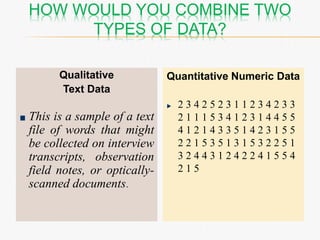
HOW WOULD YOU COMBINE TWO
TYPES OF DATA?
Qualitative
Text Data
This is a sample of a text
file of words that might
be collected on interview
transcripts, observation
field notes, or optically-
scanned documents.
Quantitative Numeric Data
2 3 4 2 5 2 3 1 1 2 3 4 2 3 3
2 1 1 1 5 3 4 1 2 3 1 4 4 5 5
4 1 2 1 4 3 3 5 1 4 2 3 1 5 5
2 2 1 5 3 5 1 3 1 5 3 2 2 5 1
3 2 4 4 3 1 2 4 2 2 4 1 5 5 4
2 1 5
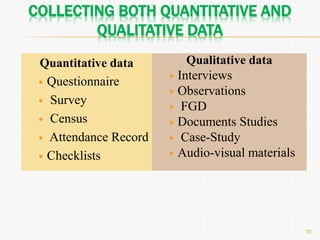
COLLECTING BOTH QUANTITATIVE AND
QUALITATIVE DATA
Quantitative data
 Questionnaire
 Survey
 Census
 Attendance Record
 Checklists
Qualitative data
 Interviews
 Observations
 FGD
 Documents Studies
 Case-Study
 Audio-visual materials
10
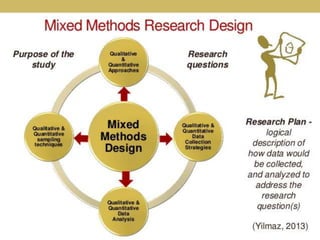
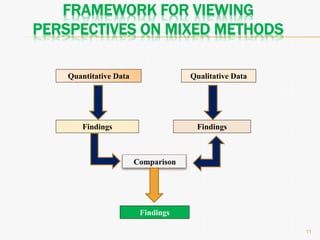
FRAMEWORK FOR VIEWING
PERSPECTIVES ON MIXED METHODS
11
Quantitative Data Qualitative Data
Findings
Findings
Findings
A MIXED METHODS RESEARCHER…
 Collects both quantitative and qualitative data
 “Mixes” them
 “Mixes” them at the same time (concurrently) or one
after the other (sequentially)
 Emphasizes both equally or unequally
BASIC CHARACTERISTICS
 Provide the rationale for the design
 Include collecting qualitative and quantitative
data
 Consider priority
 Consider sequence
 Match the data analysis to a design
 Diagram the procedures
13
WHEN DO YOU CONDUCT A MIXED
METHODS STUDY ?
 When we have both quantitative and
qualitative data
 When one type of research is not enough to
explain or to answer the question
 When we want qualitative research to help
explain quantitative findings
 When we want to generalize findings to a
large population
 When we want to provide alternative
perspectives in a study
WHAT ARE THE REASON FOR USING
MIXED METHODS ?
 To explain and interpret.
 To explore a phenomenon.
 To develop and to test a new instrument.
 To complement the strengths of a single design.
 To overcome the weaknesses of a single design.
 To address a question at different levels.
 To address a theoretical perspective at different
levels.
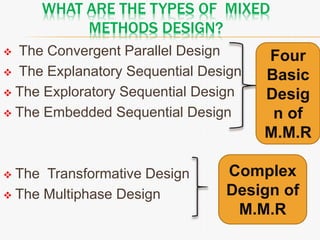
WHAT ARE THE TYPES OF MIXED
METHODS DESIGN?
 The Convergent Parallel Design
 The Explanatory Sequential Design
 The Exploratory Sequential Design
 The Embedded Sequential Design
 The Transformative Design
 The Multiphase Design
Four
Basic
Desig
n of
M.M.R
Complex
Design of
M.M.R
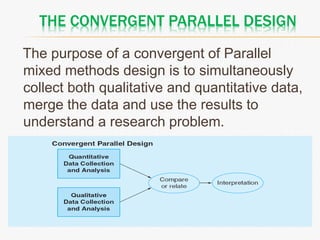
THE CONVERGENT PARALLEL DESIGN
The purpose of a convergent of Parallel
mixed methods design is to simultaneously
collect both qualitative and quantitative data,
merge the data and use the results to
understand a research problem.
CONTINUE….
Characteristic
 Data Collection Priority (Equal)
 Sequence (Concurrently/ Simultaneously)
 Use of Data (To Compare Similar/Dissimilar)
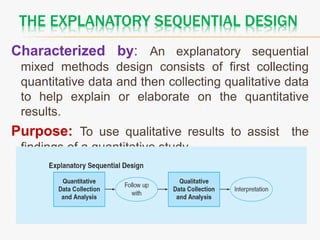
THE EXPLANATORY SEQUENTIAL DESIGN
Characterized by: An explanatory sequential
mixed methods design consists of first collecting
quantitative data and then collecting qualitative data
to help explain or elaborate on the quantitative
results.
Purpose: To use qualitative results to assist the
findings of a quantitative study.
CONTINUE….
Characteristic
 Data Collection Priority (Quantitative Data)
 Sequence (First Quantitative Data)
 Use of Data (To Refine, Polish, Elaborate)
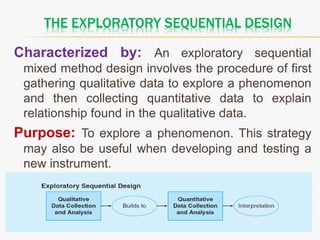
THE EXPLORATORY SEQUENTIAL DESIGN
Characterized by: An exploratory sequential
mixed method design involves the procedure of first
gathering qualitative data to explore a phenomenon
and then collecting quantitative data to explain
relationship found in the qualitative data.
Purpose: To explore a phenomenon. This strategy
may also be useful when developing and testing a
new instrument.
CONTINUE….
Characteristic
 Data Collection Priority (Qualitative Data)
 Sequence (First Qualitative Data)
 Use of Data (To Refine, Polish, Elaborate)
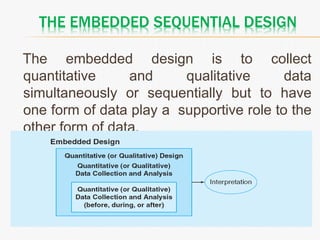
THE EMBEDDED SEQUENTIAL DESIGN
The embedded design is to collect
quantitative and qualitative data
simultaneously or sequentially but to have
one form of data play a supportive role to the
other form of data.
CONTINUE….
Characteristic
 Data Collection Priority (Often Quant./Often
Qual.)
 Sequence (Sequentially / Simultaneously)
 Use of Data (To Provide additional Source or
Argument)
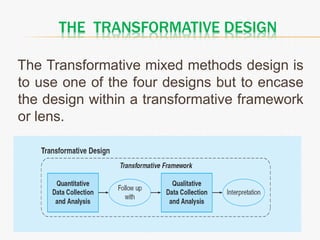
THE TRANSFORMATIVE DESIGN
The Transformative mixed methods design is
to use one of the four designs but to encase
the design within a transformative framework
or lens.
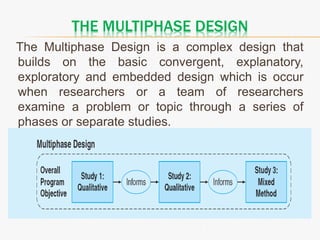
THE MULTIPHASE DESIGN
The Multiphase Design is a complex design that
builds on the basic convergent, explanatory,
exploratory and embedded design which is occur
when researchers or a team of researchers
examine a problem or topic through a series of
phases or separate studies.
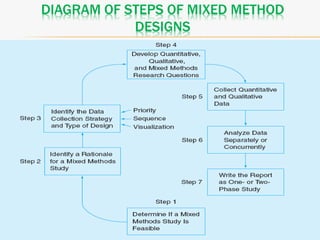
STEPS IN THE PROCESS OF CONDUCTING A
MIXED METHOD STUDIES
 Determine a mixed method study is feasible
 Identify a rationale for a mixed method study
 Identify the data collecting strategy and type of
design
 Develop quantitative, qualitative and mixed
method research questions
 Collect quantitative and qualitative data
 Analyze data separately or concurrently
 Write a report as one or two phase study
DIAGRAM OF STEPS OF MIXED METHOD
DESIGNS
STEP-1: DETERMINE A MIXED METHOD STUDY IS
FEASIBLE
• Research problem
 Content – any topics
 Fit the problem to mixed methods
(arguments)
• Access to both qualitative and quantitative
data
• Background and resources
STEP-2: IDENTIFY A RATIONALE FOR A MIXED
METHOD STUDY
 Consider why you are collecting both
quantitative and qualitative data.
 Be explicit in this rationale
 Include it early in the research plan or report
STEP-3: IDENTIFY A DATA COLLECTION
STRATEGY
 The priority give you will give to quantitative
and qualitative data
 The sequence of your data collection, if you
do not plan to collect the data
 The specific forms of quantitative data and
qualitative data you will collect
STEP-4: DEVELOP QUANTITATIVE , QUALITATIVE
AND MIXED METHODS QUESTIONS
 Identify questions prior to a study or during
the study
 Create both exploratory questions and
analytic variable question
 Question will emerge depend on the type of
design
STEP-5: COLLECT QUANTITATIVE AND
QUALITATIVE DATA
 The sequence of data collection will depend
on the type of design
 In all design the presentation of data or
information will be will organized
STEP-6: ANALYZE DATA SEPARATELY OR
CONCURRENTLY
 Data analyze mainly related to the specific
type of design being used
 Analyze data (qualitative and quantitative)
separately, concurrently or both
STEP-7: WRITE A REPORT AS ONE OR TWO
PHASE STUDY
 The report is written in two phase
 The report integrates the quantitative and
qualitative phases or the study in each
section
HOW DO YOU EVALUATE A MIXED METHOD
STUDY ?
 Describes that mixed method is the best approach to
answer the research questions.
 Incorporates both qualitative and quantitative data
collection and analysis.
 Explicitly combines or mixes two datasets.
 Frames the study one of the mixed method research
designs.
 Provides a diagram of the procedure to clarify the
timing, priority and mixing within the study.
 Signals to the reader that the study is using mixed
method.
WHAT ARE SOME STRENGTHS?
Can be easy to describe and to report
Can be useful when unexpected results arise from a
prior study
Can help to generalize qualitative data
Helpful in designing and validating an instrument
Can position research in a transformative framework
WHAT ARE SOME WEAKNESSES?
Time required.
Discrepancies between different types of
data.
Can be difficult to decide when to proceed in
sequential designs.
Little guidance on transformative methods.
SOME EXAMPLE OF MIXED METHOD RESEARCH
PROBLEM
 “Exploring the Effect of Motivational
Feedback given in Continuous on Self-
Regulated learning”
 “The Pattern of Teacher Student
Communication at the Primary Level
Education in Bangladesh”
 “A Sequential Explanatory Study of College
Student’s Copy-and-Paste Note Talking”
40
THANK YOU ALL………

Mixed method research

  • 1.
    MIXED METHOD RESEARCH DESIGN Instituteof Education and Research University of Dhaka
  • 2.
  • 3.
    WE WILL DISCUSSABOUT……  Definition of Mixed Method Research  Basic Characteristic of Mixed Method Research  When we conduct a Mixed Method Study  Reason for using Mixed Method  The types of Mixed Method Research  Steps for conducting a Mixed Method Research  Criteria for Evaluating a Mixed Method Study  Some Strength and Weakness of the M.M.S
  • 4.
  • 5.
    QUANTITATIVE RESEARCH • Quantitativeresearch is a way of collecting numerical research or data which then can be converted into useable statistics. • It uses measureable data to formulate facts and uncover patterns in research.
  • 6.
    QUALITATIVE RESEARCH • Qualitativeresearch is used to gain a deeper understanding of the subject. • It helps to develop ideas or hypothesises. It is used to uncover trends in thoughts and opinions. Common methods used are focused groups, individual interviews and observations
  • 7.
    WHAT IS MIXEDMETHODS RESEARCH?  Mixed methods research is a procedure for collecting, analyzing and “mixing” both quantitative and qualitative methods in a single study or a series of studies to understand a research problem. -Creswell & Plano Clark(2011)  The purpose of this form of research is that both qualitative and quantitative research, in combination, provide a better understanding of a research problem or issue than either research approach alone.
  • 9.
    HOW WOULD YOUCOMBINE TWO TYPES OF DATA? Qualitative Text Data This is a sample of a text file of words that might be collected on interview transcripts, observation field notes, or optically- scanned documents. Quantitative Numeric Data 2 3 4 2 5 2 3 1 1 2 3 4 2 3 3 2 1 1 1 5 3 4 1 2 3 1 4 4 5 5 4 1 2 1 4 3 3 5 1 4 2 3 1 5 5 2 2 1 5 3 5 1 3 1 5 3 2 2 5 1 3 2 4 4 3 1 2 4 2 2 4 1 5 5 4 2 1 5
  • 10.
    COLLECTING BOTH QUANTITATIVEAND QUALITATIVE DATA Quantitative data  Questionnaire  Survey  Census  Attendance Record  Checklists Qualitative data  Interviews  Observations  FGD  Documents Studies  Case-Study  Audio-visual materials 10
  • 11.
    FRAMEWORK FOR VIEWING PERSPECTIVESON MIXED METHODS 11 Quantitative Data Qualitative Data Findings Findings Findings
  • 12.
    A MIXED METHODSRESEARCHER…  Collects both quantitative and qualitative data  “Mixes” them  “Mixes” them at the same time (concurrently) or one after the other (sequentially)  Emphasizes both equally or unequally
  • 13.
    BASIC CHARACTERISTICS  Providethe rationale for the design  Include collecting qualitative and quantitative data  Consider priority  Consider sequence  Match the data analysis to a design  Diagram the procedures 13
  • 14.
    WHEN DO YOUCONDUCT A MIXED METHODS STUDY ?  When we have both quantitative and qualitative data  When one type of research is not enough to explain or to answer the question  When we want qualitative research to help explain quantitative findings  When we want to generalize findings to a large population  When we want to provide alternative perspectives in a study
  • 15.
    WHAT ARE THEREASON FOR USING MIXED METHODS ?  To explain and interpret.  To explore a phenomenon.  To develop and to test a new instrument.  To complement the strengths of a single design.  To overcome the weaknesses of a single design.  To address a question at different levels.  To address a theoretical perspective at different levels.
  • 16.
    WHAT ARE THETYPES OF MIXED METHODS DESIGN?  The Convergent Parallel Design  The Explanatory Sequential Design  The Exploratory Sequential Design  The Embedded Sequential Design  The Transformative Design  The Multiphase Design Four Basic Desig n of M.M.R Complex Design of M.M.R
  • 17.
    THE CONVERGENT PARALLELDESIGN The purpose of a convergent of Parallel mixed methods design is to simultaneously collect both qualitative and quantitative data, merge the data and use the results to understand a research problem.
  • 18.
    CONTINUE…. Characteristic  Data CollectionPriority (Equal)  Sequence (Concurrently/ Simultaneously)  Use of Data (To Compare Similar/Dissimilar)
  • 19.
    THE EXPLANATORY SEQUENTIALDESIGN Characterized by: An explanatory sequential mixed methods design consists of first collecting quantitative data and then collecting qualitative data to help explain or elaborate on the quantitative results. Purpose: To use qualitative results to assist the findings of a quantitative study.
  • 20.
    CONTINUE…. Characteristic  Data CollectionPriority (Quantitative Data)  Sequence (First Quantitative Data)  Use of Data (To Refine, Polish, Elaborate)
  • 21.
    THE EXPLORATORY SEQUENTIALDESIGN Characterized by: An exploratory sequential mixed method design involves the procedure of first gathering qualitative data to explore a phenomenon and then collecting quantitative data to explain relationship found in the qualitative data. Purpose: To explore a phenomenon. This strategy may also be useful when developing and testing a new instrument.
  • 22.
    CONTINUE…. Characteristic  Data CollectionPriority (Qualitative Data)  Sequence (First Qualitative Data)  Use of Data (To Refine, Polish, Elaborate)
  • 23.
    THE EMBEDDED SEQUENTIALDESIGN The embedded design is to collect quantitative and qualitative data simultaneously or sequentially but to have one form of data play a supportive role to the other form of data.
  • 24.
    CONTINUE…. Characteristic  Data CollectionPriority (Often Quant./Often Qual.)  Sequence (Sequentially / Simultaneously)  Use of Data (To Provide additional Source or Argument)
  • 25.
    THE TRANSFORMATIVE DESIGN TheTransformative mixed methods design is to use one of the four designs but to encase the design within a transformative framework or lens.
  • 26.
    THE MULTIPHASE DESIGN TheMultiphase Design is a complex design that builds on the basic convergent, explanatory, exploratory and embedded design which is occur when researchers or a team of researchers examine a problem or topic through a series of phases or separate studies.
  • 27.
    STEPS IN THEPROCESS OF CONDUCTING A MIXED METHOD STUDIES  Determine a mixed method study is feasible  Identify a rationale for a mixed method study  Identify the data collecting strategy and type of design  Develop quantitative, qualitative and mixed method research questions  Collect quantitative and qualitative data  Analyze data separately or concurrently  Write a report as one or two phase study
  • 28.
    DIAGRAM OF STEPSOF MIXED METHOD DESIGNS
  • 29.
    STEP-1: DETERMINE AMIXED METHOD STUDY IS FEASIBLE • Research problem  Content – any topics  Fit the problem to mixed methods (arguments) • Access to both qualitative and quantitative data • Background and resources
  • 30.
    STEP-2: IDENTIFY ARATIONALE FOR A MIXED METHOD STUDY  Consider why you are collecting both quantitative and qualitative data.  Be explicit in this rationale  Include it early in the research plan or report
  • 31.
    STEP-3: IDENTIFY ADATA COLLECTION STRATEGY  The priority give you will give to quantitative and qualitative data  The sequence of your data collection, if you do not plan to collect the data  The specific forms of quantitative data and qualitative data you will collect
  • 32.
    STEP-4: DEVELOP QUANTITATIVE, QUALITATIVE AND MIXED METHODS QUESTIONS  Identify questions prior to a study or during the study  Create both exploratory questions and analytic variable question  Question will emerge depend on the type of design
  • 33.
    STEP-5: COLLECT QUANTITATIVEAND QUALITATIVE DATA  The sequence of data collection will depend on the type of design  In all design the presentation of data or information will be will organized
  • 34.
    STEP-6: ANALYZE DATASEPARATELY OR CONCURRENTLY  Data analyze mainly related to the specific type of design being used  Analyze data (qualitative and quantitative) separately, concurrently or both
  • 35.
    STEP-7: WRITE AREPORT AS ONE OR TWO PHASE STUDY  The report is written in two phase  The report integrates the quantitative and qualitative phases or the study in each section
  • 36.
    HOW DO YOUEVALUATE A MIXED METHOD STUDY ?  Describes that mixed method is the best approach to answer the research questions.  Incorporates both qualitative and quantitative data collection and analysis.  Explicitly combines or mixes two datasets.  Frames the study one of the mixed method research designs.  Provides a diagram of the procedure to clarify the timing, priority and mixing within the study.  Signals to the reader that the study is using mixed method.
  • 37.
    WHAT ARE SOMESTRENGTHS? Can be easy to describe and to report Can be useful when unexpected results arise from a prior study Can help to generalize qualitative data Helpful in designing and validating an instrument Can position research in a transformative framework
  • 38.
    WHAT ARE SOMEWEAKNESSES? Time required. Discrepancies between different types of data. Can be difficult to decide when to proceed in sequential designs. Little guidance on transformative methods.
  • 39.
    SOME EXAMPLE OFMIXED METHOD RESEARCH PROBLEM  “Exploring the Effect of Motivational Feedback given in Continuous on Self- Regulated learning”  “The Pattern of Teacher Student Communication at the Primary Level Education in Bangladesh”  “A Sequential Explanatory Study of College Student’s Copy-and-Paste Note Talking”
  • 40.