METHODS
MIXED
KNOWING THE WHATs, WHYs AND HOWs
PART 1
THE WHATs
THE NATURE OF MIXED METHODS
Mixed method in research is where
numbers and words meet to create
a more nuanced understanding of a
certain phenomenon
MIXED METHODS
Pertains to the research design that combines
qualitative and quantitative approaches in a
single study (Taderhoost, 2021)
MIXED METHODS
Mixed methods research combines elements
from both qualitative and quantitative
paradigms to produce converging findings in
the context of complex research questions
(Lingard et al., 2008)
In this mixed-method design, the researcher often gives
equal priority to both quantitative and qualitative data and
collects both data concurrently or simultaneously during
the study (Creswell, 2012), and the critical point the
researcher needs to be careful about is how to relate these
two different data sets since they are collected and
analyzed separately.
HOW IS IT USED?
PART 2
THE WHYs
THE PURPOSE OF MIXED METHODS
The approach helps to explain on
quantitative results with subsequent
qualitative data. Thus, it enhances a
study with a supplemental data set,
either quantitative or qualitative.
PURPOSE OF
MIXED METHOD
Mixed-method research emerged as a
third research method which involved
the use of both quantitative and
qualitative research methods for
research problems that cannot be
answered by a mono-method
perspective (Sahin & Ozturk, 2019).
PURPOSE OF
MIXED METHOD
PART 3
THE HOWs
THE TYPES OF MIXED METHODS
TYPES OF
MIXED METHODS
I
Cresswell (2012) proposed four types of mixed-method design that
can be utilized by research in structuring their studies:
TYPES OF MIXED
METHODS
CONVERGENT PARALLEL
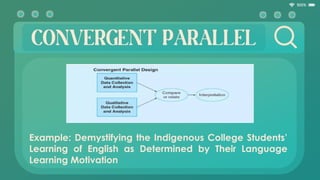
The purpose of this type of research is to collect
and combine quantitative and qualitative data
simultaneously and report the findings of the
analysis to understand the research problem
better.
CONVERGENT PARALLEL
Example: Demystifying the Indigenous College Students’
Learning of English as Determined by Their Language
Learning Motivation
TYPES OF MIXED
METHODS
EXPLANATORY DESIGN
This design consists of first collecting quantitative
data and then collecting qualitative data to help
explain or elaborate on the quantitative results.
EXPLANATORY DESIGN
Example: The Effects of Technology Integration in
English Language Learning
TYPES OF MIXED
METHODS
EXPLORATORY DESIGN
In this type, the qualitative data is collected first
and then the quantitative data is collected to
explain the relationship among the qualitative
data.
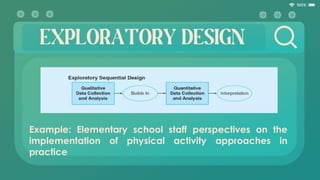
EXPLORATORY DESIGN
Example: Elementary school staff perspectives on the
implementation of physical activity approaches in
practice
TYPES OF MIXED
METHODS
EMBEDDED DESIGN
The Embedded Design is a mixed methods design
in which one data set provides a supportive,
secondary role in a study based primarily on the
other data type (Creswell, Plano Clark, et al.,
2003).
EMBEDDED DESIGN
Example: Development of Written Expression Skills with
Flipped Learning Instruction
Mixed methods should be considered when your research
questions require both qualitative and quantitative data to
be fully addressed. For instance, if you need to explore not
only the prevalence of a phenomenon (quantitative) but
also the underlying reasons or experiences related to it
(qualitative), a mixed methods approach is ideal
(Taderhoost, 2021).
HOW DO WE KNOW WHEN
TO USE MIXED METHODS?
The choice of the approach depends on the researcher’s
philosophical orientation, type of knowledge sought (for
example, objective, factual or subjective information,
personal experiences, or both) and methods and strategies
used to obtain this knowledge (surveys and experiments
versus open-ended interviews and observations, or both).
HOW DO WE KNOW WHEN
TO USE MIXED METHODS?
Researchers should consider the research problem that
they want to study and evaluate their own expertise and
consider the quantitative and qualitative skills that they
possess. As such, consideration must also be given to the
available resources, such as the length of time available to
complete the study and funding resources (Cresswell et al.,
2003).
HOW DO WE KNOW WHEN
TO USE MIXED METHODS?
KEY ELEMENTS TO LOOK FOR
• Is the research question appropriate for mixed methods
or would a single method suffice?
• Is the relation among the methods clear in terms of their
sequence, priority, and integration?
• Does the discussion relate the findings to a complex
understanding of a multifaceted phenomenon?
REFERENCES
• Creswell, J. W. (2012). Educational research: planning,
conducting, and evaluating quantitative and qualitative
research. 4th edition, Boston: Pearson.
• Creswell, J. W., Plano Clark, V. L., Gutmann, M., & Hanson, W.
(2003). Advanced mixed methods research designs. In A.
Tashakkori & C. Teddlie (Eds.), Handbook of mixed methods in
social and behavioral research (pp. 209–240). Thousand Oaks,
CA: Sage.
• Lingard, L., Albert, M., Levinson, W. (2008). Grounded theory,
mixed methods, and action research. BMJ. 337:a567. doi:
10.1136/bmj.39602.690162.47. PMID: 18687728.
REFERENCES
• Poth, C., & Munce, S. E. P. (2020). Commentary—Preparing
today’s researchers for a yet unknown tomorrow: Promising
practices for a synergistic and sustainable mentoring approach
to mixed methods research learning. International Journal of
Multiple Research Approaches, 12(1), 56-64.
doi:10.29034/ijmra.v12n1commentary
• Migiro and Magangi (2011). Mixed methods: A review of
literature and the future of the new research paradigm. African
Journal of Business Management Vol.5 (10), pp. 3757-3764.
10.5897/AJBM09.082
REFERENCES
• Şahin, M. D. & Öztürk, G. (2019). Mixed method research:
Theoretical foundations, designs and its use in educational
research. International Journal of Contemporary Educational
Research, 6(2), 301-310. DOI: https://doi.org/10.33200/ijcer.574002
• Taherdoost, H. (2021). Handbook on Research Skills: The Essential
Step-By-Step Guide on How to Do a Research Project: Amazon
Kindle.
METHODS
MIXED
A PRESENTATION BY LLEWELLYN AND MEDENILLA

Mixed-Method-Design-in-Research Design (1).pdf

  • 1.
  • 2.
    PART 1 THE WHATs THENATURE OF MIXED METHODS
  • 3.
    Mixed method inresearch is where numbers and words meet to create a more nuanced understanding of a certain phenomenon
  • 4.
    MIXED METHODS Pertains tothe research design that combines qualitative and quantitative approaches in a single study (Taderhoost, 2021)
  • 5.
    MIXED METHODS Mixed methodsresearch combines elements from both qualitative and quantitative paradigms to produce converging findings in the context of complex research questions (Lingard et al., 2008)
  • 6.
    In this mixed-methoddesign, the researcher often gives equal priority to both quantitative and qualitative data and collects both data concurrently or simultaneously during the study (Creswell, 2012), and the critical point the researcher needs to be careful about is how to relate these two different data sets since they are collected and analyzed separately. HOW IS IT USED?
  • 7.
    PART 2 THE WHYs THEPURPOSE OF MIXED METHODS
  • 8.
    The approach helpsto explain on quantitative results with subsequent qualitative data. Thus, it enhances a study with a supplemental data set, either quantitative or qualitative. PURPOSE OF MIXED METHOD
  • 9.
    Mixed-method research emergedas a third research method which involved the use of both quantitative and qualitative research methods for research problems that cannot be answered by a mono-method perspective (Sahin & Ozturk, 2019). PURPOSE OF MIXED METHOD
  • 10.
    PART 3 THE HOWs THETYPES OF MIXED METHODS
  • 11.
  • 12.
    I Cresswell (2012) proposedfour types of mixed-method design that can be utilized by research in structuring their studies:
  • 13.
  • 14.
    CONVERGENT PARALLEL The purposeof this type of research is to collect and combine quantitative and qualitative data simultaneously and report the findings of the analysis to understand the research problem better.
  • 15.
    CONVERGENT PARALLEL Example: Demystifyingthe Indigenous College Students’ Learning of English as Determined by Their Language Learning Motivation
  • 16.
  • 17.
    EXPLANATORY DESIGN This designconsists of first collecting quantitative data and then collecting qualitative data to help explain or elaborate on the quantitative results.
  • 18.
    EXPLANATORY DESIGN Example: TheEffects of Technology Integration in English Language Learning
  • 19.
  • 20.
    EXPLORATORY DESIGN In thistype, the qualitative data is collected first and then the quantitative data is collected to explain the relationship among the qualitative data.
  • 21.
    EXPLORATORY DESIGN Example: Elementaryschool staff perspectives on the implementation of physical activity approaches in practice
  • 22.
  • 23.
    EMBEDDED DESIGN The EmbeddedDesign is a mixed methods design in which one data set provides a supportive, secondary role in a study based primarily on the other data type (Creswell, Plano Clark, et al., 2003).
  • 24.
    EMBEDDED DESIGN Example: Developmentof Written Expression Skills with Flipped Learning Instruction
  • 25.
    Mixed methods shouldbe considered when your research questions require both qualitative and quantitative data to be fully addressed. For instance, if you need to explore not only the prevalence of a phenomenon (quantitative) but also the underlying reasons or experiences related to it (qualitative), a mixed methods approach is ideal (Taderhoost, 2021). HOW DO WE KNOW WHEN TO USE MIXED METHODS?
  • 26.
    The choice ofthe approach depends on the researcher’s philosophical orientation, type of knowledge sought (for example, objective, factual or subjective information, personal experiences, or both) and methods and strategies used to obtain this knowledge (surveys and experiments versus open-ended interviews and observations, or both). HOW DO WE KNOW WHEN TO USE MIXED METHODS?
  • 27.
    Researchers should considerthe research problem that they want to study and evaluate their own expertise and consider the quantitative and qualitative skills that they possess. As such, consideration must also be given to the available resources, such as the length of time available to complete the study and funding resources (Cresswell et al., 2003). HOW DO WE KNOW WHEN TO USE MIXED METHODS?
  • 28.
    KEY ELEMENTS TOLOOK FOR • Is the research question appropriate for mixed methods or would a single method suffice? • Is the relation among the methods clear in terms of their sequence, priority, and integration? • Does the discussion relate the findings to a complex understanding of a multifaceted phenomenon?
  • 29.
    REFERENCES • Creswell, J.W. (2012). Educational research: planning, conducting, and evaluating quantitative and qualitative research. 4th edition, Boston: Pearson. • Creswell, J. W., Plano Clark, V. L., Gutmann, M., & Hanson, W. (2003). Advanced mixed methods research designs. In A. Tashakkori & C. Teddlie (Eds.), Handbook of mixed methods in social and behavioral research (pp. 209–240). Thousand Oaks, CA: Sage. • Lingard, L., Albert, M., Levinson, W. (2008). Grounded theory, mixed methods, and action research. BMJ. 337:a567. doi: 10.1136/bmj.39602.690162.47. PMID: 18687728.
  • 30.
    REFERENCES • Poth, C.,& Munce, S. E. P. (2020). Commentary—Preparing today’s researchers for a yet unknown tomorrow: Promising practices for a synergistic and sustainable mentoring approach to mixed methods research learning. International Journal of Multiple Research Approaches, 12(1), 56-64. doi:10.29034/ijmra.v12n1commentary • Migiro and Magangi (2011). Mixed methods: A review of literature and the future of the new research paradigm. African Journal of Business Management Vol.5 (10), pp. 3757-3764. 10.5897/AJBM09.082
  • 31.
    REFERENCES • Şahin, M.D. & Öztürk, G. (2019). Mixed method research: Theoretical foundations, designs and its use in educational research. International Journal of Contemporary Educational Research, 6(2), 301-310. DOI: https://doi.org/10.33200/ijcer.574002 • Taherdoost, H. (2021). Handbook on Research Skills: The Essential Step-By-Step Guide on How to Do a Research Project: Amazon Kindle.
  • 32.
    METHODS MIXED A PRESENTATION BYLLEWELLYN AND MEDENILLA