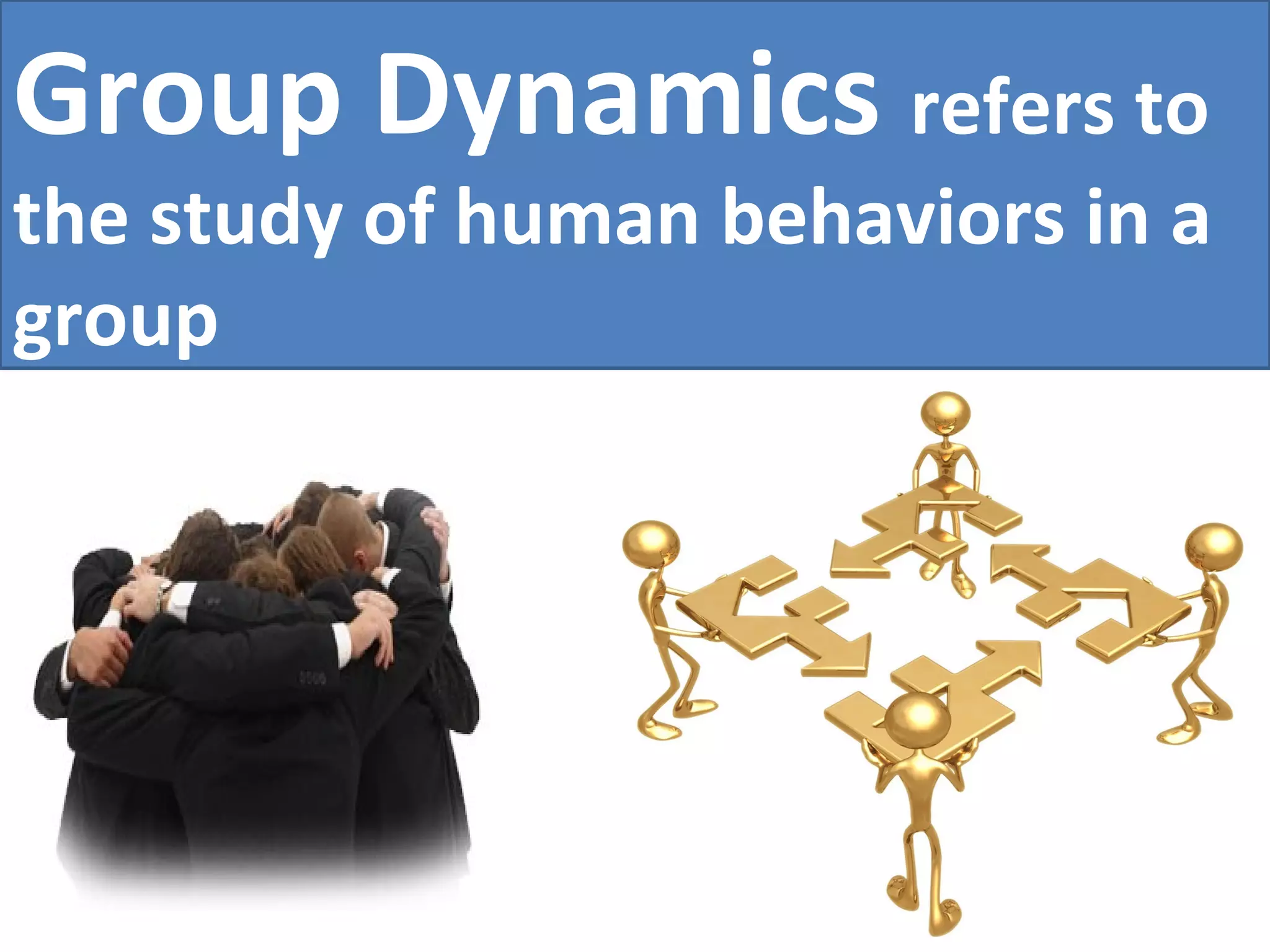
Group Dynamics  refers to the study of human behaviors in a group
 
“ A collection of two or more interacting individuals with a stable pattern of relationship between them, who share common goals and who perceive themselves as being a group.
Groups are recognized as important units  Helps in directing and channelizing the constructive efforts Common goals of the company is fulfilled Group Dynamics was first introduced by corporate giants like Toyota, Motorola, GE, etc. NATURE  OF GROUPS
Primary and Secondary Groups. Membership and Reference Groups. Command and Task Groups. In-Groups and Out-Groups. Types of Groups
Deliberately created to perform a specific task, a hierarchy of authority exists .rules and regulations guide the behaviour of small groups.  Command group- specified by org chart and includes supervisor and his Subordinates. Temporary Task Group- employees work together to complete a particular Task or Project. Formal Groups
It forms the Grapevine of the company. These are not formed under company rules and policies. They form a consequential part of the company by easing out any kind of stress or tensions It helps in:  Groups’ survival and provision of benefits Simplify the behavioral  characteristics  of the  group and make actions more predictable. Effective communication is ensured from the top  to the bottom without the line of authority. Informal Groups
Group Norms Group Cohesiveness Group Decision Making Group Behaviour
High Low Cohesiveness High Low Performance Norms Group Cohesiveness and Productivity
Brainstorming Nominal Group Technique- structured group meeting, rank a series of ideas, encourages creativity, prevents strong personality types from dominating the group. Delphi Technique- no face to face interaction, filling up questionnaires, this is used where timing for decision-making is not of prime importance. Dialectic Decision method Techniques for Improving Group Decision Making
Group development Dr Bruce Tuckman published his Forming Storming Norming Performing model in 1965. He added a fifth stage, Adjourning, in the 1970's.
Stages of Group Dynamics 1.  Forming :  It is the initial stage marked by uncertainty and confusion. The structure of the group is uncertain and unpredictable. Leadership cannot be implemented effectively .
2. Storming :  There is a huge rift created because of various disparities and disagreements between members. Stages of Group Dynamics
3. Norming :  Situation of chaos is finally settled. The groups are finally realized and “I” is replaced by “WE”.  Stages of Group Dynamics
4. Performing: Team Work forms the very essence of the group. The assigned task is completed with devotion and perseverance.  Stages of Group Dynamics
5. Adjourning : This represents the end of the group. In this case the mission is accomplished and its time to disband the group or have a new composition. All the stages starts over again. Stages of Group Dynamics
Task Roles/Functions/Behaviors Information and Opinion Giver Information and Opinion Seeker Starter Direction Giver  Summarizer Coordinator  Diagnoser Energizer  Reality Tester  Evaluator
Relationship Roles/Functions/Behaviors Encourager of Participation Harmonizer and Compromiser Tension Reliever Communication Helper  Evaluator of Emotional Climate Process Observer Standard Setter Active Listener Trust Builder Interpersonal Problem Solver 


Group Dynamics

  • 1.
    Group Dynamics refers to the study of human behaviors in a group
  • 2.
  • 3.
    “ A collectionof two or more interacting individuals with a stable pattern of relationship between them, who share common goals and who perceive themselves as being a group.
  • 4.
    Groups are recognizedas important units Helps in directing and channelizing the constructive efforts Common goals of the company is fulfilled Group Dynamics was first introduced by corporate giants like Toyota, Motorola, GE, etc. NATURE OF GROUPS
  • 5.
    Primary and SecondaryGroups. Membership and Reference Groups. Command and Task Groups. In-Groups and Out-Groups. Types of Groups
  • 6.
    Deliberately created toperform a specific task, a hierarchy of authority exists .rules and regulations guide the behaviour of small groups. Command group- specified by org chart and includes supervisor and his Subordinates. Temporary Task Group- employees work together to complete a particular Task or Project. Formal Groups
  • 7.
    It forms theGrapevine of the company. These are not formed under company rules and policies. They form a consequential part of the company by easing out any kind of stress or tensions It helps in: Groups’ survival and provision of benefits Simplify the behavioral characteristics of the group and make actions more predictable. Effective communication is ensured from the top to the bottom without the line of authority. Informal Groups
  • 8.
    Group Norms GroupCohesiveness Group Decision Making Group Behaviour
  • 9.
    High Low CohesivenessHigh Low Performance Norms Group Cohesiveness and Productivity
  • 10.
    Brainstorming Nominal GroupTechnique- structured group meeting, rank a series of ideas, encourages creativity, prevents strong personality types from dominating the group. Delphi Technique- no face to face interaction, filling up questionnaires, this is used where timing for decision-making is not of prime importance. Dialectic Decision method Techniques for Improving Group Decision Making
  • 11.
    Group development DrBruce Tuckman published his Forming Storming Norming Performing model in 1965. He added a fifth stage, Adjourning, in the 1970's.
  • 12.
    Stages of GroupDynamics 1. Forming : It is the initial stage marked by uncertainty and confusion. The structure of the group is uncertain and unpredictable. Leadership cannot be implemented effectively .
  • 13.
    2. Storming : There is a huge rift created because of various disparities and disagreements between members. Stages of Group Dynamics
  • 14.
    3. Norming : Situation of chaos is finally settled. The groups are finally realized and “I” is replaced by “WE”. Stages of Group Dynamics
  • 15.
    4. Performing: TeamWork forms the very essence of the group. The assigned task is completed with devotion and perseverance. Stages of Group Dynamics
  • 16.
    5. Adjourning :This represents the end of the group. In this case the mission is accomplished and its time to disband the group or have a new composition. All the stages starts over again. Stages of Group Dynamics
  • 17.
    Task Roles/Functions/Behaviors Informationand Opinion Giver Information and Opinion Seeker Starter Direction Giver  Summarizer Coordinator  Diagnoser Energizer  Reality Tester  Evaluator
  • 18.
    Relationship Roles/Functions/Behaviors Encouragerof Participation Harmonizer and Compromiser Tension Reliever Communication Helper  Evaluator of Emotional Climate Process Observer Standard Setter Active Listener Trust Builder Interpersonal Problem Solver 
  • 19.
  • 20.