Central University of Kerala
Department of Public Health and Community
Medicine
GROUP DYNAMICS
Presented by
Dr.Haseena C V
Banashri Haloi
Dr. Mevise M Varghese
Dr. Rahna K
Pulicherla Naveen
Kumar
Contents
• What is a Group?
• Features of a Group.
• Theories of group formation.
• Types & Dynamics of Group.
• Efficient Vs inefficient group .
• Responsibilities of a group leader.
What is a group ?
A group is defined as two or more individuals,
interacting and interdependent, who come together to
achieve particular objectives.
(Stephen P. Robbins)
Features of a group
• Two or more persons
• Commonness
• Objectives
• Interdependence
• Work for collective goal
• Interaction and involvement
• Regularity
• Acceptance
What is group dynamics??
Group dynamics is a set of behavioral and psychological processes
that occur within a social group or between groups. It refers to the
"nature of groups, the laws of their development, and their
interrelations with individuals, other groups, and larger institutions“
(Cartwright and Zander, 1968)
THEORITICAL ASPECTS OF GROUP DYNAMICS
• Kurt Lewin (1943, 1948 and 1951) – Studied group scientifically. Coined term
‘group dynamics’
• Wilfred Bion (1961) studied group dynamics from psychoanalytical perspective
(Experiences in Group)
• William Schutz (1958 and 1966) looked at interpersonal relationship from the
perspective of three parameters- inclusion control & affection. (basis for a
theory of group behaviour)
• Bruce Tuckman (1965): Four-stage model
Tuckman’s stages for ideal group decision making
process :
a) Forming
b) Storming
c) Norming
d) Performing
STAGES OF GROUP DEVELOPMENT
1. Forming :
• Orientation
• There is anxiety and uncertainty among members
• The individual roles are unclear
• Processes are not well established
2. Storming :
• Power Struggle
• Conflict and competition are at its greatest.
• Have understanding of work and a general
feeling of belongingness
• Purposes are clear
• Team relationship are blurry.
3. Norming:
• Cooperation and Integration
• The team really starts to function and work
towards the team goal.
• Team members begin to use their experiences to
solve their problems and pull together as a
cohesive group.
• Begins to work to optimize team process
4. Performing
• Synergy
• Group members are really united
• Starts delivering high shining and superior result.
5. Adjourning
• The process of ‘unforming’ the group
6. Transforming
Why Group Dynamics?
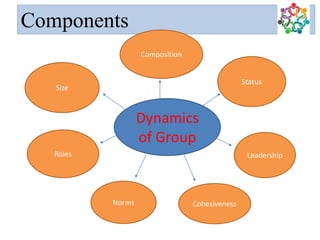
Components
Dynamics
of Group
Composition
Size
Roles
Status
Leadership
CohesivenessNorms
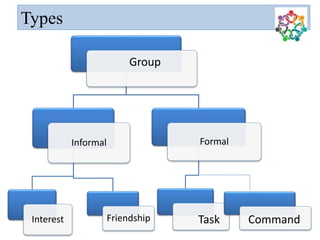
Informal
Interest Friendship
Formal
Group
Task Command
Types
THROUGH A RECENT INCIDENT-
NIPAH virus outbreak in kerala
The Problem
Planning And Action
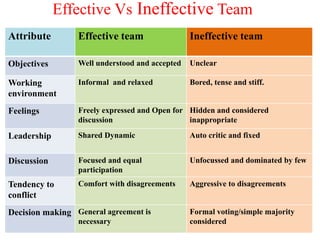
Effective Vs Ineffective Team
Attribute Effective team Ineffective team
Objectives Well understood and accepted Unclear
Working
environment
Informal and relaxed Bored, tense and stiff.
Feelings Freely expressed and Open for
discussion
Hidden and considered
inappropriate
Leadership Shared Dynamic Auto critic and fixed
Discussion Focused and equal
participation
Unfocussed and dominated by few
Tendency to
conflict
Comfort with disagreements Aggressive to disagreements
Decision making General agreement is
necessary
Formal voting/simple majority
considered
Responsibilities of a ‘Group leader’
• Create an environment oriented to trust, open
communication, creative thinking, and cohesive
team effort.
• Coach and Motivator.
• Lead by setting a good example (role model).
• Facilitate problem solving and collaboration.
• Maintain healthy group dynamics.
• Intervene when necessary to aid the group in
resolving issues.
• Recognize and celebrate team and team member
accomplishments and exceptional performance
Q&A Session
We Welcome And Value Your
queries.
Group Dynamics

Group Dynamics

  • 1.
    Central University ofKerala Department of Public Health and Community Medicine GROUP DYNAMICS Presented by Dr.Haseena C V Banashri Haloi Dr. Mevise M Varghese Dr. Rahna K Pulicherla Naveen Kumar
  • 2.
    Contents • What isa Group? • Features of a Group. • Theories of group formation. • Types & Dynamics of Group. • Efficient Vs inefficient group . • Responsibilities of a group leader.
  • 3.
    What is agroup ? A group is defined as two or more individuals, interacting and interdependent, who come together to achieve particular objectives. (Stephen P. Robbins)
  • 5.
    Features of agroup • Two or more persons • Commonness • Objectives • Interdependence • Work for collective goal • Interaction and involvement • Regularity • Acceptance
  • 6.
    What is groupdynamics?? Group dynamics is a set of behavioral and psychological processes that occur within a social group or between groups. It refers to the "nature of groups, the laws of their development, and their interrelations with individuals, other groups, and larger institutions“ (Cartwright and Zander, 1968)
  • 7.
    THEORITICAL ASPECTS OFGROUP DYNAMICS • Kurt Lewin (1943, 1948 and 1951) – Studied group scientifically. Coined term ‘group dynamics’ • Wilfred Bion (1961) studied group dynamics from psychoanalytical perspective (Experiences in Group) • William Schutz (1958 and 1966) looked at interpersonal relationship from the perspective of three parameters- inclusion control & affection. (basis for a theory of group behaviour)
  • 8.
    • Bruce Tuckman(1965): Four-stage model Tuckman’s stages for ideal group decision making process : a) Forming b) Storming c) Norming d) Performing
  • 9.
    STAGES OF GROUPDEVELOPMENT 1. Forming : • Orientation • There is anxiety and uncertainty among members • The individual roles are unclear • Processes are not well established
  • 10.
    2. Storming : •Power Struggle • Conflict and competition are at its greatest. • Have understanding of work and a general feeling of belongingness • Purposes are clear • Team relationship are blurry.
  • 11.
    3. Norming: • Cooperationand Integration • The team really starts to function and work towards the team goal. • Team members begin to use their experiences to solve their problems and pull together as a cohesive group. • Begins to work to optimize team process
  • 12.
    4. Performing • Synergy •Group members are really united • Starts delivering high shining and superior result. 5. Adjourning • The process of ‘unforming’ the group 6. Transforming
  • 14.
  • 15.
  • 16.
  • 17.
    THROUGH A RECENTINCIDENT- NIPAH virus outbreak in kerala
  • 18.
  • 19.
    Effective Vs IneffectiveTeam Attribute Effective team Ineffective team Objectives Well understood and accepted Unclear Working environment Informal and relaxed Bored, tense and stiff. Feelings Freely expressed and Open for discussion Hidden and considered inappropriate Leadership Shared Dynamic Auto critic and fixed Discussion Focused and equal participation Unfocussed and dominated by few Tendency to conflict Comfort with disagreements Aggressive to disagreements Decision making General agreement is necessary Formal voting/simple majority considered
  • 20.
    Responsibilities of a‘Group leader’ • Create an environment oriented to trust, open communication, creative thinking, and cohesive team effort. • Coach and Motivator. • Lead by setting a good example (role model). • Facilitate problem solving and collaboration. • Maintain healthy group dynamics. • Intervene when necessary to aid the group in resolving issues. • Recognize and celebrate team and team member accomplishments and exceptional performance
  • 22.
    Q&A Session We WelcomeAnd Value Your queries.