Effective Communication
Techniques
Communication
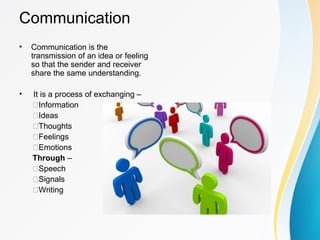
• Communication is the
transmission of an idea or feeling
so that the sender and receiver
share the same understanding.
• It is a process of exchanging –
Information
Ideas
Thoughts
Feelings
Emotions
Through –
Speech
Signals
Writing
Effective Communication
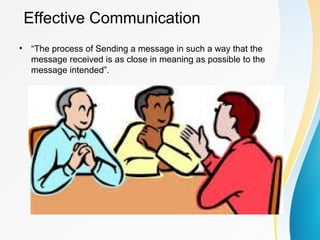
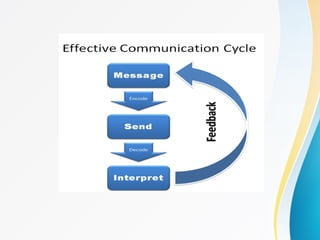
• “The process of Sending a message in such a way that the
message received is as close in meaning as possible to the
message intended”.
Listening Skills
• Listening is the absorption of the meanings of words and sentences by the
brain. Listening leads to the understanding of facts and ideas.
• Although we “learn” to listen on our mother’s knee, very few persons have
ever been thought to listen. The most common complaint of subordinates
about their supervisor is: “He / She never listens..
• Various stages to listening:
Hearing
Focusing on the message not the person
Comprehending and interpreting
Analyzing and Evaluating
Responding
Remembering
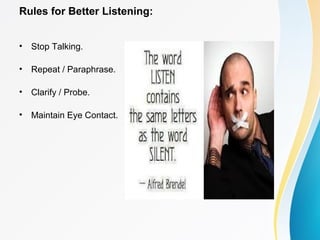
Rules for Better Listening:
• Stop Talking.
• Repeat / Paraphrase.
• Clarify / Probe.
• Maintain Eye Contact.
Techniques for the Receiver Developing Listening
Skills
• Be Prepare to listen.
• Don’t interrupt..
• Concentrate on Words & Meaning.
• Learn to Distinguish between
• Peripheral Listening.
• Projective Listening.
• Improve Surroundings.
• Concentrate.
Mass media
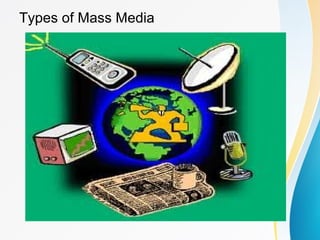
• The means of communication that reach large numbers of people in
a short time, such as television, newspapers, magazines, and radio.
• “It is a message created by a person or a group of people sent
through a transmitting device (a medium) to a large audience or
market”
• Mass media is communication that reaches and influences a large
number of people.
Types of Mass Media
Conclusion
• In conclusion, it is important to always remember the importance of
communication in an organization.
• The methods of communication you choose could in a sense make
or break the management structure of your organization and could
also affect your relationship with customers, if not chosen carefully.
• It is vital therefore that you spend some time choosing the right
methods to aid you in your management tasks.
References
• http://www.slideshare.net/tirthamal2010/communication-ppt-
26816723
• http://www.slideshare.net/AdilKhan11/effective-communications-
skills-39036889
• http://www.slideshare.net/effectivecommunication/cs-final-ppt-
11938630
• http://www.slideshare.net/tirthamal2010/communication-ppt-
26816723
• http://www.slideshare.net/SaimaSam/mass-media-30154320

Effective communication techniques

  • 1.
  • 2.
    Communication • Communication isthe transmission of an idea or feeling so that the sender and receiver share the same understanding. • It is a process of exchanging – Information Ideas Thoughts Feelings Emotions Through – Speech Signals Writing
  • 3.
    Effective Communication • “Theprocess of Sending a message in such a way that the message received is as close in meaning as possible to the message intended”.
  • 6.
    Listening Skills • Listeningis the absorption of the meanings of words and sentences by the brain. Listening leads to the understanding of facts and ideas. • Although we “learn” to listen on our mother’s knee, very few persons have ever been thought to listen. The most common complaint of subordinates about their supervisor is: “He / She never listens.. • Various stages to listening: Hearing Focusing on the message not the person Comprehending and interpreting Analyzing and Evaluating Responding Remembering
  • 7.
    Rules for BetterListening: • Stop Talking. • Repeat / Paraphrase. • Clarify / Probe. • Maintain Eye Contact.
  • 8.
    Techniques for theReceiver Developing Listening Skills • Be Prepare to listen. • Don’t interrupt.. • Concentrate on Words & Meaning. • Learn to Distinguish between • Peripheral Listening. • Projective Listening. • Improve Surroundings. • Concentrate.
  • 9.
    Mass media • Themeans of communication that reach large numbers of people in a short time, such as television, newspapers, magazines, and radio. • “It is a message created by a person or a group of people sent through a transmitting device (a medium) to a large audience or market” • Mass media is communication that reaches and influences a large number of people.
  • 10.
  • 13.
    Conclusion • In conclusion,it is important to always remember the importance of communication in an organization. • The methods of communication you choose could in a sense make or break the management structure of your organization and could also affect your relationship with customers, if not chosen carefully. • It is vital therefore that you spend some time choosing the right methods to aid you in your management tasks.
  • 14.
    References • http://www.slideshare.net/tirthamal2010/communication-ppt- 26816723 • http://www.slideshare.net/AdilKhan11/effective-communications- skills-39036889 •http://www.slideshare.net/effectivecommunication/cs-final-ppt- 11938630 • http://www.slideshare.net/tirthamal2010/communication-ppt- 26816723 • http://www.slideshare.net/SaimaSam/mass-media-30154320