An expert system is an interactive computer program that uses knowledge acquired from experts to solve complex problems in a specific domain. It consists of an inference engine that applies rules and logic to the facts contained within a knowledge base in order to provide recommendations or advice to users. The first expert system was called DENDRAL and was developed in the 1970s at Stanford University to identify unknown organic molecules. Expert systems are used in applications like diagnosis, financial planning, configuration, and more to perform tasks previously requiring human expertise. They have benefits like increased productivity and quality, reduced costs and errors, and the ability to capture scarce human knowledge. However, they also have limitations such as difficulty acquiring and representing human expertise and an inability to operate outside their
What is ExpertSystem ?
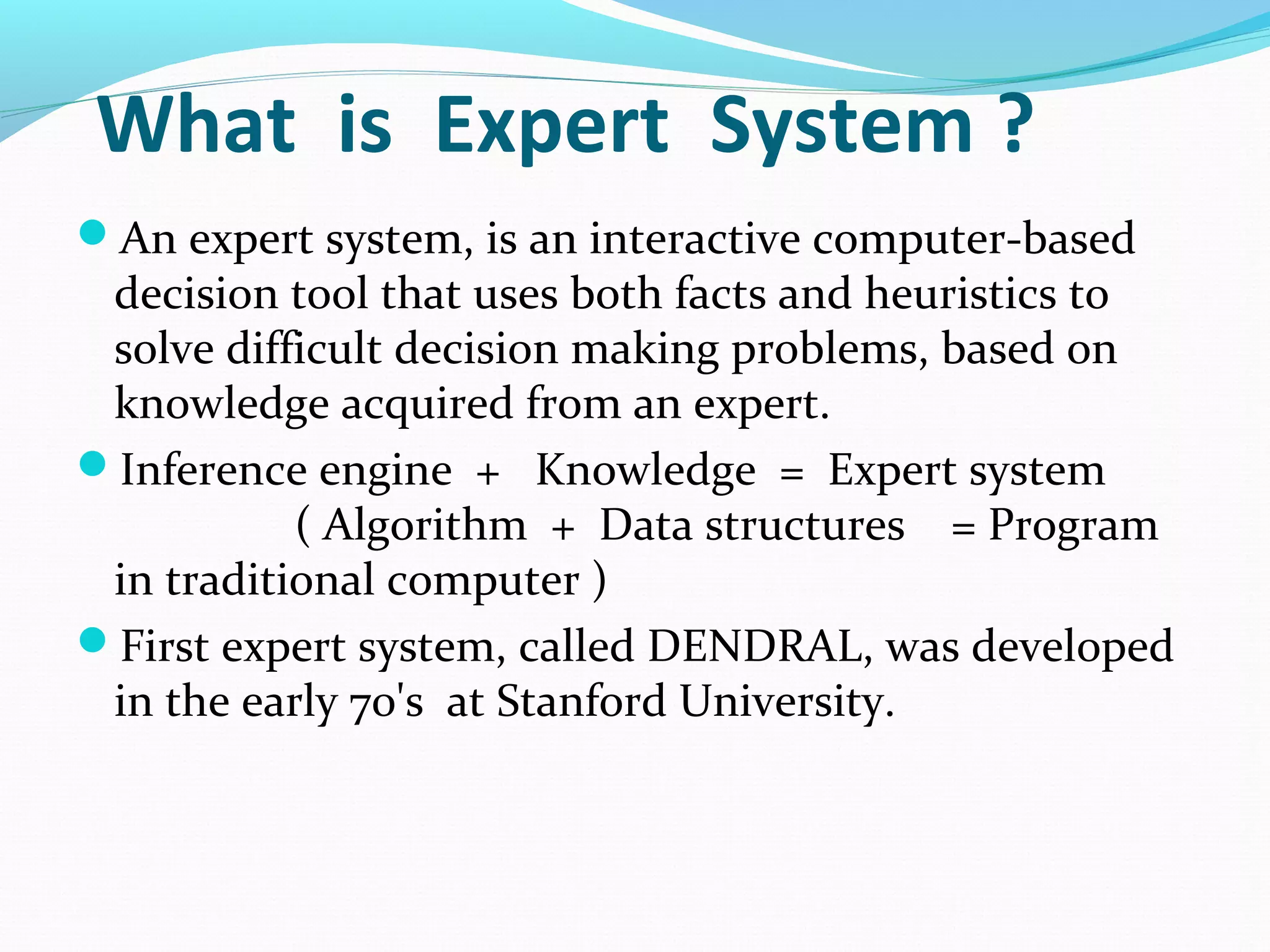
An expert system, is an interactive computer-based
decision tool that uses both facts and heuristics to
solve difficult decision making problems, based on
knowledge acquired from an expert.
Inference engine + Knowledge = Expert system
( Algorithm + Data structures = Program
in traditional computer )
First expert system, called DENDRAL, was developed
in the early 70's at Stanford University.
3.
INTRODUCTION
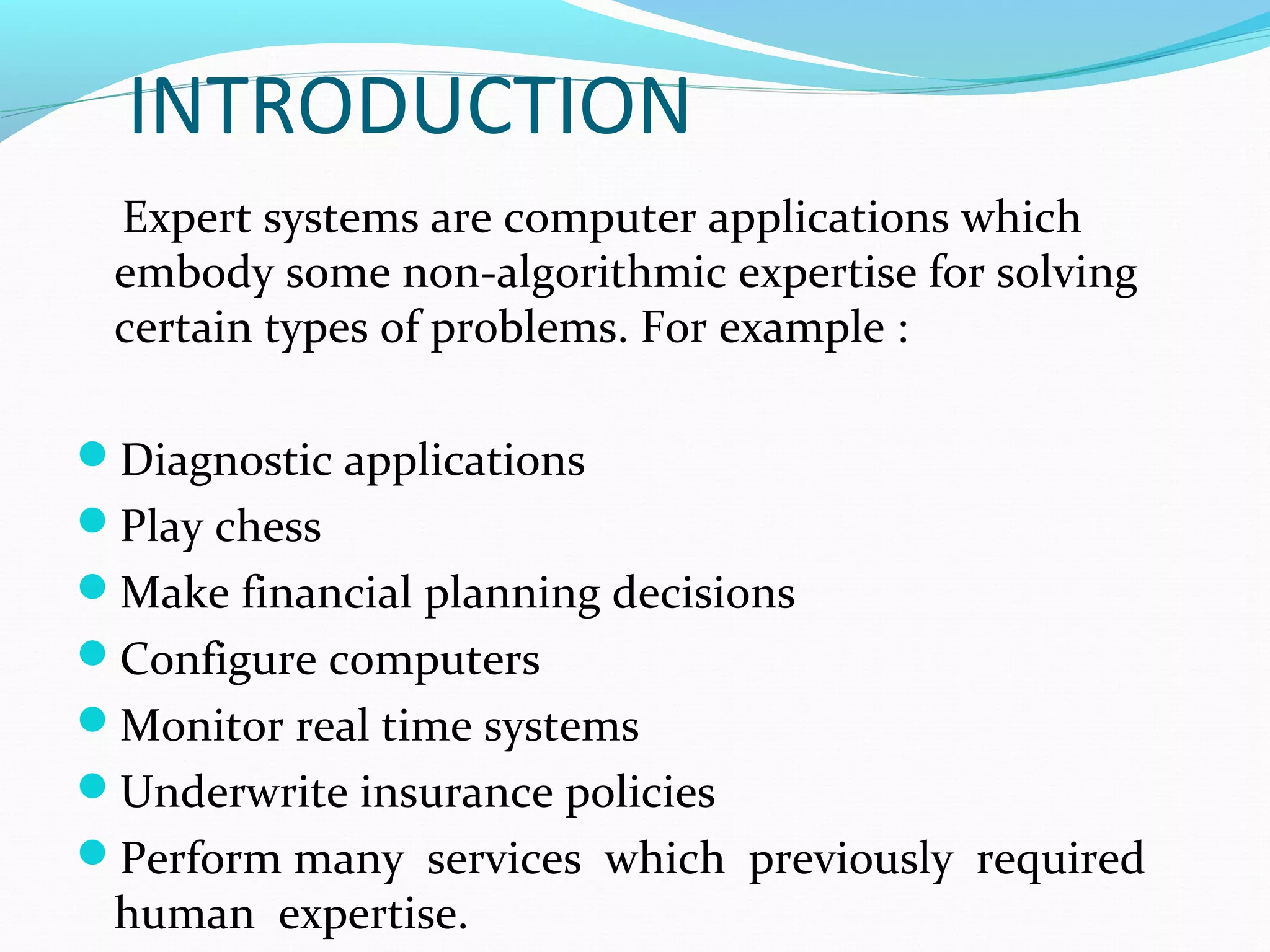
Expert systems arecomputer applications which
embody some non-algorithmic expertise for solving
certain types of problems. For example :
Diagnostic applications
Play chess
Make financial planning decisions
Configure computers
Monitor real time systems
Underwrite insurance policies
Perform many services which previously required
human expertise.
4.
Expert System Shells
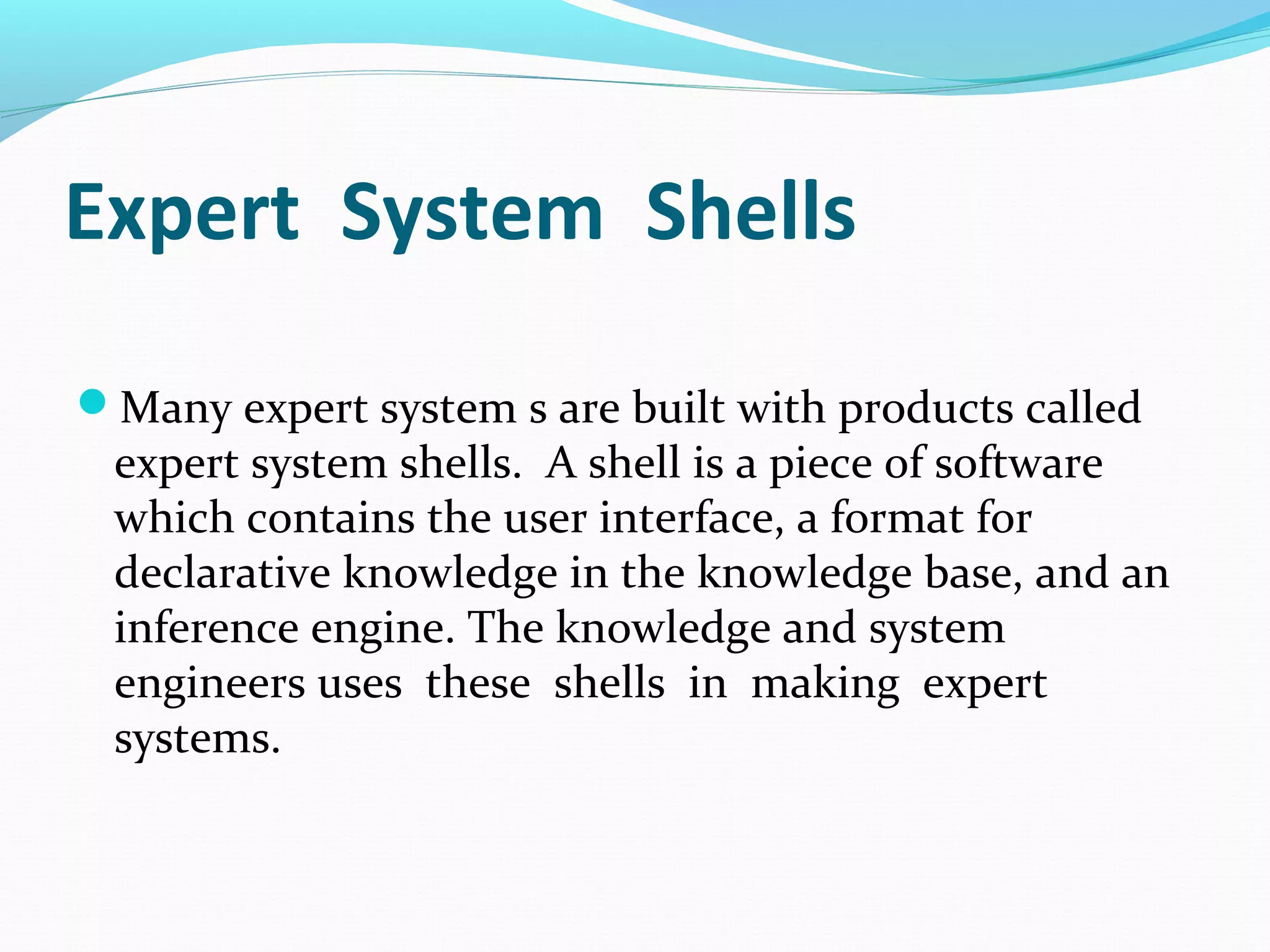
Manyexpert system s are built with products called
expert system shells. A shell is a piece of software
which contains the user interface, a format for
declarative knowledge in the knowledge base, and an
inference engine. The knowledge and system
engineers uses these shells in making expert
systems.
5.
Knowledge engineer :uses the shell to build a
system for a particular problem domain.
System engineer : builds the user interface, designs
the declarative format of the knowledge base, and
implements the inference engine.
Depending on the size of the system, the knowledge
engineer and the system engineer might be the
same person.
6.
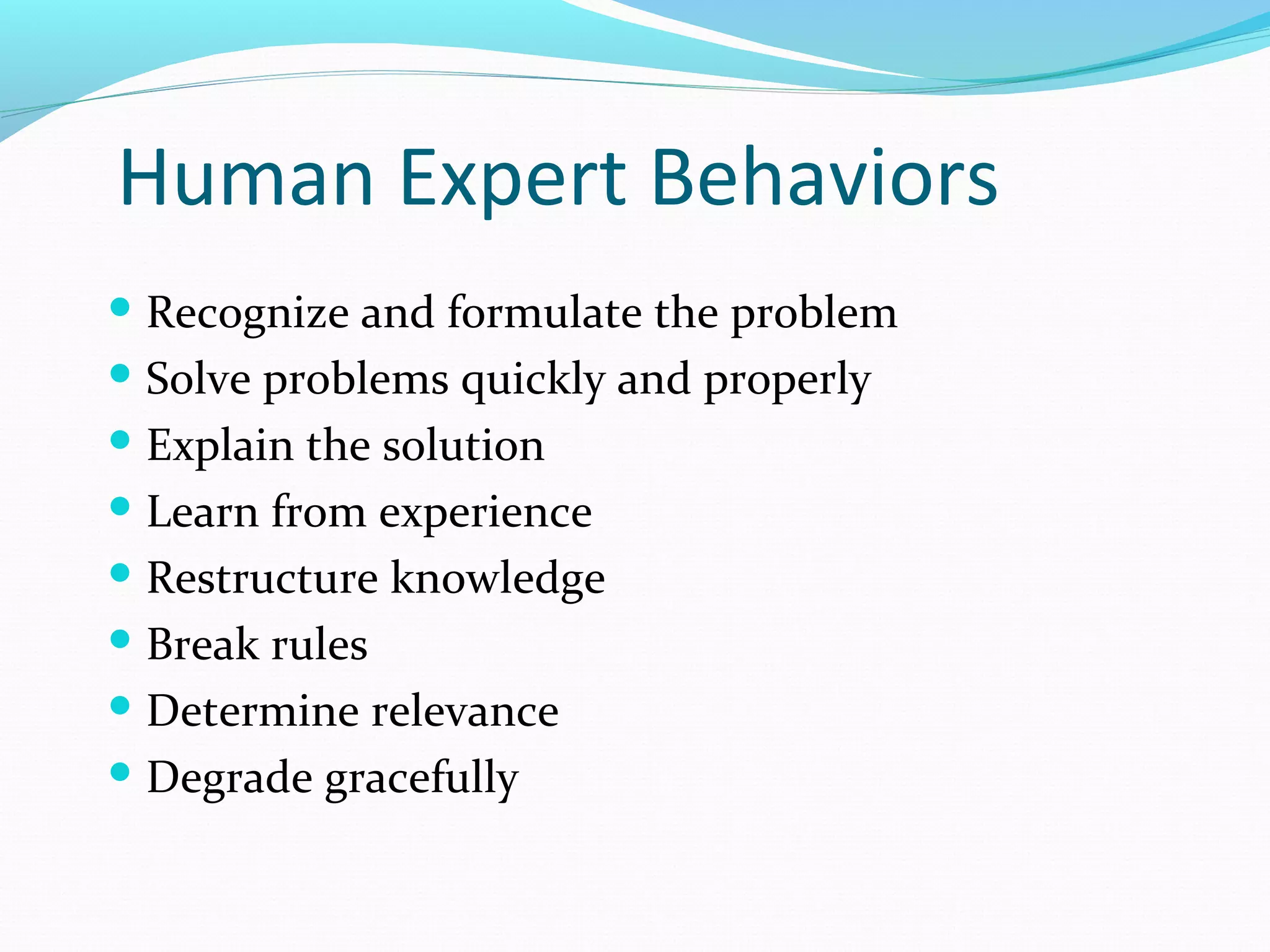
Human Expert Behaviors
Recognize and formulate the problem
Solve problems quickly and properly
Explain the solution
Learn from experience
Restructure knowledge
Break rules
Determine relevance
Degrade gracefully
The knowledgebase contains the knowledge
necessary for understanding, formulating,
and solving problems.
Two Basic Knowledge Base Elements
Facts & Special heuristics, or rules that
direct the use of knowledge
The Inference Engine, brain of the ES.
The control structure (rule interpreter)
Provides methodology for reasoning
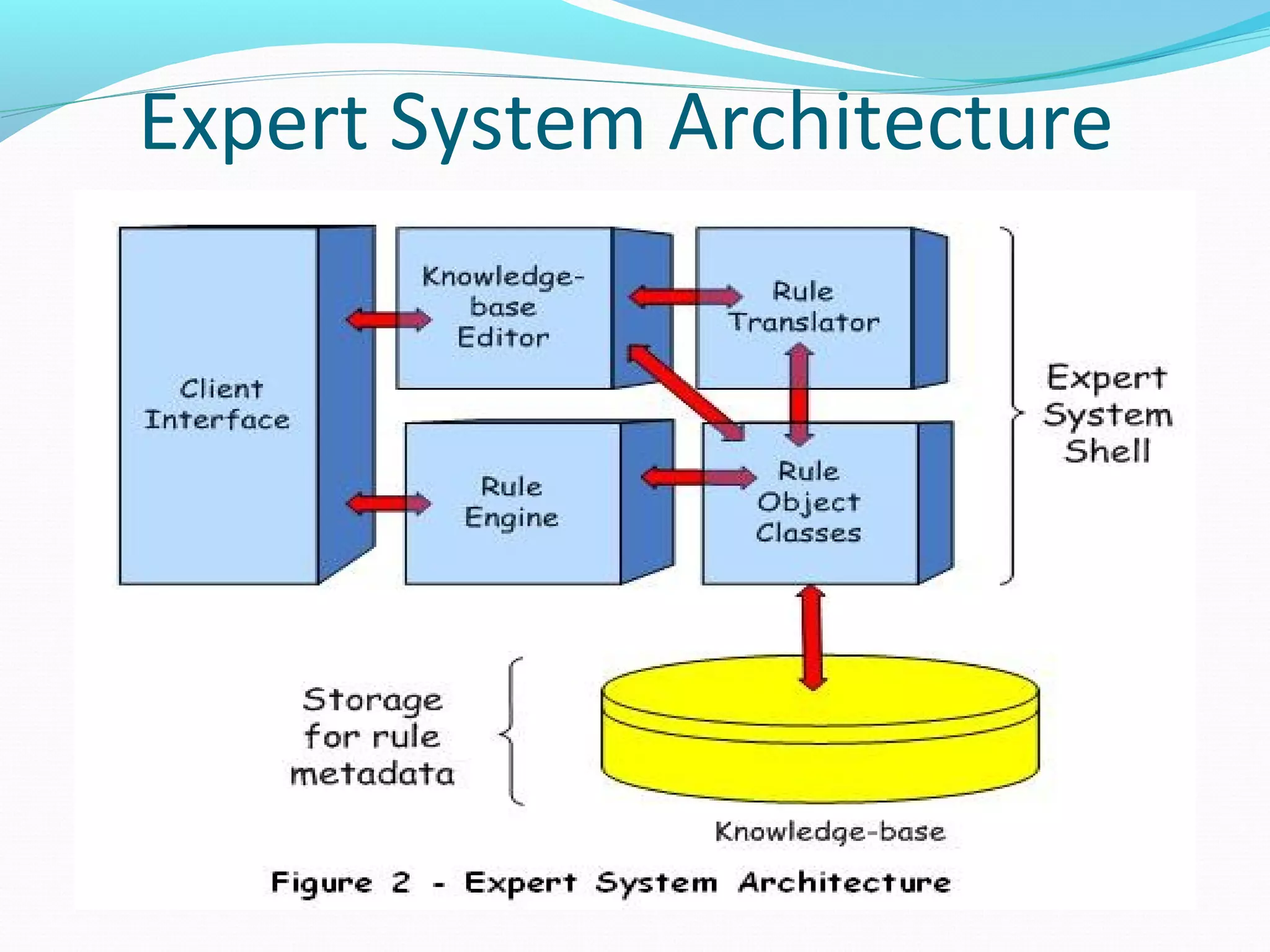
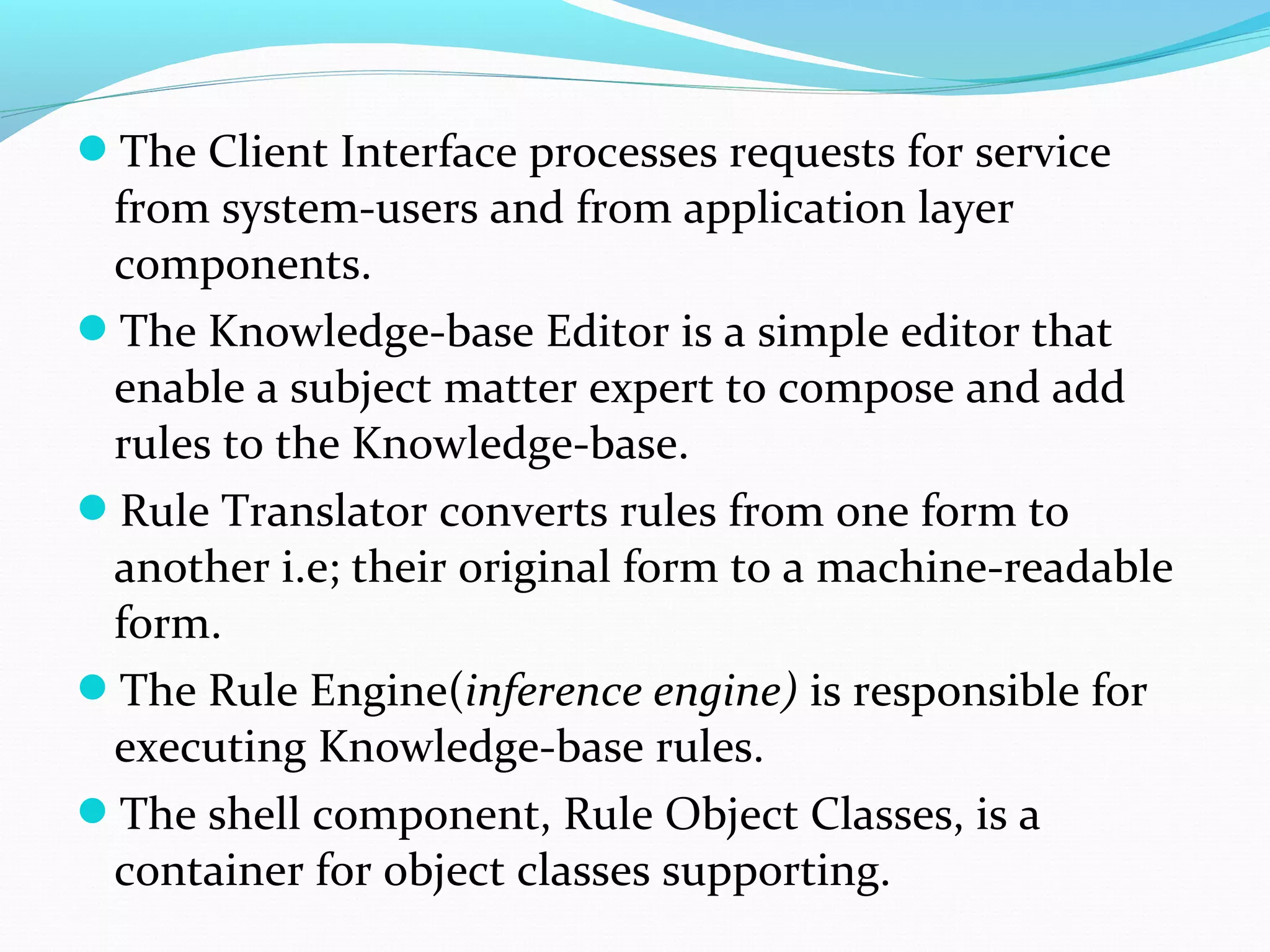
The Client Interfaceprocesses requests for service
from system-users and from application layer
components.
The Knowledge-base Editor is a simple editor that
enable a subject matter expert to compose and add
rules to the Knowledge-base.
Rule Translator converts rules from one form to
another i.e; their original form to a machine-readable
form.
The Rule Engine(inference engine) is responsible for
executing Knowledge-base rules.
The shell component, Rule Object Classes, is a
container for object classes supporting.
Components and Interfaces
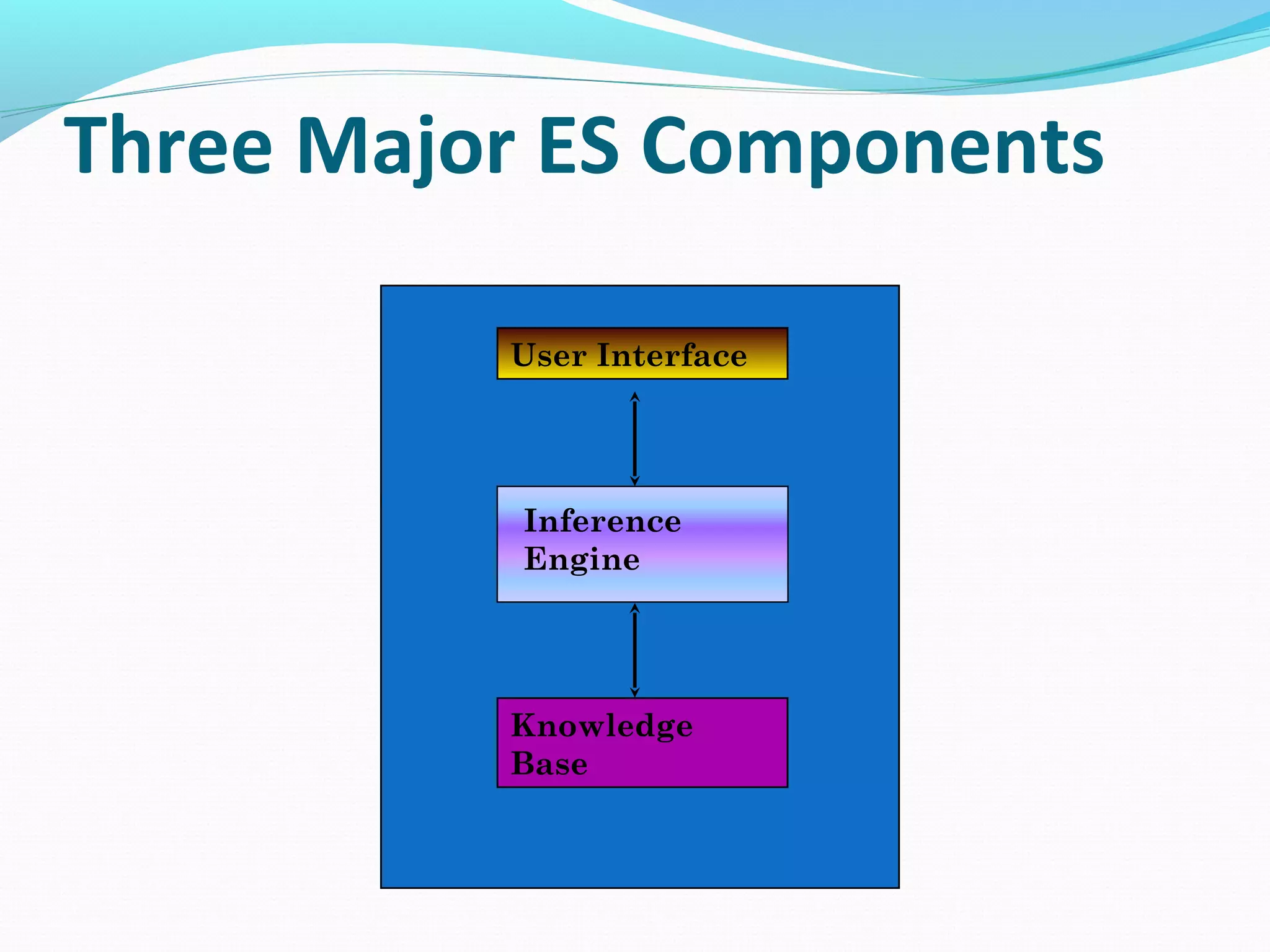
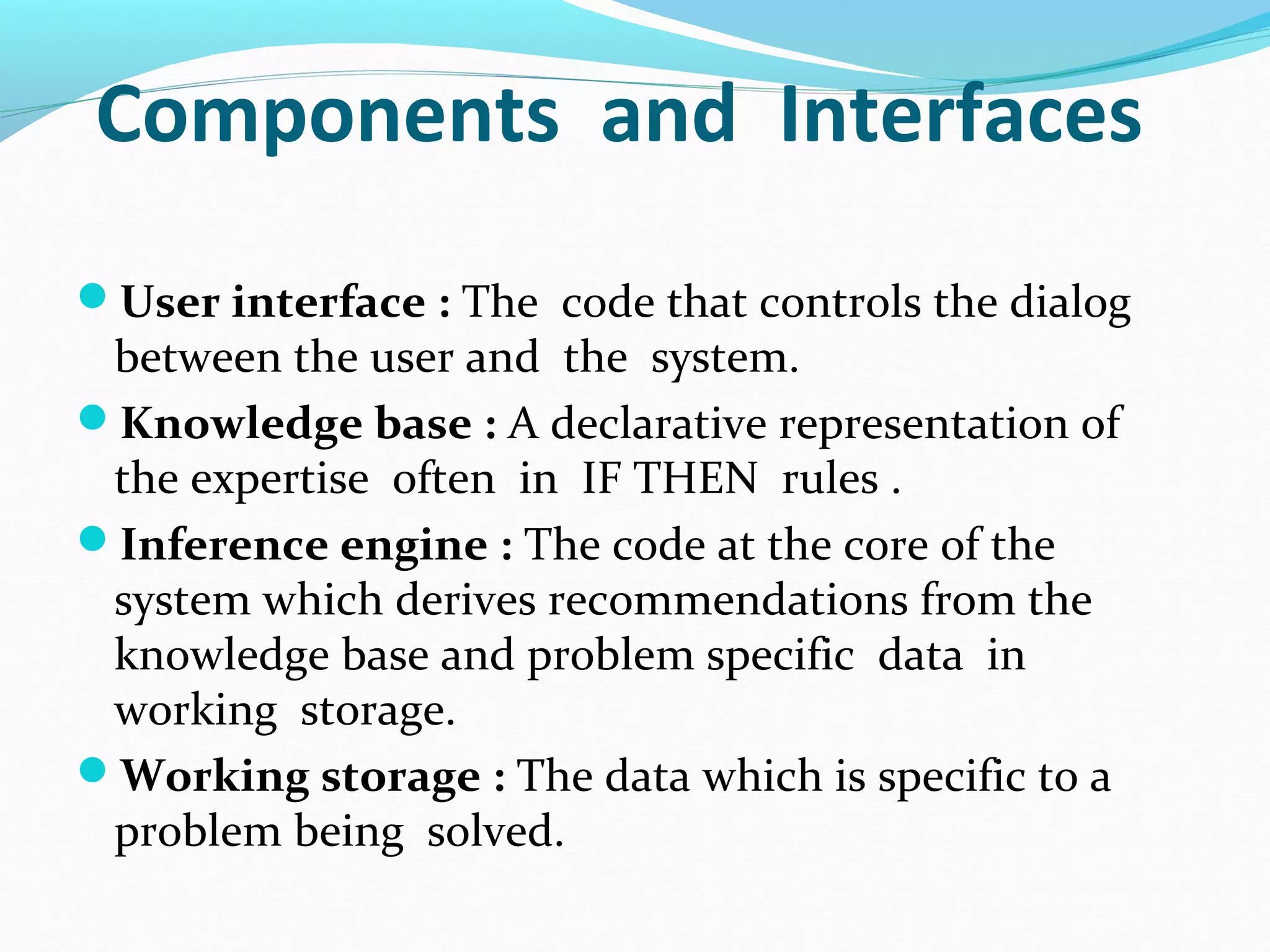
Userinterface : The code that controls the dialog
between the user and the system.
Knowledge base : A declarative representation of
the expertise often in IF THEN rules .
Inference engine : The code at the core of the
system which derives recommendations from the
knowledge base and problem specific data in
working storage.
Working storage : The data which is specific to a
problem being solved.
13.
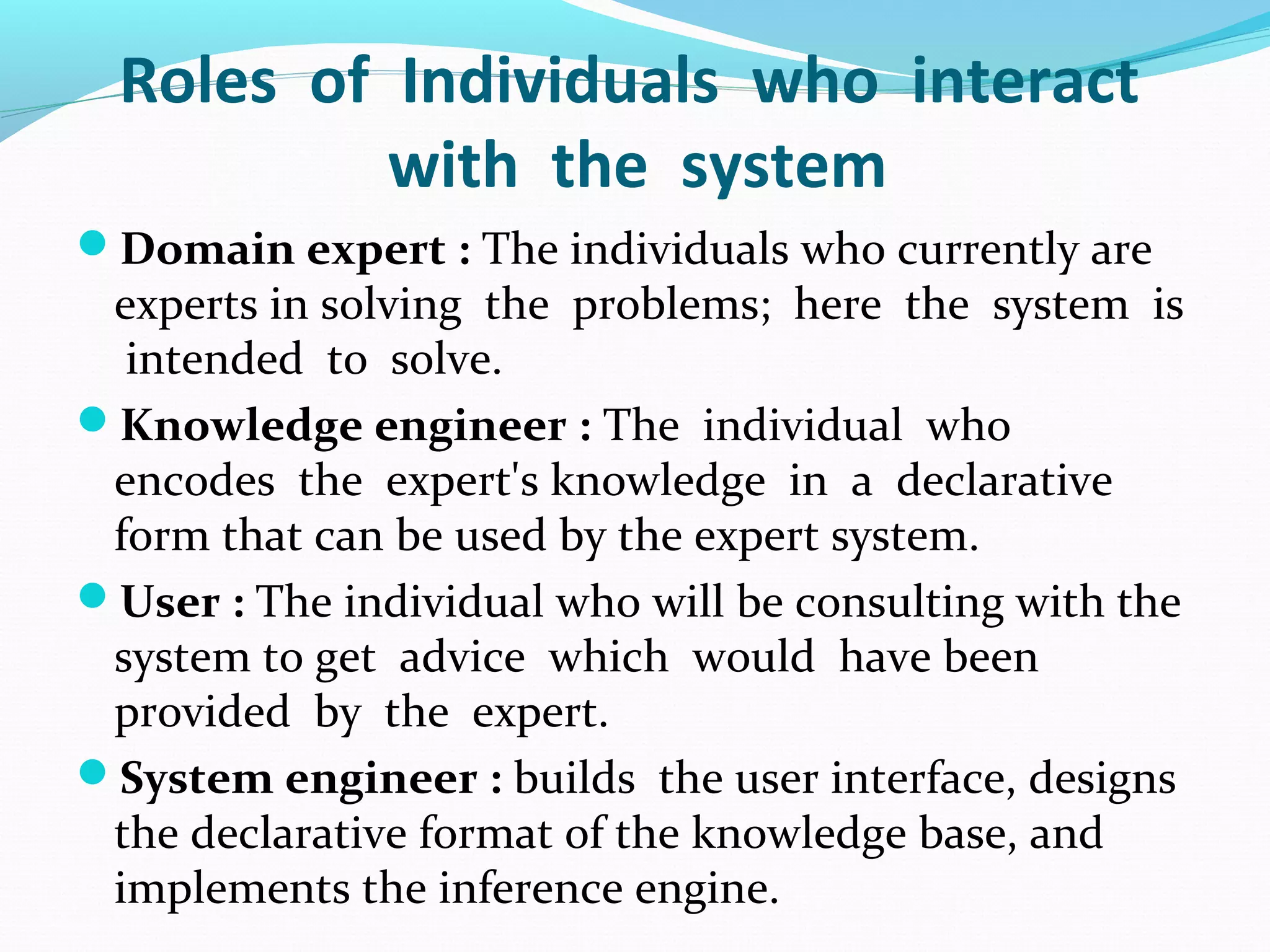
Roles of Individualswho interact
with the system
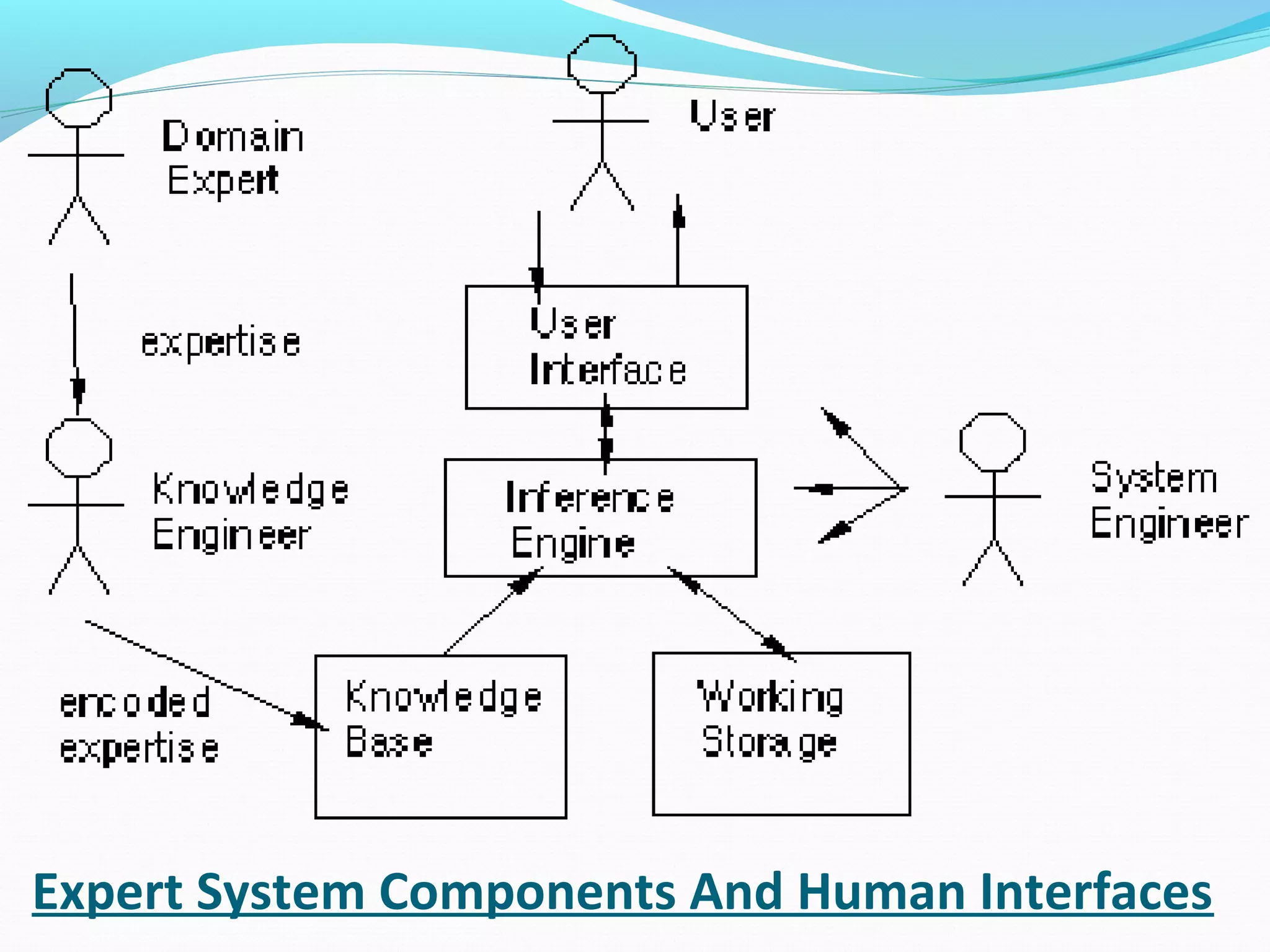
Domain expert : The individuals who currently are
experts in solving the problems; here the system is
intended to solve.
Knowledge engineer : The individual who
encodes the expert's knowledge in a declarative
form that can be used by the expert system.
User : The individual who will be consulting with the
system to get advice which would have been
provided by the expert.
System engineer : builds the user interface, designs
the declarative format of the knowledge base, and
implements the inference engine.
14.
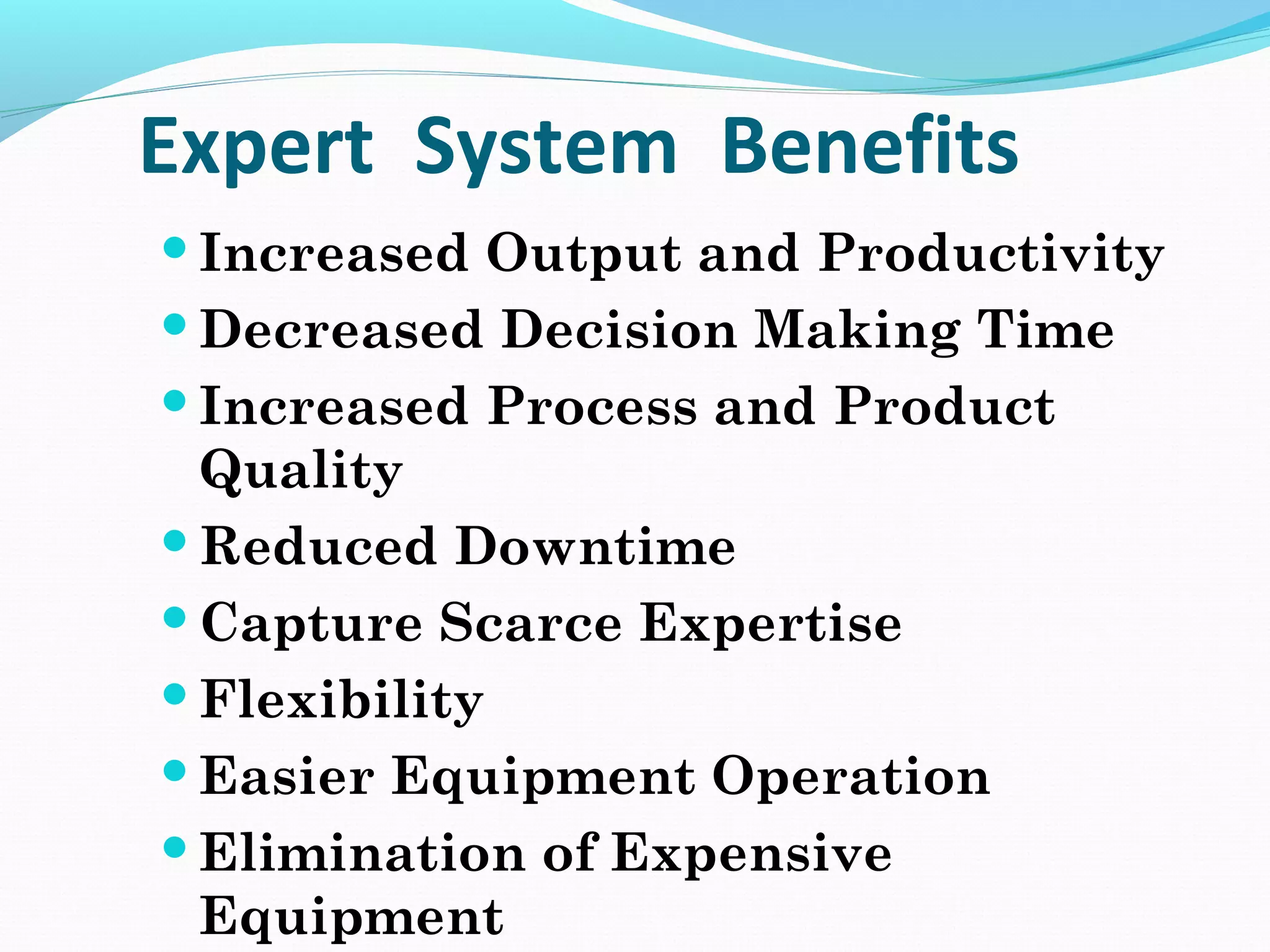
Expert System Benefits
IncreasedOutput and Productivity
Decreased Decision Making Time
Increased Process and Product
Quality
Reduced Downtime
Capture Scarce Expertise
Flexibility
Easier Equipment Operation
Elimination of Expensive
Equipment
15.
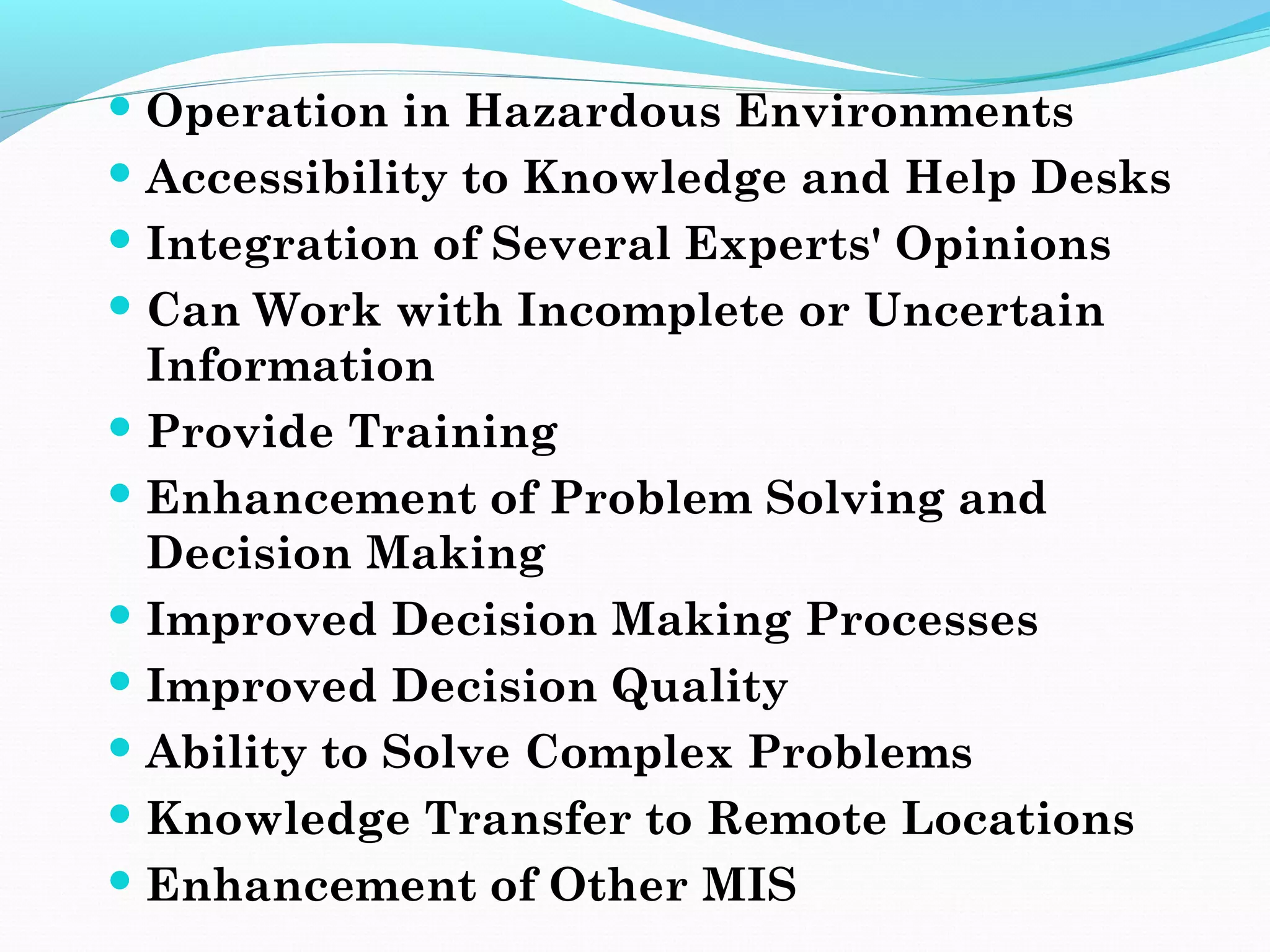
Operation inHazardous Environments
Accessibility to Knowledge and Help Desks
Integration of Several Experts' Opinions
Can Work with Incomplete or Uncertain
Information
Provide Training
Enhancement of Problem Solving and
Decision Making
Improved Decision Making Processes
Improved Decision Quality
Ability to Solve Complex Problems
Knowledge Transfer to Remote Locations
Enhancement of Other MIS
16.
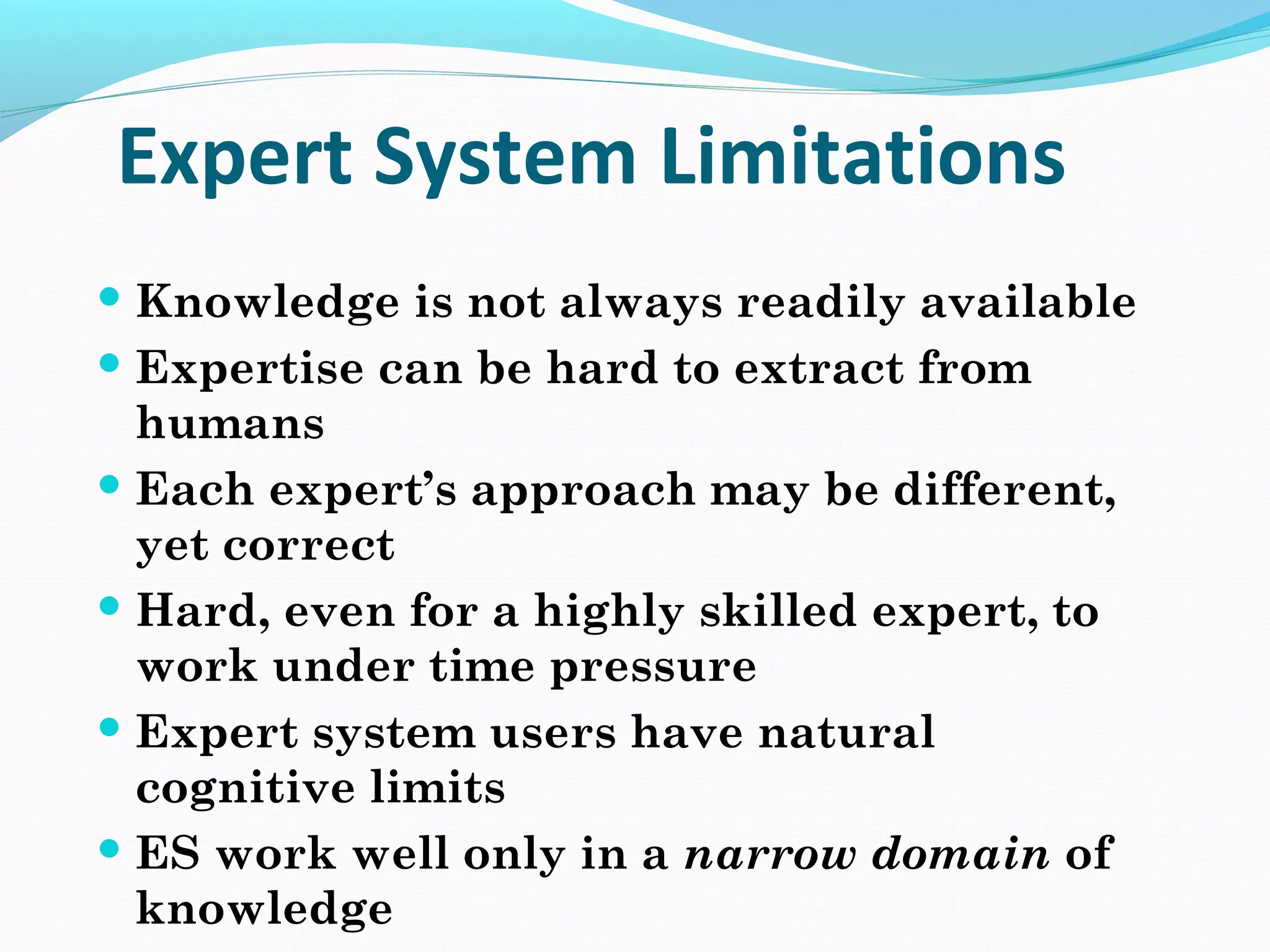
Expert System Limitations
Knowledge is not always readily available
Expertise can be hard to extract from
humans
Each expert’s approach may be different,
yet correct
Hard, even for a highly skilled expert, to
work under time pressure
Expert system users have natural
cognitive limits
ES work well only in a narrow domain of
knowledge
17.
Most expertshave no independent means
to validate their conclusions
Experts’ vocabulary often limited and
highly technical
Knowledge engineers are rare and
expensive
Lack of trust by end-users
Knowledge transfer subject to a host of
perceptual and judgmental biases
ES may not be able to arrive at valid
conclusions
ES sometimes produce incorrect
recommendations
18.
References
"Artificial Intelligence", byElaine Rich and Kevin
Knight, (2006), McGraw Hill
"Introduction To Artificial Intelligence & Expert
Systems", by Dan W Patterson.
"Expert Systems: Introduction To First And Second
Generation And Hybrid
Knowledge Based Systems", by Chris Nikolopoulos.
"Artificial intelligence and expert systems for
engineers", by C. S. Krishnamoorthy.
S. Rajeev, (1996), CRC Press INC, page 1-293.