E-VOTING AND ASSOCIATED
RISKS
Presented By
Prem Deshmane
IMED
MBA
1st Year
10-03-2015
1
What is electronic voting (system)?
 An electronic voting (e-voting) system is a voting
system in which the election data is recorded, stored
and processed primarily as digital information.
10-03-2015
2
Do we need electronic voting systems?
 They could lead to increased voter turnout thus
supporting democratic process.
 They could give elections new potential (by providing
ballots in multiple languages, accommodating
lengthy ballots, facilitate early and absentee voting,
etc.) thus enhancing democratic process.
 They could open a new market, thus supporting the
commerce and the employment.
10-03-2015
3
Barriers to electronic voting
 Lack of common voting system
 standards across nations.
 Time and difficulty of changing
 national election laws.
 Time and cost of certifying a voting system.
 Security and reliability of electronic voting.
 Equal access to Internet voting for all socioeconomic
groups.
 Difficulty of training election judges on a new system.
 Political risk associated with trying a new voting system.
 ̧Need for security and election experts.
10-03-2015
4
Security risk analysis
10-03-2015
5
FACTS ABOUT E-VOTING
• The first Internet vote was cast by US astronaut David Wolf who was allowed to
vote by e-mail from the space station Mir in the 1997 Texas election.
The Internet voting system used would include the following features:
 a provision for authentication (a PIN mailed to an eligible voter)
 encryption of the vote with a public key on the client machine with the private
key held by a trusted 3rd party
 transmission of the vote to an election.com server using a SSL encrypted pipe
 separation of the voter identity from the vote into two tables. Audit logs tracked
who voted and another audit logged monitored access to the database server.
10-03-2015
6
Working Of e-Voting System
10-03-2015
7
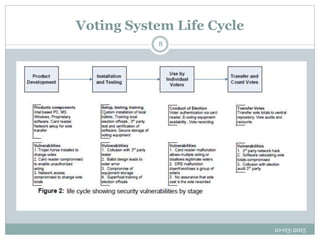
Voting System Life Cycle
10-03-2015
8
Security threats to voting systems
10-03-2015
9
Security threats to Internet voting
10-03-2015
10
Conclusions
 Rapidly emerging issue...
 There are contradicting views...
 Several questions remain open...
 Security experts and skillful judges needed...
 Need for further experimentation...
10-03-2015
11
THANK YOU
10-03-2015
12

Evote and associated risks

  • 1.
    E-VOTING AND ASSOCIATED RISKS PresentedBy Prem Deshmane IMED MBA 1st Year 10-03-2015 1
  • 2.
    What is electronicvoting (system)?  An electronic voting (e-voting) system is a voting system in which the election data is recorded, stored and processed primarily as digital information. 10-03-2015 2
  • 3.
    Do we needelectronic voting systems?  They could lead to increased voter turnout thus supporting democratic process.  They could give elections new potential (by providing ballots in multiple languages, accommodating lengthy ballots, facilitate early and absentee voting, etc.) thus enhancing democratic process.  They could open a new market, thus supporting the commerce and the employment. 10-03-2015 3
  • 4.
    Barriers to electronicvoting  Lack of common voting system  standards across nations.  Time and difficulty of changing  national election laws.  Time and cost of certifying a voting system.  Security and reliability of electronic voting.  Equal access to Internet voting for all socioeconomic groups.  Difficulty of training election judges on a new system.  Political risk associated with trying a new voting system.  ̧Need for security and election experts. 10-03-2015 4
  • 5.
  • 6.
    FACTS ABOUT E-VOTING •The first Internet vote was cast by US astronaut David Wolf who was allowed to vote by e-mail from the space station Mir in the 1997 Texas election. The Internet voting system used would include the following features:  a provision for authentication (a PIN mailed to an eligible voter)  encryption of the vote with a public key on the client machine with the private key held by a trusted 3rd party  transmission of the vote to an election.com server using a SSL encrypted pipe  separation of the voter identity from the vote into two tables. Audit logs tracked who voted and another audit logged monitored access to the database server. 10-03-2015 6
  • 7.
    Working Of e-VotingSystem 10-03-2015 7
  • 8.
    Voting System LifeCycle 10-03-2015 8
  • 9.
    Security threats tovoting systems 10-03-2015 9
  • 10.
    Security threats toInternet voting 10-03-2015 10
  • 11.
    Conclusions  Rapidly emergingissue...  There are contradicting views...  Several questions remain open...  Security experts and skillful judges needed...  Need for further experimentation... 10-03-2015 11
  • 12.