Expert Systems
Presentation By:
Prahlad Timalsina
Expert Systems
“..An intelligent computer program that uses
knowledge and inference procedures to solve
problems that are difficult enough to require
significant human expertise for their solution..”
(Feigenbaum 1982)
In short, an ES is an intelligent computer
program that can perform special and difficult
task(s) in some field(s) at the level of human
expert.
Expert System
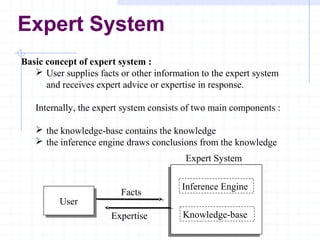
Basic concept of expert system :
 User supplies facts or other information to the expert system
and receives expert advice or expertise in response.
Internally, the expert system consists of two main components :
 the knowledge-base contains the knowledge
 the inference engine draws conclusions from the knowledge
Knowledge-base
Inference Engine
User
Expertise
Expert System
Facts
Expert System
Functionality
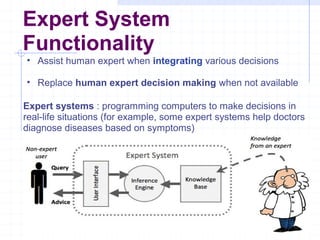
• Assist human expert when integrating various decisions
• Replace human expert decision making when not available
Expert systems : programming computers to make decisions in
real-life situations (for example, some expert systems help doctors
diagnose diseases based on symptoms)
Applications of Expert Systems
Peachtree:
Used by accountant for
making Database,
Financial documents
Applications of Expert Systems
PROSPECTOR:
Used by geologists to
identify sites for
drilling or mining
PUFF:
Medical system
for diagnosis of
respiratory conditions
Components of an Expert System
• The knowledge base is the collection of facts
and rules which describe all the knowledge
about the problem domain
• The inference engine is the part of the
system that chooses which facts and rules to
apply when trying to solve the user’s query
• The user interface is the part of the system
which takes in the user’s query in a readable
form and passes it to the inference engine. It
then displays the results to the user.
ADVANTAGES
 COSISTENT: it provides consistent answer for
repetitive decisions, processes and tasks
1. MAINTAINS: it holds and maintain levels of
information
2. CLARIFY: it clarify the logic of decision making
3. NO HUMAN NEED: it cannot needs human, it works
continuously
4. MULTIUSER: a multi user expert system can serve
more users at a time
DIS-ADVANTAGES
1. SENSE: it lacks common sense needed in decision
making
2. CREATIVENESS: it cannot respond creatively like
a human expert would in unusual circumstances
3. ERRORS: in knowledge base errors may occur and
this leads wrong decisions
4. ENVIRONMENTS: if knowledge base is changed it
cannot adapt changing environments
USES OF EXPERT SYSTEM
1. In medical field
2. In agricultural
3. In education etc
Expert system

Expert system

  • 1.
  • 2.
    Expert Systems “..An intelligentcomputer program that uses knowledge and inference procedures to solve problems that are difficult enough to require significant human expertise for their solution..” (Feigenbaum 1982) In short, an ES is an intelligent computer program that can perform special and difficult task(s) in some field(s) at the level of human expert.
  • 3.
    Expert System Basic conceptof expert system :  User supplies facts or other information to the expert system and receives expert advice or expertise in response. Internally, the expert system consists of two main components :  the knowledge-base contains the knowledge  the inference engine draws conclusions from the knowledge Knowledge-base Inference Engine User Expertise Expert System Facts
  • 4.
    Expert System Functionality • Assisthuman expert when integrating various decisions • Replace human expert decision making when not available Expert systems : programming computers to make decisions in real-life situations (for example, some expert systems help doctors diagnose diseases based on symptoms)
  • 5.
    Applications of ExpertSystems Peachtree: Used by accountant for making Database, Financial documents
  • 6.
    Applications of ExpertSystems PROSPECTOR: Used by geologists to identify sites for drilling or mining PUFF: Medical system for diagnosis of respiratory conditions
  • 7.
    Components of anExpert System • The knowledge base is the collection of facts and rules which describe all the knowledge about the problem domain • The inference engine is the part of the system that chooses which facts and rules to apply when trying to solve the user’s query • The user interface is the part of the system which takes in the user’s query in a readable form and passes it to the inference engine. It then displays the results to the user.
  • 8.
    ADVANTAGES  COSISTENT: itprovides consistent answer for repetitive decisions, processes and tasks 1. MAINTAINS: it holds and maintain levels of information 2. CLARIFY: it clarify the logic of decision making 3. NO HUMAN NEED: it cannot needs human, it works continuously 4. MULTIUSER: a multi user expert system can serve more users at a time
  • 9.
    DIS-ADVANTAGES 1. SENSE: itlacks common sense needed in decision making 2. CREATIVENESS: it cannot respond creatively like a human expert would in unusual circumstances 3. ERRORS: in knowledge base errors may occur and this leads wrong decisions 4. ENVIRONMENTS: if knowledge base is changed it cannot adapt changing environments
  • 10.
    USES OF EXPERTSYSTEM 1. In medical field 2. In agricultural 3. In education etc