Steam TurbineSteam Turbine
The Impulse PrincipleThe Impulse Principle
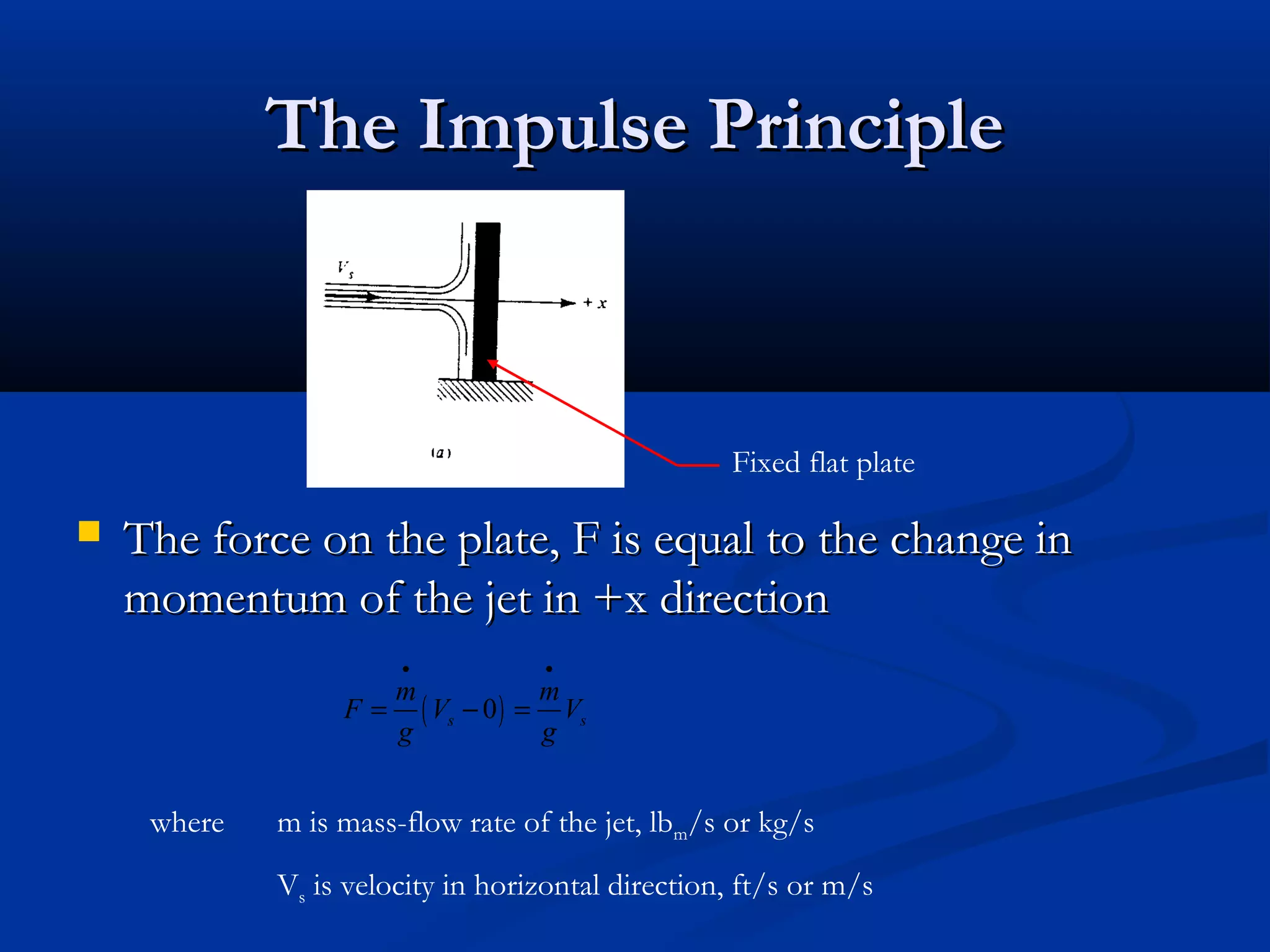
 The force on the plate, F is equal to the change inThe force on the plate, F is equal to the change in
momentum of the jet in +x directionmomentum of the jet in +x direction
( )0s s
m m
F V V
g g
• •
= − =
where m is mass-flow rate of the jet, lbm/s or kg/s
Vs is velocity in horizontal direction, ft/s or m/s
Fixed flat plate
The Impulse PrincipleThe Impulse Principle
( )s B
m
F V V
g
•
= −
( )B B S B
m
W FV V V V
g
•
•
= = −
Moving flat plate
where VB is the plate velocity, ft/s or m/s
2
2
2
2
B B
plate
S S
S
V VW
V V
mV
g
η
•
•
  
 = = − ÷
      ÷
 ÷
 
Force on the plate
Power done by jet
Efficiency is ratio of power
to initial power of the jet
Power is 0 if VB = 0 or
(Vs-VB)=0
B
S
V
V
The Impulse PrincipleThe Impulse Principle
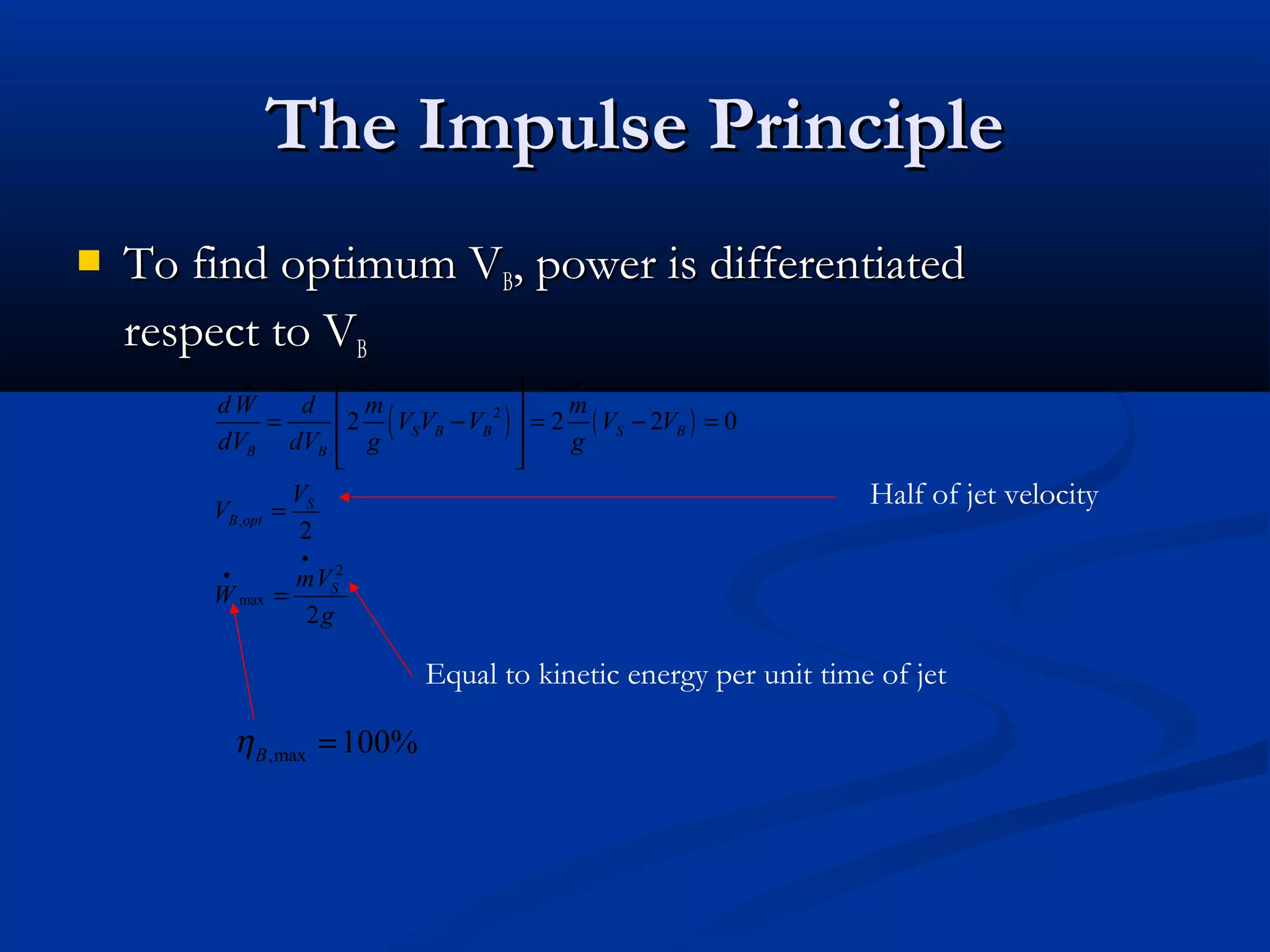
 To find optimum VTo find optimum VBB, power is differentiated, power is differentiated
respect to Vrespect to VBB
( ) ( )2
,
2
max
2 0
2
4
S B B S B
B B
S
B opt
S
dW d m m
V V V V V
dV dV g g
V
V
mV
W
g
• • •
•
•
 
 = − = − =
 
 
=
=
Half of kinetic energy per unit time of jet
Half of jet velocity
The Impulse PrincipleThe Impulse Principle
Fluid relative entrance velocity = Fluid relative exit velocity
Fluid relative velocity = s BV V−
( )Absolute jet velocity at exit (+x direction) = - - 2B S B B SV V V V V= −
( ) ( )
( )
2
2
2
2
4
S B S S B
B B S B
B B
b
S S
m m
F V V V V V
g g
m
W FV V V V
g
V V
V V
η
• •
•
•
= − − = −  
= = −
  
 = − ÷
   
For frictionless blade
By impulse and momentum principle
For 180o
curved blade
Double of value on
flat plate case
The Impulse PrincipleThe Impulse Principle
( ) ( )2
,
2
max
2 2 2 0
2
2
S B B S B
B B
S
B opt
S
dW d m m
V V V V V
dV dV g g
V
V
mV
W
g
• • •
•
•
 
 = − = − =
 
 
=
=
 To find optimum VTo find optimum VBB, power is differentiated, power is differentiated
respect to Vrespect to VBB
Half of jet velocity
Equal to kinetic energy per unit time of jet
,max 100%Bη =
The Impulse PrincipleThe Impulse Principle
 It is impossible to have 180It is impossible to have 18000
curved blade in actualcurved blade in actual
applicationapplication
 jet exit will impinging on the back of next bladejet exit will impinging on the back of next blade
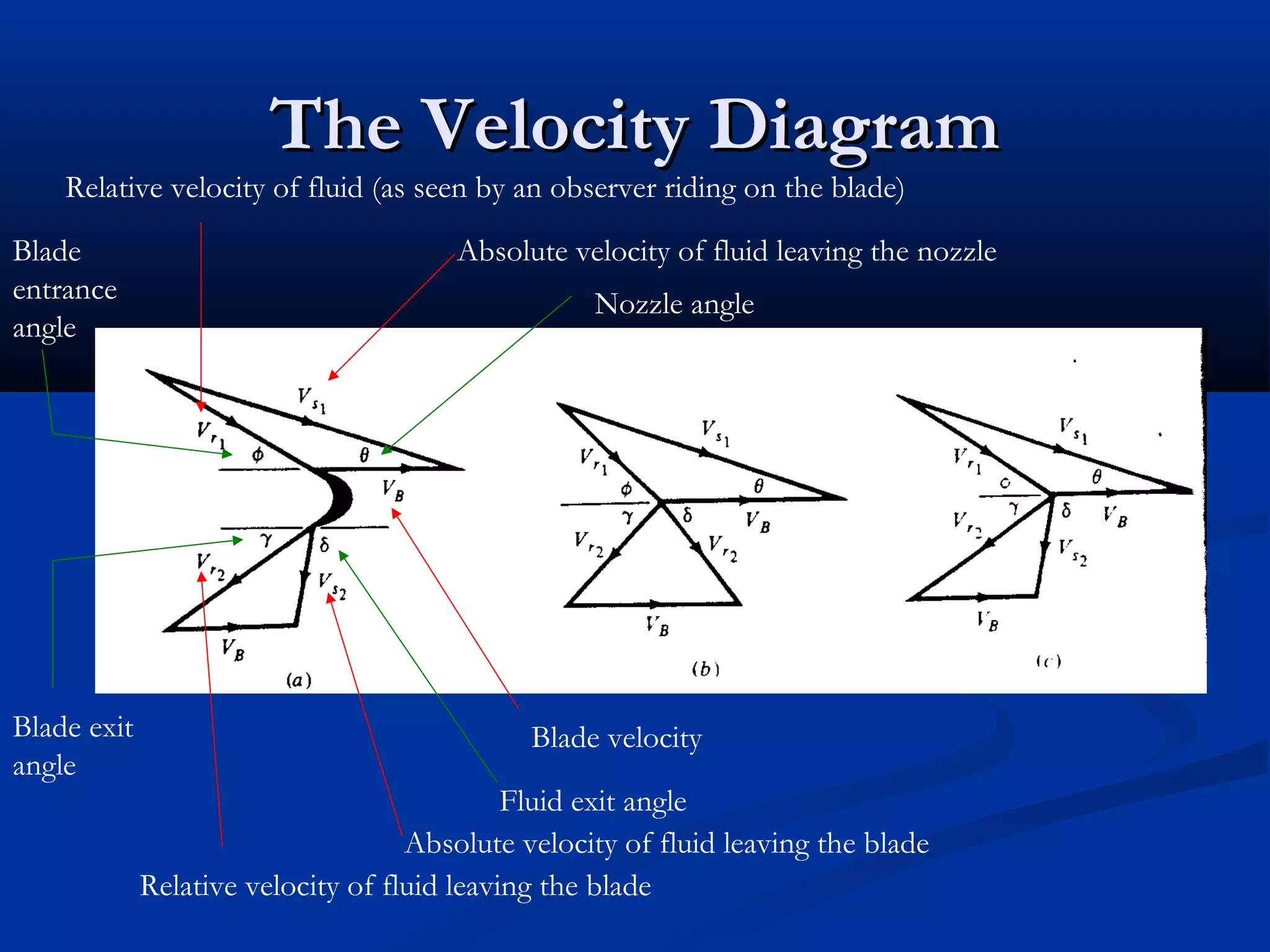
 Blade entrance angle and blade exit angle cannot beBlade entrance angle and blade exit angle cannot be
zero, as shown in the figure belowzero, as shown in the figure below
The Velocity DiagramThe Velocity Diagram
Absolute velocity of fluid leaving the nozzle
Relative velocity of fluid (as seen by an observer riding on the blade)
Blade velocity
Absolute velocity of fluid leaving the blade
Relative velocity of fluid leaving the blade
Nozzle angle
Blade
entrance
angle
Blade exit
angle
Fluid exit angle
The Velocity DiagramThe Velocity Diagram
( )
( )
( )
1 2
1 2
1 2
2
1 1 1
cos cos
cos cos
2 cos cos
S S
w w
B
B S S
sB B
B
s s s
m
F V V
g
m
F V V
g
mV
W FV V V
g
VV V
V V V
θ δ
θ δ
η θ δ
•
•
•
•
= −
= −
= = −
     
= −  ÷  ÷ ÷
     
Velocity of whirl, Vw
The Velocity DiagramThe Velocity Diagram
 With no friction, expansion or contractionWith no friction, expansion or contraction
( )
r1 r2 1
2 1 1
V in + x direction = V in -x direction = cos
Absolute velocity of fluid leaving the blade in +x direction
cos cos 2 cos
s B
s B s B B s
V V
V V V V V V
θ
δ θ θ
−
= − − = −
( )
( ) ,
1
1
,
2 2
max 1
2
cos
0
cos
2
2
cos
2 B opt
B
s B
B
s
B opt
s
mV
W V V
g
dW
by
dV
V
V
m m
W V V
g g
θ
θ
θ
•
•
•
• •
•
= −
=
=
= =
( )
2max
,max
2
1
cos
2
B
s
W
mV
g
η θ
•
•
= =
 
 ÷
 ÷
 
The Impulse PrincipleThe Impulse Principle
 From first-law of thermodynamics,From first-law of thermodynamics,
 for adiabatic system andfor adiabatic system and ΔΔPE = 0PE = 0
( )
2 2
1 2
1 2
2 2
s sV V
W H H m
g g
• •  
= − + − ÷
 
where H1 and H2 are the enthalpy entering and leaving the blade
H1- H2 is obtained by considering fluid flow relative to the blade (observer is on the
blade), where only relative velocities and no work are observed.
2 2
2 1
1 2
2 2
r rV V
H H
g g
 
− = − ÷
 
( ) ( )2 2 2 2
1 2 1 2
2
s s r r
m
W V V V V
g
•
•
 = − − − 
Including friction, expansion or
contraction
The Impulse PrincipleThe Impulse Principle
 In case of pure impulse (no friction, no expansionIn case of pure impulse (no friction, no expansion
and no contraction),and no contraction),
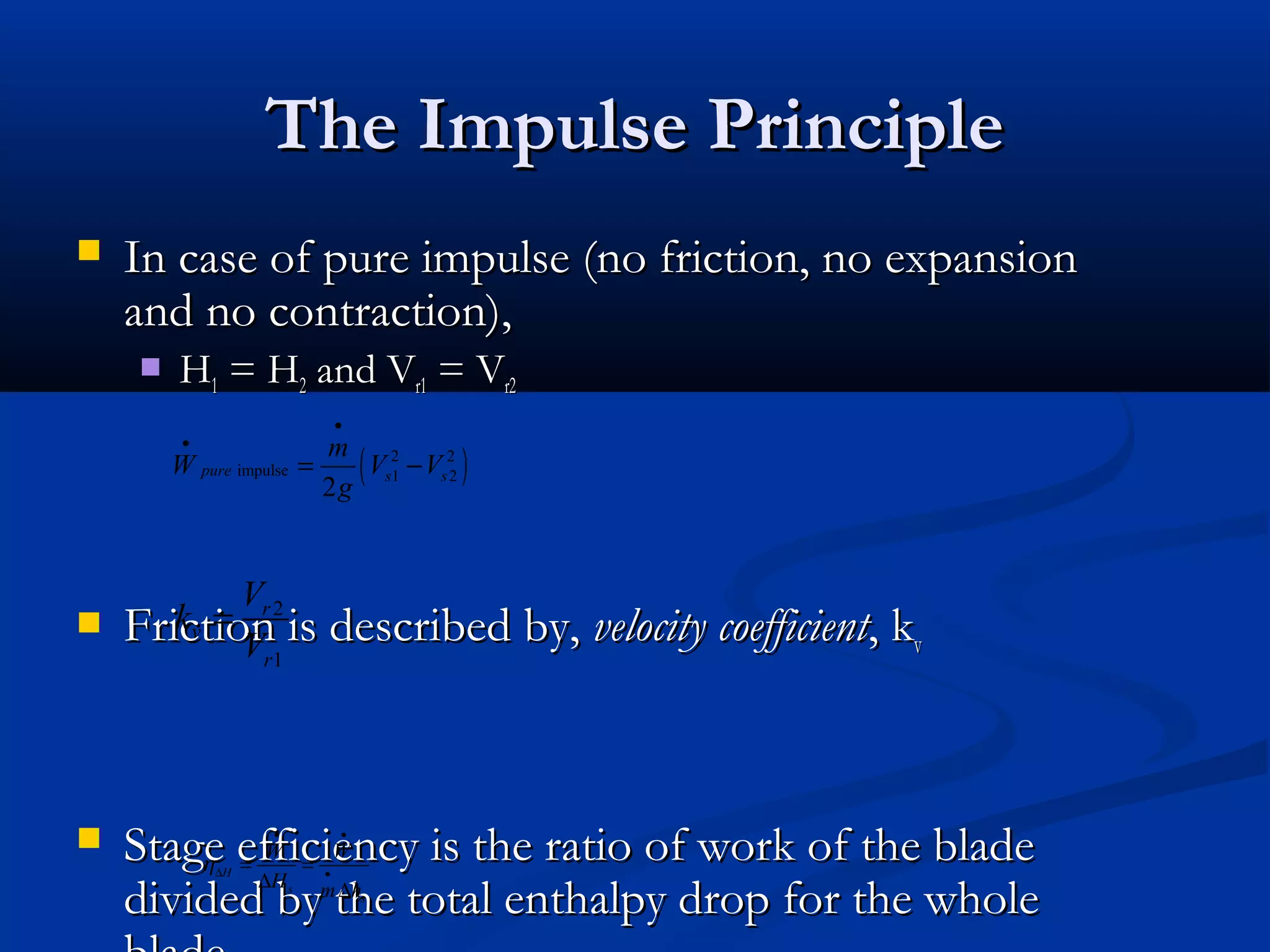
 HH11 = H= H22 and Vand Vr1r1 = V= Vr2r2
 Friction is described by,Friction is described by, velocity coefficientvelocity coefficient, k, kvv
 Stage efficiency is the ratio of work of the bladeStage efficiency is the ratio of work of the blade
divided by the total enthalpy drop for the wholedivided by the total enthalpy drop for the whole
( )2 2
impulse 1 2
2
pure s s
m
W V V
g
•
•
= −
2
1
r
v
r
V
k
V
=
H
s
s
W W
H m h
η
• •
∆ •
= =
∆ ∆
Impulse TurbineImpulse Turbine
 Blade is usually symmetrical.Blade is usually symmetrical.
 Entrance angle (Entrance angle (φφ ) and exit angle () and exit angle (γγ) are around) are around
2020oo
..
 Usually used in the entrance high-pressure stagesUsually used in the entrance high-pressure stages
of a steam turbine.of a steam turbine.
 Enthalpy drop and pressure drop occur in theEnthalpy drop and pressure drop occur in the
nozzle.nozzle.
The Single-StageThe Single-Stage Impulse TurbineImpulse Turbine
 De Laval turbineDe Laval turbine
• Steam is fed through one or
several convergent-divergent
nozzles.
• Pressure drop occurs in the
nozzle (not in the blade)
•Maximum velocity (kinetic energy)
occurs at nozzle exit.
Compounded-Impulse TurbineCompounded-Impulse Turbine
 For single-stage impulse turbineFor single-stage impulse turbine
 For modern boiler conditions, expansion in singleFor modern boiler conditions, expansion in single
nozzle stage gives 1645 m/s.nozzle stage gives 1645 m/s.
 Beyond the maximum allowable safety limits. (due toBeyond the maximum allowable safety limits. (due to
centrifugal stress)centrifugal stress)
 To overcome these difficulties,To overcome these difficulties,
 Velocity-compounded turbineVelocity-compounded turbine
 Pressure-compounded turbinePressure-compounded turbine
1
,
cos
2
s
B opt
V
V
θ
=
Velocity-Compounded Impulse TurbineVelocity-Compounded Impulse Turbine
 Curtis stage turbineCurtis stage turbine
2
2 1 1
1
3
3 2 2
2
4
4 3 3
3
r
r r v
r
s
s s v
s
r
r r v
r
V
V V k
V
V
V V k
V
V
V V k
V
< =
< =
< =
Velocity-Compounded Impulse TurbineVelocity-Compounded Impulse Turbine
( ) ( ) ( ) ( ){ }2 2 2 2 2 2 2 2
1 2 2 1 3 4 4 3
2
s s r r s s r r
c
m
W V V V V V V V V
g
•
•
   = − − − + − − −   
1 1
,
cos
2
s
B opt
V
V
n
θ
=
Nozzle angle
Number of stages
Velocity-Compounded Impulse TurbineVelocity-Compounded Impulse Turbine
 Work ratioWork ratio
 for 2 stages turbine 3:1for 2 stages turbine 3:1
 for 3 stages turbine 5:3:1for 3 stages turbine 5:3:1
 for 4 stages turbine 7:5:3:1for 4 stages turbine 7:5:3:1
Pressure-Compounded Impulse TurbinePressure-Compounded Impulse Turbine
 Rateau turbineRateau turbine
1 2 ... 2 tot
s s c
h
V V g
n
∆
= = =
Δ htot = the total specific enthalpy drop of the
turbine
n = the number of stages
Enthalpy drops per stage are the same
Pressure drops are not
Pressure-Compounded Impulse TurbinePressure-Compounded Impulse Turbine
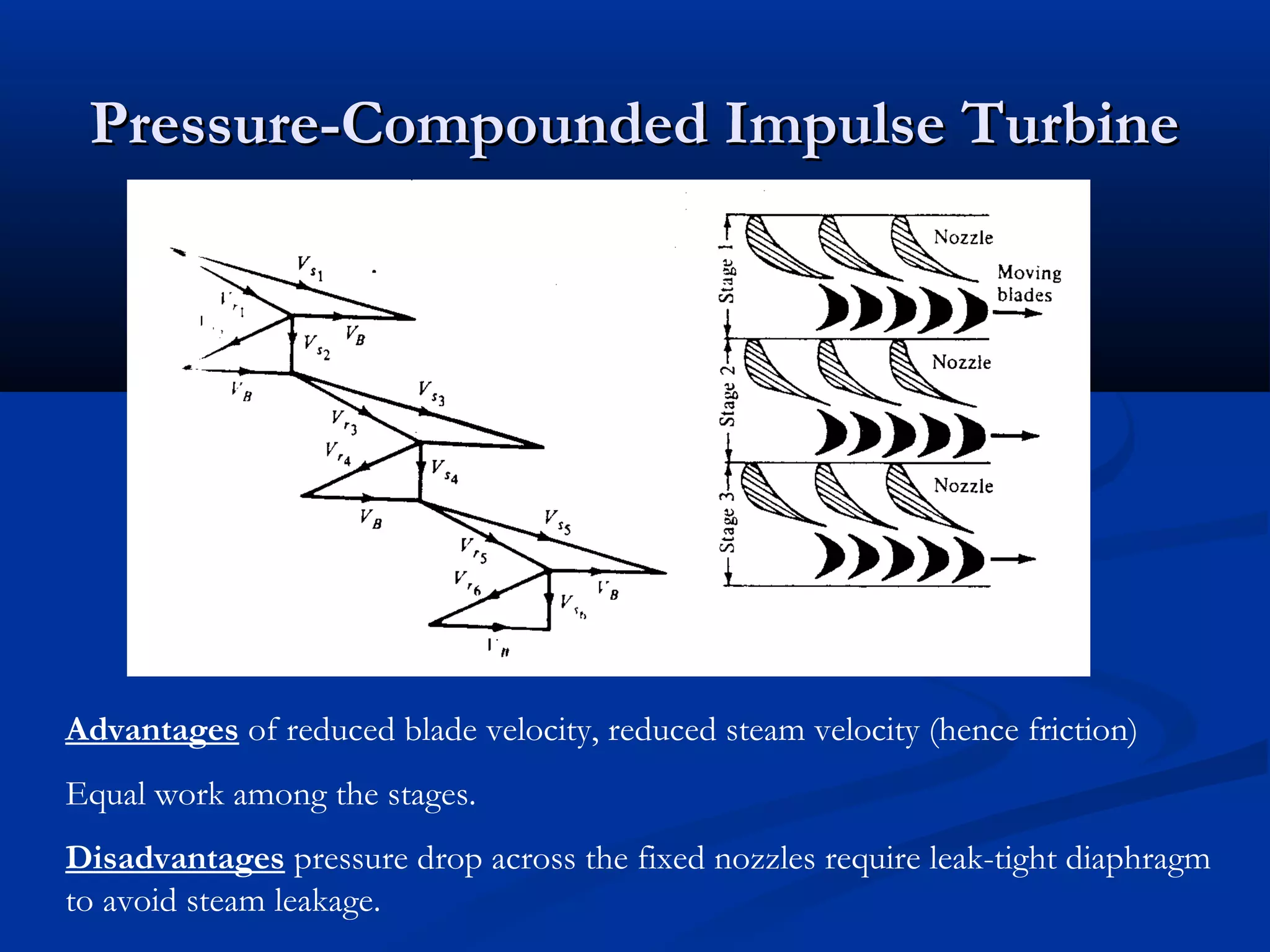
Advantages of reduced blade velocity, reduced steam velocity (hence friction)
Equal work among the stages.
Disadvantages pressure drop across the fixed nozzles require leak-tight diaphragm
to avoid steam leakage.
Reaction PrincipleReaction Principle
 Fixed nozzle, a rocket, a whirling lawn sprinkle and turbine areFixed nozzle, a rocket, a whirling lawn sprinkle and turbine are
devices that cause a fluid to exit at high speeds.devices that cause a fluid to exit at high speeds.
 The fluid beginning with zero velocity inside, creates a force inThe fluid beginning with zero velocity inside, creates a force in
the direction of motion F equal tothe direction of motion F equal to
c
V
F m
g
•
=
Reaction TurbineReaction Turbine
pressure
Absolute velocity
Nozzles with full steam admission
Unsymmetrical blade
Similar shape to fixed blade
(opposite direction curve)
Pressure continually drops through all rows of
blades (fixed and moving)
Absolute velocity changes within each stage
repeats from stage to stage
50 % Degree of reaction
-Half of enthalpy drop of the stage occurs at fixed blade
-Half of enthalpy drop of the stage occurs at moving
blade
Reaction TurbineReaction Turbine
( )
( ) ( )
1
1
, 1
2 2
1
2 cos
2 cos 2 0
cos
cos
opt
B
s B
c
s B
B
B opt s
s B
c c
V
W m V V
g
dW
V V
dV
V V
m m
W V V
g g
θ
θ
θ
θ
• •
•
• •
•
= −
= − =
=
= =
Reaction TurbineReaction Turbine
( )2 2
1 0
0 1
, 0 1
1
2 s s
c
N
f s s
V V
g h h
h h h
η
  − ÷ − = =
∆ −
( )0 2
B
s ss
W W
m h m h h
η
• •
• •
= =
∆ −
( )
2 2
1 1
1 22 2
B
s s
ms s
c c
W W
V V
m h m h h
g g
η
• •
• •
= =
   
+ ∆ + − ÷  ÷
   
Fixed-blade (nozzle) efficiency
Moving-blade efficiency
Stage efficiency
, isentropic enthalpy drop across fixed bladef sh∆ =
isentropic enthalpy drop across moving blademsh∆ =
isentropic enthalpy drop across entire stagesh∆ =
Enthalpy
Entropy
Reaction TurbineReaction Turbine
 Reaction stage has pressure drop across theReaction stage has pressure drop across the
moving blade.moving blade.
 Not suitable for high pressure stage becauseNot suitable for high pressure stage because
pressure drop is very high and results in steampressure drop is very high and results in steam
leakage around the tips of the blades.leakage around the tips of the blades.
 Impulse turbine is normally used for HP stages.Impulse turbine is normally used for HP stages.
 Reaction turbine is normally used for LP stages.Reaction turbine is normally used for LP stages.
Axial ThrustAxial Thrust
 Impulse turbineImpulse turbine
 Little pressure drop on the moving blade from frictionLittle pressure drop on the moving blade from friction
 Change in axial component of momentum of theChange in axial component of momentum of the
steam from entrance to exitsteam from entrance to exit
 For pure symmetrical impulse blades, VFor pure symmetrical impulse blades, Vr1r1 = V= Vr2r2 andand φφ ==
γγ, axial thrust is zero., axial thrust is zero.
( )1 2sin sinaxial r r
c
m
F V V
g
φ γ
•
= −
Axial ThrustAxial Thrust
 Reaction turbineReaction turbine
 Change in axial momentum is zero.Change in axial momentum is zero.
 Large and continual pressure drop across theLarge and continual pressure drop across the
moving blade.moving blade.
 Axial thrust is quite large.Axial thrust is quite large.
 Thrust bearing to support axial thrust.Thrust bearing to support axial thrust.
 Dummy piston (rings) to balance axial thrustDummy piston (rings) to balance axial thrust
Steam TurbineSteam Turbine
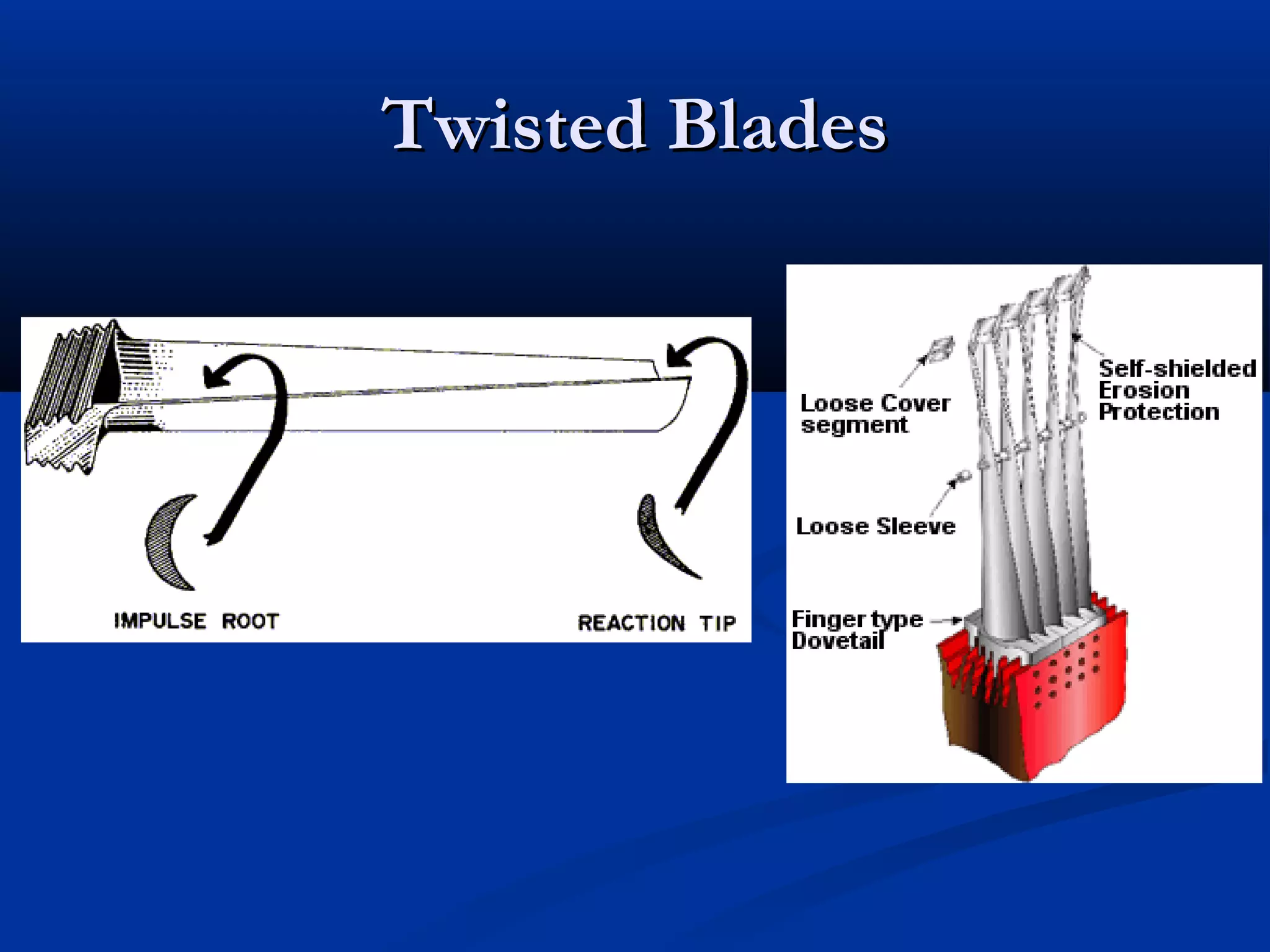
Twisted BladesTwisted Blades
 Reaction blades are high, especially in the latter stages.Reaction blades are high, especially in the latter stages.
 VVBB increases with radius from base to tip of blade.increases with radius from base to tip of blade.
 VVs1s1 andand θθ do not vary in radial direction.do not vary in radial direction.
Increase from root
to tip
decrease from root
to tip
Twisted BladesTwisted Blades
Combination TurbinesCombination Turbines
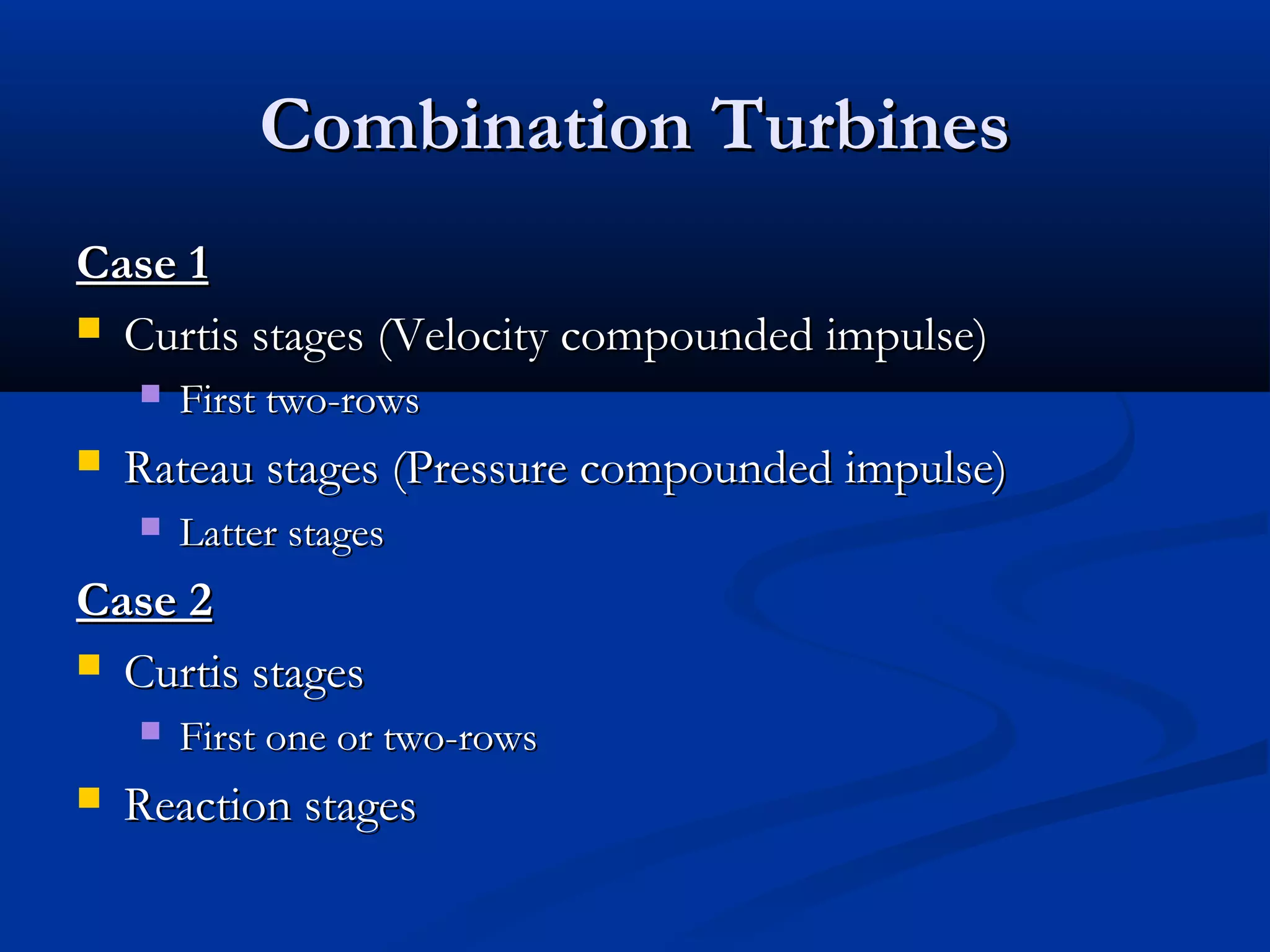
Case 1Case 1
 Curtis stages (Velocity compounded impulse)Curtis stages (Velocity compounded impulse)
 First two-rowsFirst two-rows
 Rateau stages (Pressure compounded impulse)Rateau stages (Pressure compounded impulse)
 Latter stagesLatter stages
Case 2Case 2
 Curtis stagesCurtis stages
 First one or two-rowsFirst one or two-rows
 Reaction stagesReaction stages
Combination TurbinesCombination Turbines
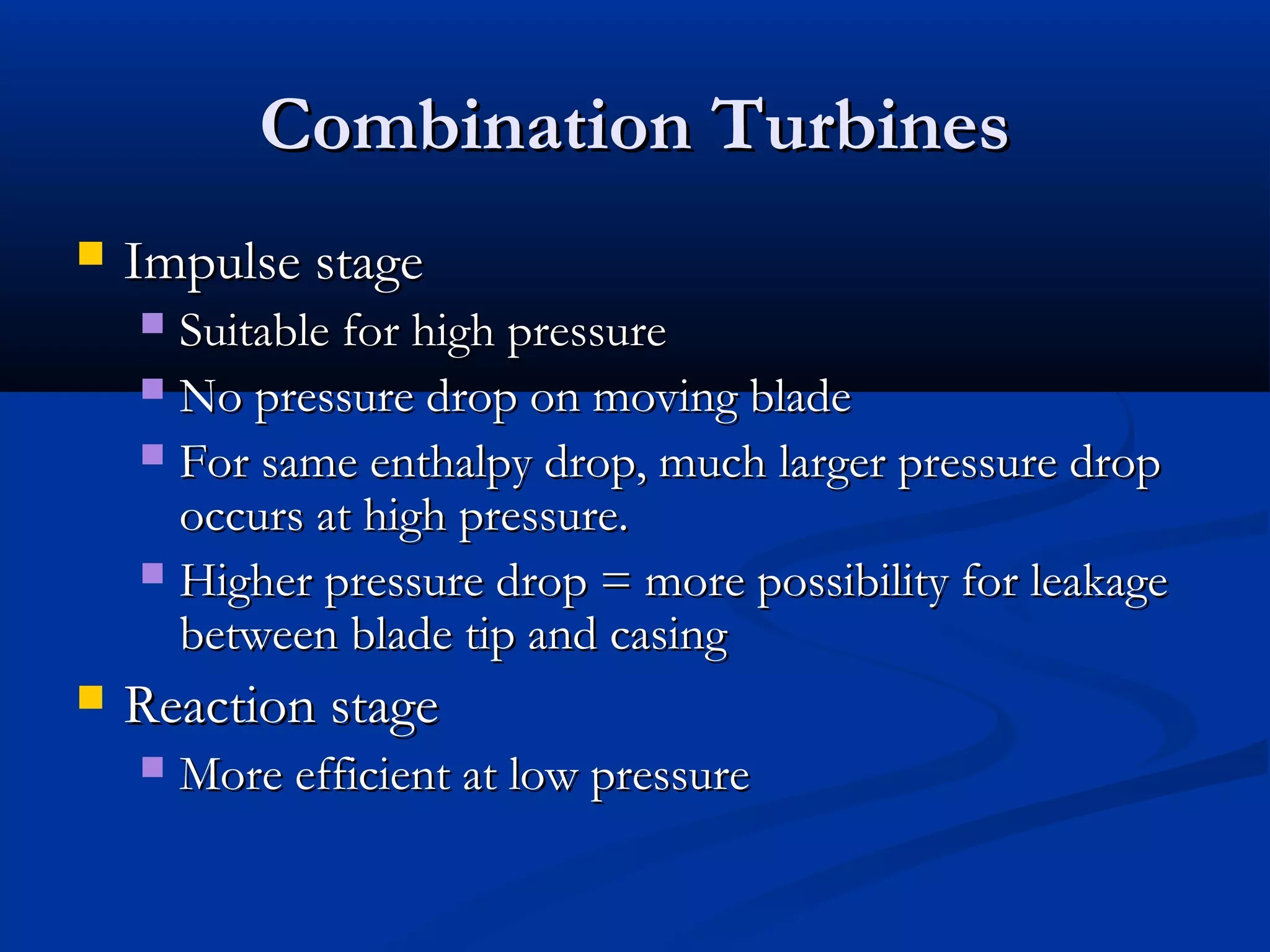
 Impulse stageImpulse stage
 Suitable for high pressureSuitable for high pressure
 No pressure drop on moving bladeNo pressure drop on moving blade
 For same enthalpy drop, much larger pressure dropFor same enthalpy drop, much larger pressure drop
occurs at high pressure.occurs at high pressure.
 Higher pressure drop = more possibility for leakageHigher pressure drop = more possibility for leakage
between blade tip and casingbetween blade tip and casing
 Reaction stageReaction stage
 More efficient at low pressureMore efficient at low pressure
Turbine ConfigurationsTurbine Configurations
 Tandem compound – single shaftTandem compound – single shaft
 Cross compound – two parallel shaftCross compound – two parallel shaft
 HP turbine – high pressure turbineHP turbine – high pressure turbine
 IP turbine – intermediate pressure turbineIP turbine – intermediate pressure turbine
 LP turbine – low pressure turbineLP turbine – low pressure turbine
 LSB – last stage bladeLSB – last stage blade
Turbine ConfigurationsTurbine Configurations
Steam Flow PathSteam Flow Path
Straight through Single reheat
Extraction Induction (or mixed flow)
Turbine RotorsTurbine Rotors
 Almost all of turbines are placed face-to-face,Almost all of turbines are placed face-to-face,
especially in IP and LP turbine, which compriseespecially in IP and LP turbine, which comprise
of reaction stages.of reaction stages.
 What is the reason for this arrangement?What is the reason for this arrangement?
HP inlet
HP Exhaust
IP inlet
LP ExhaustIP Exhaust LP Exhaust LP ExhaustLP Exhaust
LP inlet LP inlet
IP Exhaust
What is the configuration type of thisWhat is the configuration type of this
steam turbine?steam turbine?

Steam turbine

  • 1.
  • 2.
    The Impulse PrincipleTheImpulse Principle  The force on the plate, F is equal to the change inThe force on the plate, F is equal to the change in momentum of the jet in +x directionmomentum of the jet in +x direction ( )0s s m m F V V g g • • = − = where m is mass-flow rate of the jet, lbm/s or kg/s Vs is velocity in horizontal direction, ft/s or m/s Fixed flat plate
  • 3.
    The Impulse PrincipleTheImpulse Principle ( )s B m F V V g • = − ( )B B S B m W FV V V V g • • = = − Moving flat plate where VB is the plate velocity, ft/s or m/s 2 2 2 2 B B plate S S S V VW V V mV g η • •     = = − ÷       ÷  ÷   Force on the plate Power done by jet Efficiency is ratio of power to initial power of the jet Power is 0 if VB = 0 or (Vs-VB)=0 B S V V
  • 4.
    The Impulse PrincipleTheImpulse Principle  To find optimum VTo find optimum VBB, power is differentiated, power is differentiated respect to Vrespect to VBB ( ) ( )2 , 2 max 2 0 2 4 S B B S B B B S B opt S dW d m m V V V V V dV dV g g V V mV W g • • • • •    = − = − =     = = Half of kinetic energy per unit time of jet Half of jet velocity
  • 5.
    The Impulse PrincipleTheImpulse Principle Fluid relative entrance velocity = Fluid relative exit velocity Fluid relative velocity = s BV V− ( )Absolute jet velocity at exit (+x direction) = - - 2B S B B SV V V V V= − ( ) ( ) ( ) 2 2 2 2 4 S B S S B B B S B B B b S S m m F V V V V V g g m W FV V V V g V V V V η • • • • = − − = −   = = −     = − ÷     For frictionless blade By impulse and momentum principle For 180o curved blade Double of value on flat plate case
  • 6.
    The Impulse PrincipleTheImpulse Principle ( ) ( )2 , 2 max 2 2 2 0 2 2 S B B S B B B S B opt S dW d m m V V V V V dV dV g g V V mV W g • • • • •    = − = − =     = =  To find optimum VTo find optimum VBB, power is differentiated, power is differentiated respect to Vrespect to VBB Half of jet velocity Equal to kinetic energy per unit time of jet ,max 100%Bη =
  • 7.
    The Impulse PrincipleTheImpulse Principle  It is impossible to have 180It is impossible to have 18000 curved blade in actualcurved blade in actual applicationapplication  jet exit will impinging on the back of next bladejet exit will impinging on the back of next blade  Blade entrance angle and blade exit angle cannot beBlade entrance angle and blade exit angle cannot be zero, as shown in the figure belowzero, as shown in the figure below
  • 8.
    The Velocity DiagramTheVelocity Diagram Absolute velocity of fluid leaving the nozzle Relative velocity of fluid (as seen by an observer riding on the blade) Blade velocity Absolute velocity of fluid leaving the blade Relative velocity of fluid leaving the blade Nozzle angle Blade entrance angle Blade exit angle Fluid exit angle
  • 9.
    The Velocity DiagramTheVelocity Diagram ( ) ( ) ( ) 1 2 1 2 1 2 2 1 1 1 cos cos cos cos 2 cos cos S S w w B B S S sB B B s s s m F V V g m F V V g mV W FV V V g VV V V V V θ δ θ δ η θ δ • • • • = − = − = = −       = −  ÷  ÷ ÷       Velocity of whirl, Vw
  • 10.
    The Velocity DiagramTheVelocity Diagram  With no friction, expansion or contractionWith no friction, expansion or contraction ( ) r1 r2 1 2 1 1 V in + x direction = V in -x direction = cos Absolute velocity of fluid leaving the blade in +x direction cos cos 2 cos s B s B s B B s V V V V V V V V θ δ θ θ − = − − = − ( ) ( ) , 1 1 , 2 2 max 1 2 cos 0 cos 2 2 cos 2 B opt B s B B s B opt s mV W V V g dW by dV V V m m W V V g g θ θ θ • • • • • • = − = = = = ( ) 2max ,max 2 1 cos 2 B s W mV g η θ • • = =    ÷  ÷  
  • 11.
    The Impulse PrincipleTheImpulse Principle  From first-law of thermodynamics,From first-law of thermodynamics,  for adiabatic system andfor adiabatic system and ΔΔPE = 0PE = 0 ( ) 2 2 1 2 1 2 2 2 s sV V W H H m g g • •   = − + − ÷   where H1 and H2 are the enthalpy entering and leaving the blade H1- H2 is obtained by considering fluid flow relative to the blade (observer is on the blade), where only relative velocities and no work are observed. 2 2 2 1 1 2 2 2 r rV V H H g g   − = − ÷   ( ) ( )2 2 2 2 1 2 1 2 2 s s r r m W V V V V g • •  = − − −  Including friction, expansion or contraction
  • 12.
    The Impulse PrincipleTheImpulse Principle  In case of pure impulse (no friction, no expansionIn case of pure impulse (no friction, no expansion and no contraction),and no contraction),  HH11 = H= H22 and Vand Vr1r1 = V= Vr2r2  Friction is described by,Friction is described by, velocity coefficientvelocity coefficient, k, kvv  Stage efficiency is the ratio of work of the bladeStage efficiency is the ratio of work of the blade divided by the total enthalpy drop for the wholedivided by the total enthalpy drop for the whole ( )2 2 impulse 1 2 2 pure s s m W V V g • • = − 2 1 r v r V k V = H s s W W H m h η • • ∆ • = = ∆ ∆
  • 13.
    Impulse TurbineImpulse Turbine Blade is usually symmetrical.Blade is usually symmetrical.  Entrance angle (Entrance angle (φφ ) and exit angle () and exit angle (γγ) are around) are around 2020oo ..  Usually used in the entrance high-pressure stagesUsually used in the entrance high-pressure stages of a steam turbine.of a steam turbine.  Enthalpy drop and pressure drop occur in theEnthalpy drop and pressure drop occur in the nozzle.nozzle.
  • 14.
    The Single-StageThe Single-StageImpulse TurbineImpulse Turbine  De Laval turbineDe Laval turbine • Steam is fed through one or several convergent-divergent nozzles. • Pressure drop occurs in the nozzle (not in the blade) •Maximum velocity (kinetic energy) occurs at nozzle exit.
  • 15.
    Compounded-Impulse TurbineCompounded-Impulse Turbine For single-stage impulse turbineFor single-stage impulse turbine  For modern boiler conditions, expansion in singleFor modern boiler conditions, expansion in single nozzle stage gives 1645 m/s.nozzle stage gives 1645 m/s.  Beyond the maximum allowable safety limits. (due toBeyond the maximum allowable safety limits. (due to centrifugal stress)centrifugal stress)  To overcome these difficulties,To overcome these difficulties,  Velocity-compounded turbineVelocity-compounded turbine  Pressure-compounded turbinePressure-compounded turbine 1 , cos 2 s B opt V V θ =
  • 16.
    Velocity-Compounded Impulse TurbineVelocity-CompoundedImpulse Turbine  Curtis stage turbineCurtis stage turbine 2 2 1 1 1 3 3 2 2 2 4 4 3 3 3 r r r v r s s s v s r r r v r V V V k V V V V k V V V V k V < = < = < =
  • 17.
    Velocity-Compounded Impulse TurbineVelocity-CompoundedImpulse Turbine ( ) ( ) ( ) ( ){ }2 2 2 2 2 2 2 2 1 2 2 1 3 4 4 3 2 s s r r s s r r c m W V V V V V V V V g • •    = − − − + − − −    1 1 , cos 2 s B opt V V n θ = Nozzle angle Number of stages
  • 18.
    Velocity-Compounded Impulse TurbineVelocity-CompoundedImpulse Turbine  Work ratioWork ratio  for 2 stages turbine 3:1for 2 stages turbine 3:1  for 3 stages turbine 5:3:1for 3 stages turbine 5:3:1  for 4 stages turbine 7:5:3:1for 4 stages turbine 7:5:3:1
  • 19.
    Pressure-Compounded Impulse TurbinePressure-CompoundedImpulse Turbine  Rateau turbineRateau turbine 1 2 ... 2 tot s s c h V V g n ∆ = = = Δ htot = the total specific enthalpy drop of the turbine n = the number of stages Enthalpy drops per stage are the same Pressure drops are not
  • 20.
    Pressure-Compounded Impulse TurbinePressure-CompoundedImpulse Turbine Advantages of reduced blade velocity, reduced steam velocity (hence friction) Equal work among the stages. Disadvantages pressure drop across the fixed nozzles require leak-tight diaphragm to avoid steam leakage.
  • 21.
    Reaction PrincipleReaction Principle Fixed nozzle, a rocket, a whirling lawn sprinkle and turbine areFixed nozzle, a rocket, a whirling lawn sprinkle and turbine are devices that cause a fluid to exit at high speeds.devices that cause a fluid to exit at high speeds.  The fluid beginning with zero velocity inside, creates a force inThe fluid beginning with zero velocity inside, creates a force in the direction of motion F equal tothe direction of motion F equal to c V F m g • =
  • 22.
    Reaction TurbineReaction Turbine pressure Absolutevelocity Nozzles with full steam admission Unsymmetrical blade Similar shape to fixed blade (opposite direction curve) Pressure continually drops through all rows of blades (fixed and moving) Absolute velocity changes within each stage repeats from stage to stage 50 % Degree of reaction -Half of enthalpy drop of the stage occurs at fixed blade -Half of enthalpy drop of the stage occurs at moving blade
  • 23.
    Reaction TurbineReaction Turbine () ( ) ( ) 1 1 , 1 2 2 1 2 cos 2 cos 2 0 cos cos opt B s B c s B B B opt s s B c c V W m V V g dW V V dV V V m m W V V g g θ θ θ θ • • • • • • = − = − = = = =
  • 24.
    Reaction TurbineReaction Turbine ()2 2 1 0 0 1 , 0 1 1 2 s s c N f s s V V g h h h h h η   − ÷ − = = ∆ − ( )0 2 B s ss W W m h m h h η • • • • = = ∆ − ( ) 2 2 1 1 1 22 2 B s s ms s c c W W V V m h m h h g g η • • • • = =     + ∆ + − ÷  ÷     Fixed-blade (nozzle) efficiency Moving-blade efficiency Stage efficiency , isentropic enthalpy drop across fixed bladef sh∆ = isentropic enthalpy drop across moving blademsh∆ = isentropic enthalpy drop across entire stagesh∆ = Enthalpy Entropy
  • 25.
    Reaction TurbineReaction Turbine Reaction stage has pressure drop across theReaction stage has pressure drop across the moving blade.moving blade.  Not suitable for high pressure stage becauseNot suitable for high pressure stage because pressure drop is very high and results in steampressure drop is very high and results in steam leakage around the tips of the blades.leakage around the tips of the blades.  Impulse turbine is normally used for HP stages.Impulse turbine is normally used for HP stages.  Reaction turbine is normally used for LP stages.Reaction turbine is normally used for LP stages.
  • 26.
    Axial ThrustAxial Thrust Impulse turbineImpulse turbine  Little pressure drop on the moving blade from frictionLittle pressure drop on the moving blade from friction  Change in axial component of momentum of theChange in axial component of momentum of the steam from entrance to exitsteam from entrance to exit  For pure symmetrical impulse blades, VFor pure symmetrical impulse blades, Vr1r1 = V= Vr2r2 andand φφ == γγ, axial thrust is zero., axial thrust is zero. ( )1 2sin sinaxial r r c m F V V g φ γ • = −
  • 27.
    Axial ThrustAxial Thrust Reaction turbineReaction turbine  Change in axial momentum is zero.Change in axial momentum is zero.  Large and continual pressure drop across theLarge and continual pressure drop across the moving blade.moving blade.  Axial thrust is quite large.Axial thrust is quite large.  Thrust bearing to support axial thrust.Thrust bearing to support axial thrust.  Dummy piston (rings) to balance axial thrustDummy piston (rings) to balance axial thrust
  • 28.
  • 29.
    Twisted BladesTwisted Blades Reaction blades are high, especially in the latter stages.Reaction blades are high, especially in the latter stages.  VVBB increases with radius from base to tip of blade.increases with radius from base to tip of blade.  VVs1s1 andand θθ do not vary in radial direction.do not vary in radial direction. Increase from root to tip decrease from root to tip
  • 30.
  • 31.
    Combination TurbinesCombination Turbines Case1Case 1  Curtis stages (Velocity compounded impulse)Curtis stages (Velocity compounded impulse)  First two-rowsFirst two-rows  Rateau stages (Pressure compounded impulse)Rateau stages (Pressure compounded impulse)  Latter stagesLatter stages Case 2Case 2  Curtis stagesCurtis stages  First one or two-rowsFirst one or two-rows  Reaction stagesReaction stages
  • 32.
    Combination TurbinesCombination Turbines Impulse stageImpulse stage  Suitable for high pressureSuitable for high pressure  No pressure drop on moving bladeNo pressure drop on moving blade  For same enthalpy drop, much larger pressure dropFor same enthalpy drop, much larger pressure drop occurs at high pressure.occurs at high pressure.  Higher pressure drop = more possibility for leakageHigher pressure drop = more possibility for leakage between blade tip and casingbetween blade tip and casing  Reaction stageReaction stage  More efficient at low pressureMore efficient at low pressure
  • 33.
    Turbine ConfigurationsTurbine Configurations Tandem compound – single shaftTandem compound – single shaft  Cross compound – two parallel shaftCross compound – two parallel shaft  HP turbine – high pressure turbineHP turbine – high pressure turbine  IP turbine – intermediate pressure turbineIP turbine – intermediate pressure turbine  LP turbine – low pressure turbineLP turbine – low pressure turbine  LSB – last stage bladeLSB – last stage blade
  • 34.
  • 35.
    Steam Flow PathSteamFlow Path Straight through Single reheat Extraction Induction (or mixed flow)
  • 36.
    Turbine RotorsTurbine Rotors Almost all of turbines are placed face-to-face,Almost all of turbines are placed face-to-face, especially in IP and LP turbine, which compriseespecially in IP and LP turbine, which comprise of reaction stages.of reaction stages.  What is the reason for this arrangement?What is the reason for this arrangement? HP inlet HP Exhaust IP inlet LP ExhaustIP Exhaust LP Exhaust LP ExhaustLP Exhaust LP inlet LP inlet IP Exhaust
  • 37.
    What is theconfiguration type of thisWhat is the configuration type of this steam turbine?steam turbine?