Suture materials
Dr.prakash Patel
Dept. of Surgery
GMC, Surat
• Wound healing includes series of phases
• Sutures play an important role in wound
healing after surgical interventions
• So selection of suture material is more
important.
IDEAL SUTURE MATERIAL
• Sterile
• Can be used in any tissue
• Causes minimal tissue injury or tissue reaction (non
capillary , non allergic, non carcinogenic)
• Easy to handle
• Uniform diameter
• Holds securely when knotted ( no fraying /cutting )
• High tensile strength
• Favourable absorption profile
• Resistant to infection
Tensile strength
• It is amount of force required to break suture
material.
• It is maintained for longer duration in non
absorbable sutures as compared to
absorbable sutures
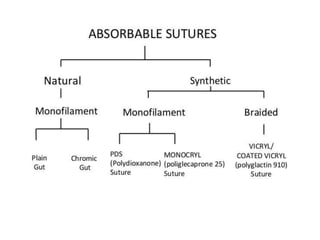
• Suture material is classified according to
structure of material
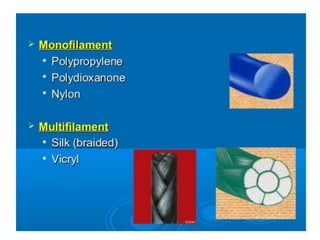
– Monofilament
– Polyfilament ( Brided / twisted )
• Classified according to nature of absorption
– Absorbable / Delayed absorbable
– Non Absorbable
• Classification according to Type of material
– Natural
– Synthetic
Natural V/s Synthetic
– Natural sutures may cause tissue reaction and
suture antigenicity leads to inflammatory
reactions
– Synthetic materials
– Less reaction
– Less inflammatory reaction
• Absorption occurs by enzymatic degradation
in NATURAL materials
• By Hydrolysis in SYNTHETIC materials
• Hydrolysis causes less tissue reaction than
enzymatic degradation.
Absorbable V/s Non Absorbable
• Nonabsorbabale sutures offer longer
mechanical support
• Absorbable sutures provide temporary wound
support untill the wound heals well enough
to withstand normal stress.
Monofilament V/s Multifilament
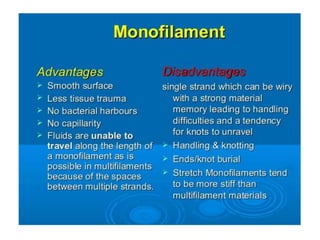
• Monofilament sutures is made of a single strand
 infection is avoided.
• Resistant to harboring micro organisms.
• Monofilament sutures exhibit less resistance to
passage through tissue  less tissue trauma.
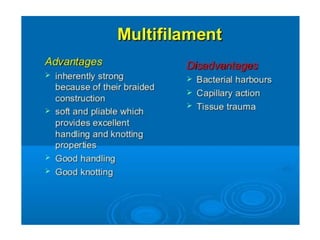
• Multifilament suture is composed of multiple
fibres
• It can be arranged in twisted or braided manner
• Multifilament suture has greater tensile
strength, better flexibility
• Multifilament suture hold knots very well as
compared to monofilament suture
• Because of multiple filaments it increased
absorption of fluid and may act as tract for
infection.
• Disadvantages of Monofilament suture
– More stiff
– Memory is more so difficult to handle
– Knot holding is difficult
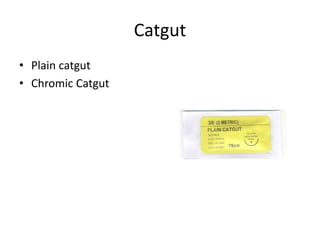
Catgut
• Plain catgut
• Chromic Catgut
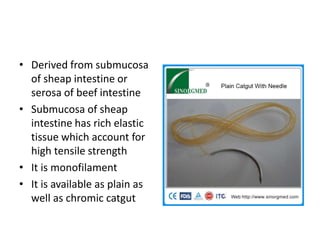
• Derived from submucosa
of sheap intestine or
serosa of beef intestine
• Submucosa of sheap
intestine has rich elastic
tissue which account for
high tensile strength
• It is monofilament
• It is available as plain as
well as chromic catgut
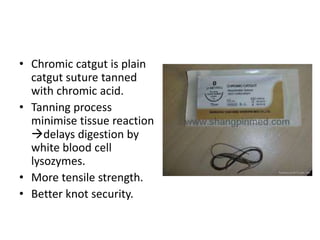
• Chromic catgut is plain
catgut suture tanned
with chromic acid.
• Tanning process
minimise tissue reaction
delays digestion by
white blood cell
lysozymes.
• More tensile strength.
• Better knot security.
• Catgut should not be boiled or autoclaved as
heat destroys its tensile strength.
• Catgut is sterilized during preparation and
kept in a preservative solution (Isoporpyl
alcohol) inside foils.
• Catgut is hygroscopic so it will swell due to
water absorption and its tensile strength will
be reduced.
• It is available pre sterilized in aluminium
coated sterile foil over wrap pack with ethicon
fluid as a preservative.
• COLOUR – plain Catgut – yellow
• Chromic catgut – Tanned ( dark yellow)
• USES- Oral surgery , Subcutaneous tissue
suturing , lap.appendisectomy .
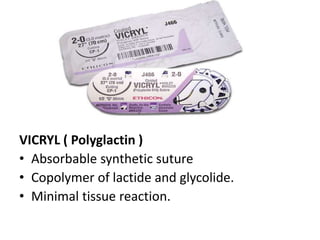
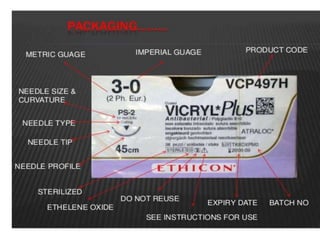
VICRYL ( Polyglactin )
• Absorbable synthetic suture
• Copolymer of lactide and glycolide.
• Minimal tissue reaction.
• Available in purple and undyed .
• Coated with polyglactin 370 and calcium
stearate which makes suture smooth easy
passage and easier knot placement.
PDS
• Polydioxanone (PDS) is synthetic,monofilament
,absorbable suture.
• Passes through tissue easily
• Memory is more than multifilament
• Absroption done by hydrolysis in months
• Tensile strength 14-42 days
• Minimal tissue reaction
• Uses – for wound under tension or contaminated
wound.
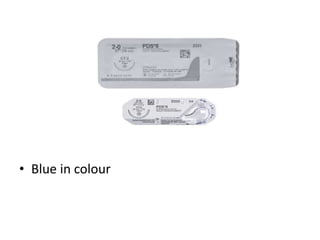
• Blue in colour
MONOCRYL
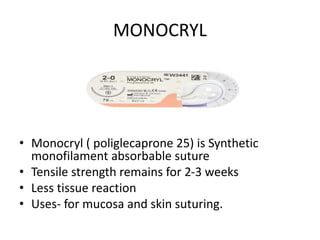
• Monocryl ( poliglecaprone 25) is Synthetic
monofilament absorbable suture
• Tensile strength remains for 2-3 weeks
• Less tissue reaction
• Uses- for mucosa and skin suturing.
• Other absorbable sutures commonly used are
• Vicryl Rapid – white colour
• Vicryl Plus – Having atibactarial property
which make antibacterial cover surrounding
suture
• Dexon – made up of homopolymer of glycolic
acid . , monofilament, absorbable , tensile
strength 3-4weeks .
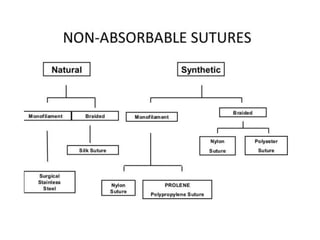
Non absorbable sutures
• Natural – silk , cotton
• Synthetic – polyester , polyamide,
polypropylene, polyethelene,nylon
• Metalic – stainless steel , platinum , silver ,
gold
Surgical Silk
• Multifilament – Braided or twisted.
• Made from silkworm larva.
• Filaments from silkworm larva is processed to
remove natural waxes , after braiding strands
are dyed , stretched and impregnated with
mixture of waxes and silicone .
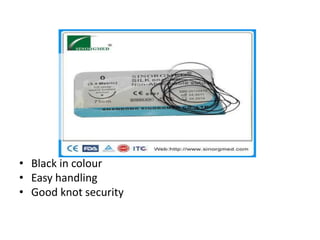
• Black in colour
• Easy handling
• Good knot security
• It is degraded by proteolysis
• Uses- used in ligating blood vessels, intestinal
anastomosis , feeding jejunostomy, mesentric
suturing.
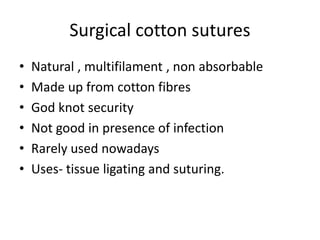
Surgical cotton sutures
• Natural , multifilament , non absorbable
• Made up from cotton fibres
• God knot security
• Not good in presence of infection
• Rarely used nowadays
• Uses- tissue ligating and suturing.
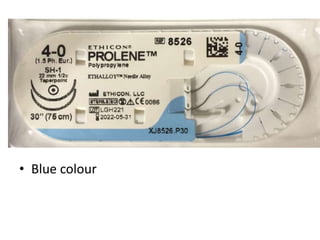
Polypropylene( PROLENE)
• Polymer of propylene.
• Inert and tensile strength remains for 2 years
• Monofilament
• Less tissue reactions so can be used in
infected or contaminated wound.
• Uses – sheath closure , tendon repair, hernia
repair , mesh fixation , vessels repair
,pancreatic anastomosis .
• Blue colour
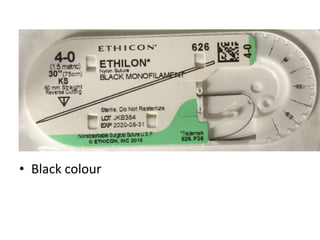
Nylon ( Ethilon)
• Monofilament , nonaborbable
• High tensile strength
• Low tissue reaction
• Memory is retained , so difficult to handle
• More knots are required to securing knots.
• Uses – for skin closure ,plastic and ophthalmic
surgery .
• Black colour
Surgical metalic wires
• surgical steel – very high tensile strength
• Difficult to handle
• Tendancy to cut through tissue
• Difficult in knot tie, knot ends require special handling
• Uses- sternotomy closure .
• Disadvantages – it can be seen in Ctscan images as
arteffects
• During MRI possiblity of suture movement is there.
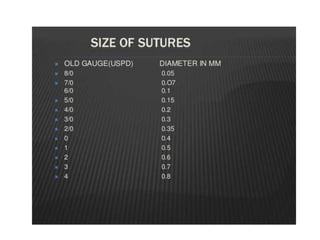
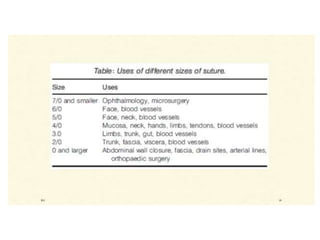
Suture size
• Largest size 1 to extremely fine 11-0.
• Increasing number of zero correlates with
decreasing diameter and strength.
• Thicker sutures are used for approximations of
deeper layers , wounds in tension prone areas,
and ligation of major blood vessels
• Thin sutures are used for closing delicate tissues
like conjunctiva , facial skin.
• Size is chosen to correlate with tensile strength of
tissue being sutured .
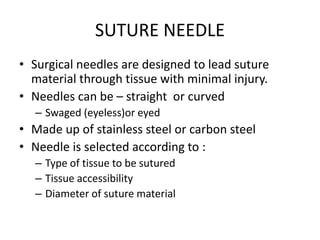
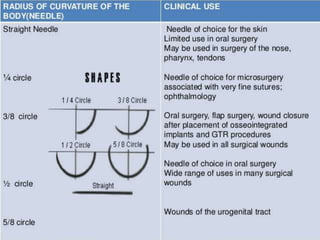
SUTURE NEEDLE
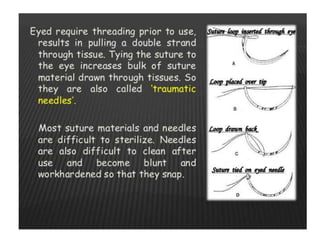
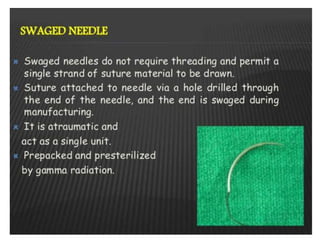
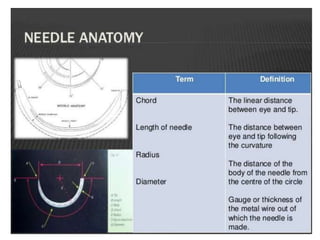
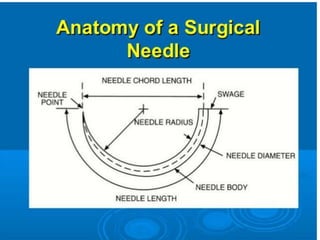
• Surgical needles are designed to lead suture
material through tissue with minimal injury.
• Needles can be – straight or curved
– Swaged (eyeless)or eyed
• Made up of stainless steel or carbon steel
• Needle is selected according to :
– Type of tissue to be sutured
– Tissue accessibility
– Diameter of suture material
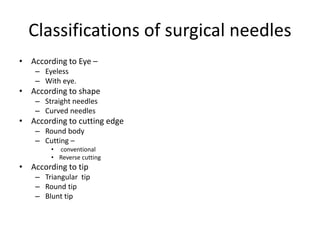
Classifications of surgical needles
• According to Eye –
– Eyeless
– With eye.
• According to shape
– Straight needles
– Curved needles
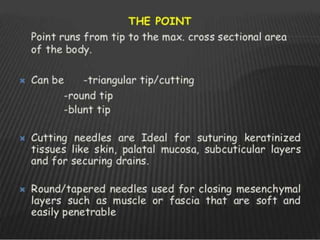
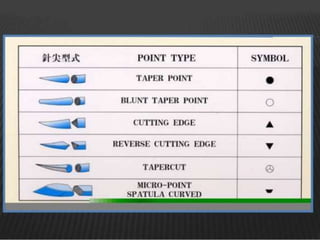
• According to cutting edge
– Round body
– Cutting –
• conventional
• Reverse cutting
• According to tip
– Triangular tip
– Round tip
– Blunt tip
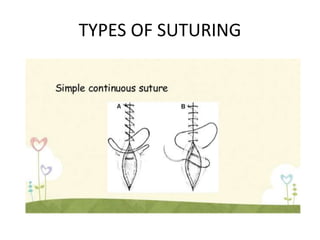
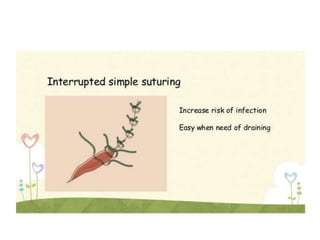
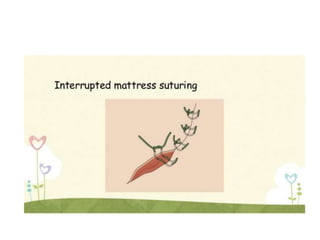
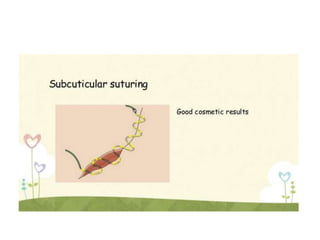
TYPES OF SUTURING
Suture Material.pptx

Suture Material.pptx

  • 1.
  • 2.
    • Wound healingincludes series of phases • Sutures play an important role in wound healing after surgical interventions • So selection of suture material is more important.
  • 3.
    IDEAL SUTURE MATERIAL •Sterile • Can be used in any tissue • Causes minimal tissue injury or tissue reaction (non capillary , non allergic, non carcinogenic) • Easy to handle • Uniform diameter • Holds securely when knotted ( no fraying /cutting ) • High tensile strength • Favourable absorption profile • Resistant to infection
  • 4.
    Tensile strength • Itis amount of force required to break suture material. • It is maintained for longer duration in non absorbable sutures as compared to absorbable sutures
  • 5.
    • Suture materialis classified according to structure of material – Monofilament – Polyfilament ( Brided / twisted )
  • 6.
    • Classified accordingto nature of absorption – Absorbable / Delayed absorbable – Non Absorbable
  • 7.
    • Classification accordingto Type of material – Natural – Synthetic
  • 8.
    Natural V/s Synthetic –Natural sutures may cause tissue reaction and suture antigenicity leads to inflammatory reactions – Synthetic materials – Less reaction – Less inflammatory reaction
  • 9.
    • Absorption occursby enzymatic degradation in NATURAL materials • By Hydrolysis in SYNTHETIC materials • Hydrolysis causes less tissue reaction than enzymatic degradation.
  • 10.
    Absorbable V/s NonAbsorbable • Nonabsorbabale sutures offer longer mechanical support • Absorbable sutures provide temporary wound support untill the wound heals well enough to withstand normal stress.
  • 11.
    Monofilament V/s Multifilament •Monofilament sutures is made of a single strand  infection is avoided. • Resistant to harboring micro organisms. • Monofilament sutures exhibit less resistance to passage through tissue  less tissue trauma. • Multifilament suture is composed of multiple fibres • It can be arranged in twisted or braided manner
  • 12.
    • Multifilament suturehas greater tensile strength, better flexibility • Multifilament suture hold knots very well as compared to monofilament suture • Because of multiple filaments it increased absorption of fluid and may act as tract for infection.
  • 13.
    • Disadvantages ofMonofilament suture – More stiff – Memory is more so difficult to handle – Knot holding is difficult
  • 19.
  • 20.
    • Derived fromsubmucosa of sheap intestine or serosa of beef intestine • Submucosa of sheap intestine has rich elastic tissue which account for high tensile strength • It is monofilament • It is available as plain as well as chromic catgut
  • 21.
    • Chromic catgutis plain catgut suture tanned with chromic acid. • Tanning process minimise tissue reaction delays digestion by white blood cell lysozymes. • More tensile strength. • Better knot security.
  • 22.
    • Catgut shouldnot be boiled or autoclaved as heat destroys its tensile strength. • Catgut is sterilized during preparation and kept in a preservative solution (Isoporpyl alcohol) inside foils. • Catgut is hygroscopic so it will swell due to water absorption and its tensile strength will be reduced.
  • 23.
    • It isavailable pre sterilized in aluminium coated sterile foil over wrap pack with ethicon fluid as a preservative. • COLOUR – plain Catgut – yellow • Chromic catgut – Tanned ( dark yellow) • USES- Oral surgery , Subcutaneous tissue suturing , lap.appendisectomy .
  • 24.
    VICRYL ( Polyglactin) • Absorbable synthetic suture • Copolymer of lactide and glycolide. • Minimal tissue reaction.
  • 25.
    • Available inpurple and undyed . • Coated with polyglactin 370 and calcium stearate which makes suture smooth easy passage and easier knot placement.
  • 26.
    PDS • Polydioxanone (PDS)is synthetic,monofilament ,absorbable suture. • Passes through tissue easily • Memory is more than multifilament • Absroption done by hydrolysis in months • Tensile strength 14-42 days • Minimal tissue reaction • Uses – for wound under tension or contaminated wound.
  • 27.
  • 28.
    MONOCRYL • Monocryl (poliglecaprone 25) is Synthetic monofilament absorbable suture • Tensile strength remains for 2-3 weeks • Less tissue reaction • Uses- for mucosa and skin suturing.
  • 29.
    • Other absorbablesutures commonly used are • Vicryl Rapid – white colour • Vicryl Plus – Having atibactarial property which make antibacterial cover surrounding suture • Dexon – made up of homopolymer of glycolic acid . , monofilament, absorbable , tensile strength 3-4weeks .
  • 30.
    Non absorbable sutures •Natural – silk , cotton • Synthetic – polyester , polyamide, polypropylene, polyethelene,nylon • Metalic – stainless steel , platinum , silver , gold
  • 31.
    Surgical Silk • Multifilament– Braided or twisted. • Made from silkworm larva. • Filaments from silkworm larva is processed to remove natural waxes , after braiding strands are dyed , stretched and impregnated with mixture of waxes and silicone .
  • 32.
    • Black incolour • Easy handling • Good knot security
  • 33.
    • It isdegraded by proteolysis • Uses- used in ligating blood vessels, intestinal anastomosis , feeding jejunostomy, mesentric suturing.
  • 34.
    Surgical cotton sutures •Natural , multifilament , non absorbable • Made up from cotton fibres • God knot security • Not good in presence of infection • Rarely used nowadays • Uses- tissue ligating and suturing.
  • 35.
    Polypropylene( PROLENE) • Polymerof propylene. • Inert and tensile strength remains for 2 years • Monofilament • Less tissue reactions so can be used in infected or contaminated wound. • Uses – sheath closure , tendon repair, hernia repair , mesh fixation , vessels repair ,pancreatic anastomosis .
  • 36.
  • 37.
    Nylon ( Ethilon) •Monofilament , nonaborbable • High tensile strength • Low tissue reaction • Memory is retained , so difficult to handle • More knots are required to securing knots. • Uses – for skin closure ,plastic and ophthalmic surgery .
  • 38.
  • 39.
    Surgical metalic wires •surgical steel – very high tensile strength • Difficult to handle • Tendancy to cut through tissue • Difficult in knot tie, knot ends require special handling • Uses- sternotomy closure . • Disadvantages – it can be seen in Ctscan images as arteffects • During MRI possiblity of suture movement is there.
  • 40.
    Suture size • Largestsize 1 to extremely fine 11-0. • Increasing number of zero correlates with decreasing diameter and strength. • Thicker sutures are used for approximations of deeper layers , wounds in tension prone areas, and ligation of major blood vessels • Thin sutures are used for closing delicate tissues like conjunctiva , facial skin. • Size is chosen to correlate with tensile strength of tissue being sutured .
  • 44.
    SUTURE NEEDLE • Surgicalneedles are designed to lead suture material through tissue with minimal injury. • Needles can be – straight or curved – Swaged (eyeless)or eyed • Made up of stainless steel or carbon steel • Needle is selected according to : – Type of tissue to be sutured – Tissue accessibility – Diameter of suture material
  • 45.
    Classifications of surgicalneedles • According to Eye – – Eyeless – With eye. • According to shape – Straight needles – Curved needles • According to cutting edge – Round body – Cutting – • conventional • Reverse cutting • According to tip – Triangular tip – Round tip – Blunt tip
  • 53.