Knowledge and
Curriculum
B.Ed.- 212
Meaning of Knowledge
– Derivative Meaning: 'Epistemology' comes from the Greek words
'episteme' meaning Knowledge and logos meaning discourse or
science.
– Epistemology is one of the branches of philosophy, which is
concerned with the theory of knowledge. It solves two
fundamental problems of knowledge– origin of knowledge and
validation of knowledge
Concept of Knowledge
Knowledge includes the fact or condition of knowing which
is gained through experience or association.
Further, knowledge is understood in terms of
enlightenment. The Indian philosophy believes it as
breaking the veil of ignorance.
Definitions of Knowledge
– Plato has examined three definitions of knowledge which are as under:
– Knowledge is perception or sensation;
– Knowledge is true belief;
– Knowledge is true belief accompanied by a rational ground.
– Plato finally called knowledge as ‘Justified truth’.
– Dewey denotes knowledge as ‘inference from truth’.
– The National Curriculum Framework (2005), while placing the experience of the
knower at centre, also defined knowledge.
– According to it, “Knowledge can be conceived as experience organized through
language into patterns of thought (or structures of concepts), thus creating
meaning, which in turn helps us to understand the world we live in. It can also be
conceived of as patterns of activity, or physical dexterity with thought, contributing
to acting in the world, and the creating and making of things. Human beings over a
time have evolved many bodies of knowledge, which include a repertoire of ways of
thinking, of feeling and of doing things, and constructing more knowledge (P.25).”
Definitions of Knowledge
Inference from Definition
– According to the most widely accepted definition,
– knowledge is justified true belief.
– It is a kind of belief is supported by the fact that both knowledge and
belief can have the same objects and that what is true of someone who
believes something to be the case is also true, among other things, of
one who knows it.
– For example, sun rises in the east is the knowledge or true belief that is
supported by the fact which is arrived at through daily observations for
millions of years by people.
Nature of Knowledge
– Abstract nature of Knowledge : Knowledge is shared understanding; be it justified
truth or agreement between two ideas. This attributes to the abstract nature of
knowledge.
– Social nature of Knowledge: Knowledge is socially shared understanding, as it is
developed through collective pursuit of the community members of the society.
Individuals acquire a great deal of knowledge from their own experience;
simultaneously they build up the knowledge through association with fellow
humans. Therefore, the knowledge is acquired and built up only in society, and its
roots lies in the social activities of man.
– Knowledge is Cumulative: It is cumulative in nature because it is socially preserved
and transmitted from one generation to the future generations. It is continuous to
grow and develop in generations with the help of new understanding of reality,
knowledge of the reality
– Knowledge is Both Limited and Limitless: The cumulative character of
knowledge also informs us both limit and limitless nature of knowledge. At any
particular stage in the development of humanity, knowledge comes up against
limits set by the limited character of available experience and by the existing
means in obtaining knowledge. In other words, the known is always bounded by
the unknown but not the unknowable.
– Knowledge is always on Probation
– Knowledge meets our daily requirements
– Means to reach the truth
Nature of Knowledge
Perception, Conception and
Information
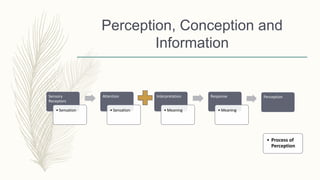
Sensory
Receptors
• Sensation
Attention
• Sensation
Interpretation
• Meaning
Response
• Meaning
Perception
• Process of
Perception
Perception
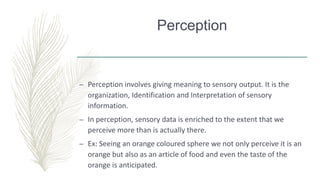
– Perception involves giving meaning to sensory output. It is the
organization, Identification and Interpretation of sensory
information.
– In perception, sensory data is enriched to the extent that we
perceive more than is actually there.
– Ex: Seeing an orange coloured sphere we not only perceive it is an
orange but also as an article of food and even the taste of the
orange is anticipated.
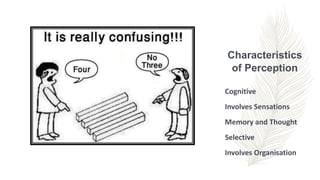
Characteristics
of Perception
Cognitive
Involves Sensations
Memory and Thought
Selective
Involves Organisation
Conception
– Conception is an inferred mental process.
– It is a mental construct or mental image of the object.
– It is an abstraction of inferred experience or information processing.
– Concept information provide students with an opportunity to explore ideas by
making connections and seeing relationships between items of information.
– Conception help students to develop and refine their abilities to recall and
discriminate among key ideas to see commonalities and identify relationship
Information
– When data is processed, organized, structured or presented in a given context
so as to make it useful is called information
– Data that is
– Accurate
– Specific and organized for a purpose
– Presented within a context that gives it meaning and relevance and
– Can lead to an increase in understanding and decrease in uncertainty
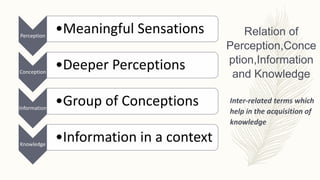
Relation of
Perception,Conce
ption,Information
and Knowledge
Perception
•Meaningful Sensations
Conception
•Deeper Perceptions
Information
•Group of Conceptions
Knowledge
•Information in a context
Inter-related terms which
help in the acquisition of
knowledge
Sources of Knowledge
(Empirical Knowledge)
– Knowledge through Sense Experience
– We can know many things about the external world, and their characteristics
through our senses i.e., by seeing, smelling, touching, tasting and hearing. But we
can commit mistake while perceiving things around us through our senses. For
example, we may mistake a rope for a snake which is known as perceptual error.
Here, it is not our senses that have deceived us but the error in the judgement.
– When we make a perceptual error owing to incomplete or fragmentary sense
experience, it is always further sense experiences that lead us to discover our error.
For example, one can get closer and confirm whether it is a rope or a snake.
Knowledge through Reason
– This type of knowledge is arrived at by means of reasoning, for example
2+2=4.There are two types of reasoning which serve as the source of
knowledge: deductive and inductive.
– In a deductive reasoning, the conclusion logically follows from the premises. If
the premises are true, the conclusion that follows must be true.
– For example, If it is raining, the streets will be wet.
– It is raining.
– Therefore, the streets will be wet.
Sources of Knowledge
In a valid argument, the premises need not be true; it is only required that the conclusion
follow logically from the premises. For example,
All cows are green. She is a cow. Therefore, she is green.
In this example, the argument is valid, i.e. conclusion follows from the premises. But the
premises are not true. Therefore, the conclusion arrived at is also not true.
Sometimes, the premises may be true, but there may not be valid arguments. For example,
India is a democratic country. 2 plus 2 equals 4. Therefore, he is-driving the car.
In the above example, the conclusion does not follow from the premises, although all
premises happen to be true.
Hence, in order to know that a conclusion is true, we have to know that the premises are true
and the argument is valid i.e. the conclusion follows logically from the premises.
Sources of Knowledge
– In inductive reasoning, the premises provide evidences for the conclusion- but not complete
evidence. The conclusion is not certain but only probable to a certain degree. For example,

Crow 1 is black. Crow 2 is black. Crow 3 is black, (and so on for 10,000 crows or more than
that) Therefore, all crows are black.
– Here, though10,000 premises where crow being black are true, the conclusion is not
established. It is always possible; the next crow, which we may come across, might be white.
– In inductive reasoning, truth is established based on earlier evidences for something, which is
not observed. In an inductive argument, we rely on certain laws of nature, which are
formulated based on certain recurring uniformities in the course of our experience. For
example, Green plants prepare their own food. Water vapourises on heating. Metals
expand when heated.
– In an inductive reasoning, the conclusion is not certain but only probable.
Sources of Knowledge
Authority
– It is not a primary source of knowledge where one experiences knowledge through one’s own
reasoning or sense experiences. We accept certain things as true on the basis of authority.
Following precautions have to be observed in the case of knowledge coming from authority:
– The person must really be an authority, one who is a specialist in his field of knowledge.
– Whenever one accepts another person’s statement on authority, he should be able to find out for
himself or verify the knowledge. For example, we can empirically check the truth of Einstein’s
theory of relativity, though it would take years of special training and experimentation.
– The authority should be able to provide evidential proof for the knowledge he possesses and
present a logical explain
– The knowledge claimed by the authority should have acceptance by the other experts in that area.
Sources of Knowledge
(Revealed Knowledge)
– Revelation: This source has the same problem as intuition. Sometimes one claims to know
something by means of revelation. For example, “It was revealed to me in a dream” (or a
vision). What if one person had a vision that told him one thing, and another person had a
vision that told him the opposite? The fact that the person had a dream or a vision, does not
show that its message is true or can be trusted. If what it says is true, its truth can be
discovered only by other means.
– Faith: This source of knowledge overlaps the previous one having the same problems. “I know
this through faith”; “I have faith in it, so it must be true”; “I believe it through faith, and this
faith gives me knowledge”. It is an attitude of belief in something in the absence of evidence.
What feeling or attitude one has towards the belief, and whether that belief is true, are two
very different things. So it cannot be a valid source of knowledge.
Sources of Knowledge
– Knowledge through Tenacity
– Tenacity is something, which psychologically force the people to accept it.
– the slogans of various political parties, advertisement of different commercial
products, and repetitive propaganda for something. When such things are
repeated many times in media such as in newspapers, televisions, or even in
rallies, people believe them to be true.
– But the problem with getting knowledge through tenacity is that we do not
know the claim made is true or not, and we also do not know when the
knowledge received can be validated.
Knowledge has
been classified into
different forms
based on different
conceptualisations
A priori Knowledge
A Posteriori Knowledge
Experienced Knowledge
Para Vidya
Apara Vidya
Classification of Knowledge
A priori Knowledge: It is a knowledge whose truth or falsity can be
decided before or without recourse to experience (a priori means
‘before’).
– Knowledge that is A priori has universal validity and once
recognized as true (through the use of pure reason) does not
require any further evidence. Logical and Mathematical truths are
a priori in nature. They do not stand in need of empirical
validations.
– Example: “All bachelors are unmarried” is A priori knowledge, you
need not have experienced the unmarried status but you have this
Classification of Knowledge
– A Posteriori Knowledge: This knowledge based upon observation and
experience and it stresses on accurate observation and exact description. The
propositions that fall under this category can be looked from the point of view
of whether they contain any factual content and from the standpoint of the
criteria employed for deciding their truth or falsity.
– For example, we have propositions like: Ice melts. Snow is white. Metals
conduct heat and electricity. These propositions give us factual information
whose truth or falsity can be decided only through observation and verification.
– Experienced Knowledge: This form of knowledge is always tentative and
cannot exist prior to experience or be concluded from observation. It must be
experienced to have value.
SUM UP
– Epistemology is that branch of philosophy, which deals with theories, sources, and the validity
of knowledge.
– Knowledge is expressed in the form of propositions. In order to know a proposition is true,
one must know the words involved in the propositions and the concepts underlying the words.
– There are certain requirements for knowing a proposition, that is, a) the p must be true,
b) we believe that p is true and c) there is evidence or reason to believe p. Knowledge is
categorized broadly into three divisions depending upon the ways it is obtained.
They are a) Apriori knowledge, b) Aposteriori knowledge and c) Experienced knowledge.
– Following are the sources of knowing: sense experience, reason, authority, intuition, faith and
revelation. Among these, the knowledge through sense experience and reasoning were
considered to be the most reliable sources of knowledge.
Disciplinary Knowledge
What is a Discipline?
– An academic investigation of the concept of ‘disciplinarity’ starts off with an
exploration of the etymology of the term ‘discipline’. The term‘ discipline’
originates from the Latin word ‘discipulus’- which means pupil, and ‘disciplina’
- which means teaching(noun).
– As a verb it means training someone to follow a rigorous set of instructions, but
also enforcing obedience (Krishnan, 2009).
– A discipline is an organised body of knowledge with a logical structure. It is a
network of concepts and generalisations which explain the relationships among
a body of facts.
Characteristics of a
Discipline
Every discipline has a history. It implies the development of that particular discipline and
the chronology of its growth and modification.
Each discipline has certain domain of knowledge (cognitive, affective and psychomotor).
– Discipline has a particular object of research, though the object of research may be
shared with another discipline.
– Discipline has a substantial body of knowledge and research, which is specific to it and
not generally shared with another discipline.
– Discipline has theories and concepts that organise the accumulated knowledge
effectively.
– Discipline has developed specific research methods according to its specific research
requirements
It is an individual understanding of
a subject matter, concept and how
these concepts relate to form large
body of knowledge.
Concept of Disciplinary Knowledge
What Constitutes a Discipline?
– Discipline has its own characteristics.
– It has a substantial body of knowledge, based upon which researches are conducted
– A discipline is always dynamic in nature.
– The followers of a discipline conduct research and further develop that discipline
from time to time.
– Very often,there are examples of emergence of many new disciplines from the parent
discipline like;‘Nano Technology’from the discipline of ‘Physics’, ‘Microbiology’from
the discipline of ‘Biology’,‘Biochemistry’from the discipline of‘Chemistry’etc.
– A discipline has also philosophical, historical and political bases/perspectives
Activity
Relating to your discipline of study and teaching at
school, suggest sources and ways of acquiring
knowledge in that discipline and pedagogies for
effective transaction of learning experiences.
Nature of Disciplinary
Knowledge
– It includes knowledge of all three essential elements of a discipline.
 A domain or structure
 A set of guiding rules
 A history
 Example: For languages structure include phonics, narrations etc.
 Rules includes rules for formation of a sentence, usage of noun, verbs etc.
 History of English language
– Knowledge in different disciplines is gained through specialized techniques.
– Awareness of the most common misconceptions
– Differ in disciplinary knowledge and beliefs
– Stereotype
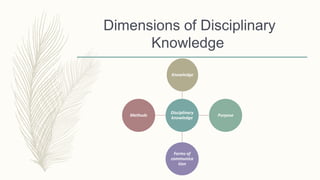
– Four dimensions of Disciplinary Knowledge
a) Knowledge: Key elements, concepts,relationships, theories of particular discipline.
b)Method: Modes of inquiry, ways of effective communication
c)Purpose: goals that drive disciplinary inquiry
d) Forms of Communication: Disciplinary language
Nature of Disciplinary
Knowledge
Dimensions of Disciplinary
Knowledge
Disciplinary
knowledge
Knowledge
Purpose
Forms of
communica
tion
Methods
– Intradisciplinary: working within a single discipline.
– Crossdisciplinary: viewing one discipline from the perspective of
another.
– Multidisciplinary: people from different disciplines working
together, each drawing on their disciplinary knowledge.
– Interdisciplinary: integrating knowledge and methods from
different disciplines, using a real synthesis of approaches.
– Transdisciplinary: creating a unity of intellectual frameworks
beyond the disciplinary perspectives.
Alternative Concepts
Course Content Knowledge
Content knowledge
Knowledge about the content to be taught, its
insertion in a disciplinary field, its theoretical-
practical implications and the relation with the other
disciplines. It generally refers to the facts, concepts,
theories and principles that are taught and learned
in a particular discipline. It is essential for teaching
practice because the teaching process necessarily
starts in a circumstance in which the teacher
understands what should be learned and how it
should be taught. The full mastery of the specific
content expands the possibilities of teacher
intervention and its shortage restricts the routes to
be followed in teaching.
Criteria of Selection
– Fit with your course learning goals
– Have importance in the discipline
– Be based on or related to research
– Appeal to student interests
– Not overlap excessively with student past experience or knowledge
– Be multi-functional (help teach more than one concept, skill, or problem)
– Stimulate search for meaning
– Encourage further investigation
– Show interrelationships amongst concepts
– Validity and Utility
– Relevance to present situations
Organization of Content
– Topic by topic – There are no set relationships amongst the topics, so the ordering is
not critical. This works well for courses that revolve around current issues, for
example.
– Chronological – Moving from past to present is a very common and easy to
implement organizational pattern.
– Causal – The course presents a number of events or issues that culminate in some
final effect or solution.
– Cumulative – Each concept builds on the previous one(s).
– Problem-centred – Problems, questions, or cases represent the principal
organizing features of the course.
– Spiral – Key topics or concepts are revisited throughout the course, with new
information or insight developing each time.
Indigenous Knowledge
– Local or Indigenous Knowledge refers to cumulative and complex bodies of
knowledge, know-how, practices and representations that are maintained and
developed by local communities, who have long histories of interaction with the
natural environment (UNESCO,2012).
– Forms of Indigenous Knowledge
– Medicine
– Folk Traditions
– Traditional knowledge through proverbs
Indigenous Knowledge
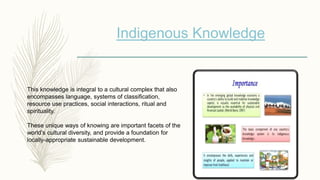
This knowledge is integral to a cultural complex that also
encompasses language, systems of classification,
resource use practices, social interactions, ritual and
spirituality.
These unique ways of knowing are important facets of the
world’s cultural diversity, and provide a foundation for
locally-appropriate sustainable development.
Scientific Knowledge
– Scientific knowledge is based on empirical evidence and is appropriate for
understanding the natural world.
– It provides only a limited understanding of the supernatural, aesthetic, or
other ways of knowing, such as art, philosophy, or religion.
– Scientific knowledge is durable and robust but open to change.
– Because science is based on empirical evidence scientists strive for
objectivity.
– But as it is a human endeavor, the processes, methods, and knowledge of
science include subjectivity, as well as creativity and discovery.
Main Characteristics of
Scientific Knowledge
– 1. Objectivity 2. Verifiability 3. Ethical Neutrality 4. Systematic Exploration 5.
Reliability 6. Precision 7. Accuracy 8. Abstractness 9. Predictability.
– 1. Objectivity:
– Scientific knowledge is objective. Objectivity simple means the ability to see
and accept facts as they are, not as one might wish them to be. To be objective,
one has to guard against his own biases, beliefs, wishes, values and preferences.
Objectivity demands that one must set aside all sorts of the subjective
considerations and prejudices.
Characteristics of Scientific
Knowledge
– 2. Verifiability:
– Science rests upon sense data, i.e., data gathered through our senses—eye, ear, nose, tongue
and touch. Scientific knowledge is based on verifiable evidence (concrete factual
observations) so that other observers can observe, weigh or measure the same phenomena
and check out observation for accuracy.
– 3. Ethical Neutrality:
– Science is ethically neutral. It only seeks knowledge. How this knowledge is to be used, is
determined by societal values. Knowledge can be put to differing uses. Knowledge about
atomic energy can be used to cure diseases or to wage atomic warfare.
– Ethical neutrality does not mean that the scientist has no values. It here only means that he
must not allow his values to distort the design and conduct of his research. Thus, scientific
knowledge is value-neutral or value- free.
Construction of Knowledge
through Dialogue
– Communication is an important tool to construct and transfer knowledge
among learners.
– Communication includes non-verbal forms such as gestures, smiles, and frowns
and verbal forms such as dialogue, talk, and speeches.
– Types of dialogue, discussion, and social interaction patterns influence how
knowledge is constructed.
Types of Dialogue
– Schwarz, Dreyfus and Hersh kowits (2004) proposed several kinds of classroom
dialogues, such as grounding dialogue, critical dialogue, and reflective dialogue.
– In grounding dialogue, the teacher presents a topic and students share
common knowledge.
– In critical dialogue, students challenge each other’s views, understand and
accommodate divergent viewpoints, and develop new ideas, and the teacher
supports students’ argumentation and knowledge construction.
– In reflective dialogue, students integrate and generalize accepted arguments.
They recapitulate actions and draw lessons from their experiences and the
teacher helps students draw conclusions.
– In reflection, experience is re-thought in order for the perspective to change
and the practice to improve.
Contestations to Knowledge
– Education for all declares that everyone has a right to education. Its aim is to give
everyone a chance to learn and benefit from basic education not as an accident of
circumstances, or as a privilege but as a right.
– Knowledge contestations are specific areas of knowledge where multiple competing
truth claims vie for legitimacy . There is a shift from a universal perception and
understanding and later explanation to an issue, thus culminating always into a
debate.
– ‘Dominance’ as a Contestation
– ‘Marginalisation’ as a Contestation
– ‘Subversion’ as a Contestation
– Contestation to knowledge is the study of conflict between the human thought and
the social context within which it arises and to see the effects prevailing ideas on
societies.
– Knowledge is usually associated with power in the social context. Those who have
power, they also have the authority to confine knowledge to themselves or restrict
others to have it.
– Dominance : Dominant groups create disparities among the society by controlling
the value system and giving privilege to their own kind. There can be dominance of
caste, class, gender, region or language.
– Marginalization : It can be done economically, socially, politically or
culturally. Groups were forced or pushed to the edge of the society and were
restrained to gain knowledge.
– Subversion : It is the process by which the value and principles of a system are
reversed. it is basically an attack on public morale.
Contestations to Knowledge
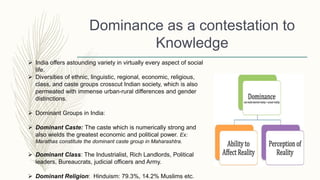
Dominance as a contestation to
Knowledge
 India offers astounding variety in virtually every aspect of social
life.
 Diversities of ethnic, linguistic, regional, economic, religious,
class, and caste groups crosscut Indian society, which is also
permeated with immense urban-rural differences and gender
distinctions.
 Dominant Groups in India:
 Dominant Caste: The caste which is numerically strong and
also wields the greatest economic and political power. Ex:
Marathas constitute the dominant caste group in Maharashtra.
 Dominant Class: The Industrialist, Rich Landlords, Political
leaders, Bureaucrats, judicial officers and Army.
 Dominant Religion: Hinduism: 79.3%, 14.2% Muslims etc.
Marginalization
– The process of pushing specific groups of people to the lower or outer edge of
the society economically, politically, culturally and socially following the process
of exclusion.
– Peter Leonard defines marginality as, “. . . being outside the mainstream of
productive activity and/or social reproductive activity”.
– ‘To be marginalized is to be placed in the margins, and thus excluded from the
privilege and power found at the center”.
Characteristics of Minority groups
 It suffers from discrimination and subordination.
 They have physical and/or cultural traits that set them apart, and which are
disapproved of, by a dominant group.
 They share a sense of collective identity and common burdens.
 They have shared social rules about who belongs, and who does not.
 They have a tendency to marry within the group.
Various Marginalized Groups
Subversion
– Subversion refers to an attempt to overthrow structures of authority, including
the state. It is an overturning or uprooting.
– Subversive activity: Subversive activity is the lending of aid, comfort, and moral
support to individuals, groups, or organizations that advocate the overthrow of
incumbent governments by force and violence.
– All willful acts that are intended to be detrimental to the best interests of the
government
– Subversive behavior: Subversive behavior is to undermine somebody with
various trick (lies, cheats, backstabbing, false advice etc...) where the intent or
goal is not visible at all.
Subversive Groups
– Political groups: A planned series of activities designed to accomplish political
objectives by influencing, dominating or displacing individuals or groups who
are so placed as to affect the decisions and actions of another Government.
– Regional groups: when they demand a separating country or region for
themselves. They use armed rebellion to pose a threat to the stability of the
Indian Federation. For Ex: Naxalites, Maoists who demand a separate state.
– Terrorist groups: Actions taken by terrorists may have subversive effect on
society
THANK YOU

Meaning, sources, types and contestation to knowledge

  • 1.
  • 2.
    Meaning of Knowledge –Derivative Meaning: 'Epistemology' comes from the Greek words 'episteme' meaning Knowledge and logos meaning discourse or science. – Epistemology is one of the branches of philosophy, which is concerned with the theory of knowledge. It solves two fundamental problems of knowledge– origin of knowledge and validation of knowledge
  • 3.
    Concept of Knowledge Knowledgeincludes the fact or condition of knowing which is gained through experience or association. Further, knowledge is understood in terms of enlightenment. The Indian philosophy believes it as breaking the veil of ignorance.
  • 4.
    Definitions of Knowledge –Plato has examined three definitions of knowledge which are as under: – Knowledge is perception or sensation; – Knowledge is true belief; – Knowledge is true belief accompanied by a rational ground. – Plato finally called knowledge as ‘Justified truth’. – Dewey denotes knowledge as ‘inference from truth’.
  • 5.
    – The NationalCurriculum Framework (2005), while placing the experience of the knower at centre, also defined knowledge. – According to it, “Knowledge can be conceived as experience organized through language into patterns of thought (or structures of concepts), thus creating meaning, which in turn helps us to understand the world we live in. It can also be conceived of as patterns of activity, or physical dexterity with thought, contributing to acting in the world, and the creating and making of things. Human beings over a time have evolved many bodies of knowledge, which include a repertoire of ways of thinking, of feeling and of doing things, and constructing more knowledge (P.25).” Definitions of Knowledge
  • 6.
    Inference from Definition –According to the most widely accepted definition, – knowledge is justified true belief. – It is a kind of belief is supported by the fact that both knowledge and belief can have the same objects and that what is true of someone who believes something to be the case is also true, among other things, of one who knows it. – For example, sun rises in the east is the knowledge or true belief that is supported by the fact which is arrived at through daily observations for millions of years by people.
  • 7.
    Nature of Knowledge –Abstract nature of Knowledge : Knowledge is shared understanding; be it justified truth or agreement between two ideas. This attributes to the abstract nature of knowledge. – Social nature of Knowledge: Knowledge is socially shared understanding, as it is developed through collective pursuit of the community members of the society. Individuals acquire a great deal of knowledge from their own experience; simultaneously they build up the knowledge through association with fellow humans. Therefore, the knowledge is acquired and built up only in society, and its roots lies in the social activities of man. – Knowledge is Cumulative: It is cumulative in nature because it is socially preserved and transmitted from one generation to the future generations. It is continuous to grow and develop in generations with the help of new understanding of reality, knowledge of the reality
  • 8.
    – Knowledge isBoth Limited and Limitless: The cumulative character of knowledge also informs us both limit and limitless nature of knowledge. At any particular stage in the development of humanity, knowledge comes up against limits set by the limited character of available experience and by the existing means in obtaining knowledge. In other words, the known is always bounded by the unknown but not the unknowable. – Knowledge is always on Probation – Knowledge meets our daily requirements – Means to reach the truth Nature of Knowledge
  • 9.
    Perception, Conception and Information Sensory Receptors •Sensation Attention • Sensation Interpretation • Meaning Response • Meaning Perception • Process of Perception
  • 10.
    Perception – Perception involvesgiving meaning to sensory output. It is the organization, Identification and Interpretation of sensory information. – In perception, sensory data is enriched to the extent that we perceive more than is actually there. – Ex: Seeing an orange coloured sphere we not only perceive it is an orange but also as an article of food and even the taste of the orange is anticipated.
  • 11.
    Characteristics of Perception Cognitive Involves Sensations Memoryand Thought Selective Involves Organisation
  • 12.
    Conception – Conception isan inferred mental process. – It is a mental construct or mental image of the object. – It is an abstraction of inferred experience or information processing. – Concept information provide students with an opportunity to explore ideas by making connections and seeing relationships between items of information. – Conception help students to develop and refine their abilities to recall and discriminate among key ideas to see commonalities and identify relationship
  • 13.
    Information – When datais processed, organized, structured or presented in a given context so as to make it useful is called information – Data that is – Accurate – Specific and organized for a purpose – Presented within a context that gives it meaning and relevance and – Can lead to an increase in understanding and decrease in uncertainty
  • 14.
    Relation of Perception,Conce ption,Information and Knowledge Perception •MeaningfulSensations Conception •Deeper Perceptions Information •Group of Conceptions Knowledge •Information in a context Inter-related terms which help in the acquisition of knowledge
  • 15.
    Sources of Knowledge (EmpiricalKnowledge) – Knowledge through Sense Experience – We can know many things about the external world, and their characteristics through our senses i.e., by seeing, smelling, touching, tasting and hearing. But we can commit mistake while perceiving things around us through our senses. For example, we may mistake a rope for a snake which is known as perceptual error. Here, it is not our senses that have deceived us but the error in the judgement. – When we make a perceptual error owing to incomplete or fragmentary sense experience, it is always further sense experiences that lead us to discover our error. For example, one can get closer and confirm whether it is a rope or a snake.
  • 16.
    Knowledge through Reason –This type of knowledge is arrived at by means of reasoning, for example 2+2=4.There are two types of reasoning which serve as the source of knowledge: deductive and inductive. – In a deductive reasoning, the conclusion logically follows from the premises. If the premises are true, the conclusion that follows must be true. – For example, If it is raining, the streets will be wet. – It is raining. – Therefore, the streets will be wet. Sources of Knowledge
  • 17.
    In a validargument, the premises need not be true; it is only required that the conclusion follow logically from the premises. For example, All cows are green. She is a cow. Therefore, she is green. In this example, the argument is valid, i.e. conclusion follows from the premises. But the premises are not true. Therefore, the conclusion arrived at is also not true. Sometimes, the premises may be true, but there may not be valid arguments. For example, India is a democratic country. 2 plus 2 equals 4. Therefore, he is-driving the car. In the above example, the conclusion does not follow from the premises, although all premises happen to be true. Hence, in order to know that a conclusion is true, we have to know that the premises are true and the argument is valid i.e. the conclusion follows logically from the premises. Sources of Knowledge
  • 18.
    – In inductivereasoning, the premises provide evidences for the conclusion- but not complete evidence. The conclusion is not certain but only probable to a certain degree. For example, Crow 1 is black. Crow 2 is black. Crow 3 is black, (and so on for 10,000 crows or more than that) Therefore, all crows are black. – Here, though10,000 premises where crow being black are true, the conclusion is not established. It is always possible; the next crow, which we may come across, might be white. – In inductive reasoning, truth is established based on earlier evidences for something, which is not observed. In an inductive argument, we rely on certain laws of nature, which are formulated based on certain recurring uniformities in the course of our experience. For example, Green plants prepare their own food. Water vapourises on heating. Metals expand when heated. – In an inductive reasoning, the conclusion is not certain but only probable. Sources of Knowledge
  • 19.
    Authority – It isnot a primary source of knowledge where one experiences knowledge through one’s own reasoning or sense experiences. We accept certain things as true on the basis of authority. Following precautions have to be observed in the case of knowledge coming from authority: – The person must really be an authority, one who is a specialist in his field of knowledge. – Whenever one accepts another person’s statement on authority, he should be able to find out for himself or verify the knowledge. For example, we can empirically check the truth of Einstein’s theory of relativity, though it would take years of special training and experimentation. – The authority should be able to provide evidential proof for the knowledge he possesses and present a logical explain – The knowledge claimed by the authority should have acceptance by the other experts in that area. Sources of Knowledge (Revealed Knowledge)
  • 20.
    – Revelation: Thissource has the same problem as intuition. Sometimes one claims to know something by means of revelation. For example, “It was revealed to me in a dream” (or a vision). What if one person had a vision that told him one thing, and another person had a vision that told him the opposite? The fact that the person had a dream or a vision, does not show that its message is true or can be trusted. If what it says is true, its truth can be discovered only by other means. – Faith: This source of knowledge overlaps the previous one having the same problems. “I know this through faith”; “I have faith in it, so it must be true”; “I believe it through faith, and this faith gives me knowledge”. It is an attitude of belief in something in the absence of evidence. What feeling or attitude one has towards the belief, and whether that belief is true, are two very different things. So it cannot be a valid source of knowledge. Sources of Knowledge
  • 21.
    Sources of Knowledge –Knowledge through Tenacity – Tenacity is something, which psychologically force the people to accept it. – the slogans of various political parties, advertisement of different commercial products, and repetitive propaganda for something. When such things are repeated many times in media such as in newspapers, televisions, or even in rallies, people believe them to be true. – But the problem with getting knowledge through tenacity is that we do not know the claim made is true or not, and we also do not know when the knowledge received can be validated.
  • 22.
    Knowledge has been classifiedinto different forms based on different conceptualisations A priori Knowledge A Posteriori Knowledge Experienced Knowledge Para Vidya Apara Vidya
  • 23.
    Classification of Knowledge Apriori Knowledge: It is a knowledge whose truth or falsity can be decided before or without recourse to experience (a priori means ‘before’). – Knowledge that is A priori has universal validity and once recognized as true (through the use of pure reason) does not require any further evidence. Logical and Mathematical truths are a priori in nature. They do not stand in need of empirical validations. – Example: “All bachelors are unmarried” is A priori knowledge, you need not have experienced the unmarried status but you have this
  • 24.
    Classification of Knowledge –A Posteriori Knowledge: This knowledge based upon observation and experience and it stresses on accurate observation and exact description. The propositions that fall under this category can be looked from the point of view of whether they contain any factual content and from the standpoint of the criteria employed for deciding their truth or falsity. – For example, we have propositions like: Ice melts. Snow is white. Metals conduct heat and electricity. These propositions give us factual information whose truth or falsity can be decided only through observation and verification. – Experienced Knowledge: This form of knowledge is always tentative and cannot exist prior to experience or be concluded from observation. It must be experienced to have value.
  • 25.
    SUM UP – Epistemologyis that branch of philosophy, which deals with theories, sources, and the validity of knowledge. – Knowledge is expressed in the form of propositions. In order to know a proposition is true, one must know the words involved in the propositions and the concepts underlying the words. – There are certain requirements for knowing a proposition, that is, a) the p must be true, b) we believe that p is true and c) there is evidence or reason to believe p. Knowledge is categorized broadly into three divisions depending upon the ways it is obtained. They are a) Apriori knowledge, b) Aposteriori knowledge and c) Experienced knowledge. – Following are the sources of knowing: sense experience, reason, authority, intuition, faith and revelation. Among these, the knowledge through sense experience and reasoning were considered to be the most reliable sources of knowledge.
  • 26.
    Disciplinary Knowledge What isa Discipline? – An academic investigation of the concept of ‘disciplinarity’ starts off with an exploration of the etymology of the term ‘discipline’. The term‘ discipline’ originates from the Latin word ‘discipulus’- which means pupil, and ‘disciplina’ - which means teaching(noun). – As a verb it means training someone to follow a rigorous set of instructions, but also enforcing obedience (Krishnan, 2009). – A discipline is an organised body of knowledge with a logical structure. It is a network of concepts and generalisations which explain the relationships among a body of facts.
  • 27.
    Characteristics of a Discipline Everydiscipline has a history. It implies the development of that particular discipline and the chronology of its growth and modification. Each discipline has certain domain of knowledge (cognitive, affective and psychomotor). – Discipline has a particular object of research, though the object of research may be shared with another discipline. – Discipline has a substantial body of knowledge and research, which is specific to it and not generally shared with another discipline. – Discipline has theories and concepts that organise the accumulated knowledge effectively. – Discipline has developed specific research methods according to its specific research requirements
  • 28.
    It is anindividual understanding of a subject matter, concept and how these concepts relate to form large body of knowledge. Concept of Disciplinary Knowledge
  • 29.
    What Constitutes aDiscipline? – Discipline has its own characteristics. – It has a substantial body of knowledge, based upon which researches are conducted – A discipline is always dynamic in nature. – The followers of a discipline conduct research and further develop that discipline from time to time. – Very often,there are examples of emergence of many new disciplines from the parent discipline like;‘Nano Technology’from the discipline of ‘Physics’, ‘Microbiology’from the discipline of ‘Biology’,‘Biochemistry’from the discipline of‘Chemistry’etc. – A discipline has also philosophical, historical and political bases/perspectives
  • 30.
    Activity Relating to yourdiscipline of study and teaching at school, suggest sources and ways of acquiring knowledge in that discipline and pedagogies for effective transaction of learning experiences.
  • 31.
    Nature of Disciplinary Knowledge –It includes knowledge of all three essential elements of a discipline.  A domain or structure  A set of guiding rules  A history  Example: For languages structure include phonics, narrations etc.  Rules includes rules for formation of a sentence, usage of noun, verbs etc.  History of English language
  • 32.
    – Knowledge indifferent disciplines is gained through specialized techniques. – Awareness of the most common misconceptions – Differ in disciplinary knowledge and beliefs – Stereotype – Four dimensions of Disciplinary Knowledge a) Knowledge: Key elements, concepts,relationships, theories of particular discipline. b)Method: Modes of inquiry, ways of effective communication c)Purpose: goals that drive disciplinary inquiry d) Forms of Communication: Disciplinary language Nature of Disciplinary Knowledge
  • 33.
  • 34.
    – Intradisciplinary: workingwithin a single discipline. – Crossdisciplinary: viewing one discipline from the perspective of another. – Multidisciplinary: people from different disciplines working together, each drawing on their disciplinary knowledge. – Interdisciplinary: integrating knowledge and methods from different disciplines, using a real synthesis of approaches. – Transdisciplinary: creating a unity of intellectual frameworks beyond the disciplinary perspectives. Alternative Concepts
  • 35.
    Course Content Knowledge Contentknowledge Knowledge about the content to be taught, its insertion in a disciplinary field, its theoretical- practical implications and the relation with the other disciplines. It generally refers to the facts, concepts, theories and principles that are taught and learned in a particular discipline. It is essential for teaching practice because the teaching process necessarily starts in a circumstance in which the teacher understands what should be learned and how it should be taught. The full mastery of the specific content expands the possibilities of teacher intervention and its shortage restricts the routes to be followed in teaching.
  • 36.
    Criteria of Selection –Fit with your course learning goals – Have importance in the discipline – Be based on or related to research – Appeal to student interests – Not overlap excessively with student past experience or knowledge – Be multi-functional (help teach more than one concept, skill, or problem) – Stimulate search for meaning – Encourage further investigation – Show interrelationships amongst concepts – Validity and Utility – Relevance to present situations
  • 37.
    Organization of Content –Topic by topic – There are no set relationships amongst the topics, so the ordering is not critical. This works well for courses that revolve around current issues, for example. – Chronological – Moving from past to present is a very common and easy to implement organizational pattern. – Causal – The course presents a number of events or issues that culminate in some final effect or solution. – Cumulative – Each concept builds on the previous one(s). – Problem-centred – Problems, questions, or cases represent the principal organizing features of the course. – Spiral – Key topics or concepts are revisited throughout the course, with new information or insight developing each time.
  • 38.
    Indigenous Knowledge – Localor Indigenous Knowledge refers to cumulative and complex bodies of knowledge, know-how, practices and representations that are maintained and developed by local communities, who have long histories of interaction with the natural environment (UNESCO,2012). – Forms of Indigenous Knowledge – Medicine – Folk Traditions – Traditional knowledge through proverbs
  • 39.
    Indigenous Knowledge This knowledgeis integral to a cultural complex that also encompasses language, systems of classification, resource use practices, social interactions, ritual and spirituality. These unique ways of knowing are important facets of the world’s cultural diversity, and provide a foundation for locally-appropriate sustainable development.
  • 40.
    Scientific Knowledge – Scientificknowledge is based on empirical evidence and is appropriate for understanding the natural world. – It provides only a limited understanding of the supernatural, aesthetic, or other ways of knowing, such as art, philosophy, or religion. – Scientific knowledge is durable and robust but open to change. – Because science is based on empirical evidence scientists strive for objectivity. – But as it is a human endeavor, the processes, methods, and knowledge of science include subjectivity, as well as creativity and discovery.
  • 41.
    Main Characteristics of ScientificKnowledge – 1. Objectivity 2. Verifiability 3. Ethical Neutrality 4. Systematic Exploration 5. Reliability 6. Precision 7. Accuracy 8. Abstractness 9. Predictability. – 1. Objectivity: – Scientific knowledge is objective. Objectivity simple means the ability to see and accept facts as they are, not as one might wish them to be. To be objective, one has to guard against his own biases, beliefs, wishes, values and preferences. Objectivity demands that one must set aside all sorts of the subjective considerations and prejudices.
  • 42.
    Characteristics of Scientific Knowledge –2. Verifiability: – Science rests upon sense data, i.e., data gathered through our senses—eye, ear, nose, tongue and touch. Scientific knowledge is based on verifiable evidence (concrete factual observations) so that other observers can observe, weigh or measure the same phenomena and check out observation for accuracy. – 3. Ethical Neutrality: – Science is ethically neutral. It only seeks knowledge. How this knowledge is to be used, is determined by societal values. Knowledge can be put to differing uses. Knowledge about atomic energy can be used to cure diseases or to wage atomic warfare. – Ethical neutrality does not mean that the scientist has no values. It here only means that he must not allow his values to distort the design and conduct of his research. Thus, scientific knowledge is value-neutral or value- free.
  • 43.
    Construction of Knowledge throughDialogue – Communication is an important tool to construct and transfer knowledge among learners. – Communication includes non-verbal forms such as gestures, smiles, and frowns and verbal forms such as dialogue, talk, and speeches. – Types of dialogue, discussion, and social interaction patterns influence how knowledge is constructed.
  • 44.
    Types of Dialogue –Schwarz, Dreyfus and Hersh kowits (2004) proposed several kinds of classroom dialogues, such as grounding dialogue, critical dialogue, and reflective dialogue. – In grounding dialogue, the teacher presents a topic and students share common knowledge. – In critical dialogue, students challenge each other’s views, understand and accommodate divergent viewpoints, and develop new ideas, and the teacher supports students’ argumentation and knowledge construction. – In reflective dialogue, students integrate and generalize accepted arguments. They recapitulate actions and draw lessons from their experiences and the teacher helps students draw conclusions. – In reflection, experience is re-thought in order for the perspective to change and the practice to improve.
  • 45.
    Contestations to Knowledge –Education for all declares that everyone has a right to education. Its aim is to give everyone a chance to learn and benefit from basic education not as an accident of circumstances, or as a privilege but as a right. – Knowledge contestations are specific areas of knowledge where multiple competing truth claims vie for legitimacy . There is a shift from a universal perception and understanding and later explanation to an issue, thus culminating always into a debate. – ‘Dominance’ as a Contestation – ‘Marginalisation’ as a Contestation – ‘Subversion’ as a Contestation
  • 46.
    – Contestation toknowledge is the study of conflict between the human thought and the social context within which it arises and to see the effects prevailing ideas on societies. – Knowledge is usually associated with power in the social context. Those who have power, they also have the authority to confine knowledge to themselves or restrict others to have it. – Dominance : Dominant groups create disparities among the society by controlling the value system and giving privilege to their own kind. There can be dominance of caste, class, gender, region or language. – Marginalization : It can be done economically, socially, politically or culturally. Groups were forced or pushed to the edge of the society and were restrained to gain knowledge. – Subversion : It is the process by which the value and principles of a system are reversed. it is basically an attack on public morale. Contestations to Knowledge
  • 47.
    Dominance as acontestation to Knowledge  India offers astounding variety in virtually every aspect of social life.  Diversities of ethnic, linguistic, regional, economic, religious, class, and caste groups crosscut Indian society, which is also permeated with immense urban-rural differences and gender distinctions.  Dominant Groups in India:  Dominant Caste: The caste which is numerically strong and also wields the greatest economic and political power. Ex: Marathas constitute the dominant caste group in Maharashtra.  Dominant Class: The Industrialist, Rich Landlords, Political leaders, Bureaucrats, judicial officers and Army.  Dominant Religion: Hinduism: 79.3%, 14.2% Muslims etc.
  • 48.
    Marginalization – The processof pushing specific groups of people to the lower or outer edge of the society economically, politically, culturally and socially following the process of exclusion. – Peter Leonard defines marginality as, “. . . being outside the mainstream of productive activity and/or social reproductive activity”. – ‘To be marginalized is to be placed in the margins, and thus excluded from the privilege and power found at the center”.
  • 49.
    Characteristics of Minoritygroups  It suffers from discrimination and subordination.  They have physical and/or cultural traits that set them apart, and which are disapproved of, by a dominant group.  They share a sense of collective identity and common burdens.  They have shared social rules about who belongs, and who does not.  They have a tendency to marry within the group. Various Marginalized Groups
  • 50.
    Subversion – Subversion refersto an attempt to overthrow structures of authority, including the state. It is an overturning or uprooting. – Subversive activity: Subversive activity is the lending of aid, comfort, and moral support to individuals, groups, or organizations that advocate the overthrow of incumbent governments by force and violence. – All willful acts that are intended to be detrimental to the best interests of the government – Subversive behavior: Subversive behavior is to undermine somebody with various trick (lies, cheats, backstabbing, false advice etc...) where the intent or goal is not visible at all.
  • 51.
    Subversive Groups – Politicalgroups: A planned series of activities designed to accomplish political objectives by influencing, dominating or displacing individuals or groups who are so placed as to affect the decisions and actions of another Government. – Regional groups: when they demand a separating country or region for themselves. They use armed rebellion to pose a threat to the stability of the Indian Federation. For Ex: Naxalites, Maoists who demand a separate state. – Terrorist groups: Actions taken by terrorists may have subversive effect on society
  • 52.