The document discusses the characteristics of homogeneous and heterogeneous distributed databases, detailing their operational differences. Homogeneous databases have identical software across sites while heterogeneous databases face challenges due to varying schemas and software, complicating query and transaction processing. The document also describes types of heterogeneous databases, specifically federated and un-federated systems, highlighting their integration and access methods.
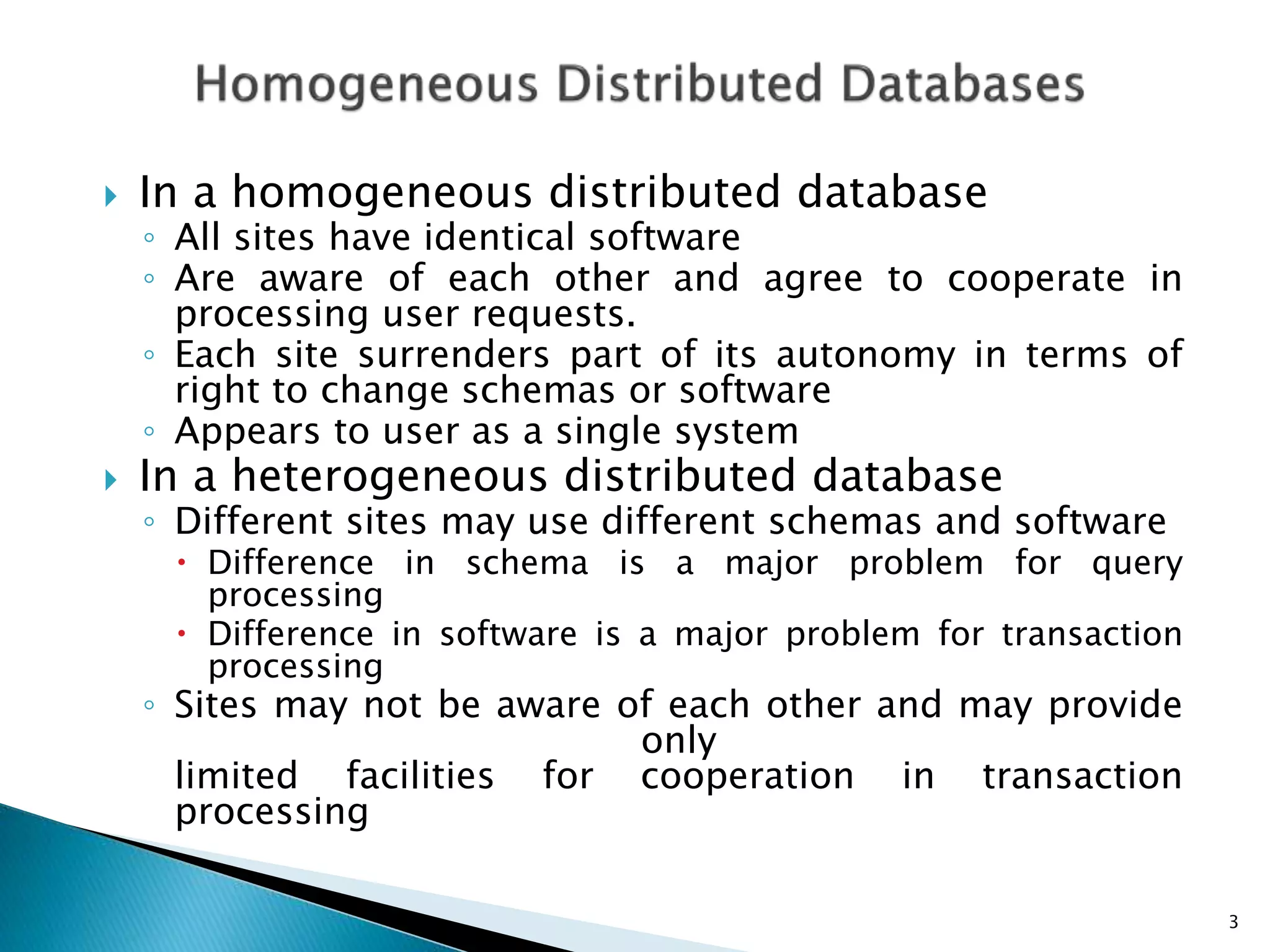
In ahomogeneous distributed database
◦ All sites have identical software
◦ Are aware of each other and agree to cooperate in
processing user requests.
◦ Each site surrenders part of its autonomy in terms of
right to change schemas or software
◦ Appears to user as a single system
In a heterogeneous distributed database
◦ Different sites may use different schemas and software
Difference in schema is a major problem for query
processing
Difference in software is a major problem for transaction
processing
◦ Sites may not be aware of each other and may provide
only
limited facilities for cooperation in transaction
processing
3
4.
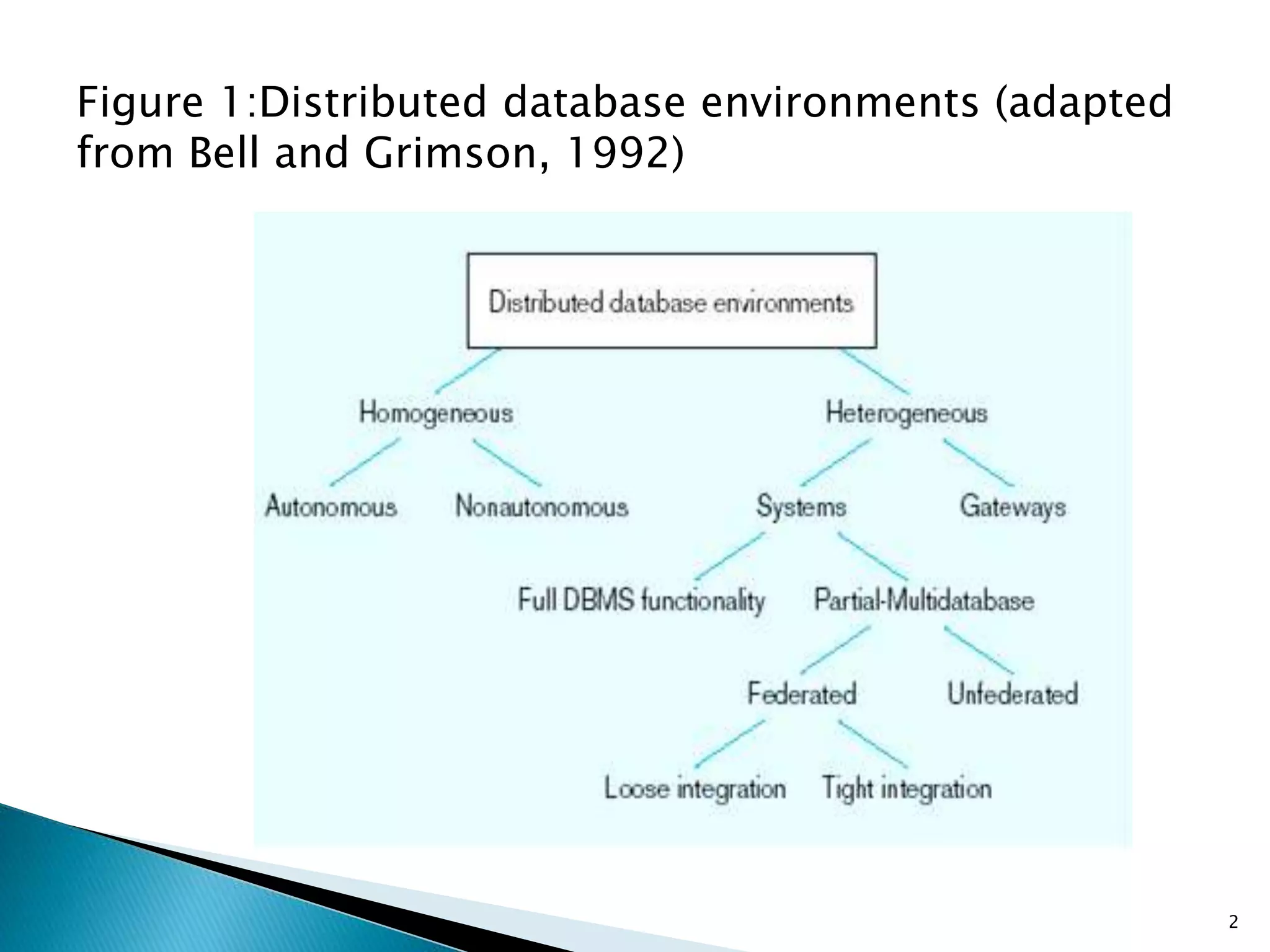
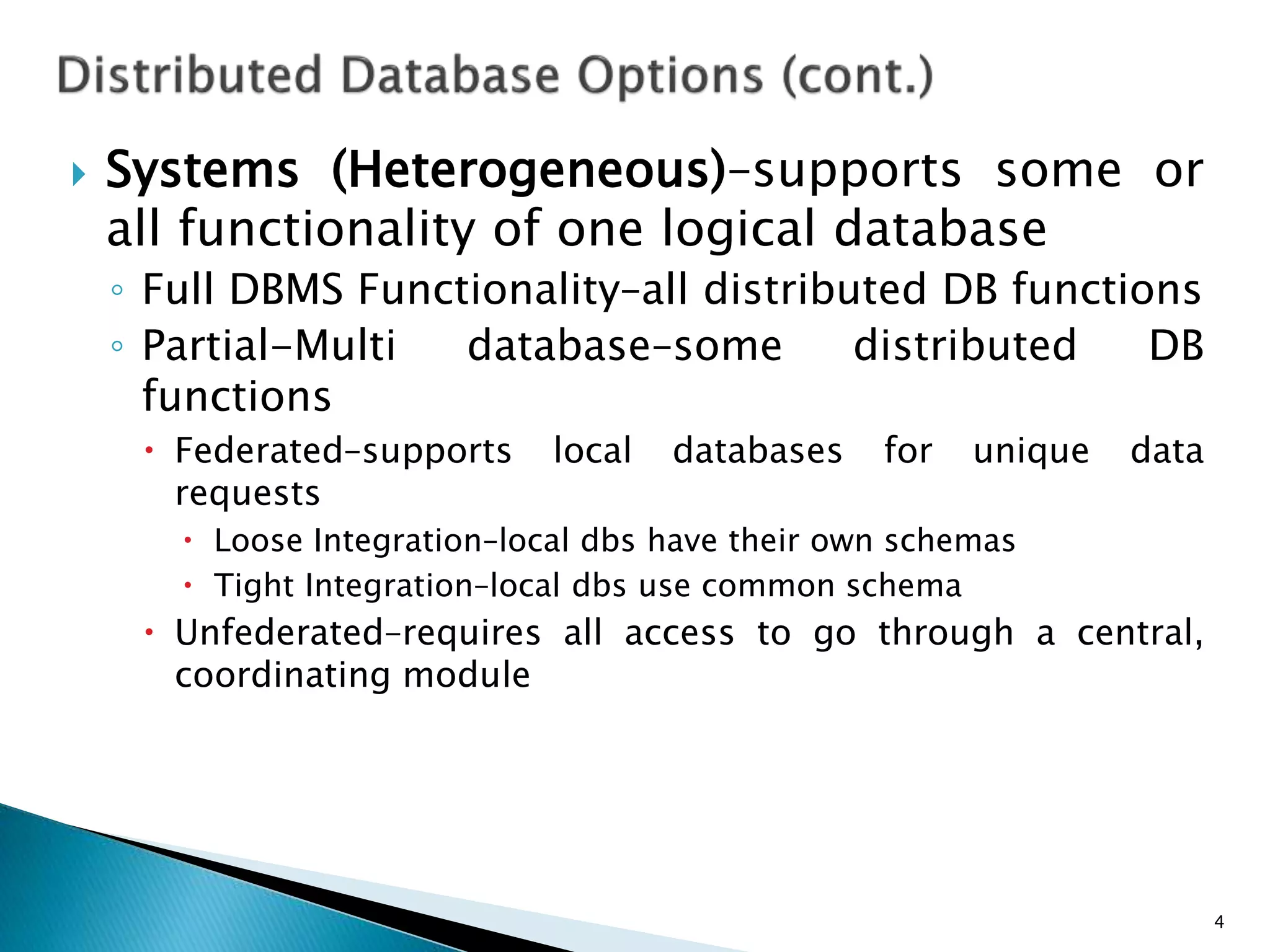
Systems (Heterogeneous)–supportssome or
all functionality of one logical database
◦ Full DBMS Functionality–all distributed DB functions
◦ Partial-Multi database–some distributed DB
functions
Federated–supports local databases for unique data
requests
Loose Integration–local dbs have their own schemas
Tight Integration–local dbs use common schema
Unfederated–requires all access to go through a central,
coordinating module
4
5.
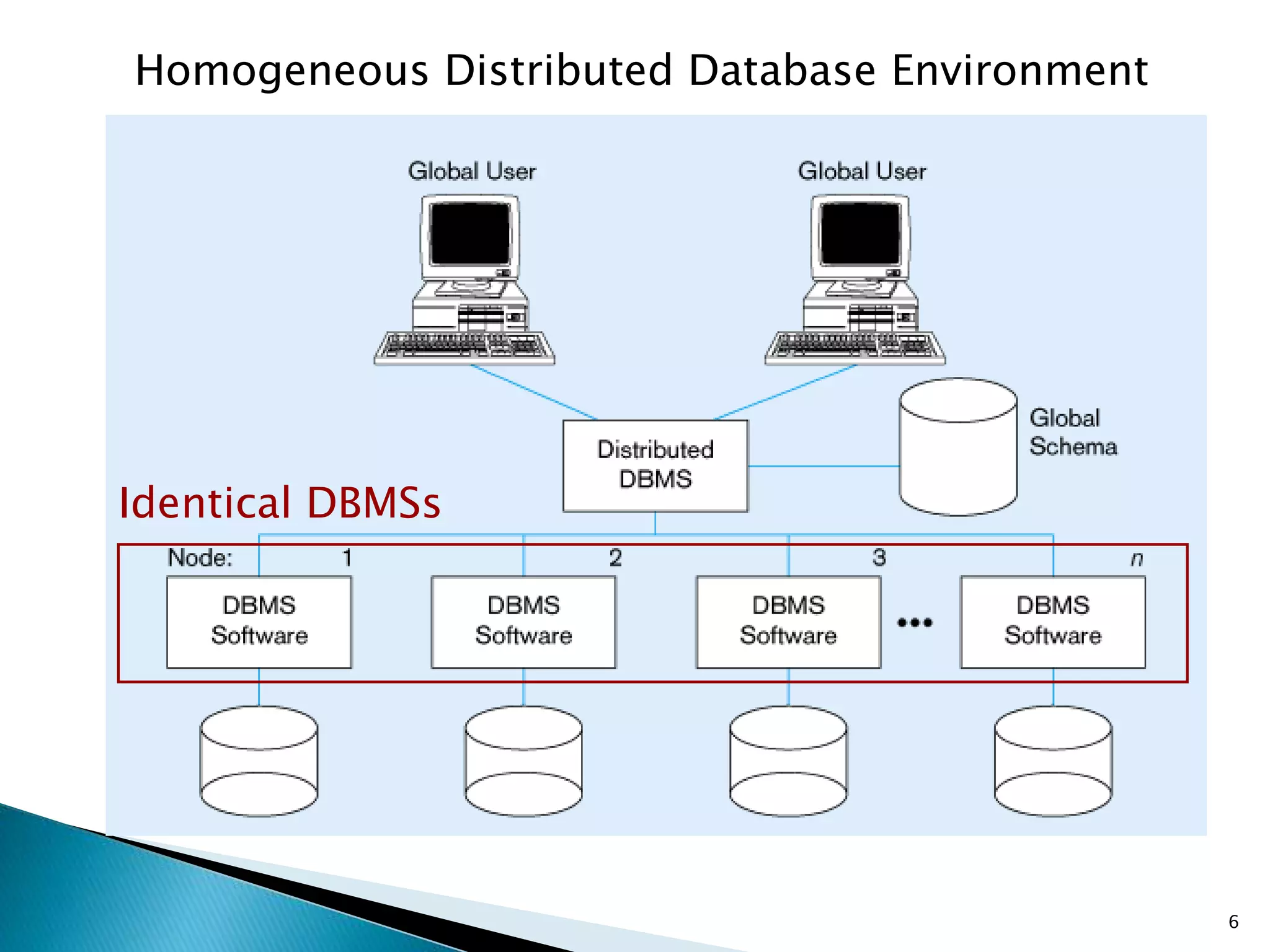
Data isdistributed across all the nodes
Same DBMS at each node
All data is managed by the distributed DBMS
(no exclusively local data)
All access is through one, global schema
The global schema is the union of all the local
schema
5
Data distributedacross all the nodes
Different DBMSs may be used at each node
Local access is done using the local DBMS and
schema
Remote access is done using the global
schema
7
8.
Location Transparency
◦User does not have to know the location of the
data
◦ Data requests automatically forwarded to
appropriate sites
Local Autonomy
◦ Local site can operate with its database when
network connections fail
◦ Each site controls its own data, security,
logging, recovery
8
9.
In aheterogeneous distributed database, different sites have
different operating systems, DBMS products and data models.
Its properties are −
Different sites use dissimilar schemas and software.
The system may be composed of a variety of DBMSs like
relational, network, hierarchical or object oriented.
Query processing is complex due to dissimilar schemas.
Transaction processing is complex due to dissimilar software.
A site may not be aware of other sites and so there is limited
co-operation in processing user requests.
Types of Heterogeneous Distributed Databases
Federated − The heterogeneous database systems are
independent in nature and integrated together so that they
function as a single database system.
Un-federated − The database systems employ a central
coordinating module through which the databases are
accessed.
9