How To Read A Head CT
Scan
Ahsan Aziz
Assistant Registrar, NIMH
Scheme Of The Topic
• Basic Principles of CT scan
• Normal Neuroanatomy as seen on head CT
scan
• How to describe a CT head
• Some abnormal tomography
BASIC PRINCIPLES OF
CT SCAN
History
• Sir Godfrey Hounsfield- introduced CT scan in
1972
• Won Nobel prize in 1979
Parts
1) Gantry- which houses X ray apparatus
2) X ray tube-akin to that in a X ray machine.
3) Detectors
4) Patient couch
5) Viewing console
Principle
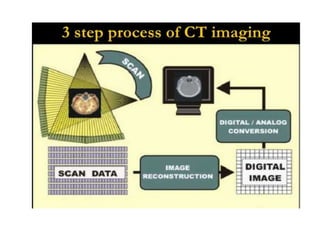
• Uses X rays applied in sequence of slices
across the organ
• Images reconstructed from X ray absorption
data
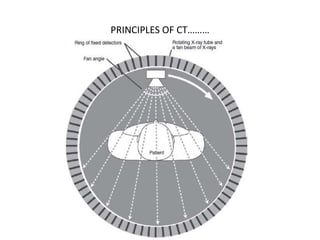
• X ray beam moves around the patient in a
circular path
PRINCIPLES OF CT………
PRINCIPLE…..
• CT scan provides a 3D display of the
intracranial anatomy built up from a vertical
series of transverse axial tomograms.
• Each tomogram represents a horizontal slice
through the patient’s head.
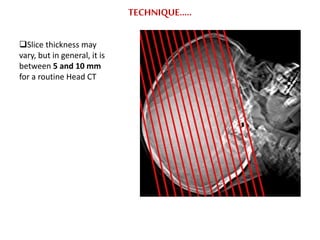
TECHNIQUE…..
Slice thickness may
vary, but in general, it is
between 5 and 10 mm
for a routine Head CT
CT Planes
Axial Plane Coronal Plane Sagittal Plane
BASICS….
• X-RAYS ARE ABSORBED TO DIFFERENT DEGREES BY
DIFFERENT TISSUES (rays pass freely through air but
not through bone)
• Always describe CT findings as densities-
isodense/hypodense/hyperdense.
• Higher the density = whiter is the appearance
• Lower the density = darker the appearance
• Brain is the reference density
• Anything of the density as brain= isodense
• Higher density than brain= hyperdense ( Bone is the
best example)
• Anything darker (lower density) than brain=
hypodense (CSF and air are classical examples)
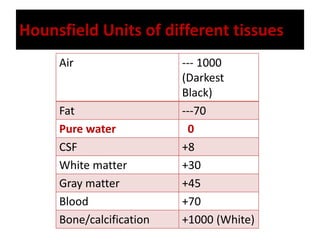
HOUNSFIELD UNITS
• CT scanners record the attenuation (brightness)
of each pixel in Hounsfield Units (HU)
• Related to composition & nature of tissue
• Represent the density of tissue
• Also called as CT NUMBER
• Marks between -1000 to +1000
• More negative more black, more positive more
white
Hounsfield Units of different tissues
Air --- 1000
(Darkest
Black)
Fat ---70
Pure water 0
CSF +8
White matter +30
Gray matter +45
Blood +70
Bone/calcification +1000 (White)
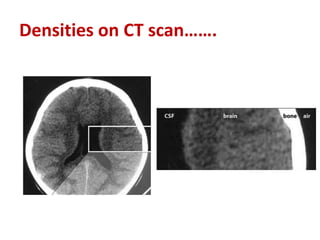
Densities on CT scan…….
NORMAL NEUROANATOMY AS
SEEN ON HEAD CT SCANS
AXIAL SECTIONS OF CT HEAD
POSTERIOR FOSSA CUTS
-Above the foramen magnum level
-Level of fourth ventricle
-Above the fourth ventricle level
-Tentorial
SUPRATENTORIAL CUTS
-Third ventricular level
-Lateral ventricular level
-Above the corpus callosum
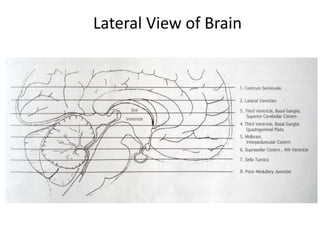
Lateral View of Brain
NORMAL ANATOMY…….
A= ORBIT , B= SPHENOID SINUS , C= TEMPORAL LOBE, D=EXTERNAL AUDITORY CANAL
E= MASTOID AIR CELLS F= CEREBELLAR HEMISPHERES
NORMAL ANATOMY…….
A=Frontal Lobe, B= Frontal Bone (Superior Surface of Orbital Part), C= Dorsum Sellae,
D=Basilar Artery E= Temporal Lobe F= Mastoid Air Cells G=Cerebellar Hemisphere
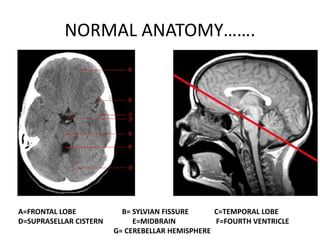
NORMAL ANATOMY…….
A=FRONTAL LOBE B= SYLVIAN FISSURE C=TEMPORAL LOBE
D=SUPRASELLAR CISTERN E=MIDBRAIN F=FOURTH VENTRICLE
G= CEREBELLAR HEMISPHERE
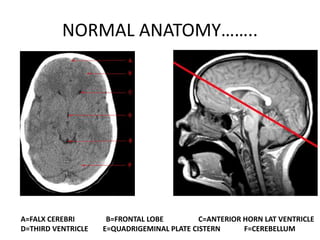
NORMAL ANATOMY……..
A=FALX CEREBRI B=FRONTAL LOBE C=ANTERIOR HORN LAT VENTRICLE
D=THIRD VENTRICLE E=QUADRIGEMINAL PLATE CISTERN F=CEREBELLUM
NORMAL ANATOMY……..
A=ANTERIOR HORN LAT VENTRICLE B=CAUDATE NUCLEUS C=ANT LIMB INT CAPSULE
D=GLOBUS PALLIDUS AND PUTAMEN E=POST LIMB INT CAPSULE F=THIRD VENTRICLE
G=QUADRIGEMINAL PLATE CISTERN H=CEREBELLAR VERMIS I=OCCIPITAL LOBE
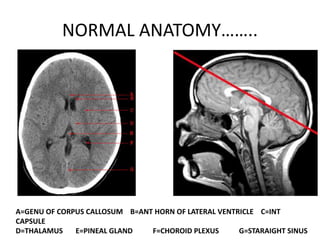
NORMAL ANATOMY……..
A=GENU OF CORPUS CALLOSUM B=ANT HORN OF LATERAL VENTRICLE C=INT
CAPSULE
D=THALAMUS E=PINEAL GLAND F=CHOROID PLEXUS G=STARAIGHT SINUS
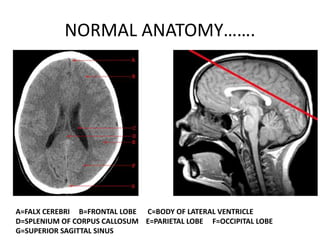
NORMAL ANATOMY…….
A=FALX CEREBRI B=FRONTAL LOBE C=BODY OF LATERAL VENTRICLE
D=SPLENIUM OF CORPUS CALLOSUM E=PARIETAL LOBE F=OCCIPITAL LOBE
G=SUPERIOR SAGITTAL SINUS
NORMAL ANATOMY……..
A=FALX CEREBRI B=SULCUS C=GYRUS D=SUPERIOR SAGGITAL SINUS
Normal neuroanatomical Shapes
to Identify distortions
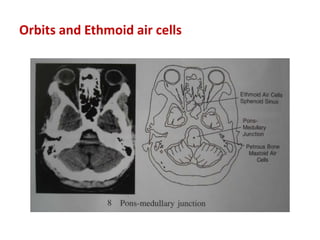
Orbits and Ethmoid air cells
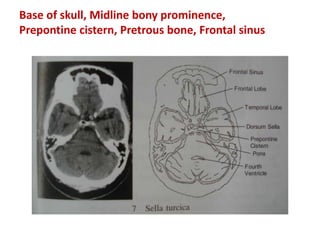
Base of skull, Midline bony prominence,
Prepontine cistern, Pretrous bone, Frontal sinus
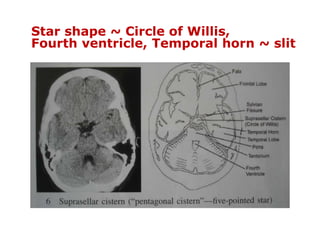
Star shape ~ Circle of Willis,
Fourth ventricle, Temporal horn ~ slit
Midbrain and interpeduncular Cistern (Heart shaped)
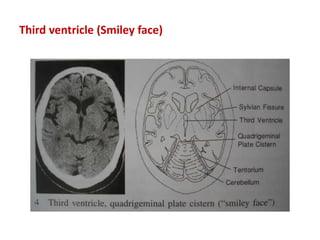
Third ventricle (Smiley face)
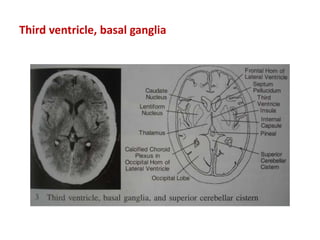
Third ventricle, basal ganglia
Body of lateral ventricle (Twin banana)
Reading a CT Head
Outside to Inside steps
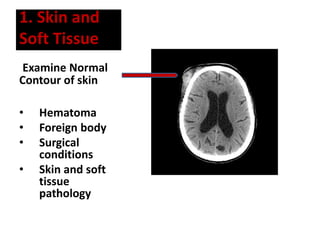
1. Skin and
Soft Tissue
Examine Normal
Contour of skin
• Hematoma
• Foreign body
• Surgical
conditions
• Skin and soft
tissue
pathology
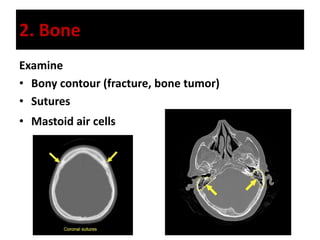
2. Bone
Examine
• Bony contour (fracture, bone tumor)
• Sutures
• Mastoid air cells
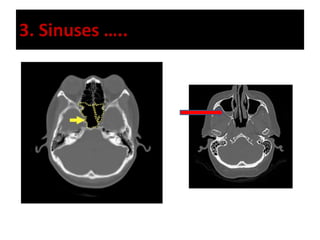
3. Sinuses
Evaluate
• Superior sagittal sinus
• Frontal sinus
• Ethmoid sinus
• Sphenoid sinus
• Maxillary sinus
3. Sinuses …..
• Look for
• Sinusitis
• Mucosal thickening
• Blood in sinus (Traumatic)
• Mucous retention cyst and polyp
3. Sinuses …..
4. Sulci
Identify
• Sulci
• Sylvian fissure
• Central sulcus
• Post central sulcus
• Precentral sulcus
Sulci will be deeper with age
Blood in sulcus is important
4. Sulci…..
5. Brain parenchyma
Identify lobes
Frontal, Parietal, Temporal, Occipital
Identify structures
Midbrain, Pons, Medulla, cerebellum
Identify deep structures
Corpus callosum, Caudate nucleus, Lentiform
nucleus, Thalamus, Internal capsule
5. Brain parenchyma….
Look for
• Symmetry between both sides
• Gray and white matter differentiation
• Change in density
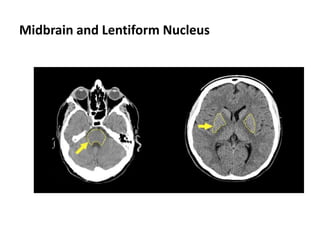
Midbrain and Lentiform Nucleus
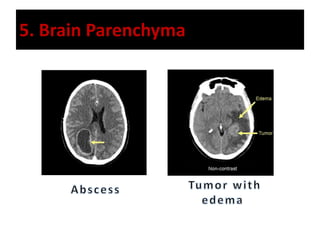
5. Brain Parenchyma
5. Brain Parenchyma….
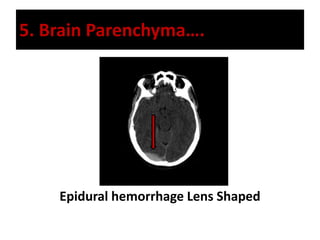
Epidural hemorrhage Lens Shaped
5. Brain Parenchyma….
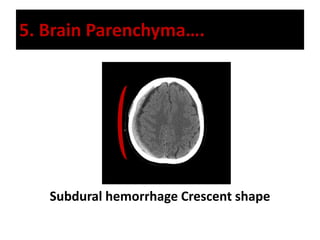
Subdural hemorrhage Crescent shape
5. Brain Parenchyma….
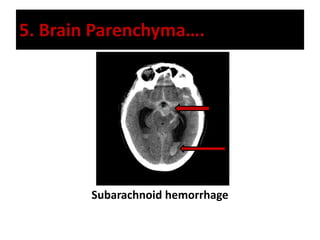
Subarachnoid hemorrhage
5. Brain Parenchyma….
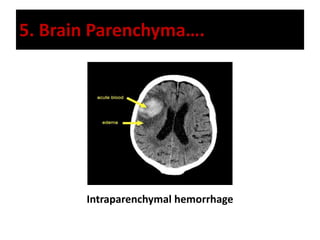
Intraparenchymal hemorrhage
6. Cisterns
Identify cisterns
Supraseller, Ambient, Prepontine, Cisterna
magna
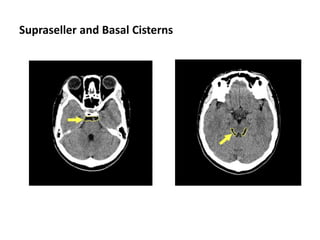
Cisterns can be filled with blood in subarachnoid
hemorrhage
Supraseller and Basal Cisterns
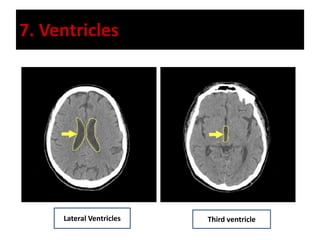
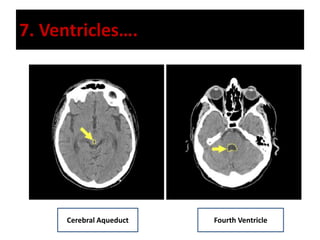
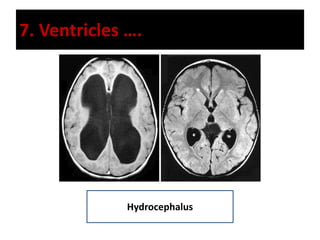
7. Ventricles
Identify ventricles
Evaluate for any change in
• Size
• Shape
• Symmetry
• Density
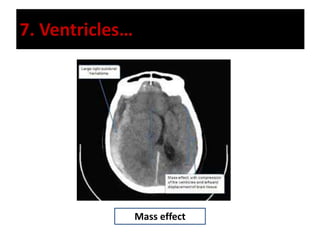
• Mass effect
7. Ventricles
Lateral Ventricles Third ventricle
7. Ventricles….
Cerebral Aqueduct Fourth Ventricle
7. Ventricles ….
Hydrocephalus
7. Ventricles…
Mass effect
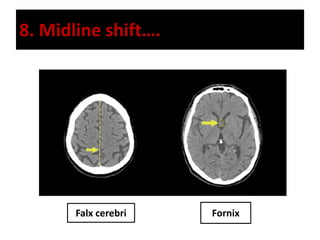
8. Midline shift
Identify midline structures
• Falx Cerebri and Fornix
• Pineal Gland
• Great vein of Galen
8. Midline shift….
Falx cerebri Fornix
8. Midline shift…
Pineal Gland
(Calcified)
Great vein of
Galen
8. Midline shift…
1. Select a slide where both lateral ventricles are
prominent.
2. Draw a line joining falx cerebri anteriorly and
posteriorly.
3. The septum between ventricles should not deviate
more than 5mm from midline.
8. Midline shift…
Prominent ventricles Draw a midline
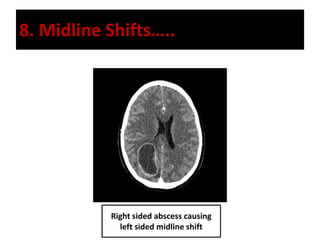
8. Midline Shifts…..
Right sided abscess causing
left sided midline shift
Recap
1. Skin and Soft tissue
2. Bony contour
3. Sinuses
4. Sulci
5. Brain parenchyma
6. Cisterns
7. Ventricles
8. Midline shift
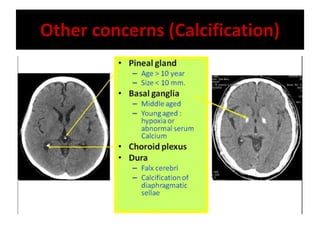
Other concerns (Calcification)
Indication of Head CT scan..(Absolute)
• GCS less than 10 any time following head injury
• Skull fracture
• Blood or CSF coming out of nose, ear, or panda eye following
injury
• Sudden severe headache
• Headache with vomiting (Exclude migraine and tension type
headache)
• Focal neurological sign (paralysis, cranial nerve palsy etc.)
• First Seizure after 20 years of age or not responding to anti-
epileptic drugs
• First episode of psychosis
CT or MRI scan?
Depends on suspected pathology
CT is better in
 Bone pathology
 Acute hemorrhagic conditions
MRI is better in
 Posterior fossa pathology (Brainstem and cerebellum)
 White matter disease
 Better gray and white matter differentiation
 Orbital or aural cavity pathology
Prefer CT scan in …
• Acute trauma or bony fracture
• Calcified lesions
• Suspected acute intracerebral hemorrhage
• Suspected subarachnoid hemorrhage
Prefer MRI scan in…
• Arteriovenous malformations
• Epilepsy and adult onset seizures
• Hemangiomas
• Hydrocephalus
• Infection / Inflammation
• Infratentorial tumors
• Lacunar infarcts
• Lyme disease
Prefer MRI in…
• Meningioma
• Multiple sclerosis
• Orbit and optical nerve disease
• Pituitary dysfunction
• Posterior fossa abnormality
• Space occupying lesion
• Stroke (use Diffusion weighted MRI)
Prefer MRI in…
• Syringomyelia
• Vascular abnormalities
• White matter disease
Further reading for those who are
interested
• Window level and width (to fix density of
image)
• Contrast CT scan
Reference
• Osborn Diagnostic Imaging (Brain), 1st edition
• Radiology in Medical Practice by Prof. A. B. M.
Abdullah
• Head and Neck Imaging, 4th edition
• Fundamentals of Diagnostic Radiology, 4th edition
How To Read A Head CT Scan

How To Read A Head CT Scan