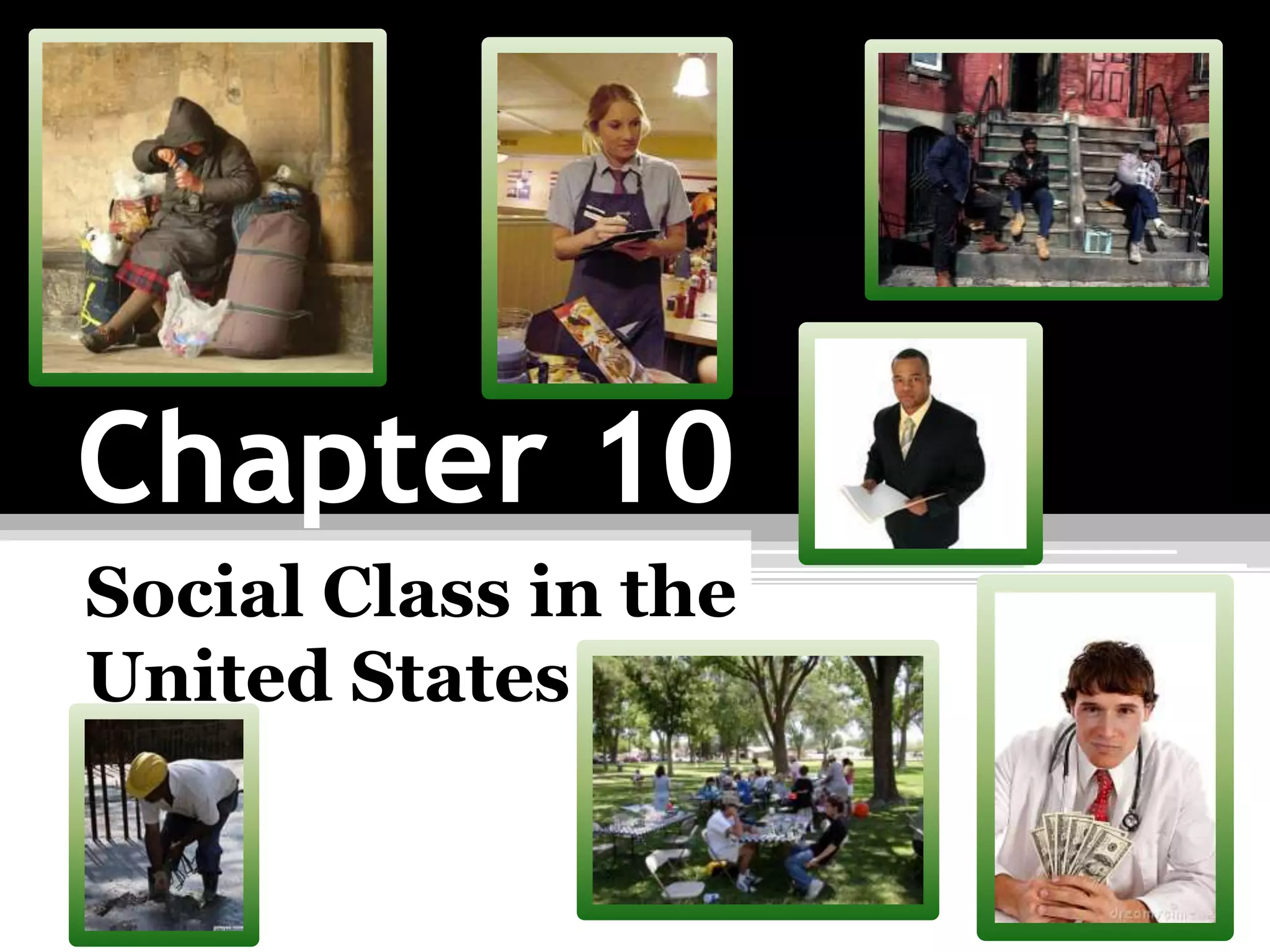
Chapter 10Social Class in the United States
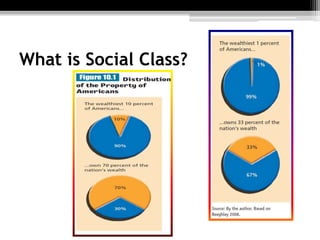
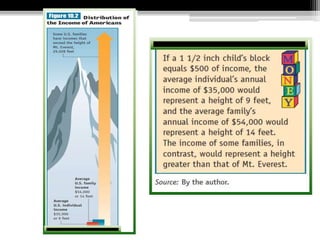
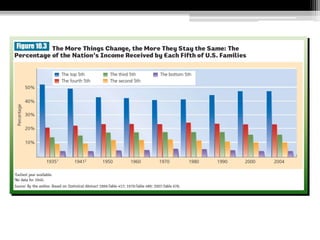
What is Social Class?Social Class– according to Weber, a large group of people who rank close to on another in property, prestige, and power; according to Marx, one of two groups: capitalist who own the means of production or the workers who sell their labor.Property – material possessions Wealth  - the total value of everything someone owns, minus the debtsIncome – money received, usually from a job, business, or assets
What is Social Class?Power – the ability to carry out your will, even over the resistance of othersPower Elite – C. Wright Mills’ term for the top people in U.S. Corporations, Military, and Politics who make the nation’s major decisionsPrestige – respect or regard
What is Social Class?
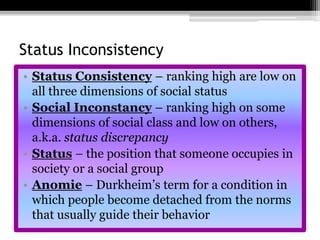
Status InconsistencyStatus Consistency – ranking high are low on all three dimensions of social statusSocial Inconstancy – ranking high on some dimensions of social class and low on others, a.k.a. status discrepancyStatus – the position that someone occupies in society or a social groupAnomie – Durkheim’s term for a condition in which people become detached from the norms that usually guide their behavior
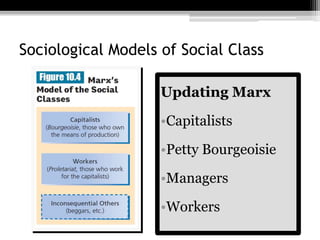
Sociological Models of Social ClassUpdating MarxCapitalistsPetty BourgeoisieManagersWorkers
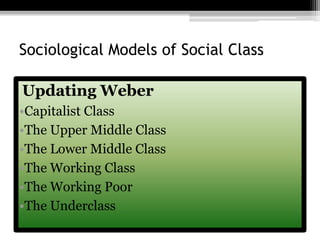
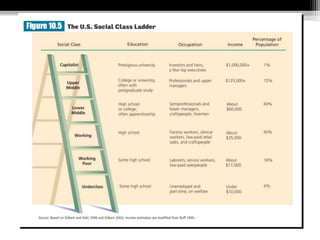
Sociological Models of Social ClassUpdating WeberCapitalist ClassThe Upper Middle ClassThe Lower Middle ClassThe Working ClassThe Working PoorThe Underclass
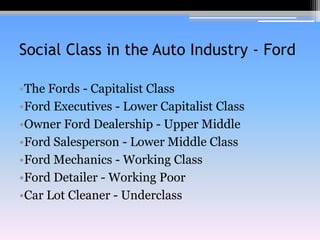
Social Class in the Auto Industry - FordThe Fords - Capitalist ClassFord Executives - Lower Capitalist ClassOwner Ford Dealership - Upper MiddleFord Salesperson - Lower Middle ClassFord Mechanics - Working ClassFord Detailer - Working PoorCar Lot Cleaner - Underclass
Consequences of Social ClassPhysical HealthMental Health Family LifeChoices of Husbands and WivesDivorceChild RearingEducationReligionPoliticsCrime and the Judicial SystemSocial Class and the Changing Economy
Social Mobility – 3 typesIntergenerational Mobility– the change that family members make in social class from one generation to the nextUpward Social Mobility – movement up the social class ladderDownward Social Mobility – movement down the social class ladderStructural Mobility – movement up or down the social ladder because of changes in the structure of society, not to individual effortsExchange Mobility – about the same numbers of people moving up and down the social class ladder, such that, on balance, the social class system shows little change
Interpreting Statistics on Social MobilityApple Doesn’t Fall Far From TreeThe Pain of Social Mobility
PovertyPoverty Line – the official measure of poverty; calculated to include incomes that are less than three times a low-cost food budgetFeminization of Poverty – a trend in U.S. poverty whereby most poor families are headed by omen
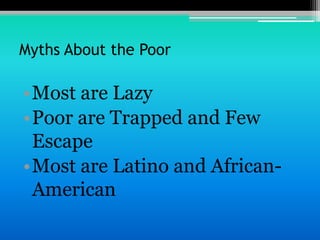
Myths About the PoorMost are LazyPoor are Trapped and Few EscapeMost are Latino and African-American
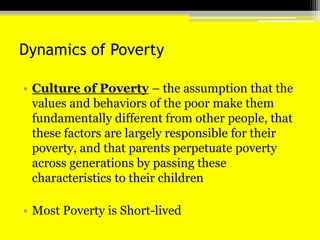
Dynamics of PovertyCulture of Poverty – the assumption that the values and behaviors of the poor make them fundamentally different from other people, that these factors are largely responsible for their poverty, and that parents perpetuate poverty across generations by passing these characteristics to their children Most Poverty is Short-lived
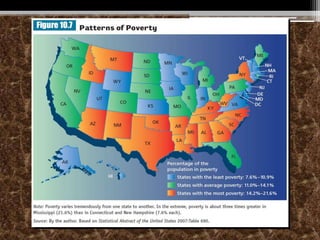
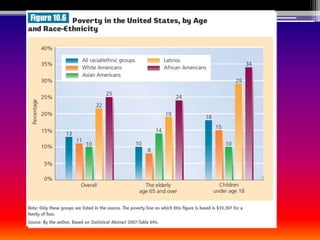
Who are the poor?Poverty is unequally distributed in the U.S.. Racial Ethnic minorities (except Asian Americans), children, women-headed households, and rural Americans are more likely than others to be poor.  The poverty rate of the elderly is less that that of the general population.
Why are people poor?Some social analysts believe that characteristics of individuals cause poverty.  Sociologists, in contrast, examine structural features of society, such as employment opportunities, to find the causes of poverty.  Sociologists generally conclude that life orientations are a consequence, not the cause, of people’s position in the social class structure.
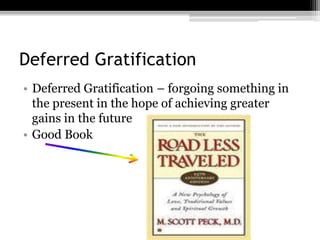
Deferred GratificationDeferred Gratification – forgoing something in the present in the hope of achieving greater gains in the futureGood Book
Horatio AlgerHoratio Alger Myth -  the belief that due to limitless possibilities anyone can get ahead if he or she tries hard enoughEncourages people to strive to get aheadAlso deflects blame for failure from society to the individual

Chapter 10 Social Class In The United States

  • 1.
    Chapter 10Social Classin the United States
  • 2.
    What is SocialClass?Social Class– according to Weber, a large group of people who rank close to on another in property, prestige, and power; according to Marx, one of two groups: capitalist who own the means of production or the workers who sell their labor.Property – material possessions Wealth - the total value of everything someone owns, minus the debtsIncome – money received, usually from a job, business, or assets
  • 3.
    What is SocialClass?Power – the ability to carry out your will, even over the resistance of othersPower Elite – C. Wright Mills’ term for the top people in U.S. Corporations, Military, and Politics who make the nation’s major decisionsPrestige – respect or regard
  • 4.
  • 7.
    Status InconsistencyStatus Consistency– ranking high are low on all three dimensions of social statusSocial Inconstancy – ranking high on some dimensions of social class and low on others, a.k.a. status discrepancyStatus – the position that someone occupies in society or a social groupAnomie – Durkheim’s term for a condition in which people become detached from the norms that usually guide their behavior
  • 8.
    Sociological Models ofSocial ClassUpdating MarxCapitalistsPetty BourgeoisieManagersWorkers
  • 9.
    Sociological Models ofSocial ClassUpdating WeberCapitalist ClassThe Upper Middle ClassThe Lower Middle ClassThe Working ClassThe Working PoorThe Underclass
  • 11.
    Social Class inthe Auto Industry - FordThe Fords - Capitalist ClassFord Executives - Lower Capitalist ClassOwner Ford Dealership - Upper MiddleFord Salesperson - Lower Middle ClassFord Mechanics - Working ClassFord Detailer - Working PoorCar Lot Cleaner - Underclass
  • 12.
    Consequences of SocialClassPhysical HealthMental Health Family LifeChoices of Husbands and WivesDivorceChild RearingEducationReligionPoliticsCrime and the Judicial SystemSocial Class and the Changing Economy
  • 13.
    Social Mobility –3 typesIntergenerational Mobility– the change that family members make in social class from one generation to the nextUpward Social Mobility – movement up the social class ladderDownward Social Mobility – movement down the social class ladderStructural Mobility – movement up or down the social ladder because of changes in the structure of society, not to individual effortsExchange Mobility – about the same numbers of people moving up and down the social class ladder, such that, on balance, the social class system shows little change
  • 14.
    Interpreting Statistics onSocial MobilityApple Doesn’t Fall Far From TreeThe Pain of Social Mobility
  • 15.
    PovertyPoverty Line –the official measure of poverty; calculated to include incomes that are less than three times a low-cost food budgetFeminization of Poverty – a trend in U.S. poverty whereby most poor families are headed by omen
  • 19.
    Myths About thePoorMost are LazyPoor are Trapped and Few EscapeMost are Latino and African-American
  • 20.
    Dynamics of PovertyCultureof Poverty – the assumption that the values and behaviors of the poor make them fundamentally different from other people, that these factors are largely responsible for their poverty, and that parents perpetuate poverty across generations by passing these characteristics to their children Most Poverty is Short-lived
  • 21.
    Who are thepoor?Poverty is unequally distributed in the U.S.. Racial Ethnic minorities (except Asian Americans), children, women-headed households, and rural Americans are more likely than others to be poor. The poverty rate of the elderly is less that that of the general population.
  • 22.
    Why are peoplepoor?Some social analysts believe that characteristics of individuals cause poverty. Sociologists, in contrast, examine structural features of society, such as employment opportunities, to find the causes of poverty. Sociologists generally conclude that life orientations are a consequence, not the cause, of people’s position in the social class structure.
  • 23.
    Deferred GratificationDeferred Gratification– forgoing something in the present in the hope of achieving greater gains in the futureGood Book
  • 24.
    Horatio AlgerHoratio AlgerMyth - the belief that due to limitless possibilities anyone can get ahead if he or she tries hard enoughEncourages people to strive to get aheadAlso deflects blame for failure from society to the individual