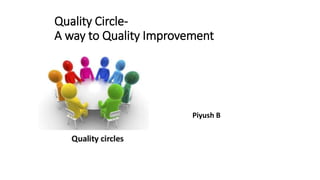
Quality Circle-
A way to Quality Improvement
Piyush B
INTRODUCTION
People are the greatest assets of an
organization, because, through people all other
resources are converted into utilities. However,
management of ‘People Resources’ has always been
a vexed problem ever since the beginning of
organized human activities. A number of
managerial responses have been developed to
answer this question.
Quality Circle -A way to Quality
Improvement
Quality Circle is
• a small group of 6 to 12 employees doing similar work
who voluntarily meet together on a regular basis to identify
improvements in their respective work areas using various
techniques
• for analysing & solving work related problems coming in
the way of achieving and sustaining excellence
• leading to mutual upliftment of employees as well as the
organization.
It is "a way of capturing the creative and innovative power that
lies within the work force“
DEFINITION
OBJECTIVE
• The objectives of Quality Circles are multi-faced.
a) Change in Attitude.
• From "I don’t care" to "I do care"
• Continuous improvement in quality of work life through humanization of work
b) Self Development
• Bring out ‘Hidden Potential’ of people
• People get to learn additional skills.
c) Development of Team Spirit
• Eliminate inter departmental conflicts.
d) Improved Organizational Culture
• Positive working environment.
• Higher motivational level.
BASIC PRINCIPLES OF QUALITY CIRCLE
• 1. Every job is capable of being improved.
• 2. People do not resist change, they resist being externally changed.
• 3. Every employee is capable of attaining excellence in his work & the
basic ability to improve the job.
• 4. People like to improve their job and derive satisfaction out of it
provided they are involved through human touch, recognition &
reward for work.
• 5. People like to participate in groups and crave for attention.
• 6. People have integrity and can be highly creative.
• 7. A man who does the job knows best about the job at least they
know the problems of the job.
Benefits
to the organization
• employee & employer relationship
• Improve – quality of the goods &
services
• Develop – participative culture &
team spirit.
• Catalyze – attitudinal change.
• Leads – towards the better efficiency.
• Reduce – work related errors & cost.
to the employee
• Provide- job interest
• Develop – latent problem solving
capabilities.
• Give – sense of participation.
• Advances – employee career &
personal development.
• Involve – worker in decision making.
• Encourage – employee to get involve
with common goal of the org.
Increase – Productivity
How Do Quality Circles Work?
• All members of a Circle need to receive training
• Members need to be empowered
• Members need to have the support of Senior Management
• Characteristics
• Volunteers
• Set Rules and Priorities
• Decisions made by Consensus
• Use of organized approaches to Problem-Solving
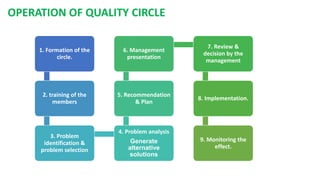
1. Formation of the
circle.
2. training of the
members
3. Problem
identification &
problem selection
4. Problem analysis
Generate
alternative
solutions
5. Recommendation
& Plan
6. Management
presentation
7. Review &
decision by the
management
8. Implementation.
9. Monitoring the
effect.
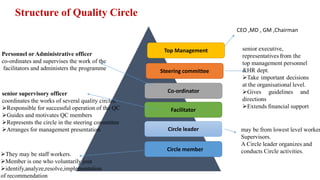
Top Management
Steering committee
Co-ordinator
Facilitator
Circle leader
Circle member
CEO ,MD , GM ,Chairman
senior supervisory officer
coordinates the works of several quality circles.
Responsible for successful operation of the QC
Guides and motivates QC members
Represents the circle in the steering committee
Arranges for management presentation
Personnel or Administrative officer
co-ordinates and supervises the work of the
facilitators and administers the programme
They may be staff workers.
Member is one who voluntarily join
identify,analyze,resolve,implementation
of recommendation
may be from lowest level worker
Supervisors.
A Circle leader organizes and
conducts Circle activities.
Structure of Quality Circle
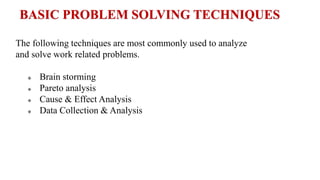
The following techniques are most commonly used to analyze
and solve work related problems.
 Brain storming
 Pareto analysis
 Cause & Effect Analysis
 Data Collection & Analysis
BASIC PROBLEM SOLVING TECHNIQUES
DISCUSSION AND
CONCLUSION Few Facts…
• Quality Circles are not limited to manufacturing firms only.
• They are applicable for variety of organizations where there is scope for
group based solution of work related problems.
• Quality Circles are relevant for factories, firms, schools, hospitals,
universities, research institutes, banks, government offices etc.
• The sustenance of success will lead to total quality improvement emerging
as a centre of excellence of its own in any small enterprise.

Quality circle

  • 1.
    Quality Circle- A wayto Quality Improvement Piyush B
  • 2.
    INTRODUCTION People are thegreatest assets of an organization, because, through people all other resources are converted into utilities. However, management of ‘People Resources’ has always been a vexed problem ever since the beginning of organized human activities. A number of managerial responses have been developed to answer this question. Quality Circle -A way to Quality Improvement
  • 3.
    Quality Circle is •a small group of 6 to 12 employees doing similar work who voluntarily meet together on a regular basis to identify improvements in their respective work areas using various techniques • for analysing & solving work related problems coming in the way of achieving and sustaining excellence • leading to mutual upliftment of employees as well as the organization. It is "a way of capturing the creative and innovative power that lies within the work force“ DEFINITION
  • 4.
    OBJECTIVE • The objectivesof Quality Circles are multi-faced. a) Change in Attitude. • From "I don’t care" to "I do care" • Continuous improvement in quality of work life through humanization of work b) Self Development • Bring out ‘Hidden Potential’ of people • People get to learn additional skills. c) Development of Team Spirit • Eliminate inter departmental conflicts. d) Improved Organizational Culture • Positive working environment. • Higher motivational level.
  • 5.
    BASIC PRINCIPLES OFQUALITY CIRCLE • 1. Every job is capable of being improved. • 2. People do not resist change, they resist being externally changed. • 3. Every employee is capable of attaining excellence in his work & the basic ability to improve the job. • 4. People like to improve their job and derive satisfaction out of it provided they are involved through human touch, recognition & reward for work. • 5. People like to participate in groups and crave for attention. • 6. People have integrity and can be highly creative. • 7. A man who does the job knows best about the job at least they know the problems of the job.
  • 6.
    Benefits to the organization •employee & employer relationship • Improve – quality of the goods & services • Develop – participative culture & team spirit. • Catalyze – attitudinal change. • Leads – towards the better efficiency. • Reduce – work related errors & cost. to the employee • Provide- job interest • Develop – latent problem solving capabilities. • Give – sense of participation. • Advances – employee career & personal development. • Involve – worker in decision making. • Encourage – employee to get involve with common goal of the org. Increase – Productivity
  • 7.
    How Do QualityCircles Work? • All members of a Circle need to receive training • Members need to be empowered • Members need to have the support of Senior Management • Characteristics • Volunteers • Set Rules and Priorities • Decisions made by Consensus • Use of organized approaches to Problem-Solving
  • 8.
    1. Formation ofthe circle. 2. training of the members 3. Problem identification & problem selection 4. Problem analysis Generate alternative solutions 5. Recommendation & Plan 6. Management presentation 7. Review & decision by the management 8. Implementation. 9. Monitoring the effect.
  • 9.
    Top Management Steering committee Co-ordinator Facilitator Circleleader Circle member CEO ,MD , GM ,Chairman senior supervisory officer coordinates the works of several quality circles. Responsible for successful operation of the QC Guides and motivates QC members Represents the circle in the steering committee Arranges for management presentation Personnel or Administrative officer co-ordinates and supervises the work of the facilitators and administers the programme They may be staff workers. Member is one who voluntarily join identify,analyze,resolve,implementation of recommendation may be from lowest level worker Supervisors. A Circle leader organizes and conducts Circle activities. Structure of Quality Circle
  • 10.
    The following techniquesare most commonly used to analyze and solve work related problems.  Brain storming  Pareto analysis  Cause & Effect Analysis  Data Collection & Analysis BASIC PROBLEM SOLVING TECHNIQUES
  • 11.
    DISCUSSION AND CONCLUSION FewFacts… • Quality Circles are not limited to manufacturing firms only. • They are applicable for variety of organizations where there is scope for group based solution of work related problems. • Quality Circles are relevant for factories, firms, schools, hospitals, universities, research institutes, banks, government offices etc. • The sustenance of success will lead to total quality improvement emerging as a centre of excellence of its own in any small enterprise.