STUDY DESIGNS
PRESENTED BY: Dr. Parth K. Vachhani
INTRODUCTION
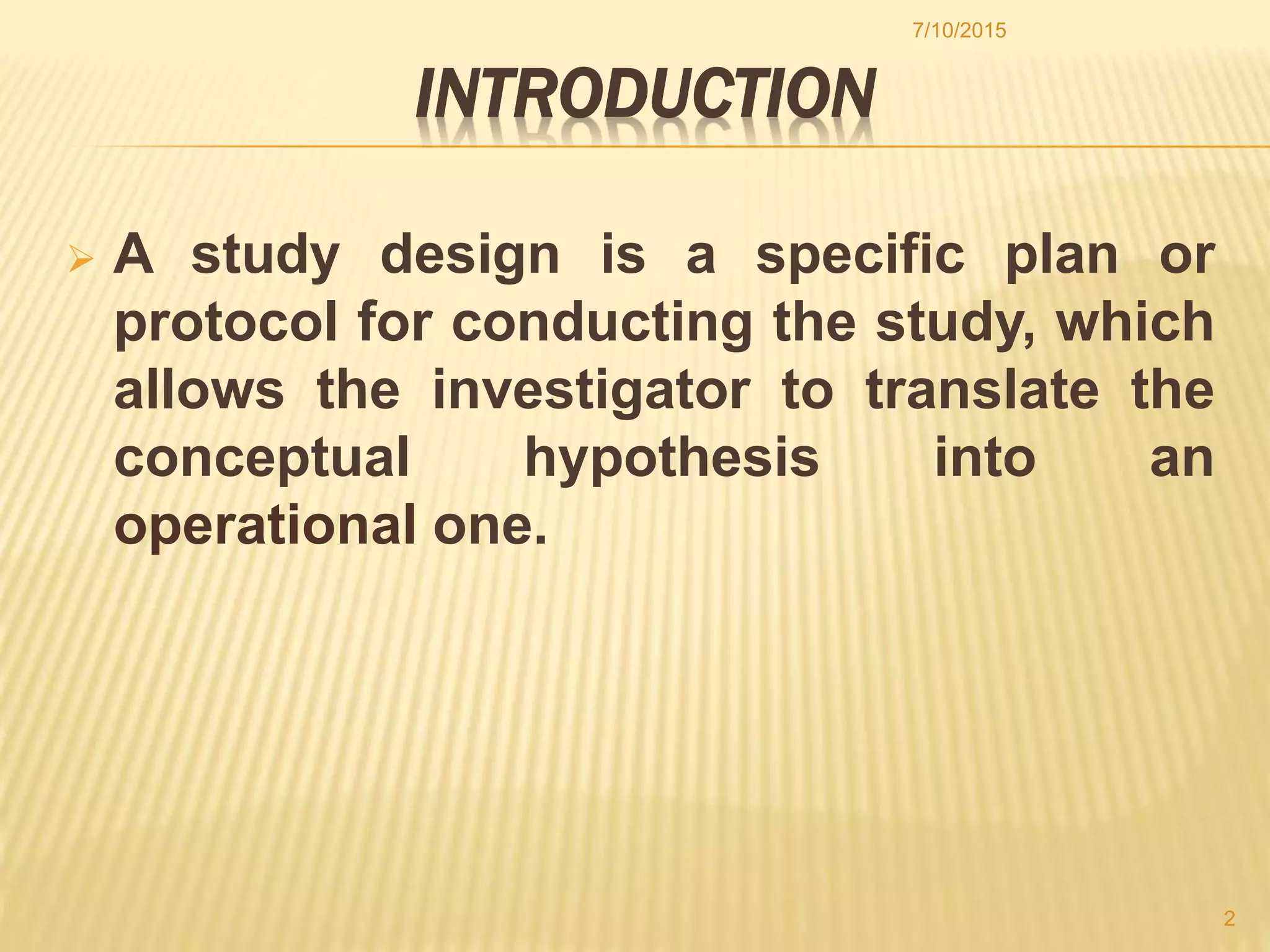
 A study design is a specific plan or
protocol for conducting the study, which
allows the investigator to translate the
conceptual hypothesis into an
operational one.
7/10/2015
2
7/10/2015
3
CONTD.
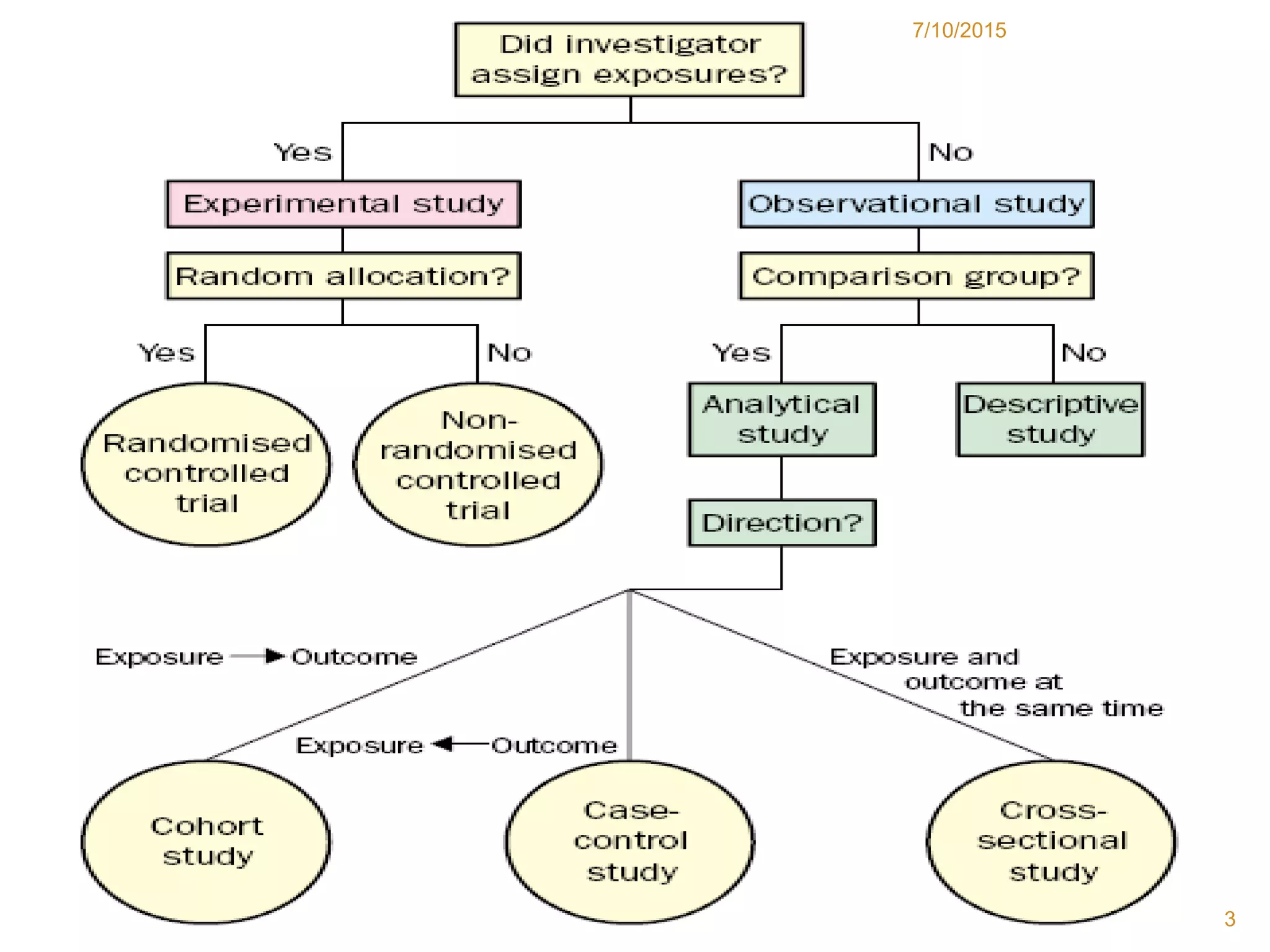
 Observational: Studies that do not
involve any intervention or
experiment.
 Experimental: Studies that entail
manipulation of the study factor
(exposure) and randomization of
subjects to treatment (exposure)
groups.
7/10/2015
4
HIERARCHY OF STUDY DESIGN
OBSERVATIONAL STUDIES
7/10/2015
6
OBSERVATIONAL STUDIES
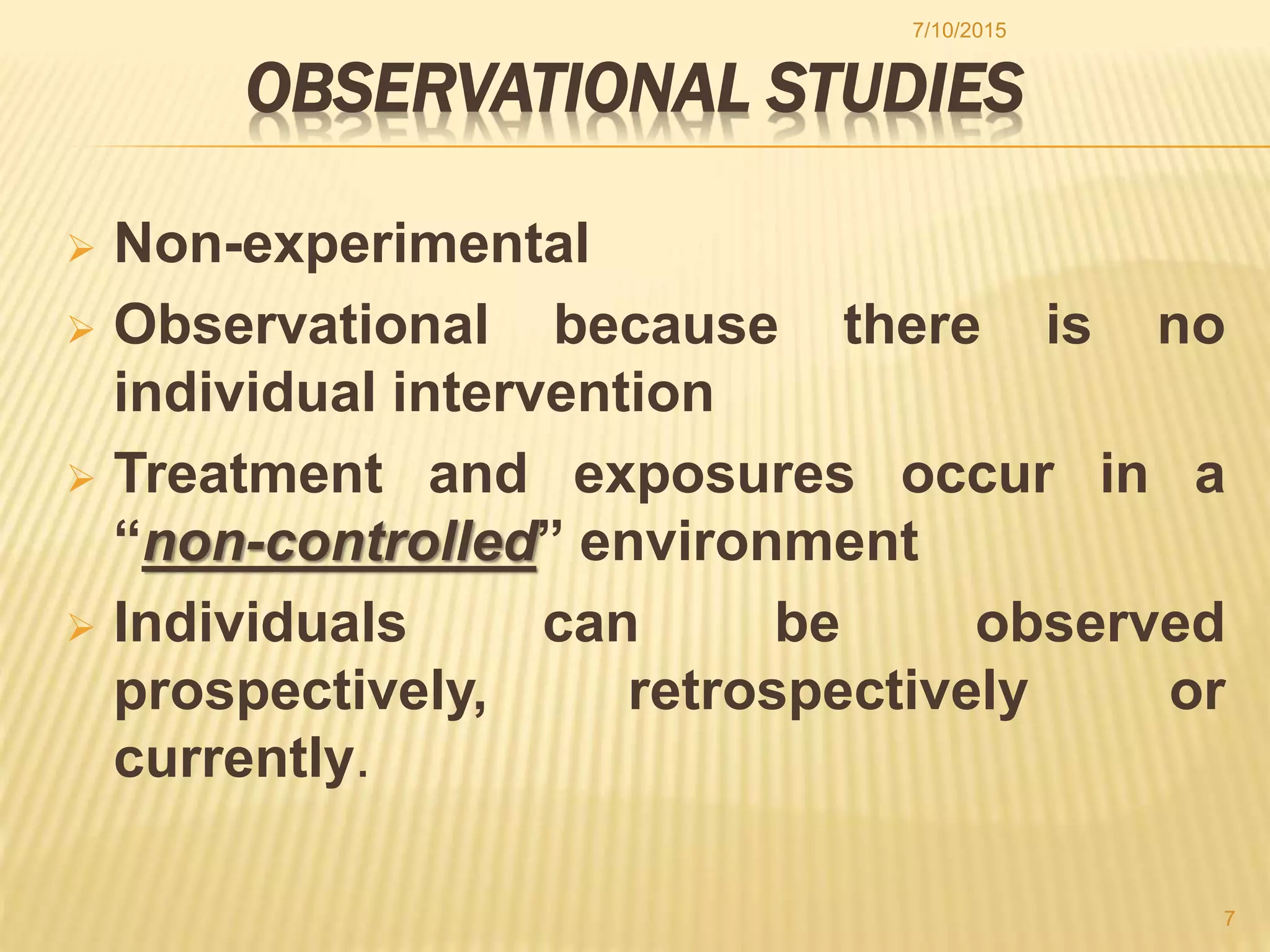
 Non-experimental
 Observational because there is no
individual intervention
 Treatment and exposures occur in a
“non-controlled” environment
 Individuals can be observed
prospectively, retrospectively or
currently.
7/10/2015
7
DESCRIPTIVE STUDIES
7/10/2015
8
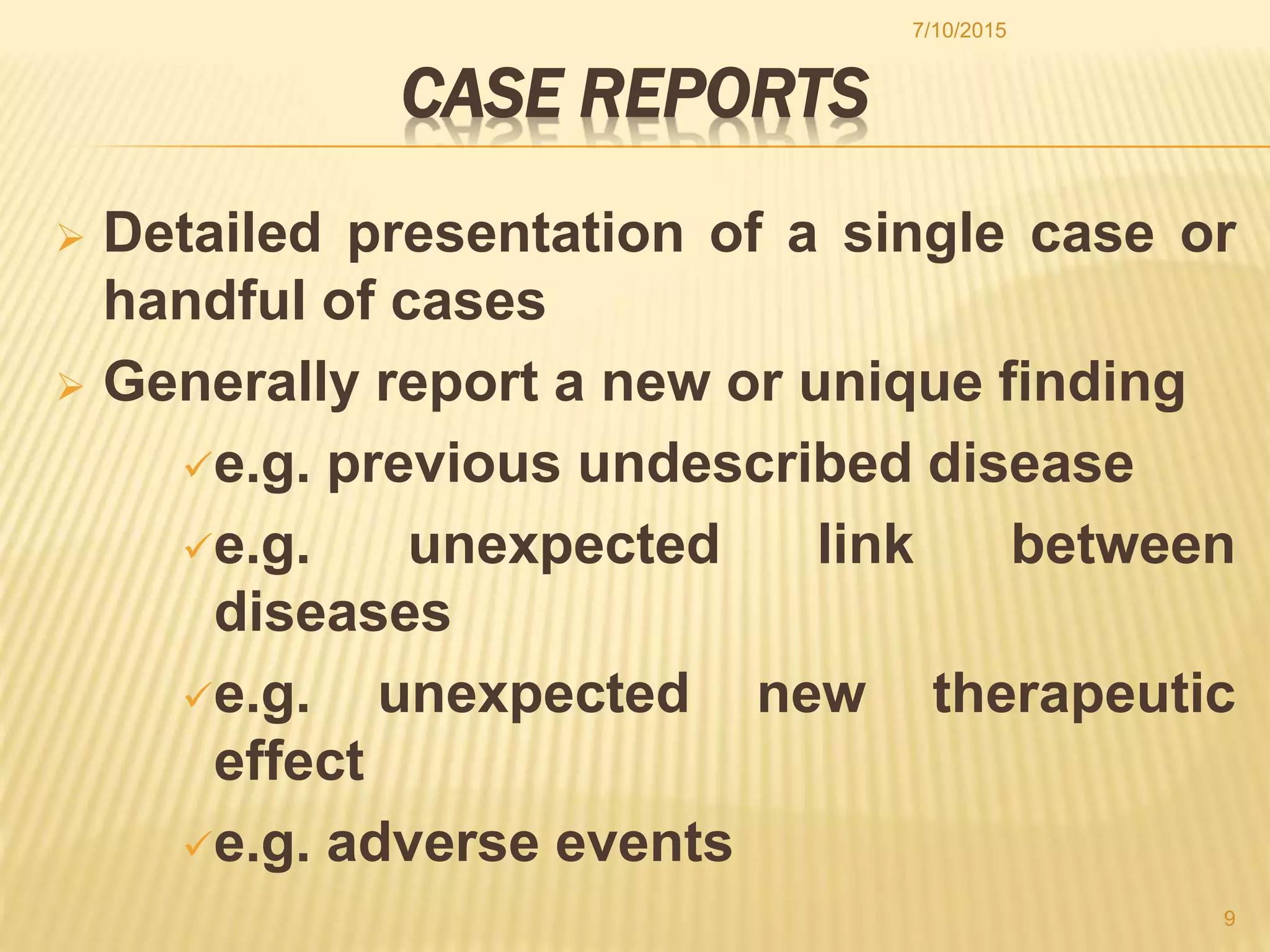
CASE REPORTS
 Detailed presentation of a single case or
handful of cases
 Generally report a new or unique finding
e.g. previous undescribed disease
e.g. unexpected link between
diseases
e.g. unexpected new therapeutic
effect
e.g. adverse events
7/10/2015
9
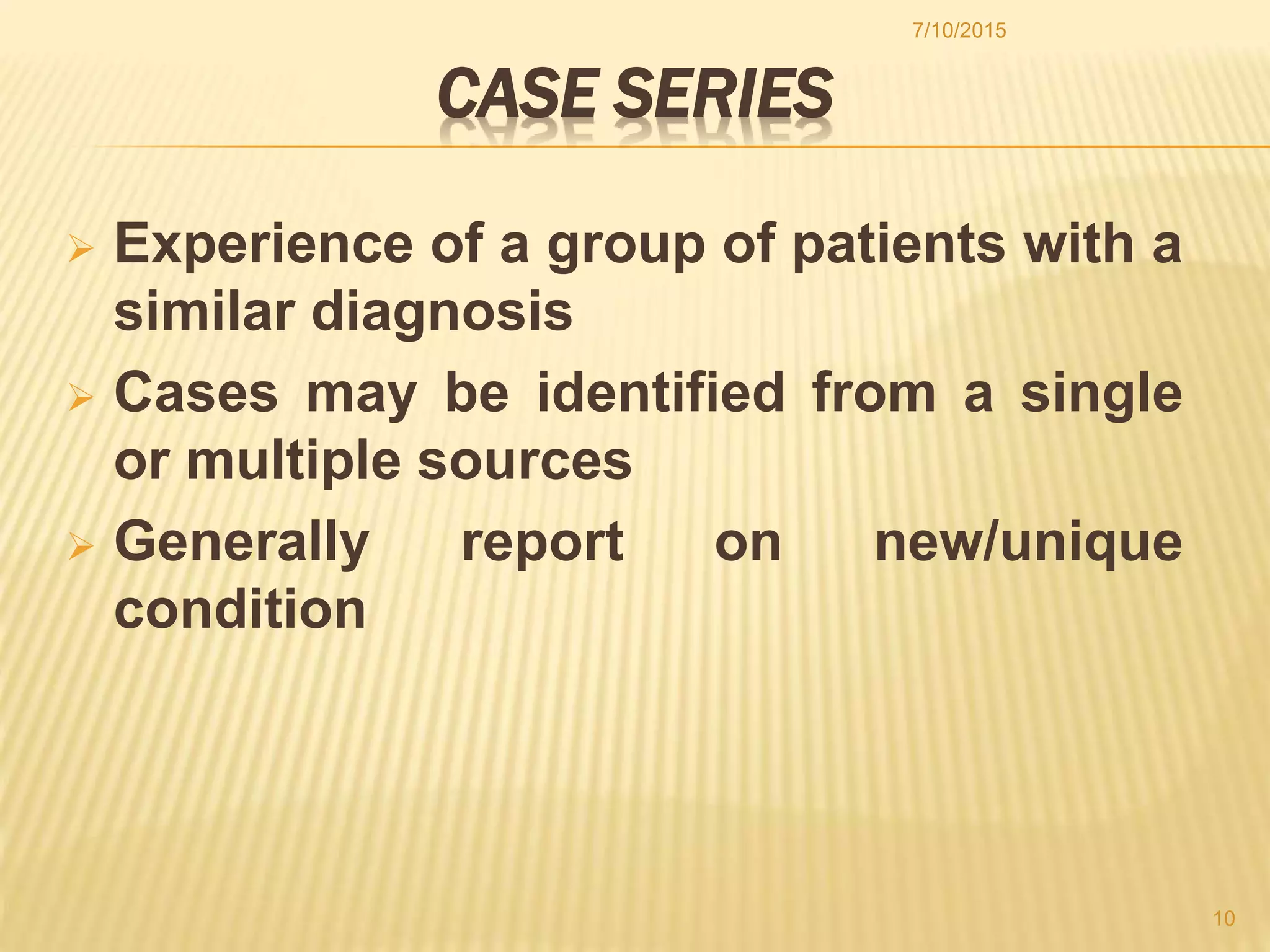
CASE SERIES
 Experience of a group of patients with a
similar diagnosis
 Cases may be identified from a single
or multiple sources
 Generally report on new/unique
condition
7/10/2015
10
CONTD.
 Advantages
 Useful for hypothesis generation
 Informative for very rare disease with
few established risk factors
 Disadvantages
 Cannot study cause and effect
relationships
 Cannot assess disease frequency
7/10/2015
11
Case Report
Case Series
One case of unusual
findings
Multiple cases of
findings
7/10/2015
12
ANALYTICAL STUDIES
7/10/2015
13
BASIC QUESTION IN ANALYTIC STUDY
 Are exposure and disease linked?
Exposure Disease
7/10/2015
14
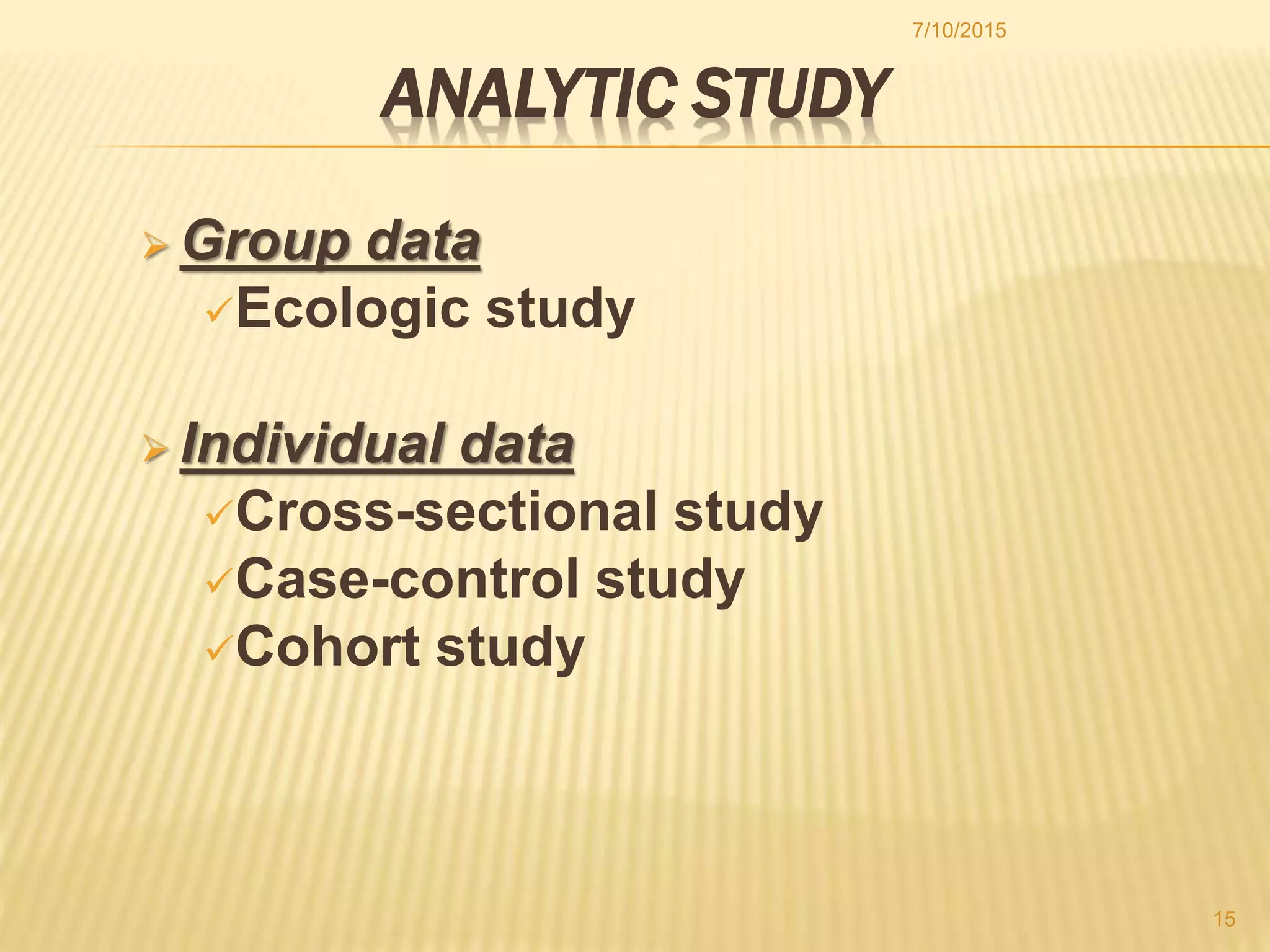
ANALYTIC STUDY
 Group data
Ecologic study
 Individual data
Cross-sectional study
Case-control study
Cohort study
7/10/2015
15
ECOLOGICAL STUDY
16
 An investigation of the distribution of
health and its determinants between
groups of individuals.
 Unit of study is the aggregate data not
individual level.
 It is usually be conducted as the first
step study for research.
 The result is difficult to interpret
because of confounding and bias.
7/10/2015
CONTD.
 Advantages
 Cheap, quick and convenient since it
usually come from existing data
 Disadvantages
 Inability to link exposure with disease in
individual (ecological fallacy)
 Limit to control effect of other factors
7/10/2015
17
CROSS-SECTIONAL STUDIES
 An “observational” design that surveys
exposures and disease status at a single
point of time (a cross-section of the
population)
time
Study only exists at this point in time
7/10/2015
18
CONTD.
time
Study only exists at this point in time
Study
population
No Disease
Disease
factor present
factor absent
factor present
factor absent
7/10/2015
19
CONTD.
 Often used to study conditions that are
relatively frequent with long duration of
expression (nonfatal, chronic
conditions)
 It measures prevalence, not incidence
of disease
 Not suitable for studying rare or highly
fatal diseases or a disease with short
duration of expression
7/10/2015
20
ADVANTAGES
 Gives general description or scope of
problem
 Useful in health service evaluation and
planning
 Baseline for prospective study
 Low-cost
7/10/2015
21
DISADVANTAGES
7/10/2015
22
 No calculation of risk
 Temporal sequence is unclear
 Not good for rare diseases
 Selective recall can lead to bias
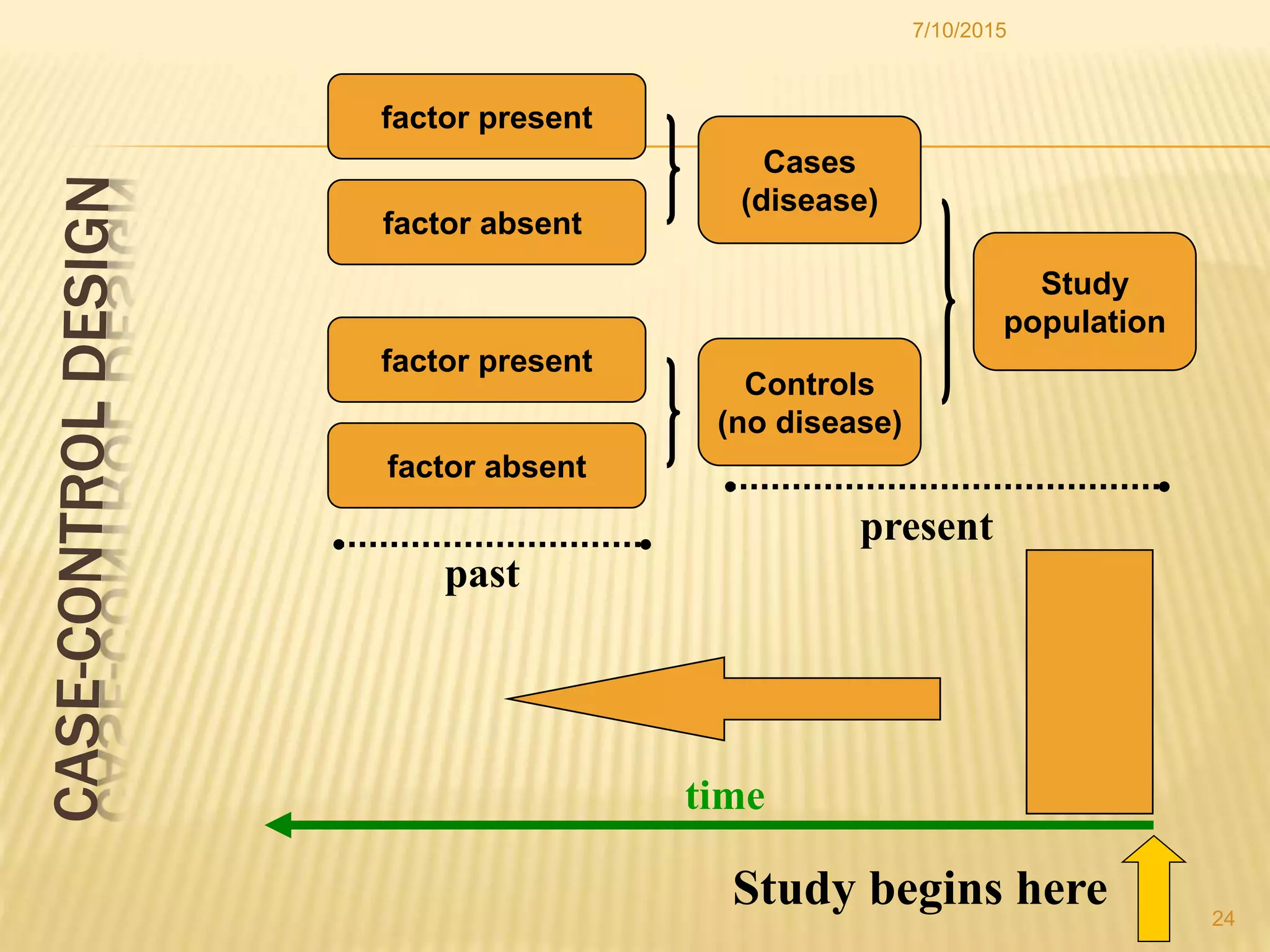
CASE CONTROL STUDY
 An “observational” design comparing
exposures in disease cases vs. healthy
controls from same population.
 Exposure data collected retrospectively.
 Most feasible design where disease
outcomes are rare.
7/10/2015
23
Study
population
Cases
(disease)
Controls
(no disease)
factor present
factor absent
factor present
factor absent
present
past
time
Study begins here
7/10/2015
24
ODDS RATIO
 Odds ratio= ad/bc
7/10/2015
25
Suspected
Risk Factor
Cases Controls
Present a b
Absent c d
a+c b+d
ADVANTAGES
 Cheap, easy and quick studies
 Require comparatively few subjects
 Multiple exposures can be examined
 Rare diseases and diseases with long
latency can be studied
 Suitable when randomization is unethical
7/10/2015
26
DISADVANTAGES
 Case and control selection troublesome
 Subject to bias
 Direct estimation of incidence is not
possible
 If the incidence of exposure is high, it is
difficult to show the difference between
cases and controls
7/10/2015
27
COHORT STUDY
 An “observational” design comparing
individuals with a known risk factor or
exposure with others without the risk
factor or exposure.
 Looking for a difference in the risk
(incidence) of a disease over time.
 One of best observational design.
 Data usually collected prospectively
(some retrospective)
7/10/2015
28
time
Study begins here
Study
population
free of
disease
Factor
present
Factor
absent
disease
no disease
disease
no disease
present
future
7/10/2015
29
7/10/2015
30
Disease
TotalPresen
t
Absen
t
Exposur
e
present
a b a+b
Exposur
e
absent
c d c+d
CONTD.
ADVANTAGES
 Can establish population-based incidence
 Accurate relative risk (risk ratio)
estimation
 Can be used where randomization is not
possible
 Selection and information biases are
decreased
 Multiple outcomes can be studied
7/10/2015
31
DISADVANTAGES
 Lengthy and expensive
 May require large samples
 Not suitable for rare diseases
 Not suitable for diseases with long-
latency
 Unexpected environmental changes may
influence the association
 Nonresponse, migration and loss-to-
follow-up biases
7/10/2015
32
EXPERIMENTAL STUDY
7/10/2015
33
EXPERIMENTAL STUDY
 Treatment and exposures occur in a
“controlled” environment
 Planned research designs
 Clinical trials are the most well known
experimental design.
7/10/2015
34
CONTD.
 Investigator can “control” the exposure
akin to laboratory experiments except
living populations are the subjects
 Generally involves random assignment
to groups
 The ultimate step in testing causal
hypotheses
7/10/2015
35
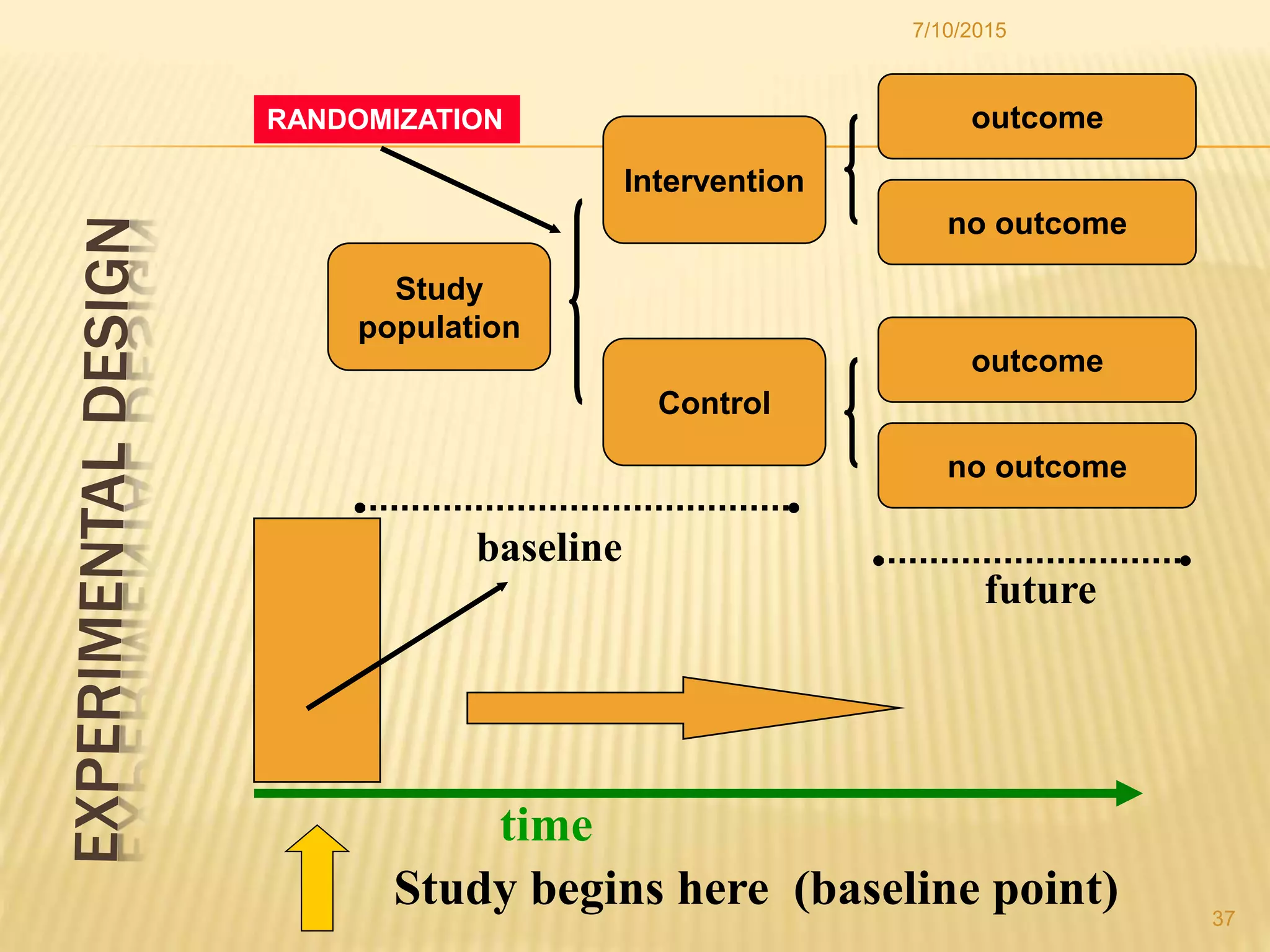
RANDOMIZED CONTROLLED TRIAL
 A design with subjects randomly
assigned to “treatment” and
“comparison” groups.
 Provides most convincing evidence of
relationship between exposure and
effect.
 Not possible to use RCTs to test effects
of exposures that are expected to be
harmful for ethical reasons.
7/10/2015
36
time
Study begins here (baseline point)
Study
population
Intervention
Control
outcome
no outcome
outcome
no outcome
baseline
future
RANDOMIZATION
7/10/2015
37
 The “gold standard” of research
designs
 Provides most convincing evidence of
relationship between exposure and
effect
Trials of hormone replacement
therapy in menopausal women
found no protection for heart
disease, contradicting findings of
7/10/2015
38
CONTD.
 Ability to randomize subjects
 Temporal sequence of cause and effect
 Can control extraneous variables
 Best evidence of causality
ADVANTAGES
7/10/2015
39
DISADVANTAGES
7/10/2015
40
 Expensive
 It may be unethical to assign persons to
certain treatment or comparison groups
 Other Types of Experimental Study
 Field trials
 Community trials
 Animal studies
7/10/2015
41
META ANALYSIS
 Meta-analysis is a statistical analysis of a
collection of studies.
 Meta-analysis methods focus on
contrasting and comparing results from
different studies in anticipation of
identifying consistent patterns and
sources of disagreements among these
results.
7/10/2015
42
7/10/2015
43

Study designs

  • 1.
    STUDY DESIGNS PRESENTED BY:Dr. Parth K. Vachhani
  • 2.
    INTRODUCTION  A studydesign is a specific plan or protocol for conducting the study, which allows the investigator to translate the conceptual hypothesis into an operational one. 7/10/2015 2
  • 3.
  • 4.
    CONTD.  Observational: Studiesthat do not involve any intervention or experiment.  Experimental: Studies that entail manipulation of the study factor (exposure) and randomization of subjects to treatment (exposure) groups. 7/10/2015 4
  • 5.
  • 6.
  • 7.
    OBSERVATIONAL STUDIES  Non-experimental Observational because there is no individual intervention  Treatment and exposures occur in a “non-controlled” environment  Individuals can be observed prospectively, retrospectively or currently. 7/10/2015 7
  • 8.
  • 9.
    CASE REPORTS  Detailedpresentation of a single case or handful of cases  Generally report a new or unique finding e.g. previous undescribed disease e.g. unexpected link between diseases e.g. unexpected new therapeutic effect e.g. adverse events 7/10/2015 9
  • 10.
    CASE SERIES  Experienceof a group of patients with a similar diagnosis  Cases may be identified from a single or multiple sources  Generally report on new/unique condition 7/10/2015 10
  • 11.
    CONTD.  Advantages  Usefulfor hypothesis generation  Informative for very rare disease with few established risk factors  Disadvantages  Cannot study cause and effect relationships  Cannot assess disease frequency 7/10/2015 11
  • 12.
    Case Report Case Series Onecase of unusual findings Multiple cases of findings 7/10/2015 12
  • 13.
  • 14.
    BASIC QUESTION INANALYTIC STUDY  Are exposure and disease linked? Exposure Disease 7/10/2015 14
  • 15.
    ANALYTIC STUDY  Groupdata Ecologic study  Individual data Cross-sectional study Case-control study Cohort study 7/10/2015 15
  • 16.
    ECOLOGICAL STUDY 16  Aninvestigation of the distribution of health and its determinants between groups of individuals.  Unit of study is the aggregate data not individual level.  It is usually be conducted as the first step study for research.  The result is difficult to interpret because of confounding and bias. 7/10/2015
  • 17.
    CONTD.  Advantages  Cheap,quick and convenient since it usually come from existing data  Disadvantages  Inability to link exposure with disease in individual (ecological fallacy)  Limit to control effect of other factors 7/10/2015 17
  • 18.
    CROSS-SECTIONAL STUDIES  An“observational” design that surveys exposures and disease status at a single point of time (a cross-section of the population) time Study only exists at this point in time 7/10/2015 18
  • 19.
    CONTD. time Study only existsat this point in time Study population No Disease Disease factor present factor absent factor present factor absent 7/10/2015 19
  • 20.
    CONTD.  Often usedto study conditions that are relatively frequent with long duration of expression (nonfatal, chronic conditions)  It measures prevalence, not incidence of disease  Not suitable for studying rare or highly fatal diseases or a disease with short duration of expression 7/10/2015 20
  • 21.
    ADVANTAGES  Gives generaldescription or scope of problem  Useful in health service evaluation and planning  Baseline for prospective study  Low-cost 7/10/2015 21
  • 22.
    DISADVANTAGES 7/10/2015 22  No calculationof risk  Temporal sequence is unclear  Not good for rare diseases  Selective recall can lead to bias
  • 23.
    CASE CONTROL STUDY An “observational” design comparing exposures in disease cases vs. healthy controls from same population.  Exposure data collected retrospectively.  Most feasible design where disease outcomes are rare. 7/10/2015 23
  • 24.
    Study population Cases (disease) Controls (no disease) factor present factorabsent factor present factor absent present past time Study begins here 7/10/2015 24
  • 25.
    ODDS RATIO  Oddsratio= ad/bc 7/10/2015 25 Suspected Risk Factor Cases Controls Present a b Absent c d a+c b+d
  • 26.
    ADVANTAGES  Cheap, easyand quick studies  Require comparatively few subjects  Multiple exposures can be examined  Rare diseases and diseases with long latency can be studied  Suitable when randomization is unethical 7/10/2015 26
  • 27.
    DISADVANTAGES  Case andcontrol selection troublesome  Subject to bias  Direct estimation of incidence is not possible  If the incidence of exposure is high, it is difficult to show the difference between cases and controls 7/10/2015 27
  • 28.
    COHORT STUDY  An“observational” design comparing individuals with a known risk factor or exposure with others without the risk factor or exposure.  Looking for a difference in the risk (incidence) of a disease over time.  One of best observational design.  Data usually collected prospectively (some retrospective) 7/10/2015 28
  • 29.
    time Study begins here Study population freeof disease Factor present Factor absent disease no disease disease no disease present future 7/10/2015 29
  • 30.
  • 31.
    ADVANTAGES  Can establishpopulation-based incidence  Accurate relative risk (risk ratio) estimation  Can be used where randomization is not possible  Selection and information biases are decreased  Multiple outcomes can be studied 7/10/2015 31
  • 32.
    DISADVANTAGES  Lengthy andexpensive  May require large samples  Not suitable for rare diseases  Not suitable for diseases with long- latency  Unexpected environmental changes may influence the association  Nonresponse, migration and loss-to- follow-up biases 7/10/2015 32
  • 33.
  • 34.
    EXPERIMENTAL STUDY  Treatmentand exposures occur in a “controlled” environment  Planned research designs  Clinical trials are the most well known experimental design. 7/10/2015 34
  • 35.
    CONTD.  Investigator can“control” the exposure akin to laboratory experiments except living populations are the subjects  Generally involves random assignment to groups  The ultimate step in testing causal hypotheses 7/10/2015 35
  • 36.
    RANDOMIZED CONTROLLED TRIAL A design with subjects randomly assigned to “treatment” and “comparison” groups.  Provides most convincing evidence of relationship between exposure and effect.  Not possible to use RCTs to test effects of exposures that are expected to be harmful for ethical reasons. 7/10/2015 36
  • 37.
    time Study begins here(baseline point) Study population Intervention Control outcome no outcome outcome no outcome baseline future RANDOMIZATION 7/10/2015 37
  • 38.
     The “goldstandard” of research designs  Provides most convincing evidence of relationship between exposure and effect Trials of hormone replacement therapy in menopausal women found no protection for heart disease, contradicting findings of 7/10/2015 38 CONTD.
  • 39.
     Ability torandomize subjects  Temporal sequence of cause and effect  Can control extraneous variables  Best evidence of causality ADVANTAGES 7/10/2015 39
  • 40.
    DISADVANTAGES 7/10/2015 40  Expensive  Itmay be unethical to assign persons to certain treatment or comparison groups
  • 41.
     Other Typesof Experimental Study  Field trials  Community trials  Animal studies 7/10/2015 41
  • 42.
    META ANALYSIS  Meta-analysisis a statistical analysis of a collection of studies.  Meta-analysis methods focus on contrasting and comparing results from different studies in anticipation of identifying consistent patterns and sources of disagreements among these results. 7/10/2015 42
  • 43.