Presentation by : Parnavi S. Kadam
Topic : Detectors in Gas Chromatography
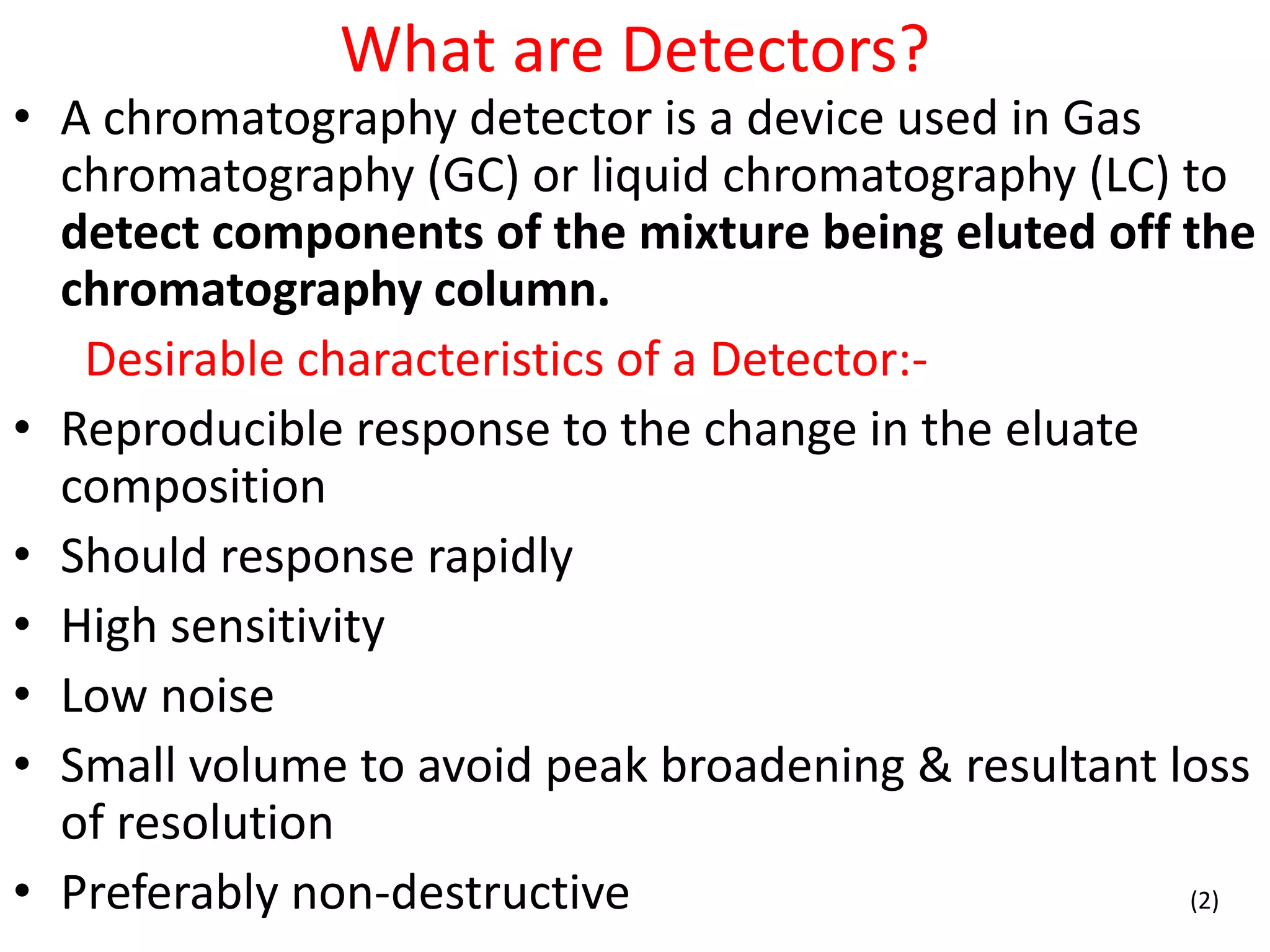
What are Detectors?
• A chromatography detector is a device used in Gas
chromatography (GC) or liquid chromatography (LC) to
detect components of the mixture being eluted off the
chromatography column.
Desirable characteristics of a Detector:-
• Reproducible response to the change in the eluate
composition
• Should response rapidly
• High sensitivity
• Low noise
• Small volume to avoid peak broadening & resultant loss
of resolution
• Preferably non-destructive (2)
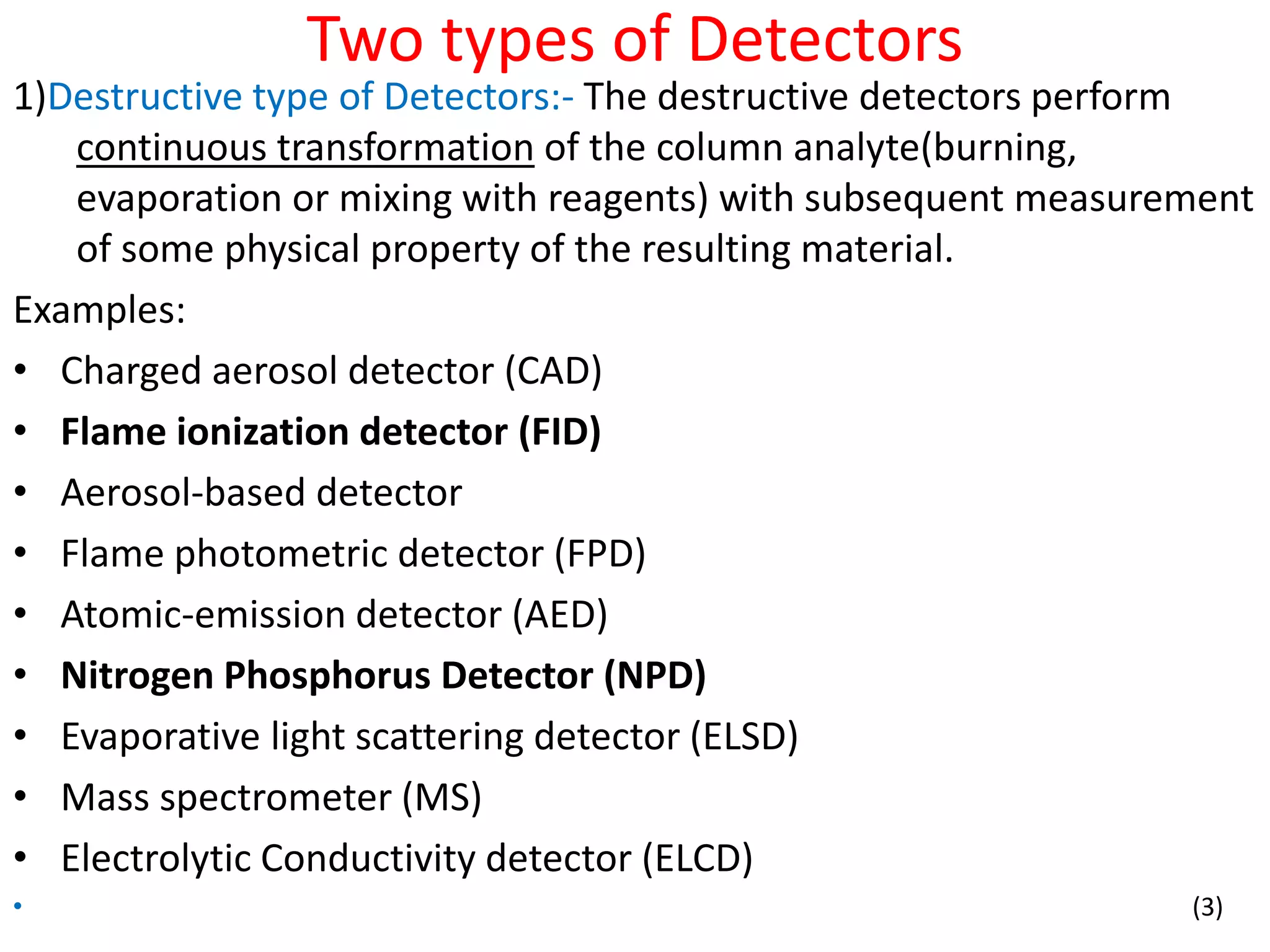
Two types of Detectors
1)Destructive type of Detectors:- The destructive detectors perform
continuous transformation of the column analyte(burning,
evaporation or mixing with reagents) with subsequent measurement
of some physical property of the resulting material.
Examples:
• Charged aerosol detector (CAD)
• Flame ionization detector (FID)
• Aerosol-based detector
• Flame photometric detector (FPD)
• Atomic-emission detector (AED)
• Nitrogen Phosphorus Detector (NPD)
• Evaporative light scattering detector (ELSD)
• Mass spectrometer (MS)
• Electrolytic Conductivity detector (ELCD)
• (3)
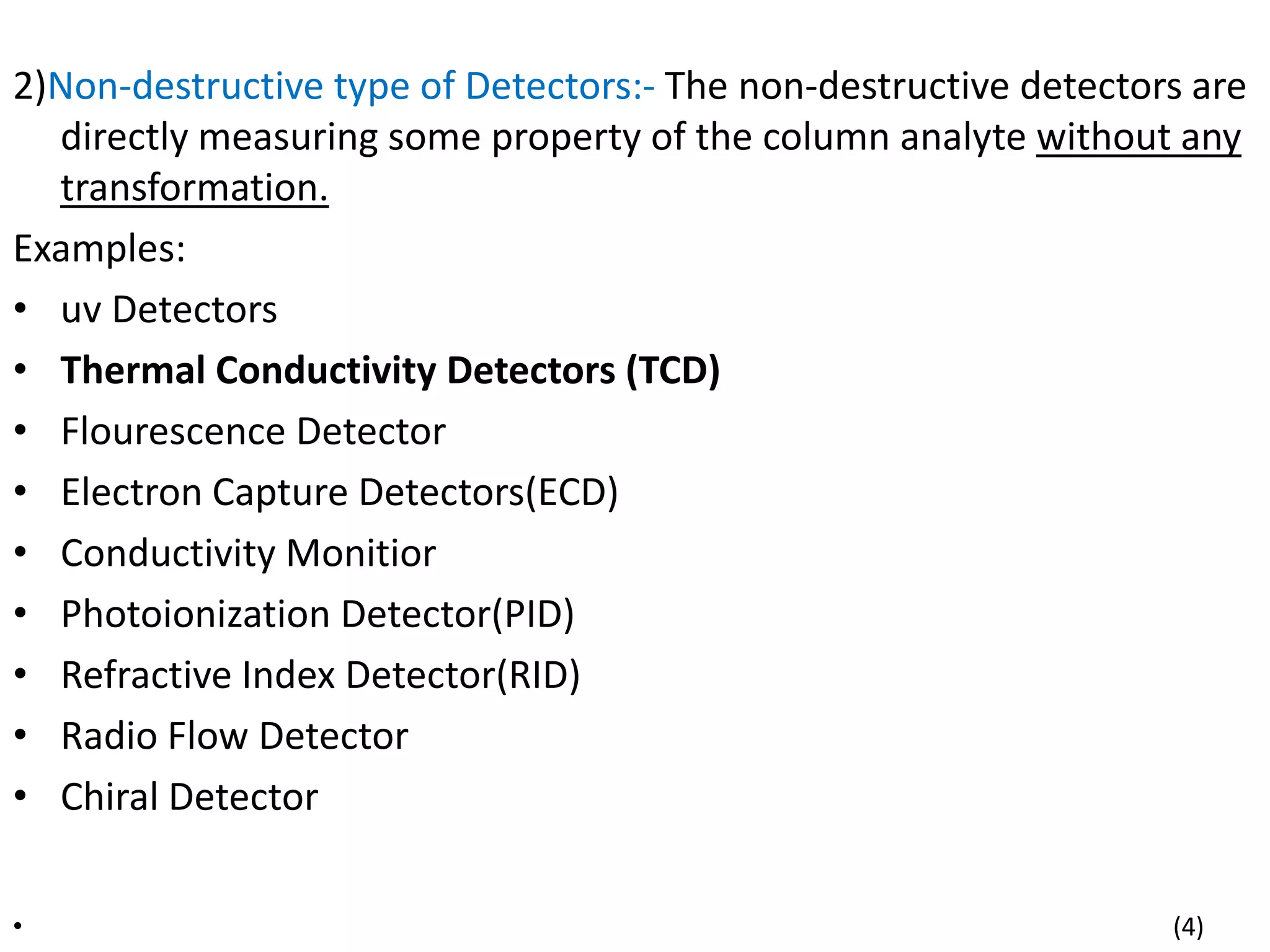
2)Non-destructive type of Detectors:- The non-destructive detectors are
directly measuring some property of the column analyte without any
transformation.
Examples:
• uv Detectors
• Thermal Conductivity Detectors (TCD)
• Flourescence Detector
• Electron Capture Detectors(ECD)
• Conductivity Monitior
• Photoionization Detector(PID)
• Refractive Index Detector(RID)
• Radio Flow Detector
• Chiral Detector
• (4)
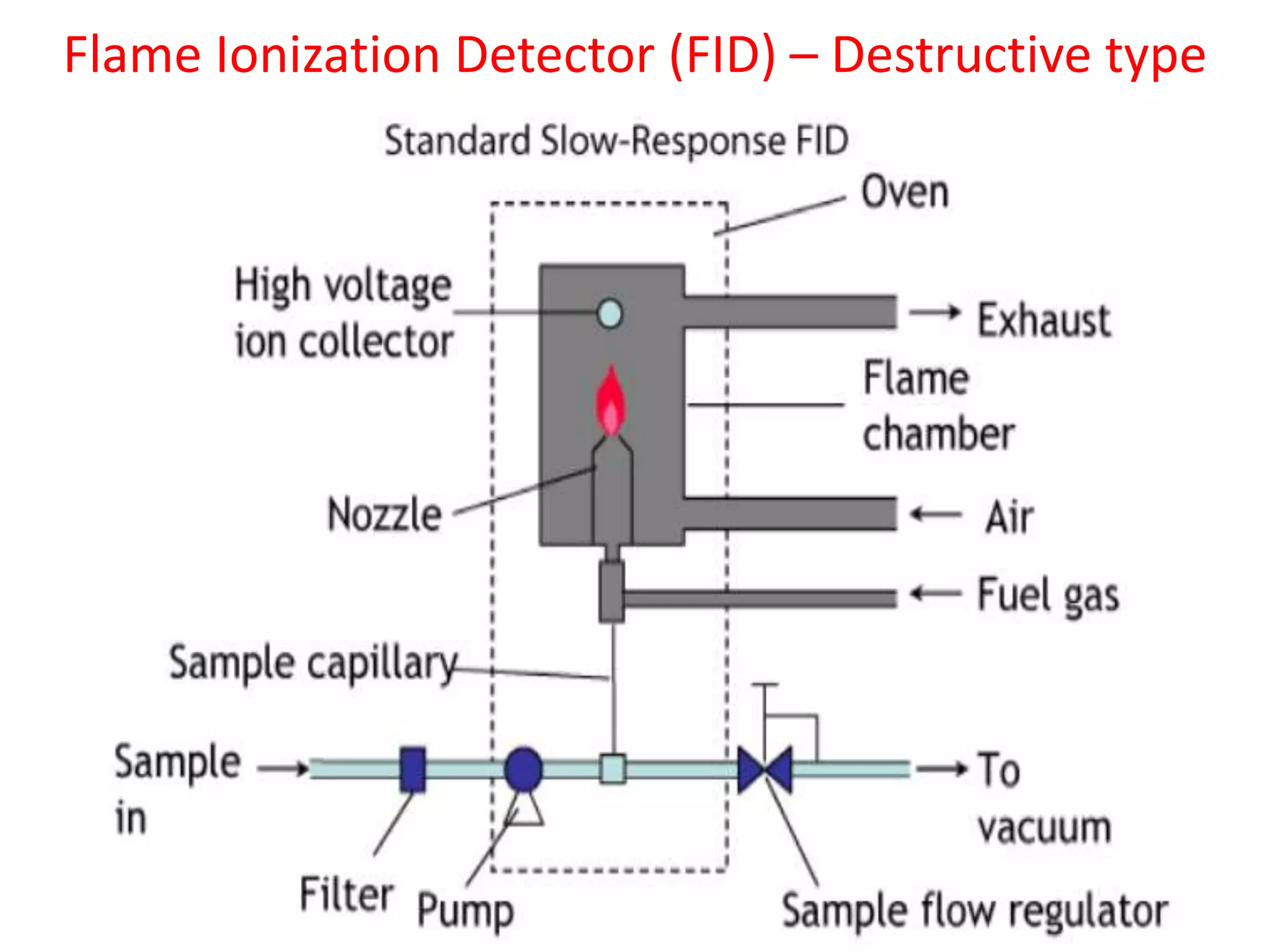
Flame Ionization Detector (FID) – Destructive type
• FID was invented by scientist Harley & Pretorious and again
separately by Mc Williams & Dewer
• The flame ionisation detector (FID) is the automotive
emissions industry standard method of measuring
hydrocarbon (HC) concentration.
• The eluate gas exits the GC column & enters the FID
detector’s oven.
• This tells us that the FID detector is placed inside the oven
so as to ensure that the eluate gas does not come out of
the gaseous phase and deposit on the interface between
the column & FID.
• As the eluate gas travels up through the capillary it comes
in the contact with H₂(fuel gas) first & then with the air.
• Flame is produced due to H₂+air and the eluate gas is
subjected to burning which produces ions.
• (6)
• Reaction:
Eluate gas + H₂ + air combustion products H₂O+ions+radicals
+ electrons
• The ions are detected using a metal collector (brass/platinum)
which further generates the current.
• This current is further analyzed using the digital convertor and
further a chromatogram is developed.
• Rate of ionization increases(i.e more ions generated)= current
which is produced is also increased.
• The current across the collector is thus proportional to the rate
of ionization which in turn depends upon the concentration of
hydrocarbon in the sample gas.
• The disadvantage is that it destroys all the sample.
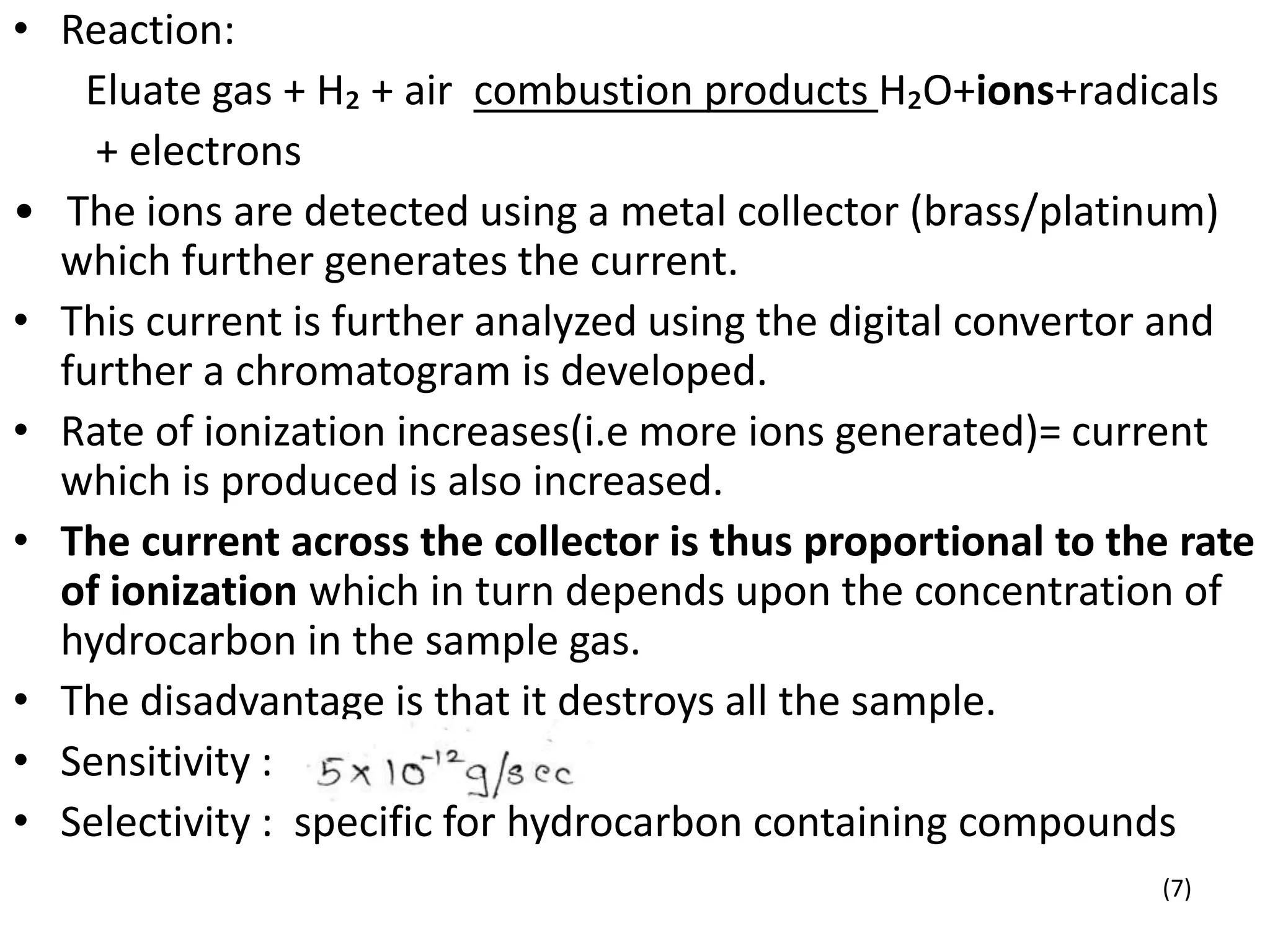
• Sensitivity :
• Selectivity : specific for hydrocarbon containing compounds
(7)
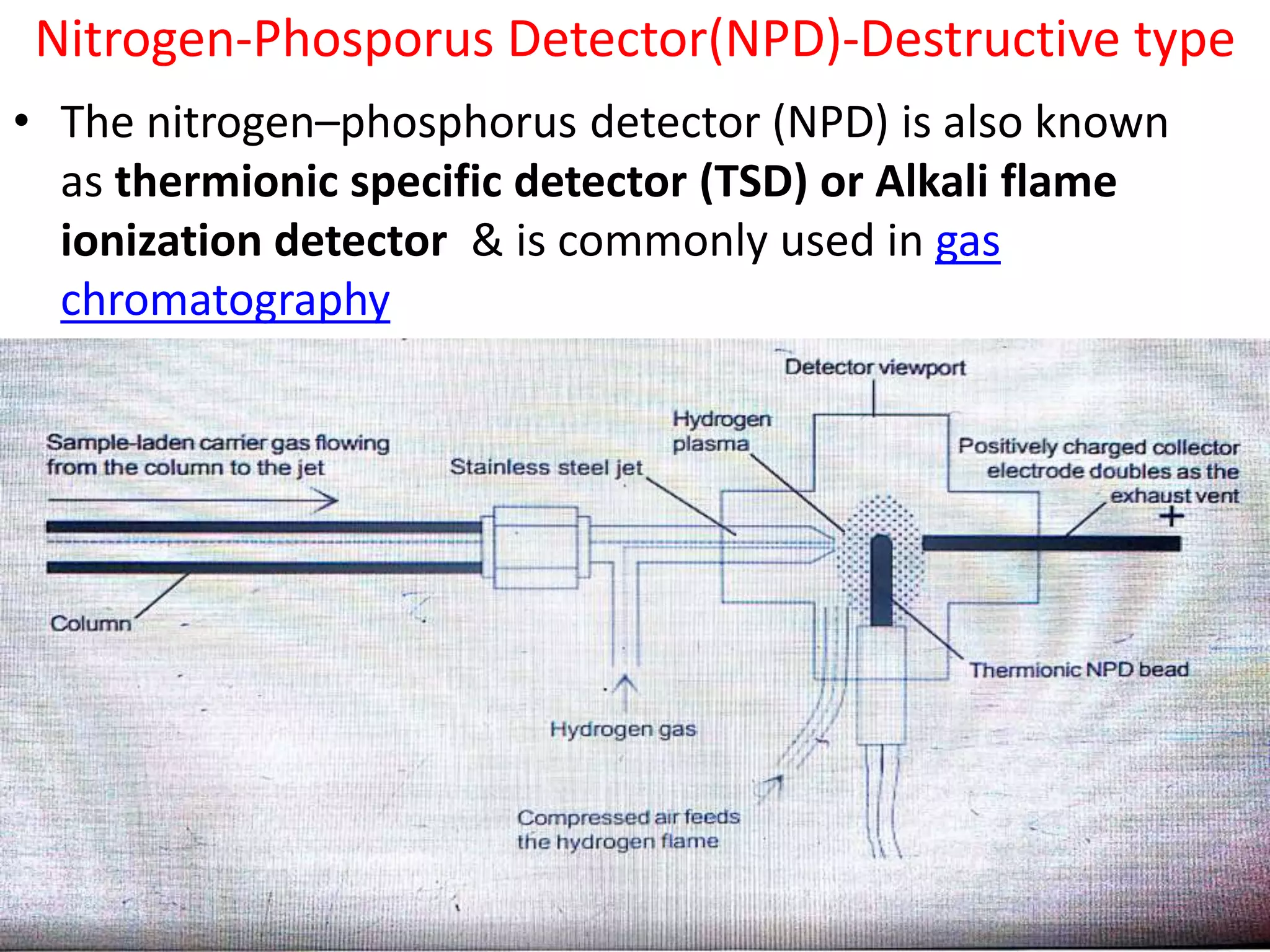
Nitrogen-Phosporus Detector(NPD)-Destructive type
• The nitrogen–phosphorus detector (NPD) is also known
as thermionic specific detector (TSD) or Alkali flame
ionization detector & is commonly used in gas
chromatography
• This stable detector is extremely sensitive to nitrogen- and
phosphorus-containing compounds and is highly selective.
• Similar to FID & is widely used in pesticide and herbicide
analysis.
• Inside the NPD detector body, an electrically heated
thermionic bead (NPD bead) is positioned between the jet
orifice and the collector electrode.
• NPD uses a Rubidium or Caesium chloride bead which is
heated by a coil which promotes the ionization of
compounds that contain nitrogen or phosphorus.
• Hydrogen and air flows create a hydrogen plasma around
the hot NPD bead.
• When molecules containing nitrogen or phosphorus enter
the plasma from the column and jet orifice, they undergo a
catalytic surface chemistry reaction, producing thermionic
electrons.
• The resulting ions are attracted to a positively charged
collector electrode, then amplified and output to the data
system.
• The hydrogen to air ratio is too less to sustain a flame,
therefore minimizing hydrocarbon ionization and
contributing to the NPD detector’s selectivity.
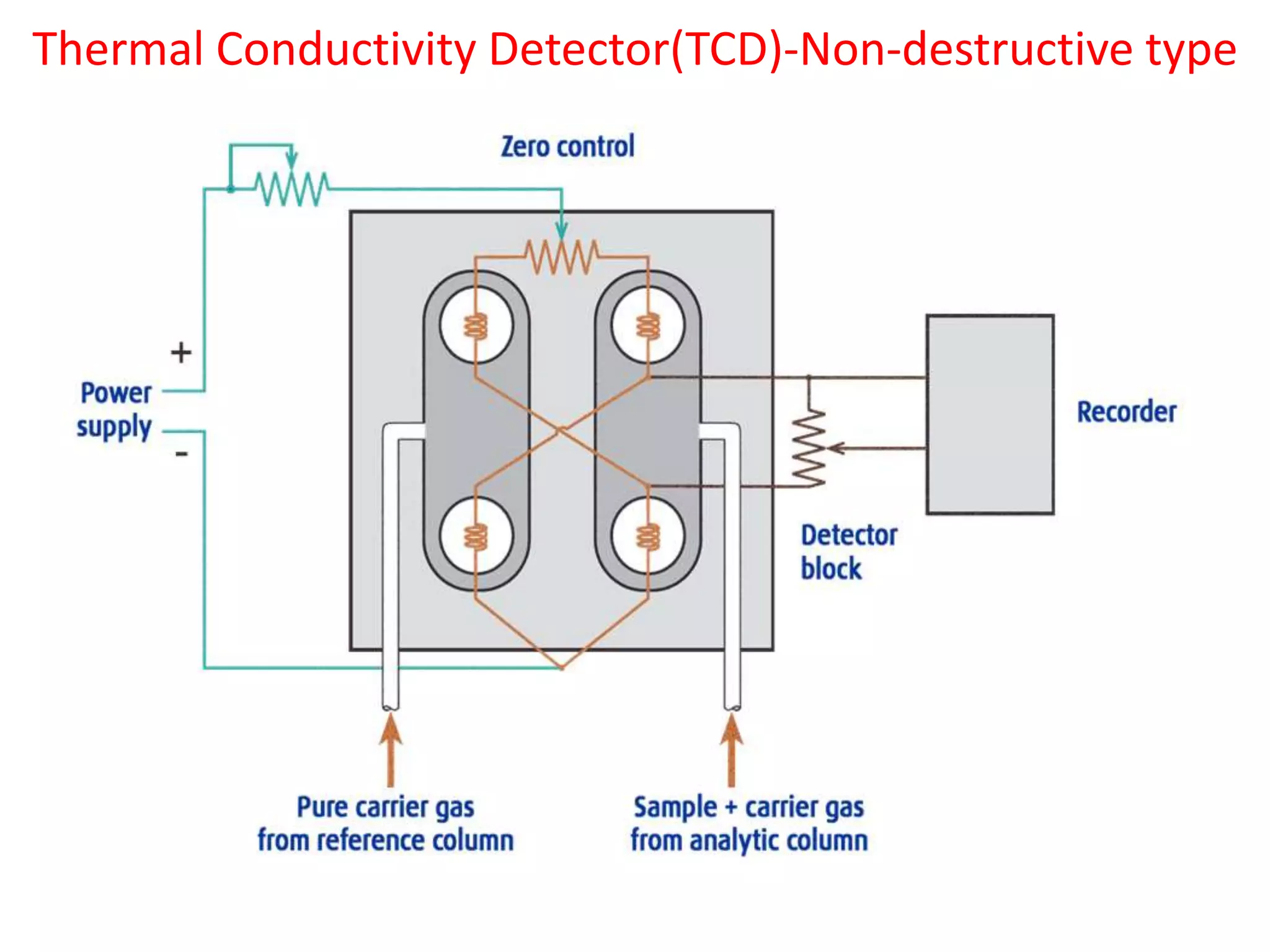
• Selectivity : N & P containing compounds
• Sensitivity :
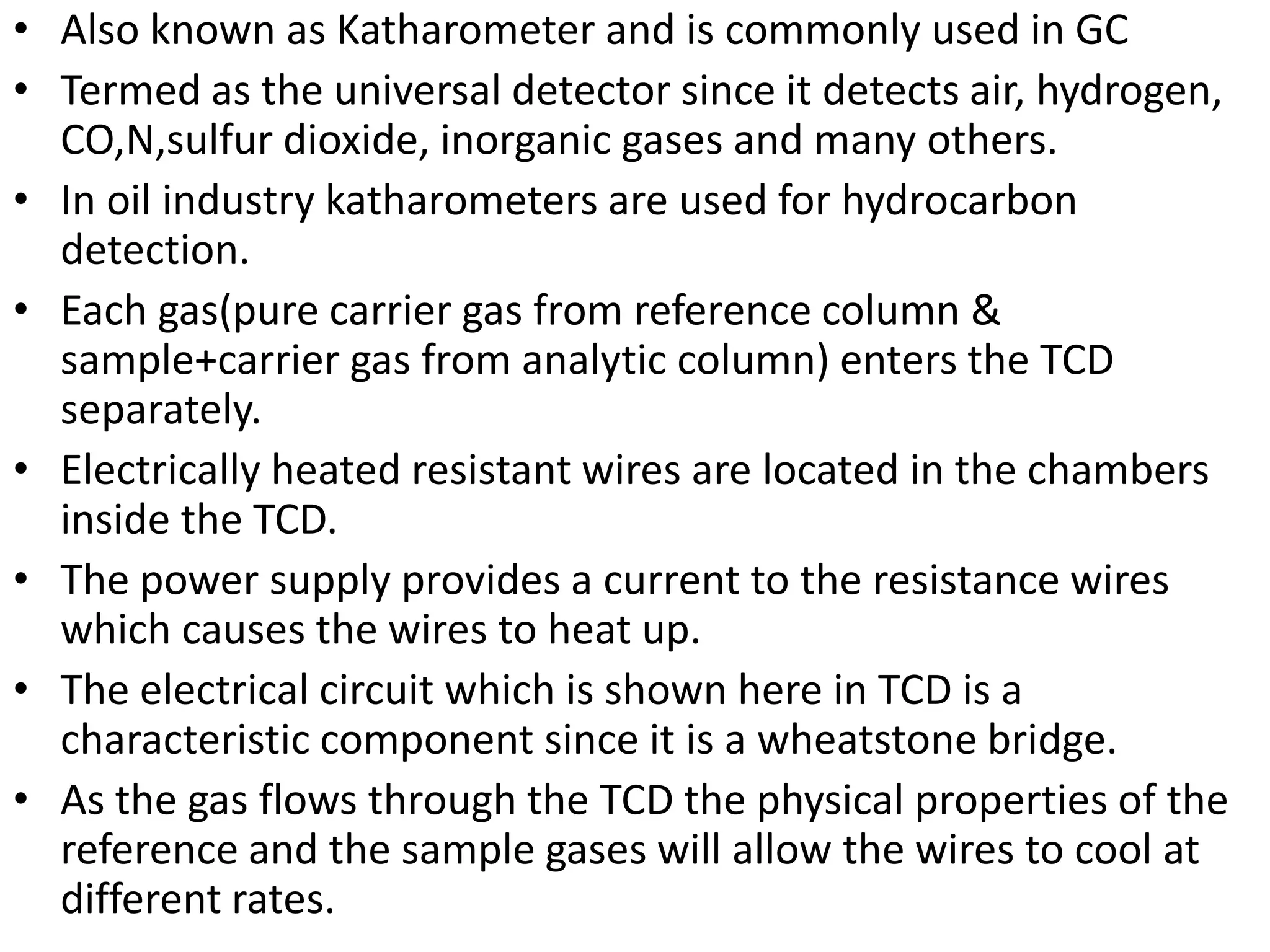
Thermal Conductivity Detector(TCD)-Non-destructive type
• Also known as Katharometer and is commonly used in GC
• Termed as the universal detector since it detects air, hydrogen,
CO,N,sulfur dioxide, inorganic gases and many others.
• In oil industry katharometers are used for hydrocarbon
detection.
• Each gas(pure carrier gas from reference column &
sample+carrier gas from analytic column) enters the TCD
separately.
• Electrically heated resistant wires are located in the chambers
inside the TCD.
• The power supply provides a current to the resistance wires
which causes the wires to heat up.
• The electrical circuit which is shown here in TCD is a
characteristic component since it is a wheatstone bridge.
• As the gas flows through the TCD the physical properties of the
reference and the sample gases will allow the wires to cool at
different rates.
• This change in temperature will result in the change in the
resistance for both the reference as well as the sample gas
which will produce an electrical signal that you ultimately
need for the compounds to be analyzed.
• This signal is proportional to the concentration of the
sample components.
• TCD therefore provides a direct means of measuring a
particular component in the sample gas.
• Further a chromatogram is received digitally for the sample
analyzed.
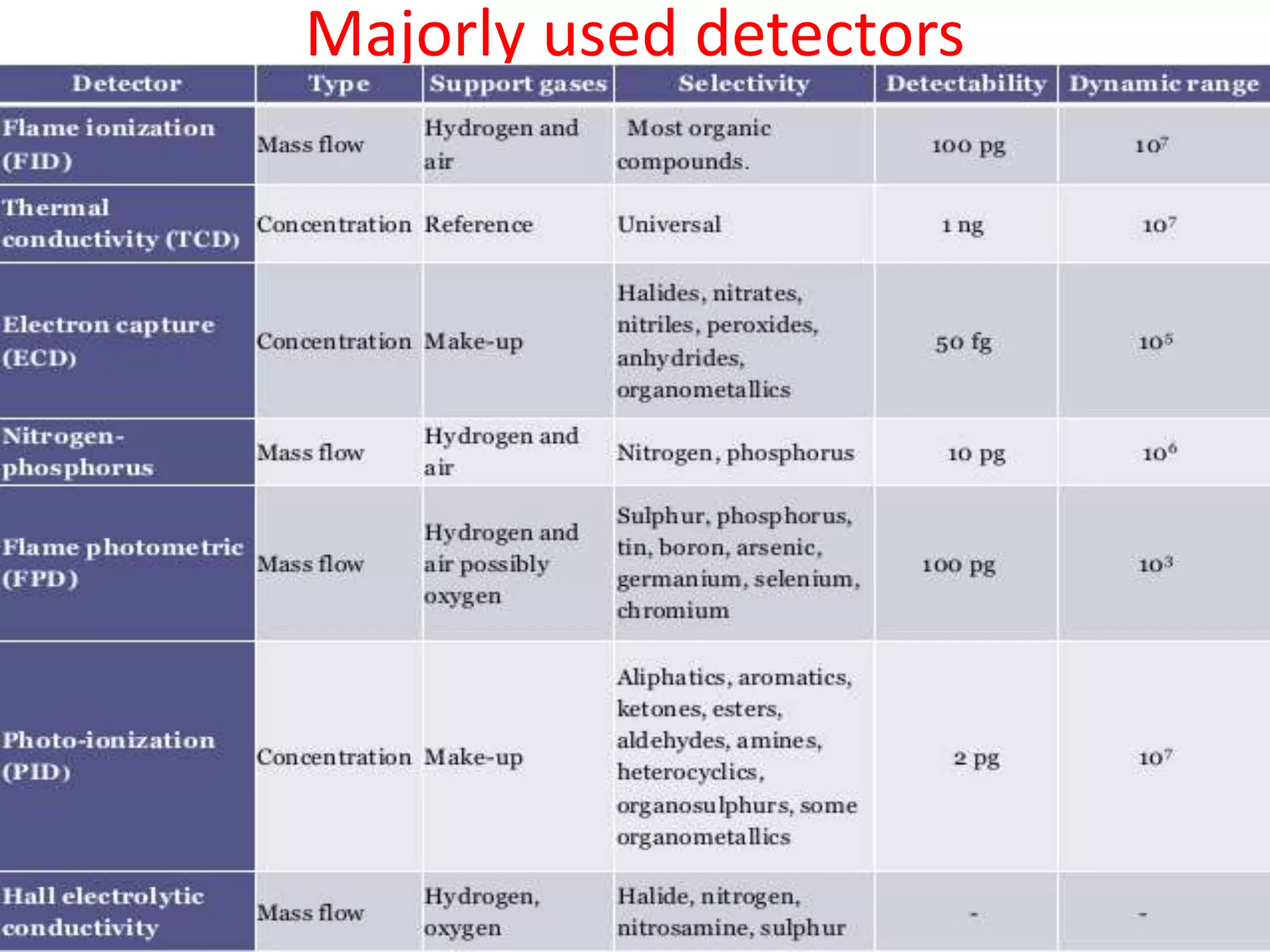
Majorly used detectors
References
• http://lab-training.com/landing/gc-module-8/
• https://www.slideshare.net/samikshasawant146/detectors
-in-gc
• https://en.wikipedia.org/wiki/Chromatography_detector
• https://www.cambustion.com/products/hfr500/fast-fid-
principles
• http://www.sciencedirect.com/science/article/pii/S002196
7300825698?via%3Dihub
• http://srigc.com/cn/downloads/43/NPD.pdf
• Principles and techniques of biochemistry and molecular
biology,edited by Keith Wilson,John Walker-7th
edition

Gas chromatography detectors

  • 1.
    Presentation by :Parnavi S. Kadam Topic : Detectors in Gas Chromatography
  • 2.
    What are Detectors? •A chromatography detector is a device used in Gas chromatography (GC) or liquid chromatography (LC) to detect components of the mixture being eluted off the chromatography column. Desirable characteristics of a Detector:- • Reproducible response to the change in the eluate composition • Should response rapidly • High sensitivity • Low noise • Small volume to avoid peak broadening & resultant loss of resolution • Preferably non-destructive (2)
  • 3.
    Two types ofDetectors 1)Destructive type of Detectors:- The destructive detectors perform continuous transformation of the column analyte(burning, evaporation or mixing with reagents) with subsequent measurement of some physical property of the resulting material. Examples: • Charged aerosol detector (CAD) • Flame ionization detector (FID) • Aerosol-based detector • Flame photometric detector (FPD) • Atomic-emission detector (AED) • Nitrogen Phosphorus Detector (NPD) • Evaporative light scattering detector (ELSD) • Mass spectrometer (MS) • Electrolytic Conductivity detector (ELCD) • (3)
  • 4.
    2)Non-destructive type ofDetectors:- The non-destructive detectors are directly measuring some property of the column analyte without any transformation. Examples: • uv Detectors • Thermal Conductivity Detectors (TCD) • Flourescence Detector • Electron Capture Detectors(ECD) • Conductivity Monitior • Photoionization Detector(PID) • Refractive Index Detector(RID) • Radio Flow Detector • Chiral Detector • (4)
  • 5.
    Flame Ionization Detector(FID) – Destructive type
  • 6.
    • FID wasinvented by scientist Harley & Pretorious and again separately by Mc Williams & Dewer • The flame ionisation detector (FID) is the automotive emissions industry standard method of measuring hydrocarbon (HC) concentration. • The eluate gas exits the GC column & enters the FID detector’s oven. • This tells us that the FID detector is placed inside the oven so as to ensure that the eluate gas does not come out of the gaseous phase and deposit on the interface between the column & FID. • As the eluate gas travels up through the capillary it comes in the contact with H₂(fuel gas) first & then with the air. • Flame is produced due to H₂+air and the eluate gas is subjected to burning which produces ions. • (6)
  • 7.
    • Reaction: Eluate gas+ H₂ + air combustion products H₂O+ions+radicals + electrons • The ions are detected using a metal collector (brass/platinum) which further generates the current. • This current is further analyzed using the digital convertor and further a chromatogram is developed. • Rate of ionization increases(i.e more ions generated)= current which is produced is also increased. • The current across the collector is thus proportional to the rate of ionization which in turn depends upon the concentration of hydrocarbon in the sample gas. • The disadvantage is that it destroys all the sample. • Sensitivity : • Selectivity : specific for hydrocarbon containing compounds (7)
  • 8.
    Nitrogen-Phosporus Detector(NPD)-Destructive type •The nitrogen–phosphorus detector (NPD) is also known as thermionic specific detector (TSD) or Alkali flame ionization detector & is commonly used in gas chromatography
  • 9.
    • This stabledetector is extremely sensitive to nitrogen- and phosphorus-containing compounds and is highly selective. • Similar to FID & is widely used in pesticide and herbicide analysis. • Inside the NPD detector body, an electrically heated thermionic bead (NPD bead) is positioned between the jet orifice and the collector electrode. • NPD uses a Rubidium or Caesium chloride bead which is heated by a coil which promotes the ionization of compounds that contain nitrogen or phosphorus. • Hydrogen and air flows create a hydrogen plasma around the hot NPD bead. • When molecules containing nitrogen or phosphorus enter the plasma from the column and jet orifice, they undergo a catalytic surface chemistry reaction, producing thermionic electrons.
  • 10.
    • The resultingions are attracted to a positively charged collector electrode, then amplified and output to the data system. • The hydrogen to air ratio is too less to sustain a flame, therefore minimizing hydrocarbon ionization and contributing to the NPD detector’s selectivity. • Selectivity : N & P containing compounds • Sensitivity :
  • 11.
  • 12.
    • Also knownas Katharometer and is commonly used in GC • Termed as the universal detector since it detects air, hydrogen, CO,N,sulfur dioxide, inorganic gases and many others. • In oil industry katharometers are used for hydrocarbon detection. • Each gas(pure carrier gas from reference column & sample+carrier gas from analytic column) enters the TCD separately. • Electrically heated resistant wires are located in the chambers inside the TCD. • The power supply provides a current to the resistance wires which causes the wires to heat up. • The electrical circuit which is shown here in TCD is a characteristic component since it is a wheatstone bridge. • As the gas flows through the TCD the physical properties of the reference and the sample gases will allow the wires to cool at different rates.
  • 13.
    • This changein temperature will result in the change in the resistance for both the reference as well as the sample gas which will produce an electrical signal that you ultimately need for the compounds to be analyzed. • This signal is proportional to the concentration of the sample components. • TCD therefore provides a direct means of measuring a particular component in the sample gas. • Further a chromatogram is received digitally for the sample analyzed.
  • 14.
  • 15.
    References • http://lab-training.com/landing/gc-module-8/ • https://www.slideshare.net/samikshasawant146/detectors -in-gc •https://en.wikipedia.org/wiki/Chromatography_detector • https://www.cambustion.com/products/hfr500/fast-fid- principles • http://www.sciencedirect.com/science/article/pii/S002196 7300825698?via%3Dihub • http://srigc.com/cn/downloads/43/NPD.pdf • Principles and techniques of biochemistry and molecular biology,edited by Keith Wilson,John Walker-7th edition