SECONDARY SECTOR
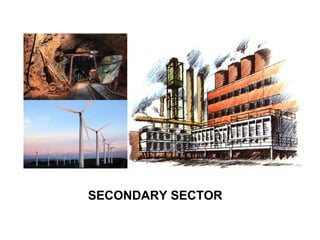
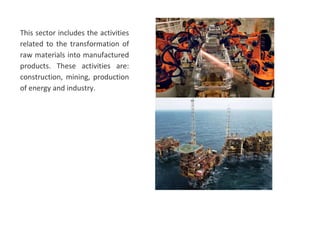
This sector includes the activities
related to the transformation of
raw materials into manufactured
products. These activities are:
construction, mining, production
of energy and industry.
MINING
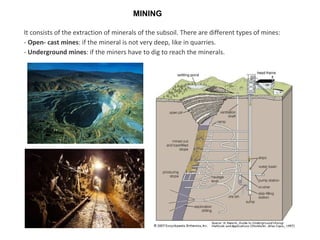
It consists of the extraction of minerals of the subsoil. There are different types of mines:
- Open- cast mines: if the mineral is not very deep, like in quarries.
- Underground mines: if the miners have to dig to reach the minerals.
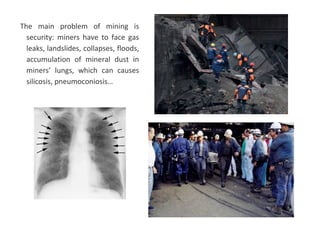
The main problem of mining is
security: miners have to face gas
leaks, landslides, collapses, floods,
accumulation of mineral dust in
miners’ lungs, which can causes
silicosis, pneumoconiosis…
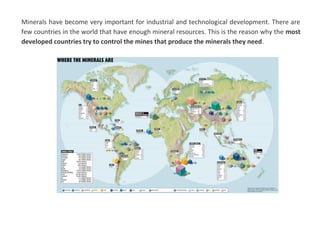
Minerals have become very important for industrial and technological development. There are
few countries in the world that have enough mineral resources. This is the reason why the most
developed countries try to control the mines that produce the minerals they need.
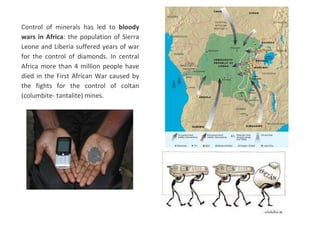
Control of minerals has led to bloody
wars in Africa: the population of Sierra
Leone and Liberia suffered years of war
for the control of diamonds. In central
Africa more than 4 million people have
died in the First African War caused by
the fights for the control of coltan
(columbite- tantalite) mines.
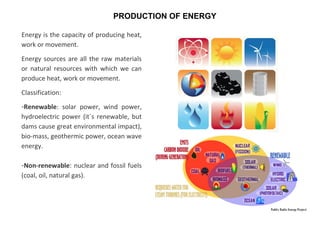
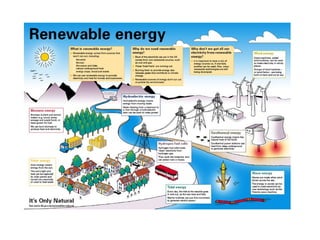
Energy is the capacity of producing heat,
work or movement.
Energy sources are all the raw materials
or natural resources with which we can
produce heat, work or movement.
Classification:
-Renewable: solar power, wind power,
hydroelectric power (it´s renewable, but
dams cause great environmental impact),
bio-mass, geothermic power, ocean wave
energy.
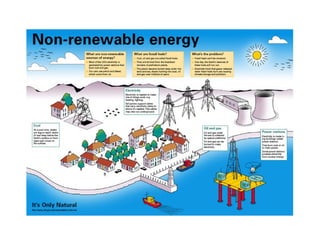
-Non-renewable: nuclear and fossil fuels
(coal, oil, natural gas).
PRODUCTION OF ENERGY
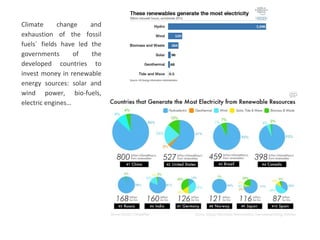
Climate change and
exhaustion of the fossil
fuels´ fields have led the
governments of the
developed countries to
invest money in renewable
energy sources: solar and
wind power, bio-fuels,
electric engines…
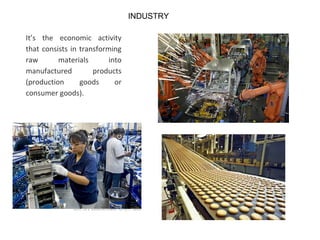
It’s the economic activity
that consists in transforming
raw materials into
manufactured products
(production goods or
consumer goods).
INDUSTRY
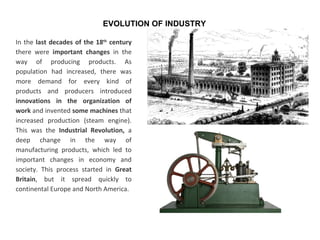
In the last decades of the 18th
century
there were important changes in the
way of producing products. As
population had increased, there was
more demand for every kind of
products and producers introduced
innovations in the organization of
work and invented some machines that
increased production (steam engine).
This was the Industrial Revolution, a
deep change in the way of
manufacturing products, which led to
important changes in economy and
society. This process started in Great
Britain, but it spread quickly to
continental Europe and North America.
EVOLUTION OF INDUSTRY
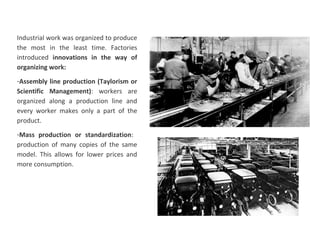
Industrial work was organized to produce
the most in the least time. Factories
introduced innovations in the way of
organizing work:
-Assembly line production (Taylorism or
Scientific Management): workers are
organized along a production line and
every worker makes only a part of the
product.
-Mass production or standardization:
production of many copies of the same
model. This allows for lower prices and
more consumption.
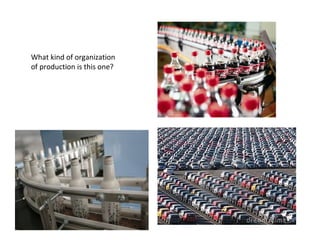
What kind of organization
of production is this one?
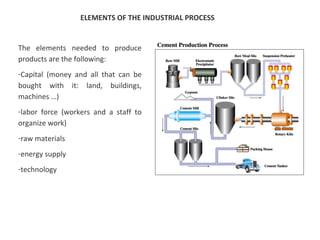
The elements needed to produce
products are the following:
-Capital (money and all that can be
bought with it: land, buildings,
machines …)
-labor force (workers and a staff to
organize work)
-raw materials
-energy supply
-technology
ELEMENTS OF THE INDUSTRIAL PROCESS
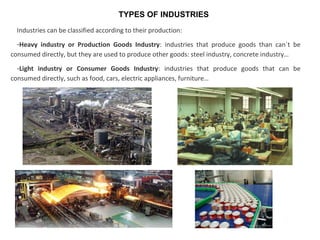
TYPES OF INDUSTRIES
Industries can be classified according to their production:
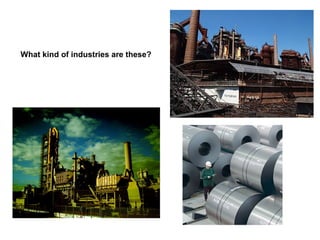
-Heavy industry or Production Goods Industry: industries that produce goods than can´t be
consumed directly, but they are used to produce other goods: steel industry, concrete industry…
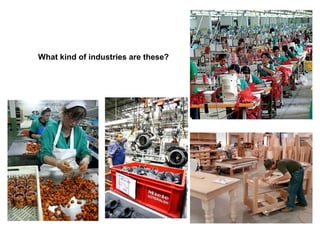
-Light industry or Consumer Goods Industry: industries that produce goods that can be
consumed directly, such as food, cars, electric appliances, furniture…
What kind of industries are these?
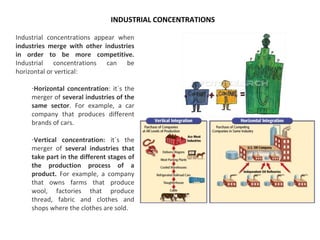
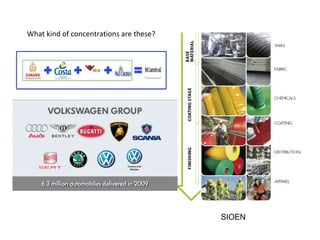
Industrial concentrations appear when
industries merge with other industries
in order to be more competitive.
Industrial concentrations can be
horizontal or vertical:
-Horizontal concentration: it´s the
merger of several industries of the
same sector. For example, a car
company that produces different
brands of cars.
-Vertical concentration: it´s the
merger of several industries that
take part in the different stages of
the production process of a
product. For example, a company
that owns farms that produce
wool, factories that produce
thread, fabric and clothes and
shops where the clothes are sold.
INDUSTRIAL CONCENTRATIONS
SIOEN
What kind of concentrations are these?
FACTORS OF INDUSTRIAL LOCATION
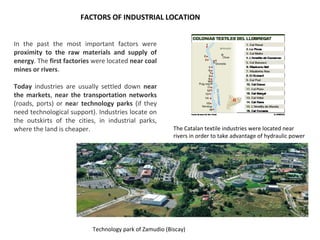
In the past the most important factors were
proximity to the raw materials and supply of
energy. The first factories were located near coal
mines or rivers.
Today industries are usually settled down near
the markets, near the transportation networks
(roads, ports) or near technology parks (if they
need technological support). Industries locate on
the outskirts of the cities, in industrial parks,
where the land is cheaper. The Catalan textile industries were located near
rivers in order to take advantage of hydraulic power
Technology park of Zamudio (Biscay)
If industries want to be competitive, they
have to be in constant change: they have to
invest in new technology and workers have
to recycle to get updated.
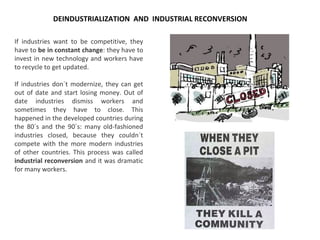
If industries don´t modernize, they can get
out of date and start losing money. Out of
date industries dismiss workers and
sometimes they have to close. This
happened in the developed countries during
the 80´s and the 90´s: many old-fashioned
industries closed, because they couldn´t
compete with the more modern industries
of other countries. This process was called
industrial reconversion and it was dramatic
for many workers.
DEINDUSTRIALIZATION AND INDUSTRIAL RECONVERSION
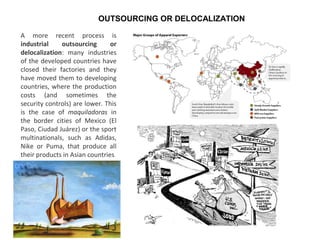
A more recent process is
industrial outsourcing or
delocalization: many industries
of the developed countries have
closed their factories and they
have moved them to developing
countries, where the production
costs (and sometimes the
security controls) are lower. This
is the case of maquiladoras in
the border cities of Mexico (El
Paso, Ciudad Juárez) or the sport
multinationals, such as Adidas,
Nike or Puma, that produce all
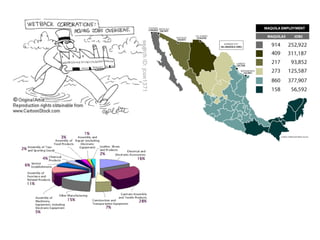
their products in Asian countries.
OUTSOURCING OR DELOCALIZATION
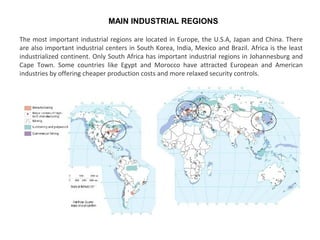
The most important industrial regions are located in Europe, the U.S.A, Japan and China. There
are also important industrial centers in South Korea, India, Mexico and Brazil. Africa is the least
industrialized continent. Only South Africa has important industrial regions in Johannesburg and
Cape Town. Some countries like Egypt and Morocco have attracted European and American
industries by offering cheaper production costs and more relaxed security controls.
MAIN INDUSTRIAL REGIONS
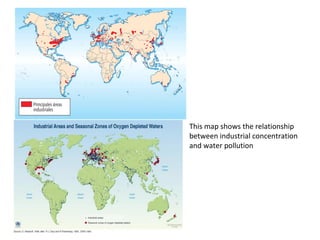
This map shows the relationship
between industrial concentration
and water pollution
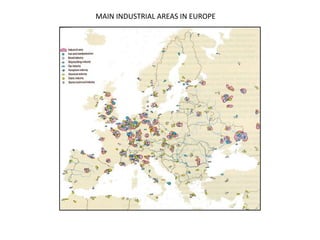
MAIN INDUSTRIAL AREAS IN EUROPE

Secondary sector

  • 1.
  • 2.
    This sector includesthe activities related to the transformation of raw materials into manufactured products. These activities are: construction, mining, production of energy and industry.
  • 3.
    MINING It consists ofthe extraction of minerals of the subsoil. There are different types of mines: - Open- cast mines: if the mineral is not very deep, like in quarries. - Underground mines: if the miners have to dig to reach the minerals.
  • 4.
    The main problemof mining is security: miners have to face gas leaks, landslides, collapses, floods, accumulation of mineral dust in miners’ lungs, which can causes silicosis, pneumoconiosis…
  • 5.
    Minerals have becomevery important for industrial and technological development. There are few countries in the world that have enough mineral resources. This is the reason why the most developed countries try to control the mines that produce the minerals they need.
  • 6.
    Control of mineralshas led to bloody wars in Africa: the population of Sierra Leone and Liberia suffered years of war for the control of diamonds. In central Africa more than 4 million people have died in the First African War caused by the fights for the control of coltan (columbite- tantalite) mines.
  • 7.
    Energy is thecapacity of producing heat, work or movement. Energy sources are all the raw materials or natural resources with which we can produce heat, work or movement. Classification: -Renewable: solar power, wind power, hydroelectric power (it´s renewable, but dams cause great environmental impact), bio-mass, geothermic power, ocean wave energy. -Non-renewable: nuclear and fossil fuels (coal, oil, natural gas). PRODUCTION OF ENERGY
  • 11.
    Climate change and exhaustionof the fossil fuels´ fields have led the governments of the developed countries to invest money in renewable energy sources: solar and wind power, bio-fuels, electric engines…
  • 12.
    It’s the economicactivity that consists in transforming raw materials into manufactured products (production goods or consumer goods). INDUSTRY
  • 13.
    In the lastdecades of the 18th century there were important changes in the way of producing products. As population had increased, there was more demand for every kind of products and producers introduced innovations in the organization of work and invented some machines that increased production (steam engine). This was the Industrial Revolution, a deep change in the way of manufacturing products, which led to important changes in economy and society. This process started in Great Britain, but it spread quickly to continental Europe and North America. EVOLUTION OF INDUSTRY
  • 14.
    Industrial work wasorganized to produce the most in the least time. Factories introduced innovations in the way of organizing work: -Assembly line production (Taylorism or Scientific Management): workers are organized along a production line and every worker makes only a part of the product. -Mass production or standardization: production of many copies of the same model. This allows for lower prices and more consumption.
  • 15.
    What kind oforganization of production is this one?
  • 16.
    The elements neededto produce products are the following: -Capital (money and all that can be bought with it: land, buildings, machines …) -labor force (workers and a staff to organize work) -raw materials -energy supply -technology ELEMENTS OF THE INDUSTRIAL PROCESS
  • 17.
    TYPES OF INDUSTRIES Industriescan be classified according to their production: -Heavy industry or Production Goods Industry: industries that produce goods than can´t be consumed directly, but they are used to produce other goods: steel industry, concrete industry… -Light industry or Consumer Goods Industry: industries that produce goods that can be consumed directly, such as food, cars, electric appliances, furniture…
  • 18.
    What kind ofindustries are these?
  • 19.
    What kind ofindustries are these?
  • 20.
    Industrial concentrations appearwhen industries merge with other industries in order to be more competitive. Industrial concentrations can be horizontal or vertical: -Horizontal concentration: it´s the merger of several industries of the same sector. For example, a car company that produces different brands of cars. -Vertical concentration: it´s the merger of several industries that take part in the different stages of the production process of a product. For example, a company that owns farms that produce wool, factories that produce thread, fabric and clothes and shops where the clothes are sold. INDUSTRIAL CONCENTRATIONS
  • 21.
    SIOEN What kind ofconcentrations are these?
  • 22.
    FACTORS OF INDUSTRIALLOCATION In the past the most important factors were proximity to the raw materials and supply of energy. The first factories were located near coal mines or rivers. Today industries are usually settled down near the markets, near the transportation networks (roads, ports) or near technology parks (if they need technological support). Industries locate on the outskirts of the cities, in industrial parks, where the land is cheaper. The Catalan textile industries were located near rivers in order to take advantage of hydraulic power Technology park of Zamudio (Biscay)
  • 23.
    If industries wantto be competitive, they have to be in constant change: they have to invest in new technology and workers have to recycle to get updated. If industries don´t modernize, they can get out of date and start losing money. Out of date industries dismiss workers and sometimes they have to close. This happened in the developed countries during the 80´s and the 90´s: many old-fashioned industries closed, because they couldn´t compete with the more modern industries of other countries. This process was called industrial reconversion and it was dramatic for many workers. DEINDUSTRIALIZATION AND INDUSTRIAL RECONVERSION
  • 24.
    A more recentprocess is industrial outsourcing or delocalization: many industries of the developed countries have closed their factories and they have moved them to developing countries, where the production costs (and sometimes the security controls) are lower. This is the case of maquiladoras in the border cities of Mexico (El Paso, Ciudad Juárez) or the sport multinationals, such as Adidas, Nike or Puma, that produce all their products in Asian countries. OUTSOURCING OR DELOCALIZATION
  • 26.
    The most importantindustrial regions are located in Europe, the U.S.A, Japan and China. There are also important industrial centers in South Korea, India, Mexico and Brazil. Africa is the least industrialized continent. Only South Africa has important industrial regions in Johannesburg and Cape Town. Some countries like Egypt and Morocco have attracted European and American industries by offering cheaper production costs and more relaxed security controls. MAIN INDUSTRIAL REGIONS
  • 27.
    This map showsthe relationship between industrial concentration and water pollution
  • 28.