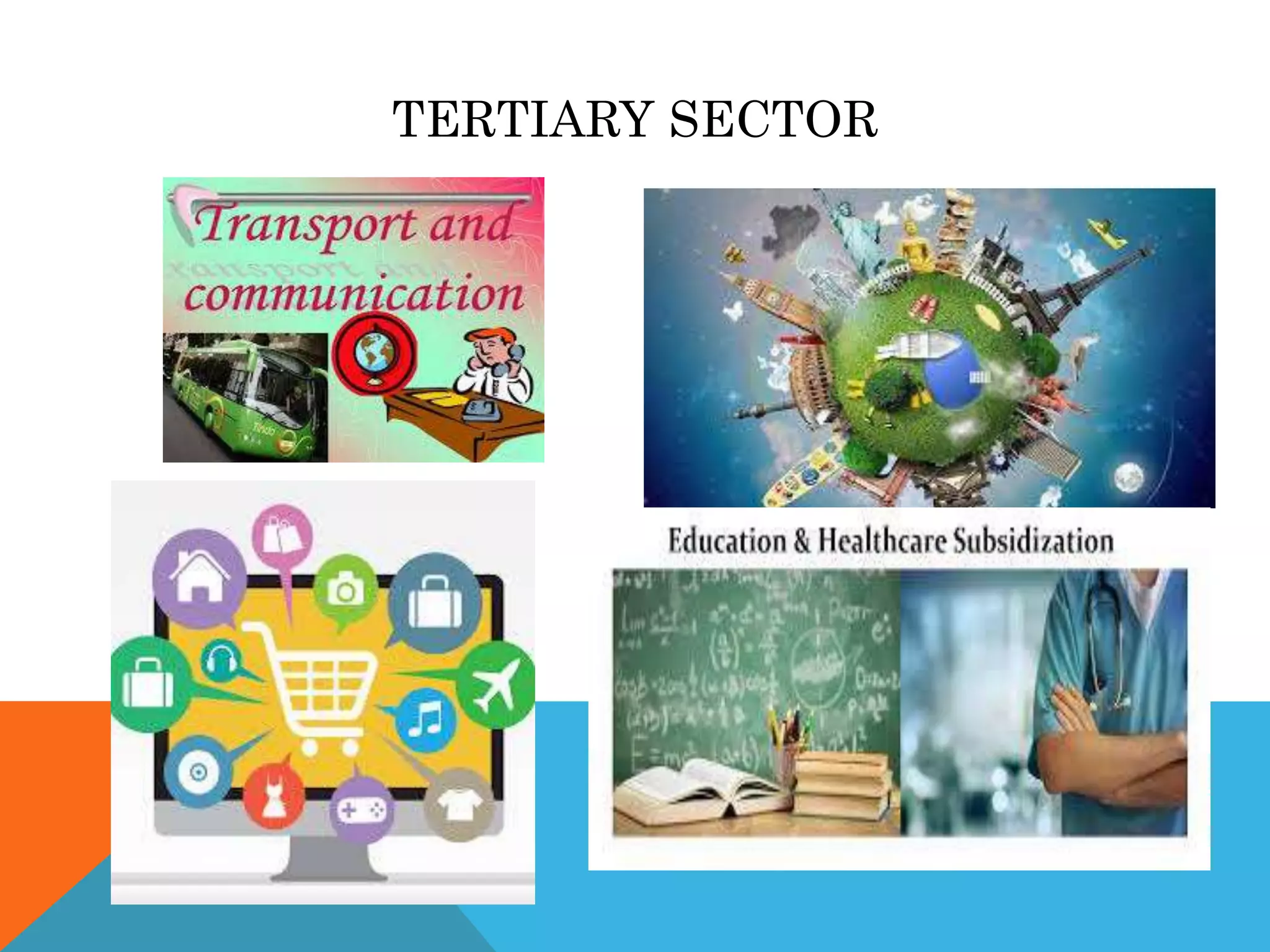
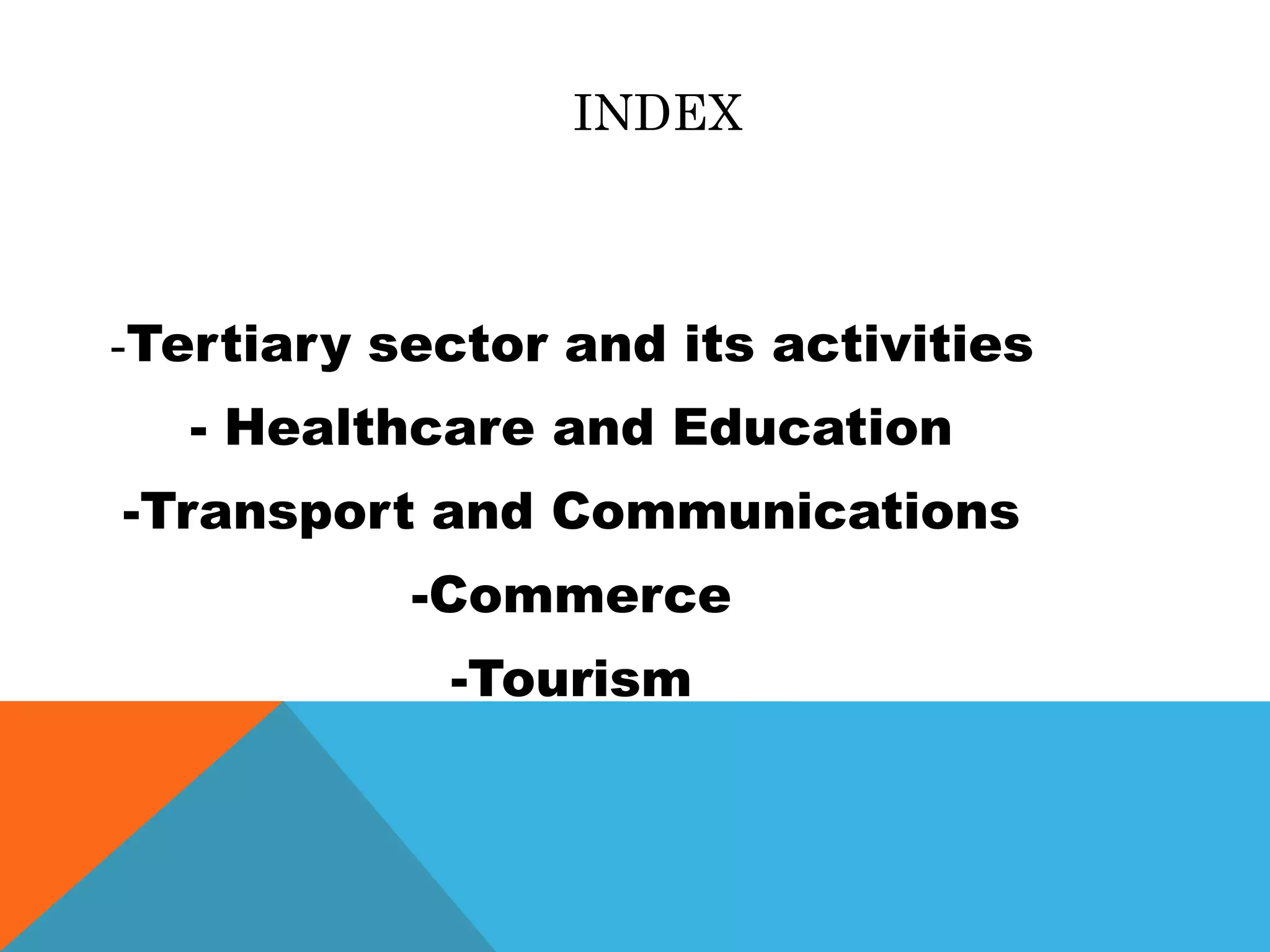
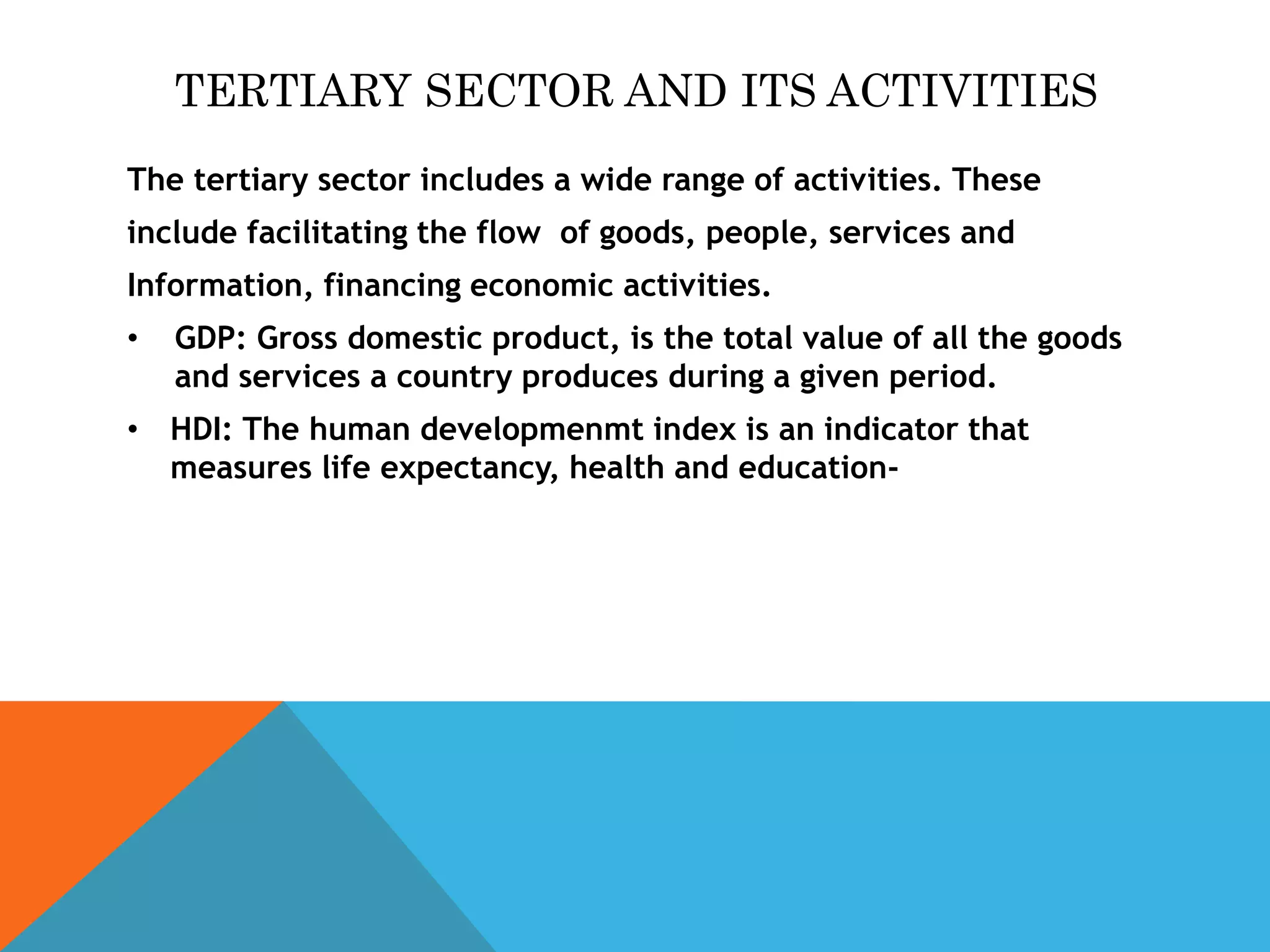
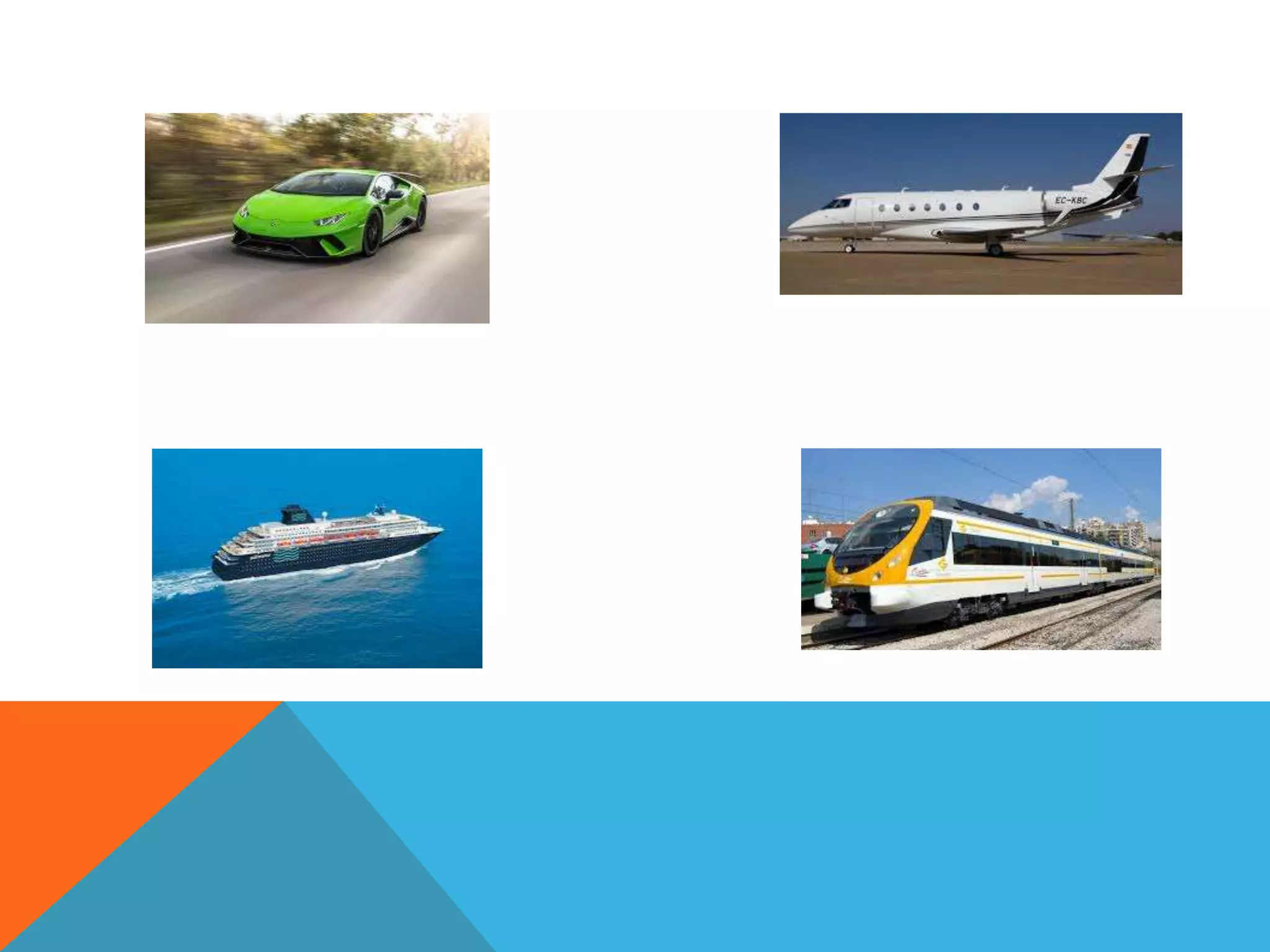
TERTIARY SECTOR
INDEX
-Tertiary sector and its activities
- Healthcare and Education
-Transport and Communications
-Commerce
-Tourism
TERTIARY SECTOR AND ITS ACTIVITIES
The tertiary sector includes a wide range of activities. These
include facilitating the flow of goods, people, services and
Information, financing economic activities.
• GDP: Gross domestic product, is the total value of all the goods
and services a country produces during a given period.
• HDI: The human developmenmt index is an indicator that
measures life expectancy, health and education-
• Public: these are
created and managed by
the government in order
to guarantee certain
basic services to the
general population.
• Private: These are
created and managed
by private companies
with the aim of
obtaining financial
benefits, such as a
newspaper.
PUBLIC AND PRIVATE SERVICES
HEALTHCARE
The healthcare sector of a country includes all the the services
that are intended to prevent and treat human illness. Healthcare
therefore has an impact on a basic necessity: Health. This is
why it is one of the most important tertiary sector activities.
EDUCATION
The education sector of a country includes all of the services
that are used to provide people with education and training .
Like healthcare, this tertiary sector activity is especially important
because it meets a basic need: the right to an education that
will make it possible to obtain a job and adapt to or live in society.
TRANSPORTS
● Transport has changed over the last century. In addition,
cost an journey times have both decreased. This
phenomenon is know as the transport revolution.
● This are some types of transport:
● Road transport: Since car spread in 20 century. The
roads increase, this is used over short distances.
● Rail transport: From the 19 century, railways were the
main transport of ground because of their speed and
carrying capacity. They are used for local routes and
medium distances on high speeds.
● River and sea transport: it requires large rivers with a
heavy flow. This is ideal for transporting heavy goods at
low cost.
● Air transport: There is most common for long distances.
Passengers are normaly tourist and people on bussines
trip.
COMMUNICATIONS
The mass media (print, radio, television, and web based media)
transmit
entertaiment , information and opinions to every corner of the
planet.
Telecommunications are long distance communications systems.
COMMERCE
Some characteristics of commerce today:
• It is governed by the principles of supply and demand.
• In terms of location, it is physically concentrated primarily in
urban environments.
• Countries are becoming more and more interdependent.
Multinational companies are also increasingly important in
international trade.
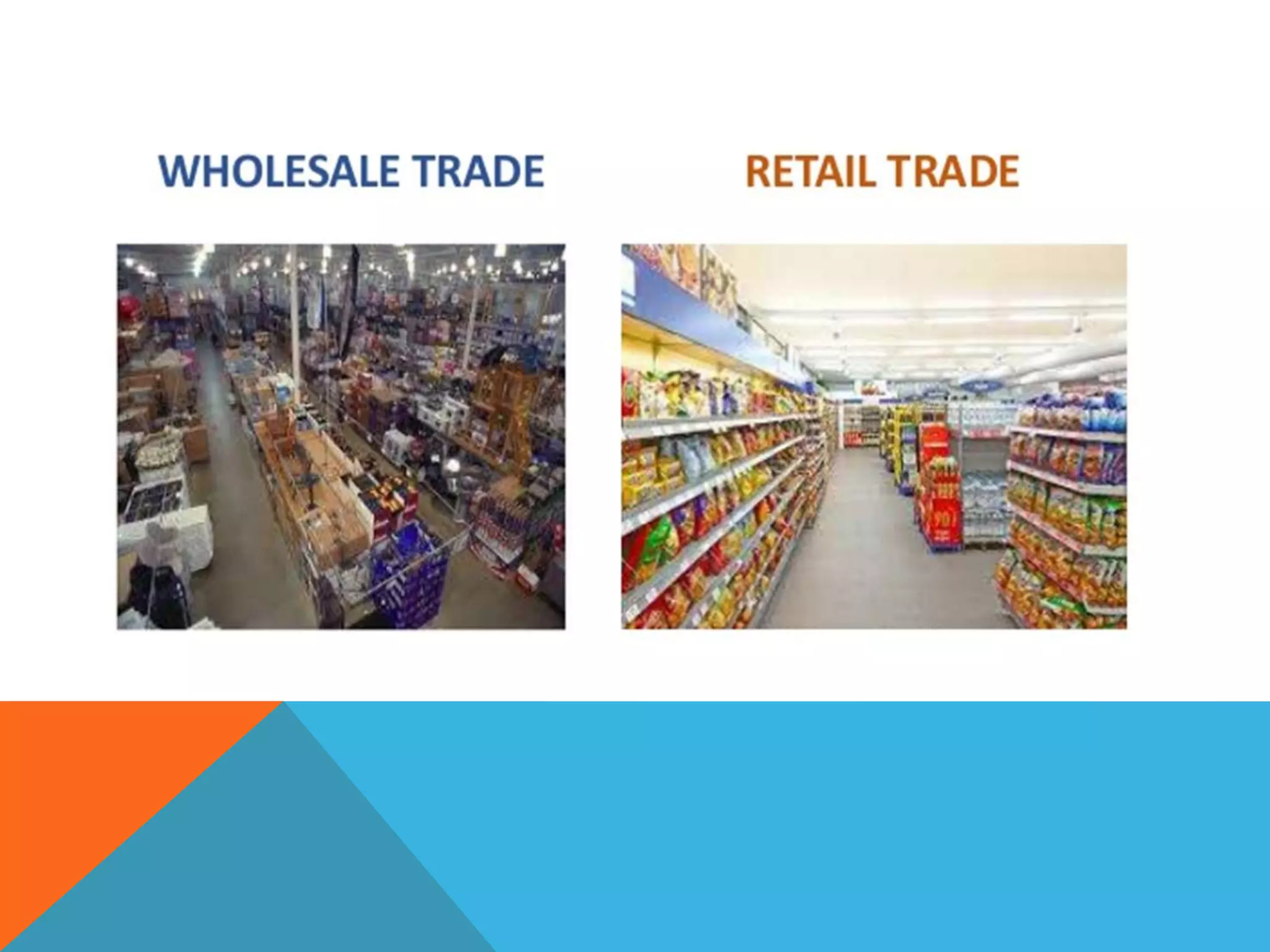
DOMESTIC TRADE
• Wholesale trade, which moves large quantities of merchandise
in order to sell it to other merchants or companies.
• Retail trade, which involves buying from wholesalers and selling
directly to consumers.
FOREIGN TRADE
Foreing trade is the exchange of goods and services between a
country and the rest of the world. There are 2 types of exchange:
Exports and Imports.
• Positive balance of trade: The value of exports exceeds the
value of purchases, creating surplus balance or trade surplus.
• Negative balance of trade: The value of imports exceeds the
value of sales, creating a deficit balance or trade deficit.
TOURISM
● Tourism is the temporary movement of people from their
place of residence to another place in order to enjoy their
free time.
● The development of the tourism industry involves creating
the necesseary transport and hospitality infrastructure to
meet demand.
TYPES OF TOURISM
● MOUNTAINS:
You can go hiking in a lot
of places and you are also
close to the pyrinees.
● RURAL:
Navarre has lot of green
places and beautifull
villages in were you can
have rurals vacations.
● LEISURE:
Entertainment and leisure
such as concerts and
amusement parks like
sendadiva.
● RELIGUOUS AND
CULTURAL: There are
many places with a rich
cultural and artistic
heritage, Pilgrimages to
holy sites.
● SPORTS AND ADVENTURE:
In winter you can ski, in
summer you can do canoe,
rafting and fishing.
● HEALTH:
Places were you can relax
like spas.
● BUSINESS:
shows in theatres like
Gayarre and special
conferences of important
people.
Tertiary sector
Tertiary sector
Tertiary sector

Tertiary sector

  • 1.
  • 2.
    INDEX -Tertiary sector andits activities - Healthcare and Education -Transport and Communications -Commerce -Tourism
  • 3.
    TERTIARY SECTOR ANDITS ACTIVITIES The tertiary sector includes a wide range of activities. These include facilitating the flow of goods, people, services and Information, financing economic activities. • GDP: Gross domestic product, is the total value of all the goods and services a country produces during a given period. • HDI: The human developmenmt index is an indicator that measures life expectancy, health and education-
  • 4.
    • Public: theseare created and managed by the government in order to guarantee certain basic services to the general population. • Private: These are created and managed by private companies with the aim of obtaining financial benefits, such as a newspaper. PUBLIC AND PRIVATE SERVICES
  • 5.
    HEALTHCARE The healthcare sectorof a country includes all the the services that are intended to prevent and treat human illness. Healthcare therefore has an impact on a basic necessity: Health. This is why it is one of the most important tertiary sector activities.
  • 6.
    EDUCATION The education sectorof a country includes all of the services that are used to provide people with education and training . Like healthcare, this tertiary sector activity is especially important because it meets a basic need: the right to an education that will make it possible to obtain a job and adapt to or live in society.
  • 7.
    TRANSPORTS ● Transport haschanged over the last century. In addition, cost an journey times have both decreased. This phenomenon is know as the transport revolution. ● This are some types of transport: ● Road transport: Since car spread in 20 century. The roads increase, this is used over short distances. ● Rail transport: From the 19 century, railways were the main transport of ground because of their speed and carrying capacity. They are used for local routes and medium distances on high speeds. ● River and sea transport: it requires large rivers with a heavy flow. This is ideal for transporting heavy goods at low cost. ● Air transport: There is most common for long distances. Passengers are normaly tourist and people on bussines trip.
  • 9.
    COMMUNICATIONS The mass media(print, radio, television, and web based media) transmit entertaiment , information and opinions to every corner of the planet. Telecommunications are long distance communications systems.
  • 10.
    COMMERCE Some characteristics ofcommerce today: • It is governed by the principles of supply and demand. • In terms of location, it is physically concentrated primarily in urban environments. • Countries are becoming more and more interdependent. Multinational companies are also increasingly important in international trade.
  • 11.
    DOMESTIC TRADE • Wholesaletrade, which moves large quantities of merchandise in order to sell it to other merchants or companies. • Retail trade, which involves buying from wholesalers and selling directly to consumers.
  • 13.
    FOREIGN TRADE Foreing tradeis the exchange of goods and services between a country and the rest of the world. There are 2 types of exchange: Exports and Imports. • Positive balance of trade: The value of exports exceeds the value of purchases, creating surplus balance or trade surplus. • Negative balance of trade: The value of imports exceeds the value of sales, creating a deficit balance or trade deficit.
  • 14.
    TOURISM ● Tourism isthe temporary movement of people from their place of residence to another place in order to enjoy their free time. ● The development of the tourism industry involves creating the necesseary transport and hospitality infrastructure to meet demand.
  • 15.
    TYPES OF TOURISM ●MOUNTAINS: You can go hiking in a lot of places and you are also close to the pyrinees. ● RURAL: Navarre has lot of green places and beautifull villages in were you can have rurals vacations. ● LEISURE: Entertainment and leisure such as concerts and amusement parks like sendadiva. ● RELIGUOUS AND CULTURAL: There are many places with a rich cultural and artistic heritage, Pilgrimages to holy sites.
  • 16.
    ● SPORTS ANDADVENTURE: In winter you can ski, in summer you can do canoe, rafting and fishing. ● HEALTH: Places were you can relax like spas. ● BUSINESS: shows in theatres like Gayarre and special conferences of important people.