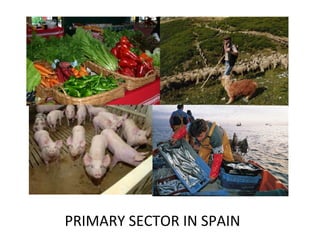
PRIMARY SECTOR IN SPAIN
Up until the 20th
century, the
primary sector was the most
important sector in the Spanish
economy, but this changed.
Nowadays less than 4% of the
working population (less than 1
million people) works in the primary
sector and only 2.6% of Spain’s GDP
comes from this sector.
Production is oriented to
market mainly and it´s closely
related to the physical
features of the country.
The main crops are cereals,
fruits, vegetables, vines, olive
trees and flowers.
AGRICULTURE AND STOCKBREEDING
AGRARIAN LANDSCAPES
STOCKBREEDING
http://www.aularagon.org/files/espa/ON_Line/Geografia/CMLG9ActEcon/Mapa_paisajesAgrarios.htm
AGRARIAN LANDSCAPES
LOCATION AGRICULTURE STOCKBREEDING HABITAT
CONTINENTAL
MEDITERRANEAN
Center of the
Peninsula (Central
Plateau and Ebro
Valley)
Dry-land crops in the plains:
Mediterranean trilogy (cereals, vines
and olive trees)
Irrigated crops in the river valleys:
vegetables.
Sheep husbandry: sheep are
raised in semi-stabled system
to produce milk and meat.
Cattle and pork stockbreeding
in mountainous areas
Concentrated
habitat is
predominant
ATLANTIC North of Spain
(Galicia, Asturias,
Cantabria and
Basque Country).
Eucalyptus and pine tree forests
have been cultivated to produce
cellulose.
Little space is dedicated to
agriculture: small estates where
farmers cultivate corn, potatoes,
apple trees or vegetables.
Cattle stockbreeding: the
most part of the space are
pastures, where cows are
raised to produce beef and
milk. Farms are small.
Scattered habitat
MEDITERRANEAN Mediterranean
regions (Catalonia,
Valencian
Community,
Murcia and
Andalusia)
Commercial agriculture destined to
export: fruit, vegetables and flowers.
In the last decades many crops have
been developed in greenhouses.
Pork and poultry farms,
whose production is destined
to markets.
Scattered habitat
in irrigated areas
CANARY ISLANDS Canary Islands Only the fertile lands with supply of
water are cultivated. The main crops
are vegetables (tomatoes, onions)
and plantations of bananas,
pineapples and tobacco.
Sheep and caprine cattle Small traditional
villages among
the plots of land.
Organic farming has grown
considerably in the last decades.
http://www.qcom.es/v_portal/informacion/informacionver.asp?cod=587&te=2&idage=769
COMMON AGRICULTURAL POLICY
As Spain is a member of the European Union
(EU), the most part of the economic policy is
determined by the EU. The primary sector is
regulated by the CAP (Common Agricultural
Policy):
-Objectives:
o Achieve self- sufficiency: to produce
the products needed by the EU
members and to avoid surplus.
o Keep the standards of living of the
producers.
-Actions:
o The EU gives subsidies to the farmers to
keep some crops or to abandon some
others.
o The EU signs trade agreements with
some countries to import their products
at a cheaper price.
41% of the EU budget is destined to
the CAP.
There are some problems with the CAP.
The decisions of Brussels have been
contradictory and unfair sometimes:
-Subsidies are given to abandon crops
and subsidies to recover the same crops
a few years later.
-Very rich producers who don´t live from
agriculture receive subsidies.
-Shortage of some products due to the
subsidies´ policy of abandoning certain
production (milk).
-The import of some products damages
the prices and benefits of the farmers.
CAP subsidies per region in 2014
http://www.finanzas.com/noticias/empresas/20120512/grandes-empresas-bodegas-entre-1363853.html
The lack of control has
also caused abuse by
some European farmers,
who have used the CAP to
cheat and receive money.
http://www.fega.es/beneficiarios_PAC_2014
FISHING
Spain is a fishing power. The country has thousands of kilometers of coasts, many
fishing ships and a lot of industries related to fish: shipyards, canned/preserved food
industries.
The Mediterranean Sea is
a warm sea, with high
salinity levels. This
reduces the amount of
fish in the Mediterranean
fisheries.
Overfishing has
exhausted the Spanish
fishing grounds in the last
decades as well. These
facts have obliged the
Spanish fishing float to
look for fishing grounds in
other places.
As a member of the EU, the
Spanish ships can fish in the
European fishing grounds.
The Spanish government has
also signed fishing
agreements with non-
European countries. This
allows the Spanish ships to
fish in the territorial waters
of other countries: Morocco,
Mauritania, Senegal …
CURRENT SITUATION
-Reduction of the fishing fleet:
nowadays there are around
10,900 ships , from which 10,500
fish in Spain’s fisheries.
- Fish catches in the
Mediterranean and Cantabrian
Sea have increased, but they
have dimisished in the Gulf of
Cádiz and the Canary Islands.
- Aquaculture has developed a
lot and it provides most of the
fish consumed in Spain.
http://ec.europa.eu/fisheries/documentation/publications/pcp_es.pdf
http://www.industriaspesqueras.com/noticias/en_portada/24588/espana_cuenta_con_menos_flota_pe
ro_aumentan_las_capturas.html
AQUACULTURE
- Main European producer
(20% of Europe’s production)
- Around 27,000 people work
in this sector
-78% of production are
molluscs (mussels) and 22%
are fish.
http://www.acuicultura-descubrela.es/images/que_mas_puedo_ver_acui_esp.pdf

Primary sector in Spain

  • 1.
  • 2.
    Up until the20th century, the primary sector was the most important sector in the Spanish economy, but this changed. Nowadays less than 4% of the working population (less than 1 million people) works in the primary sector and only 2.6% of Spain’s GDP comes from this sector.
  • 4.
    Production is orientedto market mainly and it´s closely related to the physical features of the country. The main crops are cereals, fruits, vegetables, vines, olive trees and flowers. AGRICULTURE AND STOCKBREEDING
  • 5.
  • 6.
  • 7.
  • 8.
    AGRARIAN LANDSCAPES LOCATION AGRICULTURESTOCKBREEDING HABITAT CONTINENTAL MEDITERRANEAN Center of the Peninsula (Central Plateau and Ebro Valley) Dry-land crops in the plains: Mediterranean trilogy (cereals, vines and olive trees) Irrigated crops in the river valleys: vegetables. Sheep husbandry: sheep are raised in semi-stabled system to produce milk and meat. Cattle and pork stockbreeding in mountainous areas Concentrated habitat is predominant ATLANTIC North of Spain (Galicia, Asturias, Cantabria and Basque Country). Eucalyptus and pine tree forests have been cultivated to produce cellulose. Little space is dedicated to agriculture: small estates where farmers cultivate corn, potatoes, apple trees or vegetables. Cattle stockbreeding: the most part of the space are pastures, where cows are raised to produce beef and milk. Farms are small. Scattered habitat MEDITERRANEAN Mediterranean regions (Catalonia, Valencian Community, Murcia and Andalusia) Commercial agriculture destined to export: fruit, vegetables and flowers. In the last decades many crops have been developed in greenhouses. Pork and poultry farms, whose production is destined to markets. Scattered habitat in irrigated areas CANARY ISLANDS Canary Islands Only the fertile lands with supply of water are cultivated. The main crops are vegetables (tomatoes, onions) and plantations of bananas, pineapples and tobacco. Sheep and caprine cattle Small traditional villages among the plots of land.
  • 9.
    Organic farming hasgrown considerably in the last decades. http://www.qcom.es/v_portal/informacion/informacionver.asp?cod=587&te=2&idage=769
  • 10.
    COMMON AGRICULTURAL POLICY AsSpain is a member of the European Union (EU), the most part of the economic policy is determined by the EU. The primary sector is regulated by the CAP (Common Agricultural Policy): -Objectives: o Achieve self- sufficiency: to produce the products needed by the EU members and to avoid surplus. o Keep the standards of living of the producers. -Actions: o The EU gives subsidies to the farmers to keep some crops or to abandon some others. o The EU signs trade agreements with some countries to import their products at a cheaper price.
  • 12.
    41% of theEU budget is destined to the CAP. There are some problems with the CAP. The decisions of Brussels have been contradictory and unfair sometimes: -Subsidies are given to abandon crops and subsidies to recover the same crops a few years later. -Very rich producers who don´t live from agriculture receive subsidies. -Shortage of some products due to the subsidies´ policy of abandoning certain production (milk). -The import of some products damages the prices and benefits of the farmers.
  • 13.
    CAP subsidies perregion in 2014 http://www.finanzas.com/noticias/empresas/20120512/grandes-empresas-bodegas-entre-1363853.html The lack of control has also caused abuse by some European farmers, who have used the CAP to cheat and receive money. http://www.fega.es/beneficiarios_PAC_2014
  • 14.
    FISHING Spain is afishing power. The country has thousands of kilometers of coasts, many fishing ships and a lot of industries related to fish: shipyards, canned/preserved food industries.
  • 15.
    The Mediterranean Seais a warm sea, with high salinity levels. This reduces the amount of fish in the Mediterranean fisheries. Overfishing has exhausted the Spanish fishing grounds in the last decades as well. These facts have obliged the Spanish fishing float to look for fishing grounds in other places.
  • 16.
    As a memberof the EU, the Spanish ships can fish in the European fishing grounds. The Spanish government has also signed fishing agreements with non- European countries. This allows the Spanish ships to fish in the territorial waters of other countries: Morocco, Mauritania, Senegal …
  • 17.
    CURRENT SITUATION -Reduction ofthe fishing fleet: nowadays there are around 10,900 ships , from which 10,500 fish in Spain’s fisheries. - Fish catches in the Mediterranean and Cantabrian Sea have increased, but they have dimisished in the Gulf of Cádiz and the Canary Islands. - Aquaculture has developed a lot and it provides most of the fish consumed in Spain. http://ec.europa.eu/fisheries/documentation/publications/pcp_es.pdf http://www.industriaspesqueras.com/noticias/en_portada/24588/espana_cuenta_con_menos_flota_pe ro_aumentan_las_capturas.html
  • 18.
    AQUACULTURE - Main Europeanproducer (20% of Europe’s production) - Around 27,000 people work in this sector -78% of production are molluscs (mussels) and 22% are fish. http://www.acuicultura-descubrela.es/images/que_mas_puedo_ver_acui_esp.pdf