A cement and concrete industry publication


How to Design Concrete
Structures using Eurocode 2
A J Bond MA MSc DIC PhD MICE CEng      T Harrison BSc PhD CEng MICE FICT          R S Narayanan FREng
O Brooker BEng CEng MICE MIStructE     R M Moss BSc PhD DIC CEng MICE MIStructE   R Webster CEng FIStructE
A J Harris BSc MSc DIC MICE CEng FGS
Foreword
The introduction of European standards to UK construction is a significant event. The ten design standards, known
as the Eurocodes, will affect all design and construction activities as current British Standards for design are due
to be withdrawn in 2010 at the latest. BS 8110, however, has an earlier withdrawal date of March 2008. The aim
of this publication is to make the transition to Eurocode 2: Design of concrete structures as easy as possible by
drawing together in one place key information and commentary required for the design and detailing of typical
concrete elements.

The cement and concrete industry recognised that a substantial effort was required to ensure that the UK design
profession would be able to use Eurocode 2 quickly, effectively, efficiently and with confidence. With support
from government, consultants and relevant industry bodies, the Concrete Industry Eurocode 2 Group (CIEG)
was formed in 1999 and this Group has provided the guidance for a co-ordinated and collaborative approach to
the introduction of Eurocode 2. Part of the output of the CIEG project was the technical content for 7 of the 11
chapters in this publication. The remaining chapters have been developed by The Concrete Centre.


Acknowledgements
The content of Chapters 1 and 3 to 8 were produced as part of the project Eurocode 2: transition from UK to
European concrete design standards. This project was part funded by the DTI under the Partners in Innovation
scheme. The lead partner was British Cement Association. The work was carried out under the guidance of the
Concrete Industry Eurocode 2 Group and overseen by a Steering Group of the CIEG (members are listed on inside
back cover).
Particular thanks are due to Robin Whittle, technical editor to the CEN/TC 250/SC2 committee (the committee
responsible for structural Eurocodes), who has reviewed and commented on the contents. Thanks are also due to
John Kelly and Chris Clear who have contributed to individual chapters.

Gillian Bond, Issy Harvey, Kevin Smith and the designers at Media and Design Associates and Michael Burbridge Ltd
have also made essential contributions to the production of this publication.


Published by The Concrete Centre
Riverside House, 4 Meadows Business Park, Station Approach, Blackwater, Camberley, Surrey GU17 9AB
Tel: +44 (0)1276 606800 Fax: +44 (0)1276 606801 www.concretecentre.com

CCIP–006
Published December 2006
ISBN 1-904818-4-1
Price Group P
© The Concrete Centre. Joint copyright with British Cement Association for Chapters 1 and 3 to 8.

Permission to reproduce extracts from British Standards is granted by British Standards Institution.
British Standards can be obtained from BSI Customer Services, 389 Chiswick High Road, London W4 4AL.
Tel: +44 (0)20 8996 9001 email: cservices@bsi-global.com

CCIP publications are produced on behalf of the Cement and Concrete Industry Publications Forum – an industry
initiative to publish technical guidance in support of concrete design and construction.

CCIP publications are available from the Concrete Bookshop at www.concrete bookshop.com
Tel: +44(0)7004-607777
All advice or information from The Concrete Centre (TCC), British Cement Association (BCA) and Quarry Products Association (QPA) is intended for
those who will evaluate the significance and limitations of its contents and take responsibility for its use and application. No liability (including that for
negligence) for any loss resulting from such advice or information is accepted by TCC, BCA and OPA or their subcontractors, suppliers or advisors. Readers
should note that publications from TCC, BCA and OPA are subject to revision from time to time and should therefore ensure that they are in possession
of the latest version. Part of this publication has been produced following a contract placed by the Department for Trade and Industry (DTI); the views
expressed are not necessarily those of the DTI.


Printed by Michael Burbridge Ltd, Maidenhead.
How to Design Concrete
Structures using Eurocode 2

Contents
1.   Introduction to Eurocodes         1
2.   Getting started                   9
3.   Slabs                            17
4.   Beams                            25
5.   Columns                          33
6.   Foundations                      43
7.   Flat slabs                       51
8.   Deflection calculations           59
9.   Retaining walls                  67
10. Detailing                         79
11. BS 8500 for building structures   91
How to design concrete structures using Eurocode 2
1. Introduction to Eurocodes
R S Narayanan FREng O Brooker BEng, CEng, MICE, MIStructE


                                                   The Eurocode family
                                                   This chapter shows how to use Eurocode 21 with the other Eurocodes. In
                                                   particular it introduces Eurocode: Basis of structural design2 and Eurocode 1:
                                                   Actions on structures3 and guides the designer through the process of
                                                   determining the design values for actions on a structure. It also gives a brief
                                                   overview of the significant differences between the Eurocodes and BS 81104,
                                                   (which will be superseded) and includes a glossary of Eurocode terminology.

                                                   The development of the Eurocodes started in 1975; since then they have
                                                   evolved significantly and are now claimed to be the most technically
                                                   advanced structural codes in the world. The many benefits of using Eurocode 2
                                                   are summarised below. There are ten Eurocodes covering all the main structural
                                                   materials (see Figure 1). They are produced by the European Committee for
                                                   Standardization (CEN), and will replace existing national standards in 28
                                                   countries.

                                                   Each country is required to publish a Eurocode with a national title page and
                                                   forward but the original text of the Eurocode must appear as produced by
                                                   CEN as the main body of the document. A National Annex (NA) can be
                                                   included at the back of the document (see Figure 2). Throughout this
                                                   publication it is assumed that the UK National Annexes will be used.

                                                   Table 1 details which existing standards relating to concrete design will be
                                                   replaced by the new Eurocodes. During the implementation period it is
                                                   recommended that existing standards are considered for use where the
                                                   European standards have not yet been issued.


                                                      Benefits of using Eurocode 2
                                                      Learning to use the new Eurocodes will require time and effort on
                                                      behalf of the designer, so what benefits will there be?
                                                      1. The new Eurocodes are claimed to be the most technically
                                                         advanced codes in the world.
                                                      2. Eurocode 2 should result in more economic structures than
                                                         BS 8110.
                                                      3. The Eurocodes are logical and organised to avoid repetition.
                                                      4. Eurocode 2 is less restrictive than existing codes.
                                                      5. Eurocode 2 is more extensive than existing codes.
                                                      6. Use of the Eurocodes will provide more opportunity for designers
                                                         to work throughout Europe.
                                                      7. In Europe all public works must allow the Eurocodes to be used.
How to design concrete structures using Eurocode 2


Figure 1
The Eurocodes                                                                               Eurocode: Basis of
                       BS EN 1990, Eurocode:
                       Basis of structural design
                                                        Structural safety,
                                                        serviceability and durability
                                                                                            structural design
                       BS EN 1991, Eurocode 1:                                              This Eurocode underpins all structural design irrespective of the
                                                        Actions on structures
                       Actions on structures                                                material of construction. It establishes principles and requirements for
                                                                                            safety, serviceability and durability of structures. (Note, the correct title
                 BS EN 1992, Eurocode 2: Concrete
                 BS EN 1993, Eurocode 3: Steel
                                                                                            is Eurocode not Eurocode 0.) The Eurocode uses a statistical approach
                 BS EN 1994, Eurocode 4: Composite              Design and detailing        to determine realistic values for actions that occur in combination with
                 BS EN 1995, Eurocode 5: Timber
                 BS EN 1996, Eurocode 6: Masonry                                            each other.
                 BS EN 1999, Eurocode 9: Aluminium

                                                                         Geotechnical
                                                                                            There is no equivalent British Standard for Eurocode: Basis of structural
        BS EN 1997, Eurocode 7:          BS EN 1998, Eurocode 8:
        Geotechnical design              Seismic design                  and seismic        design and the corresponding information has traditionally been
                                                                         design
                                                                                            replicated in each of the material Eurocodes. It also introduces new
                                                                                            definitions (see Glossary) and symbols (see Tables 2a and 2b), which
                                                                                            will be used throughout this publication to assist familiarity. Partial
Figure 2                                                                                    factors for actions are given in this Eurocode, whilst partial factors for
Typical Eurocode layout
                                                                                            materials are prescribed in their relevant Eurocode.

                                                                                            Representative values
                                                                                            For each variable action there are four representative values. The
                                                                                            principal representative value is the characteristic value and this can be
                         B                                                                  determined statistically or, where there is insufficient data, a nominal
    A                             C
                                          D                                                 value may be used. The other representative values are combination,
                                                    D
                                                            D                               frequent and quasi-permanent; these are obtained by applying to the
    A: National title page     D: Main text                          D
    B: National Foreword       E: Main Annex(es)                              E             characteristic value the factors c 0 , c 1 and c 2 respectively (see Figure 3).
                                                                                       F
    C: CEN title page          F: National Annex                                            A semi-probabilistic method is used to derive the c factors, which vary
                                                                                            depending on the type of imposed load (see Table 3). Further information
Table 1                                                                                     on derivation of the c factors can be found in Appendix C of the Eurocode.
Concrete related Eurocodes and their equivalent current standards
Eurocode               Title                                Superseded standards            The combination value (c 0 Qk) of an action is intended to take
BS EN 1990             Basis of structural design           BS 8110: Part 1 – section 2     account of the reduced probability of the simultaneous occurrence of
BS EN 1991–1–1         Densities, self-weight and           BS 6399: Part 1 and BS 648      two or more variable actions. The frequent value ( c 1 Qk) is such that it
                       imposed loads
BS EN 1991–1–2         Actions on structures                –                               should be exceeded only for a short period of time and is used
                       exposed to fire                                                      primarily for the serviceability limit states (SLS) and also the accidental
BS EN 1991–1–3         Snow loads                           BS 6399: Part 2                 ultimate limit state (ULS). The quasi-permanent value (c 2 Qk) may be
BS EN 1991–1–4         Wind actions                         BS 6399: Part 3                 exceeded for a considerable period of time; alternatively it may be
BS EN 1991–1–5         Thermal actions                      –                               considered as an average loading over time. It is used for the long-term
BS EN 1991–1–6         Actions during execution             –
                                                                                            affects at the SLS and also accidental and seismic ULS.
BS EN 1991–1–7         Accidental actions                   –
BS EN 1991–2           Traffic loads on bridges             BD 37/88
                                                                                            Combinations of actions
BS EN 1991–3           Actions induced by cranes            –
                       and machinery                                                        In the Eurocodes the term ‘combination of actions’ is specifically used
BS EN 1991–4           Silos and tanks                      –                               for the definition of the magnitude of actions to be used when a limit
BS EN 1992–1–1         General rules for buildings          BS 8110: Parts 1, 2 and 3       state is under the influence of different actions. It should not be
BS EN 1992–1–2         Fire resistance of concrete          BS 8110: Part 1,Table 3.2 and   confused with ‘load cases’, which are concerned with the arrangement
                       structures                           BS 8110: Part 2, section 4
                                                                                            of the variable actions to give the most unfavourable conditions and
BS EN 1992–2           Bridges                              BS 5400: Part 4
                                                                                            are given in the material Eurocodes. The following process can be used
BS EN 1992–3           Liquid-retaining and                 BS 8007
                       containment structures                                               to determine the value of actions used for analysis:
BS EN 1997–1           Geotechnical design –                BS 6031, BS 8002, BS 8004,      1. Identify the design situation (e.g. persistent, transient, accidental).
                       General rules                        BS 8006, BS 8008 & BS 8081
                                                                                            2. Identify all realistic actions.
BS EN 1997–2           Geotechnical design – Ground BS 5930
                       investigation and testing                                            3. Determine the partial factors (see below) for each applicable
BS EN 1998             Design of structures for        –                                       combination of actions.
                       earthquake resistance (6 parts)                                      4. Arrange the actions to produce the most critical conditions.


2
1. Introduction to Eurocodes


                                                                             Table 2a
Where there is only one variable action (e.g. imposed load) in a             Selected symbols for Eurocode
combination, the magnitude of the actions can be obtained by                 Symbol                                 Definition
multiplying them by the appropriate partial factors.                         Gk                                     Characteristic value of permanent action
                                                                             Qk                                     Characteristic value of single variable action
Where there is more than one variable action in a combination, it is         gG                                     Partial factor for permanent action
necessary to identify the leading action (Qk,1) and other accompanying       gQ                                     Partial factor for variable action
actions (Qk,i). The accompanying action is always taken as the               c0                                     Factor for combination value of a variable action
combination value.                                                           c1                                     Factor for frequent value of a variable action
                                                                             c2                                     Factor for quasi-permanent value of a variable action
Ultimate limit state                                                         j                                      Combination factor for permanent actions
The ultimate limit states are divided into the following categories:
EQU Loss of equilibrium of the structure.                                    Table 2b
                                                                             Selected subscripts
STR Internal failure or excessive deformation of the structure
                                                                             Subscript                              Definition
        or structural member.
                                                                             A                                      Accidental situation
GEO Failure due to excessive deformation of the ground.
                                                                             c                                      Concrete
FAT Fatigue failure of the structure or structural members.
                                                                             d                                      Design
The Eurocode gives different combinations for each of these ultimate         E                                      Effect of action
limit states. For the purpose of this publication only the STR ultimate      fi                                     Fire
limit state will be considered.                                              k                                      Characteristic
                                                                             R                                      Resistance
For persistent and transient design situations under the STR limit           w                                      Shear reinforcement
state, the Eurocode defines three possible combinations, which are given     y                                      Yield strength
in Expressions (6.10), (6.10a) and (6.10b) of the Eurocode (see Tables 4
and 5). The designer (for UK buildings) may use either (6.10) or the less    Figure 3
favourable of (6.10a) and (6.10b).                                           Representative values of variable actions ⁵
                                                                                                                           Characteristic value of QK

At first sight it appears that there is considerably more calculation
                                                                              Instantaneous value of Q


required to determine the appropriate load combination; however, with                                                      Combination value of c0 QK
experience the designer will be able to determine this by inspection.
                                                                                                                             Frequent value of c1 QK
Expression (6.10) is always equal to or more conservative than the less
                                                                                                                                Quasi-
favourable of Expressions (6.10a) and (6.10b). Expression (6.10b) will                                                       permanent
                                                                                                                            value of c2 QK
normally apply when the permanent actions are not greater than 4.5
times the variable actions (except for storage loads (category E, Table 3)
where Expression (6.10a) always applies).
                                                                                                                                                  Time


Therefore, for a typical concrete frame building, Expression (6.10b) will    Table 3
give the most structurally economical combination of actions.                Recommended values of c factors for buildings (from UK National Annex)
                                                                             Action                                                                                     c0    c1    c2
                                                                             Imposed loads in buildings (see BS EN 1991–1–1)
   For members supporting one variable action the combination
                                                                                                         Category A: domestic, residential areas                        0.7   0.5   0.3
            1.25 Gk + 1.5 Qk (derived from (Exp 6.10b))
                                                                                                         Category B: office areas                                       0.7   0.5   0.3
    can be used provided the permanent actions are not greater
                                                                                                         Category C: congregation areas                                 0.7   0.7   0.6
   than 4.5 times the variable actions (except for storage loads).                                       Category D: shopping areas                                     0.7   0.7   0.6
                                                                                                         Category E: storage areas                                      1.0   0.9   0.8
                                                                                                         Category F: traffic area, vehicle weight < 30 kN               0.7   0.7   0.6
Serviceability limit state
                                                                                                         Category G: traffic area, 30 kN < vehicle weight < 160 kN 0.7        0.5   0.3
There are three combinations of actions that can be used to check the
                                                                                                         Category H: roofs*                                             0.7   0     0
serviceability limit states (see Tables 6 and 7). Eurocode 2 indicates
                                                                             Snow loads on buildings (see BS EN 1991–3)
which combination should be used for which phenomenon (e.g.
                                                                                                         For sites located at altitude H > 1000 m above sea level       0.7   0.5   0.2
deflection is checked using the quasi-permanent combination). Care             For sites located at altitude H < 1000 m above sea level                                 0.5   0.2   0
should be taken not to confuse the SLS combinations of characteristic,       Wind loads on buildings (see BS EN 1991–1–4)                                               0.5   0.2   0
frequent and quasi-permanent, with the representative values that            Temperature (non-fire) in buildings (see BS EN 1991–1–5) 0.6                                     0.5   0
have the same titles.                                                        Key
                                                                             *See also 1991–1–1: Clause 3.3.2


                                                                                                                                                                                          3
How to design concrete structures using Eurocode 2


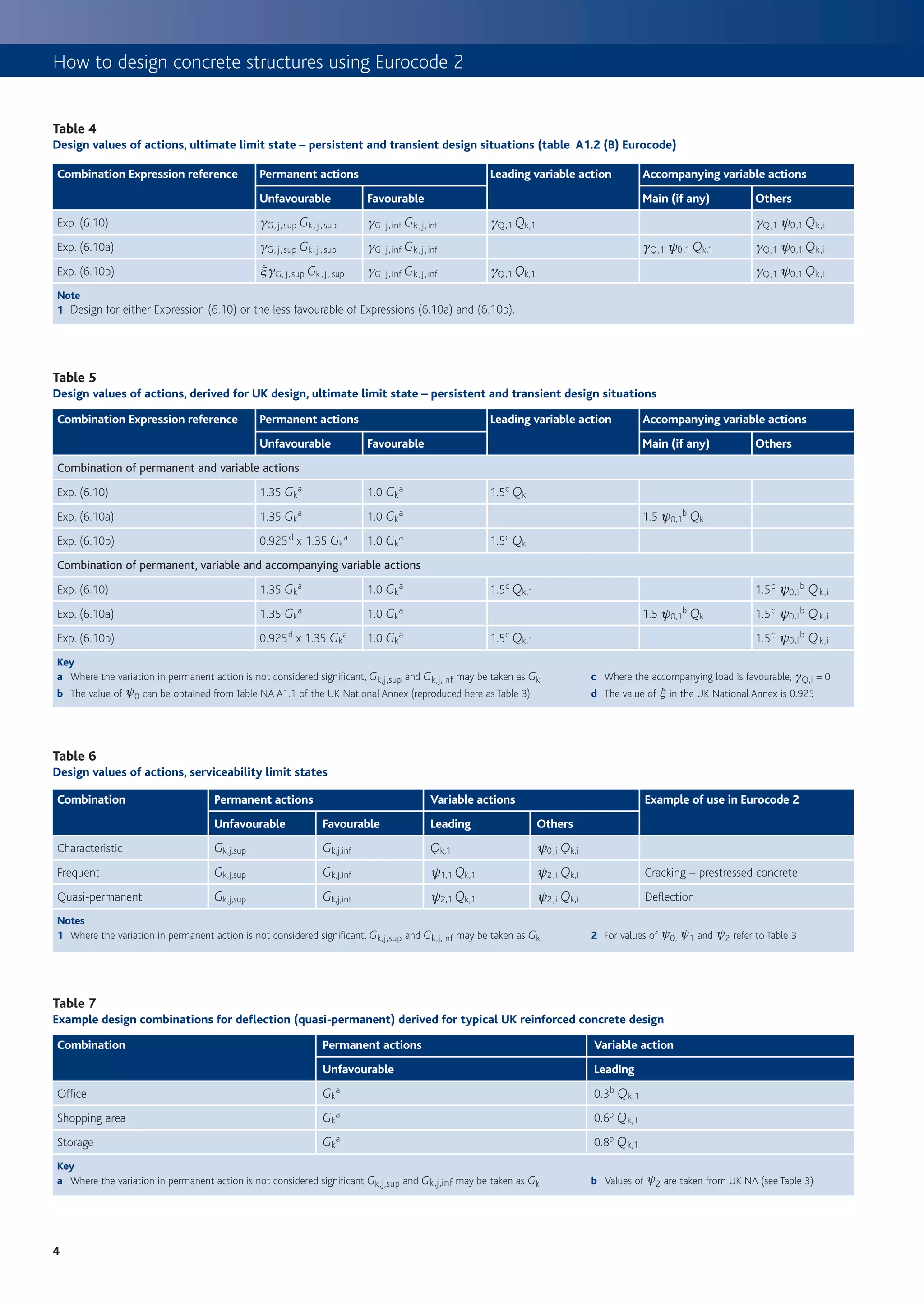
Table 4
Design values of actions, ultimate limit state – persistent and transient design situations (table A1.2 (B) Eurocode)

Combination Expression reference               Permanent actions                                                   Leading variable action                   Accompanying variable actions
                                               Unfavourable                    Favourable                                                                    Main (if any)            Others
Exp. (6.10)                                    g G, j, sup Gk , j , sup        g G , j, inf G k , j , inf          g Q,1 Qk,1                                                         g Q,1 c 0 ,1 Q k,i
Exp. (6.10a)                                   g G, j, sup Gk , j , sup        g G , j, inf G k , j , inf                                                    g Q,1 c 0 ,1 Qk,1        g Q,1 c 0 ,1 Q k,i
Exp. (6.10b)                                   jg G, j, sup Gk , j , sup       g G , j, inf G k , j , inf          g Q,1 Qk,1                                                         g Q,1 c 0 ,1 Q k,i
Note
1 Design for either Expression (6.10) or the less favourable of Expressions (6.10a) and (6.10b).


Table 5
Design values of actions, derived for UK design, ultimate limit state – persistent and transient design situations

Combination Expression reference               Permanent actions                                                   Leading variable action                   Accompanying variable actions
                                               Unfavourable                    Favourable                                                                    Main (if any)            Others
Combination of permanent and variable actions
Exp. (6.10)                                    1.35 Gk a                       1.0 Gk a                            1.5c Qk
Exp. (6.10a)                                   1.35 Gk a                       1.0 Gk a                                                                      1.5 c 0,1b Qk
Exp. (6.10b)                                   0.925 d    x 1.35 Gk        a
                                                                               1.0 Gk     a
                                                                                                                   1.5c   Qk
Combination of permanent, variable and accompanying variable actions
Exp. (6.10)                                    1.35 Gk a                       1.0 Gk a                            1.5c Qk,1                                                          1.5 c c 0,i b Q k,i
Exp. (6.10a)                                   1.35 Gk a                       1.0 Gk a                                                                      1.5 c 0,1b Qk            1.5 c c 0,i b Q k,i
Exp. (6.10b)                                   0.925 d x 1.35 Gk a             1.0 Gk a                            1.5c Qk,1                                                          1.5 c c 0,i b Q k,i
Key
a Where the variation in permanent action is not considered significant, Gk,j,sup and Gk,j,inf may be taken as Gk                              c Where the accompanying load is favourable, g Q,i = 0
b The value of c 0 can be obtained from Table NA A1.1 of the UK National Annex (reproduced here as Table 3)                                    d The value of j in the UK National Annex is 0.925


Table 6
Design values of actions, serviceability limit states

Combination                         Permanent actions                                                 Variable actions                                       Example of use in Eurocode 2
                                    Unfavourable                  Favourable                          Leading                   Others
Characteristic                      Gk,j,sup                      Gk,j,inf                            Qk,1                      c 0 , i Qk,i
Frequent                            Gk,j,sup                      Gk,j,inf                            c 1,1 Qk,1                c 2 , i Qk,i                 Cracking – prestressed concrete
Quasi-permanent                     Gk,j,sup                      Gk,j,inf                            c 2,1 Qk,1                c 2 , i Qk,i                 Deflection
Notes
1 Where the variation in permanent action is not considered significant. Gk,j,sup and Gk,j,inf may be taken as Gk                              2 For values of c 0, c 1 and c 2 refer to Table 3


Table 7
Example design combinations for deflection (quasi-permanent) derived for typical UK reinforced concrete design

Combination                                                       Permanent actions                                                            Variable action
                                                                  Unfavourable                                                                 Leading
Office                                                            Gk a                                                                         0.3 b Q k,1
                                                                       a
Shopping area                                                     Gk                                                                           0.6b Q k,1
Storage                                                           Gk a                                                                         0.8b Q k,1
Key
a Where the variation in permanent action is not considered significant Gk,j,sup and Gk,j,inf may be taken as Gk                               b Values of c 2 are taken from UK NA (see Table 3)


4
1. Introduction to Eurocodes


Eurocode 1                                                                       Table 8
                                                                                 Eurocode 1, its parts and dates of publication

                                                                                 Reference                 Title                     Publication date
Eurocode 1 supersedes BS 6399: Loading for buildings6 and BS 648:
                                                                                                                                     Eurocode        National Annex
Schedule of weights of building materials7. It contains within its ten parts
                                                                                 BS EN 1991–1–1            Densities,                July            December
(see Table 8) all the information required by the designer to assess the                                   self-weight and           2002            2005
individual actions on a structure. It is generally self-explanatory and it                                 imposed loads
is anticipated the actions to be used in the UK (as advised in the UK            BS EN 1991–1–2            Actions on                November        Due
                                                                                                           structures                2002            October
National Annex) will typically be the same as those in the current                                         exposed to fire                           2006a
British Standards. The most notable exception is the bulk density of             BS EN 1991–1–3            Snow loads                July            December
reinforced concrete, which has been increased to 25 kN/m3. Currently                                                                 2003            2005

not all the parts of Eurocode 1 and their National Annexes are                   BS EN 1991–1–4            Wind actions              April           Due
                                                                                                                                     2005            January
available, in which case it is advised that the loads recommended in                                                                                 2007a
the current British Standards are used.                                          BS EN 1991–1–5            Thermal actions           March           Due
                                                                                                                                     2004            December
                                                                                                                                                     2006a
                                                                                 BS EN 1991–1–6            Actions during            December        Due
Eurocode 2                                                                                                 execution                 2005            June
                                                                                                                                                     2007a
                                                                                 BS EN 1991–1–7            Accidental actions        September       Due
There are four parts to Eurocode 2; Figure 4 indicates how they fit into                                   due to impact             2006            October
the Eurocode system, which includes other European standards.                                              and explosions                            2007a
                                                                                 BS EN 1991–2              Traffic loads             October         Due
                                                                                                           on bridges                2003            December
Part 1–1                                                                                                                                             2006a
Eurocode 2, Part 1–1: General rules and rules for buildings9 is the              BS EN 1991–3              Actions induced           September       Due
                                                                                                           by cranes                 2006            January
principal part which is referenced by the three other parts. For the UK                                    and machinery                             2007a
designer there are a number of differences between Eurocode 2 and                BS EN 1991–4              Actions in silos          June            Due
BS 8110, which will initially make the new Eurocode seem unfamiliar.                                       and tanks                 2006            June
                                                                                                                                                     2007a
The key differences are listed below to assist in the familiarisation process.
                                                                                 Key
1. Eurocode 2 is generally laid out to give advice on the basis of               a Planned publication date (correct at time of publication) Source: BSI8
     phenomena (e.g. bending, shear etc) rather than by member
     types as in BS 8110 (e.g. beams, slabs, columns etc).                       Figure 4
2. Design is based on characteristic cylinder strengths not cube                 Relationship between Eurocode 2 and other Eurocodes
     strengths.
3. The Eurocode does not provide derived formulae (e.g. for bending,                    BS EN 1997                     BS EN 1990                    BS EN 1998
                                                                                       EUROCODE 7                     EUROCODE                      EUROCODE 8
     only the details of the stress block are expressed). This is the                  Geotechnical                 Basis of structural                Seismic
     traditional European approach, where the application of a Eurocode                   design                          design                       design

     is expected to be provided in a textbook or similar publication.
     The Eurocodes allow for this type of detail to be provided in
     ‘Non-contradictory complementary information’ (NCCI) (See                           BS EN 206                     BS EN 1991                    BS EN 10080
                                                                                         Specifying                   EUROCODE 1                      Reinforcing
     Glossary).                                                                           concrete                     Actions on                        steels
                                                                                                                        structures
4. Units for stress are mega pascals, MPa (1 MPa = 1 N/mm2).
5. Eurocode 2 uses a comma for a decimal point. It is expected that
     UK designers will continue to use a decimal point. Therefore to                       BS 8500                                                     BS 4449
                                                                                                                      BS EN 1992
     avoid confusion, the comma should not be used for separating                         Specifying                                                  Reinforcing
                                                                                                                     EUROCODE 2
                                                                                           concrete                                                      steels
     multiples of a thousand.                                                                                      Design of concrete
                                                                                                                       structures
6. One thousandth is represented by ‰.                                                                              Part 1–1: General
7. The partial factor for steel reinforcement is 1.15. However, the                                                rules for structures
                                                                                        BS EN 13670                                                  BS EN 13369
     characteristic yield strength of steel that meets the requirements                 Execution of
                                                                                                                   Part 1–2: Structural
                                                                                                                                                        Precast
                                                                                                                        fire design
     of BS 4449 will be 500 MPa; so overall the effect is negligible.                    structures                                                    concrete

8. Eurocode 2 is applicable for ribbed reinforcement with characteristic
     yield strengths of 400 to 600 MPa. There is no guidance on plain
     bar or mild steel reinforcement in the Eurocode, but guidance is                   BS EN 1992                  BS EN 1992 Part 3:                   Precast
                                                                                       EUROCODE 2                     EUROCODE 2                        concrete
     given in the background paper to the UK National Annex10.                            Part 2:                    Liquid-retaining                   product
9. The effects of geometric imperfection (‘notional horizontal loads’)                    Bridges                       structures                     standards

     are considered in addition to lateral loads.


                                                                                                                                                                      5
How to design concrete structures using Eurocode 2


10. Minimum concrete cover is related to bond strength, durability             Eurocode 7
    and fire resistance. In addition to the minimum cover an
    allowance for deviations due to variations in execution                    Eurocode 7: Geotechnical design17 is in two parts and gives guidance on
    (construction) should be included. Eurocode 2 recommends                   geotechnical design, ground investigation and testing. It has a broad
    that, for concrete cast against formwork, this is taken as 10 mm,          scope and includes the geotechnical design of spread foundations, piled
    unless the construction is subject to a quality assurance system           foundations, retaining walls, deep basements and embankments. Like
    in which case it could be reduced to 5 mm or even 0 mm where               all the Eurocodes it is based on limit state design principles, which is
    non-conforming members are rejected (e.g. in a precast yard).              a significant variation for most geotechnical design. Further guidance
    It is recommended that the nominal cover is stated on the                  related to simple foundations is given in Chapter 6, originally
    drawings and construction tolerances are given in the                      ppublished as Foundations18.
    specification.
11. Higher strengths of concrete are covered by Eurocode 2, up to
    class C90/105. However, because the characteristics of higher              Eurocode 8
    strength concrete are different, some Expressions in the Eurocode
    are adjusted for classes above C50/60.                                     Eurocode 8: Design of structures for earthquake resistance19 is divided into
12. The ‘variable strut inclination’ method is used in Eurocode 2 for          six parts and gives guidance on all aspects of design for earthquake
    the assessment of the shear capacity of a section. In practice,            resistance and covers guidance for the various structural materials for
    design values for actual structures can be compared with                   all types of structures. It also includes guidance for strengthening and
    tabulated values. Further advice can be found in Chapter 4,                repair of buildings. In areas of low seismicity it is anticipated that detailing
    originally published as Beams11.                                           structures to Eurocode 2 will ensure compliance with Eurocode 8.
13. The punching shear checks are carried out at 2d from the face of
    the column and for a rectangular column, the perimeter is
    rounded at the corners.                                                    Related Standards
14. Serviceability checks can still be carried out using ‘deemed to
    satisfy’ span to effective depth rules similar to BS 8110. However,        BS 8500/BS EN 206
    if a more detailed check is required, Eurocode 2 guidance varies           BS 8500: Concrete – Complementary British Standard to BS EN 206–120
    from the rules in BS 8110 Part 2.                                          replaced BS 5328 in December 2003 and designers should currently
15. The rules for determining the anchorage and lap lengths are more           be using this to specify concrete. Further guidance can found in
    complex than the simple tables in BS 8110. Eurocode 2 considers            Chapter 11, originally published as How to use BS 8500 with BS 811021.
    the effects of, amongst other things, the position of bars during
    concreting, the shape of the bar and cover.                                BS 4449/BS EN 10080
                                                                               BS 4449: Specification for carbon steel bars for the reinforcement of
Part 1–2                                                                       concrete22 has been revised ready for implementation in January 2006.
Eurocode 2, Part 1–2: Structural fire design12, gives guidance on design for   It is a complementary standard to BS EN 10080 Steel for the
fire resistance of concrete structures. Although much of the Eurocode          reinforcement of concrete23 and Normative Annex C of Eurocode 2. The
is devoted to fire engineering methods, the design for fire resistance         most significant changes are that steel characteristic yield will change
may still be carried out by referring to tables for minimum cover and          to 500 MPa. There are three classes of reinforcement, A, B and C, which
dimensions for various elements. These are given in section 5 of Part          indicate increasing ductility. Class A is not suitable for use where
1–2. Further advice on using the tabular method is given in Chapter 2,         redistribution of 20% and above has been assumed in the design.
originally published as Getting started 13.
                                                                               BS EN 13670
Part 2                                                                         BS 8110 Part 1 sections 6 and 7 specify the workmanship for concrete
Eurocode 2, Part 2: Bridges14 applies the general rules given in Part 1–1      construction. There is no equivalent guidance in Eurocode 2, and it is
to the design of concrete bridges. As a consequence both Part 1–1 and          intended that execution (construction) will be covered in a new
Part 2 will be required to carry out a design of a reinforced concrete         standard BS EN 13670 Execution of concrete structures24. This is still in
bridge.                                                                        preparation and is not expected to be ready for publication until 2008
                                                                               at the earliest. In the intervening period the draft background paper to
Part 3                                                                         the UK National Annex of Eurocode 2, Part 1-110 recommends that
Eurocode 2, Part 3: Liquid-retaining and containment structures15 applies      designers use the National structural concrete specification for building
the general rules given in Part 1–1 to the liquid-retaining structures         construction25, which refers to BS 8110 for workmanship.
and supersedes BS 800716.


6
1. Introduction to Eurocodes


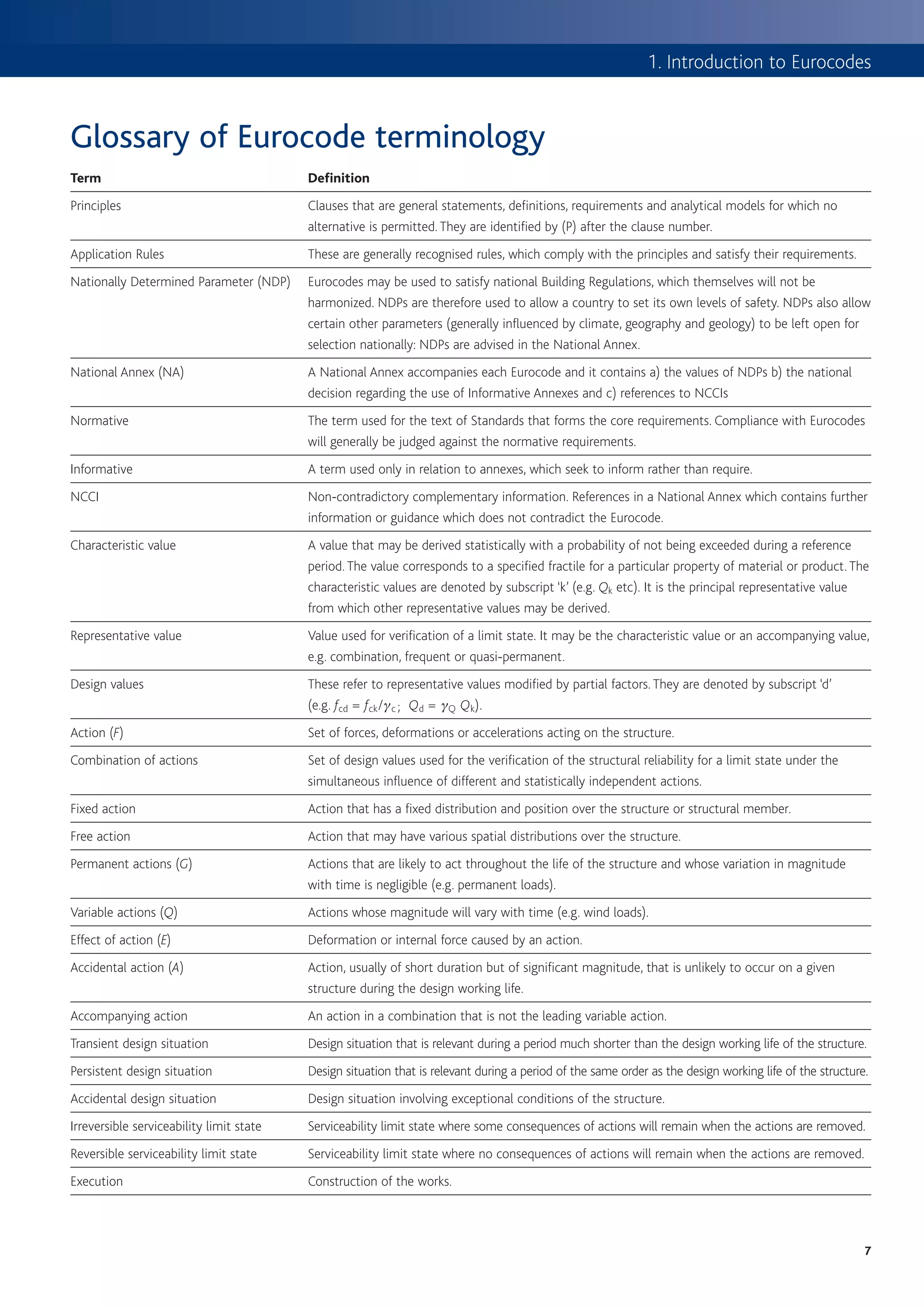
Glossary of Eurocode terminology
Term                                      Definition
Principles                                Clauses that are general statements, definitions, requirements and analytical models for which no
                                          alternative is permitted. They are identified by (P) after the clause number.
Application Rules                         These are generally recognised rules, which comply with the principles and satisfy their requirements.
Nationally Determined Parameter (NDP)     Eurocodes may be used to satisfy national Building Regulations, which themselves will not be
                                          harmonized. NDPs are therefore used to allow a country to set its own levels of safety. NDPs also allow
                                          certain other parameters (generally influenced by climate, geography and geology) to be left open for
                                          selection nationally: NDPs are advised in the National Annex.
National Annex (NA)                       A National Annex accompanies each Eurocode and it contains a) the values of NDPs b) the national
                                          decision regarding the use of Informative Annexes and c) references to NCCIs
Normative                                 The term used for the text of Standards that forms the core requirements. Compliance with Eurocodes
                                          will generally be judged against the normative requirements.
Informative                               A term used only in relation to annexes, which seek to inform rather than require.
NCCI                                      Non-contradictory complementary information. References in a National Annex which contains further
                                          information or guidance which does not contradict the Eurocode.
Characteristic value                      A value that may be derived statistically with a probability of not being exceeded during a reference
                                          period. The value corresponds to a specified fractile for a particular property of material or product. The
                                          characteristic values are denoted by subscript ‘k’ (e.g. Qk etc). It is the principal representative value
                                          from which other representative values may be derived.
Representative value                      Value used for verification of a limit state. It may be the characteristic value or an accompanying value,
                                          e.g. combination, frequent or quasi-permanent.
Design values                             These refer to representative values modified by partial factors. They are denoted by subscript ‘d’
                                          (e.g. f cd = f ck /g c ; Qd = g Q Qk).
Action (F)                                Set of forces, deformations or accelerations acting on the structure.
Combination of actions                    Set of design values used for the verification of the structural reliability for a limit state under the
                                          simultaneous influence of different and statistically independent actions.
Fixed action                              Action that has a fixed distribution and position over the structure or structural member.
Free action                               Action that may have various spatial distributions over the structure.
Permanent actions (G)                     Actions that are likely to act throughout the life of the structure and whose variation in magnitude
                                          with time is negligible (e.g. permanent loads).
Variable actions (Q)                      Actions whose magnitude will vary with time (e.g. wind loads).
Effect of action (E)                      Deformation or internal force caused by an action.
Accidental action (A)                     Action, usually of short duration but of significant magnitude, that is unlikely to occur on a given
                                          structure during the design working life.
Accompanying action                       An action in a combination that is not the leading variable action.
Transient design situation                Design situation that is relevant during a period much shorter than the design working life of the structure.
Persistent design situation               Design situation that is relevant during a period of the same order as the design working life of the structure.
Accidental design situation               Design situation involving exceptional conditions of the structure.
Irreversible serviceability limit state   Serviceability limit state where some consequences of actions will remain when the actions are removed.
Reversible serviceability limit state     Serviceability limit state where no consequences of actions will remain when the actions are removed.
Execution                                 Construction of the works.


                                                                                                                                                         7
1. Introduction to Eurocodes


References
     1 BRITISH STANDARDS INSTITUTION. BS EN 1992, Eurocode 2: Design of concrete structures. BSI (4 parts).
     2 BRITISH STANDARDS INSTITUTION. BS EN 1990, Eurocode: Basis of structural design. BSI, 2002.
     3 BRITISH STANDARDS INSTITUTION. BS EN 1991, Eurocode 1: Actions on structures. BSI (10 parts).
     4 BRITISH STANDARDS INSTITUTION. BS 8110: The structural use of concrete. BSI (3 parts).
                                            ´
     5 GULVANESSIAN, H, CALGARO, J A & HOLICY, M T. Designers’ guide to EN 1990. Thomas Telford, 2002.
     6 BRITISH STANDARDS INSTITUTION. BS 6399: Loading for buildings. BSI (3 parts).
     7 BRITISH STANDARDS INSTITUTION. BS 648: Schedule of weights of building materials. BSI, 1964.
     8 BRITISH STANDARDS INSTITUTION. Web page: www.bsi-global.com/Eurocodes/Progress/index.xalter. BSI.
     9 BRITISH STANDARDS INSTITUTION. BS EN 1992–1–1, Eurocode 2: Design of concrete structures. General rules and rules for buildings. BSI, 2004.
    10 BRITISH STANDARD INSTITUTION. PD 6687. Background paper to the UK National Annex to BS EN 1992–1–1. BSI, 2006.
    11 MOSS, R M & BROOKER, O. How to design concrete structures using Eurocode 2: Beams (TCC/03/19). The Concrete Centre, 2006.
    12 BRITISH STANDARDS INSTITUTION. BS EN 1992–1–2, Eurocode 2: Design of concrete structures. Structural fire design. BSI, 2004.
    13 BROOKER, O. How to design concrete structures using Eurocode 2: Getting started (TCC/03/17). The Concrete Centre, 2005.
    14 BRITISH STANDARDS INSTITUTION. BS EN 1992–2, Eurocode 2: Design of concrete structures. Bridges. BSI, 2005.
    15 BRITISH STANDARDS INSTITUTION. BS EN 1992–3, Eurocode 2: Design of concrete structures. Liquid-retaining and containment structures.
       BSI, due 2006.
    16 BRITISH STANDARDS INSTITUTION. BS 8007: Code of practice for design of concrete structures for retaining aqueous liquids. BSI, 1987.
    17 BRITISH STANDARDS INSTITUTION. BS EN 1997, Eurocode 7: Geotechnical design. BSI (2 parts).
    18 WEBSTER, R & BROOKER, O. How to design concrete structures using Eurocode 2: Foundations (TCC/03/21). The Concrete Centre, 2006.
    19 BRITISH STANDARDS INSTITUTION. BS EN 1998, Eurocode 8: Design of structures for earthquake resistance. BSI (6 parts).
    20 BRITISH STANDARDS INSTITUTION. BS 8500: Concrete – Complementary British Standard to BS EN 206–1, 2002 (2 parts).
    21 HARRISON, T A & BROOKER, O. How to use BS 8500 with BS 8110 (TCC/03/11). The Concrete Centre, 2005.
    22 BRITISH STANDARDS INSTITUTION. BS 4449: Specification for carbon steel bars for the reinforcement of concrete. BSI, 2005.
    23 BRITISH STANDARDS INSTITUTION. BS EN 10080: Steel for the reinforcement of concrete – Weldable reinforcing steel – General. BSI, 2005.
    24 BRITISH STANDARDS INSTITUTION. EN 13670: Execution of concrete structures – Part 1: Common. BSI, due 2008.
    25 THE CONCRETE SOCIETY. CS 152: National structural concrete specification for building construction, third edition. The Society, 2004.


8
How to design concrete structures using Eurocode 2
2. Getting started
O Brooker BEng, CEng, MICE, MIStructE


                                        The design process
                                        This chapter is intended to assist the designer determine all the design
                                        information required prior to embarking on detailed element design. It
                                        covers design life, actions on structures, load arrangements, combinations
                                        of actions, method of analysis, material properties, stability and
                                        imperfections, minimum concrete cover and maximum crack widths.

                                        The process of designing elements will not be revolutionised as a result
                                        of using Eurocode 21, although much of the detail may change – as
                                        described in subsequent chapters.

                                        Similarly, the process of detailing will not vary significantly from current
                                        practice. Guidance can be found in Chapter 10 or in Standard method of
                                        detailing 2. With regard to specification, advice can be found in Chapter 1,
                                        originally published as Introduction to Eurocodes3. Concept designs
                                        prepared assuming that detailed design would be to BS 8110 may be
                                        continued through to detailed design using Eurocode 2.

                                        In the long-term it is anticipated that Eurocode 2 will lead to more
                                        economic structures.


                                        Design life
                                        The design life for a structure is given in Eurocode: Basis of structural
                                        design 4. The UK National Annex (NA) to Eurocode presents UK values
                                        for design life; these are given in Table 1 (overleaf). These should be used
                                        to determine the durability requirements for the design of reinforced
                                        concrete structures.


                                        Actions on structures
                                        Eurocode 1: Actions on structures5 consists of 10 parts giving details of
                                        a wide variety of actions. Further information on the individual codes
                                        can be found in Chapter 1. Eurocode 1, Part 1–1: General actions –
                                        Densities, self-weight, imposed loads for buildings6 gives the densities and
                                        self-weights of building materials (see Table 2 overleaf).

                                        The key change to current practice is that the bulk density of reinforced
                                        concrete has been increased to 25 kN/m3. The draft National Annex to
                                        this Eurocode gives the imposed loads for UK buildings and a selection is
How to design concrete structures using Eurocode 2


Table 1
Indicative design working life (from UK National Annex to Eurocode)       reproduced in Table 3. It should be noted that there is no advice given
                                                                          for plant rooms.
Design life (years)       Examples
  10                      Temporary structures
  10–30                   Replaceable structural parts                    At the time of writing not all the parts of Eurocode 1 and their National
  15–25                   Agricultural and similar structures             Annexes are available; it is advised that existing standards are considered
  50                      Buildings and other common structures           for use where European standards have not yet been issued.
120                       Monumental buildings, bridges and other civil
                          engineering structures

                                                                          Load arrangements
Table 2
Selected bulk density of materials (from Eurocode 1, Part 1–1)            The term load arrangements refers to the arranging of variable actions
                                                                          (e.g. imposed and wind loads) to give the most onerous forces in a
Material                                         Bulk density (kN/m3)
Normal weight concrete                           24.0                     member or structure and are given in Eurocode 2 and its UK NA.
Reinforced normal weight concrete                25.0
Wet normal weight reinforced concrete            26.0                     For building structures, the UK NA to Eurocode 2, Part 1–1 allows any
                                                                          of the following sets of load arrangements to be used for both the
                                                                          ultimate limit state and serviceability limit state:
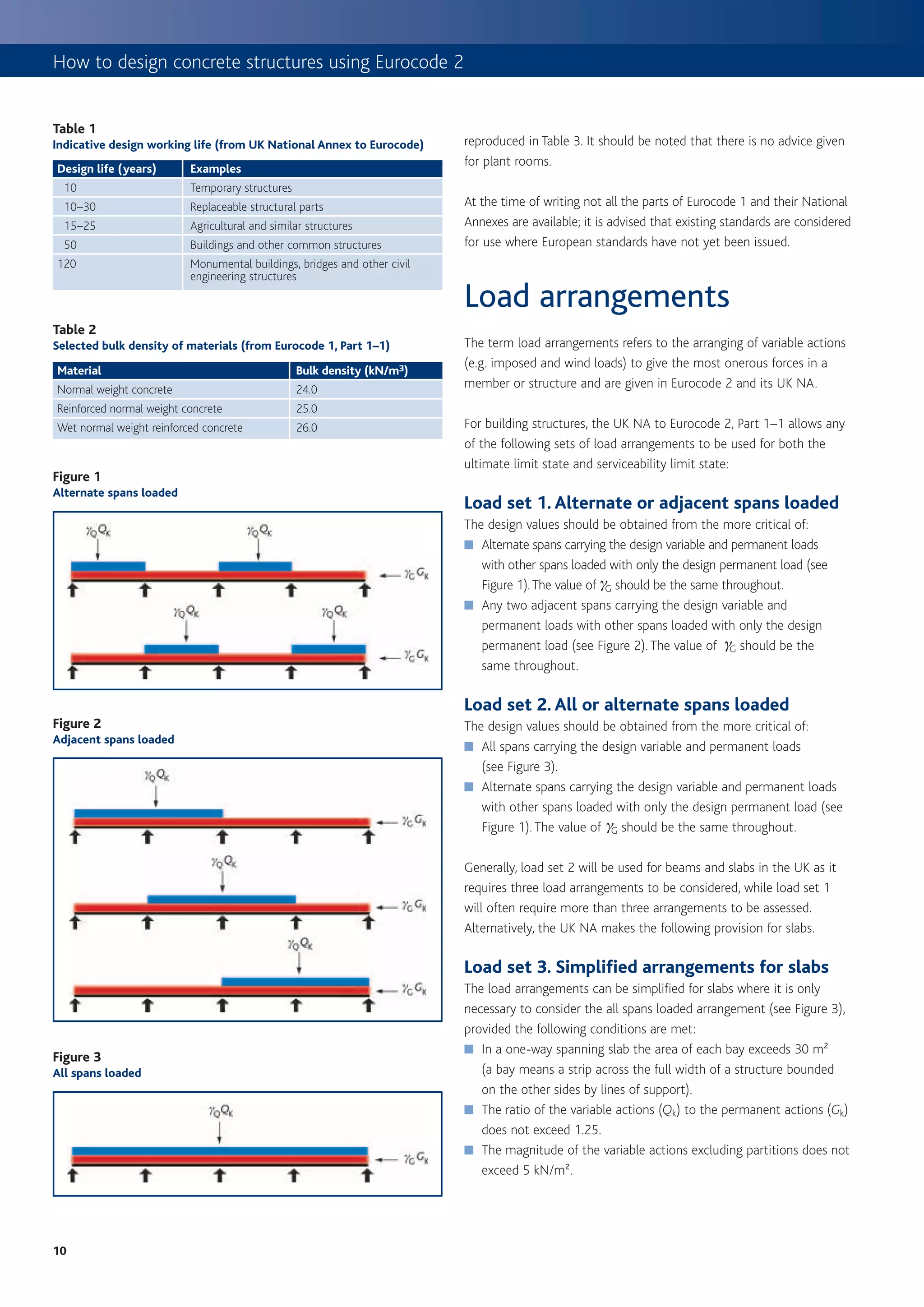
Figure 1
Alternate spans loaded
                                                                          Load set 1. Alternate or adjacent spans loaded
                                                                          The design values should be obtained from the more critical of:
                                                                          ■ Alternate spans carrying the design variable and permanent loads
                                                                             with other spans loaded with only the design permanent load (see
                                                                             Figure 1). The value of gG should be the same throughout.
                                                                          ■ Any two adjacent spans carrying the design variable and
                                                                             permanent loads with other spans loaded with only the design
                                                                             permanent load (see Figure 2). The value of gG should be the
                                                                             same throughout.

                                                                          Load set 2. All or alternate spans loaded
Figure 2                                                                  The design values should be obtained from the more critical of:
Adjacent spans loaded
                                                                          ■ All spans carrying the design variable and permanent loads
                                                                             (see Figure 3).
                                                                          ■ Alternate spans carrying the design variable and permanent loads
                                                                             with other spans loaded with only the design permanent load (see
                                                                             Figure 1). The value of gG should be the same throughout.

                                                                          Generally, load set 2 will be used for beams and slabs in the UK as it
                                                                          requires three load arrangements to be considered, while load set 1
                                                                          will often require more than three arrangements to be assessed.
                                                                          Alternatively, the UK NA makes the following provision for slabs.

                                                                          Load set 3. Simplified arrangements for slabs
                                                                          The load arrangements can be simplified for slabs where it is only
                                                                          necessary to consider the all spans loaded arrangement (see Figure 3),
                                                                          provided the following conditions are met:
                                                                          ■ In a one-way spanning slab the area of each bay exceeds 30 m2
Figure 3
All spans loaded                                                            (a bay means a strip across the full width of a structure bounded
                                                                            on the other sides by lines of support).
                                                                          ■ The ratio of the variable actions (Qk) to the permanent actions (Gk)
                                                                            does not exceed 1.25.
                                                                          ■ The magnitude of the variable actions excluding partitions does not
                                                                            exceed 5 kN/m2.


2
10
2. Getting started


Combination of actions                                                                          Standard to BS EN 206–17 (e.g. for class C28/35 concrete the cylinder
                                                                                                strength is 28 MPa, whereas the cube strength is 35 MPa). Typical
The term combination of actions refers to the value of actions to be                            concrete properties are given in Table 4.
used when a limit state is under the influence of different actions.
                                                                                                Concrete up to class C90/105 can be designed using Eurocode 2.
The numerical values of the partial factors for the ULS combination can                         For classes above C50/60, however, there are additional rules and
be obtained by referring to Eurocode: Basis of structural design or to                          variations. For this reason, the design of these higher classes is not
Chapter 1.                                                                                      considered in this publication.

      For members supporting one variable action the ULS combination                            It should be noted that designated concretes (e.g. RC30) still refer
.(        1.25 Gk + 1.5 Qk (derived from Exp. (6.10b), Eurocode)                                to the cube strength.
      can be used provided the permanent actions are not greater than
          4.5 times the variable actions (except for storage loads).                            Reinforcing steel
                                                                                                Eurocode 2 can be used with reinforcement of characteristic
There are three SLS combinations of actions – characteristic, frequent                          strengths ranging from 400 to 600 MPa. The properties of steel
and quasi-permanent. The numerical values are given in Eurocode: Basis                          reinforcement in the UK for use with Eurocode 2 are given in
of structural design.                                                                           BS 4449 (2005): Specification for carbon steel bars for the
                                                                                                reinforcement of concrete 8 and are summarised in Table 5 (on page 4).
                                                                                                A characteristic yield strength of 500 MPa has been adopted by the
Material properties                                                                             UK reinforcement industry. There are three classes of reinforcement,
                                                                                                A, B and C, which provide increasing ductility. Class A is not suitable
Concrete                                                                                        where redistribution of 20% and above has been assumed in the
In Eurocode 2 the design of reinforced concrete is based on the                                 design. There is no provision for the use of plain bar or mild steel
characteristic cylinder strength rather than cube strength and should                           reinforcement, but guidance is given in the background paper to the
be specified according to BS 8500: Concrete – complementary British                             National Annex9.


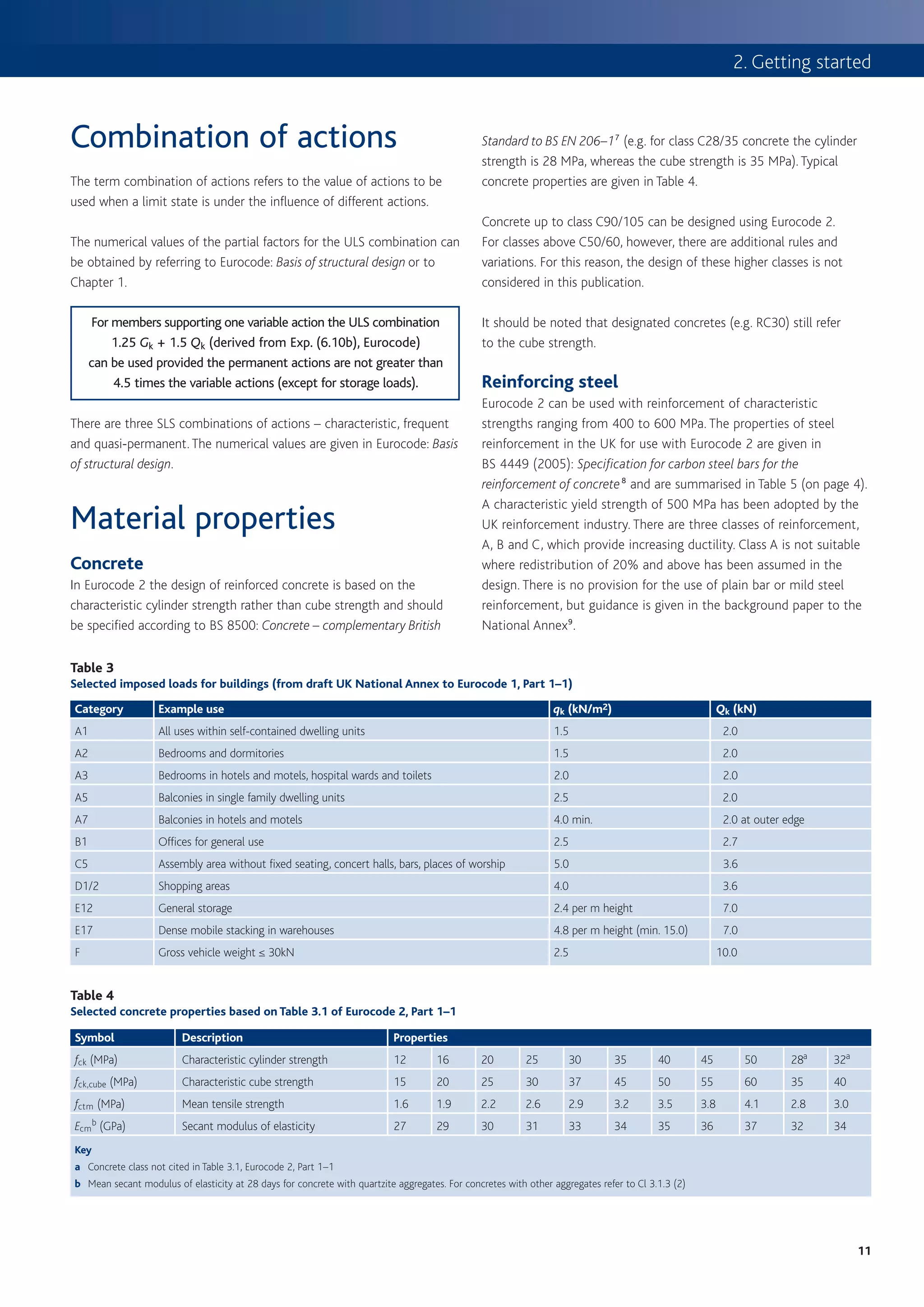
Table 3
Selected imposed loads for buildings (from draft UK National Annex to Eurocode 1, Part 1–1)

 Category           Example use                                                                                  qk (kN/m2)                               Qk (kN)
 A1                 All uses within self-contained dwelling units                                                1.5                                       2.0
 A2                 Bedrooms and dormitories                                                                     1.5                                       2.0
 A3                 Bedrooms in hotels and motels, hospital wards and toilets                                    2.0                                       2.0
 A5                 Balconies in single family dwelling units                                                    2.5                                       2.0
 A7                 Balconies in hotels and motels                                                               4.0 min.                                  2.0 at outer edge
 B1                 Offices for general use                                                                      2.5                                       2.7
 C5                 Assembly area without fixed seating, concert halls, bars, places of worship                  5.0                                       3.6
 D1/2               Shopping areas                                                                               4.0                                       3.6
 E12                General storage                                                                              2.4 per m height                          7.0
 E17                Dense mobile stacking in warehouses                                                          4.8 per m height (min. 15.0)              7.0
 F                  Gross vehicle weight ≤ 30kN                                                                  2.5                                      10.0


Table 4
Selected concrete properties based on Table 3.1 of Eurocode 2, Part 1–1

 Symbol                   Description                                       Properties
 fck (MPa)                Characteristic cylinder strength                  12        16        20         25        30         35        40        45           50      28a   32a
 fck,cube (MPa)           Characteristic cube strength                      15        20        25         30        37         45        50        55           60      35    40
 fctm (MPa)               Mean tensile strength                             1.6       1.9       2.2        2.6       2.9        3.2       3.5       3.8          4.1     2.8   3.0
 Ecm b (GPa)              Secant modulus of elasticity                      27        29        30         31        33         34        35        36           37      32    34
 Key
 a Concrete class not cited in Table 3.1, Eurocode 2, Part 1–1
 b Mean secant modulus of elasticity at 28 days for concrete with quartzite aggregates. For concretes with other aggregates refer to Cl 3.1.3 (2)


                                                                                                                                                                                      3
                                                                                                                                                                                     11
How to design concrete structures using Eurocode 2


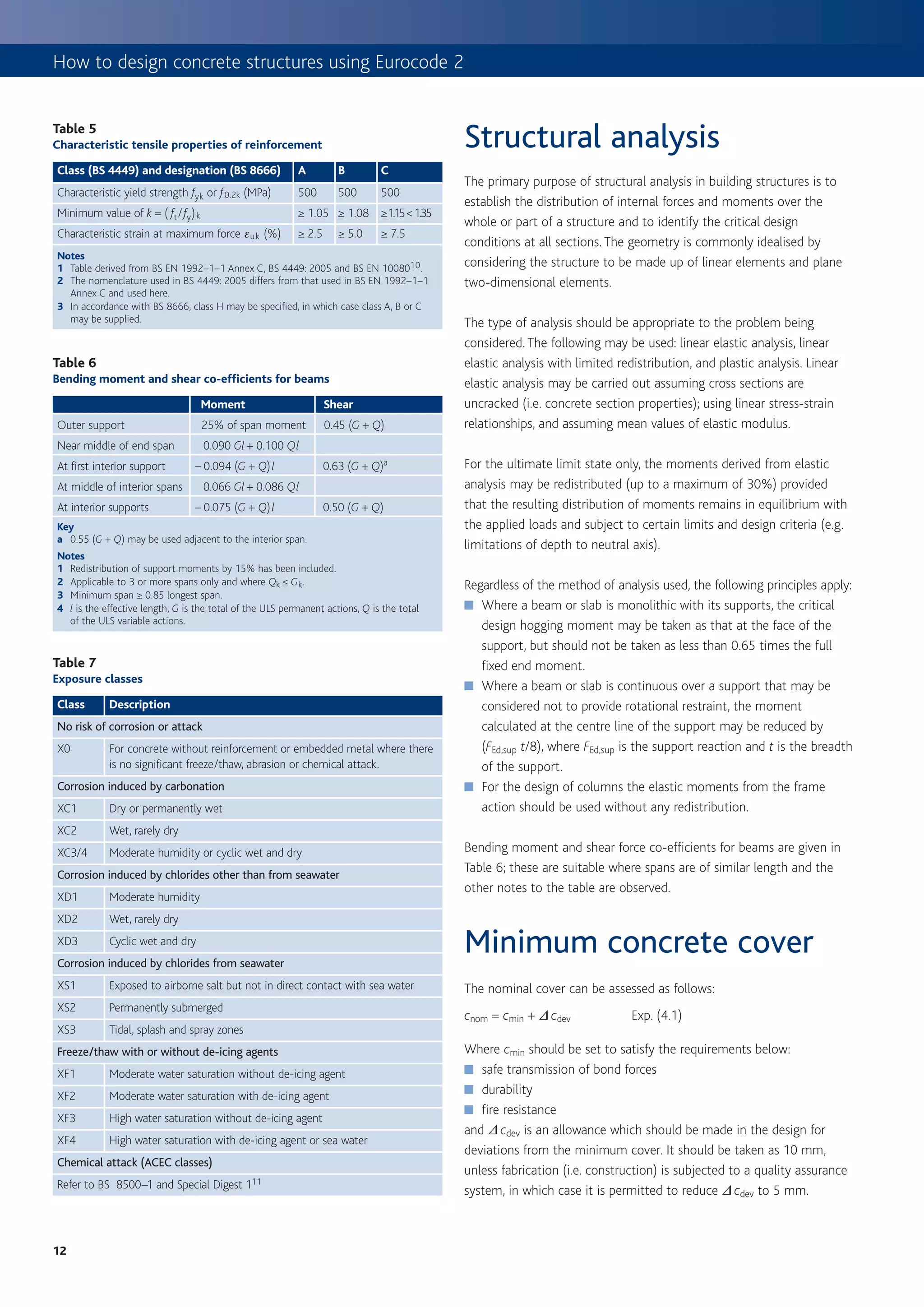
Table 5
Characteristic tensile properties of reinforcement                                         Structural analysis
Class (BS 4449) and designation (BS 8666)                 A          B        C
                                                                                           The primary purpose of structural analysis in building structures is to
Characteristic yield strength fyk or f 0.2k (MPa)         500        500      500
                                                                                           establish the distribution of internal forces and moments over the
Minimum value of k = ( ft /fy ) k                         ≥ 1.05 ≥ 1.08 ≥ 1.15 < 1.35
                                                                                           whole or part of a structure and to identify the critical design
Characteristic strain at maximum force e uk (%)           ≥ 2.5      ≥ 5.0    ≥ 7.5
                                                                                           conditions at all sections. The geometry is commonly idealised by
Notes
1 Table derived from BS EN 1992–1–1 Annex C, BS 4449: 2005 and BS EN 1008010 .             considering the structure to be made up of linear elements and plane
2 The nomenclature used in BS 4449: 2005 differs from that used in BS EN 1992–1–1          two-dimensional elements.
  Annex C and used here.
3 In accordance with BS 8666, class H may be specified, in which case class A, B or C
  may be supplied.                                                                         The type of analysis should be appropriate to the problem being
                                                                                           considered. The following may be used: linear elastic analysis, linear
Table 6                                                                                    elastic analysis with limited redistribution, and plastic analysis. Linear
Bending moment and shear co-efficients for beams                                           elastic analysis may be carried out assuming cross sections are
                                    Moment                        Shear                    uncracked (i.e. concrete section properties); using linear stress-strain
Outer support                       25% of span moment            0.45 (G + Q)             relationships, and assuming mean values of elastic modulus.
Near middle of end span             0.090 Gl + 0.100 Ql
At first interior support        – 0.094 (G + Q) l                0.63 (G + Q)a            For the ultimate limit state only, the moments derived from elastic
At middle of interior spans         0.066 Gl + 0.086 Ql                                    analysis may be redistributed (up to a maximum of 30%) provided
At interior supports             – 0.075 (G + Q) l                0.50 (G + Q)             that the resulting distribution of moments remains in equilibrium with
Key                                                                                        the applied loads and subject to certain limits and design criteria (e.g.
a 0.55 (G + Q) may be used adjacent to the interior span.
                                                                                           limitations of depth to neutral axis).
Notes
1 Redistribution of support moments by 15% has been included.
2 Applicable to 3 or more spans only and where Qk ≤ G k.                                   Regardless of the method of analysis used, the following principles apply:
3 Minimum span ≥ 0.85 longest span.
4 l is the effective length, G is the total of the ULS permanent actions, Q is the total   ■ Where a beam or slab is monolithic with its supports, the critical
  of the ULS variable actions.
                                                                                              design hogging moment may be taken as that at the face of the
                                                                                              support, but should not be taken as less than 0.65 times the full
Table 7                                                                                       fixed end moment.
Exposure classes
                                                                                           ■ Where a beam or slab is continuous over a support that may be
Class       Description                                                                       considered not to provide rotational restraint, the moment
No risk of corrosion or attack                                                                calculated at the centre line of the support may be reduced by
X0          For concrete without reinforcement or embedded metal where there                  (FEd,sup t/8), where FEd,sup is the support reaction and t is the breadth
            is no significant freeze/thaw, abrasion or chemical attack.                       of the support.
Corrosion induced by carbonation                                                           ■ For the design of columns the elastic moments from the frame
XC1         Dry or permanently wet                                                            action should be used without any redistribution.
XC2         Wet, rarely dry
XC3/4       Moderate humidity or cyclic wet and dry                                        Bending moment and shear force co-efficients for beams are given in
Corrosion induced by chlorides other than from seawater
                                                                                           Table 6; these are suitable where spans are of similar length and the
                                                                                           other notes to the table are observed.
XD1         Moderate humidity
XD2         Wet, rarely dry
XD3         Cyclic wet and dry
Corrosion induced by chlorides from seawater
                                                                                           Minimum concrete cover
XS1         Exposed to airborne salt but not in direct contact with sea water              The nominal cover can be assessed as follows:
XS2         Permanently submerged
                                                                                           cnom = cmin + D cdev             Exp. (4.1)
XS3         Tidal, splash and spray zones
Freeze/thaw with or without de-icing agents                                                Where cmin should be set to satisfy the requirements below:
XF1         Moderate water saturation without de-icing agent                               ■ safe transmission of bond forces

XF2         Moderate water saturation with de-icing agent                                  ■ durability
                                                                                           ■ fire resistance
XF3         High water saturation without de-icing agent
                                                                                           and D cdev is an allowance which should be made in the design for
XF4         High water saturation with de-icing agent or sea water
                                                                                           deviations from the minimum cover. It should be taken as 10 mm,
Chemical attack (ACEC classes)
                                                                                           unless fabrication (i.e. construction) is subjected to a quality assurance
Refer to BS 8500–1 and Special Digest 111
                                                                                           system, in which case it is permitted to reduce D cdev to 5 mm.


4
12
2. Getting started


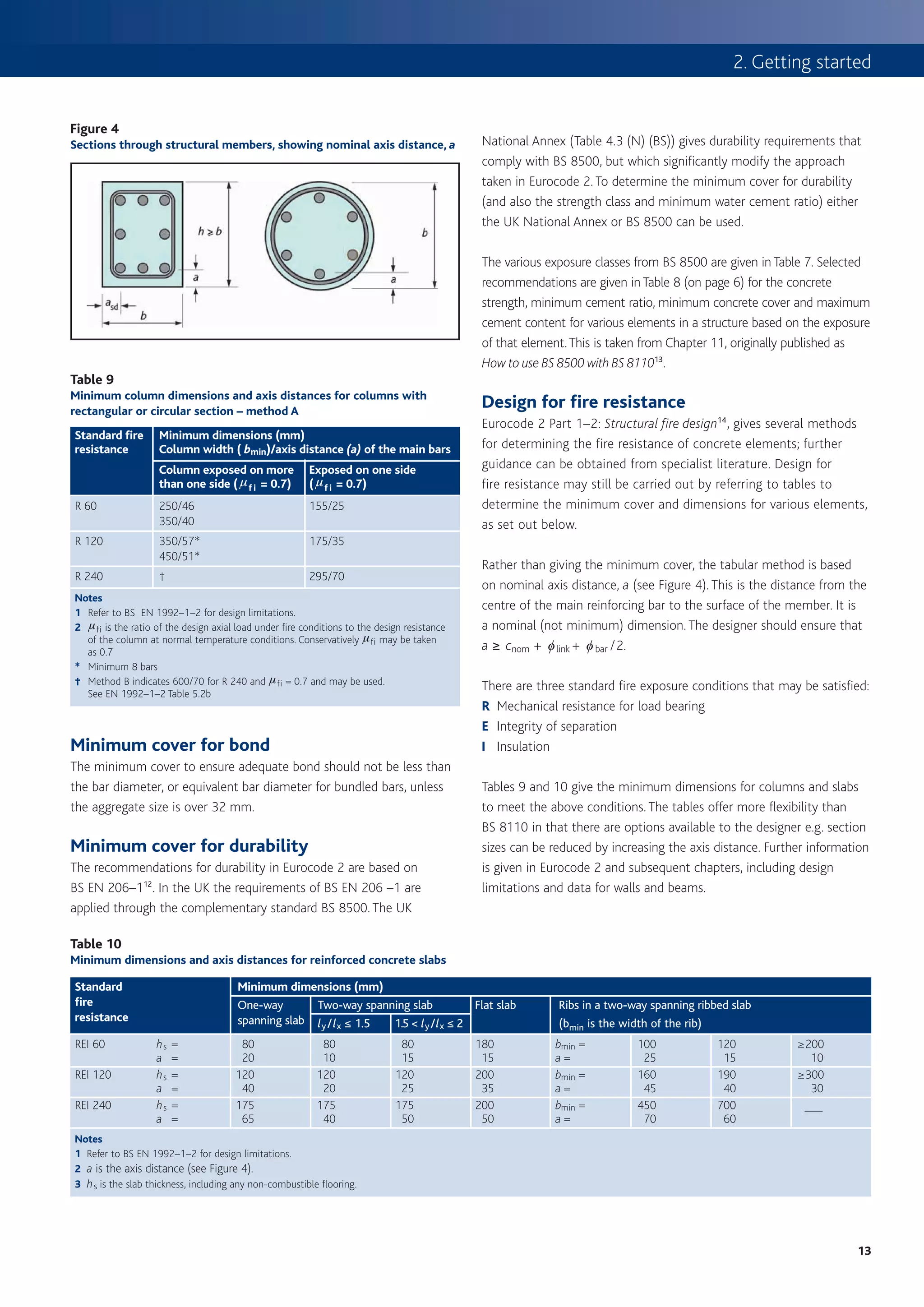
Figure 4
Sections through structural members, showing nominal axis distance, a                          National Annex (Table 4.3 (N) (BS)) gives durability requirements that
                                                                                               comply with BS 8500, but which significantly modify the approach
                                                                                               taken in Eurocode 2. To determine the minimum cover for durability
                                                                                               (and also the strength class and minimum water cement ratio) either
                                                                                               the UK National Annex or BS 8500 can be used.

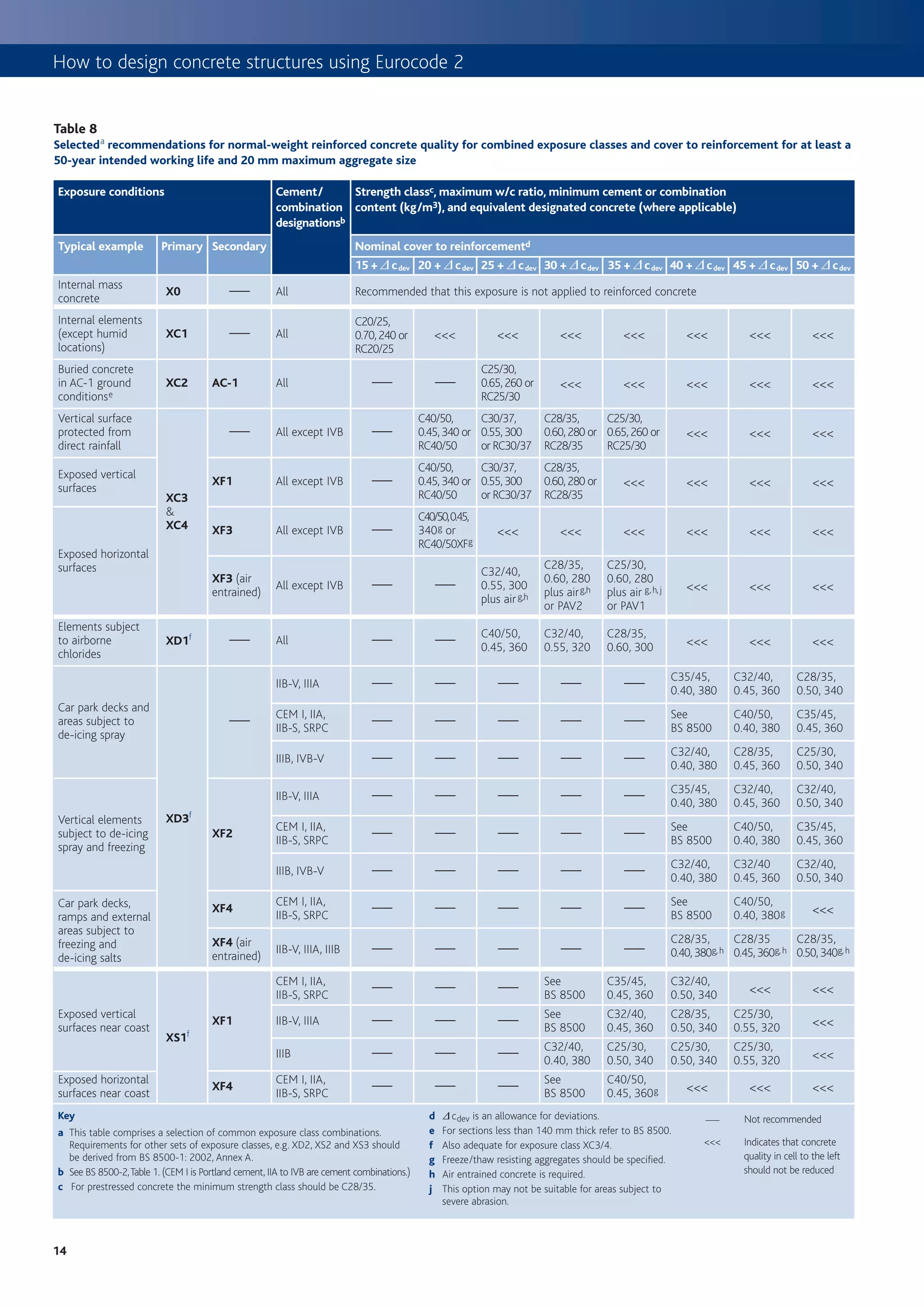
                                                                                               The various exposure classes from BS 8500 are given in Table 7. Selected
                                                                                               recommendations are given in Table 8 (on page 6) for the concrete
                                                                                               strength, minimum cement ratio, minimum concrete cover and maximum
                                                                                               cement content for various elements in a structure based on the exposure
                                                                                               of that element. This is taken from Chapter 11, originally published as
                                                                                               How to use BS 8500 with BS 811013.
Table 9
Minimum column dimensions and axis distances for columns with
rectangular or circular section – method A
                                                                                               Design for fire resistance
                                                                                               Eurocode 2 Part 1–2: Structural fire design14, gives several methods
Standard fire       Minimum dimensions (mm)
resistance          Column width ( bmin)/axis distance (a) of the main bars                    for determining the fire resistance of concrete elements; further
                    Column exposed on more               Exposed on one side                   guidance can be obtained from specialist literature. Design for
                    than one side ( m f i = 0.7)         ( m f i = 0.7)                        fire resistance may still be carried out by referring to tables to
R 60                250/46                               155/25                                determine the minimum cover and dimensions for various elements,
                    350/40                                                                     as set out below.
R 120               350/57*                              175/35
                    450/51*
                                                                                               Rather than giving the minimum cover, the tabular method is based
R 240               †                                    295/70
                                                                                               on nominal axis distance, a (see Figure 4). This is the distance from the
Notes
1 Refer to BS EN 1992–1–2 for design limitations.
                                                                                               centre of the main reinforcing bar to the surface of the member. It is
2 m fi is the ratio of the design axial load under fire conditions to the design resistance    a nominal (not minimum) dimension. The designer should ensure that
  of the column at normal temperature conditions. Conservatively m fi may be taken
  as 0.7
                                                                                               a ≥ cnom + f link + f bar /2.
* Minimum 8 bars
† Method B indicates 600/70 for R 240 and m fi = 0.7 and may be used.
  See EN 1992–1–2 Table 5.2b
                                                                                               There are three standard fire exposure conditions that may be satisfied:
                                                                                               R Mechanical resistance for load bearing
                                                                                               E Integrity of separation
Minimum cover for bond                                                                         I Insulation
The minimum cover to ensure adequate bond should not be less than
the bar diameter, or equivalent bar diameter for bundled bars, unless                          Tables 9 and 10 give the minimum dimensions for columns and slabs
the aggregate size is over 32 mm.                                                              to meet the above conditions. The tables offer more flexibility than
                                                                                               BS 8110 in that there are options available to the designer e.g. section
Minimum cover for durability                                                                   sizes can be reduced by increasing the axis distance. Further information
The recommendations for durability in Eurocode 2 are based on                                  is given in Eurocode 2 and subsequent chapters, including design
BS EN 206–112. In the UK the requirements of BS EN 206 –1 are                                  limitations and data for walls and beams.
applied through the complementary standard BS 8500. The UK

Table 10
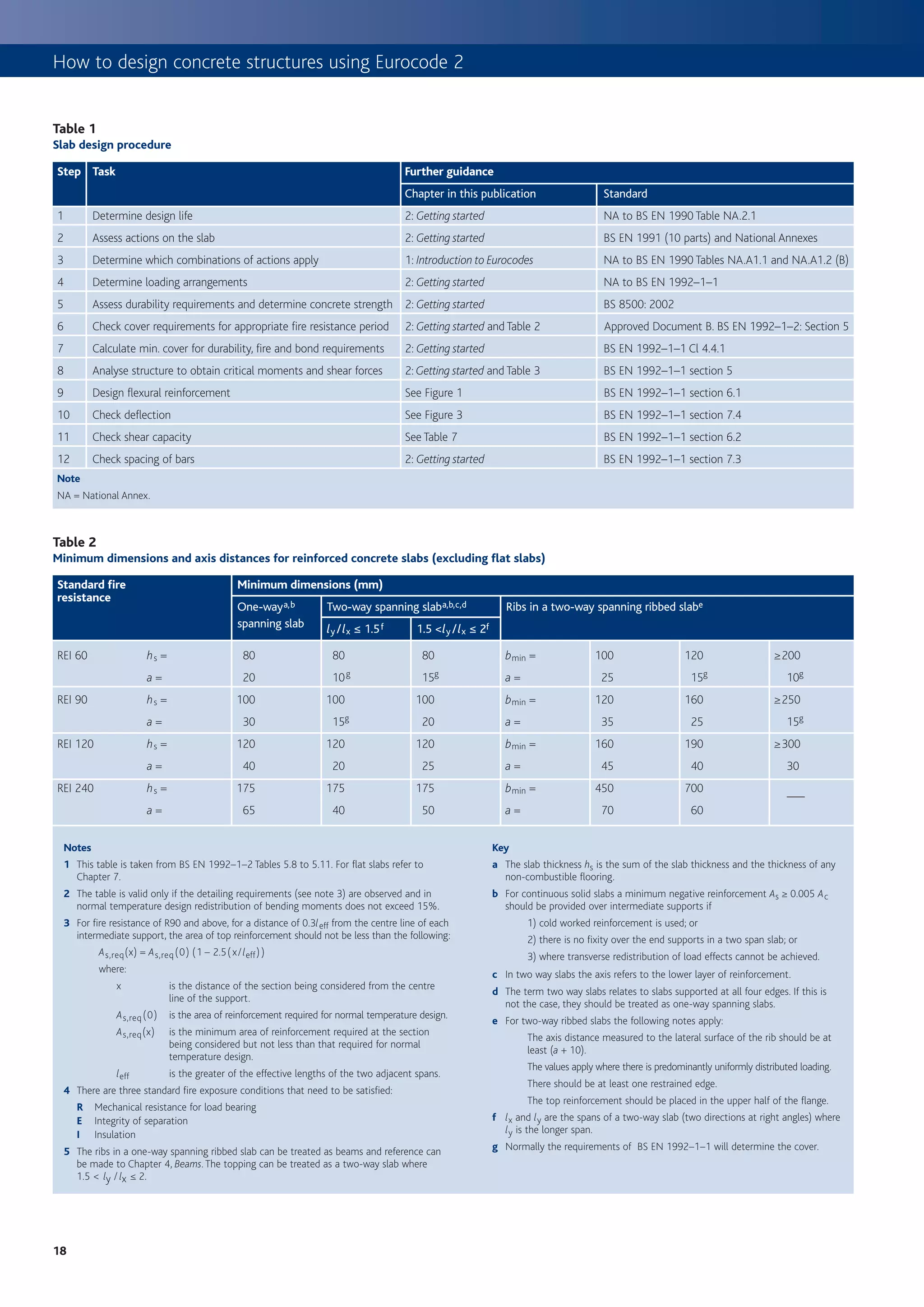
Minimum dimensions and axis distances for reinforced concrete slabs

Standard                               Minimum dimensions (mm)
fire                                   One-way       Two-way spanning slab             Flat slab             Ribs in a two-way spanning ribbed slab
resistance                             spanning slab l y /l x ≤ 1.5 1.5 < l y /l x ≤ 2                       (bmin is the width of the rib)
REI 60              hs   =              80                  80                 80             180           bmin =          100             120           ≥200
                    a    =              20                  10                 15              15           a=               25              15             10
REI 120             hs   =             120                 120                120             200           bmin =          160             190           ≥300
                    a    =              40                  20                 25              35           a=               45              40             30
REI 240             hs   =             175                 175                175             200           bmin =          450             700             –––
                    a    =              65                  40                 50              50           a=               70              60
Notes
1 Refer to BS EN 1992–1–2 for design limitations.
2 a is the axis distance (see Figure 4).
3 h s is the slab thickness, including any non-combustible flooring.


                                                                                                                                                                       5
                                                                                                                                                                      13
How to design concrete structures using Eurocode 2


Table 8
Selected a recommendations for normal-weight reinforced concrete quality for combined exposure classes and cover to reinforcement for at least a
50-year intended working life and 20 mm maximum aggregate size

Exposure conditions                                   Cement/       Strength classc, maximum w/c ratio, minimum cement or combination
                                                      combination content (kg/m3), and equivalent designated concrete (where applicable)
                                                      designationsb
Typical example          Primary Secondary                                Nominal cover to reinforcementd
                                                                          15 + D c dev 20 + D c dev 25 + D c dev 30 + D c dev 35 + D c dev 40 + D c dev 45 + D c dev 50 + D c dev
Internal mass
                          X0              ___         All                 Recommended that this exposure is not applied to reinforced concrete
concrete
Internal elements                                                         C20/25,
(except humid             XC1             ___         All                 0.70, 240 or        <<<            <<<             <<<            <<<               <<<           <<<               <<<
locations)                                                                RC20/25
Buried concrete                                                                                           C25/30,
in AC-1 ground            XC2         AC-1            All                     ___             ___         0.65, 260 or       <<<            <<<               <<<           <<<               <<<
conditions e                                                                                              RC25/30
Vertical surface                                                                           C40/50,      C30/37,    C28/35,      C25/30,
protected from                            ___         All except IVB          ___          0.45, 340 or 0.55, 300  0.60, 280 or 0.65, 260 or                  <<<           <<<               <<<
direct rainfall                                                                            RC40/50      or RC30/37 RC28/35      RC25/30
                                                                                           C40/50,      C30/37,    C28/35,
Exposed vertical
                                      XF1             All except IVB          ___          0.45, 340 or 0.55, 300  0.60, 280 or             <<<               <<<           <<<               <<<
surfaces
                          XC3                                                              RC40/50      or RC30/37 RC28/35
                          &                                                                C40/50,0.45,
                          XC4         XF3             All except IVB          ___          340 g or          <<<             <<<            <<<               <<<           <<<               <<<
                                                                                           RC40/50XFg
Exposed horizontal
surfaces                                                                                                                 C28/35,        C25/30,
                                                                                                          C32/40,
                                      XF3 (air
                                                      All except IVB          ___             ___         0.55, 300
                                                                                                                         0.60, 280      0.60, 280
                                                                                                                                                              <<<           <<<               <<<
                                      entrained)                                                                         plus air g,h   plus air g, h, j
                                                                                                          plus air g,h
                                                                                                                         or PAV2        or PAV1
Elements subject
to airborne               XD1f            ___         All                     ___             ___         C40/50,        C32/40,        C28/35,
                                                                                                                                                              <<<           <<<               <<<
                                                                                                          0.45, 360      0.55, 320      0.60, 300
chlorides

                                                      IIB-V, IIIA             ___             ___             ___            ___             ___           C35/45,       C32/40,         C28/35,
                                                                                                                                                           0.40, 380     0.45, 360       0.50, 340
Car park decks and
areas subject to                          ___         CEM I, IIA,             ___             ___             ___            ___             ___           See           C40/50,         C35/45,
                                                      IIB-S, SRPC                                                                                          BS 8500       0.40, 380       0.45, 360
de-icing spray
                                                      IIIB, IVB-V             ___             ___             ___            ___             ___           C32/40,       C28/35,         C25/30,
                                                                                                                                                           0.40, 380     0.45, 360       0.50, 340

                                                      IIB-V, IIIA             ___             ___             ___            ___             ___           C35/45,       C32/40,         C32/40,
                                                                                                                                                           0.40, 380     0.45, 360       0.50, 340
Vertical elements         XD3f
subject to de-icing                   XF2
                                                      CEM I, IIA,             ___             ___             ___            ___             ___           See           C40/50,         C35/45,
                                                      IIB-S, SRPC                                                                                          BS 8500       0.40, 380       0.45, 360
spray and freezing
                                                      IIIB, IVB-V             ___             ___             ___            ___             ___           C32/40,       C32/40          C32/40,
                                                                                                                                                           0.40, 380     0.45, 360       0.50, 340

Car park decks,                       XF4
                                                      CEM I, IIA,             ___             ___             ___            ___             ___           See           C40/50,
                                                                                                                                                                                              <<<
ramps and external                                    IIB-S, SRPC                                                                                          BS 8500       0.40, 380 g
areas subject to
freezing and                          XF4 (air                                ___             ___             ___            ___             ___           C28/35,       C28/35        C28/35,
                                                      IIB-V, IIIA, IIIB                                                                                    0.40, 380g, h 0.45, 360g, h 0.50, 340g, h
de-icing salts                        entrained)

                                                      CEM I, IIA,             ___             ___             ___        See            C35/45,            C32/40,
                                                                                                                                                                            <<<               <<<
                                                      IIB-S, SRPC                                                        BS 8500        0.45, 360          0.50, 340
Exposed vertical
                                      XF1             IIB-V, IIIA             ___             ___             ___        See            C32/40,            C28/35,       C25/30,
                                                                                                                                                                                              <<<
surfaces near coast                                                                                                      BS 8500        0.45, 360          0.50, 340     0.55, 320
                          XS1f
                                                      IIIB                    ___             ___             ___        C32/40,        C25/30,            C25/30,       C25/30,
                                                                                                                                                                                              <<<
                                                                                                                         0.40, 380      0.50, 340          0.50, 340     0.55, 320
Exposed horizontal
                                      XF4
                                                      CEM I, IIA,             ___             ___             ___        See            C40/50,
                                                                                                                                                              <<<           <<<               <<<
surfaces near coast                                   IIB-S, SRPC                                                        BS 8500        0.45, 360 g
Key                                                                                          d   D c dev is an allowance for deviations.                           ___     Not recommended
a This table comprises a selection of common exposure class combinations.                    e   For sections less than 140 mm thick refer to BS 8500.
  Requirements for other sets of exposure classes, e.g. XD2, XS2 and XS3 should              f   Also adequate for exposure class XC3/4.                          <<<      Indicates that concrete
  be derived from BS 8500-1: 2002, Annex A.                                                  g   Freeze/thaw resisting aggregates should be specified.                     quality in cell to the left
b See BS 8500-2,Table 1. (CEM I is Portland cement, IIA to IVB are cement combinations.)     h   Air entrained concrete is required.                                       should not be reduced
c For prestressed concrete the minimum strength class should be C28/35.                      j   This option may not be suitable for areas subject to
                                                                                                 severe abrasion.


6
14
2. Getting started


Stability and imperfections                                                              Crack control
The effects of geometric imperfections should be considered in                           Crack widths should be limited to ensure appearance and durability
combination with the effects of wind loads (i.e. not as an alternative                   are satisfactory. In the absence of specific durability requirements
load combination). For global analysis, the imperfections may be                         (e.g. water tightness) the crack widths may be limited to 0.3 mm in
represented by an inclination y i .                                                      all exposure classes under the quasi-permanent combination. In the
                                                                                         absence of requirements for appearance, this limit may be relaxed (to
y i = (1/200) x a h x a m                                                                say 0.4 mm) for exposure classes X0 and XC1 (refer to Table 7). The
where                                                                                    theoretical size of the crack can be calculated using the expressions
   a h = (2/Rl), to be taken as not less than 2/3 nor greater than 1.0                   given in Cl 7.3.4 from Eurocode 2–1–1 or from the ‘deemed to satisfy’
   a m = [0.5 (1 + 1/m)]0.5                                                              requirements that can be obtained from Table 11, which is based on
  l is the height of the building in metres                                              tables 7.2N and 7.3N of the Eurocode. The limits apply to either the
  m is the number of vertical members contributing to the horizontal                     bar size or the bar spacing, not both.
  force in the bracing system.
                                                                                         Figure 5
The effect of the inclination may be represented by transverse forces at                 Examples of the effect of geometric imperfections
each level and included in the analysis along with other actions (see
Figure 5):

Effect on bracing system:    Hi = y i (Nb – Na)
Effect on floor diaphragm:   Hi = y i (Nb + Na)/2
Effect on roof diaphragm:    Hi = y i Na
where Na and Nb are longitudinal forces contributing to Hi.

In most cases, an allowance for imperfections is made in the partial
factors used in the design of elements. However for columns, the effect                       a) Bracing system              b) Floor diaphragm        c) Roof diaphragm
of imperfections, which is similar in principle to the above, must be
considered (see Chapter 5, originally published as Columns15).
                                                                                         Figure 6
                                                                                         Determination of steel stress for crack width control

Table 11
Maximum bar size or spacing to limit crack width

Steel    wmax = 0.4 mm                                    wmax = 0.3 mm
stress
         Maximum       Maximum                            Maximum         Maximum
(s s)MPa bar           bar                                bar             bar
         size (mm)     spacing (mm)                       size (mm)       spacing (mm)

160           40                    300                   32              300
200           32             OR 300                       25          OR 250
240           20                250                       16             200
280           16                    200                   12              150
320           12                    150                   10              100
360           10                    100                    8               50
Note
The steel stress may be estimated from the expression below (or see Figure 6):
ss =       fyk m As,req
         gms n As,prov d
where
   fyk      = characteristic reinforcement yield stress
   gms      = partial factor for reinforcing steel
   m        = total load from quasi-permanent combination
   n        = total load from ULS combination                                              To determine stress in the reinforcement (ss), calculate the ratio Gk/Qk,
   As,req = area of reinforcement at the ULS                                               read up the graph to the appropriate curve and read across to determine ssu .
                                                                                                                                                    As,req    1
   As,prov = area of reinforcement provided
   d        = ratio of redistributed moment to elastic moment
                                                                                           ss can be calculated from the expression: ss = ssu      (As,prov d)( )

                                                                                                                                                                            7
                                                                                                                                                                           15
2. Getting started


References
      1 BRITISH STANDARDS INSTITUTION. BS EN 1992, Eurocode 2: Design of concrete structures. BSI (4 parts).
      2 INSTITUTION OF STRUCTURAL ENGINEERS/THE CONCRETE SOCIETY. Standard method of detailing. ISE/CS. 2006.
      3 NARAYANAN, R S & BROOKER, O. How to design concrete structures using Eurocode 2: Introduction to Eurocodes (TCC/03/16). The Concrete Centre, 2005.
      4 BRITISH STANDARDS INSTITUTION. BS EN 1990, Eurocode: Basis of structural design. BSI, 2002.
      5 BRITISH STANDARDS INSTITUTION. BS EN 1991, Eurocode 1: Actions on structures. BSI (10 parts).
      6 BRITISH STANDARDS INSTITUTION. BS EN 1991, Eurocode 1: Actions on structures Part 1–1: General actions – Densities, self-weight, imposed loads
        for buildings. BSI, 2002.
      7 BRITISH STANDARDS INSTITUTION. BS 8500–1: Concrete – Complementary British Standard to BS EN 206–1– Part 1: Method of specifying and
        guidance for the specifier. BSI, 2002.
      8 BRITISH STANDARDS INSTITUTION. BS 4449: Specification for carbon steel bars for the reinforcement of concrete. BSI, 2005.
      9 BRITISH STANDARDS INSTITUTION. Background paper to the UK National Annex to BS EN 1992–1–1. BSI, 2006.
     10 BRITISH STAND ARDS INSTITUTION. BS EN 10080: Steel for the reinforcement of concrete – Weldable reinforcing steel – General. BSI, 2005.
     11 BUILDING RESEARCH ESTABLISHMENT. Special Digest 1: Concrete in aggressive ground. BRE, 2005.
     12 BRITISH STANDARDS INSTITUTION. BS EN 206–1: Concrete – Part: Specification, performance, production and conformity. BSI, 2000.
     13 HARRISON, T A BROOKER, O. How to use BS 8500 with BS 8110 (TCC/03/11). The Concrete Centre, 2005.
     14 BRITISH STANDARDS INSTITUTION. BS EN 1992–1–2, Eurocode 2: Design of concrete structures. General rules – structural fire design, BSI, 2004.
     15 MOSS, R M & BROOKER, O. How to design concrete structures using Eurocode 2: Columns, (TCC/03/20). The Concrete Centre, 2006.


16
How to design concrete structures using Eurocode 2
3. Slabs
R M Moss BSc, PhD, DIC, CEng, MICE, MIStructE O Brooker BEng, CEng, MICE, MIStructE


                                                          Designing to Eurocode 2
                                                          This chapter covers the analysis and design of slabs to Eurocode 21 which is
                                                          essentially the same as with BS 81102. However, the layout and content of
                                                          Eurocode 2 may appear unusual to designers familiar with BS 8110. Eurocode 2
                                                          does not contain the derived formulae or specific guidance on determining
                                                          moments and shear forces. This has arisen because it has been European
                                                          practice to give principles in the codes and for the detailed application to
                                                          be presented in other sources such as textbooks.

                                                          Chapter 1, originally published as Introduction to Eurocodes3, highlighted the
                                                          key differences between Eurocode 2 and BS 8110, including terminology.
                                                          Chapter 7, originally published as Flat slabs4 covers the design of flat slabs.

                                                          It should be noted that values from the UK National Annex (NA) have been
                                                          used throughout, including values that are embedded in derived formulae.
                                                          (Derivations can be found at www.eurocode2.info.) A list of symbols related to
                                                          slab design is given at the end of this chapter.


                                                          Design procedure
                                                          A procedure for carrying out the detailed design of slabs is shown in Table 1.
                                                          This assumes that the slab thickness has previously been determined during
                                                          conceptual design. More detailed advice on determining design life, actions,
                                                          material properties, methods of analysis, minimum concrete cover for
                                                          durability and control of crack widths can be found in Chapter 2, originally
                                                          published as Getting started 5.


                                                          Fire resistance
                                                          Eurocode 2, Part 1–2: Structural fire design6, gives a choice of advanced,
                                                          simplified or tabular methods for determining the fire resistance. Using tables
                                                          is the fastest method for determining the minimum dimensions and cover for
                                                          slabs. There are, however, some restrictions which should be adhered to.
                                                          Further guidance on the advanced and simplified methods can be obtained
                                                          from specialist literature.

                                                          Rather than giving a minimum cover, the tabular method is based on
                                                          nominal axis distance, a. This is the distance from the centre of the main
                                                          reinforcing bar to the surface of the member. It is a nominal (not minimum)
                                                                                                                          Continues page 19
How to design concrete structures using Eurocode 2


Table 1
Slab design procedure

Step Task                                                                                   Further guidance
                                                                                            Chapter in this publication                       Standard
1           Determine design life                                                           2: Getting started                                 NA to BS EN 1990 Table NA.2.1
2           Assess actions on the slab                                                      2: Getting started                                 BS EN 1991 (10 parts) and National Annexes
3           Determine which combinations of actions apply                                   1: Introduction to Eurocodes                       NA to BS EN 1990 Tables NA.A1.1 and NA.A1.2 (B)
4           Determine loading arrangements                                                  2: Getting started                                 NA to BS EN 1992–1–1
5           Assess durability requirements and determine concrete strength 2: Getting started                                                  BS 8500: 2002
6           Check cover requirements for appropriate fire resistance period                 2: Getting started and Table 2                     Approved Document B. BS EN 1992–1–2: Section 5
7           Calculate min. cover for durability, fire and bond requirements                 2: Getting started                                 BS EN 1992–1–1 Cl 4.4.1
8           Analyse structure to obtain critical moments and shear forces                   2: Getting started and Table 3                     BS EN 1992–1–1 section 5
9           Design flexural reinforcement                                                   See Figure 1                                       BS EN 1992–1–1 section 6.1
10          Check deflection                                                                See Figure 3                                       BS EN 1992–1–1 section 7.4
11          Check shear capacity                                                            See Table 7                                        BS EN 1992–1–1 section 6.2
12          Check spacing of bars                                                           2: Getting started                                 BS EN 1992–1–1 section 7.3
Note
NA = National Annex.


Table 2
Minimum dimensions and axis distances for reinforced concrete slabs (excluding flat slabs)

Standard fire                                           Minimum dimensions (mm)
resistance
                                                        One-way a,b      Two-way spanning slab a,b,c,d                 Ribs in a two-way spanning ribbed slabe
                                                        spanning slab    l y /l x ≤ 1.5 f      1.5 <l y /l x ≤ 2f

REI 60                      hs =                          80              80                    80                     b min =              100                    120                   ≥200
                            a=                            20              10 g                  15g                    a=                     25                    15g                     10g
REI 90                      hs =                        100              100                   100                     b min =              120                    160                   ≥250
                            a=                            30              15g                   20                     a=                     35                    25                      15g
REI 120                     hs =                        120              120                   120                     b min =              160                    190                   ≥300
                            a=                            40              20                    25                     a=                     45                    40                      30
REI 240                     hs =                        175              175                   175                     b min =              450                    700
                                                                                                                                                                                            –––
                            a=                            65              40                    50                     a=                     70                    60

    Notes                                                                                                           Key
    1 This table is taken from BS EN 1992–1–2 Tables 5.8 to 5.11. For flat slabs refer to                           a The slab thickness hs is the sum of the slab thickness and the thickness of any
      Chapter 7.                                                                                                      non-combustible flooring.
    2 The table is valid only if the detailing requirements (see note 3) are observed and in                        b For continuous solid slabs a minimum negative reinforcement As ≥ 0.005 A c
      normal temperature design redistribution of bending moments does not exceed 15%.                                should be provided over intermediate supports if
    3 For fire resistance of R90 and above, for a distance of 0.3l eff from the centre line of each                         1) cold worked reinforcement is used; or
      intermediate support, the area of top reinforcement should not be less than the following:                            2) there is no fixity over the end supports in a two span slab; or
             A s,req (x) = A s,req ( 0 ) ( 1 – 2.5 ( x/ l eff ) )                                                           3) where transverse redistribution of load effects cannot be achieved.
             where:                                                                                                 c In two way slabs the axis refers to the lower layer of reinforcement.
                  x                is the distance of the section being considered from the centre
                                                                                                                    d The term two way slabs relates to slabs supported at all four edges. If this is
                                   line of the support.
                                                                                                                      not the case, they should be treated as one-way spanning slabs.
                  A s,req ( 0 )    is the area of reinforcement required for normal temperature design.
                                                                                                                    e For two-way ribbed slabs the following notes apply:
                  A s,req (x)      is the minimum area of reinforcement required at the section
                                                                                                                            The axis distance measured to the lateral surface of the rib should be at
                                   being considered but not less than that required for normal
                                                                                                                            least (a + 10).
                                   temperature design.
                                                                                                                            The values apply where there is predominantly uniformly distributed loading.
                  l eff            is the greater of the effective lengths of the two adjacent spans.
                                                                                                                            There should be at least one restrained edge.
    4 There are three standard fire exposure conditions that need to be satisfied:
                                                                                                                            The top reinforcement should be placed in the upper half of the flange.
       R    Mechanical resistance for load bearing
       E    Integrity of separation                                                                                 f l x and l y are the spans of a two-way slab (two directions at right angles) where
       I    Insulation                                                                                                l y is the longer span.

    5 The ribs in a one-way spanning ribbed slab can be treated as beams and reference can                          g Normally the requirements of BS EN 1992–1–1 will determine the cover.
      be made to Chapter 4, Beams. The topping can be treated as a two-way slab where
      1.5 < ly / lx ≤ 2.


2
18
3. Slabs


Figure 1
Procedure for determining flexural reinforcement                                          dimension, so the designer should ensure that
                                                                                          a ≥ cnom + f link + f bar /2.
                                  START                                                   The requirements for various types of slab are given in Table 2.


   Carry out analysis of slab to determine design moments (M)
        (Where appropriate use coefficients from Table 3)                                 Flexure
                                                                                          The design procedure for flexural design is given in Figure 1; this
                                                       No           Outside scope of      includes derived formulae based on the simplified rectangular stress
                            Concrete class
                              ≤C50/60?                              this publication      block from Eurocode 2. Where appropriate, Table 3 may be used to
                                                                                          determine bending moments and shear forces for slabs. Further
                            Yes                                                           information for the design of two-way, ribbed or waffle slabs is given in
               Determine K from: K =
                                              M                                           the appropriate sections on pages 5 and 6.
                                            bd 2 fck


                                                                                          Table 4
                    Determine K’ from Table 4 or
                                                                                          Values for K ’
             K’ = 0.60d – 0.18 d 2 – 0.21 where d ≤ 1.0
                                                                                          % redistribution                   d (redistribution ratio) K’
                                                                                            0                                1.00                            0.208a
                                                                      Compression
                                                                     reinforcement
                                                                                          10                                 0.90                            0.182a
                                                       No
                             Is K ≤ K ’ ?                            required – not       15                                 0.85                            0.168
                                                                   recommended for
                                                                      typical slabs       20                                 0.80                            0.153

                            Yes
                                                                                          25                                 0.75                            0.137
                                                                                          30                                 0.70                            0.120
              No compression reinforcement required                                       Key
                                                                                          a It is often recomended in the UK that K´ should be limited to 0.168 to ensure ductile failure.


                Obtain lever arm z from Table 5 or
                   d                                                                      Table 5
                z=
                   2    [
                        1 + 1 – 3.53 K ≤ 0.95d]                                           z/d for singly reinforced rectangular sections

                                                                                          K                      z/d                        K                        z/d
           Calculate tension reinforcement required from                                  ≤0.05                  0.950a                     0.13                     0.868
                                     M
                            As =                                                          0.06                   0.944                      0.14                     0.856
                                   fyd z
                                                                                          0.07                   0.934                      0.15                     0.843
                                                                                          0.08                   0.924                      0.16                     0.830
    Check minimum reinforcement requirements (see Table 6)                                0.09                   0.913                      0.17                     0.816
                        0.26 fctm bt d                                                    0.10                   0.902                      0.18                     0.802
             As,min =                       where fck ≥ 25
                             fyk                                                          0.11                   0.891                      0.19                     0.787
                                                                                          0.12                   0.880                      0.20                     0.771
                                                                                          Key
           Check maximum reinforcement requirements
                                                                                          a Limiting z to 0.95d is not a requirement of Eurocode 2, but is considered to be good practice.
           As,max = 0.04 Ac for tension or compression
               reinforcement outside lap locations

                                                                                          Table 6
                                                                                          Minimum percentage of reinforcement required
Table 3
Bending moment and shear coefficients for slabs                                           fck                          fctm                          Minimum % (0.26 fctm /fyka )
                                                                                          25                           2.6                           0.13%
       End support /slab connection                          First    Interior Interior
                                                             interior spans supports      28                           2.8                           0.14%
       Pinned            Continuous
                                                             support                      30                           2.9                           0.15%
       End     End       End      End
       support span      support span                                                     32                           3.0                           0.16%
Moment 0       0.086Fl – 0.04Fl 0.075Fl                      –0.086Fl 0.063Fl –0.063Fl    35                           3.2                           0.17%
Shear  0.40F             0.46F                               0.6F             0.5F        40                           3.5                           0.18%
Notes                                                                                     45                           3.8                           0.20%
1 Applicable to one-way spanning slabs where the area of each bay exceeds 30 m2,
  Qk ≤ 1.25 Gk and qk ≤ 5 kN/m2                                                           50                           4.1                           0.21%
2 F is the total design ultimate load, l is the span                                      Key
3 Minimum span > 0.85 longest span, minimum 3 spans
4 Based on 20% redistribution at supports and no decrease in span moments                 a Where fyk = 500 MPa.


                                                                                                                                                                                          3
                                                                                                                                                                                         19
How to design concrete structures using Eurocode 2


Eurocode 2 offers various methods for determining the stress-strain                         Deflection
relationship of concrete. For simplicity and familiarity the method
presented here is the simplified rectangular stress block, which is                         Eurocode 2 has two alternative methods of designing for deflection,
similar to that found in BS 8110 (see Figure 2).                                            either by limiting span-to-depth ratio or by assessing the theoretical
                                                                                            deflection using the Expressions given in the Eurocode. The latter
The Eurocode gives recommendations for the design of concrete up to                         is dealt with in detail in Chapter 8, originally published as Deflection
class C90/105. However, for concrete greater than class C50/60, the stress                  calculations7.
block is modified. It is important to note that concrete strength is based
on the cylinder strength and not the cube strength (i.e. for class C28/35                   The span-to-depth ratios should ensure that deflection is limited to
the cylinder strength is 28 MPa, whereas the cube strength is 35 MPa).                      span /250 and this is the procedure presented in Figure 3.

Figure 2
Simplified rectangular stress block for concrete up to class C50/60 from Eurocode 2


Figure 3                                                                                    Figure 4
Procedure for assessing deflection                                                          Determination of steel stress


                               START


                 Determine basic l/d from Figure 5


                       Determine Factor 1 (F1)
                      For ribbed or waffle slabs
                  F1 = 1 – 0.1 ((bf/bw) – 1) ≥ 0.8†
            (bf is flange breadth and bw is rib breadth)
                         Otherwise F1 = 1.0


                     Determine Factor 2 (F2)
         Where the slab span exceeds 7 m and it supports
                  brittle partitions, F2 = 7/leff
                       Otherwise F2 = 1.0


                    Determine Factor 3 (F3)
                          F3 = 310/ss
       Where ss = Stress in reinforcement at serviceability
                   limit state (see Figure 4)
        ss may be assumed to be 310 MPa (i.e. F3 = 1.0)
          Note: As,prov ≤ 1.5 As,req’d (UK National Annex)                   Increase
                                                                              As,prov


              Is basic l/d x F1 x F2 x F3 ≥ Actual l/d ?
                                                                       No
                            Yes
                                                                                               To determine stress in the reinforcement (ss), calculate the ratio
                                                                                               Gk/Qk , read up the graph to the appropriate curve and read across
                          Check complete                                                       to determine ssu .
                                                                                                                                                      As,req    1
  † The Eurocode is ambiguous regarding linear interpolation. It is understood that this
     was the intention of the drafting committee and is in line with current UK practice.
                                                                                               ss can be calculated from the expression: ss = ssu  (       )( )
                                                                                                                                                     As,prov d


4
20
3. Slabs


Design for shear                                                                   Table 7
                                                                                   vRd,c resistance of members without shear reinforcement, MPa

It is not usual for a slab to contain shear reinforcement, therefore it is         rI =     Effective depth, d (mm)
                                                                                   As /(bd)
only necessary to ensure that the concrete shear stress capacity                            ≤200 225 250 275 300 350 400 450 500 600 750
without shear reinforcement (vRd,c – see Table 7) is more than applied
                                                                                   0.25% 0.54 0.52 0.50 0.48 0.47 0.45 0.43 0.41 0.40 0.38 0.36
shear stress (vEd = VEd /( bd )). Where shear reinforcement is required,
e.g. for ribs in a ribbed slab, refer to Chapter 4, originally published as        0.50% 0.59 0.57 0.56 0.55 0.54 0.52 0.51 0.49 0.48 0.47 0.45
Beams 8.                                                                           0.75% 0.68 0.66 0.64 0.63 0.62 0.59 0.58 0.56 0.55 0.53 0.51

                                                                                   1.00% 0.75 0.72 0.71 0.69 0.68 0.65 0.64 0.62 0.61 0.59 0.57

Two-way slabs                                                                      1.25% 0.80 0.78 0.76 0.74 0.73 0.71 0.69 0.67 0.66 0.63 0.61

                                                                                   1.50% 0.85 0.83 0.81 0.79 0.78 0.75 0.73 0.71 0.70 0.67 0.65
Unlike BS 8110 there is no specific guidance given in Eurocode 2 on
how to determine the bending moments for a two-way slab. The                       1.75% 0.90 0.87 0.85 0.83 0.82 0.79 0.77 0.75 0.73 0.71 0.68
assessment of the bending moment can be carried out using any                      ≥2.00% 0.94 0.91 0.89 0.87 0.85 0.82 0.80 0.78 0.77 0.74 0.71
suitable method from Section 5 of the Code. However, co-efficients
                                                                                   k         2.000 1.943 1.894 1.853 1.816 1.756 1.707 1.667 1.632 1.577 1.516
may be obtained from Table 8 (taken from the Manual for the design of
building structures to Eurocode 29) to determine bending moments per               Table derived from: v Rd,c = 0.12 k (100r I fck)1/3 ≥ 0.035 k1.5 fck 0.5
unit width (Msx and Msy) where:                                                    where k = 1 + R(200/d) ≤ 2 and r I = As /(bd) ≤ 0.02
                                                                                   Note
Msx = bsx w lx2                                                                    1 This table has been prepared for fck = 30.
                                                                                   2 Where r I exceeds 0.40% the following factors may be used:
Msy = b sy w lx2
                                                                                   fck       25          28          32           35       40             45            50
Where bsx and bsy are coefficients, lx is the shorter span and w (load
                                                                                   Factor    0.94        0.98        1.02         1.05     1.10           1.14          1.19
per unit area) is the STR ultimate limit state combination. For more
information on combinations refer toChapter 1, originally published as
Introduction to Eurocodes3.

Figure 5
Basic span-to-effective-depth ratios


                                                                                                                Notes
                                                                                                                1 For two-way spanning slabs, the check should be
                                                                                                                  carried out on the basis of the shorter span.
                                                                                                                2 This graph assumes simply supported span
                                                                                                                  condition (K = 1.0).
                                                                                                                  K = 1.5 for interior span condition
                                                                                                                  K = 1.3 for end span condition
                                                                                                                  K = 0.4 for cantilevers
                                                                                                                3 Compression reinforcement, r’, has been taken as 0.
                                                                                                                4 Curves based on the following expressions:

                                                                                                                                                                       1.5
                                                                                                                             1.5 fck r 0                         r0
                                                                                                                  l
                                                                                                                  d       [
                                                                                                                    = K 11 +
                                                                                                                                 r
                                                                                                                                         + 3.2           fck
                                                                                                                                                               ( )]
                                                                                                                                                                 r
                                                                                                                                                                    –1


                                                                                                                  where r ≤ r 0

                                                                                                                  and

                                                                                                                             1.5 fck r 0                       r’
                                                                                                                  l
                                                                                                                  d
                                                                                                                    = K 11 +[  ( r – r ’)
                                                                                                                                          +
                                                                                                                                                   fck
                                                                                                                                                  12           r0   ]
                                                                                                                  where r > r 0 .


                               Percentage of tension reinforcement (As,req’d/bd)


                                                                                                                                                                                5
                                                                                                                                                                               21
How to design concrete structures using Eurocode 2


Ribbed or waffle slabs                                                            Figure 6
                                                                                  Procedure for determining flexural capacity of flanged ribs

Current practices for determining forces in ribbed and waffle slabs may also
                                                                                                                START
be used for designs to Eurocode 2. Where a waffle slab is treated as a
two-way slab refer to previous section, but note that their torsional stiffness
is significantly less than for a two-way slab and the bending moment co-
efficients may not be applicable. Where it is treated as a flat slab reference                                                           No    Outside scope
                                                                                                          Concrete class                          of this
may be made to Chapter 7, originally published as Flat slabs4                                              ≤ C50/60?                            publication


The position of the neutral axis in the rib should be determined, and                                      Yes

then the area of reinforcement can be calculated depending on                            Determine l0 (see Figure 7) and beff from:
whether it lies in the flange or web (see flow chart in Figure 6). The                       beff = (bw + beff1 + beff2) where
                                                                                           beff1 = (0.2b1 + 0.1 l0) ≤ 0.2 l0 ≤ b1
main differences compared with BS 8110 are that the assessment of
                                                                                           beff2 = (0.2b2 + 0.1 l0) ≤ 0.2 l0 ≤ b2
the flange width is more sophisticated (see Figures 7 and 8).                          Note: The flange width at the support will be
                                                                                             different from that at mid-span.
                                                                                           For symbols refer to Figures 7 and 8
Where a slab is formed with permanent blocks or a with a topping
thickness less than 50 mm and one-tenth of the clear distance
between ribs it is recommended that a longitudinal shear check is
                                                                                                                                M
carried out to determine whether additional transverse reinforcement is                      Determine K from: K =
                                                                                                                              bd 2 fck
required (see BS EN 1992–1–1, Cl 6.2.4).

Table 8                                                                                        Determine K’ from Table 2 or
Bending moment coefficients for two-way spanning rectangular slabs
                                                                                         K’ = 0.60d – 0.18 d2 – 0.21 where d ≤ 1.0
supported by beams

Type or panel         Short span coefficients for               Long-span
and moments           values of ly /lx                          coefficients
                                                                                                Calculate lever arm z from
considered                                                      for all values                  d
                                                                of ly /lx                    z=
                                                                                                2    [
                                                                                                     1 + 1 – 3.53 K ≤ 0.95d    ]
                      1.0      1.25    1.5     1.75    2.0

Interior panels                                                                           Calculate depth to neutral axis x from:
                                                                                                          x = 2.5 (d – z)
Negative moment       0.031    0.044 0.053     0.059 0.063      0.032
at continuous edge
                                                                                                                                               Neutral axis in
Positive moment       0.024    0.034 0.040     0.044 0.048      0.024                                                                    Yes       flange.
at midspan                                                                                                 Is x ≤ 1.25hf                         Design as
                                                                                                                                                rectangular
                                                                                                                                                  section.
One short edge discontinuous
                                                                                                           No
Negative moment       0.039    0.050 0.058     0.063 0.067      0.037
at continuous edge                                                                                 Neutral axis in web
                                                                                        Calculate moment capacity of flange from:
Positive moment       0.029    0.038 0.043     0.047 0.050      0.028                     MR,f = 0.57 fck (beff – bw) hf (d – 0.5hf)
at midspan
                                                                                                                 M – MR,f
                                                                                               and       Kf =
One long edge discontinuous                                                                                      fck bw d 2


Negative moment       0.039    0.059 0.073     0.083 0.089      0.037
at continuous edge
                                                                                                                                         No
                                                                                                            Is Kf ≤ K ’                          Redesign
Positive moment       0.030    0.045 0.055     0.062 0.067      0.028                                                                             section
at midspan

Two adjacent edges discontinuous                                                                           Yes


Negative moment       0.047    0.066 0.078     0.087 0.093      0.045                  Calculate area of reinforcement required from
at continuous edge                                                                                       MR,f           M – MR,f
                                                                                            As =                     +
                                                                                                  fywd (d – 0.5 hf )     fywd z
Positive moment       0.036    0.049 0.059     0.065 0.070      0.034
at midspan


6
22
3. Slabs


Figure 7                                                                        Figure 8
Definition of l0 , for calculation of effective flange width                    Effective flange width parameters


                                                                                Selected symbols
Rules for spacing and                                                           Symbol      Definition                                      Value

quantity of reinforcement                                                       Ac
                                                                                As
                                                                                            Cross sectional area of concrete
                                                                                            Area of tension steel
                                                                                                                                            bh


                                                                                As2         Area of compression steel
Minimum area of principal reinforcement                                         As, prov    Area of tension steel provided
The minimum area of principal reinforcement in the main direction is            As, req’d   Area of tension steel required
As,min = 0.26 fc tm b t d/fy k but not less than 0.0013b td, where b t is the   beff        Effective flange width
mean width of the tension zone (see Table 6). For a T-beam with the             bt          Mean width of the tension zone
flange in compression, only the width of the web is taken into account          bmin        Width of beam or rib
in calculating the value of b t.                                                bw          Width of rib web
                                                                                d           Effective depth
Minimum area of secondary reinforcement                                         d2          Effective depth to compression reinforcement
The minimum area of secondary transverse reinforcement is
                                                                                fcd         Design value of concrete compressive strength   acc fck /gc
20% As,min . In areas near supports, transverse reinforcement is not
                                                                                fck         Characteristic cylinder strength of concrete
necessary where there is no transverse bending moment.
                                                                                fctm        Mean value of axial tensile strength            0.30 fck2/3 for fck ≤ C50/60
                                                                                                                                            (from Table 3.1, Eurocode 2)
Maximum area of reinforcement                                                   hf          Flange thickness
Outside lap locations, the maximum area of tension or compression               hs          Slab thickness
reinforcement should not exceed As,max = 0.04 Ac                                K           Factor to take account of the different         See Table NA.4 in
                                                                                            structural systems                              UK National Annex

Minimum spacing of reinforcement                                                leff        Effective span of member                        See Section 5.3.2.2 (1)

The minimum clear distance between bars should be the greater of:               l0          Distance between points of zero moment

■ Bar diameter                                                                  l/d         Limiting span-to-depth ratio

■ Aggregate size plus 5 mm                                                      lx, ly      Spans of a two-way slab
■ 20 mm                                                                         M           Design moment at the ULS
                                                                                x           Depth to neutral axis                           (d – z)/0.4
Maximum spacing of reinforcement                                                xmax        Limiting value for depth to neutral axis        (d – 0.4)d where d ≤1.0
For slabs less than 200 mm thick the following maximum spacing                  z           Lever arm
rules apply:                                                                    a cc        Coefficient taking account of long term         0.85 for flexure and
                                                                                            effects on compressive strength and of          axial loads.
■ For the principal reinforcement: 3h but not more than 400 mm
                                                                                            unfavourable effects resulting from the         1.0 for other phenomena
■ For the secondary reinforcement: 3.5h but not more than 450 mm                            way load is applied                             (From UK National Annex)
                                                                                d           Ratio of the redistributed moment to the
The exception is in areas with concentrated loads or areas of maximum                       elastic bending moment

moment where the following applies:                                             gm          Partial factor for material properties          1.15 for reinforcement (gs )
                                                                                                                                            1.5 for concrete (gc )
■ For the principal reinforcement: 2h but not more than 250 mm
                                                                                r0          Reference reinforcement ratio                   Rfck /1000
■ For the secondary reinforcement: 3h but not more than 400 mm
                                                                                r           Required tension reinforcement at mid-span      As/bd
Where h is the depth of the slab.
                                                                                            to resist the moment due to the design
                                                                                            loads (or at support for cantilevers)
For slabs 200 mm thick or greater the bar size and spacing should be            r’          Required compression reinforcement at           As2/bd
limited to control the crack width and reference should be made to                          mid-span to resist the moment due to the
                                                                                            design loads (or at support for cantilevers)
section 7.3.3 of the Code or Chapter 2, originally published as Getting
started 5.


                                                                                                                                                                        7
                                                                                                                                                                       23
3. Slabs


References
     1 BRITISH STANDARDS INSTITUTION. BS EN 1992–1–1: Eurocode 2: Design of concrete structures – Part 1–1 General rules and rules for buildings. BSI, 2004.
     2 BRITISH STANDARDS INSTITUTION. BS 8110–1: The structural use of concrete – Part 1, Code of practice for design and construction. BSI, 1997.
     3 NARAYANAN, R S & BROOKER, O. How to design concrete structures using Eurocode 2: Introduction to Eurocodes. The Concrete Centre, 2005.
     4 MOSS, R M & BROOKER, O. How to design concrete structures using Eurocode 2: Flat slabs. The Concrete Centre, 2006.
     5 BROOKER, O. How to design concrete structures using Eurocode 2: Getting started. The Concrete Centre, 2005.
     6 BRITISH STANDARDS INSTITUTION. BS EN 1992–1–2, Eurocode 2: Design of concrete structures. General rules – structural fire design, BSI 2004.
     7 WEBSTER, R & BROOKER, O. How to design concrete structures using Eurocode 2: Deflection calculations. The Concrete Centre, 2006.
     8 MOSS, R M & BROOKER, O. How to design concrete structures using Eurocode 2: Beams. The Concrete Centre, 2006.
     9 THE INSTITUTION OF STRUCTURAL ENGINEERS/THE INSTITUTION OF CIVIL ENGINEERS. Manual for the design of concrete building structures to
       Eurocode 2. IStructE/ICE, 2006.


24
4. Beams

How to design concrete structures using Eurocode 2
4. Beams
R M Moss              O Brooker


                              Designing to Eurocode 2
                              This chapter covers the analysis and design of concrete beams to Eurocode 21
                              which is essentially the same as with BS 81102


                                                                                      3


                              Design procedure


                                                  in


                              Fire resistance
How to design concrete structures using Eurocode 2


Table 1
Beam design procedure

Step Task                                                                           Further guidance
                                                                                    Chapter in this publication                    Standard


Note


Table 2
Minimum dimensions and axis distances for beams made with reinforced concrete for fire resistance
Standard fire resistance              Minimum dimensions (mm)
                                      Possible combinations of a and bmin where a is the average axis distance and bmin is the width of the beam
                                      Simply supported beams                                       Continuous beams
                                      A              B             C              D               E              F                G             H
R60                bmin =             120            160           200            300             120            200
                   a=                  40             35            30              25              25             12a
R90                bmin =             150            200           300            400             150            250
                   a=                  55             45            40              35              35             25
R120               bmin =             200            240           300            500             200            300              450           500
                   a=                  65             60            55              50              45             35              35            30
R240               bmin =             280            350           500            700             280            500              650           700
                   a=                  90             80            75              70              75             60              60            50
Notes
1 This table is taken from BS EN 1992–1–2 Tables 5.5 and 5.6.
2 The axis distance, asd , from the side of the beam to the corner bar should be a +10 mm except where bmin is greater than the values in columns C and F.
3 The table is valid only if the detailing requirements (see note 4) are observed and, in normal temperature design, redistribution of bending moments does not exceed 15%.
4 For fire resistance of R90 and above, for a distance of 0.3l eff from the centre line of each intermediate support, the area of top reinforcement should not be less than the following:
        A s,req (x) = A s,req ( 0 )( 1– 2.5 ( x/ l eff ) )
        where:
             x              is the distance of the section being considered from the centre line of the support.
             A s,req ( 0 ) is the area of reinforcement required for normal temperature design.
             A s,req (x) is the minimum area of reinforcement required at the section being considered but not less than that required for normal temperature design.
             l eff          is the greater of the effective lengths of the two adjacent spans.
5 For fire resistances R120 – R240, the width of the beam at the first intermediate support should be at least that in column F, if both the following conditions exist:
        a there is no fixity at the end support; and
        b the acting shear at normal temperature Vsd > 0.67 V Rd,max .
Key
a Normally the requirements of BS EN 1992–1–1 will determine the cover.


Figure 1                                               Figure 3
Section through structural member,                     Simplified rectangular stress block for
showing nominal axis distances a and asd               concrete up to class C50/60 from Eurocode 2

                                                                                b                                         εc
                                                                                                                               ε sc                                 fcd
                                                                                                  d2
                                                                   x          As2                                                           0.8x          Fsc
                                                                                                                                                                                    F
                                                                                                                                                                                    c
                                h>b                                                             Neutral axis
                                                               d
                                                          h                                                                                                                z
                               a
                                                                              As                                                                                                    Fst
       asd                                                                                                                εs
                  b
                                                                            Section                              Strain                                         Stress block and forces


2
26
4. Beams


                                                                               Figure 2
member. It is a nominal (not minimum) dimension, so the designer               Procedure for determining flexural reinforcement
should ensure that:
a ≥ cnom + f link + f bar /2 and asd = a + 10 mm                                                        START
Table 2 gives the minimum dimensions for beams to meet the
standard fire periods.                                                               Carry out analysis of beam to determine
                                                                                        design moments (M) (see Table 3)


Flexure                                                                                           Concrete class                No           Outside scope of this
                                                                                                    ≤C50/60?                                      publication
The design procedure for flexural design is given in Figure 2; this includes                      Yes
derived formulae based on the simplified rectangular stress block from                                                 M
                                                                                       Determine K from K =
Eurocode 2. Table 3 may be used to determine bending moments and                                                     bd 2 fck
shear forces for beams, provided the notes to the table are observed.
                                                                                          Determine K’ from Table 4 or
Table 3                                                                                    K’ = 0.60d – 0.18 d2 – 0.21
Bending moment and shear coefficients for beams                                                   where d ≤ 1.0

                                  Moment                        Shear
Outer support                     25% of span moment            0.45 (G + Q)                                                    No        Compression reinforcement
                                                                                                     Is K ≤ K ’ ?                                 required
                                          Gl + 0.100 Ql
At first interior support        – 0.094 (G + Q) l             0.63 (G + Q)a
                                                                                                  Yes
At middle of interior spans        0.066 Gl + 0.086 Ql                                                                                     Calculate lever arm z from
At interior supports             – 0.075 (G + Q) l             0.50 (G + Q)                                                                z = d 1 + 1 – 3.53 K ’
                                                                                                                                                   [                             ]
                                                                                     No compression reinforcement required                     2
Key
a 0.55 (G + Q) may be used adjacent to the interior span.
Notes
1 Redistribution of support moments by 15% has been included.                        Obtain lever arm z from Table 5 or use                  Calculate compression
2 Applicable to 3 or more spans only and where Qk ≤ G k.                                                                                  reinforcement required from
                                                                                       z= d   [1 +      1 – 3.53 K    ] ≤ 0.95d
3 Minimum span ≥ 0.85 longest span.                                                       2                                                            (K– K’) fck bd 2
                                                                                                                                              As2 =
4 l is the span, G is the total of the ULS permanent actions, Q is the total                                                                                fsc(d– d2)
  of the ULS variable actions.
                                                                                                                                                        where
                                                                                        Calculate tension reinforcement
Table 4
Values for K ’
                                                                                                 required from

                                                                                                    As =
                                                                                                           M
                                                                                                                                           fsc = 700
                                                                                                                                                        [   x – d2
                                                                                                                                                               x     ]   ≤ fyd

                                                                                                          fyd z
% redistribution               d (redistribution ratio) K ’

                                                                                         Check minimum reinforcement                            Calculate tension
                                                                                           requirements (see Table 6)                     reinforcement required from
                                                                                              0.26 fctm bt d                                      K’fck bd 2               fsc
                                                                                     As,min =                where fck ≥ 25                As =                  + As2
                                                                                                    fyk                                                fyd z              fyd


                                                                                           Check maximum reinforcement requirements As,max = 0.04 Ac
                                                                                           for tension or compression reinforcement outside lap locations
Key
a


Table 5                                                                        Table 6
z/d for singly reinforced rectangular sections                                 Minimum percentage of required reinforcement

K                      z/d                     K                      z/d      fck                      fctm                    Minimum percentage (0.26 fctm / fyka)


Key                                                                            Key
a                                                                              a


                                                                                                                                                                                      3
                                                                                                                                                                                     27
How to design concrete structures using Eurocode 2


Figure 4
Strut inclination method                                                               Eurocode 2 offers various methods for determining the stress-strain
                                                                                       relationship of concrete. For simplicity and familiarity the method
               Concrete strut in compression
                                                                                       presented here is the simplified rectangular stress block, which is
                                                                                       similar to that found in BS 8110 (see Figure 3).

                                                                                       Eurocode 2 gives recommendations for the design of concrete up to
                                                        y
                                                                                       class C90/105. However, for concrete greater than class C50/60, the
                                                                                       stress block is modified. It is important to note that concrete strength
                                                                                       is based on the cylinder strength and not the cube strength (i.e. for
                                                                                       class C30/37 the cylinder strength ( fck ) is 30 MPa, whereas the cube
                   Longitudinal                        Vertical shear                  strength is 37 MPa).
                   reinforcement in tension            reinforcement


                                                                                       Vertical shear
Figure 5
Procedure for determining vertical shear reinforcement                                 Eurocode 2 introduces the strut inclination method for shear capacity
                                                                                       checks. In this method the shear is resisted by concrete struts acting in
                                          START                                        compression and shear reinforcement acting in tension.


                               Determine vEd where                                     The angle of the concrete strut varies, depending on the shear force
              vEd = design shear stress [ vEd = VEd /(bwz) = VEd /(0 9 bwd)]
                                                                     .                 applied (see Figure 4). The procedure for determining the shear capacity
                                                                                       of a section is shown in Figure 5 (which includes UK NA values) and is
             Determine the concrete strut capacity v Rd, max cot y = 2.5
                                                                                       in terms of shear stress in the vertical plane rather than a vertical force
                                  from Table 7                                         as given in Eurocode 2. Where shear reinforcement is required, then
                                                                                       the angle of the concrete strut should be calculated. For many typical
                                                                                       beams the minimum angle of strut will apply (when cot y = 2.5 or y =
                 Is                                    Is
                                                                                       21.8º) i.e. for class C30/37 concrete the strut angle exceeds 21.8º only
                                  No                                     No Redesign
      vEd < vRd,max coty = 2.5?           v Ed < v Rd,max cot y = 1.0?
                                                                             section   when the shear stress is greater than 3.27 N/mm2 (refer to Table 7).
                                                  (see Table 7)
                                                                                       As with BS 8110, there is a maximum permitted shear capacity, vRd,max ,
                                                                                       (when cot y = 1.0 or y = 45º), but this is not restricted to 5 MPa as in
             Yes     (cot y = 2.5)                          Yes
                                                                                       BS 8110.
                                                   Determine y from:
                                                                   vEd
                                          y = 0.5 sin -1
                                                         0.20 fck (1 – fck /250)
                                                                                       Deflection
                        Calculate area of shear reinforcement:
                                 Asw         vEd bw
                                      =
                                  s        fywd cot y


             Check maximum spacing for vertical shear reinforcement:                                          7
                               s l, max = 0.75 d


Table 7
Minimum and maximum concrete strut capacity in terms of stress

fck
20
                   v Rd,max cot y = 2.5
                   2.54
                                                         v Rd,max cot y = 1.0
                                                         3.68
                                                                                       Flanged beams
25                 3.10                                  4.50
28                 3.43                                  4.97
30                 3.64                                  5.28
32                 3.84                                  5.58
35                 4.15                                  6.02
40                 4.63                                  6.72
45                 5.08                                  7.38
50                 5.51                                  8.00


4
28
4. Beams


Figure 6                                                                                                         Figure 8
Procedure for assessing deflection                                                                               Determination of steel stress


                                                      START                                                                                         320

                                     Determine basic l/d and K from Figure 7                                                                        300


                                                                                                                     Unmodified steel stress, ssu
                                                                                                                                                    280
                                             Determine Factor 1 (F1)
                                            For ribbed or waffle slabs
                                        F1 = 1 – 0.1 ((bf/bw) – 1) ≥ 0.8†                                                                           260
                                  (bf is flange breadth and bw is rib breadth)
                                               Otherwise F1 = 1.0                                                                                   240

                                            Determine Factor 2 (F2)                                                                                 220
                               Where the slab span exceeds 7 m and it supports
                                      brittle partitions, F2 = 7/leff ≤ 1.0                                                                         200
                                              Otherwise F2 = 1.0

                                                                                                                                                    180
                                           Determine Factor 3 (F3)                                                                                           1.0               2.0                    3.0                      4.0
                                                 F3 = 310/ss
                              Where ss = Stress in reinforcement at serviceability                                                                                                 Ratio Gk /Qk
                                          limit state (see Figure 8)
                                ss may assumed to be 310 MPa (i.e. F3 = 1.0)
                                                                                                                                                             c2 = 0.8, gG = 1.35                   c2 = 0.6, gG = 1.25
                                Note: As,prov ≤ 1.5 As,req’d (UK National Annex)                    Increase
                                                                                                     As,prov                                                 c2 = 0.6, gG = 1.35                   c2 = 0.3, gG = 1.25
                                                                                                                                                             c2 = 0.3, gG = 1.35                   c2 = 0.2, gG = 1.25
                                   Is basic l/d x K x F1 x F2 x F3 ≥ Actual l/d ?                                                                            c2 = 0.2, gG = 1.35
                                                                                             No
                                                   Yes
                                                                                                                                     To determine stress in the reinforcement (ss), calculate the ratio
                                                 Check complete                                                                      Gk/Qk, read up the graph to the appropriate curve and read across
                                                                                                                                     to determine ssu .
    † The Eurocode is ambiguous regarding linear interpolation. It is understood that
                                                                                                                                                                                            As,req    1
                  it was the intention of the drafting committee that linear interpolation be used
                  and this is in line with current UK practice.
                                                                                                                                     ss can be calculated from the expression: ss = ssu
                                                                                                                                                                                           As,prov d        (           )( )

Figure 7
Basic span-to-effective-depth ratios

                                36
                                                                                                                                                                       Notes
                                34                                                                                                                                     1
                                                                                                                                             fck = 50
                                32
                                                                                                                                             fck = 45
                                30                                                                                                           fck = 40
                                                                                                                                             fck = 35                  2                             r
                                28                                                                                                           fck = 32                  3
  Span to depth ratio (l/d)


                                                                                                                                             fck = 30
                                26                                                                                                                                                            r                     r
                                                                                                                                             fck = 28
                                                                                                                                                                                          r                         r
                                                                                                                                             fck = 25
                                24
                                                                                                                                             fck = 20                          r    r
                                22

                                20                                                                                                                                                             r                r
                                                                                                                                                                                         r r                    r
                                18
                                                                                                                                                                               r     r
                                16

                                14

                                12
                                         0.40%        0.60%        0.80%            1.00%   1.20%       1.40%   1.60%                                1.80%         2.00%
                                                               Percentage of tension reinforcement (A s,req’d /bd)


                                                                                                                                                                                                                                      5
                                                                                                                                                                                                                                     29
How to design concrete structures using Eurocode 2


Figure 11                                                                         Figure 9
Procedure for determining flexural capacity of flanged beams                      Definition of lo, for calculation of effective flange width


                              START


                                                                                               l0 = 0.85 l1            l0 = 0.15 (l1 + l2 )        l0 = 0.7 l2           l0 = 0.15 l2 + l3
     Carry out analysis of beam to determine design
                moments, M (see Table 3)
                                                                                                        l1                                              l2                           l3


       Determine l0 (see Figure 9) and beff from:
           beff = (bw + beff1 + beff2) where                                      Figure 10
         beff1 = (0.2b1 + 0.1 l0) ≤ 0.2 l0 ≤ b1                                   Effective flange width parameters
         beff2 = (0.2b2 + 0.1 l0) ≤ 0.2 l0 ≤ b2
      Note: The flange width at the support will be                                                                                        beff
            different from that at mid-span.                                                                                      beff,1           beff,2
         For symbols refer to Figures 9 and 10


                                                                                                                                     bw
                                              M                                                                   b1               b1                   b2          b2
            Determine K from K =
                                            bd 2 fck
            where b = bw at support                                                                                                           b
                  b = beff in span

                                                                                  Figure 12
                                                                                  Placing of tension reinforcement in flanged cross section
              Determine K’ from Table 4 or
       K’ = 0.60d – 0.18 d2 – 0.21 where d ≤ 1.0
                                                                                                                                       beff

                                                                                                                                                  As
               Calculate lever arm z from
               d
            z=
               2   [1 + 1 – 3.53 K ≤ 0.95d  ]                                                                                                                                                hf


         Calculate depth to neutral axis x from:                                                     beff1                                        bw                        beff2
                        x = 2.5 (d – z)


                                                               Neutral axis in
                                                                flange. Design
                                                       Yes      as rectangular
                        Is x ≤ 1.25hf ?                      section (Figure 2)
                                                               and then check
                                                             longitudinal shear
                                                                  (Figure 14)
                         No

                                                                                  Figure 13
                  Neutral axis in web
       Calculate moment capacity of flange from:
                                                                                  Notations for the connection between flange and web
        MR,f = 0.57 fck (beff – bw) hf (d – 0.5hf)

                               M – MR,f                                                                      Fd                                   A
             and       Kf =                                                                                             yf
                               fck bw d 2
                                                                                                                                                        Compressive struts
                                                                                          Fd          beff
                                                                                                                                                                    Dx
                                                                                                                                                                                     Asf
                                                                                                                                                   Sf
                                                       No
                          Is Kf ≤ K ’?                       Redesign section         A                                                                                                      hf


                         Yes                                                        Longitudinal bar
                                                                                    anchored beyond                                                                              Fd + D Fd
                                                                                    this projected point
     Calculate area of reinforcement required from           Check longitudinal
                       MR,f           M – MR,f                     shear                                                                                    Fd + D Fd
          As =                     +                          (see Figure 14)                                                                                             bw
                fywd (d – 0.5 hf )     fywd


6
30
4. Beams


                                             Minimum area of shear reinforcement


                                                   4r

                                                    r


                                             Figure 14
                                             Procedure for determining longitudinal shear capacity of flanged beams


                                                   Calculate the longitudinal shear stress
Longitudinal shear                                        from: vEd = D Fd/(hf D x)
                                                               (see Figure 13)


                                                                                                               Determine the concrete
                                                                Is length of                   Yes           strut capacity from Table 8
                                                        flange under consideration                                    or from:
                                                                in tension?                                 vRd = 0.195 fck (1 – fck/250)

                                                                No


                                                   Determine the concrete strut capacity
                                                          from Table 8 or from:
                                                       vRd = 0.160 fck (1 – fck/250)


                                                                                  Determine y f from:
                                                                     No                                              No
                                                   Is v RD > vEd ?                                   vEd                  Is v RD > vEd ?
                                                                          yf = 0.5 sin-1
                                                                                           0.2 fck (1 – fck /250)

                                                     Yes     (cot y f = 2.0)                                               Yes     (cot y f
                                                                                                                                    = 1.25)
                                                                 Calculate area of transverse reinforcement from:
                                                                                Asf        vEd hf
                                                                                     =

Rules for spacing and                                                            s       fyd cot y f


quantity of reinforcement                    Table 8
                                             Concrete strut capacity for longitudinal shear in flanged beams
Minimum area of longitudinal reinforcement   fck            v Rd,max
                                                            Flange in compression                      Flange in tension


Maximum area of longitudinal reinforcement


Minimum spacing of reinforcement
                                             Table 9
                                             Values for r w,min
                                             fck                 20       25       28        30        32       35      40       45         50
                                             r


                                                                                                                                              7
                                                                                                                                             31
4. Beams


Selected symbols
Symbol   Definition   Value       Symbol   Definition   Value


                                                        d         d


                                  a


                                  d


                      a       g   g                                   g
                                                                  g
                                  r                     R
                                  r


                                  r


References
     1


     2
     3
     4
     5
     6
     7


32
How to design concrete structures using Eurocode 2

5. Columns
R Moss BSc, PhD, DIC, CEng, MICE, MIStructE O Brooker BEng, CEng, MICE, MIStructE


                                                           Designing to Eurocode 2
                                                           This chapter is intended to assist engineers with the design of columns and
                                                           walls to Eurocode 21. It sets out a design procedure to follow and gives useful
                                                           commentary on the provisions within the Eurocode. The layout and content
                                                           of Eurocode 2 may appear unusual to designers familiar with BS 81102.
                                                           Eurocode 2 does not contain the derived formulae; this is because it has been
                                                           European practice to give principles and general application rules in the codes
                                                           and for detailed application rules to be presented in other sources such as
                                                           textbooks or guidance documents.

                                                           Chapter 1, originally published as Introduction to Eurocodes 3, highlighted the
                                                           key differences between Eurocode 2 and BS 8110, including terminology.

                                                           It should also be noted that values from the UK National Annex (NA) have
                                                           been used throughout this publication, including values that are embedded in
                                                           derived formulae. (Derivations can be found at www.eurocode2.info.) A full list
                                                           of symbols related to column design is given at the end of this chapter.


                                                           Design procedure
                                                           A procedure for carrying out the detailed design of braced columns (i.e.
                                                           columns that do not contribute to resistance of horizontal actions) is shown
                                                           in Table 1. This assumes that the column dimensions have previously been
                                                           determined during conceptual design or by using quick design methods, for
                                                           example those presented in Economic concrete frame elements 4. Column sizes
                                                           should not be significantly different from those obtained using BS 8110. Steps
                                                           1 to 4 of Table 1 are covered by earlier chapters and the next step is therefore
                                                           to consider fire resistance.


                                                           Fire resistance
                                                           Eurocode 2, Part 1–2: Structural fire design5, gives a choice of advanced, simplified
                                                           or tabular methods for determining fire resistance of columns. Using tables is the
                                                           fastest method for determining the minimum dimensions and cover for columns.
                                                           There are, however, some restrictions and if these apply further guidance can
                                                           be obtained from specialist literature.6 The simplified method may give more
                                                           economic columns, especially for small columns and/or high fire resistance periods.

                                                           Rather than giving a minimum cover, the tabular method is based on nominal
                                                           axis distance, a (see Figure 1). This is the distance from the centre of the main

                                                                                                                               Continues page 35
How to design concrete structures using Eurocode 2


Table 1
Column design procedure

Step       Task                                                                      Further guidance
                                                                                     Chapter in the publication                   Standard

1         Determine design life                                                      2: Getting started                           UK NA to BS EN 1990 Table NA.2.1

2         Assess actions on the column                                               2: Getting started                           BS EN 1991 (10 parts) and UK National Annexes

3         Determine which combinations of actions apply                              1: Introduction to Eurocodes                 UK NA to BS EN 1990 Tables NA.A1.1 and NA.A1.2 (B)

4         Assess durability requirements and determine concrete strength             2: Getting started                           BS 8500: 2002

5         Check cover requirements for appropriate fire resistance period            2: Getting started and Table 2               Approved Document B. BS EN 1992–1–2

6         Calculate min. cover for durability, fire and bond requirements            2: Getting started                           BS EN 1992–1–1 Cl. 4.4.1

7         Analyse structure to obtain critical moments and axial                     2: Getting started and ‘Structural           BS EN 1992–1–1 section 5
          forces                                                                     analysis’ section

8         Check slenderness                                                          See Figures 2 and 3                          BS EN 1992–1–1 section 5.8

9         Determine area of reinforcement required                                   See Figures 2 and 3                          BS EN 1992–1–1 section 6.1

10        Check spacing of bars                                                      ‘Rules for spacing’ section                  BS EN 1992–1–1 sections 8 and 9

Note
NA = National Annex.


Table 2                                                                                              Figure 1
Minimum column dimensions and axis distances for fire resistance                                     Section through structural member, showing nominal axis distance a

Standard fire               Minimum dimensions (mm)
resistance
                            Column width bmin/axis distance, a, of the main
                            bars
                            Column exposed on more than                   Column
                            one side                                      exposed on
                                                                          one side
                                                                          ( μfi = 0.7)                                                                          h≥b
                            μfi = 0.5            μfi = 0.7
R 60                        200/36               250/46                   155/25
                            300/31               350/40
                                                                                                                                                            a
R 90                        300/45               350/53                   155/25
                            400/38 a             450/40 a
                                                                                                                                          b
R 120                       350/45 a             350/57 a                 175/35
                            450/40 a             450/51a
                                                 b
R 240                       450/75a                                       295/70                     Table 3
                                                                                                     Minimum reinforced concrete wall dimensions and axis distances for
                                                                                                     load-bearing for fire resistance
Note
The table is taken from BS EN 1992–1–2 Table 5.2a (method A) and is valid under the                   Standard            Minimum dimensions (mm)
following conditions:                                                                                 fire
                                                                                                      resistance          Wall thickness/axis distance, a, of the main bars
1 The effective length of a braced column under fire conditions lo,fi ≤ 3m. The value of lo,fi
     may be taken as 50% of the actual length for intermediate floors and between 50%                                     Wall exposed on one side           Wall exposed on two
     and 70% of the actual length for the upper floor column.                                                             ( μfi = 0.7)                       sides ( μfi = 0.7)
2 The first order eccentricity under fire conditions should be ≤ 0.15b (or h). Alternatively          REI 60              130/10 a                           140/10 a
     use method B (see Eurocode 2, Part 1–2, Table 5.2b). The eccentricity under fire
     conditions may be taken as that used in normal temperature design.                               REI 90              140/25                             170/25
3 The reinforcement area outside lap locations does not exceed 4% of the concrete                     REI 120             160/35                             220/35
     cross section.
                                                                                                      REI 240             270/60                             350/60
4 μfi is the ratio of the design axial load under fire conditions to the design resistance of
     the column at normal temperature conditions. μfi may conservatively be taken as 0.7.             Notes
Key                                                                                                   1 The table is taken from BS EN 1992–1–2 Table 5.4.

a Minimum 8 bars                                                                                      2 See note 4 of Table 2.

b Method B may be used which indicates 600/70 for R 240 and μfi = 0.7.                                Key
  See BS EN 1992–1–2 Table 5.2b
                                                                                                      a Normally the requirements of BS EN 1992–1–1 will determine the cover.


34
5. Columns


reinforcing bar to the surface of the member. It is a nominal (not                           present methods A and B. Both are equally applicable, although
minimum) dimension, and the designer should ensure that:                                     method A has smaller limits on eccentricity than method B. Method A
a ≥ cnom + f link + f bar/2.                                                                 is slightly simpler and is presented in Table 2; limits of applicability
                                                                                             are given in the notes. Similar data for load-bearing walls is given in
For columns there are two tables given in Eurocode 2 Part 1–2 that                           Table 3.

Figure 2                                                                                     For columns supporting the uppermost storey, the eccentricity will
Flow chart for braced column design                                                          often exceed the limits for both methods A and B. In this situation
                                                                                             Annex C of Eurocode 2, Part 1–2 may be used. Alternatively,
                                START
                                                                                             consideration can be given to treating the column as a beam for
                                                                                             determining the design fire resistance.

     Initial column size may be determined using quick design
                   methods or through iteration.
                                                                                             Column design
               Determine the actions on the column                                           A flow chart for the design of braced columns is shown in Figure 2. For
               using an appropriate analysis method.                                         slender columns, Figure 3 will also be required.
      The ultimate axial load is NEd and the ultimate moments
            are Mtop and Mbottom (Moments from analysis)
                                                                                             Structural analysis
                                                                                             The type of analysis should be appropriate to the problem being
           Determine the effective length, lo, using either:                                 considered. The following may be used: linear elastic analysis, linear
              1. Figure 5
              2. Table 4                                                                     elastic analysis with limited redistribution, plastic analysis and
              3. Expression (5.15) from BS EN 1992–1–1
                                                                                             non-linear analysis. Linear elastic analysis may be carried out assuming
                                                                                             cross sections are uncracked (i.e. concrete section properties),
                                                                                             using linear stress-strain relationships and assuming mean values
          Determine first order moments (see Figure 4)
                 M01 = Min {|Mtop|, |Mbottom|} + ei NEd                                      of long-term elastic modulus.
                M02 = Max {|Mtop|, |Mbottom|} + ei NEd
    Where ei = Max {lo/400, h/30, 20} (units to be in millimetres).
              M01 and M02 should have the same sign
                                                                                             For the design of columns the elastic moments from the frame action
               if they give tension on the same side.                                        should be used without any redistribution. For slender columns a
                                                                                             non-linear analysis may be carried out to determine the second order
                                                                                             moments; alternatively use the moment magnification method
                Determine slenderness, l, from either:
                l = lo/i where i = radius of gyration or
                                                                                             (Cl 5.8.7.3) or nominal curvature method (Cl 5.8.8) as illustrated in
     l = 3.46 lo/h for rectangular sections (h = overall depth) or                           Figure 3. The latter is expected to be adopted in the UK.
       l = 4.0 lo/d for circular sections (d = column diameter)

                                                                                             Design moments
                Determine slenderness limit, λlim, from:                                     The design bending moment is illustrated in Figure 4 and defined as:
                              l       15.4C
                                lim =
                                       √n                                                    MEd = Max {M02, M0e + M2, M01 + 0.5 M2}
        (See ‘Slenderness’ section on page 5 for explanation.)
                                                                                             where
                                                                                                           M01 = Min {|Mtop|, |Mbottom|} + ei NEd
                                                       Yes                                                 M02 = Max {|Mtop|, |Mbottom|} + ei NEd
                                                                      Column is slender
                             Is l ≥ l lim?                            (refer to Figure 3).
                                                                                                              ei = Max {lo/400, h/30, 20} (units to be in millimetres).
                                                                                                   Mtop, Mbottom = Moments at the top and bottom of the column
                          No                                                                               M0e = 0.6 M02 + 0.4 M01 ≥ 0.4 M02
                  Column is not slender. MEd = M02
                                                                                                            M2 = NEd e2 where NEd is the design axial load and e2
                                                                                                                   is deflection due to second order effects

                                                                                             M01 and M02 should be positive if they give tension on the same side.
      Use column chart (see Figure 9) to find As required for NEd
        and MEd. Alternatively, solve by iteration or by using RC
     Spreadsheet TCC53 from Spreadsheets for concrete design to                              A non-slender column can be designed ignoring second order effects
                       BS 8110 and Eurocode 2 7
                                                                                             and therefore the ultimate design moment, MEd = M02.

                                                                                             The calculation of the eccentricity, e2, is not simple and is likely to
      Check rules for spacing and quantity of reinforcement
                           (see page 7)                                                      require some iteration to determine the deflection at approximately
                                                                                             mid-height, e2. Guidance is given in Figure 3.


                                                                                                                                                                          35
How to design concrete structures using Eurocode 2


Figure 3                                                                                                 Effective length
Flow chart for slender columns (nominal curvature method)
                                                                                                         Figure 5 gives guidance on the effective length of the column.
                                                                                                         However, for most real structures Figures 5f) and 5g) only are
                                From Figure 2                                                            applicable, and Eurocode 2 provides two expressions to calculate the
                                                                                                         effective length for these situations. Expression (5.15) is for braced
                  Determine Kr from Figure 9 or from                                                     members and Expression (5.16) is for unbraced members.
                    Kr = (nu - n) / (nu - nbal) ≤ 1
                                    where
                     n = NEd / (Ac fcd), relative axial force
                                                                                                         In both expressions, the relative flexibilities at either end, k1 and k2,
                  NEd = the design value of axial force                                                  should be calculated. The expression for k given in the Eurocode
                    nu = 1 + w
                  nbal = 0.4                                                                             involves calculating the rotation of the restraining members, which in
                    w = As,est fyd / (Ac fcd)                                                            practice requires the use of framework analysis software. Alternatively,
                As,est = the estimated total area of steel
                    Ac = the area of concrete                                                            PD 6687: Background paper to the UK National annex 8 provides a
                                                                                                         simplification, based on the stiffness of the beams attached to either
                                                                                                         side of the column. This relative stiffness, k, can therefore be calculated
                  Calculate Kh from Kh = 1 + b hef ≥ 1
                                 where                                                                   as follows (provided the stiffness of adjacent columns does not vary by
                     hef = the effective creep ratio
                      b = 0.35 + fck/200 – λ/150
                                                                                                         more than 15% of the higher stiffness):
                       l = the slenderness ratio.
                     See section on creep (page 6)                                                            EIc           2EIb
                                                                                                         k=            Σl          ≥ 0.1
                                                                                                               lc          b


                              Calculate e2 from                                                          where
                           e2 = 0.1   (
                                     Kh fyd
                                          Kr
                                   0.45d Es
                                              l0
                                                2
                                                   )                                  Revise value
                                                                                        of As,est
                                                                                                           Ic, Ib are the column and beam uncracked second moments of area
                                 where                                                                     lc, lb are the column and beam lengths
                Es = elastic modulus of reinforcing steel
                               (200 GPa)
                                                                                                         Once k1 and k2 have been calculated, the effective length factor, F, can
                                                                                                         be established from Table 4 for braced columns. The effective length is
                                                                                                         then lo = Fl.
                   M0e = 0.6 M02 + 0.4 M01 ≥ 0.4 M02
                              M2 = NEd e2
                MEd = Max {M02, M0e + M2, M01 + 0.5 M2}                                                  For a 400 mm square internal column supporting a 250 mm thick flat
                                                                                                         slab on a 7.5 m grid, the value of k could be 0.11, and therefore lo = 0.59l.
                                                                                                         In the edge condition k is effectively doubled and lo = 0.67l. If the internal
             Use column chart to find As,req’d for NEd and MEd                                            column had a notionally ‘pinned’ support at its base then lo = 0.77l.
              Alternatively, solve by iteration or by using
                            RC Spreadsheet7
                                                                                                         It is also generally accepted that Table 3.19 of BS 8110 may
                                                                                                         conservatively be used to determine the effective length factor. In the
                                                                                                         long term, Expressions (5.15) and (5.16) will be beneficial as they are
                                                                No
                              Is As req’d & As, est?                                                     particularly suitable for incorporation into design software.


                                Yes                                                                      Figure 4
                                                                                                         Design bending moments
                     Check detailing requirements

                                                                                                                          M02
                                                                                                                          M        ei NEd                                        M02
Figure 5
Effective lengths for isolated members


                                                                                                                M0e                                                M0e + M2
                                                                                                                                            M2 = NEd e2


                                                                                                                                       +                           =
                                                                                  y
                                                                                               y
                                                                                                     l

                                                                                  y
                                                                                        M                           M01                              0.5 M2            M01 + 0.5 M2
                                                                                                              First order                      Additional second         Total moment
                                                                                                              moments for                      order moments for         diagram for
 a) l0 = l    b) l0 = 2l   c) l0 = 0.7l        d) l0 = l /2   e) l0 = l   f) l/2 < l0 < l   g) l0 > 2l        ‘stocky’ columns                 ‘slender’ columns         ‘slender’ columns


36
5. Columns


Table 4                                                                                              Slenderness
Effective length factor, F, for braced columns
                                                                                                     Eurocode 2 states that second order effects may be ignored if they
 k2          k1                                                                                      are less than 10% of the first order effects. As an alternative, if the
            0.10 0.20 0.30 0.40 0.50 0.70 1.00 2.00 5.00 9.00 Pinned                                 slenderness (l) is less than the slenderness limit (l lim), then second
                                                                                                     order effects may be ignored.
0.10        0.59 0.62 0.64 0.66 0.67 0.69 0.71 0.73 0.75 0.76 0.77
0.20        0.62 0.65 0.68 0.69 0.71 0.73 0.74 0.77 0.79 0.80 0.81                                   Slenderness, l = lo/i where i = radius of gyration and slenderness limit.
0.30        0.64 0.68 0.70 0.72 0.73 0.75 0.77 0.80 0.82 0.83 0.84
                                                                                                               20ABC       15.4C
0.40        0.66 0.69 0.72 0.74 0.75 0.77 0.79 0.82 0.84 0.85 0.86                                   l lim =           ≤
                                                                                                                 n           n
0.50        0.67 0.71 0.73 0.75 0.76 0.78 0.80 0.83 0.86 0.86 0.87
                                                                                                     where
0.70        0.69 0.73 0.75 0.77 0.78 0.80 0.82 0.85 0.88 0.89 0.90
                                                                                                       A = 1/(1+0.2 hef) (if hef is not known, A = 0.7 may be used)
1.00        0.71 0.74 0.77 0.79 0.80 0.82 0.84 0.88 0.90 0.91 0.92                                     B=            (if ω, reinforcement ratio, is not known,
2.00        0.73 0.77 0.80 0.82 0.83 0.85 0.88 0.91 0.93 0.94 0.95                                         B = 1.1 may be used)
5.00        0.75 0.79 0.82 0.84 0.86 0.88 0.90 0.93 0.96 0.97 0.98                                     C = 1.7 – rm (if rm is not known, C = 0.7 may be used – see below)
9.00        0.76 0.80 0.83 0.85 0.86 0.89 0.91 0.94 0.97 0.98 0.99                                     n = NEd / (Ac fcd)
Pinned 0.77 0.81 0.84 0.86 0.87 0.90 0.92 0.95 0.98 0.99 1.00                                          rm = M01/M02
                                                                                                       M01, M02 are the first order end moments, |M02| ≥ |M01|
Figure 6
Calculating factor C                                                                                 If the end moments M01 and M02 give tension on the same side,
                                                                                                     rm should be taken positive.
             105 kNm                      105 kNm                          105 kNm
                                                                                                     Of the three factors A, B and C, C will have the largest impact on
                                                                                                     l lim and is the simplest to calculate. An initial assessment of l lim can
                                                                                                     therefore be made using the default values for A and B, but including
                                                                                                     a calculation for C (see Figure 6). Care should be taken in determining
             105 kNm                         0                          105 kNm
                                                                                                     C because the sign of the moments makes a significant difference. For
             rm = 1.0                      rm = 0                       rm = -1.0
                                                                                                     unbraced members C should always be taken as 0.7.
      a) C = 1.7 - 1 = 0.7       b) C = 1.7 - 0 = 1.7            c) C = 1.7 + 1.0 = 2.7
                                                                                                     Column design resistance
                                                                                                     For practical purposes the rectangular stress block used for the design
Figure 7
Stress block diagram for columns                                                                     of beams (see Chapter 4, originally published as Beams 9) may also be
                                                                                                     used for the design of columns (see Figure 7). However, the maximum
                                                    f cd                  d2                         compressive strain for concrete classes up to and including C50/60,
                                 ecu 2                           s sc
                               esc           As2                                                     when the whole section is in pure compression, is 0.00175 (see Figure
                                                                               dc                    8a). When the neutral axis falls outside the section (Figure 8b), the
                                                                                    x
                                                                                        h            maximum allowable strain is assumed to lie between 0.00175 and
           n. axis
                                                      d2                                             0.0035, and may be obtained by drawing a line from the point of zero
                     ey              As
                                           s st                                                      strain through the ‘hinge point’ of 0.00175 strain at mid-depth of the
                                                                                                     section. When the neutral axis lies within the section depth then the
           a) Strain diagram              b) Stress diagram
                                                                                                     maximum compressive strain is 0.0035 (see Figure 8c).

Figure 8
Strain diagrams for columns

                     0.00175                          0.00175 x / ( x – h /2)                             0.0035 max                                               0.0035 max

                                                                                                 x                                                 x
                                                                                                                                           h/ 2
                                                                          hinge                                                                                                 hinge
       h                                                                  point                                                    h d                                          point
                                                       x
                                                                                            ex                                              ex


                     0.00175                                                                                                                                       0.00175 min


           a) Pure compression                             b) When x > h                         c) When x < h                           d) General relationship


                                                                                                                                                                                        37
How to design concrete structures using Eurocode 2


The general relationship is shown in Figure 8d). For concrete classes             Creep
above C50/60 the principles are the same but the maximum strain                   Depending on the assumptions used in the design, it may be necessary
values vary.                                                                      to determine the effective creep ratio hef (ref. Cl. 3.1.4 & 5.8.4). A
                                                                                  nomogram is provided in the Eurocode (Figure 3.1) for which the
Two expressions can be derived for the area of steel required, (based on          cement strength class is required; however, at the design stage it often
a rectangular stress block, see Figure 7) one for the axial loads and the         not certain which class applies. Generally, Class R should be assumed.
other for the moments:                                                            Where the ground granulated blastfurnace slag (ggbs) exceeds 35%
AsN /2 = (NEd – fcd b dc) / (σsc – σst)                                           of the cement combination or where pulverized fuel ash (pfa) exceeds
where                                                                             20% of the cement combination, Class N may be assumed. Where
      AsN = Area of reinforcement required to resist axial load                   ggbs exceeds 65% or where pfa exceeds 35%, Class S may be assumed.
      NEd = Axial load
       fcd = Design value of concrete compressive strength
 σsc (σst) = Stress in compression (and tension) reinforcement                    Biaxial bending
        b = Breadth of section
       dc = Effective depth of concrete in compression = lx ≤ h                   The effects of biaxial bending may be checked using Expression (5.39),
       l = 0.8 for ≤ C50/60                                                       which was first developed by Breslaer.
        x = Depth to neutral axis                                                     MEdz    a   MEdy   a

        h = Height of section                                                     ( ) + ( ) ≤ 1.0
                                                                                      MRdz        MRdy

 AsM /2 = [M – fcd b dc(h/2 – dc/2)] / [(h/2–d2) (σsc+σst)]                       where
 where                                                                              MEdz,y = Design moment in the respective direction including second
    AsM = Total area of reinforcement required to resist moment                              order effects in a slender column
                                                                                    MRdz,y = Moment of resistance in the respective direction
Realistically, these can only be solved iteratively and therefore either                a = 2 for circular and elliptical sections; refer to Table 5 for rectangular
computer software (e.g. RC Spreadsheet TCC53 from Spreadsheets for                           sections
concrete design to BS 8110 and EC27) or column design charts (see                     NRd = Ac fcd + As fyd
Figures 9a to 9e) may be used.                                                                                                                     Continues page 41

Figure 9a
Column design chart for rectangular columns d2 /h = 0.05


                  1.3
                                     Kr = 0.2
                  1.2                                                                                                             d2/h = 0.05
                                                        0.3 Asfyk/bhfck
                  1.1
                                                                    1.0     0.4
                  1.0                                             0.9
                                                            0.8
                  0.9
                                                      0.7                             0.5
                                                   0.6
                  0.8
                                                0.5                                                0.6
                                             0.4
        N/bhfck


                  0.7
                                          0.3
                                                                                                                 0.7
                  0.6                  0.2
                                    0.1
                  0.5
                                0                                                                                              0.8
                  0.4
                                                                                                                                             0.9
                  0.3
                                                                                                                                            1.0
                  0.2

                  0.1

                   0
                        0       0.05            0.10        0.15          0.20         0.25          0.30           0.35             0.40          0.45
                                                                                  2
                                                                             M/bh fck


38
5. Columns


Figure 9b
Column design chart for rectangular columns d2 /h = 0.10


                   1.3
                                        0.2
                   1.2                                                                                                            d2/h = 0.10
                                                        0.3      Asfyk/bhfck
                   1.1
                                                         1.0                0.4
                   1.0
                                                       0.9
                                                    0.8
                   0.9
                                                 0.7                                      0.5
                   0.8                         0.6
                                            0.5
                                                                                                       0.6
                   0.7                   0.4
         N/bhfck


                                       0.3
                                                                                                                 0.7
                   0.6              0.2
                                 0.1
                   0.5
                             0                                                                                             0.8
                   0.4
                                                                                                                                    0.9
                   0.3
                                                                                                                                               Kr =1
                   0.2

                   0.1

                     0
                         0   0.05             0.10            0.15             0.20             0.25           0.30       0.35       0.40              0.45
                                                                                          2
                                                                                    M/bh fck


Figure 9c
Column design chart for rectangular columns d2 /h = 0.15


                   1.3
                                          0.2
                   1.2                                                                                                           d2/h = 0.15
                                                        0.3
                   1.1
                                                                            Asfyk/bhfck
                                                              1.0
                   1.0                                     0.9                0.4
                                                        0.8
                   0.9
                                                      0.7                                     0.5
                   0.8                             0.6
                                                0.5                                                    0.6
         N/bhfck


                   0.7                        0.4
                                           0.3
                   0.6                  0.2                                                                       0.7
                                     0.1
                   0.5           0                                                                                         0.8
                   0.4
                                                                                                                                    0.9
                   0.3
                                                                                                                                               Kr =1
                   0.2

                   0.1

                     0
                         0    0.05               0.10                0.15             0.20              0.25            0.30        0.35               0.40
                                                                                          2
                                                                                    M/bh fck


                                                                                                                                                              39
How to design concrete structures using Eurocode 2


Figure 9d
Column design chart for rectangular columns d2 /h = 0.20


                   1.3
                                       0.2
                   1.2                                                                                                           d2/h = 0.20
                                                           0.3     Asfyk/bhfck
                   1.1
                                                                   1.0
                   1.0
                                                                 0.9          0.4
                   0.9                              0.8
                                                  0.7                                       0.5
                   0.8                          0.6
                                              0.5
                                                                                                        0.6
         N/bhfck


                   0.7                      0.4
                                          0.3
                   0.6                  0.2                                                                         0.7
                                     0.1
                   0.5
                                 0
                                                                                                                             0.8
                   0.4

                   0.3                                                                                                                  0.9

                   0.2
                                                                                                                                                 Kr = 1
                   0.1

                    0
                         0      0.05                0.10                  0.15               0.20               0.25               0.30                   0.35
                                                                                        2
                                                                                 M/bh f ck


Figure 9e
Column design chart for rectangular columns d2 /h = 0.25


                   1.3
                                           0.2
                   1.2                                                                                                      d2/h = 0.25

                   1.1                                             0.3
                                                                         Asfyk/bhfck
                   1.0                                                1.0
                                                                   0.9            0.4
                   0.9
                                                                0.8
                                                             0.7
                   0.8
                                                          0.6                                     0.5
                                                       0.5
                   0.7
         N/bhfck


                                                    0.4
                                                 0.3                                                          0.6
                   0.6
                                              0.2
                   0.5                     0.1
                                       0                                                                             0.7
                   0.4
                                                                                                                           0.8
                   0.3
                                                                                                                             0.9
                   0.2

                   0.1
                                                                                                                                        Kr = 1
                    0
                         0        0.05                     0.10                     0.15                 0.20                    0.25                     0.30
                                                                                        2
                                                                                 M/bh fck


40
5. Columns


Table 5                                                                     Selected symbols
Value of a for rectangular sections                                         Symbol     Definition                                        Value
                                                                            1/r0       Reference curvature                               εyd/(0.45 d)
 NEd /NRd           0.1               0.7              1.0
                                                                            1/r        Curvature                                         Kr Kh 1/r0
a                   1.0               1.5              2.0
                                                                            a          Axis distance for fire resistance
Note
Linear interpolation may be used.                                           A          Factor for determining slenderness limit          1 / (1+0.2 hef)

                                                                            Ac         Cross sectional area of concrete                  bh

                                                                            As         Area of total column reinforcement
Unbraced columns                                                            B          Factor for determining slenderness limit

                                                                            c          Factor depending on curvature distribution        10 (for constant cross-section)
There is no comment made on the design of sway frames in Eurocode 2.
                                                                            C          Factor for determining slenderness limit          1.7 – rm
However, it gives guidance on the effective length of an unbraced
member in Expression (5.16). The value for C of 0.7 should always be        d          Effective depth

used in Expression (5.13N). The design moments should be assessed           e2         Second order eccentricity                         (1/r)lo/c

including second order effects. The tabular method for fire resistance      ei         Eccentricity due to geometric imperfections

design (Part 1–2) does not explicitly cover unbraced columns; however       Es         Elastic modulus of reinforcing steel              200 GPa
reference can be made to the Handbook to EN 1992–1–2 6.                     fcd        Design value of concrete compressive strength     αcc fck/γc

                                                                            fck        Characteristic cylinder strength of concrete


Walls                                                                       l          Clear height of compression member between
                                                                                       end restraints

                                                                            lo         Effective length
When the section length of a vertical element is four times greater
                                                                            Kr         Correction factor depending on axial load
than its thickness it is defined as a wall. The design of walls does not
                                                                            Kh         Factor taking into account creep
differ significantly from that for columns except for the following:
                                                                            M01,M02    First order moments including the effect of
■ The requirements for fire resistance (see Table 3).                                  geometric imperfections |M02| ≥ |M01|
■ Bending will be critical about the weak axis.
                                                                            M2         Nominal second order moment                       NEd e2
■ There are different rules for spacing and quantity of reinforcement
                                                                            M0e        Equivalent first order moment                     0.6 M02 + 0.4 M01 ≥ 0.4 M02
    (see below).
                                                                            MEd        Ultimate design moment

There is no specific guidance given for bending about the strong axis       MEqp       First order bending moment under
                                                                                       quasi-permanent loading
for stability. However, the principles of CIRIA Report 10810 may be
                                                                            n          Relative axial force                              NEd/(Acfcd)
followed. Alternatively the strut and tie method may be used (section
6.5 of the Eurocode).                                                       nbal       Value of n at maximum moment of resistance        0.4

                                                                            nu         Factor to allow for reinforcement in the column   1 +ω


Rules for spacing and                                                       NEd

                                                                            rm
                                                                                       Ultimate axial load

                                                                                       Moment ratio                                      M01/M02


quantity of reinforcement                                                   x

                                                                            z
                                                                                       Depth to neutral axis

                                                                                       Lever arm
                                                                                                                                         (d – z)/0.4


                                                                            αcc        Coefficient taking account of long term effects   0.85 for flexure and axial
Maximum areas of reinforcement                                                         on compressive strength and of unfavourable       loads. 1.0 for other
In Eurocode 2 the maximum nominal reinforcement area for columns                       effects resulting from the way load is applied    phenomena (From UK NA)

and walls outside laps is 4% compared with 6% in BS 8110. However,          β          Factor                                            0.35 + fck/200 – λ/150
this area can be increased provided that the concrete can be placed         εyd        Design value of strain in reinforcement           fyd/Es
and compacted sufficiently. If required self-compacting concrete may        γm         Partial factor for material properties            1.15 for reinforcement (γs)
be used for particularly congested situations, where the reinforcing bars                                                                1.5 for concrete (γc)

should be spaced to ensure that the concrete can flow around them.          l          Slenderness                                       lo/i
Further guidance can be found in Self-compacting concrete.11                l lim      Slenderness limit

                                                                            μfi        Degree of utilisation in a fire                   NEd,fi /NRd
Minimum reinforcement requirements                                          hef        Effective creep ratio                             h(∞,to) MEqp /MEd
The recommended minimum diameter of longitudinal reinforcement in           h (∞,to)   Final creep co-efficient to Cl 3.1.4
columns is 12 mm. The minimum area of longitudinal reinforcement in
                                                                            ω          Mechanical reinforcement ratio                    As fyd/(Ac fcd)
columns is given by: As,min = 0.10 NEd/fyd ≥ 0.002Ac Exp. (9.12N)
                                                                            |x|        Absolute value of x
The diameter of the transverse reinforcement should not be less than
                                                                            Max. {x,y+z} The maximum of values x or y + z
6 mm or one quarter of the maximum diameter of the longitudinal bars.


                                                                                                                                                                     41
5. Columns


Spacing requirements for columns                                               Particular requirements for walls
The maximum spacing of transverse reinforcement (i.e. links) in                The minimum area of vertical reinforcement in walls is given by:
columns (Clause 9.5.3(1)) should not exceed:
■ 12 times the minimum diameter of the longitudinal bars.
                                                                               As,min = 0.002Ac
■ 60% of the lesser dimension of the column.
                                                                               Half of this area should be located at each face. The distance between
■ 240 mm.
                                                                               two adjacent vertical bars should not exceed the lesser of either three
At a distance greater than the larger dimension of the column above            times the wall thickness or 400 mm.
or below a beam or slab these spacings can be increased by a factor
of 1.67. The minimum clear distance between the bars should be the             The minimum area of horizontal reinforcement in walls is the greater
greater of the bar diameter, aggregate size plus 5 mm or 20 mm.                of either 25% of vertical reinforcement or 0.001 Ac. However, where
No longitudinal bar should be further than 150 mm from transverse              crack control is important, early age thermal and shrinkage effects
reinforcement (links) in the compression zone.                                 should be considered explicitly.


References
      1 BRITISH STANDARDS INSTITUTION. BS EN 1992–1–1, Eurocode 2: Design of concrete structures. General rules and rules for buildings. BSI, 2004.
      2 BRITISH STANDARDS INSTITUTION. BS 8110–1, Structural use of concrete – Part 1, Code of practice for design and construction. BSI, 2004.
      3 NARAYANAN, R S & BROOKER, O. How to design concrete structures using Eurocode 2: Introduction. The Concrete Centre, 2005.
      4 GOODCHILD, C H. Economic concrete frame elements. BCA 1997.
      5 BRITISH STANDARDS INSTITUTION. BS EN 1992–1–2. Eurocode 2: Design of concrete structures. General rules – structural fire design. BSI, 2004.
      6 DEPARTMENT OF COMMUNITIES AND LOCAL GOVERNMENT. Handbook to EN 1992–1–2. DCLG, due 2006.
      7 GOODCHILD, C H WEBSTER, R M. Spreadsheets for concrete design to BS 8110 and Eurocode 2, version 3. The Concrete Centre, 2006.
      8 BRITISH STANDARDS INSTITUTION. Background paper to the UK National Annex to BS EN 1992–1–1 and BS EN 1992–1–2. BSI, due 2006.
      9 MOSS, R M & BROOKER, O. How to design concrete structures using Eurocode 2: Beams. The Concrete Centre, 2006.
     10 CIRIA. Report 102: Design of shear wall buildings. CIRIA, 1984.
     11 THE CONCRETE SOCIETY. Technical Report No 62: Self-compacting concrete. A review. The Society, 2005.


42
How to design concrete structures using Eurocode 2

6. Foundations
R Webster CEng, FIStructE O Brooker BEng, CEng, MICE, MIStructE


                                                       Eurocode 7: Geotechnical design
                                                       Scope
                                                       All foundations should be designed so that the soil safely resists the
                                                       actions applied to the structure. The design of any foundation consists of
                                                       two components; the geotechnical design and the structural design of the
                                                       foundation itself. However, for some foundations (e.g. flexible rafts) the effect
                                                       of the interaction between the soil and structure may be critical and must
                                                       also be considered. Geotechnical design is covered by Eurocode 71, which
                                                       supersedes several current British Standards including BS 59302, BS 80023
                                                       and BS 80044. The new Eurocode marks a significant change in geotechnical
                                                       design in that limit state principles are used throughout and this should
                                                       ensure consistency between the Eurocodes. There are two parts to Eurocode 7,
                                                       Part 1: General rules and Part 2: Ground investigation and testing. Guidance on
                                                       the design of retaining walls can be found in Chapter 9.

                                                       The essential features of Eurocode 7, Part 1 relating to foundation design are
                                                       discussed in this chapter. It should be emphasised that this publication covers
                                                       only the design of simple foundations, which are a small part of the scope of
                                                       Eurocode 7. Therefore it should not be relied on for general guidance on this
                                                       Eurocode. At the time of writing it is anticipated that the National Annex (NA)
                                                       for Part 1 will be published in July 2007.

                                                       Limit states
                                                       The following ultimate limit states (ULS) should be satisfied for geotechnical
                                                       design; they each have their own combinations of actions. (For an explanation
                                                       of Eurocode terminology please refer to Chapter 1, originally published as
                                                       Introduction to Eurocodes5.)
                                                       EQU Loss of equilibrium of the structure.
                                                       STR Internal failure or excessive deformation of the structure or structural
                                                              member.
                                                       GEO Failure due to excessive deformation of the ground.
                                                       UPL Loss of equilibrium due to uplift by water pressure.
                                                       HYD Failure caused by hydraulic gradients.

                                                       In addition, the serviceability limit states (SLS) should be satisfied. It will
                                                       usually be clear that one of the limit states will govern the design and
                                                       therefore it will not be necessary to carry out checks for all of them, although
                                                       it is considered good practice to record that they have all been considered.

                                                       Geotechnical Categories
                                                       Eurocode 7 recommends three Geotechnical Categories to assist in establishing
                                                       the geotechnical design requirements for a structure (see Table 1).
How to design concrete structures using Eurocode 2


It is anticipated that structural engineers will take responsibility for the                          to be applied to the actions for these combinations of partial factors
geotechnical design of category 1 structures, and that geotechnical                                   are given in Table 2 and the partial factors for the geotechnical
engineers will take responsibility for category 3 structures. The                                     material properties are given in Table 3. Combination 1 will generally
geotechnical design of category 2 structures may be undertaken by                                     govern the structural resistance, and Combination 2 will generally
members of either profession. This decision will very much depend on                                  govern the sizing of the foundations.
individual circumstances.
                                                                                                      The partial factors for soil resistance to sliding and bearing should be
Methods of design and combinations                                                                    taken as 1.0 for both combinations.
There has not been a consensus amongst geotechnical engineers
over the application of limit state principles to geotechnical design.                                The partial factors to be applied to the actions at the EQU limit state
Therefore, to allow for these differences of opinion, Eurocode 7                                      are given in Table 4; the geotechnical material partial factors being the
provides for three Design Approaches to be used for the ULS. The                                      same as for Combination 2 in Table 3.
decision on which approach to use for a particular country is given
in its National Annex. In the UK Design Approach 1 will be specified                                  For the SLS, Eurocode 7 does not give any advice on whether the
in the National Annex. For this Design Approach (excluding pile and                                   characteristic, frequent or quasi-permanent combination should be
anchorage design) there are two sets of combinations to use for the                                   used. Where the prescriptive method is used for spread foundations
STR and GEO ultimate limit states. The values for the partial factors                                 (see page 3) then the characteristic values should be adopted. For


Table 1
Geotechnical categories of structures

Category          Description                                                Risk of geotechnical failure                           Examples from Eurocode 7

1                 Small and relatively simple structures                     Negligible                                             None given

2                 Conventional types of structure and foundation             No exceptional risk                                    Spread foundations
                  with no difficult ground or loading conditions
3                 All other structures                                       Abnormal risks                                         Large or unusual structures
                                                                                                                                    Exceptional ground conditions


Table 2
Design values of actions derived for UK design, STR/GEO ultimate limit state – persistent and transient design situations

Combination                      Permanent actions                                                Leading variable            Accompanying variable actions
Expression reference                                                                              action
from BS EN 1990                  Unfavourable                    Favourable                                                   Main (if any)               Others
Combination 1 (Application of combination 1 (BS EN 1997) to set B (BS EN 1990))

Exp. (6.10)                      1.35 Gka                        1.0 Gka                          1.5b Qk                     –                           1.5b co,ic Qk,i
Exp. (6.10a)                     1.35 Gka                        1.0 Gka                          –                           1.5 co,1c Qk                1.5b co,ic Qk,i

Exp. (6.10b)                     0.925d x 1.35 Gka               1.0 Gka                          1.5b Qk                     –                           1.5b co,ic Qk,i

Combination 2 (Application of combination 2 (BS EN 1997) to set C (BS EN 1990))

Exp. (6.10)                      1.0 Gka                         1.0 Gka                          1.3b Qk,1                   –                           1.3b co,i b Qk,i

Key
 a    Where the variation in permanent action is not considered significant Gk,j,sup and Gk,j,inf may be taken as Gk
 b    Where the action is favourable, gQ,i = 0 and the variable actions should be ignored
 c    The value of c o can be obtained from Table NA.A1.1 of the UK NA to BS EN 1990 (or see Table 3 of Chapter 1)
 d    The value of j in the UK NA to BS EN 1990 is 0.925


Table 3
Partial factors for geotechnical material properties

                                 Angle of shearing               Effective cohesion               Undrained shear             Unconfined strength         Bulk density
                                 resistance                                                       strength
                                 (apply to tan h)
 Symbol                          gh                              gc’                              gcu                         gqu                         gg
 Combination 1                   1.0                             1.0                              1.0                         1.0                         1.0
 Combination 2                   1.25                            1.25                             1.4                         1.4                         1.0


44
6. Foundations


direct methods of calculation the frequent combination can be used
for sizing of foundations and the quasi-permanent combination can be                             Spread foundations
used for settlement calculations.
                                                                                                 The geotechnical design of spread foundations (e.g. strip and pad
Further information on design combinations can be found in Chapter 1,                            foundations) is covered by section 6 of Eurocode 7, Part 1 and this
originally published as Introduction to Eurocodes5.                                              gives three methods for design:
                                                                                                 ■ Direct method – calculation is carried out for each limit state.
Geotechnical design report                                                                       ■ Indirect method – experience and testing used to determine
A geotechnical design report should be produced for each project,                                   serviceability limit state parameters that also satisfy all relevant
even if it is only a single sheet. The report should contain details of                             limit states (included in Eurocode 7 mainly to suit French design
the site, interpretation of the ground investigation report, geotechnical                           methods, and is not discussed further here).
design recommendations and advice on supervision, monitoring and                                 ■ Prescriptive method in which a presumed bearing resistance is used.
maintenance of the works. It is likely that this report will require input
from more than one consultant, depending on whether the project is in                            For most spread foundations in the UK, settlement will be the
Geotechnical Category 1, 2 or 3.                                                                 governing criterion; traditionally ‘allowable bearing pressures’ have been
                                                                                                 used to limit settlement. This concept of increasing the factor of safety
The foundation design recommendations should include bearing                                     on bearing resistances to control settlement may still be used with the
resistances and characteristic values for soil parameters. It should                             prescriptive method. The exception is for soft clays where Eurocode 7
also clearly state whether the values are applicable to SLS or ULS and                           requires settlement calculations to be undertaken.
whether they are for Combination 1 or Combination 2.
                                                                                                 When using the direct method, calculations are carried out for each
                                                                                                 limit state. At the ULS, the bearing resistance of the soil should be
Table 4
Design values of actions derived for UK design, EQU ultimate limit                               checked using partial factors on the soil properties as well as on
state – persistent and transient design situations                                               the actions. At the SLS the settlement of the foundations should be
                                                                                                 calculated and checked against permissible limits.
Combination Permanent actions                   Leading Accompanying variable
Expression                                      variable actions
reference                                       action                                           The prescriptive method may be used where calculation of the soil
            Unfavourable Favourable                      Main     Others
                                                         (if any)                                properties is not possible or necessary and can be used provided that
Exp. (6.10)     1.1 Gka         0.90 Gka        1.5b Qk       –               1.5c co,i c Qk,i   conservative rules of design are used. Therefore reference can continue
                                                                                                 to be made to Table 1 of BS 8004 (see Table 5) to determine presumed
Key
 a Where the variation in permanent action is not considered significant Gk, j, sup
                                                                                                 (allowable) bearing pressures for category 1 structures and preliminary
   and Gk, j, inf may be taken as Gk                                                             calculations for category 2 structures. Alternatively, the presumed
 b Where the action is favourable, gQ, i = 0 and the variable actions should be ignored          bearing resistance to allow for settlement can be calculated by the
 c    The value of co can be obtained from Table NA.A1.1 of the UK NA to BS EN 1990              geotechnical designer and included in the geotechnical design report.


Table 5
Presumed allowable bearing values under static loading (from BS 8004)
 Category          Type of soil                                       Presumed allowable bearing value (kN/m2)          Remarks

 Non-              Dense gravel, or dense sand and gravel             > 600                                             Width of foundation not less than 1 m.
 cohesive                                                                                                               Groundwater level assumed to be below the base
 soils             Medium dense gravel, or medium                     < 200 to 600                                      of the foundation.
                   dense sand and gravel
                   Loose gravel, or loose sand and gravel             < 200
                   Compact sand                                       > 300
                   Medium dense sand                                  100 to 300
                   Loose sand                                         < 100
 Cohesive          Very stiff boulder clay and hard clay              300 to 600                                        Susceptible to long-term consolidation settlement
 soils
                   Stiff clay                                         150 to 300
                   Firm clay                                          75 to 150
                   Soft clay and silt                                 <75
                   Very soft clay and silt                            Not applicable
 Note
 These values are for preliminary design purposes only.


                                                                                                                                                                            45
How to design concrete structures using Eurocode 2


A flow chart showing the design process for shallow foundations is                          Partial factors for the soil parameters used to determine the resistances
given in Figure 1.                                                                          can be obtained from Table 3 above (Combination 2).

Where there is a moment applied to the foundation, the EQU limit                            The pressure distribution under the base should be assessed to ensure
state should also be checked. Assuming the potential overturning of                         that the maximum pressure does not exceed the bearing resistances
the base is due to the variable action from the wind, the following                         obtained from the geotechnical design report at both EQU and GEO
combination should be used (the variable imposed action is not                              ultimate limit states (see Figure 2). If the eccentricity is greater than
considered to contribute to the stability of the structure):                                L/6 at SLS, then the pressure distribution used to determine the
                                                                                            settlement should be modified because tension cannot occur between
0.9 Gk + 1.5 Qk,w      EQU combination                                                      the base and the soil. In this case the designer should satisfy himself
where:                                                                                      that there will be no adverse consequences (e.g. excessive rotation of
  Gk is the stabilising characteristic permanent action                                     the base). It should also be noted that the ULS pressure distribution
  (Use 1.1 Gk for a destabilising permanent action)                                         diagram will be rectangular and not trapezoidal.
  Qk,w is the destabilising characteristic variable wind action
                                                                                            Reinforced concrete pads
Figure 1
Procedures for depth of spread foundations                                                  Where the pad foundations require reinforcement the following checks
                                                                                            should be carried out to ensure:
                                                                                            ■ Sufficient reinforcement to resist bending moments.
                                           START
                                                                                            ■ Punching shear strength.
                                                                                            ■ Beam shear strength.
              Obtain soil parameters from Ground Investigation report
                                                                                            The moments and shear forces should be assessed using the STR
                                                                                            combination:
                                                                                            1.35 Gk + 1.5 Qk  STR combination 1 (Exp. (6.10))
                                        Design using
                  Yes                                              No
                                       direct method?
                                                                                            However, there may be economies to made from using Expressions
                                                                                            (6.10a) or (6.10b) from the Eurocode.
                 Size foundation
                                                     Use prescriptive method.
           (geotechnical design) using
                                                          Size foundation                   The critical bending moments for design of bottom reinforcement
           the worst of Combinations
                                                      (geotechnical design)                 are located at the column faces. Both beam shear and punching
             1 or 2 (ULS) for actions
                                                       using SLS for actions
            and geotechnical material                                                       shear should then be checked at the locations shown in Figure 3. For
                                                           and presumed
            properties. Combination 2
                                                        bearing resistance
               will usually govern.                                                         punching shear the ground reaction within the perimeter may be
                                                                                            deducted from the column load (Expression (6.48), Eurocode 2–1–16).
                                                                                            It is not usual for a pad foundation to contain shear reinforcement,
                                                                                            therefore it is only necessary to ensure that the concrete shear stress
                                                   Check overturning using EQU
                   Is there an                      limit state for actions and             capacity without shear reinforcement (vRd,c – see Table 6) is greater than
              overturning moment?                       GEO Combination 2
                                          Yes                                               applied shear stress (vEd = VEd/(bd)).
                                                      for material properties.

                          No                                                                If the basic shear stress is exceeded, the designer may increase the
                                                                                            depth of the base. Alternatively, the amount of main reinforcement
               Design foundation (structural design) using the worst of
               Combinations 1 and 2 (ULS) for actions and geotechnical                      could be increased or, less desirably, shear links could be provided. (See
                                material properties.
                                                                                            Chapter 4, originally published as Beams8 for an explanation of how to
                                                                                            design shear reinforcement.)
Figure 2
Pressure distributions for pad foundations

                                          M                                                   M                                             M
                                                            P     6e
                                                              1
                                                            L     L
                                          P                        or                           P                                            P

                                                                             2P                                        P
                                                                        1.5 L 3 e                                  L    2e
                                   e                                                    e
                               P                                                    P
                                              e = M/ P                                                                                e
           P    6e                            L = width of base                                                                  P
             1+
           L    L
                                                     SLS pressure distributions                                              ULS pressure distribution


46
6. Foundations


Design for punching shear                                                                          Figure 4
                                                                                                   Procedure for determining punching shear capacity for pad foundations
Eurocode 2 provides specific guidance on the design of foundations for
punching shear, and this varies from that given for slabs. In Eurocode 2 the
shear perimeter has rounded corners and the forces directly resisted by                                                              START

the ground should be deducted (to avoid unnecessarily conservative
designs). The critical perimeter should be found iteratively, but it is
                                                                                                                       Determine value of factor β
generally acceptable to check at d and 2d. Alternatively, a spreadsheet                                (β =1.0 when applied moment is zero; refer to Expressions
could be used (e.g. spreadsheet TCC81 from Spreadsheets for concrete                                     (6.38) to (6.42) from BS EN 1992–1–1 for other cases)

design to BS 8110 and Eurocode 2 7). The procedure for determining the
punching shear requirements is shown in Figure 4.
                                                                                                                            Determine value of vEd,max
                                                                                                                (design shear stress at face of column) from:
Table 6                                                                                                           vEd,max = β(VEd – DVEd) (from Exp. (6.38))
vRd,c resistance of members without shear reinforcement, MPa                                                                    (u0deff)
 rl             Effective depth, d (mm)                                                                                where u0 is perimeter of column
                                                                                                                 (see Clause 6.4.5 for columns at base edges)
                 300        400         500        600         700        800     900      1000a                        deff = (dy + dz)/2 where dy and dz
                                                                                                               are the effective depths in orthogonal directions
   0.25%       0.47        0.43       0.40         0.38      0.36        0.35     0.35     0.34
   0.50%       0.54        0.51       0.48         0.47      0.45        0.44     0.44     0.43
                                                                                                                  Determine value of vRd,max (refer to Table 7)
   0.75%       0.62        0.58       0.55         0.53      0.52        0.51     0.50     0.49
   1.00%       0.68        0.64       0.61         0.59      0.57        0.56     0.55     0.54
   1.25%       0.73        0.69       0.66         0.63      0.62        0.60     0.59     0.58                                                             No
                                                                                                                               Is vEd,max < vRd,max?                       Redesign foundation
   1.50%       0.78        0.73       0.70         0.67      0.65        0.64     0.63     0.62
   1.75%       0.82        0.77       0.73         0.71      0.69        0.67     0.66     0.65                                  Yes
 ≥2.00%        0.85        0.80       0.77         0.74      0.72        0.70     0.69     0.68
                                                                                                             Determine value of vEd, (design shear stress) from:
   k           1.816       1.707      1.632        1.577     1.535       1.500    1.471    1.447                                vEd = (VEd – DVEd)
 Key                                                                                                                                    (u1deff)
                                                                                                       where u1 is length of control perimeter (refer to Figure 5). For
  a For depths greater than 1000 calculate vRd,c directly.                                                    eccentrically loaded bases, refer to Exp. (6.51).
 Notes                                                                                                 The control perimeter will have to be found through iteration;
                                                                                                                     it will usually be between d and 2d
  1 Table derived from: vRd,c = 0.12 k (100r I fck)(1/3) ≥ 0.035 k1.5 fck0.5
    where k = 1 + √(200/d) ≤ 2 and r I = √(rIy +r Iz) ≤ 0.02,
    r Iy = Asy/(bd) and r Iz = Asz/(bd)
  2 This table has been prepared for fck = 30;                                                           Determine concrete punching shear capacity vRd (without
    where r l exceed 0.40% the following factors may be used:                                           shear reinforcement) from 2dvRd,c/a (Refer to Table 6 for vRd,c)

 fck                       25          28          32         35         40       45       50
 Factor                    0.94        0.98        1.02       1.05       1.10     1.14     1.19                                                                         Either increase main
                                                                                                                                                                           steel, or provide
                                                                                                                                  Is vEd < vRd at           No             punching shear
                                                                                                                              critical perimeter?                      reinforcement required.
                                                                                                                                                                         (Not recommended
Figure 3                                                                                                                                                                   for foundations.)
                                                                                                                                 Yes
Shear checks for pad foundations
                                                                                                              No shear reinforcement required. Check complete.

            Beam shear                                  Punching shear perimeters,
            faces                                       (load within deducted from V Ed)

                                                                                                   Figure 5
                                                                                                   Typical basic control perimeters around loaded areas

                                         2d
                                                                                                                                                                                         u1

                                                                                                                                          u1                               2d
                                                                                                                     2d


                                                                                                                                                       bz

                                                                   Bends may be
                                               d                   required


                   h                                                               d
                                                                                                                                                                           by


                                                                                                                                                                                                 47
How to design concrete structures using Eurocode 2


                                                                                   flexure reference should be made to Chapter 4, originally published as
Raft foundations                                                                   Beams 8.

The basic design processes for rafts are similar to those for isolated             Alternatively, a truss analogy may be used; this is covered in Sections 5.6.4
pad foundations or pilecaps. The only difference in approach lies in the           and 6.5 of Eurocode 2–1–1. The strut angle y should be at least 21.8° to
selection of an appropriate method for analysing the interaction between           the horizontal; note that y should be measured in the plane of the column
the raft and the ground so as to achieve a reasonable representation of            and pile.
their behaviour. For stiffer rafts (i.e. span-to-thickness greater than 10) with
a fairly regular layout, simplified approaches such as yield line or the flat      Both beam shear and punching shear should then be checked as shown in
slab equivalent frame method may be employed, once an estimation of                Figure 6. For beam shear, the design resistances in Table 6 may be used. If the
the variations in bearing pressure has been obtained from a geotechnical           basic shear stress is exceeded, the designer should increase the depth of the
specialist. Whatever simplifications are made, individual elastic raft             base. Alternatively, the amount of main reinforcement could be increased or,
reactions should equate to the applied column loads.                               less desirably, shear links could be provided. Care should be taken that main
                                                                                   bars are fully anchored. As a minimum, a full anchorage should be provided
Thinner, more flexible rafts or those with a complex layout may require            from the inner face of piles. Large radius bends may be required.
the application of a finite element or grillage analysis. For rafts bearing
on granular sub-grades or when contiguous-piled walls or diaphragm                 When assessing the shear capacity in a pile cap, only the tension steel
perimeter walls are present, the ground may be modelled as a series                placed within the stress zone should be considered as contributing to the
of Winkler springs. However, for cohesive sub-grades, this approach is             shear capacity (see Figure 7).
unlikely to be valid, and specialist software will be required.
                                                                                   Figure 6
                                                                                   Critical shear perimeters for piles

Piled foundations                                                                                      f /5                   Beam shear 5 d from column face

For the purpose of this chapter it is assumed that the pile design will be
carried out by a specialist piling contractor. The actions on the piles must                                                          f /5
be clearly conveyed to the pile designer, and these should be broken down
into the unfactored permanent actions and each of the applicable variable
                                                                                                                                   Punching shear 5 2d from column face
actions (e.g. imposed and wind actions). The pile designer can then carry
out the structural and geotechnical design of the piles.                                                                f


Where moments are applied to the pilecap the EQU combination
should also be used to check the piles can resist the overturning forces.
These EQU loads must also be clearly conveyed to the pile designer                 Figure 7
                                                                                   Shear reinforcement for pilecaps
and procedures put in place to ensure the piles are designed for the
correct forces.
                                                                                                              A s contributing to shear capacity

A pilecap may be treated as a beam in bending, where the critical
bending moments for the design of the bottom reinforcement are                                                              Stress zone
                                                                                                                                                  o
located at the column faces. For further guidance on designing for                                                                           45


 Table 7
 Values for vRd, max

 fck                                      vRd,max                                  Figure 8
 20                                       3.68                                     Dimensions for plain foundations

 25                                       4.50
 28                                       4.97
                                                                                                                  a                          a
 30                                       5.28
 32                                       5.58
                                                                                                  hF
 35                                       6.02
 40                                       6.72
                                                                                                                                 bF
 45                                       7.38
 50                                       8.00


48
6. Foundations


Plain concrete foundations                                                        Table 8
                                                                                  Minimum percentage of reinforcement required

Strip and pad footings may be constructed from plain concrete                     fck                         fctm                          Minimum % (0.26 fctm /fyka )
provided the following rules are adhered to.                                      25                          2.6                           0.13%
■ In compression, the value of acc, the coefficient taking account of             28                          2.8                           0.14%
  long-term effects applied to design compressive strength                        30                          2.9                           0.15%
  (see Cl. 3.1.6), should be taken as 0.6 as opposed to 0.85 for                  32                          3.0                           0.16%
  reinforced concrete.                                                            35                          3.2                           0.17%
■ The minimum foundation depth, hF, (see Figure 8) may be                         40                          3.5                           0.18%
  calculated from:                                                                45                          3.8                           0.20%
                                                                                  50                          4.1                           0.21%
                                                                                    Key
                                                                                    a Where fyk = 500 MPa.

     where:
       sgd = the design value of the ground bearing pressure
       fctd = the design concrete tensile strength from Exp. (3.16)           Selected symbols
                                                                              Symbol        Definition                                              Value
For many situations this is unlikely to offer any savings over the current    Ac            Cross sectional area of concrete                        bh
practice of designing for hf ≥ a.                                             As            Area of tension steel
                                                                              As, prov      Area of tension steel provided
The possibility of splitting forces, as advised in Clause 9.8.4 of Eurocode
                                                                              As, req’d     Area of tension steel required
2–1–1, may need to be considered.
                                                                              d             Effective depth
Eurocode 2 allows plain concrete foundations to contain reinforcement         deff          Average effective depth                                 (dy + dz) /2

for control of cracking.                                                      fcd           Design value of concrete compressive strength           acc fck /gc
                                                                              fck           Characteristic cylinder strength of concrete
                                                                              fctm          Mean value of axial tensile strength                    0.30 fck2/3 for fck ≤ C50/60

Rules for spacing and                                                         Gk            Characteristic value of permanent action
                                                                                                                                                    (from Table 3.1, Eurocode 2)


                                                                              h             Overall depth of the section
quantity of reinforcement                                                     leff          Effective span of member                                See Section 5.3.2.2 (1)
                                                                              M             Design moment at the ULS
Crack control                                                                 Qk            Characteristic value of a variable action
Refer to Chapter 2, originally published as Getting started 9.                Qk,w          Characteristic value of a variable wind action
                                                                              VEd           Design value of applied shear force

Minimum area of principal reinforcement                                       vEd           Design value of applied shear stress
                                                                              VRd,c         Design value of the punching shear
The minimum area of reinforcement is As,min = 0.26 fctm bt d/fyk but not
                                                                                            resistance without punching shear reinforcement
less than 0.0013bt d (see Table 8).                                           vRd,c         Design value of the punching shear stress
                                                                                            resistance without punching shear reinforcement
Maximum area of reinforcement                                                 vRd,max       Design value of the maximum punching shear
                                                                                            resistance along the control section considered
Except at lap locations, the maximum area of tension or compression
                                                                              x             Depth to neutral axis                                   (d – z)/0.4
reinforcement, should not exceed As,max = 0.04 Ac
                                                                              xmax          Limiting value for depth to neutral axis                (d – 0.4)d where d ≤1.0
                                                                              z             Lever arm
Minimum spacing of reinforcement                                              acc           Coefficient taking account of long term                 0.85 for flexure and
The minimum spacing of bars should be the greater of:                                       effects on compressive strength and of                  axial loads, 1.0 for
■ Bar diameter,                                                                             unfavourable effects resulting from the way             other phenomena
                                                                                            load is applied (From UK National Annex)
■ Aggregate size plus 5 mm, or
                                                                              b             Factor for determining punching shear stress
■ 20 mm.                                                                      d             Ratio of the redistributed moment to the elastic
                                                                                            bending moment
Deep elements                                                                 gm            Partial factor for material properties
For deep elements the advice in Eurocode 2 for the side faces of deep         r0            Reference reinforcement ratio                           fck/1000

beams may be followed. The UK National Annex recommends that 0.2%             rl            Required tension reinforcement at mid-span              As l bd
                                                                                            to resist the moment due to the design
is provided in each face. The distance between bars should not exceed                       loads (or at support for cantilevers)
the lesser of twice the beam depth or 300 mm. For pile caps the side          c0            Factor for combination value of a variable action
face may be unreinforced if there is no risk of tension developing.           c1            Factor for frequent value of a variable action
                                                                              c2            Factor for quasi-permanent value of a variable action


                                                                                                                                                                              49
6. Foundations


References
     1 BRITISH STANDARDS INSTITUTION. BS EN 1997: Eurocode 7: Geotechnical design. BSI (2 parts).
     2 BRITISH STANDARDS INSTITUTION. BS 5930: Code of practice for site investigation. BSI, 1999.
     3 BRITISH STANDARDS INSTITUTION. BS 8002: Code of practice for earth retaining structures. BSI, 1994.
     4 BRITISH STANDARDS INSTITUTION. BS 8004: Code of practice for foundations. BSI, 1986.
     5 NARAYANAN, R S & BROOKER, O. How to design concrete structures using Eurocode 2: Introduction to Eurocodes. The Concrete Centre, 2005.
     6 BRITISH STANDARDS INSTITUTION. BS EN 1992–1–1, Eurocode 2: Design of concrete structures. General rules and rules for buildings. BSI, 2004.
     7 GOODCHILD, C H & WEBSTER R M. Spreadsheets for concrete design to BS 8110 and Eurocode 2, version 3. The Concrete Centre, 2006.
     8 MOSS, R M & BROOKER, O. How to design concrete structures using Eurocode 2: Beams. The Concrete Centre, 2006.
     9 BROOKER, O. How to design concrete structures using Eurocode 2: Getting started. The Concrete Centre, 2005.


50
How to design concrete structures using Eurocode 2

7. Flat slabs
R Moss BSc, PhD, DIC, CEng, MICE, MIStructE O Brooker BEng, CEng, MICE, MIStructE


                                                           Designing to Eurocode 2
                                                           This chapter covers the analysis and design of concrete flat slabs to Eurocode
                                                           21, a process which is essentially the same as when using BS 81102. However,
                                                           the layout and content of Eurocode 2 may appear unusual to designers
                                                           familiar with BS 8110. Eurocode 2 does not contain the derived formulae or
                                                           specific guidance on determining moments and shear forces. This has arisen
                                                           because it has been European practice to give principles in the codes and for
                                                           the detailed application to be presented in other sources such as textbooks.

                                                           Chapter 1, originally published as Introduction to Eurocodes3, highlighted the
                                                           key differences between Eurocode 2 and BS 8110, including terminology.

                                                           It should be noted that values from the UK National Annex (NA) have been
                                                           used throughout this publication, including values that are embedded in
                                                           derived formulae (derivations can be found at www.eurocode2.info). A list of
                                                           symbols related to flat slab design is given at the end of this chapter.


                                                           Analysis
                                                           Using Eurocode 2 for the analysis of flat slabs is similar to using BS 8110. The
                                                           following methods may be used:
                                                           ■ Equivalent frame method
                                                           ■ Finite element analysis
                                                           ■ Yield line analysis
                                                           ■ Grillage analogy

                                                           The Eurocode gives further advice on the equivalent frame method in
                                                           Annex I and designers used to BS 8110 will find this very familiar. Once the
                                                           bending moments and shear forces have been determined, the following
                                                           guidance can be used for the design of flat slabs.


                                                           Design procedure
                                                           A procedure for carrying out the detailed design of flat slabs is shown in Table 1.
                                                           This assumes that the slab thickness has previously been determined during
                                                           conceptual design. Concept designs prepared assuming detailed design would
                                                           be to BS 8110 may be continued through to detailed design using Eurocode 2.
                                                           More detailed advice on determining design life, loading, material properties,
                                                           methods of analysis, minimum concrete cover for durability and bond, and
                                                           control of crack widths can be found in Chapter 2, originally published as
                                                           Getting started 4.
How to design concrete structures using Eurocode 2


                                                                                                   (not minimum) dimension, so the designer should ensure that
Fire resistance                                                                                    a ≥ cnom + f link + f bar /2

Eurocode 2, Part 1–2: Structural fire design5, gives a choice of advanced,                         The requirements for flat slabs are given in Table 2.
simplified or tabular methods for determining the fire resistance. Using
tables is the fastest method for determining the minimum dimensions
and cover for flat slabs. There are, however, some restrictions and if these                       Flexure
apply further guidance can be obtained from specialist literature6.
                                                                                                   The design procedure for flexural design is given in Figure 1; this
Rather than giving a minimum cover, the tabular method is based                                    includes derived formulae based on the simplified rectangular stress
on nominal axis distance, a. This is the distance from the centre of                               block from Eurocode 2. Where appropriate Table 3 may be used to
the reinforcing bar to the surface of the member. It is a nominal                                  determine bending moments for flat slabs.

Table 1
Flat slab design procedure

 Step        Task                                                                    Further guidance
                                                                                     Chapter in this publication                   Standard
 1           Determine design life                                                   2: Getting started                            NA to BS EN 1990 Table NA.2.1
 2           Assess actions on the slab                                              2: Getting started                            BS EN 1991 (10 parts) and National Annexes
 3           Determine which combinations of actions apply                           1: Introduction to Eurocodes                  NA to BS EN 1990 Tables NA.A1.1 and NA.A1.2 (B)
 4           Determine loading arrangements                                          2: Getting started                            NA to BS EN 1992–1–1
 5           Assess durability requirements and determine concrete strength          2: Getting started                            BS 8500: 2002
 6           Check cover requirements for appropriate fire resistance period         2: Getting started and Table 2                 Approved Document B. BS EN 1992–1–1: Section 5
 7           Calculate min. cover for durability, fire and bond requirements         2: Getting started                            BS EN 1992–1–1 Cl 4.4.1
 8           Analyse structure to obtain critical moments and shear forces           2: Getting started and Table 3                BS EN 1992–1–1 Section 5
 9           Design flexural reinforcement                                           See Figure 1                                  BS EN 1992–1–1 Section 6.1
 10          Check deflection                                                        See Figure 3                                  BS EN 1992–1–1 Section 7.4
 11          Check punching shear capacity                                           See Figure 6                                  BS EN 1992–1–1 Section 6.4
 12          Check spacing of bars                                                   2: Getting started                            BS EN 1992–1–1 Section 7.3
 13          Check resistance to moment transfer from column to slab                 –                                             BS EN 1992–1–1 Annex I 1.2(5)
 Note
 NA = National Annex


Table 2
Minimum dimensions and axis distances for reinforced concrete slabs

 Standard fire resistance                                            Minimum dimensions (mm)
                                                                     Slab thickness, hs                                      Axis distance, a
 REI 60                                                              180                                                     15a
 REI 90                                                              200                                                     25
 REI 120                                                             200                                                     35
 REI 240                                                             200                                                     50
Notes
     1 This table is taken from BS EN 1992–1–2 Table 5.9.
     2 The axis distance is to the centre of the outer layer of reinforcement.
     3 The table is valid only if the detailing requirements (see note 4) are observed and, in the normal temperature design, redistribution of bending moments does not exceed 15%.
     4 For fire resistance of R90 and above, at least 20% of the total top reinforcement in each direction over intermediate supports required by BS EN 1992–1–1 should be continuous over
       the full span. This reinforcement should be placed in the column strip.
     5 There are three standard fire exposure conditions that may need to be satisfied:
            R Mechanical resistance for load bearing
            E Integrity of separation
            I Insulation
 Key
     a Normally the requirements of BS EN 1992–1–1 will determine the cover.


52
7. Flat slabs


Figure 1                                                                                      Whichever method of analysis is used, Cl. 9.4.1 requires the designer
Procedure for determining flexural reinforcement                                              to concentrate the reinforcement over the columns. Annex I of the
                                                                                              Eurocode gives recommendations for the equivalent frame method on
                                   START                                                      how to apportion the total bending moment across a bay width into
                                                                                              column and middle strips to comply with Cl. 9.4.1. Designers using
     Carry out analysis of slab to determine design moments                                   grillage, finite element or yield line methods may also choose to follow
      (M) (Where appropriate use coefficients from Table 3).
                                                                                              the advice in Annex I to meet this requirement.

                                                                                              Eurocode 2 offers various methods for determining the stress-strain
                                                         No            Outside scope of       relationship of concrete. For simplicity and familiarity the method
                             Concrete class
                               ≤C50/60?                                this publication
                                                                                              presented here is the simplified rectangular stress block (see Figure 2),
                                                                                              which is similar to that found in BS 8110.
                             Yes

                                                M                                             The Eurocode gives recommendations for the design of concrete up
                 Determine K from:
                 Determine K from: K =
                                              bd 2 fck                                        to class C90/105. However, for concrete strength greater than class
                                                                                              C50/60, the stress block is modified. It is important to note that
                    Determine K’ from Table 4 or                                              concrete strength is based on the cylinder strength and not the cube
             K’ = 0.60d – 0.18 d 2 – 0.21 where d ≤ 1.0
                                                                                              strength (i.e. for class C28/35 the cylinder strength is 28 MPa, whereas
                                                                                              the cube strength is 35 MPa).
                                                                          Compression
                                                         No              reinforcement        Table 4
                               Is K ≤ K ’ ?                              required – not       Values for K ’
                                                                       recommended for
                                                                          typical slabs
                                                                                               % redistribution                 d (redistribution ratio)        K’
                             Yes                                                                0                               1.00                            0.208a
                                                                                               10                               0.90                            0.182a
              No compression reinforcement required
                                                                                               15                               0.85                            0.168
                                                                                               20                               0.80                            0.153
                 Obtain lever arm z from Table 5 or                                            25                               0.75                            0.137
                    d                                                                          30                               0.70                            0.120
                 z=
                    2    [
                         1 + 1 – 3.53 K ≤ 0.95d ]                                              Key
                                                                                               a It is often recommended in the UK that K´ should be llimited to 0.168 to ensure
                                                                                                 ductile failure
           Calculate tension reinforcement required from
                                     M                                                        Table 5
                            As =
                                   fyd z
                                                                                              z/d for singly reinforced rectangular sections

                                                                                               K                       z/d                       K                       z/d
    Check minimum reinforcement requirements (see Table 6)                                     ≤ 0.05                  0.950a                    0.13                    0.868
                    0.26 fctm bt d                                                             0.06                    0.944                     0.14                    0.856
           As,min =                where fyk ≥ 25
                          fyk
                                                                                               0.07                    0.934                     0.15                    0.843
                                                                                               0.08                    0.924                     0.16                    0.830
                                                                                               0.09                    0.913                     0.17                    0.816
           Check maximum reinforcement requirements.
           As,max = 0.04 Ac for tension or compression                                         0.10                    0.902                     0.18                    0.802
               reinforcement outside lap locations                                             0.11                    0.891                     0.19                    0.787
                                                                                               0.12                    0.880                     0.20                    0.771
                                                                                               Key
                                                                                               a Limiting z to 0.95d is not a requirement of Eurocode 2, but is considered to be good practice
Table 3
Bending moment coefficients for flat slabs
                                                                                              Table 6
             End support/slab connection                      First    Interior   Interior    Minimum percentage of reinforcement required
                                                              interior spans      supports
             Pinned                 Continuous                support                          fck                         fctm                         Minimum % (0.26 fctm /fyka )
             End     End            End     End                                                25                          2.6                          0.13%
             support span           support span                                               28                          2.8                          0.14%
Moment       0          0.086Fl – 0.04Fl 0.075Fl –0.086Fl 0.063Fl                 – 0.063Fl    30                          2.9                          0.15%
                                                                                               32                          3.0                          0.16%
 Notes
                                                                                               35                          3.2                          0.17%
 1 Applicable to slabs where the area of each bay exceeds 30 m2,                               40                          3.5                          0.18%
   Qk, ≤ 1.25 Gk and qk ≤ 5 kN/m2
                                                                                               45                          3.8                          0.20%
 2 F is the total design ultimate load, l is the effective span
 3 Minimum span > 0.85 longest span, minimum 3 spans
                                                                                               50                          4.1                          0.21%
 4 Based on 20% redistribution at supports and no decrease in span moments                     Key
                                                                                               a Where fyk = 500 MPa


                                                                                                                                                                                            53
How to design concrete structures using Eurocode 2


                                                                                            depth ratios are appropriate where the structure remains propped
Deflection                                                                                  during construction or until the concrete attains sufficient strength to
                                                                                            support the construction loads. It can generally be assumed that early
Eurocode 2 has two alternative methods of designing for deflection;                         striking of formwork will not significantly affect the deflection after
either by limiting span-to-depth ratio or by assessing the theoretical                      installing the cladding and/or partitions9.
deflection using the Expressions given in the Eurocode. The latter is
dealt with in detail in Chapter 8, originally published as Deflection
calculations 7.                                                                             Punching shear
The span-to-depth ratios should ensure that deflection is limited                           The design value of the punching shear force, VEd, will usually be the
to span/250 and this is the procedure presented in Figure 3. The                            support reaction at the ultimate limit state. In principle the design
Background paper to the UK National Annex 8 notes that the span-to-                         for punching shear in Eurocode 2 and BS 8110 is similar. The main
                                                                                            differences are as follows.
Figure 2                                                                                    ■ Standard factors for edge and corner columns that allow for
Simplified rectangular stress block for concrete up to class C50/60                                         moment transfer (b) are greater in Eurocode 2. However, b can
from Eurocode 2
                                                                                                            be calculated directly from Expressions (6.38) to (6.46) of the
                                                                                                            Eurocode to give more efficient designs.


                                                                                            Figure 4
                                                                                            Basic span-to-effective-depth ratios for flat slabs


                                                                                                                                    39

                                                                                                                                    37                                                              fck   =   50
Figure 3                                                                                                                                                                                            fck   =   45
Procedure for assessing deflection                                                                                                  35                                                              fck   =   40
                                                                                                                                                                                                    fck   =   35
                                                                                                                                    33                                                              fck   =   32
                                                                                              Span-to-effective-depth ratio (l/d)


                                START                                                                                                                                                               fck   =   30
                                                                                                                                    31                                                              fck   =   28
                                                                                                                                                                                                    fck   =   25
                 Determine basic l/d from Figure 4                                                                                  29                                                              fck   =   20


                                                                                                                                    27
                        Determine Factor 1 (F1)
                       For ribbed or waffle slabs                                                                                   25
                   F1 = 1 – 0.1 ((bf/bw) – 1) ≥ 0.8†
             (bf is flange breadth and bw is rib breadth)
                          Otherwise F1 = 1.0                                                                                        23

                                                                                                                                    21
                     Determine Factor 2 (F2)
        Where the slab span exceeds 8.5 m and it supports                                                                           19
                 brittle partitions, F2 = 8.5/leff
                       Otherwise F2 = 1.0                                                                                           17

                                                                                                                                    15
                     Determine Factor 3 (F3)                                                                                             0.40% 0.60% 0.80% 1.00% 1.20% 1.40% 1.60% 1.80% 2.00%
                           F3 = 310/ss                                                                                                            Percentage of tension reinforcement (A s /bd)
        Where ss = Stress in reinforcement at serviceability
                    limit state (see Figure 5)
         ss may be assumed to be 310 MPa (i.e. F3 = 1.0)
                                                                                                      Notes
          Note: As,prov ≤ 1.5 As,req’d (UK National Annex)                   Increase
                                                                                                      1 This graph assumes a simply supported flat slab (K = 1.2).
                                                                              As,prov
                                                                                                      2 Compression reinforcement, r’, has been taken as 0.

              Is basic l/d x F1 x F2 x F3 ≥ Actual l/d ?                                              3 Curves based on the following expressions:
                                                                       No                                                                                                           1.5
                                                                                                                                               1.5 fck r 0                    r0
                            Yes
                                                                                                                                    l
                                                                                                                                    d     [
                                                                                                                                      = K 11 +
                                                                                                                                                   r
                                                                                                                                                           + 3.2       fck
                                                                                                                                                                             ( ) ]
                                                                                                                                                                              r
                                                                                                                                                                                 –1       where r ≤ r 0 and

                           Check complete
                                                                                                                                               1.5 fck r 0                   r’
 † The Eurocode is ambiguous regarding linear interpolation. It is understood that this
     was the intention of the drafting committee and is in line with current UK practice.
                                                                                                                                    l
                                                                                                                                    d      [
                                                                                                                                      = K 11 +
                                                                                                                                                 ( r – r ’)
                                                                                                                                                            +
                                                                                                                                                                 fck
                                                                                                                                                                12            ]
                                                                                                                                                                             r0
                                                                                                                                                                                  where r > r 0 .


54
7. Flat slabs


■ In Eurocode 2 the maximum value of shear at the column face is                                        As an alternative to using shear links, proprietary shear stud rails
          not limited to 5 MPa, and depends on the concrete strength used.                              may be used. Eurocode 2 (Figure 6.22) allows them to be laid out
■ With Eurocode 2 the permissible shear resistance when using shear
                                                                                                        in a radial or cruciform pattern and gives spacing requirements for
          links is higher, although such designs may not be economic or                                 both. Other techniques are available for increasing punching shear
          desirable.                                                                                    resistance and these are covered in a best practice guide10.

■ The control perimeters for rectangular columns in Eurocode 2 have
                                                                                                       Figure 6
          rounded corners.                                                                             Procedure for determining punching shear capacity
■ Where shear reinforcement is required the procedure in Eurocode 2
          is simpler; the point at which no shear reinforcement is required can
                                                                                                                                         START
          be calculated directly and then used to determine the extent of the
          area over which shear reinforcement is required.
                                                                                                                             Determine value of factor β
■ It is assumed that the reinforcement will be in a radial arrangement.                                           (refer to Figure 7 or Expressions (6.38) to (6.46)
                                                                                                                                   of the Eurocode)
          However, the reinforcement can be laid on a grid provided the
          spacing rules are followed.
                                                                                                                               Determine value of vEd,max
 The procedure for determining the punching shear requirements is                                                   (design shear stress at face of column) from:
 shown in Figure 6.                                                                                                            vEd,max = β VEd /(ui deff)
                                                                                                                           where ui is perimeter of column
                                                                                                                                  deff = (dy + dz)/2 (dy and dz
                                                                                                                  are the effective depths in orthogonal directions)

Figure 5
Determination of steel stress                                                                                           Determine value of vRd,max from Table 7


                                                                                                                                                             No
                                 320                                                                                               Is vEd,max ≤ vRd,max?                      Redesign slab

                                 300
                                                                                                                                     Yes
  Unmodified steel stress, ssu


                                 280                                                                            Determine value of vEd, (design shear stress) from:
                                                                                                                               vEd,max = β VEd /(ui deff)
                                 260                                                                           where u1 is length of control perimeter (see Figure 8)


                                 240
                                                                                                                     Determine concrete punching shear capacity
                                                                                                                   (without shear reinforcement), vRD,c from Table 8
                                 220                                                                                                where r l = (r ly r lz)0.5
                                                                                                              (r ly, r lz are the reinforcement ratios in two orthogonal
                                 200                                                                           directions for fully bonded tension steel, taken over a
                                                                                                                  width equal to column width plus 3d each side.)

                                 180
                                       1.0                2.0                  3.0               4.0
                                                                                                                                                             No               Punching shear
                                                            Ratio Gk/Qk                                                              Is vEd > vRd,c?                        reinforcement not
                                                                                                                                                                                 required
                                             c2 = 0.8, gG = 1.35                c2 = 0.6, gG = 1.25                                  Yes
                                             c2 = 0.6, gG = 1.35                c2 = 0.3, gG = 1.25
                                                                                                          Determine area of punching shear reinforcement per perimeter
                                             c2 = 0.3, gG = 1.35                c2 = 0.2, gG = 1.25                                        from:
                                                                                                                           Asw = (vEd – 0.75vRd,c)sr u1/(1.5 fywd,ef)
                                             c2 = 0.2, gG = 1.35                                                                           where
                                                                                                           sr is the radial spacing of shear reinforcement (see Figure 9)
                                                                                                                       fywd,ef = 250 + 0.25 deff ≤ fywd (see Table 9)
             To determine stress in the reinforcement (ss), calculate the ratio Gk/Qk , read
             up the graph to the appropriate curve and read across to determine ssu .
                                                                                                            Determine the length of the outer perimeter where shear
                                                                              As,req                                   reinforcement not required from:
             ss can be calculated from the expression: ss = ssu
                                                                          (   As,prov   )( )
                                                                                         d
                                                                                          1
                                                                                                                              uout,ef = b VEd/(vRd,c d)


             c2 is the factor for quasi-permanent value of a variable action. For further
             explanation refer to How to design concrete structures using Eurocode 2:                           Determine layout of punching shear reinforcement
             Introduction to Eurocodes3.                                                                          (see ‘Spacing of punching shear reinforcement’
                                                                                                                               Section and Figure 9).


                                                                                                                                                                                                55
How to design concrete structures using Eurocode 2


Table 7                                          Table 9                                        Figure 7
Values for vRd, max                              Values for fywd,ef                             Recommended standard values for b
  fck                     vRd, max                    deff                fywd,ef
  20                      3.31                        150                 288                                              Corner column
  25                      4.05                        175                 294
                                                                                                                      b = 1.5
  28                      4.48                        200                 300
  30                      4.75                        225                 306
  32                      5.02                        250                 313
  35                      5.42                        275                 319                                             Edge column                Internal column
  40                      6.05                        300                 325
  45                      6.64                        325                 331                                         b = 1.4                         b = 1.15

  50                      7.20                        350                 338


Table 8
vRd,c resistance of members without shear reinforcement, MPa                                    Rules for spacing and
rI           Effective depth, d (mm)

            ≤200 225 250 275 300 350 400 450 500 600 750                                        quantity of reinforcement
 0.25%       0.54 0.52 0.50 0.48 0.47 0.45 0.43 0.41 0.40 0.38 0.36
 0.50%       0.59 0.57 0.56 0.55 0.54 0.52 0.51 0.49 0.48 0.47 0.45                             Minimum area of reinforcement
 0.75%       0.68 0.66 0.64 0.63 0.62 0.59 0.58 0.56 0.55 0.53 0.51                             The minimum area of longitudinal reinforcement in the main direction
 1.00%       0.75 0.72 0.71 0.69 0.68 0.65 0.64 0.62 0.61 0.59 0.57                             is As,min = 0.26 fctm bt d/fyk but not less than 0.0013b d (see Table 6).
 1.25%       0.80 0.78 0.76 0.74 0.73 0.71 0.69 0.67 0.66 0.63 0.61
                                                                                                The minimum area of a link leg for vertical punching shear
 1.50%       0.85 0.83 0.81 0.79 0.78 0.75 0.73 0.71 0.70 0.67 0.65
                                                                                                reinforcement is
 1.75%       0.90 0.87 0.85 0.83 0.82 0.79 0.77 0.75 0.73 0.71 0.68
                                                                                                1.5Asw,min /(sr.st) ≥ 0.08fck½/fyk
 ≥ 2.00% 0.94 0.91 0.89 0.87 0.85 0.82 0.80 0.78 0.77 0.74 0.71
                                                                                                which can be rearranged as
 k          2.000 1.943 1.894 1.853 1.816 1.756 1.707 1.667 1.632 1.577 1.516
                                                                                                Asw,min ≥ (sr.st)/F
  Notes
  1 Table derived from: v Rd,c = 0.12 k (100r I fck)1/3 ≥ 0.035 k1.5 fck 0.5 where              where
    k = 1 + R(200/d) ≤ 2 and r I = R(r ly + r lz) ≤ 0.02, r ly = Asy/(bd) and r lz = Asz/(bd)
                                                                                                      sr = the spacing of the links in the radial direction
  2 This table has been prepared for fck = 30;
    Where r I exceeds 0.40% the following factors may be used:                                        st = the spacing of the links in the tangential direction
 fck                   25            28     32           35      40          45       50              F can be obtained from Table 10
 Factor                0.94          0.98   1.02         1.05    1.10        1.14     1.19
                                                                                                Maximum area of reinforcement
                                                                                                Outside lap locations, the maximum area of tension or compression
                                                                                                reinforcement should not exceed As,max = 0.4 Ac

Figure 8
Typical basic control perimeters around loaded areas
                                                                                                Minimum spacing of reinforcement
                                                                                                The minimum spacing of bars should be the greater of:
                                                                                                ■ Bar diameter
                                                                                         u1
                                                                                                ■ Aggregate size plus 5 mm
                                                                        2d
               2d                      u1                                                       ■ 20 mm


                                                 bz                                             Maximum spacing of main reinforcement
                                                                                                For slabs less than 200 mm thick the following maximum spacing rules apply:
                                                                                                ■ For the principal reinforcement: 3h but not more than 400 mm
                                                                                                ■ For the secondary reinforcement: 3.5h but not more than 450 mm
                                                                        by
                                                                                                The exception is in areas with concentrated loads or areas of maximum


56
7. Flat slabs


moment where the following applies:                                                  Table 10
■ For the principal reinforcement: 2h but not more than 250 mm                       Factor, F, for determining Asw, min

■ For the secondary reinforcement: 3h but not more than 400 mm                             fck                                               Factor, F
  Where h is the depth of the slab.                                                         25                                               1875
                                                                                            28                                               1772
For slabs 200 mm thick or greater, the bar size and spacing should be
                                                                                            30                                               1712
limited to control the crack width and reference should be made to
                                                                                            32                                               1657
Section 7.3.3 of the Eurocode or Chapter 2, originally published as
                                                                                            35                                               1585
Getting started.4
                                                                                            40                                               1482
                                                                                            45                                               1398
Spacing of punching shear reinforcement
                                                                                            50                                               1326
Where punching shear reinforcement is required the following rules
                                                                                            Note
should be observed.
                                                                                            fck has been taken as 500 MPa
■ It should be provided between the face of the column and kd
   inside the outer perimeter where shear reinforcement is no longer
   required. k is 1.5, unless the perimeter at which reinforcement is no             Selected symbols
   longer required is less than 3d from the face of the column. In this              Symbol         Definition                                           Value
   case the reinforcement should be placed in the zone 0.3d to 1.5d                  Ac             Cross sectional area of concrete                     bh
   from the face of the column.
                                                                                     As             Area of tension steel
■ There should be at least two perimeters of shear links.
                                                                                     As2            Area of compression steel
■ The radial spacing of the links should not exceed 0.75d
                                                                                     As, prov       Area of tension steel provided
   (see Figure 9).
■ The tangential spacing of the links should not exceed 1.5d within                  As, req’d      Area of tension steel required

   2d of the column face.                                                            b              Width of slab
■ The tangential spacing of the links should not exceed 2d for any                   d              Effective depth
   other perimeter.
                                                                                     d2             Effective depth to compression reinforcement
■ The distance between the face of the column and the nearest shear
                                                                                     fcd            Design value of concrete compressive strength        acc fck /gc
   reinforcement should be less than 0.5d.
                                                                                     fck            Characteristic cylinder strength of concrete

Figure 9                                                                             fctm           Mean value of axial tensile strength                 0.30 fck2/3 for fck ≤ C50/60
Punching shear layout                                                                                                                                    (from Table 3.1, Eurocode 2)

                                                                                     hs             Slab thickness

  Outer perimeter of shear                                                           K              Factor to take account of the different              See Table N 7.4 in
                                                                     Outer control
  reinforcement                                                      perimeter                      structural systems                                   UK National Annex
                                                                     u out
                                                                                     leff           Effective span of member                             See Section 5.3.2.2 (1)

                                                                                     l/d            Limiting span-to-depth ratio

                                                                                     M              Design moment at the ULS
                             ≤ 0.75d
                                                                                     x              Depth to neutral axis                                (d – z)/0.4
           A                                                           A
               ≤1.5d               0.5 d                                             xmax           Limiting value for depth to neutral axis             (d – 0.4)d where d ≤1.0
                                                                      ≤1.5 d
                                                                     (2 d if > 2d    z              Lever arm
                                                  sr
                                                                     from column)
                                                                                     a cc           Coefficient taking account of long term              0.85 for flexure and
                             st
                                                                                                    effects on compressive strength and of               axial loads.
                                                                                                    unfavourable effects resulting from the              1.0 for other phenomena
                                                                                                    way load is applied                                  (From UK National Annex)

                                                                                     d              Ratio of the redistributed moment to the
                                                                                                    elastic bending moment
                                                  sr ≤ 0.75 d
                                                                Outer control        gm             Partial factor for material properties               1.15 for reinforcement (gs )
                                             ≤ 0.5 d            perimeter                                                                                1.5 for concrete (gc )
                                                                kd
                                                                                     r0             Reference reinforcement ratio                        Rfck /1000

                                                                                     r              Required tension reinforcement at mid-span           As/bd
                                                                                                    to resist the moment due to the design
                                                                                                    loads (or at support for cantilevers)

                                                                                     r’             Required compression reinforcement at                As2/bd
                                  Section A - A                                                     mid-span to resist the moment due to the
                                                                                                    design loads (or at support for cantilevers)


                                                                                                                                                                                    57
7. Flat slabs


References
      1 BRITISH STANDARDS INSTITUTION. BS EN 1992–1–1, Eurocode 2: Design of concrete structures – General rules and rules for buildings. BSI, 2004.
      2 BRITISH STANDARDS INSTITUTION. BS 8110–1: The structural use of concrete – Part 1, Code of practice for design and construction. BSI, 1997.
      3 NARAYANAN, R S & BROOKER, O. How to design concrete structures using Eurocode 2: Introduction to Eurocodes. The Concrete Centre, 2005.
      4 BROOKER, O. How to design concrete structures using Eurocode 2: Getting started. The Concrete Centre, 2005.
      5 BRITISH STANDARDS INSTITUTION. BS EN 1992–1–2, Eurocode 2: Design of concrete structures. General rules – structural fire design. BSI, 2004.
      6 DEPARTMENT OF COMMUNITIES AND LOCAL GOVERNMENT. Handbook to BS EN 1992–1–2. DCLG, due 2006.
      7 WEBSTER, R & BROOKER, O. How to design concrete structures using Eurocode 2: Deflection calculations. The Concrete Centre, 2006.
      8 BRITISH STANDARDS INSTITUTION. Background paper to the UK National Annex to BS EN 1992–1–1 and BS EN 1992–1–2. BSI, 2006.
      9 PALLETT, P. Guide to flat slab formwork and falsework. Construct, 2003.
     10 BRITISH CEMENT ASSOCIATION. Prefabricated punching shear reinforcement for reinforced concrete flat slabs. BCA, 2001.


58
How to design concrete structures using Eurocode 2

8. Deflection calculations
R Webster CEng, FIStructE O Brooker BEng, CEng, MICE, MIStructE


                                                       Methods for checking deflection
                                                       This chapter describes the use of Eurocode 21 to check deflection by
                                                       calculation. The alternative method for complying with the code requirements
                                                       is to use the deemed-to-satisfy span-to-effective-depth ratios, which are
                                                       appropriate and economic for the vast majority of designs. Further guidance
                                                       on the span-to-effective-depth method is given in Chapters 3, 4 and 7,
                                                       originally published as Beams2, Slabs3 and Flat slabs4. However, there are
                                                       situations where direct calculation of deflection is necessary, as listed below:
                                                       ■ When an estimate of the deflection is required.
                                                       ■ When deflection limits of span/250 for quasi-permanent actions (see
                                                           reference 5 for Eurocode terminology) or span/500 for partition and/or
                                                           cladding loads are not appropriate.
                                                       ■ When the design requires a particularly shallow member, direct calculation
                                                           of deflection may provide a more economic solution.
                                                       ■ To determine the effect on deflection of early striking of formwork or of
                                                           temporary loading during construction.


                                                       Overview
                                                       In the past structures tended to be stiff with relatively short spans. As
                                                       technology and practice have advanced, more flexible structures have resulted.
                                                       There are a number of reasons for this, including:
                                                       ■ The increase in reinforcement strength leading to less reinforcement being
                                                           required for the ultimate limit state (ULS) and resulting in higher service
                                                           stresses in the reinforcement.
                                                       ■ Increases in concrete strength resulting from the need to improve both
                                                           durability and construction time, and leading to concrete that is more stiff
                                                           and with higher service stresses.


                                                          What affects deflection?
                                                          There are numerous factors            Other factors include:
                                                          that affect deflection. These         • Degree of restraint
                                                          factors are also often time-          • Magnitude of loading
                                                          related and interdependent,           • Time of loading
                                                          which makes the prediction            • Duration of loading
                                                          of deflection difficult.              • Cracking of the concrete
                                                                                                • Shrinkage
                                                          The main factors are:
                                                                                                • Ambient conditions
                                                          • Concrete tensile strength
                                                                                                • Secondary load-paths
                                                          • Creep
                                                                                                • Stiffening by other elements
                                                          • Elastic modulus
How to design concrete structures using Eurocode 2


■ A greater understanding of structural behaviour and the ability to                    It is often recommended that the design value of the concrete
  analyse that behaviour quickly by computer.                                           tensile strength for a low restraint layout is taken as the average
■ The requirement to produce economic designs for slabs whose                           of fctm,fl and fctm, to allow for unintentional restraint. For high restraint
  thicknesses are typically determined by the serviceability limit state                fctm should be used.
  (SLS) and which constitute 80% to 90% of the superstructure costs.
■ Client requirements for longer spans and greater operational                          Creep
  flexibility from their structures.                                                    Creep is the time-dependant increase in compressive strain in a
                                                                                        concrete element under constant compressive stress. Creep is usually
                                                                                        considered in the design by modifying the elastic modulus using a
Factors affecting deflection                                                            creep coefficient, h, which depends on the age at loading, size of
                                                                                        the member and ambient conditions, in particular relative humidity.
An accurate assessment of deflection can only be achieved if                            Eurocode 2 gives advice on the calculation of creep coefficients in
consideration is given to the factors that affect it. The more important                detail in Annex B. It also advises on the appropriate relative humidity
factors are discussed in detail below.                                                  to use in Figure 3.1.

Tensile strength                                                                        The cement strength class is required in the assessment of creep,
The tensile strength of concrete is an important property because                       however, at the design stage it is often not clear which class should
the slab will crack when the tensile stress in the extreme fibre is                     be used. Generally, Class R should be assumed. Where the ground
exceeded. In Eurocode 2 the concrete tensile strength, fctm, is a mean                  granulated blastfurnace slag (ggbs) content exceeds 35% of the
value (which is appropriate for deflection calculations) and increases                  cement combination or where fly ash (pfa) exceeds 20% of the
as the compressive strength increases. This is an advancement when                      cement combination, Class N may be assumed. Where ggbs exceeds
compared with BS 8110 where the tensile strength is fixed for all                       65% or where pfa exceeds 35% Class S may be assumed.
concrete strengths.
                                                                                        Elastic modulus
The degree of restraint to shrinkage movements will influence the                       The elastic modulus of concrete is influenced by aggregate type,
effective tensile strength of the concrete. A layout of walls with high                 workmanship and curing conditions. The effective elastic modulus
restraint will decrease the effective tensile strength. Typical examples                under sustained loading will be reduced over time due to the effect
of wall layouts are given in Figure 1. For a low restraint layout the                   of creep. These factors mean that some judgement is required
following expression may be used for the concrete tensile strength:                     to determine an appropriate elastic modulus. Eurocode 2 gives
fctm,fl = (1.6 – h/1000)fctm > fctm                                                     recommended values for the 28-day secant modulus, Ecm, (in Table 3.1)
where                                                                                   and makes recommendations for adjustments to these values to
    fctm,fl = Mean flexural tensile strength of reinforced concrete                     account for different types of aggregate. The long-term elastic modulus
    fctm = Mean tensile strength of concrete                                            should be taken as:

Figure 1
Typical floor layouts


                        a) Favourable layout of restraining walls (low restraint)


                         b) Unfavourable layout of restraining walls (high restraint)


60
8. Deflection calculations


Ec,LT = Ec28/(1 + h)                                                                   Commercial pressures often lead to a requirement to strike the formwork
where                                                                                  as soon as possible and move on to subsequent floors, with the minimum
   Ec28 = 28-day tangent modulus = 1.05 Ecm                                            of propping. Tests on flat slabs have demonstrated that as much as 70%
   h = Creep factor. (Note that with Eurocode 2, h relates to a 28-day                 of the loads from a newly cast floor (formwork, wet concrete, construction
          short-term elastic modulus, whereas a ‘true’ creep factor would              loads) may be carried by the suspended floor below7. It can generally
          be associated with the modulus at the age of loading.)                       be assumed that early striking of formwork will not greatly affect the
                                                                                       deflection after installing the cladding and/or partitions. This is because the
The assessment of the long-term E-value can be carried out more                        deflection affecting partitions will be smaller if the slab becomes ‘cracked’
accurately after the contractor has been appointed because they should be              before, rather than after, the installation of the cladding and/or partitions.
able to identify the concrete supplier (and hence the type of aggregates)
and also the construction sequence (and hence the age at first loading).               Cracking
                                                                                       Deflection of concrete sections is closely linked to the extent of
Loading sequence                                                                       cracking and the degree to which cracking capacity is exceeded. The
The loading sequence and timing may be critical in determining                         point at which cracking occurs is determined by the moments induced
the deflection of a suspended slab because it will influence the point                 in the slab and the tensile strength of the concrete, which increases
at which the slab will crack (if at all) and is used to calculate the creep            with age. Often the critical situation is when the slab is struck, or when
factors for the slab. A loading sequence is shown in Figure 2, which                   the load of the slab above is applied. Once the slab has cracked its
shows that in the early stages relatively high loads are imposed while                 stiffness is permanently reduced.
casting the slab above. The loading sequence may vary, depending on
the construction method.                                                               It is therefore necessary to find the critical loading stage at which
                                                                                       cracking first occurs. This critical loading stage corresponds with the
Smaller loads are imposed when further slabs are cast above. The loads                 minimum value of K, where:
are then increased permanently by the application of the floor finishes
                                                                                       K = fctm    ^W   0.5h
and erection of the partitions. Finally, the variable actions are applied
to the structure and, for the purpose of deflection calculation, the
quasi-permanent combination should be used. (See Chapter 1,                            where
originally published as Introduction to Eurocodes5 for further                           W = The serviceability loading applied up to that stage
information on combinations of actions.) However, it is likely that the                  fctm = The concrete tensile strength at that stage
quasi-permanent combination will be exceeded during the lifetime                       Where the frequent combination is the critical load stage, then
of the building and, for the purpose of determining whether the slab                   the degree of cracking (z) calculated for the frequent combination
might have cracked, the frequent combination may be critical.                          should also be used for the quasi-permanent combination, but not for


Figure 2
Loading history for a slab – an example


                            14

                                                                                                                    h
                            12
                                         b                                                   g

                            10                                f
                                             c
                                                          e
                            8                    d
                                     a
              Load (kN/m)


                            6                                           Loading sequence
                                                                        a    Slab struck                e      Floor finishes applied
                            4                                           b    1st slab above cast        f      Partitions erected
                                                                        c    2nd slab above cast        g      Quasi-permanent variable actions
                            2                                           d    3rd slab above cast        h      Frequent variable actions


                            0
                                 0                   50           100                  150                  200                 250               300

                                                                                 Duration (days)


                                                                                                                                                                   61
How to design concrete structures using Eurocode 2


any of the earlier load stages. If, however, an earlier stage     Figure 3
proves critical, the z value at that stage should be carried      Outline of rigorous method for calculating deflection
forward to all subsequent stages.
                                                                                                                         Collate input data
Further information can be found in the best practice                                                                    ■ Element dimensions and reinforcement details and arrangements from the
guide Early striking and improved backpropping6.                                                                           ultimate limit state design
                                                                                                                         ■ Loading sequence e.g.
                                                                                                                           • Striking the formwork
Shrinkage curvature                                                                                                        • Casting the floor above
Shrinkage depends on the water/cement ratio, relative                                                                      • Erection of the partitions and/or cladding
                                                                                                                           • Application of finishes
humidity and the size and shape of the member. The effect                                                                  The sequence will vary from project to project
of shrinkage in an asymmetrically reinforced section is to                                                               ■ Concrete properties (see Table 1)
induce a curvature that can lead to significant deflection in                                                              • Mean compressive strength (fcm)
shallow members. This effect should be considered in the                                                                   • Mean tensile strength (fctm or fctm,fl)
                                                                                                                           • Elastic modulus (Ec28) = 1.05 Ecm
deflection calculations.
                                                                                                                         ■ Critical arrangement of actions
                                                                                                                           (or repeat the calculations for each arrangement to determine the critical case)

Methods for
                                                                                                                         Assess whether the element has flexural cracking
calculating deflections                                                                                                  ■ Determine the critical load stage at which cracking first occurs.
                                                                                                                           (See ‘Cracking’ on page 3)
Two methods for calculating deflection are presented                                                                     ■ Calculate the following properties:
                                                                                                                           • Creep coefficients, h (Annex B of Eurocode 2 or Figure 4)
below, and these are based on the advice in TR58                                                                           • Long term elastic modulus, ELT (see Panel 1)
Deflections in concrete slabs and beams8.                                                                                  • Effective modulus ratio, ae from: ae = Es /ELT
                                                                                                                           • Neutral axis depth for uncracked condition, xu (see Panel 2)
                                                                                                                           • Second moment of area for uncracked condition, Iu (see Panel 2)
Rigorous method                                                                                                            • Calculate cracking moment, Mcr from:
                                                                                                                             Mcr = fctm Iu/(h – xu), using appropriate value for fctm.
The rigorous method for calculating deflections is the
                                                                                                                         ■ Does the moment at the critical load stage exceed the cracking moment?
most appropriate method for determining a realistic
                                                                                                                           • If yes, the element is cracked at all subsequent stages.
estimate of deflection. However, it is only suitable for                                                                     z = 1 – 0.5(Mcr/M)2 [z = 0 for uncracked situation]
                                                                    Repeat at 1/20 points for all three loading stages


use with computer software. The Concrete Centre has                                                                          Use these critical values of fctm and z for subsequent stages.
                                                                                                                           • If no, the element will not crack at any stage.
produced a number of spreadsheets that use this method
to carry out deflection calculations for a variety of slabs
and beams9. These offer a cost-effective way to carry
                                                                                                                         Determine the curvature of the slab
out detailed deflection calculations, and they include the
                                                                                                                         ■ When the slab is cracked calculate the following properties at the load stage
ability to consider the effect of early age loading of the                                                                 being considered, using appropriate values for fctm, z and ELT:
concrete. Figure 3 illustrates the principles of the method                                                                • Neutral axis depth for cracked section, xc (see Panel 2)
and shows how the factors affecting deflection are                                                                         • Second moment of area for cracked condition, Ic (see Panel 2)
considered in the rigorous deflection calculations.                                                                      ■ Calculate the flexural curvature:
                                                                                                                              1       MQP               MQP
                                                                                                                              rfl = g E e Ic + ]1 – g g E e Iu
Finite element analysis may also be used to obtain
                                                                                                                         ■ Calculate the curvature due to shrinkage strain 1/rcs (see Panel 2)
estimates of deflection. In this case the principles
                                                                                                                         ■ Calculate the total curvature, 1/rt = 1/rfl + 1/rcs
in Figure 3 should be applied if credible results are to
be obtained.
                                                                                                                         Repeat the calculations at frequent intervals (say at 1/20 points) and integrate
Panel 1                                                                                                                  twice to obtain the overall deflection.
Determining long term elastic modulus of elasticity


  Calculate long-term elastic modulus, ELT from:                                                                         If deflection affecting cladding and/or partitions is required, repeat calculations
                                                                                                                         for frequent combination and for loading at time of installation of partitions
                    W1     W2      W3       W4       W5
  E LT = RW    c         +       +        +        +          m                                                          and/or cladding.
                   Eeff,1 Eeff, 2 Eeff, 3   Eeff, 4 Eeff, 5
  where
    Eeff = Ec28/(1+h)                                                                                                    Estimate deflections:
                                                                                                                         ■ Overall deflection (quasi-permanent combination)
    Wn = Serviceability load at stage n
                                                                                                                         ■ Deflection affecting partitions/cladding (Frequent combination deflection
    h = Creep coefficient at relevant loading time
                                                                                                                             less deflection at time of installation)
           and duration


62
8. Deflection calculations


Table 1
Concrete properties

  fck                                                                               MPa               320        325            328   330          332           335      340      350
 fcm     = (fck + 8)                                                               MPa               328        333         336       338          340           343      348      358
 fctm    =    (0.3 fck(2/3) ≤ C50/60 or 2.12 ln(1 + (fcm/10)) > C50/60)            MPa               332.21     332.56      332.77    332.90       333.02        333.21   333.51   334.07
 fctm* = (0.3 fcm(2/3) ≤ C50/60 or 1.08 ln(fcm) + 0.1 > C50/60)a                   MPa               332.77     333.09      333.27    333.39       333.51        333.68   333.96   334.50
 Ecm     =    (22 [(fcm)/10]0.3                                                    GPa               330.0      331.5       332.3     332.8        333.3         334.1    335.2    337.3
 Ec28    =    (1.05 Ecm)                                                           GPa               331.5      333.0       333.9     334.5        335.0         335.8    337.0    339.1
 ecd,0 CEM class R, RH = 50%                                                       microstrain       746        706         683       668          653           632      598      536
 ecd,0 CEM class R, RH = 80%                                                       microstrain       416        394         381       372          364           353      334      299
 ecd,0 CEM class N, RH = 50%                                                       microstrain       544        512         494       482          471           454      428      379
 ecd,0 CEM class N, RH = 80%                                                       microstrain       303        286         275       269          263           253      239      212
 ecd,0 CEM class S, RH = 50%                                                       microstrain       441        413         397       387          377           363      340      298
 ecd,0 CEM class S, RH = 80%                                                       microstrain       246        230         221       216          210           202      189      166
 eca(∞)                                                                            microstrain       325        338         345       350          355           363      375      100
  Key
  a fctm* may be used when striking at less than 7 days or where construction overload is taken into account.


Panel 2
Useful Expressions for a rectangular section


        bh 2                                                                                                                            where
        2 + ] ae - 1 g ] Asd + As2 d2 g
   xu =                                                                                                                                 As = Area of tension reinforcement
         bh + ] ae - 1 g ] As + As2 g
                                                                                                                                        As2 = Area of compression reinforcement
        bh 3             2                                                                                                              b     = Breadth of section
  I u = 12 + bh a 2 - xuk + ] ae - 1 g 6 As ]d - xu g + As2 ] x u - d 2 g @
                  h                                  2                   2

                                                                                                                                        d     = Effective depth to tension
                                                                                                                                                reinforcement

   xc =        # 7 ^ As ae + A s2 ] ae - 1 g h 2+ 2 b ^ As d ae + A s2d2 ] ae - 1 g h A 0.5- ^ As ae + As2 ] ae - 1 g h -   b
                                                                                                                                        d2 = Depth to compression reinforcement
                                                                                                                                        h     = Overall depth of section
           3
        bx c                                                                                                                            ae = Modular ratio
  I c = 3 + ae As ^ d - x c g + ^ ae - 1 g As2 ^ d2 - x c g
                             2                              2

                                                                                                                                        Su = As(d – xu) – As2 (xu – d2)
   1                Su                   Sc                                                                                             Sc = As(d – xc) – As2 (xc – d2)
   rcs = g f cs a e I u +^1 - g h fcs ae I c


Figure 4
Method for determining creep coefficient h(∞,t0)

              1                                                                                         1
                  S        N   R                                                                            S     N     R
              2                                                                                        2
              3                                                                                        3
              5                                                                                        5

    t 0 10                                                                                         t 0 10

         20                                                                                           20
         30                                                                                           30
         50                                                                                           50

        100                                                                                          100
          7.0 6.0 5.0 4.0 3.0 2.0 1.0              0 100 300 500 700 900 1100 1300                     7.0 6.0 5.0 4.0 3.0 2.0 1.0            0    100 300 500 700 900 1100 1300
                      h (?, t 0 )                              h 0 (mm)                                            h (?, t 0)                                h o (mm)
       a) Inside conditions - RH = 50%                                                            b) Outside conditions - RH = 80%
                                                                                                                                            How to use Nonogram
       Ke y                                              Notes
                  C20/25             C40/50              1 t0 = age of concrete at time of loading
                                                                                                                                                                 D
                  C25/30             C45/55              2 h0 = 2A c /u                                                                        A
                  C30/37             C50/60              3 Intersection point between lines D & E can also be above point A                              E                C
                                                                                                                                                             B
                  C35/45                                 4 For t0 > 100 it is sufficiently accurate to assume t = 100


                                                                                                                                                                                           63
How to design concrete structures using Eurocode 2


Simplified method                                                                                     Figure 5
                                                                                                      Simplified method for calculating deflection
A simplified method for calculating deflection is presented in Figure 5.
It is feasible to carry out these calculations by hand, and they could be
                                                                                                                                                     START
used to roughly verify deflection results from computer software, or
used where a computer is not available.                                                                              Calculate the moment, MQP, due to quasi-permanent actions at
                                                                                                                      the critical section (i.e. mid-span or at support for cantilever)
The major simplification is that the effects of early age loading are not                                                  Obtain concrete properties, fctm, and Ec28 from Table 1
considered explicitly; rather an allowance is made for their effect when
calculating the cracking moment. Simplified creep factors are used and                                                   Calculate creep coefficient, h(∞,t0), using either Figure 4
                                                                                                                             or Annex B (in which case look-up fcm in Table 1)
deflection from the curvature of the slab is approximated using a factor.
                                                                                                                 1 Calculate long term elastic modulus, Eeff from: Eeff = Ec28/[1+h (∞,t0)]
Figure 6                                                                                                         2 Calculate effective modulus ratio, ae from ae = Es/Eeff, where Es is
                                                                                                                   elastic modulus for reinforcement (200 GPa)
Values for K for various bending moment diagrams
                                                                                                                 3 Calculate depth to neutral axis for uncracked condition, xu
                                                                                                                 4 Calculate second moment of area for uncracked condition, Iu
              Loading                    Bending moment diagram                        K
                                                                                                                                                                                      0.9 fctm I u
                                                                            0.125                                       Calculate cracking moment, Mcr from: Mcr               =
                                                                   M                                                                                                    h – xu
  M                                  M                                                                                 (Note the factor 0.9 has been introduced into this method
                                                                                                                           because the loading sequence is not considered)


         al        W                                                          3 4a 2                                              Yes                                             No
                                                                            48 (1-a)
                                                                                                                                                 Is Mcr > MQP?
                    l                             M = Wa (1-a ) l           If a = 1 , K = 1
                                                                                   2       12
                                                                                                                    Section is uncracked                                     Section is cracked
                                                                            0.0625                                         z=0                                              z = 1 – 0.5(Mcr/MQP)2


                                                                   M                                                                       Calculate depth to neutral axis for cracked
                                                                                                                                        condition, xc and calculate second moment of area
                                                                                                                                                       for cracked condition, Ic
          W/2               W/2
                                                                                      a2
         al                    al                                           0.125
                                                                                      6
                                                                   Wal                                                                               1            MQP                        MQP
                                                          M=                                                        Calculate flexural curvature
                                                                                                                                                     rn
                                                                                                                                                          =   g
                                                                                                                                                                  Eeff Ic
                                                                                                                                                                             + ^1 – g h E
                                                                    2                                                                                                                         eff Iu


                        q                                                   0.104                                Calculate total shrinkage strain ecs from ecs = ecd + eca where:
                                                                                                                 ecd = kh ecd,0 = Drying shrinkage strain
                                                               ql 2                                              kh = Coefficient based on notional size, see Table 2
                                                                8                                                ecd,0 = Nominal unrestrained drying shrinkage, see Table 1
                                                                                                                 eca = bas(t) eca(∞) = eca(∞) for long-term deflection, see Table 1

     q                                                                      0.102
                                                                                                                        Calculate curvature due to shrinkage strain 1/rcs (see Panel 2)
                                                          ql   2

                                                         15.6
                                                                                                                                                           1                 1         1
                                                                                                                               Calculate total curvature r            =      rn   +    rcs
                                                                                                                                                           t,QP
                                                                                               b
                            q            MA        MC                  MB   K = 0.104 (1         )
                                                                                               10                                                                             1
                                                                                 MA + MB                             Calculate quasi-permanent deflection from dQP      KL 2 rt,QP=
                                                                            b=
                                                                                   MC                                where K can be obtained from Figure 6 and L is the span.

               al               W                                           End deflection
                                                  Wal
                                                                               a (3 a )                                                          Do you need                       No
                                                                            =                                                               to calculate deflection
                                                                                  6                                                                                                            Finish
                                                                            load at end K = 0.333                                            due to cladding and
                                                                                                                                                  partitions?
                                                                                                                                               Yes
                                                    2 2
              al                                  qa l                      a (4 a )
              q                                     2                           12                               Calculate the deflection that will occur at the time of application of
                                                                                                                 the load due to partitions and/or cladding.
                                                                            if a = l , K = 0.25
                                                                                                                 1 Calculate the creep coefficient h(t,t0), where t is the age when
                                                                                                                   partition/cladding loads are applied and t0 is the age of striking.
                                                                                                b                  h(t,t0) ≈ h(∞,t0) bc(t,t0). For bc(t,t0) refer to Figure 7, alternatively
                                         MA                           MB    K = 0.083 (1          )                refer to Annex B of Eurocode 2.
                                                                                                4
                                                                                 MA + MB                         2 Calculate the moment due to self-weight, partitions/cladding and any
                                                     MC                     b=                                     other loads which have been applied prior to the installation of the
                                                                                   MC
                                                                                                                   cladding/partition, Mpar and use in place of MQP
         al                     al                                                                               3 Recalculate the section properties, curvature and hence deflection,
                                                                            1 (5 4a 2 )
                                                                                           2                       dpar, using h(t,t0) or equivalent instead of h(∞,t0)
                                                           2
                                                         Wl (3 4a 2)        80 3 4a                              4 The approximate deflection affecting cladding and partitions is
                                                         24                                                        d = dQP – dpar


64
8. Deflection calculations


Table 2
Values for Kh
                                                                                                         Precamber
 h0                                                                kh                                    A slab or beam can be precambered to reduce the effect of deflection
 >100                                                              1.0                                   below the horizontal (see Figure 8). However, in practice too much
                                                                                                         precamber is generally used and the slab remains permanently
 >200                                                              0.85
                                                                                                         cambered. This is because of the difficulty in accurately calculating
 >300                                                              0.75
                                                                                                         deflection. A precamber of up to half the quasi-permanent
 >500                                                              0.70
                                                                                                         combination deflection could be used, but a lower figure is
 Notes
                                                                                                         recommended. Precamber does not reduce the deflections affecting
 h0 is the notional size (mm) of the cross-section = 2Ac/u
 where                                                                                                   partitions or cladding.
 Ac = Concrete cross-sectional area
 u = Perimeter of that part of the cross section which is exposed to drying
                                                                                                         Flat slabs
Figure 7
Coefficient for development of creep with time after loading                                             Flat slabs are very popular and efficient floor systems. However,
                                                                                                         because they span in two directions, it can be difficult to calculate their
                                                                                                         deflection. TR58 8 gives several suitable methods for assessing flat slab
                                   0.60
                                                                                                         deflection. Of these, a popular method is to take the average deflection
                                                                                                         of two parallel column strips and to add the deflection of the middle
                                   0.55                                                                  strip spanning orthogonally to get an approximation of the maximum
                                                                                                         deflection in the centre of the slab.
                                   0.50
                                                                                                         The recommended acceptance criteria for a flat slab are shown in Figure 9.
         Coefficient, bc (t, t0)


                                   0.45
                                                                                                         Accuracy
                                   0.40                                                                  The calculation of deflection in Eurocode 2 using the rigorous method
                                                                                                         presented here is more advanced than that in BS 811010. It can be
                                   0.35                                                                  used to take account of early-age construction loading by considering
                                                                                                         reduced early concrete tensile strengths.

                                   0.30                                                                  However, the following influences on deflections cannot be accurately
                                                                                                         assessed:
                                   0.25                                                                  ■ Tensile strength, which determines the cracking moment.
                                      100             300          500          700           900
                                                               h 0 (mm)                                  ■ Construction loading.
                                                                                                         ■ Elastic modulus.
                                                  t = 90, t0 = 3          t = 90, t0 = 7
                                                  t = 60, t0 = 3          t = 60, t0 = 7                 Therefore any calculation of deflection is only an estimate, and even the
                                                  t = 28, t0 = 3          t = 28, t0 = 7                 most sophisticated analysis can still result in +15% to -30% error. It is
   Notes                                                                                                 advisable to give a suitable caveat with any estimate of deflection that
   t = Age of concrete when partitions/cladding applied                                                  others are relying on.
   t0 = Age of concrete when struck
   fck = 30 (fcm = 38), however the coefficient is not particularly sensitive to concrete class


Figure 8                                                                                                 Figure 9
Precambering of slabs                                                                                    Recommended acceptance criteria for flat slabs

                                                                            Just before installation
                                          Precamber                         of partitions                                                          Notes
                                                                                                                                                   If maximum permitted d = L/n and
                                                                                                                                                   X is the position of maximum d
                                                                                                                                                   where
                                                                                                                      a                            L = Span
                                                                                                                             X                     n = Limiting span-to-depth ratio,
                                                                                                                                                         e.g. 250
                                                                                                                                                   then the deflection at X should not be
                                                                                  Deflection due to                                                greater than 2a/n.
  Deflection due to                                                               frequent combination
  quasi-permanent                                                                                                                                  (Maximum deflection on gridlines
                                                                                                                                                   may be more critical.)
  combination                                               Deflection affecting partitions


                                                                                                                                                                                            65
8. Deflection calculations


                                                                                  ■ Manufacturers may say that their glazed systems can only
Cladding tolerances                                                                  accommodate deflection as low as 5 mm.
Deflection may affect cladding or glazing in the following ways:                  There should be open discussions between the designers for the various
■ When a slab deflects, the load on the central fixings will be relieved          elements to determine the most cost-effective way of dealing with the
     and shed to outer fixings.                                                   interaction of the structure and cladding.


References
       1 BRITISH STANDARDS INSTITUTION. BS EN 1992–1–1, Eurocode 2: Design of concrete structures. General rules and rules for building. BSI, 2004.
       2 MOSS, R M & BROOKER, O. How to design concrete structures using Eurocode 2: Beams. The Concrete Centre, 2006.
       3 MOSS, R M & BROOKER, O. How to design concrete structures using Eurocode 2: Slabs. The Concrete Centre, 2006.
       4 MOSS, R M & BROOKER, O. How to design concrete structures using Eurocode 2: Flat slabs. The Concrete Centre, 2006.
       5 NARAYANAN, R S & BROOKER, O. How to design concrete structures using Eurocode 2: Introduction to Eurocodes. The Concrete Centre, 2005
       6 BRITISH CEMENT ASSOCIATION. Early striking and improved backpropping. BCA, 2001. (Available from www.concretecentre.com)
       7 PALLETT, P. Guide to flat slab formwork and falsework. Construct, 2003
       8 THE CONCRETE SOCIETY. Technical report No. 58 Deflections in concrete slabs and beams. The Concrete Society, 2005.
       9 GOODCHILD, C H & WEBSTER, R M. Spreadsheets for concrete design to BS 8110 and EC2, version 3. The Concrete Centre, 2006.
     10 BRITISH STANDARDS INSTITUTION. BS 8110–1. Structural use of concrete – Code of practice for design and construction. BSI, 1997.


66
How to design concrete structures using Eurocode 2

9. Retaining walls
A J Bond MA, MSc, PhD, DIC, MICE, CEng O Brooker BEng, CEng, MICE, MIStructE A J Harris BSc, MSc, DIC, MICE, CEng, FGS


                                                         Introduction
                                                         This chapter covers the analysis and design of reinforced concrete retaining
                                                         walls to Eurocodes 21 and 72. It considers retaining walls up to 3 m high and
                                                         propped basement walls up to two storeys high (7 m). These limits have been
                                                         chosen so that simplifications can be made in the geotechnical design. The
                                                         self-weight of these walls, including the self-weight of backfill on them, plays a
                                                         significant role in supporting the retained material. The chapter does not cover
                                                         the analysis and design of embedded retaining walls, which rely primarily on
                                                         passive earth pressure and flexural resistance to support the retained material.

                                                         Prior to the publication of the structural Eurocodes, the geotechnical design of
                                                         retaining walls was covered by BS 80023. Although certain provisions of this
                                                         code are superseded by Eurocode 7, the former still contains useful qualitative
                                                         information regarding the design of reinforced concrete walls.

                                                         A more general introduction to the Eurocodes is given in Chapters 1 and 2
                                                         originally published as Introduction to Eurocodes4 and Getting started5. The
                                                         essential features of Eurocode 7 Part 1 are covered in Chapter 6, Foundations6,
                                                         which includes a discussion of limit states, Geotechnical Categories,
                                                         methods of design, and the Geotechnical Design Report. It should be read in
                                                         conjunction with this chapter.

                                                         Essential features of Eurocode 7 are presented, along with theoretical models
                                                         for the analysis of retaining walls. A procedure for analysis and design is given
                                                         on page 70.


                                                         Geotechnical Categories
                                                         Eurocode 7 Part 1 defines three Geotechnical Categories that can be used to
                                                         establish geotechnical design requirements. Simple structures with negliable
                                                         risk belong in Geotechnical Category 1. Walls that retain soil or water and do
                                                         not involve exceptional risk or difficult soil or loading conditions belong in
                                                         Geotechnical Category 2, for which routine procedures for field and laboratory
                                                         testing and for design and execution may be used. The design of such
                                                         structures requires quantitative geotechnical data and analysis.

                                                         Walls that involve abnormal risk or where there is unusual or exceptionally
                                                         difficult soil or loading conditions belong in Geotechnical Category 3, for
                                                         which alternative provisions and rules to those given in Eurocode 7 may be
                                                         needed; they are outside the scope of this publication.


                                                         Limit states
                                                         The design of reinforced concrete retaining walls requires verification that the
How to design concrete structures using Eurocode 2


     following ultimate limit states are not exceeded (see Figure 1):              Although Eurocode 7 provides three Design Approaches, the UK
     ■ Overall failure of the ground containing the wall.                          National Annex permits only Design Approach 1 to be used in the
                                                                                   UK. In this approach, two calculations must be performed with different
     ■ Failure of the wall by sliding.
                                                                                   combinations of partial factors for the STR/GEO limit state (see Table 1).
     ■ Failure of the wall by toppling (usually only relevant to walls
       founded on rock).                                                           In calculations for Combination 1, partial factors greater than 1 are
                                                                                   applied to actions and structural materials only: to the self-weight of
     ■ Bearing failure of the ground beneath the wall (which may
                                                                                   the wall and backfill (treated as permanent actions); to any imposed
       involve settlement and rotation of the wall).
                                                                                   loads or surcharges at the top of the wall (permanent or variable
     ■ Structural failure of the wall.                                             actions, as appropriate); and to the earth and pore water pressures
     The resistance available in fine-grained soils, such as clays and silts,      acting on the wall’s boundary (permanent actions).
     depends greatly on how quickly excess pore water pressures in the
                                                                                   In calculations for Combination 2, partial factors greater than 1 are
     ground dissipate after loading. The limit states above therefore need
                                                                                   applied to variable actions only and to the strength of the ground
     to be checked both for short-term (i.e. undrained) behaviour of the
                                                                                   and structure: to the soil’s undrained strength in short-term (i.e.
     ground and for long-term (i.e. drained) behaviour.
                                                                                   undrained) situations; and to the soil’s angle of shearing resistance
                                                                                   and effective cohesion in long-term (drained) situations.
     Figure 1
     Ultimate limit states for reinforced concrete retaining walls                 The design value, Fd, of an action can be expressed as: Fd = gF c Fk
                                                                                   where
                                                                                       gF = partial factor for the action
                                                                                       Fk = characteristic value of the action
                                                                                       c = either 1.0, c0, c1 or c2 (see Chapters 1 and 6)

                                                                                   Similarly the design value, Xd, of an action can be expressed as:
                                                                                   Xd = Xk / gM
                                                                                   where
                                                                                       gM = partial factor for the action
                  a) Overall stability                                                 Xk = characteristic value of the action

                                                                                   It is important to note that the partial factor for h´ applies to tan h´,
                                                                                   i.e. tan h´d = (tan h´k)/gh.


                                                                                   Calculation models for
                  b) Sliding                         c) Toppling                   strength limit states
                                                                                   The mechanical behaviour of reinforced concrete cantilever walls is
                                                                                   commonly analysed using one of two assumed calculation models,
                                                                                   which are explained below.

                                                                                   It is assumed that soils have negligible effective cohesion c’, which
                                                                                   greatly simplifies the mathematics involved. This is a safe assumption
                                                                                   but, in the interests of economy, the effects of effective cohesion
                  d) Bearing                         e) Structural failure         may be included in the design.

                                                                                   The beneficial effect of passive earth pressures in front of the wall
     Table 1                                                                       is ignored in this publication, because its contribution to resistance
     Partial factors to be used for retaining wall design according to             is often small for reinforced concrete walls and is only mobilized
     design approach 1 (UK National Annex)                                         after considerable movement of the wall. Furthermore, Eurocode 7
      Combin-        Partial factors on            Partial factors on material     requires allowance to be made for unplanned excavations in front
      ation          actions                       properties of soil
                                                                                   of retaining walls, which further reduces the effects of passive
                     gGa       gG,fav    gQ        gϕb     gc       gcu      gγ    earth pressures.
      1              1.35      1.0       1.5       1.0     1.0      1.0      1.0
      2              1.0       1.0       1.3       1.25    1.25     1.4      1.0   In the expressions used here, the self-weights of the wall stem,
      Key                                                                          wall base, and backfill are favourable actions when sliding and
      a gG is applied to unfavourable permanent actions                            toppling are considered, but are typically unfavourable actions for
      b gh is applied to tan h’k
                                                                                   bearing (but since they reduce the inclination and eccentricity of

68
2
9. Retaining walls


the total action, they may be favourable – both situations should          and the earth pressure coefficient used to calculate the thrust is
be checked). In the design calculations, favourable actions are            given by Rankine’s formula.
multiplied by different partial factors to unfavourable actions – see
                                                                           If bh is too small, then the wall stem interferes with the Rankine zone
Table 1.
                                                                           and c should be reduced to c ≤ (h’/3 to 2h’/3) – although strictly
                                                                           Rankine’s theory is no longer applicable and calculation model B
Calculation model A                                                        should be used instead.
In the first calculation model (see Figure 2), the wall including
backfill in block ABCD resists sliding and toppling caused by the          For sliding and toppling, the most unfavourable location of any
earth pressures acting on the vertical ‘virtual’ plane, BF. The ground     imposed surcharge is as shown in Figure 2a), with the edge of the
beneath the wall base must also be strong enough to carry the wall’s       surcharge coincident with point B. In that position it increases
self-weight and any tractions (vertical components of force) on the        unfavourable earth pressures acting on the virtual plane BF but does
virtual plane.                                                             not increase favourable vertical forces acting on the wall heel, DC.
                                                                           For bearing, the most unfavourable location of the surcharge is when
An attractive feature of this model is that, provided the wall heel
                                                                           it extends to the back of the wall, point A.
CD is large enough, the earth thrust Pa (see Figure 2b) is inclined at
an angle to the horizontal equal to the ground slope at the top of
the wall (i.e. c = b ), provided always that c ≤ h’. The test for the      Calculation model B
model’s applicability is bh ≥ ha tan (45 – h’d /2), which (if met) means   In the second calculation model (see Figure 3), the wall including
that a Rankine active zone forms within the confines of block ABCD         backfill in block ACD resists sliding and toppling caused by earth
Figure 2
Calculation model A


                                                         a
                                  h


Figure 3
Calculation model B


                                   h


                                                                                                                                                     69
                                                                                                                                                      3
How to design concrete structures using Eurocode 2


     pressures acting on the inclined ‘virtual’ plane, AF. The earth
     thrust Pa (Figure 3b) is inclined at an angle y + d to the horizontal.                                                     Design procedure
     (The same model is used to analyse plain concrete gravity walls.) The
                                                                                                                                The overall procedure for the design of reinforced concrete retaining
     ground beneath the wall base must also be strong enough to carry
                                                                                                                                walls is given in Figure 4 and explained in more detail over the next
     the wall’s self-weight and the downwards component of the earth
                                                                                                                                few pages.
     thrust on the virtual plane.
                                                                                                                                Since the sizing of reinforced concrete walls is often controlled by
     A key theoretical advantage of this model is that it can be used
                                                                                                                                sliding with partial factors from Combination 2, it is sensible to
     consistently for walls of all shapes and sizes. However, its main
                                                                                                                                undertake that verification first. The other checks should also be
     disadvantage is that it involves careful consideration of trigonometry,
                                                                                                                                performed for both combinations. Bearing can also control the
     with the angle y playing a significant role, leading to a complicated
                                                                                                                                design (depending on the wall geometry and soil properties).
     expression for Ka and values are not so readily obtained from
     published charts. To prevent the mathematics becoming too involved,
     various simplifications about the wall’s geometry and that of the
                                                                                                                                Overall stability of the site
                                                                                                                                An essential part of the geotechnical design of retaining structures
     enclosed backfill are usually made.
                                                                                                                                is checking the stability of the site against overall rotational failure
     Except for situations where bh is very small, it is reasonable to                                                          (see Figure 1a) and other forms of overall ground failure. Guidance
     assume that the angle of friction d mobilized along the virtual plane                                                      on how to perform the necessary verifications is outside the scope of
     AF is equal to the angle of shearing resistance of the soil, h'.                                                           this document, but can be found elsewhere, e.g. reference 7.
     The most unfavourable location of any imposed surcharge is typically
     when it extends to the back of the wall, point A (as shown in Figure 3a).                                                  Initial sizing
     However, since the surcharge also reduces the inclination and eccentricity                                                 The base width B of a reinforced concrete cantilever retaining wall is
     of the total action, situations with it distant from the wall should also                                                  usually between 0.5 and 0.7 times its overall height8, h (see Figure 5).
     be considered.                                                                                                             The breadth of the wall stem bs is normally h/15 to h/10 , as is
                                                                                                                                the thickness of the wall base tb. The breadth of the wall toe bt is
     Figure 4                                                                                                                   typically equal to B/4 to B/3.
     Overall design procedure
                                                                                                                                For basement walls in most structures, the thickness will normally
                                                                   Start                                                        be determined by the waterproofing requirements; often a minimum
                                                                                                                                thickness of 300 mm is used.
                                                    Check overall stability of the site                                         For simplicity, it is assumed that adequate drainage systems will be
                                                                                                                                installed behind the retaining wall so that pore water pressures need
                                                    Carry out initial sizing of the wall                                        not be considered. Since this is a potentially unsafe assumption, the
                                                                                                                                expressions given here need to be adjusted if this is not the case.
                                    Determine characteristic material properties (see Figure 6)
                                                                                                                                Figure 5
                                                                                                                                Symbols for initial sizing
                                        Calculate the characteristic value of actions (see Figure 6)


                                           Calculate the design value of actions (see Figure 6)
                                                                                                          No, revise geometry


                                                   Design against sliding
                                                       (see Figure 7)
        Carry out separately for both
           Combinations 1 and 2


                                                  Design against toppling
                                                       (see Figure 9)
                                                                                   Sufficient capacity?
                                                  Design against bearing
                                                  failure (see Figure 10)
                                                                                             Yes

                                                   Structural design (see
                                                         Figure 13)                  Design complete


70
4
9. Retaining walls


Material properties                                                        Panel 1
                                                                           General expressions for geometry and actions
The characteristic value of a geotechnical parameter is defined in
BS EN 1997–1 Cl. 2.4.5.2(2)P as “a cautious estimate of the value             Wk,s = bs H gk,c
affecting the occurrence of the limit state”, determined on the               Wk,b = tb B gk,c
basis of laboratory and field test results complemented by well-                bh = B – bs – bt
established experience and taking account of the zone of soil involved.
Characteristic geotechnical parameters should be determined by an               Ls = bt + bs
                                                                                          2
experienced geotechnical engineer and recorded in the Geotechnical
                                                                                Lb = B
Design Report.                                                                        2
The properties chosen for the backfill behind the retaining wall are          For calculation model A:
critical to the geotechnical design of the wall and should be selected
                                                                                        h = tb + H + bhtan b
carefully (see Figure 6). These include its weight density, g, angle of
                                                                                                     b tan b
shearing resistance, h, and (if cohesive) undrained strength, cu. It is               Wk,f = bh H + h        gk,f
                                                                                                        2
uncommon for retaining walls to retain cohesive fills, since this can                                  bh
                                                                                       Lf & bt + bs +
lead to the retention of water (which should be avoided). Further,                                     2
considering cohesion reduces the calculated earth pressures, which                     W= b
is not conservative. For granular backfill the characteristic angle of                 Lvp = B
shearing resistance is normally taken between 30˚ and 35˚.
                                                                              For calculation model B:
The foundation beneath the wall base is critical to the wall’s sliding
                                                                                       hb = tb + H
Figure 6                                                                                     b H
Procedure for determining material properties, geometry and actions                   Wk,f & h gk,f
                                                                                                2
                                                                                                     b
                                                                                       Lf = bt + bs + h
                                From Figure 4                                                        3
                                                                                                         bh
                                                                                        y = tan-1
      Determine characteristic material properties                                                       hb
      • Weight density (gk,f) and angle of shearing resistance (h’k,f)                  W= y
        of backfill
      • Weight density (gk,fdn), undrained strength (cuk,fdn), and angle                                 Lf
                                                                                       Lvp = Lt + Ls +
        of shearing resistance (h’k,fdn) of foundation soil                                              3
      • Weight density (gk,c) and cylinder strength (fck) of concrete

                                                                           Panel 2
      Determine initial geometry and actions (see Panel 1)                 General expressions for material properties and earth pressures
      1 Determine initial geometry (see Figure 5)
        • For calculation model B find inclination of virtual plane (y )     For calculation model A:
      2 Determine lever arms (see Figures 2c or 3c)
      3 Calculate forces                                                              cos b – R sin2 hd,f – sin2 b
        • Characteristic self-weights (Wk,s, Wk,b, Wk,f)                      Kad =                                     cos b
        • Total weight ΣWk,i = Wk,s + Wk,b + Wk,f                                     cos b + R sin2 hd,f – sin2 b
        • Total moment Σ(Wk,i Li) = (Wk,s Ls) + (Wk,b Lb) + (Wk,f Lf)
                                                                                          gk,f h2
                                                                              Pad = Kad gG 2 + gQ qkh
         Carry out separately for both Combinations 1 and 2

                                                                             For calculation model B:
      Determine design material properties and earth
      pressures (see Panel 2)                                                                sin b
      1 Apply partial material factors to obtain design material               mt = 1 cos-1           + h’d,f – b
                                                                                    2       sin h’d,f
        properties
        • Weight density gd = gk / gg = gk since gγ = 1                                          1 – sin h’d,f
        • Angle of shearing resistance h’d = tan-1(tan h’k / gφ’)              Kn =                                     e – 2 ( mt + b – h’d,f – y ) tan h’d,f
        • Undrained strength cud = cuk / gcu                                          1 + sin h’d,f sin (2mt – hd,f )
      2 Determine earth pressure
        • Earth pressure coefficient Kad = function of h’d,f and b
           (depending on calculation model used)                               Kq = Kn cos2 b
        • Earth pressure is function of vertical load and Kad
                                                                               Kg = Kn cos b cos (b – y )
                                                                                            gk,f h2
                                 To Figure 4                                  Pad = gG Kg           + gQ Kq qkh
                                                                                             2


                                                                                                                                                                 71
                                                                                                                                                                  5
How to design concrete structures using Eurocode 2


     and bearing resistance and its properties should be chosen carefully.                                                     If air can reach the interface between the base and a clay foundation,
     These include its weight density, angle of shearing resistance, and (if                                                   then the undrained resistance should be limited to HRd ≤ 0.4Vd
     cohesive) undrained strength. For consideration of sliding, it is the                                                     – see BS EN 1997–1 Cl.6.5.3(12)P. If drainage occurs at the interface,
     properties of the soil/concrete interface that are required unless a                                                      drained conditions may apply even for short-term loading.
     shear key is provided. For bearing resistance a conservative estimate
                                                                                                                               The thrust depends largely on the strength properties of the backfill.
     of the properties of the foundation soils is required.
                                                                                                                               If necessary, its magnitude can be reduced by using backfill with a
     The weight density of concrete determines part of the wall’s                                                              greater angle of shearing resistance.
     self-weight and should be taken as gk,c = 25 kN/m3 for reinforced
                                                                                                                               The resistance depends largely on the properties of the soil/structure
     concrete in accordance with Eurocode 19.
                                                                                                                               interface between the wall base and the foundation soil. It is usual
                                                                                                                               to assume full adhesion in calculations for the undrained condition
     Design against sliding                                                                                                    based on total stresses (i.e. to use full cu) and reduced friction in
     The procedure for designing reinforced concrete retaining walls
                                                                                                                               calculations for the drained condition based on effective stresses
     against sliding is given in Figure 7.
                                                                                                                               (i.e. to use dfdn ≤ ffdn). For concrete cast against soil, BS EN 1997–1
     In the short-term (i.e. under undrained conditions), the horizontal                                                       Cl. 6.5.3(10) recommends dfdn = fcv, fdn ≤ ffdn, where fcv, fdn is the
     component of the thrust on the virtual plane must be resisted by                                                          constant volume angle of shearing resistance of the foundation soil.
     adhesion on the underside of the wall base, HEd ≤ HRd, and by friction                                                    Values of fcv, fdn are independent of the soil’s relative density and
     in the long-term (under drained conditions), HEd ≤ H’Rd.                                                                  typically range from 27˚ to 33˚ for granular soils. For cohesive soils
                                                                                                                               the undrained situation will be critical.
     Figure 7
     Procedure for design against sliding
                                                                                                                               If necessary, a shear key can be used to improve the wall’s resistance
                                                                                                                               to sliding (Figure 8). The key has three benefits:
                                                                                    From Figure 4
                                                                                                                               ■ It moves the failure surface away from the interface between the
                                                                                                                                 wall and the foundation, so that an improved value of
                                                              Determine horizontal thrust on virtual plane (see Panel 2)
                                                                                                                                 dfdn = ffdn may be assumed.
       Carry out separately for both Combinations 1 and 2


                                                              • HEd = Pad cos Ω
                                                                                                                               ■ It lengthens the failure surface, from B to&R B2 + Dtb2.
                                                              If appropriate determine undrained sliding resistance on         ■ It potentially increases the passive resistance in front of the wall,
                                                              underside of wall base                                             which is not considered here.
                                                              • HRd = cud,fdn B

                                                                                                                               Design against toppling
                                                              Determine drained sliding resistance on underside of wall base
                                                                                                                               The procedure for designing reinforced concrete retaining walls
                                                              • Calculate vertical action Vd = ga S Wk,i
                                                                                                   i
                                                              • Calculate vertical traction from Pad (Panel 2)                 against toppling is given in Figure 9. Generally this check is only
                                                              • Calculate drainned sliding resistance, H’Rd (Panel 3)          needed when the retaining wall is founded on rock or very hard soil.

                                                                                                                               The destabilising moment about the wall toe (point E in Figures 2a
                                                                       Verify HEd ≤ HRd (if appropriate) and HEd ≤ H’Rd
                                                                                                                               and 3a) arising from the thrust on the virtual plane must be resisted

                                                                       If necessary, repeat the above with a shear key         Figure 9
                                                                                                                               Procedure for design against toppling
                                                                                      To Figure 4
                                                                                                                                                                                     From Figure 4

     Panel 3                                                                                                                                                     Determine destabilising moment MEd about point E.
     Expressions for drained sliding resistance                                                                                                                  (see Panels 1 and 2) MEd = Pad cos W h/3
                                                                                                                                 Carry out separately for both
                                                                                                                                    Combinations 1 and 2


                     Undrained sliding resistance:
                                                                                                                                                                 Determine stabilising moments about point E
                                                            HRd = cud,fdn B                                                                                      • Wall stem Md,s = Wd,s Ls
                                                                                                                                                                 • Wall base Md,b = Wd,b Lb
                     Drained sliding resistance:                                                                                                                 • Backfill Md,f = Wd,f Lf
                                                            dd,fdn = hcvd,fdn                                                                                    • From active thrust, Md,vp = Pad sin W Lvp
                                                                                                                                                                 • MRd = Md,s + Md,b + Md,f + Md,vp
                                                            H’Rd = Vd tan dd,fdn = gG,fav / Wk,i tan hcvd,fdn
                                                                                            i

                                                            With a shear key:                                                                                                       Verify MEd ≤ MRd


                                                                                                R
                                                            H’Rd & gG,fav / Wk,i tan h’d,fdn 1+ Dt0
                                                                                                             2
                                                                                                                                                                                      To Figure 4
                                                                          i                      B


72
6
9. Retaining walls


by the stabilising moment about the same point arising from the
                                                                                          Figure 8
wall’s self-weight, i.e. MEd ≤ MRd.                                                       Effects of shear key

The destabilising moment depends largely on the strength properties
of the backfill. If necessary, its magnitude can be reduced by using a
backfill with a greater angle of shearing resistance.

The stabilising moment depends largely on the wall’s self-weight,
including the backfill.

(Somewhat counter-intuitively, the stability of a reinforced concrete                                                                                                                 0
retaining wall supporting soil is not governed by limit state EQU,
defined in Eurocode 7 as “loss of stability of the structure or the
ground, considered as a rigid body”, because the strength of the
ground is significant in providing resistance. Instead, toppling is
usually governed by limit state GEO.)                                                     Panel 4
                                                                                          Expressions for bearing resistance
Typically, if the retaining wall has been sized appropriately for sliding,
                                                                                                                                                                                  h
then toppling will not be critical to the design.                                                                               gG / (Wk,i Li ) + (Pad sin W Lvp ) – Pad cos W
                                                                                                B                                     i                                           3
                                                                                             e=   –
                                                                                                2                                                  Vd + (Pad sin W)
Design against bearing failure
The procedure for designing reinforced concrete retaining walls                             B’ = B – 2 e
against bearing failure is given in Figure 10.
                                                                                            Undrained bearing resistance:
The bearing pressure acting beneath the wall base must be less than                            qRd = cud,fdn Ncic + qd ,
both the foundation’s short-term (undrained) bearing capacity,
                                                                                               where Nc= p + 2
qEd ≤ qRd, and its long-term (drained) value, qEd ≤ q’Rd.

The bearing pressure depends on the wall’s self-weight, including                                             ic = 1 1 +
                                                                                                                   2
                                                                                                                                          R 1– P   ad
                                                                                                                                                      cos W
                                                                                                                                                  B’ cud,fdn
backfill, and any downwards traction on the virtual plane. Since the
centre of action of the resultant bearing force is almost inevitably                        Drained bearing resistance:
eccentric to the centre of the wall base, the bearing pressure must be
                                                                                                                                                        B’
calculated over an effective width B’ (see Figure 12).                                         q’Rd = q’d Nq iq + ( gd,fdn – gw )                          N i
                                                                                                                                                        2 g g
                                                                                                                                                                 2
The bearing capacity depends largely on the strength of the                                                                Pad cos W
                                                                                                              iq = 1 –
foundation soil. Eurocode 7 gives simple analytical methods for                                                        gG / Wk,i + (Pad sin W)
                                                                                                                                          i
bearing resistance calculations, based on classical bearing capacity
                                                                                                                                1.5
theory. Since the resultant bearing force is almost inevitably inclined,                                             g      q

dimensionless factors reducing the standard bearing capacity factors                        Values for Nc, Ng and Nq can be obtained from Figure 11

Figure 10
Procedure for design against bearing failure                                              Figure 11
                                                                                          Bearing capacity factors, N, from ground properties
                                                         From Figure 4
                                                                                                                                                                          g
                                  Determine bearing pressure (see Panels 1 and 2)                                                                                             c
                                  qEd = (Vd + Pad sin Ω) / B’
  Carry out separately for both


                                                                                               Bearing capacity factor, N
     Combinations 1 and 2


                                  Determine undrained bearing capacity, qRd
                                  (if appropriate, see Panel 4)


                                  Determine drained bearing capacity q’Rd (see Panel 4)


                                  Verify qEd ≤ qRd (if appropriate) and qEd ≤ q’Rd


                                                         To Figure 4
                                                                                                                                          Angle                       ,


                                                                                                                                                                                          73
                                                                                                                                                                                           7
How to design concrete structures using Eurocode 2


     are needed. The formulation for the drained bearing capacity given in        This method for compaction earth pressure calculation assumes
     Figure 10 and Panel 4 assumes that the groundwater level is at the           that the fill is placed using a vibrating roller that is prevented from
     underside of the base of the retaining wall. This will be conservative       coming up to the face of the wall AD. If the roller is allowed to reach
     for situations where groundwater can be guaranteed to be a distance          AD then the depth zj will be greater than that given in Panel 6, owing
     ≥ B below the wall base. Note that the overburden pressure used in           to wall yield. Since the wall is not perfectly rigid, the equations given
     the expression for bearing capacity is that due to backfill above the        in Panel 6 are conservative.
     wall’s toe (and is likely to be a small value).
                                                                                  At-rest earth pressures
                                                                                  Many basement walls are constructed to retain existing ground;
     Structural design
                                                                                  they should be designed to withstand the at-rest earth pressures
     A retaining wall is likely to be much stiffer than the ground it
                                                                                  illustrated in Figure 16.
     supports, and therefore the stem of a reinforced concrete cantilever
     wall must be designed to withstand earth pressures greater than              The earth pressure coefficient used to determine the horizontal
     the active pressures assumed in the calculations of sliding, toppling,       pressures acting on the wall is given in BS EN 1997–1 Cl. 9.5.2(3)
     and bearing resistance. Depending on how the wall is constructed it          and (4) as: K0 = (1 – sin h’) ROCR (1 + sin b ) where OCR is the
     should either be designed for ‘compaction pressures’10 or for ‘at-rest’      overconsolidation ratio of the retained soil and b is the angle of
     pressures.
                                                                                  Figure 13
     As with sliding, toppling, and bearing resistance there are two              Design procedure for structural design
     combinations of partial factors to check at the ultimate limit state.

     The design procedure is given in Figure 13.                                                                                        From Figure 4


     Compaction earth pressures                                                                                    Check the stem of the retaining wall for compaction
                                                                                                                   pressures or at-rest conditions as appropriate:
     Walls that are constructed before the placement of backfill should be
                                                                                   Carry out separately for both


                                                                                                                   • Maximum design moment = Ms (see Panel 5 or 6)
     designed to withstand the compaction earth pressures (see Figure 14).
                                                                                      Combinations 1 and 2


                                                                                                                   • Maximum design shear force = Vs
     The wall should be constructed with adequate drainage so that water                                           • Refer to Chapter 3, originally published as Slabs11 for the
     pressures will not build up against the stem in the long-term and so do                                         design expressions to use to check bending, shear and
                                                                                                                     deflection
     not need to be considered in the design.

     Panel 5 gives the earth pressure s h acting at depth z down the wall                                          Check the toe and heel of the wall in bending and shear
     stem AD owing to the characteristic compaction line load Pk. For                                              using the expressions in Panel 5 to determine applied
     static rollers, the line load should be taken as the roller’s self-weight.                                    forces and the design expressions from Chapter 3 to
                                                                                                                   check bending, shear and deflection
     For vibrating compaction equipment, the sum of the self-weight and
     the centrifugal vibrator force should be used. If the centrifugal force
                                                                                                                                          To Figure 4
     is unknown, then for a vibrating roller twice the self-weight may be
     used instead. This rule of thumb should be used with caution and is
     not appropriate for use with vibrating plate compactors. All forces
     should be entered per unit length along the wall. Details of typical         Figure 14
     compaction equipment are given in Table 2                                    Compaction earth pressures for structural design of cantilever
                                                                                  retaining walls
     Figure 12
     Effective base width, B’


                                                                                                                                                zJ
                                                                                                                                                      zK


                                                                                                                                                           zD


74
8
9. Retaining walls


Panel 5                                                                  ground surface. The OCR is the ratio of maximum past level of
General expressions for designing walls for compaction pressures         vertical stress to the current level of vertical effective stress.
 Design line load (in units of kN/m), Pd = gQ Pk                         OCR is typically obtained from an oedometer test and/or knowledge
                                                                         of the geological history of the site. It is not conservative to ignore it.
          cos b – R sin2 h’d,f – sin2 b
  Kad =                                   cos b                          Many basements involve one or two levels of propping and so
          cos b + R sin2 h’d,f – sin2 b
                                                                         verification of sliding and toppling resistance is unnecessary (at least
                                                                         for persistent design situations – they may still be relevant while the
          cos b + R sin2 h’d,f – sin2 b
  Kpd =                                   cos b                          wall is being constructed).
          cos b – R sin2 h’d,f – sin2 b
                                                                         Verification of the structural resistance of basement walls follows
 Depth of point J in Figure 13, zJ = Kpd
                                           R 2Pd
                                             pgK,f
                                                                         the same procedure as that for cantilever walls (see Figure 13), with
                                                                         suitable allowance for any water pressures that may build up on the
 Depth of point K, zK = Kad 2Pd
                            pgK,fR                                       back of the wall AD, especially if no provision is made for drainage.

 Between A and J, horizonal stress (in units of kPa)                     Table 2
              shd = Kpd gk,f z                                           Typical compaction equipment12

 Between J and K                                                          Description of compaction                     Mass (kg)       Centrifugal       Design

                      R   2PdgK,f                                         equipment                                                     vibrator          force (kN)
              shd =                                                                                                                     force (kN)
                           p
                                                                          80 kg vibrating plate compactor                   80             14                 14.3
 Betwwen K and D                                                          180 kg vibrating plate compactor              180                80                 81.8
              shd = Kad gk,f z                                            350 kg pedestrian-operated                    350                12                 15.4
                                                                          vibrating roller
 Forces for stem design (see Figure 14)
                                                                          670 kg vibrating plate compactor              670                96             102.6
                  σ z            2z σ (z – z )2 (σ – σhd,K)(zD – zK)2
 Moment, Ms = hd,J J zD – J + hd,J D J + hd,D                             1.5 t pedestrian-operated                     1530               58                 73.0
                      2           3            2                     6    vibrating roller
             σhd,J zJ                                                     2.8 t smooth wheeled roller                   2800            N/A                   27.5
 Shear, Vs =          + σhd,J(zD – zJ) + (σhd,D – σhd,K )(zD – zK)/2
               2                                                          6.9 t double vibrating roller                 6900            118               185.7
 where                                                                    8.6 t smooth wheeled roller                   8600            N/A                   84.4
      σhd,J = σhd at J etc.

 Forces for heel design (see Figure 15b)                                 Panel 6
             γ W b q (b – B + B’)2                                       Expressions for the structural design of basement walls for ‘at-rest’
 Moment, Mh & G K,f h – Ed h                                             pressures
                2            2

 Shear, Vh & γG WK,f – qEd (bh – B + B’)                                   K0d = (1 – sin h’d,f ) ROCR (1 + sin b )

 Forces for toe design (see Figure 15a)
                                                                           sv,d = gd,f z + qd

                 qEd bt2                                                   Between A and W
 Moment, Mt =
                    2                                                                ud = 0
 Shear, Vt = qEd bt
                                                                                     sh,d = s’h,d = K0d sv,d
                                                                           Between W and D
Figure 15                                                                            ud = gw (zD – zw)
Pressure diagram for design of reinforced concrete base
                                                                                     s’h,d = K0d (sv,d – ud)
                                                                                     sh,d = s’h,d + ud
                                                                           Forces for stem design
                                                                                                σhd,A zw           zW           σhd,W ZW           2z W
                                                                           Moment, Ms =                    zD –             +               zD –          +
                                                                                                   2               3               2               3
                                                                                                2σhd,W (zD – zW)2           σhd,D (zD – zW)2
                                                                                                                        +
                                                                                                           6                        6
                                                                                         σhd,A zW       σhd,W zW        σhd,W (zD – zW) σhd,D (zD – zW)
                                                                           Shear, Vs =              +              +                   +
                                                                                           2               2                   2                2
                                                                           See Panel 5 for forces for base design.


                                                                                                                                                                       75
                                                                                                                                                                        9
How to design concrete structures using Eurocode 2


     When the structure retains:                                                      stress may be chosen but the selected value must then be used
     ■ Sands and gravels (i.e. high permeability soils) without a reliable            in the calculation of As,min and the size of the bar should be
       drainage system installed, or                                                  limited as shown.

     ■ Silts and clays (i.e. low permeability soils)                             ■ Where loading is the main cause of cracking, limit the bar
                                                                                   diameter or the bar spacing to that shown in Table 3.
     then BS EN 1997–1 Cl. 2.4.6.1(11) requires the water table to be
                                                                                 In the absence of specific requirements (e.g. water-tightness), the
     taken at the “maximum possible level, which may be the ground
                                                                                 limiting calculated crack width wmax may be restricted to 0.3 mm in
     surface ... unless the adequacy of the drainage system can be
                                                                                 all exposure classes under quasi-permanent load combinations (see
     demonstrated and its maintenance ensured”.
                                                                                 Chapter 1).
     The relevant expressions for the total earth pressure s h (= effective
                                                                                 The minimum area of reinforcement in tensile zones to control
     earth pressure, s’h + pore water pressure, u) acting at depth z down
                                                                                 cracking should be calculated for each part of the member as follows:
     the wall AD are given in Panel 6 for a water table at depth dw below
     the top of the wall. These expressions assume that the wall is rigid        As,min = kc k fct,eff Act /ss
     (owing to the propping) and no stress relief occurs during wall
                                                                                 where
     installation. Both of these assumptions are conservative.
                                                                                   kc = 1.0 for pure tension and 0.4 for pure bending (allows for
                                                                                        the nature of the stress distribution within the section
     Detailing                                                                          immediately prior to cracking and for the change of the lever
                                                                                        arm as a result of cracking)

     Control of cracking                                                             k = 1.0 where the wall is less than 300 mm and K = 0.65 where
     It may be necessary to control the cracking of a reinforced concrete                it exceeds 800 mm thick. For intermediate conditions
     wall, e.g. for aesthetic reasons or to minimise water ingress for a                 interpolation may be used. Factor allows for the effect of
     basement wall. For the latter, detailed guidance on the design of water-            non-uniform self-equilibrating stresses, which lead to a
     resisting basements is given in CIRIA Report 13913. Strictly, this report           reduction of restraint forces
     has been written for use alongside BS 8110 and BS 800714, but the            fct,eff = mean value of the tensile strength of concrete effective
     principles can be used with BS EN 1992–1–1 and BS EN 1992–33.                          at the time cracks may be first expected to occur at the
                                                                                            appropriate age fct,eff = fct,m (see table 3.1 of BS EN 1992-1-11)
     Control of cracking may either be assessed by using the deemed-to-
     satisfy method, which is presented here, or by calculating the crack          Act = area of concrete in that part of the section which is
     widths directly (refer to Cl 7.3.4 of BS EN 1992–1–1).                              calculated to be in the tension zone i.e. in tension just before
                                                                                         the formation of the first crack
     Cracks may be limited to acceptable widths by the following measures:
     ■ Provide a minimum amount of reinforcement, As,min; so that the            Table 3
       reinforcement does not yield immediately upon formation of the            Maximum bar size or spacing to lmit crack width (mm)

       first crack.                                                               Steel         Wmax = 0.3                     Wmax = 0.2
                                                                                  stress
     ■ Where restraint is the main cause of cracking, limit the bar               (ss)         Maximum     Maximum             Maximum     Maximum
                                                                                  MPa          bar size    bar spacing         bar size    bar spacing
       diameter to that shown in Table 3. In this case any level of steel                      (mm)        (mm)                (mm)        (mm)
                                                                                   160          32          300                 25          200
     Figure 16                                                                     200          25      OR 250                  16      OR 150
     Earth and pore water pressures for structural design of retaining             240          16          200                 12          100
     walls subject to 'at-rest' conditions
                                                                                   280          12          150                  8            50
                                                                                   320          10          100                  6          –
                                                                                   360           8           50                  5          –
                                                                                   Note
                                                                                   The steel stress may be estimated from the expression below
                                            zW                                            fyk m As,req
                                        W
                                                                                   ss =
                                                                                        gms nAs,prov d
                                                                                  where:
                                                            zD                           fyk = the characteristic reinforcement yields stress
                                                                                      gms = the partial factor for reinforcement steel
                                                                                          m = the total load from quasi-permanent combination
                                                                                           n = the total load from ULS combination
                                                                                     As,req = the area of reinforcement at the ULS
                                                                                     As,prov = the area of reinforcement provided
                                                                                          d = the ratio of redistribution moment to elastic moment


76
10
9. Retaining walls


  ss = absolute value of the maximum stress permitted in the           For walls with a high axial load (eg basement walls), the main
       reinforcement immediately after the formation of the crack.     reinforcement placed nearest to the wall faces should have transverse
       The value should be chosen bearing in mind the limits on bar    reinforcement in the form of links with at least four per m2 of wall
       size and spacing indicated in Table 3                           area. Where welded mesh and bars of diameter f ≤ 16 mm are used
                                                                       with cover larger than 2f, transverse reinforcement is not required.
Large radius bends
It is often necessary to provide large radius bends to the main        Horizontal reinforcement
reinforcement at the base of the stem because of the high tensile      The minimum area of horizontal reinforcement is the greater of
forces in the bars. The minimum mandrel diameter, fm.min should be     either 25% of vertical reinforcement or 0.001 Ac. However, where
assessed as follows:                                                   crack control is important, early age thermal and shrinkage effects
                                                                       should be considered.
fm.min ≥ Fbt(1/ab+1/(2f))/fcd
                                                                       Where flexural forces dominate, these requirements may be relaxed
where
                                                                       to 20% of the vertical reinforcement area.
    Fbt = tensile force from ultimate loads in a bar at the start of
          the bend
    ab = half the pitch of the bars or nominal cover plus f/2
    f = bar diameter
                                                                       Practical issues
    fcd = design value of concrete compressive strength
                                                                       Design for movement
The Standard method of detailing structural concrete15, appendix B,    Concrete shrinks due to early thermal effects immediately after
contains some useful tables that will assist in determining the        casting. The base of a retaining structure is usually restrained by the
minimum mandrel size.                                                  soil on which it is bearing, which induces strains in the concrete.
                                                                       Therefore, the reinforcement detailing, pour size and sequence of
Rules for spacing and quantity of                                      construction should be planned to control the resultant cracking.
reinforcement
                                                                       Typically pour sizes are up to one storey high, to limit hydrostatic
Vertical reinforcement                                                 pressures on formwork. The National structural concrete specification16
Where axial forces dominate, the minimum area of vertical              recommends pour sizes with a maximum area of 25 m2 and
reinforcement is 0.002Ac; half this area should be placed in each      maximum dimension 5 m for water-resisting walls. The contractor
face. Otherwise, the minimum percentage of reinforcement can           will seek to use the largest pour size possible and will want to ensure
be obtained from Table 6 of Chapter 3. Outside lap locations, the      that the minimum volume of concrete for a pour is 6 m3 (i.e. a full
maximum area of vertical reinforcement is 0.04Ac;; this may be         load of a ready-mixed concrete). It is usual to cast alternate bays
doubled at lap locations.                                              in a wall to reduce the effects of early shrinkage. Further advice on
                                                                       calculating strains and crack widths for restrained walls can be found
The distance between two adjacent vertical bars should not exceed
                                                                       in appendices L and M of BS EN 1992–31.
the lesser of either three times the wall thickness or 400 mm.
                                                                       For long lengths of retaining walls, it is generally accepted practice
Figure 17
                                                                       to have expansion joints every 20 – 30 m; even so the base of the
Typical drainage layout for a retaining wall
                                                                       wall will still be restrained. For a temperature range of 40°C, the joint
                                                                       should allow for 10 mm of movement for every 10 m length of wall.

                                                                       Drainage
                                                                       To prevent pore water pressures from building up, it is important
                                                                       to provide drainage material behind a retaining wall. The zone
                                         300 mm wide
                                         granular backfill             immediately behind the wall should be of a free-draining granular
                                                                       material, which should be protected to prevent it becoming blocked
                                                                       with fines. A drainage pipe, laid to falls, should be provided at the
                Weep hole
                                         Drainage pipe                 base of the free-draining material. The system should be designed for
                                                                       the anticipated rainfall, and rodding points provided for maintenance
                                                                       of the drainage systems. Weepholes should be provided as a back-up
                                                                       as they act as an overflow and as a visual warning that maintenance
                                                                       is required should the primary system become blocked. A typical
                                Large radius bend                      drainage system is illustrated in Figure 17.
                                if required


                                                                                                                                                   11
                                                                                                                                                   77
9. Retaining walls


     Construction                                                                       The designer should consider how the temporary works will
     It is particularly important when designing retaining walls to consider            affect the installation of the water-proofing for a basement wall.
     how they will be constructed. Often some form of temporary works                   For instance, a sheet pile wall may be used to affix an external
     is required and these may impact on the design. The simplest form of               waterproofing system, but this would prevent the sheet piles
     construction is in an open excavation with the sides battered back to              from being removed at the end of construction. Similarly, external
     a safe angle to allow the construction of the wall. In this case there             waterproofing should not be used where temporary propping
     is little impact on the design, although the loads imposed during                  would penetrate it, because it will not be possible to complete the
     compaction of the backfill may be onerous.                                         waterproofing when the props are removed.

     Where there is insufficient space for opening an excavation, either a              The temporary works may affect the soil pressures acting on the
     king post wall or sheet pile wall will be used as temporary supports,              wall and the construction sequence could give rise to temporary
     and these may require propping, especially for a two-storey basement.              actions that exceed the permanent actions imposed on the wall.
                                                                                        The designer should consider this aspect and prepare a method
     The designer should ensure there is sufficient space to install the
                                                                                        statement indicating the assumptions made so the temporary works
     temporary works. It is possible to use contiguous piles, secant piles
                                                                                        designer can work to the assumptions made or make alternative
     or diaphragm walling as temporary supports but it is more usual for
                                                                                        proposals.
     these to be installed as part of the permanent works.


     References
            1 BRITISH STANDARDS INSTITUTION, BS EN 1992, Eurocode 2: Design of concrete structures. BSI (4 parts).
            2 BRITISH STANDARDS INSTITUTION, BS EN 1997, Eurocode 7: Geotechnical design. BSI (2 parts).
            3 BRITISH STANDARDS INSTITUTION, BS 8002: Code of practice for earth retaining structures. BSI, 1994.
            4 NARAYANAN, R S & BROOKER, O. How to design concrete structures using Eurocode 2: Introduction to Eurocodes. The Concrete Centre, 2005.
            5 BROOKER, O. How to design concrete structures using Eurocode 2: Getting started. The Concrete Centre, 2005.
            6 WEBSTER, R & BROOKER, O. How to design concrete structures using Eurocode 2: Foundations. The Concrete Centre, 2006.
            7 FRANK, R, BAUDUIN, C, DRISCOLL, R, KAVVADAS, M, KREBS OVESEN, N, ORR, T & SCHUPPENER, B. Designers’ guide to BS EN 1997–1, Eurocode 7:
              Geotechnical design – General rules. Thomas Telford Publishing, 2004.
            8 CLAYTON, C R I & MILITITSKY, J. Earth pressure and earth-retaining structures. Blackie & Son Ltd, Glasgow, 1986.
            9 BRITISH STANDARDS INSTITUTION. BS EN 1991–1–1: General actions – Densities, self-weight, imposed loads for buildings. BSI, 2002.
          10 INGOLD, T S. The effects of compaction on retaining walls, Geotechnique 29(3), pp. 265–283, 1979.
          11 MOSS, R M & BROOKER, O. How to design concrete structures using Eurocode 2: Slabs. The Concrete Centre, 2006.
          12 PARSONS, A W. Compaction of soils and granular materials. Transport Research Laboratory, 1992.
          13 CIRIA. Report 139, Water-resisting basements. CIRIA, 1995.
          14 BRITISH STANDARDS INSTITUTION. BS 8007: Code of practice for design of structures for retaining aqueous liquids. BSI, 1987.
          15 INSTITUTION OF STRUCTURAL ENGINEERS/THE CONCRETE SOCIETY. Standard method of detailing structural concrete. IStructE/The Concrete
             Society, 2006.
          16 CONSTRUCT. National structural concrete specification (third edition). The Concrete Society, 2004.


78
12
How to design concrete structures using Eurocode 2

10. Detailing
O Brooker BEng, CEng, MICE, MIStructE


                                        Introduction
                                        This chapter is intended for use by detailers to prepare reinforcement drawings
                                        for projects that have been designed using Eurocode 21. It provides a summary
                                        of the requirements of the Eurocode and simplifies them where appropriate.

                                        To pave the way for the introduction of Eurocode 2, other supporting
                                        standards have been introduced or revised, including:
                                        ■ BS 8500: Concrete – Complementary standard to BS EN 206–12, which
                                           replaced BS 5328: Concrete on 1 December 2003 and should already be
                                           familiar.
                                        ■ BS 4449: Specification for carbon steel bars for the reinforcement of
                                           concrete3 was revised in 2005 so that it became a complementary
                                           standard to BS EN 10080: Steel for the reinforcement of concrete4 and
                                           Normative Annex C of Eurocode 2.
                                        ■ BS 8666: 2005, Scheduling, dimensioning, bending and cutting of steel
                                           reinforcement for concrete – specification5 has also been revised,
                                           introducing Eurocode 2 requirements and a greater range of shape codes.

                                        In this publication a number of assumptions have been made. Many of the
                                        derived expressions and figures assume UK values for the National Determined
                                        Parameters (NDPs). It is assumed that bars sizes are 40 mm or less and that
                                        the bars will not be bundled together. It is also assumed that the concrete
                                        class will not exceed C50/60. For additional requirements outside these limits,
                                        reference should be made to Eurocode 2.

                                        This chapter focuses on detailing the reinforcement to comply with Eurocode 2;
                                        guidance on procedures, responsibilities and preparation of drawings can be
                                        found in other documents6,7,8.


                                        Type and grade of reinforcement
                                        The 2005 revision of BS 4449 introduced a characteristic yield strength
                                        of 500 MPa. There are now three grades of reinforcement, A, B and C (see
                                        Table 1), which offer increasing ductility. It is expected that for the design of
                                        UK buildings all three grades A, B or C will be appropriate and in this case the
                                        bar size can be prefixed with an H (e.g. H12). Grade A is not suitable for use
                                        where redistribution above 20% has been assumed in the design and a
                                        grade B bar should be specified in these circumstances (e.g. B12). Grade C is
                                        for seismic conditions or where additional ductility is required.
How to design concrete structures using Eurocode 2


Table 1
Notation for steel reinforcement
                                                                                                       Cover
Type of steel reinforcement                                                     Notation               The nominal cover should generally be specified by the designer and
Grade B500A, Grade B500B or Grade B500C conforming to                           H                      full details of how to determine this are given in Chapter 2, originally
BS 4449:2005                                                                                           published as, Getting started9. The nominal cover should be shown
Grade B500A conforming to BS 4449: 2005                                         A                      on the drawings and should refer to the reinforcement nearest to the
Grade B500B or Grade B500C conforming to BS 4449: 2005                          B                      surface of the concrete e.g. the links in a beam.
Grade B500C conforming to BS 4449: 2005                                         C                      Also, the cover to the main bar should be at least equal to the size of
Reinforcement of a type not included in the above list having                   X                      that bar, plus the allowance for deviations, Dcdev. Where there are no
material properties that are defined in the design or contract
specification.                                                                                         links the nominal cover should be at least equal to the size of the bar
Note                                                                                                   plus Dcdev, this may be significant for bar diameters greater than
In the Grade description B500A, etc., ’B’ indicates reinforcing steel.                                 12 mm. Dcdev may be 5 or 10 mm depending on the quality assurance
                                                                                                       system assumed for the project. If the cover needs to be increased to
Figure 1                                                                                               meet these requirements, the detailer should consult with the designer.
Description of bond conditions

      Direction of concreting                             Direction of concreting
                                                                                                       Anchorage and lap lengths
                          a                                                                            Eurocode 2 introduces a range of factors (a1 to a6) for use when
                                                250
                                                                                                       calculating the appropriate anchorage and lap lengths. A number of
  a) 45º < a < 90º                             c) h > 250 mm
                                                                                                       assumptions can be made that enable Table 2 to be developed for
                                                          Direction of concreting                      anchorage and lap lengths. If the conditions noted in the table are not
      Direction of concreting                                                                          met then reference should be made to Eurocode 2. Lap lengths for
                                               ≥ 300
                                                                                                       unequal size bars may be based on the smaller bar, although this is not
                                       h                                                   h           stated in the Code.


  b) h < 250 mm                                d) h > 600 mm

     Key                                                                                               Anchorage of bars and links
           ‘Good’ bond conditions          ‘Poor’ bond conditions
                                                                                                       All reinforcement should be anchored so that the forces in it are safely
                                                                                                       transmitted to the surrounding concrete by bond without causing
Table 2
Anchorage and lap lengths for concrete class C25/30 (mm)

                                                                 Bond                 Reinforcement in tension, bar diameter, f (mm)                                            Reinforce-
                                                                 condition,                                                                                                     ment in
                                                                 (see Figure 1)       8           10        12          16       20          25          32           40        compres-
                                                                 Good                230          320      410          600      780         1010        1300        1760        40f
                     Straight bars only
 Anchorage                                                       Poor                330          450      580          850      1120        1450        1850        2510        58f
 length, lbd                                                     Good                320          410      490          650      810         1010        1300        1760        40f
                     Other bars
                                                                 Poor                460          580      700          930      1160        1450        1850        2510        58f
                     50% lapped in one location (a6              Good                320          440      570          830      1090        1420        1810        2460        57f
                     = 1.4)                                      Poor                460          630      820       1190        1560        2020        2590        3520        81f
 Lap length,
 l0                                                              Good                340          470      610          890      1170        1520        1940        2640        61f
                     100% lapped in one location (a6
                     = 1.15)                                     Poor                490          680      870       1270        1670        2170        2770        3770        87f
     Notes
     1 Nominal cover to all sides and distance between bars ≥ 25 mm (i.e. a2 < 1).
     2 a1 = a3 = a4 = a5 = 1.0.
     3 Design stress has been taken as 435 MPa. Where the design stress in the bar at the position from where the anchorage is measured, ssd, is less than 435 MPa the figures in this
       table can be factored by ssd/435. The minimum lap length is given in cl 8.7.3 of Eurocode 2.
     4 The anchorage and lap lengths have been rounded up to the nearest 10 mm.
     5 Where 33% of bars are lapped in one location, decrease the lap lengths for ‘50% lapped in one location’ by a factor of 0.82.
     6 The figures in this table have been prepared for concrete class C25/30; refer to Table 13 for other classes or use the following factors for other concrete classes.

Concrete class                  C20/25             C28/35                C30/37                C32/40            C35/45               C40/50              C45/55              C50/60
Factor                          1.16               0.93                  0.89                  0.85              0.80                 0.73                0.68                0.63


80
10. Detailing


cracking or spalling. The design anchorage length, lbd, (which can be          Bars in compression
obtained from Table 2) is measured along the centreline of the bar             In addition to the rules for bars in tension (Figure 6a), one bar of the
(see Figure 2). The anchorage of links is shown in Figure 3.                   transverse reinforcement should be placed outside each end of the lap
                                                                               length of bars in compression and within 4f of the ends of the lap
                                                                               length (see Figure 6b).
Arrangement of laps
                                                                               Figure 2
Where possible laps in a member should be staggered (see Figure 4)             Design anchorage length lbd, for any shape measured along the
                                                                               centreline
and not located in areas of high stress. The arrangement of lapped bars
should comply with Figure 5, as set out below:
1. The clear distance between lapped bars should not be greater than
   4f or 50 mm, otherwise the lap length should be increased by a
                                                                                                    lbd                                        f
   length equal to the clear distance.
2. The longitudinal distance between two adjacent laps should not be
   less than 0.3 times the lap length, l0. Where this is not the case, the
   bars should be considered as being lapped in one section.                   Figure 3
                                                                               Anchorage of links
3. In case of adjacent laps, the clear distance between adjacent bars
   should not be less than 2f or 20 mm.                                                                         5f, but                          10f, but
                                                                                                                ≥ 50 mm                          ≥ 70 mm


When the provisions comply with 1 and 3 above, the permissible
percentage of lapped bars in tension may be 100% where the bars are
all in one layer. In this case the design lap length, l0, from Table 2, must
be increased (see note 5). Where the bars are in several layers no more
                                                                                                      f                                            f
than 50% should be lapped in any one layer.

                                                                                            a) Bend angle > 150º                      b) Bend angle ≤ 150º
All bars in compression and secondary (distribution) reinforcement may
be lapped in the same location.
                                                                               Figure 4
                                                                               Percentage of lapped bars in one lapped section

Transverse reinforcement                                                                                            l0


Bars in tension                                                                                                                                                         bar 1

Transverse tensile stresses occur at the ends of lapped bars. Where the
                                                                                                                                                                        bar 2
diameter, f, of the lapped bars is less than 20 mm, or the percentage
of lapped bars in any section is less than 25%, then any transverse                                                                                                     bar 3
reinforcement or links necessary for other reasons may be assumed
                                                                                                                                                                        bar 4
sufficient for the transverse tensile forces without further justification.
                                                                                                                                            Example: bars 2 and 3 are
                                                                                                                                            outside the section being
                                                                                                      0.65l0                 0.65l0
Where the diameter, f, of the lapped bars is greater than or equal                                                                          considered.
                                                                                                                                            Therefore a6 = 1.4
to 20 mm, the transverse reinforcement should have a total area, Ast                                       Section considered
(sum of all legs parallel to the layer of the spliced reinforcement – see
Figure 6a) of not less than the area As of one lapped bar (ΣAst ≥ 1.0As).
The transverse bar should be placed perpendicular to the direction of          Figure 5
the lapped reinforcement and between that and the surface of the               Arranging adjacent lapping bars
concrete. Table 3 gives recommended minimum areas for transverse                                          ≥ 0.3l0                      l0
reinforcement. Where the lapped bars in a slab are located in an                                                                                       ≤ 50 mm
                                                                                  Fs                                                                   ≤ 4f        f
area of low stress, e.g. near the point of contraflexure, it is generally                                                                                               Fs

acceptable to assume that transverse reinforcement is not required.
                                                                                                                         a                             ≥ 2f
                                                                                  Fs
If more than 50% of the bars are lapped in one location and the                                                                                        ≥ 20 mm          Fs
distance, a, between adjacent laps at a section is ≤ 10f (see Figure 5)           Fs
                                                                                                                                                                        Fs
transverse reinforcement should be formed by links or U-bars anchored
into the body of the section.

                                                                                                                                                                             81
How to design concrete structures using Eurocode 2


Beams                                                                                          Figure 7
                                                                                               Illustration of curtailment of longitudinal reinforcement

Curtailment                                                                                                                                                                 Hogging reinforcement

Unless the additional tensile force in the longitudinal reinforcement
due to shear has been calculated, the curtailment length of the                                           Envelope of MEd/z + NEd                                                    lbd
longitudinal reinforcement should be extended beyond the point at                                                                                                                            lbd
which it is required for flexural strength (this is known as the ‘shift                                   Acting tensile force Fs
                                                                                                Resisting tensile force FRs                                                                        lbd
rule’) using the following expression (see also Figure 7):
al = z cot y /2 for vertical shear reinforcement.
                                                                                                                                                                    D Ftd
                                                                                                                                                               al
where
     z = lever arm
    y = angle of compression strut                                                                            al
                                                                                                    lbd
This can conservatively be taken as:                                                                                D Ftd

                                                                                                           lbd                                                      lbd
al = 1.125d
                                                                                                                     lbd                                 lbd
For beams designed using the co-efficients given in Table 3 of Chapter 4,
originally published as Beams,10 the simplified rules shown in Figure 8
may be used. However, the simplifications are conservative and economies                                           Sagging reinforcement

can be achieved by curtailing bars to suit the actual moments.

Figure 6                                                                                       Figure 8
Transverse reinforcement for lapped splices                                                    Simplified detailing rules for beams

                                            Ast/2           Ast/2                                                                Face of support               Reinforcement for
                                                            l0/3                                                                      100%                     maximum hogging moment
                                             l0/3
                                                                      ≤ 150 mm
                                                                                      Fs                                        0.15l + al ≥ lbd               60%
                        Fs
                                                                                                                                            0.30l + al                         35%*
                                                                                                                                                                                           *reduce to 25%
      a) Bars in tension                                                                                                                                                                    for equal spans
                                                     l0


                                                                                                a) Continuous member, top reinforcement
                                            Ast/2             Ast/2

                                                                         ≤ 150 mm                                                      30%
                                                                                      Fs
                   Fs
                                                                                                                                    0.30l – al

                                                                                                                            Position of                  100%
      b) Bars in compression                         l0
                                                                                                                            effective
                                                                                                                            support Reinforcement for maximum sagging moment
                                  4f         l0/3          l0/3          4f

                                                                                                b) Continuous member, bottom reinforcement

Table 3
Bar sizes for transverse reinforcement
                                                                                                                                     25%

 Lap length                  Number    Bar size (mm)                                                                                       lbd
 (mm), for                   of bars
 transverse                  at each   20           25              32           40                                                      0.08l
                                                                                                                                                                    100%
 bars at 150                 lap
 mm centresa                           As = 314     As = 491        As = 804     As = 1260                                    Position of
                                                                                                                              effective support
 ≤450                         2        10           16              16           25
                                                                                                c) Simple support, bottom reinforcement
  451 – 900                   3        10           12              16           20
     901 – 1350               4         8           10              12           16             Notes
 1351 – 1800                  5         8             8             12           16             1   l is the effective length.
                                                                                                2   al is the distance to allow for tensile force due to shear force.
 1801 – 2250                  6         8             8             10           12
                                                                                                3   lbd is the design anchorage length.
 2251 – 2700                  7        N/A            8             10           12             4   Qk ≤ Gk.
 Key                                                                                            5   Minimum of two spans required.
 a     For transverse bars at less than 150 mm centres use the following expression to          6   Applies to uniformly distributed loads only.
       calculate the required number of bars and hence the required transverse bar diameter:    7   The shortest span must be greater than or equal to 0.85 times the longest span.
       Number of bars required = 1 + l0/(3s) where s = spacing of the transverse bars.          8   Applies where 15% redistribution has been used.


82
10. Detailing


Reinforcement in end supports                                               Minimum spacing of reinforcement
In monolithic construction, even when simple supports have been             The minimum clear distance between bars should be the greater of:
assumed in design, the section at supports (top reinforcement) should       ■ Bar diameter
be designed for a bending moment arising from partial fixity of at          ■ Aggregate size plus 5 mm
least 25% of the maximum bending moment in the span (i.e. provide           ■ 20 mm
25% of mid-span bottom reinforcement).
                                                                            Shear reinforcement
The area of bottom reinforcement provided at supports with little or no     The longitudinal spacing of vertical shear reinforcement should not
end fixity assumed in design, should be at least 25% of the area of steel   exceed 0.75d. Note the requirement for a maximum spacing of
provided in the span. The bars should be anchored to resist a force , FE.   150 mm where the shear reinforcement acts as a transverse
                                                                            reinforcement at laps in the longitudinal bars. The transverse spacing
FE = (|VEd| al / z) + NEd
                                                                            of the legs in a series of shear links should not exceed:
where
                                                                            st,max = 0.75d ≤ 600 mm
   |VEd| = absolute value of shear force
   NEd = the axial force if present                                         The minimum area of shear reinforcement in beams, Asw,min should be
                                                                            calculated from:
The anchorage, lbd, should be measured beyond the line of contact
                                                                            Asw
between the beam and support.                                                    ≥ rw,min where rw,min can be obtained from Table 4.
                                                                            s bw
Provided ssd is taken as 435 MPa in the calculation of the anchorage
length (which is assumed in Tables 2 and 13) then it should not be
necesary to calculate FE.                                                   Slabs
Flanged beams                                                               Curtailment
At supports the tension reinforcement to resist hogging moments             The curtailment rules for beams should be followed, except that a
should be distributed across the full width of the effective flange as      value of al = d may be used.
shown in Figure 9; part of it may be concentrated over the web.
                                                                            For slabs designed using the co-efficients given in Table 3 of Chapter 3,
Minimum area of longitudinal reinforcement                                  originally published as Slabs11, the simplified rules shown in Figure 10
The minimum area of reinforcement is As,min = 0.26 fctm bt d/fyk but        may be used.
not less than 0.0013btd, where bt is the mean width of the tension
zone (see Table 4). For a T-beam with the flange in compression, only       Reinforcement in end supports
the width of the web is taken into account in calculating the value         In simply supported slabs, the area of reinforcement may be reduced
of bt.                                                                      to half the calculated span reinforcement and continued up to the
                                                                            support, otherwise 100% of the reinforcement may be continued
Maximum area of longitudinal reinforcement                                  to the support. Beyond the face of the support 15% of the area of
Outside lap locations, the maximum area of tension or compression           maximum reinforcement should be provided (see Figure 10c). The
reinforcement should not exceed As,max = 0.04 Ac.                           bars should be anchored to resist a force, FE, as given in the section
                                                                            on beams.
Figure 9                                                                    Table 4
Placing of tension reinforcement in flanged cross section
                                                                            Minimum percentage of reinforcement required
                                 beff                                         fck     fctm    Minimim percentage          rw, min x 10-3
                                                                                              (0.26 fctm / fyk2)
                                        As
                                                                              25      2.6     0.13%                       0.80
                                                                              28      2.8     0.14%                       0.85
                                                                    hf
                                                                              30      2.9     0.15%                       0.88
                                                                              32      3.0     0.16%                       0.91
               beff1                    bw             beff2
                                                                              35      3.2     0.17%                       0.95
                                                                              40      3.5     0.18%                       1.01
                                                                              45      3.8     0.20%                       1.07
                                                                              50      4.1     0.21%                       1.13
                                                                              Key
                                                                              a     Assuming fyk = 500 MPa


                                                                                                                                                     83
How to design concrete structures using Eurocode 2


Minimum spacing requirements                                                             Minimum areas of reinforcement
The minimum clear distance between bars (horizontal or vertical)                         The minimum area of reinforcement to be provided varies with the
should not be less than the bar size, b, (dg + 5 mm), or 20 mm, where                    concrete strength (see Table 4).
dg is the maximum size of aggregate.
                                                                                         Maximum area of longitudinal reinforcement
Maximum spacing of reinforcement                                                         Outside lap locations, the maximum area of tension or compression
For slabs less than 200 mm thick the following maximum spacing                           reinforcement, should not exceed As,max = 0.04Ac. At lap locations
rules apply (h is the depth of the slab):                                                As,max = 0.08Ac.
■ For the principal reinforcement: 3h but not more than 400 mm.
■ For the secondary reinforcement: 3.5h but not more than 450 mm.
                                                                                         Edge reinforcement
The exception is in areas with concentrated loads or areas of
maximum moment where the following applies:                                              Along a free (unsupported) edge, a slab should normally contain longitudinal
■ For the principal reinforcement: 2h but not more than 250 mm.                          and transverse reinforcement, generally arranged as shown in Figure 11.
■ For the secondary reinforcement: 3h but not more than 400 mm.


For slabs 200 mm thick or greater, the spacing requirements are given                    Flat slabs
in Table 5. Where the designer has not specified the required spacing
or provided the steel stress, ss, it can generally be assumed that ss will               A flat slab should be divided into column and middle strips (see
not exceed 320 MPa for a typical slab. Where the slab supports office                    Figure 12); the division of the moments between the column and
or residential areas it is unlikely that ss will exceed 280 MPa.                         middle strips is given in Table 6.

                                                                                         Figure 11
Figure 10                                                                                Edge reinforcement for slab
Simplified detailing rules for slabs

                               Face of support          Reinforcement for
                                  100%                  maximum hogging moment

                               0.15l ≥ lbd                  50%                                 h


                                                0.30l
                                                                                                                                                ≥ 2h


     a) Continuous member, top reinforcement

                                                                                         Table 5
                                                                                         Values for rw,min
                                             40%
                                                                                          Steel          wmax = 0.4 mm                      wmax = 0.3 mm
                                             0.2l                                         stress
                                                                                                         Maximum              Maximum       Maximum                Maximum
                          Position of                             100%                    (es) MPa
                          effective                                                                      bar size             bar spacing   bar size               bar spacing
                          support       Reinforcement for                                                (mm)                 (mm)          (mm)                   (mm)
                                        maximum sagging moment
                                                                                          160            40                   300           32                     300
     b) Continuous member, bottom reinforcement
                                                                                          200            32                   300           25                     250
                                                                                                                       OR                                    OR
                                                                                          240            20                   250           16                     200
                              15%
                                                                                          280            16                   200           12                     150
                              lbd
                                                                                          320            12                   150           10                     100
                  Face of                           100%                                  360            10                   100           8                      50
                  support

      c) Simple support, bottom reinforcement
                                                                                         Table 6
                                                                                         Apportionment of bending moments in flat slabs – equivalent frame method
  Notes
  1    l is the effective length.                                                         Location                     Negative moments                Positive moments
  2    lbd is the design anchorage length.
                                                                                          Column strip                 60% – 80%                       50% – 70%
  3    Qk ≤ 1.25 Gk and qk ≤ 5kN/m2.
  4    Minimum of two spans required.                                                     Middle strip                 40% – 20%                       50% – 30%
  5    Applies to uniformly distributed loads only.                                       Notes
  6    The shortest span must be greater than or equal to 0.85 times the longest span.    The total negative and positive moments to be resisted by the column and middle
  7    Applies where 20% redistribution has been used.                                    strips together should always add up to 100%


84
10. Detailing


Figure 12                                                                        The intention is to provide an even distribution/density of punching
Division of panels in flat slabs                                                 shear reinforcement within the zone where it is required. One
                                                                                 simplication to enable rectangular perimeters of sheer reinforcement is
                                          lx > ly
                                                                                 to use an intensity of Asw/u1 around rectangluar perimeters.
            ly /4   ly /4       Middle strip = lx – ly /2

                                                                                 The minimum area of a link leg for vertical punching shear reinforcement is
                            ly /4
                                                                                 1.5Asw,min /(sr s t ) ≥ 0.08√ f ck fyk
                            ly /4                                                which can be rearranged as:
                                                                                 Asw,min ≥ (s r s t )/F
                            Middle strip = ly /2                        ly
                                                                                 where
                                                                                    sr = the spacing of the links in the radial direction
                            Column strip = ly /2                                    s t = the spacing of the links in the tangential direction
                                                                                    F = factor obtained from Table 7


                                                                                 Figure 13
                                                                                 Effective width, be of a flat slab

At internal columns, unless rigorous serviceability calculations are                                          cx                                                       cx
                                                                                                                                           Slab edge
carried out, top reinforcement of area 0.5 At should be placed in a
                                                                                   Slab edge
width equal to the sum of 0.125 times the panel width on either side                                                           cy
of the column. At represents the area of reinforcement required to                                                                                                               cy
                                                                                                                                              y
resist the full negative moment from the sum of the two half panels                      y
each side of the column. It is also advisable to apply this requirement
to perimeter columns as far as is possible.                                                                                                                        z
                                                                                                          be = cx + y
                                                                                                                                                        be = z + y/2
At internal columns at least two bars of bottom reinforcement in each                                                                                                Slab edge
orthogonal direction should be provided and they should pass between                              y can be > cy                               z can be > cx and y can be > cy
the column reinforcement. Whilst it is not a code requirement it is                  a) Edge column                                        b) Corner column
considered good practice to provide two bars running parallel to the                 Note
                                                                                     y is the distance from the edge of the slab to the innermost face of the column
slab edge between the reinforcement of an external column.

Reinforcement perpendicular to a free edge required to transmit                  Figure 14
bending moments from the slab to an edge or corner column should                 Punching shear layout
be placed within the effective width, be, shown in Figure 13.
                                                                                    Outer perimeter of
                                                                                    shear reinforcement                                                            Outer control
                                                                                                                                                                   perimeter

Punching shear reinforcement                                                                                                                                       u out


Where punching shear reinforcement is required the following rules                                                        ≤ 0.75d
should be observed.                                                                                       A                                                             A
                                                                                                              ≤1.5d                 0.5d
■ It should be provided between the face of the column and kd                                                                                                       ≤ 1.5d
                                                                                                                                                  sr               (2d if > 2d
   inside the outer perimeter where shear reinforcement is no longer
                                                                                                                                                                   from column)
   required. k is 1.5, unless the perimeter at which reinforcement is no                                                  st

   longer required is less than 3d from the face of the column. In this
   case the reinforcement should be placed in the zone 0.3d to 1.5d
   from the face of the column.                                                                                                                   s r ≤ 0.75 d
                                                                                                                                                                 Outer control
■ There should be at least two perimeters of shear links.                                                                                  ≤0.5d                 perimeter
■ The radial spacing of the links, sr should not exceed 0.75d (see Figure 14).                                                                                   kd
■ The tangential spacing of the links, sd should not exceed 1.5d
   within 2d of the column face.
■ The tangential spacing of the links should not exceed 2d for any
   other perimeter.                                                                                                            Section A - A
■ The distance between the face of the column and the nearest shear
   reinforcement should be between 0.3d and 0.5d

                                                                                                                                                                                   85
How to design concrete structures using Eurocode 2


Columns and walls                                                                         Lapping fabric
Maximum areas of reinforcement                                                            Unless ‘flying end’ fabric is being specified, laps of fabric should be
In Eurocode 2 the maximum nominal reinforcement area for columns                          arranged as shown in Figure 15. When fabric reinforcement is lapped
and walls outside laps is 4% compared with 6% in BS 8110. However,                        by layering, the following should be noted:
this area can be increased provided that the concrete can be placed                       ■ Permissible percentage of fabric main reinforcement that may be
and compacted sufficiently. Self-compacting concrete may be used                            lapped in any section is 100% if (As/s) ≤ 1200 mm2/m (where s is
for particularly congested situations, where the reinforcing bars should                    the spacing of bars) and 60% if As/s> 1200 mm2/m.
be spaced to ensure that the concrete can flow around them. Further                       ■ All secondary reinforcement may be lapped at the same location
guidance can be found in Self-compacting concrete12.                                        and the minimum lap length l0,min for layered fabric is as follows:
                                                                                             ≥ 150 mm for f ≤ 6 mm
Minimum reinforcement requirements                                                           ≥ 250 mm for 6 mm < f ≤ 8.5 mm
The recommended minimum diameter of longitudinal reinforcement
                                                                                             ≥ 350 mm for 8.5 mm < f ≤ 12 mm
in columns is 12 mm. The minimum area of longitudinal reinforcement
in columns is given by: As,min = 0.10 NEd/fyd ≥ 0.002Ac. The diameter                     There should generally be at least two bar pitches within the lap
of the transverse reinforcement (link) should not be less than 6 mm                       length. This could be reduced to one bar pitch for f ≤ 6 mm.
or one quarter of the maximum diameter of the longitudinal bars (see
Table 8). No longitudinal bar should be more than 150 mm from a
transverse bar.                                                                           Tolerances
Particular requirements for walls                                                         The tolerances for cutting and/or bending dimensions are given in Table 10
The minimum area of vertical reinforcement in walls is given by:                          and should be taken into account when completing the bar schedule.
As,vmin = 0.002Ac (see also Table 9). Half the area should be provided in
each face.                                                                                Where the reinforcement is required to fit between two concrete faces
                                                                                          (e.g. links) then an allowance should be made for deviations in the member
The distance between two adjacent vertical bars should not exceed                         size and bending tolerances. There is no guidance given in Eurocode 2, but
the lesser of either three times the wall thickness or 400 mm.                            Table 11 gives guidance on the deductions to be made for deviations.

                                                                                          Table 9
The minimum area of horizontal reinforcement in each face of a wall                       Minimum area of vertical reinforcement in walls (half in each face)
is the greater of either 25% of vertical reinforcement or 0.001Ac.
                                                                                           Wall thickness (mm)                    As,min /m length of wall (mm2)
However, where crack control is important, early age thermal and
                                                                                           200                                    400
shrinkage effects should be considered.                                                    250                                    500
                                                                                           300                                    600
There is no advice given in the Code on provision of reinforcement                         350                                    700
to control cracking in plain walls, but reinforcement may be provided                      400                                    800
if required.
                                                                                          Table 10
                                                                                          Tolerance
Table 7
Factor, F, for determining Asw, min                                                         Cutting and bending processes         Tolerance (mm)
                                                                                            Cutting of straight lengths           +25, –25
 fck           25        28       30        32          35        40       45      50       (including reinforcement for
 Factor, F     1875      1772     1712      1657        1585      1482     1398    1326     subsequent bending)
                                                                                            Bending:
 Note
                                                                                            ≤ 1000 mm                             +5, –5
 fyk has been taken as 500 MPa
                                                                                            > 1000 mm to ≤ 2000 mm                +5, –10
                                                                                            > 2000 mm                             +5, –25
Table 8
Requirements for column reinforcement                                                     Table 11
                                                                                          Deductions to bar dimensions to allow for deviations between two
 Bar dia. (mm)           12         16           20          25          32       40
                                                                                          concrete faces
 Max spacinga (mm) 144b             192b         240b        240b        240b     240b
 Min link dia. (mm) 6 c             6c           6c          8           8        10       Distance between         Type of bar                 Total deduction
                                                                                           concrete faces (mm)                                  (mm)
 Key
                                                                                           0 – 1000                 Links and other bent bars   10
 a     At a distance greater than the larger dimension of the column above or below a
       beam or slab, dimensions can be increased by a factor of 1.67.                      1000 – 2000              Links and other bent bars   15
 b     But not greater than minimum dimension of the column.                               Over 2000                Links and other bent bars   20
 c     6 mm bars are not readily available in the UK.                                      Any length               Straight bars               40


86
10. Detailing


Figure 15                                                                              lr = the greater of the distances (in m) between the centres of the
Lapping of welded fabric                                                                    columns, frames or walls supporting any two adjacent floor
                                                                                            spans in the direction of the tie under consideration
             Fs                                               Fs
                                                                                       Ft = (20 + 4n0) ≤ 60 kN (n0 is the number of storeys)
                                         l0
                                                                                 The maximum spacing of internal ties is 1.5lr.
           a) Intermeshed fabric (longitudinal section)

            Fs
                                                                   Fs
                                                                                 Minimum radii and end
                                        l0
                                                                                 projections
           b) Layered fabric (longitudinal section)

                                                                                 The minimum radii for bends and length of end projections are given

Tying requirements                                                               in Table 12.

                                                                                 Table 12
                                                                                 Minimum scheduling radii and bend allowances
At each floor and roof level an effectively continuous peripheral tie
should be provided within 1.2 m from the edge; this need not be
additional reinforcement. In practice, for most buildings the tie should
                                                                                                                                             ≥ 5d
resist a tensile force of 60 kN. An area of reinforcement of 138 mm2 is                                                          r                    P
sufficient to resist this force.

Internal ties should be provided at each floor and roof level in two
                                                                                   Nominal            Minimum           Mimimum end projection, P
directions approximately at right angles. They should be effectively               size of bar,       radius for
                                                                                   d (mm)             scheduling,       General (min 5d             Links where bend
continuous throughout their length and should be anchored to the                                      r (mm)            straight), including        < 150° (min 10d
peripheral ties at each end, unless continuing as horizontal ties to columns                                            links where bend >          straight) (mm)
                                                                                                                        150° (mm)
or walls. The internal ties may, in whole or in part, be spread evenly in
                                                                                        8              16               115a                        115a
the slabs or may be grouped at or in beams, walls or other appropriate                 10              20               120a                        130
positions. In walls they should be within 0.5 m from the top or bottom of              12              24               125a                        160
floor slabs. In each direction, internal ties should be capable of resisting a         16              32               130                         210
design value of tensile force Ftie,int (in kN per metre width):                        20              70               190                         290
                                                                                       25              87               240                         365
Ftie,int = [(qk + gk)/7.5](lr/5)(Ft) ≥ Ft kN/m
                                                                                       32             112               305                         465
where
                                                                                       40             140                                           580
    (qk + gk) = sum of the average permanent and variable floor loads              Key
                (in kN/m2)                                                         a     The minimum end projections for smaller bars is governed by the practicalities of
                                                                                         bending bars.


References
     1 BRITISH STANDARDS INSTITUTION. BS EN 1992, Eurocode 2: Design of concrete structures. BSI (4 parts).
     2 BRITISH STANDARDS INSTITUTION. BS 8500: Concrete – Complementary standard to BS EN 206–1. BS1, 2002.
     3 BRITISH STANDARDS INSTITUTION. BS 4449: Specification for carbon steel bars for the reinforcement of concrete. BSI, 2005.
     4 BRITISH STANDARDS INSTITUTION. BS EN 10080: Steel for the reinforcement of concrete – Weldable reinforcing steel – General. BSI, 2005.
     5 BRITISH STANDARDS INSTITUTION. BS 8666: Scheduling, dimensioning, bending and cutting of steel reinforcement for concrete – Specification. BSI, 2005.
     6 INSTITUTION OF STRUCTURAL ENGINEERS/CONCRETE SOCIETY. Standard method of detailing structural concrete. ISE/CS, 2006.
     7 CONSTRUCT. National structural concrete specification (third edition). BCA, 2004.
     8 CONSTRUCT. A guide to contractor detailing of reinforcement in concrete. BCA, 1997.
     9 BROOKER, O. How to design concrete structures using Eurocode 2: Getting started. The Concrete Centre, 2006.
    10 MOSS, R M & BROOKER, O. How to design concrete structures using Eurocode 2: Beams. The Concrete Centre, 2006.
    11 MOSS, R M & BROOKER, O. How to design concrete structures using Eurocode 2: Slabs. The Concrete Centre, 2006.
    12 THE CONCRETE SOCIETY. Technical report 62: Self-compacting concrete. CCIP–001. The Concrete Society, 2005.
    13 QUEENS PRINTER OF ACTS OF PARLIAMENT. The Construction (Design and Management) Regulations. 1994. QPOAP, 1994.


                                                                                                                                                                             87
How to design concrete structures using Eurocode 2


Table 13
Anchorage and lap lengths

                                            Bond condition Reinforcement in tension, bar diameter, f (mm)                        Reinforcement
                                            (see Figure 1)                                                                       in compression
                                                           8        10        12         16        20       25     32     40
 Concrete class C20/25
                                            Good             270      370       480      690       910      1180   1500   2040   47f
               Straight bars only
 Anchorage                                  Poor             380      520       680      990     1290       1680   2150   2920   67f
 length, lbd                                Good             370      470       570      750       940      1180   1500   2040   47f
               Other bars
                                            Poor             530      670       810     1080     1340       1680   2150   2920   67f

               50% lapped in one            Good             370      510       660      970     1270       1640   2100   2860   66f
               location (a6 = 1.4)          Poor             530      730       950     1380     1810       2350   3000   4080   94f
 Lap length,
 l0          100% lapped                    Good             400      550       710     1030     1360       1760   2250   3060   70f
             in one location (a6 = 1.5)
                                            Poor             510      790      1010     1480     1940       2320   3220   4370   100f
 Concrete class C25/30
                                            Good             230      320       410      600       780      1010   1300   1760   40f
               Straight bars only
 Anchorage                                  Poor             330      450       580      850     1120       1450   1850   2510   58f
 length, lbd                                Good             320      410       490      650       810      1010   1300   1760   40f
               Other bars
                                            Poor             460      580       700      930     1160       1450   1850   2510   58f

               50% lapped in one            Good             320      440       570      830     1090       1420   1810   2460   57f
               location (a6 = 1.4)          Poor             460      630       820     1190     1560       2020   2590   3520   81f
 Lap length,
 l0                                         Good             340      470       610      890     1170       1520   1940   2640   61f
               100% lapped
               in one location (a6 = 1.5)   Poor             490      680       870     1270     1670       2170   2770   3770   87f
 Concrete class C28/35
                                            Good             210      300       380      550       730      940    1200   1630   37f
               Straight bars only
 Anchorage                                  Poor             300      420       540      790     1030       1340   1720   2330   53f
 length, lbd                                Good             300      380       450      600       750      940    1200   1630   37f
               Other bars
                                            Poor             420      540       650      860     1070       1340   1720   2330   53f

               50% lapped in one            Good             300      410       530      770     1010       1320   1680   2280   52f
               location (a6 = 1.4)          Poor             420      590       760     1100     1450       1880   2400   3260   75f
 Lap length,
 l0                                         Good             320      440       570      830     1090       1410   1800   2450   56f
               100% lapped
               in one location (a6 = 1.5)   Poor             450      630       810     1180     1550       2010   2570   3470   80f
 Concrete class C30/37
                                            Good             210      280       360      530       690      900    1150   1560   36f
               Straight bars only
 Anchorage                                  Poor             290      400       520      750       990      1280   1640   2230   51f
 length, lbd                                Good             290      360       430      580       720      900    1150   1560   36f
               Other bars
                                            Poor             410      520       620      820     1030       1280   1640   2230   51f

               50% lapped in one            Good             290      390       510      740       970      1260   1610   2180   50f
               location (a6 = 1.4)          Poor             410      560       720     1050     1380       1790   2290   3110   72f
 Lap length,
 l0                                         Good             310      420       540      790     1040       1350   1720   2340   54f
               100% lapped
               in one location (a6 = 1.5)   Poor             430      600       780     1130     1480       1920   2460   3340   77f
 Concrete class C32/40
                                            Good             200      270       350      510       660      860    1100   1490   34f
               Straight bars only
 Anchorage                                  Poor             280      380       500      720       950      1230   1570   2130   49f
 length, lbd                                Good             270      350       420      550       690      860    1100   1490   34f
               Other bars
                                            Poor             390      490       590      790       980      1230   1570   2130   49f

               50% lapped in one            Good             270      380       490      710       930      1200   1540   2090   48f
               location (a6 = 1.4)          Poor             390      540       690     1010     1320       1720   2200   2980   69f
 Lap length,
 l0                                         Good             290      400       520      760       990      1290   1650   2240   51f
               100% lapped
               in one location (a6 = 1.5)   Poor             420      570       740     1080     1420       1840   2350   3200   73f


88
10. Detailing


                                           Bond condition Reinforcement in tension, bar diameter, f (mm)                                                           Reinforcement
                                           (see Figure 1)                                                                                                          in compression
                                                          8        10        12        16        20      25                               32          40
Concrete class C35/45
                                           Good                  190          260         330         480          630           810      1040        1410         32f
              Straight bars only
Anchorage                                  Poor                  260          360         470         680          890        1160        1480        2010         46f
length, lbd                                Good                  260          330         390         520          650           810      1040        1410         32f
              Other bars
                                           Poor                  370          470         560         740          930        1160        1480        2010         46f

              50% lapped in one            Good                  260          360         460         670          870        1130        1450        1970         45f
              location (a6 = 1.4)          Poor                  370          510         650         950        1250         1620        2070        2810         65f
Lap length,
l0          100% lapped                    Good                  280          380         490         710          940        1210        1550        2110         48f
            in one location (a6 = 1.5)
                                           Poor                  390          540         700        1020        1340         1730        2220        3010         69f
Concrete class C40/50
                                           Good                  170          230         300         440          570           740       950        1290         30f
              Straight bars only
Anchorage                                  Poor                  240          330         430         620          820        1060        1350        1840         42f
length, lbd                                Good                  240          300         360         480          600           740       950        1290         30f
              Other bars
                                           Poor                  340          430         510         680          850        1060        1350        1840         42f

              50% lapped in one            Good                  240          330         420         610          800        1040        1330        1800         41f
              location (a6 = 1.4)          Poor                  340          460         600         870        1140         1480        1890        2570         59f
Lap length,
l0                                         Good                  250          350         450         650          860        1110        1420        1930         44f
              100% lapped
              in one location (a6 = 1.5)   Poor                  360          500         640         930        1220         1590        2030        2760         63f
Concrete class C45/55
                                           Good                  160          220         280         400          530           690       880        1190         27f
              Straight bars only
Anchorage                                  Poor                  220          310         400         580          760           980      1250        1700         39f
length, lbd                                Good                  220          280         330         440          550           690       880        1190         27f
              Other bars
                                           Poor                  310          390         470         630          780           980      1250        1700         39f

              50% lapped in one            Good                  220          300         390         560          740           960      1230        1670         38f
              location (a6 = 1.4)          Poor                  310          430         550         800        1060         1370        1750        2380         55f
Lap length,
l0                                         Good                  230          320         420         600          790        1030        1310        1780         41f
              100% lapped
              in one location (a6 = 1.5)   Poor                  330          460         590         860        1130         1470        1880        2550         58f
Concrete class C50/60
                                           Good                  150          200         260         380          490           640       820        1110         25f
              Straight bars only
Anchorage                                  Poor                  210          290         370         540          700           910      1170        1580         36f
length, lbd                                Good                  220          280         330         440          550           690       880        1190         27f
              Other bars
                                           Poor                  310          390         470         630          780           980      1250        1700         39f

              50% lapped in one            Good                  220          300         390         560          740           960      1230        1670         38f
              location (a6 = 1.4)          Poor                  310          430         550         800        1060         1370        1750        2380         55f
Lap length,
l0                                         Good                  230          320         420         600          790        1030        1310        1780         41f
              100% lapped
              in one location (a6 = 1.5)   Poor                  330          460         590         860        1130         1470        1880        2550         58f
Notes
1 Cover to all sides and distance between bars ≥ 25 mm (i.e. a2 < 1).
2 a1 = a3 = a4 = a5 = 1.0.
3 Design stress has been taken at 435 MPa. Where the design stress in the bar at the position from where the anchorage is measured, ssd, is less than 435 MPa the figures in this
  table can be factored by ssd/435. The mimimum lap length id given in cl 8.7.3 of Eurocode 2.
4 The anchorage and lap lengths have been rounded up to the nearest 10 mm.
5 Where 33% of bars are lapped in one location, decrease the lap lengths for '50% lapped in one location' by a factor of 0.82.


                                                                                                                                                                                    89
10. Detailing


Table 14
Sectional areas of groups of bars (mm2)

 Bar size      Number of bars
 (mm)
              1             2               3          4               5        6        7        8         9             10
     8            50.3       101             151        201             251      302      352         402       452        503
 10               78.5       157             236        314             393      471      550         628       707        785
 12            113           226             339        452             565      679      792         905   1020          1130
 16            201           402             603        804            1010     1210     1410     1610      1810          2010
 20            314           628             942       1260            1570     1880     2200     2510      2830          3140
 25            491           982            1470       1960            2450     2950     3440     3930      4420          4910
 32            804          1610            2410       3220            4020     4830     5630     6430      7240          8040
 40           1260          2510            3770       5030            6280     7540     8800     10100     11300         12600


Table 15
Sectional areas per metre width for various spacings of bars (mm2)

 Bar size      Spacing of bars (mm)
 (mm)
              75            100             125        150             175      200      225      250       275           300
     8            670           503             402     335             287      251      223      201       183           168
 10            1050             785             628     524             449      393      349      314       286           262
 12            1510          1130               905     754             646      565      503      452       411           377
 16            2680          2010           1610       1340            1150     1010      894      804       731           670
 20            4190          3140           2510       2090            1800     1570     1400     1260      1140          1050
 25            6540          4910           3930       3270            2800     2450     2180     1960      1780          1640
 32           10700          8040           6430       5360            4600     4020     3570     3220      2920          2680
 40           16800        12600          10100        8380            7180     6280     5590     5030      4570          4190


Table 16
Mass of groups of bars (kg per metre run)

 Bar size      Number of bars
 (mm)
              1             2               3          4               5        6        7        8         9             10
     8        0.395          0.789           1.184      1.578           1.973    2.368    2.762    3.157     3.551         3.946
 10           0.617          1.233           1.850      2.466           3.083    3.699    4.316    4.932     5.549         6.165
 12           0.888          1.776           2.663      3.551           4.439    5.327    6.215    7.103     7.990         8.878
 16           1.578          3.157           4.735      6.313           7.892    9.470   11.048   12.627    14.205        15.783
 20           2.466          4.932           7.398      9.865          12.331   14.797   17.263   19.729    22.195        24.662
 25           3.853          7.707          11.560     15.413          19.267   23.120   26.974   30.827    34.680        38.534
 32           6.313         12.627          18.940     25.253          31.567   37.880   44.193   50.507    56.820        63.133
 40           9.865         19.729          29.594     39.458          49.323   59.188   69.052   78.917    88.781        98.646


Table 17
Mass in kg per square metre for various spacings of bars (kg per m2)

 Bar size      Spacing of bars (mm)
 (mm)
              75            100             125        150             175      200      225      250       275           300
     8            5.261      3.946           3.157      2.631           2.255    1.973    1.754    1.578     1.435         1.315
 10               8.221      6.165           4.932      4.110           3.523    3.083    2.740    2.466     2.242         2.055
 12            11.838        8.878           7.103      5.919           5.073    4.439    3.946    3.551     3.228         2.959
 16            21.044       15.783          12.627     10.522           9.019    7.892    7.015    6.313     5.739         5.261
 20            32.882       24.662          19.729     16.441          14.092   12.331   10.961    9.865     8.968         8.221
 25            51.378       38.534          30.827     25.689          22.019   19.267   17.126   15.413    14.012        12.845
 32            84.178       63.133          50.507     42.089          36.076   31.567   28.059   25.253    22.958        21.044
 40           131.528       98.646          78.917     65.764          56.369   49.323   43.843   39.458    35.871        32.882


90
How to design concrete structures using Eurocode 2
11. BS 8500 for building structures
T A Harrison BSc, PhD, CEng, MICE, FICT O Brooker BEng, CEng, MICE, MIStructE


                                                        Introduction
                                                        BS 8500 Concrete – Complementary British Standard to BS EN 206–11 was revised
                                                        in December 2006 principally to reflect changes to Special Digest 12 and bring it
                                                        into line with other standards.

                                                        The guidelines given in BS 8500 for durability are based on the latest research
                                                        and recommends strength, cover, cement content and water/cement ratios for
                                                        various exposure conditions.


                                                        Concrete design information
                                                        Exposure classification
                                                        Initially the relevant exposure condition(s) should be identified. In BS 8500
                                                        exposure classification is related to the deterioration processes of carbonation,
                                                        ingress of chlorides, chemical attack from aggressive ground and freeze/thaw
                                                        (see Table 1). All of these deterioration processes are sub-divided. The
                                                        recommendations for XD and XS exposure classes are sufficient for exposure
                                                        class XC and it is only necessary to check each face of the concrete element
                                                        for either XC, XD or XS exposure class.

                                                        Selecting concrete strength and cover
                                                        Having identified the relevant exposure condition(s), a recommended strength
                                                        class and cover should be chosen. Table 2 indicates the minimum cover and
                                                        strengths required to meet common exposure conditions for a 50-year working
                                                        life; further explanation is given below. Table 2 is not intended to cover all
                                                        concrete exposure situations and reference should be made to BS 8500 for
                                                        those cases not included, and where a 100-year working life is required.

                                                        Compressive strength
                                                        BS 8500 uses ‘compressive strength class’ to define concrete strengths; the
                                                        notation used gives the cylinder strength as well as the cube strength (see
                                                        Table 3). It is important to quote the compressive strength class in full to
                                                        avoid confusion.

                                                        Cover to reinforcement
                                                        The durability guidance given in BS 8500 is based on the assumption that the
                                                        minimum cover for durability is achieved. An allowance should be made in the
                                                        design for deviations from the minimum cover (Δcdev). This should be added to
                                                        the minimum cover to obtain the nominal cover.


                                                                                                                        Continues page 94


                                                                                                                                        1
                                                                                                                                       91
How to design concrete structures using Eurocode 2


Table 1
Exposure Classes

Class               Class description                                                 Informative example applicable to the United Kingdom
No risk of corrosion or attack (XO class)
X0                  For concrete without reinforcement or                             Unreinforced concrete surfaces inside structures. Unreinforced concrete completely buried in soil
                    embedded metal where there is no significant                      classed as AC-1 and with hydraulic gradiant not greater than 5. Unreinforced concrete permanently
                    freeze/thaw, abrasion or chemical attack.                         submerged in non-aggressive water. Unreinforced concrete in cyclic wet and dry conditions not
                                                                                      subject to abrasion, freezing or chemical attack.
                                                                                      NOTE: For reinforced concrete, use at least XC1.

Corrosion induced by carbonation (XC classes) a
(Where concrete containing reinforcement or other embedded metal is exposed to air and moisture.)

XC1                 Dry or permanently wet.                                           Reinforced and prestressed concrete surfaces inside enclosed structures except areas of structures
                                                                                      with high humidity. Reinforced and prestressed concrete surfaces permanently submerged in
                                                                                      non-aggressive water.
XC2                 Wet, rarely dry.                                                  Reinforced and prestressed concrete completely buried in soil classed as AC-1 and with a hydraulic
                                                                                      gradient not greater than 5. For other situations see ‘chemical attack’ section below.
XC3 &               Moderate humidity or cyclic wet and dry.                          External reinforced and prestressed concrete surfaces sheltered from, or exposed to, direct rain.
XC4                                                                                   Reinforced and prestressed concrete surfaces inside structures with high humidity (e.g. poorly
                                                                                      ventilated, bathrooms, kitchens). Reinforced and prestressed concrete surfaces exposed to alternate
                                                                                      wetting and drying.

Corrosion induced by chlorides other than from sea water (XD classes) a
(Where concrete containing reinforcement or other embedded metal is subject to contact with water containing chlorides, including de-icing salts,
 from sources other than from sea water.)

XD1                 Moderate humidity.                                                Concrete surfaces exposed to airborne chlorides. Parts of structures exposed to occasional or slight
                                                                                      chloride conditions.
XD2                 Wet, rarely dry.                                                  Reinforced and prestressed concrete surfaces totally immersed in water containing chlorides b.
XD3                 Cyclic wet and dry.                                               Reinforced and prestressed concrete surfaces directly affected by de-icing salts or spray containing
                                                                                      de-icing salts (e.g. walls; abutments and columns within 10 m of the carriageway; parapet edge
                                                                                      beams and buried structures less than 1 m below carriageway level, pavements and car park slabs).

Corrosion induced by chlorides from sea water (XS classes) a
(Where concrete containing reinforcement or other embedded metal is subject to contact with chlorides from sea water or air carrying salt originating from sea water.)

XS1                 Exposed to airborne salt but not in direct                        External reinforced and prestressed concrete surfaces in coastal areas.
                    contact with sea water.
XS2                 Permanently submerged.                                            Reinforced and prestressed concrete completely submerged and remaining saturated,
                                                                                      e.g. concrete below mid-tide level b.
XS3                 Tidal, splash and spray zones.                                    Reinforced and prestressed concrete surfaces in the upper tidal zones and the splash and
                                                                                      spray zones c.
Freeze/thaw attack (XF classes)
(Where concrete is exposed to significant attack from freeze/thaw cycles whilst wet.)

XF1                 Moderate water saturation without                                 Vertical concrete surfaces such as facades and columns exposed to rain and freezing. Non-vertical
                    de-icing agent.                                                   concrete surfaces not highly saturated, but exposed to freezing and to rain or water.
XF2                 Moderate water saturation with de-icing agent. Elements such as parts of bridges, which would otherwise be classified as XF1 but which are
                                                                   exposed to de-icing salts either directly or as spray or run-off.
XF3                 High water saturation without de-icing agent.                     Horizontal concrete surfaces, such as parts of buildings, where water accumulates and which are
                                                                                      exposed to freezing. Elements subjected to frequent splashing with water and exposed to freezing.
XF4                 High water saturation with de-icing agent                         Horizontal concrete surfaces, such as roads and pavements, exposed to freezing and to de-icing
                    or sea water d.                                                   salts either directly or as spray or run-off. Elements subjected to frequent splashing with water
                                                                                      containing de-icing agents and exposed to freezing.
Chemical attack (ACEC classes)
(Where concrete is exposed to chemical attack.) Note: BS 8500-1 refers to ACEC classes rather than XA classes used in BS EN 206-1

 Key
 a The moisture condition relates to that in the concrete cover to reinforcement or other embedded             develop a specification that is appropriate to the actual conditions likely to be encountered.
   metal but, in many cases, conditions in the concrete cover can be taken as being that of the
                                                                                                            c Exposure XS3 covers a range of conditions. The most extreme conditions are in the spray zone. The
   surrounding environment. This might not be the case if there is a barrier between the concrete and
                                                                                                              least extreme is in the tidal zone where conditions can be similar to those in XS2. The
   its environment.
                                                                                                              recommendations given take into account the most extreme UK conditions within this class.
 b Reinforced and prestressed concrete elements, where one surface is immersed in water containing
                                                                                                            d It is not normally necessary to classify in the XF4 exposure class those parts of structures located in
   chlorides and another is exposed to air, are potentially a more severe condition, especially where the
                                                                                                              the United Kingdom which are in frequent contact with the sea.
   dry side is at a high ambient temperature. Specialist advice should be sought where necessary, to


2
92
BS 8500 for building structures


Table 2
Selected a recommendations for normal-weight reinforced concrete quality for combined exposure classes and cover to reinforcement for at least a
50-year intended working life and 20 mm maximum aggregate size

Exposure conditions                                   Cement/       Strength classc, maximum w/c ratio, minimum cement or combination
                                                      combination content (kg/m3), and equivalent designated concrete (where applicable)
                                                      designationsb
Typical example          Primary Secondary                                Nominal cover to reinforcementd
                                                                          15 + D c dev 20 + D c dev 25 + D c dev 30 + D c dev 35 + D c dev 40 + D c dev 45 + D c dev 50 + D c dev
Internal mass
                          X0              ___         All                 Recommended that this exposure is not applied to reinforced concrete
concrete
Internal elements                                                         C20/25,
(except humid             XC1             ___         All                 0.70, 240 or        <<<            <<<             <<<            <<<               <<<           <<<               <<<
locations)                                                                RC20/25
Buried concrete                                                                                           C25/30,
in AC-1 ground            XC2         AC-1            All                     ___             ___         0.65, 260 or       <<<            <<<               <<<           <<<               <<<
conditions e                                                                                              RC25/30
Vertical surface                                                                           C40/50,      C30/37,    C28/35,      C25/30,
protected from                            ___         All except IVB          ___          0.45, 340 or 0.55, 300  0.60, 280 or 0.65, 260 or                  <<<           <<<               <<<
direct rainfall                                                                            RC40/50      or RC30/37 RC28/35      RC25/30
                                                                                           C40/50,      C30/37,    C28/35,
Exposed vertical
                                      XF1             All except IVB          ___          0.45, 340 or 0.55, 300  0.60, 280 or             <<<               <<<           <<<               <<<
surfaces
                          XC3                                                              RC40/50      or RC30/37 RC28/35
                          &                                                                C40/50,0.45,
                          XC4         XF3             All except IVB          ___          340 g or          <<<             <<<            <<<               <<<           <<<               <<<
                                                                                           RC40/50XFg
Exposed horizontal
surfaces                                                                                                                 C28/35,        C25/30,
                                                                                                          C32/40,
                                      XF3 (air
                                                      All except IVB          ___             ___         0.55, 300
                                                                                                                         0.60, 280      0.60, 280
                                                                                                                                                              <<<           <<<               <<<
                                      entrained)                                                                         plus air g,h   plus air g, h, j
                                                                                                          plus air g,h
                                                                                                                         or PAV2        or PAV1
Elements subject
to airborne               XD1f
                                          ___         All                     ___             ___         C40/50,        C32/40,        C28/35,
                                                                                                                                                              <<<           <<<               <<<
                                                                                                          0.45, 360      0.55, 320      0.60, 300
chlorides

                                                      IIB-V, IIIA             ___             ___             ___            ___             ___           C35/45,       C32/40,         C28/35,
                                                                                                                                                           0.40, 380     0.45, 360       0.50, 340
Car park decks and
areas subject to                          ___         CEM I, IIA,             ___             ___             ___            ___             ___           See           C40/50,         C35/45,
                                                      IIB-S, SRPC                                                                                          BS 8500       0.40, 380       0.45, 360
de-icing spray
                                                      IIIB, IVB-V             ___             ___             ___            ___             ___           C32/40,       C28/35,         C25/30,
                                                                                                                                                           0.40, 380     0.45, 360       0.50, 340

                                                      IIB-V, IIIA             ___             ___             ___            ___             ___           C35/45,       C32/40,         C32/40,
                                                                                                                                                           0.40, 380     0.45, 360       0.50, 340
Vertical elements         XD3f
subject to de-icing                   XF2
                                                      CEM I, IIA,             ___             ___             ___            ___             ___           See           C40/50,         C35/45,
                                                      IIB-S, SRPC                                                                                          BS 8500       0.40, 380       0.45, 360
spray and freezing
                                                      IIIB, IVB-V             ___             ___             ___            ___             ___           C32/40,       C32/40          C32/40,
                                                                                                                                                           0.40, 380     0.45, 360       0.50, 340

Car park decks,                       XF4
                                                      CEM I, IIA,             ___             ___             ___            ___             ___           See           C40/50,
                                                                                                                                                                                              <<<
ramps and external                                    IIB-S, SRPC                                                                                          BS 8500       0.40, 380 g
areas subject to
freezing and                          XF4 (air                                ___             ___             ___            ___             ___           C28/35,       C28/35        C28/35,
                                                      IIB-V, IIIA, IIIB                                                                                    0.40, 380g, h 0.45, 360g, h 0.50, 340g, h
de-icing salts                        entrained)

                                                      CEM I, IIA,             ___             ___             ___        See            C35/45,            C32/40,
                                                                                                                                                                            <<<               <<<
                                                      IIB-S, SRPC                                                        BS 8500        0.45, 360          0.50, 340
Exposed vertical
                                      XF1             IIB-V, IIIA             ___             ___             ___        See            C32/40,            C28/35,       C25/30,
                                                                                                                                                                                              <<<
surfaces near coast                                                                                                      BS 8500        0.45, 360          0.50, 340     0.55, 320
                          XS1f
                                                      IIIB                    ___             ___             ___        C32/40,        C25/30,            C25/30,       C25/30,
                                                                                                                                                                                              <<<
                                                                                                                         0.40, 380      0.50, 340          0.50, 340     0.55, 320
Exposed horizontal
                                      XF4
                                                      CEM I, IIA,             ___             ___             ___        See            C40/50,
                                                                                                                                                              <<<           <<<               <<<
surfaces near coast                                   IIB-S, SRPC                                                        BS 8500        0.45, 360 g
Key                                                                                          d   D c dev is an allowance for deviations.                           ___     Not recommended
a This table comprises a selection of common exposure class combinations.                    e   For sections less than 140 mm thick refer to BS 8500.
  Requirements for other sets of exposure classes, e.g. XD2, XS2 and XS3 should              f   Also adequate for exposure class XC3/4.                          <<<      Indicates that concrete
  be derived from BS 8500-1: 2006, Annex A.                                                  g   Freeze/thaw resisting aggregates should be specified.                     quality in cell to the left
b See BS 8500-2,Table 1. (CEM I is Portland cement, IIA to IVB are cement combinations.)     h   Air entrained concrete is required.                                       should not be reduced
c For prestressed concrete the minimum strength class should be C28/35.                      j   This option may not be suitable for areas subject to
                                                                                                 severe abrasion.


                                                                                                                                                                                                      3
                                                                                                                                                                                                     93
How to design concrete structures using Eurocode 2


                                                                               Table 3
Eurocode 24 recommends that Δc dev is taken as 10 mm, unless the               Compressive strength class for normal and heavyweight concrete
fabrication is subjected to a quality assurance ystem where it is
                                                                               Example Compressive                   Designated                             Previous Grade
permitted to reduce Δc dev to 5 mm, or 0 mm if the element can be              strength classes                      concrete                               of concrete
rejected if it is out of tolerance (e.g. precast elements).                    (BS 8500)                             (BS 8500)                              (BS 53283 & BS 81105)
                                                                               C20/25                                RC20/25                                C25
Cement types and minimum cement content                                        C25/30                                RC25/30                                C30
Table 4 may be used to understand the cement/combination
                                                                               C28/35                                RC28/35                                C35
designations. It should be noted from Table 2 that the strength,
water/cement ratio and minimum cement content may vary depending               C30/37                                RC30/37                                –

on the cement type used. In the UK, all cement/combinations are                C32/40                                RC32/40                                C40
available (except SRPC), although in most concrete production plants           C35/45                                RC35/45                                C45
either ground granulated blastfurnace slag or flyash (pfa) is available; not   C40/50                                RC40/50                                C50
both. When using a designated concrete (see section below), it is not
                                                                               C45/55                                –                                      –
necessary to specify the types of cement/combinations.
                                                                               C50/60                                –                                      C60

 Explanation of the compressive strength class notation                        NOTE: Refer to BS 8500-1: 2006, Table A.20 for full list of Compressive strength classes.


                                             A Includes heavyweight concrete

     C
  ‘C’ for normal
                   40 /50
                   Cylinder    Cube
                                             B Minimum characteristic 150 mm
                                               diameter by 300 mm cylinder
                                                                               Table 4
                                                                               Cement and combination typea

  weight           strengthB   strengthC
                                               strength, N/mm2                 Broad        Composition                                                    Cement/combination
  concrete A                                 C Minimum characteristic cube
                                                                               designationb                                                                types (BS 8500)
     ‘LC’ for                                  strength, N/mm2
                                                                               CEM I                Portland cement                                        CEM I
     lightweight
     concrete                                                                  SRPC                 Sulfate-resisting Portland cement                      SRPC
                                                                               IIA                  Portland cement with 6–20% of fly                      CEM II/A-L, CEM II/A-LL,
Air content                                                                                         ash, ground granulated blastfurnace                    CIIA-L, CIIA-LL,
Where air entrainment is required for exposure classes XF3 and XF4                                  slag, limestone, or 6–10% silica                       CEM II/A-S, CIIA-S
                                                                                                    fumec                                                  CEM II/A-V, CIIA-V
the minimum air content by volume of 3.0%, 3.5% or 5.5% should                                                                                             CEM II/A–D
be specified for 40 mm, 20 mm and 10 mm maximum aggregate size
                                                                               IIB-S                Portland cement with 21–35%                            CEM II/B-S, CIIB-S
respectively.                                                                                       ground granulated blastfurnace slag
                                                                               IIB-V                Portland cement with 25–35% fly ash                    CEM II/B-V, CIIB-V
Freeze/thaw aggregates
                                                                               IIB+SR               Portland cement with 25–35% fly ash                    CEM II/B-V+SR,
For exposure conditions XF3 and XF4 freeze/thaw resisting
                                                                                                                                                           CIIB-V+SR
aggregates should be specified. The producer is then obliged to
                                                                               IIIAd, e             Portland cement with 36–65%                            CEM III/A,, CIIIA
conform to the requirements given in BS 8500–2: 2006, Cl.4.3.
                                                                                                    ground granulated blastfurnace slag
                                                                               IIIA+SRe             Portland cement with 36–65%                            CEM III/A+SRf,
Aggressive ground                                                                                   ground granulated blastfurnace slag                    CIII/A+SRf
Where plain or reinforced concrete is in contact with the ground                                    with additional requirements that
further checks are required to ensure durability. An aggressive                                     enhance sulfate resistance
chemical environment for concrete class (ACEC class) should be                 IIIBe, g             Portland cement with 66–80%                            CEM III/B, CIIIB
assessed for the site. BRE Special Digest 12 gives guidance on the                                  ground granulated blastfurnace slag
assessment of the ACEC class and this is normally carried out as part          IIIB+SRe             Portland cement with 66–80%                            CEM III/B+SRf , CIIIB+SRf
of the interpretive reporting for a ground investigation. Knowing the                               ground granulated blastfurnace slag
                                                                                                    with additional requirements that
ACEC class, a design chemical class (DC class) can be obtained from
                                                                                                    enhance sulfate resistance
Table 5.
                                                                               IVB-V                Portland cement with 36–55% fly ash                    CEM IV/B(V), CIVB
                                                                               Key
For designated concretes, an appropriate foundation concrete (FND              a There are a number of cements and combinations not listed in this table that may be specified for
designation) can be selected using Table 6; the cover should be                   certain specialist applications. See BRE Special Digest 12. for the sulfate-resisting characteristics of other
                                                                                  cements and combinations.
determined from Table 2 for the applicable exposure classes. A FND             b The use of these broad designations is sufficient for most applications. Where a more limited range of
                                                                                  cement or combinations types is required, select from the notations given in BS 8500-2:2006, Table 1.
concrete has the strength class of C25/30, therefore, where a higher           c When IIA or IIA-D is specified, CEM I and silica fume may be combined in the concrete mixer using the
strength is required a designed concrete should be specified. For                 k-value concept; see BS EN 206-1:200, 5.2.5.2.3.
                                                                               d Where IIIA is specified, IIIA+SR may be used.
designed concretes, the concrete producer should be advised of the             e Inclusive of low early strength option (see BS EN 197-4 and the “L” classes in BS 8500-2:2006, Table A.1.).
                                                                               f “+SR” indicates additional restrictions related to sulfate resistance. See BS 8500-2:2006, Table 1,
DC-class (see section on specification).                                          footnote D.
                                                                               g Where IIIB is specified, IIIB+SR may be used.


4
94
BS 8500 for building structures


Table 5
Selection of the DC-class and the number of Addition Protection                                               Fire design
Measures (APMs) where the hydrostatic head of groundwater is not more                                         Having selected concrete cover and strength to meet the durability
than five times the section width a, b, c, d, e                                                               recommendations of BS 8500, the nominal cover should be checked
ACEC-class                          DC-class                                                                  in accordance with Eurocode 24, for fire cover.
(Aggressive
Chemical                            Intended working life
Environment for
                                                                                                              Concrete cast against uneven surfaces
                                    At least 50 years                       At least 100 years
Concrete class)                                                                                               The nominal cover (i.e. minimum cover plus fixing tolerance) should
AC-1s, AC-1                          DC-1                                  DC-1                               be a minimum of 75 mm for concrete cast directly against the earth
                                                                                                              and 50 mm for concrete cast against blinding.
AC-2s, AC-Z                          DC-2                                  DC-2

AC-2z                                DC-2z                                 DC-2z                              Abrasion
                                                                                                              BS 8500 does not contain abrasion classes; instead reference should be
AC-3s                                DC-3                                  DC-3
                                                                                                              made to BS 8204-26 or Concrete Society Technical Report 347. Table 7
AC-3z                                DC-3z                                 DC-3z                              summarises the factors that affect the abrasion resistance of floors.
AC-3                                 DC-3                                  Refer to BS 8500

AC-4s

AC-4z
                                     DC-4

                                     DC-4z
                                                                           DC-4

                                                                           DC-4z
                                                                                                              Specification
AC-4                                 DC-4                                  Refer to BS 8500                   Method of specifying
                                                                                                              There are various methods of specifying concrete to BS 8500
AC-4ms                               DC-4m                                 DC4m
                                                                                                              (see Table 8). The most popular are designated and designed.
AC-4m                                DC-4m                                 Refer to BS 8500                   BS 8500 also introduces a new method ‘proprietary concrete’.
AC-5                                 DC-4f                                 DC-4f
                                                                                                              The specifier
AC-5z                                DC-4zf                                DC-4z/1 f
                                                                                                              Figures 1 and 2 show standard specification forms produced by the
AC-5m                                DC-4mf                                DC-4mf                             Quarry Products Association for designated and designed concretes8.
Key                                                                                                           Similar tables are included in the National Structural Concrete
a Where the hydrostatic head of groundwater is greater than five times the section width, refer to BS 8500.   Specification 9 (NSCS). In BS 8500 the ‘specifier’ is the person or body
b For guidance on precast products see Special Digest 12.
                                                                                                              responsible for the final compilation of the technical requirements,
c For structural performance outside these values refer to BS 8500.
                                                                                                              called the specification, which is passed to the concrete producer.
d For section widths < 140 mm refer to BS 8500.
                                                                                                              This will generally be the contractor, however, the designer will want
e Where any surface attack is not acceptable e.g. with friction piles, refer to BS 8500.
f   This should include APM3 (surface protection), where practicable, as one of the APMs; refer to BS 8500.
                                                                                                              to ensure their requirements are incorporated and this will normally
                                                                                                              be through their own specification for the works (e.g. with the
                                                                                                              NSCS). Figures 1 and 2 have been annotated to indicate which
Table 6                                                                                                       information is typically provided by the designer and contractor. The
Guidance on selecting designated concrete for reinforced concrete
foundations                                                                                                   designer should require that any reported non-conformities are
                                                                                                              passed to them for assessment.
DC-Class                                               Appropriate Designated Concrete

DC-1                                                   RC 25/30                                               Consistence
DC-2                                                   FND2                                                   The term ‘workability’ has been replaced by the term ‘consistence’ and a
                                                                                                              series of consistence classes has been introduced. Table 9 gives the
DC-2z                                                  FND2z
                                                                                                              slump and flow classes and the likely target slump/flow.
DC-3                                                   FND3
DC-3z                                                  FND3z                                                  Chloride Class
DC-4                                                   FND4                                                   Concrete that is to be prestressed, pre-tensioned or heat cured
DC-4z                                                  FND4z                                                  should normally be specified as chloride class Cl0,10. Reinforced
                                                                                                              concrete should be specified as class Cl0,40 except for concrete
DC-4m                                                  FND4m
                                                                                                              made with cement conforming to BS 402710 (SRPC), which should be
NOTE
                                                                                                              specified as class Cl0,20. Post-tensioned elements in an internal
Strength class for all FND concrete is C25/30.
                                                                                                              building environment may also be specifed as class Cl0,10.


                                                                                                                                                                       Continues page 98


                                                                                                                                                                                      5
                                                                                                                                                                                     95
How to design concrete structures using Eurocode 2


Table 7
Factors affecting the abrasion resistance of concrete floors

Factor                               Effect
Power floating                       Power finishing and, in particular, repeated power trowelling is a significant factor in creating abrasion
                                     resistance, however, excessive repetitions of the process do not necessarily further enhance performance.
Curing                               Prompt and efficient curing is essential in order to retain sufficient water in the surface zone to complete
                                     hydration and the development of concrete strength at and close to the surface.
Cement content                       Cement content should not be less than 325 kg/m3. Cement contents above 360 kg/m3 are unlikely to
                                     enhance abrasion resistance and excessive cement content can impair the power finishing process.
Water/cement ratio                   Water/cement ratio is of great importance. It should not exceed 0.55. Reducing to 0.50 is likely to increase
                                     abrasion resistance but lowering further is unlikely to give further enhancement.
Aggregates                           Coarse aggregate usually has no direct effect on abrasion resistance, except in floors in very aggressive
                                     environments where the surface is expected to be worn away. Coarse and fine aggregates should not contain
                                     soft or friable materials.
Dry shake finishes                   Dry shake finishes can be used to enhance the surface properties in high abrasion locations.


Figure 1
Example specification of Designated Concrete


     Schedule for the specification requirements of designated concretes for use on contract
     Contract Title:  New Office
     Contract period: June - Dec ‘04

BS 8500-1 reference                 Requirement                                            Schedule
4.2.2a)                             The concretes below shall be supplied as Designated Concretes in accordance with
                                    this specification and the relevant clauses of BS 8500-2A
4.2.2b)                       D Concrete designation                                       FND2 z             RC25/30 RC32/40                                D
4.2.2c)                             Maximum aggregate size when other                      ––                 ––      10
                              D than 20 mm                                                                                                                   D
                                                                                                                O


4.2.2d)                         Consistence                                    S1, S2, S3, S4                 S1, S2, S3, S4   S1, S2, S3, S4   S1, S2, S3, S4
                                  (Ring the class required when other than     F2, F3, F4, F5                 F2, F3, F4, F5   F2, F3, F4, F5   F2, F3, F4, F5
                                  the default classes of S3 for the GEN, FND
                                  and RC series and S2 for the PAV series. Use
                                  a separate column for different consistence
                                  with the same designated concrete)
                              C Other (specify)                                                                                                             C
4.2.3                    C D Additional requirements                                       ––                 ––               ––                       C D
Exchange of information
BS EN 206-1, 7.1                Total volume required                                      48 m3    12003 m3 72 m3
                                Anticipated peak delivery rate                             6 m /day 18 m /hr 6 m3/day
                                                                                              3
                              C Any access limitations                                                                                                      C
                                                                                                                                                                 KEY
5.1a)                           Intended method of placing,                                Skip +             Pumping          Skip +                            D   Designer specifies
                                e.g. pumping, and finishing, e.g. power                    tamped             + float          tamped                                concrete designation,
                              C floating, the concrete                                                                                                      C        maximum aggregate
                                                                                                                                                                     size and any
5.1b)                           Where identity testing is routine:                         N/A                N/A              N/A                                   additional
                                 Type of test                                                                                                                        requirements
                                 Volume of concrete in assessment
                                 Number of tests on this volume                                                                                                      Contractor specifies
                                                                                                                                                                 C
                                 Whether a non-accredited laboratory                                                                                                 consistence, any
                                                                                                                                                                     additional
                              C  will be used                                                                                                               C
                                                                                                                                                                     requirements and
5.1 & BS EN 206-1, 7.1              Other information from the specifier                   ––                 ––               ––                                    completes exchange
                              C to the producer                                                                                                             C        of information
                                                                                                                                                                     section
5.2 & BS EN 206-1, 7.2              Information required from                              ––                 ––               ––
                              C the producer                                                                                                                C    Red text
                                                                                                                                                                     Example
  A There is no need to cite BS EN 206-1 as BS 8500-2 has a clause that requires conformity to BS EN 206-1.                                                          specification


6
96
BS 8500 for building structures


Table 8
Methods of specifying concrete

BS 8500                                                                                        BS 5328 (superseded by BS 8500 1 Dec 2003)
Designated concrete                                                                            Designated mix
Designed concrete                                                                              Designed mix
Prescribed concrete                                                                            Prescribed mix
Standardized prescribed concrete                                                               Standard mix
Proprietary concrete                                                                           No equivalent


Figure 2
Example specification of Designed Concrete

  Schedule for the specification requirements of designed concretes for use on contract
  Contract Title: New Office
  Contract period:                 June - Dec ‘04
BS 8500-1              Requirement                                                               Schedule
reference
4.3.2a)            The concretes below shall be supplied as designed concretes in accordance with this specification
                   and the relevant clauses of BS 8500-2A
                 D Concrete reference, if any                            Pads            Slab             Cols                                                           D
4.3.2b)          D Compressive strength class                            C28/35 C25/30 C32/40                                                                            D
4.3.2c)            For sulfate resisting concrete, design chemical class DC-2z           DC-              DC-                                               DC-
                 D                                                                                                                                                       D
                       For other concretes, limiting values of composition:                                             0.70              0.55
                          Maximum w/c ratio
                 D        Minimum cement/combination content, kg/m3                                                     240               300                            D
4.3.2d) &              Cement or combination types                                               CEM 1, SRPC,           CEM 1, SRPC,      CEM 1, SRPC,      CEM 1, SRPC,
4.3.3a)                (delete those not permitted)                                              IIA, IIB               IIA, IIB          IIA, IIB          IIA, IIB

                 D
                       Other special property, e.g. white, low heat, +SR
                       (specify)
                                                                                                 IIIA, IIIB, IVB               xx
                                                                                                                        IIIA, IIIB, IVB         xx
                                                                                                                                          IIIA, IIIB, IVB   IIIA, IIIB, IVB
                                                                                                                                                                         D
4.3.2e)          D     Maximum aggregate size, mm                                                20                     20                10                             D    KEY
4.3.2f)                Chloride class (ring the one required)                                    Cl 0,10                Cl 0,10           Cl 0,10           Cl 0,10           D   Designer specifies
                                                                                                O

                                                                                                                       O

                                                                                                                                          O


                          Prestressed or heat cured reinforced concrete                          RC                     RC                RC                RC                    compressive strength
                          Reinforced B                                                           Cl 1,0                 Cl 1,0            Cl 1,0            Cl 1,0                class, design chemical
                 D        Unreinforced with no embedded metal                                                                                                            D        class, maximum
4.3.2g) & h)           For lightweight and heavyweight concrete,                                                                                                                  water/cement ratio,
                 D     target density                                                                                                                                    D        minimum cement
                                                                                                     O


                                                                                                                                 O
                                                                                                                                             O


                                                                                                                                                                                  content, cement or
4.3.2i)                Consistence (Ring the class required.                                     S1, S2, S3, S4         S1, S2, S3, S4    S1, S2, S3, S4    S1, S2, S3, S4
                       Use separate columns for the same basic                                   F2, F3, F4, F5         F2, F3, F4, F5    F2, F3, F4, F5    F2, F3, F4, F5        combination types
                       concretes with different consistence)                                                                                                                      (unless design
            C D        Other (specify)                                                                                                                                C D         chemical class is
                                                                                                                                                                                  specified), maximum
4.3.2                  UKAS or equivalent accredited third party product                         Yes                    Yes               Yes               Yes                   aggregate size,
Note 2       D         conformity certification (delete if not required)                                                                                                 D
                                                                                                                                                                                  chloride class, target
4.3.3b)                Additional requirements                                                                                                                                    density (excluding
to n)   C D                                                                                                                                                           C D         normal weight
Exchange of information                                                                                                                                                           concrete),
                                                                                                                                                                                  requirement for
BS EN                  Volume required                                                           48 m3    1200 m3 72 m3                                                           third party product
206-1, 7.1
                 C
                       Anticipated peak delivery rate                                            6 m3/day 18 m3/hr 6 m3/day                                              C        conformity
                       Any access limitations
                                                                                                                                                                                  certification
5.1a)                  Intended method of placing, e.g. pumping, and                             Skip +                 Pumping           Skip +                                  (recommended)
                 C     finishing, e.g. power floating, the concrete                              tamped                 + float           tamped                         C        and any additional
5.1b)                  Where identity testing is routine:                                                                                                                         requirements
                          Type of test
                                                                                                 N/A                    N/A               N/A
                          Volume of concrete in assessment                                                                                                                    C   Contractor specifies
                          Number of tests on this volume                                                                                                                          consistence,
                 C        Whether a non-accredited laboratory will be used                                                                                               C        any additional
                                                                                                                                                                                  requirements and
5.1 & BS EN            Other information from the specifier to the                               ––                     ––                ––                                      completes exchange
206-1,7.1        C     producer                                                                                                                                          C
                                                                                                                                                                                  of information
5.2 & BS EN            Information required from the producer                                    ––                     ––                ––                                      section
206-1, 7.2       C                                                                                                                                                       C
 A There is no need to cite BS EN 206-1 as BS 8500-2 has a clause that requires conformity to BS EN 206-1.
                                                                                                                                                                              Red text
                                                                                                                                                                                  Example
 B Where RC is ringed, the chloride class shall be Cl 0.40 except where SRPC is used. In this case the chloride class shall be Cl 0,20.                                           Specification


                                                                                                                                                                                                      7
                                                                                                                                                                                                     97
BS 8500 for building structures


Table 9a
Consistence slump classes and likely target values                                Conformity
                                                                                  Under BS 8500, the concrete producer is now required to follow a
Slump class                             Target slump (mm)
                                                                                  formal procedure called ‘conformity’ to verify that the concrete is in
S1                                       20                                       accordance with the specification. It is, therefore, recommended
S2                                       70                                       that the concrete supplier should have third party certification.
S3                                      130                                       Where this is not adopted, the specifier is advised to adopt
                                                                                  adequate identity testing to ensure the concrete is as specified.
S4                                      190

                                                                                  Identity testing
                                                                                  The specifier is responsible for organising any identity testing, which
Table 9b                                                                          is in all but in name acceptance testing. Identity testing can include
Consistence flow classes and likely target values                                 strength, consistence and air content. There are a number of
Flow class                              Target flow (mm)                          situations where it is recommended:
                                                                                  ■ where the producer does not hold third party certification
F2                                      380
                                                                                  ■ in cases of doubt
F3                                      450
                                                                                  ■ for critical elements, e.g. high strength columns
F4                                      520                                       ■ for spot checks on the producer.
F5                                      590
                                                                                  Exchange of information
                                                                                  To enable the concrete producer to design and produce a suitable
                                                                                  concrete, certain information must be provided in addition to the
                                                                                  specification, e.g. where the concrete needs to be pumped or a high
                                                                                  quality finish is required.


References
      1 BRITISH STANDARDS INSTITUTION. BS 8500: Concrete – Complementary British Standard to BS EN 206–1. BS1, 2006.
      2 BUILDING RESEARCH ESTABLISHMENT. BRE Special Digest 1 – Concrete in aggressive ground (3rd edition). BRE, 2005.
      3 BRITISH STANDARDS INSTITUTION. BS 5328: Concrete, BSI. (Withdrawn by BSI on 1 December 2003).
      4 BRITISH STANDARDS INSTITUTION. BS EN 1992, Eurocode 2: Design of concrete structures. BSI (4 parts).
      5 BRITISH STANDARDS INSTITUTION. BS 8110-1: The structural use of concrete – Part 1: Code of practice for design and construction. BSI, 1997.
      6 BRITISH STANDARDS INSTITUTION. BS 8204-2: Screeds, bases and in-situ floorings, Part 2: Concrete wearing surfaces – Code of practice. BSI, 1999.
      7 THE CONCRETE SOCIETY. Technical report 34: Concrete industrial ground floors. The Concrete Society, 2003.
      8 QUARRY PRODUCTS ASSOCIATION. Visit the Webpage www.qpa.org/pro_rea.
      9 CONSTRUCT. National structural concrete specification for building construction. Construct, 2004.
     10 BRITISH STANDARDS INSTITUTION. BS 4027: Specification for sulfate–resisting Portland cement. BSI, 1996.


98
Members of the Steering Group
  John Mason          Alan Baxter & Associates (Chairman)
  Stuart Alexander    WSP Group plc
  Pal Chana           British Cement Association
  Charles Goodchild   The Concrete Centre
  Tony Jones          Arup
  Andy Lyle           NRM Consultants
  Richard Moss        Formerly of Powell Tolner Associates
  Nary Narayanan      Clark Smith Partnership
  Richard Shipman     DCLG
  Robert Vollum       Imperial College, University of London
  Russ Wolstenholme   WS Atkins & DTI Project Officer
  Rod Webster         Concrete Innovation and Design


Members of the Concrete Industry Eurocode 2 Group (CIEG)
  John Moore          Consultant (Chairman)
  Clive Budge         British Precast Concrete Federation
  Pal Chana           British Cement Association
  John Clarke         The Concrete Society
  Colin Cleverly      Construct
  Charles Goodchild   The Concrete Centre
  Haig Gulvanessian   BRE
  Geoff Harding       DCLG
  Tom Harrison        Quarry Products Association
  Tony Jones          Arup
  John Mason          Alan Baxter & Associates
  Richard Moss        Formerly of Powell Tolner Associates
  Nary Narayanan      Clark Smith Partnership
  Richard Shipman     DCLG
  Martin Southcott    Consultant
  Russ Wolstenholme   W S Atkins
  Rod Webster         Concrete Innovation and Design
CI/Sfb


                                                                                                               UDC
                                                                                                                        624.012.4.001.63


How to Design Concrete Structures using Eurocode 2


This publication brings together in one place “How to...”                Dr Andrew Bond is a UK delegate on the CEN/TC 250/SC7
guidance for the design, specification and detailing of a broad           committee responsible for Eurocode 7, the geotechnical Eurocode,
range of concrete elements.                                              and is the ICE’s representative on the National Strategy Committee
                                                                         for implementation of Eurocodes.
This publication take the practising engineer through the process of
designing to Eurocode 2 and includes commentary, flow charts, data        Owen Brooker is Senior Structural Engineer for The Concrete Centre
tables and design aids to enable designers to apply Eurocode 2 quickly   where he promotes efficient concrete design through guidance
and confidently to the design of concrete structures.                     documents, presentations and the national helpline.

                                                                         Andrew Harris is a former Associate Dean of Kingston University
                                                                         and has prepared publications and gives presentations on Eurocode 7,
                                                                         the geotechnical Eurocode.

                                                                         Prof Tom Harrison is chairman of the BSI concrete committee. He
                                                                         is technical consultant to the QPA–BRMCA and a visiting industrial
                                                                         professor at the University of Dundee.

                                                                         Dr Richard Moss is formerly of Building Research Establishment and
                                                                         is author of a number of their technical publications.

                                                                         Prof R S Narayanan in past Chairman of CEN/TC 250/SC2, the
                                                                         committee responsible for structural Eurocodes on concrete. He is
                                                                         consultant to Clark Smith Partnership.

                                                                         Rod Webster of Concrete Innovation and Design is an expert in the
                                                                         design of tall concrete buildings and in advanced analytical methods.


                                                                         CCIP-006
                                                                         Published December 2006
                                                                         ISBN 1-984818-47-1
                                                                         Price Group P
                                                                         © The Concrete Centre

                                                                         Riverside House, 4 Meadows Business Park,
                                                                         Station Approach, Blackwater, Camberley, Surrey, GU17 9AB
                                                                         Tel: +44 (0)1276 606800 Fax: +44 (0)1276 606801
                                                                         www.concretecentre.com

How To Design Concrete Structures Using Eurocode 2

  • 1.
    A cement andconcrete industry publication How to Design Concrete Structures using Eurocode 2 A J Bond MA MSc DIC PhD MICE CEng T Harrison BSc PhD CEng MICE FICT R S Narayanan FREng O Brooker BEng CEng MICE MIStructE R M Moss BSc PhD DIC CEng MICE MIStructE R Webster CEng FIStructE A J Harris BSc MSc DIC MICE CEng FGS
  • 2.
    Foreword The introduction ofEuropean standards to UK construction is a significant event. The ten design standards, known as the Eurocodes, will affect all design and construction activities as current British Standards for design are due to be withdrawn in 2010 at the latest. BS 8110, however, has an earlier withdrawal date of March 2008. The aim of this publication is to make the transition to Eurocode 2: Design of concrete structures as easy as possible by drawing together in one place key information and commentary required for the design and detailing of typical concrete elements. The cement and concrete industry recognised that a substantial effort was required to ensure that the UK design profession would be able to use Eurocode 2 quickly, effectively, efficiently and with confidence. With support from government, consultants and relevant industry bodies, the Concrete Industry Eurocode 2 Group (CIEG) was formed in 1999 and this Group has provided the guidance for a co-ordinated and collaborative approach to the introduction of Eurocode 2. Part of the output of the CIEG project was the technical content for 7 of the 11 chapters in this publication. The remaining chapters have been developed by The Concrete Centre. Acknowledgements The content of Chapters 1 and 3 to 8 were produced as part of the project Eurocode 2: transition from UK to European concrete design standards. This project was part funded by the DTI under the Partners in Innovation scheme. The lead partner was British Cement Association. The work was carried out under the guidance of the Concrete Industry Eurocode 2 Group and overseen by a Steering Group of the CIEG (members are listed on inside back cover). Particular thanks are due to Robin Whittle, technical editor to the CEN/TC 250/SC2 committee (the committee responsible for structural Eurocodes), who has reviewed and commented on the contents. Thanks are also due to John Kelly and Chris Clear who have contributed to individual chapters. Gillian Bond, Issy Harvey, Kevin Smith and the designers at Media and Design Associates and Michael Burbridge Ltd have also made essential contributions to the production of this publication. Published by The Concrete Centre Riverside House, 4 Meadows Business Park, Station Approach, Blackwater, Camberley, Surrey GU17 9AB Tel: +44 (0)1276 606800 Fax: +44 (0)1276 606801 www.concretecentre.com CCIP–006 Published December 2006 ISBN 1-904818-4-1 Price Group P © The Concrete Centre. Joint copyright with British Cement Association for Chapters 1 and 3 to 8. Permission to reproduce extracts from British Standards is granted by British Standards Institution. British Standards can be obtained from BSI Customer Services, 389 Chiswick High Road, London W4 4AL. Tel: +44 (0)20 8996 9001 email: cservices@bsi-global.com CCIP publications are produced on behalf of the Cement and Concrete Industry Publications Forum – an industry initiative to publish technical guidance in support of concrete design and construction. CCIP publications are available from the Concrete Bookshop at www.concrete bookshop.com Tel: +44(0)7004-607777 All advice or information from The Concrete Centre (TCC), British Cement Association (BCA) and Quarry Products Association (QPA) is intended for those who will evaluate the significance and limitations of its contents and take responsibility for its use and application. No liability (including that for negligence) for any loss resulting from such advice or information is accepted by TCC, BCA and OPA or their subcontractors, suppliers or advisors. Readers should note that publications from TCC, BCA and OPA are subject to revision from time to time and should therefore ensure that they are in possession of the latest version. Part of this publication has been produced following a contract placed by the Department for Trade and Industry (DTI); the views expressed are not necessarily those of the DTI. Printed by Michael Burbridge Ltd, Maidenhead.
  • 3.
    How to DesignConcrete Structures using Eurocode 2 Contents 1. Introduction to Eurocodes 1 2. Getting started 9 3. Slabs 17 4. Beams 25 5. Columns 33 6. Foundations 43 7. Flat slabs 51 8. Deflection calculations 59 9. Retaining walls 67 10. Detailing 79 11. BS 8500 for building structures 91
  • 5.
    How to designconcrete structures using Eurocode 2 1. Introduction to Eurocodes R S Narayanan FREng O Brooker BEng, CEng, MICE, MIStructE The Eurocode family This chapter shows how to use Eurocode 21 with the other Eurocodes. In particular it introduces Eurocode: Basis of structural design2 and Eurocode 1: Actions on structures3 and guides the designer through the process of determining the design values for actions on a structure. It also gives a brief overview of the significant differences between the Eurocodes and BS 81104, (which will be superseded) and includes a glossary of Eurocode terminology. The development of the Eurocodes started in 1975; since then they have evolved significantly and are now claimed to be the most technically advanced structural codes in the world. The many benefits of using Eurocode 2 are summarised below. There are ten Eurocodes covering all the main structural materials (see Figure 1). They are produced by the European Committee for Standardization (CEN), and will replace existing national standards in 28 countries. Each country is required to publish a Eurocode with a national title page and forward but the original text of the Eurocode must appear as produced by CEN as the main body of the document. A National Annex (NA) can be included at the back of the document (see Figure 2). Throughout this publication it is assumed that the UK National Annexes will be used. Table 1 details which existing standards relating to concrete design will be replaced by the new Eurocodes. During the implementation period it is recommended that existing standards are considered for use where the European standards have not yet been issued. Benefits of using Eurocode 2 Learning to use the new Eurocodes will require time and effort on behalf of the designer, so what benefits will there be? 1. The new Eurocodes are claimed to be the most technically advanced codes in the world. 2. Eurocode 2 should result in more economic structures than BS 8110. 3. The Eurocodes are logical and organised to avoid repetition. 4. Eurocode 2 is less restrictive than existing codes. 5. Eurocode 2 is more extensive than existing codes. 6. Use of the Eurocodes will provide more opportunity for designers to work throughout Europe. 7. In Europe all public works must allow the Eurocodes to be used.
  • 6.
    How to designconcrete structures using Eurocode 2 Figure 1 The Eurocodes Eurocode: Basis of BS EN 1990, Eurocode: Basis of structural design Structural safety, serviceability and durability structural design BS EN 1991, Eurocode 1: This Eurocode underpins all structural design irrespective of the Actions on structures Actions on structures material of construction. It establishes principles and requirements for safety, serviceability and durability of structures. (Note, the correct title BS EN 1992, Eurocode 2: Concrete BS EN 1993, Eurocode 3: Steel is Eurocode not Eurocode 0.) The Eurocode uses a statistical approach BS EN 1994, Eurocode 4: Composite Design and detailing to determine realistic values for actions that occur in combination with BS EN 1995, Eurocode 5: Timber BS EN 1996, Eurocode 6: Masonry each other. BS EN 1999, Eurocode 9: Aluminium Geotechnical There is no equivalent British Standard for Eurocode: Basis of structural BS EN 1997, Eurocode 7: BS EN 1998, Eurocode 8: Geotechnical design Seismic design and seismic design and the corresponding information has traditionally been design replicated in each of the material Eurocodes. It also introduces new definitions (see Glossary) and symbols (see Tables 2a and 2b), which will be used throughout this publication to assist familiarity. Partial Figure 2 factors for actions are given in this Eurocode, whilst partial factors for Typical Eurocode layout materials are prescribed in their relevant Eurocode. Representative values For each variable action there are four representative values. The principal representative value is the characteristic value and this can be B determined statistically or, where there is insufficient data, a nominal A C D value may be used. The other representative values are combination, D D frequent and quasi-permanent; these are obtained by applying to the A: National title page D: Main text D B: National Foreword E: Main Annex(es) E characteristic value the factors c 0 , c 1 and c 2 respectively (see Figure 3). F C: CEN title page F: National Annex A semi-probabilistic method is used to derive the c factors, which vary depending on the type of imposed load (see Table 3). Further information Table 1 on derivation of the c factors can be found in Appendix C of the Eurocode. Concrete related Eurocodes and their equivalent current standards Eurocode Title Superseded standards The combination value (c 0 Qk) of an action is intended to take BS EN 1990 Basis of structural design BS 8110: Part 1 – section 2 account of the reduced probability of the simultaneous occurrence of BS EN 1991–1–1 Densities, self-weight and BS 6399: Part 1 and BS 648 two or more variable actions. The frequent value ( c 1 Qk) is such that it imposed loads BS EN 1991–1–2 Actions on structures – should be exceeded only for a short period of time and is used exposed to fire primarily for the serviceability limit states (SLS) and also the accidental BS EN 1991–1–3 Snow loads BS 6399: Part 2 ultimate limit state (ULS). The quasi-permanent value (c 2 Qk) may be BS EN 1991–1–4 Wind actions BS 6399: Part 3 exceeded for a considerable period of time; alternatively it may be BS EN 1991–1–5 Thermal actions – considered as an average loading over time. It is used for the long-term BS EN 1991–1–6 Actions during execution – affects at the SLS and also accidental and seismic ULS. BS EN 1991–1–7 Accidental actions – BS EN 1991–2 Traffic loads on bridges BD 37/88 Combinations of actions BS EN 1991–3 Actions induced by cranes – and machinery In the Eurocodes the term ‘combination of actions’ is specifically used BS EN 1991–4 Silos and tanks – for the definition of the magnitude of actions to be used when a limit BS EN 1992–1–1 General rules for buildings BS 8110: Parts 1, 2 and 3 state is under the influence of different actions. It should not be BS EN 1992–1–2 Fire resistance of concrete BS 8110: Part 1,Table 3.2 and confused with ‘load cases’, which are concerned with the arrangement structures BS 8110: Part 2, section 4 of the variable actions to give the most unfavourable conditions and BS EN 1992–2 Bridges BS 5400: Part 4 are given in the material Eurocodes. The following process can be used BS EN 1992–3 Liquid-retaining and BS 8007 containment structures to determine the value of actions used for analysis: BS EN 1997–1 Geotechnical design – BS 6031, BS 8002, BS 8004, 1. Identify the design situation (e.g. persistent, transient, accidental). General rules BS 8006, BS 8008 & BS 8081 2. Identify all realistic actions. BS EN 1997–2 Geotechnical design – Ground BS 5930 investigation and testing 3. Determine the partial factors (see below) for each applicable BS EN 1998 Design of structures for – combination of actions. earthquake resistance (6 parts) 4. Arrange the actions to produce the most critical conditions. 2
  • 7.
    1. Introduction toEurocodes Table 2a Where there is only one variable action (e.g. imposed load) in a Selected symbols for Eurocode combination, the magnitude of the actions can be obtained by Symbol Definition multiplying them by the appropriate partial factors. Gk Characteristic value of permanent action Qk Characteristic value of single variable action Where there is more than one variable action in a combination, it is gG Partial factor for permanent action necessary to identify the leading action (Qk,1) and other accompanying gQ Partial factor for variable action actions (Qk,i). The accompanying action is always taken as the c0 Factor for combination value of a variable action combination value. c1 Factor for frequent value of a variable action c2 Factor for quasi-permanent value of a variable action Ultimate limit state j Combination factor for permanent actions The ultimate limit states are divided into the following categories: EQU Loss of equilibrium of the structure. Table 2b Selected subscripts STR Internal failure or excessive deformation of the structure Subscript Definition or structural member. A Accidental situation GEO Failure due to excessive deformation of the ground. c Concrete FAT Fatigue failure of the structure or structural members. d Design The Eurocode gives different combinations for each of these ultimate E Effect of action limit states. For the purpose of this publication only the STR ultimate fi Fire limit state will be considered. k Characteristic R Resistance For persistent and transient design situations under the STR limit w Shear reinforcement state, the Eurocode defines three possible combinations, which are given y Yield strength in Expressions (6.10), (6.10a) and (6.10b) of the Eurocode (see Tables 4 and 5). The designer (for UK buildings) may use either (6.10) or the less Figure 3 favourable of (6.10a) and (6.10b). Representative values of variable actions ⁵ Characteristic value of QK At first sight it appears that there is considerably more calculation Instantaneous value of Q required to determine the appropriate load combination; however, with Combination value of c0 QK experience the designer will be able to determine this by inspection. Frequent value of c1 QK Expression (6.10) is always equal to or more conservative than the less Quasi- favourable of Expressions (6.10a) and (6.10b). Expression (6.10b) will permanent value of c2 QK normally apply when the permanent actions are not greater than 4.5 times the variable actions (except for storage loads (category E, Table 3) where Expression (6.10a) always applies). Time Therefore, for a typical concrete frame building, Expression (6.10b) will Table 3 give the most structurally economical combination of actions. Recommended values of c factors for buildings (from UK National Annex) Action c0 c1 c2 Imposed loads in buildings (see BS EN 1991–1–1) For members supporting one variable action the combination Category A: domestic, residential areas 0.7 0.5 0.3 1.25 Gk + 1.5 Qk (derived from (Exp 6.10b)) Category B: office areas 0.7 0.5 0.3 can be used provided the permanent actions are not greater Category C: congregation areas 0.7 0.7 0.6 than 4.5 times the variable actions (except for storage loads). Category D: shopping areas 0.7 0.7 0.6 Category E: storage areas 1.0 0.9 0.8 Category F: traffic area, vehicle weight < 30 kN 0.7 0.7 0.6 Serviceability limit state Category G: traffic area, 30 kN < vehicle weight < 160 kN 0.7 0.5 0.3 There are three combinations of actions that can be used to check the Category H: roofs* 0.7 0 0 serviceability limit states (see Tables 6 and 7). Eurocode 2 indicates Snow loads on buildings (see BS EN 1991–3) which combination should be used for which phenomenon (e.g. For sites located at altitude H > 1000 m above sea level 0.7 0.5 0.2 deflection is checked using the quasi-permanent combination). Care For sites located at altitude H < 1000 m above sea level 0.5 0.2 0 should be taken not to confuse the SLS combinations of characteristic, Wind loads on buildings (see BS EN 1991–1–4) 0.5 0.2 0 frequent and quasi-permanent, with the representative values that Temperature (non-fire) in buildings (see BS EN 1991–1–5) 0.6 0.5 0 have the same titles. Key *See also 1991–1–1: Clause 3.3.2 3
  • 8.
    How to designconcrete structures using Eurocode 2 Table 4 Design values of actions, ultimate limit state – persistent and transient design situations (table A1.2 (B) Eurocode) Combination Expression reference Permanent actions Leading variable action Accompanying variable actions Unfavourable Favourable Main (if any) Others Exp. (6.10) g G, j, sup Gk , j , sup g G , j, inf G k , j , inf g Q,1 Qk,1 g Q,1 c 0 ,1 Q k,i Exp. (6.10a) g G, j, sup Gk , j , sup g G , j, inf G k , j , inf g Q,1 c 0 ,1 Qk,1 g Q,1 c 0 ,1 Q k,i Exp. (6.10b) jg G, j, sup Gk , j , sup g G , j, inf G k , j , inf g Q,1 Qk,1 g Q,1 c 0 ,1 Q k,i Note 1 Design for either Expression (6.10) or the less favourable of Expressions (6.10a) and (6.10b). Table 5 Design values of actions, derived for UK design, ultimate limit state – persistent and transient design situations Combination Expression reference Permanent actions Leading variable action Accompanying variable actions Unfavourable Favourable Main (if any) Others Combination of permanent and variable actions Exp. (6.10) 1.35 Gk a 1.0 Gk a 1.5c Qk Exp. (6.10a) 1.35 Gk a 1.0 Gk a 1.5 c 0,1b Qk Exp. (6.10b) 0.925 d x 1.35 Gk a 1.0 Gk a 1.5c Qk Combination of permanent, variable and accompanying variable actions Exp. (6.10) 1.35 Gk a 1.0 Gk a 1.5c Qk,1 1.5 c c 0,i b Q k,i Exp. (6.10a) 1.35 Gk a 1.0 Gk a 1.5 c 0,1b Qk 1.5 c c 0,i b Q k,i Exp. (6.10b) 0.925 d x 1.35 Gk a 1.0 Gk a 1.5c Qk,1 1.5 c c 0,i b Q k,i Key a Where the variation in permanent action is not considered significant, Gk,j,sup and Gk,j,inf may be taken as Gk c Where the accompanying load is favourable, g Q,i = 0 b The value of c 0 can be obtained from Table NA A1.1 of the UK National Annex (reproduced here as Table 3) d The value of j in the UK National Annex is 0.925 Table 6 Design values of actions, serviceability limit states Combination Permanent actions Variable actions Example of use in Eurocode 2 Unfavourable Favourable Leading Others Characteristic Gk,j,sup Gk,j,inf Qk,1 c 0 , i Qk,i Frequent Gk,j,sup Gk,j,inf c 1,1 Qk,1 c 2 , i Qk,i Cracking – prestressed concrete Quasi-permanent Gk,j,sup Gk,j,inf c 2,1 Qk,1 c 2 , i Qk,i Deflection Notes 1 Where the variation in permanent action is not considered significant. Gk,j,sup and Gk,j,inf may be taken as Gk 2 For values of c 0, c 1 and c 2 refer to Table 3 Table 7 Example design combinations for deflection (quasi-permanent) derived for typical UK reinforced concrete design Combination Permanent actions Variable action Unfavourable Leading Office Gk a 0.3 b Q k,1 a Shopping area Gk 0.6b Q k,1 Storage Gk a 0.8b Q k,1 Key a Where the variation in permanent action is not considered significant Gk,j,sup and Gk,j,inf may be taken as Gk b Values of c 2 are taken from UK NA (see Table 3) 4
  • 9.
    1. Introduction toEurocodes Eurocode 1 Table 8 Eurocode 1, its parts and dates of publication Reference Title Publication date Eurocode 1 supersedes BS 6399: Loading for buildings6 and BS 648: Eurocode National Annex Schedule of weights of building materials7. It contains within its ten parts BS EN 1991–1–1 Densities, July December (see Table 8) all the information required by the designer to assess the self-weight and 2002 2005 individual actions on a structure. It is generally self-explanatory and it imposed loads is anticipated the actions to be used in the UK (as advised in the UK BS EN 1991–1–2 Actions on November Due structures 2002 October National Annex) will typically be the same as those in the current exposed to fire 2006a British Standards. The most notable exception is the bulk density of BS EN 1991–1–3 Snow loads July December reinforced concrete, which has been increased to 25 kN/m3. Currently 2003 2005 not all the parts of Eurocode 1 and their National Annexes are BS EN 1991–1–4 Wind actions April Due 2005 January available, in which case it is advised that the loads recommended in 2007a the current British Standards are used. BS EN 1991–1–5 Thermal actions March Due 2004 December 2006a BS EN 1991–1–6 Actions during December Due Eurocode 2 execution 2005 June 2007a BS EN 1991–1–7 Accidental actions September Due There are four parts to Eurocode 2; Figure 4 indicates how they fit into due to impact 2006 October the Eurocode system, which includes other European standards. and explosions 2007a BS EN 1991–2 Traffic loads October Due on bridges 2003 December Part 1–1 2006a Eurocode 2, Part 1–1: General rules and rules for buildings9 is the BS EN 1991–3 Actions induced September Due by cranes 2006 January principal part which is referenced by the three other parts. For the UK and machinery 2007a designer there are a number of differences between Eurocode 2 and BS EN 1991–4 Actions in silos June Due BS 8110, which will initially make the new Eurocode seem unfamiliar. and tanks 2006 June 2007a The key differences are listed below to assist in the familiarisation process. Key 1. Eurocode 2 is generally laid out to give advice on the basis of a Planned publication date (correct at time of publication) Source: BSI8 phenomena (e.g. bending, shear etc) rather than by member types as in BS 8110 (e.g. beams, slabs, columns etc). Figure 4 2. Design is based on characteristic cylinder strengths not cube Relationship between Eurocode 2 and other Eurocodes strengths. 3. The Eurocode does not provide derived formulae (e.g. for bending, BS EN 1997 BS EN 1990 BS EN 1998 EUROCODE 7 EUROCODE EUROCODE 8 only the details of the stress block are expressed). This is the Geotechnical Basis of structural Seismic traditional European approach, where the application of a Eurocode design design design is expected to be provided in a textbook or similar publication. The Eurocodes allow for this type of detail to be provided in ‘Non-contradictory complementary information’ (NCCI) (See BS EN 206 BS EN 1991 BS EN 10080 Specifying EUROCODE 1 Reinforcing Glossary). concrete Actions on steels structures 4. Units for stress are mega pascals, MPa (1 MPa = 1 N/mm2). 5. Eurocode 2 uses a comma for a decimal point. It is expected that UK designers will continue to use a decimal point. Therefore to BS 8500 BS 4449 BS EN 1992 avoid confusion, the comma should not be used for separating Specifying Reinforcing EUROCODE 2 concrete steels multiples of a thousand. Design of concrete structures 6. One thousandth is represented by ‰. Part 1–1: General 7. The partial factor for steel reinforcement is 1.15. However, the rules for structures BS EN 13670 BS EN 13369 characteristic yield strength of steel that meets the requirements Execution of Part 1–2: Structural Precast fire design of BS 4449 will be 500 MPa; so overall the effect is negligible. structures concrete 8. Eurocode 2 is applicable for ribbed reinforcement with characteristic yield strengths of 400 to 600 MPa. There is no guidance on plain bar or mild steel reinforcement in the Eurocode, but guidance is BS EN 1992 BS EN 1992 Part 3: Precast EUROCODE 2 EUROCODE 2 concrete given in the background paper to the UK National Annex10. Part 2: Liquid-retaining product 9. The effects of geometric imperfection (‘notional horizontal loads’) Bridges structures standards are considered in addition to lateral loads. 5
  • 10.
    How to designconcrete structures using Eurocode 2 10. Minimum concrete cover is related to bond strength, durability Eurocode 7 and fire resistance. In addition to the minimum cover an allowance for deviations due to variations in execution Eurocode 7: Geotechnical design17 is in two parts and gives guidance on (construction) should be included. Eurocode 2 recommends geotechnical design, ground investigation and testing. It has a broad that, for concrete cast against formwork, this is taken as 10 mm, scope and includes the geotechnical design of spread foundations, piled unless the construction is subject to a quality assurance system foundations, retaining walls, deep basements and embankments. Like in which case it could be reduced to 5 mm or even 0 mm where all the Eurocodes it is based on limit state design principles, which is non-conforming members are rejected (e.g. in a precast yard). a significant variation for most geotechnical design. Further guidance It is recommended that the nominal cover is stated on the related to simple foundations is given in Chapter 6, originally drawings and construction tolerances are given in the ppublished as Foundations18. specification. 11. Higher strengths of concrete are covered by Eurocode 2, up to class C90/105. However, because the characteristics of higher Eurocode 8 strength concrete are different, some Expressions in the Eurocode are adjusted for classes above C50/60. Eurocode 8: Design of structures for earthquake resistance19 is divided into 12. The ‘variable strut inclination’ method is used in Eurocode 2 for six parts and gives guidance on all aspects of design for earthquake the assessment of the shear capacity of a section. In practice, resistance and covers guidance for the various structural materials for design values for actual structures can be compared with all types of structures. It also includes guidance for strengthening and tabulated values. Further advice can be found in Chapter 4, repair of buildings. In areas of low seismicity it is anticipated that detailing originally published as Beams11. structures to Eurocode 2 will ensure compliance with Eurocode 8. 13. The punching shear checks are carried out at 2d from the face of the column and for a rectangular column, the perimeter is rounded at the corners. Related Standards 14. Serviceability checks can still be carried out using ‘deemed to satisfy’ span to effective depth rules similar to BS 8110. However, BS 8500/BS EN 206 if a more detailed check is required, Eurocode 2 guidance varies BS 8500: Concrete – Complementary British Standard to BS EN 206–120 from the rules in BS 8110 Part 2. replaced BS 5328 in December 2003 and designers should currently 15. The rules for determining the anchorage and lap lengths are more be using this to specify concrete. Further guidance can found in complex than the simple tables in BS 8110. Eurocode 2 considers Chapter 11, originally published as How to use BS 8500 with BS 811021. the effects of, amongst other things, the position of bars during concreting, the shape of the bar and cover. BS 4449/BS EN 10080 BS 4449: Specification for carbon steel bars for the reinforcement of Part 1–2 concrete22 has been revised ready for implementation in January 2006. Eurocode 2, Part 1–2: Structural fire design12, gives guidance on design for It is a complementary standard to BS EN 10080 Steel for the fire resistance of concrete structures. Although much of the Eurocode reinforcement of concrete23 and Normative Annex C of Eurocode 2. The is devoted to fire engineering methods, the design for fire resistance most significant changes are that steel characteristic yield will change may still be carried out by referring to tables for minimum cover and to 500 MPa. There are three classes of reinforcement, A, B and C, which dimensions for various elements. These are given in section 5 of Part indicate increasing ductility. Class A is not suitable for use where 1–2. Further advice on using the tabular method is given in Chapter 2, redistribution of 20% and above has been assumed in the design. originally published as Getting started 13. BS EN 13670 Part 2 BS 8110 Part 1 sections 6 and 7 specify the workmanship for concrete Eurocode 2, Part 2: Bridges14 applies the general rules given in Part 1–1 construction. There is no equivalent guidance in Eurocode 2, and it is to the design of concrete bridges. As a consequence both Part 1–1 and intended that execution (construction) will be covered in a new Part 2 will be required to carry out a design of a reinforced concrete standard BS EN 13670 Execution of concrete structures24. This is still in bridge. preparation and is not expected to be ready for publication until 2008 at the earliest. In the intervening period the draft background paper to Part 3 the UK National Annex of Eurocode 2, Part 1-110 recommends that Eurocode 2, Part 3: Liquid-retaining and containment structures15 applies designers use the National structural concrete specification for building the general rules given in Part 1–1 to the liquid-retaining structures construction25, which refers to BS 8110 for workmanship. and supersedes BS 800716. 6
  • 11.
    1. Introduction toEurocodes Glossary of Eurocode terminology Term Definition Principles Clauses that are general statements, definitions, requirements and analytical models for which no alternative is permitted. They are identified by (P) after the clause number. Application Rules These are generally recognised rules, which comply with the principles and satisfy their requirements. Nationally Determined Parameter (NDP) Eurocodes may be used to satisfy national Building Regulations, which themselves will not be harmonized. NDPs are therefore used to allow a country to set its own levels of safety. NDPs also allow certain other parameters (generally influenced by climate, geography and geology) to be left open for selection nationally: NDPs are advised in the National Annex. National Annex (NA) A National Annex accompanies each Eurocode and it contains a) the values of NDPs b) the national decision regarding the use of Informative Annexes and c) references to NCCIs Normative The term used for the text of Standards that forms the core requirements. Compliance with Eurocodes will generally be judged against the normative requirements. Informative A term used only in relation to annexes, which seek to inform rather than require. NCCI Non-contradictory complementary information. References in a National Annex which contains further information or guidance which does not contradict the Eurocode. Characteristic value A value that may be derived statistically with a probability of not being exceeded during a reference period. The value corresponds to a specified fractile for a particular property of material or product. The characteristic values are denoted by subscript ‘k’ (e.g. Qk etc). It is the principal representative value from which other representative values may be derived. Representative value Value used for verification of a limit state. It may be the characteristic value or an accompanying value, e.g. combination, frequent or quasi-permanent. Design values These refer to representative values modified by partial factors. They are denoted by subscript ‘d’ (e.g. f cd = f ck /g c ; Qd = g Q Qk). Action (F) Set of forces, deformations or accelerations acting on the structure. Combination of actions Set of design values used for the verification of the structural reliability for a limit state under the simultaneous influence of different and statistically independent actions. Fixed action Action that has a fixed distribution and position over the structure or structural member. Free action Action that may have various spatial distributions over the structure. Permanent actions (G) Actions that are likely to act throughout the life of the structure and whose variation in magnitude with time is negligible (e.g. permanent loads). Variable actions (Q) Actions whose magnitude will vary with time (e.g. wind loads). Effect of action (E) Deformation or internal force caused by an action. Accidental action (A) Action, usually of short duration but of significant magnitude, that is unlikely to occur on a given structure during the design working life. Accompanying action An action in a combination that is not the leading variable action. Transient design situation Design situation that is relevant during a period much shorter than the design working life of the structure. Persistent design situation Design situation that is relevant during a period of the same order as the design working life of the structure. Accidental design situation Design situation involving exceptional conditions of the structure. Irreversible serviceability limit state Serviceability limit state where some consequences of actions will remain when the actions are removed. Reversible serviceability limit state Serviceability limit state where no consequences of actions will remain when the actions are removed. Execution Construction of the works. 7
  • 12.
    1. Introduction toEurocodes References 1 BRITISH STANDARDS INSTITUTION. BS EN 1992, Eurocode 2: Design of concrete structures. BSI (4 parts). 2 BRITISH STANDARDS INSTITUTION. BS EN 1990, Eurocode: Basis of structural design. BSI, 2002. 3 BRITISH STANDARDS INSTITUTION. BS EN 1991, Eurocode 1: Actions on structures. BSI (10 parts). 4 BRITISH STANDARDS INSTITUTION. BS 8110: The structural use of concrete. BSI (3 parts). ´ 5 GULVANESSIAN, H, CALGARO, J A & HOLICY, M T. Designers’ guide to EN 1990. Thomas Telford, 2002. 6 BRITISH STANDARDS INSTITUTION. BS 6399: Loading for buildings. BSI (3 parts). 7 BRITISH STANDARDS INSTITUTION. BS 648: Schedule of weights of building materials. BSI, 1964. 8 BRITISH STANDARDS INSTITUTION. Web page: www.bsi-global.com/Eurocodes/Progress/index.xalter. BSI. 9 BRITISH STANDARDS INSTITUTION. BS EN 1992–1–1, Eurocode 2: Design of concrete structures. General rules and rules for buildings. BSI, 2004. 10 BRITISH STANDARD INSTITUTION. PD 6687. Background paper to the UK National Annex to BS EN 1992–1–1. BSI, 2006. 11 MOSS, R M & BROOKER, O. How to design concrete structures using Eurocode 2: Beams (TCC/03/19). The Concrete Centre, 2006. 12 BRITISH STANDARDS INSTITUTION. BS EN 1992–1–2, Eurocode 2: Design of concrete structures. Structural fire design. BSI, 2004. 13 BROOKER, O. How to design concrete structures using Eurocode 2: Getting started (TCC/03/17). The Concrete Centre, 2005. 14 BRITISH STANDARDS INSTITUTION. BS EN 1992–2, Eurocode 2: Design of concrete structures. Bridges. BSI, 2005. 15 BRITISH STANDARDS INSTITUTION. BS EN 1992–3, Eurocode 2: Design of concrete structures. Liquid-retaining and containment structures. BSI, due 2006. 16 BRITISH STANDARDS INSTITUTION. BS 8007: Code of practice for design of concrete structures for retaining aqueous liquids. BSI, 1987. 17 BRITISH STANDARDS INSTITUTION. BS EN 1997, Eurocode 7: Geotechnical design. BSI (2 parts). 18 WEBSTER, R & BROOKER, O. How to design concrete structures using Eurocode 2: Foundations (TCC/03/21). The Concrete Centre, 2006. 19 BRITISH STANDARDS INSTITUTION. BS EN 1998, Eurocode 8: Design of structures for earthquake resistance. BSI (6 parts). 20 BRITISH STANDARDS INSTITUTION. BS 8500: Concrete – Complementary British Standard to BS EN 206–1, 2002 (2 parts). 21 HARRISON, T A & BROOKER, O. How to use BS 8500 with BS 8110 (TCC/03/11). The Concrete Centre, 2005. 22 BRITISH STANDARDS INSTITUTION. BS 4449: Specification for carbon steel bars for the reinforcement of concrete. BSI, 2005. 23 BRITISH STANDARDS INSTITUTION. BS EN 10080: Steel for the reinforcement of concrete – Weldable reinforcing steel – General. BSI, 2005. 24 BRITISH STANDARDS INSTITUTION. EN 13670: Execution of concrete structures – Part 1: Common. BSI, due 2008. 25 THE CONCRETE SOCIETY. CS 152: National structural concrete specification for building construction, third edition. The Society, 2004. 8
  • 13.
    How to designconcrete structures using Eurocode 2 2. Getting started O Brooker BEng, CEng, MICE, MIStructE The design process This chapter is intended to assist the designer determine all the design information required prior to embarking on detailed element design. It covers design life, actions on structures, load arrangements, combinations of actions, method of analysis, material properties, stability and imperfections, minimum concrete cover and maximum crack widths. The process of designing elements will not be revolutionised as a result of using Eurocode 21, although much of the detail may change – as described in subsequent chapters. Similarly, the process of detailing will not vary significantly from current practice. Guidance can be found in Chapter 10 or in Standard method of detailing 2. With regard to specification, advice can be found in Chapter 1, originally published as Introduction to Eurocodes3. Concept designs prepared assuming that detailed design would be to BS 8110 may be continued through to detailed design using Eurocode 2. In the long-term it is anticipated that Eurocode 2 will lead to more economic structures. Design life The design life for a structure is given in Eurocode: Basis of structural design 4. The UK National Annex (NA) to Eurocode presents UK values for design life; these are given in Table 1 (overleaf). These should be used to determine the durability requirements for the design of reinforced concrete structures. Actions on structures Eurocode 1: Actions on structures5 consists of 10 parts giving details of a wide variety of actions. Further information on the individual codes can be found in Chapter 1. Eurocode 1, Part 1–1: General actions – Densities, self-weight, imposed loads for buildings6 gives the densities and self-weights of building materials (see Table 2 overleaf). The key change to current practice is that the bulk density of reinforced concrete has been increased to 25 kN/m3. The draft National Annex to this Eurocode gives the imposed loads for UK buildings and a selection is
  • 14.
    How to designconcrete structures using Eurocode 2 Table 1 Indicative design working life (from UK National Annex to Eurocode) reproduced in Table 3. It should be noted that there is no advice given for plant rooms. Design life (years) Examples 10 Temporary structures 10–30 Replaceable structural parts At the time of writing not all the parts of Eurocode 1 and their National 15–25 Agricultural and similar structures Annexes are available; it is advised that existing standards are considered 50 Buildings and other common structures for use where European standards have not yet been issued. 120 Monumental buildings, bridges and other civil engineering structures Load arrangements Table 2 Selected bulk density of materials (from Eurocode 1, Part 1–1) The term load arrangements refers to the arranging of variable actions (e.g. imposed and wind loads) to give the most onerous forces in a Material Bulk density (kN/m3) Normal weight concrete 24.0 member or structure and are given in Eurocode 2 and its UK NA. Reinforced normal weight concrete 25.0 Wet normal weight reinforced concrete 26.0 For building structures, the UK NA to Eurocode 2, Part 1–1 allows any of the following sets of load arrangements to be used for both the ultimate limit state and serviceability limit state: Figure 1 Alternate spans loaded Load set 1. Alternate or adjacent spans loaded The design values should be obtained from the more critical of: ■ Alternate spans carrying the design variable and permanent loads with other spans loaded with only the design permanent load (see Figure 1). The value of gG should be the same throughout. ■ Any two adjacent spans carrying the design variable and permanent loads with other spans loaded with only the design permanent load (see Figure 2). The value of gG should be the same throughout. Load set 2. All or alternate spans loaded Figure 2 The design values should be obtained from the more critical of: Adjacent spans loaded ■ All spans carrying the design variable and permanent loads (see Figure 3). ■ Alternate spans carrying the design variable and permanent loads with other spans loaded with only the design permanent load (see Figure 1). The value of gG should be the same throughout. Generally, load set 2 will be used for beams and slabs in the UK as it requires three load arrangements to be considered, while load set 1 will often require more than three arrangements to be assessed. Alternatively, the UK NA makes the following provision for slabs. Load set 3. Simplified arrangements for slabs The load arrangements can be simplified for slabs where it is only necessary to consider the all spans loaded arrangement (see Figure 3), provided the following conditions are met: ■ In a one-way spanning slab the area of each bay exceeds 30 m2 Figure 3 All spans loaded (a bay means a strip across the full width of a structure bounded on the other sides by lines of support). ■ The ratio of the variable actions (Qk) to the permanent actions (Gk) does not exceed 1.25. ■ The magnitude of the variable actions excluding partitions does not exceed 5 kN/m2. 2 10
  • 15.
    2. Getting started Combinationof actions Standard to BS EN 206–17 (e.g. for class C28/35 concrete the cylinder strength is 28 MPa, whereas the cube strength is 35 MPa). Typical The term combination of actions refers to the value of actions to be concrete properties are given in Table 4. used when a limit state is under the influence of different actions. Concrete up to class C90/105 can be designed using Eurocode 2. The numerical values of the partial factors for the ULS combination can For classes above C50/60, however, there are additional rules and be obtained by referring to Eurocode: Basis of structural design or to variations. For this reason, the design of these higher classes is not Chapter 1. considered in this publication. For members supporting one variable action the ULS combination It should be noted that designated concretes (e.g. RC30) still refer .( 1.25 Gk + 1.5 Qk (derived from Exp. (6.10b), Eurocode) to the cube strength. can be used provided the permanent actions are not greater than 4.5 times the variable actions (except for storage loads). Reinforcing steel Eurocode 2 can be used with reinforcement of characteristic There are three SLS combinations of actions – characteristic, frequent strengths ranging from 400 to 600 MPa. The properties of steel and quasi-permanent. The numerical values are given in Eurocode: Basis reinforcement in the UK for use with Eurocode 2 are given in of structural design. BS 4449 (2005): Specification for carbon steel bars for the reinforcement of concrete 8 and are summarised in Table 5 (on page 4). A characteristic yield strength of 500 MPa has been adopted by the Material properties UK reinforcement industry. There are three classes of reinforcement, A, B and C, which provide increasing ductility. Class A is not suitable Concrete where redistribution of 20% and above has been assumed in the In Eurocode 2 the design of reinforced concrete is based on the design. There is no provision for the use of plain bar or mild steel characteristic cylinder strength rather than cube strength and should reinforcement, but guidance is given in the background paper to the be specified according to BS 8500: Concrete – complementary British National Annex9. Table 3 Selected imposed loads for buildings (from draft UK National Annex to Eurocode 1, Part 1–1) Category Example use qk (kN/m2) Qk (kN) A1 All uses within self-contained dwelling units 1.5 2.0 A2 Bedrooms and dormitories 1.5 2.0 A3 Bedrooms in hotels and motels, hospital wards and toilets 2.0 2.0 A5 Balconies in single family dwelling units 2.5 2.0 A7 Balconies in hotels and motels 4.0 min. 2.0 at outer edge B1 Offices for general use 2.5 2.7 C5 Assembly area without fixed seating, concert halls, bars, places of worship 5.0 3.6 D1/2 Shopping areas 4.0 3.6 E12 General storage 2.4 per m height 7.0 E17 Dense mobile stacking in warehouses 4.8 per m height (min. 15.0) 7.0 F Gross vehicle weight ≤ 30kN 2.5 10.0 Table 4 Selected concrete properties based on Table 3.1 of Eurocode 2, Part 1–1 Symbol Description Properties fck (MPa) Characteristic cylinder strength 12 16 20 25 30 35 40 45 50 28a 32a fck,cube (MPa) Characteristic cube strength 15 20 25 30 37 45 50 55 60 35 40 fctm (MPa) Mean tensile strength 1.6 1.9 2.2 2.6 2.9 3.2 3.5 3.8 4.1 2.8 3.0 Ecm b (GPa) Secant modulus of elasticity 27 29 30 31 33 34 35 36 37 32 34 Key a Concrete class not cited in Table 3.1, Eurocode 2, Part 1–1 b Mean secant modulus of elasticity at 28 days for concrete with quartzite aggregates. For concretes with other aggregates refer to Cl 3.1.3 (2) 3 11
  • 16.
    How to designconcrete structures using Eurocode 2 Table 5 Characteristic tensile properties of reinforcement Structural analysis Class (BS 4449) and designation (BS 8666) A B C The primary purpose of structural analysis in building structures is to Characteristic yield strength fyk or f 0.2k (MPa) 500 500 500 establish the distribution of internal forces and moments over the Minimum value of k = ( ft /fy ) k ≥ 1.05 ≥ 1.08 ≥ 1.15 < 1.35 whole or part of a structure and to identify the critical design Characteristic strain at maximum force e uk (%) ≥ 2.5 ≥ 5.0 ≥ 7.5 conditions at all sections. The geometry is commonly idealised by Notes 1 Table derived from BS EN 1992–1–1 Annex C, BS 4449: 2005 and BS EN 1008010 . considering the structure to be made up of linear elements and plane 2 The nomenclature used in BS 4449: 2005 differs from that used in BS EN 1992–1–1 two-dimensional elements. Annex C and used here. 3 In accordance with BS 8666, class H may be specified, in which case class A, B or C may be supplied. The type of analysis should be appropriate to the problem being considered. The following may be used: linear elastic analysis, linear Table 6 elastic analysis with limited redistribution, and plastic analysis. Linear Bending moment and shear co-efficients for beams elastic analysis may be carried out assuming cross sections are Moment Shear uncracked (i.e. concrete section properties); using linear stress-strain Outer support 25% of span moment 0.45 (G + Q) relationships, and assuming mean values of elastic modulus. Near middle of end span 0.090 Gl + 0.100 Ql At first interior support – 0.094 (G + Q) l 0.63 (G + Q)a For the ultimate limit state only, the moments derived from elastic At middle of interior spans 0.066 Gl + 0.086 Ql analysis may be redistributed (up to a maximum of 30%) provided At interior supports – 0.075 (G + Q) l 0.50 (G + Q) that the resulting distribution of moments remains in equilibrium with Key the applied loads and subject to certain limits and design criteria (e.g. a 0.55 (G + Q) may be used adjacent to the interior span. limitations of depth to neutral axis). Notes 1 Redistribution of support moments by 15% has been included. 2 Applicable to 3 or more spans only and where Qk ≤ G k. Regardless of the method of analysis used, the following principles apply: 3 Minimum span ≥ 0.85 longest span. 4 l is the effective length, G is the total of the ULS permanent actions, Q is the total ■ Where a beam or slab is monolithic with its supports, the critical of the ULS variable actions. design hogging moment may be taken as that at the face of the support, but should not be taken as less than 0.65 times the full Table 7 fixed end moment. Exposure classes ■ Where a beam or slab is continuous over a support that may be Class Description considered not to provide rotational restraint, the moment No risk of corrosion or attack calculated at the centre line of the support may be reduced by X0 For concrete without reinforcement or embedded metal where there (FEd,sup t/8), where FEd,sup is the support reaction and t is the breadth is no significant freeze/thaw, abrasion or chemical attack. of the support. Corrosion induced by carbonation ■ For the design of columns the elastic moments from the frame XC1 Dry or permanently wet action should be used without any redistribution. XC2 Wet, rarely dry XC3/4 Moderate humidity or cyclic wet and dry Bending moment and shear force co-efficients for beams are given in Corrosion induced by chlorides other than from seawater Table 6; these are suitable where spans are of similar length and the other notes to the table are observed. XD1 Moderate humidity XD2 Wet, rarely dry XD3 Cyclic wet and dry Corrosion induced by chlorides from seawater Minimum concrete cover XS1 Exposed to airborne salt but not in direct contact with sea water The nominal cover can be assessed as follows: XS2 Permanently submerged cnom = cmin + D cdev Exp. (4.1) XS3 Tidal, splash and spray zones Freeze/thaw with or without de-icing agents Where cmin should be set to satisfy the requirements below: XF1 Moderate water saturation without de-icing agent ■ safe transmission of bond forces XF2 Moderate water saturation with de-icing agent ■ durability ■ fire resistance XF3 High water saturation without de-icing agent and D cdev is an allowance which should be made in the design for XF4 High water saturation with de-icing agent or sea water deviations from the minimum cover. It should be taken as 10 mm, Chemical attack (ACEC classes) unless fabrication (i.e. construction) is subjected to a quality assurance Refer to BS 8500–1 and Special Digest 111 system, in which case it is permitted to reduce D cdev to 5 mm. 4 12
  • 17.
    2. Getting started Figure4 Sections through structural members, showing nominal axis distance, a National Annex (Table 4.3 (N) (BS)) gives durability requirements that comply with BS 8500, but which significantly modify the approach taken in Eurocode 2. To determine the minimum cover for durability (and also the strength class and minimum water cement ratio) either the UK National Annex or BS 8500 can be used. The various exposure classes from BS 8500 are given in Table 7. Selected recommendations are given in Table 8 (on page 6) for the concrete strength, minimum cement ratio, minimum concrete cover and maximum cement content for various elements in a structure based on the exposure of that element. This is taken from Chapter 11, originally published as How to use BS 8500 with BS 811013. Table 9 Minimum column dimensions and axis distances for columns with rectangular or circular section – method A Design for fire resistance Eurocode 2 Part 1–2: Structural fire design14, gives several methods Standard fire Minimum dimensions (mm) resistance Column width ( bmin)/axis distance (a) of the main bars for determining the fire resistance of concrete elements; further Column exposed on more Exposed on one side guidance can be obtained from specialist literature. Design for than one side ( m f i = 0.7) ( m f i = 0.7) fire resistance may still be carried out by referring to tables to R 60 250/46 155/25 determine the minimum cover and dimensions for various elements, 350/40 as set out below. R 120 350/57* 175/35 450/51* Rather than giving the minimum cover, the tabular method is based R 240 † 295/70 on nominal axis distance, a (see Figure 4). This is the distance from the Notes 1 Refer to BS EN 1992–1–2 for design limitations. centre of the main reinforcing bar to the surface of the member. It is 2 m fi is the ratio of the design axial load under fire conditions to the design resistance a nominal (not minimum) dimension. The designer should ensure that of the column at normal temperature conditions. Conservatively m fi may be taken as 0.7 a ≥ cnom + f link + f bar /2. * Minimum 8 bars † Method B indicates 600/70 for R 240 and m fi = 0.7 and may be used. See EN 1992–1–2 Table 5.2b There are three standard fire exposure conditions that may be satisfied: R Mechanical resistance for load bearing E Integrity of separation Minimum cover for bond I Insulation The minimum cover to ensure adequate bond should not be less than the bar diameter, or equivalent bar diameter for bundled bars, unless Tables 9 and 10 give the minimum dimensions for columns and slabs the aggregate size is over 32 mm. to meet the above conditions. The tables offer more flexibility than BS 8110 in that there are options available to the designer e.g. section Minimum cover for durability sizes can be reduced by increasing the axis distance. Further information The recommendations for durability in Eurocode 2 are based on is given in Eurocode 2 and subsequent chapters, including design BS EN 206–112. In the UK the requirements of BS EN 206 –1 are limitations and data for walls and beams. applied through the complementary standard BS 8500. The UK Table 10 Minimum dimensions and axis distances for reinforced concrete slabs Standard Minimum dimensions (mm) fire One-way Two-way spanning slab Flat slab Ribs in a two-way spanning ribbed slab resistance spanning slab l y /l x ≤ 1.5 1.5 < l y /l x ≤ 2 (bmin is the width of the rib) REI 60 hs = 80 80 80 180 bmin = 100 120 ≥200 a = 20 10 15 15 a= 25 15 10 REI 120 hs = 120 120 120 200 bmin = 160 190 ≥300 a = 40 20 25 35 a= 45 40 30 REI 240 hs = 175 175 175 200 bmin = 450 700 ––– a = 65 40 50 50 a= 70 60 Notes 1 Refer to BS EN 1992–1–2 for design limitations. 2 a is the axis distance (see Figure 4). 3 h s is the slab thickness, including any non-combustible flooring. 5 13
  • 18.
    How to designconcrete structures using Eurocode 2 Table 8 Selected a recommendations for normal-weight reinforced concrete quality for combined exposure classes and cover to reinforcement for at least a 50-year intended working life and 20 mm maximum aggregate size Exposure conditions Cement/ Strength classc, maximum w/c ratio, minimum cement or combination combination content (kg/m3), and equivalent designated concrete (where applicable) designationsb Typical example Primary Secondary Nominal cover to reinforcementd 15 + D c dev 20 + D c dev 25 + D c dev 30 + D c dev 35 + D c dev 40 + D c dev 45 + D c dev 50 + D c dev Internal mass X0 ___ All Recommended that this exposure is not applied to reinforced concrete concrete Internal elements C20/25, (except humid XC1 ___ All 0.70, 240 or <<< <<< <<< <<< <<< <<< <<< locations) RC20/25 Buried concrete C25/30, in AC-1 ground XC2 AC-1 All ___ ___ 0.65, 260 or <<< <<< <<< <<< <<< conditions e RC25/30 Vertical surface C40/50, C30/37, C28/35, C25/30, protected from ___ All except IVB ___ 0.45, 340 or 0.55, 300 0.60, 280 or 0.65, 260 or <<< <<< <<< direct rainfall RC40/50 or RC30/37 RC28/35 RC25/30 C40/50, C30/37, C28/35, Exposed vertical XF1 All except IVB ___ 0.45, 340 or 0.55, 300 0.60, 280 or <<< <<< <<< <<< surfaces XC3 RC40/50 or RC30/37 RC28/35 & C40/50,0.45, XC4 XF3 All except IVB ___ 340 g or <<< <<< <<< <<< <<< <<< RC40/50XFg Exposed horizontal surfaces C28/35, C25/30, C32/40, XF3 (air All except IVB ___ ___ 0.55, 300 0.60, 280 0.60, 280 <<< <<< <<< entrained) plus air g,h plus air g, h, j plus air g,h or PAV2 or PAV1 Elements subject to airborne XD1f ___ All ___ ___ C40/50, C32/40, C28/35, <<< <<< <<< 0.45, 360 0.55, 320 0.60, 300 chlorides IIB-V, IIIA ___ ___ ___ ___ ___ C35/45, C32/40, C28/35, 0.40, 380 0.45, 360 0.50, 340 Car park decks and areas subject to ___ CEM I, IIA, ___ ___ ___ ___ ___ See C40/50, C35/45, IIB-S, SRPC BS 8500 0.40, 380 0.45, 360 de-icing spray IIIB, IVB-V ___ ___ ___ ___ ___ C32/40, C28/35, C25/30, 0.40, 380 0.45, 360 0.50, 340 IIB-V, IIIA ___ ___ ___ ___ ___ C35/45, C32/40, C32/40, 0.40, 380 0.45, 360 0.50, 340 Vertical elements XD3f subject to de-icing XF2 CEM I, IIA, ___ ___ ___ ___ ___ See C40/50, C35/45, IIB-S, SRPC BS 8500 0.40, 380 0.45, 360 spray and freezing IIIB, IVB-V ___ ___ ___ ___ ___ C32/40, C32/40 C32/40, 0.40, 380 0.45, 360 0.50, 340 Car park decks, XF4 CEM I, IIA, ___ ___ ___ ___ ___ See C40/50, <<< ramps and external IIB-S, SRPC BS 8500 0.40, 380 g areas subject to freezing and XF4 (air ___ ___ ___ ___ ___ C28/35, C28/35 C28/35, IIB-V, IIIA, IIIB 0.40, 380g, h 0.45, 360g, h 0.50, 340g, h de-icing salts entrained) CEM I, IIA, ___ ___ ___ See C35/45, C32/40, <<< <<< IIB-S, SRPC BS 8500 0.45, 360 0.50, 340 Exposed vertical XF1 IIB-V, IIIA ___ ___ ___ See C32/40, C28/35, C25/30, <<< surfaces near coast BS 8500 0.45, 360 0.50, 340 0.55, 320 XS1f IIIB ___ ___ ___ C32/40, C25/30, C25/30, C25/30, <<< 0.40, 380 0.50, 340 0.50, 340 0.55, 320 Exposed horizontal XF4 CEM I, IIA, ___ ___ ___ See C40/50, <<< <<< <<< surfaces near coast IIB-S, SRPC BS 8500 0.45, 360 g Key d D c dev is an allowance for deviations. ___ Not recommended a This table comprises a selection of common exposure class combinations. e For sections less than 140 mm thick refer to BS 8500. Requirements for other sets of exposure classes, e.g. XD2, XS2 and XS3 should f Also adequate for exposure class XC3/4. <<< Indicates that concrete be derived from BS 8500-1: 2002, Annex A. g Freeze/thaw resisting aggregates should be specified. quality in cell to the left b See BS 8500-2,Table 1. (CEM I is Portland cement, IIA to IVB are cement combinations.) h Air entrained concrete is required. should not be reduced c For prestressed concrete the minimum strength class should be C28/35. j This option may not be suitable for areas subject to severe abrasion. 6 14
  • 19.
    2. Getting started Stabilityand imperfections Crack control The effects of geometric imperfections should be considered in Crack widths should be limited to ensure appearance and durability combination with the effects of wind loads (i.e. not as an alternative are satisfactory. In the absence of specific durability requirements load combination). For global analysis, the imperfections may be (e.g. water tightness) the crack widths may be limited to 0.3 mm in represented by an inclination y i . all exposure classes under the quasi-permanent combination. In the absence of requirements for appearance, this limit may be relaxed (to y i = (1/200) x a h x a m say 0.4 mm) for exposure classes X0 and XC1 (refer to Table 7). The where theoretical size of the crack can be calculated using the expressions a h = (2/Rl), to be taken as not less than 2/3 nor greater than 1.0 given in Cl 7.3.4 from Eurocode 2–1–1 or from the ‘deemed to satisfy’ a m = [0.5 (1 + 1/m)]0.5 requirements that can be obtained from Table 11, which is based on l is the height of the building in metres tables 7.2N and 7.3N of the Eurocode. The limits apply to either the m is the number of vertical members contributing to the horizontal bar size or the bar spacing, not both. force in the bracing system. Figure 5 The effect of the inclination may be represented by transverse forces at Examples of the effect of geometric imperfections each level and included in the analysis along with other actions (see Figure 5): Effect on bracing system: Hi = y i (Nb – Na) Effect on floor diaphragm: Hi = y i (Nb + Na)/2 Effect on roof diaphragm: Hi = y i Na where Na and Nb are longitudinal forces contributing to Hi. In most cases, an allowance for imperfections is made in the partial factors used in the design of elements. However for columns, the effect a) Bracing system b) Floor diaphragm c) Roof diaphragm of imperfections, which is similar in principle to the above, must be considered (see Chapter 5, originally published as Columns15). Figure 6 Determination of steel stress for crack width control Table 11 Maximum bar size or spacing to limit crack width Steel wmax = 0.4 mm wmax = 0.3 mm stress Maximum Maximum Maximum Maximum (s s)MPa bar bar bar bar size (mm) spacing (mm) size (mm) spacing (mm) 160 40 300 32 300 200 32 OR 300 25 OR 250 240 20 250 16 200 280 16 200 12 150 320 12 150 10 100 360 10 100 8 50 Note The steel stress may be estimated from the expression below (or see Figure 6): ss = fyk m As,req gms n As,prov d where fyk = characteristic reinforcement yield stress gms = partial factor for reinforcing steel m = total load from quasi-permanent combination n = total load from ULS combination To determine stress in the reinforcement (ss), calculate the ratio Gk/Qk, As,req = area of reinforcement at the ULS read up the graph to the appropriate curve and read across to determine ssu . As,req 1 As,prov = area of reinforcement provided d = ratio of redistributed moment to elastic moment ss can be calculated from the expression: ss = ssu (As,prov d)( ) 7 15
  • 20.
    2. Getting started References 1 BRITISH STANDARDS INSTITUTION. BS EN 1992, Eurocode 2: Design of concrete structures. BSI (4 parts). 2 INSTITUTION OF STRUCTURAL ENGINEERS/THE CONCRETE SOCIETY. Standard method of detailing. ISE/CS. 2006. 3 NARAYANAN, R S & BROOKER, O. How to design concrete structures using Eurocode 2: Introduction to Eurocodes (TCC/03/16). The Concrete Centre, 2005. 4 BRITISH STANDARDS INSTITUTION. BS EN 1990, Eurocode: Basis of structural design. BSI, 2002. 5 BRITISH STANDARDS INSTITUTION. BS EN 1991, Eurocode 1: Actions on structures. BSI (10 parts). 6 BRITISH STANDARDS INSTITUTION. BS EN 1991, Eurocode 1: Actions on structures Part 1–1: General actions – Densities, self-weight, imposed loads for buildings. BSI, 2002. 7 BRITISH STANDARDS INSTITUTION. BS 8500–1: Concrete – Complementary British Standard to BS EN 206–1– Part 1: Method of specifying and guidance for the specifier. BSI, 2002. 8 BRITISH STANDARDS INSTITUTION. BS 4449: Specification for carbon steel bars for the reinforcement of concrete. BSI, 2005. 9 BRITISH STANDARDS INSTITUTION. Background paper to the UK National Annex to BS EN 1992–1–1. BSI, 2006. 10 BRITISH STAND ARDS INSTITUTION. BS EN 10080: Steel for the reinforcement of concrete – Weldable reinforcing steel – General. BSI, 2005. 11 BUILDING RESEARCH ESTABLISHMENT. Special Digest 1: Concrete in aggressive ground. BRE, 2005. 12 BRITISH STANDARDS INSTITUTION. BS EN 206–1: Concrete – Part: Specification, performance, production and conformity. BSI, 2000. 13 HARRISON, T A BROOKER, O. How to use BS 8500 with BS 8110 (TCC/03/11). The Concrete Centre, 2005. 14 BRITISH STANDARDS INSTITUTION. BS EN 1992–1–2, Eurocode 2: Design of concrete structures. General rules – structural fire design, BSI, 2004. 15 MOSS, R M & BROOKER, O. How to design concrete structures using Eurocode 2: Columns, (TCC/03/20). The Concrete Centre, 2006. 16
  • 21.
    How to designconcrete structures using Eurocode 2 3. Slabs R M Moss BSc, PhD, DIC, CEng, MICE, MIStructE O Brooker BEng, CEng, MICE, MIStructE Designing to Eurocode 2 This chapter covers the analysis and design of slabs to Eurocode 21 which is essentially the same as with BS 81102. However, the layout and content of Eurocode 2 may appear unusual to designers familiar with BS 8110. Eurocode 2 does not contain the derived formulae or specific guidance on determining moments and shear forces. This has arisen because it has been European practice to give principles in the codes and for the detailed application to be presented in other sources such as textbooks. Chapter 1, originally published as Introduction to Eurocodes3, highlighted the key differences between Eurocode 2 and BS 8110, including terminology. Chapter 7, originally published as Flat slabs4 covers the design of flat slabs. It should be noted that values from the UK National Annex (NA) have been used throughout, including values that are embedded in derived formulae. (Derivations can be found at www.eurocode2.info.) A list of symbols related to slab design is given at the end of this chapter. Design procedure A procedure for carrying out the detailed design of slabs is shown in Table 1. This assumes that the slab thickness has previously been determined during conceptual design. More detailed advice on determining design life, actions, material properties, methods of analysis, minimum concrete cover for durability and control of crack widths can be found in Chapter 2, originally published as Getting started 5. Fire resistance Eurocode 2, Part 1–2: Structural fire design6, gives a choice of advanced, simplified or tabular methods for determining the fire resistance. Using tables is the fastest method for determining the minimum dimensions and cover for slabs. There are, however, some restrictions which should be adhered to. Further guidance on the advanced and simplified methods can be obtained from specialist literature. Rather than giving a minimum cover, the tabular method is based on nominal axis distance, a. This is the distance from the centre of the main reinforcing bar to the surface of the member. It is a nominal (not minimum) Continues page 19
  • 22.
    How to designconcrete structures using Eurocode 2 Table 1 Slab design procedure Step Task Further guidance Chapter in this publication Standard 1 Determine design life 2: Getting started NA to BS EN 1990 Table NA.2.1 2 Assess actions on the slab 2: Getting started BS EN 1991 (10 parts) and National Annexes 3 Determine which combinations of actions apply 1: Introduction to Eurocodes NA to BS EN 1990 Tables NA.A1.1 and NA.A1.2 (B) 4 Determine loading arrangements 2: Getting started NA to BS EN 1992–1–1 5 Assess durability requirements and determine concrete strength 2: Getting started BS 8500: 2002 6 Check cover requirements for appropriate fire resistance period 2: Getting started and Table 2 Approved Document B. BS EN 1992–1–2: Section 5 7 Calculate min. cover for durability, fire and bond requirements 2: Getting started BS EN 1992–1–1 Cl 4.4.1 8 Analyse structure to obtain critical moments and shear forces 2: Getting started and Table 3 BS EN 1992–1–1 section 5 9 Design flexural reinforcement See Figure 1 BS EN 1992–1–1 section 6.1 10 Check deflection See Figure 3 BS EN 1992–1–1 section 7.4 11 Check shear capacity See Table 7 BS EN 1992–1–1 section 6.2 12 Check spacing of bars 2: Getting started BS EN 1992–1–1 section 7.3 Note NA = National Annex. Table 2 Minimum dimensions and axis distances for reinforced concrete slabs (excluding flat slabs) Standard fire Minimum dimensions (mm) resistance One-way a,b Two-way spanning slab a,b,c,d Ribs in a two-way spanning ribbed slabe spanning slab l y /l x ≤ 1.5 f 1.5 <l y /l x ≤ 2f REI 60 hs = 80 80 80 b min = 100 120 ≥200 a= 20 10 g 15g a= 25 15g 10g REI 90 hs = 100 100 100 b min = 120 160 ≥250 a= 30 15g 20 a= 35 25 15g REI 120 hs = 120 120 120 b min = 160 190 ≥300 a= 40 20 25 a= 45 40 30 REI 240 hs = 175 175 175 b min = 450 700 ––– a= 65 40 50 a= 70 60 Notes Key 1 This table is taken from BS EN 1992–1–2 Tables 5.8 to 5.11. For flat slabs refer to a The slab thickness hs is the sum of the slab thickness and the thickness of any Chapter 7. non-combustible flooring. 2 The table is valid only if the detailing requirements (see note 3) are observed and in b For continuous solid slabs a minimum negative reinforcement As ≥ 0.005 A c normal temperature design redistribution of bending moments does not exceed 15%. should be provided over intermediate supports if 3 For fire resistance of R90 and above, for a distance of 0.3l eff from the centre line of each 1) cold worked reinforcement is used; or intermediate support, the area of top reinforcement should not be less than the following: 2) there is no fixity over the end supports in a two span slab; or A s,req (x) = A s,req ( 0 ) ( 1 – 2.5 ( x/ l eff ) ) 3) where transverse redistribution of load effects cannot be achieved. where: c In two way slabs the axis refers to the lower layer of reinforcement. x is the distance of the section being considered from the centre d The term two way slabs relates to slabs supported at all four edges. If this is line of the support. not the case, they should be treated as one-way spanning slabs. A s,req ( 0 ) is the area of reinforcement required for normal temperature design. e For two-way ribbed slabs the following notes apply: A s,req (x) is the minimum area of reinforcement required at the section The axis distance measured to the lateral surface of the rib should be at being considered but not less than that required for normal least (a + 10). temperature design. The values apply where there is predominantly uniformly distributed loading. l eff is the greater of the effective lengths of the two adjacent spans. There should be at least one restrained edge. 4 There are three standard fire exposure conditions that need to be satisfied: The top reinforcement should be placed in the upper half of the flange. R Mechanical resistance for load bearing E Integrity of separation f l x and l y are the spans of a two-way slab (two directions at right angles) where I Insulation l y is the longer span. 5 The ribs in a one-way spanning ribbed slab can be treated as beams and reference can g Normally the requirements of BS EN 1992–1–1 will determine the cover. be made to Chapter 4, Beams. The topping can be treated as a two-way slab where 1.5 < ly / lx ≤ 2. 2 18
  • 23.
    3. Slabs Figure 1 Procedurefor determining flexural reinforcement dimension, so the designer should ensure that a ≥ cnom + f link + f bar /2. START The requirements for various types of slab are given in Table 2. Carry out analysis of slab to determine design moments (M) (Where appropriate use coefficients from Table 3) Flexure The design procedure for flexural design is given in Figure 1; this No Outside scope of includes derived formulae based on the simplified rectangular stress Concrete class ≤C50/60? this publication block from Eurocode 2. Where appropriate, Table 3 may be used to determine bending moments and shear forces for slabs. Further Yes information for the design of two-way, ribbed or waffle slabs is given in Determine K from: K = M the appropriate sections on pages 5 and 6. bd 2 fck Table 4 Determine K’ from Table 4 or Values for K ’ K’ = 0.60d – 0.18 d 2 – 0.21 where d ≤ 1.0 % redistribution d (redistribution ratio) K’ 0 1.00 0.208a Compression reinforcement 10 0.90 0.182a No Is K ≤ K ’ ? required – not 15 0.85 0.168 recommended for typical slabs 20 0.80 0.153 Yes 25 0.75 0.137 30 0.70 0.120 No compression reinforcement required Key a It is often recomended in the UK that K´ should be limited to 0.168 to ensure ductile failure. Obtain lever arm z from Table 5 or d Table 5 z= 2 [ 1 + 1 – 3.53 K ≤ 0.95d] z/d for singly reinforced rectangular sections K z/d K z/d Calculate tension reinforcement required from ≤0.05 0.950a 0.13 0.868 M As = 0.06 0.944 0.14 0.856 fyd z 0.07 0.934 0.15 0.843 0.08 0.924 0.16 0.830 Check minimum reinforcement requirements (see Table 6) 0.09 0.913 0.17 0.816 0.26 fctm bt d 0.10 0.902 0.18 0.802 As,min = where fck ≥ 25 fyk 0.11 0.891 0.19 0.787 0.12 0.880 0.20 0.771 Key Check maximum reinforcement requirements a Limiting z to 0.95d is not a requirement of Eurocode 2, but is considered to be good practice. As,max = 0.04 Ac for tension or compression reinforcement outside lap locations Table 6 Minimum percentage of reinforcement required Table 3 Bending moment and shear coefficients for slabs fck fctm Minimum % (0.26 fctm /fyka ) 25 2.6 0.13% End support /slab connection First Interior Interior interior spans supports 28 2.8 0.14% Pinned Continuous support 30 2.9 0.15% End End End End support span support span 32 3.0 0.16% Moment 0 0.086Fl – 0.04Fl 0.075Fl –0.086Fl 0.063Fl –0.063Fl 35 3.2 0.17% Shear 0.40F 0.46F 0.6F 0.5F 40 3.5 0.18% Notes 45 3.8 0.20% 1 Applicable to one-way spanning slabs where the area of each bay exceeds 30 m2, Qk ≤ 1.25 Gk and qk ≤ 5 kN/m2 50 4.1 0.21% 2 F is the total design ultimate load, l is the span Key 3 Minimum span > 0.85 longest span, minimum 3 spans 4 Based on 20% redistribution at supports and no decrease in span moments a Where fyk = 500 MPa. 3 19
  • 24.
    How to designconcrete structures using Eurocode 2 Eurocode 2 offers various methods for determining the stress-strain Deflection relationship of concrete. For simplicity and familiarity the method presented here is the simplified rectangular stress block, which is Eurocode 2 has two alternative methods of designing for deflection, similar to that found in BS 8110 (see Figure 2). either by limiting span-to-depth ratio or by assessing the theoretical deflection using the Expressions given in the Eurocode. The latter The Eurocode gives recommendations for the design of concrete up to is dealt with in detail in Chapter 8, originally published as Deflection class C90/105. However, for concrete greater than class C50/60, the stress calculations7. block is modified. It is important to note that concrete strength is based on the cylinder strength and not the cube strength (i.e. for class C28/35 The span-to-depth ratios should ensure that deflection is limited to the cylinder strength is 28 MPa, whereas the cube strength is 35 MPa). span /250 and this is the procedure presented in Figure 3. Figure 2 Simplified rectangular stress block for concrete up to class C50/60 from Eurocode 2 Figure 3 Figure 4 Procedure for assessing deflection Determination of steel stress START Determine basic l/d from Figure 5 Determine Factor 1 (F1) For ribbed or waffle slabs F1 = 1 – 0.1 ((bf/bw) – 1) ≥ 0.8† (bf is flange breadth and bw is rib breadth) Otherwise F1 = 1.0 Determine Factor 2 (F2) Where the slab span exceeds 7 m and it supports brittle partitions, F2 = 7/leff Otherwise F2 = 1.0 Determine Factor 3 (F3) F3 = 310/ss Where ss = Stress in reinforcement at serviceability limit state (see Figure 4) ss may be assumed to be 310 MPa (i.e. F3 = 1.0) Note: As,prov ≤ 1.5 As,req’d (UK National Annex) Increase As,prov Is basic l/d x F1 x F2 x F3 ≥ Actual l/d ? No Yes To determine stress in the reinforcement (ss), calculate the ratio Gk/Qk , read up the graph to the appropriate curve and read across Check complete to determine ssu . As,req 1 † The Eurocode is ambiguous regarding linear interpolation. It is understood that this was the intention of the drafting committee and is in line with current UK practice. ss can be calculated from the expression: ss = ssu ( )( ) As,prov d 4 20
  • 25.
    3. Slabs Design forshear Table 7 vRd,c resistance of members without shear reinforcement, MPa It is not usual for a slab to contain shear reinforcement, therefore it is rI = Effective depth, d (mm) As /(bd) only necessary to ensure that the concrete shear stress capacity ≤200 225 250 275 300 350 400 450 500 600 750 without shear reinforcement (vRd,c – see Table 7) is more than applied 0.25% 0.54 0.52 0.50 0.48 0.47 0.45 0.43 0.41 0.40 0.38 0.36 shear stress (vEd = VEd /( bd )). Where shear reinforcement is required, e.g. for ribs in a ribbed slab, refer to Chapter 4, originally published as 0.50% 0.59 0.57 0.56 0.55 0.54 0.52 0.51 0.49 0.48 0.47 0.45 Beams 8. 0.75% 0.68 0.66 0.64 0.63 0.62 0.59 0.58 0.56 0.55 0.53 0.51 1.00% 0.75 0.72 0.71 0.69 0.68 0.65 0.64 0.62 0.61 0.59 0.57 Two-way slabs 1.25% 0.80 0.78 0.76 0.74 0.73 0.71 0.69 0.67 0.66 0.63 0.61 1.50% 0.85 0.83 0.81 0.79 0.78 0.75 0.73 0.71 0.70 0.67 0.65 Unlike BS 8110 there is no specific guidance given in Eurocode 2 on how to determine the bending moments for a two-way slab. The 1.75% 0.90 0.87 0.85 0.83 0.82 0.79 0.77 0.75 0.73 0.71 0.68 assessment of the bending moment can be carried out using any ≥2.00% 0.94 0.91 0.89 0.87 0.85 0.82 0.80 0.78 0.77 0.74 0.71 suitable method from Section 5 of the Code. However, co-efficients k 2.000 1.943 1.894 1.853 1.816 1.756 1.707 1.667 1.632 1.577 1.516 may be obtained from Table 8 (taken from the Manual for the design of building structures to Eurocode 29) to determine bending moments per Table derived from: v Rd,c = 0.12 k (100r I fck)1/3 ≥ 0.035 k1.5 fck 0.5 unit width (Msx and Msy) where: where k = 1 + R(200/d) ≤ 2 and r I = As /(bd) ≤ 0.02 Note Msx = bsx w lx2 1 This table has been prepared for fck = 30. 2 Where r I exceeds 0.40% the following factors may be used: Msy = b sy w lx2 fck 25 28 32 35 40 45 50 Where bsx and bsy are coefficients, lx is the shorter span and w (load Factor 0.94 0.98 1.02 1.05 1.10 1.14 1.19 per unit area) is the STR ultimate limit state combination. For more information on combinations refer toChapter 1, originally published as Introduction to Eurocodes3. Figure 5 Basic span-to-effective-depth ratios Notes 1 For two-way spanning slabs, the check should be carried out on the basis of the shorter span. 2 This graph assumes simply supported span condition (K = 1.0). K = 1.5 for interior span condition K = 1.3 for end span condition K = 0.4 for cantilevers 3 Compression reinforcement, r’, has been taken as 0. 4 Curves based on the following expressions: 1.5 1.5 fck r 0 r0 l d [ = K 11 + r + 3.2 fck ( )] r –1 where r ≤ r 0 and 1.5 fck r 0 r’ l d = K 11 +[ ( r – r ’) + fck 12 r0 ] where r > r 0 . Percentage of tension reinforcement (As,req’d/bd) 5 21
  • 26.
    How to designconcrete structures using Eurocode 2 Ribbed or waffle slabs Figure 6 Procedure for determining flexural capacity of flanged ribs Current practices for determining forces in ribbed and waffle slabs may also START be used for designs to Eurocode 2. Where a waffle slab is treated as a two-way slab refer to previous section, but note that their torsional stiffness is significantly less than for a two-way slab and the bending moment co- efficients may not be applicable. Where it is treated as a flat slab reference No Outside scope Concrete class of this may be made to Chapter 7, originally published as Flat slabs4 ≤ C50/60? publication The position of the neutral axis in the rib should be determined, and Yes then the area of reinforcement can be calculated depending on Determine l0 (see Figure 7) and beff from: whether it lies in the flange or web (see flow chart in Figure 6). The beff = (bw + beff1 + beff2) where beff1 = (0.2b1 + 0.1 l0) ≤ 0.2 l0 ≤ b1 main differences compared with BS 8110 are that the assessment of beff2 = (0.2b2 + 0.1 l0) ≤ 0.2 l0 ≤ b2 the flange width is more sophisticated (see Figures 7 and 8). Note: The flange width at the support will be different from that at mid-span. For symbols refer to Figures 7 and 8 Where a slab is formed with permanent blocks or a with a topping thickness less than 50 mm and one-tenth of the clear distance between ribs it is recommended that a longitudinal shear check is M carried out to determine whether additional transverse reinforcement is Determine K from: K = bd 2 fck required (see BS EN 1992–1–1, Cl 6.2.4). Table 8 Determine K’ from Table 2 or Bending moment coefficients for two-way spanning rectangular slabs K’ = 0.60d – 0.18 d2 – 0.21 where d ≤ 1.0 supported by beams Type or panel Short span coefficients for Long-span and moments values of ly /lx coefficients Calculate lever arm z from considered for all values d of ly /lx z= 2 [ 1 + 1 – 3.53 K ≤ 0.95d ] 1.0 1.25 1.5 1.75 2.0 Interior panels Calculate depth to neutral axis x from: x = 2.5 (d – z) Negative moment 0.031 0.044 0.053 0.059 0.063 0.032 at continuous edge Neutral axis in Positive moment 0.024 0.034 0.040 0.044 0.048 0.024 Yes flange. at midspan Is x ≤ 1.25hf Design as rectangular section. One short edge discontinuous No Negative moment 0.039 0.050 0.058 0.063 0.067 0.037 at continuous edge Neutral axis in web Calculate moment capacity of flange from: Positive moment 0.029 0.038 0.043 0.047 0.050 0.028 MR,f = 0.57 fck (beff – bw) hf (d – 0.5hf) at midspan M – MR,f and Kf = One long edge discontinuous fck bw d 2 Negative moment 0.039 0.059 0.073 0.083 0.089 0.037 at continuous edge No Is Kf ≤ K ’ Redesign Positive moment 0.030 0.045 0.055 0.062 0.067 0.028 section at midspan Two adjacent edges discontinuous Yes Negative moment 0.047 0.066 0.078 0.087 0.093 0.045 Calculate area of reinforcement required from at continuous edge MR,f M – MR,f As = + fywd (d – 0.5 hf ) fywd z Positive moment 0.036 0.049 0.059 0.065 0.070 0.034 at midspan 6 22
  • 27.
    3. Slabs Figure 7 Figure 8 Definition of l0 , for calculation of effective flange width Effective flange width parameters Selected symbols Rules for spacing and Symbol Definition Value quantity of reinforcement Ac As Cross sectional area of concrete Area of tension steel bh As2 Area of compression steel Minimum area of principal reinforcement As, prov Area of tension steel provided The minimum area of principal reinforcement in the main direction is As, req’d Area of tension steel required As,min = 0.26 fc tm b t d/fy k but not less than 0.0013b td, where b t is the beff Effective flange width mean width of the tension zone (see Table 6). For a T-beam with the bt Mean width of the tension zone flange in compression, only the width of the web is taken into account bmin Width of beam or rib in calculating the value of b t. bw Width of rib web d Effective depth Minimum area of secondary reinforcement d2 Effective depth to compression reinforcement The minimum area of secondary transverse reinforcement is fcd Design value of concrete compressive strength acc fck /gc 20% As,min . In areas near supports, transverse reinforcement is not fck Characteristic cylinder strength of concrete necessary where there is no transverse bending moment. fctm Mean value of axial tensile strength 0.30 fck2/3 for fck ≤ C50/60 (from Table 3.1, Eurocode 2) Maximum area of reinforcement hf Flange thickness Outside lap locations, the maximum area of tension or compression hs Slab thickness reinforcement should not exceed As,max = 0.04 Ac K Factor to take account of the different See Table NA.4 in structural systems UK National Annex Minimum spacing of reinforcement leff Effective span of member See Section 5.3.2.2 (1) The minimum clear distance between bars should be the greater of: l0 Distance between points of zero moment ■ Bar diameter l/d Limiting span-to-depth ratio ■ Aggregate size plus 5 mm lx, ly Spans of a two-way slab ■ 20 mm M Design moment at the ULS x Depth to neutral axis (d – z)/0.4 Maximum spacing of reinforcement xmax Limiting value for depth to neutral axis (d – 0.4)d where d ≤1.0 For slabs less than 200 mm thick the following maximum spacing z Lever arm rules apply: a cc Coefficient taking account of long term 0.85 for flexure and effects on compressive strength and of axial loads. ■ For the principal reinforcement: 3h but not more than 400 mm unfavourable effects resulting from the 1.0 for other phenomena ■ For the secondary reinforcement: 3.5h but not more than 450 mm way load is applied (From UK National Annex) d Ratio of the redistributed moment to the The exception is in areas with concentrated loads or areas of maximum elastic bending moment moment where the following applies: gm Partial factor for material properties 1.15 for reinforcement (gs ) 1.5 for concrete (gc ) ■ For the principal reinforcement: 2h but not more than 250 mm r0 Reference reinforcement ratio Rfck /1000 ■ For the secondary reinforcement: 3h but not more than 400 mm r Required tension reinforcement at mid-span As/bd Where h is the depth of the slab. to resist the moment due to the design loads (or at support for cantilevers) For slabs 200 mm thick or greater the bar size and spacing should be r’ Required compression reinforcement at As2/bd limited to control the crack width and reference should be made to mid-span to resist the moment due to the design loads (or at support for cantilevers) section 7.3.3 of the Code or Chapter 2, originally published as Getting started 5. 7 23
  • 28.
    3. Slabs References 1 BRITISH STANDARDS INSTITUTION. BS EN 1992–1–1: Eurocode 2: Design of concrete structures – Part 1–1 General rules and rules for buildings. BSI, 2004. 2 BRITISH STANDARDS INSTITUTION. BS 8110–1: The structural use of concrete – Part 1, Code of practice for design and construction. BSI, 1997. 3 NARAYANAN, R S & BROOKER, O. How to design concrete structures using Eurocode 2: Introduction to Eurocodes. The Concrete Centre, 2005. 4 MOSS, R M & BROOKER, O. How to design concrete structures using Eurocode 2: Flat slabs. The Concrete Centre, 2006. 5 BROOKER, O. How to design concrete structures using Eurocode 2: Getting started. The Concrete Centre, 2005. 6 BRITISH STANDARDS INSTITUTION. BS EN 1992–1–2, Eurocode 2: Design of concrete structures. General rules – structural fire design, BSI 2004. 7 WEBSTER, R & BROOKER, O. How to design concrete structures using Eurocode 2: Deflection calculations. The Concrete Centre, 2006. 8 MOSS, R M & BROOKER, O. How to design concrete structures using Eurocode 2: Beams. The Concrete Centre, 2006. 9 THE INSTITUTION OF STRUCTURAL ENGINEERS/THE INSTITUTION OF CIVIL ENGINEERS. Manual for the design of concrete building structures to Eurocode 2. IStructE/ICE, 2006. 24
  • 29.
    4. Beams How todesign concrete structures using Eurocode 2 4. Beams R M Moss O Brooker Designing to Eurocode 2 This chapter covers the analysis and design of concrete beams to Eurocode 21 which is essentially the same as with BS 81102 3 Design procedure in Fire resistance
  • 30.
    How to designconcrete structures using Eurocode 2 Table 1 Beam design procedure Step Task Further guidance Chapter in this publication Standard Note Table 2 Minimum dimensions and axis distances for beams made with reinforced concrete for fire resistance Standard fire resistance Minimum dimensions (mm) Possible combinations of a and bmin where a is the average axis distance and bmin is the width of the beam Simply supported beams Continuous beams A B C D E F G H R60 bmin = 120 160 200 300 120 200 a= 40 35 30 25 25 12a R90 bmin = 150 200 300 400 150 250 a= 55 45 40 35 35 25 R120 bmin = 200 240 300 500 200 300 450 500 a= 65 60 55 50 45 35 35 30 R240 bmin = 280 350 500 700 280 500 650 700 a= 90 80 75 70 75 60 60 50 Notes 1 This table is taken from BS EN 1992–1–2 Tables 5.5 and 5.6. 2 The axis distance, asd , from the side of the beam to the corner bar should be a +10 mm except where bmin is greater than the values in columns C and F. 3 The table is valid only if the detailing requirements (see note 4) are observed and, in normal temperature design, redistribution of bending moments does not exceed 15%. 4 For fire resistance of R90 and above, for a distance of 0.3l eff from the centre line of each intermediate support, the area of top reinforcement should not be less than the following: A s,req (x) = A s,req ( 0 )( 1– 2.5 ( x/ l eff ) ) where: x is the distance of the section being considered from the centre line of the support. A s,req ( 0 ) is the area of reinforcement required for normal temperature design. A s,req (x) is the minimum area of reinforcement required at the section being considered but not less than that required for normal temperature design. l eff is the greater of the effective lengths of the two adjacent spans. 5 For fire resistances R120 – R240, the width of the beam at the first intermediate support should be at least that in column F, if both the following conditions exist: a there is no fixity at the end support; and b the acting shear at normal temperature Vsd > 0.67 V Rd,max . Key a Normally the requirements of BS EN 1992–1–1 will determine the cover. Figure 1 Figure 3 Section through structural member, Simplified rectangular stress block for showing nominal axis distances a and asd concrete up to class C50/60 from Eurocode 2 b εc ε sc fcd d2 x As2 0.8x Fsc F c h>b Neutral axis d h z a As Fst asd εs b Section Strain Stress block and forces 2 26
  • 31.
    4. Beams Figure 2 member. It is a nominal (not minimum) dimension, so the designer Procedure for determining flexural reinforcement should ensure that: a ≥ cnom + f link + f bar /2 and asd = a + 10 mm START Table 2 gives the minimum dimensions for beams to meet the standard fire periods. Carry out analysis of beam to determine design moments (M) (see Table 3) Flexure Concrete class No Outside scope of this ≤C50/60? publication The design procedure for flexural design is given in Figure 2; this includes Yes derived formulae based on the simplified rectangular stress block from M Determine K from K = Eurocode 2. Table 3 may be used to determine bending moments and bd 2 fck shear forces for beams, provided the notes to the table are observed. Determine K’ from Table 4 or Table 3 K’ = 0.60d – 0.18 d2 – 0.21 Bending moment and shear coefficients for beams where d ≤ 1.0 Moment Shear Outer support 25% of span moment 0.45 (G + Q) No Compression reinforcement Is K ≤ K ’ ? required Gl + 0.100 Ql At first interior support – 0.094 (G + Q) l 0.63 (G + Q)a Yes At middle of interior spans 0.066 Gl + 0.086 Ql Calculate lever arm z from At interior supports – 0.075 (G + Q) l 0.50 (G + Q) z = d 1 + 1 – 3.53 K ’ [ ] No compression reinforcement required 2 Key a 0.55 (G + Q) may be used adjacent to the interior span. Notes 1 Redistribution of support moments by 15% has been included. Obtain lever arm z from Table 5 or use Calculate compression 2 Applicable to 3 or more spans only and where Qk ≤ G k. reinforcement required from z= d [1 + 1 – 3.53 K ] ≤ 0.95d 3 Minimum span ≥ 0.85 longest span. 2 (K– K’) fck bd 2 As2 = 4 l is the span, G is the total of the ULS permanent actions, Q is the total fsc(d– d2) of the ULS variable actions. where Calculate tension reinforcement Table 4 Values for K ’ required from As = M fsc = 700 [ x – d2 x ] ≤ fyd fyd z % redistribution d (redistribution ratio) K ’ Check minimum reinforcement Calculate tension requirements (see Table 6) reinforcement required from 0.26 fctm bt d K’fck bd 2 fsc As,min = where fck ≥ 25 As = + As2 fyk fyd z fyd Check maximum reinforcement requirements As,max = 0.04 Ac for tension or compression reinforcement outside lap locations Key a Table 5 Table 6 z/d for singly reinforced rectangular sections Minimum percentage of required reinforcement K z/d K z/d fck fctm Minimum percentage (0.26 fctm / fyka) Key Key a a 3 27
  • 32.
    How to designconcrete structures using Eurocode 2 Figure 4 Strut inclination method Eurocode 2 offers various methods for determining the stress-strain relationship of concrete. For simplicity and familiarity the method Concrete strut in compression presented here is the simplified rectangular stress block, which is similar to that found in BS 8110 (see Figure 3). Eurocode 2 gives recommendations for the design of concrete up to y class C90/105. However, for concrete greater than class C50/60, the stress block is modified. It is important to note that concrete strength is based on the cylinder strength and not the cube strength (i.e. for class C30/37 the cylinder strength ( fck ) is 30 MPa, whereas the cube Longitudinal Vertical shear strength is 37 MPa). reinforcement in tension reinforcement Vertical shear Figure 5 Procedure for determining vertical shear reinforcement Eurocode 2 introduces the strut inclination method for shear capacity checks. In this method the shear is resisted by concrete struts acting in START compression and shear reinforcement acting in tension. Determine vEd where The angle of the concrete strut varies, depending on the shear force vEd = design shear stress [ vEd = VEd /(bwz) = VEd /(0 9 bwd)] . applied (see Figure 4). The procedure for determining the shear capacity of a section is shown in Figure 5 (which includes UK NA values) and is Determine the concrete strut capacity v Rd, max cot y = 2.5 in terms of shear stress in the vertical plane rather than a vertical force from Table 7 as given in Eurocode 2. Where shear reinforcement is required, then the angle of the concrete strut should be calculated. For many typical beams the minimum angle of strut will apply (when cot y = 2.5 or y = Is Is 21.8º) i.e. for class C30/37 concrete the strut angle exceeds 21.8º only No No Redesign vEd < vRd,max coty = 2.5? v Ed < v Rd,max cot y = 1.0? section when the shear stress is greater than 3.27 N/mm2 (refer to Table 7). (see Table 7) As with BS 8110, there is a maximum permitted shear capacity, vRd,max , (when cot y = 1.0 or y = 45º), but this is not restricted to 5 MPa as in Yes (cot y = 2.5) Yes BS 8110. Determine y from: vEd y = 0.5 sin -1 0.20 fck (1 – fck /250) Deflection Calculate area of shear reinforcement: Asw vEd bw = s fywd cot y Check maximum spacing for vertical shear reinforcement: 7 s l, max = 0.75 d Table 7 Minimum and maximum concrete strut capacity in terms of stress fck 20 v Rd,max cot y = 2.5 2.54 v Rd,max cot y = 1.0 3.68 Flanged beams 25 3.10 4.50 28 3.43 4.97 30 3.64 5.28 32 3.84 5.58 35 4.15 6.02 40 4.63 6.72 45 5.08 7.38 50 5.51 8.00 4 28
  • 33.
    4. Beams Figure 6 Figure 8 Procedure for assessing deflection Determination of steel stress START 320 Determine basic l/d and K from Figure 7 300 Unmodified steel stress, ssu 280 Determine Factor 1 (F1) For ribbed or waffle slabs F1 = 1 – 0.1 ((bf/bw) – 1) ≥ 0.8† 260 (bf is flange breadth and bw is rib breadth) Otherwise F1 = 1.0 240 Determine Factor 2 (F2) 220 Where the slab span exceeds 7 m and it supports brittle partitions, F2 = 7/leff ≤ 1.0 200 Otherwise F2 = 1.0 180 Determine Factor 3 (F3) 1.0 2.0 3.0 4.0 F3 = 310/ss Where ss = Stress in reinforcement at serviceability Ratio Gk /Qk limit state (see Figure 8) ss may assumed to be 310 MPa (i.e. F3 = 1.0) c2 = 0.8, gG = 1.35 c2 = 0.6, gG = 1.25 Note: As,prov ≤ 1.5 As,req’d (UK National Annex) Increase As,prov c2 = 0.6, gG = 1.35 c2 = 0.3, gG = 1.25 c2 = 0.3, gG = 1.35 c2 = 0.2, gG = 1.25 Is basic l/d x K x F1 x F2 x F3 ≥ Actual l/d ? c2 = 0.2, gG = 1.35 No Yes To determine stress in the reinforcement (ss), calculate the ratio Check complete Gk/Qk, read up the graph to the appropriate curve and read across to determine ssu . † The Eurocode is ambiguous regarding linear interpolation. It is understood that As,req 1 it was the intention of the drafting committee that linear interpolation be used and this is in line with current UK practice. ss can be calculated from the expression: ss = ssu As,prov d ( )( ) Figure 7 Basic span-to-effective-depth ratios 36 Notes 34 1 fck = 50 32 fck = 45 30 fck = 40 fck = 35 2 r 28 fck = 32 3 Span to depth ratio (l/d) fck = 30 26 r r fck = 28 r r fck = 25 24 fck = 20 r r 22 20 r r r r r 18 r r 16 14 12 0.40% 0.60% 0.80% 1.00% 1.20% 1.40% 1.60% 1.80% 2.00% Percentage of tension reinforcement (A s,req’d /bd) 5 29
  • 34.
    How to designconcrete structures using Eurocode 2 Figure 11 Figure 9 Procedure for determining flexural capacity of flanged beams Definition of lo, for calculation of effective flange width START l0 = 0.85 l1 l0 = 0.15 (l1 + l2 ) l0 = 0.7 l2 l0 = 0.15 l2 + l3 Carry out analysis of beam to determine design moments, M (see Table 3) l1 l2 l3 Determine l0 (see Figure 9) and beff from: beff = (bw + beff1 + beff2) where Figure 10 beff1 = (0.2b1 + 0.1 l0) ≤ 0.2 l0 ≤ b1 Effective flange width parameters beff2 = (0.2b2 + 0.1 l0) ≤ 0.2 l0 ≤ b2 Note: The flange width at the support will be beff different from that at mid-span. beff,1 beff,2 For symbols refer to Figures 9 and 10 bw M b1 b1 b2 b2 Determine K from K = bd 2 fck where b = bw at support b b = beff in span Figure 12 Placing of tension reinforcement in flanged cross section Determine K’ from Table 4 or K’ = 0.60d – 0.18 d2 – 0.21 where d ≤ 1.0 beff As Calculate lever arm z from d z= 2 [1 + 1 – 3.53 K ≤ 0.95d ] hf Calculate depth to neutral axis x from: beff1 bw beff2 x = 2.5 (d – z) Neutral axis in flange. Design Yes as rectangular Is x ≤ 1.25hf ? section (Figure 2) and then check longitudinal shear (Figure 14) No Figure 13 Neutral axis in web Calculate moment capacity of flange from: Notations for the connection between flange and web MR,f = 0.57 fck (beff – bw) hf (d – 0.5hf) M – MR,f Fd A and Kf = yf fck bw d 2 Compressive struts Fd beff Dx Asf Sf No Is Kf ≤ K ’? Redesign section A hf Yes Longitudinal bar anchored beyond Fd + D Fd this projected point Calculate area of reinforcement required from Check longitudinal MR,f M – MR,f shear Fd + D Fd As = + (see Figure 14) bw fywd (d – 0.5 hf ) fywd 6 30
  • 35.
    4. Beams Minimum area of shear reinforcement 4r r Figure 14 Procedure for determining longitudinal shear capacity of flanged beams Calculate the longitudinal shear stress Longitudinal shear from: vEd = D Fd/(hf D x) (see Figure 13) Determine the concrete Is length of Yes strut capacity from Table 8 flange under consideration or from: in tension? vRd = 0.195 fck (1 – fck/250) No Determine the concrete strut capacity from Table 8 or from: vRd = 0.160 fck (1 – fck/250) Determine y f from: No No Is v RD > vEd ? vEd Is v RD > vEd ? yf = 0.5 sin-1 0.2 fck (1 – fck /250) Yes (cot y f = 2.0) Yes (cot y f = 1.25) Calculate area of transverse reinforcement from: Asf vEd hf = Rules for spacing and s fyd cot y f quantity of reinforcement Table 8 Concrete strut capacity for longitudinal shear in flanged beams Minimum area of longitudinal reinforcement fck v Rd,max Flange in compression Flange in tension Maximum area of longitudinal reinforcement Minimum spacing of reinforcement Table 9 Values for r w,min fck 20 25 28 30 32 35 40 45 50 r 7 31
  • 36.
    4. Beams Selected symbols Symbol Definition Value Symbol Definition Value d d a d a g g g g r R r r References 1 2 3 4 5 6 7 32
  • 37.
    How to designconcrete structures using Eurocode 2 5. Columns R Moss BSc, PhD, DIC, CEng, MICE, MIStructE O Brooker BEng, CEng, MICE, MIStructE Designing to Eurocode 2 This chapter is intended to assist engineers with the design of columns and walls to Eurocode 21. It sets out a design procedure to follow and gives useful commentary on the provisions within the Eurocode. The layout and content of Eurocode 2 may appear unusual to designers familiar with BS 81102. Eurocode 2 does not contain the derived formulae; this is because it has been European practice to give principles and general application rules in the codes and for detailed application rules to be presented in other sources such as textbooks or guidance documents. Chapter 1, originally published as Introduction to Eurocodes 3, highlighted the key differences between Eurocode 2 and BS 8110, including terminology. It should also be noted that values from the UK National Annex (NA) have been used throughout this publication, including values that are embedded in derived formulae. (Derivations can be found at www.eurocode2.info.) A full list of symbols related to column design is given at the end of this chapter. Design procedure A procedure for carrying out the detailed design of braced columns (i.e. columns that do not contribute to resistance of horizontal actions) is shown in Table 1. This assumes that the column dimensions have previously been determined during conceptual design or by using quick design methods, for example those presented in Economic concrete frame elements 4. Column sizes should not be significantly different from those obtained using BS 8110. Steps 1 to 4 of Table 1 are covered by earlier chapters and the next step is therefore to consider fire resistance. Fire resistance Eurocode 2, Part 1–2: Structural fire design5, gives a choice of advanced, simplified or tabular methods for determining fire resistance of columns. Using tables is the fastest method for determining the minimum dimensions and cover for columns. There are, however, some restrictions and if these apply further guidance can be obtained from specialist literature.6 The simplified method may give more economic columns, especially for small columns and/or high fire resistance periods. Rather than giving a minimum cover, the tabular method is based on nominal axis distance, a (see Figure 1). This is the distance from the centre of the main Continues page 35
  • 38.
    How to designconcrete structures using Eurocode 2 Table 1 Column design procedure Step Task Further guidance Chapter in the publication Standard 1 Determine design life 2: Getting started UK NA to BS EN 1990 Table NA.2.1 2 Assess actions on the column 2: Getting started BS EN 1991 (10 parts) and UK National Annexes 3 Determine which combinations of actions apply 1: Introduction to Eurocodes UK NA to BS EN 1990 Tables NA.A1.1 and NA.A1.2 (B) 4 Assess durability requirements and determine concrete strength 2: Getting started BS 8500: 2002 5 Check cover requirements for appropriate fire resistance period 2: Getting started and Table 2 Approved Document B. BS EN 1992–1–2 6 Calculate min. cover for durability, fire and bond requirements 2: Getting started BS EN 1992–1–1 Cl. 4.4.1 7 Analyse structure to obtain critical moments and axial 2: Getting started and ‘Structural BS EN 1992–1–1 section 5 forces analysis’ section 8 Check slenderness See Figures 2 and 3 BS EN 1992–1–1 section 5.8 9 Determine area of reinforcement required See Figures 2 and 3 BS EN 1992–1–1 section 6.1 10 Check spacing of bars ‘Rules for spacing’ section BS EN 1992–1–1 sections 8 and 9 Note NA = National Annex. Table 2 Figure 1 Minimum column dimensions and axis distances for fire resistance Section through structural member, showing nominal axis distance a Standard fire Minimum dimensions (mm) resistance Column width bmin/axis distance, a, of the main bars Column exposed on more than Column one side exposed on one side ( μfi = 0.7) h≥b μfi = 0.5 μfi = 0.7 R 60 200/36 250/46 155/25 300/31 350/40 a R 90 300/45 350/53 155/25 400/38 a 450/40 a b R 120 350/45 a 350/57 a 175/35 450/40 a 450/51a b R 240 450/75a 295/70 Table 3 Minimum reinforced concrete wall dimensions and axis distances for load-bearing for fire resistance Note The table is taken from BS EN 1992–1–2 Table 5.2a (method A) and is valid under the Standard Minimum dimensions (mm) following conditions: fire resistance Wall thickness/axis distance, a, of the main bars 1 The effective length of a braced column under fire conditions lo,fi ≤ 3m. The value of lo,fi may be taken as 50% of the actual length for intermediate floors and between 50% Wall exposed on one side Wall exposed on two and 70% of the actual length for the upper floor column. ( μfi = 0.7) sides ( μfi = 0.7) 2 The first order eccentricity under fire conditions should be ≤ 0.15b (or h). Alternatively REI 60 130/10 a 140/10 a use method B (see Eurocode 2, Part 1–2, Table 5.2b). The eccentricity under fire conditions may be taken as that used in normal temperature design. REI 90 140/25 170/25 3 The reinforcement area outside lap locations does not exceed 4% of the concrete REI 120 160/35 220/35 cross section. REI 240 270/60 350/60 4 μfi is the ratio of the design axial load under fire conditions to the design resistance of the column at normal temperature conditions. μfi may conservatively be taken as 0.7. Notes Key 1 The table is taken from BS EN 1992–1–2 Table 5.4. a Minimum 8 bars 2 See note 4 of Table 2. b Method B may be used which indicates 600/70 for R 240 and μfi = 0.7. Key See BS EN 1992–1–2 Table 5.2b a Normally the requirements of BS EN 1992–1–1 will determine the cover. 34
  • 39.
    5. Columns reinforcing barto the surface of the member. It is a nominal (not present methods A and B. Both are equally applicable, although minimum) dimension, and the designer should ensure that: method A has smaller limits on eccentricity than method B. Method A a ≥ cnom + f link + f bar/2. is slightly simpler and is presented in Table 2; limits of applicability are given in the notes. Similar data for load-bearing walls is given in For columns there are two tables given in Eurocode 2 Part 1–2 that Table 3. Figure 2 For columns supporting the uppermost storey, the eccentricity will Flow chart for braced column design often exceed the limits for both methods A and B. In this situation Annex C of Eurocode 2, Part 1–2 may be used. Alternatively, START consideration can be given to treating the column as a beam for determining the design fire resistance. Initial column size may be determined using quick design methods or through iteration. Column design Determine the actions on the column A flow chart for the design of braced columns is shown in Figure 2. For using an appropriate analysis method. slender columns, Figure 3 will also be required. The ultimate axial load is NEd and the ultimate moments are Mtop and Mbottom (Moments from analysis) Structural analysis The type of analysis should be appropriate to the problem being Determine the effective length, lo, using either: considered. The following may be used: linear elastic analysis, linear 1. Figure 5 2. Table 4 elastic analysis with limited redistribution, plastic analysis and 3. Expression (5.15) from BS EN 1992–1–1 non-linear analysis. Linear elastic analysis may be carried out assuming cross sections are uncracked (i.e. concrete section properties), using linear stress-strain relationships and assuming mean values Determine first order moments (see Figure 4) M01 = Min {|Mtop|, |Mbottom|} + ei NEd of long-term elastic modulus. M02 = Max {|Mtop|, |Mbottom|} + ei NEd Where ei = Max {lo/400, h/30, 20} (units to be in millimetres). M01 and M02 should have the same sign For the design of columns the elastic moments from the frame action if they give tension on the same side. should be used without any redistribution. For slender columns a non-linear analysis may be carried out to determine the second order moments; alternatively use the moment magnification method Determine slenderness, l, from either: l = lo/i where i = radius of gyration or (Cl 5.8.7.3) or nominal curvature method (Cl 5.8.8) as illustrated in l = 3.46 lo/h for rectangular sections (h = overall depth) or Figure 3. The latter is expected to be adopted in the UK. l = 4.0 lo/d for circular sections (d = column diameter) Design moments Determine slenderness limit, λlim, from: The design bending moment is illustrated in Figure 4 and defined as: l 15.4C lim = √n MEd = Max {M02, M0e + M2, M01 + 0.5 M2} (See ‘Slenderness’ section on page 5 for explanation.) where M01 = Min {|Mtop|, |Mbottom|} + ei NEd Yes M02 = Max {|Mtop|, |Mbottom|} + ei NEd Column is slender Is l ≥ l lim? (refer to Figure 3). ei = Max {lo/400, h/30, 20} (units to be in millimetres). Mtop, Mbottom = Moments at the top and bottom of the column No M0e = 0.6 M02 + 0.4 M01 ≥ 0.4 M02 Column is not slender. MEd = M02 M2 = NEd e2 where NEd is the design axial load and e2 is deflection due to second order effects M01 and M02 should be positive if they give tension on the same side. Use column chart (see Figure 9) to find As required for NEd and MEd. Alternatively, solve by iteration or by using RC Spreadsheet TCC53 from Spreadsheets for concrete design to A non-slender column can be designed ignoring second order effects BS 8110 and Eurocode 2 7 and therefore the ultimate design moment, MEd = M02. The calculation of the eccentricity, e2, is not simple and is likely to Check rules for spacing and quantity of reinforcement (see page 7) require some iteration to determine the deflection at approximately mid-height, e2. Guidance is given in Figure 3. 35
  • 40.
    How to designconcrete structures using Eurocode 2 Figure 3 Effective length Flow chart for slender columns (nominal curvature method) Figure 5 gives guidance on the effective length of the column. However, for most real structures Figures 5f) and 5g) only are From Figure 2 applicable, and Eurocode 2 provides two expressions to calculate the effective length for these situations. Expression (5.15) is for braced Determine Kr from Figure 9 or from members and Expression (5.16) is for unbraced members. Kr = (nu - n) / (nu - nbal) ≤ 1 where n = NEd / (Ac fcd), relative axial force In both expressions, the relative flexibilities at either end, k1 and k2, NEd = the design value of axial force should be calculated. The expression for k given in the Eurocode nu = 1 + w nbal = 0.4 involves calculating the rotation of the restraining members, which in w = As,est fyd / (Ac fcd) practice requires the use of framework analysis software. Alternatively, As,est = the estimated total area of steel Ac = the area of concrete PD 6687: Background paper to the UK National annex 8 provides a simplification, based on the stiffness of the beams attached to either side of the column. This relative stiffness, k, can therefore be calculated Calculate Kh from Kh = 1 + b hef ≥ 1 where as follows (provided the stiffness of adjacent columns does not vary by hef = the effective creep ratio b = 0.35 + fck/200 – λ/150 more than 15% of the higher stiffness): l = the slenderness ratio. See section on creep (page 6) EIc 2EIb k= Σl ≥ 0.1 lc b Calculate e2 from where e2 = 0.1 ( Kh fyd Kr 0.45d Es l0 2 ) Revise value of As,est Ic, Ib are the column and beam uncracked second moments of area where lc, lb are the column and beam lengths Es = elastic modulus of reinforcing steel (200 GPa) Once k1 and k2 have been calculated, the effective length factor, F, can be established from Table 4 for braced columns. The effective length is then lo = Fl. M0e = 0.6 M02 + 0.4 M01 ≥ 0.4 M02 M2 = NEd e2 MEd = Max {M02, M0e + M2, M01 + 0.5 M2} For a 400 mm square internal column supporting a 250 mm thick flat slab on a 7.5 m grid, the value of k could be 0.11, and therefore lo = 0.59l. In the edge condition k is effectively doubled and lo = 0.67l. If the internal Use column chart to find As,req’d for NEd and MEd column had a notionally ‘pinned’ support at its base then lo = 0.77l. Alternatively, solve by iteration or by using RC Spreadsheet7 It is also generally accepted that Table 3.19 of BS 8110 may conservatively be used to determine the effective length factor. In the long term, Expressions (5.15) and (5.16) will be beneficial as they are No Is As req’d & As, est? particularly suitable for incorporation into design software. Yes Figure 4 Design bending moments Check detailing requirements M02 M ei NEd M02 Figure 5 Effective lengths for isolated members M0e M0e + M2 M2 = NEd e2 + = y y l y M M01 0.5 M2 M01 + 0.5 M2 First order Additional second Total moment moments for order moments for diagram for a) l0 = l b) l0 = 2l c) l0 = 0.7l d) l0 = l /2 e) l0 = l f) l/2 < l0 < l g) l0 > 2l ‘stocky’ columns ‘slender’ columns ‘slender’ columns 36
  • 41.
    5. Columns Table 4 Slenderness Effective length factor, F, for braced columns Eurocode 2 states that second order effects may be ignored if they k2 k1 are less than 10% of the first order effects. As an alternative, if the 0.10 0.20 0.30 0.40 0.50 0.70 1.00 2.00 5.00 9.00 Pinned slenderness (l) is less than the slenderness limit (l lim), then second order effects may be ignored. 0.10 0.59 0.62 0.64 0.66 0.67 0.69 0.71 0.73 0.75 0.76 0.77 0.20 0.62 0.65 0.68 0.69 0.71 0.73 0.74 0.77 0.79 0.80 0.81 Slenderness, l = lo/i where i = radius of gyration and slenderness limit. 0.30 0.64 0.68 0.70 0.72 0.73 0.75 0.77 0.80 0.82 0.83 0.84 20ABC 15.4C 0.40 0.66 0.69 0.72 0.74 0.75 0.77 0.79 0.82 0.84 0.85 0.86 l lim = ≤ n n 0.50 0.67 0.71 0.73 0.75 0.76 0.78 0.80 0.83 0.86 0.86 0.87 where 0.70 0.69 0.73 0.75 0.77 0.78 0.80 0.82 0.85 0.88 0.89 0.90 A = 1/(1+0.2 hef) (if hef is not known, A = 0.7 may be used) 1.00 0.71 0.74 0.77 0.79 0.80 0.82 0.84 0.88 0.90 0.91 0.92 B= (if ω, reinforcement ratio, is not known, 2.00 0.73 0.77 0.80 0.82 0.83 0.85 0.88 0.91 0.93 0.94 0.95 B = 1.1 may be used) 5.00 0.75 0.79 0.82 0.84 0.86 0.88 0.90 0.93 0.96 0.97 0.98 C = 1.7 – rm (if rm is not known, C = 0.7 may be used – see below) 9.00 0.76 0.80 0.83 0.85 0.86 0.89 0.91 0.94 0.97 0.98 0.99 n = NEd / (Ac fcd) Pinned 0.77 0.81 0.84 0.86 0.87 0.90 0.92 0.95 0.98 0.99 1.00 rm = M01/M02 M01, M02 are the first order end moments, |M02| ≥ |M01| Figure 6 Calculating factor C If the end moments M01 and M02 give tension on the same side, rm should be taken positive. 105 kNm 105 kNm 105 kNm Of the three factors A, B and C, C will have the largest impact on l lim and is the simplest to calculate. An initial assessment of l lim can therefore be made using the default values for A and B, but including a calculation for C (see Figure 6). Care should be taken in determining 105 kNm 0 105 kNm C because the sign of the moments makes a significant difference. For rm = 1.0 rm = 0 rm = -1.0 unbraced members C should always be taken as 0.7. a) C = 1.7 - 1 = 0.7 b) C = 1.7 - 0 = 1.7 c) C = 1.7 + 1.0 = 2.7 Column design resistance For practical purposes the rectangular stress block used for the design Figure 7 Stress block diagram for columns of beams (see Chapter 4, originally published as Beams 9) may also be used for the design of columns (see Figure 7). However, the maximum f cd d2 compressive strain for concrete classes up to and including C50/60, ecu 2 s sc esc As2 when the whole section is in pure compression, is 0.00175 (see Figure dc 8a). When the neutral axis falls outside the section (Figure 8b), the x h maximum allowable strain is assumed to lie between 0.00175 and n. axis d2 0.0035, and may be obtained by drawing a line from the point of zero ey As s st strain through the ‘hinge point’ of 0.00175 strain at mid-depth of the section. When the neutral axis lies within the section depth then the a) Strain diagram b) Stress diagram maximum compressive strain is 0.0035 (see Figure 8c). Figure 8 Strain diagrams for columns 0.00175 0.00175 x / ( x – h /2) 0.0035 max 0.0035 max x x h/ 2 hinge hinge h point h d point x ex ex 0.00175 0.00175 min a) Pure compression b) When x > h c) When x < h d) General relationship 37
  • 42.
    How to designconcrete structures using Eurocode 2 The general relationship is shown in Figure 8d). For concrete classes Creep above C50/60 the principles are the same but the maximum strain Depending on the assumptions used in the design, it may be necessary values vary. to determine the effective creep ratio hef (ref. Cl. 3.1.4 & 5.8.4). A nomogram is provided in the Eurocode (Figure 3.1) for which the Two expressions can be derived for the area of steel required, (based on cement strength class is required; however, at the design stage it often a rectangular stress block, see Figure 7) one for the axial loads and the not certain which class applies. Generally, Class R should be assumed. other for the moments: Where the ground granulated blastfurnace slag (ggbs) exceeds 35% AsN /2 = (NEd – fcd b dc) / (σsc – σst) of the cement combination or where pulverized fuel ash (pfa) exceeds where 20% of the cement combination, Class N may be assumed. Where AsN = Area of reinforcement required to resist axial load ggbs exceeds 65% or where pfa exceeds 35%, Class S may be assumed. NEd = Axial load fcd = Design value of concrete compressive strength σsc (σst) = Stress in compression (and tension) reinforcement Biaxial bending b = Breadth of section dc = Effective depth of concrete in compression = lx ≤ h The effects of biaxial bending may be checked using Expression (5.39), l = 0.8 for ≤ C50/60 which was first developed by Breslaer. x = Depth to neutral axis MEdz a MEdy a h = Height of section ( ) + ( ) ≤ 1.0 MRdz MRdy AsM /2 = [M – fcd b dc(h/2 – dc/2)] / [(h/2–d2) (σsc+σst)] where where MEdz,y = Design moment in the respective direction including second AsM = Total area of reinforcement required to resist moment order effects in a slender column MRdz,y = Moment of resistance in the respective direction Realistically, these can only be solved iteratively and therefore either a = 2 for circular and elliptical sections; refer to Table 5 for rectangular computer software (e.g. RC Spreadsheet TCC53 from Spreadsheets for sections concrete design to BS 8110 and EC27) or column design charts (see NRd = Ac fcd + As fyd Figures 9a to 9e) may be used. Continues page 41 Figure 9a Column design chart for rectangular columns d2 /h = 0.05 1.3 Kr = 0.2 1.2 d2/h = 0.05 0.3 Asfyk/bhfck 1.1 1.0 0.4 1.0 0.9 0.8 0.9 0.7 0.5 0.6 0.8 0.5 0.6 0.4 N/bhfck 0.7 0.3 0.7 0.6 0.2 0.1 0.5 0 0.8 0.4 0.9 0.3 1.0 0.2 0.1 0 0 0.05 0.10 0.15 0.20 0.25 0.30 0.35 0.40 0.45 2 M/bh fck 38
  • 43.
    5. Columns Figure 9b Columndesign chart for rectangular columns d2 /h = 0.10 1.3 0.2 1.2 d2/h = 0.10 0.3 Asfyk/bhfck 1.1 1.0 0.4 1.0 0.9 0.8 0.9 0.7 0.5 0.8 0.6 0.5 0.6 0.7 0.4 N/bhfck 0.3 0.7 0.6 0.2 0.1 0.5 0 0.8 0.4 0.9 0.3 Kr =1 0.2 0.1 0 0 0.05 0.10 0.15 0.20 0.25 0.30 0.35 0.40 0.45 2 M/bh fck Figure 9c Column design chart for rectangular columns d2 /h = 0.15 1.3 0.2 1.2 d2/h = 0.15 0.3 1.1 Asfyk/bhfck 1.0 1.0 0.9 0.4 0.8 0.9 0.7 0.5 0.8 0.6 0.5 0.6 N/bhfck 0.7 0.4 0.3 0.6 0.2 0.7 0.1 0.5 0 0.8 0.4 0.9 0.3 Kr =1 0.2 0.1 0 0 0.05 0.10 0.15 0.20 0.25 0.30 0.35 0.40 2 M/bh fck 39
  • 44.
    How to designconcrete structures using Eurocode 2 Figure 9d Column design chart for rectangular columns d2 /h = 0.20 1.3 0.2 1.2 d2/h = 0.20 0.3 Asfyk/bhfck 1.1 1.0 1.0 0.9 0.4 0.9 0.8 0.7 0.5 0.8 0.6 0.5 0.6 N/bhfck 0.7 0.4 0.3 0.6 0.2 0.7 0.1 0.5 0 0.8 0.4 0.3 0.9 0.2 Kr = 1 0.1 0 0 0.05 0.10 0.15 0.20 0.25 0.30 0.35 2 M/bh f ck Figure 9e Column design chart for rectangular columns d2 /h = 0.25 1.3 0.2 1.2 d2/h = 0.25 1.1 0.3 Asfyk/bhfck 1.0 1.0 0.9 0.4 0.9 0.8 0.7 0.8 0.6 0.5 0.5 0.7 N/bhfck 0.4 0.3 0.6 0.6 0.2 0.5 0.1 0 0.7 0.4 0.8 0.3 0.9 0.2 0.1 Kr = 1 0 0 0.05 0.10 0.15 0.20 0.25 0.30 2 M/bh fck 40
  • 45.
    5. Columns Table 5 Selected symbols Value of a for rectangular sections Symbol Definition Value 1/r0 Reference curvature εyd/(0.45 d) NEd /NRd 0.1 0.7 1.0 1/r Curvature Kr Kh 1/r0 a 1.0 1.5 2.0 a Axis distance for fire resistance Note Linear interpolation may be used. A Factor for determining slenderness limit 1 / (1+0.2 hef) Ac Cross sectional area of concrete bh As Area of total column reinforcement Unbraced columns B Factor for determining slenderness limit c Factor depending on curvature distribution 10 (for constant cross-section) There is no comment made on the design of sway frames in Eurocode 2. C Factor for determining slenderness limit 1.7 – rm However, it gives guidance on the effective length of an unbraced member in Expression (5.16). The value for C of 0.7 should always be d Effective depth used in Expression (5.13N). The design moments should be assessed e2 Second order eccentricity (1/r)lo/c including second order effects. The tabular method for fire resistance ei Eccentricity due to geometric imperfections design (Part 1–2) does not explicitly cover unbraced columns; however Es Elastic modulus of reinforcing steel 200 GPa reference can be made to the Handbook to EN 1992–1–2 6. fcd Design value of concrete compressive strength αcc fck/γc fck Characteristic cylinder strength of concrete Walls l Clear height of compression member between end restraints lo Effective length When the section length of a vertical element is four times greater Kr Correction factor depending on axial load than its thickness it is defined as a wall. The design of walls does not Kh Factor taking into account creep differ significantly from that for columns except for the following: M01,M02 First order moments including the effect of ■ The requirements for fire resistance (see Table 3). geometric imperfections |M02| ≥ |M01| ■ Bending will be critical about the weak axis. M2 Nominal second order moment NEd e2 ■ There are different rules for spacing and quantity of reinforcement M0e Equivalent first order moment 0.6 M02 + 0.4 M01 ≥ 0.4 M02 (see below). MEd Ultimate design moment There is no specific guidance given for bending about the strong axis MEqp First order bending moment under quasi-permanent loading for stability. However, the principles of CIRIA Report 10810 may be n Relative axial force NEd/(Acfcd) followed. Alternatively the strut and tie method may be used (section 6.5 of the Eurocode). nbal Value of n at maximum moment of resistance 0.4 nu Factor to allow for reinforcement in the column 1 +ω Rules for spacing and NEd rm Ultimate axial load Moment ratio M01/M02 quantity of reinforcement x z Depth to neutral axis Lever arm (d – z)/0.4 αcc Coefficient taking account of long term effects 0.85 for flexure and axial Maximum areas of reinforcement on compressive strength and of unfavourable loads. 1.0 for other In Eurocode 2 the maximum nominal reinforcement area for columns effects resulting from the way load is applied phenomena (From UK NA) and walls outside laps is 4% compared with 6% in BS 8110. However, β Factor 0.35 + fck/200 – λ/150 this area can be increased provided that the concrete can be placed εyd Design value of strain in reinforcement fyd/Es and compacted sufficiently. If required self-compacting concrete may γm Partial factor for material properties 1.15 for reinforcement (γs) be used for particularly congested situations, where the reinforcing bars 1.5 for concrete (γc) should be spaced to ensure that the concrete can flow around them. l Slenderness lo/i Further guidance can be found in Self-compacting concrete.11 l lim Slenderness limit μfi Degree of utilisation in a fire NEd,fi /NRd Minimum reinforcement requirements hef Effective creep ratio h(∞,to) MEqp /MEd The recommended minimum diameter of longitudinal reinforcement in h (∞,to) Final creep co-efficient to Cl 3.1.4 columns is 12 mm. The minimum area of longitudinal reinforcement in ω Mechanical reinforcement ratio As fyd/(Ac fcd) columns is given by: As,min = 0.10 NEd/fyd ≥ 0.002Ac Exp. (9.12N) |x| Absolute value of x The diameter of the transverse reinforcement should not be less than Max. {x,y+z} The maximum of values x or y + z 6 mm or one quarter of the maximum diameter of the longitudinal bars. 41
  • 46.
    5. Columns Spacing requirementsfor columns Particular requirements for walls The maximum spacing of transverse reinforcement (i.e. links) in The minimum area of vertical reinforcement in walls is given by: columns (Clause 9.5.3(1)) should not exceed: ■ 12 times the minimum diameter of the longitudinal bars. As,min = 0.002Ac ■ 60% of the lesser dimension of the column. Half of this area should be located at each face. The distance between ■ 240 mm. two adjacent vertical bars should not exceed the lesser of either three At a distance greater than the larger dimension of the column above times the wall thickness or 400 mm. or below a beam or slab these spacings can be increased by a factor of 1.67. The minimum clear distance between the bars should be the The minimum area of horizontal reinforcement in walls is the greater greater of the bar diameter, aggregate size plus 5 mm or 20 mm. of either 25% of vertical reinforcement or 0.001 Ac. However, where No longitudinal bar should be further than 150 mm from transverse crack control is important, early age thermal and shrinkage effects reinforcement (links) in the compression zone. should be considered explicitly. References 1 BRITISH STANDARDS INSTITUTION. BS EN 1992–1–1, Eurocode 2: Design of concrete structures. General rules and rules for buildings. BSI, 2004. 2 BRITISH STANDARDS INSTITUTION. BS 8110–1, Structural use of concrete – Part 1, Code of practice for design and construction. BSI, 2004. 3 NARAYANAN, R S & BROOKER, O. How to design concrete structures using Eurocode 2: Introduction. The Concrete Centre, 2005. 4 GOODCHILD, C H. Economic concrete frame elements. BCA 1997. 5 BRITISH STANDARDS INSTITUTION. BS EN 1992–1–2. Eurocode 2: Design of concrete structures. General rules – structural fire design. BSI, 2004. 6 DEPARTMENT OF COMMUNITIES AND LOCAL GOVERNMENT. Handbook to EN 1992–1–2. DCLG, due 2006. 7 GOODCHILD, C H WEBSTER, R M. Spreadsheets for concrete design to BS 8110 and Eurocode 2, version 3. The Concrete Centre, 2006. 8 BRITISH STANDARDS INSTITUTION. Background paper to the UK National Annex to BS EN 1992–1–1 and BS EN 1992–1–2. BSI, due 2006. 9 MOSS, R M & BROOKER, O. How to design concrete structures using Eurocode 2: Beams. The Concrete Centre, 2006. 10 CIRIA. Report 102: Design of shear wall buildings. CIRIA, 1984. 11 THE CONCRETE SOCIETY. Technical Report No 62: Self-compacting concrete. A review. The Society, 2005. 42
  • 47.
    How to designconcrete structures using Eurocode 2 6. Foundations R Webster CEng, FIStructE O Brooker BEng, CEng, MICE, MIStructE Eurocode 7: Geotechnical design Scope All foundations should be designed so that the soil safely resists the actions applied to the structure. The design of any foundation consists of two components; the geotechnical design and the structural design of the foundation itself. However, for some foundations (e.g. flexible rafts) the effect of the interaction between the soil and structure may be critical and must also be considered. Geotechnical design is covered by Eurocode 71, which supersedes several current British Standards including BS 59302, BS 80023 and BS 80044. The new Eurocode marks a significant change in geotechnical design in that limit state principles are used throughout and this should ensure consistency between the Eurocodes. There are two parts to Eurocode 7, Part 1: General rules and Part 2: Ground investigation and testing. Guidance on the design of retaining walls can be found in Chapter 9. The essential features of Eurocode 7, Part 1 relating to foundation design are discussed in this chapter. It should be emphasised that this publication covers only the design of simple foundations, which are a small part of the scope of Eurocode 7. Therefore it should not be relied on for general guidance on this Eurocode. At the time of writing it is anticipated that the National Annex (NA) for Part 1 will be published in July 2007. Limit states The following ultimate limit states (ULS) should be satisfied for geotechnical design; they each have their own combinations of actions. (For an explanation of Eurocode terminology please refer to Chapter 1, originally published as Introduction to Eurocodes5.) EQU Loss of equilibrium of the structure. STR Internal failure or excessive deformation of the structure or structural member. GEO Failure due to excessive deformation of the ground. UPL Loss of equilibrium due to uplift by water pressure. HYD Failure caused by hydraulic gradients. In addition, the serviceability limit states (SLS) should be satisfied. It will usually be clear that one of the limit states will govern the design and therefore it will not be necessary to carry out checks for all of them, although it is considered good practice to record that they have all been considered. Geotechnical Categories Eurocode 7 recommends three Geotechnical Categories to assist in establishing the geotechnical design requirements for a structure (see Table 1).
  • 48.
    How to designconcrete structures using Eurocode 2 It is anticipated that structural engineers will take responsibility for the to be applied to the actions for these combinations of partial factors geotechnical design of category 1 structures, and that geotechnical are given in Table 2 and the partial factors for the geotechnical engineers will take responsibility for category 3 structures. The material properties are given in Table 3. Combination 1 will generally geotechnical design of category 2 structures may be undertaken by govern the structural resistance, and Combination 2 will generally members of either profession. This decision will very much depend on govern the sizing of the foundations. individual circumstances. The partial factors for soil resistance to sliding and bearing should be Methods of design and combinations taken as 1.0 for both combinations. There has not been a consensus amongst geotechnical engineers over the application of limit state principles to geotechnical design. The partial factors to be applied to the actions at the EQU limit state Therefore, to allow for these differences of opinion, Eurocode 7 are given in Table 4; the geotechnical material partial factors being the provides for three Design Approaches to be used for the ULS. The same as for Combination 2 in Table 3. decision on which approach to use for a particular country is given in its National Annex. In the UK Design Approach 1 will be specified For the SLS, Eurocode 7 does not give any advice on whether the in the National Annex. For this Design Approach (excluding pile and characteristic, frequent or quasi-permanent combination should be anchorage design) there are two sets of combinations to use for the used. Where the prescriptive method is used for spread foundations STR and GEO ultimate limit states. The values for the partial factors (see page 3) then the characteristic values should be adopted. For Table 1 Geotechnical categories of structures Category Description Risk of geotechnical failure Examples from Eurocode 7 1 Small and relatively simple structures Negligible None given 2 Conventional types of structure and foundation No exceptional risk Spread foundations with no difficult ground or loading conditions 3 All other structures Abnormal risks Large or unusual structures Exceptional ground conditions Table 2 Design values of actions derived for UK design, STR/GEO ultimate limit state – persistent and transient design situations Combination Permanent actions Leading variable Accompanying variable actions Expression reference action from BS EN 1990 Unfavourable Favourable Main (if any) Others Combination 1 (Application of combination 1 (BS EN 1997) to set B (BS EN 1990)) Exp. (6.10) 1.35 Gka 1.0 Gka 1.5b Qk – 1.5b co,ic Qk,i Exp. (6.10a) 1.35 Gka 1.0 Gka – 1.5 co,1c Qk 1.5b co,ic Qk,i Exp. (6.10b) 0.925d x 1.35 Gka 1.0 Gka 1.5b Qk – 1.5b co,ic Qk,i Combination 2 (Application of combination 2 (BS EN 1997) to set C (BS EN 1990)) Exp. (6.10) 1.0 Gka 1.0 Gka 1.3b Qk,1 – 1.3b co,i b Qk,i Key a Where the variation in permanent action is not considered significant Gk,j,sup and Gk,j,inf may be taken as Gk b Where the action is favourable, gQ,i = 0 and the variable actions should be ignored c The value of c o can be obtained from Table NA.A1.1 of the UK NA to BS EN 1990 (or see Table 3 of Chapter 1) d The value of j in the UK NA to BS EN 1990 is 0.925 Table 3 Partial factors for geotechnical material properties Angle of shearing Effective cohesion Undrained shear Unconfined strength Bulk density resistance strength (apply to tan h) Symbol gh gc’ gcu gqu gg Combination 1 1.0 1.0 1.0 1.0 1.0 Combination 2 1.25 1.25 1.4 1.4 1.0 44
  • 49.
    6. Foundations direct methodsof calculation the frequent combination can be used for sizing of foundations and the quasi-permanent combination can be Spread foundations used for settlement calculations. The geotechnical design of spread foundations (e.g. strip and pad Further information on design combinations can be found in Chapter 1, foundations) is covered by section 6 of Eurocode 7, Part 1 and this originally published as Introduction to Eurocodes5. gives three methods for design: ■ Direct method – calculation is carried out for each limit state. Geotechnical design report ■ Indirect method – experience and testing used to determine A geotechnical design report should be produced for each project, serviceability limit state parameters that also satisfy all relevant even if it is only a single sheet. The report should contain details of limit states (included in Eurocode 7 mainly to suit French design the site, interpretation of the ground investigation report, geotechnical methods, and is not discussed further here). design recommendations and advice on supervision, monitoring and ■ Prescriptive method in which a presumed bearing resistance is used. maintenance of the works. It is likely that this report will require input from more than one consultant, depending on whether the project is in For most spread foundations in the UK, settlement will be the Geotechnical Category 1, 2 or 3. governing criterion; traditionally ‘allowable bearing pressures’ have been used to limit settlement. This concept of increasing the factor of safety The foundation design recommendations should include bearing on bearing resistances to control settlement may still be used with the resistances and characteristic values for soil parameters. It should prescriptive method. The exception is for soft clays where Eurocode 7 also clearly state whether the values are applicable to SLS or ULS and requires settlement calculations to be undertaken. whether they are for Combination 1 or Combination 2. When using the direct method, calculations are carried out for each limit state. At the ULS, the bearing resistance of the soil should be Table 4 Design values of actions derived for UK design, EQU ultimate limit checked using partial factors on the soil properties as well as on state – persistent and transient design situations the actions. At the SLS the settlement of the foundations should be calculated and checked against permissible limits. Combination Permanent actions Leading Accompanying variable Expression variable actions reference action The prescriptive method may be used where calculation of the soil Unfavourable Favourable Main Others (if any) properties is not possible or necessary and can be used provided that Exp. (6.10) 1.1 Gka 0.90 Gka 1.5b Qk – 1.5c co,i c Qk,i conservative rules of design are used. Therefore reference can continue to be made to Table 1 of BS 8004 (see Table 5) to determine presumed Key a Where the variation in permanent action is not considered significant Gk, j, sup (allowable) bearing pressures for category 1 structures and preliminary and Gk, j, inf may be taken as Gk calculations for category 2 structures. Alternatively, the presumed b Where the action is favourable, gQ, i = 0 and the variable actions should be ignored bearing resistance to allow for settlement can be calculated by the c The value of co can be obtained from Table NA.A1.1 of the UK NA to BS EN 1990 geotechnical designer and included in the geotechnical design report. Table 5 Presumed allowable bearing values under static loading (from BS 8004) Category Type of soil Presumed allowable bearing value (kN/m2) Remarks Non- Dense gravel, or dense sand and gravel > 600 Width of foundation not less than 1 m. cohesive Groundwater level assumed to be below the base soils Medium dense gravel, or medium < 200 to 600 of the foundation. dense sand and gravel Loose gravel, or loose sand and gravel < 200 Compact sand > 300 Medium dense sand 100 to 300 Loose sand < 100 Cohesive Very stiff boulder clay and hard clay 300 to 600 Susceptible to long-term consolidation settlement soils Stiff clay 150 to 300 Firm clay 75 to 150 Soft clay and silt <75 Very soft clay and silt Not applicable Note These values are for preliminary design purposes only. 45
  • 50.
    How to designconcrete structures using Eurocode 2 A flow chart showing the design process for shallow foundations is Partial factors for the soil parameters used to determine the resistances given in Figure 1. can be obtained from Table 3 above (Combination 2). Where there is a moment applied to the foundation, the EQU limit The pressure distribution under the base should be assessed to ensure state should also be checked. Assuming the potential overturning of that the maximum pressure does not exceed the bearing resistances the base is due to the variable action from the wind, the following obtained from the geotechnical design report at both EQU and GEO combination should be used (the variable imposed action is not ultimate limit states (see Figure 2). If the eccentricity is greater than considered to contribute to the stability of the structure): L/6 at SLS, then the pressure distribution used to determine the settlement should be modified because tension cannot occur between 0.9 Gk + 1.5 Qk,w EQU combination the base and the soil. In this case the designer should satisfy himself where: that there will be no adverse consequences (e.g. excessive rotation of Gk is the stabilising characteristic permanent action the base). It should also be noted that the ULS pressure distribution (Use 1.1 Gk for a destabilising permanent action) diagram will be rectangular and not trapezoidal. Qk,w is the destabilising characteristic variable wind action Reinforced concrete pads Figure 1 Procedures for depth of spread foundations Where the pad foundations require reinforcement the following checks should be carried out to ensure: ■ Sufficient reinforcement to resist bending moments. START ■ Punching shear strength. ■ Beam shear strength. Obtain soil parameters from Ground Investigation report The moments and shear forces should be assessed using the STR combination: 1.35 Gk + 1.5 Qk STR combination 1 (Exp. (6.10)) Design using Yes No direct method? However, there may be economies to made from using Expressions (6.10a) or (6.10b) from the Eurocode. Size foundation Use prescriptive method. (geotechnical design) using Size foundation The critical bending moments for design of bottom reinforcement the worst of Combinations (geotechnical design) are located at the column faces. Both beam shear and punching 1 or 2 (ULS) for actions using SLS for actions and geotechnical material shear should then be checked at the locations shown in Figure 3. For and presumed properties. Combination 2 bearing resistance will usually govern. punching shear the ground reaction within the perimeter may be deducted from the column load (Expression (6.48), Eurocode 2–1–16). It is not usual for a pad foundation to contain shear reinforcement, therefore it is only necessary to ensure that the concrete shear stress Check overturning using EQU Is there an limit state for actions and capacity without shear reinforcement (vRd,c – see Table 6) is greater than overturning moment? GEO Combination 2 Yes applied shear stress (vEd = VEd/(bd)). for material properties. No If the basic shear stress is exceeded, the designer may increase the depth of the base. Alternatively, the amount of main reinforcement Design foundation (structural design) using the worst of Combinations 1 and 2 (ULS) for actions and geotechnical could be increased or, less desirably, shear links could be provided. (See material properties. Chapter 4, originally published as Beams8 for an explanation of how to design shear reinforcement.) Figure 2 Pressure distributions for pad foundations M M M P 6e 1 L L P or P P 2P P 1.5 L 3 e L 2e e e P P e = M/ P e P 6e L = width of base P 1+ L L SLS pressure distributions ULS pressure distribution 46
  • 51.
    6. Foundations Design forpunching shear Figure 4 Procedure for determining punching shear capacity for pad foundations Eurocode 2 provides specific guidance on the design of foundations for punching shear, and this varies from that given for slabs. In Eurocode 2 the shear perimeter has rounded corners and the forces directly resisted by START the ground should be deducted (to avoid unnecessarily conservative designs). The critical perimeter should be found iteratively, but it is Determine value of factor β generally acceptable to check at d and 2d. Alternatively, a spreadsheet (β =1.0 when applied moment is zero; refer to Expressions could be used (e.g. spreadsheet TCC81 from Spreadsheets for concrete (6.38) to (6.42) from BS EN 1992–1–1 for other cases) design to BS 8110 and Eurocode 2 7). The procedure for determining the punching shear requirements is shown in Figure 4. Determine value of vEd,max (design shear stress at face of column) from: Table 6 vEd,max = β(VEd – DVEd) (from Exp. (6.38)) vRd,c resistance of members without shear reinforcement, MPa (u0deff) rl Effective depth, d (mm) where u0 is perimeter of column (see Clause 6.4.5 for columns at base edges) 300 400 500 600 700 800 900 1000a deff = (dy + dz)/2 where dy and dz are the effective depths in orthogonal directions 0.25% 0.47 0.43 0.40 0.38 0.36 0.35 0.35 0.34 0.50% 0.54 0.51 0.48 0.47 0.45 0.44 0.44 0.43 Determine value of vRd,max (refer to Table 7) 0.75% 0.62 0.58 0.55 0.53 0.52 0.51 0.50 0.49 1.00% 0.68 0.64 0.61 0.59 0.57 0.56 0.55 0.54 1.25% 0.73 0.69 0.66 0.63 0.62 0.60 0.59 0.58 No Is vEd,max < vRd,max? Redesign foundation 1.50% 0.78 0.73 0.70 0.67 0.65 0.64 0.63 0.62 1.75% 0.82 0.77 0.73 0.71 0.69 0.67 0.66 0.65 Yes ≥2.00% 0.85 0.80 0.77 0.74 0.72 0.70 0.69 0.68 Determine value of vEd, (design shear stress) from: k 1.816 1.707 1.632 1.577 1.535 1.500 1.471 1.447 vEd = (VEd – DVEd) Key (u1deff) where u1 is length of control perimeter (refer to Figure 5). For a For depths greater than 1000 calculate vRd,c directly. eccentrically loaded bases, refer to Exp. (6.51). Notes The control perimeter will have to be found through iteration; it will usually be between d and 2d 1 Table derived from: vRd,c = 0.12 k (100r I fck)(1/3) ≥ 0.035 k1.5 fck0.5 where k = 1 + √(200/d) ≤ 2 and r I = √(rIy +r Iz) ≤ 0.02, r Iy = Asy/(bd) and r Iz = Asz/(bd) 2 This table has been prepared for fck = 30; Determine concrete punching shear capacity vRd (without where r l exceed 0.40% the following factors may be used: shear reinforcement) from 2dvRd,c/a (Refer to Table 6 for vRd,c) fck 25 28 32 35 40 45 50 Factor 0.94 0.98 1.02 1.05 1.10 1.14 1.19 Either increase main steel, or provide Is vEd < vRd at No punching shear critical perimeter? reinforcement required. (Not recommended Figure 3 for foundations.) Yes Shear checks for pad foundations No shear reinforcement required. Check complete. Beam shear Punching shear perimeters, faces (load within deducted from V Ed) Figure 5 Typical basic control perimeters around loaded areas 2d u1 u1 2d 2d bz Bends may be d required h d by 47
  • 52.
    How to designconcrete structures using Eurocode 2 flexure reference should be made to Chapter 4, originally published as Raft foundations Beams 8. The basic design processes for rafts are similar to those for isolated Alternatively, a truss analogy may be used; this is covered in Sections 5.6.4 pad foundations or pilecaps. The only difference in approach lies in the and 6.5 of Eurocode 2–1–1. The strut angle y should be at least 21.8° to selection of an appropriate method for analysing the interaction between the horizontal; note that y should be measured in the plane of the column the raft and the ground so as to achieve a reasonable representation of and pile. their behaviour. For stiffer rafts (i.e. span-to-thickness greater than 10) with a fairly regular layout, simplified approaches such as yield line or the flat Both beam shear and punching shear should then be checked as shown in slab equivalent frame method may be employed, once an estimation of Figure 6. For beam shear, the design resistances in Table 6 may be used. If the the variations in bearing pressure has been obtained from a geotechnical basic shear stress is exceeded, the designer should increase the depth of the specialist. Whatever simplifications are made, individual elastic raft base. Alternatively, the amount of main reinforcement could be increased or, reactions should equate to the applied column loads. less desirably, shear links could be provided. Care should be taken that main bars are fully anchored. As a minimum, a full anchorage should be provided Thinner, more flexible rafts or those with a complex layout may require from the inner face of piles. Large radius bends may be required. the application of a finite element or grillage analysis. For rafts bearing on granular sub-grades or when contiguous-piled walls or diaphragm When assessing the shear capacity in a pile cap, only the tension steel perimeter walls are present, the ground may be modelled as a series placed within the stress zone should be considered as contributing to the of Winkler springs. However, for cohesive sub-grades, this approach is shear capacity (see Figure 7). unlikely to be valid, and specialist software will be required. Figure 6 Critical shear perimeters for piles Piled foundations f /5 Beam shear 5 d from column face For the purpose of this chapter it is assumed that the pile design will be carried out by a specialist piling contractor. The actions on the piles must f /5 be clearly conveyed to the pile designer, and these should be broken down into the unfactored permanent actions and each of the applicable variable Punching shear 5 2d from column face actions (e.g. imposed and wind actions). The pile designer can then carry out the structural and geotechnical design of the piles. f Where moments are applied to the pilecap the EQU combination should also be used to check the piles can resist the overturning forces. These EQU loads must also be clearly conveyed to the pile designer Figure 7 Shear reinforcement for pilecaps and procedures put in place to ensure the piles are designed for the correct forces. A s contributing to shear capacity A pilecap may be treated as a beam in bending, where the critical bending moments for the design of the bottom reinforcement are Stress zone o located at the column faces. For further guidance on designing for 45 Table 7 Values for vRd, max fck vRd,max Figure 8 20 3.68 Dimensions for plain foundations 25 4.50 28 4.97 a a 30 5.28 32 5.58 hF 35 6.02 40 6.72 bF 45 7.38 50 8.00 48
  • 53.
    6. Foundations Plain concretefoundations Table 8 Minimum percentage of reinforcement required Strip and pad footings may be constructed from plain concrete fck fctm Minimum % (0.26 fctm /fyka ) provided the following rules are adhered to. 25 2.6 0.13% ■ In compression, the value of acc, the coefficient taking account of 28 2.8 0.14% long-term effects applied to design compressive strength 30 2.9 0.15% (see Cl. 3.1.6), should be taken as 0.6 as opposed to 0.85 for 32 3.0 0.16% reinforced concrete. 35 3.2 0.17% ■ The minimum foundation depth, hF, (see Figure 8) may be 40 3.5 0.18% calculated from: 45 3.8 0.20% 50 4.1 0.21% Key a Where fyk = 500 MPa. where: sgd = the design value of the ground bearing pressure fctd = the design concrete tensile strength from Exp. (3.16) Selected symbols Symbol Definition Value For many situations this is unlikely to offer any savings over the current Ac Cross sectional area of concrete bh practice of designing for hf ≥ a. As Area of tension steel As, prov Area of tension steel provided The possibility of splitting forces, as advised in Clause 9.8.4 of Eurocode As, req’d Area of tension steel required 2–1–1, may need to be considered. d Effective depth Eurocode 2 allows plain concrete foundations to contain reinforcement deff Average effective depth (dy + dz) /2 for control of cracking. fcd Design value of concrete compressive strength acc fck /gc fck Characteristic cylinder strength of concrete fctm Mean value of axial tensile strength 0.30 fck2/3 for fck ≤ C50/60 Rules for spacing and Gk Characteristic value of permanent action (from Table 3.1, Eurocode 2) h Overall depth of the section quantity of reinforcement leff Effective span of member See Section 5.3.2.2 (1) M Design moment at the ULS Crack control Qk Characteristic value of a variable action Refer to Chapter 2, originally published as Getting started 9. Qk,w Characteristic value of a variable wind action VEd Design value of applied shear force Minimum area of principal reinforcement vEd Design value of applied shear stress VRd,c Design value of the punching shear The minimum area of reinforcement is As,min = 0.26 fctm bt d/fyk but not resistance without punching shear reinforcement less than 0.0013bt d (see Table 8). vRd,c Design value of the punching shear stress resistance without punching shear reinforcement Maximum area of reinforcement vRd,max Design value of the maximum punching shear resistance along the control section considered Except at lap locations, the maximum area of tension or compression x Depth to neutral axis (d – z)/0.4 reinforcement, should not exceed As,max = 0.04 Ac xmax Limiting value for depth to neutral axis (d – 0.4)d where d ≤1.0 z Lever arm Minimum spacing of reinforcement acc Coefficient taking account of long term 0.85 for flexure and The minimum spacing of bars should be the greater of: effects on compressive strength and of axial loads, 1.0 for ■ Bar diameter, unfavourable effects resulting from the way other phenomena load is applied (From UK National Annex) ■ Aggregate size plus 5 mm, or b Factor for determining punching shear stress ■ 20 mm. d Ratio of the redistributed moment to the elastic bending moment Deep elements gm Partial factor for material properties For deep elements the advice in Eurocode 2 for the side faces of deep r0 Reference reinforcement ratio fck/1000 beams may be followed. The UK National Annex recommends that 0.2% rl Required tension reinforcement at mid-span As l bd to resist the moment due to the design is provided in each face. The distance between bars should not exceed loads (or at support for cantilevers) the lesser of twice the beam depth or 300 mm. For pile caps the side c0 Factor for combination value of a variable action face may be unreinforced if there is no risk of tension developing. c1 Factor for frequent value of a variable action c2 Factor for quasi-permanent value of a variable action 49
  • 54.
    6. Foundations References 1 BRITISH STANDARDS INSTITUTION. BS EN 1997: Eurocode 7: Geotechnical design. BSI (2 parts). 2 BRITISH STANDARDS INSTITUTION. BS 5930: Code of practice for site investigation. BSI, 1999. 3 BRITISH STANDARDS INSTITUTION. BS 8002: Code of practice for earth retaining structures. BSI, 1994. 4 BRITISH STANDARDS INSTITUTION. BS 8004: Code of practice for foundations. BSI, 1986. 5 NARAYANAN, R S & BROOKER, O. How to design concrete structures using Eurocode 2: Introduction to Eurocodes. The Concrete Centre, 2005. 6 BRITISH STANDARDS INSTITUTION. BS EN 1992–1–1, Eurocode 2: Design of concrete structures. General rules and rules for buildings. BSI, 2004. 7 GOODCHILD, C H & WEBSTER R M. Spreadsheets for concrete design to BS 8110 and Eurocode 2, version 3. The Concrete Centre, 2006. 8 MOSS, R M & BROOKER, O. How to design concrete structures using Eurocode 2: Beams. The Concrete Centre, 2006. 9 BROOKER, O. How to design concrete structures using Eurocode 2: Getting started. The Concrete Centre, 2005. 50
  • 55.
    How to designconcrete structures using Eurocode 2 7. Flat slabs R Moss BSc, PhD, DIC, CEng, MICE, MIStructE O Brooker BEng, CEng, MICE, MIStructE Designing to Eurocode 2 This chapter covers the analysis and design of concrete flat slabs to Eurocode 21, a process which is essentially the same as when using BS 81102. However, the layout and content of Eurocode 2 may appear unusual to designers familiar with BS 8110. Eurocode 2 does not contain the derived formulae or specific guidance on determining moments and shear forces. This has arisen because it has been European practice to give principles in the codes and for the detailed application to be presented in other sources such as textbooks. Chapter 1, originally published as Introduction to Eurocodes3, highlighted the key differences between Eurocode 2 and BS 8110, including terminology. It should be noted that values from the UK National Annex (NA) have been used throughout this publication, including values that are embedded in derived formulae (derivations can be found at www.eurocode2.info). A list of symbols related to flat slab design is given at the end of this chapter. Analysis Using Eurocode 2 for the analysis of flat slabs is similar to using BS 8110. The following methods may be used: ■ Equivalent frame method ■ Finite element analysis ■ Yield line analysis ■ Grillage analogy The Eurocode gives further advice on the equivalent frame method in Annex I and designers used to BS 8110 will find this very familiar. Once the bending moments and shear forces have been determined, the following guidance can be used for the design of flat slabs. Design procedure A procedure for carrying out the detailed design of flat slabs is shown in Table 1. This assumes that the slab thickness has previously been determined during conceptual design. Concept designs prepared assuming detailed design would be to BS 8110 may be continued through to detailed design using Eurocode 2. More detailed advice on determining design life, loading, material properties, methods of analysis, minimum concrete cover for durability and bond, and control of crack widths can be found in Chapter 2, originally published as Getting started 4.
  • 56.
    How to designconcrete structures using Eurocode 2 (not minimum) dimension, so the designer should ensure that Fire resistance a ≥ cnom + f link + f bar /2 Eurocode 2, Part 1–2: Structural fire design5, gives a choice of advanced, The requirements for flat slabs are given in Table 2. simplified or tabular methods for determining the fire resistance. Using tables is the fastest method for determining the minimum dimensions and cover for flat slabs. There are, however, some restrictions and if these Flexure apply further guidance can be obtained from specialist literature6. The design procedure for flexural design is given in Figure 1; this Rather than giving a minimum cover, the tabular method is based includes derived formulae based on the simplified rectangular stress on nominal axis distance, a. This is the distance from the centre of block from Eurocode 2. Where appropriate Table 3 may be used to the reinforcing bar to the surface of the member. It is a nominal determine bending moments for flat slabs. Table 1 Flat slab design procedure Step Task Further guidance Chapter in this publication Standard 1 Determine design life 2: Getting started NA to BS EN 1990 Table NA.2.1 2 Assess actions on the slab 2: Getting started BS EN 1991 (10 parts) and National Annexes 3 Determine which combinations of actions apply 1: Introduction to Eurocodes NA to BS EN 1990 Tables NA.A1.1 and NA.A1.2 (B) 4 Determine loading arrangements 2: Getting started NA to BS EN 1992–1–1 5 Assess durability requirements and determine concrete strength 2: Getting started BS 8500: 2002 6 Check cover requirements for appropriate fire resistance period 2: Getting started and Table 2 Approved Document B. BS EN 1992–1–1: Section 5 7 Calculate min. cover for durability, fire and bond requirements 2: Getting started BS EN 1992–1–1 Cl 4.4.1 8 Analyse structure to obtain critical moments and shear forces 2: Getting started and Table 3 BS EN 1992–1–1 Section 5 9 Design flexural reinforcement See Figure 1 BS EN 1992–1–1 Section 6.1 10 Check deflection See Figure 3 BS EN 1992–1–1 Section 7.4 11 Check punching shear capacity See Figure 6 BS EN 1992–1–1 Section 6.4 12 Check spacing of bars 2: Getting started BS EN 1992–1–1 Section 7.3 13 Check resistance to moment transfer from column to slab – BS EN 1992–1–1 Annex I 1.2(5) Note NA = National Annex Table 2 Minimum dimensions and axis distances for reinforced concrete slabs Standard fire resistance Minimum dimensions (mm) Slab thickness, hs Axis distance, a REI 60 180 15a REI 90 200 25 REI 120 200 35 REI 240 200 50 Notes 1 This table is taken from BS EN 1992–1–2 Table 5.9. 2 The axis distance is to the centre of the outer layer of reinforcement. 3 The table is valid only if the detailing requirements (see note 4) are observed and, in the normal temperature design, redistribution of bending moments does not exceed 15%. 4 For fire resistance of R90 and above, at least 20% of the total top reinforcement in each direction over intermediate supports required by BS EN 1992–1–1 should be continuous over the full span. This reinforcement should be placed in the column strip. 5 There are three standard fire exposure conditions that may need to be satisfied: R Mechanical resistance for load bearing E Integrity of separation I Insulation Key a Normally the requirements of BS EN 1992–1–1 will determine the cover. 52
  • 57.
    7. Flat slabs Figure1 Whichever method of analysis is used, Cl. 9.4.1 requires the designer Procedure for determining flexural reinforcement to concentrate the reinforcement over the columns. Annex I of the Eurocode gives recommendations for the equivalent frame method on START how to apportion the total bending moment across a bay width into column and middle strips to comply with Cl. 9.4.1. Designers using Carry out analysis of slab to determine design moments grillage, finite element or yield line methods may also choose to follow (M) (Where appropriate use coefficients from Table 3). the advice in Annex I to meet this requirement. Eurocode 2 offers various methods for determining the stress-strain No Outside scope of relationship of concrete. For simplicity and familiarity the method Concrete class ≤C50/60? this publication presented here is the simplified rectangular stress block (see Figure 2), which is similar to that found in BS 8110. Yes M The Eurocode gives recommendations for the design of concrete up Determine K from: Determine K from: K = bd 2 fck to class C90/105. However, for concrete strength greater than class C50/60, the stress block is modified. It is important to note that Determine K’ from Table 4 or concrete strength is based on the cylinder strength and not the cube K’ = 0.60d – 0.18 d 2 – 0.21 where d ≤ 1.0 strength (i.e. for class C28/35 the cylinder strength is 28 MPa, whereas the cube strength is 35 MPa). Compression No reinforcement Table 4 Is K ≤ K ’ ? required – not Values for K ’ recommended for typical slabs % redistribution d (redistribution ratio) K’ Yes 0 1.00 0.208a 10 0.90 0.182a No compression reinforcement required 15 0.85 0.168 20 0.80 0.153 Obtain lever arm z from Table 5 or 25 0.75 0.137 d 30 0.70 0.120 z= 2 [ 1 + 1 – 3.53 K ≤ 0.95d ] Key a It is often recommended in the UK that K´ should be llimited to 0.168 to ensure ductile failure Calculate tension reinforcement required from M Table 5 As = fyd z z/d for singly reinforced rectangular sections K z/d K z/d Check minimum reinforcement requirements (see Table 6) ≤ 0.05 0.950a 0.13 0.868 0.26 fctm bt d 0.06 0.944 0.14 0.856 As,min = where fyk ≥ 25 fyk 0.07 0.934 0.15 0.843 0.08 0.924 0.16 0.830 0.09 0.913 0.17 0.816 Check maximum reinforcement requirements. As,max = 0.04 Ac for tension or compression 0.10 0.902 0.18 0.802 reinforcement outside lap locations 0.11 0.891 0.19 0.787 0.12 0.880 0.20 0.771 Key a Limiting z to 0.95d is not a requirement of Eurocode 2, but is considered to be good practice Table 3 Bending moment coefficients for flat slabs Table 6 End support/slab connection First Interior Interior Minimum percentage of reinforcement required interior spans supports Pinned Continuous support fck fctm Minimum % (0.26 fctm /fyka ) End End End End 25 2.6 0.13% support span support span 28 2.8 0.14% Moment 0 0.086Fl – 0.04Fl 0.075Fl –0.086Fl 0.063Fl – 0.063Fl 30 2.9 0.15% 32 3.0 0.16% Notes 35 3.2 0.17% 1 Applicable to slabs where the area of each bay exceeds 30 m2, 40 3.5 0.18% Qk, ≤ 1.25 Gk and qk ≤ 5 kN/m2 45 3.8 0.20% 2 F is the total design ultimate load, l is the effective span 3 Minimum span > 0.85 longest span, minimum 3 spans 50 4.1 0.21% 4 Based on 20% redistribution at supports and no decrease in span moments Key a Where fyk = 500 MPa 53
  • 58.
    How to designconcrete structures using Eurocode 2 depth ratios are appropriate where the structure remains propped Deflection during construction or until the concrete attains sufficient strength to support the construction loads. It can generally be assumed that early Eurocode 2 has two alternative methods of designing for deflection; striking of formwork will not significantly affect the deflection after either by limiting span-to-depth ratio or by assessing the theoretical installing the cladding and/or partitions9. deflection using the Expressions given in the Eurocode. The latter is dealt with in detail in Chapter 8, originally published as Deflection calculations 7. Punching shear The span-to-depth ratios should ensure that deflection is limited The design value of the punching shear force, VEd, will usually be the to span/250 and this is the procedure presented in Figure 3. The support reaction at the ultimate limit state. In principle the design Background paper to the UK National Annex 8 notes that the span-to- for punching shear in Eurocode 2 and BS 8110 is similar. The main differences are as follows. Figure 2 ■ Standard factors for edge and corner columns that allow for Simplified rectangular stress block for concrete up to class C50/60 moment transfer (b) are greater in Eurocode 2. However, b can from Eurocode 2 be calculated directly from Expressions (6.38) to (6.46) of the Eurocode to give more efficient designs. Figure 4 Basic span-to-effective-depth ratios for flat slabs 39 37 fck = 50 Figure 3 fck = 45 Procedure for assessing deflection 35 fck = 40 fck = 35 33 fck = 32 Span-to-effective-depth ratio (l/d) START fck = 30 31 fck = 28 fck = 25 Determine basic l/d from Figure 4 29 fck = 20 27 Determine Factor 1 (F1) For ribbed or waffle slabs 25 F1 = 1 – 0.1 ((bf/bw) – 1) ≥ 0.8† (bf is flange breadth and bw is rib breadth) Otherwise F1 = 1.0 23 21 Determine Factor 2 (F2) Where the slab span exceeds 8.5 m and it supports 19 brittle partitions, F2 = 8.5/leff Otherwise F2 = 1.0 17 15 Determine Factor 3 (F3) 0.40% 0.60% 0.80% 1.00% 1.20% 1.40% 1.60% 1.80% 2.00% F3 = 310/ss Percentage of tension reinforcement (A s /bd) Where ss = Stress in reinforcement at serviceability limit state (see Figure 5) ss may be assumed to be 310 MPa (i.e. F3 = 1.0) Notes Note: As,prov ≤ 1.5 As,req’d (UK National Annex) Increase 1 This graph assumes a simply supported flat slab (K = 1.2). As,prov 2 Compression reinforcement, r’, has been taken as 0. Is basic l/d x F1 x F2 x F3 ≥ Actual l/d ? 3 Curves based on the following expressions: No 1.5 1.5 fck r 0 r0 Yes l d [ = K 11 + r + 3.2 fck ( ) ] r –1 where r ≤ r 0 and Check complete 1.5 fck r 0 r’ † The Eurocode is ambiguous regarding linear interpolation. It is understood that this was the intention of the drafting committee and is in line with current UK practice. l d [ = K 11 + ( r – r ’) + fck 12 ] r0 where r > r 0 . 54
  • 59.
    7. Flat slabs ■In Eurocode 2 the maximum value of shear at the column face is As an alternative to using shear links, proprietary shear stud rails not limited to 5 MPa, and depends on the concrete strength used. may be used. Eurocode 2 (Figure 6.22) allows them to be laid out ■ With Eurocode 2 the permissible shear resistance when using shear in a radial or cruciform pattern and gives spacing requirements for links is higher, although such designs may not be economic or both. Other techniques are available for increasing punching shear desirable. resistance and these are covered in a best practice guide10. ■ The control perimeters for rectangular columns in Eurocode 2 have Figure 6 rounded corners. Procedure for determining punching shear capacity ■ Where shear reinforcement is required the procedure in Eurocode 2 is simpler; the point at which no shear reinforcement is required can START be calculated directly and then used to determine the extent of the area over which shear reinforcement is required. Determine value of factor β ■ It is assumed that the reinforcement will be in a radial arrangement. (refer to Figure 7 or Expressions (6.38) to (6.46) of the Eurocode) However, the reinforcement can be laid on a grid provided the spacing rules are followed. Determine value of vEd,max The procedure for determining the punching shear requirements is (design shear stress at face of column) from: shown in Figure 6. vEd,max = β VEd /(ui deff) where ui is perimeter of column deff = (dy + dz)/2 (dy and dz are the effective depths in orthogonal directions) Figure 5 Determination of steel stress Determine value of vRd,max from Table 7 No 320 Is vEd,max ≤ vRd,max? Redesign slab 300 Yes Unmodified steel stress, ssu 280 Determine value of vEd, (design shear stress) from: vEd,max = β VEd /(ui deff) 260 where u1 is length of control perimeter (see Figure 8) 240 Determine concrete punching shear capacity (without shear reinforcement), vRD,c from Table 8 220 where r l = (r ly r lz)0.5 (r ly, r lz are the reinforcement ratios in two orthogonal 200 directions for fully bonded tension steel, taken over a width equal to column width plus 3d each side.) 180 1.0 2.0 3.0 4.0 No Punching shear Ratio Gk/Qk Is vEd > vRd,c? reinforcement not required c2 = 0.8, gG = 1.35 c2 = 0.6, gG = 1.25 Yes c2 = 0.6, gG = 1.35 c2 = 0.3, gG = 1.25 Determine area of punching shear reinforcement per perimeter c2 = 0.3, gG = 1.35 c2 = 0.2, gG = 1.25 from: Asw = (vEd – 0.75vRd,c)sr u1/(1.5 fywd,ef) c2 = 0.2, gG = 1.35 where sr is the radial spacing of shear reinforcement (see Figure 9) fywd,ef = 250 + 0.25 deff ≤ fywd (see Table 9) To determine stress in the reinforcement (ss), calculate the ratio Gk/Qk , read up the graph to the appropriate curve and read across to determine ssu . Determine the length of the outer perimeter where shear As,req reinforcement not required from: ss can be calculated from the expression: ss = ssu ( As,prov )( ) d 1 uout,ef = b VEd/(vRd,c d) c2 is the factor for quasi-permanent value of a variable action. For further explanation refer to How to design concrete structures using Eurocode 2: Determine layout of punching shear reinforcement Introduction to Eurocodes3. (see ‘Spacing of punching shear reinforcement’ Section and Figure 9). 55
  • 60.
    How to designconcrete structures using Eurocode 2 Table 7 Table 9 Figure 7 Values for vRd, max Values for fywd,ef Recommended standard values for b fck vRd, max deff fywd,ef 20 3.31 150 288 Corner column 25 4.05 175 294 b = 1.5 28 4.48 200 300 30 4.75 225 306 32 5.02 250 313 35 5.42 275 319 Edge column Internal column 40 6.05 300 325 45 6.64 325 331 b = 1.4 b = 1.15 50 7.20 350 338 Table 8 vRd,c resistance of members without shear reinforcement, MPa Rules for spacing and rI Effective depth, d (mm) ≤200 225 250 275 300 350 400 450 500 600 750 quantity of reinforcement 0.25% 0.54 0.52 0.50 0.48 0.47 0.45 0.43 0.41 0.40 0.38 0.36 0.50% 0.59 0.57 0.56 0.55 0.54 0.52 0.51 0.49 0.48 0.47 0.45 Minimum area of reinforcement 0.75% 0.68 0.66 0.64 0.63 0.62 0.59 0.58 0.56 0.55 0.53 0.51 The minimum area of longitudinal reinforcement in the main direction 1.00% 0.75 0.72 0.71 0.69 0.68 0.65 0.64 0.62 0.61 0.59 0.57 is As,min = 0.26 fctm bt d/fyk but not less than 0.0013b d (see Table 6). 1.25% 0.80 0.78 0.76 0.74 0.73 0.71 0.69 0.67 0.66 0.63 0.61 The minimum area of a link leg for vertical punching shear 1.50% 0.85 0.83 0.81 0.79 0.78 0.75 0.73 0.71 0.70 0.67 0.65 reinforcement is 1.75% 0.90 0.87 0.85 0.83 0.82 0.79 0.77 0.75 0.73 0.71 0.68 1.5Asw,min /(sr.st) ≥ 0.08fck½/fyk ≥ 2.00% 0.94 0.91 0.89 0.87 0.85 0.82 0.80 0.78 0.77 0.74 0.71 which can be rearranged as k 2.000 1.943 1.894 1.853 1.816 1.756 1.707 1.667 1.632 1.577 1.516 Asw,min ≥ (sr.st)/F Notes 1 Table derived from: v Rd,c = 0.12 k (100r I fck)1/3 ≥ 0.035 k1.5 fck 0.5 where where k = 1 + R(200/d) ≤ 2 and r I = R(r ly + r lz) ≤ 0.02, r ly = Asy/(bd) and r lz = Asz/(bd) sr = the spacing of the links in the radial direction 2 This table has been prepared for fck = 30; Where r I exceeds 0.40% the following factors may be used: st = the spacing of the links in the tangential direction fck 25 28 32 35 40 45 50 F can be obtained from Table 10 Factor 0.94 0.98 1.02 1.05 1.10 1.14 1.19 Maximum area of reinforcement Outside lap locations, the maximum area of tension or compression reinforcement should not exceed As,max = 0.4 Ac Figure 8 Typical basic control perimeters around loaded areas Minimum spacing of reinforcement The minimum spacing of bars should be the greater of: ■ Bar diameter u1 ■ Aggregate size plus 5 mm 2d 2d u1 ■ 20 mm bz Maximum spacing of main reinforcement For slabs less than 200 mm thick the following maximum spacing rules apply: ■ For the principal reinforcement: 3h but not more than 400 mm ■ For the secondary reinforcement: 3.5h but not more than 450 mm by The exception is in areas with concentrated loads or areas of maximum 56
  • 61.
    7. Flat slabs momentwhere the following applies: Table 10 ■ For the principal reinforcement: 2h but not more than 250 mm Factor, F, for determining Asw, min ■ For the secondary reinforcement: 3h but not more than 400 mm fck Factor, F Where h is the depth of the slab. 25 1875 28 1772 For slabs 200 mm thick or greater, the bar size and spacing should be 30 1712 limited to control the crack width and reference should be made to 32 1657 Section 7.3.3 of the Eurocode or Chapter 2, originally published as 35 1585 Getting started.4 40 1482 45 1398 Spacing of punching shear reinforcement 50 1326 Where punching shear reinforcement is required the following rules Note should be observed. fck has been taken as 500 MPa ■ It should be provided between the face of the column and kd inside the outer perimeter where shear reinforcement is no longer required. k is 1.5, unless the perimeter at which reinforcement is no Selected symbols longer required is less than 3d from the face of the column. In this Symbol Definition Value case the reinforcement should be placed in the zone 0.3d to 1.5d Ac Cross sectional area of concrete bh from the face of the column. As Area of tension steel ■ There should be at least two perimeters of shear links. As2 Area of compression steel ■ The radial spacing of the links should not exceed 0.75d As, prov Area of tension steel provided (see Figure 9). ■ The tangential spacing of the links should not exceed 1.5d within As, req’d Area of tension steel required 2d of the column face. b Width of slab ■ The tangential spacing of the links should not exceed 2d for any d Effective depth other perimeter. d2 Effective depth to compression reinforcement ■ The distance between the face of the column and the nearest shear fcd Design value of concrete compressive strength acc fck /gc reinforcement should be less than 0.5d. fck Characteristic cylinder strength of concrete Figure 9 fctm Mean value of axial tensile strength 0.30 fck2/3 for fck ≤ C50/60 Punching shear layout (from Table 3.1, Eurocode 2) hs Slab thickness Outer perimeter of shear K Factor to take account of the different See Table N 7.4 in Outer control reinforcement perimeter structural systems UK National Annex u out leff Effective span of member See Section 5.3.2.2 (1) l/d Limiting span-to-depth ratio M Design moment at the ULS ≤ 0.75d x Depth to neutral axis (d – z)/0.4 A A ≤1.5d 0.5 d xmax Limiting value for depth to neutral axis (d – 0.4)d where d ≤1.0 ≤1.5 d (2 d if > 2d z Lever arm sr from column) a cc Coefficient taking account of long term 0.85 for flexure and st effects on compressive strength and of axial loads. unfavourable effects resulting from the 1.0 for other phenomena way load is applied (From UK National Annex) d Ratio of the redistributed moment to the elastic bending moment sr ≤ 0.75 d Outer control gm Partial factor for material properties 1.15 for reinforcement (gs ) ≤ 0.5 d perimeter 1.5 for concrete (gc ) kd r0 Reference reinforcement ratio Rfck /1000 r Required tension reinforcement at mid-span As/bd to resist the moment due to the design loads (or at support for cantilevers) r’ Required compression reinforcement at As2/bd Section A - A mid-span to resist the moment due to the design loads (or at support for cantilevers) 57
  • 62.
    7. Flat slabs References 1 BRITISH STANDARDS INSTITUTION. BS EN 1992–1–1, Eurocode 2: Design of concrete structures – General rules and rules for buildings. BSI, 2004. 2 BRITISH STANDARDS INSTITUTION. BS 8110–1: The structural use of concrete – Part 1, Code of practice for design and construction. BSI, 1997. 3 NARAYANAN, R S & BROOKER, O. How to design concrete structures using Eurocode 2: Introduction to Eurocodes. The Concrete Centre, 2005. 4 BROOKER, O. How to design concrete structures using Eurocode 2: Getting started. The Concrete Centre, 2005. 5 BRITISH STANDARDS INSTITUTION. BS EN 1992–1–2, Eurocode 2: Design of concrete structures. General rules – structural fire design. BSI, 2004. 6 DEPARTMENT OF COMMUNITIES AND LOCAL GOVERNMENT. Handbook to BS EN 1992–1–2. DCLG, due 2006. 7 WEBSTER, R & BROOKER, O. How to design concrete structures using Eurocode 2: Deflection calculations. The Concrete Centre, 2006. 8 BRITISH STANDARDS INSTITUTION. Background paper to the UK National Annex to BS EN 1992–1–1 and BS EN 1992–1–2. BSI, 2006. 9 PALLETT, P. Guide to flat slab formwork and falsework. Construct, 2003. 10 BRITISH CEMENT ASSOCIATION. Prefabricated punching shear reinforcement for reinforced concrete flat slabs. BCA, 2001. 58
  • 63.
    How to designconcrete structures using Eurocode 2 8. Deflection calculations R Webster CEng, FIStructE O Brooker BEng, CEng, MICE, MIStructE Methods for checking deflection This chapter describes the use of Eurocode 21 to check deflection by calculation. The alternative method for complying with the code requirements is to use the deemed-to-satisfy span-to-effective-depth ratios, which are appropriate and economic for the vast majority of designs. Further guidance on the span-to-effective-depth method is given in Chapters 3, 4 and 7, originally published as Beams2, Slabs3 and Flat slabs4. However, there are situations where direct calculation of deflection is necessary, as listed below: ■ When an estimate of the deflection is required. ■ When deflection limits of span/250 for quasi-permanent actions (see reference 5 for Eurocode terminology) or span/500 for partition and/or cladding loads are not appropriate. ■ When the design requires a particularly shallow member, direct calculation of deflection may provide a more economic solution. ■ To determine the effect on deflection of early striking of formwork or of temporary loading during construction. Overview In the past structures tended to be stiff with relatively short spans. As technology and practice have advanced, more flexible structures have resulted. There are a number of reasons for this, including: ■ The increase in reinforcement strength leading to less reinforcement being required for the ultimate limit state (ULS) and resulting in higher service stresses in the reinforcement. ■ Increases in concrete strength resulting from the need to improve both durability and construction time, and leading to concrete that is more stiff and with higher service stresses. What affects deflection? There are numerous factors Other factors include: that affect deflection. These • Degree of restraint factors are also often time- • Magnitude of loading related and interdependent, • Time of loading which makes the prediction • Duration of loading of deflection difficult. • Cracking of the concrete • Shrinkage The main factors are: • Ambient conditions • Concrete tensile strength • Secondary load-paths • Creep • Stiffening by other elements • Elastic modulus
  • 64.
    How to designconcrete structures using Eurocode 2 ■ A greater understanding of structural behaviour and the ability to It is often recommended that the design value of the concrete analyse that behaviour quickly by computer. tensile strength for a low restraint layout is taken as the average ■ The requirement to produce economic designs for slabs whose of fctm,fl and fctm, to allow for unintentional restraint. For high restraint thicknesses are typically determined by the serviceability limit state fctm should be used. (SLS) and which constitute 80% to 90% of the superstructure costs. ■ Client requirements for longer spans and greater operational Creep flexibility from their structures. Creep is the time-dependant increase in compressive strain in a concrete element under constant compressive stress. Creep is usually considered in the design by modifying the elastic modulus using a Factors affecting deflection creep coefficient, h, which depends on the age at loading, size of the member and ambient conditions, in particular relative humidity. An accurate assessment of deflection can only be achieved if Eurocode 2 gives advice on the calculation of creep coefficients in consideration is given to the factors that affect it. The more important detail in Annex B. It also advises on the appropriate relative humidity factors are discussed in detail below. to use in Figure 3.1. Tensile strength The cement strength class is required in the assessment of creep, The tensile strength of concrete is an important property because however, at the design stage it is often not clear which class should the slab will crack when the tensile stress in the extreme fibre is be used. Generally, Class R should be assumed. Where the ground exceeded. In Eurocode 2 the concrete tensile strength, fctm, is a mean granulated blastfurnace slag (ggbs) content exceeds 35% of the value (which is appropriate for deflection calculations) and increases cement combination or where fly ash (pfa) exceeds 20% of the as the compressive strength increases. This is an advancement when cement combination, Class N may be assumed. Where ggbs exceeds compared with BS 8110 where the tensile strength is fixed for all 65% or where pfa exceeds 35% Class S may be assumed. concrete strengths. Elastic modulus The degree of restraint to shrinkage movements will influence the The elastic modulus of concrete is influenced by aggregate type, effective tensile strength of the concrete. A layout of walls with high workmanship and curing conditions. The effective elastic modulus restraint will decrease the effective tensile strength. Typical examples under sustained loading will be reduced over time due to the effect of wall layouts are given in Figure 1. For a low restraint layout the of creep. These factors mean that some judgement is required following expression may be used for the concrete tensile strength: to determine an appropriate elastic modulus. Eurocode 2 gives fctm,fl = (1.6 – h/1000)fctm > fctm recommended values for the 28-day secant modulus, Ecm, (in Table 3.1) where and makes recommendations for adjustments to these values to fctm,fl = Mean flexural tensile strength of reinforced concrete account for different types of aggregate. The long-term elastic modulus fctm = Mean tensile strength of concrete should be taken as: Figure 1 Typical floor layouts a) Favourable layout of restraining walls (low restraint) b) Unfavourable layout of restraining walls (high restraint) 60
  • 65.
    8. Deflection calculations Ec,LT= Ec28/(1 + h) Commercial pressures often lead to a requirement to strike the formwork where as soon as possible and move on to subsequent floors, with the minimum Ec28 = 28-day tangent modulus = 1.05 Ecm of propping. Tests on flat slabs have demonstrated that as much as 70% h = Creep factor. (Note that with Eurocode 2, h relates to a 28-day of the loads from a newly cast floor (formwork, wet concrete, construction short-term elastic modulus, whereas a ‘true’ creep factor would loads) may be carried by the suspended floor below7. It can generally be associated with the modulus at the age of loading.) be assumed that early striking of formwork will not greatly affect the deflection after installing the cladding and/or partitions. This is because the The assessment of the long-term E-value can be carried out more deflection affecting partitions will be smaller if the slab becomes ‘cracked’ accurately after the contractor has been appointed because they should be before, rather than after, the installation of the cladding and/or partitions. able to identify the concrete supplier (and hence the type of aggregates) and also the construction sequence (and hence the age at first loading). Cracking Deflection of concrete sections is closely linked to the extent of Loading sequence cracking and the degree to which cracking capacity is exceeded. The The loading sequence and timing may be critical in determining point at which cracking occurs is determined by the moments induced the deflection of a suspended slab because it will influence the point in the slab and the tensile strength of the concrete, which increases at which the slab will crack (if at all) and is used to calculate the creep with age. Often the critical situation is when the slab is struck, or when factors for the slab. A loading sequence is shown in Figure 2, which the load of the slab above is applied. Once the slab has cracked its shows that in the early stages relatively high loads are imposed while stiffness is permanently reduced. casting the slab above. The loading sequence may vary, depending on the construction method. It is therefore necessary to find the critical loading stage at which cracking first occurs. This critical loading stage corresponds with the Smaller loads are imposed when further slabs are cast above. The loads minimum value of K, where: are then increased permanently by the application of the floor finishes K = fctm ^W 0.5h and erection of the partitions. Finally, the variable actions are applied to the structure and, for the purpose of deflection calculation, the quasi-permanent combination should be used. (See Chapter 1, where originally published as Introduction to Eurocodes5 for further W = The serviceability loading applied up to that stage information on combinations of actions.) However, it is likely that the fctm = The concrete tensile strength at that stage quasi-permanent combination will be exceeded during the lifetime Where the frequent combination is the critical load stage, then of the building and, for the purpose of determining whether the slab the degree of cracking (z) calculated for the frequent combination might have cracked, the frequent combination may be critical. should also be used for the quasi-permanent combination, but not for Figure 2 Loading history for a slab – an example 14 h 12 b g 10 f c e 8 d a Load (kN/m) 6 Loading sequence a Slab struck e Floor finishes applied 4 b 1st slab above cast f Partitions erected c 2nd slab above cast g Quasi-permanent variable actions 2 d 3rd slab above cast h Frequent variable actions 0 0 50 100 150 200 250 300 Duration (days) 61
  • 66.
    How to designconcrete structures using Eurocode 2 any of the earlier load stages. If, however, an earlier stage Figure 3 proves critical, the z value at that stage should be carried Outline of rigorous method for calculating deflection forward to all subsequent stages. Collate input data Further information can be found in the best practice ■ Element dimensions and reinforcement details and arrangements from the guide Early striking and improved backpropping6. ultimate limit state design ■ Loading sequence e.g. • Striking the formwork Shrinkage curvature • Casting the floor above Shrinkage depends on the water/cement ratio, relative • Erection of the partitions and/or cladding • Application of finishes humidity and the size and shape of the member. The effect The sequence will vary from project to project of shrinkage in an asymmetrically reinforced section is to ■ Concrete properties (see Table 1) induce a curvature that can lead to significant deflection in • Mean compressive strength (fcm) shallow members. This effect should be considered in the • Mean tensile strength (fctm or fctm,fl) • Elastic modulus (Ec28) = 1.05 Ecm deflection calculations. ■ Critical arrangement of actions (or repeat the calculations for each arrangement to determine the critical case) Methods for Assess whether the element has flexural cracking calculating deflections ■ Determine the critical load stage at which cracking first occurs. (See ‘Cracking’ on page 3) Two methods for calculating deflection are presented ■ Calculate the following properties: • Creep coefficients, h (Annex B of Eurocode 2 or Figure 4) below, and these are based on the advice in TR58 • Long term elastic modulus, ELT (see Panel 1) Deflections in concrete slabs and beams8. • Effective modulus ratio, ae from: ae = Es /ELT • Neutral axis depth for uncracked condition, xu (see Panel 2) • Second moment of area for uncracked condition, Iu (see Panel 2) Rigorous method • Calculate cracking moment, Mcr from: Mcr = fctm Iu/(h – xu), using appropriate value for fctm. The rigorous method for calculating deflections is the ■ Does the moment at the critical load stage exceed the cracking moment? most appropriate method for determining a realistic • If yes, the element is cracked at all subsequent stages. estimate of deflection. However, it is only suitable for z = 1 – 0.5(Mcr/M)2 [z = 0 for uncracked situation] Repeat at 1/20 points for all three loading stages use with computer software. The Concrete Centre has Use these critical values of fctm and z for subsequent stages. • If no, the element will not crack at any stage. produced a number of spreadsheets that use this method to carry out deflection calculations for a variety of slabs and beams9. These offer a cost-effective way to carry Determine the curvature of the slab out detailed deflection calculations, and they include the ■ When the slab is cracked calculate the following properties at the load stage ability to consider the effect of early age loading of the being considered, using appropriate values for fctm, z and ELT: concrete. Figure 3 illustrates the principles of the method • Neutral axis depth for cracked section, xc (see Panel 2) and shows how the factors affecting deflection are • Second moment of area for cracked condition, Ic (see Panel 2) considered in the rigorous deflection calculations. ■ Calculate the flexural curvature: 1 MQP MQP rfl = g E e Ic + ]1 – g g E e Iu Finite element analysis may also be used to obtain ■ Calculate the curvature due to shrinkage strain 1/rcs (see Panel 2) estimates of deflection. In this case the principles ■ Calculate the total curvature, 1/rt = 1/rfl + 1/rcs in Figure 3 should be applied if credible results are to be obtained. Repeat the calculations at frequent intervals (say at 1/20 points) and integrate Panel 1 twice to obtain the overall deflection. Determining long term elastic modulus of elasticity Calculate long-term elastic modulus, ELT from: If deflection affecting cladding and/or partitions is required, repeat calculations for frequent combination and for loading at time of installation of partitions W1 W2 W3 W4 W5 E LT = RW c + + + + m and/or cladding. Eeff,1 Eeff, 2 Eeff, 3 Eeff, 4 Eeff, 5 where Eeff = Ec28/(1+h) Estimate deflections: ■ Overall deflection (quasi-permanent combination) Wn = Serviceability load at stage n ■ Deflection affecting partitions/cladding (Frequent combination deflection h = Creep coefficient at relevant loading time less deflection at time of installation) and duration 62
  • 67.
    8. Deflection calculations Table1 Concrete properties fck MPa 320 325 328 330 332 335 340 350 fcm = (fck + 8) MPa 328 333 336 338 340 343 348 358 fctm = (0.3 fck(2/3) ≤ C50/60 or 2.12 ln(1 + (fcm/10)) > C50/60) MPa 332.21 332.56 332.77 332.90 333.02 333.21 333.51 334.07 fctm* = (0.3 fcm(2/3) ≤ C50/60 or 1.08 ln(fcm) + 0.1 > C50/60)a MPa 332.77 333.09 333.27 333.39 333.51 333.68 333.96 334.50 Ecm = (22 [(fcm)/10]0.3 GPa 330.0 331.5 332.3 332.8 333.3 334.1 335.2 337.3 Ec28 = (1.05 Ecm) GPa 331.5 333.0 333.9 334.5 335.0 335.8 337.0 339.1 ecd,0 CEM class R, RH = 50% microstrain 746 706 683 668 653 632 598 536 ecd,0 CEM class R, RH = 80% microstrain 416 394 381 372 364 353 334 299 ecd,0 CEM class N, RH = 50% microstrain 544 512 494 482 471 454 428 379 ecd,0 CEM class N, RH = 80% microstrain 303 286 275 269 263 253 239 212 ecd,0 CEM class S, RH = 50% microstrain 441 413 397 387 377 363 340 298 ecd,0 CEM class S, RH = 80% microstrain 246 230 221 216 210 202 189 166 eca(∞) microstrain 325 338 345 350 355 363 375 100 Key a fctm* may be used when striking at less than 7 days or where construction overload is taken into account. Panel 2 Useful Expressions for a rectangular section bh 2 where 2 + ] ae - 1 g ] Asd + As2 d2 g xu = As = Area of tension reinforcement bh + ] ae - 1 g ] As + As2 g As2 = Area of compression reinforcement bh 3 2 b = Breadth of section I u = 12 + bh a 2 - xuk + ] ae - 1 g 6 As ]d - xu g + As2 ] x u - d 2 g @ h 2 2 d = Effective depth to tension reinforcement xc = # 7 ^ As ae + A s2 ] ae - 1 g h 2+ 2 b ^ As d ae + A s2d2 ] ae - 1 g h A 0.5- ^ As ae + As2 ] ae - 1 g h - b d2 = Depth to compression reinforcement h = Overall depth of section 3 bx c ae = Modular ratio I c = 3 + ae As ^ d - x c g + ^ ae - 1 g As2 ^ d2 - x c g 2 2 Su = As(d – xu) – As2 (xu – d2) 1 Su Sc Sc = As(d – xc) – As2 (xc – d2) rcs = g f cs a e I u +^1 - g h fcs ae I c Figure 4 Method for determining creep coefficient h(∞,t0) 1 1 S N R S N R 2 2 3 3 5 5 t 0 10 t 0 10 20 20 30 30 50 50 100 100 7.0 6.0 5.0 4.0 3.0 2.0 1.0 0 100 300 500 700 900 1100 1300 7.0 6.0 5.0 4.0 3.0 2.0 1.0 0 100 300 500 700 900 1100 1300 h (?, t 0 ) h 0 (mm) h (?, t 0) h o (mm) a) Inside conditions - RH = 50% b) Outside conditions - RH = 80% How to use Nonogram Ke y Notes C20/25 C40/50 1 t0 = age of concrete at time of loading D C25/30 C45/55 2 h0 = 2A c /u A C30/37 C50/60 3 Intersection point between lines D & E can also be above point A E C B C35/45 4 For t0 > 100 it is sufficiently accurate to assume t = 100 63
  • 68.
    How to designconcrete structures using Eurocode 2 Simplified method Figure 5 Simplified method for calculating deflection A simplified method for calculating deflection is presented in Figure 5. It is feasible to carry out these calculations by hand, and they could be START used to roughly verify deflection results from computer software, or used where a computer is not available. Calculate the moment, MQP, due to quasi-permanent actions at the critical section (i.e. mid-span or at support for cantilever) The major simplification is that the effects of early age loading are not Obtain concrete properties, fctm, and Ec28 from Table 1 considered explicitly; rather an allowance is made for their effect when calculating the cracking moment. Simplified creep factors are used and Calculate creep coefficient, h(∞,t0), using either Figure 4 or Annex B (in which case look-up fcm in Table 1) deflection from the curvature of the slab is approximated using a factor. 1 Calculate long term elastic modulus, Eeff from: Eeff = Ec28/[1+h (∞,t0)] Figure 6 2 Calculate effective modulus ratio, ae from ae = Es/Eeff, where Es is elastic modulus for reinforcement (200 GPa) Values for K for various bending moment diagrams 3 Calculate depth to neutral axis for uncracked condition, xu 4 Calculate second moment of area for uncracked condition, Iu Loading Bending moment diagram K 0.9 fctm I u 0.125 Calculate cracking moment, Mcr from: Mcr = M h – xu M M (Note the factor 0.9 has been introduced into this method because the loading sequence is not considered) al W 3 4a 2 Yes No 48 (1-a) Is Mcr > MQP? l M = Wa (1-a ) l If a = 1 , K = 1 2 12 Section is uncracked Section is cracked 0.0625 z=0 z = 1 – 0.5(Mcr/MQP)2 M Calculate depth to neutral axis for cracked condition, xc and calculate second moment of area for cracked condition, Ic W/2 W/2 a2 al al 0.125 6 Wal 1 MQP MQP M= Calculate flexural curvature rn = g Eeff Ic + ^1 – g h E 2 eff Iu q 0.104 Calculate total shrinkage strain ecs from ecs = ecd + eca where: ecd = kh ecd,0 = Drying shrinkage strain ql 2 kh = Coefficient based on notional size, see Table 2 8 ecd,0 = Nominal unrestrained drying shrinkage, see Table 1 eca = bas(t) eca(∞) = eca(∞) for long-term deflection, see Table 1 q 0.102 Calculate curvature due to shrinkage strain 1/rcs (see Panel 2) ql 2 15.6 1 1 1 Calculate total curvature r = rn + rcs t,QP b q MA MC MB K = 0.104 (1 ) 10 1 MA + MB Calculate quasi-permanent deflection from dQP KL 2 rt,QP= b= MC where K can be obtained from Figure 6 and L is the span. al W End deflection Wal a (3 a ) Do you need No = to calculate deflection 6 Finish load at end K = 0.333 due to cladding and partitions? Yes 2 2 al qa l a (4 a ) q 2 12 Calculate the deflection that will occur at the time of application of the load due to partitions and/or cladding. if a = l , K = 0.25 1 Calculate the creep coefficient h(t,t0), where t is the age when partition/cladding loads are applied and t0 is the age of striking. b h(t,t0) ≈ h(∞,t0) bc(t,t0). For bc(t,t0) refer to Figure 7, alternatively MA MB K = 0.083 (1 ) refer to Annex B of Eurocode 2. 4 MA + MB 2 Calculate the moment due to self-weight, partitions/cladding and any MC b= other loads which have been applied prior to the installation of the MC cladding/partition, Mpar and use in place of MQP al al 3 Recalculate the section properties, curvature and hence deflection, 1 (5 4a 2 ) 2 dpar, using h(t,t0) or equivalent instead of h(∞,t0) 2 Wl (3 4a 2) 80 3 4a 4 The approximate deflection affecting cladding and partitions is 24 d = dQP – dpar 64
  • 69.
    8. Deflection calculations Table2 Values for Kh Precamber h0 kh A slab or beam can be precambered to reduce the effect of deflection >100 1.0 below the horizontal (see Figure 8). However, in practice too much precamber is generally used and the slab remains permanently >200 0.85 cambered. This is because of the difficulty in accurately calculating >300 0.75 deflection. A precamber of up to half the quasi-permanent >500 0.70 combination deflection could be used, but a lower figure is Notes recommended. Precamber does not reduce the deflections affecting h0 is the notional size (mm) of the cross-section = 2Ac/u where partitions or cladding. Ac = Concrete cross-sectional area u = Perimeter of that part of the cross section which is exposed to drying Flat slabs Figure 7 Coefficient for development of creep with time after loading Flat slabs are very popular and efficient floor systems. However, because they span in two directions, it can be difficult to calculate their deflection. TR58 8 gives several suitable methods for assessing flat slab 0.60 deflection. Of these, a popular method is to take the average deflection of two parallel column strips and to add the deflection of the middle 0.55 strip spanning orthogonally to get an approximation of the maximum deflection in the centre of the slab. 0.50 The recommended acceptance criteria for a flat slab are shown in Figure 9. Coefficient, bc (t, t0) 0.45 Accuracy 0.40 The calculation of deflection in Eurocode 2 using the rigorous method presented here is more advanced than that in BS 811010. It can be 0.35 used to take account of early-age construction loading by considering reduced early concrete tensile strengths. 0.30 However, the following influences on deflections cannot be accurately assessed: 0.25 ■ Tensile strength, which determines the cracking moment. 100 300 500 700 900 h 0 (mm) ■ Construction loading. ■ Elastic modulus. t = 90, t0 = 3 t = 90, t0 = 7 t = 60, t0 = 3 t = 60, t0 = 7 Therefore any calculation of deflection is only an estimate, and even the t = 28, t0 = 3 t = 28, t0 = 7 most sophisticated analysis can still result in +15% to -30% error. It is Notes advisable to give a suitable caveat with any estimate of deflection that t = Age of concrete when partitions/cladding applied others are relying on. t0 = Age of concrete when struck fck = 30 (fcm = 38), however the coefficient is not particularly sensitive to concrete class Figure 8 Figure 9 Precambering of slabs Recommended acceptance criteria for flat slabs Just before installation Precamber of partitions Notes If maximum permitted d = L/n and X is the position of maximum d where a L = Span X n = Limiting span-to-depth ratio, e.g. 250 then the deflection at X should not be Deflection due to greater than 2a/n. Deflection due to frequent combination quasi-permanent (Maximum deflection on gridlines may be more critical.) combination Deflection affecting partitions 65
  • 70.
    8. Deflection calculations ■ Manufacturers may say that their glazed systems can only Cladding tolerances accommodate deflection as low as 5 mm. Deflection may affect cladding or glazing in the following ways: There should be open discussions between the designers for the various ■ When a slab deflects, the load on the central fixings will be relieved elements to determine the most cost-effective way of dealing with the and shed to outer fixings. interaction of the structure and cladding. References 1 BRITISH STANDARDS INSTITUTION. BS EN 1992–1–1, Eurocode 2: Design of concrete structures. General rules and rules for building. BSI, 2004. 2 MOSS, R M & BROOKER, O. How to design concrete structures using Eurocode 2: Beams. The Concrete Centre, 2006. 3 MOSS, R M & BROOKER, O. How to design concrete structures using Eurocode 2: Slabs. The Concrete Centre, 2006. 4 MOSS, R M & BROOKER, O. How to design concrete structures using Eurocode 2: Flat slabs. The Concrete Centre, 2006. 5 NARAYANAN, R S & BROOKER, O. How to design concrete structures using Eurocode 2: Introduction to Eurocodes. The Concrete Centre, 2005 6 BRITISH CEMENT ASSOCIATION. Early striking and improved backpropping. BCA, 2001. (Available from www.concretecentre.com) 7 PALLETT, P. Guide to flat slab formwork and falsework. Construct, 2003 8 THE CONCRETE SOCIETY. Technical report No. 58 Deflections in concrete slabs and beams. The Concrete Society, 2005. 9 GOODCHILD, C H & WEBSTER, R M. Spreadsheets for concrete design to BS 8110 and EC2, version 3. The Concrete Centre, 2006. 10 BRITISH STANDARDS INSTITUTION. BS 8110–1. Structural use of concrete – Code of practice for design and construction. BSI, 1997. 66
  • 71.
    How to designconcrete structures using Eurocode 2 9. Retaining walls A J Bond MA, MSc, PhD, DIC, MICE, CEng O Brooker BEng, CEng, MICE, MIStructE A J Harris BSc, MSc, DIC, MICE, CEng, FGS Introduction This chapter covers the analysis and design of reinforced concrete retaining walls to Eurocodes 21 and 72. It considers retaining walls up to 3 m high and propped basement walls up to two storeys high (7 m). These limits have been chosen so that simplifications can be made in the geotechnical design. The self-weight of these walls, including the self-weight of backfill on them, plays a significant role in supporting the retained material. The chapter does not cover the analysis and design of embedded retaining walls, which rely primarily on passive earth pressure and flexural resistance to support the retained material. Prior to the publication of the structural Eurocodes, the geotechnical design of retaining walls was covered by BS 80023. Although certain provisions of this code are superseded by Eurocode 7, the former still contains useful qualitative information regarding the design of reinforced concrete walls. A more general introduction to the Eurocodes is given in Chapters 1 and 2 originally published as Introduction to Eurocodes4 and Getting started5. The essential features of Eurocode 7 Part 1 are covered in Chapter 6, Foundations6, which includes a discussion of limit states, Geotechnical Categories, methods of design, and the Geotechnical Design Report. It should be read in conjunction with this chapter. Essential features of Eurocode 7 are presented, along with theoretical models for the analysis of retaining walls. A procedure for analysis and design is given on page 70. Geotechnical Categories Eurocode 7 Part 1 defines three Geotechnical Categories that can be used to establish geotechnical design requirements. Simple structures with negliable risk belong in Geotechnical Category 1. Walls that retain soil or water and do not involve exceptional risk or difficult soil or loading conditions belong in Geotechnical Category 2, for which routine procedures for field and laboratory testing and for design and execution may be used. The design of such structures requires quantitative geotechnical data and analysis. Walls that involve abnormal risk or where there is unusual or exceptionally difficult soil or loading conditions belong in Geotechnical Category 3, for which alternative provisions and rules to those given in Eurocode 7 may be needed; they are outside the scope of this publication. Limit states The design of reinforced concrete retaining walls requires verification that the
  • 72.
    How to designconcrete structures using Eurocode 2 following ultimate limit states are not exceeded (see Figure 1): Although Eurocode 7 provides three Design Approaches, the UK ■ Overall failure of the ground containing the wall. National Annex permits only Design Approach 1 to be used in the UK. In this approach, two calculations must be performed with different ■ Failure of the wall by sliding. combinations of partial factors for the STR/GEO limit state (see Table 1). ■ Failure of the wall by toppling (usually only relevant to walls founded on rock). In calculations for Combination 1, partial factors greater than 1 are applied to actions and structural materials only: to the self-weight of ■ Bearing failure of the ground beneath the wall (which may the wall and backfill (treated as permanent actions); to any imposed involve settlement and rotation of the wall). loads or surcharges at the top of the wall (permanent or variable ■ Structural failure of the wall. actions, as appropriate); and to the earth and pore water pressures The resistance available in fine-grained soils, such as clays and silts, acting on the wall’s boundary (permanent actions). depends greatly on how quickly excess pore water pressures in the In calculations for Combination 2, partial factors greater than 1 are ground dissipate after loading. The limit states above therefore need applied to variable actions only and to the strength of the ground to be checked both for short-term (i.e. undrained) behaviour of the and structure: to the soil’s undrained strength in short-term (i.e. ground and for long-term (i.e. drained) behaviour. undrained) situations; and to the soil’s angle of shearing resistance and effective cohesion in long-term (drained) situations. Figure 1 Ultimate limit states for reinforced concrete retaining walls The design value, Fd, of an action can be expressed as: Fd = gF c Fk where gF = partial factor for the action Fk = characteristic value of the action c = either 1.0, c0, c1 or c2 (see Chapters 1 and 6) Similarly the design value, Xd, of an action can be expressed as: Xd = Xk / gM where gM = partial factor for the action a) Overall stability Xk = characteristic value of the action It is important to note that the partial factor for h´ applies to tan h´, i.e. tan h´d = (tan h´k)/gh. Calculation models for b) Sliding c) Toppling strength limit states The mechanical behaviour of reinforced concrete cantilever walls is commonly analysed using one of two assumed calculation models, which are explained below. It is assumed that soils have negligible effective cohesion c’, which greatly simplifies the mathematics involved. This is a safe assumption but, in the interests of economy, the effects of effective cohesion d) Bearing e) Structural failure may be included in the design. The beneficial effect of passive earth pressures in front of the wall Table 1 is ignored in this publication, because its contribution to resistance Partial factors to be used for retaining wall design according to is often small for reinforced concrete walls and is only mobilized design approach 1 (UK National Annex) after considerable movement of the wall. Furthermore, Eurocode 7 Combin- Partial factors on Partial factors on material requires allowance to be made for unplanned excavations in front ation actions properties of soil of retaining walls, which further reduces the effects of passive gGa gG,fav gQ gϕb gc gcu gγ earth pressures. 1 1.35 1.0 1.5 1.0 1.0 1.0 1.0 2 1.0 1.0 1.3 1.25 1.25 1.4 1.0 In the expressions used here, the self-weights of the wall stem, Key wall base, and backfill are favourable actions when sliding and a gG is applied to unfavourable permanent actions toppling are considered, but are typically unfavourable actions for b gh is applied to tan h’k bearing (but since they reduce the inclination and eccentricity of 68 2
  • 73.
    9. Retaining walls thetotal action, they may be favourable – both situations should and the earth pressure coefficient used to calculate the thrust is be checked). In the design calculations, favourable actions are given by Rankine’s formula. multiplied by different partial factors to unfavourable actions – see If bh is too small, then the wall stem interferes with the Rankine zone Table 1. and c should be reduced to c ≤ (h’/3 to 2h’/3) – although strictly Rankine’s theory is no longer applicable and calculation model B Calculation model A should be used instead. In the first calculation model (see Figure 2), the wall including backfill in block ABCD resists sliding and toppling caused by the For sliding and toppling, the most unfavourable location of any earth pressures acting on the vertical ‘virtual’ plane, BF. The ground imposed surcharge is as shown in Figure 2a), with the edge of the beneath the wall base must also be strong enough to carry the wall’s surcharge coincident with point B. In that position it increases self-weight and any tractions (vertical components of force) on the unfavourable earth pressures acting on the virtual plane BF but does virtual plane. not increase favourable vertical forces acting on the wall heel, DC. For bearing, the most unfavourable location of the surcharge is when An attractive feature of this model is that, provided the wall heel it extends to the back of the wall, point A. CD is large enough, the earth thrust Pa (see Figure 2b) is inclined at an angle to the horizontal equal to the ground slope at the top of the wall (i.e. c = b ), provided always that c ≤ h’. The test for the Calculation model B model’s applicability is bh ≥ ha tan (45 – h’d /2), which (if met) means In the second calculation model (see Figure 3), the wall including that a Rankine active zone forms within the confines of block ABCD backfill in block ACD resists sliding and toppling caused by earth Figure 2 Calculation model A a h Figure 3 Calculation model B h 69 3
  • 74.
    How to designconcrete structures using Eurocode 2 pressures acting on the inclined ‘virtual’ plane, AF. The earth thrust Pa (Figure 3b) is inclined at an angle y + d to the horizontal. Design procedure (The same model is used to analyse plain concrete gravity walls.) The The overall procedure for the design of reinforced concrete retaining ground beneath the wall base must also be strong enough to carry walls is given in Figure 4 and explained in more detail over the next the wall’s self-weight and the downwards component of the earth few pages. thrust on the virtual plane. Since the sizing of reinforced concrete walls is often controlled by A key theoretical advantage of this model is that it can be used sliding with partial factors from Combination 2, it is sensible to consistently for walls of all shapes and sizes. However, its main undertake that verification first. The other checks should also be disadvantage is that it involves careful consideration of trigonometry, performed for both combinations. Bearing can also control the with the angle y playing a significant role, leading to a complicated design (depending on the wall geometry and soil properties). expression for Ka and values are not so readily obtained from published charts. To prevent the mathematics becoming too involved, various simplifications about the wall’s geometry and that of the Overall stability of the site An essential part of the geotechnical design of retaining structures enclosed backfill are usually made. is checking the stability of the site against overall rotational failure Except for situations where bh is very small, it is reasonable to (see Figure 1a) and other forms of overall ground failure. Guidance assume that the angle of friction d mobilized along the virtual plane on how to perform the necessary verifications is outside the scope of AF is equal to the angle of shearing resistance of the soil, h'. this document, but can be found elsewhere, e.g. reference 7. The most unfavourable location of any imposed surcharge is typically when it extends to the back of the wall, point A (as shown in Figure 3a). Initial sizing However, since the surcharge also reduces the inclination and eccentricity The base width B of a reinforced concrete cantilever retaining wall is of the total action, situations with it distant from the wall should also usually between 0.5 and 0.7 times its overall height8, h (see Figure 5). be considered. The breadth of the wall stem bs is normally h/15 to h/10 , as is the thickness of the wall base tb. The breadth of the wall toe bt is Figure 4 typically equal to B/4 to B/3. Overall design procedure For basement walls in most structures, the thickness will normally Start be determined by the waterproofing requirements; often a minimum thickness of 300 mm is used. Check overall stability of the site For simplicity, it is assumed that adequate drainage systems will be installed behind the retaining wall so that pore water pressures need Carry out initial sizing of the wall not be considered. Since this is a potentially unsafe assumption, the expressions given here need to be adjusted if this is not the case. Determine characteristic material properties (see Figure 6) Figure 5 Symbols for initial sizing Calculate the characteristic value of actions (see Figure 6) Calculate the design value of actions (see Figure 6) No, revise geometry Design against sliding (see Figure 7) Carry out separately for both Combinations 1 and 2 Design against toppling (see Figure 9) Sufficient capacity? Design against bearing failure (see Figure 10) Yes Structural design (see Figure 13) Design complete 70 4
  • 75.
    9. Retaining walls Materialproperties Panel 1 General expressions for geometry and actions The characteristic value of a geotechnical parameter is defined in BS EN 1997–1 Cl. 2.4.5.2(2)P as “a cautious estimate of the value Wk,s = bs H gk,c affecting the occurrence of the limit state”, determined on the Wk,b = tb B gk,c basis of laboratory and field test results complemented by well- bh = B – bs – bt established experience and taking account of the zone of soil involved. Characteristic geotechnical parameters should be determined by an Ls = bt + bs 2 experienced geotechnical engineer and recorded in the Geotechnical Lb = B Design Report. 2 The properties chosen for the backfill behind the retaining wall are For calculation model A: critical to the geotechnical design of the wall and should be selected h = tb + H + bhtan b carefully (see Figure 6). These include its weight density, g, angle of b tan b shearing resistance, h, and (if cohesive) undrained strength, cu. It is Wk,f = bh H + h gk,f 2 uncommon for retaining walls to retain cohesive fills, since this can bh Lf & bt + bs + lead to the retention of water (which should be avoided). Further, 2 considering cohesion reduces the calculated earth pressures, which W= b is not conservative. For granular backfill the characteristic angle of Lvp = B shearing resistance is normally taken between 30˚ and 35˚. For calculation model B: The foundation beneath the wall base is critical to the wall’s sliding hb = tb + H Figure 6 b H Procedure for determining material properties, geometry and actions Wk,f & h gk,f 2 b Lf = bt + bs + h From Figure 4 3 bh y = tan-1 Determine characteristic material properties hb • Weight density (gk,f) and angle of shearing resistance (h’k,f) W= y of backfill • Weight density (gk,fdn), undrained strength (cuk,fdn), and angle Lf Lvp = Lt + Ls + of shearing resistance (h’k,fdn) of foundation soil 3 • Weight density (gk,c) and cylinder strength (fck) of concrete Panel 2 Determine initial geometry and actions (see Panel 1) General expressions for material properties and earth pressures 1 Determine initial geometry (see Figure 5) • For calculation model B find inclination of virtual plane (y ) For calculation model A: 2 Determine lever arms (see Figures 2c or 3c) 3 Calculate forces cos b – R sin2 hd,f – sin2 b • Characteristic self-weights (Wk,s, Wk,b, Wk,f) Kad = cos b • Total weight ΣWk,i = Wk,s + Wk,b + Wk,f cos b + R sin2 hd,f – sin2 b • Total moment Σ(Wk,i Li) = (Wk,s Ls) + (Wk,b Lb) + (Wk,f Lf) gk,f h2 Pad = Kad gG 2 + gQ qkh Carry out separately for both Combinations 1 and 2 For calculation model B: Determine design material properties and earth pressures (see Panel 2) sin b 1 Apply partial material factors to obtain design material mt = 1 cos-1 + h’d,f – b 2 sin h’d,f properties • Weight density gd = gk / gg = gk since gγ = 1 1 – sin h’d,f • Angle of shearing resistance h’d = tan-1(tan h’k / gφ’) Kn = e – 2 ( mt + b – h’d,f – y ) tan h’d,f • Undrained strength cud = cuk / gcu 1 + sin h’d,f sin (2mt – hd,f ) 2 Determine earth pressure • Earth pressure coefficient Kad = function of h’d,f and b (depending on calculation model used) Kq = Kn cos2 b • Earth pressure is function of vertical load and Kad Kg = Kn cos b cos (b – y ) gk,f h2 To Figure 4 Pad = gG Kg + gQ Kq qkh 2 71 5
  • 76.
    How to designconcrete structures using Eurocode 2 and bearing resistance and its properties should be chosen carefully. If air can reach the interface between the base and a clay foundation, These include its weight density, angle of shearing resistance, and (if then the undrained resistance should be limited to HRd ≤ 0.4Vd cohesive) undrained strength. For consideration of sliding, it is the – see BS EN 1997–1 Cl.6.5.3(12)P. If drainage occurs at the interface, properties of the soil/concrete interface that are required unless a drained conditions may apply even for short-term loading. shear key is provided. For bearing resistance a conservative estimate The thrust depends largely on the strength properties of the backfill. of the properties of the foundation soils is required. If necessary, its magnitude can be reduced by using backfill with a The weight density of concrete determines part of the wall’s greater angle of shearing resistance. self-weight and should be taken as gk,c = 25 kN/m3 for reinforced The resistance depends largely on the properties of the soil/structure concrete in accordance with Eurocode 19. interface between the wall base and the foundation soil. It is usual to assume full adhesion in calculations for the undrained condition Design against sliding based on total stresses (i.e. to use full cu) and reduced friction in The procedure for designing reinforced concrete retaining walls calculations for the drained condition based on effective stresses against sliding is given in Figure 7. (i.e. to use dfdn ≤ ffdn). For concrete cast against soil, BS EN 1997–1 In the short-term (i.e. under undrained conditions), the horizontal Cl. 6.5.3(10) recommends dfdn = fcv, fdn ≤ ffdn, where fcv, fdn is the component of the thrust on the virtual plane must be resisted by constant volume angle of shearing resistance of the foundation soil. adhesion on the underside of the wall base, HEd ≤ HRd, and by friction Values of fcv, fdn are independent of the soil’s relative density and in the long-term (under drained conditions), HEd ≤ H’Rd. typically range from 27˚ to 33˚ for granular soils. For cohesive soils the undrained situation will be critical. Figure 7 Procedure for design against sliding If necessary, a shear key can be used to improve the wall’s resistance to sliding (Figure 8). The key has three benefits: From Figure 4 ■ It moves the failure surface away from the interface between the wall and the foundation, so that an improved value of Determine horizontal thrust on virtual plane (see Panel 2) dfdn = ffdn may be assumed. Carry out separately for both Combinations 1 and 2 • HEd = Pad cos Ω ■ It lengthens the failure surface, from B to&R B2 + Dtb2. If appropriate determine undrained sliding resistance on ■ It potentially increases the passive resistance in front of the wall, underside of wall base which is not considered here. • HRd = cud,fdn B Design against toppling Determine drained sliding resistance on underside of wall base The procedure for designing reinforced concrete retaining walls • Calculate vertical action Vd = ga S Wk,i i • Calculate vertical traction from Pad (Panel 2) against toppling is given in Figure 9. Generally this check is only • Calculate drainned sliding resistance, H’Rd (Panel 3) needed when the retaining wall is founded on rock or very hard soil. The destabilising moment about the wall toe (point E in Figures 2a Verify HEd ≤ HRd (if appropriate) and HEd ≤ H’Rd and 3a) arising from the thrust on the virtual plane must be resisted If necessary, repeat the above with a shear key Figure 9 Procedure for design against toppling To Figure 4 From Figure 4 Panel 3 Determine destabilising moment MEd about point E. Expressions for drained sliding resistance (see Panels 1 and 2) MEd = Pad cos W h/3 Carry out separately for both Combinations 1 and 2 Undrained sliding resistance: Determine stabilising moments about point E HRd = cud,fdn B • Wall stem Md,s = Wd,s Ls • Wall base Md,b = Wd,b Lb Drained sliding resistance: • Backfill Md,f = Wd,f Lf dd,fdn = hcvd,fdn • From active thrust, Md,vp = Pad sin W Lvp • MRd = Md,s + Md,b + Md,f + Md,vp H’Rd = Vd tan dd,fdn = gG,fav / Wk,i tan hcvd,fdn i With a shear key: Verify MEd ≤ MRd R H’Rd & gG,fav / Wk,i tan h’d,fdn 1+ Dt0 2 To Figure 4 i B 72 6
  • 77.
    9. Retaining walls bythe stabilising moment about the same point arising from the Figure 8 wall’s self-weight, i.e. MEd ≤ MRd. Effects of shear key The destabilising moment depends largely on the strength properties of the backfill. If necessary, its magnitude can be reduced by using a backfill with a greater angle of shearing resistance. The stabilising moment depends largely on the wall’s self-weight, including the backfill. (Somewhat counter-intuitively, the stability of a reinforced concrete 0 retaining wall supporting soil is not governed by limit state EQU, defined in Eurocode 7 as “loss of stability of the structure or the ground, considered as a rigid body”, because the strength of the ground is significant in providing resistance. Instead, toppling is usually governed by limit state GEO.) Panel 4 Expressions for bearing resistance Typically, if the retaining wall has been sized appropriately for sliding, h then toppling will not be critical to the design. gG / (Wk,i Li ) + (Pad sin W Lvp ) – Pad cos W B i 3 e= – 2 Vd + (Pad sin W) Design against bearing failure The procedure for designing reinforced concrete retaining walls B’ = B – 2 e against bearing failure is given in Figure 10. Undrained bearing resistance: The bearing pressure acting beneath the wall base must be less than qRd = cud,fdn Ncic + qd , both the foundation’s short-term (undrained) bearing capacity, where Nc= p + 2 qEd ≤ qRd, and its long-term (drained) value, qEd ≤ q’Rd. The bearing pressure depends on the wall’s self-weight, including ic = 1 1 + 2 R 1– P ad cos W B’ cud,fdn backfill, and any downwards traction on the virtual plane. Since the centre of action of the resultant bearing force is almost inevitably Drained bearing resistance: eccentric to the centre of the wall base, the bearing pressure must be B’ calculated over an effective width B’ (see Figure 12). q’Rd = q’d Nq iq + ( gd,fdn – gw ) N i 2 g g 2 The bearing capacity depends largely on the strength of the Pad cos W iq = 1 – foundation soil. Eurocode 7 gives simple analytical methods for gG / Wk,i + (Pad sin W) i bearing resistance calculations, based on classical bearing capacity 1.5 theory. Since the resultant bearing force is almost inevitably inclined, g q dimensionless factors reducing the standard bearing capacity factors Values for Nc, Ng and Nq can be obtained from Figure 11 Figure 10 Procedure for design against bearing failure Figure 11 Bearing capacity factors, N, from ground properties From Figure 4 g Determine bearing pressure (see Panels 1 and 2) c qEd = (Vd + Pad sin Ω) / B’ Carry out separately for both Bearing capacity factor, N Combinations 1 and 2 Determine undrained bearing capacity, qRd (if appropriate, see Panel 4) Determine drained bearing capacity q’Rd (see Panel 4) Verify qEd ≤ qRd (if appropriate) and qEd ≤ q’Rd To Figure 4 Angle , 73 7
  • 78.
    How to designconcrete structures using Eurocode 2 are needed. The formulation for the drained bearing capacity given in This method for compaction earth pressure calculation assumes Figure 10 and Panel 4 assumes that the groundwater level is at the that the fill is placed using a vibrating roller that is prevented from underside of the base of the retaining wall. This will be conservative coming up to the face of the wall AD. If the roller is allowed to reach for situations where groundwater can be guaranteed to be a distance AD then the depth zj will be greater than that given in Panel 6, owing ≥ B below the wall base. Note that the overburden pressure used in to wall yield. Since the wall is not perfectly rigid, the equations given the expression for bearing capacity is that due to backfill above the in Panel 6 are conservative. wall’s toe (and is likely to be a small value). At-rest earth pressures Many basement walls are constructed to retain existing ground; Structural design they should be designed to withstand the at-rest earth pressures A retaining wall is likely to be much stiffer than the ground it illustrated in Figure 16. supports, and therefore the stem of a reinforced concrete cantilever wall must be designed to withstand earth pressures greater than The earth pressure coefficient used to determine the horizontal the active pressures assumed in the calculations of sliding, toppling, pressures acting on the wall is given in BS EN 1997–1 Cl. 9.5.2(3) and bearing resistance. Depending on how the wall is constructed it and (4) as: K0 = (1 – sin h’) ROCR (1 + sin b ) where OCR is the should either be designed for ‘compaction pressures’10 or for ‘at-rest’ overconsolidation ratio of the retained soil and b is the angle of pressures. Figure 13 As with sliding, toppling, and bearing resistance there are two Design procedure for structural design combinations of partial factors to check at the ultimate limit state. The design procedure is given in Figure 13. From Figure 4 Compaction earth pressures Check the stem of the retaining wall for compaction pressures or at-rest conditions as appropriate: Walls that are constructed before the placement of backfill should be Carry out separately for both • Maximum design moment = Ms (see Panel 5 or 6) designed to withstand the compaction earth pressures (see Figure 14). Combinations 1 and 2 • Maximum design shear force = Vs The wall should be constructed with adequate drainage so that water • Refer to Chapter 3, originally published as Slabs11 for the pressures will not build up against the stem in the long-term and so do design expressions to use to check bending, shear and deflection not need to be considered in the design. Panel 5 gives the earth pressure s h acting at depth z down the wall Check the toe and heel of the wall in bending and shear stem AD owing to the characteristic compaction line load Pk. For using the expressions in Panel 5 to determine applied static rollers, the line load should be taken as the roller’s self-weight. forces and the design expressions from Chapter 3 to check bending, shear and deflection For vibrating compaction equipment, the sum of the self-weight and the centrifugal vibrator force should be used. If the centrifugal force To Figure 4 is unknown, then for a vibrating roller twice the self-weight may be used instead. This rule of thumb should be used with caution and is not appropriate for use with vibrating plate compactors. All forces should be entered per unit length along the wall. Details of typical Figure 14 compaction equipment are given in Table 2 Compaction earth pressures for structural design of cantilever retaining walls Figure 12 Effective base width, B’ zJ zK zD 74 8
  • 79.
    9. Retaining walls Panel5 ground surface. The OCR is the ratio of maximum past level of General expressions for designing walls for compaction pressures vertical stress to the current level of vertical effective stress. Design line load (in units of kN/m), Pd = gQ Pk OCR is typically obtained from an oedometer test and/or knowledge of the geological history of the site. It is not conservative to ignore it. cos b – R sin2 h’d,f – sin2 b Kad = cos b Many basements involve one or two levels of propping and so cos b + R sin2 h’d,f – sin2 b verification of sliding and toppling resistance is unnecessary (at least for persistent design situations – they may still be relevant while the cos b + R sin2 h’d,f – sin2 b Kpd = cos b wall is being constructed). cos b – R sin2 h’d,f – sin2 b Verification of the structural resistance of basement walls follows Depth of point J in Figure 13, zJ = Kpd R 2Pd pgK,f the same procedure as that for cantilever walls (see Figure 13), with suitable allowance for any water pressures that may build up on the Depth of point K, zK = Kad 2Pd pgK,fR back of the wall AD, especially if no provision is made for drainage. Between A and J, horizonal stress (in units of kPa) Table 2 shd = Kpd gk,f z Typical compaction equipment12 Between J and K Description of compaction Mass (kg) Centrifugal Design R 2PdgK,f equipment vibrator force (kN) shd = force (kN) p 80 kg vibrating plate compactor 80 14 14.3 Betwwen K and D 180 kg vibrating plate compactor 180 80 81.8 shd = Kad gk,f z 350 kg pedestrian-operated 350 12 15.4 vibrating roller Forces for stem design (see Figure 14) 670 kg vibrating plate compactor 670 96 102.6 σ z 2z σ (z – z )2 (σ – σhd,K)(zD – zK)2 Moment, Ms = hd,J J zD – J + hd,J D J + hd,D 1.5 t pedestrian-operated 1530 58 73.0 2 3 2 6 vibrating roller σhd,J zJ 2.8 t smooth wheeled roller 2800 N/A 27.5 Shear, Vs = + σhd,J(zD – zJ) + (σhd,D – σhd,K )(zD – zK)/2 2 6.9 t double vibrating roller 6900 118 185.7 where 8.6 t smooth wheeled roller 8600 N/A 84.4 σhd,J = σhd at J etc. Forces for heel design (see Figure 15b) Panel 6 γ W b q (b – B + B’)2 Expressions for the structural design of basement walls for ‘at-rest’ Moment, Mh & G K,f h – Ed h pressures 2 2 Shear, Vh & γG WK,f – qEd (bh – B + B’) K0d = (1 – sin h’d,f ) ROCR (1 + sin b ) Forces for toe design (see Figure 15a) sv,d = gd,f z + qd qEd bt2 Between A and W Moment, Mt = 2 ud = 0 Shear, Vt = qEd bt sh,d = s’h,d = K0d sv,d Between W and D Figure 15 ud = gw (zD – zw) Pressure diagram for design of reinforced concrete base s’h,d = K0d (sv,d – ud) sh,d = s’h,d + ud Forces for stem design σhd,A zw zW σhd,W ZW 2z W Moment, Ms = zD – + zD – + 2 3 2 3 2σhd,W (zD – zW)2 σhd,D (zD – zW)2 + 6 6 σhd,A zW σhd,W zW σhd,W (zD – zW) σhd,D (zD – zW) Shear, Vs = + + + 2 2 2 2 See Panel 5 for forces for base design. 75 9
  • 80.
    How to designconcrete structures using Eurocode 2 When the structure retains: stress may be chosen but the selected value must then be used ■ Sands and gravels (i.e. high permeability soils) without a reliable in the calculation of As,min and the size of the bar should be drainage system installed, or limited as shown. ■ Silts and clays (i.e. low permeability soils) ■ Where loading is the main cause of cracking, limit the bar diameter or the bar spacing to that shown in Table 3. then BS EN 1997–1 Cl. 2.4.6.1(11) requires the water table to be In the absence of specific requirements (e.g. water-tightness), the taken at the “maximum possible level, which may be the ground limiting calculated crack width wmax may be restricted to 0.3 mm in surface ... unless the adequacy of the drainage system can be all exposure classes under quasi-permanent load combinations (see demonstrated and its maintenance ensured”. Chapter 1). The relevant expressions for the total earth pressure s h (= effective The minimum area of reinforcement in tensile zones to control earth pressure, s’h + pore water pressure, u) acting at depth z down cracking should be calculated for each part of the member as follows: the wall AD are given in Panel 6 for a water table at depth dw below the top of the wall. These expressions assume that the wall is rigid As,min = kc k fct,eff Act /ss (owing to the propping) and no stress relief occurs during wall where installation. Both of these assumptions are conservative. kc = 1.0 for pure tension and 0.4 for pure bending (allows for the nature of the stress distribution within the section Detailing immediately prior to cracking and for the change of the lever arm as a result of cracking) Control of cracking k = 1.0 where the wall is less than 300 mm and K = 0.65 where It may be necessary to control the cracking of a reinforced concrete it exceeds 800 mm thick. For intermediate conditions wall, e.g. for aesthetic reasons or to minimise water ingress for a interpolation may be used. Factor allows for the effect of basement wall. For the latter, detailed guidance on the design of water- non-uniform self-equilibrating stresses, which lead to a resisting basements is given in CIRIA Report 13913. Strictly, this report reduction of restraint forces has been written for use alongside BS 8110 and BS 800714, but the fct,eff = mean value of the tensile strength of concrete effective principles can be used with BS EN 1992–1–1 and BS EN 1992–33. at the time cracks may be first expected to occur at the appropriate age fct,eff = fct,m (see table 3.1 of BS EN 1992-1-11) Control of cracking may either be assessed by using the deemed-to- satisfy method, which is presented here, or by calculating the crack Act = area of concrete in that part of the section which is widths directly (refer to Cl 7.3.4 of BS EN 1992–1–1). calculated to be in the tension zone i.e. in tension just before the formation of the first crack Cracks may be limited to acceptable widths by the following measures: ■ Provide a minimum amount of reinforcement, As,min; so that the Table 3 reinforcement does not yield immediately upon formation of the Maximum bar size or spacing to lmit crack width (mm) first crack. Steel Wmax = 0.3 Wmax = 0.2 stress ■ Where restraint is the main cause of cracking, limit the bar (ss) Maximum Maximum Maximum Maximum MPa bar size bar spacing bar size bar spacing diameter to that shown in Table 3. In this case any level of steel (mm) (mm) (mm) (mm) 160 32 300 25 200 Figure 16 200 25 OR 250 16 OR 150 Earth and pore water pressures for structural design of retaining 240 16 200 12 100 walls subject to 'at-rest' conditions 280 12 150 8 50 320 10 100 6 – 360 8 50 5 – Note The steel stress may be estimated from the expression below zW fyk m As,req W ss = gms nAs,prov d where: zD fyk = the characteristic reinforcement yields stress gms = the partial factor for reinforcement steel m = the total load from quasi-permanent combination n = the total load from ULS combination As,req = the area of reinforcement at the ULS As,prov = the area of reinforcement provided d = the ratio of redistribution moment to elastic moment 76 10
  • 81.
    9. Retaining walls ss = absolute value of the maximum stress permitted in the For walls with a high axial load (eg basement walls), the main reinforcement immediately after the formation of the crack. reinforcement placed nearest to the wall faces should have transverse The value should be chosen bearing in mind the limits on bar reinforcement in the form of links with at least four per m2 of wall size and spacing indicated in Table 3 area. Where welded mesh and bars of diameter f ≤ 16 mm are used with cover larger than 2f, transverse reinforcement is not required. Large radius bends It is often necessary to provide large radius bends to the main Horizontal reinforcement reinforcement at the base of the stem because of the high tensile The minimum area of horizontal reinforcement is the greater of forces in the bars. The minimum mandrel diameter, fm.min should be either 25% of vertical reinforcement or 0.001 Ac. However, where assessed as follows: crack control is important, early age thermal and shrinkage effects should be considered. fm.min ≥ Fbt(1/ab+1/(2f))/fcd Where flexural forces dominate, these requirements may be relaxed where to 20% of the vertical reinforcement area. Fbt = tensile force from ultimate loads in a bar at the start of the bend ab = half the pitch of the bars or nominal cover plus f/2 f = bar diameter Practical issues fcd = design value of concrete compressive strength Design for movement The Standard method of detailing structural concrete15, appendix B, Concrete shrinks due to early thermal effects immediately after contains some useful tables that will assist in determining the casting. The base of a retaining structure is usually restrained by the minimum mandrel size. soil on which it is bearing, which induces strains in the concrete. Therefore, the reinforcement detailing, pour size and sequence of Rules for spacing and quantity of construction should be planned to control the resultant cracking. reinforcement Typically pour sizes are up to one storey high, to limit hydrostatic Vertical reinforcement pressures on formwork. The National structural concrete specification16 Where axial forces dominate, the minimum area of vertical recommends pour sizes with a maximum area of 25 m2 and reinforcement is 0.002Ac; half this area should be placed in each maximum dimension 5 m for water-resisting walls. The contractor face. Otherwise, the minimum percentage of reinforcement can will seek to use the largest pour size possible and will want to ensure be obtained from Table 6 of Chapter 3. Outside lap locations, the that the minimum volume of concrete for a pour is 6 m3 (i.e. a full maximum area of vertical reinforcement is 0.04Ac;; this may be load of a ready-mixed concrete). It is usual to cast alternate bays doubled at lap locations. in a wall to reduce the effects of early shrinkage. Further advice on calculating strains and crack widths for restrained walls can be found The distance between two adjacent vertical bars should not exceed in appendices L and M of BS EN 1992–31. the lesser of either three times the wall thickness or 400 mm. For long lengths of retaining walls, it is generally accepted practice Figure 17 to have expansion joints every 20 – 30 m; even so the base of the Typical drainage layout for a retaining wall wall will still be restrained. For a temperature range of 40°C, the joint should allow for 10 mm of movement for every 10 m length of wall. Drainage To prevent pore water pressures from building up, it is important to provide drainage material behind a retaining wall. The zone 300 mm wide granular backfill immediately behind the wall should be of a free-draining granular material, which should be protected to prevent it becoming blocked with fines. A drainage pipe, laid to falls, should be provided at the Weep hole Drainage pipe base of the free-draining material. The system should be designed for the anticipated rainfall, and rodding points provided for maintenance of the drainage systems. Weepholes should be provided as a back-up as they act as an overflow and as a visual warning that maintenance is required should the primary system become blocked. A typical Large radius bend drainage system is illustrated in Figure 17. if required 11 77
  • 82.
    9. Retaining walls Construction The designer should consider how the temporary works will It is particularly important when designing retaining walls to consider affect the installation of the water-proofing for a basement wall. how they will be constructed. Often some form of temporary works For instance, a sheet pile wall may be used to affix an external is required and these may impact on the design. The simplest form of waterproofing system, but this would prevent the sheet piles construction is in an open excavation with the sides battered back to from being removed at the end of construction. Similarly, external a safe angle to allow the construction of the wall. In this case there waterproofing should not be used where temporary propping is little impact on the design, although the loads imposed during would penetrate it, because it will not be possible to complete the compaction of the backfill may be onerous. waterproofing when the props are removed. Where there is insufficient space for opening an excavation, either a The temporary works may affect the soil pressures acting on the king post wall or sheet pile wall will be used as temporary supports, wall and the construction sequence could give rise to temporary and these may require propping, especially for a two-storey basement. actions that exceed the permanent actions imposed on the wall. The designer should consider this aspect and prepare a method The designer should ensure there is sufficient space to install the statement indicating the assumptions made so the temporary works temporary works. It is possible to use contiguous piles, secant piles designer can work to the assumptions made or make alternative or diaphragm walling as temporary supports but it is more usual for proposals. these to be installed as part of the permanent works. References 1 BRITISH STANDARDS INSTITUTION, BS EN 1992, Eurocode 2: Design of concrete structures. BSI (4 parts). 2 BRITISH STANDARDS INSTITUTION, BS EN 1997, Eurocode 7: Geotechnical design. BSI (2 parts). 3 BRITISH STANDARDS INSTITUTION, BS 8002: Code of practice for earth retaining structures. BSI, 1994. 4 NARAYANAN, R S & BROOKER, O. How to design concrete structures using Eurocode 2: Introduction to Eurocodes. The Concrete Centre, 2005. 5 BROOKER, O. How to design concrete structures using Eurocode 2: Getting started. The Concrete Centre, 2005. 6 WEBSTER, R & BROOKER, O. How to design concrete structures using Eurocode 2: Foundations. The Concrete Centre, 2006. 7 FRANK, R, BAUDUIN, C, DRISCOLL, R, KAVVADAS, M, KREBS OVESEN, N, ORR, T & SCHUPPENER, B. Designers’ guide to BS EN 1997–1, Eurocode 7: Geotechnical design – General rules. Thomas Telford Publishing, 2004. 8 CLAYTON, C R I & MILITITSKY, J. Earth pressure and earth-retaining structures. Blackie & Son Ltd, Glasgow, 1986. 9 BRITISH STANDARDS INSTITUTION. BS EN 1991–1–1: General actions – Densities, self-weight, imposed loads for buildings. BSI, 2002. 10 INGOLD, T S. The effects of compaction on retaining walls, Geotechnique 29(3), pp. 265–283, 1979. 11 MOSS, R M & BROOKER, O. How to design concrete structures using Eurocode 2: Slabs. The Concrete Centre, 2006. 12 PARSONS, A W. Compaction of soils and granular materials. Transport Research Laboratory, 1992. 13 CIRIA. Report 139, Water-resisting basements. CIRIA, 1995. 14 BRITISH STANDARDS INSTITUTION. BS 8007: Code of practice for design of structures for retaining aqueous liquids. BSI, 1987. 15 INSTITUTION OF STRUCTURAL ENGINEERS/THE CONCRETE SOCIETY. Standard method of detailing structural concrete. IStructE/The Concrete Society, 2006. 16 CONSTRUCT. National structural concrete specification (third edition). The Concrete Society, 2004. 78 12
  • 83.
    How to designconcrete structures using Eurocode 2 10. Detailing O Brooker BEng, CEng, MICE, MIStructE Introduction This chapter is intended for use by detailers to prepare reinforcement drawings for projects that have been designed using Eurocode 21. It provides a summary of the requirements of the Eurocode and simplifies them where appropriate. To pave the way for the introduction of Eurocode 2, other supporting standards have been introduced or revised, including: ■ BS 8500: Concrete – Complementary standard to BS EN 206–12, which replaced BS 5328: Concrete on 1 December 2003 and should already be familiar. ■ BS 4449: Specification for carbon steel bars for the reinforcement of concrete3 was revised in 2005 so that it became a complementary standard to BS EN 10080: Steel for the reinforcement of concrete4 and Normative Annex C of Eurocode 2. ■ BS 8666: 2005, Scheduling, dimensioning, bending and cutting of steel reinforcement for concrete – specification5 has also been revised, introducing Eurocode 2 requirements and a greater range of shape codes. In this publication a number of assumptions have been made. Many of the derived expressions and figures assume UK values for the National Determined Parameters (NDPs). It is assumed that bars sizes are 40 mm or less and that the bars will not be bundled together. It is also assumed that the concrete class will not exceed C50/60. For additional requirements outside these limits, reference should be made to Eurocode 2. This chapter focuses on detailing the reinforcement to comply with Eurocode 2; guidance on procedures, responsibilities and preparation of drawings can be found in other documents6,7,8. Type and grade of reinforcement The 2005 revision of BS 4449 introduced a characteristic yield strength of 500 MPa. There are now three grades of reinforcement, A, B and C (see Table 1), which offer increasing ductility. It is expected that for the design of UK buildings all three grades A, B or C will be appropriate and in this case the bar size can be prefixed with an H (e.g. H12). Grade A is not suitable for use where redistribution above 20% has been assumed in the design and a grade B bar should be specified in these circumstances (e.g. B12). Grade C is for seismic conditions or where additional ductility is required.
  • 84.
    How to designconcrete structures using Eurocode 2 Table 1 Notation for steel reinforcement Cover Type of steel reinforcement Notation The nominal cover should generally be specified by the designer and Grade B500A, Grade B500B or Grade B500C conforming to H full details of how to determine this are given in Chapter 2, originally BS 4449:2005 published as, Getting started9. The nominal cover should be shown Grade B500A conforming to BS 4449: 2005 A on the drawings and should refer to the reinforcement nearest to the Grade B500B or Grade B500C conforming to BS 4449: 2005 B surface of the concrete e.g. the links in a beam. Grade B500C conforming to BS 4449: 2005 C Also, the cover to the main bar should be at least equal to the size of Reinforcement of a type not included in the above list having X that bar, plus the allowance for deviations, Dcdev. Where there are no material properties that are defined in the design or contract specification. links the nominal cover should be at least equal to the size of the bar Note plus Dcdev, this may be significant for bar diameters greater than In the Grade description B500A, etc., ’B’ indicates reinforcing steel. 12 mm. Dcdev may be 5 or 10 mm depending on the quality assurance system assumed for the project. If the cover needs to be increased to Figure 1 meet these requirements, the detailer should consult with the designer. Description of bond conditions Direction of concreting Direction of concreting Anchorage and lap lengths a Eurocode 2 introduces a range of factors (a1 to a6) for use when 250 calculating the appropriate anchorage and lap lengths. A number of a) 45º < a < 90º c) h > 250 mm assumptions can be made that enable Table 2 to be developed for Direction of concreting anchorage and lap lengths. If the conditions noted in the table are not Direction of concreting met then reference should be made to Eurocode 2. Lap lengths for ≥ 300 unequal size bars may be based on the smaller bar, although this is not h h stated in the Code. b) h < 250 mm d) h > 600 mm Key Anchorage of bars and links ‘Good’ bond conditions ‘Poor’ bond conditions All reinforcement should be anchored so that the forces in it are safely transmitted to the surrounding concrete by bond without causing Table 2 Anchorage and lap lengths for concrete class C25/30 (mm) Bond Reinforcement in tension, bar diameter, f (mm) Reinforce- condition, ment in (see Figure 1) 8 10 12 16 20 25 32 40 compres- Good 230 320 410 600 780 1010 1300 1760 40f Straight bars only Anchorage Poor 330 450 580 850 1120 1450 1850 2510 58f length, lbd Good 320 410 490 650 810 1010 1300 1760 40f Other bars Poor 460 580 700 930 1160 1450 1850 2510 58f 50% lapped in one location (a6 Good 320 440 570 830 1090 1420 1810 2460 57f = 1.4) Poor 460 630 820 1190 1560 2020 2590 3520 81f Lap length, l0 Good 340 470 610 890 1170 1520 1940 2640 61f 100% lapped in one location (a6 = 1.15) Poor 490 680 870 1270 1670 2170 2770 3770 87f Notes 1 Nominal cover to all sides and distance between bars ≥ 25 mm (i.e. a2 < 1). 2 a1 = a3 = a4 = a5 = 1.0. 3 Design stress has been taken as 435 MPa. Where the design stress in the bar at the position from where the anchorage is measured, ssd, is less than 435 MPa the figures in this table can be factored by ssd/435. The minimum lap length is given in cl 8.7.3 of Eurocode 2. 4 The anchorage and lap lengths have been rounded up to the nearest 10 mm. 5 Where 33% of bars are lapped in one location, decrease the lap lengths for ‘50% lapped in one location’ by a factor of 0.82. 6 The figures in this table have been prepared for concrete class C25/30; refer to Table 13 for other classes or use the following factors for other concrete classes. Concrete class C20/25 C28/35 C30/37 C32/40 C35/45 C40/50 C45/55 C50/60 Factor 1.16 0.93 0.89 0.85 0.80 0.73 0.68 0.63 80
  • 85.
    10. Detailing cracking orspalling. The design anchorage length, lbd, (which can be Bars in compression obtained from Table 2) is measured along the centreline of the bar In addition to the rules for bars in tension (Figure 6a), one bar of the (see Figure 2). The anchorage of links is shown in Figure 3. transverse reinforcement should be placed outside each end of the lap length of bars in compression and within 4f of the ends of the lap length (see Figure 6b). Arrangement of laps Figure 2 Where possible laps in a member should be staggered (see Figure 4) Design anchorage length lbd, for any shape measured along the centreline and not located in areas of high stress. The arrangement of lapped bars should comply with Figure 5, as set out below: 1. The clear distance between lapped bars should not be greater than 4f or 50 mm, otherwise the lap length should be increased by a lbd f length equal to the clear distance. 2. The longitudinal distance between two adjacent laps should not be less than 0.3 times the lap length, l0. Where this is not the case, the bars should be considered as being lapped in one section. Figure 3 Anchorage of links 3. In case of adjacent laps, the clear distance between adjacent bars should not be less than 2f or 20 mm. 5f, but 10f, but ≥ 50 mm ≥ 70 mm When the provisions comply with 1 and 3 above, the permissible percentage of lapped bars in tension may be 100% where the bars are all in one layer. In this case the design lap length, l0, from Table 2, must be increased (see note 5). Where the bars are in several layers no more f f than 50% should be lapped in any one layer. a) Bend angle > 150º b) Bend angle ≤ 150º All bars in compression and secondary (distribution) reinforcement may be lapped in the same location. Figure 4 Percentage of lapped bars in one lapped section Transverse reinforcement l0 Bars in tension bar 1 Transverse tensile stresses occur at the ends of lapped bars. Where the bar 2 diameter, f, of the lapped bars is less than 20 mm, or the percentage of lapped bars in any section is less than 25%, then any transverse bar 3 reinforcement or links necessary for other reasons may be assumed bar 4 sufficient for the transverse tensile forces without further justification. Example: bars 2 and 3 are outside the section being 0.65l0 0.65l0 Where the diameter, f, of the lapped bars is greater than or equal considered. Therefore a6 = 1.4 to 20 mm, the transverse reinforcement should have a total area, Ast Section considered (sum of all legs parallel to the layer of the spliced reinforcement – see Figure 6a) of not less than the area As of one lapped bar (ΣAst ≥ 1.0As). The transverse bar should be placed perpendicular to the direction of Figure 5 the lapped reinforcement and between that and the surface of the Arranging adjacent lapping bars concrete. Table 3 gives recommended minimum areas for transverse ≥ 0.3l0 l0 reinforcement. Where the lapped bars in a slab are located in an ≤ 50 mm Fs ≤ 4f f area of low stress, e.g. near the point of contraflexure, it is generally Fs acceptable to assume that transverse reinforcement is not required. a ≥ 2f Fs If more than 50% of the bars are lapped in one location and the ≥ 20 mm Fs distance, a, between adjacent laps at a section is ≤ 10f (see Figure 5) Fs Fs transverse reinforcement should be formed by links or U-bars anchored into the body of the section. 81
  • 86.
    How to designconcrete structures using Eurocode 2 Beams Figure 7 Illustration of curtailment of longitudinal reinforcement Curtailment Hogging reinforcement Unless the additional tensile force in the longitudinal reinforcement due to shear has been calculated, the curtailment length of the Envelope of MEd/z + NEd lbd longitudinal reinforcement should be extended beyond the point at lbd which it is required for flexural strength (this is known as the ‘shift Acting tensile force Fs Resisting tensile force FRs lbd rule’) using the following expression (see also Figure 7): al = z cot y /2 for vertical shear reinforcement. D Ftd al where z = lever arm y = angle of compression strut al lbd This can conservatively be taken as: D Ftd lbd lbd al = 1.125d lbd lbd For beams designed using the co-efficients given in Table 3 of Chapter 4, originally published as Beams,10 the simplified rules shown in Figure 8 may be used. However, the simplifications are conservative and economies Sagging reinforcement can be achieved by curtailing bars to suit the actual moments. Figure 6 Figure 8 Transverse reinforcement for lapped splices Simplified detailing rules for beams Ast/2 Ast/2 Face of support Reinforcement for l0/3 100% maximum hogging moment l0/3 ≤ 150 mm Fs 0.15l + al ≥ lbd 60% Fs 0.30l + al 35%* *reduce to 25% a) Bars in tension for equal spans l0 a) Continuous member, top reinforcement Ast/2 Ast/2 ≤ 150 mm 30% Fs Fs 0.30l – al Position of 100% b) Bars in compression l0 effective support Reinforcement for maximum sagging moment 4f l0/3 l0/3 4f b) Continuous member, bottom reinforcement Table 3 Bar sizes for transverse reinforcement 25% Lap length Number Bar size (mm) lbd (mm), for of bars transverse at each 20 25 32 40 0.08l 100% bars at 150 lap mm centresa As = 314 As = 491 As = 804 As = 1260 Position of effective support ≤450 2 10 16 16 25 c) Simple support, bottom reinforcement 451 – 900 3 10 12 16 20 901 – 1350 4 8 10 12 16 Notes 1351 – 1800 5 8 8 12 16 1 l is the effective length. 2 al is the distance to allow for tensile force due to shear force. 1801 – 2250 6 8 8 10 12 3 lbd is the design anchorage length. 2251 – 2700 7 N/A 8 10 12 4 Qk ≤ Gk. Key 5 Minimum of two spans required. a For transverse bars at less than 150 mm centres use the following expression to 6 Applies to uniformly distributed loads only. calculate the required number of bars and hence the required transverse bar diameter: 7 The shortest span must be greater than or equal to 0.85 times the longest span. Number of bars required = 1 + l0/(3s) where s = spacing of the transverse bars. 8 Applies where 15% redistribution has been used. 82
  • 87.
    10. Detailing Reinforcement inend supports Minimum spacing of reinforcement In monolithic construction, even when simple supports have been The minimum clear distance between bars should be the greater of: assumed in design, the section at supports (top reinforcement) should ■ Bar diameter be designed for a bending moment arising from partial fixity of at ■ Aggregate size plus 5 mm least 25% of the maximum bending moment in the span (i.e. provide ■ 20 mm 25% of mid-span bottom reinforcement). Shear reinforcement The area of bottom reinforcement provided at supports with little or no The longitudinal spacing of vertical shear reinforcement should not end fixity assumed in design, should be at least 25% of the area of steel exceed 0.75d. Note the requirement for a maximum spacing of provided in the span. The bars should be anchored to resist a force , FE. 150 mm where the shear reinforcement acts as a transverse reinforcement at laps in the longitudinal bars. The transverse spacing FE = (|VEd| al / z) + NEd of the legs in a series of shear links should not exceed: where st,max = 0.75d ≤ 600 mm |VEd| = absolute value of shear force NEd = the axial force if present The minimum area of shear reinforcement in beams, Asw,min should be calculated from: The anchorage, lbd, should be measured beyond the line of contact Asw between the beam and support. ≥ rw,min where rw,min can be obtained from Table 4. s bw Provided ssd is taken as 435 MPa in the calculation of the anchorage length (which is assumed in Tables 2 and 13) then it should not be necesary to calculate FE. Slabs Flanged beams Curtailment At supports the tension reinforcement to resist hogging moments The curtailment rules for beams should be followed, except that a should be distributed across the full width of the effective flange as value of al = d may be used. shown in Figure 9; part of it may be concentrated over the web. For slabs designed using the co-efficients given in Table 3 of Chapter 3, Minimum area of longitudinal reinforcement originally published as Slabs11, the simplified rules shown in Figure 10 The minimum area of reinforcement is As,min = 0.26 fctm bt d/fyk but may be used. not less than 0.0013btd, where bt is the mean width of the tension zone (see Table 4). For a T-beam with the flange in compression, only Reinforcement in end supports the width of the web is taken into account in calculating the value In simply supported slabs, the area of reinforcement may be reduced of bt. to half the calculated span reinforcement and continued up to the support, otherwise 100% of the reinforcement may be continued Maximum area of longitudinal reinforcement to the support. Beyond the face of the support 15% of the area of Outside lap locations, the maximum area of tension or compression maximum reinforcement should be provided (see Figure 10c). The reinforcement should not exceed As,max = 0.04 Ac. bars should be anchored to resist a force, FE, as given in the section on beams. Figure 9 Table 4 Placing of tension reinforcement in flanged cross section Minimum percentage of reinforcement required beff fck fctm Minimim percentage rw, min x 10-3 (0.26 fctm / fyk2) As 25 2.6 0.13% 0.80 28 2.8 0.14% 0.85 hf 30 2.9 0.15% 0.88 32 3.0 0.16% 0.91 beff1 bw beff2 35 3.2 0.17% 0.95 40 3.5 0.18% 1.01 45 3.8 0.20% 1.07 50 4.1 0.21% 1.13 Key a Assuming fyk = 500 MPa 83
  • 88.
    How to designconcrete structures using Eurocode 2 Minimum spacing requirements Minimum areas of reinforcement The minimum clear distance between bars (horizontal or vertical) The minimum area of reinforcement to be provided varies with the should not be less than the bar size, b, (dg + 5 mm), or 20 mm, where concrete strength (see Table 4). dg is the maximum size of aggregate. Maximum area of longitudinal reinforcement Maximum spacing of reinforcement Outside lap locations, the maximum area of tension or compression For slabs less than 200 mm thick the following maximum spacing reinforcement, should not exceed As,max = 0.04Ac. At lap locations rules apply (h is the depth of the slab): As,max = 0.08Ac. ■ For the principal reinforcement: 3h but not more than 400 mm. ■ For the secondary reinforcement: 3.5h but not more than 450 mm. Edge reinforcement The exception is in areas with concentrated loads or areas of maximum moment where the following applies: Along a free (unsupported) edge, a slab should normally contain longitudinal ■ For the principal reinforcement: 2h but not more than 250 mm. and transverse reinforcement, generally arranged as shown in Figure 11. ■ For the secondary reinforcement: 3h but not more than 400 mm. For slabs 200 mm thick or greater, the spacing requirements are given Flat slabs in Table 5. Where the designer has not specified the required spacing or provided the steel stress, ss, it can generally be assumed that ss will A flat slab should be divided into column and middle strips (see not exceed 320 MPa for a typical slab. Where the slab supports office Figure 12); the division of the moments between the column and or residential areas it is unlikely that ss will exceed 280 MPa. middle strips is given in Table 6. Figure 11 Figure 10 Edge reinforcement for slab Simplified detailing rules for slabs Face of support Reinforcement for 100% maximum hogging moment 0.15l ≥ lbd 50% h 0.30l ≥ 2h a) Continuous member, top reinforcement Table 5 Values for rw,min 40% Steel wmax = 0.4 mm wmax = 0.3 mm 0.2l stress Maximum Maximum Maximum Maximum Position of 100% (es) MPa effective bar size bar spacing bar size bar spacing support Reinforcement for (mm) (mm) (mm) (mm) maximum sagging moment 160 40 300 32 300 b) Continuous member, bottom reinforcement 200 32 300 25 250 OR OR 240 20 250 16 200 15% 280 16 200 12 150 lbd 320 12 150 10 100 Face of 100% 360 10 100 8 50 support c) Simple support, bottom reinforcement Table 6 Apportionment of bending moments in flat slabs – equivalent frame method Notes 1 l is the effective length. Location Negative moments Positive moments 2 lbd is the design anchorage length. Column strip 60% – 80% 50% – 70% 3 Qk ≤ 1.25 Gk and qk ≤ 5kN/m2. 4 Minimum of two spans required. Middle strip 40% – 20% 50% – 30% 5 Applies to uniformly distributed loads only. Notes 6 The shortest span must be greater than or equal to 0.85 times the longest span. The total negative and positive moments to be resisted by the column and middle 7 Applies where 20% redistribution has been used. strips together should always add up to 100% 84
  • 89.
    10. Detailing Figure 12 The intention is to provide an even distribution/density of punching Division of panels in flat slabs shear reinforcement within the zone where it is required. One simplication to enable rectangular perimeters of sheer reinforcement is lx > ly to use an intensity of Asw/u1 around rectangluar perimeters. ly /4 ly /4 Middle strip = lx – ly /2 The minimum area of a link leg for vertical punching shear reinforcement is ly /4 1.5Asw,min /(sr s t ) ≥ 0.08√ f ck fyk ly /4 which can be rearranged as: Asw,min ≥ (s r s t )/F Middle strip = ly /2 ly where sr = the spacing of the links in the radial direction Column strip = ly /2 s t = the spacing of the links in the tangential direction F = factor obtained from Table 7 Figure 13 Effective width, be of a flat slab At internal columns, unless rigorous serviceability calculations are cx cx Slab edge carried out, top reinforcement of area 0.5 At should be placed in a Slab edge width equal to the sum of 0.125 times the panel width on either side cy of the column. At represents the area of reinforcement required to cy y resist the full negative moment from the sum of the two half panels y each side of the column. It is also advisable to apply this requirement to perimeter columns as far as is possible. z be = cx + y be = z + y/2 At internal columns at least two bars of bottom reinforcement in each Slab edge orthogonal direction should be provided and they should pass between y can be > cy z can be > cx and y can be > cy the column reinforcement. Whilst it is not a code requirement it is a) Edge column b) Corner column considered good practice to provide two bars running parallel to the Note y is the distance from the edge of the slab to the innermost face of the column slab edge between the reinforcement of an external column. Reinforcement perpendicular to a free edge required to transmit Figure 14 bending moments from the slab to an edge or corner column should Punching shear layout be placed within the effective width, be, shown in Figure 13. Outer perimeter of shear reinforcement Outer control perimeter Punching shear reinforcement u out Where punching shear reinforcement is required the following rules ≤ 0.75d should be observed. A A ≤1.5d 0.5d ■ It should be provided between the face of the column and kd ≤ 1.5d sr (2d if > 2d inside the outer perimeter where shear reinforcement is no longer from column) required. k is 1.5, unless the perimeter at which reinforcement is no st longer required is less than 3d from the face of the column. In this case the reinforcement should be placed in the zone 0.3d to 1.5d from the face of the column. s r ≤ 0.75 d Outer control ■ There should be at least two perimeters of shear links. ≤0.5d perimeter ■ The radial spacing of the links, sr should not exceed 0.75d (see Figure 14). kd ■ The tangential spacing of the links, sd should not exceed 1.5d within 2d of the column face. ■ The tangential spacing of the links should not exceed 2d for any other perimeter. Section A - A ■ The distance between the face of the column and the nearest shear reinforcement should be between 0.3d and 0.5d 85
  • 90.
    How to designconcrete structures using Eurocode 2 Columns and walls Lapping fabric Maximum areas of reinforcement Unless ‘flying end’ fabric is being specified, laps of fabric should be In Eurocode 2 the maximum nominal reinforcement area for columns arranged as shown in Figure 15. When fabric reinforcement is lapped and walls outside laps is 4% compared with 6% in BS 8110. However, by layering, the following should be noted: this area can be increased provided that the concrete can be placed ■ Permissible percentage of fabric main reinforcement that may be and compacted sufficiently. Self-compacting concrete may be used lapped in any section is 100% if (As/s) ≤ 1200 mm2/m (where s is for particularly congested situations, where the reinforcing bars should the spacing of bars) and 60% if As/s> 1200 mm2/m. be spaced to ensure that the concrete can flow around them. Further ■ All secondary reinforcement may be lapped at the same location guidance can be found in Self-compacting concrete12. and the minimum lap length l0,min for layered fabric is as follows: ≥ 150 mm for f ≤ 6 mm Minimum reinforcement requirements ≥ 250 mm for 6 mm < f ≤ 8.5 mm The recommended minimum diameter of longitudinal reinforcement ≥ 350 mm for 8.5 mm < f ≤ 12 mm in columns is 12 mm. The minimum area of longitudinal reinforcement in columns is given by: As,min = 0.10 NEd/fyd ≥ 0.002Ac. The diameter There should generally be at least two bar pitches within the lap of the transverse reinforcement (link) should not be less than 6 mm length. This could be reduced to one bar pitch for f ≤ 6 mm. or one quarter of the maximum diameter of the longitudinal bars (see Table 8). No longitudinal bar should be more than 150 mm from a transverse bar. Tolerances Particular requirements for walls The tolerances for cutting and/or bending dimensions are given in Table 10 The minimum area of vertical reinforcement in walls is given by: and should be taken into account when completing the bar schedule. As,vmin = 0.002Ac (see also Table 9). Half the area should be provided in each face. Where the reinforcement is required to fit between two concrete faces (e.g. links) then an allowance should be made for deviations in the member The distance between two adjacent vertical bars should not exceed size and bending tolerances. There is no guidance given in Eurocode 2, but the lesser of either three times the wall thickness or 400 mm. Table 11 gives guidance on the deductions to be made for deviations. Table 9 The minimum area of horizontal reinforcement in each face of a wall Minimum area of vertical reinforcement in walls (half in each face) is the greater of either 25% of vertical reinforcement or 0.001Ac. Wall thickness (mm) As,min /m length of wall (mm2) However, where crack control is important, early age thermal and 200 400 shrinkage effects should be considered. 250 500 300 600 There is no advice given in the Code on provision of reinforcement 350 700 to control cracking in plain walls, but reinforcement may be provided 400 800 if required. Table 10 Tolerance Table 7 Factor, F, for determining Asw, min Cutting and bending processes Tolerance (mm) Cutting of straight lengths +25, –25 fck 25 28 30 32 35 40 45 50 (including reinforcement for Factor, F 1875 1772 1712 1657 1585 1482 1398 1326 subsequent bending) Bending: Note ≤ 1000 mm +5, –5 fyk has been taken as 500 MPa > 1000 mm to ≤ 2000 mm +5, –10 > 2000 mm +5, –25 Table 8 Requirements for column reinforcement Table 11 Deductions to bar dimensions to allow for deviations between two Bar dia. (mm) 12 16 20 25 32 40 concrete faces Max spacinga (mm) 144b 192b 240b 240b 240b 240b Min link dia. (mm) 6 c 6c 6c 8 8 10 Distance between Type of bar Total deduction concrete faces (mm) (mm) Key 0 – 1000 Links and other bent bars 10 a At a distance greater than the larger dimension of the column above or below a beam or slab, dimensions can be increased by a factor of 1.67. 1000 – 2000 Links and other bent bars 15 b But not greater than minimum dimension of the column. Over 2000 Links and other bent bars 20 c 6 mm bars are not readily available in the UK. Any length Straight bars 40 86
  • 91.
    10. Detailing Figure 15 lr = the greater of the distances (in m) between the centres of the Lapping of welded fabric columns, frames or walls supporting any two adjacent floor spans in the direction of the tie under consideration Fs Fs Ft = (20 + 4n0) ≤ 60 kN (n0 is the number of storeys) l0 The maximum spacing of internal ties is 1.5lr. a) Intermeshed fabric (longitudinal section) Fs Fs Minimum radii and end l0 projections b) Layered fabric (longitudinal section) The minimum radii for bends and length of end projections are given Tying requirements in Table 12. Table 12 Minimum scheduling radii and bend allowances At each floor and roof level an effectively continuous peripheral tie should be provided within 1.2 m from the edge; this need not be additional reinforcement. In practice, for most buildings the tie should ≥ 5d resist a tensile force of 60 kN. An area of reinforcement of 138 mm2 is r P sufficient to resist this force. Internal ties should be provided at each floor and roof level in two Nominal Minimum Mimimum end projection, P directions approximately at right angles. They should be effectively size of bar, radius for d (mm) scheduling, General (min 5d Links where bend continuous throughout their length and should be anchored to the r (mm) straight), including < 150° (min 10d peripheral ties at each end, unless continuing as horizontal ties to columns links where bend > straight) (mm) 150° (mm) or walls. The internal ties may, in whole or in part, be spread evenly in 8 16 115a 115a the slabs or may be grouped at or in beams, walls or other appropriate 10 20 120a 130 positions. In walls they should be within 0.5 m from the top or bottom of 12 24 125a 160 floor slabs. In each direction, internal ties should be capable of resisting a 16 32 130 210 design value of tensile force Ftie,int (in kN per metre width): 20 70 190 290 25 87 240 365 Ftie,int = [(qk + gk)/7.5](lr/5)(Ft) ≥ Ft kN/m 32 112 305 465 where 40 140 580 (qk + gk) = sum of the average permanent and variable floor loads Key (in kN/m2) a The minimum end projections for smaller bars is governed by the practicalities of bending bars. References 1 BRITISH STANDARDS INSTITUTION. BS EN 1992, Eurocode 2: Design of concrete structures. BSI (4 parts). 2 BRITISH STANDARDS INSTITUTION. BS 8500: Concrete – Complementary standard to BS EN 206–1. BS1, 2002. 3 BRITISH STANDARDS INSTITUTION. BS 4449: Specification for carbon steel bars for the reinforcement of concrete. BSI, 2005. 4 BRITISH STANDARDS INSTITUTION. BS EN 10080: Steel for the reinforcement of concrete – Weldable reinforcing steel – General. BSI, 2005. 5 BRITISH STANDARDS INSTITUTION. BS 8666: Scheduling, dimensioning, bending and cutting of steel reinforcement for concrete – Specification. BSI, 2005. 6 INSTITUTION OF STRUCTURAL ENGINEERS/CONCRETE SOCIETY. Standard method of detailing structural concrete. ISE/CS, 2006. 7 CONSTRUCT. National structural concrete specification (third edition). BCA, 2004. 8 CONSTRUCT. A guide to contractor detailing of reinforcement in concrete. BCA, 1997. 9 BROOKER, O. How to design concrete structures using Eurocode 2: Getting started. The Concrete Centre, 2006. 10 MOSS, R M & BROOKER, O. How to design concrete structures using Eurocode 2: Beams. The Concrete Centre, 2006. 11 MOSS, R M & BROOKER, O. How to design concrete structures using Eurocode 2: Slabs. The Concrete Centre, 2006. 12 THE CONCRETE SOCIETY. Technical report 62: Self-compacting concrete. CCIP–001. The Concrete Society, 2005. 13 QUEENS PRINTER OF ACTS OF PARLIAMENT. The Construction (Design and Management) Regulations. 1994. QPOAP, 1994. 87
  • 92.
    How to designconcrete structures using Eurocode 2 Table 13 Anchorage and lap lengths Bond condition Reinforcement in tension, bar diameter, f (mm) Reinforcement (see Figure 1) in compression 8 10 12 16 20 25 32 40 Concrete class C20/25 Good 270 370 480 690 910 1180 1500 2040 47f Straight bars only Anchorage Poor 380 520 680 990 1290 1680 2150 2920 67f length, lbd Good 370 470 570 750 940 1180 1500 2040 47f Other bars Poor 530 670 810 1080 1340 1680 2150 2920 67f 50% lapped in one Good 370 510 660 970 1270 1640 2100 2860 66f location (a6 = 1.4) Poor 530 730 950 1380 1810 2350 3000 4080 94f Lap length, l0 100% lapped Good 400 550 710 1030 1360 1760 2250 3060 70f in one location (a6 = 1.5) Poor 510 790 1010 1480 1940 2320 3220 4370 100f Concrete class C25/30 Good 230 320 410 600 780 1010 1300 1760 40f Straight bars only Anchorage Poor 330 450 580 850 1120 1450 1850 2510 58f length, lbd Good 320 410 490 650 810 1010 1300 1760 40f Other bars Poor 460 580 700 930 1160 1450 1850 2510 58f 50% lapped in one Good 320 440 570 830 1090 1420 1810 2460 57f location (a6 = 1.4) Poor 460 630 820 1190 1560 2020 2590 3520 81f Lap length, l0 Good 340 470 610 890 1170 1520 1940 2640 61f 100% lapped in one location (a6 = 1.5) Poor 490 680 870 1270 1670 2170 2770 3770 87f Concrete class C28/35 Good 210 300 380 550 730 940 1200 1630 37f Straight bars only Anchorage Poor 300 420 540 790 1030 1340 1720 2330 53f length, lbd Good 300 380 450 600 750 940 1200 1630 37f Other bars Poor 420 540 650 860 1070 1340 1720 2330 53f 50% lapped in one Good 300 410 530 770 1010 1320 1680 2280 52f location (a6 = 1.4) Poor 420 590 760 1100 1450 1880 2400 3260 75f Lap length, l0 Good 320 440 570 830 1090 1410 1800 2450 56f 100% lapped in one location (a6 = 1.5) Poor 450 630 810 1180 1550 2010 2570 3470 80f Concrete class C30/37 Good 210 280 360 530 690 900 1150 1560 36f Straight bars only Anchorage Poor 290 400 520 750 990 1280 1640 2230 51f length, lbd Good 290 360 430 580 720 900 1150 1560 36f Other bars Poor 410 520 620 820 1030 1280 1640 2230 51f 50% lapped in one Good 290 390 510 740 970 1260 1610 2180 50f location (a6 = 1.4) Poor 410 560 720 1050 1380 1790 2290 3110 72f Lap length, l0 Good 310 420 540 790 1040 1350 1720 2340 54f 100% lapped in one location (a6 = 1.5) Poor 430 600 780 1130 1480 1920 2460 3340 77f Concrete class C32/40 Good 200 270 350 510 660 860 1100 1490 34f Straight bars only Anchorage Poor 280 380 500 720 950 1230 1570 2130 49f length, lbd Good 270 350 420 550 690 860 1100 1490 34f Other bars Poor 390 490 590 790 980 1230 1570 2130 49f 50% lapped in one Good 270 380 490 710 930 1200 1540 2090 48f location (a6 = 1.4) Poor 390 540 690 1010 1320 1720 2200 2980 69f Lap length, l0 Good 290 400 520 760 990 1290 1650 2240 51f 100% lapped in one location (a6 = 1.5) Poor 420 570 740 1080 1420 1840 2350 3200 73f 88
  • 93.
    10. Detailing Bond condition Reinforcement in tension, bar diameter, f (mm) Reinforcement (see Figure 1) in compression 8 10 12 16 20 25 32 40 Concrete class C35/45 Good 190 260 330 480 630 810 1040 1410 32f Straight bars only Anchorage Poor 260 360 470 680 890 1160 1480 2010 46f length, lbd Good 260 330 390 520 650 810 1040 1410 32f Other bars Poor 370 470 560 740 930 1160 1480 2010 46f 50% lapped in one Good 260 360 460 670 870 1130 1450 1970 45f location (a6 = 1.4) Poor 370 510 650 950 1250 1620 2070 2810 65f Lap length, l0 100% lapped Good 280 380 490 710 940 1210 1550 2110 48f in one location (a6 = 1.5) Poor 390 540 700 1020 1340 1730 2220 3010 69f Concrete class C40/50 Good 170 230 300 440 570 740 950 1290 30f Straight bars only Anchorage Poor 240 330 430 620 820 1060 1350 1840 42f length, lbd Good 240 300 360 480 600 740 950 1290 30f Other bars Poor 340 430 510 680 850 1060 1350 1840 42f 50% lapped in one Good 240 330 420 610 800 1040 1330 1800 41f location (a6 = 1.4) Poor 340 460 600 870 1140 1480 1890 2570 59f Lap length, l0 Good 250 350 450 650 860 1110 1420 1930 44f 100% lapped in one location (a6 = 1.5) Poor 360 500 640 930 1220 1590 2030 2760 63f Concrete class C45/55 Good 160 220 280 400 530 690 880 1190 27f Straight bars only Anchorage Poor 220 310 400 580 760 980 1250 1700 39f length, lbd Good 220 280 330 440 550 690 880 1190 27f Other bars Poor 310 390 470 630 780 980 1250 1700 39f 50% lapped in one Good 220 300 390 560 740 960 1230 1670 38f location (a6 = 1.4) Poor 310 430 550 800 1060 1370 1750 2380 55f Lap length, l0 Good 230 320 420 600 790 1030 1310 1780 41f 100% lapped in one location (a6 = 1.5) Poor 330 460 590 860 1130 1470 1880 2550 58f Concrete class C50/60 Good 150 200 260 380 490 640 820 1110 25f Straight bars only Anchorage Poor 210 290 370 540 700 910 1170 1580 36f length, lbd Good 220 280 330 440 550 690 880 1190 27f Other bars Poor 310 390 470 630 780 980 1250 1700 39f 50% lapped in one Good 220 300 390 560 740 960 1230 1670 38f location (a6 = 1.4) Poor 310 430 550 800 1060 1370 1750 2380 55f Lap length, l0 Good 230 320 420 600 790 1030 1310 1780 41f 100% lapped in one location (a6 = 1.5) Poor 330 460 590 860 1130 1470 1880 2550 58f Notes 1 Cover to all sides and distance between bars ≥ 25 mm (i.e. a2 < 1). 2 a1 = a3 = a4 = a5 = 1.0. 3 Design stress has been taken at 435 MPa. Where the design stress in the bar at the position from where the anchorage is measured, ssd, is less than 435 MPa the figures in this table can be factored by ssd/435. The mimimum lap length id given in cl 8.7.3 of Eurocode 2. 4 The anchorage and lap lengths have been rounded up to the nearest 10 mm. 5 Where 33% of bars are lapped in one location, decrease the lap lengths for '50% lapped in one location' by a factor of 0.82. 89
  • 94.
    10. Detailing Table 14 Sectionalareas of groups of bars (mm2) Bar size Number of bars (mm) 1 2 3 4 5 6 7 8 9 10 8 50.3 101 151 201 251 302 352 402 452 503 10 78.5 157 236 314 393 471 550 628 707 785 12 113 226 339 452 565 679 792 905 1020 1130 16 201 402 603 804 1010 1210 1410 1610 1810 2010 20 314 628 942 1260 1570 1880 2200 2510 2830 3140 25 491 982 1470 1960 2450 2950 3440 3930 4420 4910 32 804 1610 2410 3220 4020 4830 5630 6430 7240 8040 40 1260 2510 3770 5030 6280 7540 8800 10100 11300 12600 Table 15 Sectional areas per metre width for various spacings of bars (mm2) Bar size Spacing of bars (mm) (mm) 75 100 125 150 175 200 225 250 275 300 8 670 503 402 335 287 251 223 201 183 168 10 1050 785 628 524 449 393 349 314 286 262 12 1510 1130 905 754 646 565 503 452 411 377 16 2680 2010 1610 1340 1150 1010 894 804 731 670 20 4190 3140 2510 2090 1800 1570 1400 1260 1140 1050 25 6540 4910 3930 3270 2800 2450 2180 1960 1780 1640 32 10700 8040 6430 5360 4600 4020 3570 3220 2920 2680 40 16800 12600 10100 8380 7180 6280 5590 5030 4570 4190 Table 16 Mass of groups of bars (kg per metre run) Bar size Number of bars (mm) 1 2 3 4 5 6 7 8 9 10 8 0.395 0.789 1.184 1.578 1.973 2.368 2.762 3.157 3.551 3.946 10 0.617 1.233 1.850 2.466 3.083 3.699 4.316 4.932 5.549 6.165 12 0.888 1.776 2.663 3.551 4.439 5.327 6.215 7.103 7.990 8.878 16 1.578 3.157 4.735 6.313 7.892 9.470 11.048 12.627 14.205 15.783 20 2.466 4.932 7.398 9.865 12.331 14.797 17.263 19.729 22.195 24.662 25 3.853 7.707 11.560 15.413 19.267 23.120 26.974 30.827 34.680 38.534 32 6.313 12.627 18.940 25.253 31.567 37.880 44.193 50.507 56.820 63.133 40 9.865 19.729 29.594 39.458 49.323 59.188 69.052 78.917 88.781 98.646 Table 17 Mass in kg per square metre for various spacings of bars (kg per m2) Bar size Spacing of bars (mm) (mm) 75 100 125 150 175 200 225 250 275 300 8 5.261 3.946 3.157 2.631 2.255 1.973 1.754 1.578 1.435 1.315 10 8.221 6.165 4.932 4.110 3.523 3.083 2.740 2.466 2.242 2.055 12 11.838 8.878 7.103 5.919 5.073 4.439 3.946 3.551 3.228 2.959 16 21.044 15.783 12.627 10.522 9.019 7.892 7.015 6.313 5.739 5.261 20 32.882 24.662 19.729 16.441 14.092 12.331 10.961 9.865 8.968 8.221 25 51.378 38.534 30.827 25.689 22.019 19.267 17.126 15.413 14.012 12.845 32 84.178 63.133 50.507 42.089 36.076 31.567 28.059 25.253 22.958 21.044 40 131.528 98.646 78.917 65.764 56.369 49.323 43.843 39.458 35.871 32.882 90
  • 95.
    How to designconcrete structures using Eurocode 2 11. BS 8500 for building structures T A Harrison BSc, PhD, CEng, MICE, FICT O Brooker BEng, CEng, MICE, MIStructE Introduction BS 8500 Concrete – Complementary British Standard to BS EN 206–11 was revised in December 2006 principally to reflect changes to Special Digest 12 and bring it into line with other standards. The guidelines given in BS 8500 for durability are based on the latest research and recommends strength, cover, cement content and water/cement ratios for various exposure conditions. Concrete design information Exposure classification Initially the relevant exposure condition(s) should be identified. In BS 8500 exposure classification is related to the deterioration processes of carbonation, ingress of chlorides, chemical attack from aggressive ground and freeze/thaw (see Table 1). All of these deterioration processes are sub-divided. The recommendations for XD and XS exposure classes are sufficient for exposure class XC and it is only necessary to check each face of the concrete element for either XC, XD or XS exposure class. Selecting concrete strength and cover Having identified the relevant exposure condition(s), a recommended strength class and cover should be chosen. Table 2 indicates the minimum cover and strengths required to meet common exposure conditions for a 50-year working life; further explanation is given below. Table 2 is not intended to cover all concrete exposure situations and reference should be made to BS 8500 for those cases not included, and where a 100-year working life is required. Compressive strength BS 8500 uses ‘compressive strength class’ to define concrete strengths; the notation used gives the cylinder strength as well as the cube strength (see Table 3). It is important to quote the compressive strength class in full to avoid confusion. Cover to reinforcement The durability guidance given in BS 8500 is based on the assumption that the minimum cover for durability is achieved. An allowance should be made in the design for deviations from the minimum cover (Δcdev). This should be added to the minimum cover to obtain the nominal cover. Continues page 94 1 91
  • 96.
    How to designconcrete structures using Eurocode 2 Table 1 Exposure Classes Class Class description Informative example applicable to the United Kingdom No risk of corrosion or attack (XO class) X0 For concrete without reinforcement or Unreinforced concrete surfaces inside structures. Unreinforced concrete completely buried in soil embedded metal where there is no significant classed as AC-1 and with hydraulic gradiant not greater than 5. Unreinforced concrete permanently freeze/thaw, abrasion or chemical attack. submerged in non-aggressive water. Unreinforced concrete in cyclic wet and dry conditions not subject to abrasion, freezing or chemical attack. NOTE: For reinforced concrete, use at least XC1. Corrosion induced by carbonation (XC classes) a (Where concrete containing reinforcement or other embedded metal is exposed to air and moisture.) XC1 Dry or permanently wet. Reinforced and prestressed concrete surfaces inside enclosed structures except areas of structures with high humidity. Reinforced and prestressed concrete surfaces permanently submerged in non-aggressive water. XC2 Wet, rarely dry. Reinforced and prestressed concrete completely buried in soil classed as AC-1 and with a hydraulic gradient not greater than 5. For other situations see ‘chemical attack’ section below. XC3 & Moderate humidity or cyclic wet and dry. External reinforced and prestressed concrete surfaces sheltered from, or exposed to, direct rain. XC4 Reinforced and prestressed concrete surfaces inside structures with high humidity (e.g. poorly ventilated, bathrooms, kitchens). Reinforced and prestressed concrete surfaces exposed to alternate wetting and drying. Corrosion induced by chlorides other than from sea water (XD classes) a (Where concrete containing reinforcement or other embedded metal is subject to contact with water containing chlorides, including de-icing salts, from sources other than from sea water.) XD1 Moderate humidity. Concrete surfaces exposed to airborne chlorides. Parts of structures exposed to occasional or slight chloride conditions. XD2 Wet, rarely dry. Reinforced and prestressed concrete surfaces totally immersed in water containing chlorides b. XD3 Cyclic wet and dry. Reinforced and prestressed concrete surfaces directly affected by de-icing salts or spray containing de-icing salts (e.g. walls; abutments and columns within 10 m of the carriageway; parapet edge beams and buried structures less than 1 m below carriageway level, pavements and car park slabs). Corrosion induced by chlorides from sea water (XS classes) a (Where concrete containing reinforcement or other embedded metal is subject to contact with chlorides from sea water or air carrying salt originating from sea water.) XS1 Exposed to airborne salt but not in direct External reinforced and prestressed concrete surfaces in coastal areas. contact with sea water. XS2 Permanently submerged. Reinforced and prestressed concrete completely submerged and remaining saturated, e.g. concrete below mid-tide level b. XS3 Tidal, splash and spray zones. Reinforced and prestressed concrete surfaces in the upper tidal zones and the splash and spray zones c. Freeze/thaw attack (XF classes) (Where concrete is exposed to significant attack from freeze/thaw cycles whilst wet.) XF1 Moderate water saturation without Vertical concrete surfaces such as facades and columns exposed to rain and freezing. Non-vertical de-icing agent. concrete surfaces not highly saturated, but exposed to freezing and to rain or water. XF2 Moderate water saturation with de-icing agent. Elements such as parts of bridges, which would otherwise be classified as XF1 but which are exposed to de-icing salts either directly or as spray or run-off. XF3 High water saturation without de-icing agent. Horizontal concrete surfaces, such as parts of buildings, where water accumulates and which are exposed to freezing. Elements subjected to frequent splashing with water and exposed to freezing. XF4 High water saturation with de-icing agent Horizontal concrete surfaces, such as roads and pavements, exposed to freezing and to de-icing or sea water d. salts either directly or as spray or run-off. Elements subjected to frequent splashing with water containing de-icing agents and exposed to freezing. Chemical attack (ACEC classes) (Where concrete is exposed to chemical attack.) Note: BS 8500-1 refers to ACEC classes rather than XA classes used in BS EN 206-1 Key a The moisture condition relates to that in the concrete cover to reinforcement or other embedded develop a specification that is appropriate to the actual conditions likely to be encountered. metal but, in many cases, conditions in the concrete cover can be taken as being that of the c Exposure XS3 covers a range of conditions. The most extreme conditions are in the spray zone. The surrounding environment. This might not be the case if there is a barrier between the concrete and least extreme is in the tidal zone where conditions can be similar to those in XS2. The its environment. recommendations given take into account the most extreme UK conditions within this class. b Reinforced and prestressed concrete elements, where one surface is immersed in water containing d It is not normally necessary to classify in the XF4 exposure class those parts of structures located in chlorides and another is exposed to air, are potentially a more severe condition, especially where the the United Kingdom which are in frequent contact with the sea. dry side is at a high ambient temperature. Specialist advice should be sought where necessary, to 2 92
  • 97.
    BS 8500 forbuilding structures Table 2 Selected a recommendations for normal-weight reinforced concrete quality for combined exposure classes and cover to reinforcement for at least a 50-year intended working life and 20 mm maximum aggregate size Exposure conditions Cement/ Strength classc, maximum w/c ratio, minimum cement or combination combination content (kg/m3), and equivalent designated concrete (where applicable) designationsb Typical example Primary Secondary Nominal cover to reinforcementd 15 + D c dev 20 + D c dev 25 + D c dev 30 + D c dev 35 + D c dev 40 + D c dev 45 + D c dev 50 + D c dev Internal mass X0 ___ All Recommended that this exposure is not applied to reinforced concrete concrete Internal elements C20/25, (except humid XC1 ___ All 0.70, 240 or <<< <<< <<< <<< <<< <<< <<< locations) RC20/25 Buried concrete C25/30, in AC-1 ground XC2 AC-1 All ___ ___ 0.65, 260 or <<< <<< <<< <<< <<< conditions e RC25/30 Vertical surface C40/50, C30/37, C28/35, C25/30, protected from ___ All except IVB ___ 0.45, 340 or 0.55, 300 0.60, 280 or 0.65, 260 or <<< <<< <<< direct rainfall RC40/50 or RC30/37 RC28/35 RC25/30 C40/50, C30/37, C28/35, Exposed vertical XF1 All except IVB ___ 0.45, 340 or 0.55, 300 0.60, 280 or <<< <<< <<< <<< surfaces XC3 RC40/50 or RC30/37 RC28/35 & C40/50,0.45, XC4 XF3 All except IVB ___ 340 g or <<< <<< <<< <<< <<< <<< RC40/50XFg Exposed horizontal surfaces C28/35, C25/30, C32/40, XF3 (air All except IVB ___ ___ 0.55, 300 0.60, 280 0.60, 280 <<< <<< <<< entrained) plus air g,h plus air g, h, j plus air g,h or PAV2 or PAV1 Elements subject to airborne XD1f ___ All ___ ___ C40/50, C32/40, C28/35, <<< <<< <<< 0.45, 360 0.55, 320 0.60, 300 chlorides IIB-V, IIIA ___ ___ ___ ___ ___ C35/45, C32/40, C28/35, 0.40, 380 0.45, 360 0.50, 340 Car park decks and areas subject to ___ CEM I, IIA, ___ ___ ___ ___ ___ See C40/50, C35/45, IIB-S, SRPC BS 8500 0.40, 380 0.45, 360 de-icing spray IIIB, IVB-V ___ ___ ___ ___ ___ C32/40, C28/35, C25/30, 0.40, 380 0.45, 360 0.50, 340 IIB-V, IIIA ___ ___ ___ ___ ___ C35/45, C32/40, C32/40, 0.40, 380 0.45, 360 0.50, 340 Vertical elements XD3f subject to de-icing XF2 CEM I, IIA, ___ ___ ___ ___ ___ See C40/50, C35/45, IIB-S, SRPC BS 8500 0.40, 380 0.45, 360 spray and freezing IIIB, IVB-V ___ ___ ___ ___ ___ C32/40, C32/40 C32/40, 0.40, 380 0.45, 360 0.50, 340 Car park decks, XF4 CEM I, IIA, ___ ___ ___ ___ ___ See C40/50, <<< ramps and external IIB-S, SRPC BS 8500 0.40, 380 g areas subject to freezing and XF4 (air ___ ___ ___ ___ ___ C28/35, C28/35 C28/35, IIB-V, IIIA, IIIB 0.40, 380g, h 0.45, 360g, h 0.50, 340g, h de-icing salts entrained) CEM I, IIA, ___ ___ ___ See C35/45, C32/40, <<< <<< IIB-S, SRPC BS 8500 0.45, 360 0.50, 340 Exposed vertical XF1 IIB-V, IIIA ___ ___ ___ See C32/40, C28/35, C25/30, <<< surfaces near coast BS 8500 0.45, 360 0.50, 340 0.55, 320 XS1f IIIB ___ ___ ___ C32/40, C25/30, C25/30, C25/30, <<< 0.40, 380 0.50, 340 0.50, 340 0.55, 320 Exposed horizontal XF4 CEM I, IIA, ___ ___ ___ See C40/50, <<< <<< <<< surfaces near coast IIB-S, SRPC BS 8500 0.45, 360 g Key d D c dev is an allowance for deviations. ___ Not recommended a This table comprises a selection of common exposure class combinations. e For sections less than 140 mm thick refer to BS 8500. Requirements for other sets of exposure classes, e.g. XD2, XS2 and XS3 should f Also adequate for exposure class XC3/4. <<< Indicates that concrete be derived from BS 8500-1: 2006, Annex A. g Freeze/thaw resisting aggregates should be specified. quality in cell to the left b See BS 8500-2,Table 1. (CEM I is Portland cement, IIA to IVB are cement combinations.) h Air entrained concrete is required. should not be reduced c For prestressed concrete the minimum strength class should be C28/35. j This option may not be suitable for areas subject to severe abrasion. 3 93
  • 98.
    How to designconcrete structures using Eurocode 2 Table 3 Eurocode 24 recommends that Δc dev is taken as 10 mm, unless the Compressive strength class for normal and heavyweight concrete fabrication is subjected to a quality assurance ystem where it is Example Compressive Designated Previous Grade permitted to reduce Δc dev to 5 mm, or 0 mm if the element can be strength classes concrete of concrete rejected if it is out of tolerance (e.g. precast elements). (BS 8500) (BS 8500) (BS 53283 & BS 81105) C20/25 RC20/25 C25 Cement types and minimum cement content C25/30 RC25/30 C30 Table 4 may be used to understand the cement/combination C28/35 RC28/35 C35 designations. It should be noted from Table 2 that the strength, water/cement ratio and minimum cement content may vary depending C30/37 RC30/37 – on the cement type used. In the UK, all cement/combinations are C32/40 RC32/40 C40 available (except SRPC), although in most concrete production plants C35/45 RC35/45 C45 either ground granulated blastfurnace slag or flyash (pfa) is available; not C40/50 RC40/50 C50 both. When using a designated concrete (see section below), it is not C45/55 – – necessary to specify the types of cement/combinations. C50/60 – C60 Explanation of the compressive strength class notation NOTE: Refer to BS 8500-1: 2006, Table A.20 for full list of Compressive strength classes. A Includes heavyweight concrete C ‘C’ for normal 40 /50 Cylinder Cube B Minimum characteristic 150 mm diameter by 300 mm cylinder Table 4 Cement and combination typea weight strengthB strengthC strength, N/mm2 Broad Composition Cement/combination concrete A C Minimum characteristic cube designationb types (BS 8500) ‘LC’ for strength, N/mm2 CEM I Portland cement CEM I lightweight concrete SRPC Sulfate-resisting Portland cement SRPC IIA Portland cement with 6–20% of fly CEM II/A-L, CEM II/A-LL, Air content ash, ground granulated blastfurnace CIIA-L, CIIA-LL, Where air entrainment is required for exposure classes XF3 and XF4 slag, limestone, or 6–10% silica CEM II/A-S, CIIA-S fumec CEM II/A-V, CIIA-V the minimum air content by volume of 3.0%, 3.5% or 5.5% should CEM II/A–D be specified for 40 mm, 20 mm and 10 mm maximum aggregate size IIB-S Portland cement with 21–35% CEM II/B-S, CIIB-S respectively. ground granulated blastfurnace slag IIB-V Portland cement with 25–35% fly ash CEM II/B-V, CIIB-V Freeze/thaw aggregates IIB+SR Portland cement with 25–35% fly ash CEM II/B-V+SR, For exposure conditions XF3 and XF4 freeze/thaw resisting CIIB-V+SR aggregates should be specified. The producer is then obliged to IIIAd, e Portland cement with 36–65% CEM III/A,, CIIIA conform to the requirements given in BS 8500–2: 2006, Cl.4.3. ground granulated blastfurnace slag IIIA+SRe Portland cement with 36–65% CEM III/A+SRf, Aggressive ground ground granulated blastfurnace slag CIII/A+SRf Where plain or reinforced concrete is in contact with the ground with additional requirements that further checks are required to ensure durability. An aggressive enhance sulfate resistance chemical environment for concrete class (ACEC class) should be IIIBe, g Portland cement with 66–80% CEM III/B, CIIIB assessed for the site. BRE Special Digest 12 gives guidance on the ground granulated blastfurnace slag assessment of the ACEC class and this is normally carried out as part IIIB+SRe Portland cement with 66–80% CEM III/B+SRf , CIIIB+SRf of the interpretive reporting for a ground investigation. Knowing the ground granulated blastfurnace slag with additional requirements that ACEC class, a design chemical class (DC class) can be obtained from enhance sulfate resistance Table 5. IVB-V Portland cement with 36–55% fly ash CEM IV/B(V), CIVB Key For designated concretes, an appropriate foundation concrete (FND a There are a number of cements and combinations not listed in this table that may be specified for designation) can be selected using Table 6; the cover should be certain specialist applications. See BRE Special Digest 12. for the sulfate-resisting characteristics of other cements and combinations. determined from Table 2 for the applicable exposure classes. A FND b The use of these broad designations is sufficient for most applications. Where a more limited range of cement or combinations types is required, select from the notations given in BS 8500-2:2006, Table 1. concrete has the strength class of C25/30, therefore, where a higher c When IIA or IIA-D is specified, CEM I and silica fume may be combined in the concrete mixer using the strength is required a designed concrete should be specified. For k-value concept; see BS EN 206-1:200, 5.2.5.2.3. d Where IIIA is specified, IIIA+SR may be used. designed concretes, the concrete producer should be advised of the e Inclusive of low early strength option (see BS EN 197-4 and the “L” classes in BS 8500-2:2006, Table A.1.). f “+SR” indicates additional restrictions related to sulfate resistance. See BS 8500-2:2006, Table 1, DC-class (see section on specification). footnote D. g Where IIIB is specified, IIIB+SR may be used. 4 94
  • 99.
    BS 8500 forbuilding structures Table 5 Selection of the DC-class and the number of Addition Protection Fire design Measures (APMs) where the hydrostatic head of groundwater is not more Having selected concrete cover and strength to meet the durability than five times the section width a, b, c, d, e recommendations of BS 8500, the nominal cover should be checked ACEC-class DC-class in accordance with Eurocode 24, for fire cover. (Aggressive Chemical Intended working life Environment for Concrete cast against uneven surfaces At least 50 years At least 100 years Concrete class) The nominal cover (i.e. minimum cover plus fixing tolerance) should AC-1s, AC-1 DC-1 DC-1 be a minimum of 75 mm for concrete cast directly against the earth and 50 mm for concrete cast against blinding. AC-2s, AC-Z DC-2 DC-2 AC-2z DC-2z DC-2z Abrasion BS 8500 does not contain abrasion classes; instead reference should be AC-3s DC-3 DC-3 made to BS 8204-26 or Concrete Society Technical Report 347. Table 7 AC-3z DC-3z DC-3z summarises the factors that affect the abrasion resistance of floors. AC-3 DC-3 Refer to BS 8500 AC-4s AC-4z DC-4 DC-4z DC-4 DC-4z Specification AC-4 DC-4 Refer to BS 8500 Method of specifying There are various methods of specifying concrete to BS 8500 AC-4ms DC-4m DC4m (see Table 8). The most popular are designated and designed. AC-4m DC-4m Refer to BS 8500 BS 8500 also introduces a new method ‘proprietary concrete’. AC-5 DC-4f DC-4f The specifier AC-5z DC-4zf DC-4z/1 f Figures 1 and 2 show standard specification forms produced by the AC-5m DC-4mf DC-4mf Quarry Products Association for designated and designed concretes8. Key Similar tables are included in the National Structural Concrete a Where the hydrostatic head of groundwater is greater than five times the section width, refer to BS 8500. Specification 9 (NSCS). In BS 8500 the ‘specifier’ is the person or body b For guidance on precast products see Special Digest 12. responsible for the final compilation of the technical requirements, c For structural performance outside these values refer to BS 8500. called the specification, which is passed to the concrete producer. d For section widths < 140 mm refer to BS 8500. This will generally be the contractor, however, the designer will want e Where any surface attack is not acceptable e.g. with friction piles, refer to BS 8500. f This should include APM3 (surface protection), where practicable, as one of the APMs; refer to BS 8500. to ensure their requirements are incorporated and this will normally be through their own specification for the works (e.g. with the NSCS). Figures 1 and 2 have been annotated to indicate which Table 6 information is typically provided by the designer and contractor. The Guidance on selecting designated concrete for reinforced concrete foundations designer should require that any reported non-conformities are passed to them for assessment. DC-Class Appropriate Designated Concrete DC-1 RC 25/30 Consistence DC-2 FND2 The term ‘workability’ has been replaced by the term ‘consistence’ and a series of consistence classes has been introduced. Table 9 gives the DC-2z FND2z slump and flow classes and the likely target slump/flow. DC-3 FND3 DC-3z FND3z Chloride Class DC-4 FND4 Concrete that is to be prestressed, pre-tensioned or heat cured DC-4z FND4z should normally be specified as chloride class Cl0,10. Reinforced concrete should be specified as class Cl0,40 except for concrete DC-4m FND4m made with cement conforming to BS 402710 (SRPC), which should be NOTE specified as class Cl0,20. Post-tensioned elements in an internal Strength class for all FND concrete is C25/30. building environment may also be specifed as class Cl0,10. Continues page 98 5 95
  • 100.
    How to designconcrete structures using Eurocode 2 Table 7 Factors affecting the abrasion resistance of concrete floors Factor Effect Power floating Power finishing and, in particular, repeated power trowelling is a significant factor in creating abrasion resistance, however, excessive repetitions of the process do not necessarily further enhance performance. Curing Prompt and efficient curing is essential in order to retain sufficient water in the surface zone to complete hydration and the development of concrete strength at and close to the surface. Cement content Cement content should not be less than 325 kg/m3. Cement contents above 360 kg/m3 are unlikely to enhance abrasion resistance and excessive cement content can impair the power finishing process. Water/cement ratio Water/cement ratio is of great importance. It should not exceed 0.55. Reducing to 0.50 is likely to increase abrasion resistance but lowering further is unlikely to give further enhancement. Aggregates Coarse aggregate usually has no direct effect on abrasion resistance, except in floors in very aggressive environments where the surface is expected to be worn away. Coarse and fine aggregates should not contain soft or friable materials. Dry shake finishes Dry shake finishes can be used to enhance the surface properties in high abrasion locations. Figure 1 Example specification of Designated Concrete Schedule for the specification requirements of designated concretes for use on contract Contract Title: New Office Contract period: June - Dec ‘04 BS 8500-1 reference Requirement Schedule 4.2.2a) The concretes below shall be supplied as Designated Concretes in accordance with this specification and the relevant clauses of BS 8500-2A 4.2.2b) D Concrete designation FND2 z RC25/30 RC32/40 D 4.2.2c) Maximum aggregate size when other –– –– 10 D than 20 mm D O 4.2.2d) Consistence S1, S2, S3, S4 S1, S2, S3, S4 S1, S2, S3, S4 S1, S2, S3, S4 (Ring the class required when other than F2, F3, F4, F5 F2, F3, F4, F5 F2, F3, F4, F5 F2, F3, F4, F5 the default classes of S3 for the GEN, FND and RC series and S2 for the PAV series. Use a separate column for different consistence with the same designated concrete) C Other (specify) C 4.2.3 C D Additional requirements –– –– –– C D Exchange of information BS EN 206-1, 7.1 Total volume required 48 m3 12003 m3 72 m3 Anticipated peak delivery rate 6 m /day 18 m /hr 6 m3/day 3 C Any access limitations C KEY 5.1a) Intended method of placing, Skip + Pumping Skip + D Designer specifies e.g. pumping, and finishing, e.g. power tamped + float tamped concrete designation, C floating, the concrete C maximum aggregate size and any 5.1b) Where identity testing is routine: N/A N/A N/A additional Type of test requirements Volume of concrete in assessment Number of tests on this volume Contractor specifies C Whether a non-accredited laboratory consistence, any additional C will be used C requirements and 5.1 & BS EN 206-1, 7.1 Other information from the specifier –– –– –– completes exchange C to the producer C of information section 5.2 & BS EN 206-1, 7.2 Information required from –– –– –– C the producer C Red text Example A There is no need to cite BS EN 206-1 as BS 8500-2 has a clause that requires conformity to BS EN 206-1. specification 6 96
  • 101.
    BS 8500 forbuilding structures Table 8 Methods of specifying concrete BS 8500 BS 5328 (superseded by BS 8500 1 Dec 2003) Designated concrete Designated mix Designed concrete Designed mix Prescribed concrete Prescribed mix Standardized prescribed concrete Standard mix Proprietary concrete No equivalent Figure 2 Example specification of Designed Concrete Schedule for the specification requirements of designed concretes for use on contract Contract Title: New Office Contract period: June - Dec ‘04 BS 8500-1 Requirement Schedule reference 4.3.2a) The concretes below shall be supplied as designed concretes in accordance with this specification and the relevant clauses of BS 8500-2A D Concrete reference, if any Pads Slab Cols D 4.3.2b) D Compressive strength class C28/35 C25/30 C32/40 D 4.3.2c) For sulfate resisting concrete, design chemical class DC-2z DC- DC- DC- D D For other concretes, limiting values of composition: 0.70 0.55 Maximum w/c ratio D Minimum cement/combination content, kg/m3 240 300 D 4.3.2d) & Cement or combination types CEM 1, SRPC, CEM 1, SRPC, CEM 1, SRPC, CEM 1, SRPC, 4.3.3a) (delete those not permitted) IIA, IIB IIA, IIB IIA, IIB IIA, IIB D Other special property, e.g. white, low heat, +SR (specify) IIIA, IIIB, IVB xx IIIA, IIIB, IVB xx IIIA, IIIB, IVB IIIA, IIIB, IVB D 4.3.2e) D Maximum aggregate size, mm 20 20 10 D KEY 4.3.2f) Chloride class (ring the one required) Cl 0,10 Cl 0,10 Cl 0,10 Cl 0,10 D Designer specifies O O O Prestressed or heat cured reinforced concrete RC RC RC RC compressive strength Reinforced B Cl 1,0 Cl 1,0 Cl 1,0 Cl 1,0 class, design chemical D Unreinforced with no embedded metal D class, maximum 4.3.2g) & h) For lightweight and heavyweight concrete, water/cement ratio, D target density D minimum cement O O O content, cement or 4.3.2i) Consistence (Ring the class required. S1, S2, S3, S4 S1, S2, S3, S4 S1, S2, S3, S4 S1, S2, S3, S4 Use separate columns for the same basic F2, F3, F4, F5 F2, F3, F4, F5 F2, F3, F4, F5 F2, F3, F4, F5 combination types concretes with different consistence) (unless design C D Other (specify) C D chemical class is specified), maximum 4.3.2 UKAS or equivalent accredited third party product Yes Yes Yes Yes aggregate size, Note 2 D conformity certification (delete if not required) D chloride class, target 4.3.3b) Additional requirements density (excluding to n) C D C D normal weight Exchange of information concrete), requirement for BS EN Volume required 48 m3 1200 m3 72 m3 third party product 206-1, 7.1 C Anticipated peak delivery rate 6 m3/day 18 m3/hr 6 m3/day C conformity Any access limitations certification 5.1a) Intended method of placing, e.g. pumping, and Skip + Pumping Skip + (recommended) C finishing, e.g. power floating, the concrete tamped + float tamped C and any additional 5.1b) Where identity testing is routine: requirements Type of test N/A N/A N/A Volume of concrete in assessment C Contractor specifies Number of tests on this volume consistence, C Whether a non-accredited laboratory will be used C any additional requirements and 5.1 & BS EN Other information from the specifier to the –– –– –– completes exchange 206-1,7.1 C producer C of information 5.2 & BS EN Information required from the producer –– –– –– section 206-1, 7.2 C C A There is no need to cite BS EN 206-1 as BS 8500-2 has a clause that requires conformity to BS EN 206-1. Red text Example B Where RC is ringed, the chloride class shall be Cl 0.40 except where SRPC is used. In this case the chloride class shall be Cl 0,20. Specification 7 97
  • 102.
    BS 8500 forbuilding structures Table 9a Consistence slump classes and likely target values Conformity Under BS 8500, the concrete producer is now required to follow a Slump class Target slump (mm) formal procedure called ‘conformity’ to verify that the concrete is in S1 20 accordance with the specification. It is, therefore, recommended S2 70 that the concrete supplier should have third party certification. S3 130 Where this is not adopted, the specifier is advised to adopt adequate identity testing to ensure the concrete is as specified. S4 190 Identity testing The specifier is responsible for organising any identity testing, which Table 9b is in all but in name acceptance testing. Identity testing can include Consistence flow classes and likely target values strength, consistence and air content. There are a number of Flow class Target flow (mm) situations where it is recommended: ■ where the producer does not hold third party certification F2 380 ■ in cases of doubt F3 450 ■ for critical elements, e.g. high strength columns F4 520 ■ for spot checks on the producer. F5 590 Exchange of information To enable the concrete producer to design and produce a suitable concrete, certain information must be provided in addition to the specification, e.g. where the concrete needs to be pumped or a high quality finish is required. References 1 BRITISH STANDARDS INSTITUTION. BS 8500: Concrete – Complementary British Standard to BS EN 206–1. BS1, 2006. 2 BUILDING RESEARCH ESTABLISHMENT. BRE Special Digest 1 – Concrete in aggressive ground (3rd edition). BRE, 2005. 3 BRITISH STANDARDS INSTITUTION. BS 5328: Concrete, BSI. (Withdrawn by BSI on 1 December 2003). 4 BRITISH STANDARDS INSTITUTION. BS EN 1992, Eurocode 2: Design of concrete structures. BSI (4 parts). 5 BRITISH STANDARDS INSTITUTION. BS 8110-1: The structural use of concrete – Part 1: Code of practice for design and construction. BSI, 1997. 6 BRITISH STANDARDS INSTITUTION. BS 8204-2: Screeds, bases and in-situ floorings, Part 2: Concrete wearing surfaces – Code of practice. BSI, 1999. 7 THE CONCRETE SOCIETY. Technical report 34: Concrete industrial ground floors. The Concrete Society, 2003. 8 QUARRY PRODUCTS ASSOCIATION. Visit the Webpage www.qpa.org/pro_rea. 9 CONSTRUCT. National structural concrete specification for building construction. Construct, 2004. 10 BRITISH STANDARDS INSTITUTION. BS 4027: Specification for sulfate–resisting Portland cement. BSI, 1996. 98
  • 103.
    Members of theSteering Group John Mason Alan Baxter & Associates (Chairman) Stuart Alexander WSP Group plc Pal Chana British Cement Association Charles Goodchild The Concrete Centre Tony Jones Arup Andy Lyle NRM Consultants Richard Moss Formerly of Powell Tolner Associates Nary Narayanan Clark Smith Partnership Richard Shipman DCLG Robert Vollum Imperial College, University of London Russ Wolstenholme WS Atkins & DTI Project Officer Rod Webster Concrete Innovation and Design Members of the Concrete Industry Eurocode 2 Group (CIEG) John Moore Consultant (Chairman) Clive Budge British Precast Concrete Federation Pal Chana British Cement Association John Clarke The Concrete Society Colin Cleverly Construct Charles Goodchild The Concrete Centre Haig Gulvanessian BRE Geoff Harding DCLG Tom Harrison Quarry Products Association Tony Jones Arup John Mason Alan Baxter & Associates Richard Moss Formerly of Powell Tolner Associates Nary Narayanan Clark Smith Partnership Richard Shipman DCLG Martin Southcott Consultant Russ Wolstenholme W S Atkins Rod Webster Concrete Innovation and Design
  • 104.
    CI/Sfb UDC 624.012.4.001.63 How to Design Concrete Structures using Eurocode 2 This publication brings together in one place “How to...” Dr Andrew Bond is a UK delegate on the CEN/TC 250/SC7 guidance for the design, specification and detailing of a broad committee responsible for Eurocode 7, the geotechnical Eurocode, range of concrete elements. and is the ICE’s representative on the National Strategy Committee for implementation of Eurocodes. This publication take the practising engineer through the process of designing to Eurocode 2 and includes commentary, flow charts, data Owen Brooker is Senior Structural Engineer for The Concrete Centre tables and design aids to enable designers to apply Eurocode 2 quickly where he promotes efficient concrete design through guidance and confidently to the design of concrete structures. documents, presentations and the national helpline. Andrew Harris is a former Associate Dean of Kingston University and has prepared publications and gives presentations on Eurocode 7, the geotechnical Eurocode. Prof Tom Harrison is chairman of the BSI concrete committee. He is technical consultant to the QPA–BRMCA and a visiting industrial professor at the University of Dundee. Dr Richard Moss is formerly of Building Research Establishment and is author of a number of their technical publications. Prof R S Narayanan in past Chairman of CEN/TC 250/SC2, the committee responsible for structural Eurocodes on concrete. He is consultant to Clark Smith Partnership. Rod Webster of Concrete Innovation and Design is an expert in the design of tall concrete buildings and in advanced analytical methods. CCIP-006 Published December 2006 ISBN 1-984818-47-1 Price Group P © The Concrete Centre Riverside House, 4 Meadows Business Park, Station Approach, Blackwater, Camberley, Surrey, GU17 9AB Tel: +44 (0)1276 606800 Fax: +44 (0)1276 606801 www.concretecentre.com