

Genk, Belgium, December 9th, 2014 
Dordrecht, Netherlands , December 10th, 2014 
Eurocode 2 Design of Composite Concrete 
Structures 
Assoc. Prof. Jaroslav Navrátil, M.Sc., Ph.D.
IDEA RS - Literature 4 
Book on Prestressing by J. Navratil 
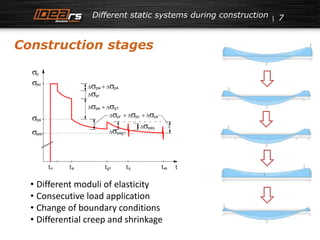
€ 100 eBTW 
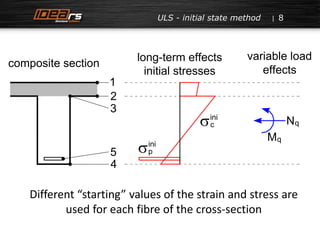
http://eurocode2-naslagwerken-idea.eventbrite.com
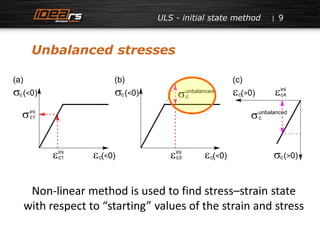
3 
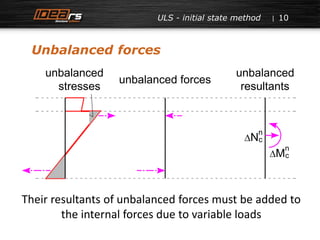
Design of composite cross-section 
Ultimate Limit States 
• Flexure, Shear, Torsion 
• Interaction of internal forces 
• Fatigue 
• Shear in composite joint
4 
Shear in composite joint 
• Standard EN approach 
• Lever arm, factor b, shortcomings 
• Alternative approach 
• Comparative study 
Prestressed composite bridge design 
• Comparison and standard EN approach 
• Effects of creep and shrinkage 
• Comparison of EN 1992-1-1 and EN 1992-2 
Scope
5 
Design of composite cross-section 
Serviceability Limit States 
• Stress limitation 
• Decompression condition 
• Crack width 
• Brittle failure
6 
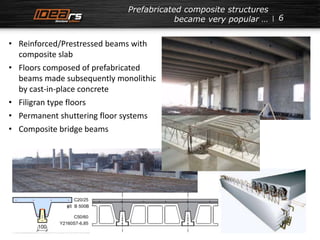
Prefabricated composite structures 
became very popular … 
• Reinforced/Prestressed beams with 
composite slab 
• Floors composed of prefabricated 
beams made subsequently monolithic 
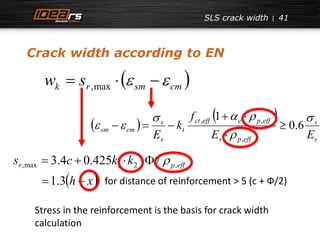
by cast-in-place concrete 
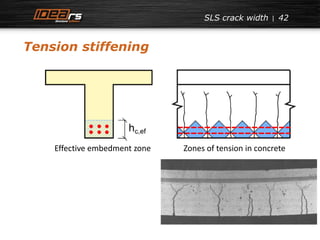
• Filigran type floors 
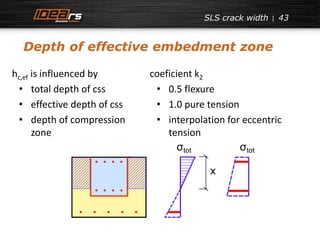
• Permanent shuttering floor systems 
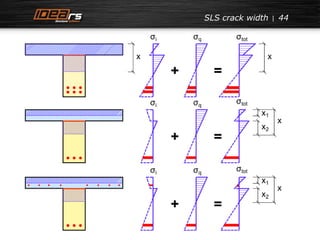
• Composite bridge beams
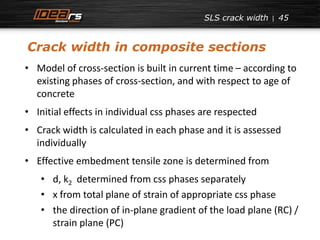
Different static systems during construction 7 
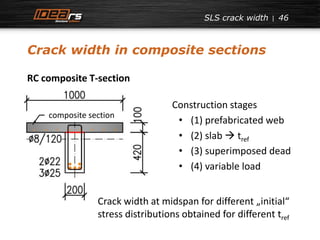
Construction stages 
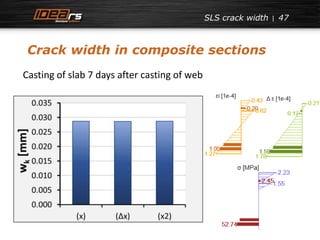
p 
po 
pa 
p 
8 
pw     pA 
pr 
pe      pT 
pr      pc      ps 
peq 
peg1 
to ta tg1 tq t 
8 
t 
• Different moduli of elasticity 
• Consecutive load application 
• Change of boundary conditions 
• Differential creep and shrinkage
1 
2 
3 
5 
4 
long-term effects 
initial stresses 
ini 
p 
ini 
c 
composite section 
variable load 
Different “starting” values of the strain and stress are 
used for each fibre of the cross-section 
effects 
Mq 
Nq 
ULS - initial state method 8
ULS - initial state method 9 
Unbalanced stresses 
(a) (b) (c) 
c(<0) 
ini 
c1 
c(<0) 
ini c(<0) 
c1 
unbalanced 
c 
ini c(<0) 
c3 
ini 
c4 
unbalanced 
c(>0) 
c(>0) 
c 
Non-linear method is used to find stress–strain state 
with respect to “starting” values of the strain and stress
ULS - initial state method 10 
Unbalanced forces 
unbalanced 
stresses 
unbalanced forces 
unbalanced 
resultants 
n 
Mc 
n 
Nc 
Their resultants of unbalanced forces must be added to 
the internal forces due to variable loads
ULS - initial state method 11 
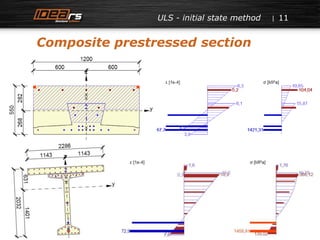
Composite prestressed section
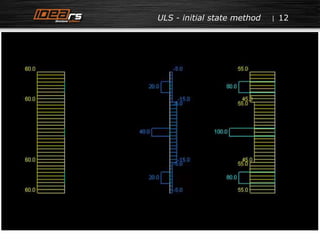
ULS - initial state method 12
ULS shear design 13 
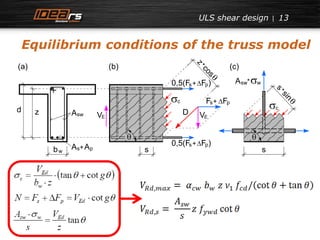
Equilibrium conditions of the truss model 
d z 
Asw 
bw As + Ap 
(a) 
Fs + Fp 
D V 
(b) 
0,5(Fs + Fp ) 
c 
VE E 
  
s 
z * cos  
s 
A s w * w 
s * sin  
(c) 
c 
0,5(Fs + Fp )
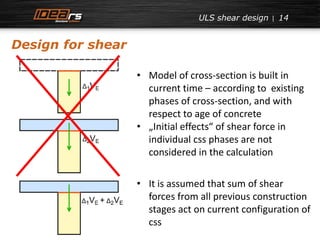
Design for shear 
ULS shear design 14 
• Model of cross-section is built in 
current time – according to existing 
phases of cross-section, and with 
respect to age of concrete 
• „Initial effects“ of shear force in 
individual css phases are not 
considered in the calculation 
• It is assumed that sum of shear 
forces from all previous construction 
stages act on current configuration of 
css
ULS shear design 15 
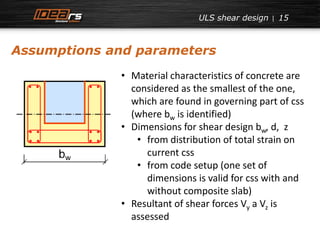
Assumptions and parameters 
• Material characteristics of concrete are 
considered as the smallest of the one, 
which are found in governing part of css 
(where bw is identified) 
• Dimensions for shear design bw, d, z 
• from distribution of total strain on 
current css 
• from code setup (one set of 
dimensions is valid for css with and 
without composite slab) 
• Resultant of shear forces Vy a Vz is 
assessed
16 
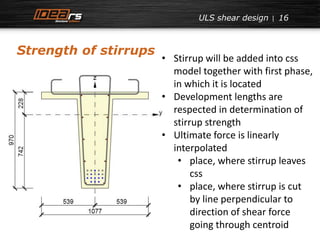
Strength of stirrups 
ULS shear design 
• Stirrup will be added into css 
model together with first phase, 
in which it is located 
• Development lengths are 
respected in determination of 
stirrup strength 
• Ultimate force is linearly 
interpolated 
• place, where stirrup leaves 
css 
• place, where stirrup is cut 
by line perpendicular to 
direction of shear force 
going through centroid
17 
Torsion resistance 
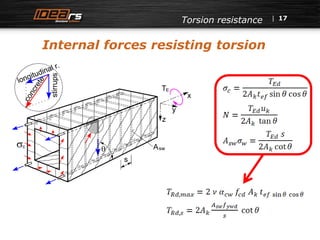
Internal forces resisting torsion 
T 
x 
z 
y 
 Asw c 
s 
longitudinal r. 
stirrups 
concrete 
E
ULS design for torsion 18 
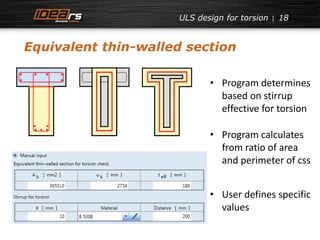
Equivalent thin-walled section 
• Program determines 
based on stirrup 
effective for torsion 
• Program calculates 
from ratio of area 
and perimeter of css 
• User defines specific 
values
ULS design for torsion 19 
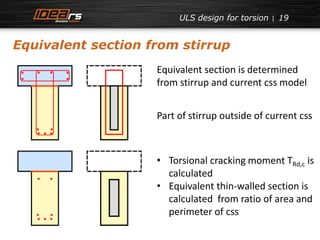
Equivalent section from stirrup 
Equivalent section is determined 
from stirrup and current css model 
Part of stirrup outside of current css 
• Torsional cracking moment TRd,c is 
calculated 
• Equivalent thin-walled section is 
calculated from ratio of area and 
perimeter of css
ULS design for torsion 20 
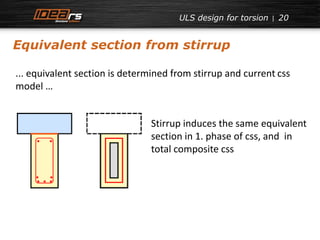
Equivalent section from stirrup 
... equivalent section is determined from stirrup and current css 
model … 
Stirrup induces the same equivalent 
section in 1. phase of css, and in 
total composite css
Design for torsion 
ULS design for torsion 21 
• Model of cross-section is built in current time – according to 
existing phases of cross-section, and with respect to age of 
concrete 
• Sum of torsional moments from all previous construction stages 
act on current configuration of css 
• Material characteristics of concrete are considered as the 
smallest of the one, which are found in equivalent thin-walled 
section
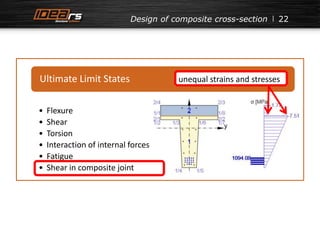
22 
Ultimate Limit States 
Design of composite cross-section 
• Flexure 
• Shear 
• Torsion 
• Interaction of internal forces 
• Fatigue 
• Shear in composite joint 
unequal strains and stresses
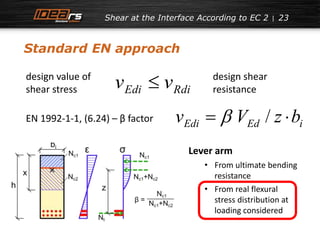
Shear at the Interface According to EC 2 23 
Standard EN approach 
design value of 
v  v shear stress 
Edi Rdi design shear 
resistance 
EN 1992-1-1, (6.24) – β factor Edi Ed i v  b V / z b 
Lever arm 
• From ultimate bending 
resistance 
• From real flexural 
stress distribution at 
loading considered
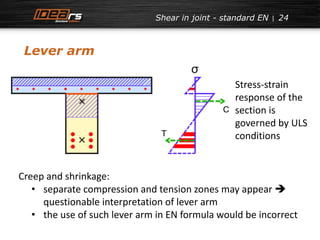
Lever arm 
Shear in joint - standard EN 24 
Creep and shrinkage: 
Stress-strain 
response of the 
section is 
governed by ULS 
conditions 
• separate compression and tension zones may appear  
questionable interpretation of lever arm 
• the use of such lever arm in EN formula would be incorrect
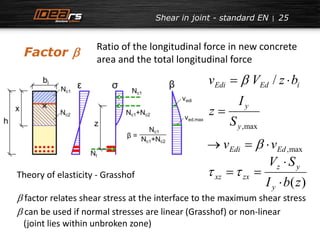
Factor b 
25 
Shear in joint - standard EN 
Ratio of the longitudinal force in new concrete 
area and the total longitudinal force 
Edi Ed i v  b V / z b 
Edi Ed ,max v  b v 
V S 
I b(z) 
y 
z y 
y 
I 
y,max 
S 
z  
xz zx  
 
   
Theory of elasticity - Grasshof 
b factor relates shear stress at the interface to the maximum shear stress 
b can be used if normal stresses are linear (Grasshof) or non-linear 
(joint lies within unbroken zone)
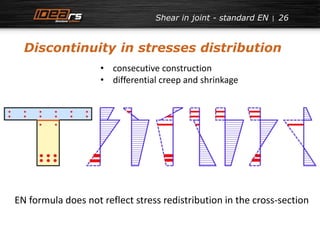
26 
Shear in joint - standard EN 
Discontinuity in stresses distribution 
• consecutive construction 
• differential creep and shrinkage 
EN formula does not reflect stress redistribution in the cross-section
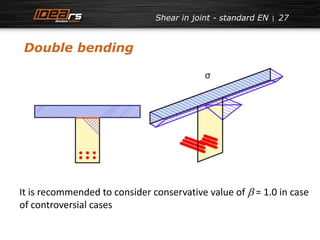
Double bending 
27 
Shear in joint - standard EN 
It is recommended to consider conservative value of b = 1.0 in case 
of controversial cases
Shear in joint from difference 
of normal Forces 28 
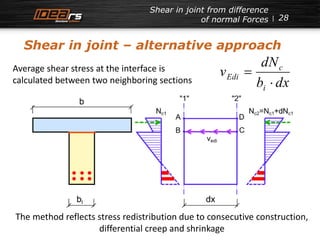
Shear in joint – alternative approach 
dN 
Average shear stress at the interface is 
v 
calculated between two neighboring sections b dx 
i 
c 
 
Edi  
The method reflects stress redistribution due to consecutive construction, 
differential creep and shrinkage
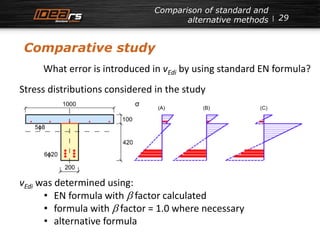
Comparative study 
29 
Comparison of standard and 
alternative methods 
What error is introduced in vEdi by using standard EN formula? 
Stress distributions considered in the study 
vEdi was determined using: 
• EN formula with b factor calculated 
• formula with b factor = 1.0 where necessary 
• alternative formula
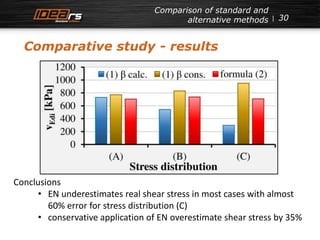
Comparative study - results 
30 
Comparison of standard and 
alternative methods 
Conclusions 
• EN underestimates real shear stress in most cases with almost 
60% error for stress distribution (C) 
• conservative application of EN overestimate shear stress by 35%
Analysis of real-life structure 31 
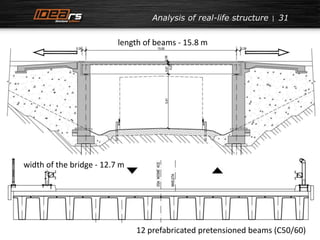
length of beams - 15.8 m 
12 prefabricated pretensioned beams (C50/60) 
width of the bridge - 12.7 m
Composite concrete bridge 32 
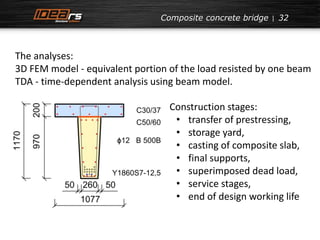
The analyses: 
3D FEM model - equivalent portion of the load resisted by one beam 
TDA - time-dependent analysis using beam model. 
Construction stages: 
• transfer of prestressing, 
• storage yard, 
• casting of composite slab, 
• final supports, 
• superimposed dead load, 
• service stages, 
• end of design working life
33 
shear stresses at distance 
1.1 m from support 
1200 
1000 
800 
600 
400 
200 
0 
100 150 200 250 300 350 400 
Shear stress [kPa] 
Shear force [kN] 
β-2 dx-2 
β = 1,0 
β ≤ 1,0 
cracks 
β=0,57
34 
1200 
1000 
800 
600 
400 
200 
0 
β-2 dx-2 
β-1-1 dx-1-1 
β = 1,0 
EN 1992-1-1 
100 150 200 250 300 350 400 
Shear stress [kPa] 
Shear force [kN] 
β = 1,0 
β ≤ 1,0 
cracks 
cracks 
β=0,57 
EN 1992-2 
shear stresses at distance 
1.1 m from support
35 
1200 
1000 
800 
600 
400 
200 
0 
dx-1-1 dx-2 
β-1-1 β-2 
dx no cr-2 dx lin-2 
dx lin-1-1 
shear stresses at distance 
100 150 200 250 300 350 400 
Shear stress [kPa] 
Shear force [kN] 
cracks 
cracks 
1.1 m from support
36 
30 
25 
20 
15 
10 
5 
0 
0 
-1 
-2 
-3 
σc,b-2 
σc,b-1-1 
σs,t-2 
σs,t-1-1 
normal stresses at distance 
1.1 m from support 
1 10 100 1000 10000 100000 
Steel stress [MPa] 
Concrete stress [MPa] 
Age of prefabricated beam [days]
Casting of composite slab after 20 years 37 
60 
50 
40 
30 
20 
10 
0 
0 
-0.5 
-1 
-1.5 
-2 
1 10 100 1000 10000 100000 
Steel stress [MPa] 
Concrete stress [MPa] 
Slab age [days] 
σc,b-2 
σc,b-1-1 
σs,t-2 
σs,t-1-1
Casting of composite slab after 20 years 38 
1200 
1000 
800 
600 
400 
200 
0 
dx-1-1 dx-2 
β-1-1 β-2 
dx lin-1-1 dx lin-2 
β = 1,0 
cracks cracks 
100 150 200 250 300 350 400 
Shear stress [kPa] 
Shear force [kN]
39 
Comparison composite slab after 
60 days/20 years 
1200 
1000 
800 
600 
400 
200 
0 
dx 60 days-2 
dx 60 days-1-1 
dx 20 years-2 
dx 20 years-1-1 
100 150 200 250 300 350 400 
Shear stress [kPa] 
Shear force [kN]
Shear in construction joint 40 
Conclusions for shear in composite joint 
• Eurocode 2 method 
• does not reflect stress redistribution caused by 
construction and differential creep and shrinkage 
• underestimates shear stresses (calculated b factor) or 
leads to uneconomic design (conservative b factor) 
• Alternative method was proposed and tested numerically 
• Shear in construction joint is sensitive to creep and 
shrinkage redistribution 
• Rhelological effects according to EN 1992-1-1 exhibit 
higher effects than according to EN 1992-2
SLS crack width 41 
Crack width according to EN 
  k r sm cm w  s    ,max 
  
   
s 
  
, ,  
  0.6 
sm cm E E 
r p eff s c k k ,max 1 2 ,  3.4  0.425  / 
  
s 
s 
ct eff e p eff 
s p eff 
t 
s 
f 
k 
E 
 
 
1 
, 
 
   
1.3h  x for distance of reinforcement > 5 (c + Ф/2) 
Stress in the reinforcement is the basis for crack width 
calculation
SLS crack width 42 
Tension stiffening 
Effective embedment zone Zones of tension in concrete
SLS crack width 43 
Depth of effective embedment zone 
hc,ef is influenced by 
• total depth of css 
• effective depth of css 
• depth of compression 
zone 
coeficient k2 
• 0.5 flexure 
• 1.0 pure tension 
• interpolation for eccentric 
tension
SLS crack width 44
45 
• Model of cross-section is built in current time – according to 
existing phases of cross-section, and with respect to age of 
concrete 
• Initial effects in individual css phases are respected 
• Crack width is calculated in each phase and it is assessed 
individually 
• Effective embedment tensile zone is determined from 
• d, k2 determined from css phases separately 
• x from total plane of strain of appropriate css phase 
• the direction of in-plane gradient of the load plane (RC) / 
strain plane (PC) 
SLS crack width 
Crack width in composite sections
SLS crack width 
Crack width in composite sections 
46 
RC composite T-section 
Construction stages 
• (1) prefabricated web 
• (2) slab  tref 
• (3) superimposed dead 
• (4) variable load 
composite section 
Crack width at midspan for different „initial“ 
stress distributions obtained for different tref
Crack width in composite sections 
47 
Casting of slab 7 days after casting of web 
SLS crack width
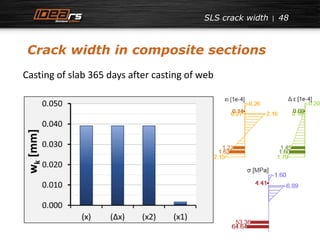
SLS crack width 48 
Crack width in composite sections 
Casting of slab 365 days after casting of web
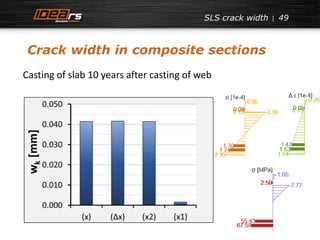
SLS crack width 49 
Crack width in composite sections 
Casting of slab 10 years after casting of web
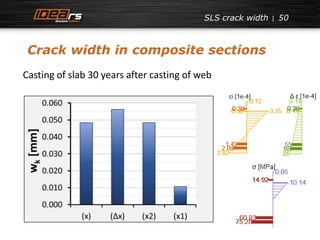
SLS crack width 50 
Crack width in composite sections 
Casting of slab 30 years after casting of web
SLS crack width 
Crack width in composite sections 
51 
RC composite T-section (after 100 years) 
Casting of composite slab [days] 
Crack in slab [mm] 
Crack in web [mm]
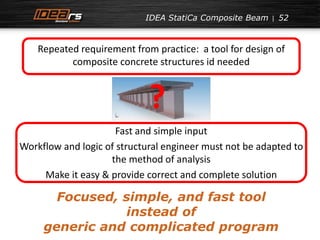
IDEA StatiCa Composite Beam 52 
Repeated requirement from practice: a tool for design of 
composite concrete structures id needed 
? 
Fast and simple input 
Workflow and logic of structural engineer must not be adapted to 
the method of analysis 
Make it easy & provide correct and complete solution 
Focused, simple, and fast tool 
instead of 
generic and complicated program
IDEA RS - Literature 4 
Book on Prestressing by J. Navratil 
€ 100 eBTW 
http://eurocode2-naslagwerken-idea.eventbrite.com
Thank you for your attention 
www.ideastatica.com www.idea-rs.com

Eurocode 2 design of composite concrete

  • 1.
    Genk, Belgium, December9th, 2014 Dordrecht, Netherlands , December 10th, 2014 Eurocode 2 Design of Composite Concrete Structures Assoc. Prof. Jaroslav Navrátil, M.Sc., Ph.D.
  • 2.
    IDEA RS -Literature 4 Book on Prestressing by J. Navratil € 100 eBTW http://eurocode2-naslagwerken-idea.eventbrite.com
  • 3.
    3 Design ofcomposite cross-section Ultimate Limit States • Flexure, Shear, Torsion • Interaction of internal forces • Fatigue • Shear in composite joint
  • 4.
    4 Shear incomposite joint • Standard EN approach • Lever arm, factor b, shortcomings • Alternative approach • Comparative study Prestressed composite bridge design • Comparison and standard EN approach • Effects of creep and shrinkage • Comparison of EN 1992-1-1 and EN 1992-2 Scope
  • 5.
    5 Design ofcomposite cross-section Serviceability Limit States • Stress limitation • Decompression condition • Crack width • Brittle failure
  • 6.
    6 Prefabricated compositestructures became very popular … • Reinforced/Prestressed beams with composite slab • Floors composed of prefabricated beams made subsequently monolithic by cast-in-place concrete • Filigran type floors • Permanent shuttering floor systems • Composite bridge beams
  • 7.
    Different static systemsduring construction 7 Construction stages p po pa p 8 pw     pA pr pe      pT pr      pc      ps peq peg1 to ta tg1 tq t 8 t • Different moduli of elasticity • Consecutive load application • Change of boundary conditions • Differential creep and shrinkage
  • 8.
    1 2 3 5 4 long-term effects initial stresses ini p ini c composite section variable load Different “starting” values of the strain and stress are used for each fibre of the cross-section effects Mq Nq ULS - initial state method 8
  • 9.
    ULS - initialstate method 9 Unbalanced stresses (a) (b) (c) c(<0) ini c1 c(<0) ini c(<0) c1 unbalanced c ini c(<0) c3 ini c4 unbalanced c(>0) c(>0) c Non-linear method is used to find stress–strain state with respect to “starting” values of the strain and stress
  • 10.
    ULS - initialstate method 10 Unbalanced forces unbalanced stresses unbalanced forces unbalanced resultants n Mc n Nc Their resultants of unbalanced forces must be added to the internal forces due to variable loads
  • 11.
    ULS - initialstate method 11 Composite prestressed section
  • 12.
    ULS - initialstate method 12
  • 13.
    ULS shear design13 Equilibrium conditions of the truss model d z Asw bw As + Ap (a) Fs + Fp D V (b) 0,5(Fs + Fp ) c VE E   s z * cos  s A s w * w s * sin  (c) c 0,5(Fs + Fp )
  • 14.
    Design for shear ULS shear design 14 • Model of cross-section is built in current time – according to existing phases of cross-section, and with respect to age of concrete • „Initial effects“ of shear force in individual css phases are not considered in the calculation • It is assumed that sum of shear forces from all previous construction stages act on current configuration of css
  • 15.
    ULS shear design15 Assumptions and parameters • Material characteristics of concrete are considered as the smallest of the one, which are found in governing part of css (where bw is identified) • Dimensions for shear design bw, d, z • from distribution of total strain on current css • from code setup (one set of dimensions is valid for css with and without composite slab) • Resultant of shear forces Vy a Vz is assessed
  • 16.
    16 Strength ofstirrups ULS shear design • Stirrup will be added into css model together with first phase, in which it is located • Development lengths are respected in determination of stirrup strength • Ultimate force is linearly interpolated • place, where stirrup leaves css • place, where stirrup is cut by line perpendicular to direction of shear force going through centroid
  • 17.
    17 Torsion resistance Internal forces resisting torsion T x z y  Asw c s longitudinal r. stirrups concrete E
  • 18.
    ULS design fortorsion 18 Equivalent thin-walled section • Program determines based on stirrup effective for torsion • Program calculates from ratio of area and perimeter of css • User defines specific values
  • 19.
    ULS design fortorsion 19 Equivalent section from stirrup Equivalent section is determined from stirrup and current css model Part of stirrup outside of current css • Torsional cracking moment TRd,c is calculated • Equivalent thin-walled section is calculated from ratio of area and perimeter of css
  • 20.
    ULS design fortorsion 20 Equivalent section from stirrup ... equivalent section is determined from stirrup and current css model … Stirrup induces the same equivalent section in 1. phase of css, and in total composite css
  • 21.
    Design for torsion ULS design for torsion 21 • Model of cross-section is built in current time – according to existing phases of cross-section, and with respect to age of concrete • Sum of torsional moments from all previous construction stages act on current configuration of css • Material characteristics of concrete are considered as the smallest of the one, which are found in equivalent thin-walled section
  • 22.
    22 Ultimate LimitStates Design of composite cross-section • Flexure • Shear • Torsion • Interaction of internal forces • Fatigue • Shear in composite joint unequal strains and stresses
  • 23.
    Shear at theInterface According to EC 2 23 Standard EN approach design value of v  v shear stress Edi Rdi design shear resistance EN 1992-1-1, (6.24) – β factor Edi Ed i v  b V / z b Lever arm • From ultimate bending resistance • From real flexural stress distribution at loading considered
  • 24.
    Lever arm Shearin joint - standard EN 24 Creep and shrinkage: Stress-strain response of the section is governed by ULS conditions • separate compression and tension zones may appear  questionable interpretation of lever arm • the use of such lever arm in EN formula would be incorrect
  • 25.
    Factor b 25 Shear in joint - standard EN Ratio of the longitudinal force in new concrete area and the total longitudinal force Edi Ed i v  b V / z b Edi Ed ,max v  b v V S I b(z) y z y y I y,max S z  xz zx      Theory of elasticity - Grasshof b factor relates shear stress at the interface to the maximum shear stress b can be used if normal stresses are linear (Grasshof) or non-linear (joint lies within unbroken zone)
  • 26.
    26 Shear injoint - standard EN Discontinuity in stresses distribution • consecutive construction • differential creep and shrinkage EN formula does not reflect stress redistribution in the cross-section
  • 27.
    Double bending 27 Shear in joint - standard EN It is recommended to consider conservative value of b = 1.0 in case of controversial cases
  • 28.
    Shear in jointfrom difference of normal Forces 28 Shear in joint – alternative approach dN Average shear stress at the interface is v calculated between two neighboring sections b dx i c  Edi  The method reflects stress redistribution due to consecutive construction, differential creep and shrinkage
  • 29.
    Comparative study 29 Comparison of standard and alternative methods What error is introduced in vEdi by using standard EN formula? Stress distributions considered in the study vEdi was determined using: • EN formula with b factor calculated • formula with b factor = 1.0 where necessary • alternative formula
  • 30.
    Comparative study -results 30 Comparison of standard and alternative methods Conclusions • EN underestimates real shear stress in most cases with almost 60% error for stress distribution (C) • conservative application of EN overestimate shear stress by 35%
  • 31.
    Analysis of real-lifestructure 31 length of beams - 15.8 m 12 prefabricated pretensioned beams (C50/60) width of the bridge - 12.7 m
  • 32.
    Composite concrete bridge32 The analyses: 3D FEM model - equivalent portion of the load resisted by one beam TDA - time-dependent analysis using beam model. Construction stages: • transfer of prestressing, • storage yard, • casting of composite slab, • final supports, • superimposed dead load, • service stages, • end of design working life
  • 33.
    33 shear stressesat distance 1.1 m from support 1200 1000 800 600 400 200 0 100 150 200 250 300 350 400 Shear stress [kPa] Shear force [kN] β-2 dx-2 β = 1,0 β ≤ 1,0 cracks β=0,57
  • 34.
    34 1200 1000 800 600 400 200 0 β-2 dx-2 β-1-1 dx-1-1 β = 1,0 EN 1992-1-1 100 150 200 250 300 350 400 Shear stress [kPa] Shear force [kN] β = 1,0 β ≤ 1,0 cracks cracks β=0,57 EN 1992-2 shear stresses at distance 1.1 m from support
  • 35.
    35 1200 1000 800 600 400 200 0 dx-1-1 dx-2 β-1-1 β-2 dx no cr-2 dx lin-2 dx lin-1-1 shear stresses at distance 100 150 200 250 300 350 400 Shear stress [kPa] Shear force [kN] cracks cracks 1.1 m from support
  • 36.
    36 30 25 20 15 10 5 0 0 -1 -2 -3 σc,b-2 σc,b-1-1 σs,t-2 σs,t-1-1 normal stresses at distance 1.1 m from support 1 10 100 1000 10000 100000 Steel stress [MPa] Concrete stress [MPa] Age of prefabricated beam [days]
  • 37.
    Casting of compositeslab after 20 years 37 60 50 40 30 20 10 0 0 -0.5 -1 -1.5 -2 1 10 100 1000 10000 100000 Steel stress [MPa] Concrete stress [MPa] Slab age [days] σc,b-2 σc,b-1-1 σs,t-2 σs,t-1-1
  • 38.
    Casting of compositeslab after 20 years 38 1200 1000 800 600 400 200 0 dx-1-1 dx-2 β-1-1 β-2 dx lin-1-1 dx lin-2 β = 1,0 cracks cracks 100 150 200 250 300 350 400 Shear stress [kPa] Shear force [kN]
  • 39.
    39 Comparison compositeslab after 60 days/20 years 1200 1000 800 600 400 200 0 dx 60 days-2 dx 60 days-1-1 dx 20 years-2 dx 20 years-1-1 100 150 200 250 300 350 400 Shear stress [kPa] Shear force [kN]
  • 40.
    Shear in constructionjoint 40 Conclusions for shear in composite joint • Eurocode 2 method • does not reflect stress redistribution caused by construction and differential creep and shrinkage • underestimates shear stresses (calculated b factor) or leads to uneconomic design (conservative b factor) • Alternative method was proposed and tested numerically • Shear in construction joint is sensitive to creep and shrinkage redistribution • Rhelological effects according to EN 1992-1-1 exhibit higher effects than according to EN 1992-2
  • 41.
    SLS crack width41 Crack width according to EN   k r sm cm w  s    ,max      s   , ,    0.6 sm cm E E r p eff s c k k ,max 1 2 ,  3.4  0.425  /   s s ct eff e p eff s p eff t s f k E   1 ,     1.3h  x for distance of reinforcement > 5 (c + Ф/2) Stress in the reinforcement is the basis for crack width calculation
  • 42.
    SLS crack width42 Tension stiffening Effective embedment zone Zones of tension in concrete
  • 43.
    SLS crack width43 Depth of effective embedment zone hc,ef is influenced by • total depth of css • effective depth of css • depth of compression zone coeficient k2 • 0.5 flexure • 1.0 pure tension • interpolation for eccentric tension
  • 44.
  • 45.
    45 • Modelof cross-section is built in current time – according to existing phases of cross-section, and with respect to age of concrete • Initial effects in individual css phases are respected • Crack width is calculated in each phase and it is assessed individually • Effective embedment tensile zone is determined from • d, k2 determined from css phases separately • x from total plane of strain of appropriate css phase • the direction of in-plane gradient of the load plane (RC) / strain plane (PC) SLS crack width Crack width in composite sections
  • 46.
    SLS crack width Crack width in composite sections 46 RC composite T-section Construction stages • (1) prefabricated web • (2) slab  tref • (3) superimposed dead • (4) variable load composite section Crack width at midspan for different „initial“ stress distributions obtained for different tref
  • 47.
    Crack width incomposite sections 47 Casting of slab 7 days after casting of web SLS crack width
  • 48.
    SLS crack width48 Crack width in composite sections Casting of slab 365 days after casting of web
  • 49.
    SLS crack width49 Crack width in composite sections Casting of slab 10 years after casting of web
  • 50.
    SLS crack width50 Crack width in composite sections Casting of slab 30 years after casting of web
  • 51.
    SLS crack width Crack width in composite sections 51 RC composite T-section (after 100 years) Casting of composite slab [days] Crack in slab [mm] Crack in web [mm]
  • 52.
    IDEA StatiCa CompositeBeam 52 Repeated requirement from practice: a tool for design of composite concrete structures id needed ? Fast and simple input Workflow and logic of structural engineer must not be adapted to the method of analysis Make it easy & provide correct and complete solution Focused, simple, and fast tool instead of generic and complicated program
  • 53.
    IDEA RS -Literature 4 Book on Prestressing by J. Navratil € 100 eBTW http://eurocode2-naslagwerken-idea.eventbrite.com
  • 54.
    Thank you foryour attention www.ideastatica.com www.idea-rs.com

Editor's Notes

  • #4 The history of construction stages influences the ULS and SLS … and cause unequal strains and stresses in two adjacent fibers of construction joint. The requirement is to ensure that both parts act fully compositely. Therefore the level of shear stresses at the interface between two parts must be limited. The objective of the paper is to review the methods for the calculation of shear stresses in construction joint
  • #6 The history of construction stages influences the ULS and SLS … and cause unequal strains and stresses in two adjacent fibers of construction joint. The requirement is to ensure that both parts act fully compositely. Therefore the level of shear stresses at the interface between two parts must be limited. The objective of the paper is to review the methods for the calculation of shear stresses in construction joint
  • #7 Composite concrete beams made of prefabricated prestressed or non-prestressed element and cast-in-place reinforced concrete slab became very popular in present-day civil engineering practice.
  • #8 The structures utilize different static systems during their construction. Different moduli of elasticity Consecutive load application, Differential creep and shrinkage, Change of boundary conditions
  • #23 The history of construction stages influences the ULS and SLS … and cause unequal strains and stresses in two adjacent fibers of construction joint. The requirement is to ensure that both parts act fully compositely. Therefore the level of shear stresses at the interface between two parts must be limited. The objective of the paper is to review the methods for the calculation of shear stresses in construction joint
  • #24 VEd is the shear force, bi is the width of the interface, and z is the lever arm of composite section. Lever arm: correct solution: z should reflect the flexural stress distribution in the section and loading considered
  • #25 We integrate the stresses in all parts of compression zone and in all parts of tension zone  resultant forces  lever arm E.g. tensile zone in the slab moves total resultant in tension towards resultant in compression and therefore decreases lever arm. The use of such lever arm in EN formula would be incorrect.
  • #26 If the plane of construction joint lies within unbroken either compression or tension zones - beta can be used
  • #27 Therefore EN formula does not reflect stress redistribution in the cross-section caused by consecutive construction, and differential creep and shrinkage of concrete of both composite parts of cross-section
  • #29 dNc is the difference of the resultant of normal stresses integrated on one of sectional components in two neighboring sections dx is the distance between two neighboring sections bi is the width of the interface
  • #30 The discontinuities in the distribution of normal stresses are symptomatic for composite concrete sections  what err? Study: various distributions of normal stress were introduced by altering the age tref of first component of cross-section reached at the time of casting of composite component - creep + shrinkage + external load after 100 years.
  • #31 EC2 method with beta factor calculated underestimates real shear stress in most cases with almost 60% error in the case of stress distribution C conservative application of EC2 formula may overestimate realistic shear stress, by 35% in the case of stress distribution C
  • #32 One span concrete composite bridge was analyzed for the effects of dead and superimposed dead loads, construction stages, and moving loads (EN 1991-2). The structure is composed of 12 prefabricated pretensioned beams (C50/60) with composite concrete slab (C30/37). The width of the bridge is 12.7 m, the length of beams is 15.8 m
  • #34 Normal and shear stresses were evaluated at distance d = 1.1 m from support For various load combinations with live load  resulting shear force Shear stresses at the interface between two parts Compression zone is broken  conservative value Beta =1,0 in most cases EN 1992-2 For max Vz compression zone is unbroken  Beta ≤ 1,0 For dx method - „cracks“ means that whole slab is in tension = it means cracked at ULS conditions
  • #35 EN 1992-1-1: Beta = 1 for whole range of Vz Cracks for wider range of Vz: up to 250 KN (caused by higher shrinkage acc 1992-1-1  redistribution  tension in slab). „Softening“ due to cracked slab at ULS conditions leads to the stress redistribution from slab to prefa (slab reinforcement does not take all tension over) For max Vz – identical shear stress for 1992-1-1 and 1992-2 when calculating acc. dx method (= correct result, because most of shear stress in caused by moving load) In spite of that – different normal stress distribution for 1992-1-1 and 1992-2
  • #36 Influence of creep Influence of ULS conditions (LIN elastic response)
  • #37 Normal stress redistribution
  • #38 Normal stress redistribution Significant influence of stress redistribution of normal stresses due to creep to shear stress in the joint (influence by way of “cracks”).
  • #39 Compression zone is broken  Beta =1,0 for all Vz For dx method – higher redistribution  „cracks“ for larger range of Vz
  • #40 1-1 is higher redistribution  tension in slab  „Softening“ due to cracked slab at ULS conditions 20 years even higher
  • #41 The methods for the calculation of shear stresses in construction joint were reviewed Shear in construction joint is sensitive to creep and shrinkage redistribution  tension in slab, assuming ULS conditions  „Softening“ due to cracked slab leads to the stress redistribution from slab to prefa (slab reinforcement does not take all tension over)
  • #42 p,eff stupeň vyztužení k2 součinitel, kterým se zohledňuje rozdělení poměrného přetvoření: = 0,5 pro ohyb; = 1,0 pro prostý tah, pro případy mimostředného tahu …. x výška tlačené zóny
  • #44 U žlabu není vůbec zřejmé, jaké hodnoty x, d, uvažovat do výpočtu k2 zohlednuje rozdeleni poměrného pretvoreni po prurezu
  • #45 Při ohybovém namáhání desky vznikají tři možnosti pro x,d: buď uvažovat z celkového průřezu (co když deska bude pouze tažená, jaké k2?), nebo z přírůstku (jednoduché k programování, ale nezachycuje trhliny v desce), nebo po komponentách (nejvhodnější, protože průběh napětí na komponentě je lineární)
  • #46 Šířku trhlin počítáme na každé komponentě zvlášť. Není to sice třeba pro případy, kdy je potrhané vlákno kryto dalším betonem, ale zatím se posuzují všechna vlákna. Měli bychom mít možnost neposuzovat šířku trhlin na styku dvou fází průřezu. Pozn: směr spádové přímky z roviny zatížení (železobeton), z roviny přetvoření (předpjatý b.) V železobetonu - kvůli snadné identifikaci vrstvy výztuže a následně vzdáleností mezi vložkami v předpjatém to nelze vzhledem ke spoustě případů, kdy rozdíl mezi směrem spadové přímky a směrem roviny zatížení byl velký a vycházely nesmyslné výsledky. Proto jsme přijali pro předpjatý beton rozdílné řešení
  • #47 Výpočet byl proveden pro reálná postupně vznikající zatížení. Průřez je jinak vyztužen než předchozí s ohledem na důležitost rozmístění výztuže pro výpočet trhlin Posuzovala se šířka trhlin uprostřed rozpětí pro různé „inišly“ - průběhy napětí získané pro různé tref "d:\IDEA\SVN_docs\Idea\Projects\P26_Spřažený průřez\Lukáš Zvolánek\CompositeBeam_CrackWidth\CompositeBeam_CrackWidth.xlsx"
  • #48 (x) je vztaženo k výsledné napjatosti celého průřezu – poslední (modrý) obr. (Δx) je vztaženo k přírůstku napjatosti celého průřezu – zelený obr (x1/x2) je vztaženo ke komponentě (deska/stojina)  IDEA RS - modrý obr., spodní část průřezu … x2 je pouze od neutr. osy po spáru
  • #49 (x) je vztaženo k výsledné napjatosti celého průřezu, přestože v desce už není tlačená zóna (Δx) je vztaženo k přírůstku napjatosti celého průřezu (x1/x2) je vztaženo ke komponentě (deska/stojina)  IDEA RS
  • #50 (x) je vztaženo k výsledné napjatosti celého průřezu, přestože je tlačená zóna „přerušena“ v desce taženou – diskutabilní určení x, EC2 mlčí (Δx) je vztaženo k přírůstku napjatosti celého průřezu (x1/x2) je vztaženo ke komponentě (deska/stojina)  IDEA RS
  • #51 (x) je vztaženo k výsledné napjatosti celého průřezu, přestože v desce už není tlačená zóna (Δx) je vztaženo k přírůstku napjatosti celého průřezu (x1/x2) je vztaženo ke komponentě (deska/stojina)  IDEA RS IDEA vyhodnocuje horší z x1/x2, parametry jsou jasně dány
  • #52 Shrnutí všech případů na jednu časovou osu (= čas vzniku spřažené desky). Je zřetelné, že čím větší je diference stáří betonů, tím je širší trhlina jak v desce, tak i ve stojině. Trhlina v desce se vztahuje k sekundární ose (oranžová), aby byla na grafu vidět. (x1) je vztaženo ke komponentě – deska (x2) je vztaženo ke komponentě – stojina