








1
CE 72.52 Advanced Concrete
Lecture 1:
Introduction
Naveed Anwar
Executive Director, AIT Consulting
Director, ACECOMS
Affiliate Faculty, Structural Engineering, AIT
August - 2015
The Role of Structural Engineers
• To help in the creation of the safe built
environment
• Nothing can function, if structural
engineers do not do their job well
• Every other professional “Depends” on the
role of structural engineers
2
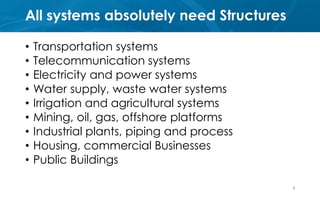
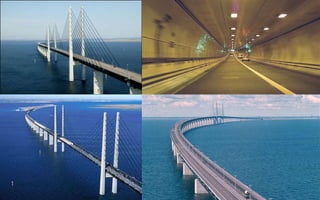
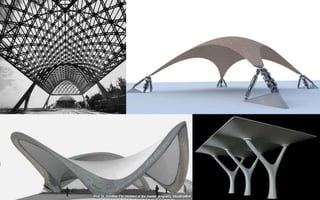
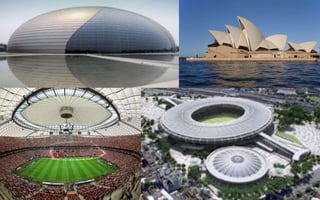
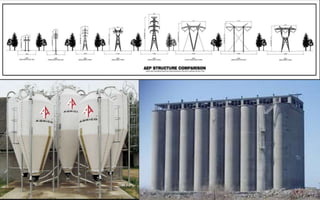
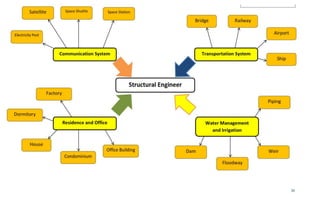
All systems absolutely need Structures
• Transportation systems
• Telecommunication systems
• Electricity and power systems
• Water supply, waste water systems
• Irrigation and agricultural systems
• Mining, oil, gas, offshore platforms
• Industrial plants, piping and process
• Housing, commercial Businesses
• Public Buildings
3
4
5
6
7
8
9
10
11
12
13
14
15
16
17
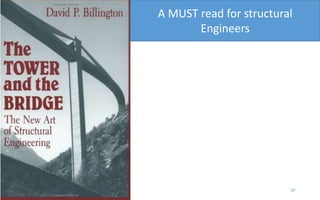
A MUST read for structural
Engineers
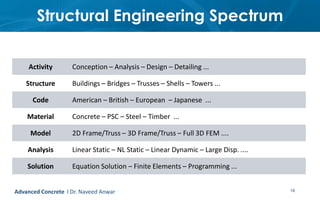
Structural Engineering Spectrum
18
Activity Conception – Analysis – Design – Detailing ...
Structure Buildings – Bridges – Trusses – Shells – Towers ...
Code American – British – European – Japanese ...
Material Concrete – PSC – Steel – Timber ...
Model 2D Frame/Truss – 3D Frame/Truss – Full 3D FEM ....
Analysis Linear Static – NL Static – Linear Dynamic – Large Disp. ....
Solution Equation Solution – Finite Elements – Programming ...
Advanced Concrete l Dr. Naveed Anwar
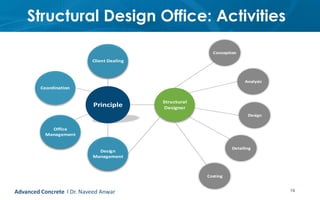
Structural Design Office: Activities
19
Design
Management
Structural
Designer
Office
Management
Coordination
Client Dealing
Principle
Conception
Detailing
Design
Analysis
Costing
Advanced Concrete l Dr. Naveed Anwar
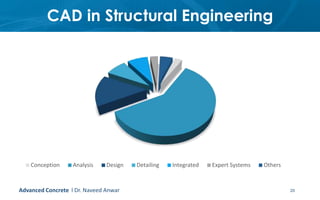
CAD in Structural Engineering
20
Conception Analysis Design Detailing Integrated Expert Systems Others
Advanced Concrete l Dr. Naveed Anwar
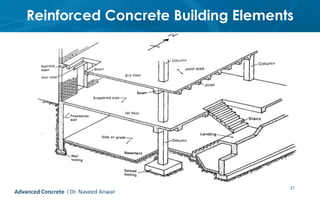
Reinforced Concrete Building Elements
21
Advanced Concrete l Dr. Naveed Anwar
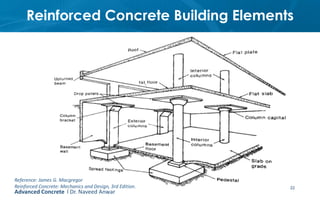
Reinforced Concrete Building Elements
22
Advanced Concrete l Dr. Naveed Anwar
Reference: James G. Macgregor
Reinforced Concrete: Mechanics and Design, 3rd Edition.
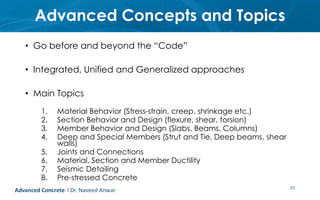
Advanced Concepts and Topics
• Go before and beyond the “Code”
• Integrated, Unified and Generalized approaches
• Main Topics
1. Material Behavior (Stress-strain, creep, shrinkage etc.)
2. Section Behavior and Design (flexure, shear, torsion)
3. Member Behavior and Design (Slabs, Beams, Columns)
4. Deep and Special Members (Strut and Tie, Deep beams, shear
walls)
5. Joints and Connections
6. Material, Section and Member Ductility
7. Seismic Detailing
8. Pre-stressed Concrete
23Advanced Concrete l Dr. Naveed Anwar
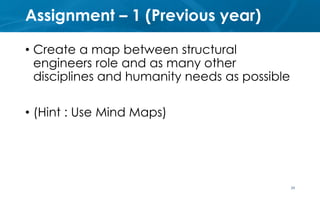
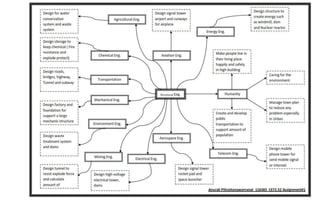
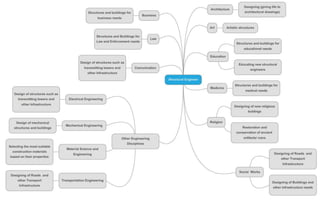
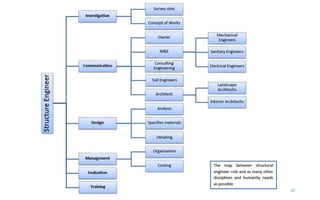
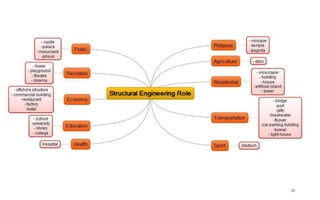
Assignment – 1 (Previous year)
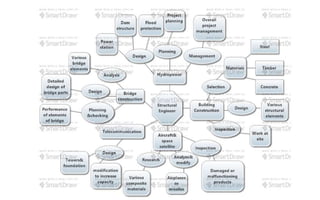
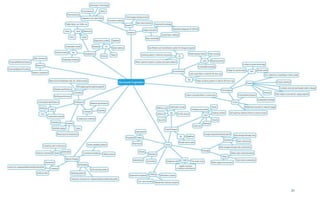
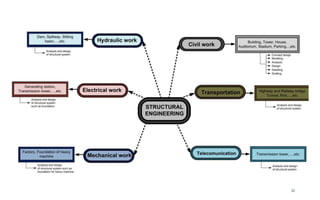
• Create a map between structural
engineers role and as many other
disciplines and humanity needs as possible
• (Hint : Use Mind Maps)
24
25
26
27
28
29
30
31
32
Assignment – 1 (This year)
• List Top Ten Structural Engineers of All times
• Picture, name, year, country
• Main projects, achievements
33
The Hierarchy of Structures and its Components
• Physical Structures
• When applied to the physical and the built
environment, the term Structure means an
assemblage of physical components and
elements, each of which could further be a
structure itself, signifying the complexity of the
system
34
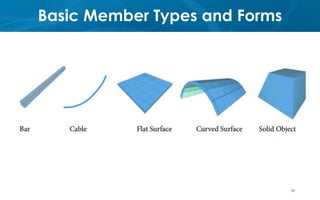
Basic Member Types and Forms
35
Characterization of Structures
• Based on the member types, the structures
can be broadly categorized as
• Cable structures
• Skeletal structural
• Spatial structures
• Solid structures and
• A combination of these
36
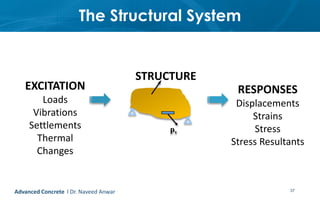
The Structural System
37
pv
Advanced Concrete l Dr. Naveed Anwar
EXCITATION
Loads
Vibrations
Settlements
Thermal
Changes
RESPONSES
Displacements
Strains
Stress
Stress Resultants
STRUCTURE
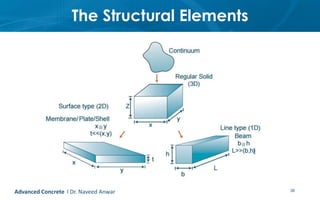
The Structural Elements
38Advanced Concrete l Dr. Naveed Anwar
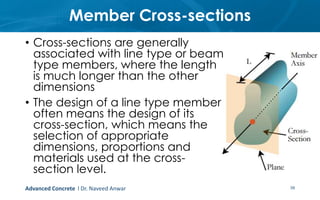
Member Cross-sections
Advanced Concrete l Dr. Naveed Anwar 39
• Cross-sections are generally
associated with line type or beam
type members, where the length
is much longer than the other
dimensions
• The design of a line type member
often means the design of its
cross-section, which means the
selection of appropriate
dimensions, proportions and
materials used at the cross-
section level.
The Structural Materials
• Concrete
• Reinforcing Steel
• Pre-stressing Steel
• Hot Rolled Structural Steel
• Cold Formed Structural Steel
• Aluminum other metals
• Structural Timber
Advanced Concrete l Dr. Naveed Anwar 40
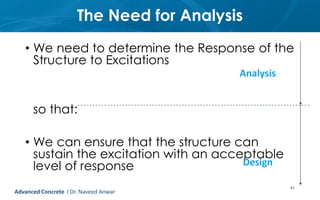
The Need for Analysis
• We need to determine the Response of the
Structure to Excitations
so that:
• We can ensure that the structure can
sustain the excitation with an acceptable
level of response
41
Advanced Concrete l Dr. Naveed Anwar
Analysis
Design
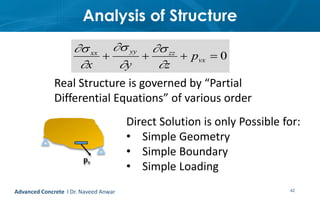
Analysis of Structure
42
0 vx
zzyyxx
p
zyx 





pv
Real Structure is governed by “Partial
Differential Equations” of various order
Advanced Concrete l Dr. Naveed Anwar
Direct Solution is only Possible for:
• Simple Geometry
• Simple Boundary
• Simple Loading
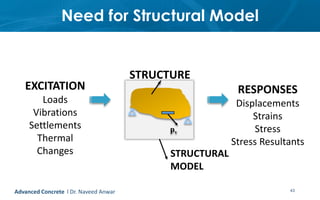
Need for Structural Model
43
pv
EXCITATION
Loads
Vibrations
Settlements
Thermal
Changes
RESPONSES
Displacements
Strains
Stress
Stress Resultants
STRUCTURE
STRUCTURAL
MODEL
Advanced Concrete l Dr. Naveed Anwar
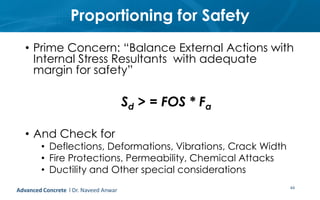
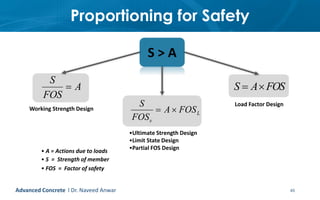
Proportioning for Safety
• Prime Concern: “Balance External Actions with
Internal Stress Resultants with adequate
margin for safety”
Sd > = FOS * Fa
• And Check for
• Deflections, Deformations, Vibrations, Crack Width
• Fire Protections, Permeability, Chemical Attacks
• Ductility and Other special considerations
44Advanced Concrete l Dr. Naveed Anwar
Proportioning for Safety
45
S > A
S
FOS
A
Working Strength Design
S
FOS
A FOS
s
L 
•Ultimate Strength Design
•Limit State Design
•Partial FOS Design
S A FOS 
Load Factor Design
• A = Actions due to loads
• S = Strength of member
• FOS = Factor of safety
Advanced Concrete l Dr. Naveed Anwar
46
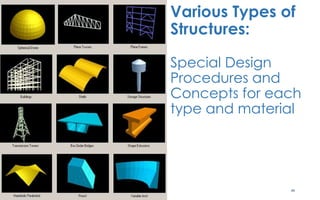
Various Types of
Structures:
Special Design
Procedures and
Concepts for each
type and material
Structural Design
Process and Concept
47
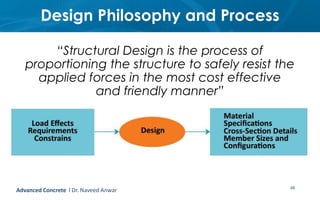
Design Philosophy and Process
“Structural Design is the process of
proportioning the structure to safely resist the
applied forces in the most cost effective
and friendly manner”
48Advanced Concrete l Dr. Naveed Anwar
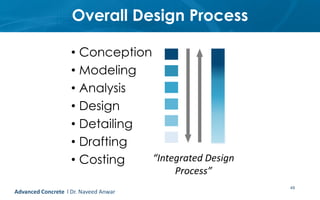
Overall Design Process
• Conception
• Modeling
• Analysis
• Design
• Detailing
• Drafting
• Costing
49
“Integrated Design
Process”
Advanced Concrete l Dr. Naveed Anwar
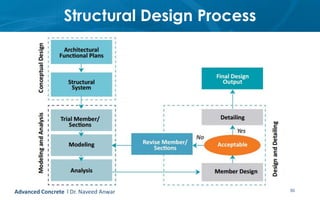
Structural Design Process
50Advanced Concrete l Dr. Naveed Anwar
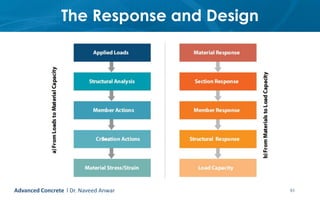
The Response and Design
51Advanced Concrete l Dr. Naveed Anwar
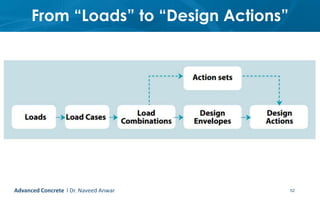
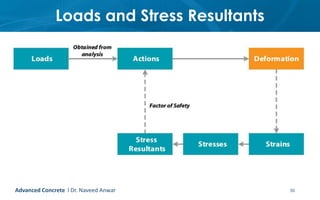
From “Loads” to “Design Actions”
52Advanced Concrete l Dr. Naveed Anwar
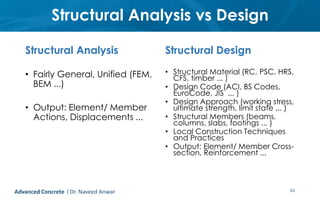
Structural Analysis vs Design
Structural Analysis
• Fairly General, Unified (FEM,
BEM ...)
• Output: Element/ Member
Actions, Displacements ...
Structural Design
• Structural Material (RC, PSC, HRS,
CFS, timber ... )
• Design Code (ACI, BS Codes,
EuroCode, JIS ... )
• Design Approach (working stress,
ultimate strength, limit state ... )
• Structural Members (beams,
columns, slabs, footings ... )
• Local Construction Techniques
and Practices
• Output: Element/ Member Cross-
section, Reinforcement ...
53Advanced Concrete l Dr. Naveed Anwar
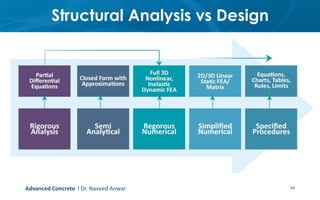
Structural Analysis vs Design
Advanced Concrete l Dr. Naveed Anwar 54
Loads and Stress Resultants
55Advanced Concrete l Dr. Naveed Anwar
Various Methods of
Structural Designs
56Advanced Concrete l Dr. Naveed Anwar
Various Methods of Structural Design
• Working Stress Design
• Allowable Stress Design (ASD)
• Working Stress Design (WSD)
• Load Factor Design
• Ultimate Strength Design
• Ultimate Strength Design (USD)
• Strength Design (SD)
• Load and Resistance Factor Design (LRFD)
• Performance Based Design
• Pushover Analysis
• Capacity Based Design
57Advanced Concrete l Dr. Naveed Anwar
From Serviceability to Performance
58
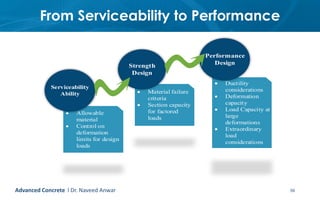
 Allowable
material
 Control on
deformation
limits for design
loads
 Material failure
criteria
 Section capacity
for factored
loads
 Ductility
considerations
 Deformation
capacity
 Load Capacity at
large
deformations
 Extraordinary
load
considerations
Serviceability
Ability
Strength
Design
Performance
Design
Advanced Concrete l Dr. Naveed Anwar
From Serviceability to Performance
• Satisfying one design level does not ensure that
other design levels will be satisfied
• Serviceability design only ensures that deflections and
vibrations etc. for service loads are within limits but says
nothing about strength
• Strength design ensures that a certain factor of safety
against overload is available within a member or a cross-
section but says nothing about what happens if load
exceeds design level
• Performance design ensures that structure as a whole
reaches a specified demand level. Performance design
can include, both service and strength design levels
59Advanced Concrete l Dr. Naveed Anwar
Design Philosophies
and Methods
60Advanced Concrete l Dr. Naveed Anwar
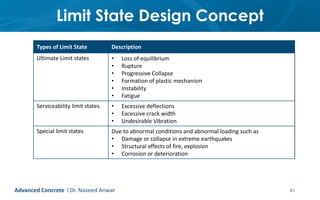
Limit State Design Concept
61
Types of Limit State Description
Ultimate Limit states • Loss of equilibrium
• Rupture
• Progressive Collapse
• Formation of plastic mechanism
• Instability
• Fatigue
Serviceability limit states • Excessive deflections
• Excessive crack width
• Undesirable Vibration
Special limit states Due to abnormal conditions and abnormal loading such as
• Damage or collapse in extreme earthquakes
• Structural effects of fire, explosion
• Corrosion or deterioration
Advanced Concrete l Dr. Naveed Anwar
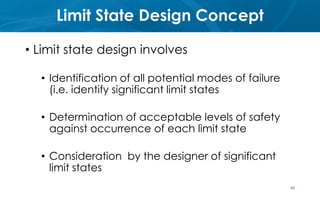
Limit State Design Concept
• Limit state design involves
• Identification of all potential modes of failure
(i.e. identify significant limit states
• Determination of acceptable levels of safety
against occurrence of each limit state
• Consideration by the designer of significant
limit states
62
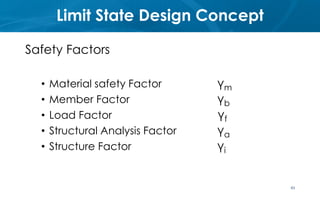
Limit State Design Concept
Safety Factors
• Material safety Factor γm
• Member Factor γb
• Load Factor γf
• Structural Analysis Factor γa
• Structure Factor γi
63
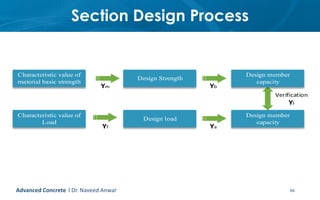
Section Design Process
64
Characteristic value of
material basic strength
Design Strength
Design member
capacity
Characteristic value of
Load
Design load
Design member
capacity
Ym Yb
Yf Ya
Verification
Yi
Advanced Concrete l Dr. Naveed Anwar
Limit State Design Concept
65
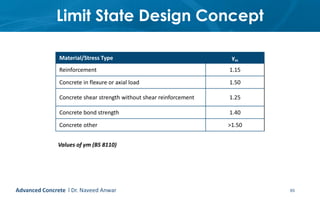
Material/Stress Type γm
Reinforcement 1.15
Concrete in flexure or axial load 1.50
Concrete shear strength without shear reinforcement 1.25
Concrete bond strength 1.40
Concrete other >1.50
Values of γm (BS 8110)
Advanced Concrete l Dr. Naveed Anwar
Limit State Design Concept
66
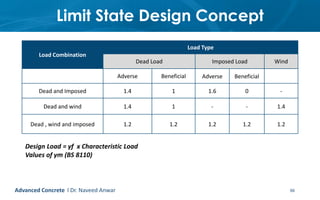
Load Combination
Load Type
Dead Load Imposed Load Wind
Adverse Beneficial Adverse Beneficial
Dead and Imposed 1.4 1 1.6 0 -
Dead and wind 1.4 1 - - 1.4
Dead , wind and imposed 1.2 1.2 1.2 1.2 1.2
Design Load = γf x Characteristic Load
Values of γm (BS 8110)
Advanced Concrete l Dr. Naveed Anwar
What is Advanced
in this course?
67Advanced Concrete l Dr. Naveed Anwar
68

CE72.52 - Lecture1 - Introduction

  • 1.
    1 CE 72.52 AdvancedConcrete Lecture 1: Introduction Naveed Anwar Executive Director, AIT Consulting Director, ACECOMS Affiliate Faculty, Structural Engineering, AIT August - 2015
  • 2.
    The Role ofStructural Engineers • To help in the creation of the safe built environment • Nothing can function, if structural engineers do not do their job well • Every other professional “Depends” on the role of structural engineers 2
  • 3.
    All systems absolutelyneed Structures • Transportation systems • Telecommunication systems • Electricity and power systems • Water supply, waste water systems • Irrigation and agricultural systems • Mining, oil, gas, offshore platforms • Industrial plants, piping and process • Housing, commercial Businesses • Public Buildings 3
  • 4.
  • 5.
  • 6.
  • 7.
  • 8.
  • 9.
  • 10.
  • 11.
  • 12.
  • 13.
  • 14.
  • 15.
  • 16.
  • 17.
    17 A MUST readfor structural Engineers
  • 18.
    Structural Engineering Spectrum 18 ActivityConception – Analysis – Design – Detailing ... Structure Buildings – Bridges – Trusses – Shells – Towers ... Code American – British – European – Japanese ... Material Concrete – PSC – Steel – Timber ... Model 2D Frame/Truss – 3D Frame/Truss – Full 3D FEM .... Analysis Linear Static – NL Static – Linear Dynamic – Large Disp. .... Solution Equation Solution – Finite Elements – Programming ... Advanced Concrete l Dr. Naveed Anwar
  • 19.
    Structural Design Office:Activities 19 Design Management Structural Designer Office Management Coordination Client Dealing Principle Conception Detailing Design Analysis Costing Advanced Concrete l Dr. Naveed Anwar
  • 20.
    CAD in StructuralEngineering 20 Conception Analysis Design Detailing Integrated Expert Systems Others Advanced Concrete l Dr. Naveed Anwar
  • 21.
    Reinforced Concrete BuildingElements 21 Advanced Concrete l Dr. Naveed Anwar
  • 22.
    Reinforced Concrete BuildingElements 22 Advanced Concrete l Dr. Naveed Anwar Reference: James G. Macgregor Reinforced Concrete: Mechanics and Design, 3rd Edition.
  • 23.
    Advanced Concepts andTopics • Go before and beyond the “Code” • Integrated, Unified and Generalized approaches • Main Topics 1. Material Behavior (Stress-strain, creep, shrinkage etc.) 2. Section Behavior and Design (flexure, shear, torsion) 3. Member Behavior and Design (Slabs, Beams, Columns) 4. Deep and Special Members (Strut and Tie, Deep beams, shear walls) 5. Joints and Connections 6. Material, Section and Member Ductility 7. Seismic Detailing 8. Pre-stressed Concrete 23Advanced Concrete l Dr. Naveed Anwar
  • 24.
    Assignment – 1(Previous year) • Create a map between structural engineers role and as many other disciplines and humanity needs as possible • (Hint : Use Mind Maps) 24
  • 25.
  • 26.
  • 27.
  • 28.
  • 29.
  • 30.
  • 31.
  • 32.
  • 33.
    Assignment – 1(This year) • List Top Ten Structural Engineers of All times • Picture, name, year, country • Main projects, achievements 33
  • 34.
    The Hierarchy ofStructures and its Components • Physical Structures • When applied to the physical and the built environment, the term Structure means an assemblage of physical components and elements, each of which could further be a structure itself, signifying the complexity of the system 34
  • 35.
    Basic Member Typesand Forms 35
  • 36.
    Characterization of Structures •Based on the member types, the structures can be broadly categorized as • Cable structures • Skeletal structural • Spatial structures • Solid structures and • A combination of these 36
  • 37.
    The Structural System 37 pv AdvancedConcrete l Dr. Naveed Anwar EXCITATION Loads Vibrations Settlements Thermal Changes RESPONSES Displacements Strains Stress Stress Resultants STRUCTURE
  • 38.
    The Structural Elements 38AdvancedConcrete l Dr. Naveed Anwar
  • 39.
    Member Cross-sections Advanced Concretel Dr. Naveed Anwar 39 • Cross-sections are generally associated with line type or beam type members, where the length is much longer than the other dimensions • The design of a line type member often means the design of its cross-section, which means the selection of appropriate dimensions, proportions and materials used at the cross- section level.
  • 40.
    The Structural Materials •Concrete • Reinforcing Steel • Pre-stressing Steel • Hot Rolled Structural Steel • Cold Formed Structural Steel • Aluminum other metals • Structural Timber Advanced Concrete l Dr. Naveed Anwar 40
  • 41.
    The Need forAnalysis • We need to determine the Response of the Structure to Excitations so that: • We can ensure that the structure can sustain the excitation with an acceptable level of response 41 Advanced Concrete l Dr. Naveed Anwar Analysis Design
  • 42.
    Analysis of Structure 42 0vx zzyyxx p zyx       pv Real Structure is governed by “Partial Differential Equations” of various order Advanced Concrete l Dr. Naveed Anwar Direct Solution is only Possible for: • Simple Geometry • Simple Boundary • Simple Loading
  • 43.
    Need for StructuralModel 43 pv EXCITATION Loads Vibrations Settlements Thermal Changes RESPONSES Displacements Strains Stress Stress Resultants STRUCTURE STRUCTURAL MODEL Advanced Concrete l Dr. Naveed Anwar
  • 44.
    Proportioning for Safety •Prime Concern: “Balance External Actions with Internal Stress Resultants with adequate margin for safety” Sd > = FOS * Fa • And Check for • Deflections, Deformations, Vibrations, Crack Width • Fire Protections, Permeability, Chemical Attacks • Ductility and Other special considerations 44Advanced Concrete l Dr. Naveed Anwar
  • 45.
    Proportioning for Safety 45 S> A S FOS A Working Strength Design S FOS A FOS s L  •Ultimate Strength Design •Limit State Design •Partial FOS Design S A FOS  Load Factor Design • A = Actions due to loads • S = Strength of member • FOS = Factor of safety Advanced Concrete l Dr. Naveed Anwar
  • 46.
    46 Various Types of Structures: SpecialDesign Procedures and Concepts for each type and material
  • 47.
  • 48.
    Design Philosophy andProcess “Structural Design is the process of proportioning the structure to safely resist the applied forces in the most cost effective and friendly manner” 48Advanced Concrete l Dr. Naveed Anwar
  • 49.
    Overall Design Process •Conception • Modeling • Analysis • Design • Detailing • Drafting • Costing 49 “Integrated Design Process” Advanced Concrete l Dr. Naveed Anwar
  • 50.
    Structural Design Process 50AdvancedConcrete l Dr. Naveed Anwar
  • 51.
    The Response andDesign 51Advanced Concrete l Dr. Naveed Anwar
  • 52.
    From “Loads” to“Design Actions” 52Advanced Concrete l Dr. Naveed Anwar
  • 53.
    Structural Analysis vsDesign Structural Analysis • Fairly General, Unified (FEM, BEM ...) • Output: Element/ Member Actions, Displacements ... Structural Design • Structural Material (RC, PSC, HRS, CFS, timber ... ) • Design Code (ACI, BS Codes, EuroCode, JIS ... ) • Design Approach (working stress, ultimate strength, limit state ... ) • Structural Members (beams, columns, slabs, footings ... ) • Local Construction Techniques and Practices • Output: Element/ Member Cross- section, Reinforcement ... 53Advanced Concrete l Dr. Naveed Anwar
  • 54.
    Structural Analysis vsDesign Advanced Concrete l Dr. Naveed Anwar 54
  • 55.
    Loads and StressResultants 55Advanced Concrete l Dr. Naveed Anwar
  • 56.
    Various Methods of StructuralDesigns 56Advanced Concrete l Dr. Naveed Anwar
  • 57.
    Various Methods ofStructural Design • Working Stress Design • Allowable Stress Design (ASD) • Working Stress Design (WSD) • Load Factor Design • Ultimate Strength Design • Ultimate Strength Design (USD) • Strength Design (SD) • Load and Resistance Factor Design (LRFD) • Performance Based Design • Pushover Analysis • Capacity Based Design 57Advanced Concrete l Dr. Naveed Anwar
  • 58.
    From Serviceability toPerformance 58  Allowable material  Control on deformation limits for design loads  Material failure criteria  Section capacity for factored loads  Ductility considerations  Deformation capacity  Load Capacity at large deformations  Extraordinary load considerations Serviceability Ability Strength Design Performance Design Advanced Concrete l Dr. Naveed Anwar
  • 59.
    From Serviceability toPerformance • Satisfying one design level does not ensure that other design levels will be satisfied • Serviceability design only ensures that deflections and vibrations etc. for service loads are within limits but says nothing about strength • Strength design ensures that a certain factor of safety against overload is available within a member or a cross- section but says nothing about what happens if load exceeds design level • Performance design ensures that structure as a whole reaches a specified demand level. Performance design can include, both service and strength design levels 59Advanced Concrete l Dr. Naveed Anwar
  • 60.
    Design Philosophies and Methods 60AdvancedConcrete l Dr. Naveed Anwar
  • 61.
    Limit State DesignConcept 61 Types of Limit State Description Ultimate Limit states • Loss of equilibrium • Rupture • Progressive Collapse • Formation of plastic mechanism • Instability • Fatigue Serviceability limit states • Excessive deflections • Excessive crack width • Undesirable Vibration Special limit states Due to abnormal conditions and abnormal loading such as • Damage or collapse in extreme earthquakes • Structural effects of fire, explosion • Corrosion or deterioration Advanced Concrete l Dr. Naveed Anwar
  • 62.
    Limit State DesignConcept • Limit state design involves • Identification of all potential modes of failure (i.e. identify significant limit states • Determination of acceptable levels of safety against occurrence of each limit state • Consideration by the designer of significant limit states 62
  • 63.
    Limit State DesignConcept Safety Factors • Material safety Factor γm • Member Factor γb • Load Factor γf • Structural Analysis Factor γa • Structure Factor γi 63
  • 64.
    Section Design Process 64 Characteristicvalue of material basic strength Design Strength Design member capacity Characteristic value of Load Design load Design member capacity Ym Yb Yf Ya Verification Yi Advanced Concrete l Dr. Naveed Anwar
  • 65.
    Limit State DesignConcept 65 Material/Stress Type γm Reinforcement 1.15 Concrete in flexure or axial load 1.50 Concrete shear strength without shear reinforcement 1.25 Concrete bond strength 1.40 Concrete other >1.50 Values of γm (BS 8110) Advanced Concrete l Dr. Naveed Anwar
  • 66.
    Limit State DesignConcept 66 Load Combination Load Type Dead Load Imposed Load Wind Adverse Beneficial Adverse Beneficial Dead and Imposed 1.4 1 1.6 0 - Dead and wind 1.4 1 - - 1.4 Dead , wind and imposed 1.2 1.2 1.2 1.2 1.2 Design Load = γf x Characteristic Load Values of γm (BS 8110) Advanced Concrete l Dr. Naveed Anwar
  • 67.
    What is Advanced inthis course? 67Advanced Concrete l Dr. Naveed Anwar
  • 68.