The Doppler Effect
Explained
What is the
Dopler Effect?
Concept
• Donde lo explica
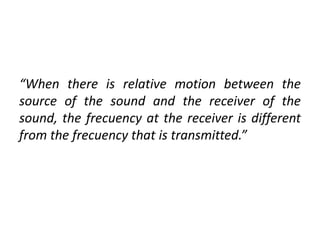
“When there is relative motion between the
source of the sound and the receiver of the
sound, the frecuency at the receiver is different
from the frecuency that is transmitted.”
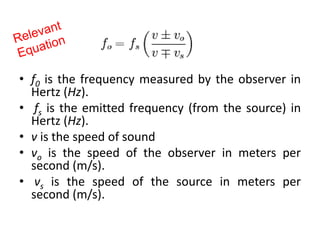
• f0 is the frequency measured by the observer in
Hertz (Hz).
• fs is the emitted frequency (from the source) in
Hertz (Hz).
• v is the speed of sound
• vo is the speed of the observer in meters per
second (m/s).
• vs is the speed of the source in meters per
second (m/s).
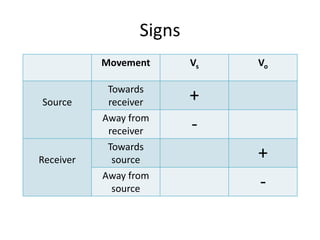
Signs
Movement Vs Vo
Source
Towards
receiver +
Away from
receiver -
Receiver
Towards
source +
Away from
source -
Sample Exam Question
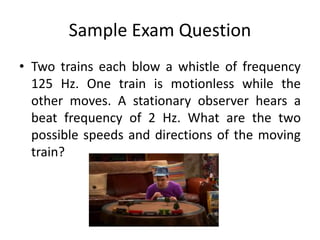
• Two trains each blow a whistle of frequency
125 Hz. One train is motionless while the
other moves. A stationary observer hears a
beat frequency of 2 Hz. What are the two
possible speeds and directions of the moving
train?
Points to Consider
• As we are given the beat frecuency we need
to calculate the actual frecuency from the
receiver for each train.
• Using the calculated frecuencies we can plug
in the Dopler Effect Equation and solve for
speed of the source.
• We use v=0 for the stationary train and for the
stationary observer.
• We know that speed of sound is v=343m/s
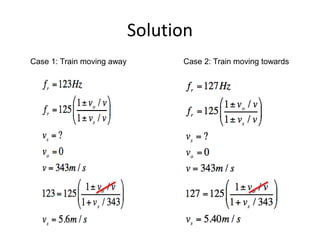
Solution
Case 1: Train moving away Case 2: Train moving towards

The Doppler Effect

  • 1.
  • 2.
  • 4.
  • 5.
    • Donde loexplica
  • 6.
    “When there isrelative motion between the source of the sound and the receiver of the sound, the frecuency at the receiver is different from the frecuency that is transmitted.”
  • 7.
    • f0 isthe frequency measured by the observer in Hertz (Hz). • fs is the emitted frequency (from the source) in Hertz (Hz). • v is the speed of sound • vo is the speed of the observer in meters per second (m/s). • vs is the speed of the source in meters per second (m/s).
  • 8.
    Signs Movement Vs Vo Source Towards receiver+ Away from receiver - Receiver Towards source + Away from source -
  • 9.
    Sample Exam Question •Two trains each blow a whistle of frequency 125 Hz. One train is motionless while the other moves. A stationary observer hears a beat frequency of 2 Hz. What are the two possible speeds and directions of the moving train?
  • 10.
    Points to Consider •As we are given the beat frecuency we need to calculate the actual frecuency from the receiver for each train. • Using the calculated frecuencies we can plug in the Dopler Effect Equation and solve for speed of the source. • We use v=0 for the stationary train and for the stationary observer. • We know that speed of sound is v=343m/s
  • 11.
    Solution Case 1: Trainmoving away Case 2: Train moving towards