Computer Assisted Art
Lesson 2
Mrs. Hurd
Lesson 2 Vocabulary
1. Perspective
2. Foreshorten
3. Vanishing Point
4. Horizon Line
5. One Point Perspective
6. Vincent Van Gogh
7. Post Impressionism
Linear Perspective
• Perspective in the graphic arts, such as
drawing, is an approximate
representation, on a flat surface (such
as paper), of an image as it is seen by
the eye. The two most characteristic
features of perspective are that
objects are drawn:
• Smaller as their distance from the
observer increases
• Foreshortened: to reduce or distort in
order to convey the illusion of three-
dimensional space as perceived by the
human eye: often done according to
the rules of perspective.
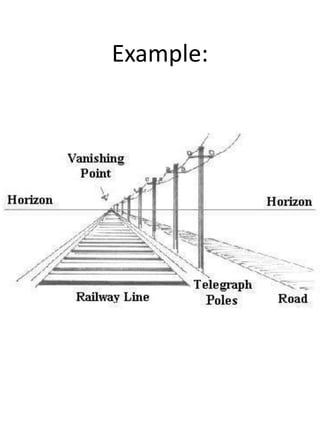
Any perspective representation of a
scene that includes parallel lines, has
one or more vanishing points (The
point in linear perspective at which all
imaginary lines of perspective
converge) is a perspective drawing. A
one-point perspective drawing means
that the drawing has a single vanishing
point, usually (though not necessarily)
directly opposite the viewer's eye and
usually (though not necessarily) on the
horizon line (the level your eyes are at,
an imaginary line to which things
recede). All lines parallel with the
viewer's line of sight recede to the
horizon towards this vanishing point.
This is the standard "receding railroad
tracks" phenomenon.
Example:
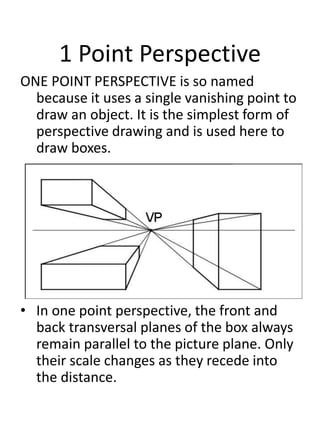
1 Point Perspective
ONE POINT PERSPECTIVE is so named
because it uses a single vanishing point to
draw an object. It is the simplest form of
perspective drawing and is used here to
draw boxes.
• In one point perspective, the front and
back transversal planes of the box always
remain parallel to the picture plane. Only
their scale changes as they recede into
the distance.
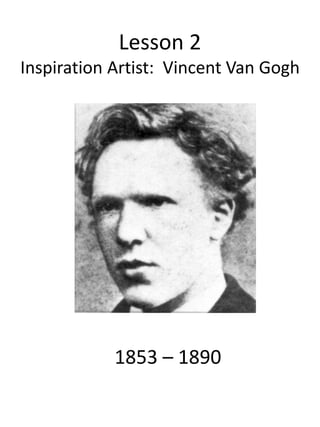
Lesson 2
Inspiration Artist: Vincent Van Gogh
1853 – 1890
Biography
Born March 30, 1853 in Zundert,
Netherlands, Vincent had two
brothers and three sisters. He was
closest to his younger brother
Theo. Although he enjoyed
drawing from the time he was a
young boy, Vincent had a number
of other jobs before he decided to
work as an artist full time. He
worked as a teacher in London
and then as a minister. He also
worked in a book store, an art
gallery, and as a missionary. At
around the age of 27, Van Gogh
decided to devote himself
completely to art.
He is most known as a Dutch post-
Impressionist painter whose work is
notable for its rough beauty,
emotional honesty and bold color.
It had a far-reaching influence on
20th-century art.
The Post Impressionists were a group
of young painters who sought
independent artistic styles for
expressing emotions rather than
simply optical impressions;
concentrating on themes of deeper
symbolism. Through the use of
simplified colors and definitive
forms, their art was characterized
by a renewed aesthetic sense as
well as abstract tendencies.
In 1888 van Gogh moved south to Arles,
France to start up an artist's commune.
He rented out a yellow house to live in
and invited artist Paul Gauguin to join
him. He loved the vibrant colors and the
bright sun of Arles.
Van Gogh began painting with intensity
and emotion. The colors in his paintings
became more vibrant and bright. He
would sometimes apply the paint
directly onto the canvas from the tubes
leaving the paint thick with rough brush
strokes. Sometimes it would take weeks
for his paintings to dry because the
paint was so thick.
Vincent painted hundreds of pictures
during this time, sometimes painting
masterpieces in a single day. He became
fully obsessed with art.
In 1989 Van Gogh committed himself
to a mental hospital. He could
barely take care of himself. He still
continued to paint and painted one
of his most famous paintings Starry
Night during this time. Van Gogh's
mental state continued to
deteriorate. On July 29, 1890 he
died from a self-inflicted bullet
wound to the chest.
Although he wasn't famous during his
lifetime, today he is considered one
of the greatest and most influential
artists of his time. Many of his
paintings sell for millions of dollars
today. There are over 800 surviving
oil paintings as well as over a
thousand water colors and sketches
of his work.
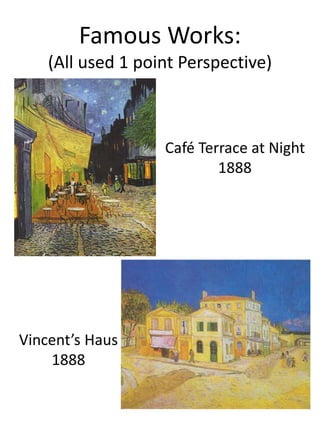
Famous Works:
(All used 1 point Perspective)
Café Terrace at Night
1888
Vincent’s Haus
1888
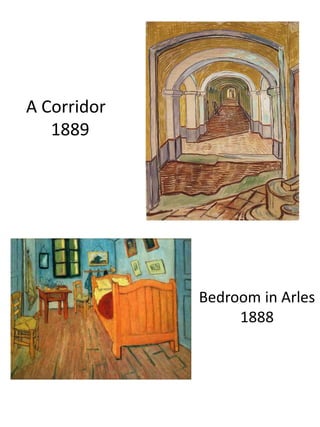
A Corridor
1889
Bedroom in Arles
1888
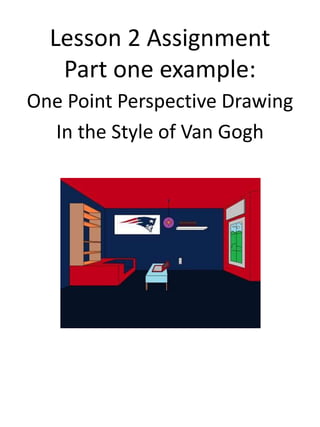
Lesson 2 Assignment
Part one example:
One Point Perspective Drawing
In the Style of Van Gogh
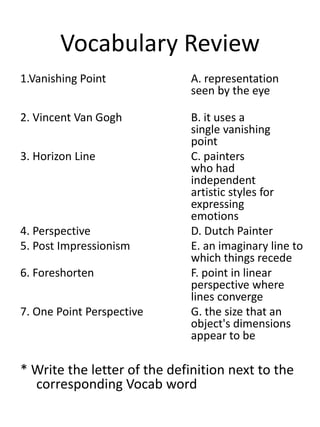
Vocabulary Review
1.Vanishing Point A. representation
seen by the eye
2. Vincent Van Gogh B. it uses a
single vanishing
point
3. Horizon Line C. painters
who had
independent
artistic styles for
expressing
emotions
4. Perspective D. Dutch Painter
5. Post Impressionism E. an imaginary line to
which things recede
6. Foreshorten F. point in linear
perspective where
lines converge
7. One Point Perspective G. the size that an
object's dimensions
appear to be
* Write the letter of the definition next to the
corresponding Vocab word
Reflection
Answer these questions in your sketchbook using complete
sentences.
1. How do you think the Post-
Impressionists might have influenced 20th
century art?
2. What are some characteristics of
Vincent Van Gogh’s Artistic style?

Computer assisted art lesson-2

  • 1.
  • 2.
    Lesson 2 Vocabulary 1.Perspective 2. Foreshorten 3. Vanishing Point 4. Horizon Line 5. One Point Perspective 6. Vincent Van Gogh 7. Post Impressionism
  • 3.
    Linear Perspective • Perspectivein the graphic arts, such as drawing, is an approximate representation, on a flat surface (such as paper), of an image as it is seen by the eye. The two most characteristic features of perspective are that objects are drawn: • Smaller as their distance from the observer increases • Foreshortened: to reduce or distort in order to convey the illusion of three- dimensional space as perceived by the human eye: often done according to the rules of perspective.
  • 4.
    Any perspective representationof a scene that includes parallel lines, has one or more vanishing points (The point in linear perspective at which all imaginary lines of perspective converge) is a perspective drawing. A one-point perspective drawing means that the drawing has a single vanishing point, usually (though not necessarily) directly opposite the viewer's eye and usually (though not necessarily) on the horizon line (the level your eyes are at, an imaginary line to which things recede). All lines parallel with the viewer's line of sight recede to the horizon towards this vanishing point. This is the standard "receding railroad tracks" phenomenon.
  • 5.
  • 6.
    1 Point Perspective ONEPOINT PERSPECTIVE is so named because it uses a single vanishing point to draw an object. It is the simplest form of perspective drawing and is used here to draw boxes. • In one point perspective, the front and back transversal planes of the box always remain parallel to the picture plane. Only their scale changes as they recede into the distance.
  • 7.
    Lesson 2 Inspiration Artist:Vincent Van Gogh 1853 – 1890
  • 8.
    Biography Born March 30,1853 in Zundert, Netherlands, Vincent had two brothers and three sisters. He was closest to his younger brother Theo. Although he enjoyed drawing from the time he was a young boy, Vincent had a number of other jobs before he decided to work as an artist full time. He worked as a teacher in London and then as a minister. He also worked in a book store, an art gallery, and as a missionary. At around the age of 27, Van Gogh decided to devote himself completely to art.
  • 9.
    He is mostknown as a Dutch post- Impressionist painter whose work is notable for its rough beauty, emotional honesty and bold color. It had a far-reaching influence on 20th-century art. The Post Impressionists were a group of young painters who sought independent artistic styles for expressing emotions rather than simply optical impressions; concentrating on themes of deeper symbolism. Through the use of simplified colors and definitive forms, their art was characterized by a renewed aesthetic sense as well as abstract tendencies.
  • 10.
    In 1888 vanGogh moved south to Arles, France to start up an artist's commune. He rented out a yellow house to live in and invited artist Paul Gauguin to join him. He loved the vibrant colors and the bright sun of Arles. Van Gogh began painting with intensity and emotion. The colors in his paintings became more vibrant and bright. He would sometimes apply the paint directly onto the canvas from the tubes leaving the paint thick with rough brush strokes. Sometimes it would take weeks for his paintings to dry because the paint was so thick. Vincent painted hundreds of pictures during this time, sometimes painting masterpieces in a single day. He became fully obsessed with art.
  • 11.
    In 1989 VanGogh committed himself to a mental hospital. He could barely take care of himself. He still continued to paint and painted one of his most famous paintings Starry Night during this time. Van Gogh's mental state continued to deteriorate. On July 29, 1890 he died from a self-inflicted bullet wound to the chest. Although he wasn't famous during his lifetime, today he is considered one of the greatest and most influential artists of his time. Many of his paintings sell for millions of dollars today. There are over 800 surviving oil paintings as well as over a thousand water colors and sketches of his work.
  • 12.
    Famous Works: (All used1 point Perspective) Café Terrace at Night 1888 Vincent’s Haus 1888
  • 13.
  • 14.
    Lesson 2 Assignment Partone example: One Point Perspective Drawing In the Style of Van Gogh
  • 15.
    Vocabulary Review 1.Vanishing PointA. representation seen by the eye 2. Vincent Van Gogh B. it uses a single vanishing point 3. Horizon Line C. painters who had independent artistic styles for expressing emotions 4. Perspective D. Dutch Painter 5. Post Impressionism E. an imaginary line to which things recede 6. Foreshorten F. point in linear perspective where lines converge 7. One Point Perspective G. the size that an object's dimensions appear to be * Write the letter of the definition next to the corresponding Vocab word
  • 16.
    Reflection Answer these questionsin your sketchbook using complete sentences. 1. How do you think the Post- Impressionists might have influenced 20th century art? 2. What are some characteristics of Vincent Van Gogh’s Artistic style?