

Zaid Ali Alsagoff
zaid.alsagoff@gmail.com
Module 7:Module 7:
Problem SolvingProblem Solving
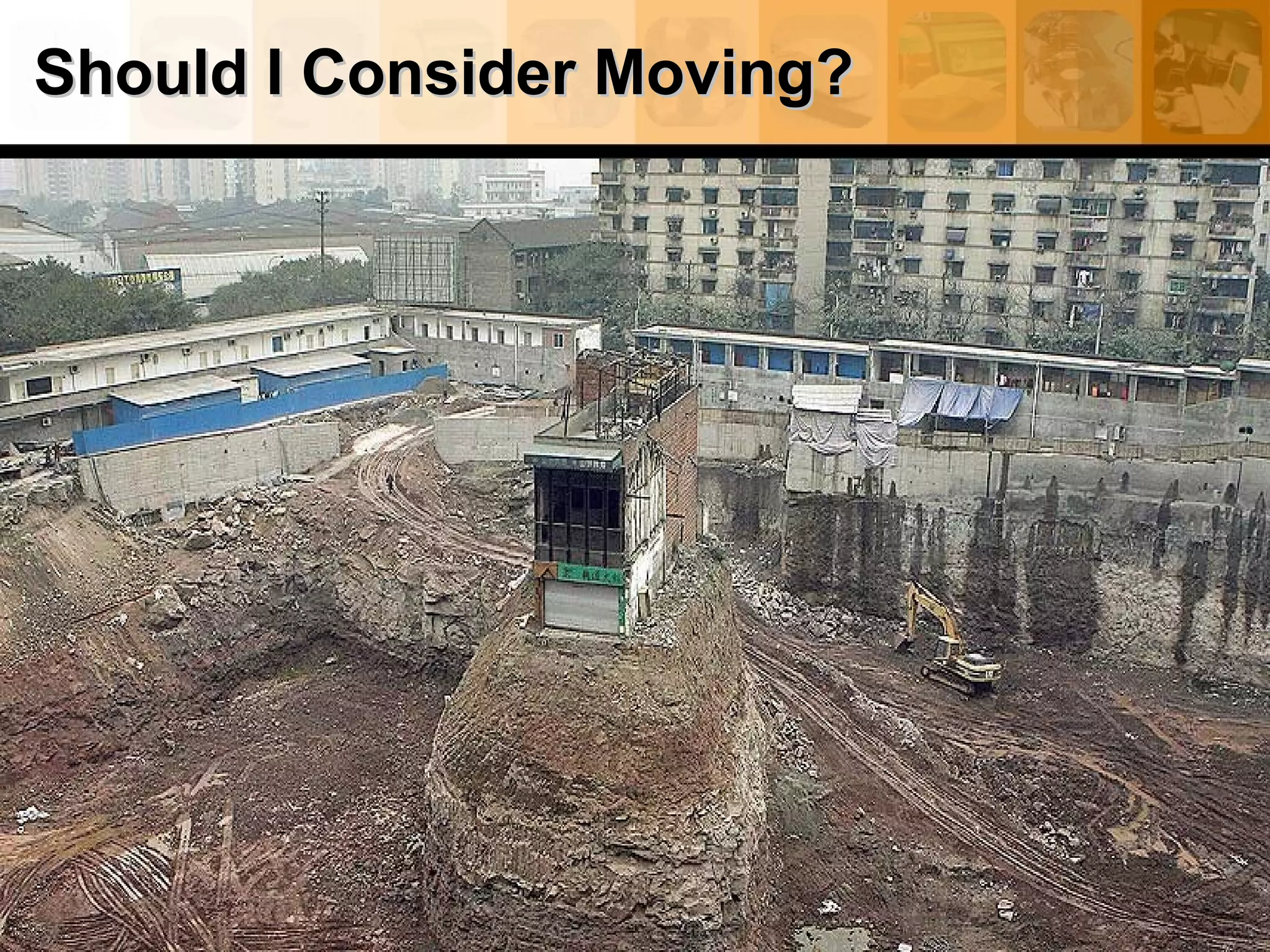
Should I Consider Moving?Should I Consider Moving?
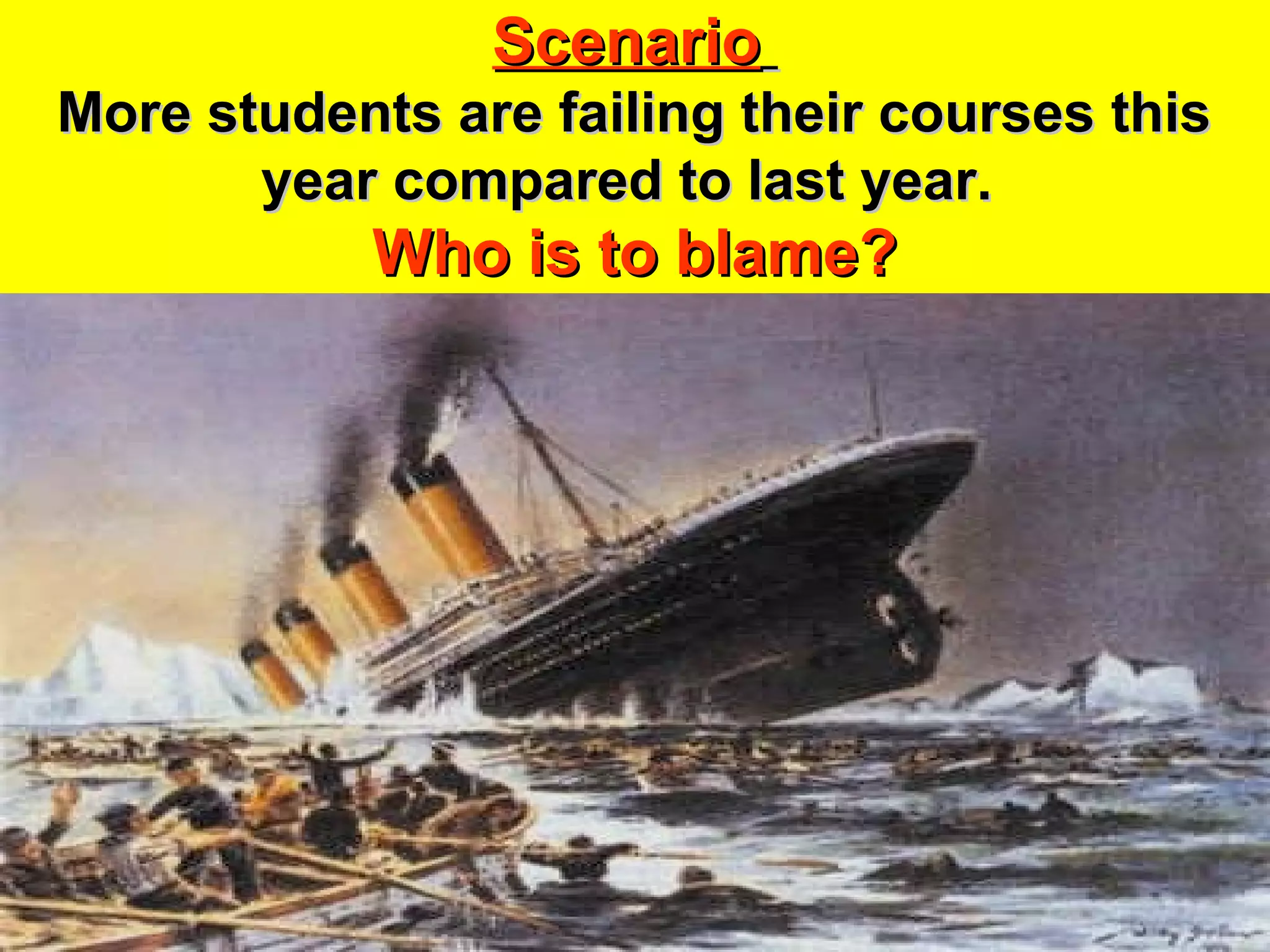
ScenarioScenario
More students are failing their courses thisMore students are failing their courses this
year compared to last year.year compared to last year.
Who is to blame?Who is to blame?
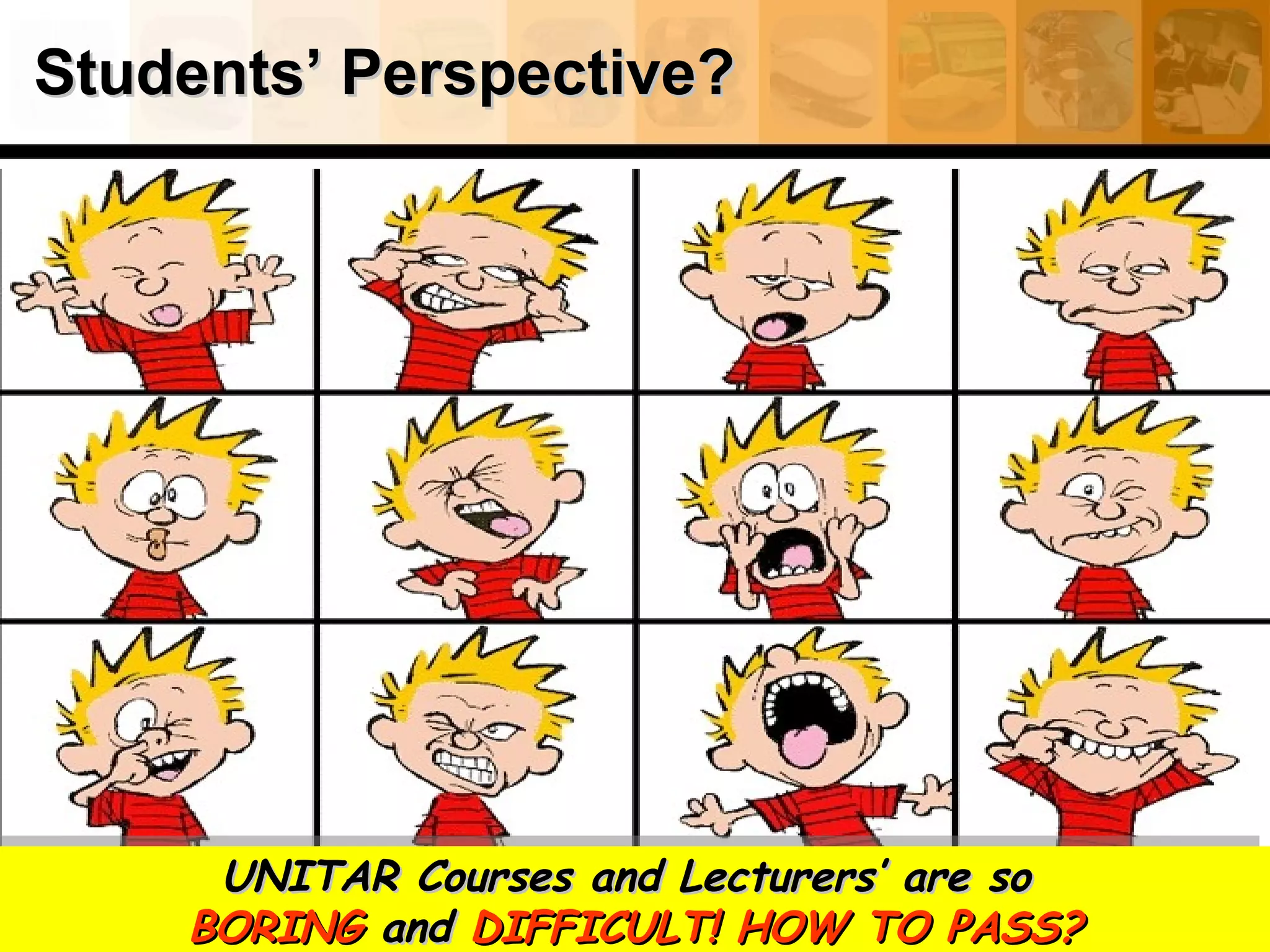
Students’ Perspective?Students’ Perspective?
UNITAR Courses and Lecturers’ are soUNITAR Courses and Lecturers’ are so
BORINGBORING andand DIFFICULT! HOW TO PASS?DIFFICULT! HOW TO PASS?
UNITAR Courses and Lecturers’ are soUNITAR Courses and Lecturers’ are so
BORINGBORING andand DIFFICULT! HOW TO PASS?DIFFICULT! HOW TO PASS?
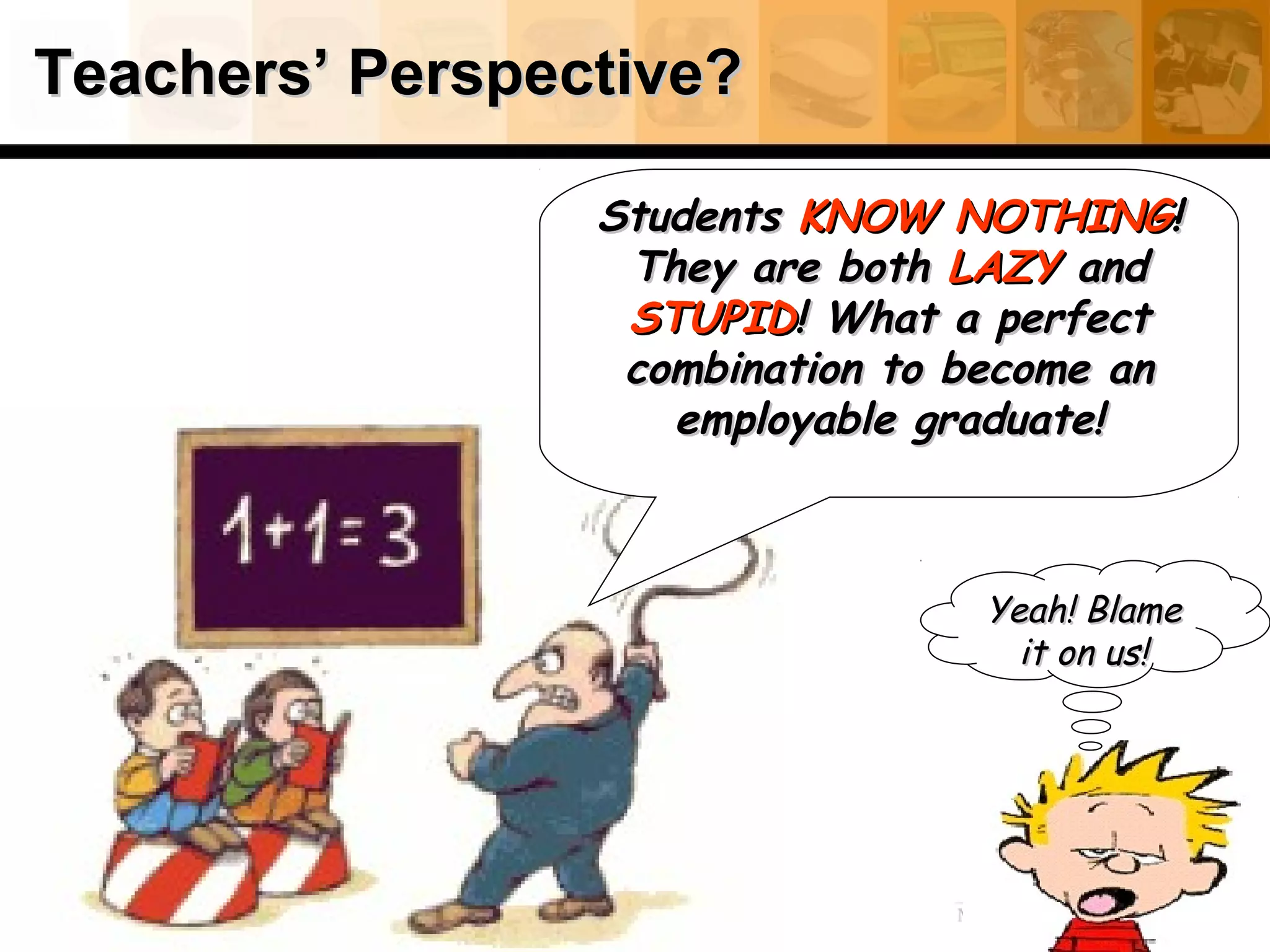
Teachers’ Perspective?Teachers’ Perspective?
StudentsStudents KNOW NOTHINGKNOW NOTHING!!
They are bothThey are both LAZYLAZY andand
STUPIDSTUPID! What a perfect! What a perfect
combination to become ancombination to become an
employable graduate!employable graduate!
Yeah! BlameYeah! Blame
it on us!it on us!
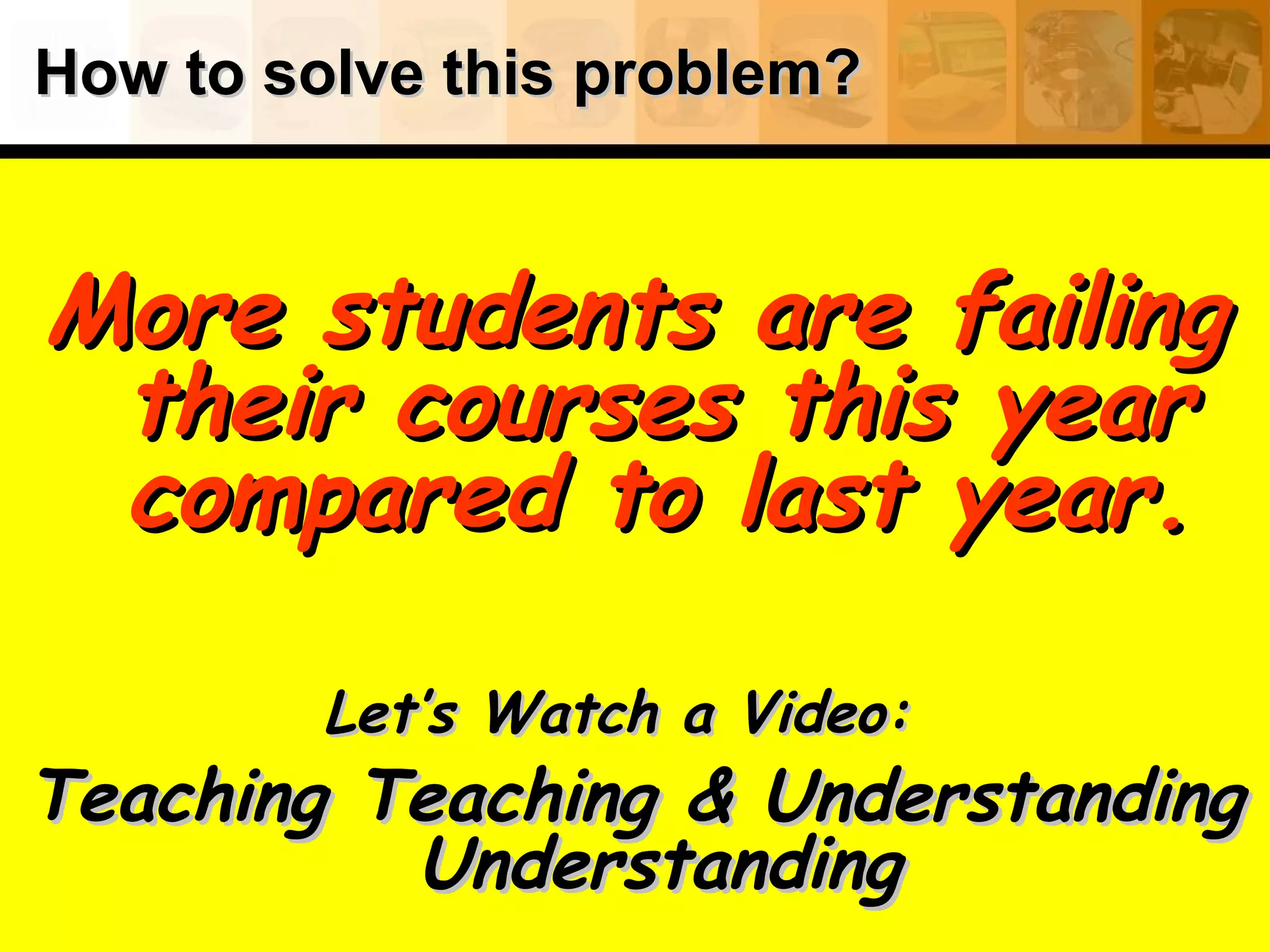
How to solve this problem?How to solve this problem?
More students are failingMore students are failing
their courses this yeartheir courses this year
compared to last year.compared to last year.
Let’s Watch a Video:Let’s Watch a Video:
Teaching Teaching & UnderstandingTeaching Teaching & Understanding
UnderstandingUnderstanding
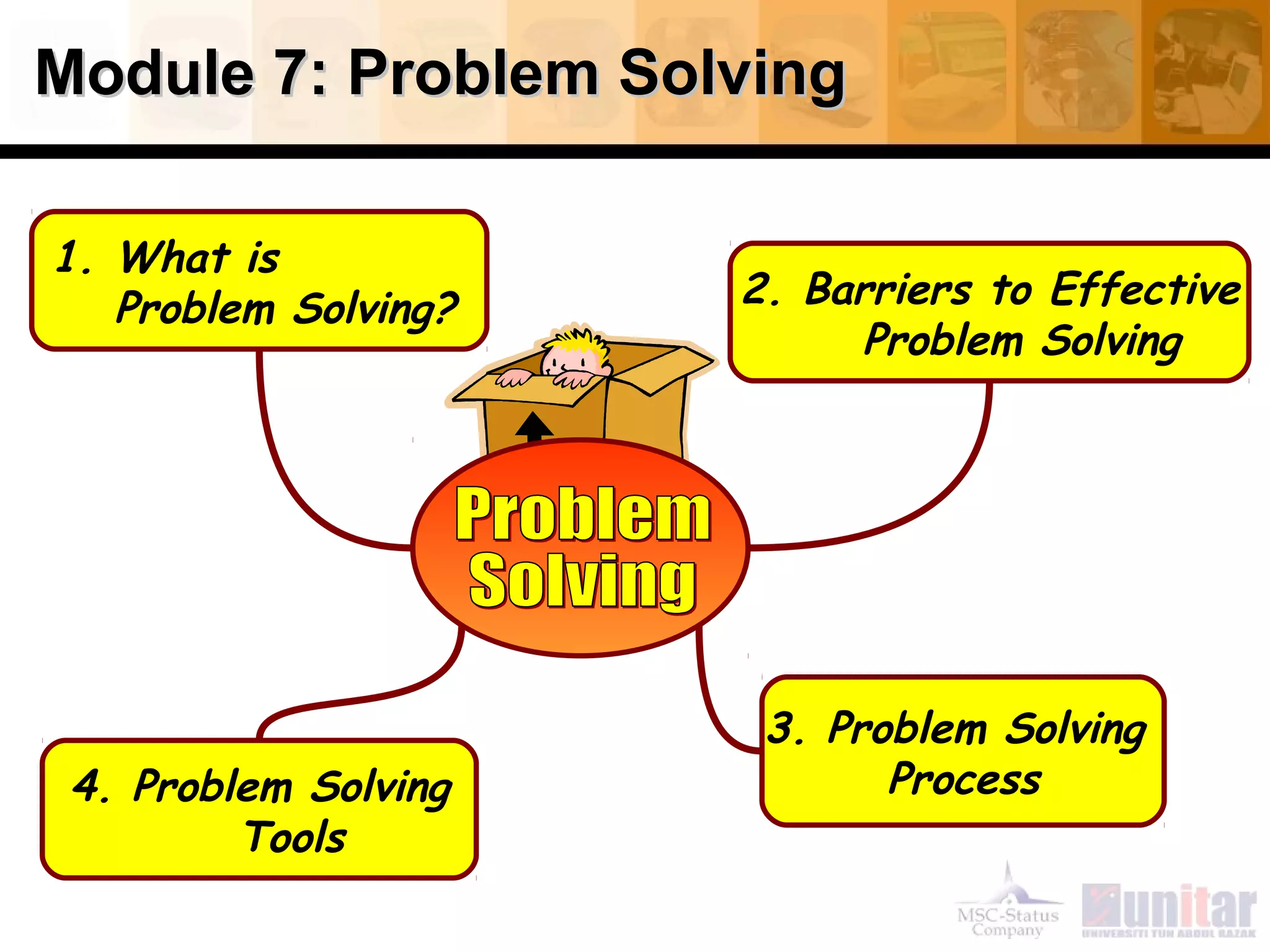
Module 7: Problem SolvingModule 7: Problem Solving
3. Problem Solving
Process4. Problem Solving
Tools
1. What is
Problem Solving? 2. Barriers to Effective
Problem Solving
“Problems call forth our courage and our wisdom; indeed, they
create our courage and our wisdom. It is only because of
problems that we grow mentally and spiritually.”
- M. Scott Peck
7.1 What is Problem Solving?7.1 What is Problem Solving?
Problem solving forms part of thinking.
Considered the most complex of all intellectual
functions, problem solving has been defined as
higher-order cognitive process that requires thehigher-order cognitive process that requires the
modulation and control of more routine ormodulation and control of more routine or
fundamental skillsfundamental skills (Goldstein & Levin, 1987).
It occurs if an organism or an artificial intelligence
system does not know how to proceed from adoes not know how to proceed from a
given state to a desired goal stategiven state to a desired goal state.
It is part of the larger problem process that includes
problem finding and problem shaping.
Source: http://en.wikipedia.org/wiki/Problem_solving
“He who asks a question may be a fool for five minutes,
but he who never asks a question remains a fool forever.”
- Tom Connelly
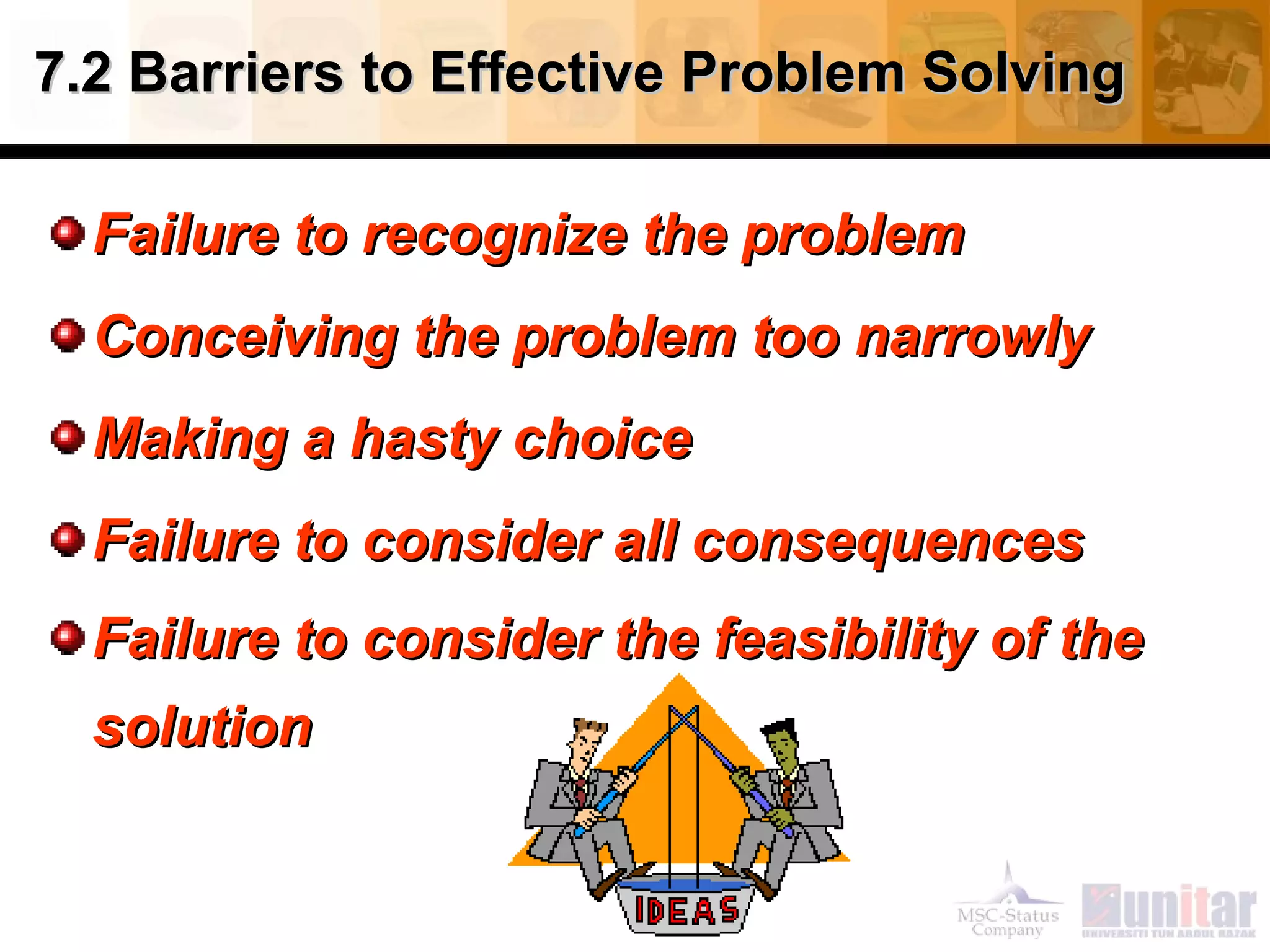
7.2 Barriers to Effective Problem Solving7.2 Barriers to Effective Problem Solving
Failure to recognize the problemFailure to recognize the problem
Conceiving the problem too narrowlyConceiving the problem too narrowly
Making a hasty choiceMaking a hasty choice
Failure to consider all consequencesFailure to consider all consequences
Failure to consider the feasibility of theFailure to consider the feasibility of the
solutionsolution
“It's not that I'm so smart, it's just that I
stay with problems longer.”
- Albert Einstein
7.3 Problem Solving Process7.3 Problem Solving Process
Accepting the ProblemAccepting the Problem
Step 1: What is the Problem?Step 1: What is the Problem?
Step 2: What Are the Alternatives?Step 2: What Are the Alternatives?
Step 3: What Are the Advantages and/orStep 3: What Are the Advantages and/or
Disadvantages of Each Alternative?Disadvantages of Each Alternative?
Step 4: What Is the Solution?Step 4: What Is the Solution?
Step 5: How Well Is the Solution Working?Step 5: How Well Is the Solution Working?
Accepting the ProblemAccepting the Problem
To solve a problem, you must first be willing to acceptaccept the
problem by acknowledging that the problem existsproblem exists and
committing yourself to trying to solve it.
StrategiesStrategies to find the motivation and commitment to prepare
you to enter the problem-solving process:
1.1. List the benefitsList the benefits. – how will solving the problem benefit
you?
2.2. Formalize your acceptanceFormalize your acceptance.- formal commitment to
solve problem
3.3. Accept responsibility for your lifeAccept responsibility for your life.- we have the
potential to control the direction of our lives
4.4. Create a “worst-case” scenarioCreate a “worst-case” scenario.- what are potential
disastrous consequences of your actions or inactions
5.5. Identify what’s holding you backIdentify what’s holding you back.- what is preventing
you from solving the problem?
Step 1: What is the Problem?Step 1: What is the Problem?
Step 1A: What do I know about the situation?Step 1A: What do I know about the situation?
Step 1B: What results am I aiming for in thisStep 1B: What results am I aiming for in this
situation?situation?
Step 1C: How can I define the problem?Step 1C: How can I define the problem?
 View the problem from different perspectives.
 Identify component problems.
 State the problem clearly and specifically.
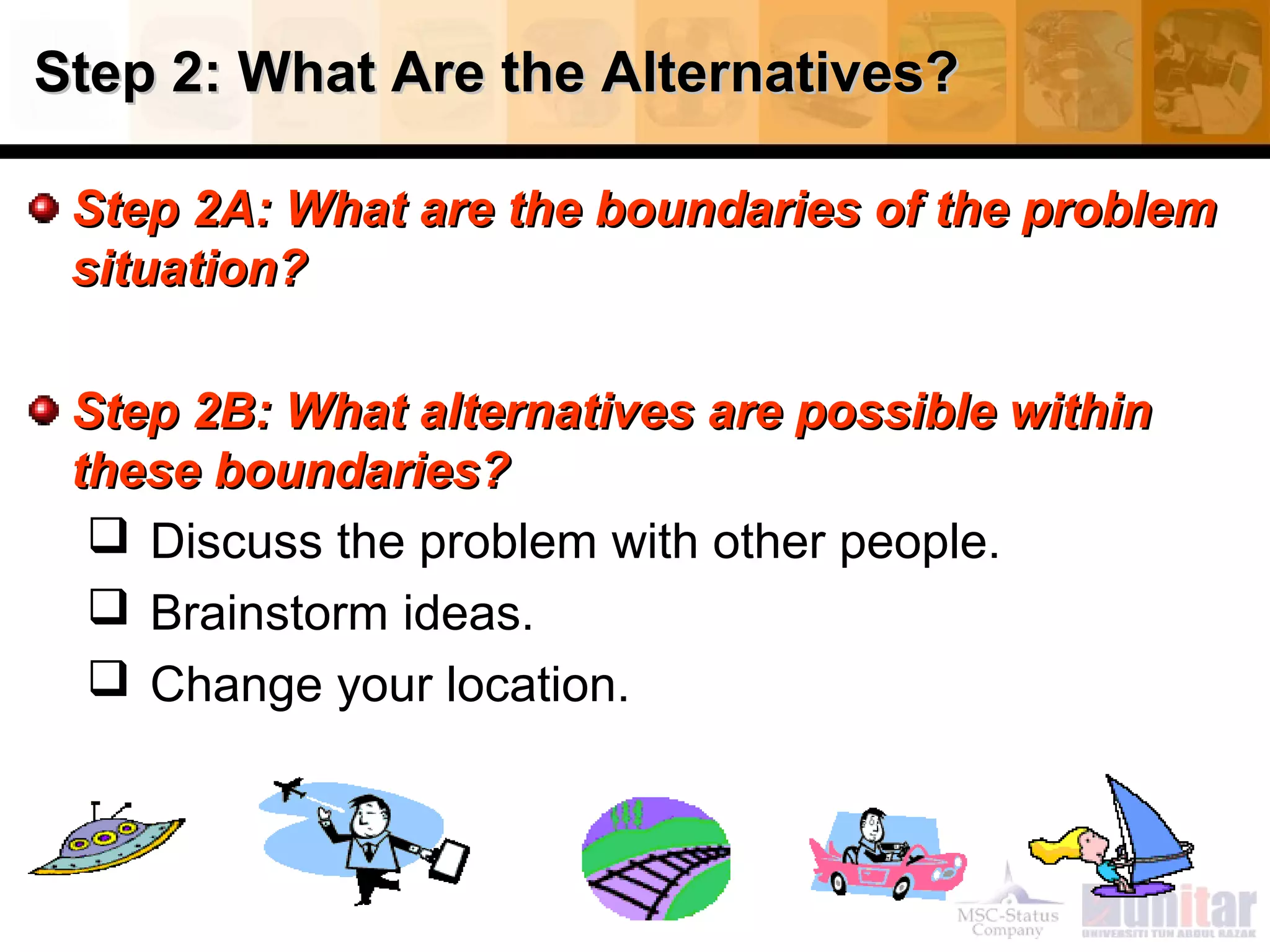
Step 2: What Are the Alternatives?Step 2: What Are the Alternatives?
Step 2A: What are the boundaries of the problemStep 2A: What are the boundaries of the problem
situation?situation?
Step 2B: What alternatives are possible withinStep 2B: What alternatives are possible within
these boundaries?these boundaries?
 Discuss the problem with other people.
 Brainstorm ideas.
 Change your location.
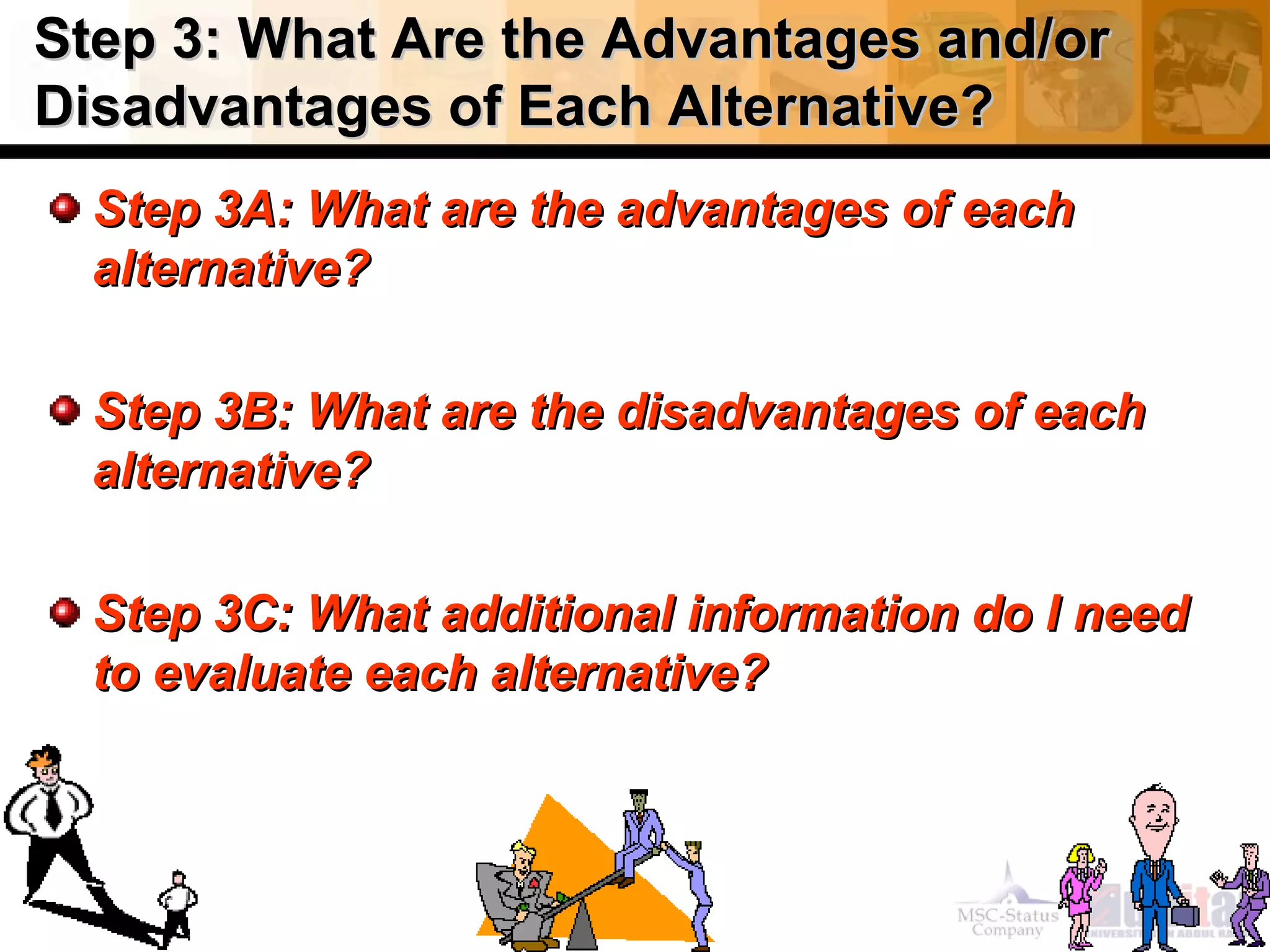
Step 3: What Are the Advantages and/orStep 3: What Are the Advantages and/or
Disadvantages of Each Alternative?Disadvantages of Each Alternative?
Step 3A: What are the advantages of eachStep 3A: What are the advantages of each
alternative?alternative?
Step 3B: What are the disadvantages of eachStep 3B: What are the disadvantages of each
alternative?alternative?
Step 3C: What additional information do I needStep 3C: What additional information do I need
to evaluate each alternative?to evaluate each alternative?
Step 4: What Is the Solution?Step 4: What Is the Solution?
Step 4A: Which alternative(s) will I pursue?Step 4A: Which alternative(s) will I pursue?
 Evaluate and compare alternatives.
 Combine alternatives.
 Try out each alternative in your imagination.
Step 4B: What steps can I take to act on theStep 4B: What steps can I take to act on the
alternative(s) chosen?alternative(s) chosen?
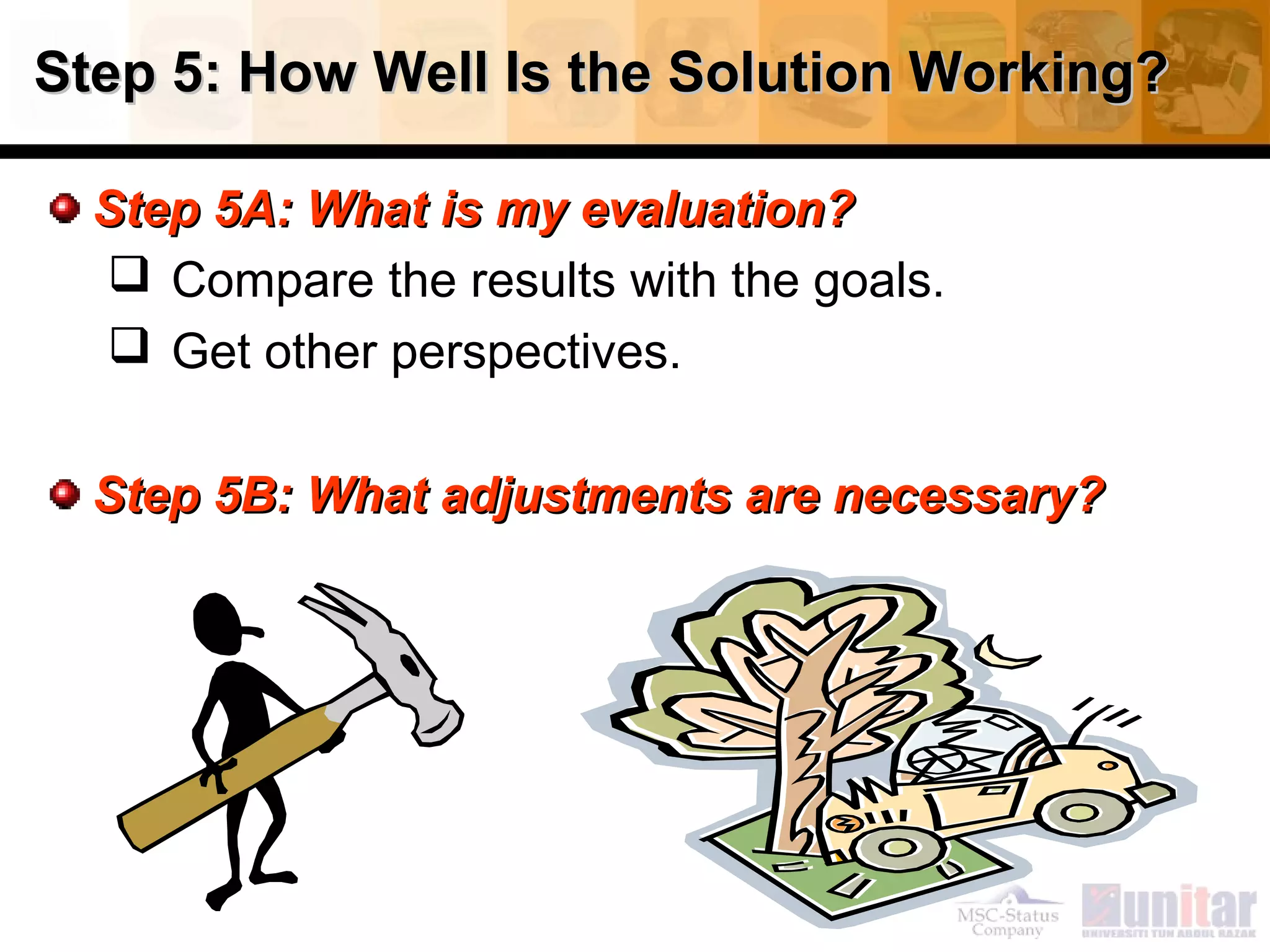
Step 5: How Well Is the Solution Working?Step 5: How Well Is the Solution Working?
Step 5A: What is my evaluation?Step 5A: What is my evaluation?
 Compare the results with the goals.
 Get other perspectives.
Step 5B: What adjustments are necessary?Step 5B: What adjustments are necessary?
“Because I'm thinking in a broader way, I feel
like I am able to make better decisions.”
- Takafumi Horie
6.4 Problem Solving Tools6.4 Problem Solving Tools
Tools to facilitate effective Problem Solving:Tools to facilitate effective Problem Solving:
CoRT (Module 2)CoRT (Module 2)
SWOT ANALYSIS (Module 6)SWOT ANALYSIS (Module 6)
SIX THINKING HATS (Next)SIX THINKING HATS (Next)
PORTER’s 5 FORCESPORTER’s 5 FORCES
FORCE FIELD ANALYSISFORCE FIELD ANALYSIS
ISHIKAWA DIAGRAMISHIKAWA DIAGRAM
MIND MAPPINGMIND MAPPING
MoreMore  MyCotedMyCoted ++ Mind Tools +Mind Tools + Creativity WebCreativity Web
I can study theseI can study these
tools on my own.tools on my own.
Click!Click!
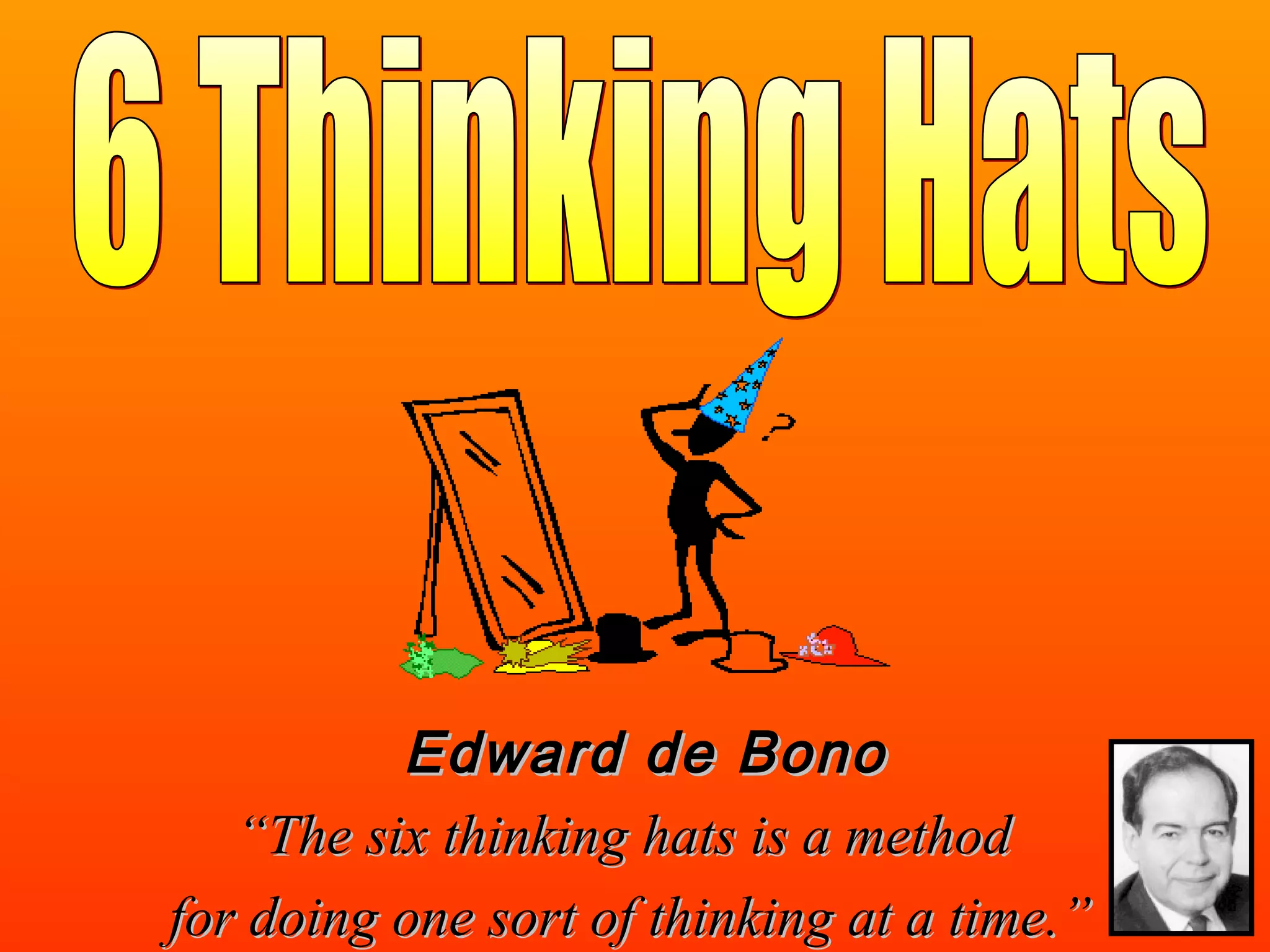
Edward de BonoEdward de Bono
““The six thinking hats is a methodThe six thinking hats is a method
for doing one sort of thinking at a time.”for doing one sort of thinking at a time.”
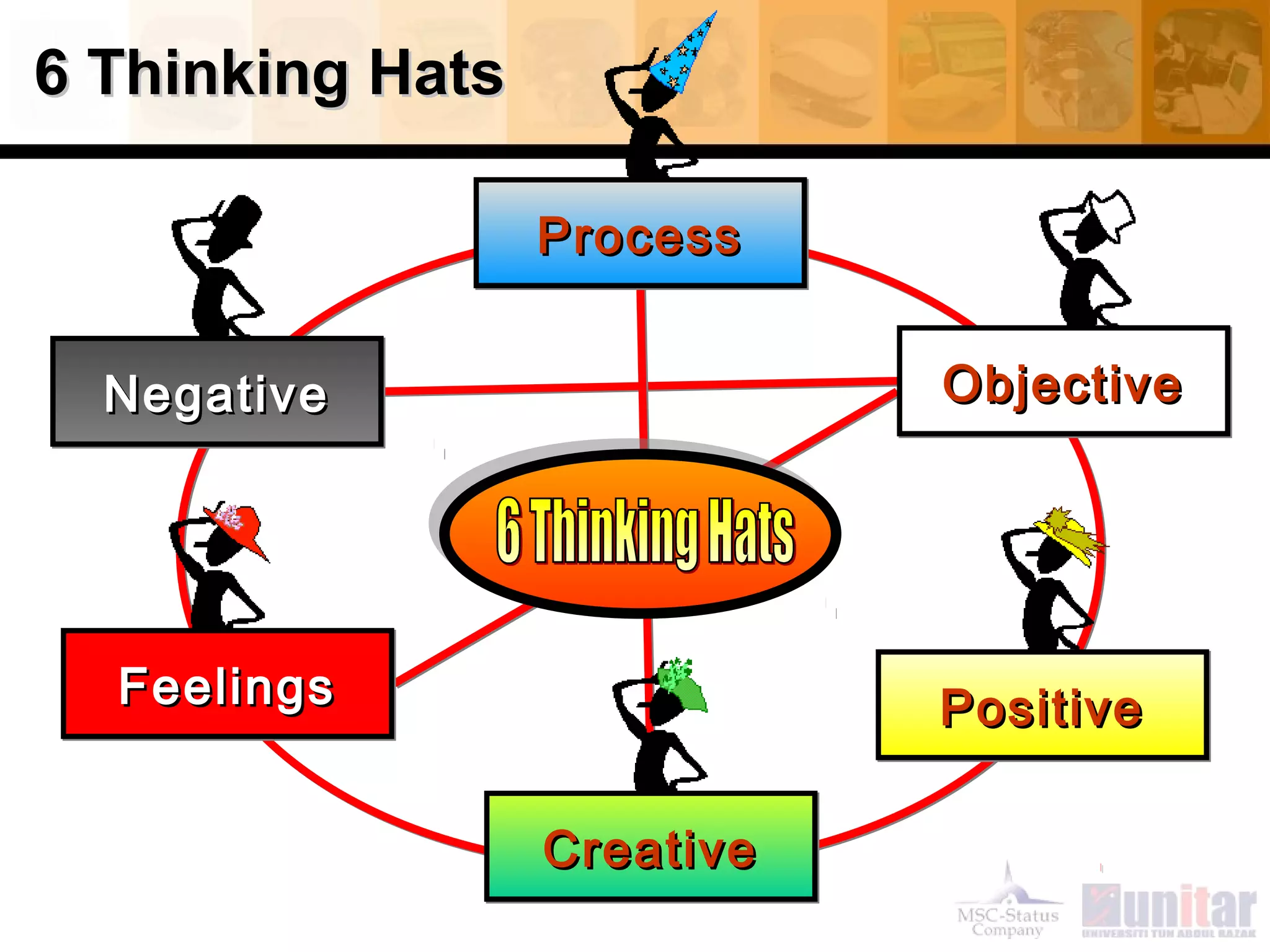
6 Thinking Hats6 Thinking Hats
CreativeCreativeCreativeCreative
PositivePositivePositivePositive
ObjectiveObjectiveObjectiveObjective
FeelingsFeelingsFeelingsFeelings
NegativeNegativeNegativeNegative
ProcessProcessProcessProcess
Benefits of Using 6 Thinking HatsBenefits of Using 6 Thinking Hats
Role-playing (Put the hat on, take the hat off,
switch hats, and signal your thinking)
Encourage creative, parallel and lateral thinking
Improve communication
Speed up decision making
Avoid debate
Detaching the Ego
Occasional Use (Single Hat)
Sequence Use
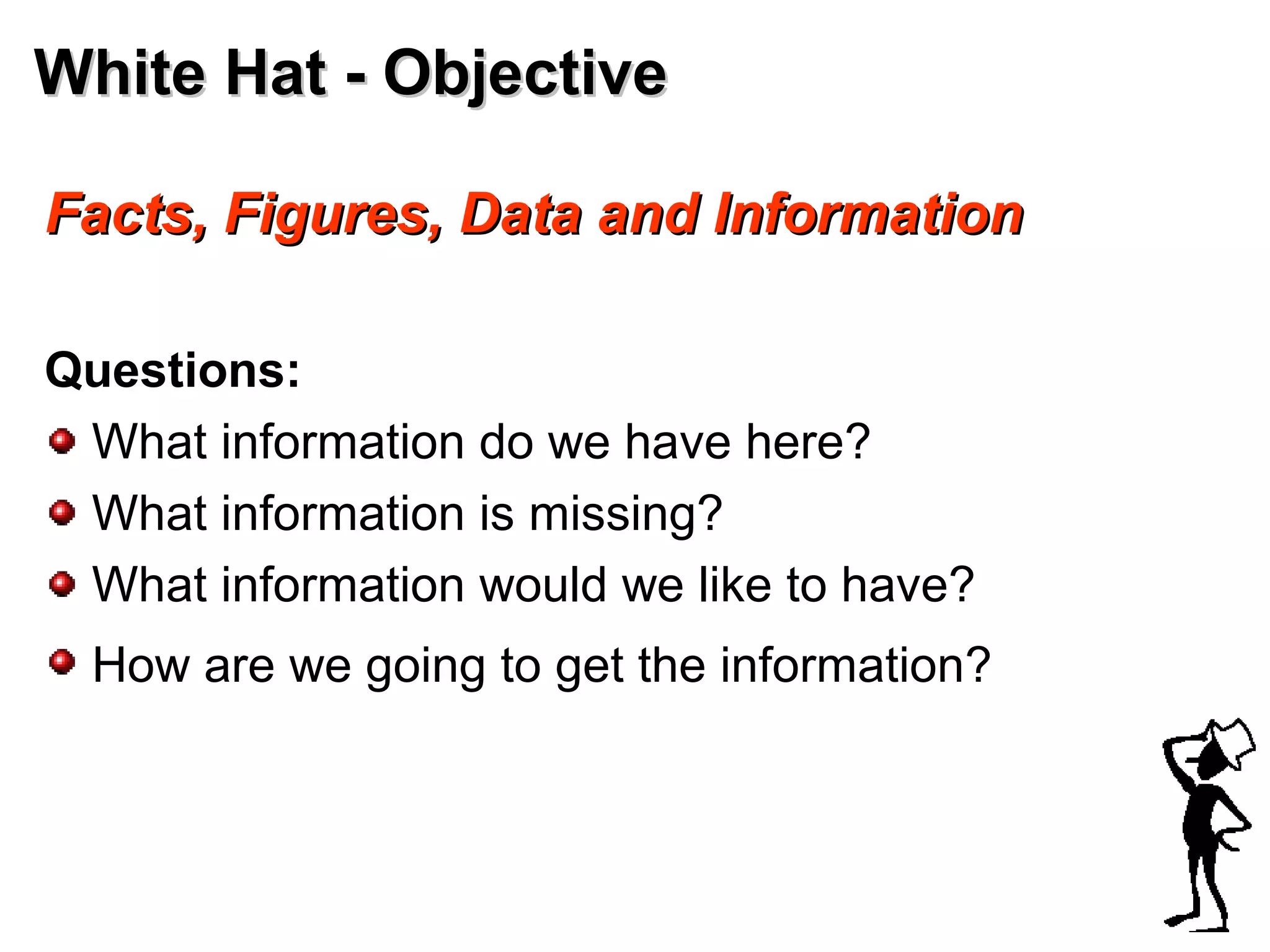
White Hat - ObjectiveWhite Hat - Objective
Facts, Figures, Data and InformationFacts, Figures, Data and Information
Questions:
What information do we have here?
What information is missing?
What information would we like to have?
How are we going to get the information?
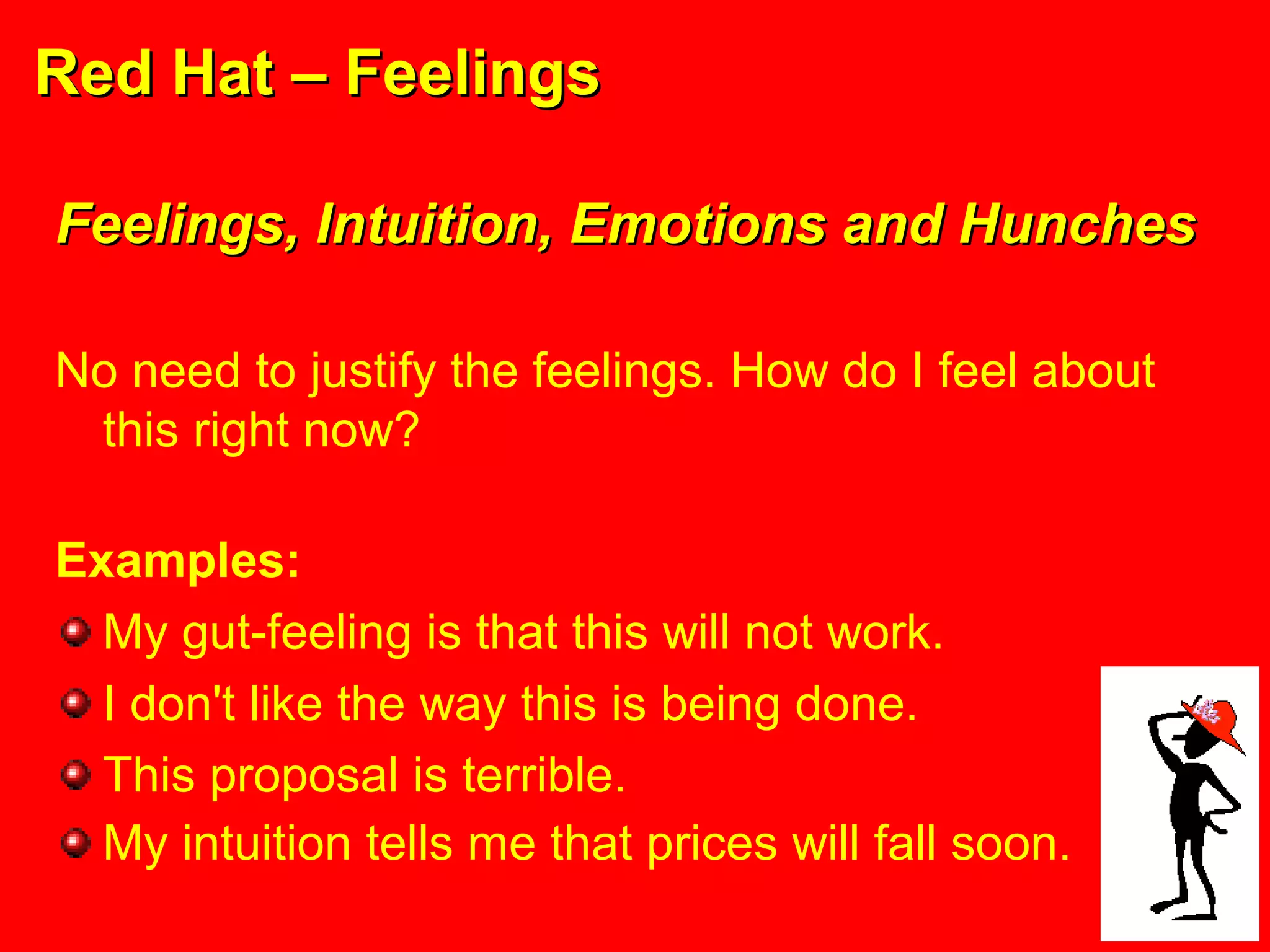
Red Hat – FeelingsRed Hat – Feelings
Feelings, Intuition, Emotions and HunchesFeelings, Intuition, Emotions and Hunches
No need to justify the feelings. How do I feel about
this right now?
Examples:
My gut-feeling is that this will not work.
I don't like the way this is being done.
This proposal is terrible.
My intuition tells me that prices will fall soon.
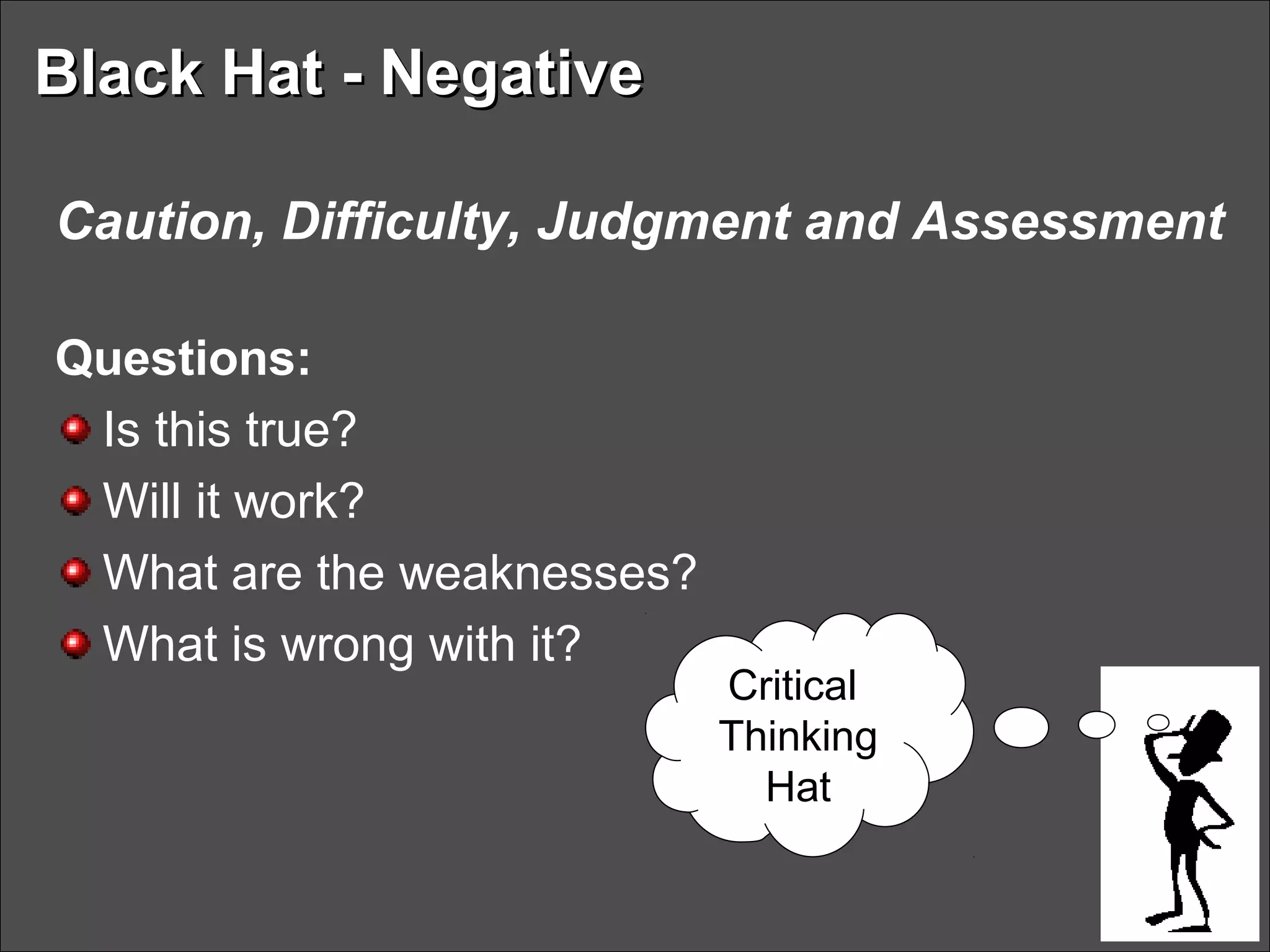
Black Hat - NegativeBlack Hat - Negative
Caution, Difficulty, Judgment and Assessment
Questions:
Is this true?
Will it work?
What are the weaknesses?
What is wrong with it?
Critical
Thinking
Hat
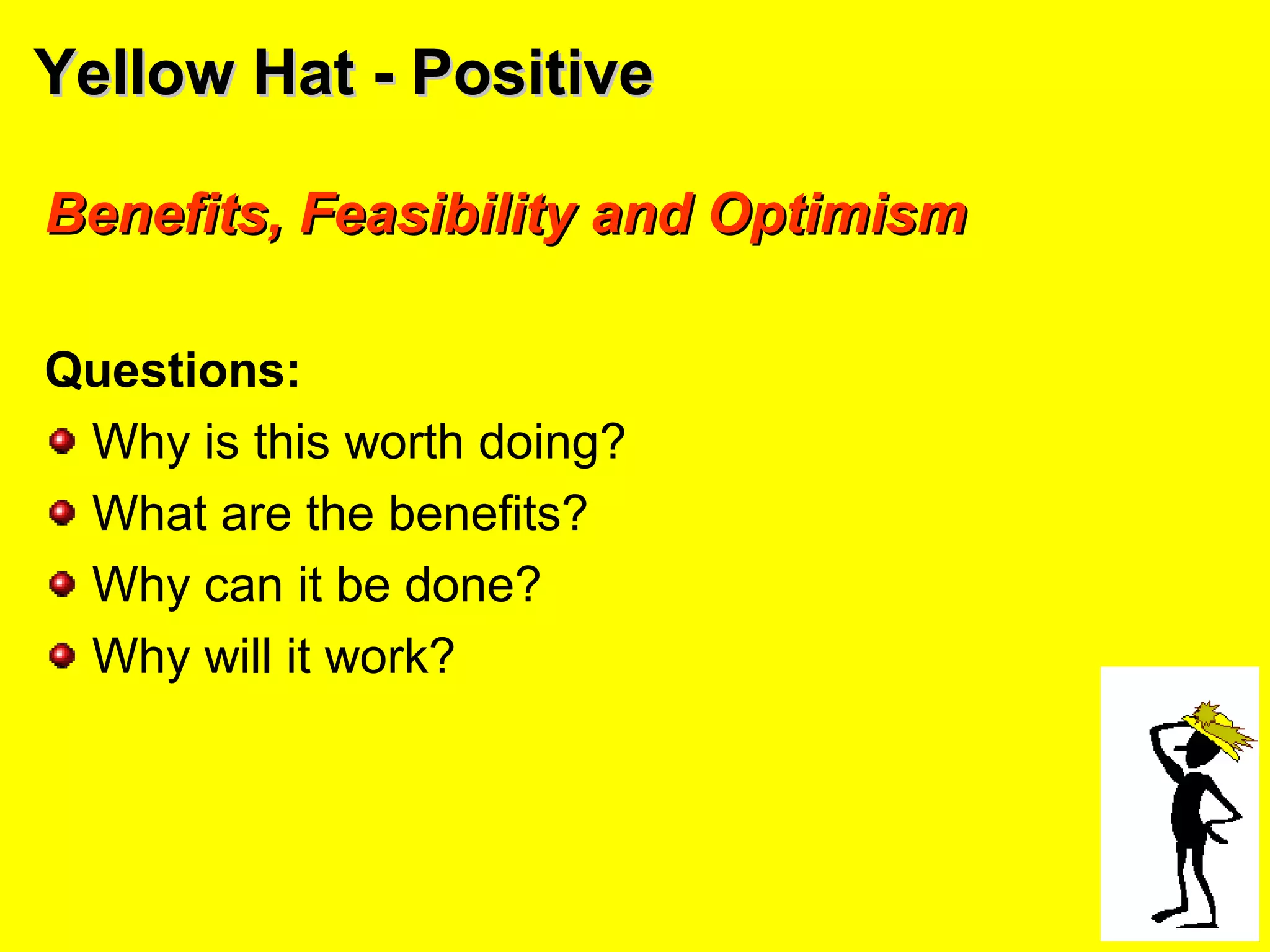
Yellow Hat - PositiveYellow Hat - Positive
Benefits, Feasibility and OptimismBenefits, Feasibility and Optimism
Questions:
Why is this worth doing?
What are the benefits?
Why can it be done?
Why will it work?
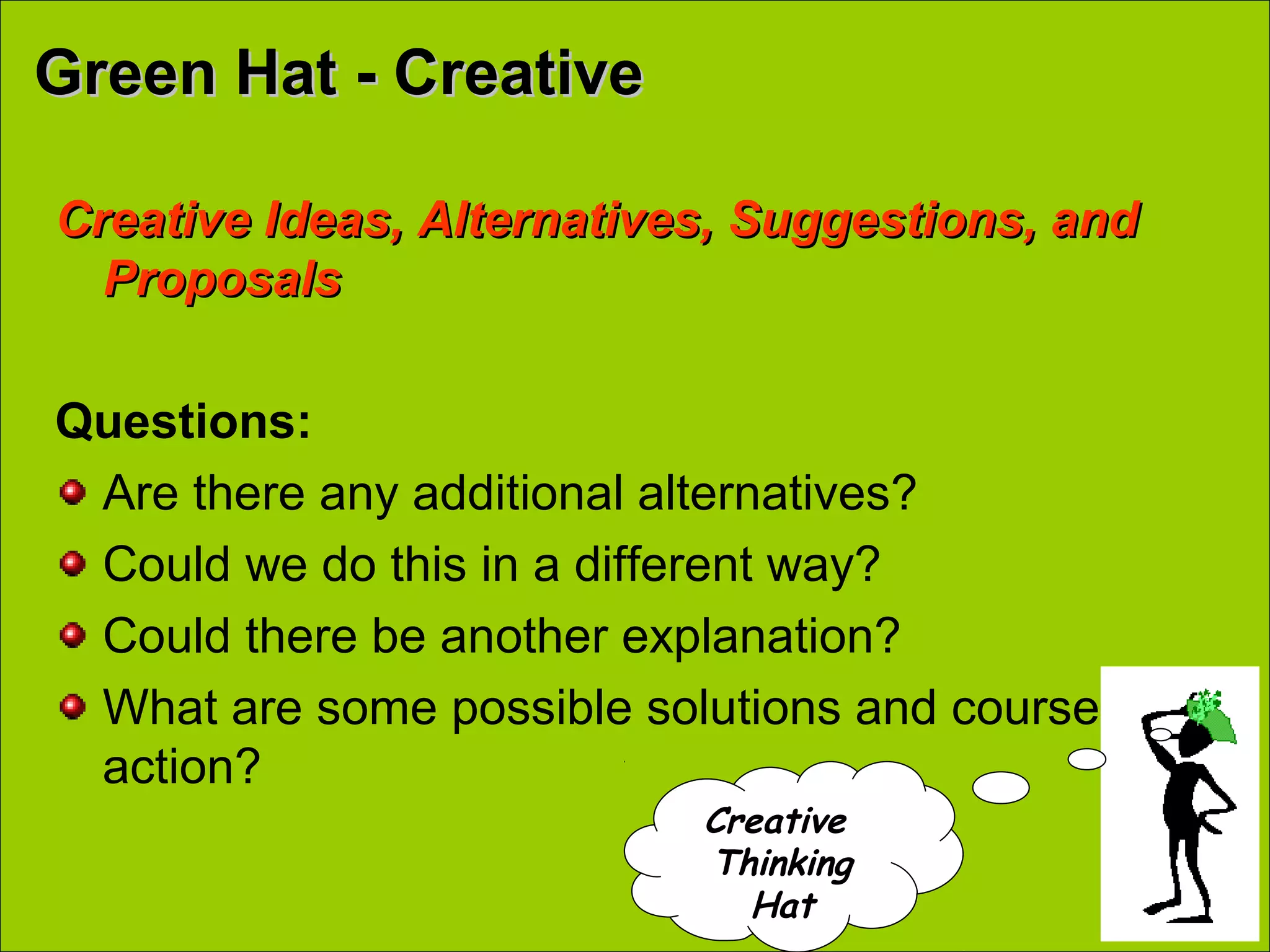
Green Hat - CreativeGreen Hat - Creative
Creative Ideas, Alternatives, Suggestions, andCreative Ideas, Alternatives, Suggestions, and
ProposalsProposals
Questions:
Are there any additional alternatives?
Could we do this in a different way?
Could there be another explanation?
What are some possible solutions and courses of
action?
Creative
Thinking
Hat
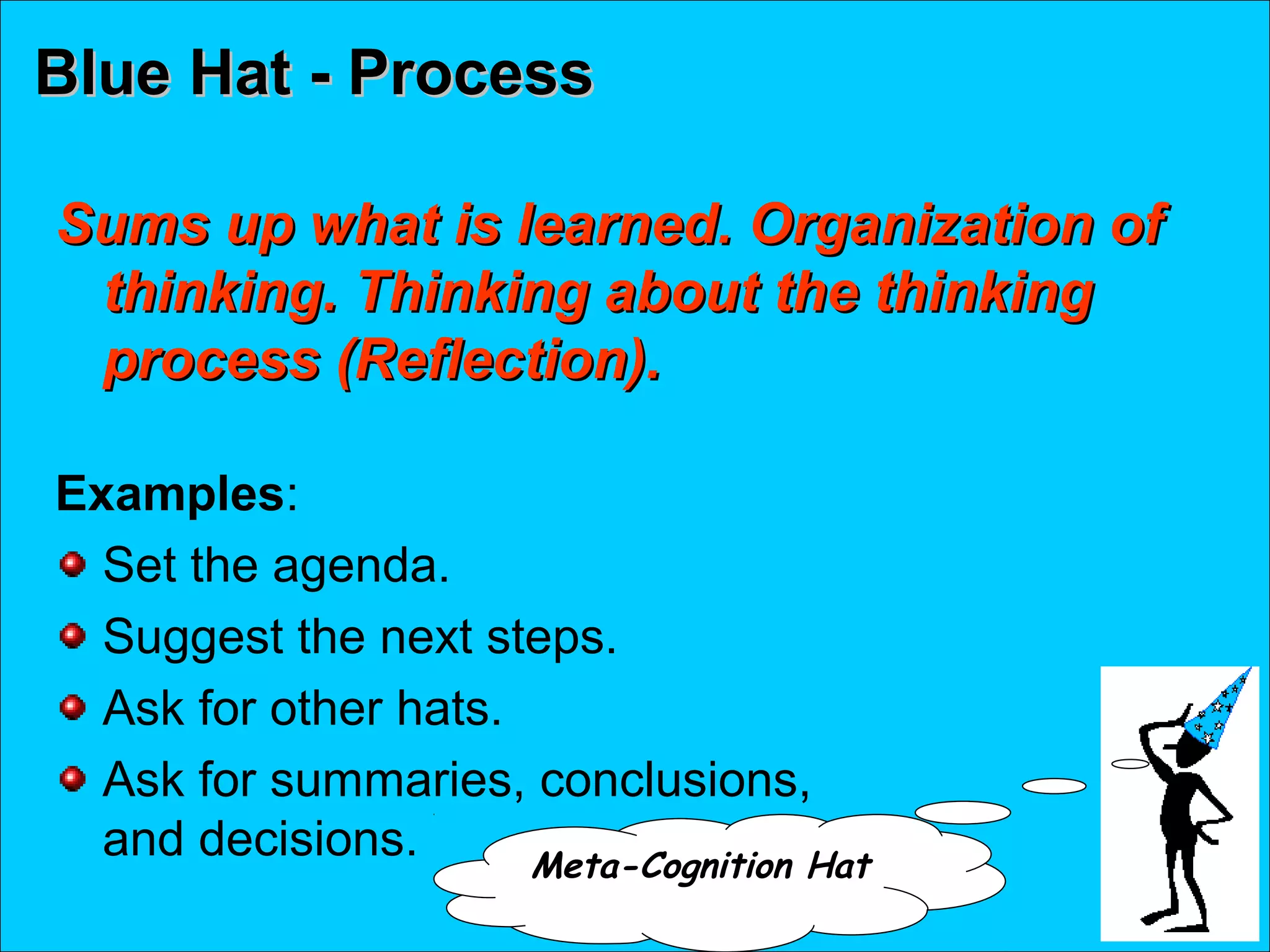
Blue Hat - ProcessBlue Hat - Process
Sums up what is learned. Organization ofSums up what is learned. Organization of
thinking. Thinking about the thinkingthinking. Thinking about the thinking
process (Reflection).process (Reflection).
Examples:
Set the agenda.
Suggest the next steps.
Ask for other hats.
Ask for summaries, conclusions,
and decisions. Meta-Cognition Hat
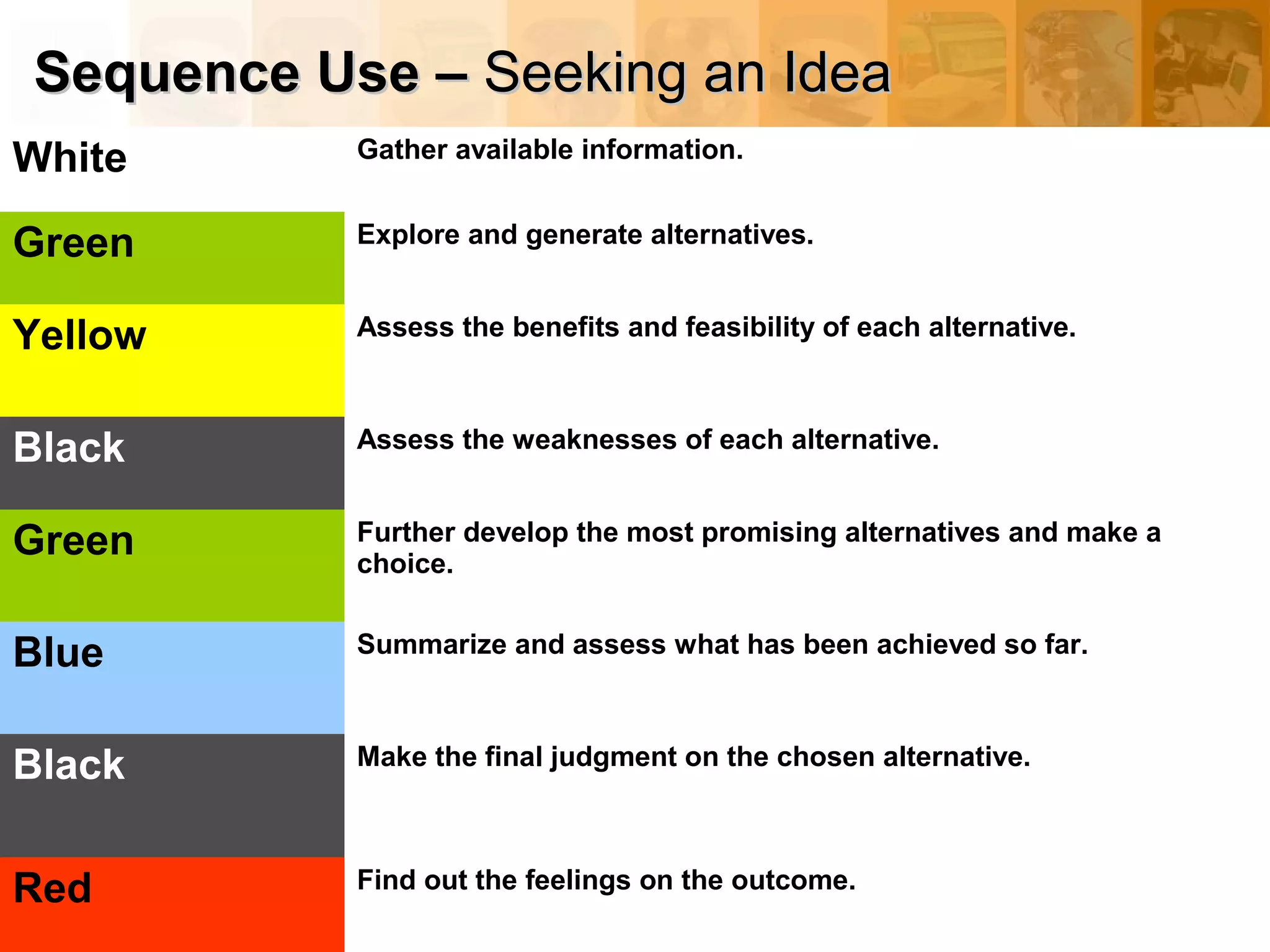
Sequence Use –Sequence Use – Seeking an IdeaSeeking an Idea
White Gather available information.
Green Explore and generate alternatives.
Yellow Assess the benefits and feasibility of each alternative.
Black Assess the weaknesses of each alternative.
Green Further develop the most promising alternatives and make a
choice.
Blue Summarize and assess what has been achieved so far.
Black Make the final judgment on the chosen alternative.
Red Find out the feelings on the outcome.
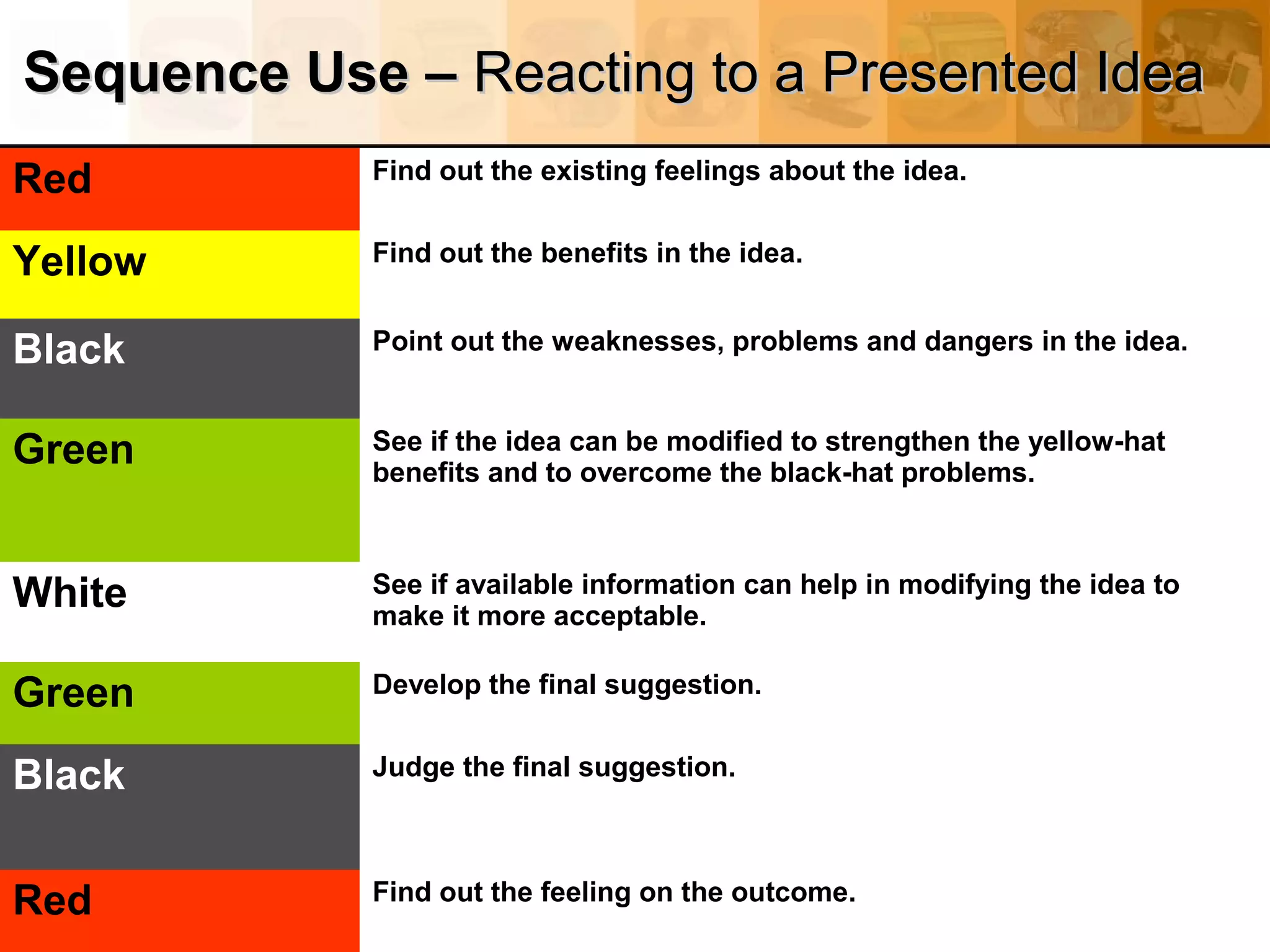
Sequence Use –Sequence Use – Reacting to a Presented IdeaReacting to a Presented Idea
Red Find out the existing feelings about the idea.
Yellow Find out the benefits in the idea.
Black Point out the weaknesses, problems and dangers in the idea.
Green See if the idea can be modified to strengthen the yellow-hat
benefits and to overcome the black-hat problems.
White See if available information can help in modifying the idea to
make it more acceptable.
Green Develop the final suggestion.
Black Judge the final suggestion.
Red Find out the feeling on the outcome.
Sequence Use –Sequence Use – Short SequencesShort Sequences
Yellow/Black/Red: Quick assessment (idea)
White/Green: Generate ideas
Black/Green: Improve an existing idea
Blue/Green: Summarize & suggest alternatives
Blue/Yellow: Any benefits? (e.g. the idea)
Etc…
““...Be open-minded and creative about...Be open-minded and creative about
the sequence use, too!”the sequence use, too!”
Case Study Example:Case Study Example:
Classroom Management - Six Thinking HatsClassroom Management - Six Thinking Hats
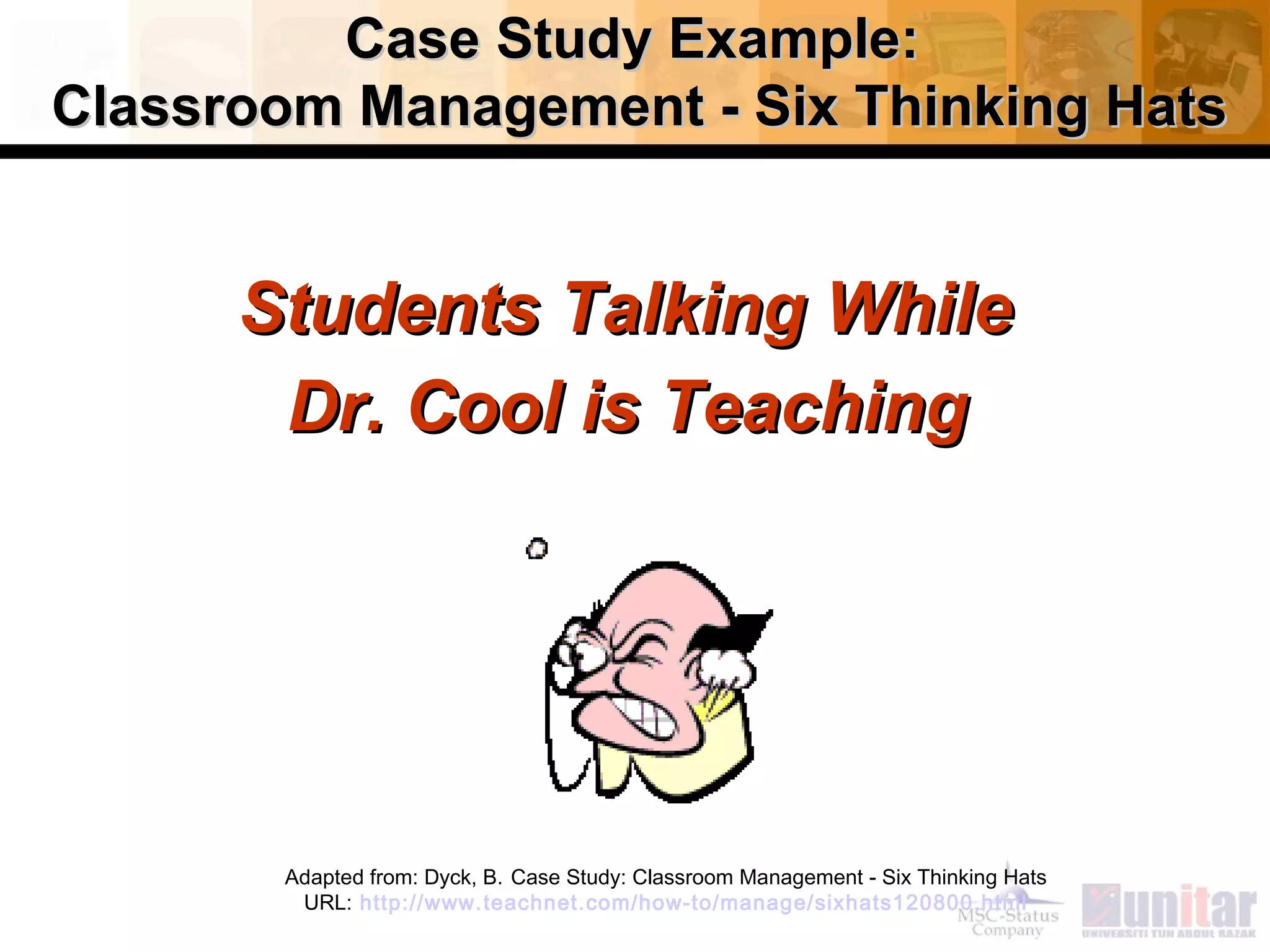
Students Talking WhileStudents Talking While
Dr. Cool is TeachingDr. Cool is Teaching
Adapted from: Dyck, B. Case Study: Classroom Management - Six Thinking Hats
URL: http://www.teachnet.com/how-to/manage/sixhats120800.html
White Hat - Facts and InformationWhite Hat - Facts and Information
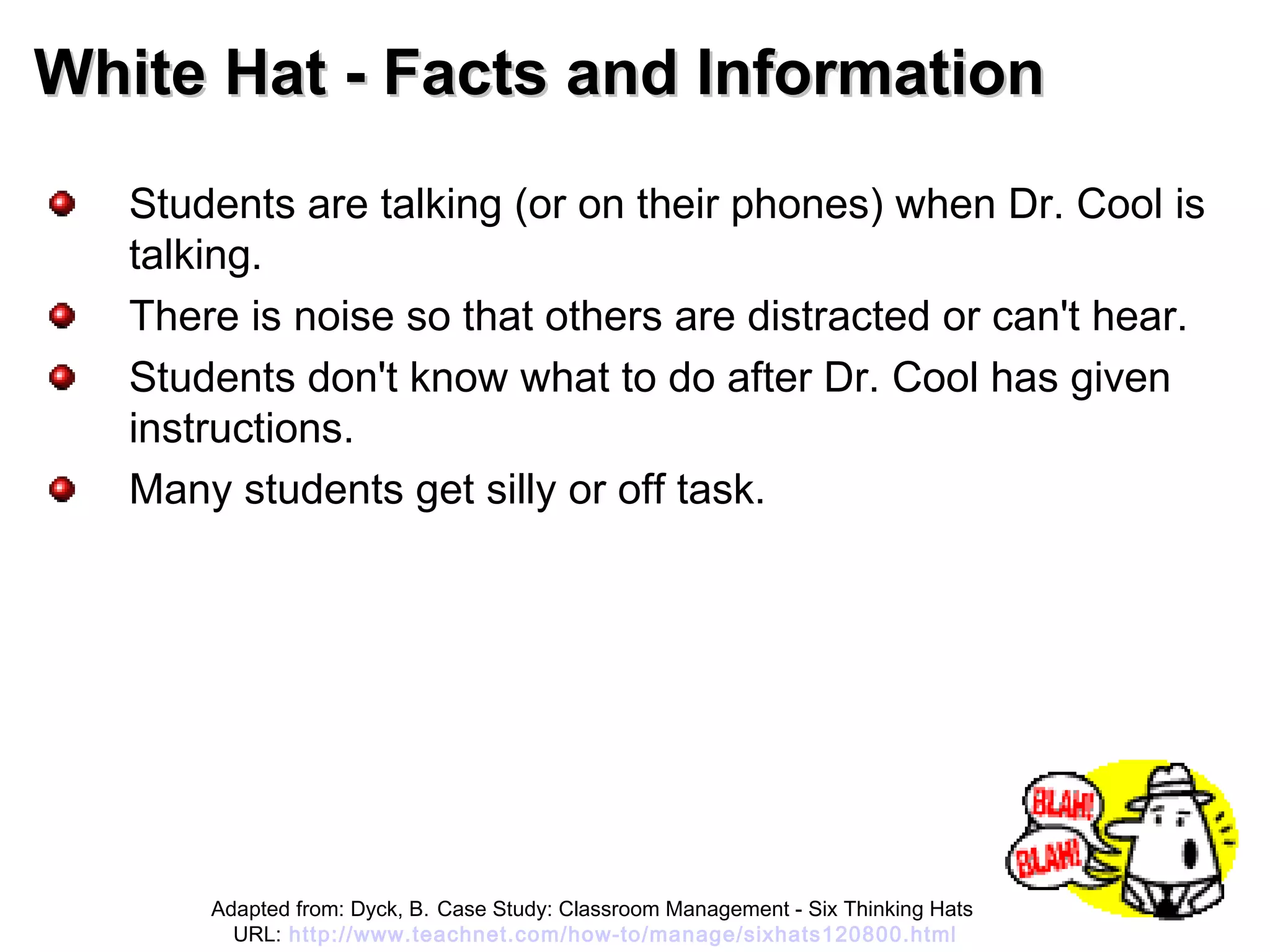
Students are talking (or on their phones) when Dr. Cool is
talking.
There is noise so that others are distracted or can't hear.
Students don't know what to do after Dr. Cool has given
instructions.
Many students get silly or off task.
Adapted from: Dyck, B. Case Study: Classroom Management - Six Thinking Hats
URL: http://www.teachnet.com/how-to/manage/sixhats120800.html
Red Hat – Emotions and FeelingsRed Hat – Emotions and Feelings
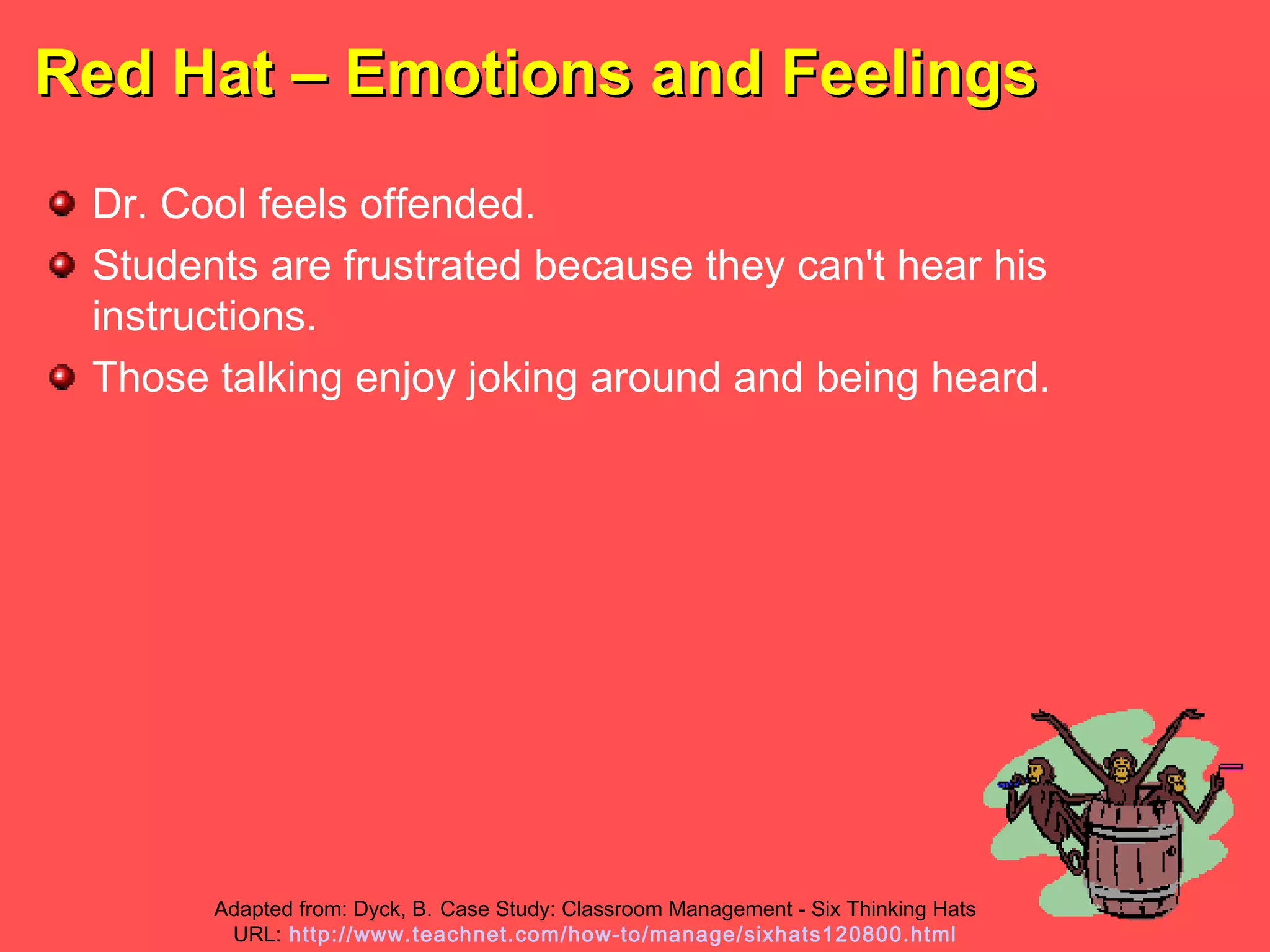
Dr. Cool feels offended.
Students are frustrated because they can't hear his
instructions.
Those talking enjoy joking around and being heard.
Adapted from: Dyck, B. Case Study: Classroom Management - Six Thinking Hats
URL: http://www.teachnet.com/how-to/manage/sixhats120800.html
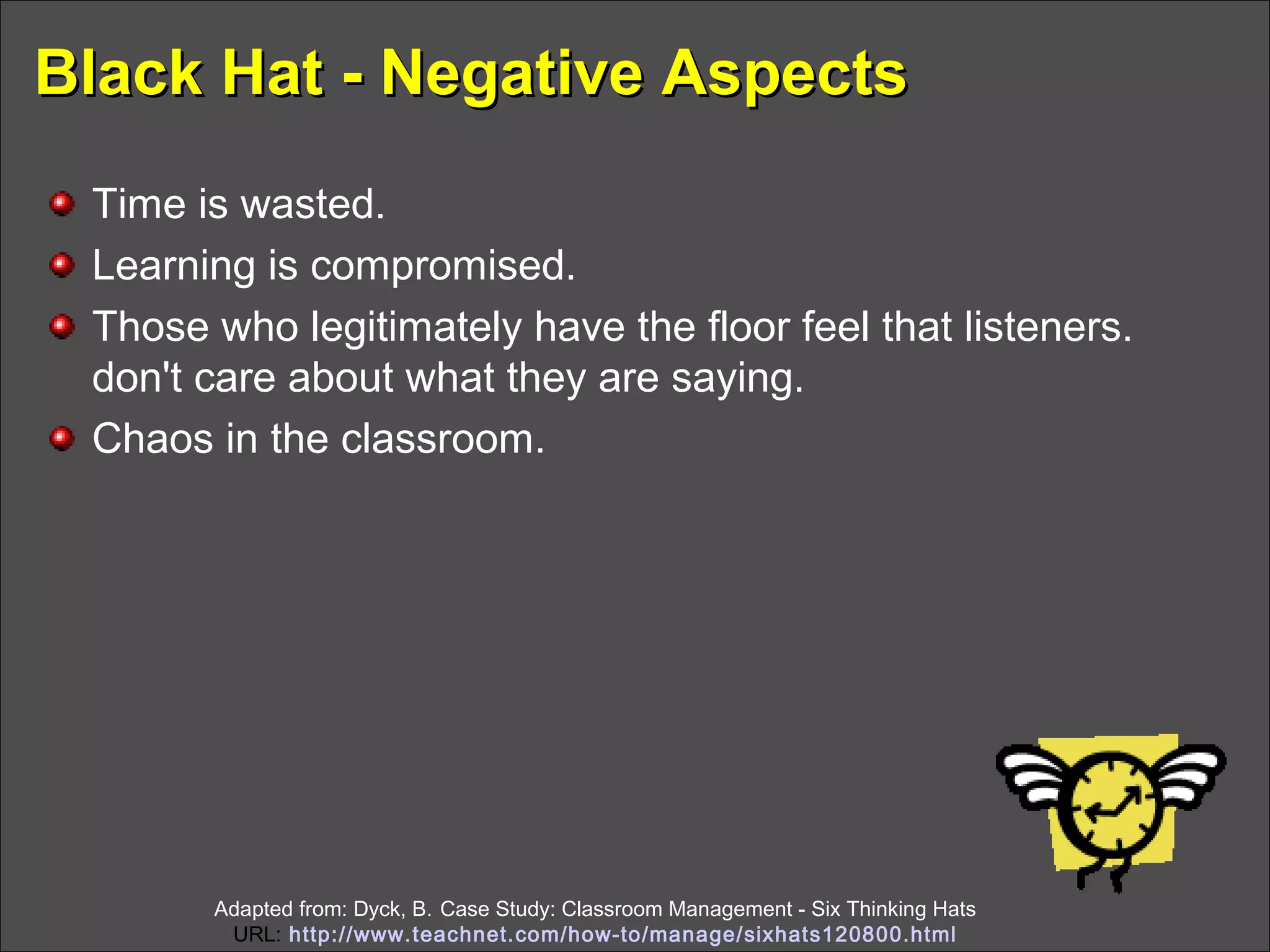
Black Hat -Black Hat - Negative AspectsNegative Aspects
Time is wasted.
Learning is compromised.
Those who legitimately have the floor feel that listeners.
don't care about what they are saying.
Chaos in the classroom.
Adapted from: Dyck, B. Case Study: Classroom Management - Six Thinking Hats
URL: http://www.teachnet.com/how-to/manage/sixhats120800.html
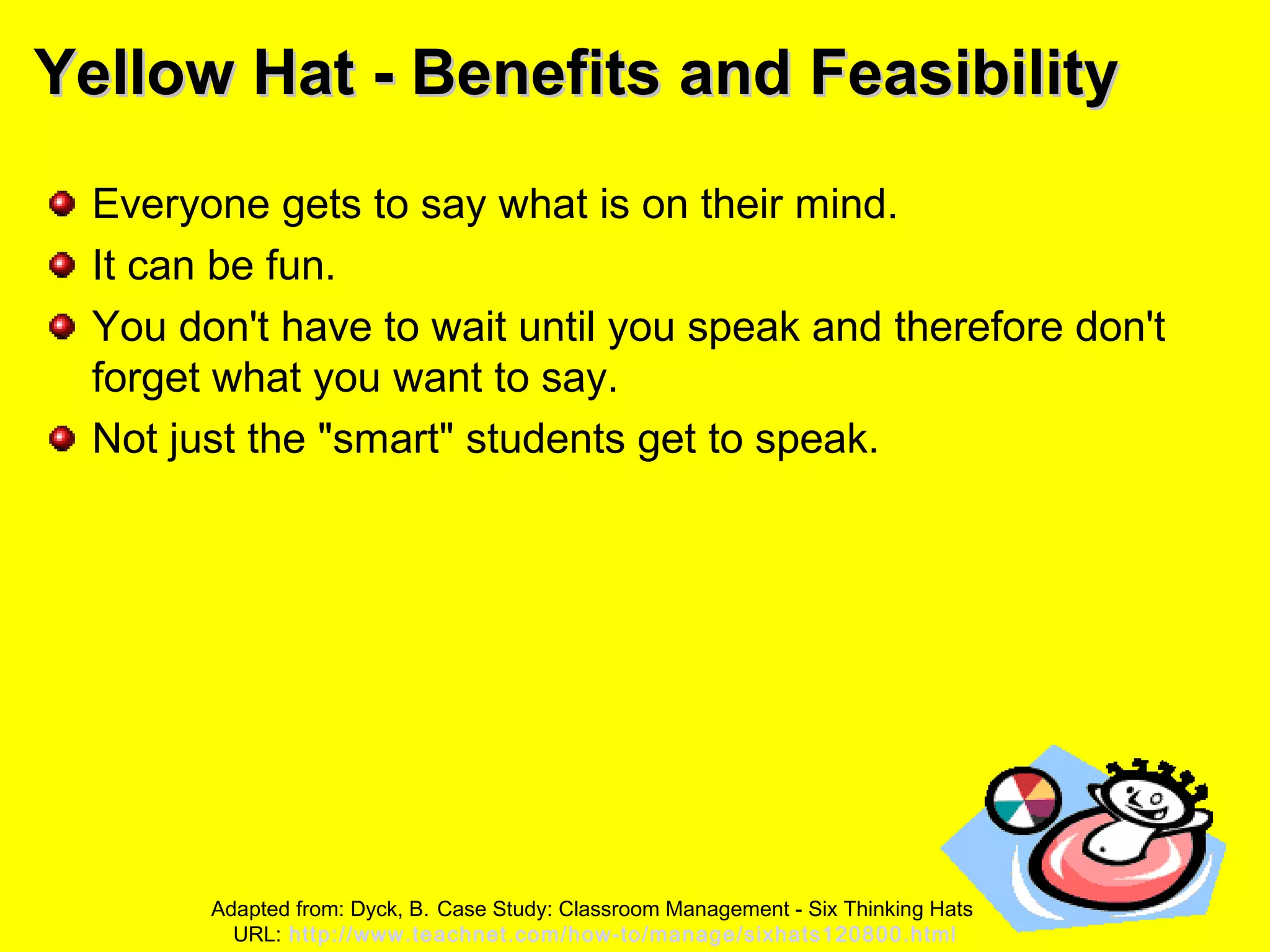
Yellow Hat - Benefits and FeasibilityYellow Hat - Benefits and Feasibility
Everyone gets to say what is on their mind.
It can be fun.
You don't have to wait until you speak and therefore don't
forget what you want to say.
Not just the "smart" students get to speak.
Adapted from: Dyck, B. Case Study: Classroom Management - Six Thinking Hats
URL: http://www.teachnet.com/how-to/manage/sixhats120800.html
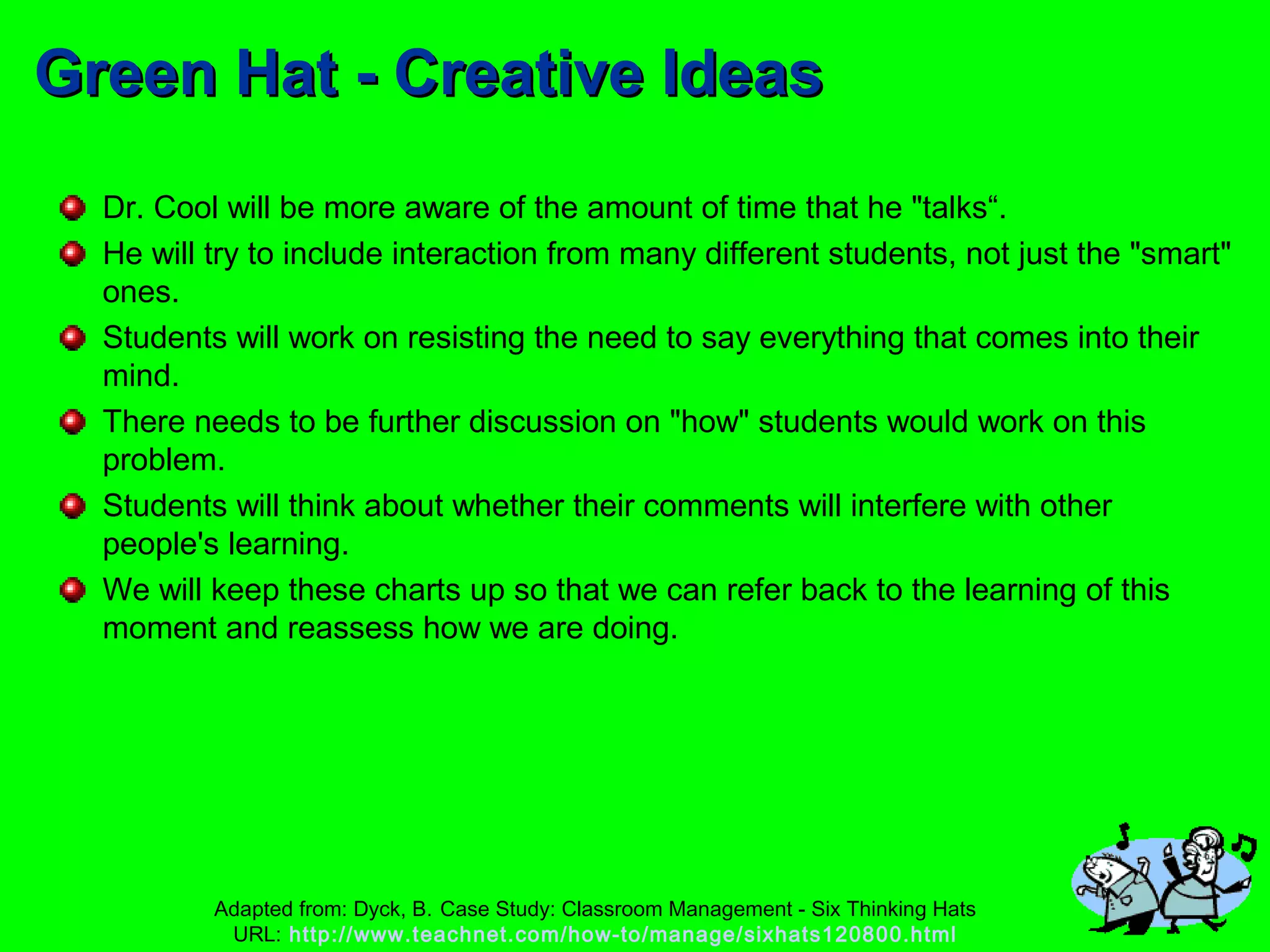
Green Hat - Creative IdeasGreen Hat - Creative Ideas
Dr. Cool will be more aware of the amount of time that he "talks“.
He will try to include interaction from many different students, not just the "smart"
ones.
Students will work on resisting the need to say everything that comes into their
mind.
There needs to be further discussion on "how" students would work on this
problem.
Students will think about whether their comments will interfere with other
people's learning.
We will keep these charts up so that we can refer back to the learning of this
moment and reassess how we are doing.
Adapted from: Dyck, B. Case Study: Classroom Management - Six Thinking Hats
URL: http://www.teachnet.com/how-to/manage/sixhats120800.html
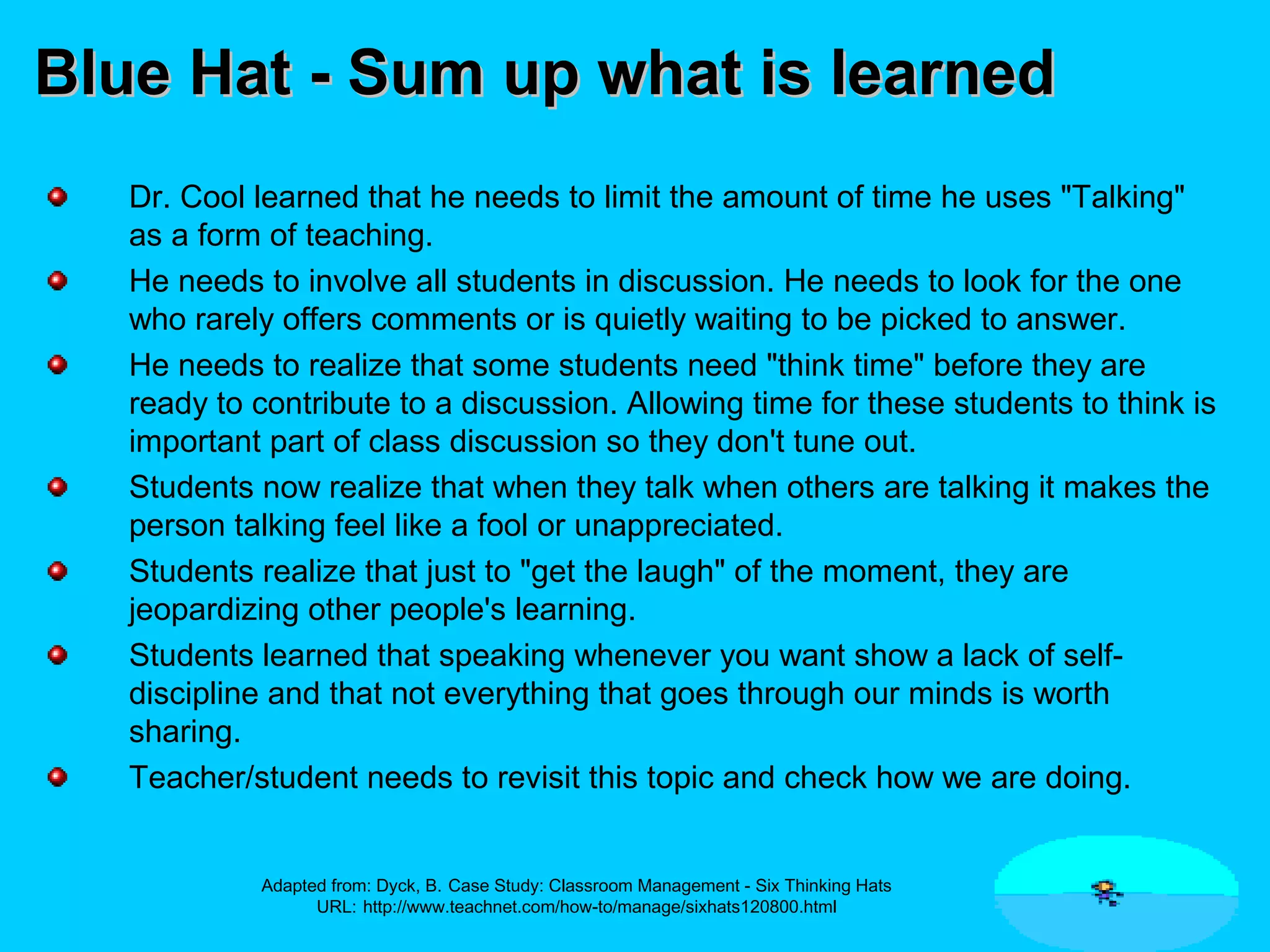
Blue Hat - Sum up what is learnedBlue Hat - Sum up what is learned
Dr. Cool learned that he needs to limit the amount of time he uses "Talking"
as a form of teaching.
He needs to involve all students in discussion. He needs to look for the one
who rarely offers comments or is quietly waiting to be picked to answer.
He needs to realize that some students need "think time" before they are
ready to contribute to a discussion. Allowing time for these students to think is
important part of class discussion so they don't tune out.
Students now realize that when they talk when others are talking it makes the
person talking feel like a fool or unappreciated.
Students realize that just to "get the laugh" of the moment, they are
jeopardizing other people's learning.
Students learned that speaking whenever you want show a lack of self-
discipline and that not everything that goes through our minds is worth
sharing.
Teacher/student needs to revisit this topic and check how we are doing.
Adapted from: Dyck, B. Case Study: Classroom Management - Six Thinking Hats
URL: http://www.teachnet.com/how-to/manage/sixhats120800.html
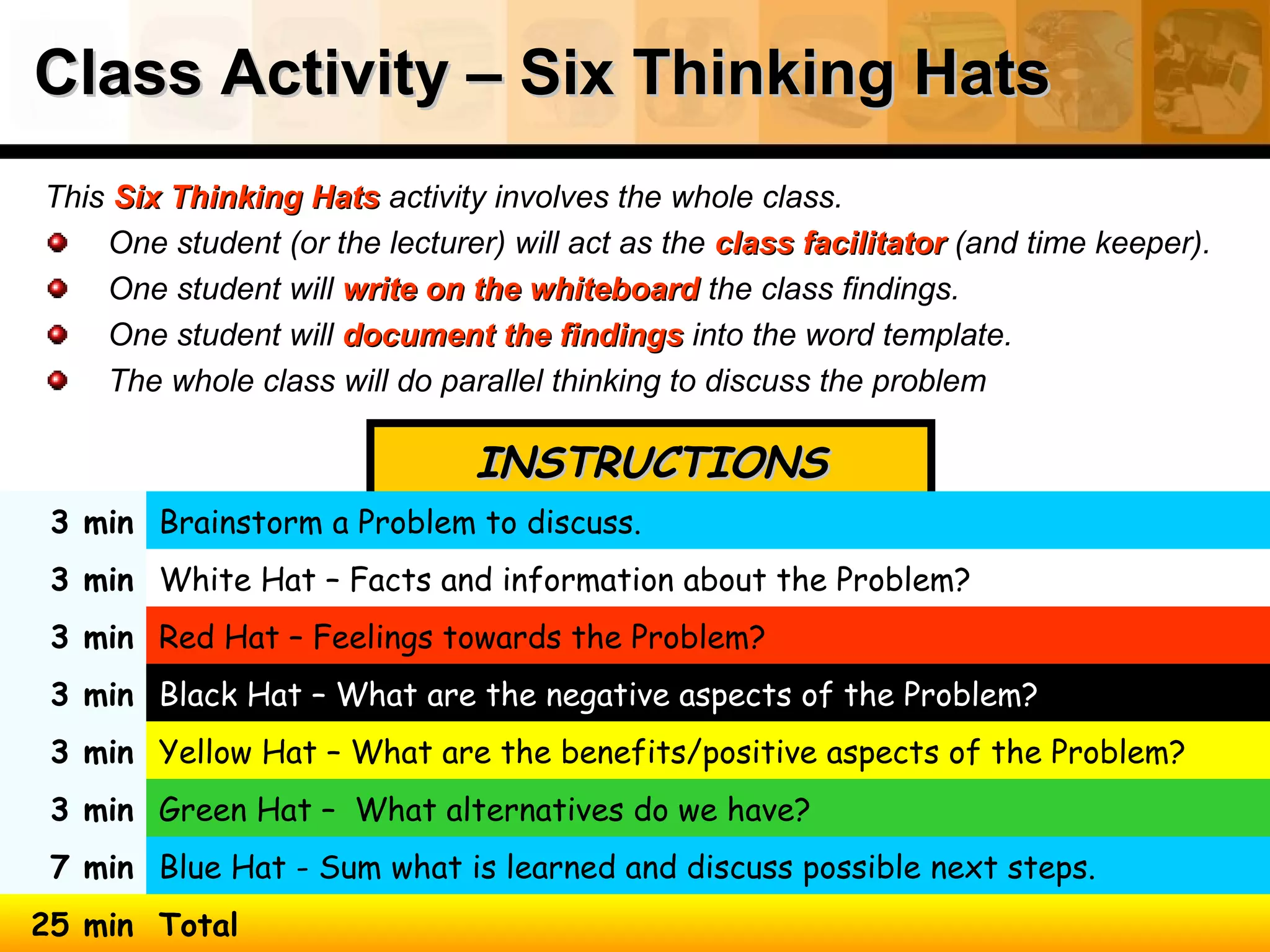
INSTRUCTIONSINSTRUCTIONS
Class Activity – Six Thinking HatsClass Activity – Six Thinking Hats
This Six Thinking HatsSix Thinking Hats activity involves the whole class.
One student (or the lecturer) will act as the class facilitatorclass facilitator (and time keeper).
One student will write on the whiteboardwrite on the whiteboard the class findings.
One student will documentdocument the findingsthe findings into the word template.
The whole class will do parallel thinking to discuss the problem
3 min Brainstorm a Problem to discuss.
3 min White Hat – Facts and information about the Problem?
3 min Red Hat – Feelings towards the Problem?
3 min Black Hat – What are the negative aspects of the Problem?
3 min Yellow Hat – What are the benefits/positive aspects of the Problem?
3 min Green Hat – What alternatives do we have?
7 min Blue Hat - Sum what is learned and discuss possible next steps.
25 min Total
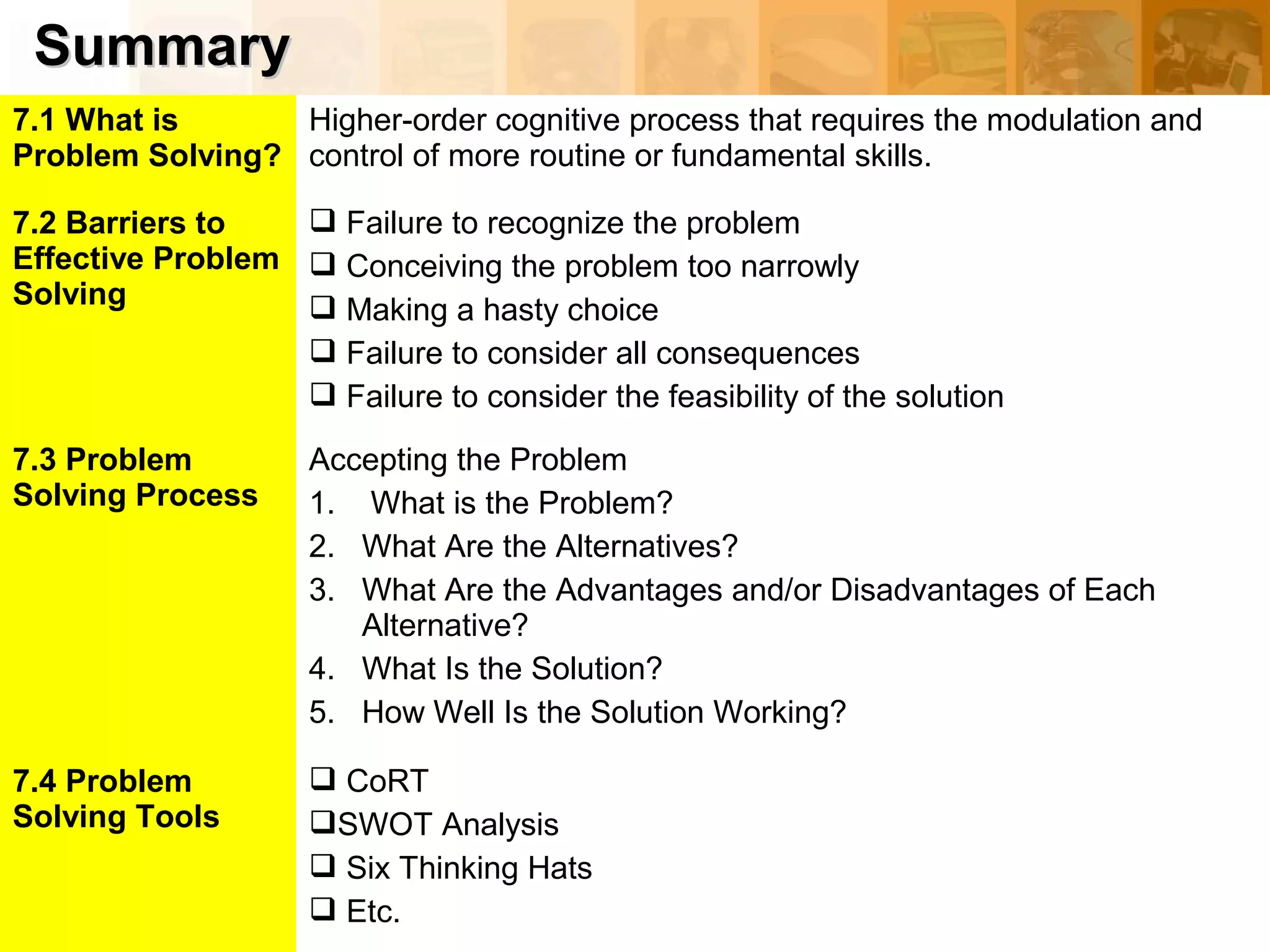
SummarySummary
7.1 What is
Problem Solving?
Higher-order cognitive process that requires the modulation and
control of more routine or fundamental skills.
7.2 Barriers to
Effective Problem
Solving
 Failure to recognize the problem
 Conceiving the problem too narrowly
 Making a hasty choice
 Failure to consider all consequences
 Failure to consider the feasibility of the solution
7.3 Problem
Solving Process
Accepting the Problem
1. What is the Problem?
2. What Are the Alternatives?
3. What Are the Advantages and/or Disadvantages of Each
Alternative?
4. What Is the Solution?
5. How Well Is the Solution Working?
7.4 Problem
Solving Tools
 CoRT
SWOT Analysis
 Six Thinking Hats
 Etc.
Any Questions?Any Questions?
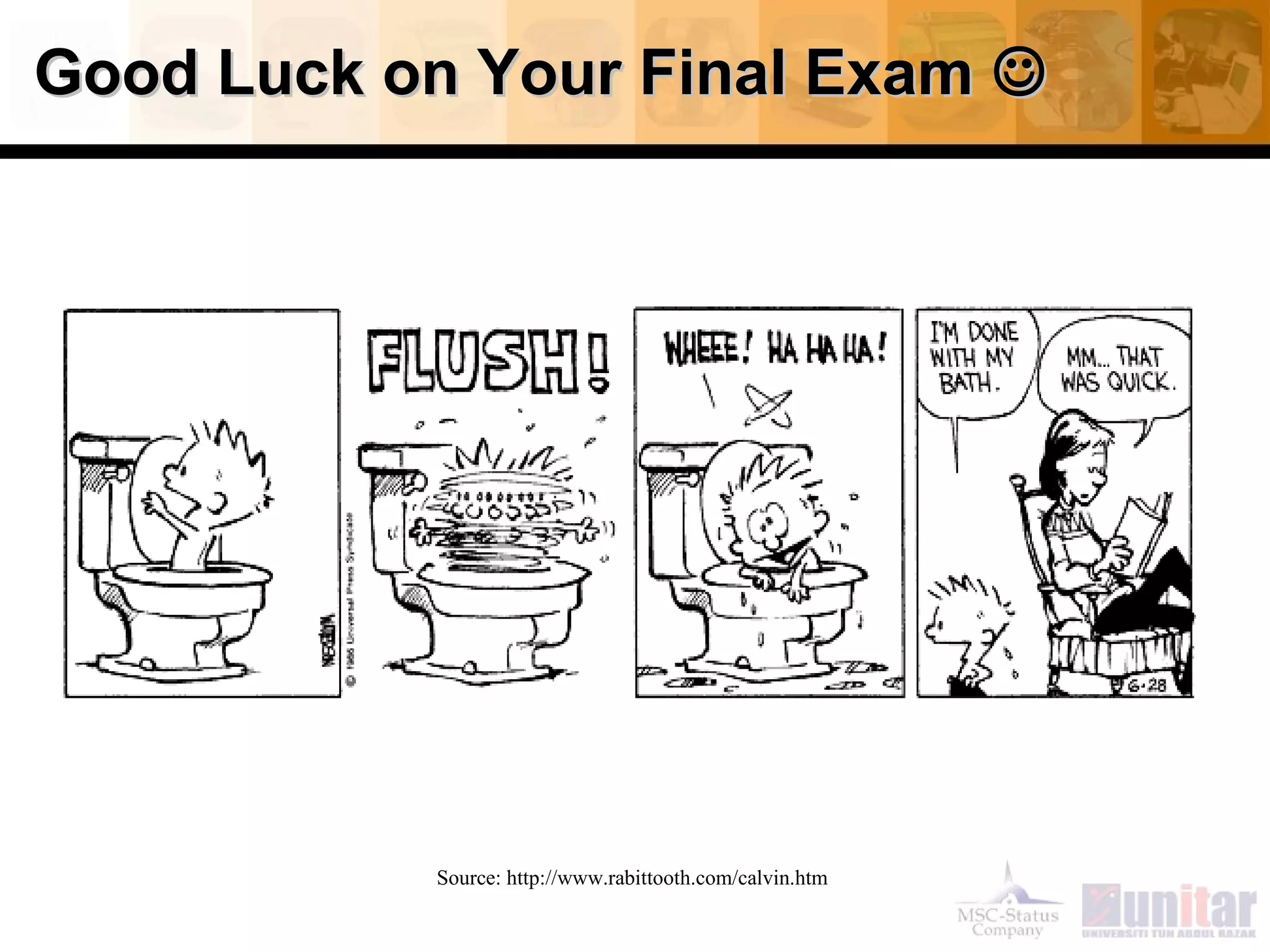
Good Luck on Your Final ExamGood Luck on Your Final Exam 
Source: http://www.rabittooth.com/calvin.htm
ReferencesReferences
OOnnlliinnee RReessoouurrcceess
Courseware - Module 5: Problem Solving
http://cw.unitar.edu.my/ugb2013/c5/index.htm
Problem Solving. URLs: http://en.wikipedia.org/wiki/Problem_solving
Edward de Bono 6 Thinking Hats. URL: http://
schoolnet.gov.mt/thinkingskills/thinkingtools.htm
Six Thinking Hats. URL:
http://www.learnerslink.com/SixThinkingHats.htm
Calvin’s faces: http://www.rabittooth.com/13_calvin/faces.jpg
Angry Teacher: http://www.webweaver.nu/clipart/img/education/angry-
teacher.gif
Titanic Sinking:
http://www.solarnavigator.net/images/titanic_sinking_atlantic.jpg
Contact DetailsContact Details
Zaid Ali AlsagoffZaid Ali Alsagoff
UNIVERSITI TUN ABDUL RAZAK
16-5, Jalan SS 6/12
47301 Kelana Jaya
Selangor Darul Ehsan
Malaysia
E-mail: zaid.alsagoff@gmail.com
Tel: 603-7627 7238
Fax: 603-7627 7246

Problem solving4112

  • 1.
    Zaid Ali Alsagoff zaid.alsagoff@gmail.com Module7:Module 7: Problem SolvingProblem Solving
  • 2.
    Should I ConsiderMoving?Should I Consider Moving?
  • 3.
    ScenarioScenario More students arefailing their courses thisMore students are failing their courses this year compared to last year.year compared to last year. Who is to blame?Who is to blame?
  • 4.
    Students’ Perspective?Students’ Perspective? UNITARCourses and Lecturers’ are soUNITAR Courses and Lecturers’ are so BORINGBORING andand DIFFICULT! HOW TO PASS?DIFFICULT! HOW TO PASS? UNITAR Courses and Lecturers’ are soUNITAR Courses and Lecturers’ are so BORINGBORING andand DIFFICULT! HOW TO PASS?DIFFICULT! HOW TO PASS?
  • 5.
    Teachers’ Perspective?Teachers’ Perspective? StudentsStudentsKNOW NOTHINGKNOW NOTHING!! They are bothThey are both LAZYLAZY andand STUPIDSTUPID! What a perfect! What a perfect combination to become ancombination to become an employable graduate!employable graduate! Yeah! BlameYeah! Blame it on us!it on us!
  • 6.
    How to solvethis problem?How to solve this problem? More students are failingMore students are failing their courses this yeartheir courses this year compared to last year.compared to last year. Let’s Watch a Video:Let’s Watch a Video: Teaching Teaching & UnderstandingTeaching Teaching & Understanding UnderstandingUnderstanding
  • 7.
    Module 7: ProblemSolvingModule 7: Problem Solving 3. Problem Solving Process4. Problem Solving Tools 1. What is Problem Solving? 2. Barriers to Effective Problem Solving
  • 8.
    “Problems call forthour courage and our wisdom; indeed, they create our courage and our wisdom. It is only because of problems that we grow mentally and spiritually.” - M. Scott Peck
  • 9.
    7.1 What isProblem Solving?7.1 What is Problem Solving? Problem solving forms part of thinking. Considered the most complex of all intellectual functions, problem solving has been defined as higher-order cognitive process that requires thehigher-order cognitive process that requires the modulation and control of more routine ormodulation and control of more routine or fundamental skillsfundamental skills (Goldstein & Levin, 1987). It occurs if an organism or an artificial intelligence system does not know how to proceed from adoes not know how to proceed from a given state to a desired goal stategiven state to a desired goal state. It is part of the larger problem process that includes problem finding and problem shaping. Source: http://en.wikipedia.org/wiki/Problem_solving
  • 10.
    “He who asksa question may be a fool for five minutes, but he who never asks a question remains a fool forever.” - Tom Connelly
  • 11.
    7.2 Barriers toEffective Problem Solving7.2 Barriers to Effective Problem Solving Failure to recognize the problemFailure to recognize the problem Conceiving the problem too narrowlyConceiving the problem too narrowly Making a hasty choiceMaking a hasty choice Failure to consider all consequencesFailure to consider all consequences Failure to consider the feasibility of theFailure to consider the feasibility of the solutionsolution
  • 12.
    “It's not thatI'm so smart, it's just that I stay with problems longer.” - Albert Einstein
  • 13.
    7.3 Problem SolvingProcess7.3 Problem Solving Process Accepting the ProblemAccepting the Problem Step 1: What is the Problem?Step 1: What is the Problem? Step 2: What Are the Alternatives?Step 2: What Are the Alternatives? Step 3: What Are the Advantages and/orStep 3: What Are the Advantages and/or Disadvantages of Each Alternative?Disadvantages of Each Alternative? Step 4: What Is the Solution?Step 4: What Is the Solution? Step 5: How Well Is the Solution Working?Step 5: How Well Is the Solution Working?
  • 14.
    Accepting the ProblemAcceptingthe Problem To solve a problem, you must first be willing to acceptaccept the problem by acknowledging that the problem existsproblem exists and committing yourself to trying to solve it. StrategiesStrategies to find the motivation and commitment to prepare you to enter the problem-solving process: 1.1. List the benefitsList the benefits. – how will solving the problem benefit you? 2.2. Formalize your acceptanceFormalize your acceptance.- formal commitment to solve problem 3.3. Accept responsibility for your lifeAccept responsibility for your life.- we have the potential to control the direction of our lives 4.4. Create a “worst-case” scenarioCreate a “worst-case” scenario.- what are potential disastrous consequences of your actions or inactions 5.5. Identify what’s holding you backIdentify what’s holding you back.- what is preventing you from solving the problem?
  • 15.
    Step 1: Whatis the Problem?Step 1: What is the Problem? Step 1A: What do I know about the situation?Step 1A: What do I know about the situation? Step 1B: What results am I aiming for in thisStep 1B: What results am I aiming for in this situation?situation? Step 1C: How can I define the problem?Step 1C: How can I define the problem?  View the problem from different perspectives.  Identify component problems.  State the problem clearly and specifically.
  • 16.
    Step 2: WhatAre the Alternatives?Step 2: What Are the Alternatives? Step 2A: What are the boundaries of the problemStep 2A: What are the boundaries of the problem situation?situation? Step 2B: What alternatives are possible withinStep 2B: What alternatives are possible within these boundaries?these boundaries?  Discuss the problem with other people.  Brainstorm ideas.  Change your location.
  • 17.
    Step 3: WhatAre the Advantages and/orStep 3: What Are the Advantages and/or Disadvantages of Each Alternative?Disadvantages of Each Alternative? Step 3A: What are the advantages of eachStep 3A: What are the advantages of each alternative?alternative? Step 3B: What are the disadvantages of eachStep 3B: What are the disadvantages of each alternative?alternative? Step 3C: What additional information do I needStep 3C: What additional information do I need to evaluate each alternative?to evaluate each alternative?
  • 18.
    Step 4: WhatIs the Solution?Step 4: What Is the Solution? Step 4A: Which alternative(s) will I pursue?Step 4A: Which alternative(s) will I pursue?  Evaluate and compare alternatives.  Combine alternatives.  Try out each alternative in your imagination. Step 4B: What steps can I take to act on theStep 4B: What steps can I take to act on the alternative(s) chosen?alternative(s) chosen?
  • 19.
    Step 5: HowWell Is the Solution Working?Step 5: How Well Is the Solution Working? Step 5A: What is my evaluation?Step 5A: What is my evaluation?  Compare the results with the goals.  Get other perspectives. Step 5B: What adjustments are necessary?Step 5B: What adjustments are necessary?
  • 20.
    “Because I'm thinkingin a broader way, I feel like I am able to make better decisions.” - Takafumi Horie
  • 21.
    6.4 Problem SolvingTools6.4 Problem Solving Tools Tools to facilitate effective Problem Solving:Tools to facilitate effective Problem Solving: CoRT (Module 2)CoRT (Module 2) SWOT ANALYSIS (Module 6)SWOT ANALYSIS (Module 6) SIX THINKING HATS (Next)SIX THINKING HATS (Next) PORTER’s 5 FORCESPORTER’s 5 FORCES FORCE FIELD ANALYSISFORCE FIELD ANALYSIS ISHIKAWA DIAGRAMISHIKAWA DIAGRAM MIND MAPPINGMIND MAPPING MoreMore  MyCotedMyCoted ++ Mind Tools +Mind Tools + Creativity WebCreativity Web I can study theseI can study these tools on my own.tools on my own. Click!Click!
  • 22.
    Edward de BonoEdwardde Bono ““The six thinking hats is a methodThe six thinking hats is a method for doing one sort of thinking at a time.”for doing one sort of thinking at a time.”
  • 23.
    6 Thinking Hats6Thinking Hats CreativeCreativeCreativeCreative PositivePositivePositivePositive ObjectiveObjectiveObjectiveObjective FeelingsFeelingsFeelingsFeelings NegativeNegativeNegativeNegative ProcessProcessProcessProcess
  • 24.
    Benefits of Using6 Thinking HatsBenefits of Using 6 Thinking Hats Role-playing (Put the hat on, take the hat off, switch hats, and signal your thinking) Encourage creative, parallel and lateral thinking Improve communication Speed up decision making Avoid debate Detaching the Ego Occasional Use (Single Hat) Sequence Use
  • 25.
    White Hat -ObjectiveWhite Hat - Objective Facts, Figures, Data and InformationFacts, Figures, Data and Information Questions: What information do we have here? What information is missing? What information would we like to have? How are we going to get the information?
  • 26.
    Red Hat –FeelingsRed Hat – Feelings Feelings, Intuition, Emotions and HunchesFeelings, Intuition, Emotions and Hunches No need to justify the feelings. How do I feel about this right now? Examples: My gut-feeling is that this will not work. I don't like the way this is being done. This proposal is terrible. My intuition tells me that prices will fall soon.
  • 27.
    Black Hat -NegativeBlack Hat - Negative Caution, Difficulty, Judgment and Assessment Questions: Is this true? Will it work? What are the weaknesses? What is wrong with it? Critical Thinking Hat
  • 28.
    Yellow Hat -PositiveYellow Hat - Positive Benefits, Feasibility and OptimismBenefits, Feasibility and Optimism Questions: Why is this worth doing? What are the benefits? Why can it be done? Why will it work?
  • 29.
    Green Hat -CreativeGreen Hat - Creative Creative Ideas, Alternatives, Suggestions, andCreative Ideas, Alternatives, Suggestions, and ProposalsProposals Questions: Are there any additional alternatives? Could we do this in a different way? Could there be another explanation? What are some possible solutions and courses of action? Creative Thinking Hat
  • 30.
    Blue Hat -ProcessBlue Hat - Process Sums up what is learned. Organization ofSums up what is learned. Organization of thinking. Thinking about the thinkingthinking. Thinking about the thinking process (Reflection).process (Reflection). Examples: Set the agenda. Suggest the next steps. Ask for other hats. Ask for summaries, conclusions, and decisions. Meta-Cognition Hat
  • 31.
    Sequence Use –SequenceUse – Seeking an IdeaSeeking an Idea White Gather available information. Green Explore and generate alternatives. Yellow Assess the benefits and feasibility of each alternative. Black Assess the weaknesses of each alternative. Green Further develop the most promising alternatives and make a choice. Blue Summarize and assess what has been achieved so far. Black Make the final judgment on the chosen alternative. Red Find out the feelings on the outcome.
  • 32.
    Sequence Use –SequenceUse – Reacting to a Presented IdeaReacting to a Presented Idea Red Find out the existing feelings about the idea. Yellow Find out the benefits in the idea. Black Point out the weaknesses, problems and dangers in the idea. Green See if the idea can be modified to strengthen the yellow-hat benefits and to overcome the black-hat problems. White See if available information can help in modifying the idea to make it more acceptable. Green Develop the final suggestion. Black Judge the final suggestion. Red Find out the feeling on the outcome.
  • 33.
    Sequence Use –SequenceUse – Short SequencesShort Sequences Yellow/Black/Red: Quick assessment (idea) White/Green: Generate ideas Black/Green: Improve an existing idea Blue/Green: Summarize & suggest alternatives Blue/Yellow: Any benefits? (e.g. the idea) Etc… ““...Be open-minded and creative about...Be open-minded and creative about the sequence use, too!”the sequence use, too!”
  • 34.
    Case Study Example:CaseStudy Example: Classroom Management - Six Thinking HatsClassroom Management - Six Thinking Hats Students Talking WhileStudents Talking While Dr. Cool is TeachingDr. Cool is Teaching Adapted from: Dyck, B. Case Study: Classroom Management - Six Thinking Hats URL: http://www.teachnet.com/how-to/manage/sixhats120800.html
  • 35.
    White Hat -Facts and InformationWhite Hat - Facts and Information Students are talking (or on their phones) when Dr. Cool is talking. There is noise so that others are distracted or can't hear. Students don't know what to do after Dr. Cool has given instructions. Many students get silly or off task. Adapted from: Dyck, B. Case Study: Classroom Management - Six Thinking Hats URL: http://www.teachnet.com/how-to/manage/sixhats120800.html
  • 36.
    Red Hat –Emotions and FeelingsRed Hat – Emotions and Feelings Dr. Cool feels offended. Students are frustrated because they can't hear his instructions. Those talking enjoy joking around and being heard. Adapted from: Dyck, B. Case Study: Classroom Management - Six Thinking Hats URL: http://www.teachnet.com/how-to/manage/sixhats120800.html
  • 37.
    Black Hat -BlackHat - Negative AspectsNegative Aspects Time is wasted. Learning is compromised. Those who legitimately have the floor feel that listeners. don't care about what they are saying. Chaos in the classroom. Adapted from: Dyck, B. Case Study: Classroom Management - Six Thinking Hats URL: http://www.teachnet.com/how-to/manage/sixhats120800.html
  • 38.
    Yellow Hat -Benefits and FeasibilityYellow Hat - Benefits and Feasibility Everyone gets to say what is on their mind. It can be fun. You don't have to wait until you speak and therefore don't forget what you want to say. Not just the "smart" students get to speak. Adapted from: Dyck, B. Case Study: Classroom Management - Six Thinking Hats URL: http://www.teachnet.com/how-to/manage/sixhats120800.html
  • 39.
    Green Hat -Creative IdeasGreen Hat - Creative Ideas Dr. Cool will be more aware of the amount of time that he "talks“. He will try to include interaction from many different students, not just the "smart" ones. Students will work on resisting the need to say everything that comes into their mind. There needs to be further discussion on "how" students would work on this problem. Students will think about whether their comments will interfere with other people's learning. We will keep these charts up so that we can refer back to the learning of this moment and reassess how we are doing. Adapted from: Dyck, B. Case Study: Classroom Management - Six Thinking Hats URL: http://www.teachnet.com/how-to/manage/sixhats120800.html
  • 40.
    Blue Hat -Sum up what is learnedBlue Hat - Sum up what is learned Dr. Cool learned that he needs to limit the amount of time he uses "Talking" as a form of teaching. He needs to involve all students in discussion. He needs to look for the one who rarely offers comments or is quietly waiting to be picked to answer. He needs to realize that some students need "think time" before they are ready to contribute to a discussion. Allowing time for these students to think is important part of class discussion so they don't tune out. Students now realize that when they talk when others are talking it makes the person talking feel like a fool or unappreciated. Students realize that just to "get the laugh" of the moment, they are jeopardizing other people's learning. Students learned that speaking whenever you want show a lack of self- discipline and that not everything that goes through our minds is worth sharing. Teacher/student needs to revisit this topic and check how we are doing. Adapted from: Dyck, B. Case Study: Classroom Management - Six Thinking Hats URL: http://www.teachnet.com/how-to/manage/sixhats120800.html
  • 42.
    INSTRUCTIONSINSTRUCTIONS Class Activity –Six Thinking HatsClass Activity – Six Thinking Hats This Six Thinking HatsSix Thinking Hats activity involves the whole class. One student (or the lecturer) will act as the class facilitatorclass facilitator (and time keeper). One student will write on the whiteboardwrite on the whiteboard the class findings. One student will documentdocument the findingsthe findings into the word template. The whole class will do parallel thinking to discuss the problem 3 min Brainstorm a Problem to discuss. 3 min White Hat – Facts and information about the Problem? 3 min Red Hat – Feelings towards the Problem? 3 min Black Hat – What are the negative aspects of the Problem? 3 min Yellow Hat – What are the benefits/positive aspects of the Problem? 3 min Green Hat – What alternatives do we have? 7 min Blue Hat - Sum what is learned and discuss possible next steps. 25 min Total
  • 43.
    SummarySummary 7.1 What is ProblemSolving? Higher-order cognitive process that requires the modulation and control of more routine or fundamental skills. 7.2 Barriers to Effective Problem Solving  Failure to recognize the problem  Conceiving the problem too narrowly  Making a hasty choice  Failure to consider all consequences  Failure to consider the feasibility of the solution 7.3 Problem Solving Process Accepting the Problem 1. What is the Problem? 2. What Are the Alternatives? 3. What Are the Advantages and/or Disadvantages of Each Alternative? 4. What Is the Solution? 5. How Well Is the Solution Working? 7.4 Problem Solving Tools  CoRT SWOT Analysis  Six Thinking Hats  Etc.
  • 44.
  • 45.
    Good Luck onYour Final ExamGood Luck on Your Final Exam  Source: http://www.rabittooth.com/calvin.htm
  • 46.
    ReferencesReferences OOnnlliinnee RReessoouurrcceess Courseware -Module 5: Problem Solving http://cw.unitar.edu.my/ugb2013/c5/index.htm Problem Solving. URLs: http://en.wikipedia.org/wiki/Problem_solving Edward de Bono 6 Thinking Hats. URL: http:// schoolnet.gov.mt/thinkingskills/thinkingtools.htm Six Thinking Hats. URL: http://www.learnerslink.com/SixThinkingHats.htm Calvin’s faces: http://www.rabittooth.com/13_calvin/faces.jpg Angry Teacher: http://www.webweaver.nu/clipart/img/education/angry- teacher.gif Titanic Sinking: http://www.solarnavigator.net/images/titanic_sinking_atlantic.jpg
  • 47.
    Contact DetailsContact Details ZaidAli AlsagoffZaid Ali Alsagoff UNIVERSITI TUN ABDUL RAZAK 16-5, Jalan SS 6/12 47301 Kelana Jaya Selangor Darul Ehsan Malaysia E-mail: zaid.alsagoff@gmail.com Tel: 603-7627 7238 Fax: 603-7627 7246