Lesson Two Problem Solving Skills
What is problem solving? Problem solving is a tool, a skill and a process. It is a tool because it can help you solve an immediate problem or to achieve a goal.
What is problem solving? It is a skill because once you have learnt it you can use it repeatedly, like the ability to ride a bicycle, add numbers or speak a language.  It is also a process because it involves taking a number of steps.
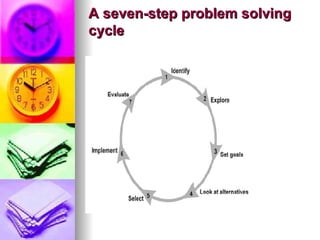
A seven-step problem solving cycle There are a variety of problem solving processes but each process consists of a series of steps, including identifying an issue, searching for options and putting a possible solution into action.  It is useful to view problem solving as a cycle because, sometimes, a problem needs several attempts to solve it, or the problem changes.
A seven-step problem solving cycle
Step 1. Identify the problem The first step you need to take is to identify and name the problem so that you can find an appropriate solution.
Step 2. Explore the problem When you are clear about what the problem is you need to think about it in different ways. You can ask yourself questions such as: ‘ How is this problem affecting me?’  ‘ How is it affecting others?’  ‘ Who else experiences this problem?’  ‘ What do they do about it?’
Step 3. Set goals Once you have thought about the problem from different angles you can identify your goals.  What is it that you want to achieve? Sometimes you might get so frustrated by a problem that you forget to think about what you want.
Step 4. Look at Alternatives When you have decided what your goal is you need to look for possible solutions.  The more possible solutions you find the more likely it is that you will be able to discover an effective solution. You can  brain-storm  for ideas.  The purpose of brain-storming is to collect together a long list of possibilities.
Step 5. Select a possible solution From the list of possible solutions you can sort out which are most relevant to your situation and which are realistic and manageable.  You can do this by predicting outcomes for possible solutions and also checking with other people what they think outcomes might be.
Step 6. Implement a possible solution Once you have selected a possible solution you are ready to put it into action. You will need to have energy and motivation to do this because implementing the solution may take some time and effort.
Step 7. Evaluate Just because you have worked your way through the problem solving process it does not mean that, by implementing the possible solution, you automatically solve your problem.
When to use problem solving You can problem solve anytime you have a problem to solve or a goal to achieve.  You can use the problem solving model to look for solutions to issues connected with your study, relationships, work or sport.  You can take the problem solving steps by yourself, with a friend, or in a group.
When to use problem solving Problem solving with others is often very effective because you have access to a wide variety of viewpoints and potential solutions.  The problem solving model is a useful resource for you to utilise in your personal, academic and professional lives.
Obtained from: http://www.unisanet.unisa.edu.au/learningconnection/student/counselling/problemsolving.asp

Lesson Two

  • 1.
    Lesson Two ProblemSolving Skills
  • 2.
    What is problemsolving? Problem solving is a tool, a skill and a process. It is a tool because it can help you solve an immediate problem or to achieve a goal.
  • 3.
    What is problemsolving? It is a skill because once you have learnt it you can use it repeatedly, like the ability to ride a bicycle, add numbers or speak a language. It is also a process because it involves taking a number of steps.
  • 4.
    A seven-step problemsolving cycle There are a variety of problem solving processes but each process consists of a series of steps, including identifying an issue, searching for options and putting a possible solution into action. It is useful to view problem solving as a cycle because, sometimes, a problem needs several attempts to solve it, or the problem changes.
  • 5.
    A seven-step problemsolving cycle
  • 6.
    Step 1. Identifythe problem The first step you need to take is to identify and name the problem so that you can find an appropriate solution.
  • 7.
    Step 2. Explorethe problem When you are clear about what the problem is you need to think about it in different ways. You can ask yourself questions such as: ‘ How is this problem affecting me?’ ‘ How is it affecting others?’ ‘ Who else experiences this problem?’ ‘ What do they do about it?’
  • 8.
    Step 3. Setgoals Once you have thought about the problem from different angles you can identify your goals. What is it that you want to achieve? Sometimes you might get so frustrated by a problem that you forget to think about what you want.
  • 9.
    Step 4. Lookat Alternatives When you have decided what your goal is you need to look for possible solutions. The more possible solutions you find the more likely it is that you will be able to discover an effective solution. You can brain-storm for ideas. The purpose of brain-storming is to collect together a long list of possibilities.
  • 10.
    Step 5. Selecta possible solution From the list of possible solutions you can sort out which are most relevant to your situation and which are realistic and manageable. You can do this by predicting outcomes for possible solutions and also checking with other people what they think outcomes might be.
  • 11.
    Step 6. Implementa possible solution Once you have selected a possible solution you are ready to put it into action. You will need to have energy and motivation to do this because implementing the solution may take some time and effort.
  • 12.
    Step 7. EvaluateJust because you have worked your way through the problem solving process it does not mean that, by implementing the possible solution, you automatically solve your problem.
  • 13.
    When to useproblem solving You can problem solve anytime you have a problem to solve or a goal to achieve. You can use the problem solving model to look for solutions to issues connected with your study, relationships, work or sport. You can take the problem solving steps by yourself, with a friend, or in a group.
  • 14.
    When to useproblem solving Problem solving with others is often very effective because you have access to a wide variety of viewpoints and potential solutions. The problem solving model is a useful resource for you to utilise in your personal, academic and professional lives.
  • 15.