




DecisionMaking &
Problem Solving
Leadershipfor ManagerandSupervisor
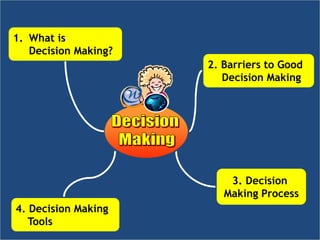
3. Decision
Making Process
4. Decision Making
Tools
1. What is
Decision Making?
2. Barriers to Good
Decision Making
What is Decision Making?
Please write a One Sentence
Definition of
DECISION MAKING
What are the
things you
consider before
making a
decision?
What are the
things you
consider before
making a
decision?
Definition
Decision Making:
The cognitive process leading to the
selection of some action among alternatives.
or
The process of examining your possibilities
options, comparing them, and choosing a
course of action.
 Every decision making process produces a
final choice. It can be an action or an
opinion.
 It begins when we need to do something but
we do not know what. Therefore, decision
making is a reasoning process which can be
rational or irrational, and can be based on
explicit assumptions or tacit assumptions.
 Examples:
Shopping, deciding what to eat,
what to wear, when to sleep, etc..
Decision Making
Related Quotes
“Be sure you are right -- then go ahead.”
Davy Crocket.
“Doing what's right isn't hard -- Knowing what's
right is.” Lyndon B. Johnson.
“Mine own applause is the only applause which
matters.” Cicero.
“Once you've made your mark, watch out for
erasers!” Will Rogers.
Six C's of Decision Making (1 of 2)
 Construct a clear picture of
precisely what must be decided.
 Compile a list of requirements that
must be met.
 Collect information on alternatives
that meet the requirements.
Six C's of Decision Making (2 of 2)
 Compare alternatives that meet
the requirements.
 Consider the "what might go wrong"
factor with each alternative.
 Commit to a decision and follow
through with it.
Inherent Personal Traps
 Trying too hard to play it safe.
 Letting fears and biases tilt your
thinking and analysis.
 Getting lost in the minutia can cause
trouble.
 Craving for unanimous approval.
 Trying to make decisions which are
outside your realm of authority.
• Berusaha terlalu keras untukbermain aman.
• Membiarkan ketakutandan bias dalam pemikiran dan
analisis.
• Tersesat dalam hal-halkecilyang dapat menyebabkan
masalah.
• Mendambakan persetujuan dengan suara bulat.
• Mencoba membuat keputusanyang berada di luar
kewenangan.
Inherent System Traps
 Willing to begin with too little,
inaccurate, or wrong information.
 Overlook viable alternatives or waste
time considering alternatives which
have no realistic prospects.
 Not following the six C's.
 Failure to clearly define the results you
expect to achieve.
 Worst of all, failure to reach a decision.
• Bersediamemulaidenganinformasiyangterlalusedikit,dangkal,
tidakakurat,atausalah.
• Mengabaikanalternatifyanglayakataubuangwaktudengan
mempertimbangkanalternatifyangtidakmemilikiprospek
realistis.
• TidakmengikutiSix’C.
• KegagalanuntuksecarajelasmendefinisikanhasilyanginginAnda
capai.
• Yangterburuk,kegagalan untukmengambilkeputusan.
Barriers to GoodDecision Making
"Pemimpin yang sukses memiliki keberanian untuk mengambil tindakan
sementara yang lain ragu."
Barriers to Good Decision Making
 Hasty - Making quick decisions without having much
thought.
 Narrow - Decision making is based on very limited
information.
 Scattered - Our thoughts in making decisions are
disconnected or disorganized.
 Fuzzy - Sometimes, the lack of clarity on important
aspects of a decision causes us to overlook certain
important considerations.
The Decision-Making Process
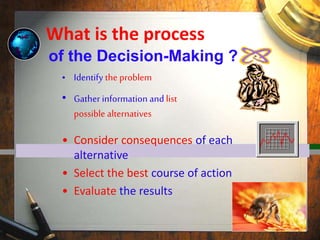
What is the process
• Identify the problem
• Gather information and list
possible alternatives
• Consider consequences of each
alternative
• Select the best course of action
• Evaluate the results
of the Decision-Making ?
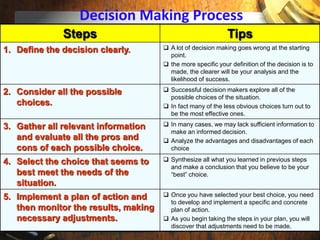
Decision Making Process
Steps Tips
1. Define the decision clearly.  A lot of decision making goes wrong at the starting
point.
 the more specific your definition of the decision is to
made, the clearer will be your analysis and the
likelihood of success.
2. Consider all the possible
choices.
 Successful decision makers explore all of the
possible choices of the situation.
 In fact many of the less obvious choices turn out to
be the most effective ones.
3. Gather all relevant information
and evaluate all the pros and
cons of each possible choice.
 In many cases, we may lack sufficient information to
make an informed decision.
 Analyze the advantages and disadvantages of each
choice
4. Select the choice that seems to
best meet the needs of the
situation.
 Synthesize all what you learned in previous steps
and make a conclusion that you believe to be your
“best” choice.
5. Implement a plan of action and
then monitor the results, making
necessary adjustments.
 Once you have selected your best choice, you need
to develop and implement a specific and concrete
plan of action.
 As you begin taking the steps in your plan, you will
discover that adjustments need to be made.
What factors can influence
a decision?
 Values
 Peers
 Habits
 Feelings (love, anger, frustration, ambivalence,
rejection)
 Family
 Risksand consequences
 Age
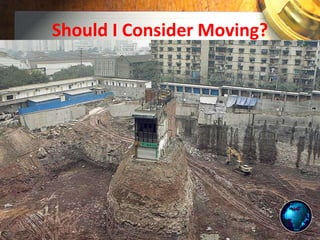
Should I Consider Moving?
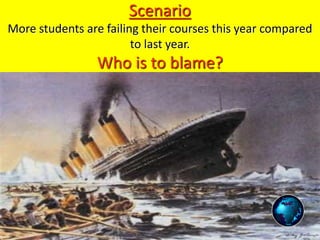
Scenario
More students are failing their courses this year compared
to last year.
Who is to blame?
Apa yang
Anda LIHAT
& Pikirkan?
What is Problem Solving?
• Problem solving forms part of thinking.
• Considered the most complex of all intellectual functions,
problem solving has been defined as higher-order
cognitive process that requires the modulation and
control of more routine or fundamental skills (Goldstein
& Levin).
• It occurs if an organism or an artificial intelligence system
does not know how to proceed from a given state to a
desired goal state.
• It is part of the larger problem process that includes
problem finding and problem shaping.
• Pemecahan masalah merupakan bagian dari pemikiran dan dianggap yang paling
kompleks dari semuafungsi intelektual.
• Pemecahan masalah didefinisikan sebagai proses kognitif tingkat tinggi yang
membutuhkan modulasi dankontrol dariketerampilan yang lebih rutin atau mendasar
(Goldstein & Levin).
• Itu terjadi jika suatu organisme atau sistem kecerdasan buatan tidak mengetahui
bagaimana melanjutkan dari suatu keadaan tertentu kearah tujuan yang diinginkan.
• Ini adalah bagian dari proses masalah yang lebih besaryang mencakup penemuan
masalah danpembentukan masalah.
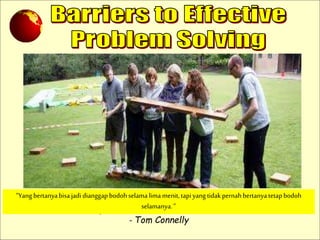
“He who asks a question may be a fool for five minutes, but he who never asks a
question remains a fool forever.”
- Tom Connelly
“Yangbertanyabisajadi dianggapbodohselama lima menit,tapiyangtidakpernahbertanyatetapbodoh
selamanya.”
Barriers to Effective Problem Solving
• Failure to recognize the problem
• Conceiving the problem too narrowly
• Making a hasty choice
• Failure to consider all consequences
• Failure to consider the feasibility of the solution
XX• Gagal mengenali masalahnya
• Memahami masalahterlalu sempit
• Membuat pilihanyang terburu-buru
• Kegagalanuntuk mempertimbangkan semua konsekuensi
• Kegagalanuntuk mempertimbangkan kelayakansolusi
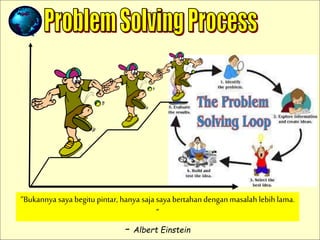
“It's not that I'm so smart, it's just that I
stay with problems longer.”
- Albert Einstein
“Bukannya saya begitu pintar, hanya saja saya bertahan dengan masalah lebih lama.
”
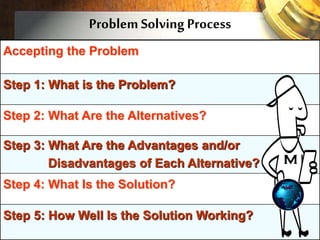
Problem Solving Process
Accepting the Problem
Step 1: What is the Problem?
Step 2: What Are the Alternatives?
Step 3: What Are the Advantages and/or
Disadvantages of Each Alternative?
Step 4: What Is the Solution?
Step 5: How Well Is the Solution Working?
Accepting the Problem …
• To solve a problem, you must first be willing to
accept the problem by acknowledging that the
problem exists and committing yourself to trying
to solve it.
• Strategies to find the motivation and commitment
to prepare you to enter the problem-solving
process:
1. List the benefits. – how will solving the problem benefit
you?
2. Formalize your acceptance.- formal commitment to
solve problem
3. Accept responsibility for your life.- we have the
potential to control the direction of our lives
4. Create a “worst-case” scenario.- what are potential
disastrous consequences of your actions or inactions
5. Identify what’s holding you back.- what is preventing
you from solving the problem?
Step 1: What is the Problem?
• Step 1A: What do I know about the situation?
• Step 1B: What results am I aiming for in this
situation?
• Step 1C: How can I define the problem?
– View the problem from different perspectives.
– Identify component problems.
– State the problem clearly and specifically.
Step 2: What Are the Alternatives?
• Step 2A: What are the boundaries of the problem
situation?
• Step 2B: What alternatives are possible within these
boundaries?
– Discuss the problem with other people.
– Brainstorm ideas.
– Change your location.
Step 3: What Are the Advantages and/or
Disadvantages of Each Alternative?
• Step 3A: What are the advantages of each
alternative?
• Step 3B: What are the disadvantages of each
alternative?
• Step 3C: What additional information do I need to
evaluate each alternative?
Step 4: What Is the Solution?
• Step 4A: Which alternative(s) will I pursue?
– Evaluate and compare alternatives.
– Combine alternatives.
– Try out each alternative in your imagination.
• Step 4B: What steps can I take to act on the
alternative(s) chosen?
Step 5: How Well Is the Solution Working?
• Step 5A: What is my evaluation?
– Compare the results with the goals.
– Get other perspectives.
• Step 5B: What adjustments are necessary?
“Because I'm thinking in a broader way, I feel like
I am able to make better decisions.”
- Takafumi Horie
“Karenasaya berpikir dengan cara yang lebih luas, saya merasa dapat membuat
keputusan yang lebih baik.”
- Takafumi Horie
Decision Making &
Problem Solving Tools
 SWOT/TOWSAnalysis
 ParetoAnalysis
 Paired Comparison Analysis
 Grid Analysis
 Decision Trees
 Force Field Analysis
 Six Thinking Hats
 Plus-Minus-Interesting(PMI)
 Cost/Benefit Analysis
 etc.
www.slideshare.net/kenkanaidi
(Narasumber)
www.ken-spektakuler.blogspot.com
e-mail: kanaidi63@gmail.com atau
kanaidi@yahoo.com
Fax. 022-4267749 HP. 0812 2353 284
WA. 0877 5871 1905
www.antawijaya.com

Decision Making & Problem Solving _ Materi Training "LEADERSHIP for Manager & Supervisor"

  • 1.
  • 2.
    3. Decision Making Process 4.Decision Making Tools 1. What is Decision Making? 2. Barriers to Good Decision Making
  • 3.
    What is DecisionMaking? Please write a One Sentence Definition of DECISION MAKING
  • 4.
    What are the thingsyou consider before making a decision?
  • 5.
    What are the thingsyou consider before making a decision?
  • 6.
    Definition Decision Making: The cognitiveprocess leading to the selection of some action among alternatives. or The process of examining your possibilities options, comparing them, and choosing a course of action.
  • 7.
     Every decisionmaking process produces a final choice. It can be an action or an opinion.  It begins when we need to do something but we do not know what. Therefore, decision making is a reasoning process which can be rational or irrational, and can be based on explicit assumptions or tacit assumptions.  Examples: Shopping, deciding what to eat, what to wear, when to sleep, etc.. Decision Making
  • 8.
    Related Quotes “Be sureyou are right -- then go ahead.” Davy Crocket. “Doing what's right isn't hard -- Knowing what's right is.” Lyndon B. Johnson. “Mine own applause is the only applause which matters.” Cicero. “Once you've made your mark, watch out for erasers!” Will Rogers.
  • 9.
    Six C's ofDecision Making (1 of 2)  Construct a clear picture of precisely what must be decided.  Compile a list of requirements that must be met.  Collect information on alternatives that meet the requirements.
  • 10.
    Six C's ofDecision Making (2 of 2)  Compare alternatives that meet the requirements.  Consider the "what might go wrong" factor with each alternative.  Commit to a decision and follow through with it.
  • 11.
    Inherent Personal Traps Trying too hard to play it safe.  Letting fears and biases tilt your thinking and analysis.  Getting lost in the minutia can cause trouble.  Craving for unanimous approval.  Trying to make decisions which are outside your realm of authority. • Berusaha terlalu keras untukbermain aman. • Membiarkan ketakutandan bias dalam pemikiran dan analisis. • Tersesat dalam hal-halkecilyang dapat menyebabkan masalah. • Mendambakan persetujuan dengan suara bulat. • Mencoba membuat keputusanyang berada di luar kewenangan.
  • 12.
    Inherent System Traps Willing to begin with too little, inaccurate, or wrong information.  Overlook viable alternatives or waste time considering alternatives which have no realistic prospects.  Not following the six C's.  Failure to clearly define the results you expect to achieve.  Worst of all, failure to reach a decision. • Bersediamemulaidenganinformasiyangterlalusedikit,dangkal, tidakakurat,atausalah. • Mengabaikanalternatifyanglayakataubuangwaktudengan mempertimbangkanalternatifyangtidakmemilikiprospek realistis. • TidakmengikutiSix’C. • KegagalanuntuksecarajelasmendefinisikanhasilyanginginAnda capai. • Yangterburuk,kegagalan untukmengambilkeputusan.
  • 13.
    Barriers to GoodDecisionMaking "Pemimpin yang sukses memiliki keberanian untuk mengambil tindakan sementara yang lain ragu."
  • 14.
    Barriers to GoodDecision Making  Hasty - Making quick decisions without having much thought.  Narrow - Decision making is based on very limited information.  Scattered - Our thoughts in making decisions are disconnected or disorganized.  Fuzzy - Sometimes, the lack of clarity on important aspects of a decision causes us to overlook certain important considerations.
  • 15.
  • 16.
    What is theprocess • Identify the problem • Gather information and list possible alternatives • Consider consequences of each alternative • Select the best course of action • Evaluate the results of the Decision-Making ?
  • 17.
    Decision Making Process StepsTips 1. Define the decision clearly.  A lot of decision making goes wrong at the starting point.  the more specific your definition of the decision is to made, the clearer will be your analysis and the likelihood of success. 2. Consider all the possible choices.  Successful decision makers explore all of the possible choices of the situation.  In fact many of the less obvious choices turn out to be the most effective ones. 3. Gather all relevant information and evaluate all the pros and cons of each possible choice.  In many cases, we may lack sufficient information to make an informed decision.  Analyze the advantages and disadvantages of each choice 4. Select the choice that seems to best meet the needs of the situation.  Synthesize all what you learned in previous steps and make a conclusion that you believe to be your “best” choice. 5. Implement a plan of action and then monitor the results, making necessary adjustments.  Once you have selected your best choice, you need to develop and implement a specific and concrete plan of action.  As you begin taking the steps in your plan, you will discover that adjustments need to be made.
  • 18.
    What factors caninfluence a decision?  Values  Peers  Habits  Feelings (love, anger, frustration, ambivalence, rejection)  Family  Risksand consequences  Age
  • 20.
  • 21.
    Scenario More students arefailing their courses this year compared to last year. Who is to blame?
  • 22.
  • 23.
    What is ProblemSolving? • Problem solving forms part of thinking. • Considered the most complex of all intellectual functions, problem solving has been defined as higher-order cognitive process that requires the modulation and control of more routine or fundamental skills (Goldstein & Levin). • It occurs if an organism or an artificial intelligence system does not know how to proceed from a given state to a desired goal state. • It is part of the larger problem process that includes problem finding and problem shaping. • Pemecahan masalah merupakan bagian dari pemikiran dan dianggap yang paling kompleks dari semuafungsi intelektual. • Pemecahan masalah didefinisikan sebagai proses kognitif tingkat tinggi yang membutuhkan modulasi dankontrol dariketerampilan yang lebih rutin atau mendasar (Goldstein & Levin). • Itu terjadi jika suatu organisme atau sistem kecerdasan buatan tidak mengetahui bagaimana melanjutkan dari suatu keadaan tertentu kearah tujuan yang diinginkan. • Ini adalah bagian dari proses masalah yang lebih besaryang mencakup penemuan masalah danpembentukan masalah.
  • 24.
    “He who asksa question may be a fool for five minutes, but he who never asks a question remains a fool forever.” - Tom Connelly “Yangbertanyabisajadi dianggapbodohselama lima menit,tapiyangtidakpernahbertanyatetapbodoh selamanya.”
  • 25.
    Barriers to EffectiveProblem Solving • Failure to recognize the problem • Conceiving the problem too narrowly • Making a hasty choice • Failure to consider all consequences • Failure to consider the feasibility of the solution XX• Gagal mengenali masalahnya • Memahami masalahterlalu sempit • Membuat pilihanyang terburu-buru • Kegagalanuntuk mempertimbangkan semua konsekuensi • Kegagalanuntuk mempertimbangkan kelayakansolusi
  • 26.
    “It's not thatI'm so smart, it's just that I stay with problems longer.” - Albert Einstein “Bukannya saya begitu pintar, hanya saja saya bertahan dengan masalah lebih lama. ”
  • 27.
    Problem Solving Process Acceptingthe Problem Step 1: What is the Problem? Step 2: What Are the Alternatives? Step 3: What Are the Advantages and/or Disadvantages of Each Alternative? Step 4: What Is the Solution? Step 5: How Well Is the Solution Working?
  • 28.
    Accepting the Problem… • To solve a problem, you must first be willing to accept the problem by acknowledging that the problem exists and committing yourself to trying to solve it. • Strategies to find the motivation and commitment to prepare you to enter the problem-solving process: 1. List the benefits. – how will solving the problem benefit you? 2. Formalize your acceptance.- formal commitment to solve problem 3. Accept responsibility for your life.- we have the potential to control the direction of our lives 4. Create a “worst-case” scenario.- what are potential disastrous consequences of your actions or inactions 5. Identify what’s holding you back.- what is preventing you from solving the problem?
  • 29.
    Step 1: Whatis the Problem? • Step 1A: What do I know about the situation? • Step 1B: What results am I aiming for in this situation? • Step 1C: How can I define the problem? – View the problem from different perspectives. – Identify component problems. – State the problem clearly and specifically.
  • 30.
    Step 2: WhatAre the Alternatives? • Step 2A: What are the boundaries of the problem situation? • Step 2B: What alternatives are possible within these boundaries? – Discuss the problem with other people. – Brainstorm ideas. – Change your location.
  • 31.
    Step 3: WhatAre the Advantages and/or Disadvantages of Each Alternative? • Step 3A: What are the advantages of each alternative? • Step 3B: What are the disadvantages of each alternative? • Step 3C: What additional information do I need to evaluate each alternative?
  • 32.
    Step 4: WhatIs the Solution? • Step 4A: Which alternative(s) will I pursue? – Evaluate and compare alternatives. – Combine alternatives. – Try out each alternative in your imagination. • Step 4B: What steps can I take to act on the alternative(s) chosen?
  • 33.
    Step 5: HowWell Is the Solution Working? • Step 5A: What is my evaluation? – Compare the results with the goals. – Get other perspectives. • Step 5B: What adjustments are necessary?
  • 34.
    “Because I'm thinkingin a broader way, I feel like I am able to make better decisions.” - Takafumi Horie “Karenasaya berpikir dengan cara yang lebih luas, saya merasa dapat membuat keputusan yang lebih baik.” - Takafumi Horie
  • 35.
    Decision Making & ProblemSolving Tools  SWOT/TOWSAnalysis  ParetoAnalysis  Paired Comparison Analysis  Grid Analysis  Decision Trees  Force Field Analysis  Six Thinking Hats  Plus-Minus-Interesting(PMI)  Cost/Benefit Analysis  etc.
  • 36.