By
Mutahir Shah
Resident M Phil VS
Pakistan Institute of Community Ophthalmology
Medical Treatment of Glaucoma
Medical Treatment for
Glaucoma
 Most glaucoma medications are administered
topically , but the absorption may occurs
systemically as it passes through the lacrial
drainage system
 It can be overcome by applying a digital pressure
on the lacrimal sac for three minutes so that to
enhance the drug contact time with the eye is
prolonged.
 Glaucoma medications should be avoided in
pregnancy if possible, with systemic carbonic
anhydrase inhibitors perhaps carrying the
greatest risk due to teratogenicity concerns.
Major Groups of Drugs Treating
Gluacoma
 Prostaglandin Analogues
 ß Blockers
 Carbonic Anhydrase Inhibitors
 Alph 2 Agonist
 Miotics
 Combined Therapy
 Osmotic Agents
Prostaglandin Analogues
 Mechanism of Action:
 The major mode of prostaglandin (PG) action is the
enhancement of uveoscleral aqueous outflow,
although increased trabecular outflow facility and
other mechanisms have been identified.
 There IOP lowering effect is usually greater than
the others but some time equal to Beta Blockers.
 A prostaglandin derivative is now typically
preferred to a beta-blocker as first-line treatment
for glaucoma due to the latter’s potential for
systemic side effects.
 Duration of action may extends to days when
applied at bed time.
Agents
 • Latanoprost may cause fewer ocular adverse
events than other PG agents and so is often used
first line, although as a proportion of patients
show no response many practitioners prefer initial
use of an alternative.
 • Travoprost is similar to latanoprost, though it
may lower IOP to a slightly greater extent,
particularly in black patients. Polyquad® is a
novel proprietary preservative introduced by a
major pharmaceutical manufacturer in its
travoprost formulation that may reduce ocular
surface-related adverse effects
 Bimatoprost
 It has been shown to have a greater IOP-lowering
effect than the other PG agents in several studies, but
may cause more conjunctival hyperaemia but fewer
headaches and perhaps also less iris
hyperpigmentation. A newer 0.01% (versus the older
0.03%) preparation may have a comparable IOP-
lowering effect but with less hyperaemia.
Preservative-free bimatoprost is now available.
 • Tafluprost
 it is a newer prostaglandin derivative, and was the
first available in preservative-free form. Its IOP-
lowering efficacy may be slightly less than that of
other PG agents, but it is well tolerated and seems to
cause less disruption of the ocular surface.
Side effects
 Conjunctival hyperemia is very common.
 Eyelash lengthening, thickening, hyper pigmentation and
occasionally increase in number.
 Irreversible iris hyper pigmentation occurs in up to a
quarter of patients after 6 months. The highest incidence
is in
 green–brown irides,
 less in yellow-brown irides and
 least in blue-grey/brown irides.
 It is caused by an increase in the number of pigmented
granules within the superficial stroma rather than an
increase in the number of melanocytes
 Hyper pigmentation of periocular skin is common but
reversible.
 Preoperative use of PG agents may increase the
likelihood of cystoid macular oedema following cataract
 Anterior uveitis is rare, but prostaglandins should
be used with caution in inflamed eyes.
 Promotion of herpetic keratitis can occur, so
prostaglandins should be used with caution in
patients with a history of the condition.
 Systemic side effects
 include occasional headache, precipitation of
migraine in susceptible individuals, malaise,
myalgia, skin rash and mild upper respiratory tract
symptoms.
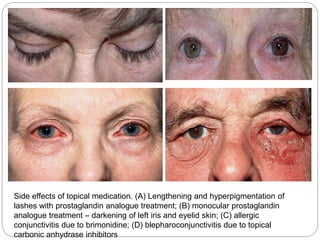
Side effects of topical medication. (A) Lengthening and hyperpigmentation of
lashes with prostaglandin analogue treatment; (B) monocular prostaglandin
analogue treatment – darkening of left iris and eyelid skin; (C) allergic
conjunctivitis due to brimonidine; (D) blepharoconjunctivitis due to topical
carbonic anhydrase inhibitors
Beta Blockers
 Beta-blockers reduce IOP by decreasing aqueous
production, mediated by an effect on the ciliary
epithelium.
 Beta-blockers should not be instilled at bedtime
as they may cause a profound drop in blood
pressure while the individual is asleep, thus
reducing optic disc perfusion and potentially
causing visual field deterioration
 the IOP-lowering effect is also believed to be less
marked during sleep, as nocturnal aqueous
production is normally less than half the daytime
rate
 However, a beta-blocker may be preferred under
some circumstances such as monocular
Agents:
 Betaxolol (0.25-0.5%) Betoptic S available
generically in suspension form. And the only
cardioselective drug.
 Carteolol (1%)
 Levobunalol (0.25-0.50%) Betagan generic name
can be used at overnight in hypertensive patient
that are on AHD.
 Metipranalol the only preservative free B blockers
of this group.
 Timolol Maleate (0.25-0.5%)
Side Effects
 Ocular.
 Ocular side effects are few but include
 allergy
 punctate keratitis
 Granulomatous uveitis has been reported with
metipranolol.
 Systemic.
 Though severe problems are extremely rare, numerous
deaths have been associated with topical beta-blocker
use.
 Bronchospasm.
 Cardiovascular
 Unpleasant but less severe side effects include sleep
disorders, reduced exercise tolerance, hallucinations,
confusion, depression, fatigue, headache, nausea
Alpha-2 agonists
 Mechanism of Action:
 Ocular alpha-2 receptor stimulation decreases
aqueous synthesis via an effect on the ciliary
epithelium, and increases uveoscleral outflow.
 There is probably a neuroprotective effect. They
cross the blood–brain barrier and should be used
with great caution in young children, in whom
severe central nervous system (CNS) depression
and hypotension been reported, and are
contraindicated under the age of 2 years.
 Agents
 • Brimonidine 0.2% twice daily in isolation generally
has a slightly less marked IOP-lowering effect than
timolol
 Apraclonidine 1% (or 0.5%) is used principally to
prevent or treat an acute rise in IOP following
laser surgery on the anterior segment
Topical carbonic anhydrase
inhibitors
 Mechanism of Action:
 They lower IOP by inhibiting aqueous secretion, and via the
topical route are used three times daily as monotherapy or
twice daily as adjunctive treatment.
 The carbonic anhydrase inhibitors (CAI) are chemically related
to sulfonamide antibiotics.
 CAI are relatively contraindicated in patients allergic to
sulfonamide antibiotics
 Agents
 Dorzolamide.
 The main adverse effects are
 stinging
 transient bitter taste following administration;
 allergic blepharoconjunctivitis is not uncommon.
 Brinzolamide
 is similar to dorzolamide, but with a lower incidence of stinging
and local allergy. It is a suspension, and a white residue may
be left on the eyelids after instillation if excess is not wiped
away.
Miotics
 Mechanism of Action:
 In angle-closure glaucoma, miotic-induced contraction of the
sphincter pupillae pulls the peripheral iris away from the
trabeculum, opening the angle.
 Miotics also reduce IOP by contraction of the ciliary muscle,
which increases the facility of aqueous outflow through the
trabecular meshwork.
 Local side effects include
 miosis,
 brow ache,
 myopic shift and
 exacerbation of the symptoms of cataract.
 Visual field defects appear denser and larger.
 Systemic side effects
 Rare but include confusion, bradycardia, bronchospasm,
gastrointestinal symptoms and urinary frequency.
 Agents: Pilocarpine 0.5,1,2,4%
 Carbachol
Osmotic agents
 Mechanism of Action:
 Osmotic agents lower IOP by creating an osmotic gradient so
that water is ‘drawn out’ from the vitreous into the blood. They
are employed when a short-term reduction in IOP is required
that cannot be achieved by other means, such as in resistant
acute angle-closure glaucoma or when the IOP is very high
prior to intraocular surgery.
 Side effects include
 cardiovascular overload as a result of increased extracellular
volume (caution in patients with cardiac or renal disease)
 urinary retention (especially elderly men)
 headache,
 backache,
 nausea
 confusion
Agents
 Mannitol is given intravenously (1 g/kg body weight
or 5 ml/ kg body weight of a 20% solution in water)
over 30–60 minutes; peak action occurs within 30
minutes.
 Glycerol is an oral agent (1 g/kg body weight or 2
ml/kg body weight of a 50% solution) with a sweet
and sickly taste, and can be given with lemon (not
orange) juice to avoid nausea. Peak action occurs
within 1 hour. Glycerol is metabolized to glucose, and
careful monitoring with insulin cover may be required
if administered to a (well-controlled only) diabetic
patient.
 •Isosorbide is a metabolically inert oral agent with a
minty taste; the dose is the same as for glycerol. It
may be safer for diabetic patients.
Combined preparations
 Combined preparations with similar ocular hypotensive
effects to the sum of the individual components improve
convenience and patient compliance. They are also more
cost effective. Proprietary examples include:
 • Cosopt®: timolol and dorzolamide, administered twice
daily.
 • Xalacom®: timolol and latanoprost once daily.
 • TimPilo®: timolol and pilocarpine twice daily.
 • Combigan®: timolol and brimonidine twice daily.
 • DuoTrav®: timolol and travoprost once daily.
 • Ganfort®: timolol and bimatoprost once daily.
 • Azarga®: timolol and brinzolamide twice daily.
 • Simbrinza®: brimonidine and brinzolamide; a new
combination – the only one that does not contain the beta-
blocker timolol; administered twice daily.
Medical Treatment for Glaucoma

Medical Treatment for Glaucoma

  • 1.
    By Mutahir Shah Resident MPhil VS Pakistan Institute of Community Ophthalmology Medical Treatment of Glaucoma
  • 2.
    Medical Treatment for Glaucoma Most glaucoma medications are administered topically , but the absorption may occurs systemically as it passes through the lacrial drainage system  It can be overcome by applying a digital pressure on the lacrimal sac for three minutes so that to enhance the drug contact time with the eye is prolonged.  Glaucoma medications should be avoided in pregnancy if possible, with systemic carbonic anhydrase inhibitors perhaps carrying the greatest risk due to teratogenicity concerns.
  • 3.
    Major Groups ofDrugs Treating Gluacoma  Prostaglandin Analogues  ß Blockers  Carbonic Anhydrase Inhibitors  Alph 2 Agonist  Miotics  Combined Therapy  Osmotic Agents
  • 4.
    Prostaglandin Analogues  Mechanismof Action:  The major mode of prostaglandin (PG) action is the enhancement of uveoscleral aqueous outflow, although increased trabecular outflow facility and other mechanisms have been identified.  There IOP lowering effect is usually greater than the others but some time equal to Beta Blockers.  A prostaglandin derivative is now typically preferred to a beta-blocker as first-line treatment for glaucoma due to the latter’s potential for systemic side effects.  Duration of action may extends to days when applied at bed time.
  • 5.
    Agents  • Latanoprostmay cause fewer ocular adverse events than other PG agents and so is often used first line, although as a proportion of patients show no response many practitioners prefer initial use of an alternative.  • Travoprost is similar to latanoprost, though it may lower IOP to a slightly greater extent, particularly in black patients. Polyquad® is a novel proprietary preservative introduced by a major pharmaceutical manufacturer in its travoprost formulation that may reduce ocular surface-related adverse effects
  • 6.
     Bimatoprost  Ithas been shown to have a greater IOP-lowering effect than the other PG agents in several studies, but may cause more conjunctival hyperaemia but fewer headaches and perhaps also less iris hyperpigmentation. A newer 0.01% (versus the older 0.03%) preparation may have a comparable IOP- lowering effect but with less hyperaemia. Preservative-free bimatoprost is now available.  • Tafluprost  it is a newer prostaglandin derivative, and was the first available in preservative-free form. Its IOP- lowering efficacy may be slightly less than that of other PG agents, but it is well tolerated and seems to cause less disruption of the ocular surface.
  • 7.
    Side effects  Conjunctivalhyperemia is very common.  Eyelash lengthening, thickening, hyper pigmentation and occasionally increase in number.  Irreversible iris hyper pigmentation occurs in up to a quarter of patients after 6 months. The highest incidence is in  green–brown irides,  less in yellow-brown irides and  least in blue-grey/brown irides.  It is caused by an increase in the number of pigmented granules within the superficial stroma rather than an increase in the number of melanocytes  Hyper pigmentation of periocular skin is common but reversible.  Preoperative use of PG agents may increase the likelihood of cystoid macular oedema following cataract
  • 8.
     Anterior uveitisis rare, but prostaglandins should be used with caution in inflamed eyes.  Promotion of herpetic keratitis can occur, so prostaglandins should be used with caution in patients with a history of the condition.  Systemic side effects  include occasional headache, precipitation of migraine in susceptible individuals, malaise, myalgia, skin rash and mild upper respiratory tract symptoms.
  • 9.
    Side effects oftopical medication. (A) Lengthening and hyperpigmentation of lashes with prostaglandin analogue treatment; (B) monocular prostaglandin analogue treatment – darkening of left iris and eyelid skin; (C) allergic conjunctivitis due to brimonidine; (D) blepharoconjunctivitis due to topical carbonic anhydrase inhibitors
  • 10.
    Beta Blockers  Beta-blockersreduce IOP by decreasing aqueous production, mediated by an effect on the ciliary epithelium.  Beta-blockers should not be instilled at bedtime as they may cause a profound drop in blood pressure while the individual is asleep, thus reducing optic disc perfusion and potentially causing visual field deterioration  the IOP-lowering effect is also believed to be less marked during sleep, as nocturnal aqueous production is normally less than half the daytime rate  However, a beta-blocker may be preferred under some circumstances such as monocular
  • 11.
    Agents:  Betaxolol (0.25-0.5%)Betoptic S available generically in suspension form. And the only cardioselective drug.  Carteolol (1%)  Levobunalol (0.25-0.50%) Betagan generic name can be used at overnight in hypertensive patient that are on AHD.  Metipranalol the only preservative free B blockers of this group.  Timolol Maleate (0.25-0.5%)
  • 12.
    Side Effects  Ocular. Ocular side effects are few but include  allergy  punctate keratitis  Granulomatous uveitis has been reported with metipranolol.  Systemic.  Though severe problems are extremely rare, numerous deaths have been associated with topical beta-blocker use.  Bronchospasm.  Cardiovascular  Unpleasant but less severe side effects include sleep disorders, reduced exercise tolerance, hallucinations, confusion, depression, fatigue, headache, nausea
  • 13.
    Alpha-2 agonists  Mechanismof Action:  Ocular alpha-2 receptor stimulation decreases aqueous synthesis via an effect on the ciliary epithelium, and increases uveoscleral outflow.  There is probably a neuroprotective effect. They cross the blood–brain barrier and should be used with great caution in young children, in whom severe central nervous system (CNS) depression and hypotension been reported, and are contraindicated under the age of 2 years.  Agents  • Brimonidine 0.2% twice daily in isolation generally has a slightly less marked IOP-lowering effect than timolol
  • 14.
     Apraclonidine 1%(or 0.5%) is used principally to prevent or treat an acute rise in IOP following laser surgery on the anterior segment
  • 15.
    Topical carbonic anhydrase inhibitors Mechanism of Action:  They lower IOP by inhibiting aqueous secretion, and via the topical route are used three times daily as monotherapy or twice daily as adjunctive treatment.  The carbonic anhydrase inhibitors (CAI) are chemically related to sulfonamide antibiotics.  CAI are relatively contraindicated in patients allergic to sulfonamide antibiotics  Agents  Dorzolamide.  The main adverse effects are  stinging  transient bitter taste following administration;  allergic blepharoconjunctivitis is not uncommon.  Brinzolamide  is similar to dorzolamide, but with a lower incidence of stinging and local allergy. It is a suspension, and a white residue may be left on the eyelids after instillation if excess is not wiped away.
  • 16.
    Miotics  Mechanism ofAction:  In angle-closure glaucoma, miotic-induced contraction of the sphincter pupillae pulls the peripheral iris away from the trabeculum, opening the angle.  Miotics also reduce IOP by contraction of the ciliary muscle, which increases the facility of aqueous outflow through the trabecular meshwork.  Local side effects include  miosis,  brow ache,  myopic shift and  exacerbation of the symptoms of cataract.  Visual field defects appear denser and larger.  Systemic side effects  Rare but include confusion, bradycardia, bronchospasm, gastrointestinal symptoms and urinary frequency.  Agents: Pilocarpine 0.5,1,2,4%  Carbachol
  • 17.
    Osmotic agents  Mechanismof Action:  Osmotic agents lower IOP by creating an osmotic gradient so that water is ‘drawn out’ from the vitreous into the blood. They are employed when a short-term reduction in IOP is required that cannot be achieved by other means, such as in resistant acute angle-closure glaucoma or when the IOP is very high prior to intraocular surgery.  Side effects include  cardiovascular overload as a result of increased extracellular volume (caution in patients with cardiac or renal disease)  urinary retention (especially elderly men)  headache,  backache,  nausea  confusion
  • 18.
    Agents  Mannitol isgiven intravenously (1 g/kg body weight or 5 ml/ kg body weight of a 20% solution in water) over 30–60 minutes; peak action occurs within 30 minutes.  Glycerol is an oral agent (1 g/kg body weight or 2 ml/kg body weight of a 50% solution) with a sweet and sickly taste, and can be given with lemon (not orange) juice to avoid nausea. Peak action occurs within 1 hour. Glycerol is metabolized to glucose, and careful monitoring with insulin cover may be required if administered to a (well-controlled only) diabetic patient.  •Isosorbide is a metabolically inert oral agent with a minty taste; the dose is the same as for glycerol. It may be safer for diabetic patients.
  • 19.
    Combined preparations  Combinedpreparations with similar ocular hypotensive effects to the sum of the individual components improve convenience and patient compliance. They are also more cost effective. Proprietary examples include:  • Cosopt®: timolol and dorzolamide, administered twice daily.  • Xalacom®: timolol and latanoprost once daily.  • TimPilo®: timolol and pilocarpine twice daily.  • Combigan®: timolol and brimonidine twice daily.  • DuoTrav®: timolol and travoprost once daily.  • Ganfort®: timolol and bimatoprost once daily.  • Azarga®: timolol and brinzolamide twice daily.  • Simbrinza®: brimonidine and brinzolamide; a new combination – the only one that does not contain the beta- blocker timolol; administered twice daily.