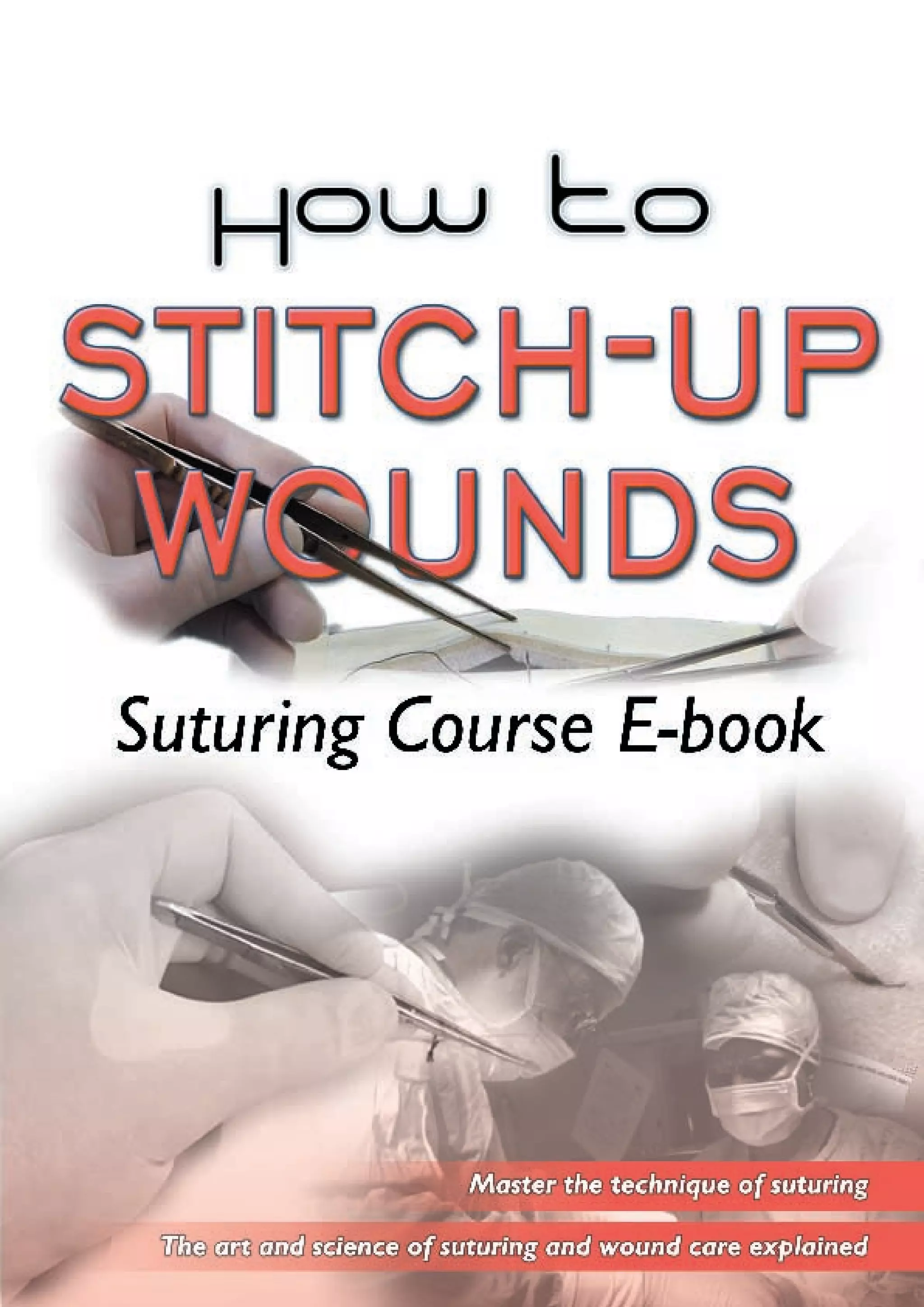
AN ILLUSTRATED HANDS-ON COURSE
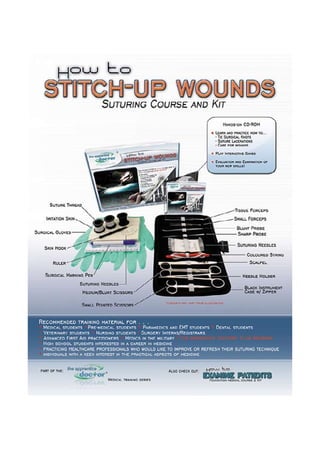
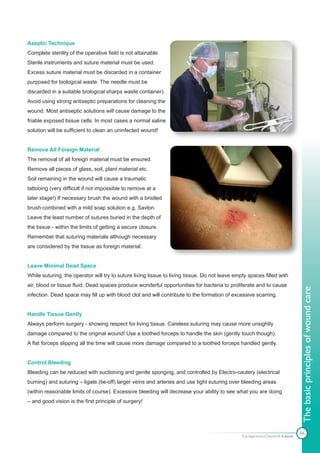
               Available for purchase:
   An 18 piece suturing Kit with all the instruments
 and items needed to learn how to suture lacerations!

 Learn how to care for- and suture wounds AND get your 18-piece
suture kit with real medical instruments and items – all you will need
     to practice wound suturing at home… or wherever you are!!


                             A product by


             THE APPRENTICE CORPORATION
          Copyright© The Apprentice Corporation 2007
                      All rights reserved.


                              WARNING:
   The Apprentice Doctor® Suturing Kit is exclusively intended for
educational purposes. It is strictly prohibited for use in medical situations.
        Not intended for treating either human or animal patients!
THE APPRENTICE CORPORATION: COPYRIGHT INFORMATION
    All copyright in and to the contents of The Apprentice Doctor® CD–ROMs and web sites

(including text, pictures, sketches, logos, animations, photographic material, video material, sound

samples and graphic art) are the sole property of The Apprentice Corporation and all the rights of

                             The Apprentice Corporation are reserved.


     No part of The Apprentice Doctor® CD–ROMs and web sites books or e-books may be

 reproduced or transmitted in any form or by any means without the express, written consent of

                                   The Apprentice Corporation.


                                  Contact information for written

                                 consent may be requested from:

                                    The Apprentice Corporation

                                      2299 Kenmore Avenue

                                              Buffalo,

                                             NY 14207

                                              U.S.A.


                          Or per e-mail: reg@TheApprenticeDoctor.com

                            We appreciate your integrity in this regard.
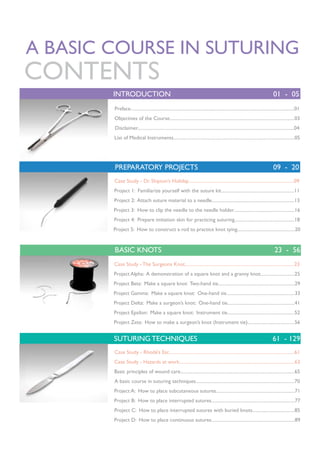
A BASIC COURSE IN SUTURING
CONTENTS
        INTRODUCTION                                                                                                                  01 - 05
        Preface...........................................................................................................................................01
        Objectives of the Course..........................................................................................................03
        Disclaimer.....................................................................................................................................04
        List of Medical Instruments.......................................................................................................05


        PREPARATORY PROJECTS                                                                                                          09 - 20
        Case Study - Dr. Shipton’s Holiday..........................................................................................09
        Project 1: Familiarize yourself with the suture kit..............................................................11
        Project 2: Attach suture material to a needle......................................................................13
        Project 3: How to clip the needle to the needle holder....................................................16
        Project 4: Prepare imitation skin for practicing suturing...................................................18
        Project 5: How to construct a rod to practice knot tying.................................................20


        BASIC KNOTS                                                                                                                    23 - 56
        Case Study - The Surgeons Knot.............................................................................................23
        Project Alpha: A demonstration of a square knot and a granny knot.............................25
        Project Beta: Make a square knot: Two-hand tie.................................................................29
        Project Gamma: Make a square knot: One-hand tie..........................................................33
        Project Delta: Make a surgeon’s knot: One-hand tie.........................................................41
        Project Epsilon: Make a square knot: Instrument tie.........................................................52
        Project Zeta: How to make a surgeon’s knot (Instrument tie)........................................56


        SUTURING TECHNIQUES                                                                                                           61 - 129
        Case Study - Rhodé’s Ear...........................................................................................................61
        Case Study - Hazards at work..................................................................................................63
        Basic principles of wound care.................................................................................................65
        A basic course in suturing techniques....................................................................................70
        Project A: How to place subcutaneous sutures...................................................................71
        Project B: How to place interrupted sutures.......................................................................77
        Project C: How to place interrupted sutures with buried knots....................................85
        Project D: How to place continuous sutures.......................................................................89
SUTURING TECHNIQUES (CONTINUE)
Project E: How to place continuous interlocking sutures.................................................93
Project F: How to place horizontal mattress sutures........................................................97
Project G: How to place vertical mattress sutures...........................................................101
Project H: How to place “Far-and-Near” sutures.............................................................105
Project I: How to place subcuticular sutures......................................................................109
Project J: How to place a purse string suture.....................................................................115
Project K: How to correct a “Dog’s Ear”...........................................................................118
Project L: How to correct unequal levels of tissue...........................................................121
Project M: How to remove sutures......................................................................................125
Complications of suturing........................................................................................................129


CONCLUSION                                                                                                             131 - 132
Epilogue........................................................................................................................................131
Glossary.......................................................................................................................................132
PREFACE
               Learning how to suture wounds and lacerations requires a thorough understanding of the theory of wound
               care and the basic principles of suturing. The student also needs to reach an advanced level of
               proficiency by practicing knot tying and suturing techniques.


               The Apprentice Doctor® Suture Course and Kit is not intended to substitute the clinical training of students
               but rather to offer a firm foundation and an opportunity to experience his/her initial learning curve in an
               imitation situation – so as to fill the student with confidence when he is faced with the real life clinical
               situation.


               The Apprentice Doctor® Suturing course material consists of 3 sections:
               1. Get acquainted with the instruments and items in the Kit
               2. Basic Knot tying
               3. Suturing techniques


               Follow this specific order when working your way through the course material, and ensure that you understand
               the one section and are able to perform the practical projects skillfully before proceeding to the next section.
               Do not skip a section because you think it is unimportant or too simple. Basic principles are like that, they
               appear to be simple, but one needs to understand and practice these simple building blocks before proceeding
               to, and succeeding with the complicated stuff.


               IMPORTANT NOTES:
               Kindly note: For the purpose of this course the word suture will be used as the verb/noun pertaining to the
               closing-up or stitching-up of wounds/lacerations /incisions.


               • The Apprentice Doctor® Suturing Hands-on Course and Kit has been designed mainly for right-handed
               persons. Left-handed persons please exchange the terms left and right as they occur in the text where
               applicable.
Introduction


               • This Kit contains the bulk of the information, instruments and items to successfully practice your suturing
               technique. It is highly recommended that you invest in The Apprentice Doctor® Basic Medical Course and
               Kit, which wonderfully supplements The Apprentice Doctor® Suturing Course and Kit!


          1    The Apprentice Doctor® E-book
• TheApprenticeDoctor.com website and community compliments these 2 products and gives the future
Healthcare professional a chance to join groups of like-minded students with the aspiration of becoming
medical professionals, or to learn from other practicing Healthcare professionals. You will find a suitable
community in your country/state – and will receive lots of free advice and support to help you fulfill your dream!


Dr Anton Scheepers and the staff of The Apprentice Corporation as well as all the Apprentice Doctor
community leaders would like to wish you success with your future and look forward to being a small part of
fulfilling your dreams!


Recommended training material for …
All Healthcare Professionals whether prospective, in training or qualified:

• Medical students

• Pre-medical students

• Paramedics and EMT students

• Dental students

• Veterinary students

• Nursing students

• Surgery Interns/Registrars

• Advanced First Aid practitioners

• Medics in the military

• The Apprentice Doctors’ Club Members

• High school students interested in a career in medicine

• Practicing Healthcare professionals who would like to improve or refresh their suturing technique.

• Non-medically qualified individuals with a keen interest in the practical aspects of medicine
                                                                                                                             Preface


                                                                                                                             2
                                                                                             The Apprentice Doctor® E-book
OBJECTIVES OF THE COURSE:
                To equip students with a basic understanding of the theory of suturing wounds and to acquire the skills to
                confidently tie surgical knots and suture lacerations.


                The student should on completion of this course have a good understanding of:
                • The basic principles of wound care
                • Knot tying techniques (as related to knots used in surgery)
                • Surgical instruments used in suturing
                • Suture materials
                • The various suturing techniques used by medical professionals


                The student should have the following skills:
                • Placing sub-cutaneous sutures
                • Placing interrupted sutures
                • Placing a variety of mattress sutures
                • Tying a square knot (two-hand tie, one-hand tie, and instrument tie)
                • Tying a surgeon’s knot (one-hand tie, and instrument tie)
                • Using a number of other types of suturing techniques
                • Correcting minor discrepancies while suturing
                • Removing sutures


                                    Developed by a surgeon with more than 20 years of experience


                                          PLEASE READ THESE WARNINGS CAREFULLY

                • Your Suture and Dissection Kit contains sharp objects e.g. a scalpel-like knife, needles and scissors. Please be extremely

                  cautious and careful when using these instruments!

                • Not suitable for children under 12 years of age!

                • Supervision/guidance by a responsible adult is recommended for students under 18 years of age.

                • The user must always wash his/her hands before using the kit to minimize the risk of infection following accidental injury.

                  For the same reason gloving is recommended.

                • Always use clean instruments. Wash instruments with soap and water after each usage session, then leave it in an

                  antiseptic solution e.g. Savlon for 60 minutes. Rinse thoroughly with clean water then dry before replacing it in the kit.
Introduction


                • For any cut or needle prick injuries – squeeze the wound for 15-30 seconds to bleed out impurities, then wash

                  profusely with soap and water; apply pressure to stop the bleeding, then apply a plaster e.g. Band Aid. Seek professional

                  medical assistance.

                • Keep out of reach of babies, toddlers and children under the age of 10.

                • Keep sharp instruments away from the eyes.


          3    The Apprentice Doctor® E-book
DISCLAIMER
The producer or supplier of this application does not:
• Offer any warranty regarding the accuracy or correctness of any information contained in this application;
• Assume any responsibility for any damage or consequential damage related in any way to the information,
 instrumentation or items contained in this product/application or as a result of the use thereof.


The user takes full and exclusive responsibility for the safe application of any information contained in this
application. The user also takes full and exclusive responsibility for all safety aspects related in any way to the
use of any instrument or item supplied with this application. This exclusive responsibility applies equally to the
user or to any person or persons being supervised by the user.


No warranties are offered on the functional status or fitness for a specific application of any information,
instrument or item supplied in this application.


The supplier accepts no responsibility for the malfunction of any instrument or item.


The supplier disclaims all liability for any direct or indirect damages – specific or consequential - related in any
way to the information, and instrumentation or any item contained in this application.


All practical exercises are performed exclusively at the user’s own risk. The producer or supplier of this
application disclaims any responsibility for any medical emergencies, medical problems or any other problems
whatsoever, which may arise while using any instrument or item or applying any information supplied with this
application.


The use of the instruments, items and information supplied in this application is conditional upon the
acceptance of this disclaimer as well as the undertaking to honor the copyrighted course material.


REIMBURSEMENT POLICY
The Apprentice Corporation is confident that you will be satisfied with this product in each and every way.
If you are, for any reason dissatisfied with your choice, The Apprentice Corporation will be happy to
reimburse you (less postage and shipping charges) should you wish to return the complete medical kit as well
as the CD-ROM in an undamaged state within a reasonable time limit of not more than 8 weeks after acquiring
this product.
                                                                                                                               Disclaimer


                YOUR ORDER NUMBER AND THE DATE OF THE TRANSACTION
                SHOULD ACCOMPANY YOUR REQUEST FOR REIMBURSEMENT.


                                                                                                                               4
                                                                                               The Apprentice Doctor® E-book
LIST OF MEDICAL INSTRUMENTS

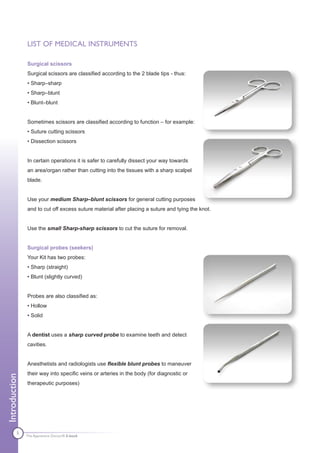
               Surgical scissors
               Surgical scissors are classified according to the 2 blade tips - thus:
               • Sharp–sharp
               • Sharp–blunt
               • Blunt–blunt


               Sometimes scissors are classified according to function – for example:
               • Suture cutting scissors
               • Dissection scissors


               In certain operations it is safer to carefully dissect your way towards
               an area/organ rather than cutting into the tissues with a sharp scalpel
               blade.


               Use your medium Sharp–blunt scissors for general cutting purposes
               and to cut off excess suture material after placing a suture and tying the knot.


               Use the small Sharp-sharp scissors to cut the suture for removal.


               Surgical probes (seekers)
               Your Kit has two probes:
               • Sharp (straight)
               • Blunt (slightly curved)


               Probes are also classified as:
               • Hollow
               • Solid


               A dentist uses a sharp curved probe to examine teeth and detect
               cavities.


               Anesthetists and radiologists use flexible blunt probes to maneuver
               their way into specific veins or arteries in the body (for diagnostic or
Introduction


               therapeutic purposes)


         5
               The Apprentice Doctor® E-book
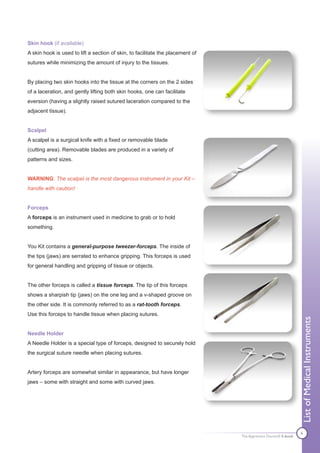
Skin hook (if available)
A skin hook is used to lift a section of skin, to facilitate the placement of
sutures while minimizing the amount of injury to the tissues.


By placing two skin hooks into the tissue at the corners on the 2 sides
of a laceration, and gently lifting both skin hooks, one can facilitate
eversion (having a slightly raised sutured laceration compared to the
adjacent tissue).


Scalpel
A scalpel is a surgical knife with a fixed or removable blade
(cutting area). Removable blades are produced in a variety of
patterns and sizes.


WARNING: The scalpel is the most dangerous instrument in your Kit –
handle with caution!


Forceps
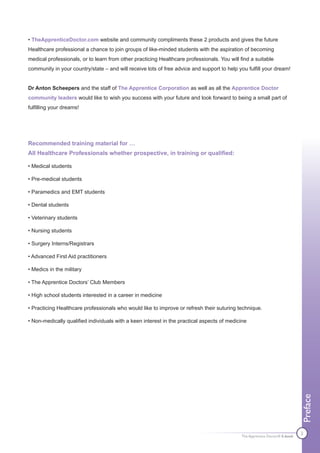
A forceps is an instrument used in medicine to grab or to hold
something.


You Kit contains a general-purpose tweezer-forceps. The inside of
the tips (jaws) are serrated to enhance gripping. This forceps is used
for general handling and gripping of tissue or objects.


The other forceps is called a tissue forceps. The tip of this forceps
shows a sharpish tip (jaws) on the one leg and a v-shaped groove on
the other side. It is commonly referred to as a rat-tooth forceps.
Use this forceps to handle tissue when placing sutures.
                                                                                                                List of Medical Instruments

Needle Holder
A Needle Holder is a special type of forceps, designed to securely hold
the surgical suture needle when placing sutures.


Artery forceps are somewhat similar in appearance, but have longer
jaws – some with straight and some with curved jaws.


                                                                                                                6
                                                                                The Apprentice Doctor® E-book
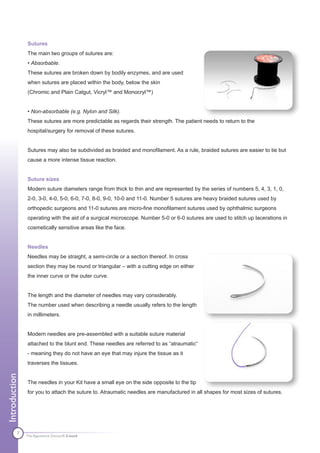
Sutures
               The main two groups of sutures are:
               • Absorbable.
               These sutures are broken down by bodily enzymes, and are used
               when sutures are placed within the body, below the skin
               (Chromic and Plain Catgut, Vicryl™ and Monocryl™)


               • Non-absorbable (e.g. Nylon and Silk).
               These sutures are more predictable as regards their strength. The patient needs to return to the
               hospital/surgery for removal of these sutures.


               Sutures may also be subdivided as braided and monofilament. As a rule, braided sutures are easier to tie but
               cause a more intense tissue reaction.


               Suture sizes
               Modern suture diameters range from thick to thin and are represented by the series of numbers 5, 4, 3, 1, 0,
               2-0, 3-0, 4-0, 5-0, 6-0, 7-0, 8-0, 9-0, 10-0 and 11-0. Number 5 sutures are heavy braided sutures used by
               orthopedic surgeons and 11-0 sutures are micro-fine monofilament sutures used by ophthalmic surgeons
               operating with the aid of a surgical microscope. Number 5-0 or 6-0 sutures are used to stitch up lacerations in
               cosmetically sensitive areas like the face.


               Needles
               Needles may be straight, a semi-circle or a section thereof. In cross
               section they may be round or triangular – with a cutting edge on either
               the inner curve or the outer curve.


               The length and the diameter of needles may vary considerably.
               The number used when describing a needle usually refers to the length
               in millimeters.


               Modern needles are pre-assembled with a suitable suture material
               attached to the blunt end. These needles are referred to as “atraumatic”
               - meaning they do not have an eye that may injure the tissue as it
               traverses the tissues.
Introduction


               The needles in your Kit have a small eye on the side opposite to the tip
               for you to attach the suture to. Atraumatic needles are manufactured in all shapes for most sizes of sutures.


          7    The Apprentice Doctor® E-book
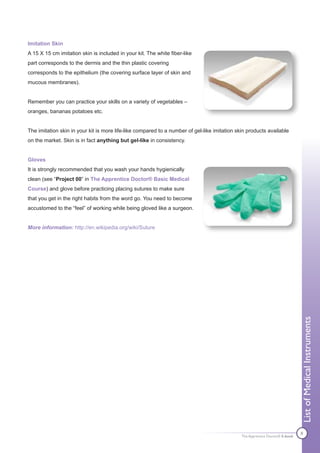
Imitation Skin
A 15 X 15 cm imitation skin is included in your kit. The white fiber-like
part corresponds to the dermis and the thin plastic covering
corresponds to the epithelium (the covering surface layer of skin and
mucous membranes).


Remember you can practice your skills on a variety of vegetables –
oranges, bananas potatoes etc.


The imitation skin in your kit is more life-like compared to a number of gel-like imitation skin products available
on the market. Skin is in fact anything but gel-like in consistency.


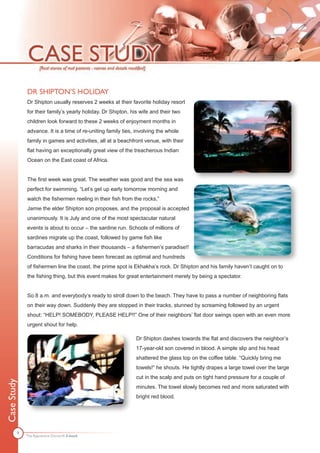
Gloves
It is strongly recommended that you wash your hands hygienically
clean (see “Project 00” in The Apprentice Doctor® Basic Medical
Course) and glove before practicing placing sutures to make sure
that you get in the right habits from the word go. You need to become
accustomed to the “feel” of working while being gloved like a surgeon.


More information: http://en.wikipedia.org/wiki/Suture


                                                                                                                              List of Medical Instruments


                                                                                                                              8
                                                                                              The Apprentice Doctor® E-book
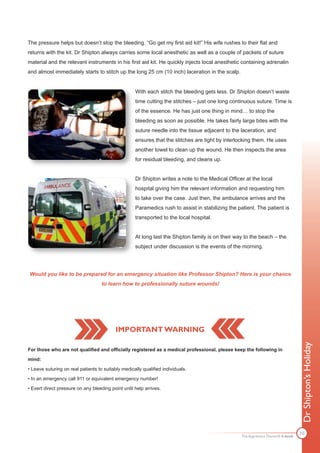
DR SHIPTON’S HOLIDAY
             Dr Shipton usually reserves 2 weeks at their favorite holiday resort
             for their family’s yearly holiday. Dr Shipton, his wife and their two
             children look forward to these 2 weeks of enjoyment months in
             advance. It is a time of re-uniting family ties, involving the whole
             family in games and activities, all at a beachfront venue, with their
             flat having an exceptionally great view of the treacherous Indian
             Ocean on the East coast of Africa.


             The first week was great. The weather was good and the sea was
             perfect for swimming. “Let’s get up early tomorrow morning and
             watch the fishermen reeling in their fish from the rocks,”
             Jamie the elder Shipton son proposes, and the proposal is accepted
             unanimously. It is July and one of the most spectacular natural
             events is about to occur – the sardine run. Schools of millions of
             sardines migrate up the coast, followed by game fish like
             barracudas and sharks in their thousands – a fishermen’s paradise!!
             Conditions for fishing have been forecast as optimal and hundreds
             of fishermen line the coast, the prime spot is Ekhakha’s rock. Dr Shipton and his family haven’t caught on to
             the fishing thing, but this event makes for great entertainment merely by being a spectator.


             So 8 a.m. and everybody’s ready to stroll down to the beach. They have to pass a number of neighboring flats
             on their way down. Suddenly they are stopped in their tracks, stunned by screaming followed by an urgent
             shout: “HELP! SOMEBODY, PLEASE HELP!!” One of their neighbors’ flat door swings open with an even more
             urgent shout for help.

                                                              Dr Shipton dashes towards the flat and discovers the neighbor’s
                                                              17-year-old son covered in blood. A simple slip and his head
                                                              shattered the glass top on the coffee table. “Quickly bring me
                                                              towels!” he shouts. He tightly drapes a large towel over the large
                                                              cut in the scalp and puts on tight hand pressure for a couple of
Case Study


                                                              minutes. The towel slowly becomes red and more saturated with
                                                              bright red blood.


         9
             The Apprentice Doctor® E-book
The pressure helps but doesn’t stop the bleeding. “Go get my first aid kit!” His wife rushes to their flat and
returns with the kit. Dr Shipton always carries some local anesthetic as well as a couple of packets of suture
material and the relevant instruments in his first aid kit. He quickly injects local anesthetic containing adrenalin
and almost immediately starts to stitch up the long 25 cm (10 inch) laceration in the scalp.


                                                    With each stitch the bleeding gets less. Dr Shipton doesn’t waste
                                                    time cutting the stitches – just one long continuous suture. Time is
                                                    of the essence. He has just one thing in mind… to stop the
                                                    bleeding as soon as possible. He takes fairly large bites with the
                                                    suture needle into the tissue adjacent to the laceration, and
                                                    ensures that the stitches are tight by interlocking them. He uses
                                                    another towel to clean up the wound. He then inspects the area
                                                    for residual bleeding, and cleans up.


                                                    Dr Shipton writes a note to the Medical Officer at the local
                                                    hospital giving him the relevant information and requesting him
                                                    to take over the case. Just then, the ambulance arrives and the
                                                    Paramedics rush to assist in stabilizing the patient. The patient is
                                                    transported to the local hospital.


                                                    At long last the Shipton family is on their way to the beach – the
                                                    subject under discussion is the events of the morning.


Would you like to be prepared for an emergency situation like Professor Shipton? Here is your chance
                                    to learn how to professionally suture wounds!


                                           IMPORTANT WARNING
                                                                                                                                  Dr Shipton’s Holiday


For those who are not qualified and officially registered as a medical professional, please keep the following in

mind:

• Leave suturing on real patients to suitably medically qualified individuals.

• In an emergency call 911 or equivalent emergency number!

• Exert direct pressure on any bleeding point until help arrives.


                                                                                                                                  10
                                                                                                  The Apprentice Doctor® E-book
PROJECT 1 - FAMILIARIZE YOURSELF WITH THE SUTURE KIT

                       Ensure that your Suture Kit is complete and that you know the names of each individual instrument


                       INFORMATION
                       Most metal surgical instruments are made from stainless steel – which is strong, durable and won’t corrode
                       (rust). They can be sterilized by steam autoclaving and will retain their characteristics.


                       REQUIREMENTS
                       Your suture Kit


                       STEP 1
                       Identify the components of your suture Kit using the list
                       (provided on page 5). Our Kits are double checked for quality and
                       completeness by our factory. In the unlikely event of problems,
                       kindly contact customer support personnel at
                       Customercare@TheApprenticeDoctor.com.


                       STEP 2
                       2.1 Remove the Needle Holder from the Kit, and examine it. Identify its
                       different parts.


                       2.2 Have a good look at the ratchet latch (lock) mechanism - it has 3
                       beveled teeth on the inside of both sides – designed to catch at 3 levels
                       – light, medium and strong locking.


                       2.3 Put the thumb in the upper eye and the 4th finger in the lower eye
Preparatory Projects


                       of the handle – see picture right. Practice the locking and unlocking
                       action of the ratchet latch mechanism
                       at all three levels.


                       2.4 Clamp and unclamp small objects like pieces of paper or thin
                       cardboard. Do the jaws leave a checked pattern on the paper?


               11      The Apprentice Doctor® E-book
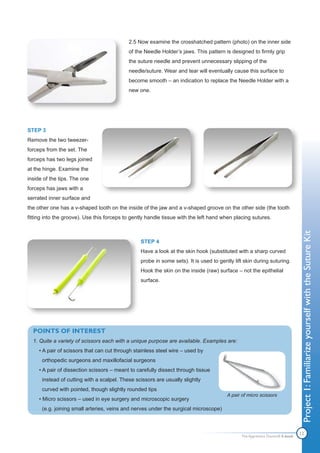
2.5 Now examine the crosshatched pattern (photo) on the inner side
                                            of the Needle Holder’s jaws. This pattern is designed to firmly grip
                                            the suture needle and prevent unnecessary slipping of the
                                            needle/suture. Wear and tear will eventually cause this surface to
                                            become smooth – an indication to replace the Needle Holder with a
                                            new one.


STEP 3
Remove the two tweezer-
forceps from the set. The
forceps has two legs joined
at the hinge. Examine the
inside of the tips. The one
forceps has jaws with a
serrated inner surface and
the other one has a v-shaped tooth on the inside of the jaw and a v-shaped groove on the other side (the tooth
fitting into the groove). Use this forceps to gently handle tissue with the left hand when placing sutures.


                                                                                                                               Project 1: Familiarize yourself with the Suture Kit
                                                 STEP 4
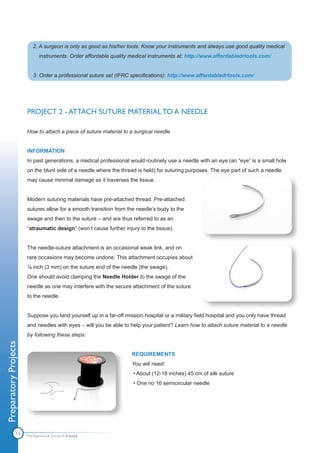
                                                 Have a look at the skin hook (substituted with a sharp curved
                                                 probe in some sets). It is used to gently lift skin during suturing.
                                                 Hook the skin on the inside (raw) surface – not the epithelial
                                                 surface.


  POINTS OF INTEREST
  1. Quite a variety of scissors each with a unique purpose are available. Examples are:
     • A pair of scissors that can cut through stainless steel wire – used by
      orthopedic surgeons and maxillofacial surgeons
     • A pair of dissection scissors – meant to carefully dissect through tissue
      instead of cutting with a scalpel. These scissors are usually slightly
      curved with pointed, though slightly rounded tips
                                                                                        A pair of micro scissors
     • Micro scissors – used in eye surgery and microscopic surgery
      (e.g. joining small arteries, veins and nerves under the surgical microscope)


                                                                                               The Apprentice Doctor® E-book
                                                                                                                               12
2. A surgeon is only as good as his/her tools. Know your instruments and always use good quality medical
                              instruments. Order affordable quality medical instruments at: http://www.affordabledrtools.com/


                          3. Order a professional suture set (IFRC specifications): http://www.affordabledrtools.com/


                       PROJECT 2 - ATTACH SUTURE MATERIAL TO A NEEDLE

                       How to attach a piece of suture material to a surgical needle


                       INFORMATION
                       In past generations, a medical professional would routinely use a needle with an eye (an “eye” is a small hole
                       on the blunt side of a needle where the thread is held) for suturing purposes. The eye part of such a needle
                       may cause minimal damage as it traverses the tissue.


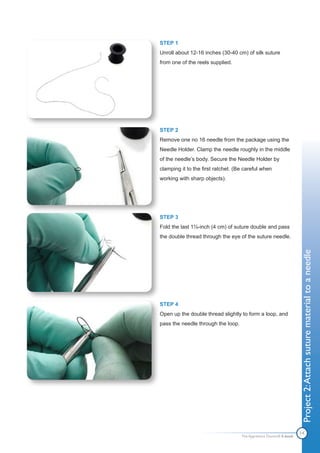
                       Modern suturing materials have pre-attached thread. Pre-attached
                       sutures allow for a smooth transition from the needle’s body to the
                       swage and then to the suture – and are thus referred to as an
                       “atraumatic design” (won’t cause further injury to the tissue).


                       The needle-suture attachment is an occasional weak link, and on
                       rare occasions may become undone. This attachment occupies about
                       ⅛ inch (3 mm) on the suture end of the needle (the swage).
                       One should avoid clamping the Needle Holder to the swage of the
                       needle as one may interfere with the secure attachment of the suture
                       to the needle.


                       Suppose you land yourself up in a far-off mission hospital or a military field hospital and you only have thread
                       and needles with eyes – will you be able to help your patient? Learn how to attach suture material to a needle
                       by following these steps:
Preparatory Projects


                                                                    REQUIREMENTS
                                                                    You will need:
                                                                    • About (12-18 inches) 45 cm of silk suture
                                                                    • One no 16 semicircular needle


               13      The Apprentice Doctor® E-book
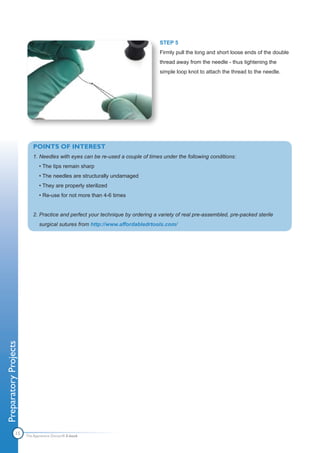
STEP 1
Unroll about 12-16 inches (30-40 cm) of silk suture
from one of the reels supplied.


STEP 2
Remove one no 16 needle from the package using the
Needle Holder. Clamp the needle roughly in the middle
of the needle’s body. Secure the Needle Holder by
clamping it to the first ratchet. (Be careful when
working with sharp objects).


STEP 3
Fold the last 1½-inch (4 cm) of suture double and pass
the double thread through the eye of the suture needle.


STEP 4
                                                                    Project 2: Attach suture material to a needle
Open up the double thread slightly to form a loop, and
pass the needle through the loop.


                                                                    14
                                    The Apprentice Doctor® E-book
STEP 5
                                                                               Firmly pull the long and short loose ends of the double
                                                                               thread away from the needle - thus tightening the
                                                                               simple loop knot to attach the thread to the needle.


                          POINTS OF INTEREST
                          1. Needles with eyes can be re-used a couple of times under the following conditions:
                              • The tips remain sharp
                              • The needles are structurally undamaged
                              • They are properly sterilized
                              • Re-use for not more than 4-6 times

                          2. Practice and perfect your technique by ordering a variety of real pre-assembled, pre-packed sterile
                              surgical sutures from http://www.affordabledrtools.com/
Preparatory Projects


               15      The Apprentice Doctor® E-book
PROJECT 3 - HOW TO CLIP THE NEEDLE TO THE NEEDLE HOLDER

Learn the technique on how to properly clip and secure a needle onto a Needle Holder


INFORMATION
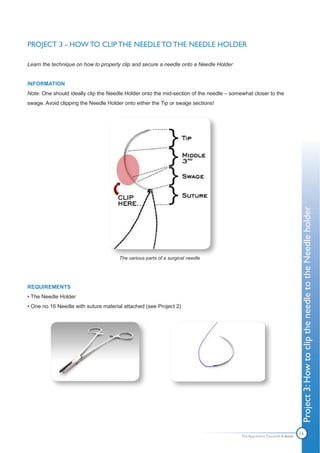
Note: One should ideally clip the Needle Holder onto the mid-section of the needle – somewhat closer to the
swage. Avoid clipping the Needle Holder onto either the Tip or swage sections!


                                                                                                                         Project 3: How to clip the needle to the Needle holder
                                      The various parts of a surgical needle


REQUIREMENTS
• The Needle Holder
• One no 16 Needle with suture material attached (see Project 2)


                                                                                         The Apprentice Doctor® E-book
                                                                                                                         16
STEP 1
                                                                                  Wash your hands, dry and put on a pair of gloves
                                                                                  (Project 00 of The Apprentice Doctor® Basic
                                                                                  Medical Course). The Gloves serve as a surgical
                                                                                  barrier between operator and patient, and provide
                                                                                  protection from accidental needle injuries. Double
                                                                                  gloving is advised for high-risk patients e.g. patients
                                                                                  with Hepatitis B and HIV infections.


                                                                                  STEP 2
                                                                                  Follow the principle of minimal handling of sharp
                                                                                  instruments and items. Use a tweezer-forceps to
                                                                                  remove one no 16 needle from the package using your
                                                                                  left hand. Present the needle to the needle holder with
                                                                                  this tweezers forceps.


                                                                                  STEP 3
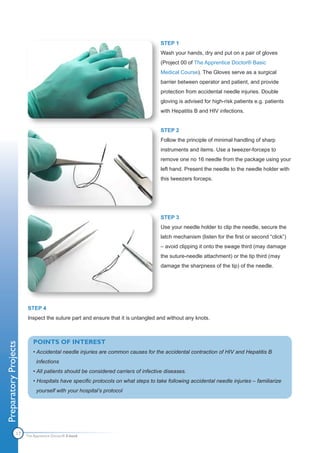
                                                                                  Use your needle holder to clip the needle, secure the
                                                                                  latch mechanism (listen for the first or second “click”)
                                                                                  – avoid clipping it onto the swage third (may damage
                                                                                  the suture-needle attachment) or the tip third (may
                                                                                  damage the sharpness of the tip) of the needle.


                       STEP 4
                       Inspect the suture part and ensure that it is untangled and without any knots.


                           POINTS OF INTEREST
Preparatory Projects


                           • Accidental needle injuries are common causes for the accidental contraction of HIV and Hepatitis B
                            infections
                           • All patients should be considered carriers of infective diseases.
                           • Hospitals have specific protocols on what steps to take following accidental needle injuries – familiarize
                            yourself with your hospital’s protocol


                17     The Apprentice Doctor® E-book
• Handle sharp objects and instruments once – minimize the handling of sharps. Surgeons should get into
   the habit of taking scalpels and assembled needles for suturing directly from the instrument tray. Do not
   ask the assisting theatre sister to hand you such sharp instruments/items if at all possible. Many “sharps”
   injuries in theatre occur during the transfer of “sharps” from one person to the other.


PROJECT 4 - PREPARE IMITATION SKIN FOR PRACTICING SUTURING

Prepare a piece of imitation skin for practicing your suture technique


INFORMATION
The imitation skin for practicing your suture technique consists of three layers – just like natural skin:
• A superficial covering layer (1 mm)
 – representing the epithelium
• A white fibrous layer (3 mm / ⅛ inch)
 – corresponding to the dermis
• A spongy layer (6 mm / ¼ inch)


                                                                                                                               Project 4: Prepare imitation skin for practicing suturing
 -- corresponding to the subcutaneous tissue


This patented imitation skin, provided with The Apprentice Doctor® How to Stitch-up Wounds Kit, is a
remarkably effective substrate for practicing suturing techniques, and sutures can be placed, and removed
repeatedly along the same incision line!


REQUIREMENTS
• A 4 X 6 inches (10 x 15 cm) piece of imitation skin
• The large scissors
• The small scissors
• A pen and ruler (a skin marker pen and ruler is available in The Apprentice Doctor® Basic Medical Kit)


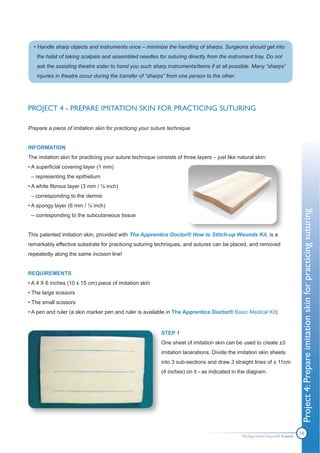
                                                           STEP 1
                                                           One sheet of imitation skin can be used to create ±3
                                                           imitation lacerations. Divide the imitation skin sheets
                                                           into 3 sub-sections and draw 3 straight lines of ± 11cm
                                                           (4 inches) on it - as indicated in the diagram.


                                                                                               The Apprentice Doctor® E-book
                                                                                                                               18
STEP 2
                                                                                  Make a short 5 mm (¼ inch) vertical line at 90
                                                                                  degrees to the straight line - in the middle of
                                                                                  each of these 3 lines.


                                                                                  STEP 3
                                                                                  Divide each of these halves into quarters and draw
                                                                                  another two short 5 mm (¼ inch) vertical lines in these
                                                                                  regions. (These lines will enable you to check the
                                                                                  alignment of the skin following closure of the laceration
                                                                                  with sutures).


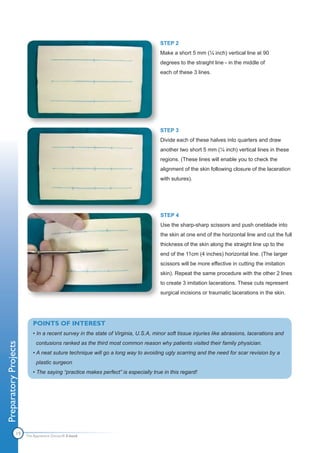
                                                                                  STEP 4
                                                                                  Use the sharp-sharp scissors and push oneblade into
                                                                                  the skin at one end of the horizontal line and cut the full
                                                                                  thickness of the skin along the straight line up to the
                                                                                  end of the 11cm (4 inches) horizontal line. (The larger
                                                                                  scissors will be more effective in cutting the imitation
                                                                                  skin). Repeat the same procedure with the other 2 lines
                                                                                  to create 3 imitation lacerations. These cuts represent
                                                                                  surgical incisions or traumatic lacerations in the skin.


                          POINTS OF INTEREST
                          • In a recent survey in the state of Virginia, U.S.A, minor soft tissue injuries like abrasions, lacerations and
                            contusions ranked as the third most common reason why patients visited their family physician.
Preparatory Projects


                          • A neat suture technique will go a long way to avoiding ugly scarring and the need for scar revision by a
                            plastic surgeon
                          • The saying “practice makes perfect” is especially true in this regard!


                19     The Apprentice Doctor® E-book
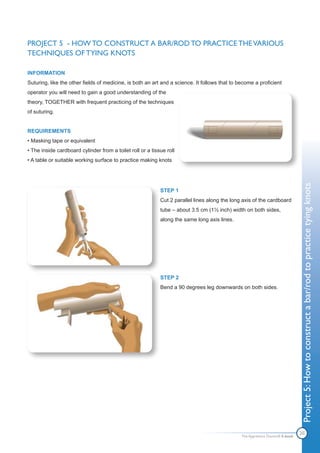
PROJECT 5 - HOW TO CONSTRUCT A BAR/ROD TO PRACTICE THE VARIOUS
TECHNIQUES OF TYING KNOTS

INFORMATION
Suturing, like the other fields of medicine, is both an art and a science. It follows that to become a proficient
operator you will need to gain a good understanding of the
theory, TOGETHER with frequent practicing of the techniques
of suturing.


REQUIREMENTS
• Masking tape or equivalent
• The inside cardboard cylinder from a toilet roll or a tissue roll
• A table or suitable working surface to practice making knots


                                                                                                                               Project 5: How to construct a bar/rod to practice tying knots
                                                            STEP 1
                                                            Cut 2 parallel lines along the long axis of the cardboard
                                                            tube – about 3.5 cm (1½ inch) width on both sides,
                                                            along the same long axis lines.


                                                            STEP 2
                                                            Bend a 90 degrees leg downwards on both sides.


                                                                                                                               20
                                                                                               The Apprentice Doctor® E-book
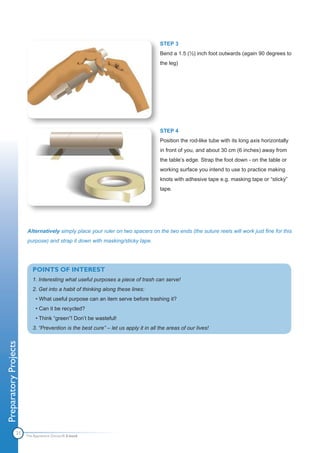
STEP 3
                                                                                    Bend a 1.5 (½) inch foot outwards (again 90 degrees to
                                                                                    the leg)


                                                                                    STEP 4
                                                                                    Position the rod-like tube with its long axis horizontally
                                                                                    in front of you, and about 30 cm (6 inches) away from
                                                                                    the table’s edge. Strap the foot down - on the table or
                                                                                    working surface you intend to use to practice making
                                                                                    knots with adhesive tape e.g. masking tape or “sticky”
                                                                                    tape.


                       Alternatively simply place your ruler on two spacers on the two ends (the suture reels will work just fine for this
                       purpose) and strap it down with masking/sticky tape.


                          POINTS OF INTEREST
                          1. Interesting what useful purposes a piece of trash can serve!
                          2. Get into a habit of thinking along these lines:
                            • What useful purpose can an item serve before trashing it?
                            • Can it be recycled?
                            • Think “green”! Don’t be wasteful!
                          3. “Prevention is the best cure” – let us apply it in all the areas of our lives!
Preparatory Projects


                21
                       The Apprentice Doctor® E-book
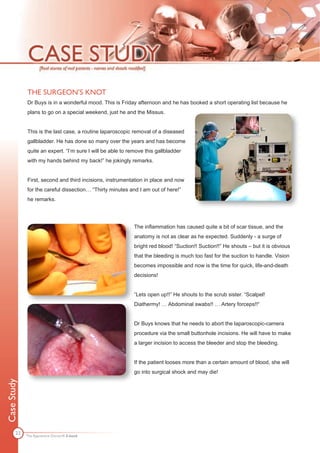
THE SURGEON’S KNOT
             Dr Buys is in a wonderful mood. This is Friday afternoon and he has booked a short operating list because he
             plans to go on a special weekend, just he and the Missus.


             This is the last case, a routine laparoscopic removal of a diseased
             gallbladder. He has done so many over the years and has become
             quite an expert. “I’m sure I will be able to remove this gallbladder
             with my hands behind my back!” he jokingly remarks.


             First, second and third incisions, instrumentation in place and now
             for the careful dissection… “Thirty minutes and I am out of here!”
             he remarks.


                                                            The inflammation has caused quite a bit of scar tissue, and the
                                                            anatomy is not as clear as he expected. Suddenly - a surge of
                                                            bright red blood! “Suction!! Suction!!” He shouts – but it is obvious
                                                            that the bleeding is much too fast for the suction to handle. Vision
                                                            becomes impossible and now is the time for quick, life-and-death
                                                            decisions!


                                                            ”Lets open up!!” He shouts to the scrub sister. “Scalpel!
                                                            Diathermy! … Abdominal swabs!! … Artery forceps!!“


                                                            Dr Buys knows that he needs to abort the laparoscopic-camera
                                                            procedure via the small buttonhole incisions. He will have to make
                                                            a larger incision to access the bleeder and stop the bleeding.


                                                            If the patient looses more than a certain amount of blood, she will
                                                            go into surgical shock and may die!
Case Study


       23
             The Apprentice Doctor® E-book
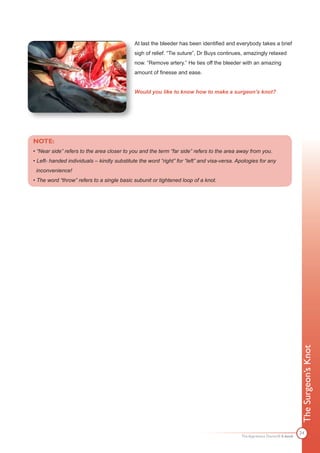
At last the bleeder has been identified and everybody takes a brief
                                             sigh of relief. “Tie suture”, Dr Buys continues, amazingly relaxed
                                             now. “Remove artery.” He ties off the bleeder with an amazing
                                             amount of finesse and ease.


                                             Would you like to know how to make a surgeon’s knot?


NOTE:
• “Near side” refers to the area closer to you and the term “far side” refers to the area away from you.
• Left- handed individuals – kindly substitute the word “right” for “left” and visa-versa. Apologies for any
 inconvenience!
• The word “throw” refers to a single basic subunit or tightened loop of a knot.


                                                                                                                            The Surgeon’s Knot


                                                                                                                            24
                                                                                            The Apprentice Doctor® E-book
PROJECT ALPHA - A DEMONSTRATION OF A SQUARE KNOT AND A GRANNY
              KNOT

              View a demonstration of the difference between a Square knot and a Granny knot


              INFORMATION
              • Definition – knot: The American Heritage® Dictionary defines a knot as: “A fastening made by tying together
                lengths of material, such as rope, in a prescribed way.”
              • Description of a square knot: The square knot consists of two “throws” or turns of the two ends of a piece of
                string/rope.
              • A thorough understanding of knots is essential before you can proceed with acquiring suturing skills.


              REQUIREMENTS
              You will need:
              • The colored and white string (included in the kit)


              Follow these steps:
                                                                           STEP 1
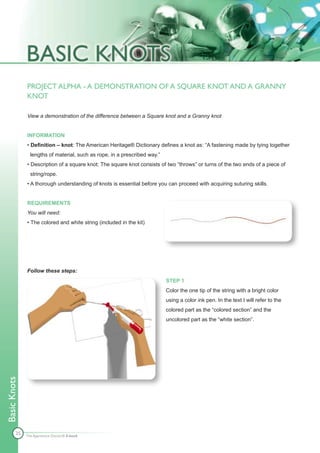
                                                                           Color the one tip of the string with a bright color
                                                                           using a color ink pen. In the text I will refer to the
                                                                           colored part as the “colored section” and the
                                                                           uncolored part as the “white section”.
Basic Knots


        25    The Apprentice Doctor® E-book
Step 2                                    Step 3                                 Step 4a


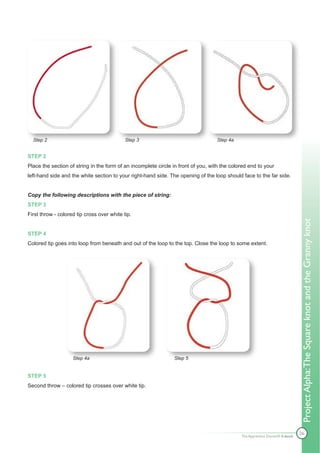
STEP 2
Place the section of string in the form of an incomplete circle in front of you, with the colored end to your
left-hand side and the white section to your right-hand side. The opening of the loop should face to the far side.


Copy the following descriptions with the piece of string:
STEP 3
First throw - colored tip cross over white tip.


                                                                                                                              Project Alpha: The Square knot and the Granny knot
STEP 4
Colored tip goes into loop from beneath and out of the loop to the top. Close the loop to some extent.


                    Step 4a                                     Step 5


STEP 5
Second throw – colored tip crosses over white tip.


                                                                                                                              26
                                                                                              The Apprentice Doctor® E-book
Step 6a                                 Step 6b                                 Step 7


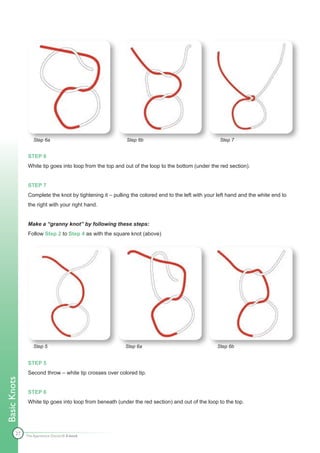
               STEP 6
               White tip goes into loop from the top and out of the loop to the bottom (under the red section).


               STEP 7
               Complete the knot by tightening it – pulling the colored end to the left with your left hand and the white end to
               the right with your right hand.


               Make a “granny knot” by following these steps:
               Follow Step 2 to Step 4 as with the square knot (above)


                  Step 5                                 Step 6a                                 Step 6b


               STEP 5
               Second throw – white tip crosses over colored tip.
Basic Knots


               STEP 6
               White tip goes into loop from beneath (under the red section) and out of the loop to the top.


        27    The Apprentice Doctor® E-book
STEP 7
                                     Complete the knot by tightening it – pulling the colored end to the left
                                     with your left hand and the white end to the right with your right hand.


POINTS OF INTEREST
1. A granny knot tends to tighten on the tissue, while a square knot tightens on itself. A granny knot tends
  to slip where a square knot would have held.
2. Fishermen and sailors are often masters in making a variety of secure knots.
3. Macramé is a form of textile-making that uses knotting rather than weaving or knitting. People practicing
  the art form of macramé are usually real knot experts.


                                                                                                                           Project Alpha: The Square knot and the Granny knot


                                                                                                                           28
                                                                                           The Apprentice Doctor® E-book
PROJECT BETA - MAKE A SQUARE KNOT: TWO-HAND TIE

              INFORMATION
              The Square Knot is the recommended knot for tying most types of sutures. Be sure not to tie a Granny knot
              (this knot results when you tie two throws in the same direction). Square knots hold, granny knots slip.


              REQUIREMENTS
              You will need:
              • The colored and white string (included in the kit)
              • The cardboard tube constructed in Project 5
              • Good lighting


              Follow these steps:
                                                                       STEP 1
                                                                       Prepare the cardboard tube and strap it to the
                                                                       tabletop or working surface using masking/sticky tape
                                                                       (see Project 5).


                                                                       STEP 2
                                                                       Slip the string underneath the cardboard tube with the
                                                                       colored end towards you (near side), and the white end
                                                                       away from you (far side).


                                                                       STEP 3
                                                                       Let the open palm of your left hand face you. Bring the
                                                                       white end from the back and let it come over the index
                                                                       finger, cross the palm down to the little finger. Close the
Basic Knots


                                                                       bottom 3 fingers around the white string, while
                                                                       maintaining an extended index finger.


        29
              The Apprentice Doctor® E-book
STEP 4
          Hold the colored strand in your right hand between
          your right thumb and index finger. Bring the colored
          strand forward and let it cross over the white strand
          (and thus over the left index finger).


          STEP 5
          Let the tips of the left thumb and index finger touch
          to enclose the two stands of string. Keep holding the
          colored end with your right thumb and index finger.


          STEP 6
          While keeping the tips of your left thumb and index
          finger touching, rotate these fingertips away from you,


                                                                              Project Beta: Make a square knot: Two-hand Tie
          moving your thumb under the two strands and into the
          loop.


Step 7a      Step 7b


                                                                              30
                                              The Apprentice Doctor® E-book
STEP 7
              Place the colored end, currently in your right hand, between your left thumb and index finger, and let go of it
              with your right hand. Rotate your hand back to the starting position, bringing the colored tip through the loop.
              Re-grasp the colored end with your right hand while releasing it from the left hand.

                                                                       STEP 8
                                                                       Pull the white section towards you with your left hand
                                                                       and the colored end away from you with your right hand,
                                                                       thereby tightening the first throw of the knot.


                                                                       STEP 9
                                                                       Let the open palm of your left hand face towards your
                                                                       right-hand side. Make a V-shaped opening between your
                                                                       left thumb and index finger, and pull the white tip over
                                                                       the thumb into the “V” with the free end hanging down
                                                                       the palm past the little finger. Hold the white tip in the
                                                                       palm of the left hand by closing the bottom three fingers.
                                                                       The hand is held in a position almost as if pointing a gun.


                                                                       STEP 10
                                                                       With the right hand, bring the colored strand toward you,
                                                                       and place it between the left thumb and index finger,
                                                                       crossing over the white strand. Place the index finger of
                                                                       your left hand over the colored section and touch the tip
                                                                       of the left thumb - enclosing the two strands.


                                                                       STEP 11
                                                                       Rotate these fingertips downwards and towards you.
                                                                       The left index finger goes under the two strands and into
                                                                       the loop. Take the colored tip held by the right hand, and
Basic Knots


                                                                       place it between your left thumb and index finger while
                                                                       releasing it from your right hand.


        31
              The Apprentice Doctor® E-book
STEP 12
                                                            While maintaining your grip on the colored end
                                                            between your left thumb and index finger, rotate your
                                                            left hand back allowing the left thumb and index finger
                                                            to carry the colored strand through the loop. Grip the
                                                            colored strand between your right thumb and index
                                                            finger and release it from the left hand.


                                                            STEP 13
                                                            *Loosely tighten the knot by moving your left hand
                                                            holding the white tip away from you and your right hand
                                                            holding the colored tip toward you - thereby completing
                                                            the second throw of the square knot.


                                                            *If you tie the knot too tightly you might not be able to
                                                            untie the knot for re-using the rope!


                                                 KEEP IN MIND:
               If required, you may add another throw (by following Steps 3-8) or another two throws


                                                                                                                                   Project Beta: Make a square knot: Two-hand Tie
            (by following Steps 3-13) again. In the last instance you will have tied a double square knot.


STEP 14
Practice the technique of making a square knot using the two-hand tie method before proceeding to the
one-hand tie technique.


  INTERESTING SITES:
  (See video clips of a number of knot tying techniques):
  1. http://www.vetmed.ufl.edu/coursevideos/adin/tiesvid.asp
  2. http://www.edu.rcsed.ac.uk/video_album_clips_menu_basicskills.htm
  3. http://cal.vet.upenn.edu/surgery/5000.htm
  4. http://www.edu.rcsed.ac.uk/madras/T1-1.HTML


                                                                                                                                   32
                                                                                                   The Apprentice Doctor® E-book
PROJECT GAMMA - MAKE A SQUARE KNOT: ONE-HAND TIE

              Take a couple of short cuts towards tying a square knot more efficiently


              INFORMATION
              I will describe 2 methods to tie a “one-hand tie square knot”. Method 1 will suit most right-handed persons and
              Method 2 most left handed persons, although a couple of right-handed persons may find Method 2 somewhat
              easier and visa versa.


              The basic difference between a “two-hand tie square knot” and a “one-hand tie square knot” is the time it takes
              to make a secure knot – remember – occasionally during surgery, seconds may be the difference between life
              and death!


              REQUIREMENTS
              You will need:
              • The colored and white string (included in the kit)
              • The cardboard tube constructed in Project 5
              • Good lighting


              METHOD 1
              Follow these steps:
                                                                      STEP 1
                                                                      Prepare the cardboard tube and strap it to the
                                                                      tabletop or working surface using masking/sticky tape
                                                                      (see Project 5).


                                                                      STEP 2
                                                                      Slip the string underneath the cardboard tube with the
                                                                      colored end towards you (near side), and the white end
                                                                      away from you (far side).
Basic Knots


        33    The Apprentice Doctor® E-book
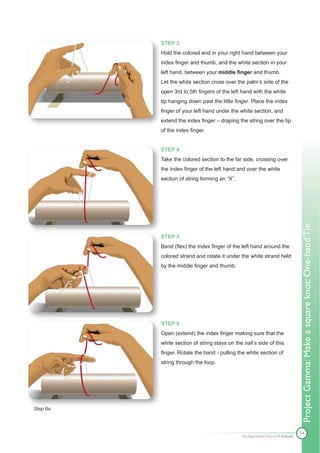
STEP 3
          Hold the colored end in your right hand between your
          index finger and thumb, and the white section in your
          left hand, between your middle finger and thumb.
          Let the white section cross over the palm’s side of the
          open 3rd to 5th fingers of the left hand with the white
          tip hanging down past the little finger. Place the index
          finger of your left hand under the white section, and
          extend the index finger – draping the string over the tip
          of the index finger.


          STEP 4
          Take the colored section to the far side, crossing over
          the index finger of the left hand and over the white
          section of string forming an “X”.


                                                                              Project Gamma: Make a square knot: One-hand Tie
          STEP 5
          Bend (flex) the index finger of the left hand around the
          colored strand and rotate it under the white strand held
          by the middle finger and thumb.


          STEP 6
          Open (extend) the index finger making sure that the
          white section of string stays on the nail’s side of this
          finger. Rotate the hand - pulling the white section of
          string through the loop.


Step 6a


                                                                              34
                                              The Apprentice Doctor® E-book
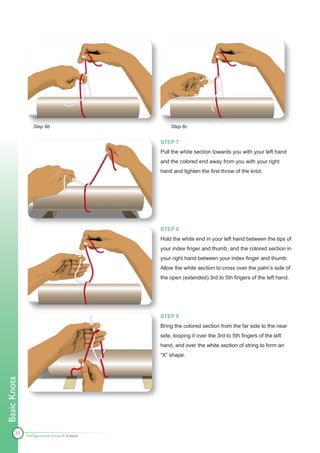
Step 6b                          Step 6c


                                              STEP 7
                                              Pull the white section towards you with your left hand
                                              and the colored end away from you with your right
                                              hand and tighten the first throw of the knot.


                                              STEP 8
                                              Hold the white end in your left hand between the tips of
                                              your index finger and thumb, and the colored section in
                                              your right hand between your index finger and thumb.
                                              Allow the white section to cross over the palm’s side of
                                              the open (extended) 3rd to 5th fingers of the left hand.


                                              STEP 9
                                              Bring the colored section from the far side to the near
                                              side, looping it over the 3rd to 5th fingers of the left
                                              hand, and over the white section of string to form an
                                              “X” shape.
Basic Knots


        35
              The Apprentice Doctor® E-book
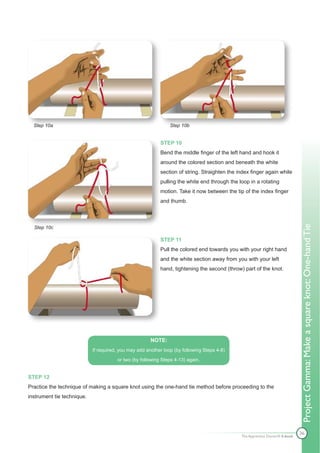
Step 10a                                                      Step 10b


                                                           STEP 10
                                                           Bend the middle finger of the left hand and hook it
                                                           around the colored section and beneath the white
                                                           section of string. Straighten the index finger again while
                                                           pulling the white end through the loop in a rotating
                                                           motion. Take it now between the tip of the index finger
                                                           and thumb.


                                                                                                                              Project Gamma: Make a square knot: One-hand Tie
  Step 10c

                                                           STEP 11
                                                           Pull the colored end towards you with your right hand
                                                           and the white section away from you with your left
                                                           hand, tightening the second (throw) part of the knot.


                                                       NOTE:
                            If required, you may add another loop (by following Steps 4-8)

                                       or two (by following Steps 4-13) again.


STEP 12
Practice the technique of making a square knot using the one-hand tie method before proceeding to the
instrument tie technique.


                                                                                                                              36
                                                                                              The Apprentice Doctor® E-book
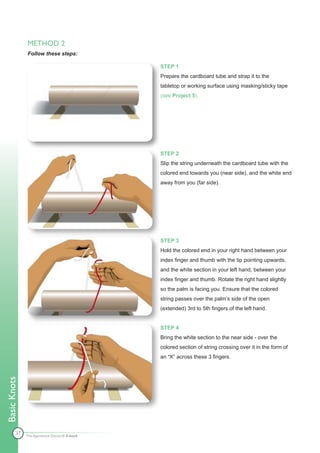
METHOD 2
              Follow these steps:

                                              STEP 1
                                              Prepare the cardboard tube and strap it to the
                                              tabletop or working surface using masking/sticky tape
                                              (see Project 5).


                                              STEP 2
                                              Slip the string underneath the cardboard tube with the
                                              colored end towards you (near side), and the white end
                                              away from you (far side).


                                              STEP 3
                                              Hold the colored end in your right hand between your
                                              index finger and thumb with the tip pointing upwards,
                                              and the white section in your left hand, between your
                                              index finger and thumb. Rotate the right hand slightly
                                              so the palm is facing you. Ensure that the colored
                                              string passes over the palm’s side of the open
                                              (extended) 3rd to 5th fingers of the left hand.


                                              STEP 4
                                              Bring the white section to the near side - over the
                                              colored section of string crossing over it in the form of
                                              an “X” across these 3 fingers.
Basic Knots


        37
              The Apprentice Doctor® E-book
STEP 5
                                                        Bend the middle finger of the right hand, and close
                                                        (flex) it around the white section and under the colored
                                                        section of string held by the index finger and thumb of
                                                        the right hand.


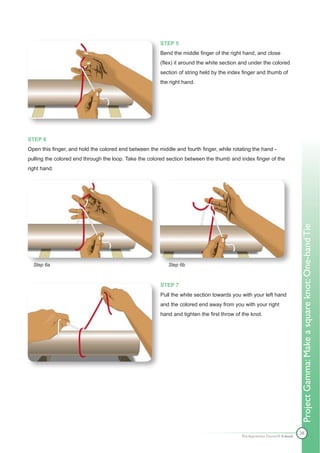
STEP 6
Open this finger, and hold the colored end between the middle and fourth finger, while rotating the hand -
pulling the colored end through the loop. Take the colored section between the thumb and index finger of the
right hand.


                                                                                                                           Project Gamma: Make a square knot: One-hand Tie
  Step 6a                                                  Step 6b


                                                        STEP 7
                                                        Pull the white section towards you with your left hand
                                                        and the colored end away from you with your right
                                                        hand and tighten the first throw of the knot.


                                                                                                                           38
                                                                                           The Apprentice Doctor® E-book
STEP 8
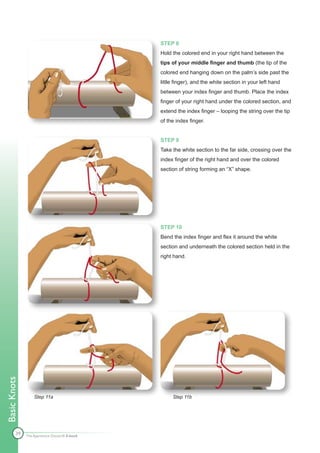
                                              Hold the colored end in your right hand between the
                                              tips of your middle finger and thumb (the tip of the
                                              colored end hanging down on the palm’s side past the
                                              little finger), and the white section in your left hand
                                              between your index finger and thumb. Place the index
                                              finger of your right hand under the colored section, and
                                              extend the index finger – looping the string over the tip
                                              of the index finger.


                                              STEP 9
                                              Take the white section to the far side, crossing over the
                                              index finger of the right hand and over the colored
                                              section of string forming an “X” shape.


                                              STEP 10
                                              Bend the index finger and flex it around the white
                                              section and underneath the colored section held in the
                                              right hand.
Basic Knots


                  Step 11a                         Step 11b


        39    The Apprentice Doctor® E-book
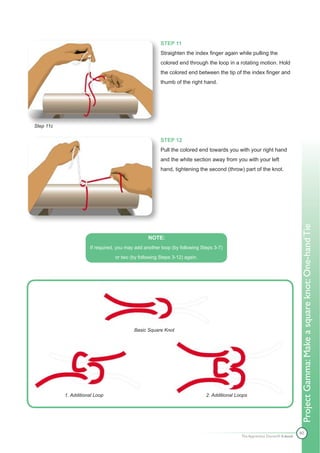
STEP 11
                                                       Straighten the index finger again while pulling the
                                                       colored end through the loop in a rotating motion. Hold
                                                       the colored end between the tip of the index finger and
                                                       thumb of the right hand.


Step 11c

                                                       STEP 12
                                                       Pull the colored end towards you with your right hand
                                                       and the white section away from you with your left
                                                       hand, tightening the second (throw) part of the knot.


                                                                                                                            Project Gamma: Make a square knot: One-hand Tie
                                                 NOTE:
                      If required, you may add another loop (by following Steps 3-7)

                                 or two (by following Steps 3-12) again.


                                          Basic Square Knot


           1. Additional Loop                                               2. Additional Loops


                                                                                                                            40
                                                                                            The Apprentice Doctor® E-book
STEP 13
              Practice the technique of making a square knot using the one-hand tie method before proceeding to the
              instrument tie technique.


                 POINTS OF INTEREST
                 • Both hands are used to tie a One-hand tie knot. The non-dominant hand plays a passive roll and the
                   dominant hand an active roll during the knot tying sequence.
                 • Most surgeons can tie a one-hand tie square knot in their sleep. Keep on practicing until it becomes
                   almost reflexive actions.
                 • If a square knot slips add another loop (or two or three) to the square knot. Note: consecutive loops
                   should always be in the opposite direction to the previous loop.
                 • Different suture materials vary in the number of loops required to secure the knot thus avoiding
                   unraveling.


              PROJECT DELTA - MAKE A SURGEON’S KNOT: ONE-HAND TIE

              The technique on how to tie a secure Surgeons Knot with your hands


              INFORMATION
              A surgeon’s knot is essentially a square knot with the difference that the thread is passed twice through the first
              loop.


              The surgeon’s knot is a very important knot. Master it thoroughly -your patient’s well-being or even his /her life
              will depend on your level of skill when tying this knot.


              Like with the square knot, I will describe 2 methods to tie a “one-hand surgeon’s knot”. Method one will suit
              most right-handed persons and Method 2 most left handed persons, although a couple of right-handed persons
              may find Method 2 somewhat easier and visa versa.


              REQUIREMENTS
              You will need:
Basic Knots


              • The colored and white string (included in the kit)
              • The cardboard tube constructed in Project 5
              • Good lighting


        41    The Apprentice Doctor® E-book
METHOD 1
Follow these steps:

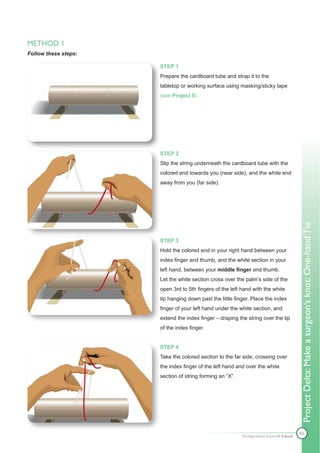
                      STEP 1
                      Prepare the cardboard tube and strap it to the
                      tabletop or working surface using masking/sticky tape
                      (see Project 5).


                      STEP 2
                      Slip the string underneath the cardboard tube with the
                      colored end towards you (near side), and the white end
                      away from you (far side).


                                                                                          Project Delta: Make a surgeon’s knot: One-hand Tie
                      STEP 3
                      Hold the colored end in your right hand between your
                      index finger and thumb, and the white section in your
                      left hand, between your middle finger and thumb.
                      Let the white section cross over the palm’s side of the
                      open 3rd to 5th fingers of the left hand with the white
                      tip hanging down past the little finger. Place the index
                      finger of your left hand under the white section, and
                      extend the index finger – draping the string over the tip
                      of the index finger.


                      STEP 4
                      Take the colored section to the far side, crossing over
                      the index finger of the left hand and over the white
                      section of string forming an “X”.


                                                                                          42
                                                          The Apprentice Doctor® E-book
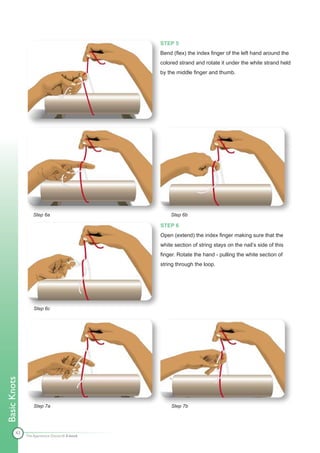
STEP 5
                                              Bend (flex) the index finger of the left hand around the
                                              colored strand and rotate it under the white strand held
                                              by the middle finger and thumb.


                 Step 6a                          Step 6b

                                              STEP 6
                                              Open (extend) the index finger making sure that the
                                              white section of string stays on the nail’s side of this
                                              finger. Rotate the hand - pulling the white section of
                                              string through the loop.


                  Step 6c
Basic Knots


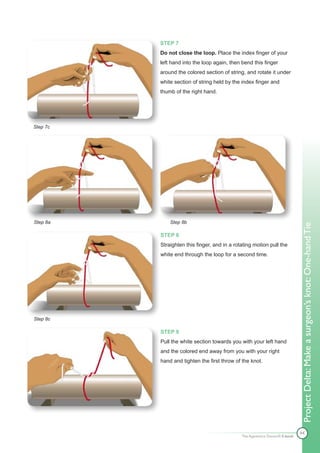
                  Step 7a                         Step 7b


        43
              The Apprentice Doctor® E-book
STEP 7
          Do not close the loop. Place the index finger of your
          left hand into the loop again, then bend this finger
          around the colored section of string, and rotate it under
          white section of string held by the index finger and
          thumb of the right hand.


Step 7c


Step 8a       Step 8b


                                                                              Project Delta: Make a surgeon’s knot: One-hand Tie
          STEP 8
          Straighten this finger, and in a rotating motion pull the
          white end through the loop for a second time.


Step 8c

          STEP 9
          Pull the white section towards you with your left hand
          and the colored end away from you with your right
          hand and tighten the first throw of the knot.


                                                                              44
                                              The Apprentice Doctor® E-book
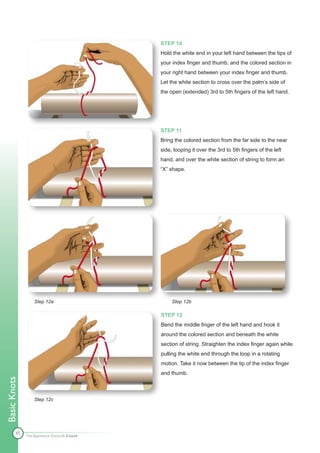
STEP 10
                                              Hold the white end in your left hand between the tips of
                                              your index finger and thumb, and the colored section in
                                              your right hand between your index finger and thumb.
                                              Let the white section to cross over the palm’s side of
                                              the open (extended) 3rd to 5th fingers of the left hand.


                                              STEP 11
                                              Bring the colored section from the far side to the near
                                              side, looping it over the 3rd to 5th fingers of the left
                                              hand, and over the white section of string to form an
                                              “X” shape.


                  Step 12a                         Step 12b

                                              STEP 12
                                              Bend the middle finger of the left hand and hook it
                                              around the colored section and beneath the white
                                              section of string. Straighten the index finger again while
                                              pulling the white end through the loop in a rotating
                                              motion. Take it now between the tip of the index finger
                                              and thumb.
Basic Knots


                  Step 12c


        45
              The Apprentice Doctor® E-book
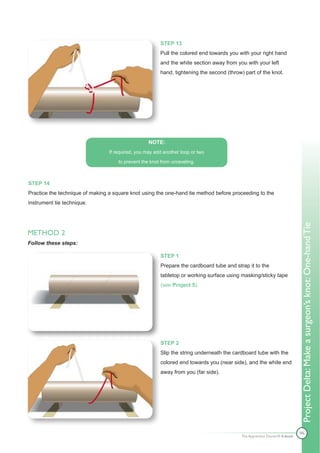
STEP 13
                                                        Pull the colored end towards you with your right hand
                                                        and the white section away from you with your left
                                                        hand, tightening the second (throw) part of the knot.


                                                   NOTE:
                                 If required, you may add another loop or two

                                     to prevent the knot from unraveling.


STEP 14
Practice the technique of making a square knot using the one-hand tie method before proceeding to the
instrument tie technique.


                                                                                                                          Project Delta: Make a surgeon’s knot: One-hand Tie
METHOD 2
Follow these steps:

                                                        STEP 1
                                                        Prepare the cardboard tube and strap it to the
                                                        tabletop or working surface using masking/sticky tape
                                                        (see Project 5).


                                                        STEP 2
                                                        Slip the string underneath the cardboard tube with the
                                                        colored end towards you (near side), and the white end
                                                        away from you (far side).


                                                                                                                          46
                                                                                          The Apprentice Doctor® E-book
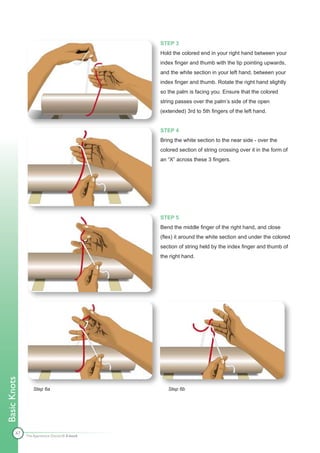
STEP 3
                                              Hold the colored end in your right hand between your
                                              index finger and thumb with the tip pointing upwards,
                                              and the white section in your left hand, between your
                                              index finger and thumb. Rotate the right hand slightly
                                              so the palm is facing you. Ensure that the colored
                                              string passes over the palm’s side of the open
                                              (extended) 3rd to 5th fingers of the left hand.


                                              STEP 4
                                              Bring the white section to the near side - over the
                                              colored section of string crossing over it in the form of
                                              an “X” across these 3 fingers.


                                              STEP 5
                                              Bend the middle finger of the right hand, and close
                                              (flex) it around the white section and under the colored
                                              section of string held by the index finger and thumb of
                                              the right hand.
Basic Knots


                  Step 6a                        Step 6b


        47    The Apprentice Doctor® E-book
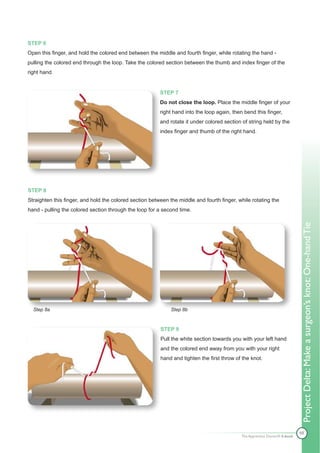
STEP 6
Open this finger, and hold the colored end between the middle and fourth finger, while rotating the hand -
pulling the colored end through the loop. Take the colored section between the thumb and index finger of the
right hand.


                                                         STEP 7
                                                         Do not close the loop. Place the middle finger of your
                                                         right hand into the loop again, then bend this finger,
                                                         and rotate it under colored section of string held by the
                                                         index finger and thumb of the right hand.


STEP 8
Straighten this finger, and hold the colored section between the middle and fourth finger, while rotating the
hand - pulling the colored section through the loop for a second time.


  Step 8a                                                     Step 8b                                                        Project Delta: Make a surgeon’s knot: One-hand Tie

                                                         STEP 9
                                                         Pull the white section towards you with your left hand
                                                         and the colored end away from you with your right
                                                         hand and tighten the first throw of the knot.


                                                                                                                             48
                                                                                             The Apprentice Doctor® E-book
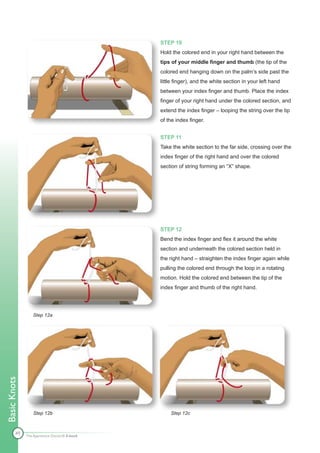
STEP 10
                                              Hold the colored end in your right hand between the
                                              tips of your middle finger and thumb (the tip of the
                                              colored end hanging down on the palm’s side past the
                                              little finger), and the white section in your left hand
                                              between your index finger and thumb. Place the index
                                              finger of your right hand under the colored section, and
                                              extend the index finger – looping the string over the tip
                                              of the index finger.


                                              STEP 11
                                              Take the white section to the far side, crossing over the
                                              index finger of the right hand and over the colored
                                              section of string forming an “X” shape.


                                              STEP 12
                                              Bend the index finger and flex it around the white
                                              section and underneath the colored section held in
                                              the right hand – straighten the index finger again while
                                              pulling the colored end through the loop in a rotating
                                              motion. Hold the colored end between the tip of the
                                              index finger and thumb of the right hand.


                 Step 12a
Basic Knots


                 Step 12b                         Step 12c


        49    The Apprentice Doctor® E-book
Step 12d                                                        Step 13


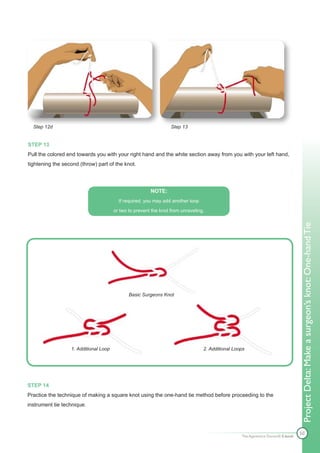
STEP 13
Pull the colored end towards you with your right hand and the white section away from you with your left hand,
tightening the second (throw) part of the knot.


                                                        NOTE:
                                         If required, you may add another loop

                                       or two to prevent the knot from unraveling.


                                                                                                                                  Project Delta: Make a surgeon’s knot: One-hand Tie
                                              Basic Surgeons Knot


                  1. Additional Loop                                             2. Additional Loops


STEP 14
Practice the technique of making a square knot using the one-hand tie method before proceeding to the
instrument tie technique.


                                                                                                                                  50
                                                                                                  The Apprentice Doctor® E-book
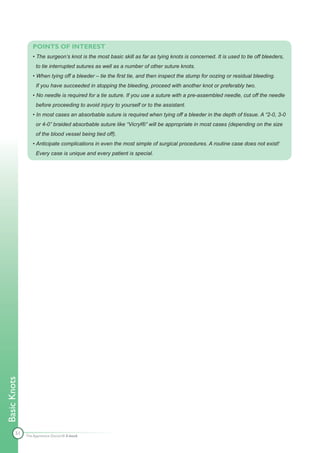
POINTS OF INTEREST
                 • The surgeon’s knot is the most basic skill as far as tying knots is concerned. It is used to tie off bleeders,
                   to tie interrupted sutures as well as a number of other suture knots.
                 • When tying off a bleeder – tie the first tie, and then inspect the stump for oozing or residual bleeding.
                   If you have succeeded in stopping the bleeding, proceed with another knot or preferably two.
                 • No needle is required for a tie suture. If you use a suture with a pre-assembled needle, cut off the needle
                   before proceeding to avoid injury to yourself or to the assistant.
                 • In most cases an absorbable suture is required when tying off a bleeder in the depth of tissue. A “2-0, 3-0
                   or 4-0” braided absorbable suture like “Vicryl®” will be appropriate in most cases (depending on the size
                   of the blood vessel being tied off).
                 • Anticipate complications in even the most simple of surgical procedures. A routine case does not exist!
                   Every case is unique and every patient is special.
Basic Knots


        51    The Apprentice Doctor® E-book
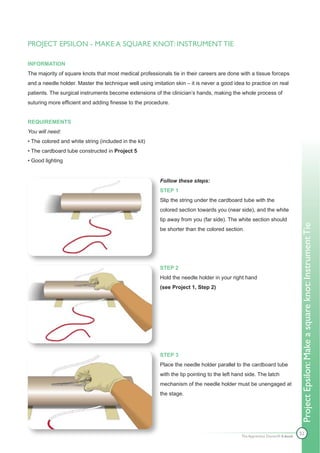
PROJECT EPSILON - MAKE A SQUARE KNOT: INSTRUMENT TIE

INFORMATION
The majority of square knots that most medical professionals tie in their careers are done with a tissue forceps
and a needle holder. Master the technique well using imitation skin – it is never a good idea to practice on real
patients. The surgical instruments become extensions of the clinician’s hands, making the whole process of
suturing more efficient and adding finesse to the procedure.


REQUIREMENTS
You will need:
• The colored and white string (included in the kit)
• The cardboard tube constructed in Project 5
• Good lighting


                                                         Follow these steps:
                                                         STEP 1
                                                         Slip the string under the cardboard tube with the
                                                         colored section towards you (near side), and the white
                                                         tip away from you (far side). The white section should


                                                                                                                             Project Epsilon: Make a square knot: Instrument Tie
                                                         be shorter than the colored section.


                                                         STEP 2
                                                         Hold the needle holder in your right hand
                                                         (see Project 1, Step 2)


                                                         STEP 3
                                                         Place the needle holder parallel to the cardboard tube
                                                         with the tip pointing to the left hand side. The latch
                                                         mechanism of the needle holder must be unengaged at
                                                         the stage.


                                                                                             The Apprentice Doctor® E-book
                                                                                                                             52
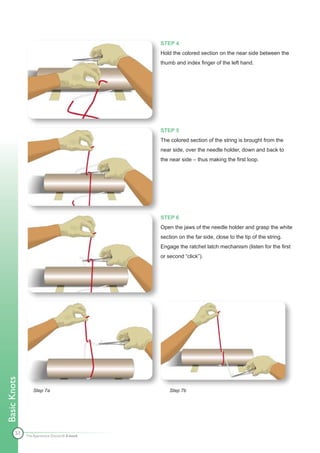
STEP 4
                                              Hold the colored section on the near side between the
                                              thumb and index finger of the left hand.


                                              STEP 5
                                              The colored section of the string is brought from the
                                              near side, over the needle holder, down and back to
                                              the near side – thus making the first loop.


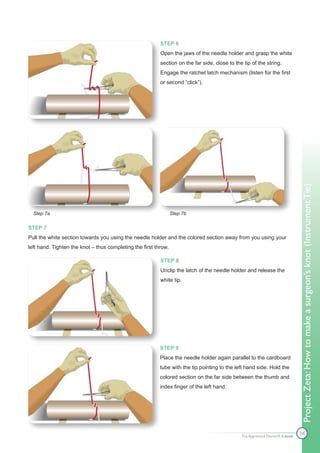
                                              STEP 6
                                              Open the jaws of the needle holder and grasp the white
                                              section on the far side, close to the tip of the string.
                                              Engage the ratchet latch mechanism (listen for the first
                                              or second “click”).
Basic Knots


                 Step 7a                          Step 7b


        53
              The Apprentice Doctor® E-book
STEP 7
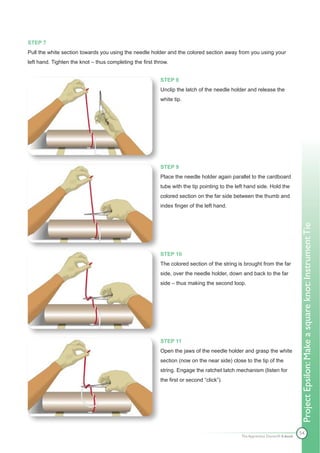
Pull the white section towards you using the needle holder and the colored section away from you using your
left hand. Tighten the knot – thus completing the first throw.


                                                          STEP 8
                                                          Unclip the latch of the needle holder and release the
                                                          white tip.


                                                          STEP 9
                                                          Place the needle holder again parallel to the cardboard
                                                          tube with the tip pointing to the left hand side. Hold the
                                                          colored section on the far side between the thumb and
                                                          index finger of the left hand.


                                                                                                                              Project Epsilon: Make a square knot: Instrument Tie
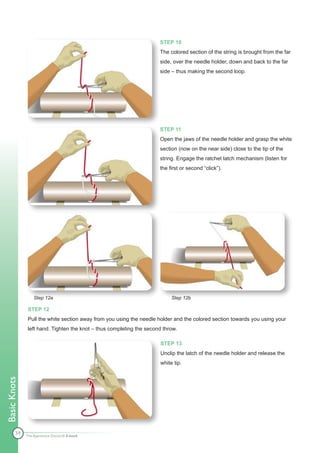
                                                          STEP 10
                                                          The colored section of the string is brought from the far
                                                          side, over the needle holder, down and back to the far
                                                          side – thus making the second loop.


                                                          STEP 11
                                                          Open the jaws of the needle holder and grasp the white
                                                          section (now on the near side) close to the tip of the
                                                          string. Engage the ratchet latch mechanism (listen for
                                                          the first or second “click”).


                                                                                                                              54
                                                                                              The Apprentice Doctor® E-book
Step 12a                                                    Step 12b

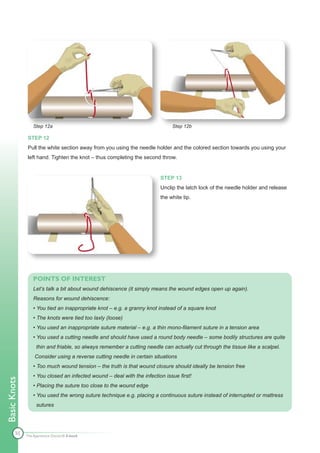
              STEP 12
              Pull the white section away from you using the needle holder and the colored section towards you using your
              left hand. Tighten the knot – thus completing the second throw.


                                                                         STEP 13
                                                                         Unclip the latch lock of the needle holder and release
                                                                         the white tip.


                  POINTS OF INTEREST
                  Let’s talk a bit about wound dehiscence (it simply means the wound edges open up again).
                  Reasons for wound dehiscence:
                  • You tied an inappropriate knot – e.g. a granny knot instead of a square knot
                  • The knots were tied too laxly (loose)
                  • You used an inappropriate suture material – e.g. a thin mono-filament suture in a tension area
                  • You used a cutting needle and should have used a round body needle – some bodily structures are quite
                   thin and friable, so always remember a cutting needle can actually cut through the tissue like a scalpel.
                  Consider using a reverse cutting needle in certain situations
                  • Too much wound tension – the truth is that wound closure should ideally be tension free
                  • You closed an infected wound – deal with the infection issue first!
Basic Knots


                  • Placing the suture too close to the wound edge
                  • You used the wrong suture technique e.g. placing a continuous suture instead of interrupted or mattress
                   sutures


        55    The Apprentice Doctor® E-book
• You removed the sutures too soon – especially in the lower extremities!
  • A foreign object was inadvertently left in the wound
  • A large blood clot (hematoma) formed and is forcing the two wound edges apart
  • An arterial bleed is putting an immense amount of pressure within the wound and forcing it open – always
   control bleeders first by appropriate means – e.g. ligation (tying bleeding vessels off) or diathermy (burn
   them closed with an electric current)
  • You are placing sutures in a malignant tumor. One of the attributes of a cancerous growth is the loss of
   cellular adhesion


PROJECT ZETA - HOW TO MAKE A SURGEON’S KNOT (INSTRUMENT TIE)

The technique on how to tie a secure Surgeons Knot using surgical instruments


INFORMATION


                                                                                                                              Project Zeta: How to make a surgeon’s knot (Instrument Tie)
A surgeon’s knot is essentially a square knot with the difference that the thread is passed twice through the first
loop.


The surgeon’s knot is a very important knot. Master it thoroughly -your patient’s well-being or even his /her life
will depend on your level of skill when tying this knot.


REQUIREMENTS
You will need:
• The colored and white string (included in the kit)
• The cardboard tube constructed in Project 5
• Good lighting


Follow these steps:

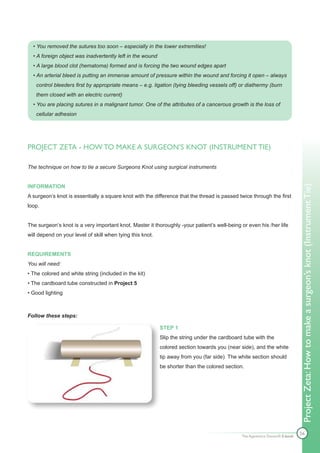
                                                           STEP 1
                                                           Slip the string under the cardboard tube with the
                                                           colored section towards you (near side), and the white
                                                           tip away from you (far side). The white section should
                                                           be shorter than the colored section.


                                                                                              The Apprentice Doctor® E-book
                                                                                                                              56
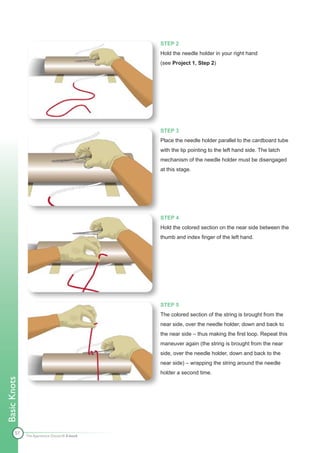
STEP 2
                                              Hold the needle holder in your right hand
                                              (see Project 1, Step 2)


                                              STEP 3
                                              Place the needle holder parallel to the cardboard tube
                                              with the tip pointing to the left hand side. The latch
                                              mechanism of the needle holder must be disengaged
                                              at this stage.


                                              STEP 4
                                              Hold the colored section on the near side between the
                                              thumb and index finger of the left hand.


                                              STEP 5
                                              The colored section of the string is brought from the
                                              near side, over the needle holder, down and back to
                                              the near side – thus making the first loop. Repeat this
                                              maneuver again (the string is brought from the near
                                              side, over the needle holder, down and back to the
                                              near side) – wrapping the string around the needle
                                              holder a second time.
Basic Knots


        57    The Apprentice Doctor® E-book
STEP 6
                                                          Open the jaws of the needle holder and grasp the white
                                                          section on the far side, close to the tip of the string.
                                                          Engage the ratchet latch mechanism (listen for the first
                                                          or second “click”).


                                                                                                                               Project Zeta: How to make a surgeon’s knot (Instrument Tie)
  Step 7a                                                        Step 7b

STEP 7
Pull the white section towards you using the needle holder and the colored section away from you using your
left hand. Tighten the knot – thus completing the first throw.

                                                          STEP 8
                                                          Unclip the latch of the needle holder and release the
                                                          white tip.


                                                          STEP 9
                                                          Place the needle holder again parallel to the cardboard
                                                          tube with the tip pointing to the left hand side. Hold the
                                                          colored section on the far side between the thumb and
                                                          index finger of the left hand.


                                                                                                                               58
                                                                                               The Apprentice Doctor® E-book
STEP 10
                                                                     The colored section of the string is brought from the far
                                                                     side, over the needle holder, down and back to the far
                                                                     side – thus making the second loop.


                                                                     STEP 11
                                                                     Open the jaws of the needle holder and grasp the white
                                                                     section (now on the near side) close to the tip of the
                                                                     string. Engage the ratchet latch mechanism (listen for
                                                                     the first or second “click”).


                  Step 12a                                                 Step 12b

              STEP 12
              Pull the white section away from you using the needle holder and the colored section towards you using your
              left hand. Tighten the knot – thus completing the second throw.

                                                                      STEP 13
                                                                      Unclip the latch of the needle holder and release the
                                                                      white tip.
Basic Knots


        59    The Apprentice Doctor® E-book
POINTS OF INTEREST
More information:
Visit this site for great video-clip demonstrations of tying surgical knots:
http://www.vetmed.ufl.edu/coursevideos/adin/tiesvid.asp


Other useful sites:
http://www.bumc.bu.edu/Dept/Content.aspx?DepartmentID=69&PageID=5734
http://cal.vet.upenn.edu/surgery/5000.htm
http://www.edu.rcsed.ac.uk/video_album_clips_menu_basicskills.htm


A classical work for any student of suturing is an e-book with the title:
Suture Materials & Techniques by Ethicon® download it for free from this address:
http://www.jnjgateway.com/public/USENG/Knot_Tying_Manual.pdf


You will need an Acrobat Reader to open this document – download Acrobat Reader from:


                                                                                                                    Project Zeta: How to make a surgeon’s knot (Instrument Tie)
http://www.download.com/3000-2378-10000062.html


                                                                                                                    60
                                                                                    The Apprentice Doctor® E-book
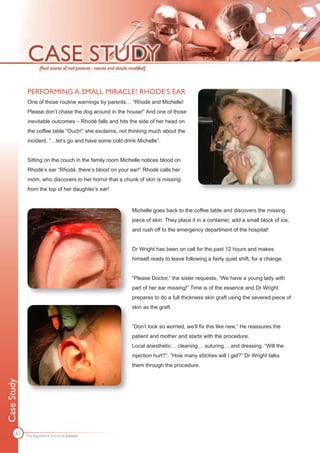
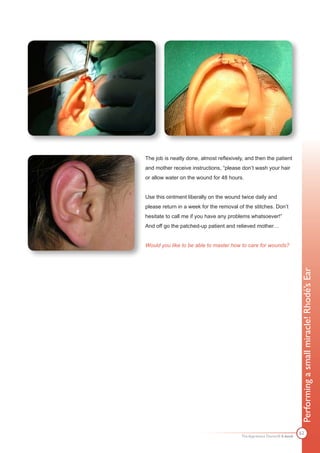
PERFORMING A SMALL MIRACLE! RHODE’S EAR
             One of those routine warnings by parents… “Rhodé and Michelle!
             Please don’t chase the dog around in the house!” And one of those
             inevitable outcomes – Rhodé falls and hits the side of her head on
             the coffee table “Ouch!” she exclaims, not thinking much about the
             incident, “…let’s go and have some cold drink Michelle”.


             Sitting on the couch in the family room Michelle notices blood on
             Rhodé’s ear “Rhodé, there’s blood on your ear!” Rhodé calls her
             mom, who discovers to her horror that a chunk of skin is missing
             from the top of her daughter’s ear!


                                                         Michelle goes back to the coffee table and discovers the missing
                                                         piece of skin. They place it in a container, add a small block of ice,
                                                         and rush off to the emergency department of the hospital!


                                                         Dr Wright has been on call for the past 12 hours and makes
                                                         himself ready to leave following a fairly quiet shift, for a change.


                                                         “Please Doctor,” the sister requests, “We have a young lady with
                                                         part of her ear missing!” Time is of the essence and Dr Wright
                                                         prepares to do a full thickness skin graft using the severed piece of
                                                         skin as the graft.


                                                         “Don’t look so worried, we’ll fix this like new,” He reassures the
                                                         patient and mother and starts with the procedure.
                                                         Local anesthetic… cleaning… suturing… and dressing. “Will the
                                                         injection hurt?”, ”How many stitches will I get?” Dr Wright talks
                                                         them through the procedure.
Case Study


       61
             The Apprentice Doctor® E-book
The job is neatly done, almost reflexively, and then the patient
and mother receive instructions, “please don’t wash your hair
or allow water on the wound for 48 hours.


Use this ointment liberally on the wound twice daily and
please return in a week for the removal of the stitches. Don’t
hesitate to call me if you have any problems whatsoever!”
And off go the patched-up patient and relieved mother…


Would you like to be able to master how to care for wounds?


                                                                         Performing a small miracle! Rhodé’s Ear


                                                                         62
                                         The Apprentice Doctor® E-book
HAZARDS AT WORK
             James is off to work. “Smooch!” He kisses his wife Leticia goodbye …and another 4 kisses to his 4 children
             James Junior, Jake, Susan and Baby Brad. “See you guys tonight” he exclaims as he closes the door.


                                                        James is a welder – and not any type of welder – he specializes in
                                                        repairing gas cylinders – big or small – even the large tanker types
                                                        for transporting truckloads of various types of gas.


                                                        Today is a high-intensity day – 30 gas cylinders to repair, then the
                                                        pressure testing and final quality control checks. The protocol is
                                                        clear – first empty the cylinders – then flush them with air and
                                                        finally, fill the cylinder with Nitrogen before starting with the
                                                        welding. Two inspection checks before James gets to do his job.


                                                        Now some people work well under pressure and James is one of
                                                        those, but James’s friend Jerry is not – a bit lazy on occasion he
                                                        decides to take a couple of short-cuts – and yes it seems to work
                                                        out well, at first.


                                                        “It is 3 p.m. Only 10 cylinders to go, and then I can head home”,
                                                        James thinks as he starts repairing the fine metal crack on the
                                                        bottom of this cylinder.


                                                        Then it all happens in less than an instant – a massive explosion
                                                        as the 7 mm (¼ inch) metal casing explodes due to a trickle of
                                                        flammable gas remaining in this specific cylinder!


                                                        James is seriously injured – the soft tissue and bones of his face
                                                        are in pieces and there’s blood everywhere. His co-workers do
                                                        what they can to stop the bleeding until the paramedics arrive.
                                                        The Paramedics finally arrive, resuscitate him, and evacuate him
Case Study


                                                        to the trauma unit.


       63
             The Apprentice Doctor® E-book
Miraculously, James’ friend Jerry emerges physically uninjured from the tearoom, because he took the liberty of
stretching his 15-minute tea break to 20 minutes.


James is profusely bleeding from his scalp lacerations.
The trauma doctors place a number of interrupted sutures,
tying them tightly to control the bleeding.


Next, it’s off to theatre. The anesthetist works like a
machine to keep James alive. He requests urgent blood
tests, administers IV fluids and a number of life-saving
medications.


The Trauma Surgeon secures the airway by doing a
tracheotomy and this is followed by a multidisciplinary
repair involving Neurosurgeons, an Ophthalmic surgeon, a
Maxillofacial Surgeon and a Plastic and Reconstructive
Surgeon.


The lower lip is in rags, but applying the basic principles of
wound care, the Plastic Surgeon starts cleaning,
removing all foreign material and dead tissue. He then
plans a layered closure and 45 minutes later… well the lip
is fixed and presentable!


                                                                 Would you like to know how to repair major
                                                                 soft tissue lacerations? Well stick to the
                                                                 basic principles of surgery and practice,
                                                                 practice and practice!!
                                                                                                                           Hazards at work


                                                                                                                           64
                                                                                           The Apprentice Doctor® E-book
THE BASIC PRINCIPLES OF WOUND CARE

                      Know your patient
                      If time allows – take a good medical history, if not take a brief
                      medical history – but always take a medical history -
                      (see “Project 0” of The Apprentice Doctor® Course and Kit).
                      Is your patient allergic to certain local anesthetics, antibiotics
                      and pain medication, antiseptic solutions or plasters/strapping?
                      Does he/she suffer from chronic diseases like Diabetes or
                      bleeding disorders? Are they using any chronic medications?
                      Etc.


                      Good vision (good lighting)
                      Fact is that medical schools have trained a number of blind
                      physicians over the years – but no blind surgeon yet. Scrub
                      sisters have a saying that the good surgeons are those who
                      always complain about the light – might be true, because the
                      whole success of the surgical procedure depends on good,
                      proper lighting of the operative field offering the surgeon with
                      optimal visual sensory input!
Suturing Techniques


                                                                 Anesthesia
                                                                 The surgeon will make decisions regarding local anesthesia / general
                                                                 anesthesia and/or sedation. You cannot do your best for a patient who
                                                                 is jumping, jerking screaming or crying all the time.


               65
                      The Apprentice Doctor® E-book
Aseptic Technique
Complete sterility of the operative field is not attainable.
Sterile instruments and suture material must be used.
Excess suture material must be discarded in a container
purposed for biological waste. The needle must be
discarded in a suitable biological sharps waste container).
Avoid using strong antiseptic preparations for cleaning the
wound. Most antiseptic solutions will cause damage to the
friable exposed tissue cells. In most cases a normal saline
solution will be sufficient to clean an uninfected wound!


Remove All Foreign Material
The removal of all foreign material must be ensured.
Remove all pieces of glass, soil, plant material etc.
Soil remaining in the wound will cause a traumatic
tattooing (very difficult if not impossible to remove at a
later stage!) If necessary brush the wound with a bristled
brush combined with a mild soap solution e.g. Savlon.
Leave the least number of sutures buried in the depth of
the tissue - within the limits of getting a secure closure.
Remember that suturing materials although necessary
are considered by the tissue as foreign material.


Leave Minimal Dead Space
While suturing, the operator will try to suture living tissue to living tissue. Do not leave empty spaces filled with
air, blood or tissue fluid. Dead spaces produce wonderful opportunities for bacteria to proliferate and to cause


                                                                                                                                The basic principles of wound care
infection. Dead space may fill up with blood clot and will contribute to the formation of excessive scarring.


Handle Tissue Gently
Always perform surgery - showing respect for living tissue. Careless suturing may cause more unsightly
damage compared to the original wound! Use a toothed forceps to handle the skin (gently touch though).
A flat forceps slipping all the time will cause more damage compared to a toothed forceps handled gently.


Control Bleeding
Bleeding can be reduced with suctioning and gentle sponging, and controlled by Electro-cautery (electrical
burning) and suturing – ligate (tie-off) larger veins and arteries and use tight suturing over bleeding areas
(within reasonable limits of course). Excessive bleeding will decrease your ability to see what you are doing
– and good vision is the first principle of surgery!


                                                                                                                                66
                                                                                                The Apprentice Doctor® E-book
General bleeding and an inability of blood to clot may be due to a number of medications e.g. aspirin
                      (pain-killer), Hemophilia (a hereditary absence of clotting factors in the blood), Liver disease, a number of blood
                      diseases, anti-cancer medication (chemotherapy may reduce the blood platelets which are essential for normal
                      blood clotting to occur) and alcohol consumption (not an infrequent finding with patients reporting to a hospital’s
                      emergency section). Do take a thorough patient history before you start treating the injury!


                      The acronym LACERATE will help you to stay on track when confronted with a laceration to repair.


                                                      Look At The Wound, Assess It


                                                      Anesthetic Considerations


                                                      Cleaning The Wound


                                                      Equipment – Set Up


                                                      Repair Of The Wound


                                                      Assessing Results, Anticipate Complications
Suturing Techniques


                                                      Tetanus Immunization Status


                                                      Educate The Patient Regarding Wound Care


               67
                      The Apprentice Doctor® E-book
THE REPAIR OF WOUNDS

Goals For Suturing Wounds
Optimal wound care aims at maximizing functional restoration as well as optimizing the esthetic result. These
goals must occur within the limits of maximum patient safety and patient comfort (a calm patient experiencing
the minimal amount of pain and discomfort).


Suturing a wound may assist the healthcare professional with 3 immediate goals:
• Tight sutures will assist in controlling bleeding (securing hemostasis). It is not a substitute for normal bleeding
 control measures e.g. ligating arterial bleeds in the depth of the wound etc.
• It reduces the chances of wound infection. A closed wound is much less prone to wound sepsis than an open
 wound. Further contamination from the outside environment is also reduced considerably!
• Reduced pain. An open wound leaves the severed sensory nerve endings open – thus increasing pain.


Suturing a wound will optimize the traumatized tissue’s chances of retaining its blood supply, and at the same
time minimizing the formation of unsightly scar tissue.


Wound closure is divided into:
• Primary closure – closure within the first 24 hours
• Secondary closure – wound closure more than 24 hours after the injury.


Primary closure of wounds should be the norm in most cases. Exceptions to the rule would be highly
compromised tissue where the medical professional anticipates debridement of the wound (cleaning and
cutting away dead tissue and-or foreign material) to be necessary.


                                                                                                                               The basic principles of wound care


  Lesion                                                         Markings


                                                                                                                               68
                                                                                               The Apprentice Doctor® E-book
Excision                    Excision


                          Removal                     Wipe blood
Suturing Techniques


                          Suturing                    Completed sutures


              69      The Apprentice Doctor® E-book
Reasons for wound breakdown:
• Suturing under tension. Suturing should be passive – do not stretch tissue and try to close the wound under
 tension – it will break down!
• Sepsis. Common reasons for sutured wounds to open up again are wound contamination by bacteria and/or
 foreign material.
• Poor blood supply to the wound edges due to the extent of the trauma.
• Other factors include irradiated tissue, certain systemic diseases like diabetes, AIDS etc.


A BASIC COURSE IN SUTURING TECHNIQUES

May I repeat, The Apprentice Doctor® Suture Course and Kit is not intended to substitute the clinical
training of students but rather to offer a firm foundation and an opportunity to experience his/her initial
learning curve in an imitation situation – so as to fill the student with confidence when he is faced with the
real life clinical situation.


During practical Projects A to L, guidelines are given regarding distances, spacing of sutures and needle bite
sizes. These indications are only average guidelines and will vary quite a bit depending on the specific area of
the body one is suturing.


Each of the following variables will influence the choice of suture, needle and suturing technique:
• The relative cosmetic importance of the wound site
• Suturing elastic skin (neck) versus non-elastic skin (scalp)
• Skin covering soft tissue structure like muscles (chest and thigh) versus skin covering bone (the shin)


                                                                                                                                A basic course in Suturing Techniques
• Skin covering specialized structures (the nose and ears) versus general covering (the torso and extremities)
• Skin covered by hair (scalp) versus hairless skin (palms of the hand)
• Thin skin (the ears) and thick skin (soles of the feet)
• Tough skin (around the umbilicus) and soft skin (the eyelids)
• Blood-rich skin (nose) versus skin with a less plenteous blood supply (lower extremities)
• Patient variables like age, access to medical facilities, medical history etc.
• Wound variables e.g. abrasion, depth of laceration, neat or ragged wound edges, contamination, infection etc.


In the final analysis the student will be gaining experience by suturing real wounds on real patients. There is no
substitute to the clinical teaching situation and skills transfer from experienced clinicians to students.


                                                                                                                                70
                                                                                                The Apprentice Doctor® E-book
PROJECT A - HOW TO PLACE SUBCUTANEOUS SUTURES

                      Learn the technique for placing continuous subcutaneous sutures


                         IMPORTANT NOTE:
                         • In ALL the Projects – all uneven numbers represent the needle going into the tissues and all even
                           numbers represent the needle emerging from the tissues
                         • Dotted lines represent the suture within the skin below the epithelial surface, and solid lines
                           represent the suture above the epithelium surface
                         • Handle the Imitation skin with care! After placing sutures practice your suture removal skills
                           (Project L), and then re-use the incision to practice other suturing techniques


                      INFORMATION
                      One should ideally suture wounds in anatomical layers. For instance, the surgeon cuts through skin
                      (epithelium, dermis, subcutaneous tissue), then through a layer of connective tissue called fascia, then through
                      a muscle and through a 2nd layer of connective tissue to get access in removing a diseased salivary gland.
                      As he closes up, he will suture the 2nd layer of connective tissue, then the muscle, the first layer of connective
                      tissue, the subcutaneous tissue and lastly the skin. He/she will aim at getting wound closure and eversion of
                      the wound edges (being turned outward). All the layers except the skin will require absorbable sutures.
                      (Recommend: Study the section on the Skin in The Apprentice Doctor® Basic Medical Course - if available)
Suturing Techniques


               71     The Apprentice Doctor® E-book
REQUIREMENTS
1. The Suture Kit
  1.1. Tissue forceps
  1.2. A suture needle with an eye
  1.3. Suture thread
  1.4. A needle holder
  1.5. Imitation skin
2. A bright study lamp or equivalent light source


                                                            STEP 1
                                                            Use a needle with suture material attached, clipped to
                                                            a Needle Holder – see Project 2 and 3.


STEP 2
Place the imitation skin (with the prepared ±7 cm (2,5 inch) lacerations - see Project 4) - with the long axes


                                                                                                                                 Project A: How to place subcutaneous sutures
horizontally positioned in front of you. For stability, secure the imitation skin to the table with surgical strapping/
sticky- or masking tape. (You may want to work on a piece of cardboard to protect the desk). These cuts in the
imitation skin represent surgical incisions or traumatic lacerations. Study the diagram [A] shown below.


                                                                                                                                 72
                                                                                                 The Apprentice Doctor® E-book
STEP 3
                                                                                 Take the tissue forceps in your left hand and the
                                                                                 Needle Holder in your right hand (thumb in the upper
                                                                                 eye and fourth finger in the lower eye of the handle as
                                                                                 described previously). Ensure that the needle tip is
                                                                                 facing forward and upwards.


                       STEP 4
                       Use the Tissue Forceps to gently lift and open the far side of the incision/laceration on the imitation skin.


                       STEP 5
                       Start by inserting the needle in the deep side of the laceration, penetrating the tissue in an upwards direction
                       - letting the needle emerge just (1-3 mm/⅛ inch) below the epithelium. Assist the emerging needle through the
                       tissues with your tissue forceps – then deliver ±3-5 cm / ±1-2 inches of suture thread out of the incision. Re-clip
                       the needle holder – needle tip facing towards you and downwards.
Suturing Techniques


                          Step 5a                                                    Step 5b


               73     The Apprentice Doctor® E-book
Step 5c                                                    Step 5d


  Step 5e


STEP 6


                                                                                                                            Project A: How to place subcutaneous sutures
Insert the needle directly opposite the spot where the needle emerged previously, at exactly the same distance
below the epithelium directing the needle downwards - aiming at taking an equivalent sized bite from the tissue
on the opposite side. Assist the emerging needle and deliver it out of the tissue using the tissue forceps.
Clip the Needle Holder on the needle and deliver the suture thread with ±3-5 cm / ±1-2 inches of the free end
remaining on the surface.


  Step 6a                                                   Step 6b


                                                                                                                            74
                                                                                            The Apprentice Doctor® E-book
Step 6c


                      IMPORTANT NOTE: Ensure that both ends of the suture are either to the left or to the right side of the suture
                      loop in the tissue. If one end is to the left and the other end to the right of the suture loop, the knot will land on
                      top of the suture loop – defying the object of burying the knot in the deep part of the wound!


                       STEP 7
                       Make a square knot ensuring that the two tissue sides are brought closely together (into close proximity). If the
                       square knot slips add another loop to the square knot – always in the opposite direction to the previous loop,
                       alternatively you may choose to tie a surgeons knot.
Suturing Techniques


                          Step 7a                                                    Step 7b


              75      The Apprentice Doctor® E-book
Step 7c                                                   Step 8


STEP 8
Cut the suture about 3 mm (⅛ inch) away from the knot – ensure that the tips of the cut suture do not protrude
through the wound.


  POINTS OF INTEREST
  • Eversion of the sutured wound means that the incision line is somewhat raised above the skin surface.
   This accommodates scar tissue formation – so that the laceration surface ends up at the same level as
   the rest of the skin
  • Subcutaneous sutures are placed to eliminate so-called dead space, and to minimize tension on the skin
   sutures. It also assists in everting the incision line


                                                                                                                          Project A: How to place subcutaneous sutures
  • Place enough subcutaneous sutures to do the job, but always keep in mind that all sutures are in essence
   foreign objects, so at the same time, keep these sutures to a minimum
  • Both “too much dead space” as well as “too many sutures” will increase the chances of wound infection
   – so keep it to a happy medium!
  • Subcutaneous sutures should always be of the absorbable variety. If you need suture strength to remain
   for an extended period of time – use standard Vicryl® or equivalent sutures (for shorter periods of time
   use the “rapid” variety).


                                                                                                                          76
                                                                                          The Apprentice Doctor® E-book
PROJECT B - HOW TO PLACE INTERRUPTED SUTURES

                      Learn the technique on how to place Interrupted sutures


                      INFORMATION
                      The interrupted suture is by far the most common suture placed by medical professionals in a wide variety of
                      clinical situations. In general it is easy to place and with the prerequisite that the wound is not compromised,
                      and can be closed without tension, this knot gives predictable results.


                      REQUIREMENTS
                      1. The Suture Kit
                          1.1. Tissue forceps
                          1.2. A suture needle with an eye
                          1.3. Suture thread
                          1.4. A needle holder
                          1.5. Imitation skin
                      2. A bright study lamp or equivalent light source


                                                                               STEP 1
                                                                               Use a needle with suture material attached, clipped to
                                                                               a Needle Holder – see Project 2 and 3.


                      STEP 2
                      Use of the prepared imitation skin (see Project 4) with the ±7 cm (2.5 inch) cut representing a surgical incision
                      or a laceration in the skin. Study the diagram [B] shown on page 78.
Suturing Techniques


               77     The Apprentice Doctor® E-book
STEP 3
                                                          Take the tissue forceps in your left hand and the
                                                          Needle Holder in your right hand (thumb in the upper
                                                          eye and fourth finger in the lower eye of the handle as
                                                          described previously). Ensure that the needle tip is
                                                          facing downwards and towards you.


STEP 4
Use the Tissue Forceps to gently lift and open the imitation skin on the far side of the incision/laceration.


                                                                                                                              Project B: How to place interrupted sutures
PLACE THE INTERRUPTED SUTURE IN A SINGLE STEP:
STEP 5 (Option 1)
Let the needle penetrate the surface of the imitation skin on the far side, approximately 3 mm (⅛ inch) from the
margin of the incision – at an angle of 90 degrees to the surface (or slightly more). Let the needle penetrate
both the epithelium and the dermis. Do not unclip the needle holder. With the Tissue Forceps, evert (lift and
open / outwardly turn) the imitation skin on the near side of the incision/laceration.


Insert the needle in the depth of the tissue on the near side - exactly opposite the spot where the needle
emerged from the far side. The course of the needle on the near side should mirror the course of the needle on
the far side. Deliver the needle completely out of the tissue including most of the suture thread (leave ±3-5 cm /
±1-2 inches of suture thread free).


                                                                                                                              78
                                                                                              The Apprentice Doctor® E-book
Step 5a                                                   Step 5b


                         Step 5c                                                   Step 5d


                         Step 5e
Suturing Techniques


                      OR DIVIDE STEP 5 INTO TWO SUB-STEPS:
                      STEP 5a (Option 2)
                      Let the needle penetrate the surface of the imitation skin on the far side, approximately 3 mm (⅛ inch) from the
                      margin of the incision – at an angle of 90 degrees to the surface (or slightly more). Let the needle penetrate
                      both the epithelium and the dermis (including 1 or 2 mm of the subcutaneous tissue would be quite
                      acceptable). Assist the emerging needle through the tissues with your tissue forceps – then deliver ±3-5 cm /
                      ±1-2 inches of suture thread.


               79
                      The Apprentice Doctor® E-book
Occasionally it may be easier to pull most of the suture thread through leaving only ±3-5 cm / ±1-2 inches of the
free end out of the skin. Re-clip the needle holder – needle tip facing downwards and towards you.


  Step 5a                                                     Step 5b


                                                                                                                              Project B: How to place interrupted sutures
  Step 5c


STEP 5b (Option 2)
With the Tissue Forceps evert (outwardly turn / lift and open) the imitation skin on the near side of the
incision/laceration. Insert the needle in the depth of the tissue (on the side closer to you) exactly opposite the
spot where the needle emerged previously. Try to mirror the course of the needle on the two sides - ensuring
the deep part is slightly wider than the surface part. Deliver the needle completely out of the tissue including
most of the suture thread (leave ±3-5 cm / ±1-2 inches of suture thread free).


  Step 5a                                                     Step 5b

                                                                                                                              80
                                                                                              The Apprentice Doctor® E-book
Step 5c


                      PRACTICAL HINTS WHEN PERFORMING STEP 5 IN A CLINICAL SITUATION:
                      1. Place the two tips of the tissue forceps at some distance on either side of the incision. Exert some pinching
                          pressure – raising the incision somewhat – you are everting the wound, and will be able to traverse the
                          tissue from the far side to the near side in one single thrust of the needle.


                         Step a                                                      Step b
Suturing Techniques


                         Step c                                                      Step d


               81
                      The Apprentice Doctor® E-book
2. When working in elastic tissue like the neck, ask an assistant to place a skin hook at the two edges of the
incision, and to lift the skin hooks up somewhat. This will assist with wound eversion, and the ease of suturing
the wound.


                                                                                                                           Project B: How to place interrupted sutures
  Step a                                                    Step b


  Step c                                                    Step d


                                                                                                                           82
                                                                                           The Apprentice Doctor® E-book
STEP 6
                       Tie an “Instrument Square Knot” – see “Project Epsilon”. Cut the loose ends; leave at least 3 mm (⅛ inch) of
                       suture material beyond the knots ensuring a long enough piece of suture to facilitate the removal of the sutures
                       at a later stage. On completion, pull the knot to one side of the incision line (pull away from sensitive structures
                       like the eyes or lips and ala of the nose).


                         Step 6a                                                    Step 6b


                         Step 6c                                                    Step 6d
Suturing Techniques


                         Step 6e                                                    Step 6f


               83     The Apprentice Doctor® E-book
STEP 7
                                                     Repeat steps 4 to 6 at the other vertical marks over the
                                                     incision line. Place some more interrupted sutures by
                                                     repeating these steps - placing a suture approximately
                                                     every 5mm (¼ inch) over the width of the entire
                                                     incision. Pull all the knots to the same side. Place
                                                     additional sutures if you see any gaping areas.


POINTS OF INTEREST
• A gifted surgeon, colleague and mentor to myself, Professor Johan Reyneke taught us that your suturing
 represents your signature when operating. The message is - do not perform a great operation and then
 sign off with messy sutures. Neat suturing says something about you as person!
• Never pull wound margins together under any significant degree of tension. Rather undermine the skin
 somewhat, use local skin flaps or skin grafts to get skin to cover the wound surface without tension.


                                                                                                                         Project B: How to place interrupted sutures


                                                                                                                         84
                                                                                         The Apprentice Doctor® E-book
PROJECT C - HOW TO PLACE INTERRUPTED SUTURES WITH BURIED KNOTS

                      Learn the technique on how to place interrupted sutures with buried knots


                      INFORMATION
                      When suturing sensitive organs like the tongue – you may want to avoid placing suture knots and loose suture
                      ends on the surface. By burying the suture ends and knots, the patient may feel a lot more comfortable! Use
                      only absorbable sutures when using this method.


                      The disadvantage of this technique is the fact that one is increasing the amount of foreign (suture) material in
                      the tissue and as a consequence the risk of infection (suture abscess).


                      REQUIREMENTS
                      1. The Suture Kit
                          1.1. Tissue forceps
                          1.2. A suture needle with an eye
                          1.3. Suture thread
                          1.4. A needle holder
                          1.5. Imitation skin
                      2. A bright study lamp or equivalent light source


                      STEP 1 - 4
                      Follow Steps 1-4 as explained in PROJECT B - HOW TO PLACE INTERRUPTED SUTURES. Study the
                      diagram shown below.
Suturing Techniques


                      STEP 5 (Part 1)
                      Insert the needle on the far side ± 4 mm (¼ inch) within the depth of the laceration and directing the needle
                      in an upward direction towards the surface on the far side. Aim for the needle to emerge about ± 3-5 mm
                      (¼ inch) from the wound edge on the far side surface. Assist the emerging needle through the tissues with
                      your tissue forceps – then deliver ±3-5 cm / ±1-2 inches of suture thread out of the incision. Re-clip the needle
                      holder – needle tip facing towards you and downwards.


               85     The Apprentice Doctor® E-book
Step 5a                                                   Step 5b


                                                                                                                           Project C: How to place interrupted sutures with buried knots
  Step 5c                                                   Step 5d


STEP 5 (Part 2)
Go to the near side and insert the needle ± 3-5 mm (¼ inch) from the edge of the laceration on the skin surface
on the near side. Direct the needle to the far side and aim for the needle to emerge ±4 mm (¼ inch) into the
depth of the wound. Deliver the needle completely out of the tissue including most of the suture thread (leave
±3-5 cm / ±1-2 inches of suture thread free).


                                                                                                                           86
                                                                                           The Apprentice Doctor® E-book
Step 5a                                                    Step 5b


                          Step 5c


                      STEP 6
                      Ensure that both ends of the suture thread are either to the left or to the right side of the suture crossing the
                      surface. (If they cross over under the suture, the knot will land on top of the suture – defying the object of
                      burying the knot in the deep part of the wound!) Make a square knot ensuring that the two tissue sides are
                      brought closely together (into close proximity).
Suturing Techniques


                         Step 6a                                                    Step 6b


               87     The Apprentice Doctor® E-book
Step 6c


STEP 7
Cut the suture about 1.5 mm (1/16 inch) away from the knot – ensure that the tips of the cut suture do not
protrude through the wound.


                                                                                                                           Project C: How to place interrupted sutures with buried knots
  Step 7a                                                   Step 7b


STEP 8
Place another number of sutures by repeating steps 5 and 6 above - placing a suture approximately every 5
mm (¼ inch) over the width of the entire incision. Place additional sutures if you see any gaping areas.


                                                                                                                           88
                                                                                           The Apprentice Doctor® E-book
PROJECT D - HOW TO PLACE CONTINUOUS SUTURES

                      Learn the technique on how to place continuous sutures


                      INFORMATION
                      The continuous suture is also known as “simple running sutures”. It basically is a continuous variant of the
                      Interrupted suture (Project B). Continuous sutures can be used to close long lacerations and surgical incisions
                      as well as to secure a split - or full-thickness skin grafts.


                      Scarring may be reduced with running sutures as compared to interrupted sutures as fewer knots are made
                      with continuous sutures. Continuous sutures are also indicated to quickly control bleeding in the absence of
                      other bleeding control measures e.g. a profusely
                      bleeding scalp wound.


                      REQUIREMENTS
                      1. The Suture Kit
                          1.1. Tissue forceps
                          1.2. A suture needle with an eye
                          1.3. Suture thread
                          1.4. A needle holder
                          1.5. Imitation skin
                      2. A bright study lamp or equivalent light source
                      3. An assistant


                      STEP 1
                      Start the suture 1-2 mm (⅛ inch) from the left hand edge of the prepared laceration (or at one of the positional
                      markings) on the imitation skin over the incision/laceration. Follow steps 1 to 5 as described in Project B to
                      place the first suture. Study the diagram [D] shown below.
Suturing Techniques


              89      The Apprentice Doctor® E-book
STEP 2
Tie an “Instrument Square Knot” – see “Project Epsilon”. Cut ONLY the short end (the end without the needle)
of the suture leaving at least 3 mm (¼-⅛ inch) of suture material beyond the knot.


  Step 2a                                                      Step 2b


                                                                                                                                Project D: How to place continuous sutures
  Step 2c                                                     Step 2d


STEP 3
Ask the assistant to hold part of the long end of the suture – pulling it with mild tension (this is called
“follow-up”), so as to prevent the wound from opening spontaneously.


Proceed with the next suture loop approximately 3-5 mm (¼-⅛ inch) further away from the knot. Ask the
assistant to release the suture as you proceed with tightening the second suture loop.


                                                                                                                                90
                                                                                                The Apprentice Doctor® E-book
Step 3a                                                  Step 3b


                      STEP 4
                      Repeat step 3 at intervals of 3-5 mm (¼-⅛ inch) until you arrive at the other wound margin.


                         Step 4a                                                  Step 4b


                      STEP 5
                      When you anticipate that you are going to place the last stitch – ask your assistant not to tense (follow-up) the
                      suture. Make a square knot using the double suture line of the pen-ultimate stitch and the remaining free end of
                      the suture (the end with the needle attached).
Suturing Techniques


                         Step 5a                                                  Step 5b


               91
                      The Apprentice Doctor® E-book
Step 5c                                                     Step 5d


                                                        STEP 6
                                                        Cut the 3 ends with a suture cutting scissors leaving not
                                                        less than 3 mm of free suture ends.


                                                                                                                           Project D: How to place continuous sutures
POINTS OF INTEREST
Advantages of the simple running suture include:
• Quicker placement and more rapid closure of wounds (compared to other types of sutures)
• The continuous suture is easy to place - even in inexperienced hands


Disadvantages include:
• The possible formation of skin marks (crosshatching) and the risk of opening (dehiscence) if the suture
 material breaks anywhere along the length of the laceration
• It is difficult to make fine adjustments along the suture line, and
• Elastic parts of the skin may become bunched up (do not use this to close a laceration on an eyelid for
 instance)


                                                                                                                           92
                                                                                           The Apprentice Doctor® E-book
PROJECT E - HOW TO PLACE CONTINUOUS INTERLOCKING SUTURES

                      Learn the technique on how to place continuous interlocking sutures


                      INFORMATION
                      The indications, advantages and disadvantages of the continuous interlocking suture are similar to that for the
                      continuous suture although the strength of the wound closure is somewhat enhanced as each suture sub-unit
                      gets locked in by the previous sub-unit.


                      REQUIREMENTS
                      1. The Suture Kit
                          1.1. Tissue forceps
                          1.2. A suture needle with an eye
                          1.3. Suture thread
                          1.4. A needle holder
                          1.5. Imitation skin
                      2. A bright study lamp or equivalent light source
                      3. An assistant


                      STEP 1
                      Start the suture 1-2 mm (⅛ inch) from the left hand edge of the prepared laceration (or at one of the positional
                      markings) on the imitation skin over the incision/laceration. Follow steps 1 to 5 as described in Project B to
                      place the first suture. Study the diagram [E] shown below.
Suturing Techniques


               93     The Apprentice Doctor® E-book
STEP 2
                                                        Tie a double “Instrument Square Knot” – see “Project
                                                        Epsilon”. Cut ONLY the short end (the end without the
                                                        needle) of the suture leaving at least 3 mm of suture
                                                        material beyond the knot.


STEP 3
Proceed with the next suture loop approximately 5 mm (¼-⅛ inch) further away from the knot. Before
tightening the second loop, take the open loop from the assistant’s hand, and then put the needle through the
loop – using the needle holder and the tissue forceps. Tighten the suture thread.


                                                                                                                            Project E: How to place continuous interlocking sutures
 Step 3a                                                  Step 3b


                                                        STEP 4
                                                        Ask the assistant to hold part of the long end of the
                                                        suture – pulling it with mild force as to assist in keeping
                                                        the wound closed (this is called “follow-up”).


                                                                                                                            94
                                                                                            The Apprentice Doctor® E-book
STEP 5
                      Repeat step 3 and 4 every 5 mm (¼ inch) until you arrive at the other end of the wound margin.


                         Step 5a                                                  Step 5b


                         Step 5c                                                  Step 5d


                      STEP 6
                      When you anticipate that you are going to place the last stitch – ask your assistant not to tense (follow-up) the
                      suture. Make a square knot using the double suture line of the pen-ultimate stitch and the remaining free end of
                      the suture (the end with the needle attached).
Suturing Techniques


                         Step 6a                                                  Step 6b


               95     The Apprentice Doctor® E-book
STEP 7
Cut the 3 ends with a suture cutting scissors leaving not less than 3 mm (¼-⅛ inch) of free suture ends.


 Step 7a                                                   Step 7b


  POINTS OF INTEREST
  Advantages of locked sutures include:
  • Increased tensile strength


                                                                                                                           Project E: How to place continuous interlocking sutures
  • Can be used in wounds under moderate tension
  • Useful in wounds oozing from the skin edges where it can assist with control of bleeding (hemostasis)


  Disadvantage:
  • Running locked sutures have an increased risk of impairing the microcirculation in the wound area, and
   they may cause tissue strangulation if placed too tightly. This type of suture should be used in areas with
   good blood supply e.g. the scalp.


                                                                                                                           96
                                                                                           The Apprentice Doctor® E-book
PROJECT F - HOW TO PLACE HORIZONTAL MATTRESS SUTURES

                      Learn the technique on how to place horizontal mattress sutures


                      INFORMATION
                      Indications:
                      • Horizontal mattress sutures provide both strength and wound eversion, and are therefore useful with the
                        closure of wounds under tension
                      • Mattress sutures are also indicated when the operator wants to maximize the raw on raw surface area.
                        An example is the secure closure of an opening between 2 cavities e.g. the oral and nasal cavity
                      • These sutures may also be used temporarily as so-called “stay sutures” to approximate wound edges,
                        allowing placement of e.g. interrupted or subcuticular sutures. The temporary mattress sutures may then be
                        removed
                      • To assist with wound eversion – place alternating horizontal mattress and interrupted sutures


                      REQUIREMENTS
                      1. The Suture Kit
                          1.1. Tissue forceps
                          1.2. A suture needle with an eye
                          1.3. Suture thread
                          1.4. A needle holder
                          1.5. Imitation skin
                      2. A bright study lamp or equivalent light source


                                                                               STEP 1
                                                                               Use a needle with suture material attached, clipped to
                                                                               a Needle Holder – see Project 2 and 3.
Suturing Techniques


                      STEP 2
                      Use of the prepared imitation skin (see Project 4) with the ±7 cm (2,5 inch) cut representing a surgical incision
                      or a laceration in the skin. Study the diagram [F] shown on page 98.


               97     The Apprentice Doctor® E-book
STEP 3
Start the suture in the region of one of the positional markings on the mock laceration of the imitation skin, on
the far side. Follow the example on the diagram shown below.


                                                                                                                               Project F: How to place horizontal mattress sutures
STEP 4
Evert the far side of the laceration with the tissue forceps and insert the needle - 5-10 mm (¼ to ½ inch) away
from the wound edge (as described previously). Now evert the near side of the laceration and mirror the course
of the needle, aiming for it to emerge at an equal distance from the laceration edge on the near side. Do not tie
or cut the suture at this stage. Move 4/5 mm (¼ inch) to the right of this subsection of the stitch (stay parallel to
the incision line) and place the second subsection of the horizontal mattress suture like the first part – but this
time from the near side to the far side. Follow the pattern on the template: In “1”, out “2” then in “3” and out “4”.


  Step 4a                                                     Step 4b


                                                                                                                               98
                                                                                               The Apprentice Doctor® E-book
Step 4c                         Step 4d


                         Step 4e                         Step 4f


                                                      STEP 5
                                                      Tie a double “Instrument Square Knot” (“Project
Suturing Techniques


                                                      Epsilon”) or a surgeons knot – (“Project Zeta”). Cut
                                                      both ends of the suture leaving at least 3 mm (¼-⅛
                                                      inch) of suture material beyond the knot.


                         Step 5a


              99      The Apprentice Doctor® E-book
Step 5b                                                   Step 5c


STEP 6
Place a second horizontal mattress suture ±3-4 mm
(⅛ inch) to the right of the first suture by repeating
Steps 4 and 5.


                                                                                                                              Project F: How to place horizontal mattress sutures
STEP 7
Follow with another couple of horizontal mattress
sutures – until you reach the right edge of the
laceration.


  POINTS OF INTEREST
  Advantages:
  • Improved eversion may be achieved
  • Can be used in wounds under a fair amount of tension


  Disadvantages:
  • High risk of producing suture marks if left in place for too long – especially where the suture exerts
   pressure on the skin surface
  • High risk of tissue in the wound edge dying (necrosis) due to compromised blood supply – especially if
   they are tied too tightly. Do not place these sutures too close to the wound edges and consider removing
   the sutures as early as possible.


                                                                                                                             100
                                                                                             The Apprentice Doctor® E-book
PROJECT G - HOW TO PLACE VERTICAL MATTRESS SUTURES

                      Learn the technique on how to place vertical mattress sutures


                      INFORMATION
                      Just like the horizontal mattress suture, the vertical mattress suture excels with the closure of wounds under
                      tension. Since the suture bites can be placed quite a distance from the wound margin within healthy tissue,
                      these sutures are probably the best choice to help with the closure of a wound under tension. On the down side
                      are the increased risk of leaving suture marks – especially if they are left for too long in the tissues.


                      As a general rule, mattress sutures should be removed after 5 days – definitely not longer than 7 days. One
                      way of reducing the risk of leaving suture marks is the use of soft plastic rods placed between the skin and the
                      surface loop of the vertical mattress suture.


                      REQUIREMENTS
                      1. The Suture Kit
                          1.1. Tissue forceps
                          1.2. A suture needle with an eye
                          1.3. Suture thread
                          1.4. A needle holder
                          1.5. Imitation skin
                      2. A bright study lamp or equivalent light source


                                                                                 STEP 1
                                                                                 Use a needle with suture material attached, clipped to
                                                                                 a Needle Holder – see Project 2 and 3.
Suturing Techniques


                      STEP 2
                      Use of the prepared imitation skin (see Project 4) with the ±7 cm (2,5 inch) cut representing a surgical incision
                      or a laceration in the skin. Study the diagram [G] shown on page 102.


            101       The Apprentice Doctor® E-book
STEP 3
Start the suture in the region of one of the positional markings on the mock laceration of the imitation skin, on
the far side. Follow the example on the diagram shown below.


                                                                                                                              Project G: How to place vertical mattress sutures
STEP 4
Evert the far side of the laceration with the tissue forceps and insert the needle - about 5 mm (¼ inch) on the
far side of the laceration (as described previously). Now evert the near side of the laceration and mirror the
course of the needle, aiming for it to emerge at an equal distance form the laceration edge on the near side.


  Step 4a                                                    Step 4b


                                                                                                                             102
                                                                                             The Apprentice Doctor® E-book
Step 4c


                       STEP 5
                       Insert the needle ±8 mm (⅜ inch) from the left wound edge on the near side and mirror the course of the
                       needle on the far side of the laceration. Follow the pattern on the template: In “1”, out “2” then in “3” and out “4”.


                          Step 5a                                                    Step 5b
Suturing Techniques


                          Step 5c


            103       The Apprentice Doctor® E-book
STEP 6
Tie an “Instrument Square Knot” (“Project Epsilon”) or a surgeons knot – (“Project Zeta”). Cut both ends of
the suture leaving at least 3 mm of suture material beyond the knot.


  Step 6a                                                   Step 6b


STEP 7
Place a second vertical mattress suture ±6 mm
(¼ inch) to the right of the first suture by repeating
Steps 4 to 6.


                                                                                                                             Project G: How to place vertical mattress sutures
STEP 8
Follow with another couple of vertical mattress
sutures – until you reach the right side edge of the
laceration.


  POINTS OF INTEREST
  The advantages and disadvantages of the vertical mattress suture are similar to that of the horizontal
  mattress suture.


  PRACTICAL HINT TO PROSPECTIVE DENTISTS / ORAL SURGEONS
  As a dentist you will have to become proficient in suturing within a confined cavity. Simulate suturing inside
  the oral cavity by gluing a piece of sponge or cloth to the bottom of a plastic container or disposable cup.
  Now practice your newly acquired suturing skills by placing sutures in the sponge or cloth in the bottom of
  this container/cup.


                                                                                                                            104
                                                                                            The Apprentice Doctor® E-book
PROJECT H - HOW TO PLACE “FAR-AND-NEAR” SUTURES

                      Learn the technique on how to place “far-and-near” sutures


                      INFORMATION
                      Mattress sutures – in the process of everting the wound may leave the wound edge slightly open at the end of
                      the day. “Far-near-near-far” sutures are great with eversion, are strong, so can be used in wounds under
                      tension. In addition they will assist in closing the wound margins as they cross over the wound margins twice.


                      REQUIREMENTS
                      1. The Suture Kit
                          1.1. Tissue forceps
                          1.2. A suture needle with an eye
                          1.3. Suture thread
                          1.4. A needle holder
                          1.5. Imitation skin
                      2. A bright study lamp or equivalent light source


                                                                               STEP 1
                                                                               Use a needle with suture material attached, clipped to
                                                                               a Needle Holder – see Project 2 and 3.


                      STEP 2
                      Use of the prepared imitation skin (see Project 4) with the ±7 cm (2,5 inch) cut representing a surgical incision
                      or a laceration in the skin. Study the diagram [H] shown below.
Suturing Techniques


             105      The Apprentice Doctor® E-book
STEP 3
Start the suture in the region of one of the positional markings on the mock laceration of the imitation skin, on
the far side. Follow the example on the diagram shown below.


STEP 4
Evert the far side of the laceration with the tissue forceps and insert the needle (as described preciously)
– about 8 mm (⅜ inch) away from the wound margin - on the far side of the laceration. Now evert the near side
of the laceration and aim for the needle to emerge 5 mm (¼ inch) on the near side of the laceration.


                                                                                                                              Project H: How to place “Far-and-near” sutures
  Step 4a                                                    Step 4b


                                                                                                                             106
                                                                                             The Apprentice Doctor® E-book
STEP 5
                       Insert the needle ±5 mm (¼ inch) on the far side and aim for the needle to emerge about 8 mm (⅜ inch) on the
                       near side of the laceration. Follow the pattern on the template: In 1”, out “2” then in “3” and out “4”.


                          Step 5a                                                    Step 5b


                          Step 5c


                      STEP 6
                      Tie a double “Instrument Square Knot” (“Project Epsilon”) or a surgeons knot – (“Project Zeta”). Cut both
                      ends of the suture leaving at least 3 mm of suture material beyond the knot.
Suturing Techniques


                          Step 6a                                                    Step 6b


            107
                      The Apprentice Doctor® E-book
STEP 7
Place a second “far-and-near” suture ±3-4 mm
(⅛ inch) to the right of the first suture by repeating
Steps 4 to 6.


STEP 8
Follow with another couple of “far-and-near”
sutures – until you reach the right side edge of the
laceration.


  POINTS OF INTEREST
  Far-near-near-far sutures are useful when the clinician wants additional closure strength. Otherwise the
  advantages and disadvantages are similar to the horizontal and vertical mattress sutures.


  A variant of the “Far-near-near-far suture” is the “Pulley suture”. In my opinion it does not have any
  significant advantages compared to the other mattress sutures and will therefore not be discussed any


                                                                                                                              Project H: How to place “Far-and-near” sutures
  further.


                                                                                             The Apprentice Doctor® E-book
                                                                                                                             108
PROJECT I - HOW TO PLACE SUBCUTICULAR SUTURES

                      Learn the technique on how to place a continuous subcuticular suture


                      INFORMATION
                      The subcuticular suture is indicated in cosmetically sensitive areas like the face. It is time-consuming and more
                      difficult to master compared to the other suturing techniques.


                      Keep in mind that cosmetic results are much better when minimal tension is placed on wound edges at the time
                      of repair. The most favorable wounds from a cosmetic point of view are those where the long axis is parallel to
                      the natural skin tension lines. Repair of such a wound will result in a fine cosmetically acceptable linear scar.
Suturing Techniques


            109       The Apprentice Doctor® E-book
REQUIREMENTS
1. The Suture Kit
  1.1. Tissue forceps
  1.2. A suture needle with an eye
  1.3. Suture thread
  1.4. A needle holder
  1.5. Imitation skin
2. A bright study lamp or equivalent light source


                                                           STEP 1
                                                           Use a needle with suture material attached, clipped to
                                                           a Needle Holder – see Project 2 and 3.


STEP 2
Use of the prepared imitation skin (see Project 4) with the ±7 cm (2,5 inch) cut representing a surgical incision
or a laceration in the skin. Study the diagram [I] shown below.


                                                                                                                                Project I: How to place subcuticular sutures


STEP 3
Insert the needle about 3 mm (⅛ inch) to the left of the left corner of the laceration (and in line with the long
axis of the laceration) – aiming for the needle to emerge just below the epithelium on the inside of the
laceration.


                                                                                                                               110
                                                                                               The Apprentice Doctor® E-book
Step 3a                                                 Step 3b


                         Step 3c                                                 Step 3d


                      STEP 4
                      Insert the needle just below the epithelium on the near side of the laceration - taking a ±3 mm (⅛ inch) bite
                      of tissue – and aim for the needle to emerge just below the epithelium inside the laceration. Do not allow the
                      needle to emerge through the skin surface. If the needle emerges through the skin – pull back slightly and
                      redirect the needle to remain just below the epithelium.
Suturing Techniques


                          Step 4a                                                 Step 4b


            111
                      The Apprentice Doctor® E-book
STEP 5
                                                         Deliver the emerging needle from the near side - using
                                                         the needle holder and pull enough suture string through
                                                         to allow you to proceed with the suturing unrestrained.


                                                         STEP 6
                                                         Insert the needle just below the epithelium on the far
                                                         side of the laceration opposite to the point where the
                                                         needle emerged from the far side of the laceration -
                                                         taking again a ±3 mm (⅛ inch) bite of tissue as
                                                         described in “Step 4”.


  Step 6a


                                                                                                                             Project I: How to place subcuticular sutures
  Step 6b                                                    Step 6c


STEP 7
Work your way to the right-hand side of the laceration - alternating small bites of tissue on the near and far
sides of the laceration (as described in “Step 4”).


                                                                                                                            112
                                                                                            The Apprentice Doctor® E-book
Step 7a                      Step 7b


                         Step 7c                      Step 7d


                         Step 7e                      Step 7f
Suturing Techniques


            113       The Apprentice Doctor® E-book
STEP 8
When needle emerges within 3 mm (⅛ inch) from the left edge of the laceration, insert the needle just below
the epithelium – but aim for the needle to emerge about 3 mm (⅛ inch) away from the right edge of the
laceration emerging through healthy skin – in line with the long axis of the laceration.


 Step 8a                                                     Step 8b


                                                                                                                            Project I: How to place subcuticular sutures
 Step 8c                                                     Step 8d


STEP 9
Pull the two ends of the suture tightly away from each other and strap the loose ends to the adjacent skin with
a suitable strapping like Steri-strips®. Alternatively, make a knot at both ends of the emerging suture thread.


  Step 9a                                                    Step 9b


                                                                                                                           114
                                                                                           The Apprentice Doctor® E-book
Step 9c                                                   Step 9d


                          POINTS OF INTEREST
                          Have a look at the suggested surgical incision lines in the facial area – to ensure optimum cosmetic results
                          after wound closure. As a general rule these lines run perpendicular (at an angle of 90 degrees) to the
                          underlying muscles of facial expression.


                      PROJECT J - HOW TO PLACE A PURSE STRING SUTURE

                      Learn the technique on how to place a purse string suture


                      INFORMATION
                      Two examples of where a purse string suture may be used are:
                      • Closure of the colon after the removal of the appendix and
                      • Closure of the opening into the chest when a chest drain has been placed


                      REQUIREMENTS
                      1. The Suture Kit
                          1.1. Tissue forceps
                          1.2. A suture needle with an eye
                          1.3. Suture thread
Suturing Techniques


                          1.4. A needle holder
                          1.5. Imitation skin
                      2. A marker pen
                      3. A bright study lamp or equivalent light source


            115       The Apprentice Doctor® E-book
STEP 1
                                                          Use a needle with suture material attached, clipped to
                                                          a Needle Holder – see Project 2 and 3.


STEP 2
Mark out a ±1.2 cm (½ inch) circle on the bottom (sponge) side of the imitation skin - see the example on the
template. This circle represents either a circular defect in elastic tissue or an opening in a hollow organ.


                                                                                                                               Project J: How to place a purse string suture
                                                          STEP 3
                                                          Start about 3 mm away from the wound margin on the
                                                          near side of the circular wound. Place a suture parallel
                                                          to the circumference of the wound margin. Take ±3 mm
                                                          (⅛ inch) bite then leave a space of ±3-4 mm (⅛ inch)
                                                          before taking the next bite. Work your way clockwise
                                                          or anti-clockwise around the wound - placing further
                                                          sutures - until the last suture emerges about 3-4 mm
                                                          (⅛ inch) away from the starting point.
  Step 3a


                                                                                                                              116
                                                                                              The Apprentice Doctor® E-book
Step 3b                                                  Step 3c


                                                                              STEP 4
                                                                              Cross the two loose ends over and pull these two ends
                                                                              of the suture tightly in opposite directions.


                      STEP 5
                      Tie a double “Instrument Square Knot” (“Project Epsilon”) or a surgeons knot – (“Project Zeta”). Cut both ends
                      of the suture leaving at least 3-5 mm (⅛ - ¼ inch) of suture material beyond the knot.
Suturing Techniques


                         Step 5a                                                  Step 5b


                      Variation: Cut off part of the finger from a surgical glove and practice the purse string suture on the remaining
                      finger stump.


            117       The Apprentice Doctor® E-book
POINTS OF INTEREST
  Never use a purse string suture for closing round defects on the skin – especially in cosmetically sensitive
  areas – it invariably gives poor cosmetic results! Rather convert the round defect into an ellipse, undermine
  the skin to alleviate tension and close with e.g. mattress sutures.


PROJECT K - HOW TO CORRECT A “DOG’S EAR”

How to get rid of those ugly, unwelcome dog’s ears


INFORMATION
A Dog’s ear defect occurs when one edge of the wound is longer than the other. The result is an extra amount
of tissue at the end of the wound in the process of being closed. Do not attempt to “suture it away” it will not
work!


REQUIREMENTS
1. The Suture Kit
  1.1. Tissue forceps
  1.2. A suture needle with an eye
  1.3. Suture thread
  1.4. A needle holder
  1.5. Imitation skin


                                                                                                                              Project K: How to correct a “Dog’s Ear”
2. A bright study lamp or equivalent light source


                                                          STEP 1
                                                          Use a needle with suture material attached, clipped to
                                                          a Needle Holder – see Project 2 and 3.


                                                                                                                             118
                                                                                             The Apprentice Doctor® E-book
STEP 2
                      Use the Imitation Skin prepared with a 7.5 (3 inch laceration). Study the diagram shown below. Lift the
                      superficial layer of skin from the deeper layers (±2.5 cm long and 1 cm wide) just on the one side of the
                      incision.


                      STEP 3
                      Intentionally place a number of oblique or “skew” sutures in the incision (all in the same direction) next to the
                      lifted skin section. This should produce a misaligned wound closure with the superficial layer of skin
                      “bunching” up on the one side, thus producing a so-called dog’s ear. Use a tissue forceps to lift the dog’s ear
                      out up somewhat.


                          Step 3a                                                  Step 3b


                                                                                STEP 4
                                                                                On the dog’s ear side the incision, at the end of the
Suturing Techniques


                                                                                incision, make a short ±5 mm (¼ inch) mark on the
                                                                                imitation skin angled at ±45 degrees to the original
                                                                                incision line. Cut this incision line using either the
                                                                                sharp-sharp scissors or the scalpel.


            119       The Apprentice Doctor® E-book
STEP 5
Apply gentle traction with a forceps (or a skin hook) to the excess triangle of skin to match the extended wound
margin, and cut it off with the scissors.


  Step 5a                                                    Step 5b


STEP 6
Continue placing interrupted sutures on the original incision. Now place one or two interrupted suture on the
side of the incision that formed when the small excess piece of tissue was cut off. The final result is a sutured
laceration that resembles a hockey stick.


  Step 6a                                                    Step 6b                                                          Project K: How to correct a “Dog’s Ear”


  Step 6c                                                    Step 6d


                                                                                                                             120
                                                                                             The Apprentice Doctor® E-book
ALTERNATIVE METHOD:
                      Simply perform a neat elliptical excision of the dog’s ear as indicated on the diagram. Now proceed with placing
                      another couple of interrupted sutures.


                         POINTS OF INTEREST
                         • By making strategically placed cross markings on a surgical incision with a surgical pen – before making
                           the incision, you will be creating landmarks for closure later on – and thus avoid creating Dog’s ears.
                         • With the exception of quite minor incisions, it is always a good idea to use a surgical pen to plan your
                           incisions.
                         • Need more Information on dog’s ears? - http://www.dogfacts.org/hearing-dog-facts.htm


                      PROJECT L - HOW TO CORRECT UNEQUAL LEVELS OF TISSUE

                      Learn how to “flatten” unequal heights of tissue during suturing.


                      INFORMATION
                      Occasionally – even with the best of efforts to avoid unequal heights of tissue- one may be confronted with
                      somewhat unequal levels of skin at the wound edge during the suturing process. A common cause is the
                      mal-positioning of sutures in the deeper layers of the skin during a layered closure. If the discrepancy is large
                      – rather undo the deeper sutures and redo them at the correct level. If the discrepancy is slight – the method
                      described below will assist you to correct the problem with ease.


                      REQUIREMENTS
                      1. The Suture Kit
                         1.1. Tissue forceps
                         1.2. A suture needle with an eye
                         1.3. Suture thread
                         1.4. A needle holder
                         1.5. Imitation skin
                      2. A bright study lamp or equivalent light source


                                                                                STEP 1
Suturing Techniques


                                                                                Use a needle with suture material attached, clipped to
                                                                                a Needle Holder – see Project 2 and 3.


            121
                      The Apprentice Doctor® E-book
STEP 2
Use of the prepared imitation skin (see Project 4) with the ±7 cm (2,5 inch) cut representing a surgical incision
or a laceration in the skin. Study the diagram [L] shown below.


                                                        STEP 3
                                                        Intentionally place two “uneven” sutures at a distance of
                                                        ± 2.5 cm (1 inch) apart from each other by taking a deep
                                                        bite of tissue on the far side and a shallow bite on the
                                                        near side of the incision – tie a square knot or surgeons
                                                        knot. You have produced a misaligned wound with the
                                                        far wound edge higher and the near one lower.


                                                                                                                             Project L: How to correct unequal levels of tissue
  Step 3a


  Step 3b                                                    Step 3c


                                                                                                                            122
                                                                                            The Apprentice Doctor® E-book
Step 3d                                                 Step 3e


                      STEP 4
                      Correct these uneven edges by placing Interrupted sutures- but intentionally take a shallow bite on the far side
                      and a deeper bite on the near side. See the uneven heights even out as you tie the sutures.


                          Step 4a                                                 Step 4b
Suturing Techniques


                          Step 4c                                                 Step 4d


            123       The Apprentice Doctor® E-book
Step 4e                                                   Step 4f


POINTS OF INTEREST
• Unequal levels at the wound margin may be due to a foreign object remaining in the wound e.g. a piece of
 glass after a motor vehicle accident. Always make sure that you remove all foreign objects from the
 wound before closure. A small piece of glass may be difficult to find. A radiograph can often assist in
 identifying a fragment of glass.
• Unequal tissue levels may also be due to wound infection. As a general rule, an infected wound should
 not be sutured. Rather clear up the wound infection by debridement (surgical excision of dead,
 devitalized, or contaminated tissue and removal of foreign matter from a wound) suitable dressings and


                                                                                                                           Project L: How to correct unequal levels of tissue
 possibly antibiotic therapy and perform so-called secondary closure at a later stage.
• Get more information here:
 http://www.plasticsurgery.org/medical_professionals/publications/Everyday-Wounds-Ch02-How-
 do-Wounds-Heal.cfm


                                                                                                                          124
                                                                                          The Apprentice Doctor® E-book
PROJECT M - HOW TO REMOVE SUTURES

                      Learn how to remove sutures the correct way.


                      INFORMATION
                      Suture removal is usually an easy office procedure. The idea is to remove the sutures as soon as they have
                      done their job of wound closure and before they start causing suture related complications like suture scarring
                      and suture abscesses. Most patients are somewhat apprehensive about this procedure, but the discomfort with
                      the removal of sutures is usually minimal - if any at all.


                      REQUIREMENTS
                      1. Your Suture Kit
                      2. Sharp-sharp scissors
                      3. The regular tweezers forceps
                      4. Imitation skin (This project requires completion of Project B to G)
                      5. A bright study lamp or equivalent light source
                      6. Your reading glasses (if you are over 40 years of age or you have placed 6-0 or thinner sutures)


                                                                                   STEP 1
                                                                                   Remove the sutures placed previously in Projects B to
                                                                                   J. Start with the interrupted sutures in “Project B”.


                                                                                   STEP 2
                                                                                   Clean the area with a mild anti-septic solution
                                                                                   (in a clinical situation).


                                                                                   STEP 3
                                                                                   Lift the knot with a forceps and pull gently away from
                                                                                   the skin and slightly towards the wound edge.
Suturing Techniques


            125       The Apprentice Doctor® E-book
STEP 4
          Ease the one leg of the scissors within the suture loop –
          remaining as close to the skin as possible.


          STEP 5
          Gently cut the stitch, and remove by pulling it out with
          the forceps holding onto the knot.


          STEP 6
          Give another quick wipe with a mild antiseptic solution
          and apply a conservative wipe of local antibiotic
          ointment.


          STEP 7
          Remove continuous sutures by carefully easing the
          one leg of the scissors under each of the loops – again
          remain right next to the skin surface. Remove the suture
          loops by pulling all the loose ends out of the skin.


Step 7a
                                                                                Project M: How to remove sutures


Step 7b        Step 7c


                                                                               126
                                               The Apprentice Doctor® E-book
STEP 8
                       Remove mattress sutures by gently lifting the knot – then cut both sides of the knot-loop just above the skin
                       surface and remove by pulling the loop remaining on the skin surface.


                          Step 8a                                                  Step 8b


                                                                               STEP 9
                                                                               Remove subcuticular sutures by removing the 2
                                                                               securing straps at the ends, cut one end next to the
                                                                               skin surface and pull the remaining suture filament out
                                                                               – away and in line with the long axis of the laceration.


                          Step 9a
Suturing Techniques


                          Step 9b                                                 Step 9c


            127
                      The Apprentice Doctor® E-book
POINTS OF INTEREST
• A stitch-cutter or a scalpel blade can be used as an alternative for cutting sutures.
• Always work with a sharp scissors – ensure that the tips remain sharp and able to cut (and not chew) the
 sutures
• Ensure that you use a forceps that doesn’t slip.
• Do not test the strength of the wound closure after suture removal – if you stretch the wound open with
 enough force it will open up again! Rather assist the immature closure with a number of small strappings
 like Steri-Strips®.
• If you are unsure about the strength of the wound closure, consider removing alternative sutures today
 – and the balance tomorrow.
• Recommended removal time in days for sutures in different areas of the body:
• Face: 3 - 5, Neck: 5 - 8, Scalp: 7 - 9, Upper extremity: 8 - 14, Trunk: 10 - 14, Extensor surface hands: 14,
 Lower extremity: 14 - 28.


                                                                                                                           Project M: How to remove sutures


                                                                                                                          128
                                                                                          The Apprentice Doctor® E-book
COMPLICATIONS OF SUTURING

                      It is always wonderful when everything goes smoothly – but in medicine it occasionally doesn’t…
                      lets consider:


                      1. Stitch “tear-through”
                      Occasionally when placing or tying a suture, the stitch may tear through the tissue. This is always an
                      unfortunate mishap and will contribute to a cosmetically less pleasing result. Reasons of for this include:


                      • Placing a stitch too close to the wound margin. Avoid this by taking a reasonable bite at a fair distance from
                        the wound margin.
                      • Taking a too superficial bite. Ensure that you include the full thickness of dermis in the bite!
                      • The inappropriate use of a cutting needle. Consider using a reverse cutting needle or a round-body needle.
                      • Placing stitches in diseased tissue e.g. infected wound or tumors.


                      2. Wound dehiscence
                      See Points of Interest - Project Epsilon (p.55 - 56)


                      3. Stitch abscess
                      A small yellowish collection of puss is visible where the suture emerges from the skin, adjacent to the suture
                      material. Remove the stitch, and cover the wound with a topical antiseptic or antibiotic ointment. An isolated
                      stitch abscess is rarely an indication for systemic (oral or intra-venous) antibiotics.


                      4. Defective scar
                      The scar is in the form of a groove or a dimple. The most common reason for this is that the operator did not
                      pay enough attention to wound eversion. Another possible cause would be leaving too much dead space in the
                      subcutaneous tissue. Suture in anatomical layers and do not suture the surface of the skin while neglecting to
                      suture the subcutaneous tissue!
Suturing Techniques


            129       The Apprentice Doctor® E-book
5. Hypertrophic scar
The wound healing is somewhat exuberant, causing
a raised and thickened scar. This may relate to mild
mechanical or bacterial irritation, of the wound during
the healing process or to wound dehiscence.
A Hypertrophic scar increases in size up to a point,
then regresses again to some extent. Leave this type
of scar for at least 6 months and re-evaluate for a scar
revision.


6. Keloids
A keloid is similar to a hypertrophic scar, with the difference that it is not self-limiting, but continues to increase
in size, thus behaving like a true tumor, growing beyond the margins of the original wound/scar. Surgical
excision or wound revision usually produces poor results and the formation of a new keloid. Keloids are best
handled by the relevant professionals e.g. Dermatologists or Plastic surgeons.


7. Stitch marks
All stitch types piercing the epidermis will cause small “dot-like” marks next to the incision line. Limit these
marks by removing sutures as soon as possible without risking wound dehiscence. Consider using alternative
methods like wound strapping e.g. Steri-Strips®, subcuticular sutures or wound glue.


8. Crosshatching
Crosshatching is linear scars corresponding to pressure lines produced by the suture material pressing the
underlying tissue. Avoid using inappropriate suture techniques and do not suture wounds under tension.


9. Wound contracture
Wound contraction is a normal part of wound healing Wound contracture on the other hand is abnormal and
implies distortion of the surrounding tissue. A contracture in areas like eyelids, fingers, toes etc. may cause
limitation of movement of these structures. Plan surgical incisions and flaps properly and apply basic surgical
principles like aseptic technique, anatomical and physiological considerations.
                                                                                                                                  Complications of suturing


                                                                                                                                 130
                                                                                                 The Apprentice Doctor® E-book
EPILOGUE

             Suturing in essence is a surgical procedure and is governed by the basic principles of surgery like aseptic
             technique etc. At the end of the day we should be reminded that historically, surgery has been seen as a last
             resort. Let us also be reminded of the famous quotation by the famous surgeon in history, Ambrose Paré
             (1510–1590), who on occasion remarked, “I dressed the wound, and God healed it!”


             The body has healing mechanisms of its own. Most wounds if left for a sufficient period of time will close
             completely/significantly on its own by the process of wound contraction. Remember – do not suture each and
             every single little wound – some minor cuts and bruises in esthetically unimportant areas will heal perfectly well
             without suturing. Sometimes cleaning and a small band-aid strapping is the appropriate way to manage a cut.
             Some wounds may even heal better if left undisturbed by invasive measures…
Conclusion


      131    The Apprentice Doctor® E-book
GLOSSARY

ABSORBABLE SUTURE   Suture material that will disappear over a period of time when placed in bodily
                    tissue - usually due to enzymatic breakdown
ABRASION            The scraping away of part of the surface of the skin or mucous membrane
AIDS                A fatal disease caused by the Human Immunodeficiency Virus with the ability to
                    slowly destroy part of a person’s immune system
ALCOHOL             Usually referring to ethyl alcohol found in alcoholic beverages. In high
                    concentrations it has medically useful antiseptic properties
ANATOMY             Bodily structure./ The study of the form and arrangement of bodily parts
ANTIBIOTICS         A group of biochemical substances produces by a variety of fungi with the ability
                    of slowing down the growth of, or kill bacteria
APPRENTICE          A beginner or learning a trade or an occupation
ARTERIAL BLEED      Blood squirting, usually in a pulsating fashion, out of a blood vessel - moving
                    blood away from the heart
ARTIFICIAL          An imitation of something natural e.g. artificial teeth
ASPIRIN             A medication for relieving pain, reducing fever and “thinning” blood
ATRAUMATIC          Causing minimal or no injury to the tissue
ATRAUMATIC NEEDLE   A suture attached to the end of an eyeless needle
AUTOCLAVE           An apparatus using steam under high pressure to sterilize medical instruments,
                    items and equipment
AXIS                The center line of a structure or body
BITE                The amount of tissue included when inserting a needle into the tissue on either
                    side of a laceration
BLEEDERS            A blood vessel leaking blood into a wound
BLOOD CLOTTING      Blood changing from a liquid to a gel state - an essential step towards stopping
                    the process of active bleeding
BRAIDED             An interconnected network of fibers to form a suture, string or rope
CATGUT              A tough, thin cord made from the treated and stretched intestines of certain
                    animals and used for surgical closure of wounds
CENTIMETER          The metric unit of length equal to one hundredth of a meter
CHEMOTHERAPY        Specific chemical agents or drugs that selectively destroy cancerous (malignant)
                    cells and tissues
CHEST               The part of the body between the neck and the abdomen
CHROMIC             Chromic is an absorbable suture made from purified collagen, and treated with
                    chromic acid salts
                                                                                                                    Glossary


CLINICIAN           A medical practitioner who does clinical work (interact with patients)
COMMUNITY           A group of people having a common interest/s


                                                                                   The Apprentice Doctor® E-book
                                                                                                                   132
COMPLICATION                  A development that complicates any disease or disorder or occurs during or
                                             following medical or surgical treatment
               CONTAMINATION                 The presence of harmful foreign or infectious material in a wound or in a
                                             preparation
               CONTINUOUS SUTURE             A suture made from a continuous (uninterrupted) succession of stitches and
                                             fastened at the two ends by a knot
               CONTRACTURE                   An abnormal reduction in the dimensions of a healing wound due to the
                                             contraction of scar tissue
               COSMETIC                      Pertaining to the improvement of appearance or a physical feature
               CROSSHATCH                    Shading, marks or prominences consisting of multiple crossing lines
               CURRICULUM                    Planned courses of academic study
               CUTANEOUS                     Pertaining to skin
               CUTTING NEEDLE                A needle with a sharp edge as viewed in cross section
               DEAD SPACE                    Referring to a significant residual space (gap) within the tissues of the body
                                             following injury or surgery
               DEBRIDEMENT                   The surgical cleaning of a wound by excising dead (devitalized) and
                                             contaminated tissue and the removal of foreign material
               DEHISCENCE                    The splitting or bursting open along a sutured line
               DENTISTRY                     The profession concerned with the teeth, mouth and associated structures
               DERMIS                        The layer of the skin below the epidermis containing fibrous tissue, blood vessels,
                                             nerves and sweat glands
               DEXTERITY                     Pertaining to the ability of a person to skillfully coordinate their movements -
                                             especially referring to the hands
               DIABETES MELLITUS             A chronic disease in which the body is unable to properly process glucose due to
                                             an insufficient production of / a resistance to insulin
               DIATHERMY                     The use of electromagnetic currents to produce heat for sealing off blood vessels
                                             by coagulating blood and denaturalizing proteins
               DISEASE                       A pathological (abnormal) condition of a part, organ, or system of the body
                                             characterized by an identifiable group of signs or symptoms
               DISENGAGED                    To unlock or cause to become unlocked
               DISSECTION                    The surgical separation or disassembling of a part of the body to expose internal
                                             structures
               DOG’S EAR                     An excess amount of tissue remaining at the edge of a sutured wound resembling
                                             the ear of a dog
               DRESSING                      A therapeutic or protective material applied over a wound surface
Conclusion


               ELASTIC TISSUE                Tissue that deforms (stretches) when an external force is applied, but then
                                             returns to its original shape when the force is removed


      133
             The Apprentice Doctor® E-book
ELETRO-CAUTERY            The use of a needle-like probe heated by electric current to destroy tissue
EMT                       Emergency Medical Technician
ENGAGED                   To interlock or cause to interlock
ENTHUSE                   To cause to become enthusiastic
ENZYMES                   A chemical substance produced by living cells which promotes chemical reactions
EPITHELIUM                The outer (surface or covering) layer of skin and mucous membranes
EVACUATE                  To remove the contents of, or to empty
EVERSION                  The condition of being turned outward
EVERT/EVERTING            To cause to turn outwardly
EXTREMITIES               Limbs (arms or legs)
EYELIDS                   Skin folds covering the exposed parts of the eyeball when in the closed position
FIBER                     A thread-like structure
FIBROUS                   Consisting of microscopic fibers
FIRST AID                 Emergency treatment of a victim of sudden illness or injury while awaiting
                          professional medical care
FLAT FORCEPS              An instrument similar to a pair of pincers or tongs, used for grasping. The
                          grasping surface is flat or somewhat serrated
FOREIGN MATERIAL          A contaminating substance, not usually found in the body, which entered the
                          tissue unintentionally during injury
GALLBLADDER               A small bag attached to the under-side of the liver serving as a temporary storing
                          area for bile
GENERAL ANESTHETIC        An agent that acts on the brain producing an absence of sensation or feeling in
                          the whole body as well as a loss of consciousness
GRANNY KNOT               A knot similar to a square knot, but with the second tie crossed in the opposite
                          direction, which easily becomes undone
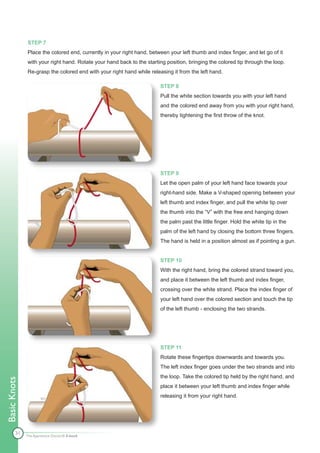
HEALTHCARE                The management of the various aspects of health and illness
HEMATOMA                  A blood clot within a body cavity or tissue space
HEMOPHILIA                A hereditary blood disorder marked by the inability of the blood to clot and the risk
                          of excessive bleeding
HEPATITIS B               An infection of the liver, caused by a specific virus and transmitted by blood or
                          blood derivatives from a carrier of this virus
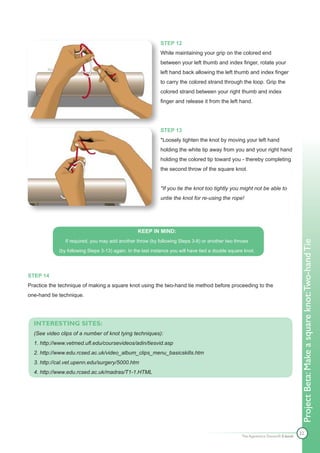
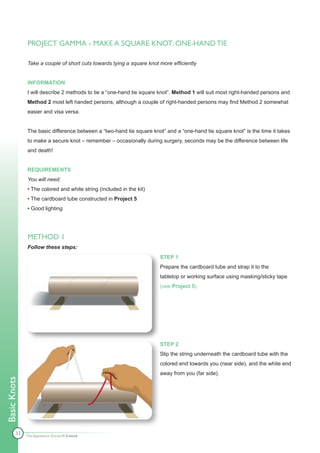
HEREDITARY                Transmitted genetically from parent to offspring
HIV                       Human immunodeficiency virus, the causative agent of the disease AIDS
HYGIENE/HYGIENICALLY Pertaining to cleanliness and the prevention of infections and sepsis
HYPERTROPHY               An increase in the size of a tissue or an organ due to growth of individual cells
IMITATION                 A copy that is similar regarding certain attributes to an original
                                                                                                                           Glossary


IMPAIRED                  Diminished in strength, value, or quality


                                                                                          The Apprentice Doctor® E-book
                                                                                                                          134
INCH                          A measure of length equal to one-twelfth of a foot or 2.54 centimeter
               INCISION                      A cut into the body, tissue e.g. skin or an organ - especially referring to a surgical
                                             cut
               INDEX FINGER                  The finger next to the thumb
               INFECTED                      Contaminated with a disease-forming microorganism or agent
               INFECTION                     Invasion and multiplication of disease-producing microorganisms in tissue, an
                                             organ, or a part of the body
               INFLAMMATION                  The response of tissue to injury characterized by pain and swelling
               INFUSE                        Introducing a solution into the body through a vein
               INJECTION                     The introduction of a fluid into the body by means of a needle and or cannula
                                             (flexible tube)
               INTERLOCKING                  A modified type of continuous suture where each suture loop is connected to the
               SUTURES                       previous suture loop
               INTERNS                       A recent graduate or advanced student who assists with the medical or surgical
                                             care of hospital patients
              INTERRUPTED SUTURES Individual sutures (stitches) are placed, the ends are tied into a knot and both
                                             ends are cut before proceeding with placing next suture
               INVASIVE                      Pertaining to a medical procedure where a part of the body is entered into
               JAWS                          The gripping part of a forceps / needle holder / tweezers or similar instrument
                                             usually somewhat serrated, crosshatched or “toothed”
               KELOIDS                       The formation of excessive amounts of scar tissue caused by an exuberant repair
                                             response following trauma or a surgical incision
               KNOT                          A fastening made by tying together lengths of string or rope, in a specific way
               LACERATE                      To cut, tear or wound
               LACERATION                    A cut, tear or wound
               LAPAROSCOPIC                  A minimally invasive surgical procedure that uses a flexible endoscope (camera)
                                             to view structures in the abdomen
               LATCH                         Catch for fastening or connecting two parts of an object e.g. the two legs of an
                                             artery forceps
               LATEX                         A natural rubber material used in the manufacturing of products like surgical
                                             gloves
               LIGATION                      Tying a blood vessel with a ligature during surgery to stop bleeding
              LIGATURE                       A thread or suture cord used in surgery to tie off vessels and tubular structures
               LOCAL ANESTHETIC              Absence of sensation or feeling in a restricted area of the body
               LOOP                          A length of string, rope or suture material that is circular or curved to form an
Conclusion


                                             opening
               MALIGNANT                     A life threatening disease (cancerous growth) tending to metastasize (form new
                                             growths distant to the initial site)


      135
             The Apprentice Doctor® E-book
MATTRESS SUTURE     A “double suture” used to assist with wound eversion
MAXILLOFACIAL       Pertaining to the facial skeleton - including the jaws, mouth and teeth
MEDICAL             Pertaining to the study or practice of medicine
MEDICAL HISTORY     An account of a patient’s past and present state of health
MEDICINE            The science that relates to the prevention, and treatment of diseases / Drugs and
                    potions used for restoring health
MICROCIRCULATION    Blood flow through the smallest vessels of the body (venules, capillaries, and
                    arterioles)
MONOCRYL            A monfilament absorbable suture material ( trade name)
MONOFILAMENT        A single strand of untwisted synthetic fiber used to manufacture suture cord
MUCOUS              Pertaining to the production and secretion of mucus
MUCOUS MEMBRANES    Membranes lining interior body surfaces opening to the exterior e.g. the nose and
                    mouth
MULTIDISCIPLINARY   Making use of several experts in a number of different disciplines
MUSCLE              A specialized tissue with the ability to contract, making movement possible
NEEDLE              A small, slender device used for surgical suturing. The sharp hollow device
                    placed at the tip of a syringe to inject medication into the body
NEEDLE HOLDER       A surgical instrument used for gripping the needle for suturing
NON-ABSORBABLE      Suture material requiring removal following placement - the body being unable to
SUTURE              digest these suture’s fibers
NON-ELASTIC         Tissue that resists deformation (stretching) when an external force is applied
NURSING             The science of providing care for sick and frail people
NYLON               A non-absorbable suture fiber, manufactured from a synthetic plastic material
OOZING              A liquid e.g. blood seeping or leaking out slowly through small blood vessels
ORTHOPEDIC          Relating to abnormalities and injuries of bone, muscles and joints
PAIN                An unpleasant sensation (hurting / suffering) usually occurring as a consequence
                    of injury or disease
PALM                The flexor (inside) surface of the hand
PARAMEDIC           A person who is trained to give emergency medical treatment
PENETRATE           To pierce, enter into something or make a way through something
PERFUSE             To permeate with e.g. a liquid
PERPENDICULAR       A line at a right angle (90 degrees) to another line
PHYSIOLOGY          Study of the function of living organisms and their parts
PLASTIC SURGEON     Surgery dedicated to the repair and restoration of the body, especially as it relates
                    to the enhancement of appearance
PRACTITIONER        A person who practices medicine or an allied health profession
                                                                                                                    Glossary


PRE-MEDICAL         A pre-medical degree (pre-med) is one preparing a person for entrance into
                    medical school


                                                                                   The Apprentice Doctor® E-book
                                                                                                                   136
PRIMARY CLOSURE               Final closure of a wound or laceration within 24 hours after sustaining the injury
               PROBE                         A slender flexible surgical instrument with a sharp or rounded tip used for
                                             exploration purposes
               PURSE STRING SUTURE A suture designed to close a rounded surgical defect or wound
               RAGGED                        Having an irregular or uneven surface or edge
               RATCHET                       A toothed component or tool, operating with a catch mechanism, locking
                                             movement in one direction only
               RAT-TOOTHED                   A forceps with a tip having a tooth-like projection for holding tissue when suturing
                                             or performing surgery
               RECONSTRUCTIVE                Pertaining to the restoration and correction of appearance and function of
                                             defective or damaged body parts
               REFLEXIVE                     Without conscious control
               REGISTRARS                    A specialist in training who acts as assistant to the attending specialist (term used
                                             in British hospitals)
              REPAIR                         Restoring to health and a functional condition following damage or injury
               RESUSCITATE                   To restore consciousness or life (to revive) following a life threatening incident
               ROUND NEEDLE                  A suture needle with a round contour when viewed in cross-section
               RUNNING SUTURES               A suture made from a continuous (uninterrupted) succession of sutures and
                                             fastened at the two ends by a knot
               SCALP                         The skin covering the top of the human head
               SCALPEL                       A surgical knife with an extremely sharp blade used for dissections and for
                                             performing surgery
               SCAR                          A mark left on the skin following an injury or wound that has healed
               SCAR TISSUE                   Dense, fibrous connective tissue that forms over a healed wound or incision
               SCISSORS                      A cutting tool consisting of two blades and two handles, joined by a swivel pin that
                                             allows the blades to be opened and closed
               SECONDARY CLOSURE             Suturing a wound a number of days after the injury
               SEDATION                      Sedation involves the administration of calming drugs to facilitate the
                                             performance of a surgical procedure
               SEMICIRCULAR                  A form in the shape of half a circle
               SEPSIS                        A bacterial infection in the bloodstream or body tissues
              SERRATED                       A saw-toothed edge / a margin notched with tooth-like projections
               SHARPS                        Referring to all sharp or potentially sharp surgical items like scalpel blades,
                                             needles, glass cartridges etc.
               SHIN                          The front part of the leg between the knee and the ankle
Conclusion


               SKIN GRAFT                    The process of harvesting and transferring skin from a donor to a recipient site,
                                             and securing it at the recipient site


      137    The Apprentice Doctor® E-book
SKIN TENSION LINES   Surgical incision lines with directions designed to minimize scar tissue formation
SOLE                 The underside of the foot
SQUARE KNOT          A double knot in which the two loops are tied in opposite directions, used to join
                     the two ends of a suture or a ligature
STAY SUTURES         Temporary sutures placed to approximate two sides of a wound or laceration to
                     assist in aligning the wound/incision correctly
STERILITY            Sterility indicates the total absence of infectious micro organisms
STERI-STRIPS         Small plaster strips used to close minor lacerations or to reinforce sutured
                     lacerations (trade name)
STITCH               A single suture
STRAPPING            A strip of adhesive plaster, used in attaching parts to each other
STRING               A cord used for fastening or tying
SUBCUTANEOUS         Below the skin
SUBCUTANEOUS         Sutures placed to approximate the subcutaneous layers of tissue in a wound or
SUTURES
                     surgical incision
SUBCUTANEOUS         The layer of tissue just below the dermis of the skin
TISSUE

SUBCUTICULAR         A continuous suture placed just below the cuticular layer of the skin
SUTURES

SURGEON              A physician who specializes in surgery
SURGEON’S KNOT       A modified square knot - the first loop consists of a double throw
SURGERY              The branch of medicine that deals with the diagnosis and treatment of injury,
                     deformity, and disease by invasive means
SUTURE               The surgical technique used to close a wound or join tissues
SWAGE                The section of an atraumatic needle where the suture connects to the needle
TECHNIQUE            The skill and procedure with which a surgical procedure is carried out
TENSION              The act of stretching something tight
TETANUS              An infectious disease, also known as lockjaw, caused by the toxin of tetanus
                     bacteria (Clostridium Tetani)
THEATRE              Referring to an operating theatre - the room where surgical operations take place
THIGH                The section of the leg between the hip and the knee
THREAD               A cord of natural or manufactured material
THROW                A basic step in the process of tying a knot
THUMB                The short thicker digit of the human hand, next to the index finger and opposable
                     to the other four digits
TIE                  To fasten or to secure with, e.g. rope or string by making a knot
                                                                                                                     Glossary


                                                                                    The Apprentice Doctor® E-book
                                                                                                                    138
TIE SUTURE                    A section of suture material without a needle used to tie-off (close -off) e.g. blood
                                             vessels
               TISSUE                        A collection of similar cells
               TORSO                         Trunk or body without the head and limbs
               TOXIC                         Able to cause injury or death - especially pertaining to chemicals (poisonous)
               TRACHEOTOMY                   A tracheotomy is an operation in which an opening is made in the windpipe
                                             (trachea)
               TRAUMA SURGEON                A surgeon specializing in the various aspects of diagnosing, managing and
                                             treating injured patients
               TRAUMATIC TATTOOING The inclusion of foreign material into an abrasion or wound causing a change in
                                             the color of the skin following wound healing
               TRAUMATIZED                   Wounded or injured
               TUMOR                         A swelling, especially referring to swellings caused by the abnormal growth of
                                             cells or tissue.
              TWEEZERS                       Instruments that are usually held with the thumb and forefinger and used for
                                             handling or manipulating tissue during surgery
               UNDERMINE                     Dissecting some distance under the skin’s surface at a plane parallel to the
                                             surface
               UNRAVEL                       The fibers of a suture thread becoming undone
               VETERINARY                    Medicine and surgery related to animals
               VICRYL                        A braided absorbable suture material (trade name)
               WOUND CONTRACTION             The body’s repair mechanisms producing shrinkage (reduction of the size) of the
                                             wound during the healing process
               WOUND EDGE                    The side margin of a wound or laceration


              SERRATED
Conclusion


      139    The Apprentice Doctor® E-book

How To Stitch Up Wounds Course

  • 2.
    AN ILLUSTRATED HANDS-ONCOURSE Available for purchase: An 18 piece suturing Kit with all the instruments and items needed to learn how to suture lacerations! Learn how to care for- and suture wounds AND get your 18-piece suture kit with real medical instruments and items – all you will need to practice wound suturing at home… or wherever you are!! A product by THE APPRENTICE CORPORATION Copyright© The Apprentice Corporation 2007 All rights reserved. WARNING: The Apprentice Doctor® Suturing Kit is exclusively intended for educational purposes. It is strictly prohibited for use in medical situations. Not intended for treating either human or animal patients!
  • 3.
    THE APPRENTICE CORPORATION:COPYRIGHT INFORMATION All copyright in and to the contents of The Apprentice Doctor® CD–ROMs and web sites (including text, pictures, sketches, logos, animations, photographic material, video material, sound samples and graphic art) are the sole property of The Apprentice Corporation and all the rights of The Apprentice Corporation are reserved. No part of The Apprentice Doctor® CD–ROMs and web sites books or e-books may be reproduced or transmitted in any form or by any means without the express, written consent of The Apprentice Corporation. Contact information for written consent may be requested from: The Apprentice Corporation 2299 Kenmore Avenue Buffalo, NY 14207 U.S.A. Or per e-mail: reg@TheApprenticeDoctor.com We appreciate your integrity in this regard.
  • 4.
    A BASIC COURSEIN SUTURING CONTENTS INTRODUCTION 01 - 05 Preface...........................................................................................................................................01 Objectives of the Course..........................................................................................................03 Disclaimer.....................................................................................................................................04 List of Medical Instruments.......................................................................................................05 PREPARATORY PROJECTS 09 - 20 Case Study - Dr. Shipton’s Holiday..........................................................................................09 Project 1: Familiarize yourself with the suture kit..............................................................11 Project 2: Attach suture material to a needle......................................................................13 Project 3: How to clip the needle to the needle holder....................................................16 Project 4: Prepare imitation skin for practicing suturing...................................................18 Project 5: How to construct a rod to practice knot tying.................................................20 BASIC KNOTS 23 - 56 Case Study - The Surgeons Knot.............................................................................................23 Project Alpha: A demonstration of a square knot and a granny knot.............................25 Project Beta: Make a square knot: Two-hand tie.................................................................29 Project Gamma: Make a square knot: One-hand tie..........................................................33 Project Delta: Make a surgeon’s knot: One-hand tie.........................................................41 Project Epsilon: Make a square knot: Instrument tie.........................................................52 Project Zeta: How to make a surgeon’s knot (Instrument tie)........................................56 SUTURING TECHNIQUES 61 - 129 Case Study - Rhodé’s Ear...........................................................................................................61 Case Study - Hazards at work..................................................................................................63 Basic principles of wound care.................................................................................................65 A basic course in suturing techniques....................................................................................70 Project A: How to place subcutaneous sutures...................................................................71 Project B: How to place interrupted sutures.......................................................................77 Project C: How to place interrupted sutures with buried knots....................................85 Project D: How to place continuous sutures.......................................................................89
  • 5.
    SUTURING TECHNIQUES (CONTINUE) ProjectE: How to place continuous interlocking sutures.................................................93 Project F: How to place horizontal mattress sutures........................................................97 Project G: How to place vertical mattress sutures...........................................................101 Project H: How to place “Far-and-Near” sutures.............................................................105 Project I: How to place subcuticular sutures......................................................................109 Project J: How to place a purse string suture.....................................................................115 Project K: How to correct a “Dog’s Ear”...........................................................................118 Project L: How to correct unequal levels of tissue...........................................................121 Project M: How to remove sutures......................................................................................125 Complications of suturing........................................................................................................129 CONCLUSION 131 - 132 Epilogue........................................................................................................................................131 Glossary.......................................................................................................................................132
  • 6.
    PREFACE Learning how to suture wounds and lacerations requires a thorough understanding of the theory of wound care and the basic principles of suturing. The student also needs to reach an advanced level of proficiency by practicing knot tying and suturing techniques. The Apprentice Doctor® Suture Course and Kit is not intended to substitute the clinical training of students but rather to offer a firm foundation and an opportunity to experience his/her initial learning curve in an imitation situation – so as to fill the student with confidence when he is faced with the real life clinical situation. The Apprentice Doctor® Suturing course material consists of 3 sections: 1. Get acquainted with the instruments and items in the Kit 2. Basic Knot tying 3. Suturing techniques Follow this specific order when working your way through the course material, and ensure that you understand the one section and are able to perform the practical projects skillfully before proceeding to the next section. Do not skip a section because you think it is unimportant or too simple. Basic principles are like that, they appear to be simple, but one needs to understand and practice these simple building blocks before proceeding to, and succeeding with the complicated stuff. IMPORTANT NOTES: Kindly note: For the purpose of this course the word suture will be used as the verb/noun pertaining to the closing-up or stitching-up of wounds/lacerations /incisions. • The Apprentice Doctor® Suturing Hands-on Course and Kit has been designed mainly for right-handed persons. Left-handed persons please exchange the terms left and right as they occur in the text where applicable. Introduction • This Kit contains the bulk of the information, instruments and items to successfully practice your suturing technique. It is highly recommended that you invest in The Apprentice Doctor® Basic Medical Course and Kit, which wonderfully supplements The Apprentice Doctor® Suturing Course and Kit! 1 The Apprentice Doctor® E-book
  • 7.
    • TheApprenticeDoctor.com websiteand community compliments these 2 products and gives the future Healthcare professional a chance to join groups of like-minded students with the aspiration of becoming medical professionals, or to learn from other practicing Healthcare professionals. You will find a suitable community in your country/state – and will receive lots of free advice and support to help you fulfill your dream! Dr Anton Scheepers and the staff of The Apprentice Corporation as well as all the Apprentice Doctor community leaders would like to wish you success with your future and look forward to being a small part of fulfilling your dreams! Recommended training material for … All Healthcare Professionals whether prospective, in training or qualified: • Medical students • Pre-medical students • Paramedics and EMT students • Dental students • Veterinary students • Nursing students • Surgery Interns/Registrars • Advanced First Aid practitioners • Medics in the military • The Apprentice Doctors’ Club Members • High school students interested in a career in medicine • Practicing Healthcare professionals who would like to improve or refresh their suturing technique. • Non-medically qualified individuals with a keen interest in the practical aspects of medicine Preface 2 The Apprentice Doctor® E-book
  • 8.
    OBJECTIVES OF THECOURSE: To equip students with a basic understanding of the theory of suturing wounds and to acquire the skills to confidently tie surgical knots and suture lacerations. The student should on completion of this course have a good understanding of: • The basic principles of wound care • Knot tying techniques (as related to knots used in surgery) • Surgical instruments used in suturing • Suture materials • The various suturing techniques used by medical professionals The student should have the following skills: • Placing sub-cutaneous sutures • Placing interrupted sutures • Placing a variety of mattress sutures • Tying a square knot (two-hand tie, one-hand tie, and instrument tie) • Tying a surgeon’s knot (one-hand tie, and instrument tie) • Using a number of other types of suturing techniques • Correcting minor discrepancies while suturing • Removing sutures Developed by a surgeon with more than 20 years of experience PLEASE READ THESE WARNINGS CAREFULLY • Your Suture and Dissection Kit contains sharp objects e.g. a scalpel-like knife, needles and scissors. Please be extremely cautious and careful when using these instruments! • Not suitable for children under 12 years of age! • Supervision/guidance by a responsible adult is recommended for students under 18 years of age. • The user must always wash his/her hands before using the kit to minimize the risk of infection following accidental injury. For the same reason gloving is recommended. • Always use clean instruments. Wash instruments with soap and water after each usage session, then leave it in an antiseptic solution e.g. Savlon for 60 minutes. Rinse thoroughly with clean water then dry before replacing it in the kit. Introduction • For any cut or needle prick injuries – squeeze the wound for 15-30 seconds to bleed out impurities, then wash profusely with soap and water; apply pressure to stop the bleeding, then apply a plaster e.g. Band Aid. Seek professional medical assistance. • Keep out of reach of babies, toddlers and children under the age of 10. • Keep sharp instruments away from the eyes. 3 The Apprentice Doctor® E-book
  • 9.
    DISCLAIMER The producer orsupplier of this application does not: • Offer any warranty regarding the accuracy or correctness of any information contained in this application; • Assume any responsibility for any damage or consequential damage related in any way to the information, instrumentation or items contained in this product/application or as a result of the use thereof. The user takes full and exclusive responsibility for the safe application of any information contained in this application. The user also takes full and exclusive responsibility for all safety aspects related in any way to the use of any instrument or item supplied with this application. This exclusive responsibility applies equally to the user or to any person or persons being supervised by the user. No warranties are offered on the functional status or fitness for a specific application of any information, instrument or item supplied in this application. The supplier accepts no responsibility for the malfunction of any instrument or item. The supplier disclaims all liability for any direct or indirect damages – specific or consequential - related in any way to the information, and instrumentation or any item contained in this application. All practical exercises are performed exclusively at the user’s own risk. The producer or supplier of this application disclaims any responsibility for any medical emergencies, medical problems or any other problems whatsoever, which may arise while using any instrument or item or applying any information supplied with this application. The use of the instruments, items and information supplied in this application is conditional upon the acceptance of this disclaimer as well as the undertaking to honor the copyrighted course material. REIMBURSEMENT POLICY The Apprentice Corporation is confident that you will be satisfied with this product in each and every way. If you are, for any reason dissatisfied with your choice, The Apprentice Corporation will be happy to reimburse you (less postage and shipping charges) should you wish to return the complete medical kit as well as the CD-ROM in an undamaged state within a reasonable time limit of not more than 8 weeks after acquiring this product. Disclaimer YOUR ORDER NUMBER AND THE DATE OF THE TRANSACTION SHOULD ACCOMPANY YOUR REQUEST FOR REIMBURSEMENT. 4 The Apprentice Doctor® E-book
  • 10.
    LIST OF MEDICALINSTRUMENTS Surgical scissors Surgical scissors are classified according to the 2 blade tips - thus: • Sharp–sharp • Sharp–blunt • Blunt–blunt Sometimes scissors are classified according to function – for example: • Suture cutting scissors • Dissection scissors In certain operations it is safer to carefully dissect your way towards an area/organ rather than cutting into the tissues with a sharp scalpel blade. Use your medium Sharp–blunt scissors for general cutting purposes and to cut off excess suture material after placing a suture and tying the knot. Use the small Sharp-sharp scissors to cut the suture for removal. Surgical probes (seekers) Your Kit has two probes: • Sharp (straight) • Blunt (slightly curved) Probes are also classified as: • Hollow • Solid A dentist uses a sharp curved probe to examine teeth and detect cavities. Anesthetists and radiologists use flexible blunt probes to maneuver their way into specific veins or arteries in the body (for diagnostic or Introduction therapeutic purposes) 5 The Apprentice Doctor® E-book
  • 11.
    Skin hook (ifavailable) A skin hook is used to lift a section of skin, to facilitate the placement of sutures while minimizing the amount of injury to the tissues. By placing two skin hooks into the tissue at the corners on the 2 sides of a laceration, and gently lifting both skin hooks, one can facilitate eversion (having a slightly raised sutured laceration compared to the adjacent tissue). Scalpel A scalpel is a surgical knife with a fixed or removable blade (cutting area). Removable blades are produced in a variety of patterns and sizes. WARNING: The scalpel is the most dangerous instrument in your Kit – handle with caution! Forceps A forceps is an instrument used in medicine to grab or to hold something. You Kit contains a general-purpose tweezer-forceps. The inside of the tips (jaws) are serrated to enhance gripping. This forceps is used for general handling and gripping of tissue or objects. The other forceps is called a tissue forceps. The tip of this forceps shows a sharpish tip (jaws) on the one leg and a v-shaped groove on the other side. It is commonly referred to as a rat-tooth forceps. Use this forceps to handle tissue when placing sutures. List of Medical Instruments Needle Holder A Needle Holder is a special type of forceps, designed to securely hold the surgical suture needle when placing sutures. Artery forceps are somewhat similar in appearance, but have longer jaws – some with straight and some with curved jaws. 6 The Apprentice Doctor® E-book
  • 12.
    Sutures The main two groups of sutures are: • Absorbable. These sutures are broken down by bodily enzymes, and are used when sutures are placed within the body, below the skin (Chromic and Plain Catgut, Vicryl™ and Monocryl™) • Non-absorbable (e.g. Nylon and Silk). These sutures are more predictable as regards their strength. The patient needs to return to the hospital/surgery for removal of these sutures. Sutures may also be subdivided as braided and monofilament. As a rule, braided sutures are easier to tie but cause a more intense tissue reaction. Suture sizes Modern suture diameters range from thick to thin and are represented by the series of numbers 5, 4, 3, 1, 0, 2-0, 3-0, 4-0, 5-0, 6-0, 7-0, 8-0, 9-0, 10-0 and 11-0. Number 5 sutures are heavy braided sutures used by orthopedic surgeons and 11-0 sutures are micro-fine monofilament sutures used by ophthalmic surgeons operating with the aid of a surgical microscope. Number 5-0 or 6-0 sutures are used to stitch up lacerations in cosmetically sensitive areas like the face. Needles Needles may be straight, a semi-circle or a section thereof. In cross section they may be round or triangular – with a cutting edge on either the inner curve or the outer curve. The length and the diameter of needles may vary considerably. The number used when describing a needle usually refers to the length in millimeters. Modern needles are pre-assembled with a suitable suture material attached to the blunt end. These needles are referred to as “atraumatic” - meaning they do not have an eye that may injure the tissue as it traverses the tissues. Introduction The needles in your Kit have a small eye on the side opposite to the tip for you to attach the suture to. Atraumatic needles are manufactured in all shapes for most sizes of sutures. 7 The Apprentice Doctor® E-book
  • 13.
    Imitation Skin A 15X 15 cm imitation skin is included in your kit. The white fiber-like part corresponds to the dermis and the thin plastic covering corresponds to the epithelium (the covering surface layer of skin and mucous membranes). Remember you can practice your skills on a variety of vegetables – oranges, bananas potatoes etc. The imitation skin in your kit is more life-like compared to a number of gel-like imitation skin products available on the market. Skin is in fact anything but gel-like in consistency. Gloves It is strongly recommended that you wash your hands hygienically clean (see “Project 00” in The Apprentice Doctor® Basic Medical Course) and glove before practicing placing sutures to make sure that you get in the right habits from the word go. You need to become accustomed to the “feel” of working while being gloved like a surgeon. More information: http://en.wikipedia.org/wiki/Suture List of Medical Instruments 8 The Apprentice Doctor® E-book
  • 14.
    DR SHIPTON’S HOLIDAY Dr Shipton usually reserves 2 weeks at their favorite holiday resort for their family’s yearly holiday. Dr Shipton, his wife and their two children look forward to these 2 weeks of enjoyment months in advance. It is a time of re-uniting family ties, involving the whole family in games and activities, all at a beachfront venue, with their flat having an exceptionally great view of the treacherous Indian Ocean on the East coast of Africa. The first week was great. The weather was good and the sea was perfect for swimming. “Let’s get up early tomorrow morning and watch the fishermen reeling in their fish from the rocks,” Jamie the elder Shipton son proposes, and the proposal is accepted unanimously. It is July and one of the most spectacular natural events is about to occur – the sardine run. Schools of millions of sardines migrate up the coast, followed by game fish like barracudas and sharks in their thousands – a fishermen’s paradise!! Conditions for fishing have been forecast as optimal and hundreds of fishermen line the coast, the prime spot is Ekhakha’s rock. Dr Shipton and his family haven’t caught on to the fishing thing, but this event makes for great entertainment merely by being a spectator. So 8 a.m. and everybody’s ready to stroll down to the beach. They have to pass a number of neighboring flats on their way down. Suddenly they are stopped in their tracks, stunned by screaming followed by an urgent shout: “HELP! SOMEBODY, PLEASE HELP!!” One of their neighbors’ flat door swings open with an even more urgent shout for help. Dr Shipton dashes towards the flat and discovers the neighbor’s 17-year-old son covered in blood. A simple slip and his head shattered the glass top on the coffee table. “Quickly bring me towels!” he shouts. He tightly drapes a large towel over the large cut in the scalp and puts on tight hand pressure for a couple of Case Study minutes. The towel slowly becomes red and more saturated with bright red blood. 9 The Apprentice Doctor® E-book
  • 15.
    The pressure helpsbut doesn’t stop the bleeding. “Go get my first aid kit!” His wife rushes to their flat and returns with the kit. Dr Shipton always carries some local anesthetic as well as a couple of packets of suture material and the relevant instruments in his first aid kit. He quickly injects local anesthetic containing adrenalin and almost immediately starts to stitch up the long 25 cm (10 inch) laceration in the scalp. With each stitch the bleeding gets less. Dr Shipton doesn’t waste time cutting the stitches – just one long continuous suture. Time is of the essence. He has just one thing in mind… to stop the bleeding as soon as possible. He takes fairly large bites with the suture needle into the tissue adjacent to the laceration, and ensures that the stitches are tight by interlocking them. He uses another towel to clean up the wound. He then inspects the area for residual bleeding, and cleans up. Dr Shipton writes a note to the Medical Officer at the local hospital giving him the relevant information and requesting him to take over the case. Just then, the ambulance arrives and the Paramedics rush to assist in stabilizing the patient. The patient is transported to the local hospital. At long last the Shipton family is on their way to the beach – the subject under discussion is the events of the morning. Would you like to be prepared for an emergency situation like Professor Shipton? Here is your chance to learn how to professionally suture wounds! IMPORTANT WARNING Dr Shipton’s Holiday For those who are not qualified and officially registered as a medical professional, please keep the following in mind: • Leave suturing on real patients to suitably medically qualified individuals. • In an emergency call 911 or equivalent emergency number! • Exert direct pressure on any bleeding point until help arrives. 10 The Apprentice Doctor® E-book
  • 16.
    PROJECT 1 -FAMILIARIZE YOURSELF WITH THE SUTURE KIT Ensure that your Suture Kit is complete and that you know the names of each individual instrument INFORMATION Most metal surgical instruments are made from stainless steel – which is strong, durable and won’t corrode (rust). They can be sterilized by steam autoclaving and will retain their characteristics. REQUIREMENTS Your suture Kit STEP 1 Identify the components of your suture Kit using the list (provided on page 5). Our Kits are double checked for quality and completeness by our factory. In the unlikely event of problems, kindly contact customer support personnel at Customercare@TheApprenticeDoctor.com. STEP 2 2.1 Remove the Needle Holder from the Kit, and examine it. Identify its different parts. 2.2 Have a good look at the ratchet latch (lock) mechanism - it has 3 beveled teeth on the inside of both sides – designed to catch at 3 levels – light, medium and strong locking. 2.3 Put the thumb in the upper eye and the 4th finger in the lower eye Preparatory Projects of the handle – see picture right. Practice the locking and unlocking action of the ratchet latch mechanism at all three levels. 2.4 Clamp and unclamp small objects like pieces of paper or thin cardboard. Do the jaws leave a checked pattern on the paper? 11 The Apprentice Doctor® E-book
  • 17.
    2.5 Now examinethe crosshatched pattern (photo) on the inner side of the Needle Holder’s jaws. This pattern is designed to firmly grip the suture needle and prevent unnecessary slipping of the needle/suture. Wear and tear will eventually cause this surface to become smooth – an indication to replace the Needle Holder with a new one. STEP 3 Remove the two tweezer- forceps from the set. The forceps has two legs joined at the hinge. Examine the inside of the tips. The one forceps has jaws with a serrated inner surface and the other one has a v-shaped tooth on the inside of the jaw and a v-shaped groove on the other side (the tooth fitting into the groove). Use this forceps to gently handle tissue with the left hand when placing sutures. Project 1: Familiarize yourself with the Suture Kit STEP 4 Have a look at the skin hook (substituted with a sharp curved probe in some sets). It is used to gently lift skin during suturing. Hook the skin on the inside (raw) surface – not the epithelial surface. POINTS OF INTEREST 1. Quite a variety of scissors each with a unique purpose are available. Examples are: • A pair of scissors that can cut through stainless steel wire – used by orthopedic surgeons and maxillofacial surgeons • A pair of dissection scissors – meant to carefully dissect through tissue instead of cutting with a scalpel. These scissors are usually slightly curved with pointed, though slightly rounded tips A pair of micro scissors • Micro scissors – used in eye surgery and microscopic surgery (e.g. joining small arteries, veins and nerves under the surgical microscope) The Apprentice Doctor® E-book 12
  • 18.
    2. A surgeonis only as good as his/her tools. Know your instruments and always use good quality medical instruments. Order affordable quality medical instruments at: http://www.affordabledrtools.com/ 3. Order a professional suture set (IFRC specifications): http://www.affordabledrtools.com/ PROJECT 2 - ATTACH SUTURE MATERIAL TO A NEEDLE How to attach a piece of suture material to a surgical needle INFORMATION In past generations, a medical professional would routinely use a needle with an eye (an “eye” is a small hole on the blunt side of a needle where the thread is held) for suturing purposes. The eye part of such a needle may cause minimal damage as it traverses the tissue. Modern suturing materials have pre-attached thread. Pre-attached sutures allow for a smooth transition from the needle’s body to the swage and then to the suture – and are thus referred to as an “atraumatic design” (won’t cause further injury to the tissue). The needle-suture attachment is an occasional weak link, and on rare occasions may become undone. This attachment occupies about ⅛ inch (3 mm) on the suture end of the needle (the swage). One should avoid clamping the Needle Holder to the swage of the needle as one may interfere with the secure attachment of the suture to the needle. Suppose you land yourself up in a far-off mission hospital or a military field hospital and you only have thread and needles with eyes – will you be able to help your patient? Learn how to attach suture material to a needle by following these steps: Preparatory Projects REQUIREMENTS You will need: • About (12-18 inches) 45 cm of silk suture • One no 16 semicircular needle 13 The Apprentice Doctor® E-book
  • 19.
    STEP 1 Unroll about12-16 inches (30-40 cm) of silk suture from one of the reels supplied. STEP 2 Remove one no 16 needle from the package using the Needle Holder. Clamp the needle roughly in the middle of the needle’s body. Secure the Needle Holder by clamping it to the first ratchet. (Be careful when working with sharp objects). STEP 3 Fold the last 1½-inch (4 cm) of suture double and pass the double thread through the eye of the suture needle. STEP 4 Project 2: Attach suture material to a needle Open up the double thread slightly to form a loop, and pass the needle through the loop. 14 The Apprentice Doctor® E-book
  • 20.
    STEP 5 Firmly pull the long and short loose ends of the double thread away from the needle - thus tightening the simple loop knot to attach the thread to the needle. POINTS OF INTEREST 1. Needles with eyes can be re-used a couple of times under the following conditions: • The tips remain sharp • The needles are structurally undamaged • They are properly sterilized • Re-use for not more than 4-6 times 2. Practice and perfect your technique by ordering a variety of real pre-assembled, pre-packed sterile surgical sutures from http://www.affordabledrtools.com/ Preparatory Projects 15 The Apprentice Doctor® E-book
  • 21.
    PROJECT 3 -HOW TO CLIP THE NEEDLE TO THE NEEDLE HOLDER Learn the technique on how to properly clip and secure a needle onto a Needle Holder INFORMATION Note: One should ideally clip the Needle Holder onto the mid-section of the needle – somewhat closer to the swage. Avoid clipping the Needle Holder onto either the Tip or swage sections! Project 3: How to clip the needle to the Needle holder The various parts of a surgical needle REQUIREMENTS • The Needle Holder • One no 16 Needle with suture material attached (see Project 2) The Apprentice Doctor® E-book 16
  • 22.
    STEP 1 Wash your hands, dry and put on a pair of gloves (Project 00 of The Apprentice Doctor® Basic Medical Course). The Gloves serve as a surgical barrier between operator and patient, and provide protection from accidental needle injuries. Double gloving is advised for high-risk patients e.g. patients with Hepatitis B and HIV infections. STEP 2 Follow the principle of minimal handling of sharp instruments and items. Use a tweezer-forceps to remove one no 16 needle from the package using your left hand. Present the needle to the needle holder with this tweezers forceps. STEP 3 Use your needle holder to clip the needle, secure the latch mechanism (listen for the first or second “click”) – avoid clipping it onto the swage third (may damage the suture-needle attachment) or the tip third (may damage the sharpness of the tip) of the needle. STEP 4 Inspect the suture part and ensure that it is untangled and without any knots. POINTS OF INTEREST Preparatory Projects • Accidental needle injuries are common causes for the accidental contraction of HIV and Hepatitis B infections • All patients should be considered carriers of infective diseases. • Hospitals have specific protocols on what steps to take following accidental needle injuries – familiarize yourself with your hospital’s protocol 17 The Apprentice Doctor® E-book
  • 23.
    • Handle sharpobjects and instruments once – minimize the handling of sharps. Surgeons should get into the habit of taking scalpels and assembled needles for suturing directly from the instrument tray. Do not ask the assisting theatre sister to hand you such sharp instruments/items if at all possible. Many “sharps” injuries in theatre occur during the transfer of “sharps” from one person to the other. PROJECT 4 - PREPARE IMITATION SKIN FOR PRACTICING SUTURING Prepare a piece of imitation skin for practicing your suture technique INFORMATION The imitation skin for practicing your suture technique consists of three layers – just like natural skin: • A superficial covering layer (1 mm) – representing the epithelium • A white fibrous layer (3 mm / ⅛ inch) – corresponding to the dermis • A spongy layer (6 mm / ¼ inch) Project 4: Prepare imitation skin for practicing suturing -- corresponding to the subcutaneous tissue This patented imitation skin, provided with The Apprentice Doctor® How to Stitch-up Wounds Kit, is a remarkably effective substrate for practicing suturing techniques, and sutures can be placed, and removed repeatedly along the same incision line! REQUIREMENTS • A 4 X 6 inches (10 x 15 cm) piece of imitation skin • The large scissors • The small scissors • A pen and ruler (a skin marker pen and ruler is available in The Apprentice Doctor® Basic Medical Kit) STEP 1 One sheet of imitation skin can be used to create ±3 imitation lacerations. Divide the imitation skin sheets into 3 sub-sections and draw 3 straight lines of ± 11cm (4 inches) on it - as indicated in the diagram. The Apprentice Doctor® E-book 18
  • 24.
    STEP 2 Make a short 5 mm (¼ inch) vertical line at 90 degrees to the straight line - in the middle of each of these 3 lines. STEP 3 Divide each of these halves into quarters and draw another two short 5 mm (¼ inch) vertical lines in these regions. (These lines will enable you to check the alignment of the skin following closure of the laceration with sutures). STEP 4 Use the sharp-sharp scissors and push oneblade into the skin at one end of the horizontal line and cut the full thickness of the skin along the straight line up to the end of the 11cm (4 inches) horizontal line. (The larger scissors will be more effective in cutting the imitation skin). Repeat the same procedure with the other 2 lines to create 3 imitation lacerations. These cuts represent surgical incisions or traumatic lacerations in the skin. POINTS OF INTEREST • In a recent survey in the state of Virginia, U.S.A, minor soft tissue injuries like abrasions, lacerations and contusions ranked as the third most common reason why patients visited their family physician. Preparatory Projects • A neat suture technique will go a long way to avoiding ugly scarring and the need for scar revision by a plastic surgeon • The saying “practice makes perfect” is especially true in this regard! 19 The Apprentice Doctor® E-book
  • 25.
    PROJECT 5 -HOW TO CONSTRUCT A BAR/ROD TO PRACTICE THE VARIOUS TECHNIQUES OF TYING KNOTS INFORMATION Suturing, like the other fields of medicine, is both an art and a science. It follows that to become a proficient operator you will need to gain a good understanding of the theory, TOGETHER with frequent practicing of the techniques of suturing. REQUIREMENTS • Masking tape or equivalent • The inside cardboard cylinder from a toilet roll or a tissue roll • A table or suitable working surface to practice making knots Project 5: How to construct a bar/rod to practice tying knots STEP 1 Cut 2 parallel lines along the long axis of the cardboard tube – about 3.5 cm (1½ inch) width on both sides, along the same long axis lines. STEP 2 Bend a 90 degrees leg downwards on both sides. 20 The Apprentice Doctor® E-book
  • 26.
    STEP 3 Bend a 1.5 (½) inch foot outwards (again 90 degrees to the leg) STEP 4 Position the rod-like tube with its long axis horizontally in front of you, and about 30 cm (6 inches) away from the table’s edge. Strap the foot down - on the table or working surface you intend to use to practice making knots with adhesive tape e.g. masking tape or “sticky” tape. Alternatively simply place your ruler on two spacers on the two ends (the suture reels will work just fine for this purpose) and strap it down with masking/sticky tape. POINTS OF INTEREST 1. Interesting what useful purposes a piece of trash can serve! 2. Get into a habit of thinking along these lines: • What useful purpose can an item serve before trashing it? • Can it be recycled? • Think “green”! Don’t be wasteful! 3. “Prevention is the best cure” – let us apply it in all the areas of our lives! Preparatory Projects 21 The Apprentice Doctor® E-book
  • 28.
    THE SURGEON’S KNOT Dr Buys is in a wonderful mood. This is Friday afternoon and he has booked a short operating list because he plans to go on a special weekend, just he and the Missus. This is the last case, a routine laparoscopic removal of a diseased gallbladder. He has done so many over the years and has become quite an expert. “I’m sure I will be able to remove this gallbladder with my hands behind my back!” he jokingly remarks. First, second and third incisions, instrumentation in place and now for the careful dissection… “Thirty minutes and I am out of here!” he remarks. The inflammation has caused quite a bit of scar tissue, and the anatomy is not as clear as he expected. Suddenly - a surge of bright red blood! “Suction!! Suction!!” He shouts – but it is obvious that the bleeding is much too fast for the suction to handle. Vision becomes impossible and now is the time for quick, life-and-death decisions! ”Lets open up!!” He shouts to the scrub sister. “Scalpel! Diathermy! … Abdominal swabs!! … Artery forceps!!“ Dr Buys knows that he needs to abort the laparoscopic-camera procedure via the small buttonhole incisions. He will have to make a larger incision to access the bleeder and stop the bleeding. If the patient looses more than a certain amount of blood, she will go into surgical shock and may die! Case Study 23 The Apprentice Doctor® E-book
  • 29.
    At last thebleeder has been identified and everybody takes a brief sigh of relief. “Tie suture”, Dr Buys continues, amazingly relaxed now. “Remove artery.” He ties off the bleeder with an amazing amount of finesse and ease. Would you like to know how to make a surgeon’s knot? NOTE: • “Near side” refers to the area closer to you and the term “far side” refers to the area away from you. • Left- handed individuals – kindly substitute the word “right” for “left” and visa-versa. Apologies for any inconvenience! • The word “throw” refers to a single basic subunit or tightened loop of a knot. The Surgeon’s Knot 24 The Apprentice Doctor® E-book
  • 30.
    PROJECT ALPHA -A DEMONSTRATION OF A SQUARE KNOT AND A GRANNY KNOT View a demonstration of the difference between a Square knot and a Granny knot INFORMATION • Definition – knot: The American Heritage® Dictionary defines a knot as: “A fastening made by tying together lengths of material, such as rope, in a prescribed way.” • Description of a square knot: The square knot consists of two “throws” or turns of the two ends of a piece of string/rope. • A thorough understanding of knots is essential before you can proceed with acquiring suturing skills. REQUIREMENTS You will need: • The colored and white string (included in the kit) Follow these steps: STEP 1 Color the one tip of the string with a bright color using a color ink pen. In the text I will refer to the colored part as the “colored section” and the uncolored part as the “white section”. Basic Knots 25 The Apprentice Doctor® E-book
  • 31.
    Step 2 Step 3 Step 4a STEP 2 Place the section of string in the form of an incomplete circle in front of you, with the colored end to your left-hand side and the white section to your right-hand side. The opening of the loop should face to the far side. Copy the following descriptions with the piece of string: STEP 3 First throw - colored tip cross over white tip. Project Alpha: The Square knot and the Granny knot STEP 4 Colored tip goes into loop from beneath and out of the loop to the top. Close the loop to some extent. Step 4a Step 5 STEP 5 Second throw – colored tip crosses over white tip. 26 The Apprentice Doctor® E-book
  • 32.
    Step 6a Step 6b Step 7 STEP 6 White tip goes into loop from the top and out of the loop to the bottom (under the red section). STEP 7 Complete the knot by tightening it – pulling the colored end to the left with your left hand and the white end to the right with your right hand. Make a “granny knot” by following these steps: Follow Step 2 to Step 4 as with the square knot (above) Step 5 Step 6a Step 6b STEP 5 Second throw – white tip crosses over colored tip. Basic Knots STEP 6 White tip goes into loop from beneath (under the red section) and out of the loop to the top. 27 The Apprentice Doctor® E-book
  • 33.
    STEP 7 Complete the knot by tightening it – pulling the colored end to the left with your left hand and the white end to the right with your right hand. POINTS OF INTEREST 1. A granny knot tends to tighten on the tissue, while a square knot tightens on itself. A granny knot tends to slip where a square knot would have held. 2. Fishermen and sailors are often masters in making a variety of secure knots. 3. Macramé is a form of textile-making that uses knotting rather than weaving or knitting. People practicing the art form of macramé are usually real knot experts. Project Alpha: The Square knot and the Granny knot 28 The Apprentice Doctor® E-book
  • 34.
    PROJECT BETA -MAKE A SQUARE KNOT: TWO-HAND TIE INFORMATION The Square Knot is the recommended knot for tying most types of sutures. Be sure not to tie a Granny knot (this knot results when you tie two throws in the same direction). Square knots hold, granny knots slip. REQUIREMENTS You will need: • The colored and white string (included in the kit) • The cardboard tube constructed in Project 5 • Good lighting Follow these steps: STEP 1 Prepare the cardboard tube and strap it to the tabletop or working surface using masking/sticky tape (see Project 5). STEP 2 Slip the string underneath the cardboard tube with the colored end towards you (near side), and the white end away from you (far side). STEP 3 Let the open palm of your left hand face you. Bring the white end from the back and let it come over the index finger, cross the palm down to the little finger. Close the Basic Knots bottom 3 fingers around the white string, while maintaining an extended index finger. 29 The Apprentice Doctor® E-book
  • 35.
    STEP 4 Hold the colored strand in your right hand between your right thumb and index finger. Bring the colored strand forward and let it cross over the white strand (and thus over the left index finger). STEP 5 Let the tips of the left thumb and index finger touch to enclose the two stands of string. Keep holding the colored end with your right thumb and index finger. STEP 6 While keeping the tips of your left thumb and index finger touching, rotate these fingertips away from you, Project Beta: Make a square knot: Two-hand Tie moving your thumb under the two strands and into the loop. Step 7a Step 7b 30 The Apprentice Doctor® E-book
  • 36.
    STEP 7 Place the colored end, currently in your right hand, between your left thumb and index finger, and let go of it with your right hand. Rotate your hand back to the starting position, bringing the colored tip through the loop. Re-grasp the colored end with your right hand while releasing it from the left hand. STEP 8 Pull the white section towards you with your left hand and the colored end away from you with your right hand, thereby tightening the first throw of the knot. STEP 9 Let the open palm of your left hand face towards your right-hand side. Make a V-shaped opening between your left thumb and index finger, and pull the white tip over the thumb into the “V” with the free end hanging down the palm past the little finger. Hold the white tip in the palm of the left hand by closing the bottom three fingers. The hand is held in a position almost as if pointing a gun. STEP 10 With the right hand, bring the colored strand toward you, and place it between the left thumb and index finger, crossing over the white strand. Place the index finger of your left hand over the colored section and touch the tip of the left thumb - enclosing the two strands. STEP 11 Rotate these fingertips downwards and towards you. The left index finger goes under the two strands and into the loop. Take the colored tip held by the right hand, and Basic Knots place it between your left thumb and index finger while releasing it from your right hand. 31 The Apprentice Doctor® E-book
  • 37.
    STEP 12 While maintaining your grip on the colored end between your left thumb and index finger, rotate your left hand back allowing the left thumb and index finger to carry the colored strand through the loop. Grip the colored strand between your right thumb and index finger and release it from the left hand. STEP 13 *Loosely tighten the knot by moving your left hand holding the white tip away from you and your right hand holding the colored tip toward you - thereby completing the second throw of the square knot. *If you tie the knot too tightly you might not be able to untie the knot for re-using the rope! KEEP IN MIND: If required, you may add another throw (by following Steps 3-8) or another two throws Project Beta: Make a square knot: Two-hand Tie (by following Steps 3-13) again. In the last instance you will have tied a double square knot. STEP 14 Practice the technique of making a square knot using the two-hand tie method before proceeding to the one-hand tie technique. INTERESTING SITES: (See video clips of a number of knot tying techniques): 1. http://www.vetmed.ufl.edu/coursevideos/adin/tiesvid.asp 2. http://www.edu.rcsed.ac.uk/video_album_clips_menu_basicskills.htm 3. http://cal.vet.upenn.edu/surgery/5000.htm 4. http://www.edu.rcsed.ac.uk/madras/T1-1.HTML 32 The Apprentice Doctor® E-book
  • 38.
    PROJECT GAMMA -MAKE A SQUARE KNOT: ONE-HAND TIE Take a couple of short cuts towards tying a square knot more efficiently INFORMATION I will describe 2 methods to tie a “one-hand tie square knot”. Method 1 will suit most right-handed persons and Method 2 most left handed persons, although a couple of right-handed persons may find Method 2 somewhat easier and visa versa. The basic difference between a “two-hand tie square knot” and a “one-hand tie square knot” is the time it takes to make a secure knot – remember – occasionally during surgery, seconds may be the difference between life and death! REQUIREMENTS You will need: • The colored and white string (included in the kit) • The cardboard tube constructed in Project 5 • Good lighting METHOD 1 Follow these steps: STEP 1 Prepare the cardboard tube and strap it to the tabletop or working surface using masking/sticky tape (see Project 5). STEP 2 Slip the string underneath the cardboard tube with the colored end towards you (near side), and the white end away from you (far side). Basic Knots 33 The Apprentice Doctor® E-book
  • 39.
    STEP 3 Hold the colored end in your right hand between your index finger and thumb, and the white section in your left hand, between your middle finger and thumb. Let the white section cross over the palm’s side of the open 3rd to 5th fingers of the left hand with the white tip hanging down past the little finger. Place the index finger of your left hand under the white section, and extend the index finger – draping the string over the tip of the index finger. STEP 4 Take the colored section to the far side, crossing over the index finger of the left hand and over the white section of string forming an “X”. Project Gamma: Make a square knot: One-hand Tie STEP 5 Bend (flex) the index finger of the left hand around the colored strand and rotate it under the white strand held by the middle finger and thumb. STEP 6 Open (extend) the index finger making sure that the white section of string stays on the nail’s side of this finger. Rotate the hand - pulling the white section of string through the loop. Step 6a 34 The Apprentice Doctor® E-book
  • 40.
    Step 6b Step 6c STEP 7 Pull the white section towards you with your left hand and the colored end away from you with your right hand and tighten the first throw of the knot. STEP 8 Hold the white end in your left hand between the tips of your index finger and thumb, and the colored section in your right hand between your index finger and thumb. Allow the white section to cross over the palm’s side of the open (extended) 3rd to 5th fingers of the left hand. STEP 9 Bring the colored section from the far side to the near side, looping it over the 3rd to 5th fingers of the left hand, and over the white section of string to form an “X” shape. Basic Knots 35 The Apprentice Doctor® E-book
  • 41.
    Step 10a Step 10b STEP 10 Bend the middle finger of the left hand and hook it around the colored section and beneath the white section of string. Straighten the index finger again while pulling the white end through the loop in a rotating motion. Take it now between the tip of the index finger and thumb. Project Gamma: Make a square knot: One-hand Tie Step 10c STEP 11 Pull the colored end towards you with your right hand and the white section away from you with your left hand, tightening the second (throw) part of the knot. NOTE: If required, you may add another loop (by following Steps 4-8) or two (by following Steps 4-13) again. STEP 12 Practice the technique of making a square knot using the one-hand tie method before proceeding to the instrument tie technique. 36 The Apprentice Doctor® E-book
  • 42.
    METHOD 2 Follow these steps: STEP 1 Prepare the cardboard tube and strap it to the tabletop or working surface using masking/sticky tape (see Project 5). STEP 2 Slip the string underneath the cardboard tube with the colored end towards you (near side), and the white end away from you (far side). STEP 3 Hold the colored end in your right hand between your index finger and thumb with the tip pointing upwards, and the white section in your left hand, between your index finger and thumb. Rotate the right hand slightly so the palm is facing you. Ensure that the colored string passes over the palm’s side of the open (extended) 3rd to 5th fingers of the left hand. STEP 4 Bring the white section to the near side - over the colored section of string crossing over it in the form of an “X” across these 3 fingers. Basic Knots 37 The Apprentice Doctor® E-book
  • 43.
    STEP 5 Bend the middle finger of the right hand, and close (flex) it around the white section and under the colored section of string held by the index finger and thumb of the right hand. STEP 6 Open this finger, and hold the colored end between the middle and fourth finger, while rotating the hand - pulling the colored end through the loop. Take the colored section between the thumb and index finger of the right hand. Project Gamma: Make a square knot: One-hand Tie Step 6a Step 6b STEP 7 Pull the white section towards you with your left hand and the colored end away from you with your right hand and tighten the first throw of the knot. 38 The Apprentice Doctor® E-book
  • 44.
    STEP 8 Hold the colored end in your right hand between the tips of your middle finger and thumb (the tip of the colored end hanging down on the palm’s side past the little finger), and the white section in your left hand between your index finger and thumb. Place the index finger of your right hand under the colored section, and extend the index finger – looping the string over the tip of the index finger. STEP 9 Take the white section to the far side, crossing over the index finger of the right hand and over the colored section of string forming an “X” shape. STEP 10 Bend the index finger and flex it around the white section and underneath the colored section held in the right hand. Basic Knots Step 11a Step 11b 39 The Apprentice Doctor® E-book
  • 45.
    STEP 11 Straighten the index finger again while pulling the colored end through the loop in a rotating motion. Hold the colored end between the tip of the index finger and thumb of the right hand. Step 11c STEP 12 Pull the colored end towards you with your right hand and the white section away from you with your left hand, tightening the second (throw) part of the knot. Project Gamma: Make a square knot: One-hand Tie NOTE: If required, you may add another loop (by following Steps 3-7) or two (by following Steps 3-12) again. Basic Square Knot 1. Additional Loop 2. Additional Loops 40 The Apprentice Doctor® E-book
  • 46.
    STEP 13 Practice the technique of making a square knot using the one-hand tie method before proceeding to the instrument tie technique. POINTS OF INTEREST • Both hands are used to tie a One-hand tie knot. The non-dominant hand plays a passive roll and the dominant hand an active roll during the knot tying sequence. • Most surgeons can tie a one-hand tie square knot in their sleep. Keep on practicing until it becomes almost reflexive actions. • If a square knot slips add another loop (or two or three) to the square knot. Note: consecutive loops should always be in the opposite direction to the previous loop. • Different suture materials vary in the number of loops required to secure the knot thus avoiding unraveling. PROJECT DELTA - MAKE A SURGEON’S KNOT: ONE-HAND TIE The technique on how to tie a secure Surgeons Knot with your hands INFORMATION A surgeon’s knot is essentially a square knot with the difference that the thread is passed twice through the first loop. The surgeon’s knot is a very important knot. Master it thoroughly -your patient’s well-being or even his /her life will depend on your level of skill when tying this knot. Like with the square knot, I will describe 2 methods to tie a “one-hand surgeon’s knot”. Method one will suit most right-handed persons and Method 2 most left handed persons, although a couple of right-handed persons may find Method 2 somewhat easier and visa versa. REQUIREMENTS You will need: Basic Knots • The colored and white string (included in the kit) • The cardboard tube constructed in Project 5 • Good lighting 41 The Apprentice Doctor® E-book
  • 47.
    METHOD 1 Follow thesesteps: STEP 1 Prepare the cardboard tube and strap it to the tabletop or working surface using masking/sticky tape (see Project 5). STEP 2 Slip the string underneath the cardboard tube with the colored end towards you (near side), and the white end away from you (far side). Project Delta: Make a surgeon’s knot: One-hand Tie STEP 3 Hold the colored end in your right hand between your index finger and thumb, and the white section in your left hand, between your middle finger and thumb. Let the white section cross over the palm’s side of the open 3rd to 5th fingers of the left hand with the white tip hanging down past the little finger. Place the index finger of your left hand under the white section, and extend the index finger – draping the string over the tip of the index finger. STEP 4 Take the colored section to the far side, crossing over the index finger of the left hand and over the white section of string forming an “X”. 42 The Apprentice Doctor® E-book
  • 48.
    STEP 5 Bend (flex) the index finger of the left hand around the colored strand and rotate it under the white strand held by the middle finger and thumb. Step 6a Step 6b STEP 6 Open (extend) the index finger making sure that the white section of string stays on the nail’s side of this finger. Rotate the hand - pulling the white section of string through the loop. Step 6c Basic Knots Step 7a Step 7b 43 The Apprentice Doctor® E-book
  • 49.
    STEP 7 Do not close the loop. Place the index finger of your left hand into the loop again, then bend this finger around the colored section of string, and rotate it under white section of string held by the index finger and thumb of the right hand. Step 7c Step 8a Step 8b Project Delta: Make a surgeon’s knot: One-hand Tie STEP 8 Straighten this finger, and in a rotating motion pull the white end through the loop for a second time. Step 8c STEP 9 Pull the white section towards you with your left hand and the colored end away from you with your right hand and tighten the first throw of the knot. 44 The Apprentice Doctor® E-book
  • 50.
    STEP 10 Hold the white end in your left hand between the tips of your index finger and thumb, and the colored section in your right hand between your index finger and thumb. Let the white section to cross over the palm’s side of the open (extended) 3rd to 5th fingers of the left hand. STEP 11 Bring the colored section from the far side to the near side, looping it over the 3rd to 5th fingers of the left hand, and over the white section of string to form an “X” shape. Step 12a Step 12b STEP 12 Bend the middle finger of the left hand and hook it around the colored section and beneath the white section of string. Straighten the index finger again while pulling the white end through the loop in a rotating motion. Take it now between the tip of the index finger and thumb. Basic Knots Step 12c 45 The Apprentice Doctor® E-book
  • 51.
    STEP 13 Pull the colored end towards you with your right hand and the white section away from you with your left hand, tightening the second (throw) part of the knot. NOTE: If required, you may add another loop or two to prevent the knot from unraveling. STEP 14 Practice the technique of making a square knot using the one-hand tie method before proceeding to the instrument tie technique. Project Delta: Make a surgeon’s knot: One-hand Tie METHOD 2 Follow these steps: STEP 1 Prepare the cardboard tube and strap it to the tabletop or working surface using masking/sticky tape (see Project 5). STEP 2 Slip the string underneath the cardboard tube with the colored end towards you (near side), and the white end away from you (far side). 46 The Apprentice Doctor® E-book
  • 52.
    STEP 3 Hold the colored end in your right hand between your index finger and thumb with the tip pointing upwards, and the white section in your left hand, between your index finger and thumb. Rotate the right hand slightly so the palm is facing you. Ensure that the colored string passes over the palm’s side of the open (extended) 3rd to 5th fingers of the left hand. STEP 4 Bring the white section to the near side - over the colored section of string crossing over it in the form of an “X” across these 3 fingers. STEP 5 Bend the middle finger of the right hand, and close (flex) it around the white section and under the colored section of string held by the index finger and thumb of the right hand. Basic Knots Step 6a Step 6b 47 The Apprentice Doctor® E-book
  • 53.
    STEP 6 Open thisfinger, and hold the colored end between the middle and fourth finger, while rotating the hand - pulling the colored end through the loop. Take the colored section between the thumb and index finger of the right hand. STEP 7 Do not close the loop. Place the middle finger of your right hand into the loop again, then bend this finger, and rotate it under colored section of string held by the index finger and thumb of the right hand. STEP 8 Straighten this finger, and hold the colored section between the middle and fourth finger, while rotating the hand - pulling the colored section through the loop for a second time. Step 8a Step 8b Project Delta: Make a surgeon’s knot: One-hand Tie STEP 9 Pull the white section towards you with your left hand and the colored end away from you with your right hand and tighten the first throw of the knot. 48 The Apprentice Doctor® E-book
  • 54.
    STEP 10 Hold the colored end in your right hand between the tips of your middle finger and thumb (the tip of the colored end hanging down on the palm’s side past the little finger), and the white section in your left hand between your index finger and thumb. Place the index finger of your right hand under the colored section, and extend the index finger – looping the string over the tip of the index finger. STEP 11 Take the white section to the far side, crossing over the index finger of the right hand and over the colored section of string forming an “X” shape. STEP 12 Bend the index finger and flex it around the white section and underneath the colored section held in the right hand – straighten the index finger again while pulling the colored end through the loop in a rotating motion. Hold the colored end between the tip of the index finger and thumb of the right hand. Step 12a Basic Knots Step 12b Step 12c 49 The Apprentice Doctor® E-book
  • 55.
    Step 12d Step 13 STEP 13 Pull the colored end towards you with your right hand and the white section away from you with your left hand, tightening the second (throw) part of the knot. NOTE: If required, you may add another loop or two to prevent the knot from unraveling. Project Delta: Make a surgeon’s knot: One-hand Tie Basic Surgeons Knot 1. Additional Loop 2. Additional Loops STEP 14 Practice the technique of making a square knot using the one-hand tie method before proceeding to the instrument tie technique. 50 The Apprentice Doctor® E-book
  • 56.
    POINTS OF INTEREST • The surgeon’s knot is the most basic skill as far as tying knots is concerned. It is used to tie off bleeders, to tie interrupted sutures as well as a number of other suture knots. • When tying off a bleeder – tie the first tie, and then inspect the stump for oozing or residual bleeding. If you have succeeded in stopping the bleeding, proceed with another knot or preferably two. • No needle is required for a tie suture. If you use a suture with a pre-assembled needle, cut off the needle before proceeding to avoid injury to yourself or to the assistant. • In most cases an absorbable suture is required when tying off a bleeder in the depth of tissue. A “2-0, 3-0 or 4-0” braided absorbable suture like “Vicryl®” will be appropriate in most cases (depending on the size of the blood vessel being tied off). • Anticipate complications in even the most simple of surgical procedures. A routine case does not exist! Every case is unique and every patient is special. Basic Knots 51 The Apprentice Doctor® E-book
  • 57.
    PROJECT EPSILON -MAKE A SQUARE KNOT: INSTRUMENT TIE INFORMATION The majority of square knots that most medical professionals tie in their careers are done with a tissue forceps and a needle holder. Master the technique well using imitation skin – it is never a good idea to practice on real patients. The surgical instruments become extensions of the clinician’s hands, making the whole process of suturing more efficient and adding finesse to the procedure. REQUIREMENTS You will need: • The colored and white string (included in the kit) • The cardboard tube constructed in Project 5 • Good lighting Follow these steps: STEP 1 Slip the string under the cardboard tube with the colored section towards you (near side), and the white tip away from you (far side). The white section should Project Epsilon: Make a square knot: Instrument Tie be shorter than the colored section. STEP 2 Hold the needle holder in your right hand (see Project 1, Step 2) STEP 3 Place the needle holder parallel to the cardboard tube with the tip pointing to the left hand side. The latch mechanism of the needle holder must be unengaged at the stage. The Apprentice Doctor® E-book 52
  • 58.
    STEP 4 Hold the colored section on the near side between the thumb and index finger of the left hand. STEP 5 The colored section of the string is brought from the near side, over the needle holder, down and back to the near side – thus making the first loop. STEP 6 Open the jaws of the needle holder and grasp the white section on the far side, close to the tip of the string. Engage the ratchet latch mechanism (listen for the first or second “click”). Basic Knots Step 7a Step 7b 53 The Apprentice Doctor® E-book
  • 59.
    STEP 7 Pull thewhite section towards you using the needle holder and the colored section away from you using your left hand. Tighten the knot – thus completing the first throw. STEP 8 Unclip the latch of the needle holder and release the white tip. STEP 9 Place the needle holder again parallel to the cardboard tube with the tip pointing to the left hand side. Hold the colored section on the far side between the thumb and index finger of the left hand. Project Epsilon: Make a square knot: Instrument Tie STEP 10 The colored section of the string is brought from the far side, over the needle holder, down and back to the far side – thus making the second loop. STEP 11 Open the jaws of the needle holder and grasp the white section (now on the near side) close to the tip of the string. Engage the ratchet latch mechanism (listen for the first or second “click”). 54 The Apprentice Doctor® E-book
  • 60.
    Step 12a Step 12b STEP 12 Pull the white section away from you using the needle holder and the colored section towards you using your left hand. Tighten the knot – thus completing the second throw. STEP 13 Unclip the latch lock of the needle holder and release the white tip. POINTS OF INTEREST Let’s talk a bit about wound dehiscence (it simply means the wound edges open up again). Reasons for wound dehiscence: • You tied an inappropriate knot – e.g. a granny knot instead of a square knot • The knots were tied too laxly (loose) • You used an inappropriate suture material – e.g. a thin mono-filament suture in a tension area • You used a cutting needle and should have used a round body needle – some bodily structures are quite thin and friable, so always remember a cutting needle can actually cut through the tissue like a scalpel. Consider using a reverse cutting needle in certain situations • Too much wound tension – the truth is that wound closure should ideally be tension free • You closed an infected wound – deal with the infection issue first! Basic Knots • Placing the suture too close to the wound edge • You used the wrong suture technique e.g. placing a continuous suture instead of interrupted or mattress sutures 55 The Apprentice Doctor® E-book
  • 61.
    • You removedthe sutures too soon – especially in the lower extremities! • A foreign object was inadvertently left in the wound • A large blood clot (hematoma) formed and is forcing the two wound edges apart • An arterial bleed is putting an immense amount of pressure within the wound and forcing it open – always control bleeders first by appropriate means – e.g. ligation (tying bleeding vessels off) or diathermy (burn them closed with an electric current) • You are placing sutures in a malignant tumor. One of the attributes of a cancerous growth is the loss of cellular adhesion PROJECT ZETA - HOW TO MAKE A SURGEON’S KNOT (INSTRUMENT TIE) The technique on how to tie a secure Surgeons Knot using surgical instruments INFORMATION Project Zeta: How to make a surgeon’s knot (Instrument Tie) A surgeon’s knot is essentially a square knot with the difference that the thread is passed twice through the first loop. The surgeon’s knot is a very important knot. Master it thoroughly -your patient’s well-being or even his /her life will depend on your level of skill when tying this knot. REQUIREMENTS You will need: • The colored and white string (included in the kit) • The cardboard tube constructed in Project 5 • Good lighting Follow these steps: STEP 1 Slip the string under the cardboard tube with the colored section towards you (near side), and the white tip away from you (far side). The white section should be shorter than the colored section. The Apprentice Doctor® E-book 56
  • 62.
    STEP 2 Hold the needle holder in your right hand (see Project 1, Step 2) STEP 3 Place the needle holder parallel to the cardboard tube with the tip pointing to the left hand side. The latch mechanism of the needle holder must be disengaged at this stage. STEP 4 Hold the colored section on the near side between the thumb and index finger of the left hand. STEP 5 The colored section of the string is brought from the near side, over the needle holder, down and back to the near side – thus making the first loop. Repeat this maneuver again (the string is brought from the near side, over the needle holder, down and back to the near side) – wrapping the string around the needle holder a second time. Basic Knots 57 The Apprentice Doctor® E-book
  • 63.
    STEP 6 Open the jaws of the needle holder and grasp the white section on the far side, close to the tip of the string. Engage the ratchet latch mechanism (listen for the first or second “click”). Project Zeta: How to make a surgeon’s knot (Instrument Tie) Step 7a Step 7b STEP 7 Pull the white section towards you using the needle holder and the colored section away from you using your left hand. Tighten the knot – thus completing the first throw. STEP 8 Unclip the latch of the needle holder and release the white tip. STEP 9 Place the needle holder again parallel to the cardboard tube with the tip pointing to the left hand side. Hold the colored section on the far side between the thumb and index finger of the left hand. 58 The Apprentice Doctor® E-book
  • 64.
    STEP 10 The colored section of the string is brought from the far side, over the needle holder, down and back to the far side – thus making the second loop. STEP 11 Open the jaws of the needle holder and grasp the white section (now on the near side) close to the tip of the string. Engage the ratchet latch mechanism (listen for the first or second “click”). Step 12a Step 12b STEP 12 Pull the white section away from you using the needle holder and the colored section towards you using your left hand. Tighten the knot – thus completing the second throw. STEP 13 Unclip the latch of the needle holder and release the white tip. Basic Knots 59 The Apprentice Doctor® E-book
  • 65.
    POINTS OF INTEREST Moreinformation: Visit this site for great video-clip demonstrations of tying surgical knots: http://www.vetmed.ufl.edu/coursevideos/adin/tiesvid.asp Other useful sites: http://www.bumc.bu.edu/Dept/Content.aspx?DepartmentID=69&PageID=5734 http://cal.vet.upenn.edu/surgery/5000.htm http://www.edu.rcsed.ac.uk/video_album_clips_menu_basicskills.htm A classical work for any student of suturing is an e-book with the title: Suture Materials & Techniques by Ethicon® download it for free from this address: http://www.jnjgateway.com/public/USENG/Knot_Tying_Manual.pdf You will need an Acrobat Reader to open this document – download Acrobat Reader from: Project Zeta: How to make a surgeon’s knot (Instrument Tie) http://www.download.com/3000-2378-10000062.html 60 The Apprentice Doctor® E-book
  • 66.
    PERFORMING A SMALLMIRACLE! RHODE’S EAR One of those routine warnings by parents… “Rhodé and Michelle! Please don’t chase the dog around in the house!” And one of those inevitable outcomes – Rhodé falls and hits the side of her head on the coffee table “Ouch!” she exclaims, not thinking much about the incident, “…let’s go and have some cold drink Michelle”. Sitting on the couch in the family room Michelle notices blood on Rhodé’s ear “Rhodé, there’s blood on your ear!” Rhodé calls her mom, who discovers to her horror that a chunk of skin is missing from the top of her daughter’s ear! Michelle goes back to the coffee table and discovers the missing piece of skin. They place it in a container, add a small block of ice, and rush off to the emergency department of the hospital! Dr Wright has been on call for the past 12 hours and makes himself ready to leave following a fairly quiet shift, for a change. “Please Doctor,” the sister requests, “We have a young lady with part of her ear missing!” Time is of the essence and Dr Wright prepares to do a full thickness skin graft using the severed piece of skin as the graft. “Don’t look so worried, we’ll fix this like new,” He reassures the patient and mother and starts with the procedure. Local anesthetic… cleaning… suturing… and dressing. “Will the injection hurt?”, ”How many stitches will I get?” Dr Wright talks them through the procedure. Case Study 61 The Apprentice Doctor® E-book
  • 67.
    The job isneatly done, almost reflexively, and then the patient and mother receive instructions, “please don’t wash your hair or allow water on the wound for 48 hours. Use this ointment liberally on the wound twice daily and please return in a week for the removal of the stitches. Don’t hesitate to call me if you have any problems whatsoever!” And off go the patched-up patient and relieved mother… Would you like to be able to master how to care for wounds? Performing a small miracle! Rhodé’s Ear 62 The Apprentice Doctor® E-book
  • 68.
    HAZARDS AT WORK James is off to work. “Smooch!” He kisses his wife Leticia goodbye …and another 4 kisses to his 4 children James Junior, Jake, Susan and Baby Brad. “See you guys tonight” he exclaims as he closes the door. James is a welder – and not any type of welder – he specializes in repairing gas cylinders – big or small – even the large tanker types for transporting truckloads of various types of gas. Today is a high-intensity day – 30 gas cylinders to repair, then the pressure testing and final quality control checks. The protocol is clear – first empty the cylinders – then flush them with air and finally, fill the cylinder with Nitrogen before starting with the welding. Two inspection checks before James gets to do his job. Now some people work well under pressure and James is one of those, but James’s friend Jerry is not – a bit lazy on occasion he decides to take a couple of short-cuts – and yes it seems to work out well, at first. “It is 3 p.m. Only 10 cylinders to go, and then I can head home”, James thinks as he starts repairing the fine metal crack on the bottom of this cylinder. Then it all happens in less than an instant – a massive explosion as the 7 mm (¼ inch) metal casing explodes due to a trickle of flammable gas remaining in this specific cylinder! James is seriously injured – the soft tissue and bones of his face are in pieces and there’s blood everywhere. His co-workers do what they can to stop the bleeding until the paramedics arrive. The Paramedics finally arrive, resuscitate him, and evacuate him Case Study to the trauma unit. 63 The Apprentice Doctor® E-book
  • 69.
    Miraculously, James’ friendJerry emerges physically uninjured from the tearoom, because he took the liberty of stretching his 15-minute tea break to 20 minutes. James is profusely bleeding from his scalp lacerations. The trauma doctors place a number of interrupted sutures, tying them tightly to control the bleeding. Next, it’s off to theatre. The anesthetist works like a machine to keep James alive. He requests urgent blood tests, administers IV fluids and a number of life-saving medications. The Trauma Surgeon secures the airway by doing a tracheotomy and this is followed by a multidisciplinary repair involving Neurosurgeons, an Ophthalmic surgeon, a Maxillofacial Surgeon and a Plastic and Reconstructive Surgeon. The lower lip is in rags, but applying the basic principles of wound care, the Plastic Surgeon starts cleaning, removing all foreign material and dead tissue. He then plans a layered closure and 45 minutes later… well the lip is fixed and presentable! Would you like to know how to repair major soft tissue lacerations? Well stick to the basic principles of surgery and practice, practice and practice!! Hazards at work 64 The Apprentice Doctor® E-book
  • 70.
    THE BASIC PRINCIPLESOF WOUND CARE Know your patient If time allows – take a good medical history, if not take a brief medical history – but always take a medical history - (see “Project 0” of The Apprentice Doctor® Course and Kit). Is your patient allergic to certain local anesthetics, antibiotics and pain medication, antiseptic solutions or plasters/strapping? Does he/she suffer from chronic diseases like Diabetes or bleeding disorders? Are they using any chronic medications? Etc. Good vision (good lighting) Fact is that medical schools have trained a number of blind physicians over the years – but no blind surgeon yet. Scrub sisters have a saying that the good surgeons are those who always complain about the light – might be true, because the whole success of the surgical procedure depends on good, proper lighting of the operative field offering the surgeon with optimal visual sensory input! Suturing Techniques Anesthesia The surgeon will make decisions regarding local anesthesia / general anesthesia and/or sedation. You cannot do your best for a patient who is jumping, jerking screaming or crying all the time. 65 The Apprentice Doctor® E-book
  • 71.
    Aseptic Technique Complete sterilityof the operative field is not attainable. Sterile instruments and suture material must be used. Excess suture material must be discarded in a container purposed for biological waste. The needle must be discarded in a suitable biological sharps waste container). Avoid using strong antiseptic preparations for cleaning the wound. Most antiseptic solutions will cause damage to the friable exposed tissue cells. In most cases a normal saline solution will be sufficient to clean an uninfected wound! Remove All Foreign Material The removal of all foreign material must be ensured. Remove all pieces of glass, soil, plant material etc. Soil remaining in the wound will cause a traumatic tattooing (very difficult if not impossible to remove at a later stage!) If necessary brush the wound with a bristled brush combined with a mild soap solution e.g. Savlon. Leave the least number of sutures buried in the depth of the tissue - within the limits of getting a secure closure. Remember that suturing materials although necessary are considered by the tissue as foreign material. Leave Minimal Dead Space While suturing, the operator will try to suture living tissue to living tissue. Do not leave empty spaces filled with air, blood or tissue fluid. Dead spaces produce wonderful opportunities for bacteria to proliferate and to cause The basic principles of wound care infection. Dead space may fill up with blood clot and will contribute to the formation of excessive scarring. Handle Tissue Gently Always perform surgery - showing respect for living tissue. Careless suturing may cause more unsightly damage compared to the original wound! Use a toothed forceps to handle the skin (gently touch though). A flat forceps slipping all the time will cause more damage compared to a toothed forceps handled gently. Control Bleeding Bleeding can be reduced with suctioning and gentle sponging, and controlled by Electro-cautery (electrical burning) and suturing – ligate (tie-off) larger veins and arteries and use tight suturing over bleeding areas (within reasonable limits of course). Excessive bleeding will decrease your ability to see what you are doing – and good vision is the first principle of surgery! 66 The Apprentice Doctor® E-book
  • 72.
    General bleeding andan inability of blood to clot may be due to a number of medications e.g. aspirin (pain-killer), Hemophilia (a hereditary absence of clotting factors in the blood), Liver disease, a number of blood diseases, anti-cancer medication (chemotherapy may reduce the blood platelets which are essential for normal blood clotting to occur) and alcohol consumption (not an infrequent finding with patients reporting to a hospital’s emergency section). Do take a thorough patient history before you start treating the injury! The acronym LACERATE will help you to stay on track when confronted with a laceration to repair. Look At The Wound, Assess It Anesthetic Considerations Cleaning The Wound Equipment – Set Up Repair Of The Wound Assessing Results, Anticipate Complications Suturing Techniques Tetanus Immunization Status Educate The Patient Regarding Wound Care 67 The Apprentice Doctor® E-book
  • 73.
    THE REPAIR OFWOUNDS Goals For Suturing Wounds Optimal wound care aims at maximizing functional restoration as well as optimizing the esthetic result. These goals must occur within the limits of maximum patient safety and patient comfort (a calm patient experiencing the minimal amount of pain and discomfort). Suturing a wound may assist the healthcare professional with 3 immediate goals: • Tight sutures will assist in controlling bleeding (securing hemostasis). It is not a substitute for normal bleeding control measures e.g. ligating arterial bleeds in the depth of the wound etc. • It reduces the chances of wound infection. A closed wound is much less prone to wound sepsis than an open wound. Further contamination from the outside environment is also reduced considerably! • Reduced pain. An open wound leaves the severed sensory nerve endings open – thus increasing pain. Suturing a wound will optimize the traumatized tissue’s chances of retaining its blood supply, and at the same time minimizing the formation of unsightly scar tissue. Wound closure is divided into: • Primary closure – closure within the first 24 hours • Secondary closure – wound closure more than 24 hours after the injury. Primary closure of wounds should be the norm in most cases. Exceptions to the rule would be highly compromised tissue where the medical professional anticipates debridement of the wound (cleaning and cutting away dead tissue and-or foreign material) to be necessary. The basic principles of wound care Lesion Markings 68 The Apprentice Doctor® E-book
  • 74.
    Excision Excision Removal Wipe blood Suturing Techniques Suturing Completed sutures 69 The Apprentice Doctor® E-book
  • 75.
    Reasons for woundbreakdown: • Suturing under tension. Suturing should be passive – do not stretch tissue and try to close the wound under tension – it will break down! • Sepsis. Common reasons for sutured wounds to open up again are wound contamination by bacteria and/or foreign material. • Poor blood supply to the wound edges due to the extent of the trauma. • Other factors include irradiated tissue, certain systemic diseases like diabetes, AIDS etc. A BASIC COURSE IN SUTURING TECHNIQUES May I repeat, The Apprentice Doctor® Suture Course and Kit is not intended to substitute the clinical training of students but rather to offer a firm foundation and an opportunity to experience his/her initial learning curve in an imitation situation – so as to fill the student with confidence when he is faced with the real life clinical situation. During practical Projects A to L, guidelines are given regarding distances, spacing of sutures and needle bite sizes. These indications are only average guidelines and will vary quite a bit depending on the specific area of the body one is suturing. Each of the following variables will influence the choice of suture, needle and suturing technique: • The relative cosmetic importance of the wound site • Suturing elastic skin (neck) versus non-elastic skin (scalp) • Skin covering soft tissue structure like muscles (chest and thigh) versus skin covering bone (the shin) A basic course in Suturing Techniques • Skin covering specialized structures (the nose and ears) versus general covering (the torso and extremities) • Skin covered by hair (scalp) versus hairless skin (palms of the hand) • Thin skin (the ears) and thick skin (soles of the feet) • Tough skin (around the umbilicus) and soft skin (the eyelids) • Blood-rich skin (nose) versus skin with a less plenteous blood supply (lower extremities) • Patient variables like age, access to medical facilities, medical history etc. • Wound variables e.g. abrasion, depth of laceration, neat or ragged wound edges, contamination, infection etc. In the final analysis the student will be gaining experience by suturing real wounds on real patients. There is no substitute to the clinical teaching situation and skills transfer from experienced clinicians to students. 70 The Apprentice Doctor® E-book
  • 76.
    PROJECT A -HOW TO PLACE SUBCUTANEOUS SUTURES Learn the technique for placing continuous subcutaneous sutures IMPORTANT NOTE: • In ALL the Projects – all uneven numbers represent the needle going into the tissues and all even numbers represent the needle emerging from the tissues • Dotted lines represent the suture within the skin below the epithelial surface, and solid lines represent the suture above the epithelium surface • Handle the Imitation skin with care! After placing sutures practice your suture removal skills (Project L), and then re-use the incision to practice other suturing techniques INFORMATION One should ideally suture wounds in anatomical layers. For instance, the surgeon cuts through skin (epithelium, dermis, subcutaneous tissue), then through a layer of connective tissue called fascia, then through a muscle and through a 2nd layer of connective tissue to get access in removing a diseased salivary gland. As he closes up, he will suture the 2nd layer of connective tissue, then the muscle, the first layer of connective tissue, the subcutaneous tissue and lastly the skin. He/she will aim at getting wound closure and eversion of the wound edges (being turned outward). All the layers except the skin will require absorbable sutures. (Recommend: Study the section on the Skin in The Apprentice Doctor® Basic Medical Course - if available) Suturing Techniques 71 The Apprentice Doctor® E-book
  • 77.
    REQUIREMENTS 1. The SutureKit 1.1. Tissue forceps 1.2. A suture needle with an eye 1.3. Suture thread 1.4. A needle holder 1.5. Imitation skin 2. A bright study lamp or equivalent light source STEP 1 Use a needle with suture material attached, clipped to a Needle Holder – see Project 2 and 3. STEP 2 Place the imitation skin (with the prepared ±7 cm (2,5 inch) lacerations - see Project 4) - with the long axes Project A: How to place subcutaneous sutures horizontally positioned in front of you. For stability, secure the imitation skin to the table with surgical strapping/ sticky- or masking tape. (You may want to work on a piece of cardboard to protect the desk). These cuts in the imitation skin represent surgical incisions or traumatic lacerations. Study the diagram [A] shown below. 72 The Apprentice Doctor® E-book
  • 78.
    STEP 3 Take the tissue forceps in your left hand and the Needle Holder in your right hand (thumb in the upper eye and fourth finger in the lower eye of the handle as described previously). Ensure that the needle tip is facing forward and upwards. STEP 4 Use the Tissue Forceps to gently lift and open the far side of the incision/laceration on the imitation skin. STEP 5 Start by inserting the needle in the deep side of the laceration, penetrating the tissue in an upwards direction - letting the needle emerge just (1-3 mm/⅛ inch) below the epithelium. Assist the emerging needle through the tissues with your tissue forceps – then deliver ±3-5 cm / ±1-2 inches of suture thread out of the incision. Re-clip the needle holder – needle tip facing towards you and downwards. Suturing Techniques Step 5a Step 5b 73 The Apprentice Doctor® E-book
  • 79.
    Step 5c Step 5d Step 5e STEP 6 Project A: How to place subcutaneous sutures Insert the needle directly opposite the spot where the needle emerged previously, at exactly the same distance below the epithelium directing the needle downwards - aiming at taking an equivalent sized bite from the tissue on the opposite side. Assist the emerging needle and deliver it out of the tissue using the tissue forceps. Clip the Needle Holder on the needle and deliver the suture thread with ±3-5 cm / ±1-2 inches of the free end remaining on the surface. Step 6a Step 6b 74 The Apprentice Doctor® E-book
  • 80.
    Step 6c IMPORTANT NOTE: Ensure that both ends of the suture are either to the left or to the right side of the suture loop in the tissue. If one end is to the left and the other end to the right of the suture loop, the knot will land on top of the suture loop – defying the object of burying the knot in the deep part of the wound! STEP 7 Make a square knot ensuring that the two tissue sides are brought closely together (into close proximity). If the square knot slips add another loop to the square knot – always in the opposite direction to the previous loop, alternatively you may choose to tie a surgeons knot. Suturing Techniques Step 7a Step 7b 75 The Apprentice Doctor® E-book
  • 81.
    Step 7c Step 8 STEP 8 Cut the suture about 3 mm (⅛ inch) away from the knot – ensure that the tips of the cut suture do not protrude through the wound. POINTS OF INTEREST • Eversion of the sutured wound means that the incision line is somewhat raised above the skin surface. This accommodates scar tissue formation – so that the laceration surface ends up at the same level as the rest of the skin • Subcutaneous sutures are placed to eliminate so-called dead space, and to minimize tension on the skin sutures. It also assists in everting the incision line Project A: How to place subcutaneous sutures • Place enough subcutaneous sutures to do the job, but always keep in mind that all sutures are in essence foreign objects, so at the same time, keep these sutures to a minimum • Both “too much dead space” as well as “too many sutures” will increase the chances of wound infection – so keep it to a happy medium! • Subcutaneous sutures should always be of the absorbable variety. If you need suture strength to remain for an extended period of time – use standard Vicryl® or equivalent sutures (for shorter periods of time use the “rapid” variety). 76 The Apprentice Doctor® E-book
  • 82.
    PROJECT B -HOW TO PLACE INTERRUPTED SUTURES Learn the technique on how to place Interrupted sutures INFORMATION The interrupted suture is by far the most common suture placed by medical professionals in a wide variety of clinical situations. In general it is easy to place and with the prerequisite that the wound is not compromised, and can be closed without tension, this knot gives predictable results. REQUIREMENTS 1. The Suture Kit 1.1. Tissue forceps 1.2. A suture needle with an eye 1.3. Suture thread 1.4. A needle holder 1.5. Imitation skin 2. A bright study lamp or equivalent light source STEP 1 Use a needle with suture material attached, clipped to a Needle Holder – see Project 2 and 3. STEP 2 Use of the prepared imitation skin (see Project 4) with the ±7 cm (2.5 inch) cut representing a surgical incision or a laceration in the skin. Study the diagram [B] shown on page 78. Suturing Techniques 77 The Apprentice Doctor® E-book
  • 83.
    STEP 3 Take the tissue forceps in your left hand and the Needle Holder in your right hand (thumb in the upper eye and fourth finger in the lower eye of the handle as described previously). Ensure that the needle tip is facing downwards and towards you. STEP 4 Use the Tissue Forceps to gently lift and open the imitation skin on the far side of the incision/laceration. Project B: How to place interrupted sutures PLACE THE INTERRUPTED SUTURE IN A SINGLE STEP: STEP 5 (Option 1) Let the needle penetrate the surface of the imitation skin on the far side, approximately 3 mm (⅛ inch) from the margin of the incision – at an angle of 90 degrees to the surface (or slightly more). Let the needle penetrate both the epithelium and the dermis. Do not unclip the needle holder. With the Tissue Forceps, evert (lift and open / outwardly turn) the imitation skin on the near side of the incision/laceration. Insert the needle in the depth of the tissue on the near side - exactly opposite the spot where the needle emerged from the far side. The course of the needle on the near side should mirror the course of the needle on the far side. Deliver the needle completely out of the tissue including most of the suture thread (leave ±3-5 cm / ±1-2 inches of suture thread free). 78 The Apprentice Doctor® E-book
  • 84.
    Step 5a Step 5b Step 5c Step 5d Step 5e Suturing Techniques OR DIVIDE STEP 5 INTO TWO SUB-STEPS: STEP 5a (Option 2) Let the needle penetrate the surface of the imitation skin on the far side, approximately 3 mm (⅛ inch) from the margin of the incision – at an angle of 90 degrees to the surface (or slightly more). Let the needle penetrate both the epithelium and the dermis (including 1 or 2 mm of the subcutaneous tissue would be quite acceptable). Assist the emerging needle through the tissues with your tissue forceps – then deliver ±3-5 cm / ±1-2 inches of suture thread. 79 The Apprentice Doctor® E-book
  • 85.
    Occasionally it maybe easier to pull most of the suture thread through leaving only ±3-5 cm / ±1-2 inches of the free end out of the skin. Re-clip the needle holder – needle tip facing downwards and towards you. Step 5a Step 5b Project B: How to place interrupted sutures Step 5c STEP 5b (Option 2) With the Tissue Forceps evert (outwardly turn / lift and open) the imitation skin on the near side of the incision/laceration. Insert the needle in the depth of the tissue (on the side closer to you) exactly opposite the spot where the needle emerged previously. Try to mirror the course of the needle on the two sides - ensuring the deep part is slightly wider than the surface part. Deliver the needle completely out of the tissue including most of the suture thread (leave ±3-5 cm / ±1-2 inches of suture thread free). Step 5a Step 5b 80 The Apprentice Doctor® E-book
  • 86.
    Step 5c PRACTICAL HINTS WHEN PERFORMING STEP 5 IN A CLINICAL SITUATION: 1. Place the two tips of the tissue forceps at some distance on either side of the incision. Exert some pinching pressure – raising the incision somewhat – you are everting the wound, and will be able to traverse the tissue from the far side to the near side in one single thrust of the needle. Step a Step b Suturing Techniques Step c Step d 81 The Apprentice Doctor® E-book
  • 87.
    2. When workingin elastic tissue like the neck, ask an assistant to place a skin hook at the two edges of the incision, and to lift the skin hooks up somewhat. This will assist with wound eversion, and the ease of suturing the wound. Project B: How to place interrupted sutures Step a Step b Step c Step d 82 The Apprentice Doctor® E-book
  • 88.
    STEP 6 Tie an “Instrument Square Knot” – see “Project Epsilon”. Cut the loose ends; leave at least 3 mm (⅛ inch) of suture material beyond the knots ensuring a long enough piece of suture to facilitate the removal of the sutures at a later stage. On completion, pull the knot to one side of the incision line (pull away from sensitive structures like the eyes or lips and ala of the nose). Step 6a Step 6b Step 6c Step 6d Suturing Techniques Step 6e Step 6f 83 The Apprentice Doctor® E-book
  • 89.
    STEP 7 Repeat steps 4 to 6 at the other vertical marks over the incision line. Place some more interrupted sutures by repeating these steps - placing a suture approximately every 5mm (¼ inch) over the width of the entire incision. Pull all the knots to the same side. Place additional sutures if you see any gaping areas. POINTS OF INTEREST • A gifted surgeon, colleague and mentor to myself, Professor Johan Reyneke taught us that your suturing represents your signature when operating. The message is - do not perform a great operation and then sign off with messy sutures. Neat suturing says something about you as person! • Never pull wound margins together under any significant degree of tension. Rather undermine the skin somewhat, use local skin flaps or skin grafts to get skin to cover the wound surface without tension. Project B: How to place interrupted sutures 84 The Apprentice Doctor® E-book
  • 90.
    PROJECT C -HOW TO PLACE INTERRUPTED SUTURES WITH BURIED KNOTS Learn the technique on how to place interrupted sutures with buried knots INFORMATION When suturing sensitive organs like the tongue – you may want to avoid placing suture knots and loose suture ends on the surface. By burying the suture ends and knots, the patient may feel a lot more comfortable! Use only absorbable sutures when using this method. The disadvantage of this technique is the fact that one is increasing the amount of foreign (suture) material in the tissue and as a consequence the risk of infection (suture abscess). REQUIREMENTS 1. The Suture Kit 1.1. Tissue forceps 1.2. A suture needle with an eye 1.3. Suture thread 1.4. A needle holder 1.5. Imitation skin 2. A bright study lamp or equivalent light source STEP 1 - 4 Follow Steps 1-4 as explained in PROJECT B - HOW TO PLACE INTERRUPTED SUTURES. Study the diagram shown below. Suturing Techniques STEP 5 (Part 1) Insert the needle on the far side ± 4 mm (¼ inch) within the depth of the laceration and directing the needle in an upward direction towards the surface on the far side. Aim for the needle to emerge about ± 3-5 mm (¼ inch) from the wound edge on the far side surface. Assist the emerging needle through the tissues with your tissue forceps – then deliver ±3-5 cm / ±1-2 inches of suture thread out of the incision. Re-clip the needle holder – needle tip facing towards you and downwards. 85 The Apprentice Doctor® E-book
  • 91.
    Step 5a Step 5b Project C: How to place interrupted sutures with buried knots Step 5c Step 5d STEP 5 (Part 2) Go to the near side and insert the needle ± 3-5 mm (¼ inch) from the edge of the laceration on the skin surface on the near side. Direct the needle to the far side and aim for the needle to emerge ±4 mm (¼ inch) into the depth of the wound. Deliver the needle completely out of the tissue including most of the suture thread (leave ±3-5 cm / ±1-2 inches of suture thread free). 86 The Apprentice Doctor® E-book
  • 92.
    Step 5a Step 5b Step 5c STEP 6 Ensure that both ends of the suture thread are either to the left or to the right side of the suture crossing the surface. (If they cross over under the suture, the knot will land on top of the suture – defying the object of burying the knot in the deep part of the wound!) Make a square knot ensuring that the two tissue sides are brought closely together (into close proximity). Suturing Techniques Step 6a Step 6b 87 The Apprentice Doctor® E-book
  • 93.
    Step 6c STEP 7 Cutthe suture about 1.5 mm (1/16 inch) away from the knot – ensure that the tips of the cut suture do not protrude through the wound. Project C: How to place interrupted sutures with buried knots Step 7a Step 7b STEP 8 Place another number of sutures by repeating steps 5 and 6 above - placing a suture approximately every 5 mm (¼ inch) over the width of the entire incision. Place additional sutures if you see any gaping areas. 88 The Apprentice Doctor® E-book
  • 94.
    PROJECT D -HOW TO PLACE CONTINUOUS SUTURES Learn the technique on how to place continuous sutures INFORMATION The continuous suture is also known as “simple running sutures”. It basically is a continuous variant of the Interrupted suture (Project B). Continuous sutures can be used to close long lacerations and surgical incisions as well as to secure a split - or full-thickness skin grafts. Scarring may be reduced with running sutures as compared to interrupted sutures as fewer knots are made with continuous sutures. Continuous sutures are also indicated to quickly control bleeding in the absence of other bleeding control measures e.g. a profusely bleeding scalp wound. REQUIREMENTS 1. The Suture Kit 1.1. Tissue forceps 1.2. A suture needle with an eye 1.3. Suture thread 1.4. A needle holder 1.5. Imitation skin 2. A bright study lamp or equivalent light source 3. An assistant STEP 1 Start the suture 1-2 mm (⅛ inch) from the left hand edge of the prepared laceration (or at one of the positional markings) on the imitation skin over the incision/laceration. Follow steps 1 to 5 as described in Project B to place the first suture. Study the diagram [D] shown below. Suturing Techniques 89 The Apprentice Doctor® E-book
  • 95.
    STEP 2 Tie an“Instrument Square Knot” – see “Project Epsilon”. Cut ONLY the short end (the end without the needle) of the suture leaving at least 3 mm (¼-⅛ inch) of suture material beyond the knot. Step 2a Step 2b Project D: How to place continuous sutures Step 2c Step 2d STEP 3 Ask the assistant to hold part of the long end of the suture – pulling it with mild tension (this is called “follow-up”), so as to prevent the wound from opening spontaneously. Proceed with the next suture loop approximately 3-5 mm (¼-⅛ inch) further away from the knot. Ask the assistant to release the suture as you proceed with tightening the second suture loop. 90 The Apprentice Doctor® E-book
  • 96.
    Step 3a Step 3b STEP 4 Repeat step 3 at intervals of 3-5 mm (¼-⅛ inch) until you arrive at the other wound margin. Step 4a Step 4b STEP 5 When you anticipate that you are going to place the last stitch – ask your assistant not to tense (follow-up) the suture. Make a square knot using the double suture line of the pen-ultimate stitch and the remaining free end of the suture (the end with the needle attached). Suturing Techniques Step 5a Step 5b 91 The Apprentice Doctor® E-book
  • 97.
    Step 5c Step 5d STEP 6 Cut the 3 ends with a suture cutting scissors leaving not less than 3 mm of free suture ends. Project D: How to place continuous sutures POINTS OF INTEREST Advantages of the simple running suture include: • Quicker placement and more rapid closure of wounds (compared to other types of sutures) • The continuous suture is easy to place - even in inexperienced hands Disadvantages include: • The possible formation of skin marks (crosshatching) and the risk of opening (dehiscence) if the suture material breaks anywhere along the length of the laceration • It is difficult to make fine adjustments along the suture line, and • Elastic parts of the skin may become bunched up (do not use this to close a laceration on an eyelid for instance) 92 The Apprentice Doctor® E-book
  • 98.
    PROJECT E -HOW TO PLACE CONTINUOUS INTERLOCKING SUTURES Learn the technique on how to place continuous interlocking sutures INFORMATION The indications, advantages and disadvantages of the continuous interlocking suture are similar to that for the continuous suture although the strength of the wound closure is somewhat enhanced as each suture sub-unit gets locked in by the previous sub-unit. REQUIREMENTS 1. The Suture Kit 1.1. Tissue forceps 1.2. A suture needle with an eye 1.3. Suture thread 1.4. A needle holder 1.5. Imitation skin 2. A bright study lamp or equivalent light source 3. An assistant STEP 1 Start the suture 1-2 mm (⅛ inch) from the left hand edge of the prepared laceration (or at one of the positional markings) on the imitation skin over the incision/laceration. Follow steps 1 to 5 as described in Project B to place the first suture. Study the diagram [E] shown below. Suturing Techniques 93 The Apprentice Doctor® E-book
  • 99.
    STEP 2 Tie a double “Instrument Square Knot” – see “Project Epsilon”. Cut ONLY the short end (the end without the needle) of the suture leaving at least 3 mm of suture material beyond the knot. STEP 3 Proceed with the next suture loop approximately 5 mm (¼-⅛ inch) further away from the knot. Before tightening the second loop, take the open loop from the assistant’s hand, and then put the needle through the loop – using the needle holder and the tissue forceps. Tighten the suture thread. Project E: How to place continuous interlocking sutures Step 3a Step 3b STEP 4 Ask the assistant to hold part of the long end of the suture – pulling it with mild force as to assist in keeping the wound closed (this is called “follow-up”). 94 The Apprentice Doctor® E-book
  • 100.
    STEP 5 Repeat step 3 and 4 every 5 mm (¼ inch) until you arrive at the other end of the wound margin. Step 5a Step 5b Step 5c Step 5d STEP 6 When you anticipate that you are going to place the last stitch – ask your assistant not to tense (follow-up) the suture. Make a square knot using the double suture line of the pen-ultimate stitch and the remaining free end of the suture (the end with the needle attached). Suturing Techniques Step 6a Step 6b 95 The Apprentice Doctor® E-book
  • 101.
    STEP 7 Cut the3 ends with a suture cutting scissors leaving not less than 3 mm (¼-⅛ inch) of free suture ends. Step 7a Step 7b POINTS OF INTEREST Advantages of locked sutures include: • Increased tensile strength Project E: How to place continuous interlocking sutures • Can be used in wounds under moderate tension • Useful in wounds oozing from the skin edges where it can assist with control of bleeding (hemostasis) Disadvantage: • Running locked sutures have an increased risk of impairing the microcirculation in the wound area, and they may cause tissue strangulation if placed too tightly. This type of suture should be used in areas with good blood supply e.g. the scalp. 96 The Apprentice Doctor® E-book
  • 102.
    PROJECT F -HOW TO PLACE HORIZONTAL MATTRESS SUTURES Learn the technique on how to place horizontal mattress sutures INFORMATION Indications: • Horizontal mattress sutures provide both strength and wound eversion, and are therefore useful with the closure of wounds under tension • Mattress sutures are also indicated when the operator wants to maximize the raw on raw surface area. An example is the secure closure of an opening between 2 cavities e.g. the oral and nasal cavity • These sutures may also be used temporarily as so-called “stay sutures” to approximate wound edges, allowing placement of e.g. interrupted or subcuticular sutures. The temporary mattress sutures may then be removed • To assist with wound eversion – place alternating horizontal mattress and interrupted sutures REQUIREMENTS 1. The Suture Kit 1.1. Tissue forceps 1.2. A suture needle with an eye 1.3. Suture thread 1.4. A needle holder 1.5. Imitation skin 2. A bright study lamp or equivalent light source STEP 1 Use a needle with suture material attached, clipped to a Needle Holder – see Project 2 and 3. Suturing Techniques STEP 2 Use of the prepared imitation skin (see Project 4) with the ±7 cm (2,5 inch) cut representing a surgical incision or a laceration in the skin. Study the diagram [F] shown on page 98. 97 The Apprentice Doctor® E-book
  • 103.
    STEP 3 Start thesuture in the region of one of the positional markings on the mock laceration of the imitation skin, on the far side. Follow the example on the diagram shown below. Project F: How to place horizontal mattress sutures STEP 4 Evert the far side of the laceration with the tissue forceps and insert the needle - 5-10 mm (¼ to ½ inch) away from the wound edge (as described previously). Now evert the near side of the laceration and mirror the course of the needle, aiming for it to emerge at an equal distance from the laceration edge on the near side. Do not tie or cut the suture at this stage. Move 4/5 mm (¼ inch) to the right of this subsection of the stitch (stay parallel to the incision line) and place the second subsection of the horizontal mattress suture like the first part – but this time from the near side to the far side. Follow the pattern on the template: In “1”, out “2” then in “3” and out “4”. Step 4a Step 4b 98 The Apprentice Doctor® E-book
  • 104.
    Step 4c Step 4d Step 4e Step 4f STEP 5 Tie a double “Instrument Square Knot” (“Project Suturing Techniques Epsilon”) or a surgeons knot – (“Project Zeta”). Cut both ends of the suture leaving at least 3 mm (¼-⅛ inch) of suture material beyond the knot. Step 5a 99 The Apprentice Doctor® E-book
  • 105.
    Step 5b Step 5c STEP 6 Place a second horizontal mattress suture ±3-4 mm (⅛ inch) to the right of the first suture by repeating Steps 4 and 5. Project F: How to place horizontal mattress sutures STEP 7 Follow with another couple of horizontal mattress sutures – until you reach the right edge of the laceration. POINTS OF INTEREST Advantages: • Improved eversion may be achieved • Can be used in wounds under a fair amount of tension Disadvantages: • High risk of producing suture marks if left in place for too long – especially where the suture exerts pressure on the skin surface • High risk of tissue in the wound edge dying (necrosis) due to compromised blood supply – especially if they are tied too tightly. Do not place these sutures too close to the wound edges and consider removing the sutures as early as possible. 100 The Apprentice Doctor® E-book
  • 106.
    PROJECT G -HOW TO PLACE VERTICAL MATTRESS SUTURES Learn the technique on how to place vertical mattress sutures INFORMATION Just like the horizontal mattress suture, the vertical mattress suture excels with the closure of wounds under tension. Since the suture bites can be placed quite a distance from the wound margin within healthy tissue, these sutures are probably the best choice to help with the closure of a wound under tension. On the down side are the increased risk of leaving suture marks – especially if they are left for too long in the tissues. As a general rule, mattress sutures should be removed after 5 days – definitely not longer than 7 days. One way of reducing the risk of leaving suture marks is the use of soft plastic rods placed between the skin and the surface loop of the vertical mattress suture. REQUIREMENTS 1. The Suture Kit 1.1. Tissue forceps 1.2. A suture needle with an eye 1.3. Suture thread 1.4. A needle holder 1.5. Imitation skin 2. A bright study lamp or equivalent light source STEP 1 Use a needle with suture material attached, clipped to a Needle Holder – see Project 2 and 3. Suturing Techniques STEP 2 Use of the prepared imitation skin (see Project 4) with the ±7 cm (2,5 inch) cut representing a surgical incision or a laceration in the skin. Study the diagram [G] shown on page 102. 101 The Apprentice Doctor® E-book
  • 107.
    STEP 3 Start thesuture in the region of one of the positional markings on the mock laceration of the imitation skin, on the far side. Follow the example on the diagram shown below. Project G: How to place vertical mattress sutures STEP 4 Evert the far side of the laceration with the tissue forceps and insert the needle - about 5 mm (¼ inch) on the far side of the laceration (as described previously). Now evert the near side of the laceration and mirror the course of the needle, aiming for it to emerge at an equal distance form the laceration edge on the near side. Step 4a Step 4b 102 The Apprentice Doctor® E-book
  • 108.
    Step 4c STEP 5 Insert the needle ±8 mm (⅜ inch) from the left wound edge on the near side and mirror the course of the needle on the far side of the laceration. Follow the pattern on the template: In “1”, out “2” then in “3” and out “4”. Step 5a Step 5b Suturing Techniques Step 5c 103 The Apprentice Doctor® E-book
  • 109.
    STEP 6 Tie an“Instrument Square Knot” (“Project Epsilon”) or a surgeons knot – (“Project Zeta”). Cut both ends of the suture leaving at least 3 mm of suture material beyond the knot. Step 6a Step 6b STEP 7 Place a second vertical mattress suture ±6 mm (¼ inch) to the right of the first suture by repeating Steps 4 to 6. Project G: How to place vertical mattress sutures STEP 8 Follow with another couple of vertical mattress sutures – until you reach the right side edge of the laceration. POINTS OF INTEREST The advantages and disadvantages of the vertical mattress suture are similar to that of the horizontal mattress suture. PRACTICAL HINT TO PROSPECTIVE DENTISTS / ORAL SURGEONS As a dentist you will have to become proficient in suturing within a confined cavity. Simulate suturing inside the oral cavity by gluing a piece of sponge or cloth to the bottom of a plastic container or disposable cup. Now practice your newly acquired suturing skills by placing sutures in the sponge or cloth in the bottom of this container/cup. 104 The Apprentice Doctor® E-book
  • 110.
    PROJECT H -HOW TO PLACE “FAR-AND-NEAR” SUTURES Learn the technique on how to place “far-and-near” sutures INFORMATION Mattress sutures – in the process of everting the wound may leave the wound edge slightly open at the end of the day. “Far-near-near-far” sutures are great with eversion, are strong, so can be used in wounds under tension. In addition they will assist in closing the wound margins as they cross over the wound margins twice. REQUIREMENTS 1. The Suture Kit 1.1. Tissue forceps 1.2. A suture needle with an eye 1.3. Suture thread 1.4. A needle holder 1.5. Imitation skin 2. A bright study lamp or equivalent light source STEP 1 Use a needle with suture material attached, clipped to a Needle Holder – see Project 2 and 3. STEP 2 Use of the prepared imitation skin (see Project 4) with the ±7 cm (2,5 inch) cut representing a surgical incision or a laceration in the skin. Study the diagram [H] shown below. Suturing Techniques 105 The Apprentice Doctor® E-book
  • 111.
    STEP 3 Start thesuture in the region of one of the positional markings on the mock laceration of the imitation skin, on the far side. Follow the example on the diagram shown below. STEP 4 Evert the far side of the laceration with the tissue forceps and insert the needle (as described preciously) – about 8 mm (⅜ inch) away from the wound margin - on the far side of the laceration. Now evert the near side of the laceration and aim for the needle to emerge 5 mm (¼ inch) on the near side of the laceration. Project H: How to place “Far-and-near” sutures Step 4a Step 4b 106 The Apprentice Doctor® E-book
  • 112.
    STEP 5 Insert the needle ±5 mm (¼ inch) on the far side and aim for the needle to emerge about 8 mm (⅜ inch) on the near side of the laceration. Follow the pattern on the template: In 1”, out “2” then in “3” and out “4”. Step 5a Step 5b Step 5c STEP 6 Tie a double “Instrument Square Knot” (“Project Epsilon”) or a surgeons knot – (“Project Zeta”). Cut both ends of the suture leaving at least 3 mm of suture material beyond the knot. Suturing Techniques Step 6a Step 6b 107 The Apprentice Doctor® E-book
  • 113.
    STEP 7 Place asecond “far-and-near” suture ±3-4 mm (⅛ inch) to the right of the first suture by repeating Steps 4 to 6. STEP 8 Follow with another couple of “far-and-near” sutures – until you reach the right side edge of the laceration. POINTS OF INTEREST Far-near-near-far sutures are useful when the clinician wants additional closure strength. Otherwise the advantages and disadvantages are similar to the horizontal and vertical mattress sutures. A variant of the “Far-near-near-far suture” is the “Pulley suture”. In my opinion it does not have any significant advantages compared to the other mattress sutures and will therefore not be discussed any Project H: How to place “Far-and-near” sutures further. The Apprentice Doctor® E-book 108
  • 114.
    PROJECT I -HOW TO PLACE SUBCUTICULAR SUTURES Learn the technique on how to place a continuous subcuticular suture INFORMATION The subcuticular suture is indicated in cosmetically sensitive areas like the face. It is time-consuming and more difficult to master compared to the other suturing techniques. Keep in mind that cosmetic results are much better when minimal tension is placed on wound edges at the time of repair. The most favorable wounds from a cosmetic point of view are those where the long axis is parallel to the natural skin tension lines. Repair of such a wound will result in a fine cosmetically acceptable linear scar. Suturing Techniques 109 The Apprentice Doctor® E-book
  • 115.
    REQUIREMENTS 1. The SutureKit 1.1. Tissue forceps 1.2. A suture needle with an eye 1.3. Suture thread 1.4. A needle holder 1.5. Imitation skin 2. A bright study lamp or equivalent light source STEP 1 Use a needle with suture material attached, clipped to a Needle Holder – see Project 2 and 3. STEP 2 Use of the prepared imitation skin (see Project 4) with the ±7 cm (2,5 inch) cut representing a surgical incision or a laceration in the skin. Study the diagram [I] shown below. Project I: How to place subcuticular sutures STEP 3 Insert the needle about 3 mm (⅛ inch) to the left of the left corner of the laceration (and in line with the long axis of the laceration) – aiming for the needle to emerge just below the epithelium on the inside of the laceration. 110 The Apprentice Doctor® E-book
  • 116.
    Step 3a Step 3b Step 3c Step 3d STEP 4 Insert the needle just below the epithelium on the near side of the laceration - taking a ±3 mm (⅛ inch) bite of tissue – and aim for the needle to emerge just below the epithelium inside the laceration. Do not allow the needle to emerge through the skin surface. If the needle emerges through the skin – pull back slightly and redirect the needle to remain just below the epithelium. Suturing Techniques Step 4a Step 4b 111 The Apprentice Doctor® E-book
  • 117.
    STEP 5 Deliver the emerging needle from the near side - using the needle holder and pull enough suture string through to allow you to proceed with the suturing unrestrained. STEP 6 Insert the needle just below the epithelium on the far side of the laceration opposite to the point where the needle emerged from the far side of the laceration - taking again a ±3 mm (⅛ inch) bite of tissue as described in “Step 4”. Step 6a Project I: How to place subcuticular sutures Step 6b Step 6c STEP 7 Work your way to the right-hand side of the laceration - alternating small bites of tissue on the near and far sides of the laceration (as described in “Step 4”). 112 The Apprentice Doctor® E-book
  • 118.
    Step 7a Step 7b Step 7c Step 7d Step 7e Step 7f Suturing Techniques 113 The Apprentice Doctor® E-book
  • 119.
    STEP 8 When needleemerges within 3 mm (⅛ inch) from the left edge of the laceration, insert the needle just below the epithelium – but aim for the needle to emerge about 3 mm (⅛ inch) away from the right edge of the laceration emerging through healthy skin – in line with the long axis of the laceration. Step 8a Step 8b Project I: How to place subcuticular sutures Step 8c Step 8d STEP 9 Pull the two ends of the suture tightly away from each other and strap the loose ends to the adjacent skin with a suitable strapping like Steri-strips®. Alternatively, make a knot at both ends of the emerging suture thread. Step 9a Step 9b 114 The Apprentice Doctor® E-book
  • 120.
    Step 9c Step 9d POINTS OF INTEREST Have a look at the suggested surgical incision lines in the facial area – to ensure optimum cosmetic results after wound closure. As a general rule these lines run perpendicular (at an angle of 90 degrees) to the underlying muscles of facial expression. PROJECT J - HOW TO PLACE A PURSE STRING SUTURE Learn the technique on how to place a purse string suture INFORMATION Two examples of where a purse string suture may be used are: • Closure of the colon after the removal of the appendix and • Closure of the opening into the chest when a chest drain has been placed REQUIREMENTS 1. The Suture Kit 1.1. Tissue forceps 1.2. A suture needle with an eye 1.3. Suture thread Suturing Techniques 1.4. A needle holder 1.5. Imitation skin 2. A marker pen 3. A bright study lamp or equivalent light source 115 The Apprentice Doctor® E-book
  • 121.
    STEP 1 Use a needle with suture material attached, clipped to a Needle Holder – see Project 2 and 3. STEP 2 Mark out a ±1.2 cm (½ inch) circle on the bottom (sponge) side of the imitation skin - see the example on the template. This circle represents either a circular defect in elastic tissue or an opening in a hollow organ. Project J: How to place a purse string suture STEP 3 Start about 3 mm away from the wound margin on the near side of the circular wound. Place a suture parallel to the circumference of the wound margin. Take ±3 mm (⅛ inch) bite then leave a space of ±3-4 mm (⅛ inch) before taking the next bite. Work your way clockwise or anti-clockwise around the wound - placing further sutures - until the last suture emerges about 3-4 mm (⅛ inch) away from the starting point. Step 3a 116 The Apprentice Doctor® E-book
  • 122.
    Step 3b Step 3c STEP 4 Cross the two loose ends over and pull these two ends of the suture tightly in opposite directions. STEP 5 Tie a double “Instrument Square Knot” (“Project Epsilon”) or a surgeons knot – (“Project Zeta”). Cut both ends of the suture leaving at least 3-5 mm (⅛ - ¼ inch) of suture material beyond the knot. Suturing Techniques Step 5a Step 5b Variation: Cut off part of the finger from a surgical glove and practice the purse string suture on the remaining finger stump. 117 The Apprentice Doctor® E-book
  • 123.
    POINTS OF INTEREST Never use a purse string suture for closing round defects on the skin – especially in cosmetically sensitive areas – it invariably gives poor cosmetic results! Rather convert the round defect into an ellipse, undermine the skin to alleviate tension and close with e.g. mattress sutures. PROJECT K - HOW TO CORRECT A “DOG’S EAR” How to get rid of those ugly, unwelcome dog’s ears INFORMATION A Dog’s ear defect occurs when one edge of the wound is longer than the other. The result is an extra amount of tissue at the end of the wound in the process of being closed. Do not attempt to “suture it away” it will not work! REQUIREMENTS 1. The Suture Kit 1.1. Tissue forceps 1.2. A suture needle with an eye 1.3. Suture thread 1.4. A needle holder 1.5. Imitation skin Project K: How to correct a “Dog’s Ear” 2. A bright study lamp or equivalent light source STEP 1 Use a needle with suture material attached, clipped to a Needle Holder – see Project 2 and 3. 118 The Apprentice Doctor® E-book
  • 124.
    STEP 2 Use the Imitation Skin prepared with a 7.5 (3 inch laceration). Study the diagram shown below. Lift the superficial layer of skin from the deeper layers (±2.5 cm long and 1 cm wide) just on the one side of the incision. STEP 3 Intentionally place a number of oblique or “skew” sutures in the incision (all in the same direction) next to the lifted skin section. This should produce a misaligned wound closure with the superficial layer of skin “bunching” up on the one side, thus producing a so-called dog’s ear. Use a tissue forceps to lift the dog’s ear out up somewhat. Step 3a Step 3b STEP 4 On the dog’s ear side the incision, at the end of the Suturing Techniques incision, make a short ±5 mm (¼ inch) mark on the imitation skin angled at ±45 degrees to the original incision line. Cut this incision line using either the sharp-sharp scissors or the scalpel. 119 The Apprentice Doctor® E-book
  • 125.
    STEP 5 Apply gentletraction with a forceps (or a skin hook) to the excess triangle of skin to match the extended wound margin, and cut it off with the scissors. Step 5a Step 5b STEP 6 Continue placing interrupted sutures on the original incision. Now place one or two interrupted suture on the side of the incision that formed when the small excess piece of tissue was cut off. The final result is a sutured laceration that resembles a hockey stick. Step 6a Step 6b Project K: How to correct a “Dog’s Ear” Step 6c Step 6d 120 The Apprentice Doctor® E-book
  • 126.
    ALTERNATIVE METHOD: Simply perform a neat elliptical excision of the dog’s ear as indicated on the diagram. Now proceed with placing another couple of interrupted sutures. POINTS OF INTEREST • By making strategically placed cross markings on a surgical incision with a surgical pen – before making the incision, you will be creating landmarks for closure later on – and thus avoid creating Dog’s ears. • With the exception of quite minor incisions, it is always a good idea to use a surgical pen to plan your incisions. • Need more Information on dog’s ears? - http://www.dogfacts.org/hearing-dog-facts.htm PROJECT L - HOW TO CORRECT UNEQUAL LEVELS OF TISSUE Learn how to “flatten” unequal heights of tissue during suturing. INFORMATION Occasionally – even with the best of efforts to avoid unequal heights of tissue- one may be confronted with somewhat unequal levels of skin at the wound edge during the suturing process. A common cause is the mal-positioning of sutures in the deeper layers of the skin during a layered closure. If the discrepancy is large – rather undo the deeper sutures and redo them at the correct level. If the discrepancy is slight – the method described below will assist you to correct the problem with ease. REQUIREMENTS 1. The Suture Kit 1.1. Tissue forceps 1.2. A suture needle with an eye 1.3. Suture thread 1.4. A needle holder 1.5. Imitation skin 2. A bright study lamp or equivalent light source STEP 1 Suturing Techniques Use a needle with suture material attached, clipped to a Needle Holder – see Project 2 and 3. 121 The Apprentice Doctor® E-book
  • 127.
    STEP 2 Use ofthe prepared imitation skin (see Project 4) with the ±7 cm (2,5 inch) cut representing a surgical incision or a laceration in the skin. Study the diagram [L] shown below. STEP 3 Intentionally place two “uneven” sutures at a distance of ± 2.5 cm (1 inch) apart from each other by taking a deep bite of tissue on the far side and a shallow bite on the near side of the incision – tie a square knot or surgeons knot. You have produced a misaligned wound with the far wound edge higher and the near one lower. Project L: How to correct unequal levels of tissue Step 3a Step 3b Step 3c 122 The Apprentice Doctor® E-book
  • 128.
    Step 3d Step 3e STEP 4 Correct these uneven edges by placing Interrupted sutures- but intentionally take a shallow bite on the far side and a deeper bite on the near side. See the uneven heights even out as you tie the sutures. Step 4a Step 4b Suturing Techniques Step 4c Step 4d 123 The Apprentice Doctor® E-book
  • 129.
    Step 4e Step 4f POINTS OF INTEREST • Unequal levels at the wound margin may be due to a foreign object remaining in the wound e.g. a piece of glass after a motor vehicle accident. Always make sure that you remove all foreign objects from the wound before closure. A small piece of glass may be difficult to find. A radiograph can often assist in identifying a fragment of glass. • Unequal tissue levels may also be due to wound infection. As a general rule, an infected wound should not be sutured. Rather clear up the wound infection by debridement (surgical excision of dead, devitalized, or contaminated tissue and removal of foreign matter from a wound) suitable dressings and Project L: How to correct unequal levels of tissue possibly antibiotic therapy and perform so-called secondary closure at a later stage. • Get more information here: http://www.plasticsurgery.org/medical_professionals/publications/Everyday-Wounds-Ch02-How- do-Wounds-Heal.cfm 124 The Apprentice Doctor® E-book
  • 130.
    PROJECT M -HOW TO REMOVE SUTURES Learn how to remove sutures the correct way. INFORMATION Suture removal is usually an easy office procedure. The idea is to remove the sutures as soon as they have done their job of wound closure and before they start causing suture related complications like suture scarring and suture abscesses. Most patients are somewhat apprehensive about this procedure, but the discomfort with the removal of sutures is usually minimal - if any at all. REQUIREMENTS 1. Your Suture Kit 2. Sharp-sharp scissors 3. The regular tweezers forceps 4. Imitation skin (This project requires completion of Project B to G) 5. A bright study lamp or equivalent light source 6. Your reading glasses (if you are over 40 years of age or you have placed 6-0 or thinner sutures) STEP 1 Remove the sutures placed previously in Projects B to J. Start with the interrupted sutures in “Project B”. STEP 2 Clean the area with a mild anti-septic solution (in a clinical situation). STEP 3 Lift the knot with a forceps and pull gently away from the skin and slightly towards the wound edge. Suturing Techniques 125 The Apprentice Doctor® E-book
  • 131.
    STEP 4 Ease the one leg of the scissors within the suture loop – remaining as close to the skin as possible. STEP 5 Gently cut the stitch, and remove by pulling it out with the forceps holding onto the knot. STEP 6 Give another quick wipe with a mild antiseptic solution and apply a conservative wipe of local antibiotic ointment. STEP 7 Remove continuous sutures by carefully easing the one leg of the scissors under each of the loops – again remain right next to the skin surface. Remove the suture loops by pulling all the loose ends out of the skin. Step 7a Project M: How to remove sutures Step 7b Step 7c 126 The Apprentice Doctor® E-book
  • 132.
    STEP 8 Remove mattress sutures by gently lifting the knot – then cut both sides of the knot-loop just above the skin surface and remove by pulling the loop remaining on the skin surface. Step 8a Step 8b STEP 9 Remove subcuticular sutures by removing the 2 securing straps at the ends, cut one end next to the skin surface and pull the remaining suture filament out – away and in line with the long axis of the laceration. Step 9a Suturing Techniques Step 9b Step 9c 127 The Apprentice Doctor® E-book
  • 133.
    POINTS OF INTEREST •A stitch-cutter or a scalpel blade can be used as an alternative for cutting sutures. • Always work with a sharp scissors – ensure that the tips remain sharp and able to cut (and not chew) the sutures • Ensure that you use a forceps that doesn’t slip. • Do not test the strength of the wound closure after suture removal – if you stretch the wound open with enough force it will open up again! Rather assist the immature closure with a number of small strappings like Steri-Strips®. • If you are unsure about the strength of the wound closure, consider removing alternative sutures today – and the balance tomorrow. • Recommended removal time in days for sutures in different areas of the body: • Face: 3 - 5, Neck: 5 - 8, Scalp: 7 - 9, Upper extremity: 8 - 14, Trunk: 10 - 14, Extensor surface hands: 14, Lower extremity: 14 - 28. Project M: How to remove sutures 128 The Apprentice Doctor® E-book
  • 134.
    COMPLICATIONS OF SUTURING It is always wonderful when everything goes smoothly – but in medicine it occasionally doesn’t… lets consider: 1. Stitch “tear-through” Occasionally when placing or tying a suture, the stitch may tear through the tissue. This is always an unfortunate mishap and will contribute to a cosmetically less pleasing result. Reasons of for this include: • Placing a stitch too close to the wound margin. Avoid this by taking a reasonable bite at a fair distance from the wound margin. • Taking a too superficial bite. Ensure that you include the full thickness of dermis in the bite! • The inappropriate use of a cutting needle. Consider using a reverse cutting needle or a round-body needle. • Placing stitches in diseased tissue e.g. infected wound or tumors. 2. Wound dehiscence See Points of Interest - Project Epsilon (p.55 - 56) 3. Stitch abscess A small yellowish collection of puss is visible where the suture emerges from the skin, adjacent to the suture material. Remove the stitch, and cover the wound with a topical antiseptic or antibiotic ointment. An isolated stitch abscess is rarely an indication for systemic (oral or intra-venous) antibiotics. 4. Defective scar The scar is in the form of a groove or a dimple. The most common reason for this is that the operator did not pay enough attention to wound eversion. Another possible cause would be leaving too much dead space in the subcutaneous tissue. Suture in anatomical layers and do not suture the surface of the skin while neglecting to suture the subcutaneous tissue! Suturing Techniques 129 The Apprentice Doctor® E-book
  • 135.
    5. Hypertrophic scar Thewound healing is somewhat exuberant, causing a raised and thickened scar. This may relate to mild mechanical or bacterial irritation, of the wound during the healing process or to wound dehiscence. A Hypertrophic scar increases in size up to a point, then regresses again to some extent. Leave this type of scar for at least 6 months and re-evaluate for a scar revision. 6. Keloids A keloid is similar to a hypertrophic scar, with the difference that it is not self-limiting, but continues to increase in size, thus behaving like a true tumor, growing beyond the margins of the original wound/scar. Surgical excision or wound revision usually produces poor results and the formation of a new keloid. Keloids are best handled by the relevant professionals e.g. Dermatologists or Plastic surgeons. 7. Stitch marks All stitch types piercing the epidermis will cause small “dot-like” marks next to the incision line. Limit these marks by removing sutures as soon as possible without risking wound dehiscence. Consider using alternative methods like wound strapping e.g. Steri-Strips®, subcuticular sutures or wound glue. 8. Crosshatching Crosshatching is linear scars corresponding to pressure lines produced by the suture material pressing the underlying tissue. Avoid using inappropriate suture techniques and do not suture wounds under tension. 9. Wound contracture Wound contraction is a normal part of wound healing Wound contracture on the other hand is abnormal and implies distortion of the surrounding tissue. A contracture in areas like eyelids, fingers, toes etc. may cause limitation of movement of these structures. Plan surgical incisions and flaps properly and apply basic surgical principles like aseptic technique, anatomical and physiological considerations. Complications of suturing 130 The Apprentice Doctor® E-book
  • 136.
    EPILOGUE Suturing in essence is a surgical procedure and is governed by the basic principles of surgery like aseptic technique etc. At the end of the day we should be reminded that historically, surgery has been seen as a last resort. Let us also be reminded of the famous quotation by the famous surgeon in history, Ambrose Paré (1510–1590), who on occasion remarked, “I dressed the wound, and God healed it!” The body has healing mechanisms of its own. Most wounds if left for a sufficient period of time will close completely/significantly on its own by the process of wound contraction. Remember – do not suture each and every single little wound – some minor cuts and bruises in esthetically unimportant areas will heal perfectly well without suturing. Sometimes cleaning and a small band-aid strapping is the appropriate way to manage a cut. Some wounds may even heal better if left undisturbed by invasive measures… Conclusion 131 The Apprentice Doctor® E-book
  • 137.
    GLOSSARY ABSORBABLE SUTURE Suture material that will disappear over a period of time when placed in bodily tissue - usually due to enzymatic breakdown ABRASION The scraping away of part of the surface of the skin or mucous membrane AIDS A fatal disease caused by the Human Immunodeficiency Virus with the ability to slowly destroy part of a person’s immune system ALCOHOL Usually referring to ethyl alcohol found in alcoholic beverages. In high concentrations it has medically useful antiseptic properties ANATOMY Bodily structure./ The study of the form and arrangement of bodily parts ANTIBIOTICS A group of biochemical substances produces by a variety of fungi with the ability of slowing down the growth of, or kill bacteria APPRENTICE A beginner or learning a trade or an occupation ARTERIAL BLEED Blood squirting, usually in a pulsating fashion, out of a blood vessel - moving blood away from the heart ARTIFICIAL An imitation of something natural e.g. artificial teeth ASPIRIN A medication for relieving pain, reducing fever and “thinning” blood ATRAUMATIC Causing minimal or no injury to the tissue ATRAUMATIC NEEDLE A suture attached to the end of an eyeless needle AUTOCLAVE An apparatus using steam under high pressure to sterilize medical instruments, items and equipment AXIS The center line of a structure or body BITE The amount of tissue included when inserting a needle into the tissue on either side of a laceration BLEEDERS A blood vessel leaking blood into a wound BLOOD CLOTTING Blood changing from a liquid to a gel state - an essential step towards stopping the process of active bleeding BRAIDED An interconnected network of fibers to form a suture, string or rope CATGUT A tough, thin cord made from the treated and stretched intestines of certain animals and used for surgical closure of wounds CENTIMETER The metric unit of length equal to one hundredth of a meter CHEMOTHERAPY Specific chemical agents or drugs that selectively destroy cancerous (malignant) cells and tissues CHEST The part of the body between the neck and the abdomen CHROMIC Chromic is an absorbable suture made from purified collagen, and treated with chromic acid salts Glossary CLINICIAN A medical practitioner who does clinical work (interact with patients) COMMUNITY A group of people having a common interest/s The Apprentice Doctor® E-book 132
  • 138.
    COMPLICATION A development that complicates any disease or disorder or occurs during or following medical or surgical treatment CONTAMINATION The presence of harmful foreign or infectious material in a wound or in a preparation CONTINUOUS SUTURE A suture made from a continuous (uninterrupted) succession of stitches and fastened at the two ends by a knot CONTRACTURE An abnormal reduction in the dimensions of a healing wound due to the contraction of scar tissue COSMETIC Pertaining to the improvement of appearance or a physical feature CROSSHATCH Shading, marks or prominences consisting of multiple crossing lines CURRICULUM Planned courses of academic study CUTANEOUS Pertaining to skin CUTTING NEEDLE A needle with a sharp edge as viewed in cross section DEAD SPACE Referring to a significant residual space (gap) within the tissues of the body following injury or surgery DEBRIDEMENT The surgical cleaning of a wound by excising dead (devitalized) and contaminated tissue and the removal of foreign material DEHISCENCE The splitting or bursting open along a sutured line DENTISTRY The profession concerned with the teeth, mouth and associated structures DERMIS The layer of the skin below the epidermis containing fibrous tissue, blood vessels, nerves and sweat glands DEXTERITY Pertaining to the ability of a person to skillfully coordinate their movements - especially referring to the hands DIABETES MELLITUS A chronic disease in which the body is unable to properly process glucose due to an insufficient production of / a resistance to insulin DIATHERMY The use of electromagnetic currents to produce heat for sealing off blood vessels by coagulating blood and denaturalizing proteins DISEASE A pathological (abnormal) condition of a part, organ, or system of the body characterized by an identifiable group of signs or symptoms DISENGAGED To unlock or cause to become unlocked DISSECTION The surgical separation or disassembling of a part of the body to expose internal structures DOG’S EAR An excess amount of tissue remaining at the edge of a sutured wound resembling the ear of a dog DRESSING A therapeutic or protective material applied over a wound surface Conclusion ELASTIC TISSUE Tissue that deforms (stretches) when an external force is applied, but then returns to its original shape when the force is removed 133 The Apprentice Doctor® E-book
  • 139.
    ELETRO-CAUTERY The use of a needle-like probe heated by electric current to destroy tissue EMT Emergency Medical Technician ENGAGED To interlock or cause to interlock ENTHUSE To cause to become enthusiastic ENZYMES A chemical substance produced by living cells which promotes chemical reactions EPITHELIUM The outer (surface or covering) layer of skin and mucous membranes EVACUATE To remove the contents of, or to empty EVERSION The condition of being turned outward EVERT/EVERTING To cause to turn outwardly EXTREMITIES Limbs (arms or legs) EYELIDS Skin folds covering the exposed parts of the eyeball when in the closed position FIBER A thread-like structure FIBROUS Consisting of microscopic fibers FIRST AID Emergency treatment of a victim of sudden illness or injury while awaiting professional medical care FLAT FORCEPS An instrument similar to a pair of pincers or tongs, used for grasping. The grasping surface is flat or somewhat serrated FOREIGN MATERIAL A contaminating substance, not usually found in the body, which entered the tissue unintentionally during injury GALLBLADDER A small bag attached to the under-side of the liver serving as a temporary storing area for bile GENERAL ANESTHETIC An agent that acts on the brain producing an absence of sensation or feeling in the whole body as well as a loss of consciousness GRANNY KNOT A knot similar to a square knot, but with the second tie crossed in the opposite direction, which easily becomes undone HEALTHCARE The management of the various aspects of health and illness HEMATOMA A blood clot within a body cavity or tissue space HEMOPHILIA A hereditary blood disorder marked by the inability of the blood to clot and the risk of excessive bleeding HEPATITIS B An infection of the liver, caused by a specific virus and transmitted by blood or blood derivatives from a carrier of this virus HEREDITARY Transmitted genetically from parent to offspring HIV Human immunodeficiency virus, the causative agent of the disease AIDS HYGIENE/HYGIENICALLY Pertaining to cleanliness and the prevention of infections and sepsis HYPERTROPHY An increase in the size of a tissue or an organ due to growth of individual cells IMITATION A copy that is similar regarding certain attributes to an original Glossary IMPAIRED Diminished in strength, value, or quality The Apprentice Doctor® E-book 134
  • 140.
    INCH A measure of length equal to one-twelfth of a foot or 2.54 centimeter INCISION A cut into the body, tissue e.g. skin or an organ - especially referring to a surgical cut INDEX FINGER The finger next to the thumb INFECTED Contaminated with a disease-forming microorganism or agent INFECTION Invasion and multiplication of disease-producing microorganisms in tissue, an organ, or a part of the body INFLAMMATION The response of tissue to injury characterized by pain and swelling INFUSE Introducing a solution into the body through a vein INJECTION The introduction of a fluid into the body by means of a needle and or cannula (flexible tube) INTERLOCKING A modified type of continuous suture where each suture loop is connected to the SUTURES previous suture loop INTERNS A recent graduate or advanced student who assists with the medical or surgical care of hospital patients INTERRUPTED SUTURES Individual sutures (stitches) are placed, the ends are tied into a knot and both ends are cut before proceeding with placing next suture INVASIVE Pertaining to a medical procedure where a part of the body is entered into JAWS The gripping part of a forceps / needle holder / tweezers or similar instrument usually somewhat serrated, crosshatched or “toothed” KELOIDS The formation of excessive amounts of scar tissue caused by an exuberant repair response following trauma or a surgical incision KNOT A fastening made by tying together lengths of string or rope, in a specific way LACERATE To cut, tear or wound LACERATION A cut, tear or wound LAPAROSCOPIC A minimally invasive surgical procedure that uses a flexible endoscope (camera) to view structures in the abdomen LATCH Catch for fastening or connecting two parts of an object e.g. the two legs of an artery forceps LATEX A natural rubber material used in the manufacturing of products like surgical gloves LIGATION Tying a blood vessel with a ligature during surgery to stop bleeding LIGATURE A thread or suture cord used in surgery to tie off vessels and tubular structures LOCAL ANESTHETIC Absence of sensation or feeling in a restricted area of the body LOOP A length of string, rope or suture material that is circular or curved to form an Conclusion opening MALIGNANT A life threatening disease (cancerous growth) tending to metastasize (form new growths distant to the initial site) 135 The Apprentice Doctor® E-book
  • 141.
    MATTRESS SUTURE A “double suture” used to assist with wound eversion MAXILLOFACIAL Pertaining to the facial skeleton - including the jaws, mouth and teeth MEDICAL Pertaining to the study or practice of medicine MEDICAL HISTORY An account of a patient’s past and present state of health MEDICINE The science that relates to the prevention, and treatment of diseases / Drugs and potions used for restoring health MICROCIRCULATION Blood flow through the smallest vessels of the body (venules, capillaries, and arterioles) MONOCRYL A monfilament absorbable suture material ( trade name) MONOFILAMENT A single strand of untwisted synthetic fiber used to manufacture suture cord MUCOUS Pertaining to the production and secretion of mucus MUCOUS MEMBRANES Membranes lining interior body surfaces opening to the exterior e.g. the nose and mouth MULTIDISCIPLINARY Making use of several experts in a number of different disciplines MUSCLE A specialized tissue with the ability to contract, making movement possible NEEDLE A small, slender device used for surgical suturing. The sharp hollow device placed at the tip of a syringe to inject medication into the body NEEDLE HOLDER A surgical instrument used for gripping the needle for suturing NON-ABSORBABLE Suture material requiring removal following placement - the body being unable to SUTURE digest these suture’s fibers NON-ELASTIC Tissue that resists deformation (stretching) when an external force is applied NURSING The science of providing care for sick and frail people NYLON A non-absorbable suture fiber, manufactured from a synthetic plastic material OOZING A liquid e.g. blood seeping or leaking out slowly through small blood vessels ORTHOPEDIC Relating to abnormalities and injuries of bone, muscles and joints PAIN An unpleasant sensation (hurting / suffering) usually occurring as a consequence of injury or disease PALM The flexor (inside) surface of the hand PARAMEDIC A person who is trained to give emergency medical treatment PENETRATE To pierce, enter into something or make a way through something PERFUSE To permeate with e.g. a liquid PERPENDICULAR A line at a right angle (90 degrees) to another line PHYSIOLOGY Study of the function of living organisms and their parts PLASTIC SURGEON Surgery dedicated to the repair and restoration of the body, especially as it relates to the enhancement of appearance PRACTITIONER A person who practices medicine or an allied health profession Glossary PRE-MEDICAL A pre-medical degree (pre-med) is one preparing a person for entrance into medical school The Apprentice Doctor® E-book 136
  • 142.
    PRIMARY CLOSURE Final closure of a wound or laceration within 24 hours after sustaining the injury PROBE A slender flexible surgical instrument with a sharp or rounded tip used for exploration purposes PURSE STRING SUTURE A suture designed to close a rounded surgical defect or wound RAGGED Having an irregular or uneven surface or edge RATCHET A toothed component or tool, operating with a catch mechanism, locking movement in one direction only RAT-TOOTHED A forceps with a tip having a tooth-like projection for holding tissue when suturing or performing surgery RECONSTRUCTIVE Pertaining to the restoration and correction of appearance and function of defective or damaged body parts REFLEXIVE Without conscious control REGISTRARS A specialist in training who acts as assistant to the attending specialist (term used in British hospitals) REPAIR Restoring to health and a functional condition following damage or injury RESUSCITATE To restore consciousness or life (to revive) following a life threatening incident ROUND NEEDLE A suture needle with a round contour when viewed in cross-section RUNNING SUTURES A suture made from a continuous (uninterrupted) succession of sutures and fastened at the two ends by a knot SCALP The skin covering the top of the human head SCALPEL A surgical knife with an extremely sharp blade used for dissections and for performing surgery SCAR A mark left on the skin following an injury or wound that has healed SCAR TISSUE Dense, fibrous connective tissue that forms over a healed wound or incision SCISSORS A cutting tool consisting of two blades and two handles, joined by a swivel pin that allows the blades to be opened and closed SECONDARY CLOSURE Suturing a wound a number of days after the injury SEDATION Sedation involves the administration of calming drugs to facilitate the performance of a surgical procedure SEMICIRCULAR A form in the shape of half a circle SEPSIS A bacterial infection in the bloodstream or body tissues SERRATED A saw-toothed edge / a margin notched with tooth-like projections SHARPS Referring to all sharp or potentially sharp surgical items like scalpel blades, needles, glass cartridges etc. SHIN The front part of the leg between the knee and the ankle Conclusion SKIN GRAFT The process of harvesting and transferring skin from a donor to a recipient site, and securing it at the recipient site 137 The Apprentice Doctor® E-book
  • 143.
    SKIN TENSION LINES Surgical incision lines with directions designed to minimize scar tissue formation SOLE The underside of the foot SQUARE KNOT A double knot in which the two loops are tied in opposite directions, used to join the two ends of a suture or a ligature STAY SUTURES Temporary sutures placed to approximate two sides of a wound or laceration to assist in aligning the wound/incision correctly STERILITY Sterility indicates the total absence of infectious micro organisms STERI-STRIPS Small plaster strips used to close minor lacerations or to reinforce sutured lacerations (trade name) STITCH A single suture STRAPPING A strip of adhesive plaster, used in attaching parts to each other STRING A cord used for fastening or tying SUBCUTANEOUS Below the skin SUBCUTANEOUS Sutures placed to approximate the subcutaneous layers of tissue in a wound or SUTURES surgical incision SUBCUTANEOUS The layer of tissue just below the dermis of the skin TISSUE SUBCUTICULAR A continuous suture placed just below the cuticular layer of the skin SUTURES SURGEON A physician who specializes in surgery SURGEON’S KNOT A modified square knot - the first loop consists of a double throw SURGERY The branch of medicine that deals with the diagnosis and treatment of injury, deformity, and disease by invasive means SUTURE The surgical technique used to close a wound or join tissues SWAGE The section of an atraumatic needle where the suture connects to the needle TECHNIQUE The skill and procedure with which a surgical procedure is carried out TENSION The act of stretching something tight TETANUS An infectious disease, also known as lockjaw, caused by the toxin of tetanus bacteria (Clostridium Tetani) THEATRE Referring to an operating theatre - the room where surgical operations take place THIGH The section of the leg between the hip and the knee THREAD A cord of natural or manufactured material THROW A basic step in the process of tying a knot THUMB The short thicker digit of the human hand, next to the index finger and opposable to the other four digits TIE To fasten or to secure with, e.g. rope or string by making a knot Glossary The Apprentice Doctor® E-book 138
  • 144.
    TIE SUTURE A section of suture material without a needle used to tie-off (close -off) e.g. blood vessels TISSUE A collection of similar cells TORSO Trunk or body without the head and limbs TOXIC Able to cause injury or death - especially pertaining to chemicals (poisonous) TRACHEOTOMY A tracheotomy is an operation in which an opening is made in the windpipe (trachea) TRAUMA SURGEON A surgeon specializing in the various aspects of diagnosing, managing and treating injured patients TRAUMATIC TATTOOING The inclusion of foreign material into an abrasion or wound causing a change in the color of the skin following wound healing TRAUMATIZED Wounded or injured TUMOR A swelling, especially referring to swellings caused by the abnormal growth of cells or tissue. TWEEZERS Instruments that are usually held with the thumb and forefinger and used for handling or manipulating tissue during surgery UNDERMINE Dissecting some distance under the skin’s surface at a plane parallel to the surface UNRAVEL The fibers of a suture thread becoming undone VETERINARY Medicine and surgery related to animals VICRYL A braided absorbable suture material (trade name) WOUND CONTRACTION The body’s repair mechanisms producing shrinkage (reduction of the size) of the wound during the healing process WOUND EDGE The side margin of a wound or laceration SERRATED Conclusion 139 The Apprentice Doctor® E-book