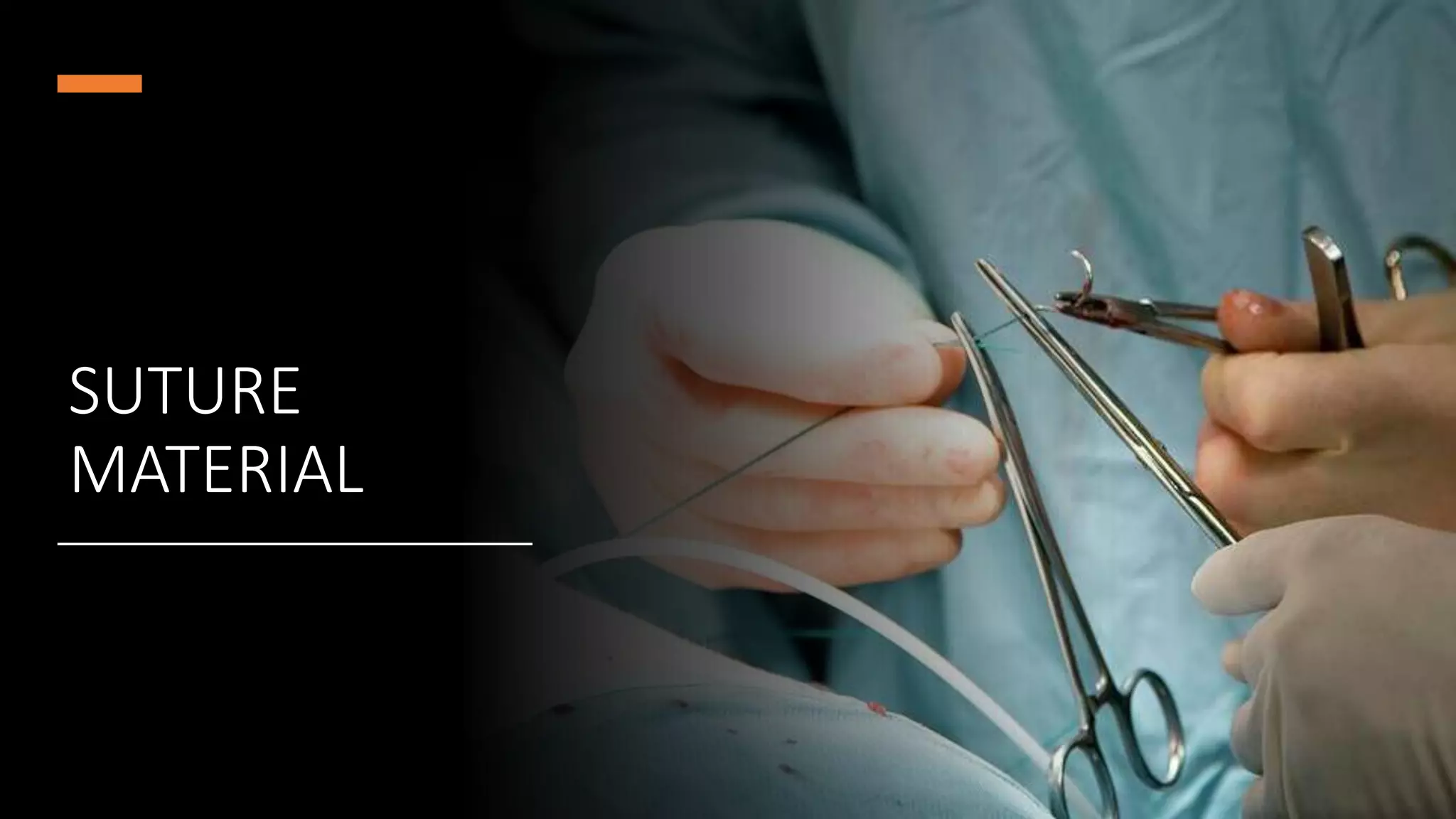
SUTURE
MATERIAL
contents
o Definitions
o Goals of suturing
o Suture characteristics
o Armamentarium of suturing
o Suture materials
o Principles of suturing
DEFINITION
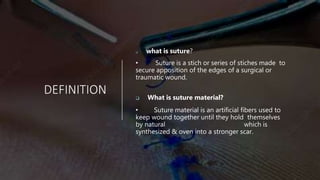
 what is suture?
• Suture is a stich or series of stiches made to
secure apposition of the edges of a surgical or
traumatic wound.
 What is suture material?
• Suture material is an artificial fibers used to
keep wound together until they hold themselves
by natural which is
synthesized & oven into a stronger scar.
GOALS OF
SUTURING
 Wound edge apposition.
 Provide adequate tension.
 Maintain hemostasis.
 Aid in wound healing.
 Avoid wound infection.
 Produce aesthetically pleasing scar by
approximating skin edges.
SUTURE
CHARACTERISTICS
PHYSICAL
STRUCTURE
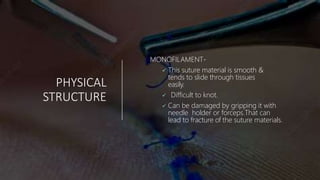
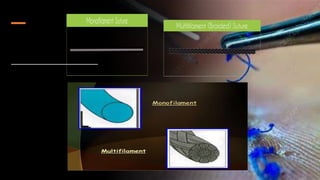
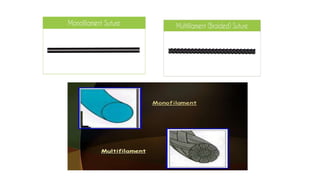
MONOFILAMENT-
 This suture material is smooth &
tends to slide through tissues
easily.
 Difficult to knot.
 Can be damaged by gripping it with
needle holder or forceps.That can
lead to fracture of the suture materials.
PHYSICAL
STRUCTURE
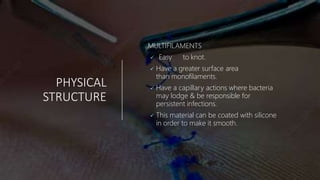
MULTIFILAMENTS
 Easy to knot.
 Have a greater surface area
than monofilaments.
 Have a capillary actions where bacteria
may lodge & be responsible for
persistent infections.
 This material can be coated with silicone
in order to make it smooth.
TENSILE
STRENGTH
•It can be expressed as the force required to
break it when pulling the two ends apart.It
depends upon –
 Constituent of suture materials.
 Thickness of suture materials.
 How it is handled in the tissues.
ABSORBABILITY
• Suture materials may be absorbable or
non-absorbable.This property must be taken
into consideration when choosing suture
materials for specific wound closures. Oral
mucosa & Deep sturcture need to be
absorbable suture materials but vascular
anastomoses need non-absorbable suture
materials.
 Biological Behaviour:
• It depends upon the constituent of raw
materials.
BIOLOGICAL
BEHAVIOUR • It depends upon the constituent of raw
materials.
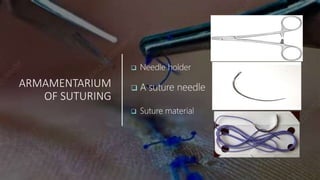
ARMAMENTARIUM
OF SUTURING
 Needle holder
 A suture needle
 Suture material
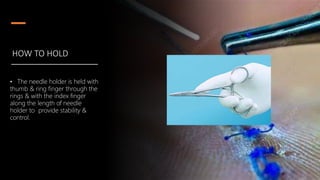
HOW TO HOLD
• The needle holder is held with
thumb & ring finger through the
rings & with the index finger
along the length of needle
holder to provide stability &
control.
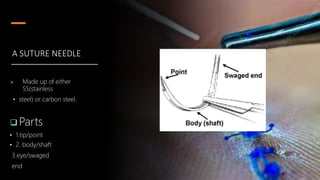
A SUTURE NEEDLE
 Made up of either
SS(stainless
• steel) or carbon steel.
 Parts:
• 1.tip/point
• 2. body/shaft
3.eye/swaged
end
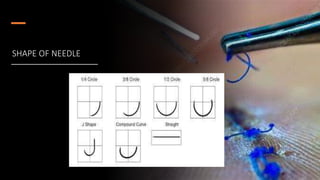
SHAPE OF NEEDLE
 According to Shape:
1. Straight 2.Curved
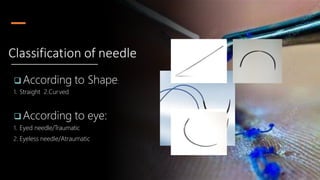
 According to eye:
1. Eyed needle/Traumatic
2. Eyeless needle/Atraumatic
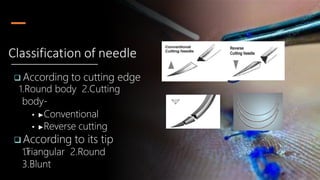
Classification of needle
 According to cutting edge
1.Round body 2.Cutting
body-
• ▶Conventional
• ▶Reverse cutting
 According to its tip
1.T
riangular 2.Round
3.Blunt
Classification of needle
SUTURE MATERIAL
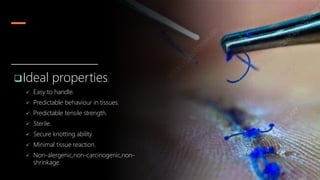
Ideal properties:
 Easy to handle.
 Predictable behaviour in tissues.
 Predictable tensile strength.
 Sterile.
 Secure knotting ability.
 Minimal tissue reaction.
 Non-alergenic,non-carcinogenic,non-
shrinkage.
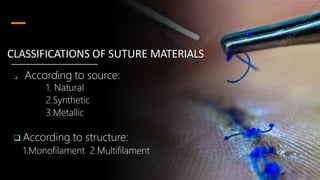
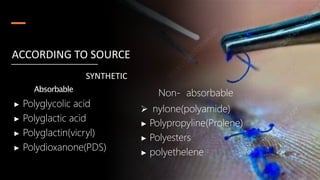
 According to source:
1. Natural
2.Synthetic
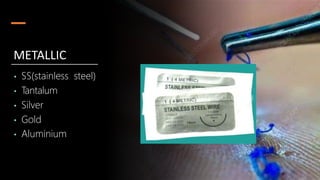
3.Metallic
 According to structure:
1.Monofilament 2.Multifilament
CLASSIFICATIONS OF SUTURE MATERIALS
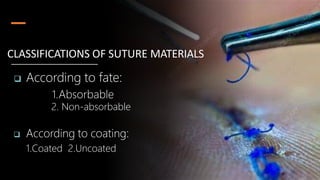
 According to fate:
1.Absorbable
2. Non-absorbable
 According to coating:
1.Coated 2.Uncoated
CLASSIFICATIONS OF SUTURE MATERIALS
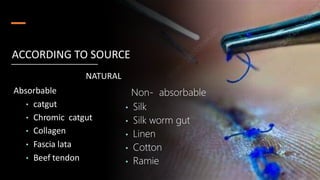
NATURAL
Absorbable
• catgut
• Chromic catgut
• Collagen
• Fascia lata
• Beef tendon
ACCORDING TO SOURCE
Non- absorbable
• Silk
• Silk worm gut
• Linen
• Cotton
• Ramie
SYNTHETIC
Absorbable
▶ Polyglycolic acid
▶ Polyglactic acid
▶ Polyglactin(vicryl)
▶ Polydioxanone(PDS)
ACCORDING TO SOURCE
Non- absorbable
 nylone(polyamide)
▶ Polypropyline(Prolene)
▶ Polyesters
▶ polyethelene
• SS(stainless steel)
• Tantalum
• Silver
• Gold
• Aluminium
METALLIC
MONOFILAMENT
Absorbable
• Catgut
• Chromic catgut
• Vicryl
• PDS
ACCORDING TO STRUCTURE
Non-absorbable
• PolyPropylene
• Polyester
• Nylone
• Polyvenyleidene
fluoride/PVDF suture
MULTIFILAMENT
Absorbable
• Vicryl
• Polyglycolic acid
ACCORDING TO STRUCTURE
Non-absorbable
• Silk
• Cotton
• linen
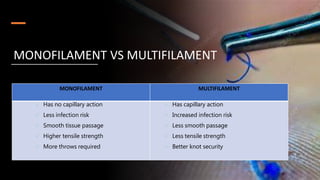
MONOFILAMENT VS MULTIFILAMENT
MONOFILAMENT MULTIFILAMENT
 Has no capillary action
 Less infection risk
 Smooth tissue passage
 Higher tensile strength
 More throws required
 Has capillary action
 Increased infection risk
 Less smooth passage
 Less tensile strength
 Better knot security
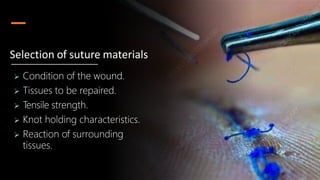
 Condition of the wound.
 Tissues to be repaired.
 Tensile strength.
 Knot holding characteristics.
 Reaction of surrounding
tissues.
Selection of suture materials
COMMONLY USED
SUTURE MATERIALS
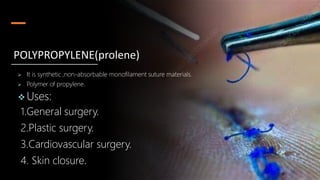
 It is synthetic ,non-absorbable monofilament suture materials.
 Polymer of propylene.
 Uses:
1.General surgery.
2.Plastic surgery.
3.Cardiovascular surgery.
4. Skin closure.
POLYPROPYLENE(prolene)
 Advantages:
1. Won’t loose tensile strength over time.
2.Good knot security. 3.Very little tissue reaction.
• 4.High plasticity.
 Disadvantage:
1.Stretch when pulled.
2.Loosens when edema subsides.
Polypropyelene
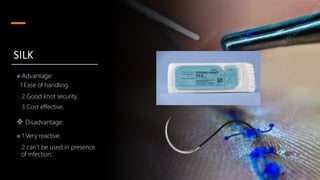
 It is natural, non-absorbable multifilament suture materials.
 Made from the filament spun by silkworm larva.
 Uses:
1. Ophthalmic surgery.
2.General surgery.
3.plastic surgery.
SILK
 Advantage:
1.Ease of handling.
2.Good knot security.
3.Cost effective.
 Disadvantage:
 1.Very reactive.
2.can’t be used in presence
of infection.
SILK
 It is synthetic & absorbable suture materials.
 Monofilament/multifilament & coated/uncoated.
 Available in purple color/undyed.
 Uses:
1. Intra oral suturing.
2. Gut anastomoses.
3.Vascular ligature.
4.Opthalmic surgery
5. Superficial soft tissue approximation of the skin and mucosa.
VICRYL
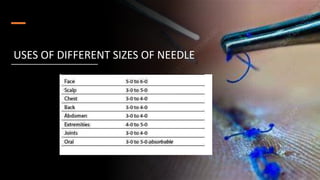
USES OF DIFFERENT SIZES OF NEEDLE
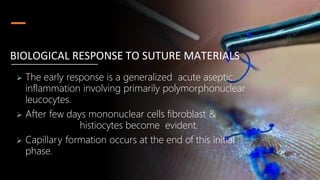
 The early response is a generalized acute aseptic
inflammation involving primarily polymorphonuclear
leucocytes.
 After few days mononuclear cells fibroblast &
histiocytes become evident.
 Capillary formation occurs at the end of this initial
phase.
BIOLOGICAL RESPONSE TO SUTURE MATERIALS
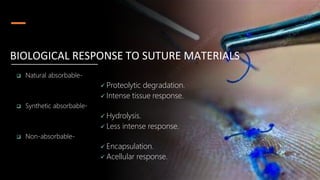
 Natural absorbable-
 Proteolytic degradation.
 Intense tissue response.
 Synthetic absorbable-
 Hydrolysis.
 Less intense response.
 Non-absorbable-
 Encapsulation.
 Acellular response.
BIOLOGICAL RESPONSE TO SUTURE MATERIALS
THANK YOU

SUTURE MATERIAL.pptx

  • 1.
  • 2.
    contents o Definitions o Goalsof suturing o Suture characteristics o Armamentarium of suturing o Suture materials o Principles of suturing
  • 3.
    DEFINITION  what issuture? • Suture is a stich or series of stiches made to secure apposition of the edges of a surgical or traumatic wound.  What is suture material? • Suture material is an artificial fibers used to keep wound together until they hold themselves by natural which is synthesized & oven into a stronger scar.
  • 4.
    GOALS OF SUTURING  Woundedge apposition.  Provide adequate tension.  Maintain hemostasis.  Aid in wound healing.  Avoid wound infection.  Produce aesthetically pleasing scar by approximating skin edges.
  • 5.
  • 6.
    PHYSICAL STRUCTURE MONOFILAMENT-  This suturematerial is smooth & tends to slide through tissues easily.  Difficult to knot.  Can be damaged by gripping it with needle holder or forceps.That can lead to fracture of the suture materials.
  • 7.
    PHYSICAL STRUCTURE MULTIFILAMENTS  Easy toknot.  Have a greater surface area than monofilaments.  Have a capillary actions where bacteria may lodge & be responsible for persistent infections.  This material can be coated with silicone in order to make it smooth.
  • 10.
    TENSILE STRENGTH •It can beexpressed as the force required to break it when pulling the two ends apart.It depends upon –  Constituent of suture materials.  Thickness of suture materials.  How it is handled in the tissues.
  • 11.
    ABSORBABILITY • Suture materialsmay be absorbable or non-absorbable.This property must be taken into consideration when choosing suture materials for specific wound closures. Oral mucosa & Deep sturcture need to be absorbable suture materials but vascular anastomoses need non-absorbable suture materials.  Biological Behaviour: • It depends upon the constituent of raw materials.
  • 12.
    BIOLOGICAL BEHAVIOUR • Itdepends upon the constituent of raw materials.
  • 13.
    ARMAMENTARIUM OF SUTURING  Needleholder  A suture needle  Suture material
  • 14.
    HOW TO HOLD •The needle holder is held with thumb & ring finger through the rings & with the index finger along the length of needle holder to provide stability & control.
  • 15.
    A SUTURE NEEDLE Made up of either SS(stainless • steel) or carbon steel.  Parts: • 1.tip/point • 2. body/shaft 3.eye/swaged end
  • 16.
  • 17.
     According toShape: 1. Straight 2.Curved  According to eye: 1. Eyed needle/Traumatic 2. Eyeless needle/Atraumatic Classification of needle
  • 18.
     According tocutting edge 1.Round body 2.Cutting body- • ▶Conventional • ▶Reverse cutting  According to its tip 1.T riangular 2.Round 3.Blunt Classification of needle
  • 19.
  • 20.
    Ideal properties:  Easyto handle.  Predictable behaviour in tissues.  Predictable tensile strength.  Sterile.  Secure knotting ability.  Minimal tissue reaction.  Non-alergenic,non-carcinogenic,non- shrinkage.
  • 21.
     According tosource: 1. Natural 2.Synthetic 3.Metallic  According to structure: 1.Monofilament 2.Multifilament CLASSIFICATIONS OF SUTURE MATERIALS
  • 22.
     According tofate: 1.Absorbable 2. Non-absorbable  According to coating: 1.Coated 2.Uncoated CLASSIFICATIONS OF SUTURE MATERIALS
  • 23.
    NATURAL Absorbable • catgut • Chromiccatgut • Collagen • Fascia lata • Beef tendon ACCORDING TO SOURCE Non- absorbable • Silk • Silk worm gut • Linen • Cotton • Ramie
  • 24.
    SYNTHETIC Absorbable ▶ Polyglycolic acid ▶Polyglactic acid ▶ Polyglactin(vicryl) ▶ Polydioxanone(PDS) ACCORDING TO SOURCE Non- absorbable  nylone(polyamide) ▶ Polypropyline(Prolene) ▶ Polyesters ▶ polyethelene
  • 25.
    • SS(stainless steel) •Tantalum • Silver • Gold • Aluminium METALLIC
  • 26.
    MONOFILAMENT Absorbable • Catgut • Chromiccatgut • Vicryl • PDS ACCORDING TO STRUCTURE Non-absorbable • PolyPropylene • Polyester • Nylone • Polyvenyleidene fluoride/PVDF suture
  • 27.
    MULTIFILAMENT Absorbable • Vicryl • Polyglycolicacid ACCORDING TO STRUCTURE Non-absorbable • Silk • Cotton • linen
  • 28.
    MONOFILAMENT VS MULTIFILAMENT MONOFILAMENTMULTIFILAMENT  Has no capillary action  Less infection risk  Smooth tissue passage  Higher tensile strength  More throws required  Has capillary action  Increased infection risk  Less smooth passage  Less tensile strength  Better knot security
  • 29.
     Condition ofthe wound.  Tissues to be repaired.  Tensile strength.  Knot holding characteristics.  Reaction of surrounding tissues. Selection of suture materials
  • 30.
  • 31.
     It issynthetic ,non-absorbable monofilament suture materials.  Polymer of propylene.  Uses: 1.General surgery. 2.Plastic surgery. 3.Cardiovascular surgery. 4. Skin closure. POLYPROPYLENE(prolene)
  • 32.
     Advantages: 1. Won’tloose tensile strength over time. 2.Good knot security. 3.Very little tissue reaction. • 4.High plasticity.  Disadvantage: 1.Stretch when pulled. 2.Loosens when edema subsides. Polypropyelene
  • 33.
     It isnatural, non-absorbable multifilament suture materials.  Made from the filament spun by silkworm larva.  Uses: 1. Ophthalmic surgery. 2.General surgery. 3.plastic surgery. SILK
  • 34.
     Advantage: 1.Ease ofhandling. 2.Good knot security. 3.Cost effective.  Disadvantage:  1.Very reactive. 2.can’t be used in presence of infection. SILK
  • 35.
     It issynthetic & absorbable suture materials.  Monofilament/multifilament & coated/uncoated.  Available in purple color/undyed.  Uses: 1. Intra oral suturing. 2. Gut anastomoses. 3.Vascular ligature. 4.Opthalmic surgery 5. Superficial soft tissue approximation of the skin and mucosa. VICRYL
  • 36.
    USES OF DIFFERENTSIZES OF NEEDLE
  • 37.
     The earlyresponse is a generalized acute aseptic inflammation involving primarily polymorphonuclear leucocytes.  After few days mononuclear cells fibroblast & histiocytes become evident.  Capillary formation occurs at the end of this initial phase. BIOLOGICAL RESPONSE TO SUTURE MATERIALS
  • 38.
     Natural absorbable- Proteolytic degradation.  Intense tissue response.  Synthetic absorbable-  Hydrolysis.  Less intense response.  Non-absorbable-  Encapsulation.  Acellular response. BIOLOGICAL RESPONSE TO SUTURE MATERIALS
  • 39.