Mini-lesson 1   What is subject verb agreement?
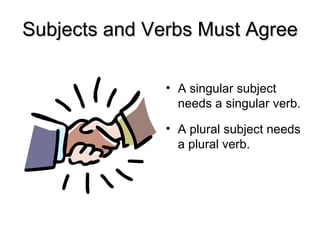
Subjects and Verbs Must Agree A singular subject needs a singular verb. A plural subject needs a plural verb.
Singular vs. Plural Singular The person waits . Plural The people wait.
Example Sentence A good student knows the value of communication skills. subject verb
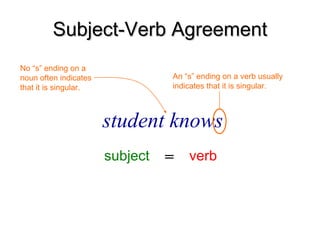
Subject-Verb Agreement student knows subject verb = An “s” ending on a verb usually indicates that it is singular. No “s” ending on a noun often indicates that it is singular.
Example Sentence Good students knows the value of communication skills. subject verb
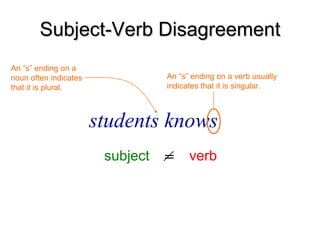
Subject-Verb Disagreement students knows An “s” ending on a verb usually indicates that it is singular. An “s” ending on a noun often indicates that it is plural. subject verb =
Some Common Rules With… Use a… I singular verb  (no “s”) You plural verb  (no “s”) He, She, It singular verb  (“s”) We plural verb  (no “s”) You plural verb  (no “s”) They plural verb  (no “s”)
Mini-lesson 2   Agreement with Compound Subjects
Special Agreement Rules When the subject is made up of two or more nouns connected by  and , use a plural verb. She and her friends are… implies two plural verb
Special Agreement Rules When the subject is made up of two or more  singular  nouns connected by  or , use a singular verb. The book or the pen is…   singular singular singular verb implies one or the other
Special Agreement Rules When the subject is made up of  singular   and plural  nouns connected by  or , the verb should agree with the part of the subject that is closer to it. The president or his assistants run…   singular plural plural verb Verb agrees with the closest part of the subject
Special Agreement Rules When the subject is made up of  singular   and plural  nouns connected by  or , the verb should agree with the part of the subject that is closer to it. His assistants or the president runs…   singular verb plural singular Verb agrees with the closest part of the subject
Mini-lesson 3   Phrases that Confuse Things
Don’t Be Misled Don’t be misled by phrases that come between the subject and the verb. one  of the boxes  is the  people  who read that report  are the team  lead , as well as his developers,  is the  manual , including all the chapters in the first section,  is the  woman  with all the answers  sits
Mini-lesson 4   Singular or Plural?
Always Singular The following words are always singular and require a singular verb: each, each one either, neither everyone, anyone, someone, no one everybody, anybody, nobody
Always Singular Even though the following nouns end with an “s,” they are singular and require a singular verb: civics mathematics dollars news
Almost Always Singular Collective nouns that refer to more than one person are usually treated as a single unit: group team committee class family
Always Plural Nouns like the following are always plural (because they are made of two parts): scissors tweezers trousers pants shears
Mini-lesson 5   Neither “Here” nor “There”
“ There” is Never the Subject In sentences starting with the word “there,” the subject usually  follows  the verb. There are many questions. subject verb
“ There” is Never the Subject In sentences starting with the word “there,” the subject usually  follows  the verb. There is a question. subject verb
The Same is True for “Here” In sentences starting with the word “here,” the subject usually  follows  the verb. Here are your keys. subject verb
The Same is True for “Here” In sentences starting with the word “here,” the subject usually  follows  the verb. Here is your key. subject verb

S V Agreement.Ppt

  • 1.
    Mini-lesson 1 What is subject verb agreement?
  • 2.
    Subjects and VerbsMust Agree A singular subject needs a singular verb. A plural subject needs a plural verb.
  • 3.
    Singular vs. PluralSingular The person waits . Plural The people wait.
  • 4.
    Example Sentence Agood student knows the value of communication skills. subject verb
  • 5.
    Subject-Verb Agreement studentknows subject verb = An “s” ending on a verb usually indicates that it is singular. No “s” ending on a noun often indicates that it is singular.
  • 6.
    Example Sentence Goodstudents knows the value of communication skills. subject verb
  • 7.
    Subject-Verb Disagreement studentsknows An “s” ending on a verb usually indicates that it is singular. An “s” ending on a noun often indicates that it is plural. subject verb =
  • 8.
    Some Common RulesWith… Use a… I singular verb (no “s”) You plural verb (no “s”) He, She, It singular verb (“s”) We plural verb (no “s”) You plural verb (no “s”) They plural verb (no “s”)
  • 9.
    Mini-lesson 2 Agreement with Compound Subjects
  • 10.
    Special Agreement RulesWhen the subject is made up of two or more nouns connected by and , use a plural verb. She and her friends are… implies two plural verb
  • 11.
    Special Agreement RulesWhen the subject is made up of two or more singular nouns connected by or , use a singular verb. The book or the pen is… singular singular singular verb implies one or the other
  • 12.
    Special Agreement RulesWhen the subject is made up of singular and plural nouns connected by or , the verb should agree with the part of the subject that is closer to it. The president or his assistants run… singular plural plural verb Verb agrees with the closest part of the subject
  • 13.
    Special Agreement RulesWhen the subject is made up of singular and plural nouns connected by or , the verb should agree with the part of the subject that is closer to it. His assistants or the president runs… singular verb plural singular Verb agrees with the closest part of the subject
  • 14.
    Mini-lesson 3 Phrases that Confuse Things
  • 15.
    Don’t Be MisledDon’t be misled by phrases that come between the subject and the verb. one of the boxes is the people who read that report are the team lead , as well as his developers, is the manual , including all the chapters in the first section, is the woman with all the answers sits
  • 16.
    Mini-lesson 4 Singular or Plural?
  • 17.
    Always Singular Thefollowing words are always singular and require a singular verb: each, each one either, neither everyone, anyone, someone, no one everybody, anybody, nobody
  • 18.
    Always Singular Eventhough the following nouns end with an “s,” they are singular and require a singular verb: civics mathematics dollars news
  • 19.
    Almost Always SingularCollective nouns that refer to more than one person are usually treated as a single unit: group team committee class family
  • 20.
    Always Plural Nounslike the following are always plural (because they are made of two parts): scissors tweezers trousers pants shears
  • 21.
    Mini-lesson 5 Neither “Here” nor “There”
  • 22.
    “ There” isNever the Subject In sentences starting with the word “there,” the subject usually follows the verb. There are many questions. subject verb
  • 23.
    “ There” isNever the Subject In sentences starting with the word “there,” the subject usually follows the verb. There is a question. subject verb
  • 24.
    The Same isTrue for “Here” In sentences starting with the word “here,” the subject usually follows the verb. Here are your keys. subject verb
  • 25.
    The Same isTrue for “Here” In sentences starting with the word “here,” the subject usually follows the verb. Here is your key. subject verb