R-Respect. Treat othersand their belongings
with respect.
E- Engage. Participate actively in class
discussion.
A- Arrive on Time. Be punctual and ready to
learn when the class begins.
D-Discern. Observe classroom rules and
guidelines.
Y-Yield to the teacher. Listen attentively and
follow instructions given by the teacher.
classroom rules:
lESSON oBJECTIVES:
• Determinethe five rules of subject-verb
agreement
• Construct grammatically correct sentences
using the five rules in subject-verb
agreement.
• Realize the importance of subject-verb
agreement in constructing grammatically
correct sentences.
Instruction: I willgive you a command and
what you are going to do is to follow what I
say but only when I say, Simon says. For
example, Simon says, touch your toes.
Everyone must touch their toes. If someone
does the action and the teacher did not say
Simon says, then that person is out of the
game.
INSTRUCTION:
8.
Read carefully each
sentence.
1.A cat was sleeping under the parked car.
2. I received three new dresses for my birthday.
3. My son started walking today.
4. We had to wash our clothes.
5. She invited all her friends to her wedding.
sUBJECT-VERB AGREEMENT
Subject-verb agreementmeans that the subject
of the sentence matches the verb describing its
action. This helps your reader understand who
or what is doing something and makes your
writing easier to read.
16.
sUBJECT-VERB AGREEMENT
First, identifythe subject (the person or thing
doing the action) and the verb (the word that
shows action/state of being) in a sentence. If
the subject is singular, the verb describing its
action should be singular. If the subject is
plural, the verb should be plural.
17.
sUBJECT-VERB AGREEMENT
Example:
The experiment(singular subject) shows (singular
verb) a significant increase in cell growth."
Subject: "The experiment" is the singular subject of
the sentence.
Verb: "Shows" is the singular form of the verb that
agrees with the singular subject "experiment".
18.
wHAT IS ASUBJECT?
Subject - A subject is a person, place, thing,
or idea that is being discussed or dealt with
in a particular situation. It is often the focus
of a conversation or piece of writing, and it
is typically the noun or pronoun that
performs the action of a verb in a sentence.
19.
sIMUNO (subject)
Simuno -ang simuno o paksa ang bahaging
pinag-uusapan o pinagtutuunan ng pansin
saloob ng pangungusap. Ang paksa o
simuno ang maaaring gumanap ng kilos o
pinagtutuunan ng diwang isinasaad sa
pandiwa at ganapan ng kilos ng pandiwa.
20.
what IS predICATE?
Predicate- A predicate in a sentence
tells about the subject (What action is
being performed by the subject).
21.
PANAGURI (PREDICATE)
Panaguri -Ang panaguri ang bahagi
ng pangungusap na nagbibigay ng
kaalaman o impormasyon tungkol sa
paksa. Ito ay naglalahad ng mga
bagay hinggil sa simuno.
Rules in Subject-Verb
Agreement!
2.The words and phrases "each," "each
one," "either," "neither," "everyone,"
"everybody," "anyone," "anybody,"
"nobody," "somebody," "someone," and
"no one" are singular and require a
singular verb.
27.
Example:
1.Each of theparticipants was willing to
be recorded.
2. Everybody who works here loves their
job.
3. Everything comes back eventually.
28.
Rules in Subject-Verb
Agreement!
3.If plural subjects are joined by
or, nor, and but the verb must
only agree with the subject that
is closest to it.
29.
Example:
1.Either Bob orhis brother walks to the
store.
2. Neither Bob nor his brothers walk to the
store.
3. Not Bob but his brothers walk to the
store
30.
Rules in Subject-Verb
Agreement!
4.When a collective noun,
such as family, group,
committee, or class, is the
subject, the verb will end in
“s.”
31.
Example:
1.My family withall my crazy cousins
always walks to the store.
2. The committee agrees on the quality of
the writing.
3. The group meets every week.
32.
Rules in Subject-Verb
Agreement!
5.A few nouns, such as economics, mumps,
measles, or news end in “s” but are considered
singular. You can tell these “s” words are singular
because if you take the “s” away, you don’t have a
noun. For example, economic and new are
adjectives that describe a noun. Mump and
measle just don’t make any sense.
33.
Example:
1. Economics isher favorite subject.
2. Billiards is my favorite game.
3. Physics was Dustin’s favorite subject in
high school.
INSTRUCTION:
The class willbe divided into three
groups. In a one whole sheet of paper,
each group will write two sentences
each of the five rules of the subject-verb
agreement. Each group will select two
representatives to discuss their answer
in the front.
Even a singlepair of scissors, for example, is
referred to in the plural. These nouns are
sometimes referred to by the Latin term pluralia
tantum (“plural only”).
42.
Pluraria tantum isLatin for “plural only,”
which describes nouns that are used
only in the plural form and this is our
rule number six all about.
43.
Rules in Subject-Verb
Agreement!
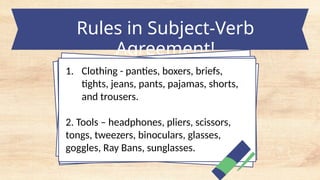
6.Nouns which are plural in form
and plural in meaning (ex.
clothes, pants, scissors, shorts,
trousers) take plural verbs.
Because it’s wrongto use an indefinite article
with a plural noun (e.g., “a scissors”) and no
singular form exists (e.g., there’s no such thing
as “a scissor”), the phrase “a pair of” is used
before the noun when an indefinite article is
needed. “Pairs of” is also used to specify
quantities of these nouns (e.g., “three pairs of
pants,” not “three pants”).
46.
Rules in Subject-Verb
Agreement!
•Plural-Only Nouns with Two Parts
Many plural-only nouns are tools or items
of clothing that have two parts (like
trousers, which have two legs).
47.
Rules in Subject-Verb
Agreement!
1.Clothing - panties, boxers, briefs,
tights, jeans, pants, pajamas, shorts,
and trousers.
2. Tools – headphones, pliers, scissors,
tongs, tweezers, binoculars, glasses,
goggles, Ray Bans, sunglasses.
Rules in Subject-Verb
Agreement!
“Each”and “every” are actually
determiners, not verbs. They
modify nouns and indicate that
the noun refers to individual
items or people.
3. The leadengineer, not
the junior engineer _____
the new product.
designs
design
59.
Rules in Subject-Verb
Agreement!
8.When one subject is used
affirmatively and the other
negatively, the verb agrees
with the subject used in the
affirmative.
60.
Answer this!
1. Thelead singer not
the guitarist (write,
writes) the lyrics.
Rules in Subject-Verb
Agreement!
11.Expressions stating amount
(time, money, measurement,
weight, volume) are usually
singular when the amount is
considered as a unit.
The team ___talking about
some new strategies.
is
are
87.
The team ___working
together to solve the
problem.
is
are
88.
Rules in Subject-Verb
Agreement!
12.A collective noun takes a plural
verb when the speaker is thinking of
individuals members of the group; it
takes a singular verb when the
speaker is thinking of the group as a
unit.
Rules in Subject-Verb
Agreement!
15.Intervening expressions like
together with, as well as, along with
have no effect on the number of the
verb, the verb agrees with the number
of the subject.
Rules in Subject-Verb
Agreement!
16.When the subject is a title, name
of a book, a quotation or a group of
words expressing a single thought, the
singular form of the verb is used.
Rules in Subject-Verb
Agreement!
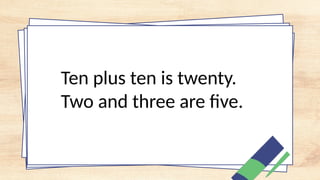
17.For mathematical expression,
the singular verb is used. When
mathematical expression are joined
by and the plural verb is used.
A relative pronounis a pronoun that’s used to
introduce a relative clause. The main English
relative pronouns are which, that, who, and
whom. These words can also function as other
parts of speech—they aren’t exclusively used as
relative pronouns.
130.
The relative clausecomes after a noun or noun
phrase (called the antecedent) and gives some
additional information about the thing or person
in question. The relative pronoun represents the
antecedent.
131.
The houses thatI lived in
previously were all quite small.
The subject that I liked best in
school was chemistry.