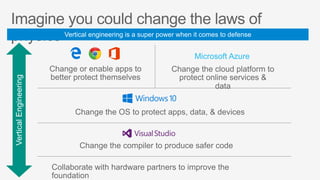
Microsoft Azure
…
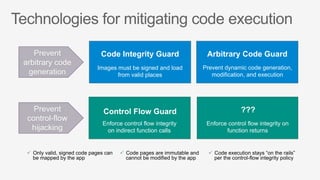
Control Flow Guard
Enforce control flow integrity
on indirect function calls
???
Enforce control flow integrity on
function returns
Arbitrary Code Guard
Prevent dynamic code generation,
modification, and execution
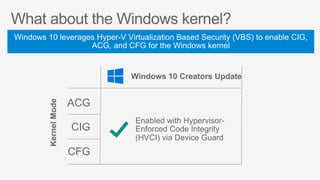
Code Integrity Guard
Images must be signed and load
from valid places
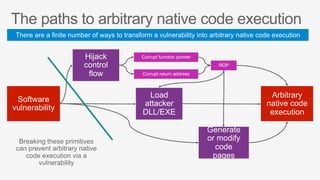
Prevent
control-flow
hijacking
Prevent
arbitrary code
generation
ü  Only valid, signed code pages can
be mapped by the app
ü  Code pages are immutable and
cannot be modified by the app
ü  Code execution stays “on the rails”
per the control-flow integrity policy
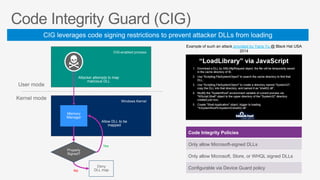
Example of such an attack provided by Yang Yu @ Black Hat USA
2014
Attacker attempts to map
malicious DLL
Allow DLL to be
mapped
Yes
No
Code Integrity Policies
Only allow Microsoft-signed DLLs
Only allow Microsoft, Store, or WHQL signed DLLs
Configurable via Device Guard policy
The following will fail with ERROR_DYNAMIC_CODE_BLOCKED
VirtualProtect(codePage, …, PAGE_EXECUTE_READWRITE)
VirtualProtect(codePage, …, PAGE_READWRITE)
VirtualAlloc(…, PAGE_EXECUTE*)
VirtualProtect(dataPage, …, PAGE_EXECUTE*)
MapViewOfFile(hPagefileSection, FILE_MAP_EXECUTE, …)
WriteProcessMemory(codePage, …)
…
ü Code is immutable
ü Data cannot become code
ü Only properly signed code
pages can be mapped
https://github.com/Microsoft/binskim
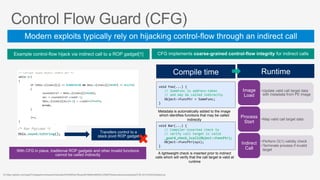
Compile time Runtime
Metadata is automatically added to the image
which identifies functions that may be called
indirectly
void	Foo(...)	{	
			//	SomeFunc	is	address-taken		
			//	and	may	be	called	indirectly	
			Object->FuncPtr	=	SomeFunc;	
}	
A lightweight check is inserted prior to indirect
calls which will verify that the call target is valid at
runtime
void	Bar(...)	{	
			//	Compiler-inserted	check	to		
			//	verify	call	target	is	valid	
			_guard_check_icall(Object->FuncPtr);	
			Object->FuncPtr(xyz);	
}	
• Update valid call target data
with metadata from PE image
Image
Load
• Map valid call target data
Process
Start
• Perform O(1) validity check
• Terminate process if invalid
target
Indirect
Call
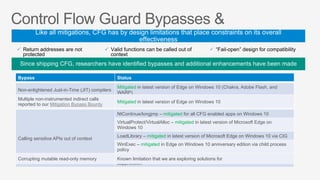
ü  Return addresses are not
protected
ü  Valid functions can be called out of
context
ü  “Fail-open” design for compatibility
Non-enlightened Just-in-Time (JIT) compilers
Mitigated in latest version of Edge on Windows 10 (Chakra, Adobe Flash, and
WARP)
Multiple non-instrumented indirect calls
reported to our Mitigation Bypass Bounty
Mitigated in latest version of Edge on Windows 10
Calling sensitive APIs out of context
NtContinue/longjmp – mitigated for all CFG enabled apps on Windows 10
VirtualProtect/VirtualAlloc – mitigated in latest version of Microsoft Edge on
Windows 10
LoadLibrary – mitigated in latest version of Microsoft Edge on Windows 10 via CIG
WinExec – mitigated in Edge on Windows 10 anniversary edition via child process
policy
All exports – mitigated in Edge on Windows 10 Creators Update via export
suppression
Corrupting mutable read-only memory Known limitation that we are exploring solutions for
Bypass Status
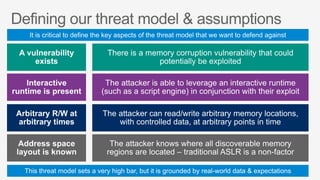
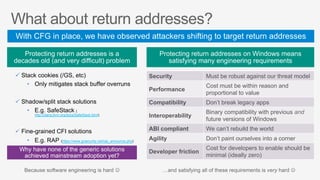
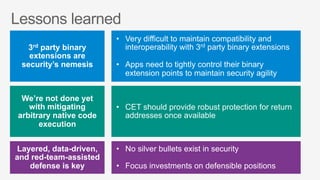
Security Must be robust against our threat model
Performance
Cost must be within reason and
proportional to value
Compatibility Don’t break legacy apps
Interoperability
Binary compatibility with previous and
future versions of Windows
ABI compliant We can’t rebuild the world
Agility Don’t paint ourselves into a corner
Developer friction
Cost for developers to enable should be
minimal (ideally zero)
ü Stack cookies (/GS, etc)
•  Only mitigates stack buffer overruns
ü Shadow/split stack solutions
•  E.g. SafeStack (
http://clang.llvm.org/docs/SafeStack.html)
ü Fine-grained CFI solutions
•  E.g. RAP (https://www.grsecurity.net/rap_announce.php)
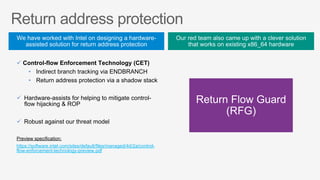
ü Control-flow Enforcement Technology (CET)
•  Indirect branch tracking via ENDBRANCH
•  Return address protection via a shadow stack
ü  Hardware-assists for helping to mitigate control-
flow hijacking & ROP
ü  Robust against our threat model
Preview specification:
https://software.intel.com/sites/default/files/managed/4d/2a/control-
flow-enforcement-technology-preview.pdf
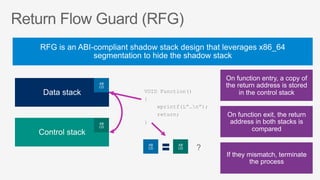
644c8b1c24						mov					r11,qword	ptr	fs:[rsp]	
4c3b1c24								cmp					r11,qword	ptr	[rsp]	
0f8518a00300				jne					DLL!__guard_ss_verify_failure	
488b0424								mov					rax,qword	ptr	[rsp]		
6448890424						mov					qword	ptr	fs:[rsp],rax
Security Must be robust against our threat model
Performance
Cost must be within reason and
proportional to value
Compatibility Don’t break legacy apps
Interoperability
Binary compatibility with previous and
future versions of Windows
ABI compliant We can’t rebuild the world
Agility Don’t paint ourselves into a corner
Developer friction
Cost for developers to enable should be
minimal (ideally zero)
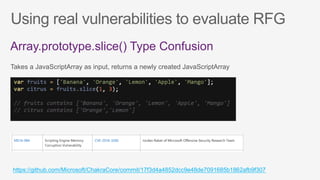
Array.prototype.slice() Type Confusion
Takes a JavaScriptArray as input, returns a newly created JavaScriptArray
https://github.com/Microsoft/ChakraCore/commit/17f3d4a4852dcc9e48de7091685b1862afb9f307
•  Create a NativeFloatArray fake_obj_arr which contains a fake object
•  Use CVE-2016-3260 to leak its address
•  Use CVE-2016-3260 to create a JavaScript variable fake_obj pointing
to fake_obj_arr + data_offset
•  …and a few other steps we won’t be talking about today J
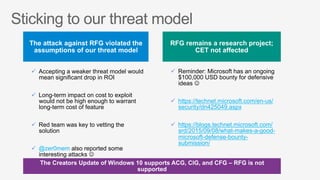
ü  Reminder: Microsoft has an ongoing
$100,000 USD bounty for defensive
ideas J
ü  https://technet.microsoft.com/en-us/
security/dn425049.aspx
ü  https://blogs.technet.microsoft.com/
srd/2015/09/08/what-makes-a-good-
microsoft-defense-bounty-
submission/
ü  Accepting a weaker threat model would
mean significant drop in ROI
ü  Long-term impact on cost to exploit
would not be high enough to warrant
long-term cost of feature
ü  Red team was key to vetting the
solution
ü  @zer0mem also reported some
interesting attacks J
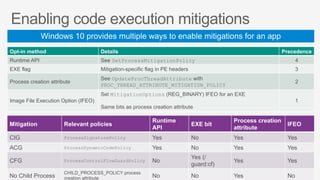
Mitigation Relevant policies
Runtime
API
EXE bit
Process creation
attribute
IFEO
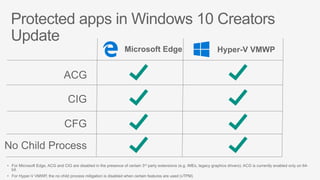
CIG ProcessSignaturePolicy Yes No Yes Yes
ACG ProcessDynamicCodePolicy Yes No Yes Yes
CFG ProcessControlFlowGuardPolicy No
Yes (/
guard:cf)
Yes Yes
No Child Process
CHILD_PROCESS_POLICY process
creation attribute No No Yes No
Opt-in method Details Precedence
Runtime API See SetProcessMitigationPolicy 4
EXE flag Mitigation-specific flag in PE headers 3
Process creation attribute
See UpdateProcThreadAttribute with
PROC_THREAD_ATTRIBUTE_MITIGATION_POLICY
2
Image File Execution Option (IFEO)
Set MitigationOptions (REG_BINARY) IFEO for an EXE
Same bits as process creation attribute
1
ü  Probability of detection increases with zero day
use
•  Attackers are incentivized to minimize use
•  Targets that detect zero day may alert vendor
ü  Selective use reduces downstream supply
•  Many actors lack means and capability to
https://www.proofpoint.com/us/threat-insight/post/magnitude-actor-social-engineering-scheme-windows-10
ü  Windows 10 is always up to date
•  Poor ROI for exploiting patched vulnerabilities
•  Rapid evolution of defensive technologies
ü  Mass-market exploit kits struggling to maintain
supply
•  Decrease in reusable & public exploits
•  Cost to acquire exceeds expected ROI
ü  Market has shifted toward social engineering
•  Macros, tech support scams, so on
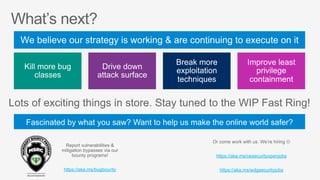
https://aka.ms/bugbounty
https://aka.ms/cesecurityopenjobs
https://aka.ms/wdgsecurityjobs
CSW2017 Weston miller csw17_mitigating_native_remote_code_execution

CSW2017 Weston miller csw17_mitigating_native_remote_code_execution

  • 4.
  • 5.
  • 11.
    Control Flow Guard Enforcecontrol flow integrity on indirect function calls ??? Enforce control flow integrity on function returns Arbitrary Code Guard Prevent dynamic code generation, modification, and execution Code Integrity Guard Images must be signed and load from valid places Prevent control-flow hijacking Prevent arbitrary code generation ü  Only valid, signed code pages can be mapped by the app ü  Code pages are immutable and cannot be modified by the app ü  Code execution stays “on the rails” per the control-flow integrity policy
  • 12.
    Example of suchan attack provided by Yang Yu @ Black Hat USA 2014 Attacker attempts to map malicious DLL Allow DLL to be mapped Yes No Code Integrity Policies Only allow Microsoft-signed DLLs Only allow Microsoft, Store, or WHQL signed DLLs Configurable via Device Guard policy
  • 14.
    The following willfail with ERROR_DYNAMIC_CODE_BLOCKED VirtualProtect(codePage, …, PAGE_EXECUTE_READWRITE) VirtualProtect(codePage, …, PAGE_READWRITE) VirtualAlloc(…, PAGE_EXECUTE*) VirtualProtect(dataPage, …, PAGE_EXECUTE*) MapViewOfFile(hPagefileSection, FILE_MAP_EXECUTE, …) WriteProcessMemory(codePage, …) … ü Code is immutable ü Data cannot become code ü Only properly signed code pages can be mapped
  • 15.
  • 16.
    Compile time Runtime Metadatais automatically added to the image which identifies functions that may be called indirectly void Foo(...) { // SomeFunc is address-taken // and may be called indirectly Object->FuncPtr = SomeFunc; } A lightweight check is inserted prior to indirect calls which will verify that the call target is valid at runtime void Bar(...) { // Compiler-inserted check to // verify call target is valid _guard_check_icall(Object->FuncPtr); Object->FuncPtr(xyz); } • Update valid call target data with metadata from PE image Image Load • Map valid call target data Process Start • Perform O(1) validity check • Terminate process if invalid target Indirect Call
  • 17.
    ü  Return addressesare not protected ü  Valid functions can be called out of context ü  “Fail-open” design for compatibility Non-enlightened Just-in-Time (JIT) compilers Mitigated in latest version of Edge on Windows 10 (Chakra, Adobe Flash, and WARP) Multiple non-instrumented indirect calls reported to our Mitigation Bypass Bounty Mitigated in latest version of Edge on Windows 10 Calling sensitive APIs out of context NtContinue/longjmp – mitigated for all CFG enabled apps on Windows 10 VirtualProtect/VirtualAlloc – mitigated in latest version of Microsoft Edge on Windows 10 LoadLibrary – mitigated in latest version of Microsoft Edge on Windows 10 via CIG WinExec – mitigated in Edge on Windows 10 anniversary edition via child process policy All exports – mitigated in Edge on Windows 10 Creators Update via export suppression Corrupting mutable read-only memory Known limitation that we are exploring solutions for Bypass Status
  • 18.
    Security Must berobust against our threat model Performance Cost must be within reason and proportional to value Compatibility Don’t break legacy apps Interoperability Binary compatibility with previous and future versions of Windows ABI compliant We can’t rebuild the world Agility Don’t paint ourselves into a corner Developer friction Cost for developers to enable should be minimal (ideally zero) ü Stack cookies (/GS, etc) •  Only mitigates stack buffer overruns ü Shadow/split stack solutions •  E.g. SafeStack ( http://clang.llvm.org/docs/SafeStack.html) ü Fine-grained CFI solutions •  E.g. RAP (https://www.grsecurity.net/rap_announce.php)
  • 19.
    ü Control-flow Enforcement Technology(CET) •  Indirect branch tracking via ENDBRANCH •  Return address protection via a shadow stack ü  Hardware-assists for helping to mitigate control- flow hijacking & ROP ü  Robust against our threat model Preview specification: https://software.intel.com/sites/default/files/managed/4d/2a/control- flow-enforcement-technology-preview.pdf
  • 21.
  • 22.
    Security Must berobust against our threat model Performance Cost must be within reason and proportional to value Compatibility Don’t break legacy apps Interoperability Binary compatibility with previous and future versions of Windows ABI compliant We can’t rebuild the world Agility Don’t paint ourselves into a corner Developer friction Cost for developers to enable should be minimal (ideally zero)
  • 23.
    Array.prototype.slice() Type Confusion Takesa JavaScriptArray as input, returns a newly created JavaScriptArray https://github.com/Microsoft/ChakraCore/commit/17f3d4a4852dcc9e48de7091685b1862afb9f307
  • 24.
    •  Create aNativeFloatArray fake_obj_arr which contains a fake object •  Use CVE-2016-3260 to leak its address •  Use CVE-2016-3260 to create a JavaScript variable fake_obj pointing to fake_obj_arr + data_offset •  …and a few other steps we won’t be talking about today J
  • 25.
    ü  Reminder: Microsofthas an ongoing $100,000 USD bounty for defensive ideas J ü  https://technet.microsoft.com/en-us/ security/dn425049.aspx ü  https://blogs.technet.microsoft.com/ srd/2015/09/08/what-makes-a-good- microsoft-defense-bounty- submission/ ü  Accepting a weaker threat model would mean significant drop in ROI ü  Long-term impact on cost to exploit would not be high enough to warrant long-term cost of feature ü  Red team was key to vetting the solution ü  @zer0mem also reported some interesting attacks J
  • 26.
    Mitigation Relevant policies Runtime API EXEbit Process creation attribute IFEO CIG ProcessSignaturePolicy Yes No Yes Yes ACG ProcessDynamicCodePolicy Yes No Yes Yes CFG ProcessControlFlowGuardPolicy No Yes (/ guard:cf) Yes Yes No Child Process CHILD_PROCESS_POLICY process creation attribute No No Yes No Opt-in method Details Precedence Runtime API See SetProcessMitigationPolicy 4 EXE flag Mitigation-specific flag in PE headers 3 Process creation attribute See UpdateProcThreadAttribute with PROC_THREAD_ATTRIBUTE_MITIGATION_POLICY 2 Image File Execution Option (IFEO) Set MitigationOptions (REG_BINARY) IFEO for an EXE Same bits as process creation attribute 1
  • 32.
    ü  Probability ofdetection increases with zero day use •  Attackers are incentivized to minimize use •  Targets that detect zero day may alert vendor ü  Selective use reduces downstream supply •  Many actors lack means and capability to https://www.proofpoint.com/us/threat-insight/post/magnitude-actor-social-engineering-scheme-windows-10 ü  Windows 10 is always up to date •  Poor ROI for exploiting patched vulnerabilities •  Rapid evolution of defensive technologies ü  Mass-market exploit kits struggling to maintain supply •  Decrease in reusable & public exploits •  Cost to acquire exceeds expected ROI ü  Market has shifted toward social engineering •  Macros, tech support scams, so on
  • 34.