


Popular Approaches to Preventing
Code Injection Attacks are
Dangerously Wrong
John Matthew Holt
CTO and Founder, Waratek
About	John	Matthew	Holt
I’m John Matthew Holt
I’m	the	founder	and	CTO	of	Waratek.	
I	am	a	JVM/JIT	compiler	engineer	by	study	
and	training,	and	I	hold	more	than	60	patents	
for	inventions	that	span	abstract	machine,	
dynamic	recompilation,	distributed	
computing	and	virtualization	technologies.	
My	company,	Waratek,	offers	a	unique,	
virtualization	based	approach	to	Application	
Security.
2
Attendee Takeaways
1. Review recent advances in runtime protection in
the application security space
2. Understanding of the most frequently employed
un-validated bytecode attacks in the JVM, where
they occur and forms of mitigation
3. Working knowledge of the new, state-of-the-art
application security technique neutralizing code
injection attacks
3
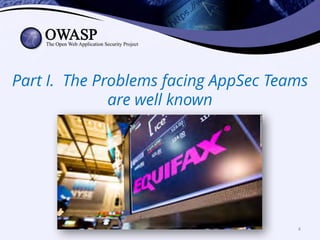
Part I. The Problems facing AppSec Teams
are well known
4
“Better coding will cure
application attacks.”
5
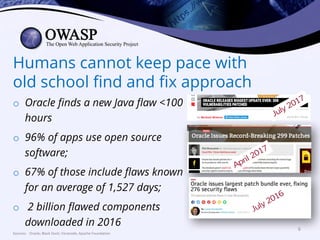
o Oracle finds a new Java flaw <100
hours
o 96% of apps use open source
software;
o 67% of those include flaws known
for an average of 1,527 days;
o 2 billion flawed components
downloaded in 2016
5
Humans cannot keep pace with
old school find and fix approach
Sources:			Oracle;	Black	Duck;	Veracode;	Apache	Foundation
6
5
“We have all the security
tools we need.”
7
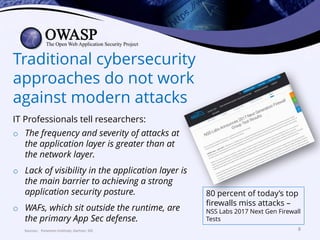
Traditional cybersecurity
approaches do not work
against modern attacks
Sources:			Ponemon Institute;	Gartner;	IDC
IT Professionals tell researchers:
o The frequency and severity of attacks at
the application layer is greater than at
the network layer.
o Lack of visibility in the application layer is
the main barrier to achieving a strong
application security posture.
o WAFs, which sit outside the runtime, are
the primary App Sec defense.
80 percent of today’s top
firewalls miss attacks –
NSS Labs 2017 Next Gen Firewall
Tests
8
Heuristics are good.
9
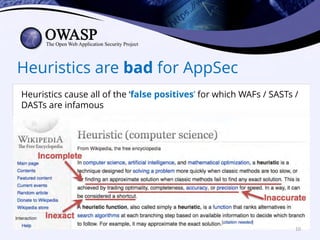
Heuristics are bad for AppSec
Heuristics cause all of the ‘false positives’ for which WAFs / SASTs /
DASTs are infamous
10
Facts, Not Opinions
1. We can’t rely on developers to write
secure code
2. Your developers are only responsible
for < 20% of the code you actually run
3. Patching and updating everything is
wholly unrealistic
11
Part II. Non-Heuristic Application
Security in the Runtime opens the
door to unique and improved
application protection
12
Tainted Lexical Analysis (TLA)
solves SQL injection, stored-XSS, reflected-
XSS, path/directory traversal, XPath injection,
OS command injection, and reflection
injection vulnerabilities
o Real time memory-tracing marks as “untrusted” all
user-input data to an app
o When “untrusted” user-input data is passed to a
structured grammar, tainted lexical analysis accurately
and reliably detects code-injection attacks - without:
o Code changes
o Pattern matching, regex, whitelists or blacklists, or
signatures
o Tuning or profiling
TLA Solves Code-Injection Vulnerabilities
Name-Space Layout
Randomization (NSLR)
solves unvalidated bytecode
attacks and Attach-API attacks
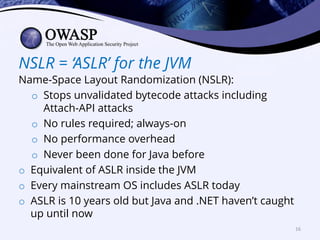
NSLR = ‘ASLR’ for the JVM
Name-Space Layout Randomization (NSLR):
o Stops unvalidated bytecode attacks including
Attach-API attacks
o No rules required; always-on
o No performance overhead
o Never been done for Java before
o Equivalent of ASLR inside the JVM
o Every mainstream OS includes ASLR today
o ASLR is 10 years old but Java and .NET haven’t caught
up until now
16
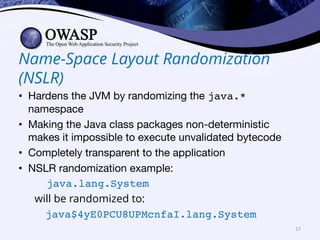
Name-Space Layout Randomization
(NSLR)
• Hardens the JVM by randomizing the java.*
namespace
• Making the Java class packages non-deterministic
makes it impossible to execute unvalidated bytecode
• Completely transparent to the application
• NSLR randomization example:
java.lang.System
will be randomized to:
java$4yE0PCU8UPMcnfaI.lang.System
17
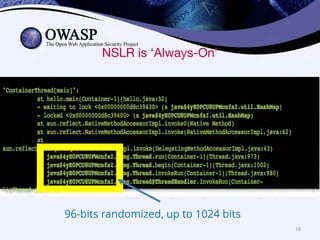
NSLR is ‘Always-On’
96-bits randomized, up to 1024 bits
18
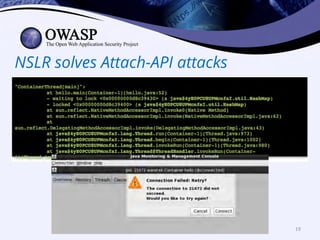
NSLR solves Attach-API attacks
19
Component Privilege De-escalation
solves software composition
vulnerabilities, API abuse,
deserialization vulnerabilities,
and zero-days
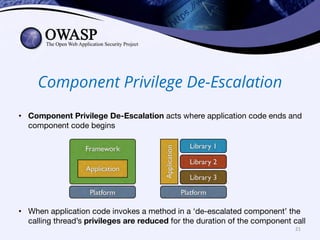
Component Privilege De-Escalation
• Component Privilege De-Escalation acts where application code ends and
component code begins
• When application code invokes a method in a ‘de-escalated component’ the
calling thread’s privileges are reduced for the duration of the component call
21
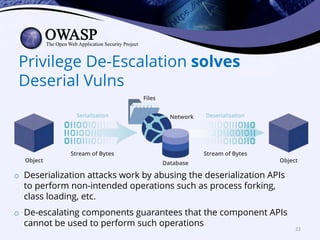
Privilege De-Escalation solves
Deserial Vulns
22
o Deserialization attacks work by abusing the deserialization APIs
to perform non-intended operations such as process forking,
class loading, etc.
o De-escalating components guarantees that the component APIs
cannot be used to perform such operations
Privilege De-Escalation solves
Deserial Vulns
o No source-code changes
o No blacklists, no whitelists, no config, no tuning
o No false positives
o No performance overhead
o Zero-day and ‘won’t fix’ protection
This approach would have prevented the
Equifax attack and any similar Remote Code
Execution attack based on Struts 2 CVE-
2017-5638 and the recent CVE-2017-9805
23
Rule Language
solves live virtual patching
Runtime Protection Rules
o Unbounced rules replace/insert
functionality at runtime to provide
“patch-equivalent” remediation
o Rules make it possible to virtually patch
any vulnerability in Java CPUs,
AppServers (WebLogic, JBoss, Tomcat,
etc) and frameworks
o Virtual patching applies instantly at
runtime with immediate effect, without
restarting the target application 25
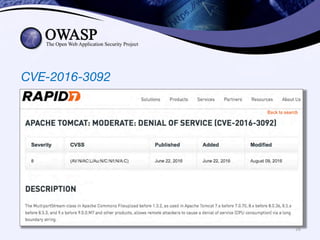
CVE-2016-3092
26
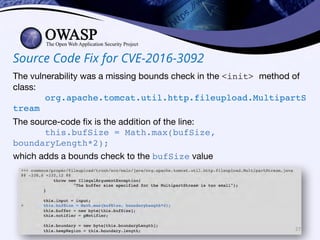
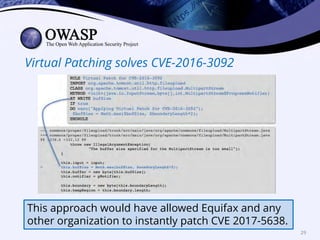
Source Code Fix for CVE-2016-3092
The vulnerability was a missing bounds check in the <init> method of
class:
org.apache.tomcat.util.http.fileupload.MultipartS
tream
The source-code fix is the addition of the line:
this.bufSize = Math.max(bufSize,
boundaryLength*2);
which adds a bounds check to the bufSize value
27
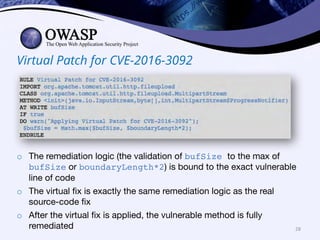
Virtual Patch for CVE-2016-3092
o The remediation logic (the validation of bufSize to the max of
bufSize or boundaryLength*2) is bound to the exact vulnerable
line of code
o The virtual fix is exactly the same remediation logic as the real
source-code fix
o After the virtual fix is applied, the vulnerable method is fully
remediated 28
Virtual Patching solves CVE-2016-3092
This approach would have allowed Equifax and any
other organization to instantly patch CVE 2017-5638.
29
Popular Approaches to Preventing Code Injection Attacks are Dangerously Wrong

Popular Approaches to Preventing Code Injection Attacks are Dangerously Wrong

  • 1.
    Popular Approaches toPreventing Code Injection Attacks are Dangerously Wrong John Matthew Holt CTO and Founder, Waratek
  • 2.
    About John Matthew Holt I’m John MatthewHolt I’m the founder and CTO of Waratek. I am a JVM/JIT compiler engineer by study and training, and I hold more than 60 patents for inventions that span abstract machine, dynamic recompilation, distributed computing and virtualization technologies. My company, Waratek, offers a unique, virtualization based approach to Application Security. 2
  • 3.
    Attendee Takeaways 1. Reviewrecent advances in runtime protection in the application security space 2. Understanding of the most frequently employed un-validated bytecode attacks in the JVM, where they occur and forms of mitigation 3. Working knowledge of the new, state-of-the-art application security technique neutralizing code injection attacks 3
  • 4.
    Part I. TheProblems facing AppSec Teams are well known 4
  • 5.
    “Better coding willcure application attacks.” 5
  • 6.
    o Oracle findsa new Java flaw <100 hours o 96% of apps use open source software; o 67% of those include flaws known for an average of 1,527 days; o 2 billion flawed components downloaded in 2016 5 Humans cannot keep pace with old school find and fix approach Sources: Oracle; Black Duck; Veracode; Apache Foundation 6
  • 7.
    5 “We have allthe security tools we need.” 7
  • 8.
    Traditional cybersecurity approaches donot work against modern attacks Sources: Ponemon Institute; Gartner; IDC IT Professionals tell researchers: o The frequency and severity of attacks at the application layer is greater than at the network layer. o Lack of visibility in the application layer is the main barrier to achieving a strong application security posture. o WAFs, which sit outside the runtime, are the primary App Sec defense. 80 percent of today’s top firewalls miss attacks – NSS Labs 2017 Next Gen Firewall Tests 8
  • 9.
  • 10.
    Heuristics are badfor AppSec Heuristics cause all of the ‘false positives’ for which WAFs / SASTs / DASTs are infamous 10
  • 11.
    Facts, Not Opinions 1.We can’t rely on developers to write secure code 2. Your developers are only responsible for < 20% of the code you actually run 3. Patching and updating everything is wholly unrealistic 11
  • 12.
    Part II. Non-HeuristicApplication Security in the Runtime opens the door to unique and improved application protection 12
  • 13.
    Tainted Lexical Analysis(TLA) solves SQL injection, stored-XSS, reflected- XSS, path/directory traversal, XPath injection, OS command injection, and reflection injection vulnerabilities
  • 14.
    o Real timememory-tracing marks as “untrusted” all user-input data to an app o When “untrusted” user-input data is passed to a structured grammar, tainted lexical analysis accurately and reliably detects code-injection attacks - without: o Code changes o Pattern matching, regex, whitelists or blacklists, or signatures o Tuning or profiling TLA Solves Code-Injection Vulnerabilities
  • 15.
    Name-Space Layout Randomization (NSLR) solvesunvalidated bytecode attacks and Attach-API attacks
  • 16.
    NSLR = ‘ASLR’for the JVM Name-Space Layout Randomization (NSLR): o Stops unvalidated bytecode attacks including Attach-API attacks o No rules required; always-on o No performance overhead o Never been done for Java before o Equivalent of ASLR inside the JVM o Every mainstream OS includes ASLR today o ASLR is 10 years old but Java and .NET haven’t caught up until now 16
  • 17.
    Name-Space Layout Randomization (NSLR) •Hardens the JVM by randomizing the java.* namespace • Making the Java class packages non-deterministic makes it impossible to execute unvalidated bytecode • Completely transparent to the application • NSLR randomization example: java.lang.System will be randomized to: java$4yE0PCU8UPMcnfaI.lang.System 17
  • 18.
    NSLR is ‘Always-On’ 96-bitsrandomized, up to 1024 bits 18
  • 19.
  • 20.
    Component Privilege De-escalation solvessoftware composition vulnerabilities, API abuse, deserialization vulnerabilities, and zero-days
  • 21.
    Component Privilege De-Escalation •Component Privilege De-Escalation acts where application code ends and component code begins • When application code invokes a method in a ‘de-escalated component’ the calling thread’s privileges are reduced for the duration of the component call 21
  • 22.
    Privilege De-Escalation solves DeserialVulns 22 o Deserialization attacks work by abusing the deserialization APIs to perform non-intended operations such as process forking, class loading, etc. o De-escalating components guarantees that the component APIs cannot be used to perform such operations
  • 23.
    Privilege De-Escalation solves DeserialVulns o No source-code changes o No blacklists, no whitelists, no config, no tuning o No false positives o No performance overhead o Zero-day and ‘won’t fix’ protection This approach would have prevented the Equifax attack and any similar Remote Code Execution attack based on Struts 2 CVE- 2017-5638 and the recent CVE-2017-9805 23
  • 24.
    Rule Language solves livevirtual patching
  • 25.
    Runtime Protection Rules oUnbounced rules replace/insert functionality at runtime to provide “patch-equivalent” remediation o Rules make it possible to virtually patch any vulnerability in Java CPUs, AppServers (WebLogic, JBoss, Tomcat, etc) and frameworks o Virtual patching applies instantly at runtime with immediate effect, without restarting the target application 25
  • 26.
  • 27.
    Source Code Fixfor CVE-2016-3092 The vulnerability was a missing bounds check in the <init> method of class: org.apache.tomcat.util.http.fileupload.MultipartS tream The source-code fix is the addition of the line: this.bufSize = Math.max(bufSize, boundaryLength*2); which adds a bounds check to the bufSize value 27
  • 28.
    Virtual Patch forCVE-2016-3092 o The remediation logic (the validation of bufSize to the max of bufSize or boundaryLength*2) is bound to the exact vulnerable line of code o The virtual fix is exactly the same remediation logic as the real source-code fix o After the virtual fix is applied, the vulnerable method is fully remediated 28
  • 29.
    Virtual Patching solvesCVE-2016-3092 This approach would have allowed Equifax and any other organization to instantly patch CVE 2017-5638. 29