The Celestial Sphere
                          LACC: §3.2, 3.5, 3.7
                     •         Coordinates--Declination      Latitude,
                               Right Ascension    Longitude

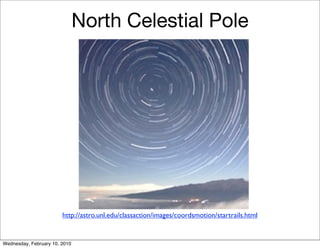
                     •         North and South Celestial Poles,
                               Celestial Equator, Ecliptic
                     •         Using the stars to navigate


                                       What is out there?


Wednesday, February 10, 2010
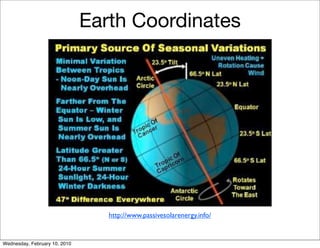
Earth Coordinates


                                  http://www.passivesolarenergy.info/


Wednesday, February 10, 2010
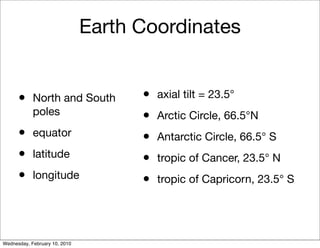
Earth Coordinates


      •     North and South          •   axial tilt = 23.5°
            poles                    •   Arctic Circle, 66.5°N
      •     equator                  •   Antarctic Circle, 66.5° S
      •     latitude                 •   tropic of Cancer, 23.5° N
      •     longitude                •   tropic of Capricorn, 23.5° S


Wednesday, February 10, 2010
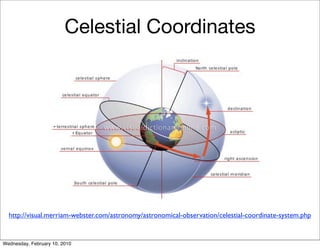
Celestial Coordinates


  http://visual.merriam-webster.com/astronomy/astronomical-observation/celestial-coordinate-system.php


Wednesday, February 10, 2010
North Celestial Pole


                        http://astro.unl.edu/classaction/images/coordsmotion/startrails.html


Wednesday, February 10, 2010
Celestial Coordinates
            •     North and South                         •    spring and autumnal
                  celestial poles                              equinox (20 Mar., 22
            •     zenith                                       Sept.)

            •     meridian                                •    summer and winter
                                                               solstice (21 June, 21
            •     celestial equator                            Dec.)
            •     ecliptic plane                          •    right ascension [RA]
                  (Earth’s orbit, Sun’s
                  Path)                                   •    declination [dec]
                     http://astro.unl.edu/classaction/animations/coordsmotion/radecdemo.html
                                      Celestial-Equator (RA/Dec) Demonstrator
                     http://astro.unl.edu/classaction/animations/coordsmotion/celhorcomp.html
                                                 Rotating Sky Explorer
                           Los Angeles: Latitude: 34° 05', North. Longitude: 118° 22', West

Wednesday, February 10, 2010
Navigation
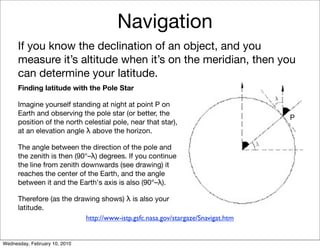
      If you know the declination of an object, and you
      measure it’s altitude when it’s on the meridian, then you
      can determine your latitude.
      Finding latitude with the Pole Star

      Imagine yourself standing at night at point P on
      Earth and observing the pole star (or better, the
                                                                                 P
      position of the north celestial pole, near that star),
      at an elevation angle λ above the horizon.

      The angle between the direction of the pole and
      the zenith is then (90°–λ) degrees. If you continue
      the line from zenith downwards (see drawing) it
      reaches the center of the Earth, and the angle
      between it and the Earth's axis is also (90°–λ).

      Therefore (as the drawing shows) λ is also your
      latitude.
                           http://www-istp.gsfc.nasa.gov/stargaze/Snavigat.htm


Wednesday, February 10, 2010
Movement of the
                               Celestial Sphere
            The celestial sphere isn’t what is moving. (Of
            course, a spherical shell of stars doesn’t even
            exist.) The earth rotates inside of it.
            Objects in space appear to “rise in the East and
            set in the West”. One can imagine why people
            thought the Earth was fixed in space, and the
            celestial sphere rotated around it--we don’t feel
            the Earth rotating. Actually, the earth’s rotation
            makes it appear that objects in space move from
            east to west over the course of the day and/or
            night.
                      Imagine a globe inside a celestial sphere.
Wednesday, February 10, 2010
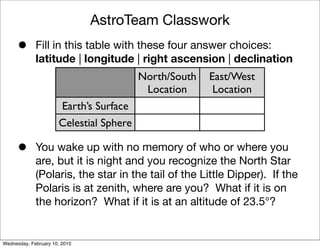
AstroTeam Classwork
      •      Fill in this table with these four answer choices:
             latitude | longitude | right ascension | declination
                                         North/South   East/West
                                          Location      Location
                      Earth’s Surface
                      Celestial Sphere

      •      You wake up with no memory of who or where you
             are, but it is night and you recognize the North Star
             (Polaris, the star in the tail of the Little Dipper). If the
             Polaris is at zenith, where are you? What if it is on
             the horizon? What if it is at an altitude of 23.5°?


Wednesday, February 10, 2010
LACC HW: Franknoi, Morrison, and
               Wolff, Voyages Through the Universe,
                              3rd ed.


            •      Ch. 3, pp. 82-83: 1, 9.


             Due on the first class of the following week, at the
                            beginning of class.


Wednesday, February 10, 2010
Celestial Mechanics
                           LACC: §3.2, 3.5, 3.7

            •       Marking Time: day       rotation, year
                    revolution
            •       Effects of the Sun: solar vs. sidereal, seasons
            •       Changes in the Sky: Moon Phases, Eclipses


                               What is going on out there?


Wednesday, February 10, 2010
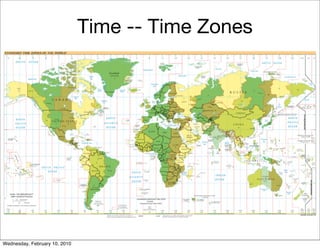
Time -- Time Zones


Wednesday, February 10, 2010
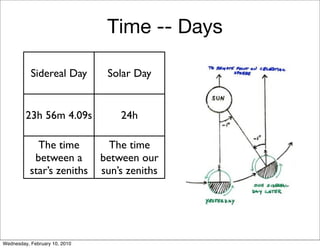
Time -- Days

           Sidereal Day         Solar Day


         23h 56m 4.09s             24h

             The time            The time
            between a          between our
           star’s zeniths      sun’s zeniths


Wednesday, February 10, 2010
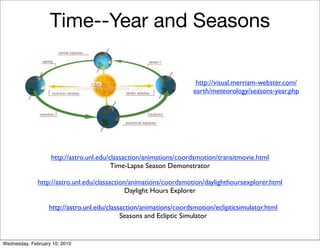
Time--Year and Seasons

                                                                    http://visual.merriam-webster.com/
                                                                   earth/meteorology/seasons-year.php


                   http://astro.unl.edu/classaction/animations/coordsmotion/transitmovie.html
                                         Time-Lapse Season Demonstrator

              http://astro.unl.edu/classaction/animations/coordsmotion/daylighthoursexplorer.html
                                              Daylight Hours Explorer

                  http://astro.unl.edu/classaction/animations/coordsmotion/eclipticsimulator.html
                                            Seasons and Ecliptic Simulator


Wednesday, February 10, 2010
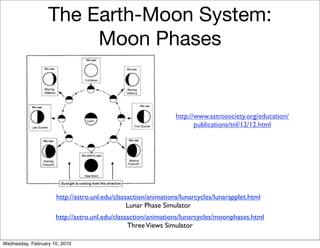
The Earth-Moon System:
                       Moon Phases


                                                               http://www.astrosociety.org/education/
                                                                      publications/tnl/12/12.html


                     http://astro.unl.edu/classaction/animations/lunarcycles/lunarapplet.html
                                               Lunar Phase Simulator
                     http://astro.unl.edu/classaction/animations/lunarcycles/moonphases.html
                                               Three Views Simulator

Wednesday, February 10, 2010
The Earth-Moon System:
                       Lunar Eclipses

                                                                      http://hyperphysics.phy-astr.gsu.edu/
                                                                             hbase/solar/lunecl.html


                      http://astro.unl.edu/classaction/animations/lunarcycles/eclipsetable.html
                                                     Eclipse Table

Wednesday, February 10, 2010
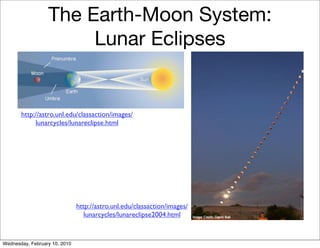
The Earth-Moon System:
                       Lunar Eclipses


       http://astro.unl.edu/classaction/images/
            lunarcycles/lunareclipse.html


                               http://astro.unl.edu/classaction/images/
                                  lunarcycles/lunareclipse2004.html


Wednesday, February 10, 2010
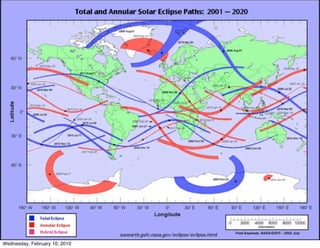
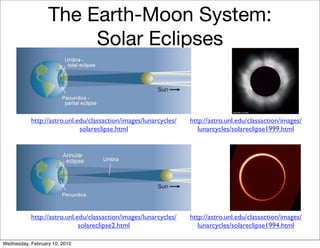
The Earth-Moon System:
                       Solar Eclipses


           http://astro.unl.edu/classaction/images/lunarcycles/   http://astro.unl.edu/classaction/images/
                             solareclipse.html                       lunarcycles/solareclipse1999.html


           http://astro.unl.edu/classaction/images/lunarcycles/   http://astro.unl.edu/classaction/images/
                             solareclipse2.html                      lunarcycles/solareclipse1994.html

Wednesday, February 10, 2010
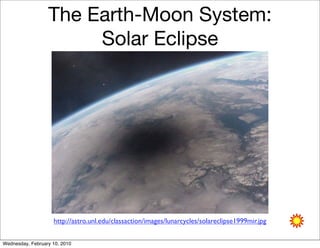
The Earth-Moon System:
                       Solar Eclipse


                    http://astro.unl.edu/classaction/images/lunarcycles/solareclipse1999mir.jpg


Wednesday, February 10, 2010
AstroTeam Classwork


            •      What are two ways the 23.5° tilt of the Earth’s
                   axis causes summers in the United States to
                   be warmer than the winters? (Voyages, Ch. 3,
                   pp. 82-83: 5)


                                   Due presently.


Wednesday, February 10, 2010
LACC HW: Franknoi, Morrison, and
               Wolff, Voyages Through the Universe,
                              3rd ed.


            •      Ch. 3, pp. 82-83: 11, 16.

            •      Ch 4: Tutorial Quizzes accessible from:
                   www.brookscole.com/cgi-brookscole/course_products_bc.pl?
                                                                           http://

                   fid=M20b&product_isbn_issn=9780495017899&discipline_number=19


             Due on the first class of the following week, at the
                            beginning of class.


Wednesday, February 10, 2010

A1 02 Celestial Sphere

  • 1.
    The Celestial Sphere LACC: §3.2, 3.5, 3.7 • Coordinates--Declination Latitude, Right Ascension Longitude • North and South Celestial Poles, Celestial Equator, Ecliptic • Using the stars to navigate What is out there? Wednesday, February 10, 2010
  • 2.
    Earth Coordinates http://www.passivesolarenergy.info/ Wednesday, February 10, 2010
  • 3.
    Earth Coordinates • North and South • axial tilt = 23.5° poles • Arctic Circle, 66.5°N • equator • Antarctic Circle, 66.5° S • latitude • tropic of Cancer, 23.5° N • longitude • tropic of Capricorn, 23.5° S Wednesday, February 10, 2010
  • 4.
    Celestial Coordinates http://visual.merriam-webster.com/astronomy/astronomical-observation/celestial-coordinate-system.php Wednesday, February 10, 2010
  • 5.
    North Celestial Pole http://astro.unl.edu/classaction/images/coordsmotion/startrails.html Wednesday, February 10, 2010
  • 6.
    Celestial Coordinates • North and South • spring and autumnal celestial poles equinox (20 Mar., 22 • zenith Sept.) • meridian • summer and winter solstice (21 June, 21 • celestial equator Dec.) • ecliptic plane • right ascension [RA] (Earth’s orbit, Sun’s Path) • declination [dec] http://astro.unl.edu/classaction/animations/coordsmotion/radecdemo.html Celestial-Equator (RA/Dec) Demonstrator http://astro.unl.edu/classaction/animations/coordsmotion/celhorcomp.html Rotating Sky Explorer Los Angeles: Latitude: 34° 05', North. Longitude: 118° 22', West Wednesday, February 10, 2010
  • 7.
    Navigation If you know the declination of an object, and you measure it’s altitude when it’s on the meridian, then you can determine your latitude. Finding latitude with the Pole Star Imagine yourself standing at night at point P on Earth and observing the pole star (or better, the P position of the north celestial pole, near that star), at an elevation angle λ above the horizon. The angle between the direction of the pole and the zenith is then (90°–λ) degrees. If you continue the line from zenith downwards (see drawing) it reaches the center of the Earth, and the angle between it and the Earth's axis is also (90°–λ). Therefore (as the drawing shows) λ is also your latitude. http://www-istp.gsfc.nasa.gov/stargaze/Snavigat.htm Wednesday, February 10, 2010
  • 8.
    Movement of the Celestial Sphere The celestial sphere isn’t what is moving. (Of course, a spherical shell of stars doesn’t even exist.) The earth rotates inside of it. Objects in space appear to “rise in the East and set in the West”. One can imagine why people thought the Earth was fixed in space, and the celestial sphere rotated around it--we don’t feel the Earth rotating. Actually, the earth’s rotation makes it appear that objects in space move from east to west over the course of the day and/or night. Imagine a globe inside a celestial sphere. Wednesday, February 10, 2010
  • 9.
    AstroTeam Classwork • Fill in this table with these four answer choices: latitude | longitude | right ascension | declination North/South East/West Location Location Earth’s Surface Celestial Sphere • You wake up with no memory of who or where you are, but it is night and you recognize the North Star (Polaris, the star in the tail of the Little Dipper). If the Polaris is at zenith, where are you? What if it is on the horizon? What if it is at an altitude of 23.5°? Wednesday, February 10, 2010
  • 10.
    LACC HW: Franknoi,Morrison, and Wolff, Voyages Through the Universe, 3rd ed. • Ch. 3, pp. 82-83: 1, 9. Due on the first class of the following week, at the beginning of class. Wednesday, February 10, 2010
  • 11.
    Celestial Mechanics LACC: §3.2, 3.5, 3.7 • Marking Time: day rotation, year revolution • Effects of the Sun: solar vs. sidereal, seasons • Changes in the Sky: Moon Phases, Eclipses What is going on out there? Wednesday, February 10, 2010
  • 12.
    Time -- TimeZones Wednesday, February 10, 2010
  • 13.
    Time -- Days Sidereal Day Solar Day 23h 56m 4.09s 24h The time The time between a between our star’s zeniths sun’s zeniths Wednesday, February 10, 2010
  • 14.
    Time--Year and Seasons http://visual.merriam-webster.com/ earth/meteorology/seasons-year.php http://astro.unl.edu/classaction/animations/coordsmotion/transitmovie.html Time-Lapse Season Demonstrator http://astro.unl.edu/classaction/animations/coordsmotion/daylighthoursexplorer.html Daylight Hours Explorer http://astro.unl.edu/classaction/animations/coordsmotion/eclipticsimulator.html Seasons and Ecliptic Simulator Wednesday, February 10, 2010
  • 15.
    The Earth-Moon System: Moon Phases http://www.astrosociety.org/education/ publications/tnl/12/12.html http://astro.unl.edu/classaction/animations/lunarcycles/lunarapplet.html Lunar Phase Simulator http://astro.unl.edu/classaction/animations/lunarcycles/moonphases.html Three Views Simulator Wednesday, February 10, 2010
  • 16.
    The Earth-Moon System: Lunar Eclipses http://hyperphysics.phy-astr.gsu.edu/ hbase/solar/lunecl.html http://astro.unl.edu/classaction/animations/lunarcycles/eclipsetable.html Eclipse Table Wednesday, February 10, 2010
  • 17.
  • 18.
    The Earth-Moon System: Lunar Eclipses http://astro.unl.edu/classaction/images/ lunarcycles/lunareclipse.html http://astro.unl.edu/classaction/images/ lunarcycles/lunareclipse2004.html Wednesday, February 10, 2010
  • 19.
    The Earth-Moon System: Solar Eclipses http://astro.unl.edu/classaction/images/lunarcycles/ http://astro.unl.edu/classaction/images/ solareclipse.html lunarcycles/solareclipse1999.html http://astro.unl.edu/classaction/images/lunarcycles/ http://astro.unl.edu/classaction/images/ solareclipse2.html lunarcycles/solareclipse1994.html Wednesday, February 10, 2010
  • 20.
    The Earth-Moon System: Solar Eclipse http://astro.unl.edu/classaction/images/lunarcycles/solareclipse1999mir.jpg Wednesday, February 10, 2010
  • 21.
    AstroTeam Classwork • What are two ways the 23.5° tilt of the Earth’s axis causes summers in the United States to be warmer than the winters? (Voyages, Ch. 3, pp. 82-83: 5) Due presently. Wednesday, February 10, 2010
  • 22.
    LACC HW: Franknoi,Morrison, and Wolff, Voyages Through the Universe, 3rd ed. • Ch. 3, pp. 82-83: 11, 16. • Ch 4: Tutorial Quizzes accessible from: www.brookscole.com/cgi-brookscole/course_products_bc.pl? http:// fid=M20b&product_isbn_issn=9780495017899&discipline_number=19 Due on the first class of the following week, at the beginning of class. Wednesday, February 10, 2010