Subject : Theory of
Communication

 Chapter 6     Group 5
INTERCULTURAL
COMMUNICATION
  COMPETENCE
        Presenter : Ngân Giang
Adopt Correct Attitudes
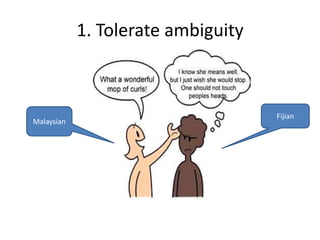
1. Tolerate ambiguity


                                    Fijian
Malaysian
• Identify the misunderstanding.
• Try to understand the possible reasons/causes
  of the misunderstanding.
• Share your expertise with your colleagues to
  prevent the same problem happening again.
2. Be open-minded
• An open-minded person is willing to
  dispassionately receive the ideas and opinions
  of others.
• Open-minded people are aware of their own
  culture values and recognize that other
  people’s values are different.
• Sala (originally from Fiji): When I came here to Australia years ago,
  people at work would feel my hair. It made me uncomfortable. We
  don’t go around touching people on the head in my Fijian culture. We
  also avoid reaching near their head for something.
• Later on, when they found out, they stopped touching my hair. They
  were curious about how my hair feels as it’s very curly.


• Mary (originally from Ireland): In the Fijian culture touching hair is NOT
  done. I’m guilty of having done this on many occasions, because I have
  been friends with Fijians at work. I would run my fingers through their
  hair and say ‘How I love your hair!’ or something like that. Never for a
  minute did I think that I was making my friends uncomfortable.
3. Be altruistic, not egocentric
• Altruism is a display of genuine and unselfish
  concern for the welfare of others => other-
  centered
• Egocentricity is a selfish interest in one’s own
  needs to the exclusion of everything else =>
  self-centered
Acquire Knowledge About Other
           Cultures

      Presenter: Minh Sang
Acquire Knowledge About Other
               Cultures
The more we know about other cultures, the more likely we are to
be competent intercultural communicators (Neuliep, 2006).

There are several ways to learn about other cultures :

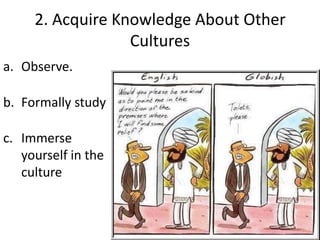
1. Observe.

2. Formally study.

3. Immerse yourself in the culture.
1.Observe
People can simply watch as members of another culture interact
with
each other.

Notice how their values, rituals, and communication styles are
similar to and different from your own and other cultures with
which you are familiar.

“passive observation “  Watching the communication behaviors
used by members of a particular culture.
2. Formally study
You can learn about other cultures by reading accounts by their
members and ethnographic research studies, by taking courses, and
by interviewing members of the culture about their
values, rituals, and so on.
3. Immerse yourself in the culture
You can learn a great deal about another culture by actively
participating in it.

When you live or work with people whose cultural assumptions
are different from yours, you not only acquire obvious cultural
information, but you also learn nuances that escape passive
observers and are generally not accessible through formal study
alone.
Acquiring Cultural Knowledge

         The Assignment
       Presenter : Hữu Lộc
Choose a culture you're not familiar with but are
curious about. Prepare a 3- to 5-minute speech
to deliver in class by gathering materials from
(a) reviewing an encyclopedia entry
(b) researching two or three academic sources
about the culture
(c) interviewing someone from that country
either face-to-face or online
Use what you learn from the encyclopedia and the
academic sources to shape the questions you ask in
the interview, in your speech discuss what you
learned from each source, answering the following
questions:
1. What did you know about the culture before you
began your research?
2. What did you learn from the encyclopedia article
that changed or deepened your knowledge?
3. How was your understanding enriched from the
additional academic sources you read?
4. What did you learn from your interviewee. and
how did the interview compare to your other
sources?
Using Diverse Resources
• When we are researching any topic, we can be
  tempted to limit our quest to only one type of
  information source. But as you will learn in this
  assignment what you know about a subject is often
  the result of where you look. That is why it is
  important to consult a variety of information sources.
• Whether online or in print encyclopedias ore good
  jumping off points to acquire information and can
  provide a wonderful overview of the subject.
  Specialized sources like books and articles by experts
  provide additional details and can confirm or
  disconfirm information in the encyclopedia.
Finally, personal interviews with experts add
another dimension or level of specificity. For
example, in this assignment when you interview
the person from the other culture, you can ask
for specific examples of his or her experiences
and whether what you have read is accurate.
Good      speeches     depend      on    accurate
information, so learning to use diverse sources is
important to your success.
Develop culture-specific skills

       Presenter: Ngọc Cẩm
How


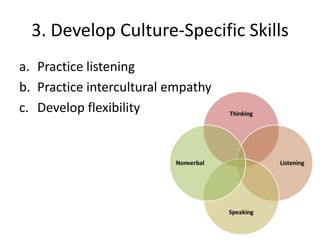
1. Practice listening
2. Practice intercultural empathy
3. Develop flexibility
Practice listening


• Language and nonverbal communication vary across
  cultures => focus closely on the other and listen
  attentively.

• There are cultural differences in how people engage in
  listening and the value that cultures place on listening.
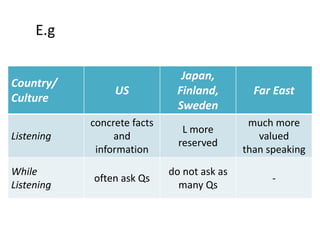
E.g

                               Japan,
Country/
                 US           Finland,         Far East
Culture
                              Sweden
            concrete facts                    much more
                                L more
Listening        and                            valued
                               reserved
             information                     than speaking
While                        do not ask as
            often ask Qs                           -
Listening                      many Qs
Practice intercultural empathy


Intercultural empathy: imaginatively placing yourself in the
other person’s cultural world to attempt to experience what
                   he/she is experiencing.
                    (Ting-Toomey, 1999)
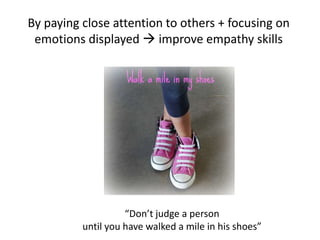
By paying close attention to others + focusing on
 emotions displayed  improve empathy skills


                    “Don’t judge a person
          until you have walked a mile in his shoes”
Develop flexibility


Flexibility: the ability to adjust your communication to
          fit the other person and the situation.
Develop flexibility
• With flexibility: use a wide variety of
  communication skills and modify your
  behavior within and across situations.

• Beiing flexible means analyzing a situation +
  making good decisions and modifying your
  communication when things are not going
  well.
Sum-up

Presenter: Minh Dang
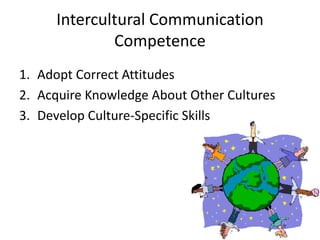
Intercultural Communication
             Competence
1. Adopt Correct Attitudes
2. Acquire Knowledge About Other Cultures
3. Develop Culture-Specific Skills
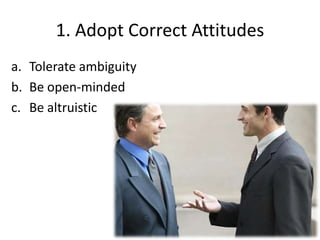
1. Adopt Correct Attitudes
a. Tolerate ambiguity
b. Be open-minded
c. Be altruistic
2. Acquire Knowledge About Other
                  Cultures
a. Observe.

b. Formally study

c. Immerse
   yourself in the
   culture
3. Develop Culture-Specific Skills
a. Practice listening
b. Practice intercultural empathy
c. Develop flexibility
CHAPTER’S SUMMARY
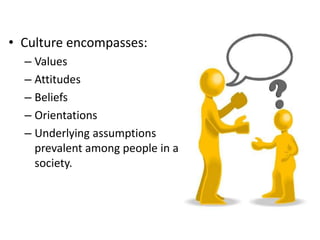
• Culture encompasses:
  – Values
  – Attitudes
  – Beliefs
  – Orientations
  – Underlying assumptions
    prevalent among people in a
    society.
• Culture shock: the psychological discomfort
  when people attempt to adjust to a new
  cultural situation
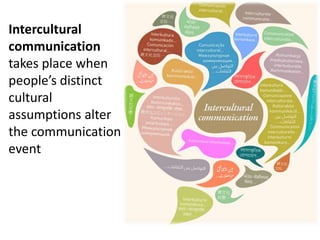
Intercultural
communication
takes place when
people’s distinct
cultural
assumptions alter
the communication
event
• A shared system of meaning exists within the
  dominant culture, but meanings can vary
  within co-cultures based on race, ethnicity, sex
  and gender, religion, sexual orientation, social
  class, and age
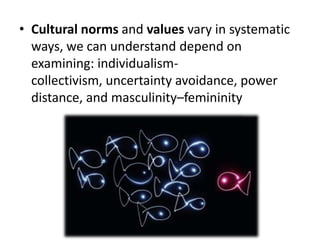
• Cultural norms and values vary in systematic
  ways, we can understand depend on
  examining: individualism-
  collectivism, uncertainty avoidance, power
  distance, and masculinity–femininity
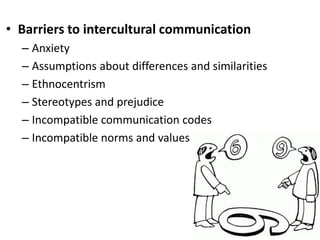
• Barriers to intercultural communication
  – Anxiety
  – Assumptions about differences and similarities
  – Ethnocentrism
  – Stereotypes and prejudice
  – Incompatible communication codes
  – Incompatible norms and values
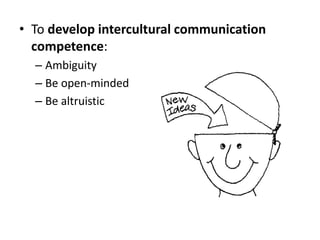
• To develop intercultural communication
  competence:
  – Ambiguity
  – Be open-minded
  – Be altruistic
• We can acquire knowledge of other cultures
  through :
  – Observing
  – Formal study
  – Cultural immersion
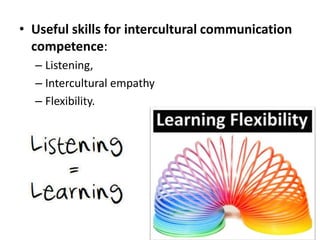
• Useful skills for intercultural communication
  competence:
  – Listening,
  – Intercultural empathy
  – Flexibility.
THANKS FOR YOUR ATTENTION!


    • Group 5:
      1.   Dinh Quoc Minh Dang
      2.   Nguyen Dinh Minh Sang
      3.   Vo Huu Loc
      4.   Tran Thi Ngan Giang
      5.   Nguyen Ngoc Cam

Chapter 6 (intercultural communication competence)

  • 1.
    Subject : Theoryof Communication Chapter 6 Group 5
  • 2.
  • 3.
  • 4.
    1. Tolerate ambiguity Fijian Malaysian
  • 5.
    • Identify themisunderstanding. • Try to understand the possible reasons/causes of the misunderstanding. • Share your expertise with your colleagues to prevent the same problem happening again.
  • 6.
    2. Be open-minded •An open-minded person is willing to dispassionately receive the ideas and opinions of others. • Open-minded people are aware of their own culture values and recognize that other people’s values are different.
  • 7.
    • Sala (originallyfrom Fiji): When I came here to Australia years ago, people at work would feel my hair. It made me uncomfortable. We don’t go around touching people on the head in my Fijian culture. We also avoid reaching near their head for something. • Later on, when they found out, they stopped touching my hair. They were curious about how my hair feels as it’s very curly. • Mary (originally from Ireland): In the Fijian culture touching hair is NOT done. I’m guilty of having done this on many occasions, because I have been friends with Fijians at work. I would run my fingers through their hair and say ‘How I love your hair!’ or something like that. Never for a minute did I think that I was making my friends uncomfortable.
  • 8.
    3. Be altruistic,not egocentric • Altruism is a display of genuine and unselfish concern for the welfare of others => other- centered • Egocentricity is a selfish interest in one’s own needs to the exclusion of everything else => self-centered
  • 9.
    Acquire Knowledge AboutOther Cultures Presenter: Minh Sang
  • 10.
    Acquire Knowledge AboutOther Cultures The more we know about other cultures, the more likely we are to be competent intercultural communicators (Neuliep, 2006). There are several ways to learn about other cultures : 1. Observe. 2. Formally study. 3. Immerse yourself in the culture.
  • 11.
    1.Observe People can simplywatch as members of another culture interact with each other. Notice how their values, rituals, and communication styles are similar to and different from your own and other cultures with which you are familiar. “passive observation “  Watching the communication behaviors used by members of a particular culture.
  • 12.
    2. Formally study Youcan learn about other cultures by reading accounts by their members and ethnographic research studies, by taking courses, and by interviewing members of the culture about their values, rituals, and so on.
  • 13.
    3. Immerse yourselfin the culture You can learn a great deal about another culture by actively participating in it. When you live or work with people whose cultural assumptions are different from yours, you not only acquire obvious cultural information, but you also learn nuances that escape passive observers and are generally not accessible through formal study alone.
  • 14.
    Acquiring Cultural Knowledge The Assignment Presenter : Hữu Lộc
  • 15.
    Choose a cultureyou're not familiar with but are curious about. Prepare a 3- to 5-minute speech to deliver in class by gathering materials from (a) reviewing an encyclopedia entry (b) researching two or three academic sources about the culture (c) interviewing someone from that country either face-to-face or online
  • 16.
    Use what youlearn from the encyclopedia and the academic sources to shape the questions you ask in the interview, in your speech discuss what you learned from each source, answering the following questions: 1. What did you know about the culture before you began your research? 2. What did you learn from the encyclopedia article that changed or deepened your knowledge? 3. How was your understanding enriched from the additional academic sources you read? 4. What did you learn from your interviewee. and how did the interview compare to your other sources?
  • 17.
    Using Diverse Resources •When we are researching any topic, we can be tempted to limit our quest to only one type of information source. But as you will learn in this assignment what you know about a subject is often the result of where you look. That is why it is important to consult a variety of information sources. • Whether online or in print encyclopedias ore good jumping off points to acquire information and can provide a wonderful overview of the subject. Specialized sources like books and articles by experts provide additional details and can confirm or disconfirm information in the encyclopedia.
  • 18.
    Finally, personal interviewswith experts add another dimension or level of specificity. For example, in this assignment when you interview the person from the other culture, you can ask for specific examples of his or her experiences and whether what you have read is accurate. Good speeches depend on accurate information, so learning to use diverse sources is important to your success.
  • 19.
    Develop culture-specific skills Presenter: Ngọc Cẩm
  • 20.
    How 1. Practice listening 2.Practice intercultural empathy 3. Develop flexibility
  • 21.
    Practice listening • Languageand nonverbal communication vary across cultures => focus closely on the other and listen attentively. • There are cultural differences in how people engage in listening and the value that cultures place on listening.
  • 22.
    E.g Japan, Country/ US Finland, Far East Culture Sweden concrete facts much more L more Listening and valued reserved information than speaking While do not ask as often ask Qs - Listening many Qs
  • 23.
    Practice intercultural empathy Interculturalempathy: imaginatively placing yourself in the other person’s cultural world to attempt to experience what he/she is experiencing. (Ting-Toomey, 1999)
  • 24.
    By paying closeattention to others + focusing on emotions displayed  improve empathy skills “Don’t judge a person until you have walked a mile in his shoes”
  • 25.
    Develop flexibility Flexibility: theability to adjust your communication to fit the other person and the situation.
  • 26.
    Develop flexibility • Withflexibility: use a wide variety of communication skills and modify your behavior within and across situations. • Beiing flexible means analyzing a situation + making good decisions and modifying your communication when things are not going well.
  • 27.
  • 28.
    Intercultural Communication Competence 1. Adopt Correct Attitudes 2. Acquire Knowledge About Other Cultures 3. Develop Culture-Specific Skills
  • 29.
    1. Adopt CorrectAttitudes a. Tolerate ambiguity b. Be open-minded c. Be altruistic
  • 30.
    2. Acquire KnowledgeAbout Other Cultures a. Observe. b. Formally study c. Immerse yourself in the culture
  • 31.
    3. Develop Culture-SpecificSkills a. Practice listening b. Practice intercultural empathy c. Develop flexibility
  • 32.
  • 33.
    • Culture encompasses: – Values – Attitudes – Beliefs – Orientations – Underlying assumptions prevalent among people in a society.
  • 34.
    • Culture shock:the psychological discomfort when people attempt to adjust to a new cultural situation
  • 35.
    Intercultural communication takes place when people’sdistinct cultural assumptions alter the communication event
  • 36.
    • A sharedsystem of meaning exists within the dominant culture, but meanings can vary within co-cultures based on race, ethnicity, sex and gender, religion, sexual orientation, social class, and age
  • 37.
    • Cultural normsand values vary in systematic ways, we can understand depend on examining: individualism- collectivism, uncertainty avoidance, power distance, and masculinity–femininity
  • 38.
    • Barriers tointercultural communication – Anxiety – Assumptions about differences and similarities – Ethnocentrism – Stereotypes and prejudice – Incompatible communication codes – Incompatible norms and values
  • 39.
    • To developintercultural communication competence: – Ambiguity – Be open-minded – Be altruistic
  • 40.
    • We canacquire knowledge of other cultures through : – Observing – Formal study – Cultural immersion
  • 41.
    • Useful skillsfor intercultural communication competence: – Listening, – Intercultural empathy – Flexibility.
  • 42.
    THANKS FOR YOURATTENTION! • Group 5: 1. Dinh Quoc Minh Dang 2. Nguyen Dinh Minh Sang 3. Vo Huu Loc 4. Tran Thi Ngan Giang 5. Nguyen Ngoc Cam