




Events Industry
Stakeholders
From Events
Management by
Eloisa Altez-Romero
Presented by:
Mervyn Maico Aldana
Faculty, SHTM
Stakeholders
 Stakeholders refer to the parties who hold a stake or interest in the
particular project or industry.
 The stakeholders in the events industry can be classified into four
major categories:
 The professional congress/event managers (PCO)
 The community
 The service suppliers
 Government offices and regulatory bodies
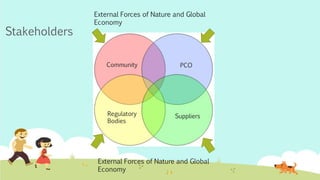
Stakeholders
Community PCO
Regulatory
Bodies
Suppliers
External Forces of Nature and Global
Economy
External Forces of Nature and Global
Economy
Stakeholders
 Notice that the PCO has equivalent friction with the community, regulatory
bodies, and suppliers; so do the regulatory bodies with PCOs, suppliers, and
the community.
 There is, however minimal contact between the community and suppliers
within the context of events, as suppliers pass through the PCOs to reach the
community.
 The event is likewise affected by external factors, such as forces of nature,
natural calamities, terrorism, global economic downturn/upturn, and political
events, among others.
The Event Manager/Professional
Congress Organizer (PCO)
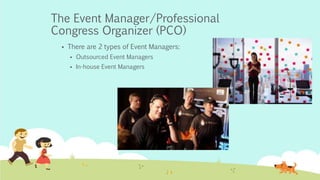
 There are 2 types of Event Managers:
 Outsourced Event Managers
 In-house Event Managers
The Event Manager/Professional
Congress Organizer (PCO)
 Outsourced Event Managers – event management companies or individuals
(also known as PCOs) that organize events on a per contract basis on behalf
of their clients.
 PCOs are independent event managers, professionally knowledgeable in their
own fields of specialization who bring the know-how, coupled with a database
of contacts needed in various stages of event organizing.
 They are entrepreneurs.
The Event Manager/Professional
Congress Organizer (PCO)
 In-house Event Managers – positions or departments within an organization
that is not into the business of event management but requires its own group
of event managers or coordinators due to the volume of special events that
the company has, such as executive meetings, strategic planning, team
building, trainings, incentive events for the sales team, and product launches.
 In-house event managers may either be employed by corporations or
associations.
 Examples: hotel’s banquet managers, marketing department of an company
The Community
 The community represents both the target market and the
people living in and around the event destination.
 Residents and events destinations receive the impact of event
activities, both positive and negative.
 They enjoy the resulting economic benefits, job opportunities,
and infrastructure developments, but also suffer from
environmental and other possible exploitive impacts too.
The Community
 The target market includes exhibitors, visitors, sponsors, and other attendees
of the event.
 They bring in revenues for any profit-oriented event.
 They are those whom the organizers attract and try to satisfy.
 They are the raison d'être or the main reason for organizing the event.
Community - Associations
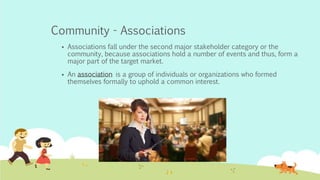
 Associations fall under the second major stakeholder category or the
community, because associations hold a number of events and thus, form a
major part of the target market.
 An association is a group of individuals or organizations who formed
themselves formally to uphold a common interest.
Community - Associations
 There are two types of associations:
 Trade associations – non-profit organizations whose aim is to meet the needs of
for-profit business. Example – Philippine Association of Convention/Exhibition
Organizers and Suppliers, Inc. (PACEOS)
 Professional associations – non-profit organizations that are not involved with
business firms... Organized to assist individuals in the pursuit of their common
goals. There are three types:
 The first is one that is bound by common personal interests (UP Mountaineers Club, UP
Anime Manga Enthusiasts)
 The second type is bound by their career (Philippine Nurses Association)
 The third type is bound to do community service (Association of Foundations)
Suppliers
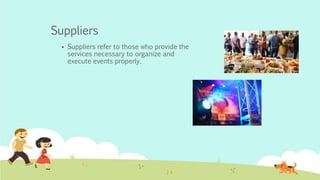
 Suppliers refer to those who provide the
services necessary to organize and
execute events properly.
Suppliers
 Venues
 Hotels
 Food and Beverage Suppliers/Caterers
 Airlines
 Airports
 Ground Transportation (Car Rental, Bus or Coach Service)
 Ground Handlers (Travel Agencies, Tour Operators, Spouse
Programs)
 Freight Forwarders
 Audiovisual/Meeting Technology Suppliers
 Security
 Manpower Agencies
 Photography, Documentation, and Transcription Services
 Advertising agencies, PR companies, printers, providers of corporate
premiums, and other promotional materials
Venues
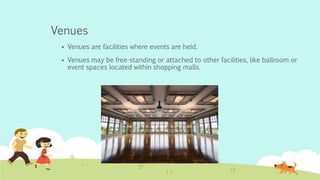
 Venues are facilities where events are held.
 Venues may be free-standing or attached to other facilities, like ballroom or
event spaces located within shopping malls.
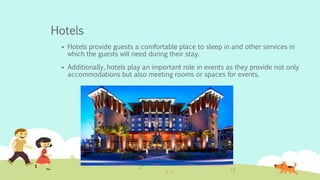
Hotels
 Hotels provide guests a comfortable place to sleep in and other services in
which the guests will need during their stay.
 Additionally, hotels play an important role in events as they provide not only
accommodations but also meeting rooms or spaces for events.
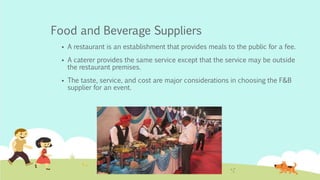
Food and Beverage Suppliers
 A restaurant is an establishment that provides meals to the public for a fee.
 A caterer provides the same service except that the service may be outside
the restaurant premises.
 The taste, service, and cost are major considerations in choosing the F&B
supplier for an event.
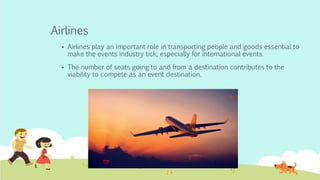
Airlines
 Airlines play an important role in transporting people and goods essential to
make the events industry tick, especially for international events.
 The number of seats going to and from a destination contributes to the
viability to compete as an event destination.
Airports
 First impressions last.
 Airports have the responsibility of
making a good first impression for
international participants.
 Airports are doors into a country and
provide visitors with the first taste of
the country’s culture.
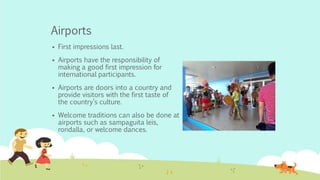
 Welcome traditions can also be done at
airports such as sampaguita leis,
rondalla, or welcome dances.
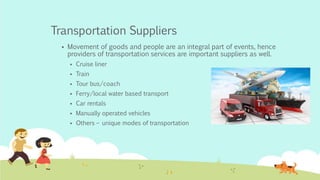
Transportation Suppliers
 Movement of goods and people are an integral part of events, hence
providers of transportation services are important suppliers as well.
 Cruise liner
 Train
 Tour bus/coach
 Ferry/local water based transport
 Car rentals
 Manually operated vehicles
 Others – unique modes of transportation
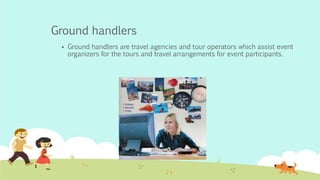
Ground handlers
 Ground handlers are travel agencies and tour operators which assist event
organizers for the tours and travel arrangements for event participants.
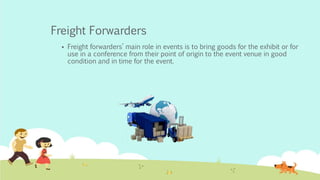
Freight Forwarders
 Freight forwarders’ main role in events is to bring goods for the exhibit or for
use in a conference from their point of origin to the event venue in good
condition and in time for the event.
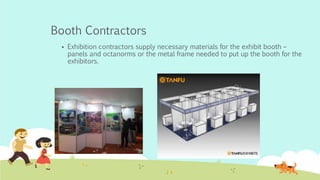
Booth Contractors
 Exhibition contractors supply necessary materials for the exhibit booth –
panels and octanorms or the metal frame needed to put up the booth for the
exhibitors.
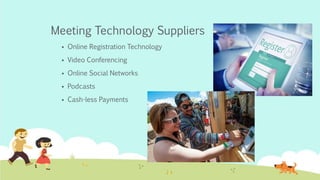
Meeting Technology Suppliers
 Online Registration Technology
 Video Conferencing
 Online Social Networks
 Podcasts
 Cash-less Payments
Security
 Security is one of the important factors considered by
organizers when choosing a venue and planning for an
event.
 Event venues have their own safety measures installed
and their own security personnel. However, it is
advisable to contract the services of a security
company to provide additional event security guards.
Manpower Agencies
 Additional manpower may be required for an event such as
registration staff, marshals/ushers, telemarketers,
encoders, interpreters/translators; extra waiters,
messengers, and janitorial staff.
 These positions may not necessarily be permanent but still
are needed; thus the organizer may employ or contract
such additional services temporarily.
 On-the-job trainees (OJTs) form universities are
sometimes tapped to perform these duties.
Procurement
 Procurement is the jargon for “purchasing” something form a supplier.
 You can do this through shopping or “bidding.” Bidding is a process wherein
you announce the details of what you need, which can either be goods or
services, and interested suppliers will give you an offer.
 Usually the cheapest offer is accepted, as long as it satisfies the
specifications indicated in your announcement.
Industry Regulators
 Some associations regulate the staging of events in
order to maintain certain standards. They do
studies and train their members to improve the
service that the members deliver.
 Examples: Union de Faire Internationales (UFI), Bureau
of International Expositions (BIE), Convention and
Visitor Bureaus (CVB), Philippine Tourism Promotions
Board (TPB)
Government’s Role in the Events Industry
1. Development of needed infrastructure, particularly relating to access
2. Peace and order
3. Creation of policies and incentives
4. Destination management services
The End.

Lesson 4 cmice

  • 1.
    Events Industry Stakeholders From Events Managementby Eloisa Altez-Romero Presented by: Mervyn Maico Aldana Faculty, SHTM
  • 2.
    Stakeholders  Stakeholders referto the parties who hold a stake or interest in the particular project or industry.  The stakeholders in the events industry can be classified into four major categories:  The professional congress/event managers (PCO)  The community  The service suppliers  Government offices and regulatory bodies
  • 3.
    Stakeholders Community PCO Regulatory Bodies Suppliers External Forcesof Nature and Global Economy External Forces of Nature and Global Economy
  • 4.
    Stakeholders  Notice thatthe PCO has equivalent friction with the community, regulatory bodies, and suppliers; so do the regulatory bodies with PCOs, suppliers, and the community.  There is, however minimal contact between the community and suppliers within the context of events, as suppliers pass through the PCOs to reach the community.  The event is likewise affected by external factors, such as forces of nature, natural calamities, terrorism, global economic downturn/upturn, and political events, among others.
  • 5.
    The Event Manager/Professional CongressOrganizer (PCO)  There are 2 types of Event Managers:  Outsourced Event Managers  In-house Event Managers
  • 6.
    The Event Manager/Professional CongressOrganizer (PCO)  Outsourced Event Managers – event management companies or individuals (also known as PCOs) that organize events on a per contract basis on behalf of their clients.  PCOs are independent event managers, professionally knowledgeable in their own fields of specialization who bring the know-how, coupled with a database of contacts needed in various stages of event organizing.  They are entrepreneurs.
  • 7.
    The Event Manager/Professional CongressOrganizer (PCO)  In-house Event Managers – positions or departments within an organization that is not into the business of event management but requires its own group of event managers or coordinators due to the volume of special events that the company has, such as executive meetings, strategic planning, team building, trainings, incentive events for the sales team, and product launches.  In-house event managers may either be employed by corporations or associations.  Examples: hotel’s banquet managers, marketing department of an company
  • 8.
    The Community  Thecommunity represents both the target market and the people living in and around the event destination.  Residents and events destinations receive the impact of event activities, both positive and negative.  They enjoy the resulting economic benefits, job opportunities, and infrastructure developments, but also suffer from environmental and other possible exploitive impacts too.
  • 9.
    The Community  Thetarget market includes exhibitors, visitors, sponsors, and other attendees of the event.  They bring in revenues for any profit-oriented event.  They are those whom the organizers attract and try to satisfy.  They are the raison d'être or the main reason for organizing the event.
  • 10.
    Community - Associations Associations fall under the second major stakeholder category or the community, because associations hold a number of events and thus, form a major part of the target market.  An association is a group of individuals or organizations who formed themselves formally to uphold a common interest.
  • 11.
    Community - Associations There are two types of associations:  Trade associations – non-profit organizations whose aim is to meet the needs of for-profit business. Example – Philippine Association of Convention/Exhibition Organizers and Suppliers, Inc. (PACEOS)  Professional associations – non-profit organizations that are not involved with business firms... Organized to assist individuals in the pursuit of their common goals. There are three types:  The first is one that is bound by common personal interests (UP Mountaineers Club, UP Anime Manga Enthusiasts)  The second type is bound by their career (Philippine Nurses Association)  The third type is bound to do community service (Association of Foundations)
  • 12.
    Suppliers  Suppliers referto those who provide the services necessary to organize and execute events properly.
  • 13.
    Suppliers  Venues  Hotels Food and Beverage Suppliers/Caterers  Airlines  Airports  Ground Transportation (Car Rental, Bus or Coach Service)  Ground Handlers (Travel Agencies, Tour Operators, Spouse Programs)  Freight Forwarders  Audiovisual/Meeting Technology Suppliers  Security  Manpower Agencies  Photography, Documentation, and Transcription Services  Advertising agencies, PR companies, printers, providers of corporate premiums, and other promotional materials
  • 14.
    Venues  Venues arefacilities where events are held.  Venues may be free-standing or attached to other facilities, like ballroom or event spaces located within shopping malls.
  • 15.
    Hotels  Hotels provideguests a comfortable place to sleep in and other services in which the guests will need during their stay.  Additionally, hotels play an important role in events as they provide not only accommodations but also meeting rooms or spaces for events.
  • 16.
    Food and BeverageSuppliers  A restaurant is an establishment that provides meals to the public for a fee.  A caterer provides the same service except that the service may be outside the restaurant premises.  The taste, service, and cost are major considerations in choosing the F&B supplier for an event.
  • 17.
    Airlines  Airlines playan important role in transporting people and goods essential to make the events industry tick, especially for international events.  The number of seats going to and from a destination contributes to the viability to compete as an event destination.
  • 18.
    Airports  First impressionslast.  Airports have the responsibility of making a good first impression for international participants.  Airports are doors into a country and provide visitors with the first taste of the country’s culture.  Welcome traditions can also be done at airports such as sampaguita leis, rondalla, or welcome dances.
  • 19.
    Transportation Suppliers  Movementof goods and people are an integral part of events, hence providers of transportation services are important suppliers as well.  Cruise liner  Train  Tour bus/coach  Ferry/local water based transport  Car rentals  Manually operated vehicles  Others – unique modes of transportation
  • 20.
    Ground handlers  Groundhandlers are travel agencies and tour operators which assist event organizers for the tours and travel arrangements for event participants.
  • 21.
    Freight Forwarders  Freightforwarders’ main role in events is to bring goods for the exhibit or for use in a conference from their point of origin to the event venue in good condition and in time for the event.
  • 22.
    Booth Contractors  Exhibitioncontractors supply necessary materials for the exhibit booth – panels and octanorms or the metal frame needed to put up the booth for the exhibitors.
  • 23.
    Meeting Technology Suppliers Online Registration Technology  Video Conferencing  Online Social Networks  Podcasts  Cash-less Payments
  • 24.
    Security  Security isone of the important factors considered by organizers when choosing a venue and planning for an event.  Event venues have their own safety measures installed and their own security personnel. However, it is advisable to contract the services of a security company to provide additional event security guards.
  • 25.
    Manpower Agencies  Additionalmanpower may be required for an event such as registration staff, marshals/ushers, telemarketers, encoders, interpreters/translators; extra waiters, messengers, and janitorial staff.  These positions may not necessarily be permanent but still are needed; thus the organizer may employ or contract such additional services temporarily.  On-the-job trainees (OJTs) form universities are sometimes tapped to perform these duties.
  • 26.
    Procurement  Procurement isthe jargon for “purchasing” something form a supplier.  You can do this through shopping or “bidding.” Bidding is a process wherein you announce the details of what you need, which can either be goods or services, and interested suppliers will give you an offer.  Usually the cheapest offer is accepted, as long as it satisfies the specifications indicated in your announcement.
  • 27.
    Industry Regulators  Someassociations regulate the staging of events in order to maintain certain standards. They do studies and train their members to improve the service that the members deliver.  Examples: Union de Faire Internationales (UFI), Bureau of International Expositions (BIE), Convention and Visitor Bureaus (CVB), Philippine Tourism Promotions Board (TPB)
  • 28.
    Government’s Role inthe Events Industry 1. Development of needed infrastructure, particularly relating to access 2. Peace and order 3. Creation of policies and incentives 4. Destination management services
  • 29.