1- Pliability, for ease of handling
2- Knot security
3- must be sterilized
4- Appropriate elasticity
5- Nonreactivity
6- Adequate tensile strength for wound
healing
7- Chemical biodegradability as opposed to
foreign body breakdown
8-Non allergic
9-Non carcinogenic
10-Not favour bacterial growth
1. To bring tissue edges together and speed
wound healing (=tissue apposition)
2. Orthopedic surgery to help stabilize joints
 Repair ligaments
3. Ligate vessels or tissues
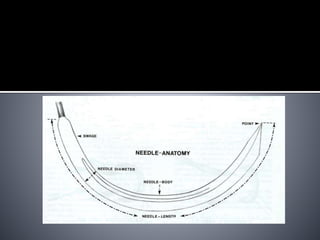
The surgical needle has a basic design
composed of three parts
 1-The eye which is swaged and permits the suture
and needle to act as a single unit to decrease
trauma
 2-The body which is the widest point of the
needle and is also referred to as the
grasping area
 3-The point which runs from the tip to the
maximum cross-sectional area of the body
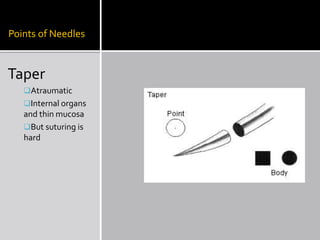
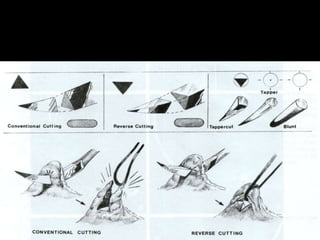
Points of Needles
Taper
Atraumatic
Internal organs
and thin mucosa
But suturing is
hard
Points of
Needles
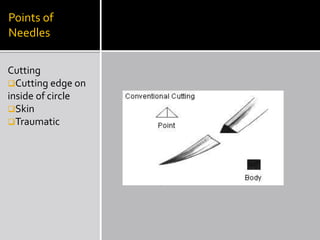
Cutting
Cutting edge on
inside of circle
Skin
Traumatic
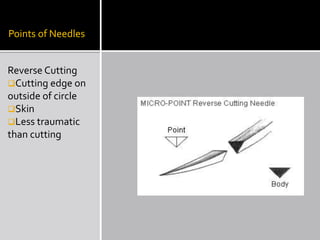
Points of Needles
Reverse Cutting
Cutting edge on
outside of circle
Skin
Less traumatic
than cutting
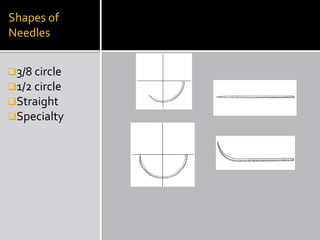
Shapes of
Needles
3/8 circle
1/2 circle
Straight
Specialty
 AbsorbableVs. Nonabsorbable
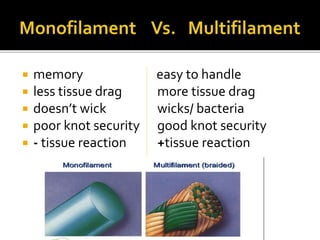
 MonofilamentVs. Multifilament
 Natural or Synthetic
 less tissue-reactive and therefore leave less
scarring as long as they are removed in a
timely fashion
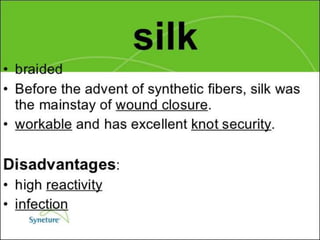
I. Natural : silk
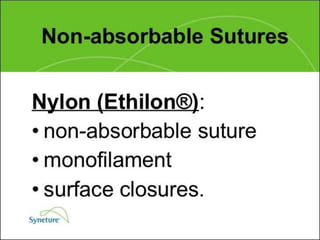
II. Synthetic : nylon, prolene, polyester, s.s
 Primarily Skin
 Ligation of BVs.
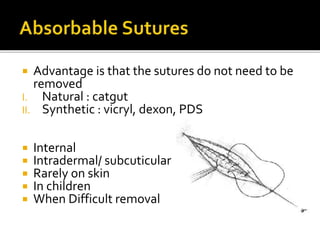
 Advantage is that the sutures do not need to be
removed
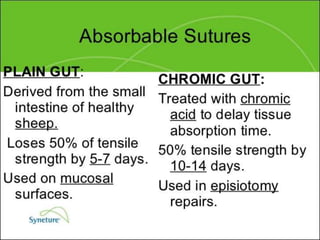
I. Natural : catgut
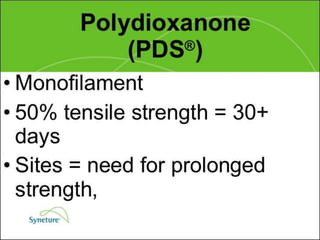
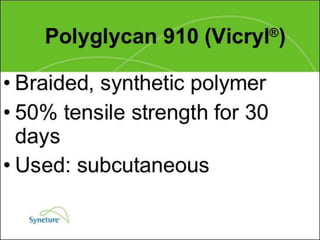
II. Synthetic : vicryl, dexon, PDS
 Internal
 Intradermal/ subcuticular
 Rarely on skin
 In children
 When Difficult removal
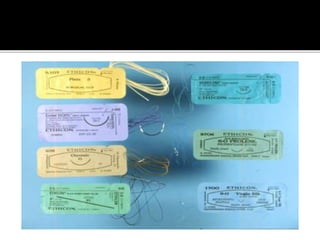
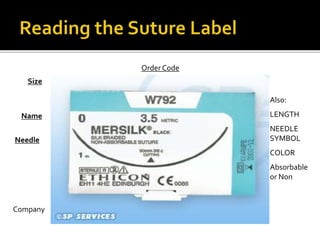
Also:
LENGTH
NEEDLE
SYMBOL
COLOR
Absorbable
or Non
Order Code
Size
Name
Needle
Company
 memory easy to handle
 less tissue drag more tissue drag
 doesn’t wick wicks/ bacteria
 poor knot security good knot security
 - tissue reaction +tissue reaction
Suture Knot
Tensile Tissue Tensile Ease of
Suture Raw Material Absorption Strength Reaction StrengthType Uses Handing
Plain gut Collagen from Digested + Moderate + + + Plain Rapidly +
healthy by body (Least) + + + + healing
mammals enzymes mucosa
within avoid
70 days suture
removal
Chromic Collagen from Digested + Moderate + + + Chromic As above +
healthy by body but less Slower
mammals enzymes than plain absorption
treated with within gut
chromic salts + + + +
Suture Knot
Tensile Tissue Tensile Ease of
Suture Raw Material Absorption Strength Reaction StrengthType Uses Handing
Coated Copolymer of Hydrolysis + + + Mild + + Braided Subepi- + + + +
Vicryl lactide and 56-70 days + + coated elial
(Polyglactin glycolide Mucosal
910) coated with surfaces
polyglactin Vessel
370 and ligation
calcium All types
stearate of general
closure
PDS Polyester Slow + + + + Slight + + Mono- Absorbable + +
(polydi- polymer hydrolysis + filament suture with
oxanone) 180 - 210 extended
days wound support
Suture Knot
Tensile Tissue Tensile Ease of
Suture Raw Material Absorption Strength Reaction StrengthType Uses Handing
Dexon Homopolymer slow + + + Mild + + Braided subepith- + + +
(polygly- of glycolic hydrolysis + + coated elial
colic acid coated after 60 - sutures
acid) with 90 days Mucosal + + + +
polaxamer surfaces
188 Vessel
ligation
Surgical Natural Usually + + Moderate + Braided Mucosal + + + +
silk protein cannot be + + + + (least) surfaces
fiber of raw found after
silk.Treated 2 years
with silicon
protein or wax
Suture Knot
Tensile Tissue Tensile Ease of
Suture Raw Material Absorption Strength Reaction StrengthType Uses Handing
Nylon Polyamide Degrades at + + + Extremely + + Mono- Skin + +
Duralon polymer a rate of 15- low filament closure
Ethilon 20%per year 0 - +
Nylon Polyamide Degrades at + + + Extremely + + Braided Skin + + + +
Nurolon polymer a rate of 15- low closure
Surgilon 20%per year 0 - + Mucosal
surfaces
Polyester Polyester Nonabsorbable + + + Minimal + + + Braided Cardiova- + + +
Mersilene Polvethylene + scular and
Dacron Terephthalate plastic
Ethibond surgery
General
surgery
Suture Knot
Tensile Tissue Tensile Ease of
Suture Raw Material Absorption Strength Reaction StrengthType Uses Handing
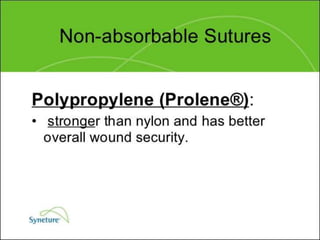
Prolene Polymer of Nonabsorbale + + + Minimal+ + + Mono- General, + +
(polypro- propylene transient filament plastic,
pylene) acute cardiova-
reaction scular, skin
opthalmology
Gor-Tex Expanded Nonabsorbale + + + Extremely + + Mono- AllTypes + + + +
polytetrafluoro- low filament of soft-
ethylene 0 - + tissue
approxi-
mation &
cardiova-
scular
surgery
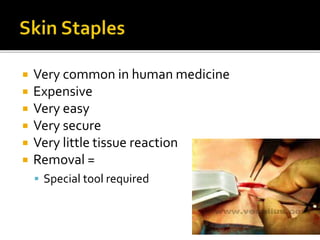
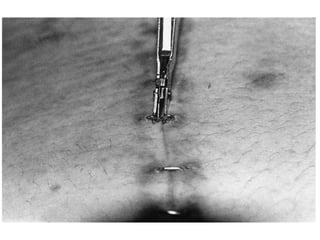
 Very common in human medicine
 Expensive
 Very easy
 Very secure
 Very little tissue reaction
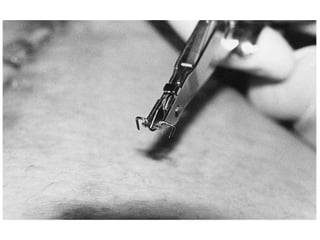
 Removal =
 Special tool required
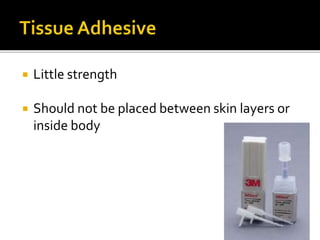
 Little strength
 Should not be placed between skin layers or
inside body
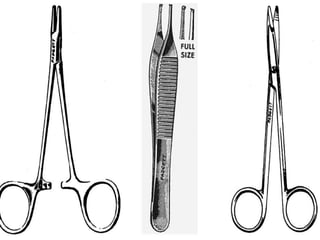
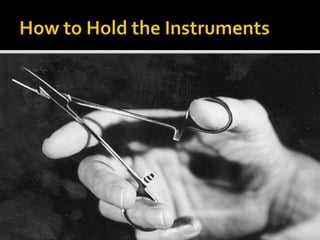
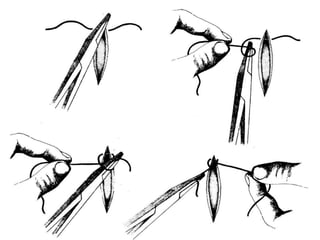
 Needle holder: used to grab onto the
suture needle
 Forceps: used to hold the tissues gently
and to grab the needle
 Suture scissors: used to cut the stitch from
the rest of the suture material
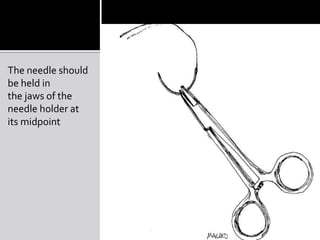
The needle should
be held in
the jaws of the
needle holder at
its midpoint
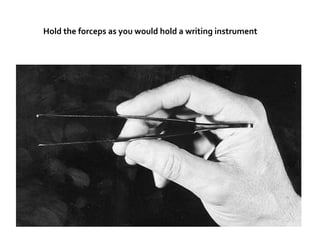
Hold the forceps as you would hold a writing instrument
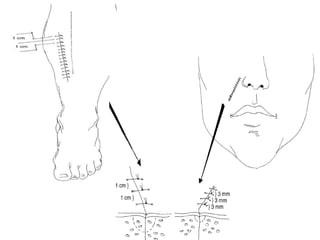
 Sutures placed on the face should be
approximately 2–3 mm from the skin edge
and 3–5 mm apart. Sutures placed elsewhere
on the body should be approximately 3–4 mm
from the skin edge and 5–10 mm apart.
 Start on the side of the wound opposite and
farthest from you to ensure that you are
always sewing toward yourself.
1- Force should always be applied in the
direction that follows the curvature of the
needle
2- Suturing should always be from movable
to a nonmovable tissue
3- Avoid excessive tissue bites with small
needle as it will be difficult to retrieve them
4- Use only sharp needles with minimal force.
Replace dull needles
5- Never force the needle through the tissue
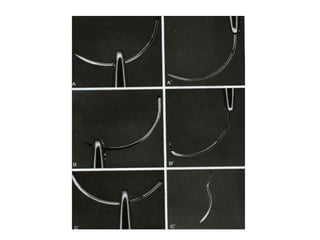
6- Grasp the needle in the body one-quarter
to one-half of the length from the swaged
area. Do not hold the swaged area; this
may bend or break the needle. Do not
grasp the point area as damage or notching
may result.
7- Avoid retrieving the needle from the tissue
by the tip. This will damage or dull the
needle
8- Suture should be placed in keratinized
tissue whenever possible
9- An adequate tissue bite is required to
prevent the flap from tearing
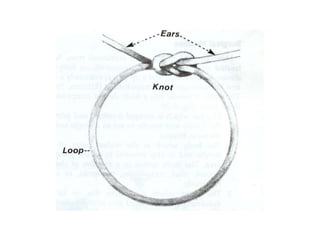
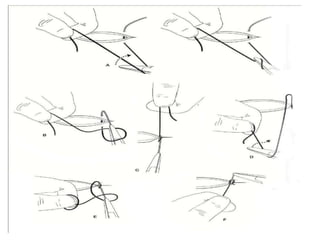
 A suture knot has three components
1-The loop created by the knot
2-The knot itself, which is composed of a
number of tight “throws”, each throw
represents a weave of the two stands
3-The ears, which are the cut ends of the
suture
 Generally 4 “throws” for >90% knot security
(nylon may need 5)
 Less “throws” = more likely to untie itself
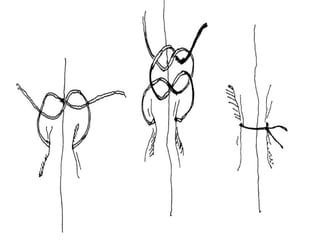
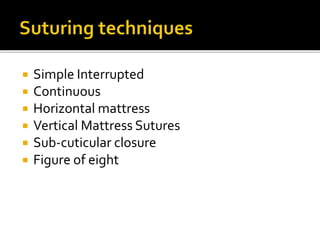
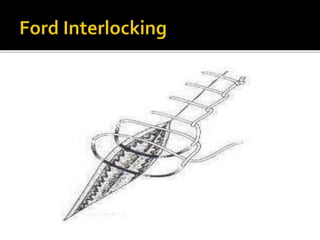
 Simple Interrupted
 Continuous
 Horizontal mattress
 Vertical Mattress Sutures
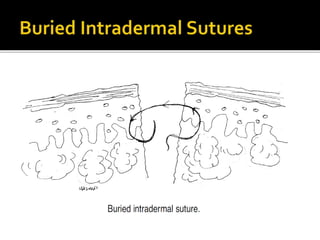
 Sub-cuticular closure
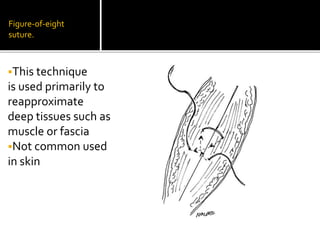
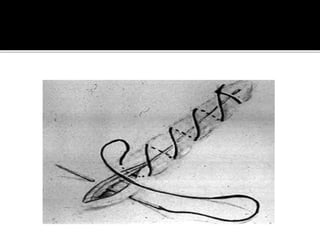
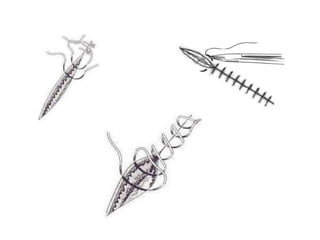
 Figure of eight
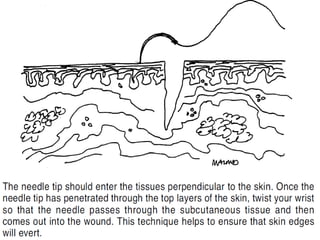
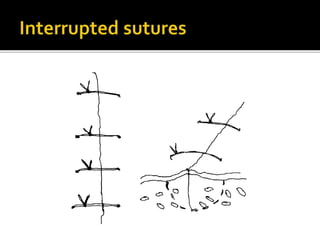
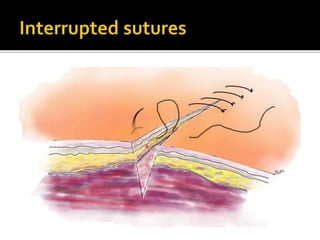
 used for simple laceration closures or closure of
office procedures like biopsies or lesion
removals.
 Interrupted sutures can be used in all areas but
may take longer to place than a continuous
suture
 They are the technique of choice if you are
worried about the cleanliness of the wound.
 If the wound looks like it is becoming infected, a
few sutures can be removed easily without
disrupting the entire closure
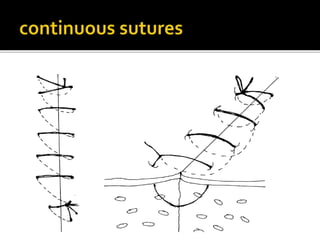
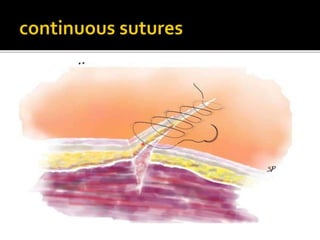
 Place the sutures again and again without
tying each individual suture.
 If the wound is very clean and it is easy to
bring the edges together, a continuous
closure is adequate and quicker to perform.
 Continuous closure is the technique of choice
to help stop bleeding from the skin edges,
which is important, for example, in a scalp
laceration.
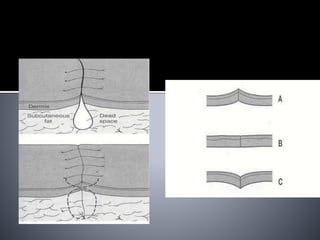
 Mattress sutures are a good choice when the
skin edges are difficult to evert
 It is a bit more technically challenging to
place mattress sutures, but it is often worth
the effort because good dermis-to-dermis
contact is achieved
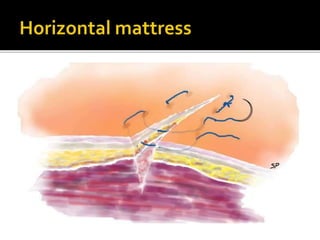
• Used with wounds with poor circulation
• Helps eliminate tension on wound edges
• Requires fewer sutures to close a wound
• Can be placed quite quickly
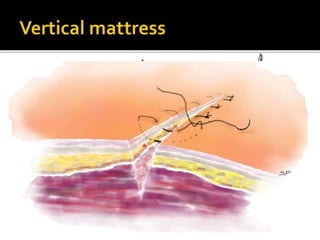
• Deep and shallow approximation of the tissue
• Can be used for wounds under tension.
• Can be useful with lax tissue e.g. elbow and
knee.
• Should not be used on the face because of
blind placement of the deep part of the
suture
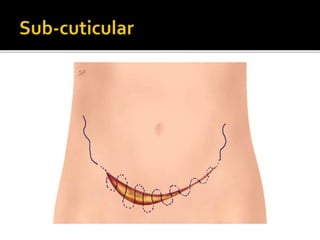
• Used for cosmetic closures
• Use an absorbable suture if you plan to leave
the sutures in and bury the knots
• Use either nylon or prolene (best) and keep
the suture sliding while you are closing. The
suture then can be easily removed with no
exterior marks. The ends can be taped or a
knot on the skin.
 Indication:This technique is useful for wide,
gaping wounds and when it is difficult to
evert the skin edges
Figure-of-eight
suture.
This technique
is used primarily to
reapproximate
deep tissues such as
muscle or fascia
Not common used
in skin
1-The area should be swabbed with
hydrogen peroxide for removal of
encrusted necrotic debris, blood, and
serum from about the sutures
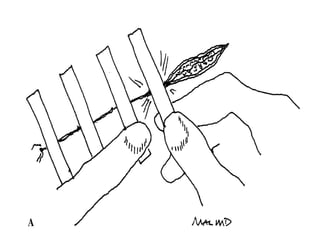
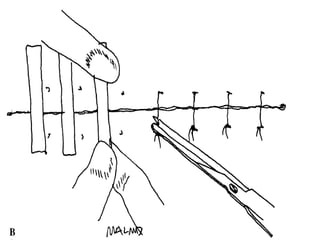
2- A sharp suture scissors should be used to
cut the loops of individual or continuous
sutures about the teeth
3- It is often helpful to use a No. 23 explorer
to help lift the sutures if they are within the
sulcus or in close opposition to the tissue
4- A cotton pliers is used to remove the
suture. The location of the knots should be
noted so that they can be removed first.
This will prevent unnecessary entrapment
under the flap
 Suture should be removed in 7 to 10 days to
prevent epithelialization or wicking about
the suture
Suture materials and techniques

Suture materials and techniques

  • 2.
    1- Pliability, forease of handling 2- Knot security 3- must be sterilized 4- Appropriate elasticity 5- Nonreactivity 6- Adequate tensile strength for wound healing 7- Chemical biodegradability as opposed to foreign body breakdown
  • 3.
  • 4.
    1. To bringtissue edges together and speed wound healing (=tissue apposition) 2. Orthopedic surgery to help stabilize joints  Repair ligaments 3. Ligate vessels or tissues
  • 5.
    The surgical needlehas a basic design composed of three parts  1-The eye which is swaged and permits the suture and needle to act as a single unit to decrease trauma  2-The body which is the widest point of the needle and is also referred to as the grasping area  3-The point which runs from the tip to the maximum cross-sectional area of the body
  • 7.
    Points of Needles Taper Atraumatic Internalorgans and thin mucosa But suturing is hard
  • 8.
    Points of Needles Cutting Cutting edgeon inside of circle Skin Traumatic
  • 9.
    Points of Needles ReverseCutting Cutting edge on outside of circle Skin Less traumatic than cutting
  • 11.
    Shapes of Needles 3/8 circle 1/2circle Straight Specialty
  • 12.
     AbsorbableVs. Nonabsorbable MonofilamentVs. Multifilament  Natural or Synthetic
  • 13.
     less tissue-reactiveand therefore leave less scarring as long as they are removed in a timely fashion I. Natural : silk II. Synthetic : nylon, prolene, polyester, s.s  Primarily Skin  Ligation of BVs.
  • 14.
     Advantage isthat the sutures do not need to be removed I. Natural : catgut II. Synthetic : vicryl, dexon, PDS  Internal  Intradermal/ subcuticular  Rarely on skin  In children  When Difficult removal
  • 16.
  • 17.
     memory easyto handle  less tissue drag more tissue drag  doesn’t wick wicks/ bacteria  poor knot security good knot security  - tissue reaction +tissue reaction
  • 18.
    Suture Knot Tensile TissueTensile Ease of Suture Raw Material Absorption Strength Reaction StrengthType Uses Handing Plain gut Collagen from Digested + Moderate + + + Plain Rapidly + healthy by body (Least) + + + + healing mammals enzymes mucosa within avoid 70 days suture removal Chromic Collagen from Digested + Moderate + + + Chromic As above + healthy by body but less Slower mammals enzymes than plain absorption treated with within gut chromic salts + + + +
  • 19.
    Suture Knot Tensile TissueTensile Ease of Suture Raw Material Absorption Strength Reaction StrengthType Uses Handing Coated Copolymer of Hydrolysis + + + Mild + + Braided Subepi- + + + + Vicryl lactide and 56-70 days + + coated elial (Polyglactin glycolide Mucosal 910) coated with surfaces polyglactin Vessel 370 and ligation calcium All types stearate of general closure PDS Polyester Slow + + + + Slight + + Mono- Absorbable + + (polydi- polymer hydrolysis + filament suture with oxanone) 180 - 210 extended days wound support
  • 20.
    Suture Knot Tensile TissueTensile Ease of Suture Raw Material Absorption Strength Reaction StrengthType Uses Handing Dexon Homopolymer slow + + + Mild + + Braided subepith- + + + (polygly- of glycolic hydrolysis + + coated elial colic acid coated after 60 - sutures acid) with 90 days Mucosal + + + + polaxamer surfaces 188 Vessel ligation Surgical Natural Usually + + Moderate + Braided Mucosal + + + + silk protein cannot be + + + + (least) surfaces fiber of raw found after silk.Treated 2 years with silicon protein or wax
  • 21.
    Suture Knot Tensile TissueTensile Ease of Suture Raw Material Absorption Strength Reaction StrengthType Uses Handing Nylon Polyamide Degrades at + + + Extremely + + Mono- Skin + + Duralon polymer a rate of 15- low filament closure Ethilon 20%per year 0 - + Nylon Polyamide Degrades at + + + Extremely + + Braided Skin + + + + Nurolon polymer a rate of 15- low closure Surgilon 20%per year 0 - + Mucosal surfaces Polyester Polyester Nonabsorbable + + + Minimal + + + Braided Cardiova- + + + Mersilene Polvethylene + scular and Dacron Terephthalate plastic Ethibond surgery General surgery
  • 23.
    Suture Knot Tensile TissueTensile Ease of Suture Raw Material Absorption Strength Reaction StrengthType Uses Handing Prolene Polymer of Nonabsorbale + + + Minimal+ + + Mono- General, + + (polypro- propylene transient filament plastic, pylene) acute cardiova- reaction scular, skin opthalmology Gor-Tex Expanded Nonabsorbale + + + Extremely + + Mono- AllTypes + + + + polytetrafluoro- low filament of soft- ethylene 0 - + tissue approxi- mation & cardiova- scular surgery
  • 26.
     Very commonin human medicine  Expensive  Very easy  Very secure  Very little tissue reaction  Removal =  Special tool required
  • 29.
     Little strength Should not be placed between skin layers or inside body
  • 30.
     Needle holder:used to grab onto the suture needle  Forceps: used to hold the tissues gently and to grab the needle  Suture scissors: used to cut the stitch from the rest of the suture material
  • 33.
    The needle should beheld in the jaws of the needle holder at its midpoint
  • 35.
    Hold the forcepsas you would hold a writing instrument
  • 36.
     Sutures placedon the face should be approximately 2–3 mm from the skin edge and 3–5 mm apart. Sutures placed elsewhere on the body should be approximately 3–4 mm from the skin edge and 5–10 mm apart.
  • 38.
     Start onthe side of the wound opposite and farthest from you to ensure that you are always sewing toward yourself.
  • 39.
    1- Force shouldalways be applied in the direction that follows the curvature of the needle 2- Suturing should always be from movable to a nonmovable tissue 3- Avoid excessive tissue bites with small needle as it will be difficult to retrieve them
  • 40.
    4- Use onlysharp needles with minimal force. Replace dull needles 5- Never force the needle through the tissue 6- Grasp the needle in the body one-quarter to one-half of the length from the swaged area. Do not hold the swaged area; this may bend or break the needle. Do not grasp the point area as damage or notching may result.
  • 41.
    7- Avoid retrievingthe needle from the tissue by the tip. This will damage or dull the needle 8- Suture should be placed in keratinized tissue whenever possible 9- An adequate tissue bite is required to prevent the flap from tearing
  • 42.
     A sutureknot has three components 1-The loop created by the knot 2-The knot itself, which is composed of a number of tight “throws”, each throw represents a weave of the two stands 3-The ears, which are the cut ends of the suture
  • 44.
     Generally 4“throws” for >90% knot security (nylon may need 5)  Less “throws” = more likely to untie itself
  • 49.
     Simple Interrupted Continuous  Horizontal mattress  Vertical Mattress Sutures  Sub-cuticular closure  Figure of eight
  • 52.
     used forsimple laceration closures or closure of office procedures like biopsies or lesion removals.  Interrupted sutures can be used in all areas but may take longer to place than a continuous suture  They are the technique of choice if you are worried about the cleanliness of the wound.  If the wound looks like it is becoming infected, a few sutures can be removed easily without disrupting the entire closure
  • 55.
     Place thesutures again and again without tying each individual suture.  If the wound is very clean and it is easy to bring the edges together, a continuous closure is adequate and quicker to perform.  Continuous closure is the technique of choice to help stop bleeding from the skin edges, which is important, for example, in a scalp laceration.
  • 56.
     Mattress suturesare a good choice when the skin edges are difficult to evert  It is a bit more technically challenging to place mattress sutures, but it is often worth the effort because good dermis-to-dermis contact is achieved
  • 58.
    • Used withwounds with poor circulation • Helps eliminate tension on wound edges • Requires fewer sutures to close a wound • Can be placed quite quickly
  • 60.
    • Deep andshallow approximation of the tissue • Can be used for wounds under tension. • Can be useful with lax tissue e.g. elbow and knee. • Should not be used on the face because of blind placement of the deep part of the suture
  • 62.
    • Used forcosmetic closures • Use an absorbable suture if you plan to leave the sutures in and bury the knots • Use either nylon or prolene (best) and keep the suture sliding while you are closing. The suture then can be easily removed with no exterior marks. The ends can be taped or a knot on the skin.
  • 64.
     Indication:This techniqueis useful for wide, gaping wounds and when it is difficult to evert the skin edges
  • 65.
    Figure-of-eight suture. This technique is usedprimarily to reapproximate deep tissues such as muscle or fascia Not common used in skin
  • 70.
    1-The area shouldbe swabbed with hydrogen peroxide for removal of encrusted necrotic debris, blood, and serum from about the sutures 2- A sharp suture scissors should be used to cut the loops of individual or continuous sutures about the teeth
  • 71.
    3- It isoften helpful to use a No. 23 explorer to help lift the sutures if they are within the sulcus or in close opposition to the tissue 4- A cotton pliers is used to remove the suture. The location of the knots should be noted so that they can be removed first. This will prevent unnecessary entrapment under the flap
  • 72.
     Suture shouldbe removed in 7 to 10 days to prevent epithelialization or wicking about the suture