© 2009 NHS National Genetics Education and Development Centre Genetics and Genomics for Healthcare
www.geneticseducation.nhs.uk
Somatic Mutations in Cancer
This PowerPoint file contains a number of slides that may be useful for teaching of
genetics concepts.
You may use these slides and their contents for non-commercial educational purposes.
© 2009 NHS National Genetics Education and Development Centre Genetics and Genomics for Healthcare
www.geneticseducation.nhs.uk
Fig. 12.6 ©Scion Publishing Ltd
The relation between sporadic and inherited forms of the same
tumour.
The target tissue contains n cells and the chance of one cell suffering a loss of
function mutation in the tumour suppressor gene is µ.
© 2009 NHS National Genetics Education and Development Centre Genetics and Genomics for Healthcare
www.geneticseducation.nhs.uk
Fig. 12.7 ©Scion Publishing Ltd
Mechanisms in
retinoblastoma.
The initial mutation may be inherited
or somatic.
Mechanisms A, B and D result in loss
of heterozygosity (in B, only for
markers close to the RB locus; in D
only for markers distal to the
crossover).
In Cavenee’s original study, some
tumours duplicated the remaining
copy of chromosome 13 after loss of
the wild-type chromosome by
mechanism A.
© 2009 NHS National Genetics Education and Development Centre Genetics and Genomics for Healthcare
www.geneticseducation.nhs.uk
Fig. 12.15 ©Scion Publishing Ltd
A possible common pathway for the development of colon cancer.
The scheme (see Kinzler and Vogelstein, 19996) summarises the way that some genes are often inactivated in
early lesions, while others are inactivated only in late-stage lesions. There has been some controversy about the
general applicability of this scheme, and there is no suggestion that every colon cancer has developed exactly in
this way.
© 2009 NHS National Genetics Education and Development Centre Genetics and Genomics for Healthcare
www.geneticseducation.nhs.uk
The genetic basis of sporadic cancer
Clone of
cancer
cells
from
this one
cell
Both alleles of a gene become inactivated in a particular somatic cell leading to loss of
control of growth and unchecked cell proliferation.
© 2009 NHS National Genetics Education and Development Centre Genetics and Genomics for Healthcare
www.geneticseducation.nhs.uk
The genetic basis of the dominantly inherited familial cancer
syndromes
Clone of
cancer
cells
from this
one cell
Inherited
altered allele
Second allele of the pair
becomes inactivated
An altered allele is inherited and so is in all body cells containing genetic material. When the
second (previously normal) allele of the gene pair becomes inactivated in a particular somatic cell
this leads to loss of control of growth and unchecked cell proliferation.
© 2009 NHS National Genetics Education and Development Centre Genetics and Genomics for Healthcare
www.geneticseducation.nhs.uk
Mosaicism
* mutation in single gene
* chromosomal anomaly
Mosaicism can be:
• somatic (ie in most body cells) or
• gonadal (confined solely to the gonads).
© 2009 NHS National Genetics Education and Development Centre Genetics and Genomics for Healthcare
www.geneticseducation.nhs.uk
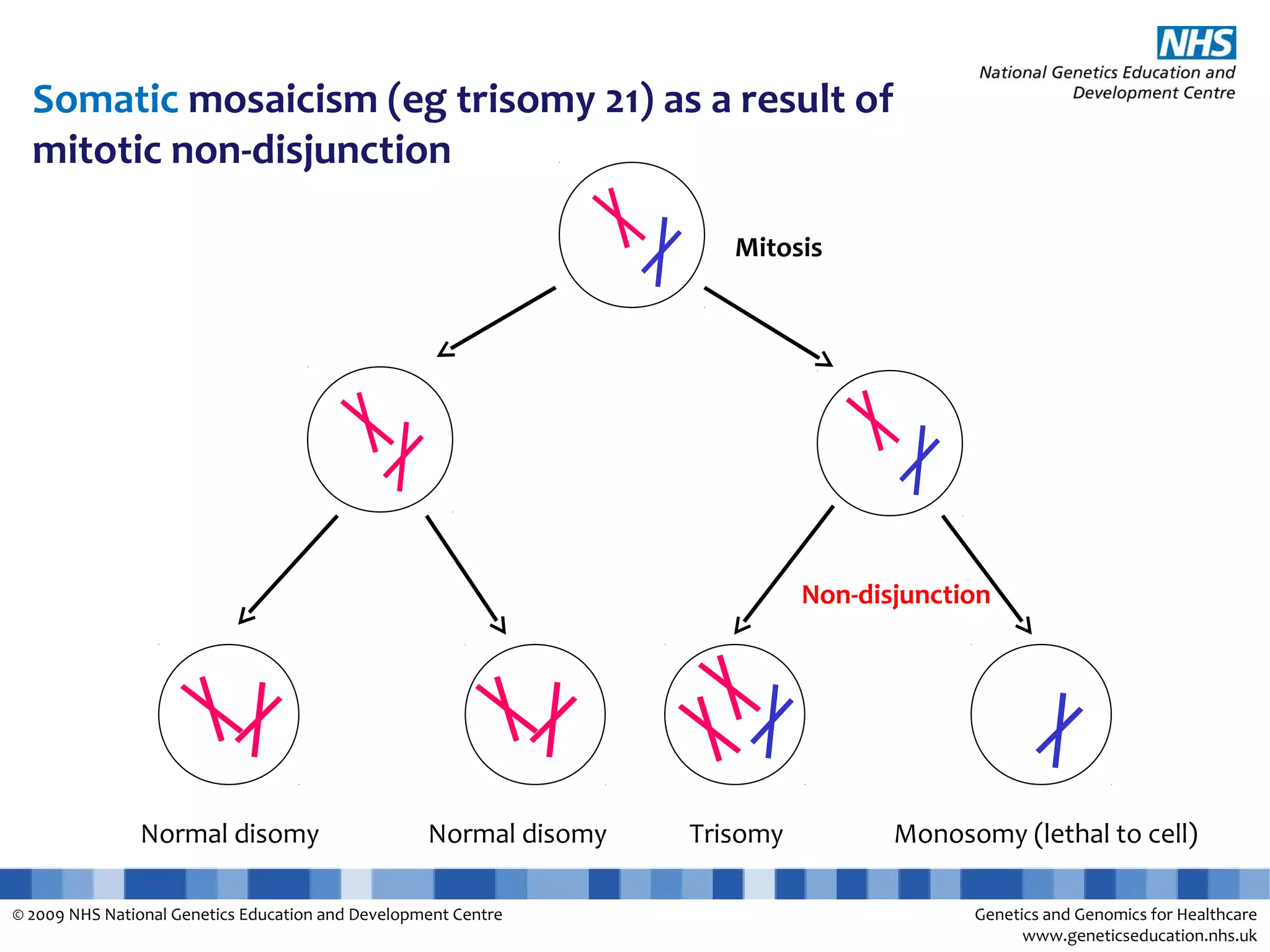
Normal disomy
Mitosis
Non-disjunction
Normal disomy Trisomy Monosomy (lethal to cell)
Somatic mosaicism (eg trisomy 21) as a result of
mitotic non-disjunction

Explanation slides Somatic Mutations cancer

  • 1.
    © 2009 NHSNational Genetics Education and Development Centre Genetics and Genomics for Healthcare www.geneticseducation.nhs.uk Somatic Mutations in Cancer This PowerPoint file contains a number of slides that may be useful for teaching of genetics concepts. You may use these slides and their contents for non-commercial educational purposes.
  • 2.
    © 2009 NHSNational Genetics Education and Development Centre Genetics and Genomics for Healthcare www.geneticseducation.nhs.uk Fig. 12.6 ©Scion Publishing Ltd The relation between sporadic and inherited forms of the same tumour. The target tissue contains n cells and the chance of one cell suffering a loss of function mutation in the tumour suppressor gene is µ.
  • 3.
    © 2009 NHSNational Genetics Education and Development Centre Genetics and Genomics for Healthcare www.geneticseducation.nhs.uk Fig. 12.7 ©Scion Publishing Ltd Mechanisms in retinoblastoma. The initial mutation may be inherited or somatic. Mechanisms A, B and D result in loss of heterozygosity (in B, only for markers close to the RB locus; in D only for markers distal to the crossover). In Cavenee’s original study, some tumours duplicated the remaining copy of chromosome 13 after loss of the wild-type chromosome by mechanism A.
  • 4.
    © 2009 NHSNational Genetics Education and Development Centre Genetics and Genomics for Healthcare www.geneticseducation.nhs.uk Fig. 12.15 ©Scion Publishing Ltd A possible common pathway for the development of colon cancer. The scheme (see Kinzler and Vogelstein, 19996) summarises the way that some genes are often inactivated in early lesions, while others are inactivated only in late-stage lesions. There has been some controversy about the general applicability of this scheme, and there is no suggestion that every colon cancer has developed exactly in this way.
  • 5.
    © 2009 NHSNational Genetics Education and Development Centre Genetics and Genomics for Healthcare www.geneticseducation.nhs.uk The genetic basis of sporadic cancer Clone of cancer cells from this one cell Both alleles of a gene become inactivated in a particular somatic cell leading to loss of control of growth and unchecked cell proliferation.
  • 6.
    © 2009 NHSNational Genetics Education and Development Centre Genetics and Genomics for Healthcare www.geneticseducation.nhs.uk The genetic basis of the dominantly inherited familial cancer syndromes Clone of cancer cells from this one cell Inherited altered allele Second allele of the pair becomes inactivated An altered allele is inherited and so is in all body cells containing genetic material. When the second (previously normal) allele of the gene pair becomes inactivated in a particular somatic cell this leads to loss of control of growth and unchecked cell proliferation.
  • 7.
    © 2009 NHSNational Genetics Education and Development Centre Genetics and Genomics for Healthcare www.geneticseducation.nhs.uk Mosaicism * mutation in single gene * chromosomal anomaly Mosaicism can be: • somatic (ie in most body cells) or • gonadal (confined solely to the gonads).
  • 8.
    © 2009 NHSNational Genetics Education and Development Centre Genetics and Genomics for Healthcare www.geneticseducation.nhs.uk Normal disomy Mitosis Non-disjunction Normal disomy Trisomy Monosomy (lethal to cell) Somatic mosaicism (eg trisomy 21) as a result of mitotic non-disjunction