OSI Model
Md. Mosharof Hosen
Dept.of CSE
OSI Model
7 Layer of OSI Model
Describe ISO Model Layer
Conclusion
Content
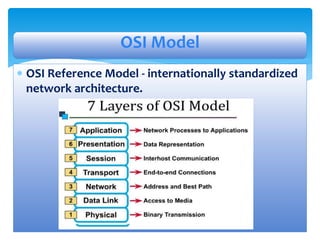
 OSI Reference Model - internationally standardized
network architecture.
OSI Model
 Level at which applications access network
services.
-Represents services that directly support
software applications for file transfers,
database access, and electronic mail etc.
Layer 7: Application Layer
 Related to representation of transmitted data
 Providing services for secure efficient data
transmission
-e.g. data encryption, and data compression.
Layer 6: Presentation Layer
 Allows two applications on different computers
to establish, use, and end a session.
 Establishes dialog control
 Performs token management and
synchronization.
Layer 5: Session Layer
 Manages transmission packets
 Handles error recognition and recovery
-Transport layer at receiving
acknowledges packet delivery.
Layer 4: Transport Layer
 Manages addressing/routing of data within
the subnet
 Routing can be:
Based on static tables
determined at start of each session
Individually determined for each packet,
reflecting the current network load
Layer 3: Network Layer
 Packages raw bits from the Physical layer
into frames
 Provides reliable transmission of frames
Layer 2: Data Link Layer
 Transmits bits from one computer to another
 Regulates the transmission of a stream of
bits over a physical medium.
 Defines how the cable is attached to the
network adapter and what transmission
technique is used to send data over the cable.
Layer 1: Physical Layer
 Overall, this presentation I had tried to
describe the OSI model, what it is all about
and how communication occurs through the
layers of the model from one user to another
.
Conclusion
Thanks to all

Osi model or open system interconnection by MHM

  • 1.
    OSI Model Md. MosharofHosen Dept.of CSE
  • 2.
    OSI Model 7 Layerof OSI Model Describe ISO Model Layer Conclusion Content
  • 3.
     OSI ReferenceModel - internationally standardized network architecture. OSI Model
  • 4.
     Level atwhich applications access network services. -Represents services that directly support software applications for file transfers, database access, and electronic mail etc. Layer 7: Application Layer
  • 5.
     Related torepresentation of transmitted data  Providing services for secure efficient data transmission -e.g. data encryption, and data compression. Layer 6: Presentation Layer
  • 6.
     Allows twoapplications on different computers to establish, use, and end a session.  Establishes dialog control  Performs token management and synchronization. Layer 5: Session Layer
  • 7.
     Manages transmissionpackets  Handles error recognition and recovery -Transport layer at receiving acknowledges packet delivery. Layer 4: Transport Layer
  • 8.
     Manages addressing/routingof data within the subnet  Routing can be: Based on static tables determined at start of each session Individually determined for each packet, reflecting the current network load Layer 3: Network Layer
  • 9.
     Packages rawbits from the Physical layer into frames  Provides reliable transmission of frames Layer 2: Data Link Layer
  • 10.
     Transmits bitsfrom one computer to another  Regulates the transmission of a stream of bits over a physical medium.  Defines how the cable is attached to the network adapter and what transmission technique is used to send data over the cable. Layer 1: Physical Layer
  • 11.
     Overall, thispresentation I had tried to describe the OSI model, what it is all about and how communication occurs through the layers of the model from one user to another . Conclusion
  • 12.