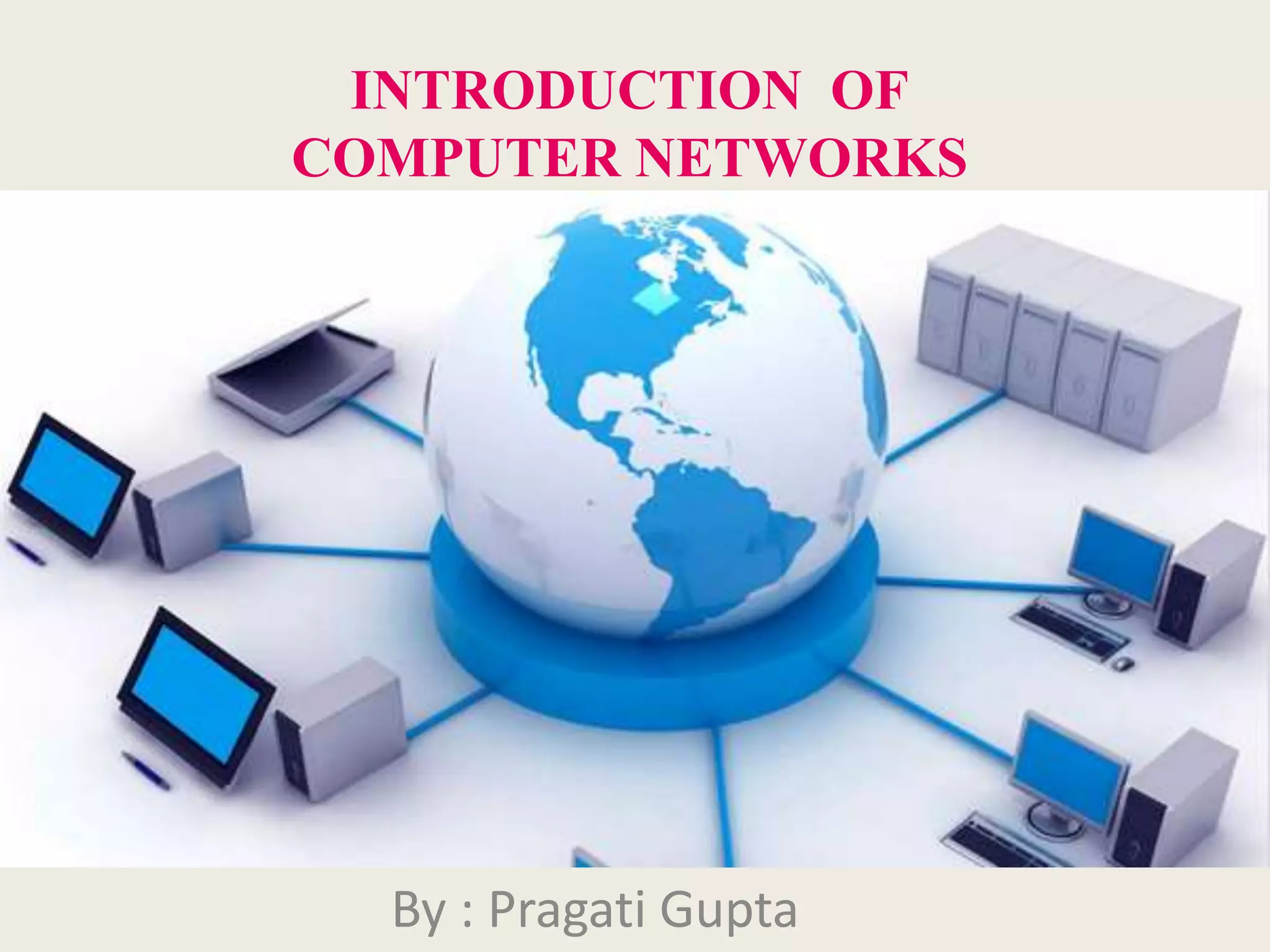
INTRODUCTION OF
COMPUTER NETWORKS
By : Pragati Gupta
Outline:
• Data Communication
• Network
• Topology
• OSI Model
DATA COMMUNICATIONS:
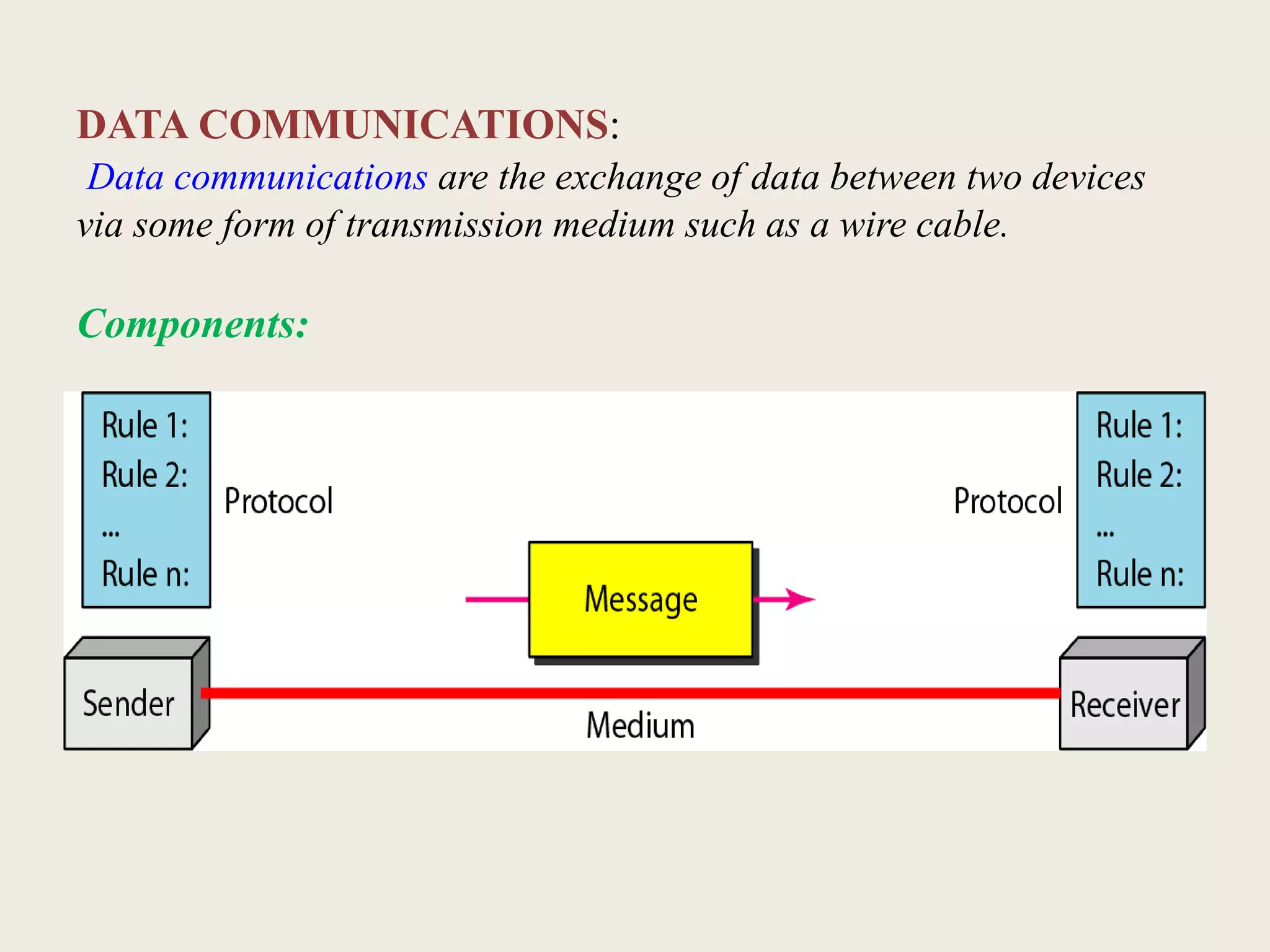
Data communications are the exchange of data between two devices
via some form of transmission medium such as a wire cable.
Components:
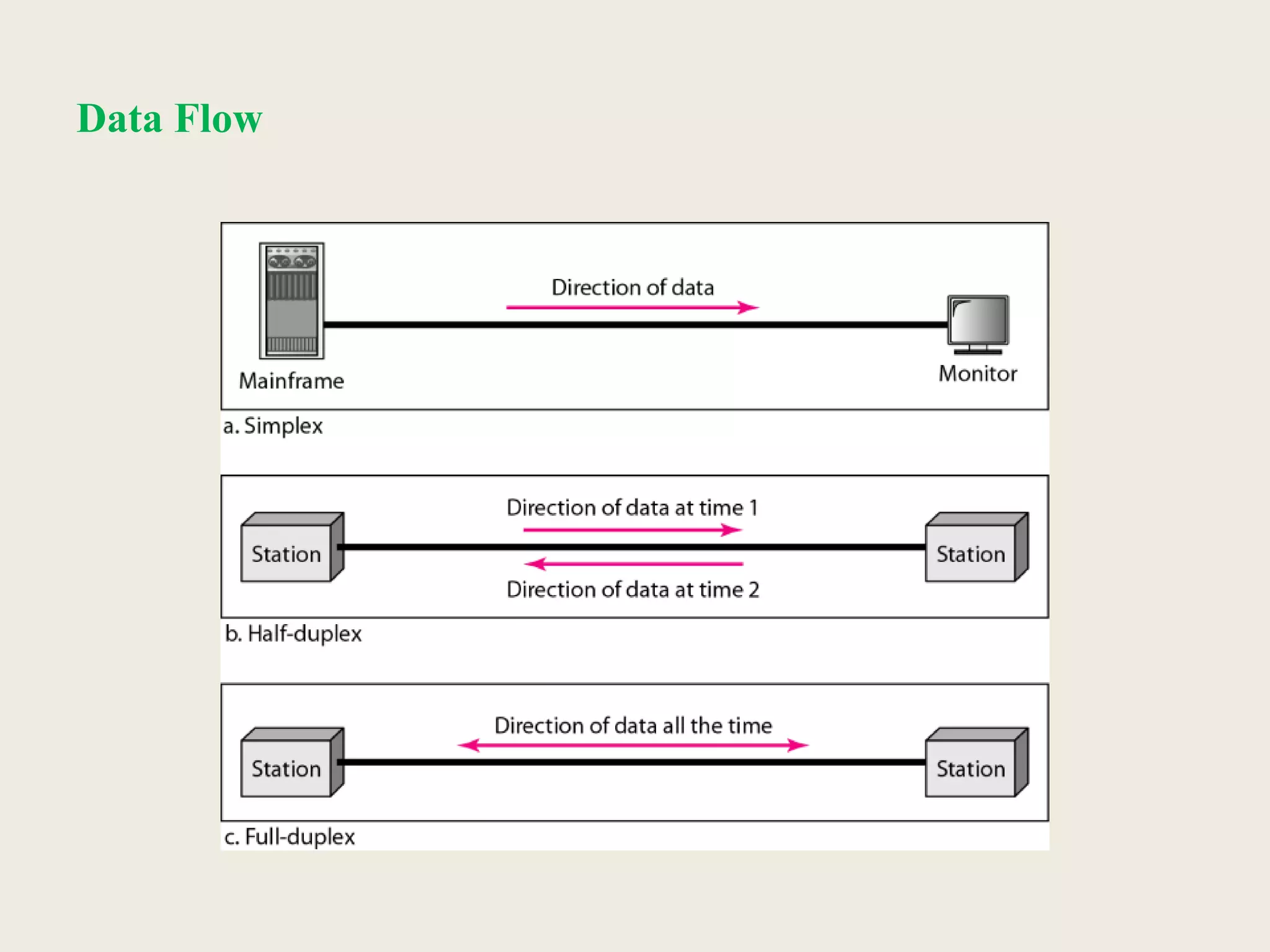
Data Flow
NETWORKS:
A network is a set of devices (often referred to as nodes) connected by
communication links.
Network Criteria:
• Performance (response time)
• Reliability (Frequency of failure)
• Security (Protecting data)
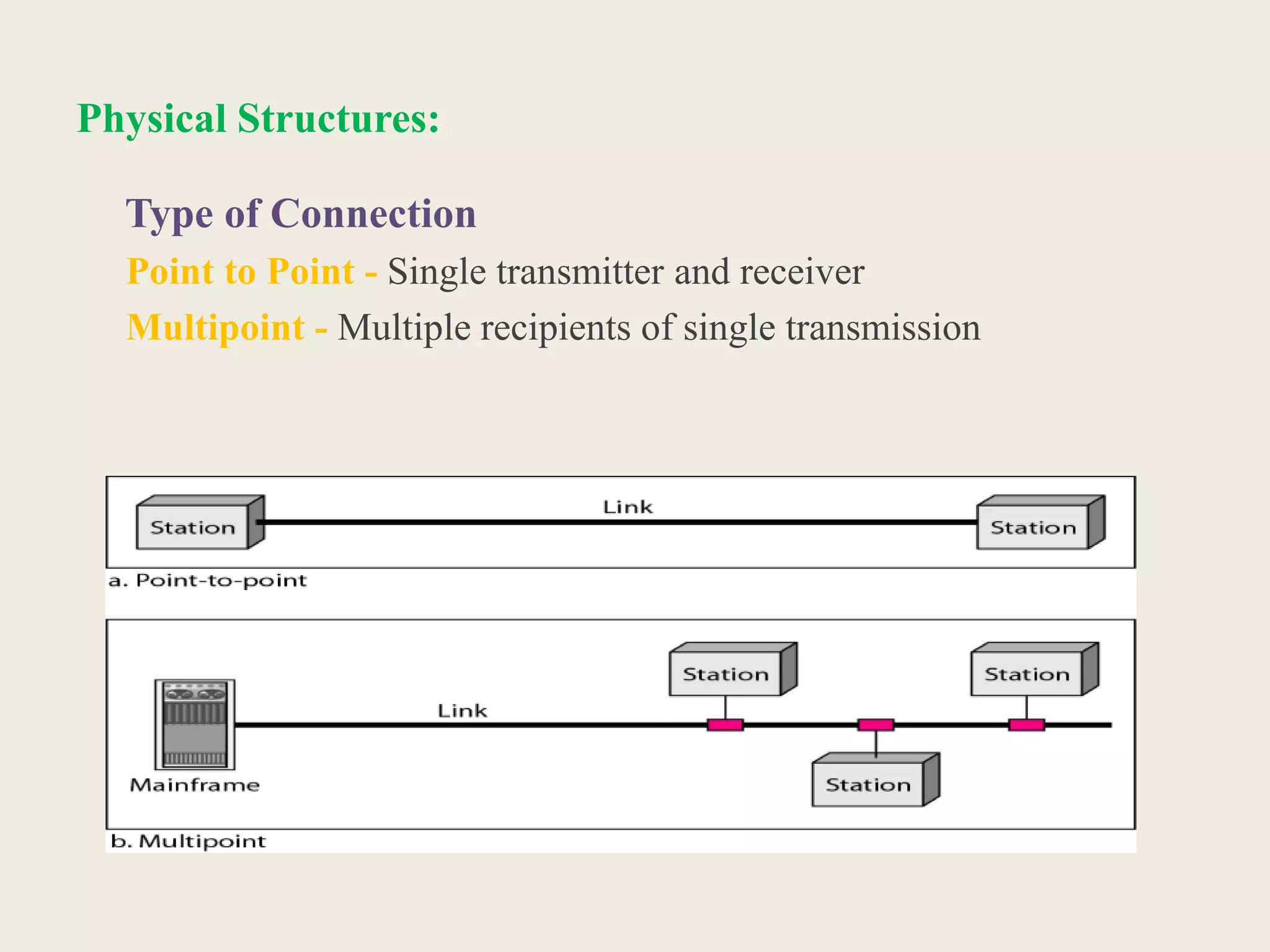
Physical Structures:
Type of Connection
Point to Point - Single transmitter and receiver
Multipoint - Multiple recipients of single transmission
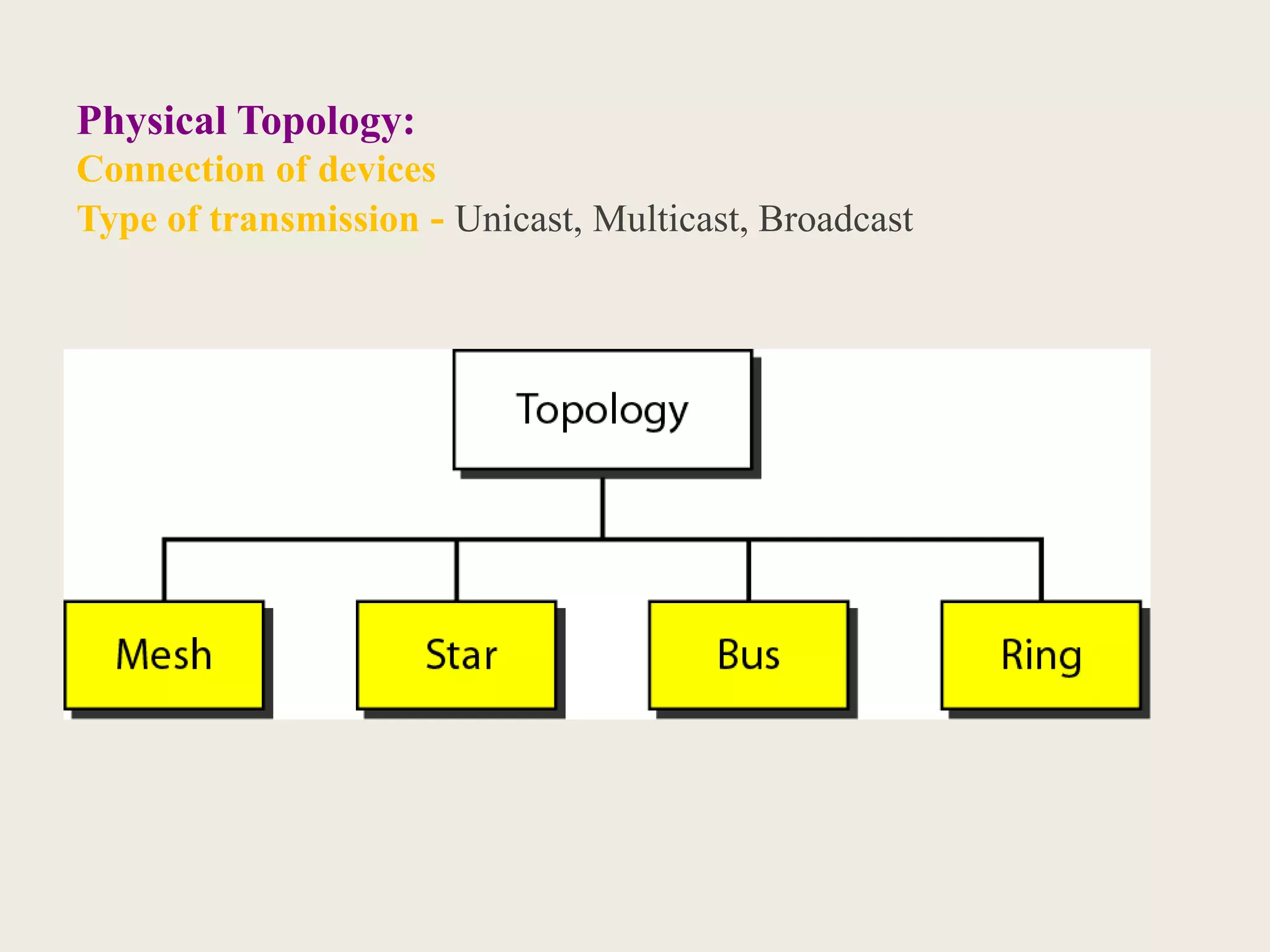
Physical Topology:
Connection of devices
Type of transmission - Unicast, Multicast, Broadcast
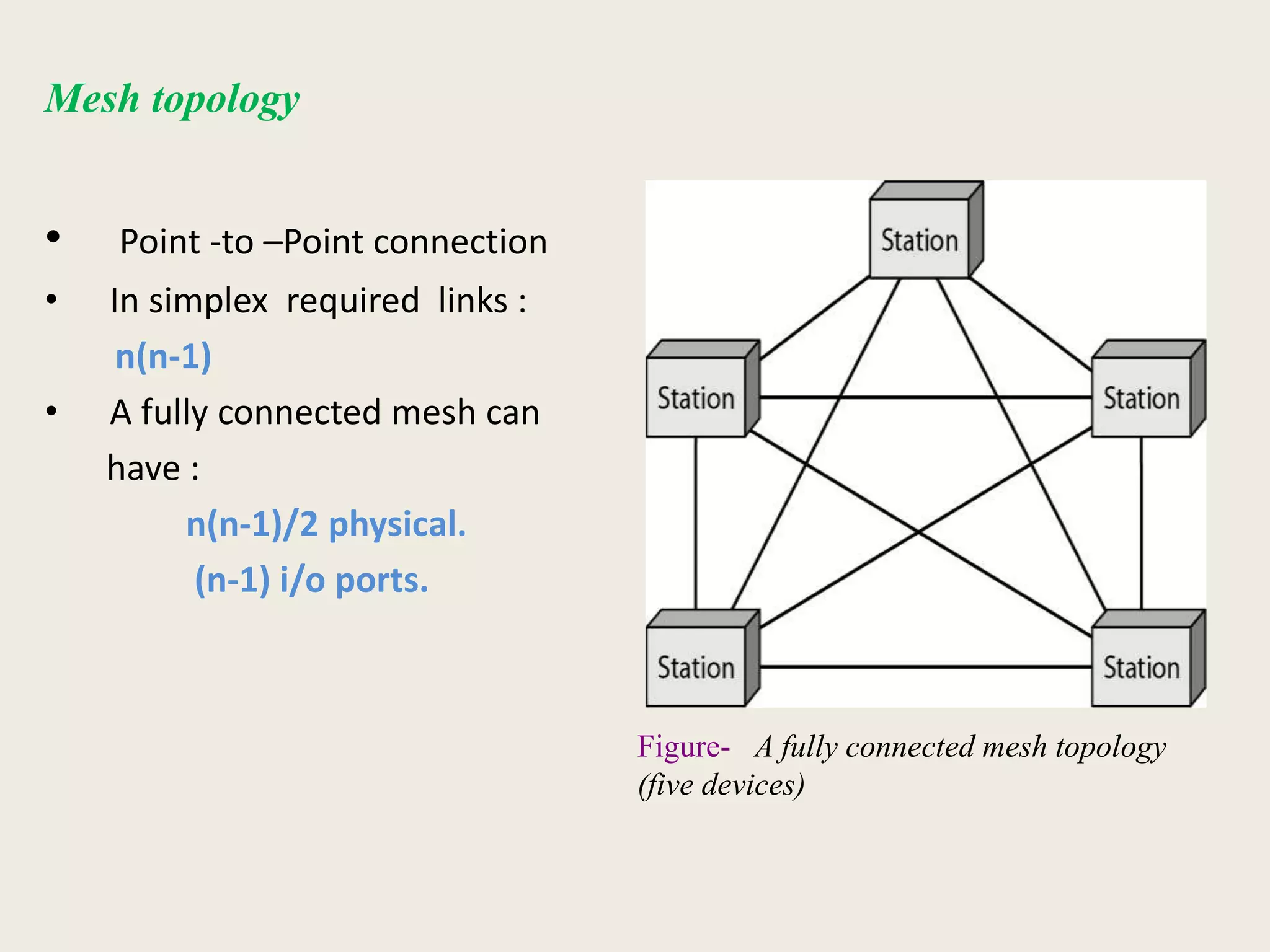
• Point -to –Point connection
• In simplex required links :
n(n-1)
• A fully connected mesh can
have :
n(n-1)/2 physical.
(n-1) i/o ports.
Mesh topology
Figure- A fully connected mesh topology
(five devices)
Advantages:
1. Reduces traffic problem.
2. Robust
3. Privacy and security.
4. Easy to fault identification and fault isolation
Disadvantages:
1. Large number of ports and cabling.
2. Highly expensive
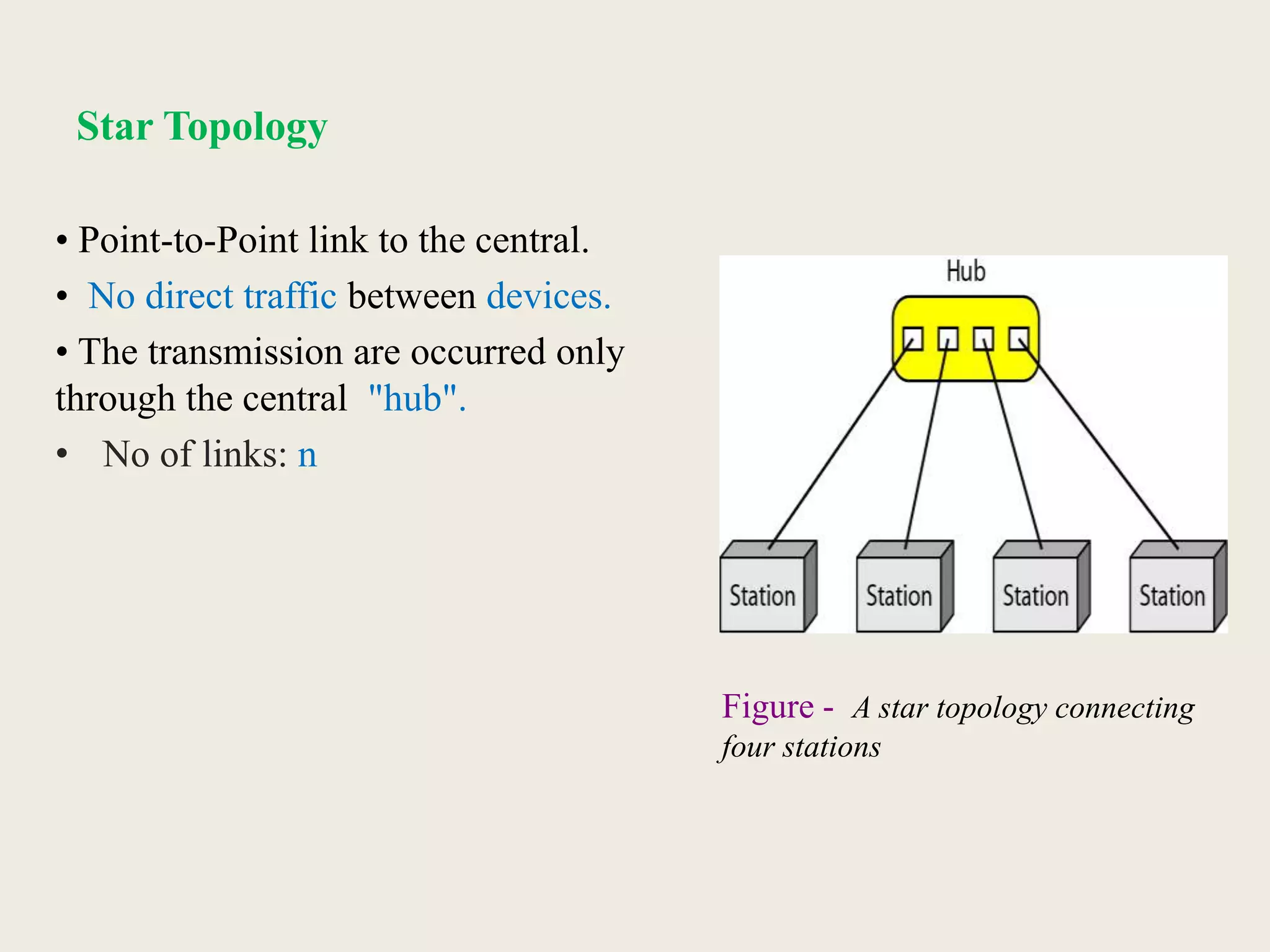
Star Topology
• Point-to-Point link to the central.
• No direct traffic between devices.
• The transmission are occurred only
through the central "hub".
• No of links: n
Figure - A star topology connecting
four stations
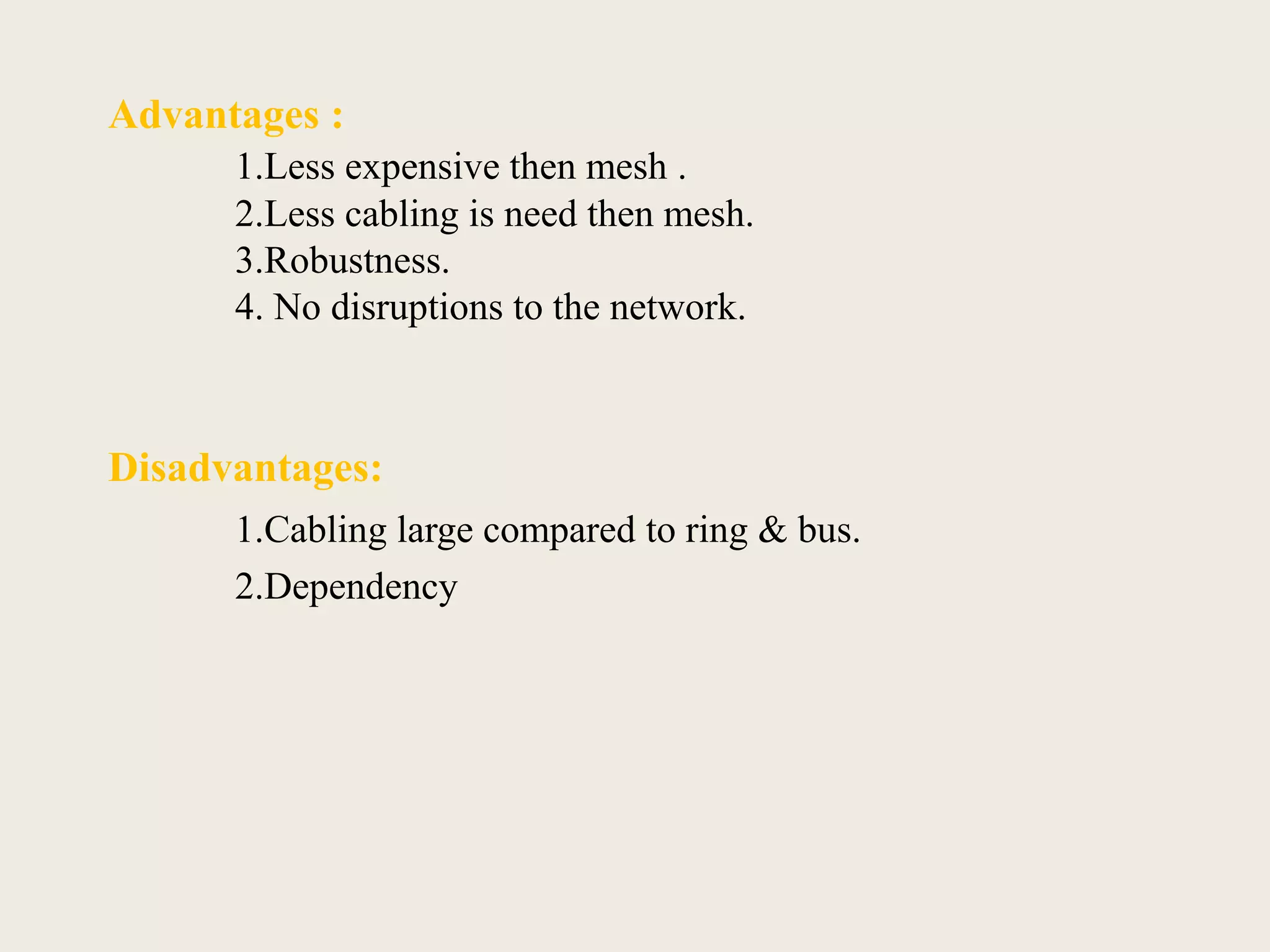
Advantages :
1.Less expensive then mesh .
2.Less cabling is need then mesh.
3.Robustness.
4. No disruptions to the network.
Disadvantages:
1.Cabling large compared to ring & bus.
2.Dependency
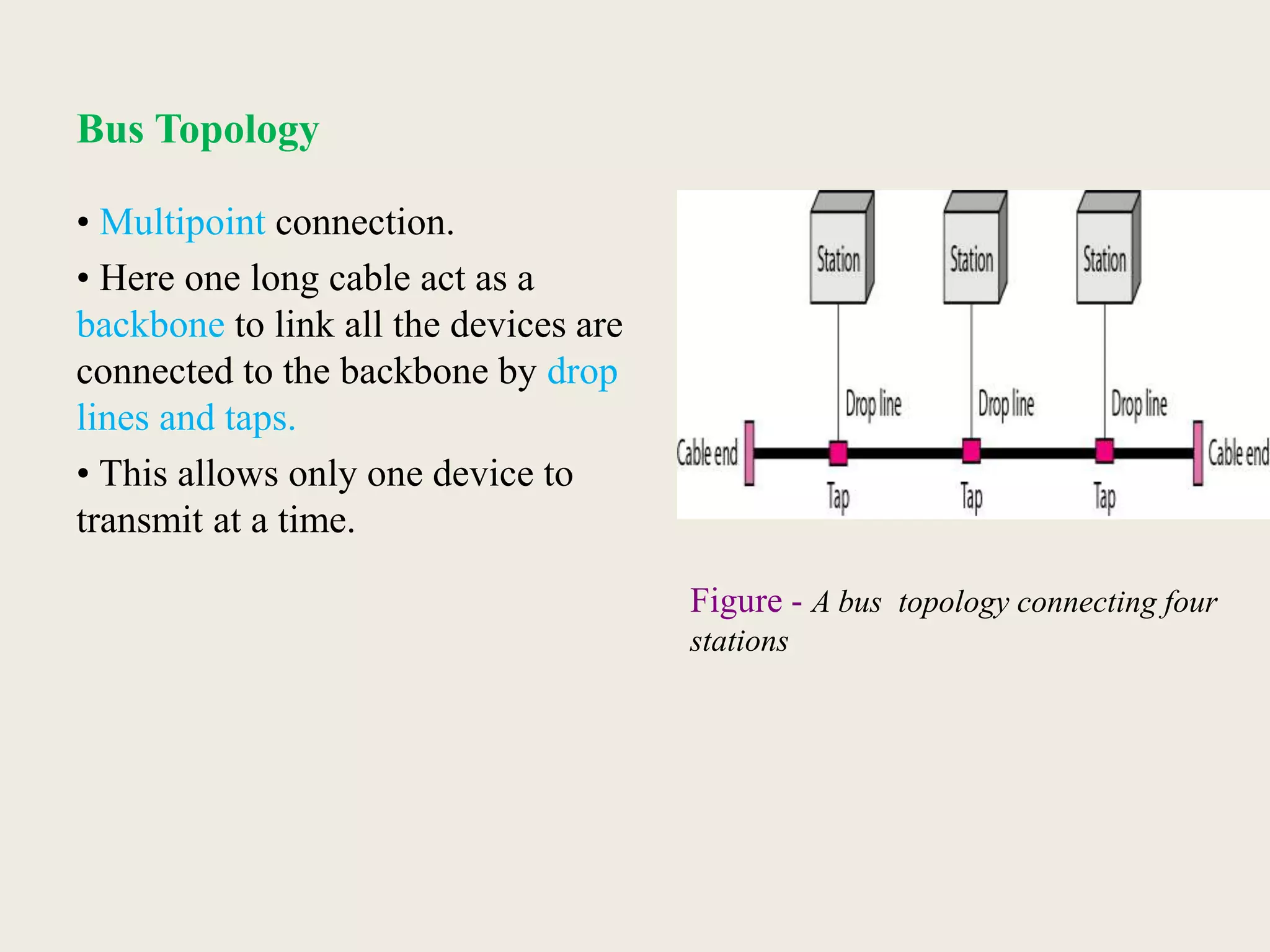
Bus Topology
• Multipoint connection.
• Here one long cable act as a
backbone to link all the devices are
connected to the backbone by drop
lines and taps.
• This allows only one device to
transmit at a time.
Figure - A bus topology connecting four
stations
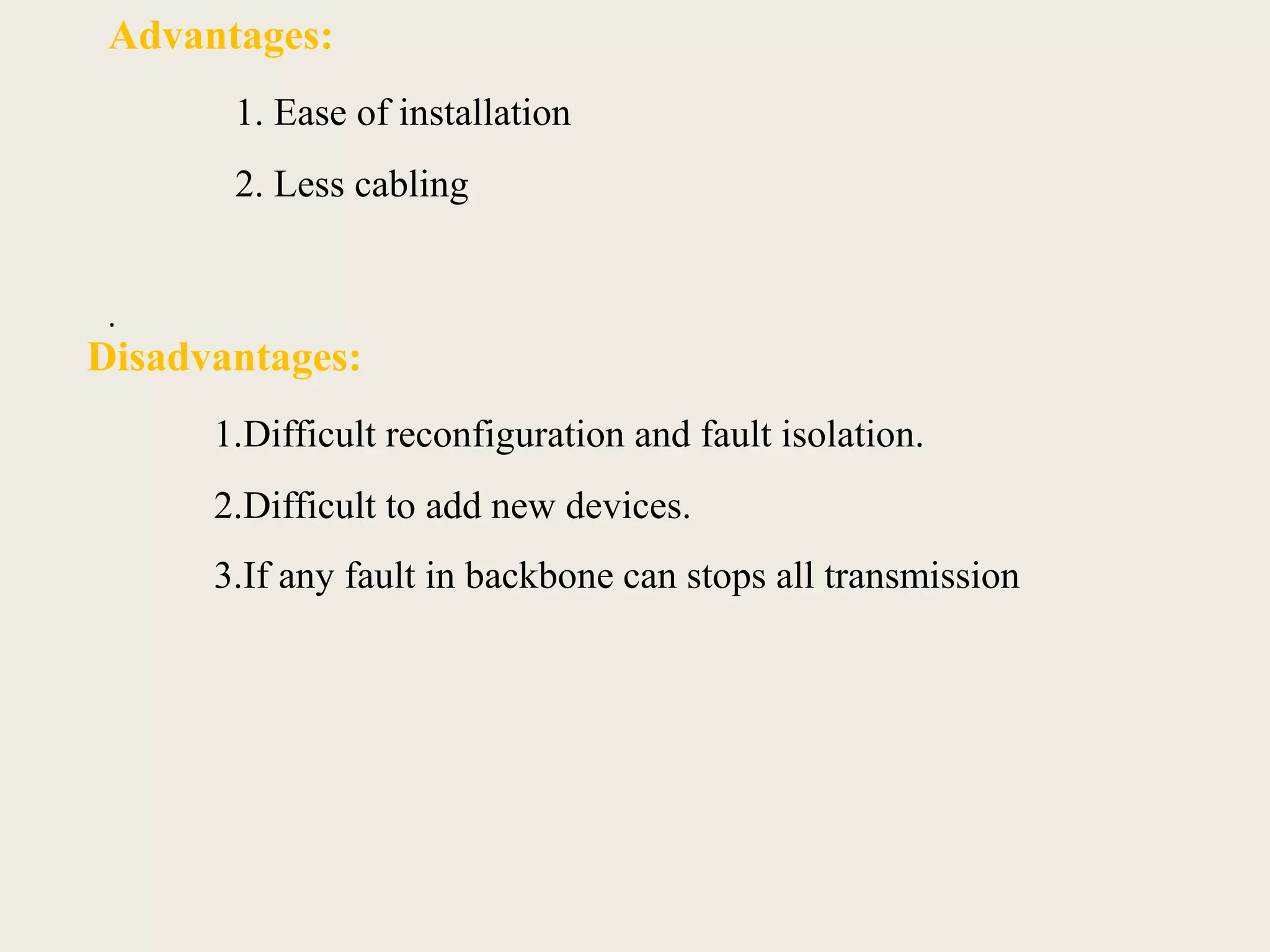
Advantages:
1. Ease of installation
2. Less cabling
.
Disadvantages:
1.Difficult reconfiguration and fault isolation.
2.Difficult to add new devices.
3.If any fault in backbone can stops all transmission
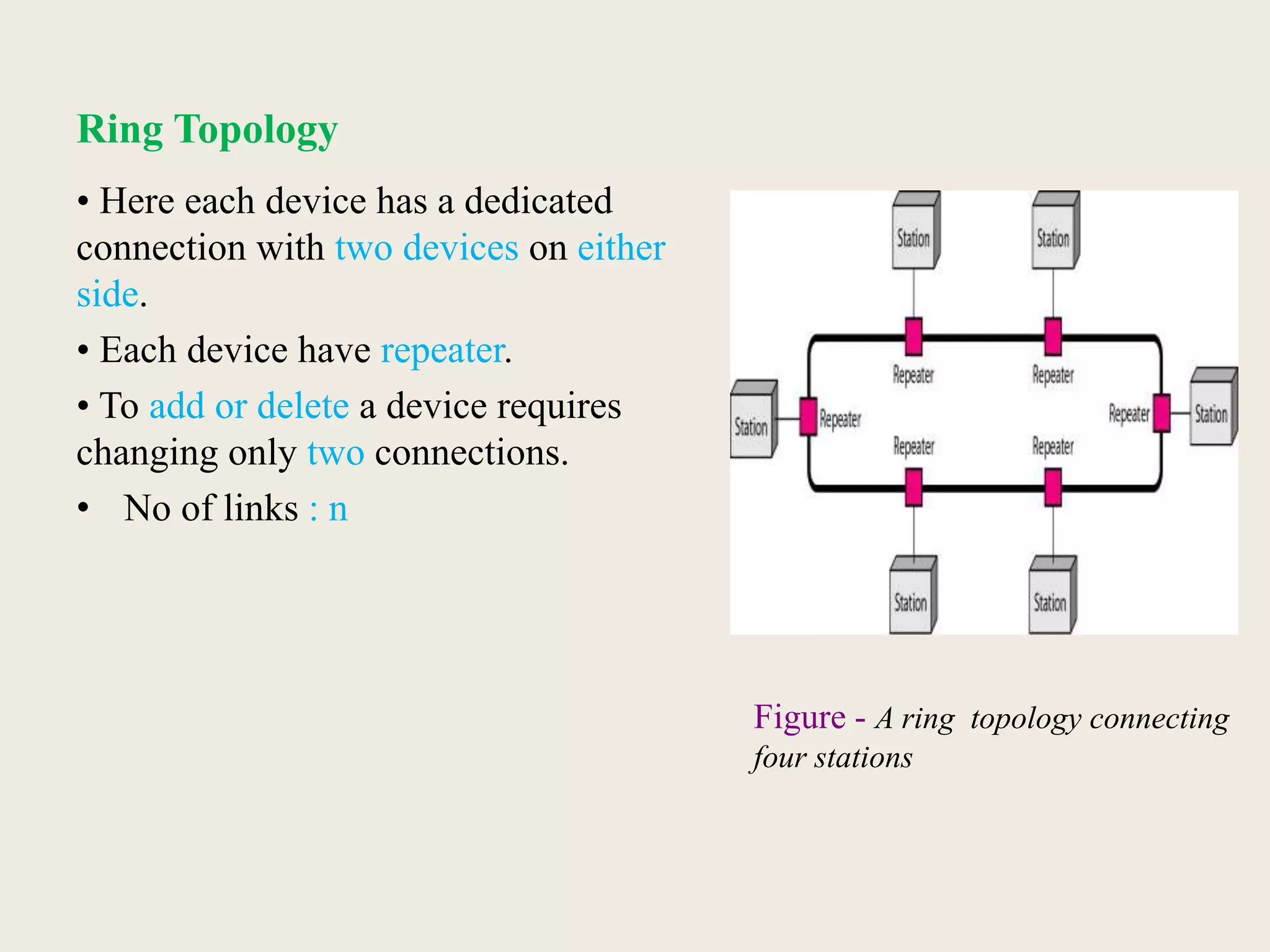
Ring Topology
• Here each device has a dedicated
connection with two devices on either
side.
• Each device have repeater.
• To add or delete a device requires
changing only two connections.
• No of links : n
Figure - A ring topology connecting
four stations
Advantages:
1. Easy to install.
2. Easy to reconfigure.
3. Fault identification is easy.
Disadvantages:
1. Unidirectional traffic.
2. Break in a single ring can break entire network.
THE OSI MODEL
• An ISO standard that covers all aspects of network communications is
the Open Systems Interconnection (OSI) model.
• It was first introduced in the late 1970s.
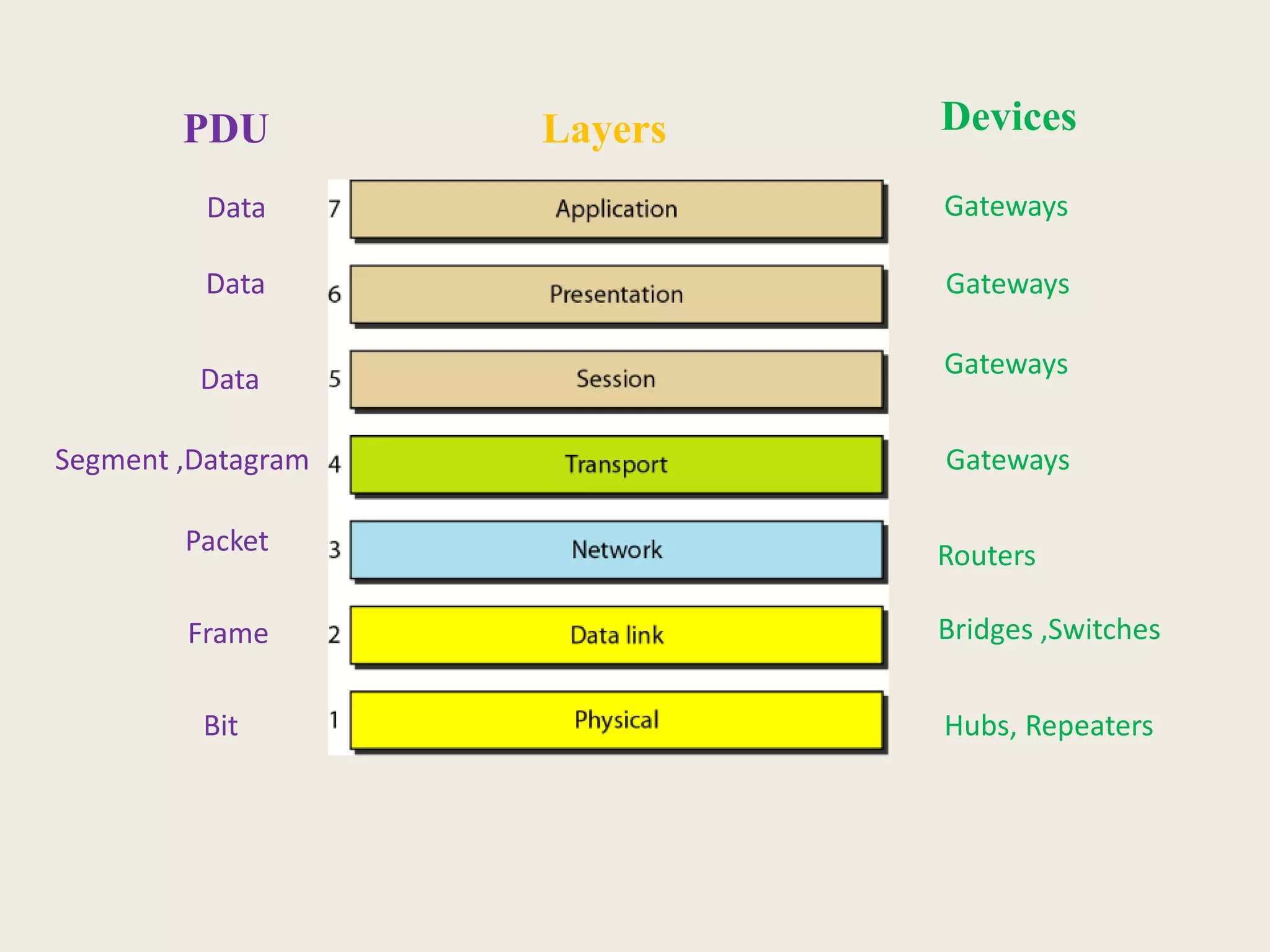
Hubs, Repeaters
Bridges ,Switches
Routers
Gateways
Gateways
Gateways
Gateways
Bit
Frame
Packet
Segment ,Datagram
Data
Data
Data
Layers DevicesPDU
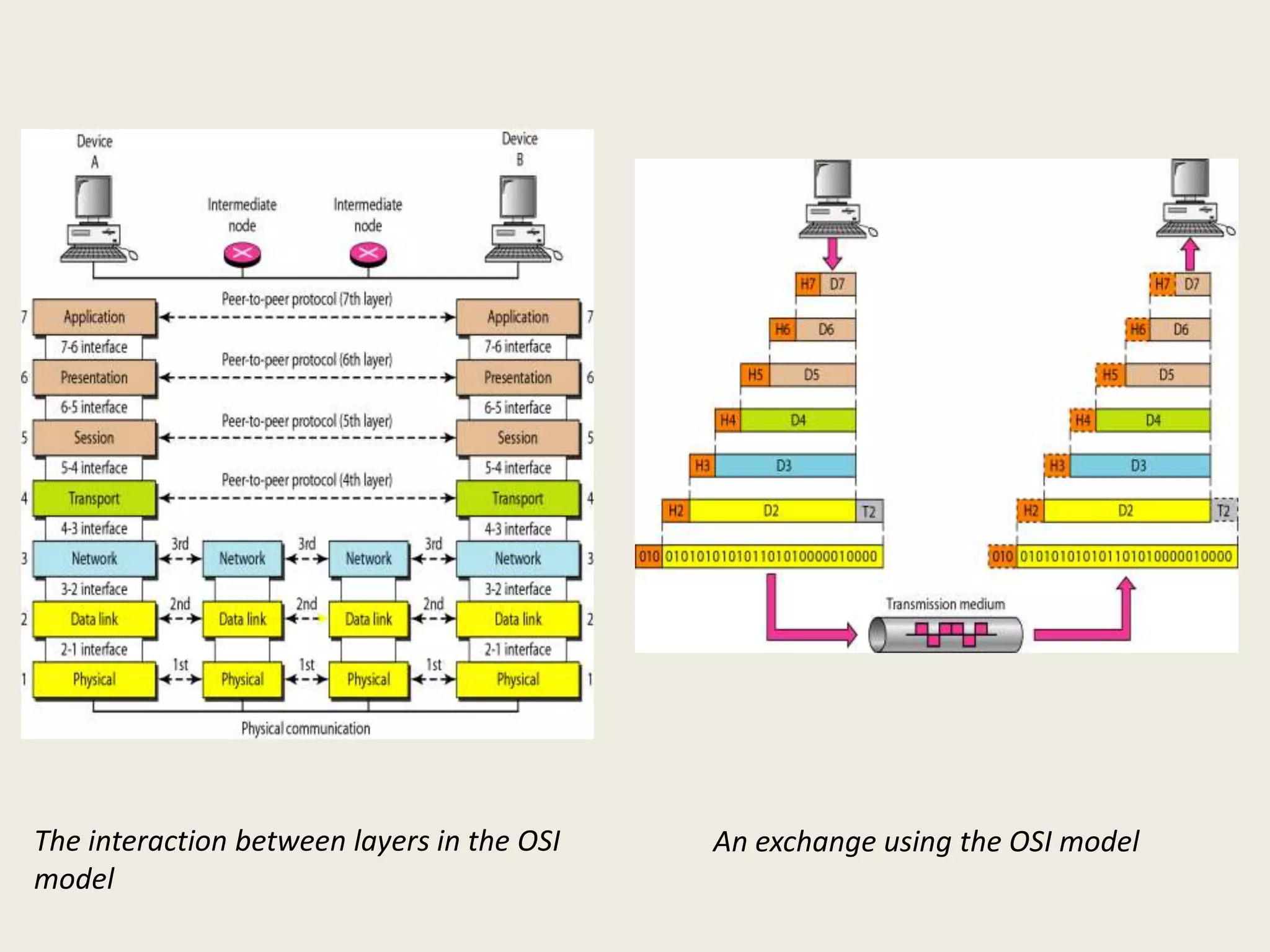
The interaction between layers in the OSI
model
An exchange using the OSI model
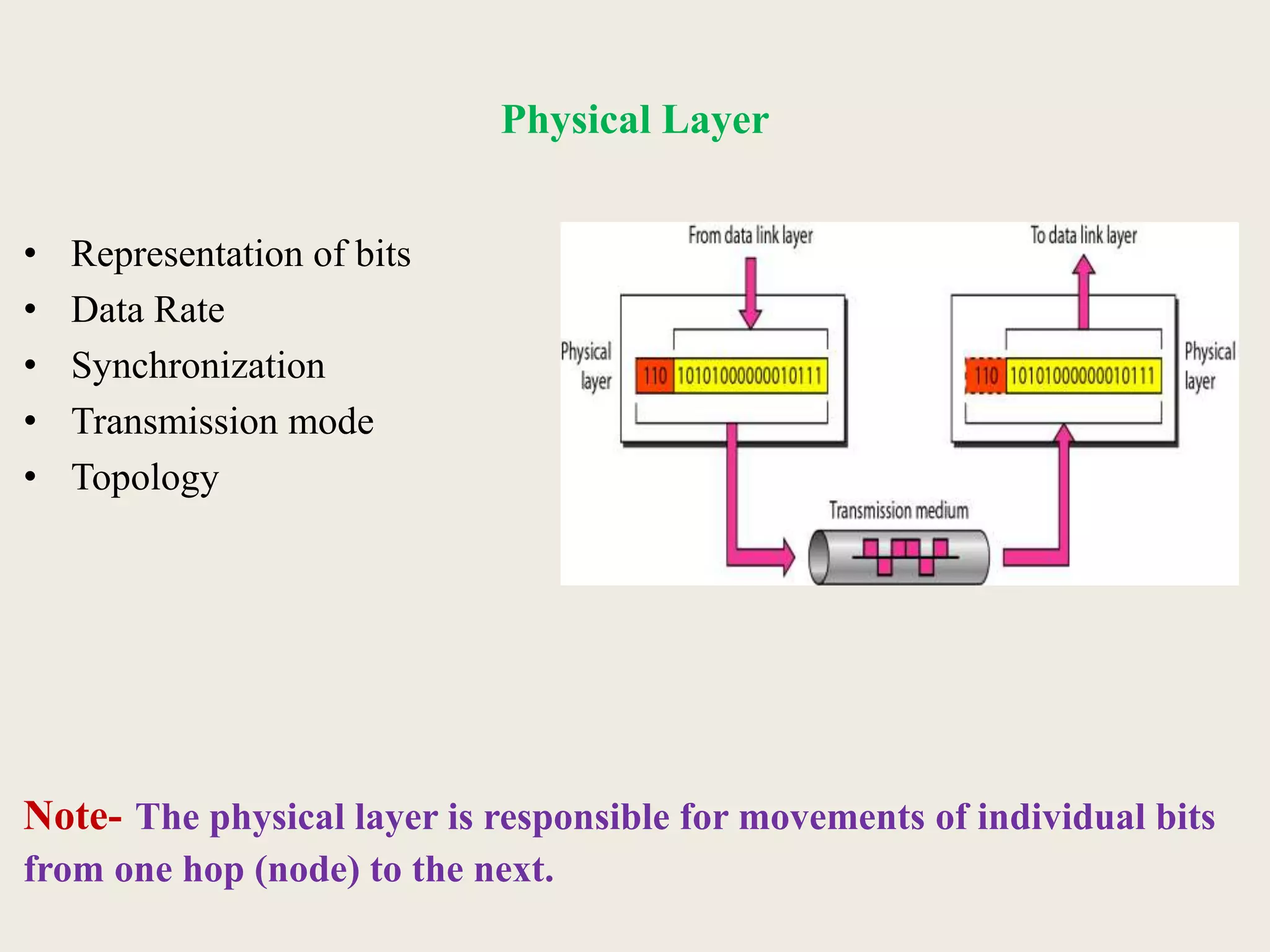
Physical Layer
• Representation of bits
• Data Rate
• Synchronization
• Transmission mode
• Topology
Note- The physical layer is responsible for movements of individual bits
from one hop (node) to the next.
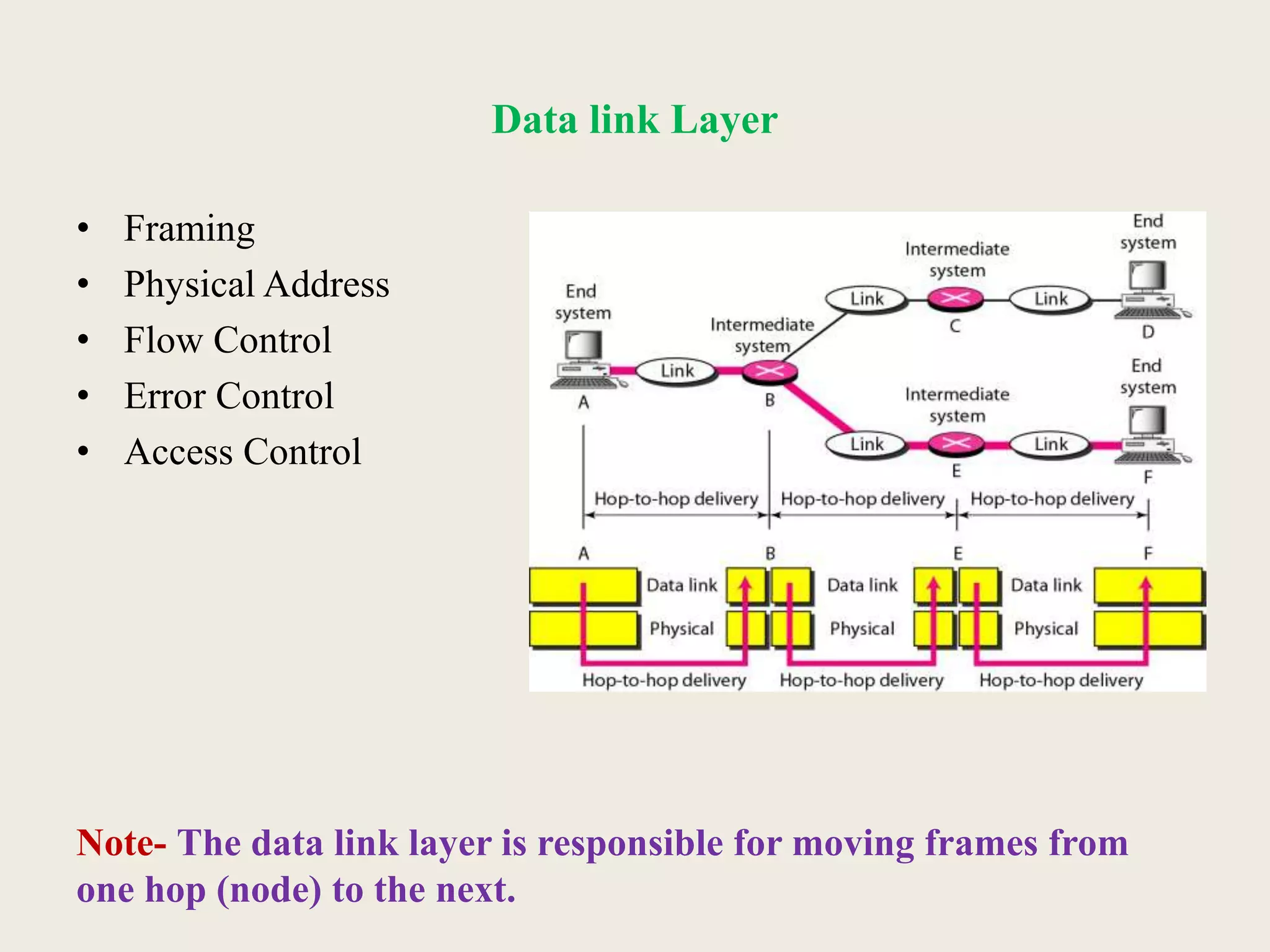
Data link Layer
• Framing
• Physical Address
• Flow Control
• Error Control
• Access Control
Note- The data link layer is responsible for moving frames from
one hop (node) to the next.
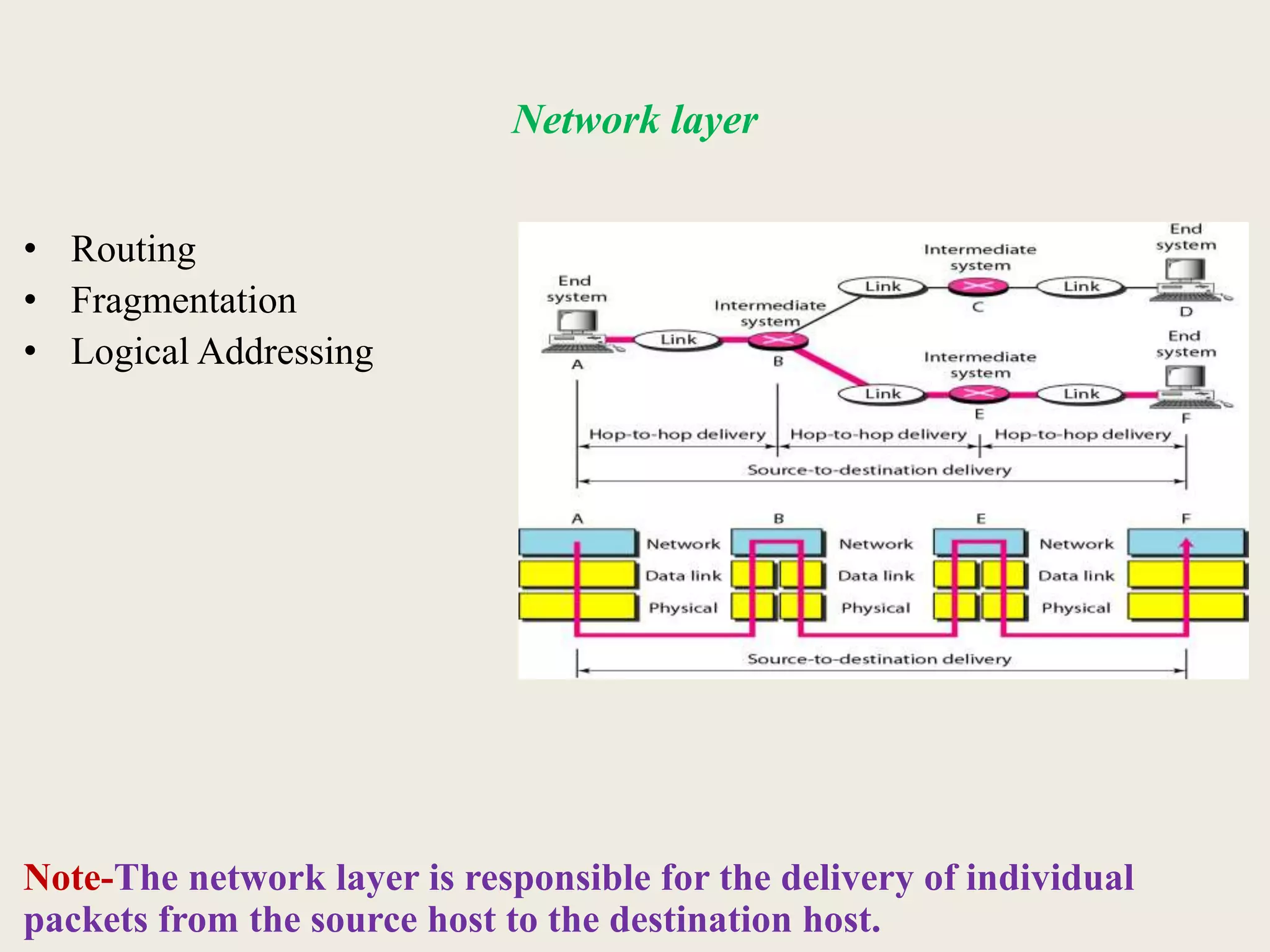
Network layer
• Routing
• Fragmentation
• Logical Addressing
Note-The network layer is responsible for the delivery of individual
packets from the source host to the destination host.
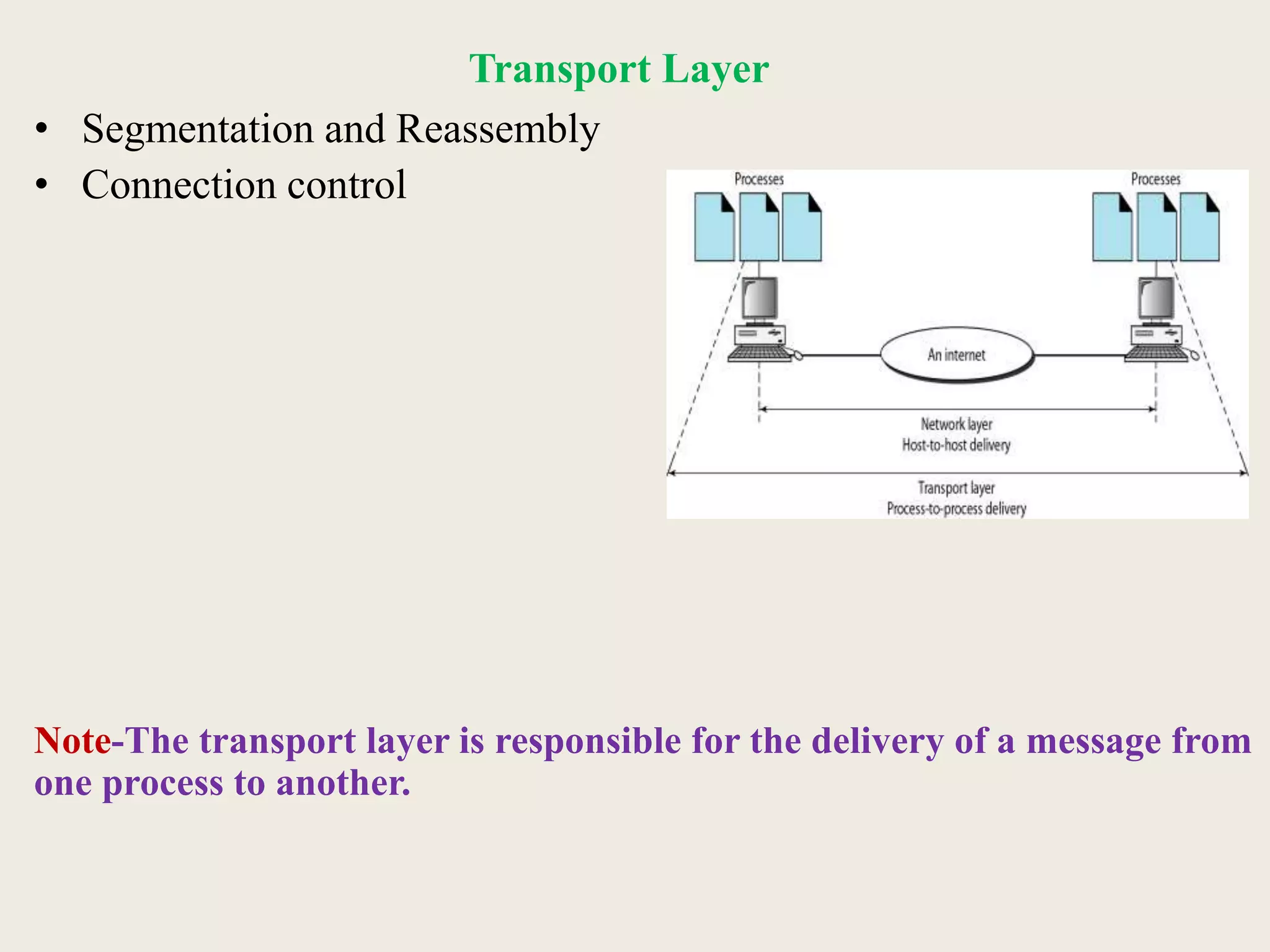
Transport Layer
• Segmentation and Reassembly
• Connection control
Note-The transport layer is responsible for the delivery of a message from
one process to another.
Session layer:
Dialog Control
Synchronization
Application Layer:
Enable User to Access Network
Provide User Interface
Support Service
key point of OSI layer with devices and Topology

key point of OSI layer with devices and Topology

  • 1.
  • 2.
    Outline: • Data Communication •Network • Topology • OSI Model
  • 3.
    DATA COMMUNICATIONS: Data communicationsare the exchange of data between two devices via some form of transmission medium such as a wire cable. Components:
  • 4.
  • 5.
    NETWORKS: A network isa set of devices (often referred to as nodes) connected by communication links. Network Criteria: • Performance (response time) • Reliability (Frequency of failure) • Security (Protecting data)
  • 6.
    Physical Structures: Type ofConnection Point to Point - Single transmitter and receiver Multipoint - Multiple recipients of single transmission
  • 7.
    Physical Topology: Connection ofdevices Type of transmission - Unicast, Multicast, Broadcast
  • 8.
    • Point -to–Point connection • In simplex required links : n(n-1) • A fully connected mesh can have : n(n-1)/2 physical. (n-1) i/o ports. Mesh topology Figure- A fully connected mesh topology (five devices)
  • 9.
    Advantages: 1. Reduces trafficproblem. 2. Robust 3. Privacy and security. 4. Easy to fault identification and fault isolation Disadvantages: 1. Large number of ports and cabling. 2. Highly expensive
  • 10.
    Star Topology • Point-to-Pointlink to the central. • No direct traffic between devices. • The transmission are occurred only through the central "hub". • No of links: n Figure - A star topology connecting four stations
  • 11.
    Advantages : 1.Less expensivethen mesh . 2.Less cabling is need then mesh. 3.Robustness. 4. No disruptions to the network. Disadvantages: 1.Cabling large compared to ring & bus. 2.Dependency
  • 12.
    Bus Topology • Multipointconnection. • Here one long cable act as a backbone to link all the devices are connected to the backbone by drop lines and taps. • This allows only one device to transmit at a time. Figure - A bus topology connecting four stations
  • 13.
    Advantages: 1. Ease ofinstallation 2. Less cabling . Disadvantages: 1.Difficult reconfiguration and fault isolation. 2.Difficult to add new devices. 3.If any fault in backbone can stops all transmission
  • 14.
    Ring Topology • Hereeach device has a dedicated connection with two devices on either side. • Each device have repeater. • To add or delete a device requires changing only two connections. • No of links : n Figure - A ring topology connecting four stations
  • 15.
    Advantages: 1. Easy toinstall. 2. Easy to reconfigure. 3. Fault identification is easy. Disadvantages: 1. Unidirectional traffic. 2. Break in a single ring can break entire network.
  • 16.
    THE OSI MODEL •An ISO standard that covers all aspects of network communications is the Open Systems Interconnection (OSI) model. • It was first introduced in the late 1970s.
  • 17.
  • 18.
    The interaction betweenlayers in the OSI model An exchange using the OSI model
  • 19.
    Physical Layer • Representationof bits • Data Rate • Synchronization • Transmission mode • Topology Note- The physical layer is responsible for movements of individual bits from one hop (node) to the next.
  • 20.
    Data link Layer •Framing • Physical Address • Flow Control • Error Control • Access Control Note- The data link layer is responsible for moving frames from one hop (node) to the next.
  • 21.
    Network layer • Routing •Fragmentation • Logical Addressing Note-The network layer is responsible for the delivery of individual packets from the source host to the destination host.
  • 22.
    Transport Layer • Segmentationand Reassembly • Connection control Note-The transport layer is responsible for the delivery of a message from one process to another.
  • 23.
    Session layer: Dialog Control Synchronization ApplicationLayer: Enable User to Access Network Provide User Interface Support Service