StudyMafia.Org
Submitted To: Submitted By:
Studymafia.org Studymafia.org
Osi Model
Table Contents
– Definition
– Introduction
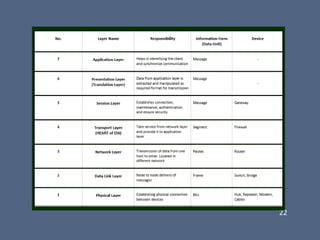
– Layers of OSI Model
– Purpose of OSI Model
– Conclusion
2
Definition
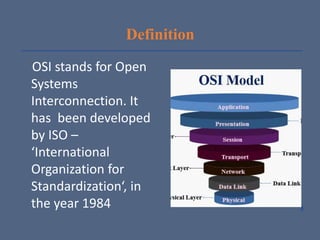
OSI stands for Open
Systems
Interconnection. It
has been developed
by ISO –
‘International
Organization for
Standardization‘, in
the year 1984 3
Introduction
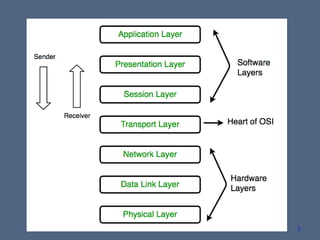
• It is a 7 layer architecture with each layer having
specific functionality to perform.
• All these 7 layers work collaboratively to transmit
the data from one person to another across the
globe.
4
5
Layers of OSI Model
Physical Layer (Layer 1) :
• The lowest layer of the OSI reference model is the
physical layer. It is responsible for the actual physical
connection between the devices.
• The physical layer contains information in the form of
bits. It is responsible for transmitting individual bits
from one node to the next.
• When receiving data, this layer will get the signal
received and convert it into 0s and 1s and send them
to the Data Link layer, which will put the frame back
together. ●●●
6
Layers of OSI Model
The functions of the physical layer are as follows:
Bit synchronization: The physical layer provides the
synchronization of the bits by providing a clock.
Bit rate control: The Physical layer also defines the
transmission rate i.e. the number of bits sent per second.
Physical topologies: Physical layer specifies the way in
which the different, devices/nodes are arranged in a
network i.e. bus, star, or mesh topology.
Transmission mode: Physical layer also defines the way in
which the data flows between the two connected devices.
●●●
7
Layers of OSI Model
Data Link Layer (DLL) (Layer 2) :
• The data link layer is responsible for the node-to-node
delivery of the message.
• The main function of this layer is to make sure data
transfer is error-free from one node to another, over
the physical layer.
• When a packet arrives in a network, it is the
responsibility of DLL to transmit it to the Host using its
MAC address.
●●●
8
Layers of OSI Model
The functions of the Data Link layer are :
Framing: Framing is a function of the data link layer. It
provides a way for a sender to transmit a set of bits that
are meaningful to the receiver.
Physical addressing: After creating frames, the Data link
layer adds physical addresses (MAC address) of the
sender and/or receiver in the header of each frame.
Error control: Data link layer provides the mechanism of
error control in which it detects and retransmits damaged
or lost frames.
●●●
9
Layers of OSI Model
The functions of the Data Link layer are :
Flow Control: The data rate must be constant on both
sides else the data may get corrupted thus, flow control
coordinates the amount of data that can be sent before
receiving acknowledgement.
Access control: When a single communication channel is
shared by multiple devices, the MAC sub-layer of the data
link layer helps to determine which device has control
over the channel at a given time.
●●●
10
Layers of OSI Model
Network Layer (Layer 3) :
• The network layer works for the transmission of data
from one host to the other located in different
networks.
• It also takes care of packet routing i.e. selection of the
shortest path to transmit the packet, from the number
of routes available.
• The sender & receiver’s IP addresses are placed in the
header by the network layer.
●●●
11
Layers of OSI Model
The functions of the Network layer are :
Routing: The network layer protocols determine
which route is suitable from source to destination.
This function of the network layer is known as
routing.
Logical Addressing: In order to identify each device
on internetwork uniquely, the network layer defines
an addressing scheme. The sender & receiver’s IP
addresses are placed in the header by the network
layer.
●●●
12
Layers of OSI Model
Transport Layer (Layer 4) :
• The transport layer provides services to the
application layer and takes services from the network
layer. The data in the transport layer is referred to as
Segments.
• It is responsible for the End to End Delivery of the
complete message.
• The transport layer also provides the
acknowledgement of the successful data transmission
and re-transmits the data if an error is found.
●●●
13
Layers of OSI Model
The functions of the transport layer are as follows:
Segmentation and Reassembly: This layer accepts the
message from the (session) layer, and breaks the
message into smaller units. Each of the segments
produced has a header associated with it.
Service Point Addressing: In order to deliver the
message to the correct process, the transport layer
header includes a type of address called service point
address or port address.
●●●
14
Layers of OSI Model
Session Layer (Layer 5) :
This layer is responsible for the establishment
of connection, maintenance of sessions,
authentication, and also ensures security.
●●●
15
Layers of OSI Model
The functions of the session layer are :
Session establishment, maintenance, and
termination: The layer allows the two processes to
establish, use and terminate a connection.
Synchronization: This layer allows a process to add
checkpoints which are considered synchronization
points into the data.
Dialog Controller: The session layer allows two
systems to start communication with each other in
half-duplex or full-duplex.
●●●
16
Layers of OSI Model
Presentation Layer (Layer 6):
The presentation layer is also called the
Translation layer. The data from the application
layer is extracted here and manipulated as per
the required format to transmit over the
network.
●●●
17
Layers of OSI Model
The functions of the presentation layer are :
Translation: For example, ASCII to EBCDIC.
Encryption/ Decryption: Data encryption translates
the data into another form or code. The encrypted
data is known as the ciphertext and the decrypted
data is known as plain text. A key value is used for
encrypting as well as decrypting data.
Compression: Reduces the number of bits that need
to be transmitted on the network.
●●●
18
Layers of OSI Model
Application Layer (Layer 7) :
• At the very top of the OSI Reference Model stack
of layers, we find the Application layer which is
implemented by the network applications.
• These applications produce the data, which has to
be transferred over the network.
• This layer also serves as a window for the
application services to access the network and for
displaying the received information to the user.
●●●
19
Layers of OSI Model
The functions of the Application layer are :
• Network Virtual Terminal
• FTAM-File transfer access and management
• Mail Services
• Directory Services
20
Purpose of OSI Model
The purpose of the OSI reference model is to
guide technology vendors and developers so the
digital communications products and software
programs they create can interoperate and to
promote a clear framework that describes the
functions of a networking or telecommunications
system that's in use.
21
22
Conclusion
 OSI model acts as a reference model and is not
implemented on the Internet because of its late
invention. The current model being used is the
TCP/IP model.
23
Thanks
To
StudyMafia.org

osi-model.pptx

  • 1.
    StudyMafia.Org Submitted To: SubmittedBy: Studymafia.org Studymafia.org Osi Model
  • 2.
    Table Contents – Definition –Introduction – Layers of OSI Model – Purpose of OSI Model – Conclusion 2
  • 3.
    Definition OSI stands forOpen Systems Interconnection. It has been developed by ISO – ‘International Organization for Standardization‘, in the year 1984 3
  • 4.
    Introduction • It isa 7 layer architecture with each layer having specific functionality to perform. • All these 7 layers work collaboratively to transmit the data from one person to another across the globe. 4
  • 5.
  • 6.
    Layers of OSIModel Physical Layer (Layer 1) : • The lowest layer of the OSI reference model is the physical layer. It is responsible for the actual physical connection between the devices. • The physical layer contains information in the form of bits. It is responsible for transmitting individual bits from one node to the next. • When receiving data, this layer will get the signal received and convert it into 0s and 1s and send them to the Data Link layer, which will put the frame back together. ●●● 6
  • 7.
    Layers of OSIModel The functions of the physical layer are as follows: Bit synchronization: The physical layer provides the synchronization of the bits by providing a clock. Bit rate control: The Physical layer also defines the transmission rate i.e. the number of bits sent per second. Physical topologies: Physical layer specifies the way in which the different, devices/nodes are arranged in a network i.e. bus, star, or mesh topology. Transmission mode: Physical layer also defines the way in which the data flows between the two connected devices. ●●● 7
  • 8.
    Layers of OSIModel Data Link Layer (DLL) (Layer 2) : • The data link layer is responsible for the node-to-node delivery of the message. • The main function of this layer is to make sure data transfer is error-free from one node to another, over the physical layer. • When a packet arrives in a network, it is the responsibility of DLL to transmit it to the Host using its MAC address. ●●● 8
  • 9.
    Layers of OSIModel The functions of the Data Link layer are : Framing: Framing is a function of the data link layer. It provides a way for a sender to transmit a set of bits that are meaningful to the receiver. Physical addressing: After creating frames, the Data link layer adds physical addresses (MAC address) of the sender and/or receiver in the header of each frame. Error control: Data link layer provides the mechanism of error control in which it detects and retransmits damaged or lost frames. ●●● 9
  • 10.
    Layers of OSIModel The functions of the Data Link layer are : Flow Control: The data rate must be constant on both sides else the data may get corrupted thus, flow control coordinates the amount of data that can be sent before receiving acknowledgement. Access control: When a single communication channel is shared by multiple devices, the MAC sub-layer of the data link layer helps to determine which device has control over the channel at a given time. ●●● 10
  • 11.
    Layers of OSIModel Network Layer (Layer 3) : • The network layer works for the transmission of data from one host to the other located in different networks. • It also takes care of packet routing i.e. selection of the shortest path to transmit the packet, from the number of routes available. • The sender & receiver’s IP addresses are placed in the header by the network layer. ●●● 11
  • 12.
    Layers of OSIModel The functions of the Network layer are : Routing: The network layer protocols determine which route is suitable from source to destination. This function of the network layer is known as routing. Logical Addressing: In order to identify each device on internetwork uniquely, the network layer defines an addressing scheme. The sender & receiver’s IP addresses are placed in the header by the network layer. ●●● 12
  • 13.
    Layers of OSIModel Transport Layer (Layer 4) : • The transport layer provides services to the application layer and takes services from the network layer. The data in the transport layer is referred to as Segments. • It is responsible for the End to End Delivery of the complete message. • The transport layer also provides the acknowledgement of the successful data transmission and re-transmits the data if an error is found. ●●● 13
  • 14.
    Layers of OSIModel The functions of the transport layer are as follows: Segmentation and Reassembly: This layer accepts the message from the (session) layer, and breaks the message into smaller units. Each of the segments produced has a header associated with it. Service Point Addressing: In order to deliver the message to the correct process, the transport layer header includes a type of address called service point address or port address. ●●● 14
  • 15.
    Layers of OSIModel Session Layer (Layer 5) : This layer is responsible for the establishment of connection, maintenance of sessions, authentication, and also ensures security. ●●● 15
  • 16.
    Layers of OSIModel The functions of the session layer are : Session establishment, maintenance, and termination: The layer allows the two processes to establish, use and terminate a connection. Synchronization: This layer allows a process to add checkpoints which are considered synchronization points into the data. Dialog Controller: The session layer allows two systems to start communication with each other in half-duplex or full-duplex. ●●● 16
  • 17.
    Layers of OSIModel Presentation Layer (Layer 6): The presentation layer is also called the Translation layer. The data from the application layer is extracted here and manipulated as per the required format to transmit over the network. ●●● 17
  • 18.
    Layers of OSIModel The functions of the presentation layer are : Translation: For example, ASCII to EBCDIC. Encryption/ Decryption: Data encryption translates the data into another form or code. The encrypted data is known as the ciphertext and the decrypted data is known as plain text. A key value is used for encrypting as well as decrypting data. Compression: Reduces the number of bits that need to be transmitted on the network. ●●● 18
  • 19.
    Layers of OSIModel Application Layer (Layer 7) : • At the very top of the OSI Reference Model stack of layers, we find the Application layer which is implemented by the network applications. • These applications produce the data, which has to be transferred over the network. • This layer also serves as a window for the application services to access the network and for displaying the received information to the user. ●●● 19
  • 20.
    Layers of OSIModel The functions of the Application layer are : • Network Virtual Terminal • FTAM-File transfer access and management • Mail Services • Directory Services 20
  • 21.
    Purpose of OSIModel The purpose of the OSI reference model is to guide technology vendors and developers so the digital communications products and software programs they create can interoperate and to promote a clear framework that describes the functions of a networking or telecommunications system that's in use. 21
  • 22.
  • 23.
    Conclusion  OSI modelacts as a reference model and is not implemented on the Internet because of its late invention. The current model being used is the TCP/IP model. 23
  • 24.