Evidence Based Medicine Module 1: Introduction to EBM Module 2: Applying EBM--Diagnosis Module 3: Applying EBM--Treatment   Prepared by: Jennifer Kleinbart, MD, Asst. Professor of Medicine, Director, EBM Curriculum Emory University School of Medicine Mark V. Williams, MD, Associate Professor of Medicine, Director, Hospital Medicine Unit Emory University School of Medicine Lawrence Blond, MD, Associate Director Graduate Medical Education, Alton Ochsner Medical Foundation
Evidence Based Medicine An evidence-based approach to answering clinical questions
Outline Introduction What is EBM? Why do we need it? How to use EBM in daily practice EBM resources
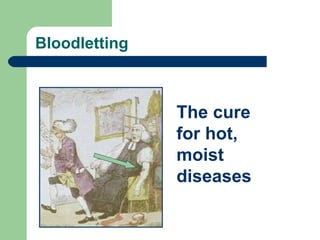
Bloodletting The cure for hot, moist diseases
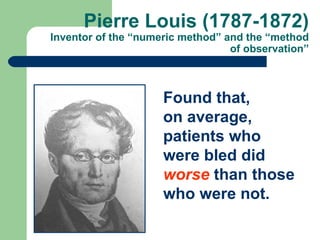
Pierre Louis (1787-1872) Inventor of the “numeric method” and the “method of observation” Found that,  on average, patients who were bled did  worse   than those who were not.
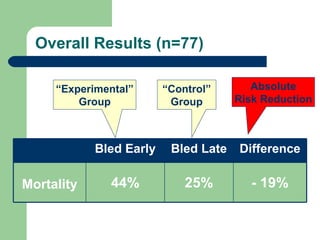
Overall Results (n=77) “ Experimental” Group “ Control” Group Absolute Risk Reduction - 19% 25% 44% Mortality Difference Bled Late Bled Early
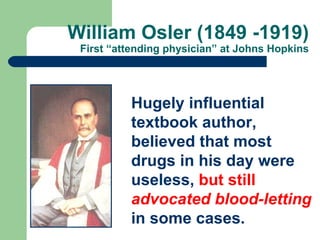
William Osler (1849 -1919) First “attending physician” at Johns Hopkins Hugely influential textbook author, believed that most drugs in his day were useless,  but still  advocated blood-letting  in some cases.
But…. We practice EBM today
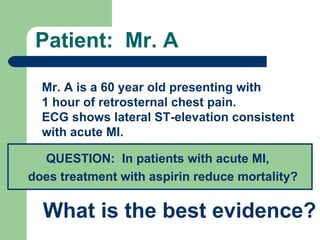
Patient:  Mr. A Mr. A is a 60 year old presenting with  1 hour of retrosternal chest pain.  ECG shows lateral ST-elevation consistent with acute MI. QUESTION:  In patients with acute MI,  does treatment with aspirin reduce mortality?   What is the best evidence?
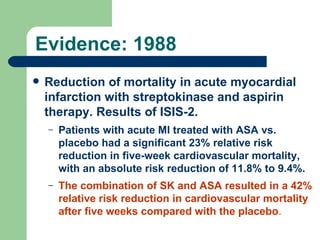
Evidence: 1988 Reduction of mortality in acute myocardial infarction with streptokinase and aspirin therapy. Results of ISIS-2.  Patients with acute MI treated with ASA vs. placebo had a significant 23% relative risk reduction in five-week cardiovascular mortality, with an absolute risk reduction of 11.8% to 9.4%.  The combination of SK and ASA resulted in a 42% relative risk reduction in cardiovascular mortality after five weeks compared with the placebo .
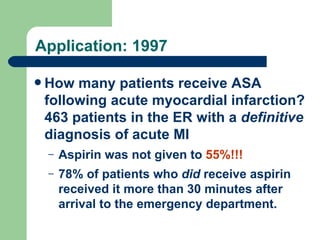
Application: 1997 How many patients receive ASA following acute myocardial infarction? 463 patients in the ER with a  definitive  diagnosis of acute MI Aspirin was not given to  55%!!! 78% of patients who  did  receive aspirin received it more than 30 minutes after arrival to the emergency department. Annals of Intern Medicine. Jul 1997;127(2):126
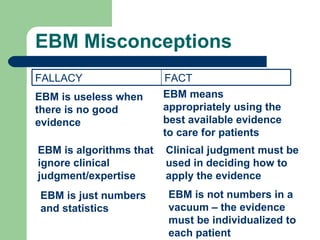
EBM Misconceptions EBM is useless when there is no good evidence EBM means appropriately using the best available evidence to care for patients EBM is algorithms that ignore clinical judgment/expertise Clinical judgment must be used in deciding how to apply the evidence EBM is just numbers and statistics EBM is not numbers in a vacuum – the evidence must be individualized to each patient FACT FALLACY
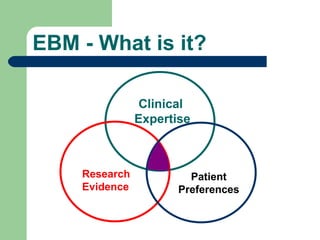
EBM - What is it?   Clinical Expertise Research  Evidence Patient Preferences
Why EBM? Caring for patients creates the need for clinically important information Diagnosis….Therapy….Prognosis Knowledge deteriorates with time:  Practitioners practice what they learned during residency training EBM:  goal of life-long self-directed learning
Why EBM? New evidence often changes clinical practice Prospective learning from reading journals and going to conferences is important, but  not  sufficient  Impossible to prospectively acquire all information necessary to treat all future patients
Besieged with Information More than 3800 biomedical journals in MEDLINE More than 7300 citations added weekly Lag period   Publication of research findings Implementation in clinical practice
Besieged with Information All studies not equally well designed or interpreted Adding expert synthesis and analysis can truly help busy clinicians
So, how does it work?   EBM Method
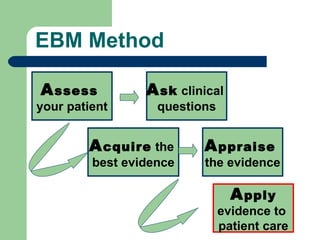
EBM Method A cquire  the  best evidence A ppraise  the evidence A pply evidence to  patient care A ssess  your patient A sk  clinical  questions
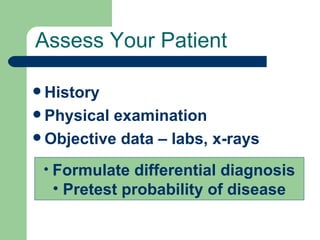
Assess Your Patient History Physical examination Objective data – labs, x-rays Formulate differential diagnosis Pretest probability of disease
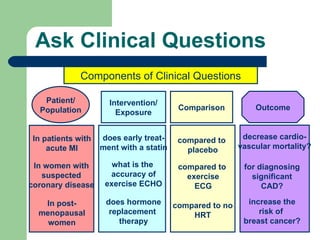
Ask Clinical Questions Components of Clinical Questions Patient/ Population Outcome Intervention/ Exposure Comparison In patients with acute MI In post- menopausal women In women with suspected coronary disease does early treat- ment with a statin what is the  accuracy of exercise ECHO does hormone replacement  therapy compared to  placebo compared to  exercise ECG compared to no HRT decrease cardio- vascular mortality? for diagnosing significant CAD? increase the risk of  breast cancer?
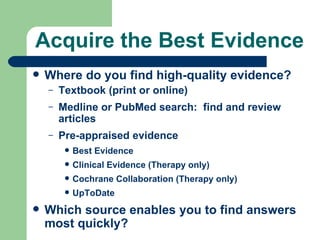
Acquire the Best Evidence Where do you find high-quality evidence? Textbook (print or online) Medline or PubMed search:  find and review articles Pre-appraised evidence Best Evidence Clinical Evidence (Therapy only) Cochrane Collaboration (Therapy only)  UpToDate Which source enables you to find answers most quickly?
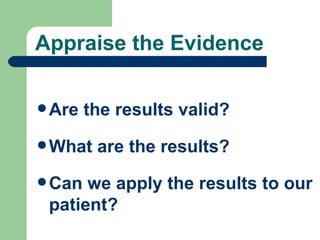
Appraise the Evidence Are the results valid? What are the results?  Can we apply the results to our patient?
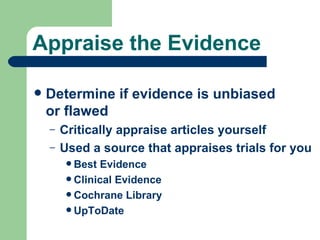
Appraise the Evidence Determine if evidence is unbiased or flawed Critically appraise articles yourself Used a source that appraises trials for you Best Evidence Clinical Evidence  Cochrane Library UpToDate
A pply the Evidence Evidence must be applied to each individual patient Is your patient similar enough to those studied? Do benefits outweigh harms? Cost What are your patient’s values and preferences?
Rules of Evidence All evidence is  not  created equal. Evidence alone  never  makes clinical decisions. Values  always  influence decisions.

Evidence Based Medicine Intro

  • 1.
    Evidence Based MedicineModule 1: Introduction to EBM Module 2: Applying EBM--Diagnosis Module 3: Applying EBM--Treatment Prepared by: Jennifer Kleinbart, MD, Asst. Professor of Medicine, Director, EBM Curriculum Emory University School of Medicine Mark V. Williams, MD, Associate Professor of Medicine, Director, Hospital Medicine Unit Emory University School of Medicine Lawrence Blond, MD, Associate Director Graduate Medical Education, Alton Ochsner Medical Foundation
  • 2.
    Evidence Based MedicineAn evidence-based approach to answering clinical questions
  • 3.
    Outline Introduction Whatis EBM? Why do we need it? How to use EBM in daily practice EBM resources
  • 4.
    Bloodletting The curefor hot, moist diseases
  • 5.
    Pierre Louis (1787-1872)Inventor of the “numeric method” and the “method of observation” Found that, on average, patients who were bled did worse than those who were not.
  • 6.
    Overall Results (n=77)“ Experimental” Group “ Control” Group Absolute Risk Reduction - 19% 25% 44% Mortality Difference Bled Late Bled Early
  • 7.
    William Osler (1849-1919) First “attending physician” at Johns Hopkins Hugely influential textbook author, believed that most drugs in his day were useless, but still advocated blood-letting in some cases.
  • 8.
  • 9.
    Patient: Mr.A Mr. A is a 60 year old presenting with 1 hour of retrosternal chest pain. ECG shows lateral ST-elevation consistent with acute MI. QUESTION: In patients with acute MI, does treatment with aspirin reduce mortality? What is the best evidence?
  • 10.
    Evidence: 1988 Reductionof mortality in acute myocardial infarction with streptokinase and aspirin therapy. Results of ISIS-2. Patients with acute MI treated with ASA vs. placebo had a significant 23% relative risk reduction in five-week cardiovascular mortality, with an absolute risk reduction of 11.8% to 9.4%. The combination of SK and ASA resulted in a 42% relative risk reduction in cardiovascular mortality after five weeks compared with the placebo .
  • 11.
    Application: 1997 Howmany patients receive ASA following acute myocardial infarction? 463 patients in the ER with a definitive diagnosis of acute MI Aspirin was not given to 55%!!! 78% of patients who did receive aspirin received it more than 30 minutes after arrival to the emergency department. Annals of Intern Medicine. Jul 1997;127(2):126
  • 12.
    EBM Misconceptions EBMis useless when there is no good evidence EBM means appropriately using the best available evidence to care for patients EBM is algorithms that ignore clinical judgment/expertise Clinical judgment must be used in deciding how to apply the evidence EBM is just numbers and statistics EBM is not numbers in a vacuum – the evidence must be individualized to each patient FACT FALLACY
  • 13.
    EBM - Whatis it? Clinical Expertise Research Evidence Patient Preferences
  • 14.
    Why EBM? Caringfor patients creates the need for clinically important information Diagnosis….Therapy….Prognosis Knowledge deteriorates with time: Practitioners practice what they learned during residency training EBM: goal of life-long self-directed learning
  • 15.
    Why EBM? Newevidence often changes clinical practice Prospective learning from reading journals and going to conferences is important, but not sufficient Impossible to prospectively acquire all information necessary to treat all future patients
  • 16.
    Besieged with InformationMore than 3800 biomedical journals in MEDLINE More than 7300 citations added weekly Lag period Publication of research findings Implementation in clinical practice
  • 17.
    Besieged with InformationAll studies not equally well designed or interpreted Adding expert synthesis and analysis can truly help busy clinicians
  • 18.
    So, how doesit work? EBM Method
  • 19.
    EBM Method Acquire the best evidence A ppraise the evidence A pply evidence to patient care A ssess your patient A sk clinical questions
  • 20.
    Assess Your PatientHistory Physical examination Objective data – labs, x-rays Formulate differential diagnosis Pretest probability of disease
  • 21.
    Ask Clinical QuestionsComponents of Clinical Questions Patient/ Population Outcome Intervention/ Exposure Comparison In patients with acute MI In post- menopausal women In women with suspected coronary disease does early treat- ment with a statin what is the accuracy of exercise ECHO does hormone replacement therapy compared to placebo compared to exercise ECG compared to no HRT decrease cardio- vascular mortality? for diagnosing significant CAD? increase the risk of breast cancer?
  • 22.
    Acquire the BestEvidence Where do you find high-quality evidence? Textbook (print or online) Medline or PubMed search: find and review articles Pre-appraised evidence Best Evidence Clinical Evidence (Therapy only) Cochrane Collaboration (Therapy only) UpToDate Which source enables you to find answers most quickly?
  • 23.
    Appraise the EvidenceAre the results valid? What are the results? Can we apply the results to our patient?
  • 24.
    Appraise the EvidenceDetermine if evidence is unbiased or flawed Critically appraise articles yourself Used a source that appraises trials for you Best Evidence Clinical Evidence Cochrane Library UpToDate
  • 25.
    A pply theEvidence Evidence must be applied to each individual patient Is your patient similar enough to those studied? Do benefits outweigh harms? Cost What are your patient’s values and preferences?
  • 26.
    Rules of EvidenceAll evidence is not created equal. Evidence alone never makes clinical decisions. Values always influence decisions.