Evidence Based Medicine
An evidence-based
approach to
answering clinical
questions
Outline


Introduction



What is EBM?



Why do we need it?



How to use EBM in daily practice



EBM resources
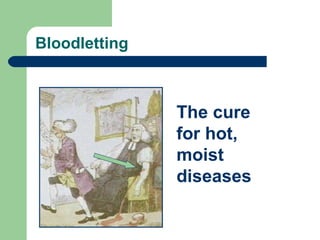
Bloodletting

The cure
for hot,
moist
diseases
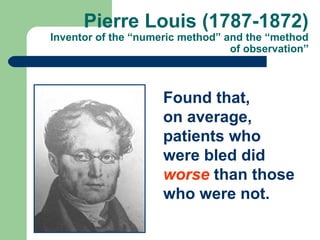
Pierre Louis (1787-1872)

Inventor of the “numeric method” and the “method
of observation”

Found that,
on average,
patients who
were bled did
worse than those
who were not.
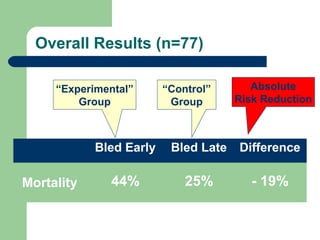
Overall Results (n=77)
“Experimental”
Group

“Control”
Group

Absolute
Risk Reduction

Bled Early

Mortality

Bled Late

Difference

44%

25%

- 19%
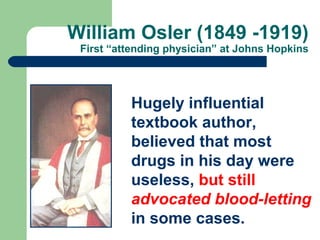
William Osler (1849 -1919)
First “attending physician” at Johns Hopkins

Hugely influential
textbook author,
believed that most
drugs in his day were
useless, but still
advocated blood-letting
in some cases.
But….

We practice EBM today
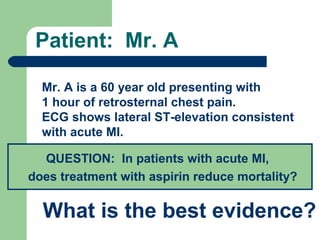
Patient: Mr. A
Mr. A is a 60 year old presenting with
1 hour of retrosternal chest pain.
ECG shows lateral ST-elevation consistent
with acute MI.
QUESTION: In patients with acute MI,
does treatment with aspirin reduce mortality?

What is the best evidence?
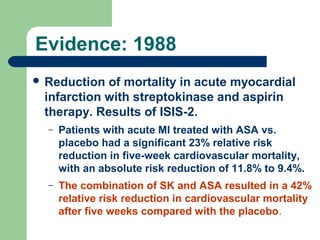
Evidence: 1988
 Reduction

of mortality in acute myocardial
infarction with streptokinase and aspirin
therapy. Results of ISIS-2.
–

Patients with acute MI treated with ASA vs.
placebo had a significant 23% relative risk
reduction in five-week cardiovascular mortality,
with an absolute risk reduction of 11.8% to 9.4%.

–

The combination of SK and ASA resulted in a 42%
relative risk reduction in cardiovascular mortality
after five weeks compared with the placebo.
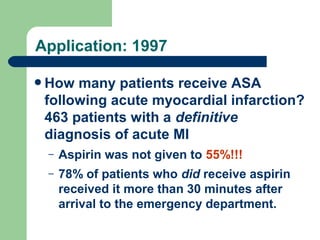
Application: 1997
 How

many patients receive ASA
following acute myocardial infarction?
463 patients with a definitive
diagnosis of acute MI
–

Aspirin was not given to 55%!!!

–

78% of patients who did receive aspirin
received it more than 30 minutes after
arrival to the emergency department.
Annals of Intern Medicine. Jul 1997;127(2):126
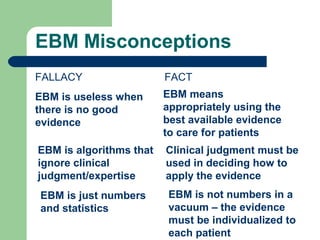
EBM Misconceptions
FALLACY

FACT

EBM is useless when
there is no good
evidence

EBM means
appropriately using the
best available evidence
to care for patients

EBM is algorithms that
ignore clinical
judgment/expertise

Clinical judgment must be
used in deciding how to
apply the evidence

EBM is just numbers
and statistics

EBM is not numbers in a
vacuum – the evidence
must be individualized to
each patient
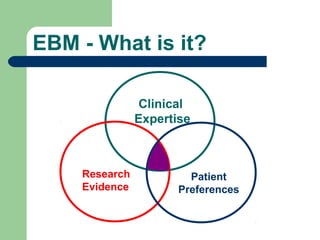
EBM - What is it?
Clinical
Expertise

Research
Evidence

Patient
Preferences
Why EBM?
 Caring

for patients creates the need for
clinically important information
– Diagnosis….Therapy….Prognosis
 Knowledge deteriorates with time:
Practitioners practice what they learned
during residency training
–

EBM: goal of life-long self-directed
learning
Why EBM?
 New

evidence often changes clinical
practice

 Prospective

learning from reading
journals and going to conferences is
important, but not sufficient
–

Impossible to prospectively acquire all
information necessary to treat all future
patients
Evidence is not Black and White

Use it to inform Clinical Practice
Besieged with Information
 More

than 3800 biomedical journals
in MEDLINE
 More than 7300 citations added
weekly
 Lag period
–
–

Publication of research findings
Implementation in clinical practice
Besieged with Information
All

studies not equally well
designed or interpreted
–

Adding expert synthesis and
analysis can
truly help busy clinicians
EBM Method

So, how does it work?
EBM Method
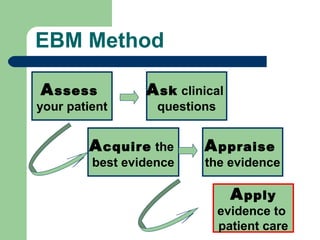
A ssess

your patient

A sk clinical
questions

A cquire the

best evidence

A ppraise

the evidence

A pply

evidence to
patient care
Assess Your Patient
History
Physical

examination
Objective data – labs, x-rays
• Formulate differential diagnosis

• Pretest probability of disease
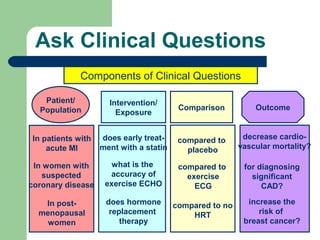
Ask Clinical Questions
Components of Clinical Questions
Patient/
Population

Intervention/
Exposure

Comparison

Outcome

In patients with
acute MI

does early treatment with a statin

compared to
placebo

decrease cardiovascular mortality?

In women with
suspected
coronary disease

what is the
accuracy of
exercise ECHO

compared to
exercise
ECG

for diagnosing
significant
CAD?

In postmenopausal
women

does hormone
replacement
therapy

compared to no
HRT

increase the
risk of
breast cancer?
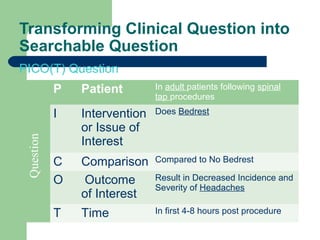
Transforming Clinical Question into
Searchable Question
PICO(T) Question
Patient

In adult patients following spinal
tap procedures

I
Question

P

Intervention
or Issue of
Interest

Does Bedrest

C
O

Comparison
Outcome
of Interest

Compared to No Bedrest

T

Time

In first 4-8 hours post procedure

Result in Decreased Incidence and
Severity of Headaches
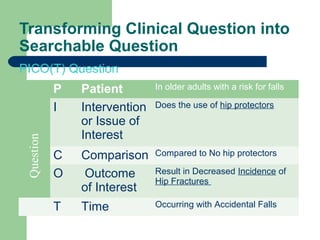
Transforming Clinical Question into
Searchable Question
PICO(T) Question

Question

P
I

Patient
Intervention
or Issue of
Interest

In older adults with a risk for falls

C
O

Comparison
Outcome
of Interest

Compared to No hip protectors

T

Time

Occurring with Accidental Falls

Does the use of hip protectors

Result in Decreased Incidence of
Hip Fractures
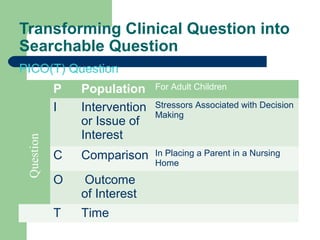
Transforming Clinical Question into
Searchable Question
PICO(T) Question

Question

P
I

Population
Intervention
or Issue of
Interest

For Adult Children

C

Comparison

In Placing a Parent in a Nursing
Home

O

Outcome
of Interest

T

Time

Stressors Associated with Decision
Making
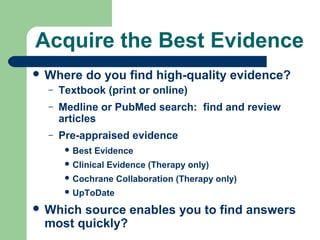
Acquire the Best Evidence
 Where

do you find high-quality evidence?

–

Textbook (print or online)

–

Medline or PubMed search: find and review
articles

–

Pre-appraised evidence
 Best

Evidence

 Clinical

Evidence (Therapy only)

 Cochrane

Collaboration (Therapy only)

 UpToDate

 Which

source enables you to find answers
most quickly?
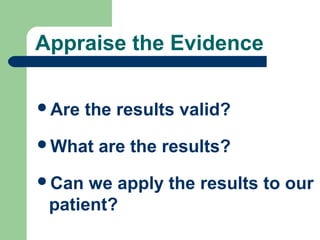
Appraise the Evidence
Are

the results valid?

What
Can

are the results?

we apply the results to our
patient?
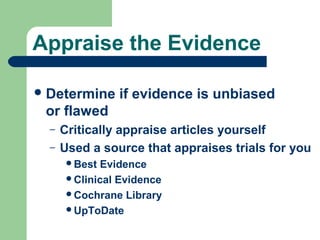
Appraise the Evidence
 Determine

if evidence is unbiased

or flawed
–
–

Critically appraise articles yourself
Used a source that appraises trials for you
Best

Evidence
Clinical Evidence
Cochrane Library
UpToDate
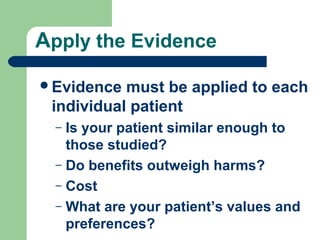
Apply the Evidence
Evidence

must be applied to each
individual patient
Is your patient similar enough to
those studied?
– Do benefits outweigh harms?
– Cost
– What are your patient’s values and
preferences?
–
Rules of Evidence
All

evidence is not created
equal.

Evidence

alone never makes
clinical decisions.

Values

always influence
decisions.
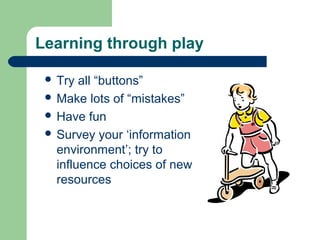
Learning through play
 Try

all “buttons”
 Make lots of “mistakes”
 Have fun
 Survey your ‘information
environment’; try to
influence choices of new
resources
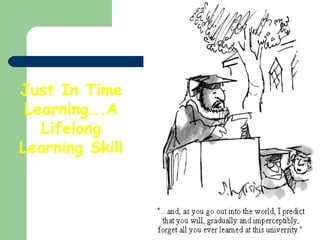
Just In Time
Learning….A
Lifelong
Learning Skill
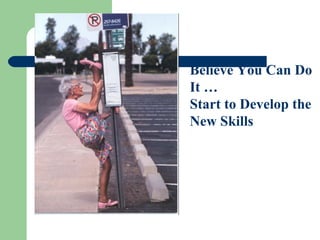
Believe You Can Do
It …
Start to Develop the
New Skills
The bridge to address all of these improvement
mandates and to cross the “quality chasm” is
evidence-based practice brought alive at the
microsystem level

Ebp mahus

  • 1.
    Evidence Based Medicine Anevidence-based approach to answering clinical questions
  • 2.
    Outline  Introduction  What is EBM?  Whydo we need it?  How to use EBM in daily practice  EBM resources
  • 3.
  • 4.
    Pierre Louis (1787-1872) Inventorof the “numeric method” and the “method of observation” Found that, on average, patients who were bled did worse than those who were not.
  • 5.
    Overall Results (n=77) “Experimental” Group “Control” Group Absolute RiskReduction Bled Early Mortality Bled Late Difference 44% 25% - 19%
  • 6.
    William Osler (1849-1919) First “attending physician” at Johns Hopkins Hugely influential textbook author, believed that most drugs in his day were useless, but still advocated blood-letting in some cases.
  • 7.
  • 8.
    Patient: Mr. A Mr.A is a 60 year old presenting with 1 hour of retrosternal chest pain. ECG shows lateral ST-elevation consistent with acute MI. QUESTION: In patients with acute MI, does treatment with aspirin reduce mortality? What is the best evidence?
  • 9.
    Evidence: 1988  Reduction ofmortality in acute myocardial infarction with streptokinase and aspirin therapy. Results of ISIS-2. – Patients with acute MI treated with ASA vs. placebo had a significant 23% relative risk reduction in five-week cardiovascular mortality, with an absolute risk reduction of 11.8% to 9.4%. – The combination of SK and ASA resulted in a 42% relative risk reduction in cardiovascular mortality after five weeks compared with the placebo.
  • 10.
    Application: 1997  How manypatients receive ASA following acute myocardial infarction? 463 patients with a definitive diagnosis of acute MI – Aspirin was not given to 55%!!! – 78% of patients who did receive aspirin received it more than 30 minutes after arrival to the emergency department. Annals of Intern Medicine. Jul 1997;127(2):126
  • 11.
    EBM Misconceptions FALLACY FACT EBM isuseless when there is no good evidence EBM means appropriately using the best available evidence to care for patients EBM is algorithms that ignore clinical judgment/expertise Clinical judgment must be used in deciding how to apply the evidence EBM is just numbers and statistics EBM is not numbers in a vacuum – the evidence must be individualized to each patient
  • 12.
    EBM - Whatis it? Clinical Expertise Research Evidence Patient Preferences
  • 13.
    Why EBM?  Caring forpatients creates the need for clinically important information – Diagnosis….Therapy….Prognosis  Knowledge deteriorates with time: Practitioners practice what they learned during residency training – EBM: goal of life-long self-directed learning
  • 14.
    Why EBM?  New evidenceoften changes clinical practice  Prospective learning from reading journals and going to conferences is important, but not sufficient – Impossible to prospectively acquire all information necessary to treat all future patients
  • 15.
    Evidence is notBlack and White Use it to inform Clinical Practice
  • 16.
    Besieged with Information More than 3800 biomedical journals in MEDLINE  More than 7300 citations added weekly  Lag period – – Publication of research findings Implementation in clinical practice
  • 17.
    Besieged with Information All studiesnot equally well designed or interpreted – Adding expert synthesis and analysis can truly help busy clinicians
  • 18.
    EBM Method So, howdoes it work?
  • 19.
    EBM Method A ssess yourpatient A sk clinical questions A cquire the best evidence A ppraise the evidence A pply evidence to patient care
  • 20.
    Assess Your Patient History Physical examination Objectivedata – labs, x-rays • Formulate differential diagnosis • Pretest probability of disease
  • 21.
    Ask Clinical Questions Componentsof Clinical Questions Patient/ Population Intervention/ Exposure Comparison Outcome In patients with acute MI does early treatment with a statin compared to placebo decrease cardiovascular mortality? In women with suspected coronary disease what is the accuracy of exercise ECHO compared to exercise ECG for diagnosing significant CAD? In postmenopausal women does hormone replacement therapy compared to no HRT increase the risk of breast cancer?
  • 22.
    Transforming Clinical Questioninto Searchable Question PICO(T) Question Patient In adult patients following spinal tap procedures I Question P Intervention or Issue of Interest Does Bedrest C O Comparison Outcome of Interest Compared to No Bedrest T Time In first 4-8 hours post procedure Result in Decreased Incidence and Severity of Headaches
  • 23.
    Transforming Clinical Questioninto Searchable Question PICO(T) Question Question P I Patient Intervention or Issue of Interest In older adults with a risk for falls C O Comparison Outcome of Interest Compared to No hip protectors T Time Occurring with Accidental Falls Does the use of hip protectors Result in Decreased Incidence of Hip Fractures
  • 24.
    Transforming Clinical Questioninto Searchable Question PICO(T) Question Question P I Population Intervention or Issue of Interest For Adult Children C Comparison In Placing a Parent in a Nursing Home O Outcome of Interest T Time Stressors Associated with Decision Making
  • 25.
    Acquire the BestEvidence  Where do you find high-quality evidence? – Textbook (print or online) – Medline or PubMed search: find and review articles – Pre-appraised evidence  Best Evidence  Clinical Evidence (Therapy only)  Cochrane Collaboration (Therapy only)  UpToDate  Which source enables you to find answers most quickly?
  • 26.
    Appraise the Evidence Are theresults valid? What Can are the results? we apply the results to our patient?
  • 27.
    Appraise the Evidence Determine if evidence is unbiased or flawed – – Critically appraise articles yourself Used a source that appraises trials for you Best Evidence Clinical Evidence Cochrane Library UpToDate
  • 28.
    Apply the Evidence Evidence mustbe applied to each individual patient Is your patient similar enough to those studied? – Do benefits outweigh harms? – Cost – What are your patient’s values and preferences? –
  • 29.
    Rules of Evidence All evidenceis not created equal. Evidence alone never makes clinical decisions. Values always influence decisions.
  • 30.
    Learning through play Try all “buttons”  Make lots of “mistakes”  Have fun  Survey your ‘information environment’; try to influence choices of new resources
  • 31.
  • 32.
    Believe You CanDo It … Start to Develop the New Skills
  • 33.
    The bridge toaddress all of these improvement mandates and to cross the “quality chasm” is evidence-based practice brought alive at the microsystem level

Editor's Notes

  • #3 Postprandial somnolence Guide to knowing when to nap
  • #13 “Explicit, judicious, and conscientious use of current best evidence from medical care research to make decisions about the medical care of individuals” Clinical expertise IS important! Why? Experience with patients: improves efficiency of diagnosis and treatment Improves ability to determine applicability of research data to your patients Allows consideration of patient preferences EBM is the process of systematically finding the most recent applicable research, appraising its validity, and using it as the basis for clinical decisions. Clinical Expertise improves efficiency of Dx and Rx considers patient preferences Overestimates usefulness of therapy -placebo effect - loss to follow-up “Have not all concerned physicians been doing this (EBM) for ages... ? The steps and recommendations of the EBM acolytes reek of obfuscations and platitudes.” WKC Morgan, London, Ontario Lancet, October 28, 1995
  • #14 1) Our up-to-date knowledge and clinical performance that we all possessed upon completing our residency program definitely deteriorate with time. Sure, we certainly gain experience and some knowledge with practicing medicine, but we tend to lose more than we gain. 2) New types of evidence are generated daily which should create major changes in the way we care for our patients. Also, modern evaluation tools allow dissection, understanding, and objectification of the diagnostic reasoning skills of expert clinicians. In other words we can sort out how skilled doctors think and apply these rigorous systems to training doctors. 3) Although we need to use the new research information being generated daily, we usually fail to use it. 4) Listserv example of variation in care delivery (PE diagnosis, pneumovax) What’s the evidence that we need it? If we look at the delivery of healthcare, we don’t see a well-ordered, knowledge-based system. When health insurers and employers, the people paying for health insurance in America, they don’t see a well-ordered, knowledge-based system. We and they see chaos! Now, am I being excessively alarmist or critical? A story in a past Sunday New York Times Magazine has likened unexplained variation to three jumbo jets crashing every two days. Highlight the number of patients killed every year because of missed diagnoses, medication mishaps, and other preventable errors.
  • #16 The balance, and even tension, between evidence and clinical expertise is summarized by Sackett:
  • #17 The lag period between publication of research findings demonstrating clinical effectiveness and the subsequent implementation in clinical practice is well recognized. Practitioners continue to base clinical decisions on outdated training and on experience with individual patients.
  • #20 Alternative to next slide