SS/EBM/IKA-UDIP-2010
(”Bringing research evidence
into practice”)
Evidence-Based
Medicine
Sudigdo Sastroasmoro
Clinical Epidemiology and Evidence-based Medicine Unit
FMUI – CMH, Jakarta
SS/EBM/IKA-UDIP-2010
Asialink for CE-EBM
(2007 – 2010)
 2 European countries
 Oxford, uk
 Utrecht, nl
 2 Asian countries
 Malaya Uni, my
 UI, id
 European Union, Euro 700,000
SS/EBM/IKA-UDIP-2010
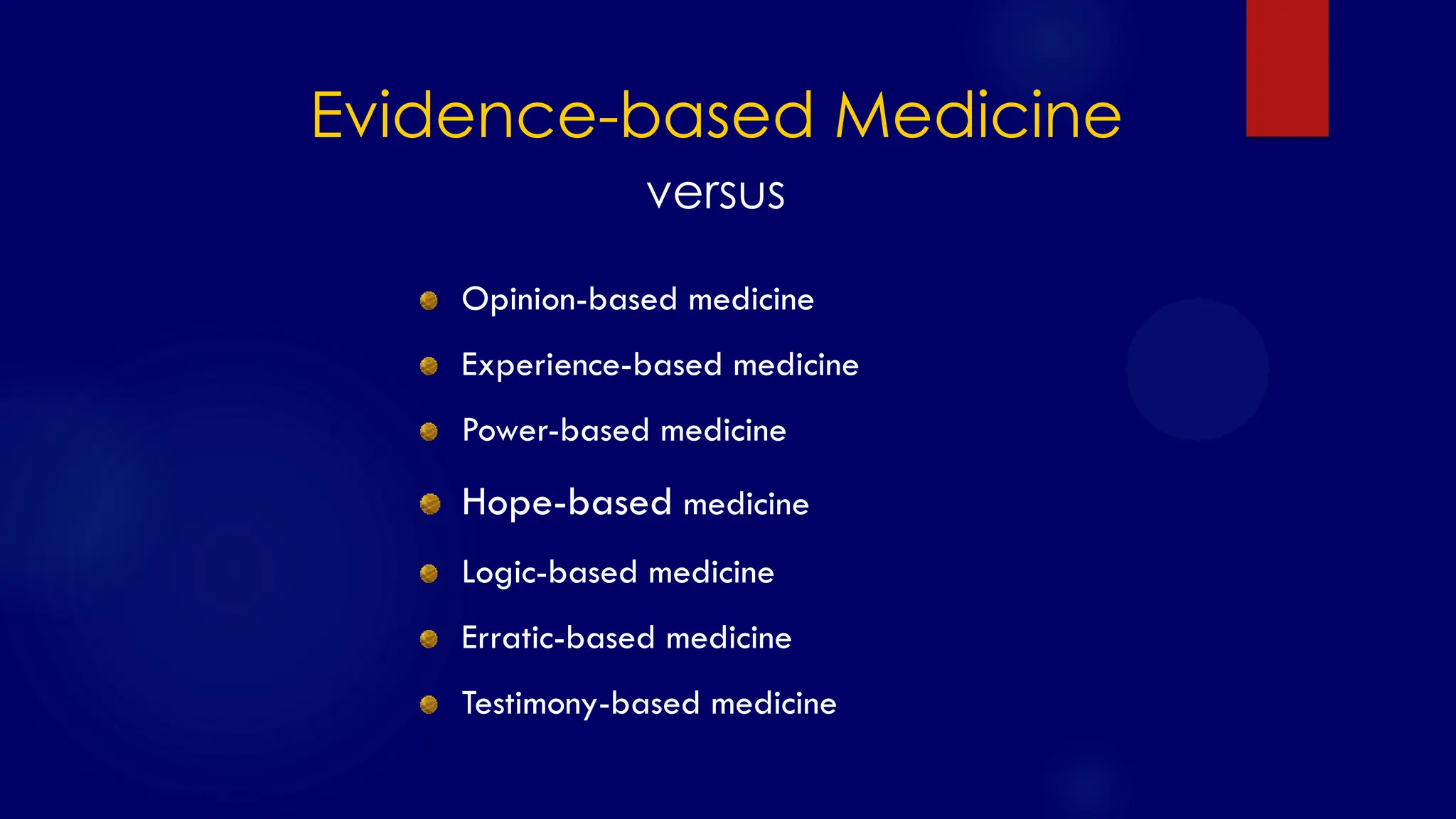
Evidence-based Medicine
versus
Opinion-based medicine
Experience-based medicine
Power-based medicine
Hope-based medicine
Logic-based medicine
Erratic-based medicine
Testimony-based medicine
SS/EBM/IKA-UDIP-2010
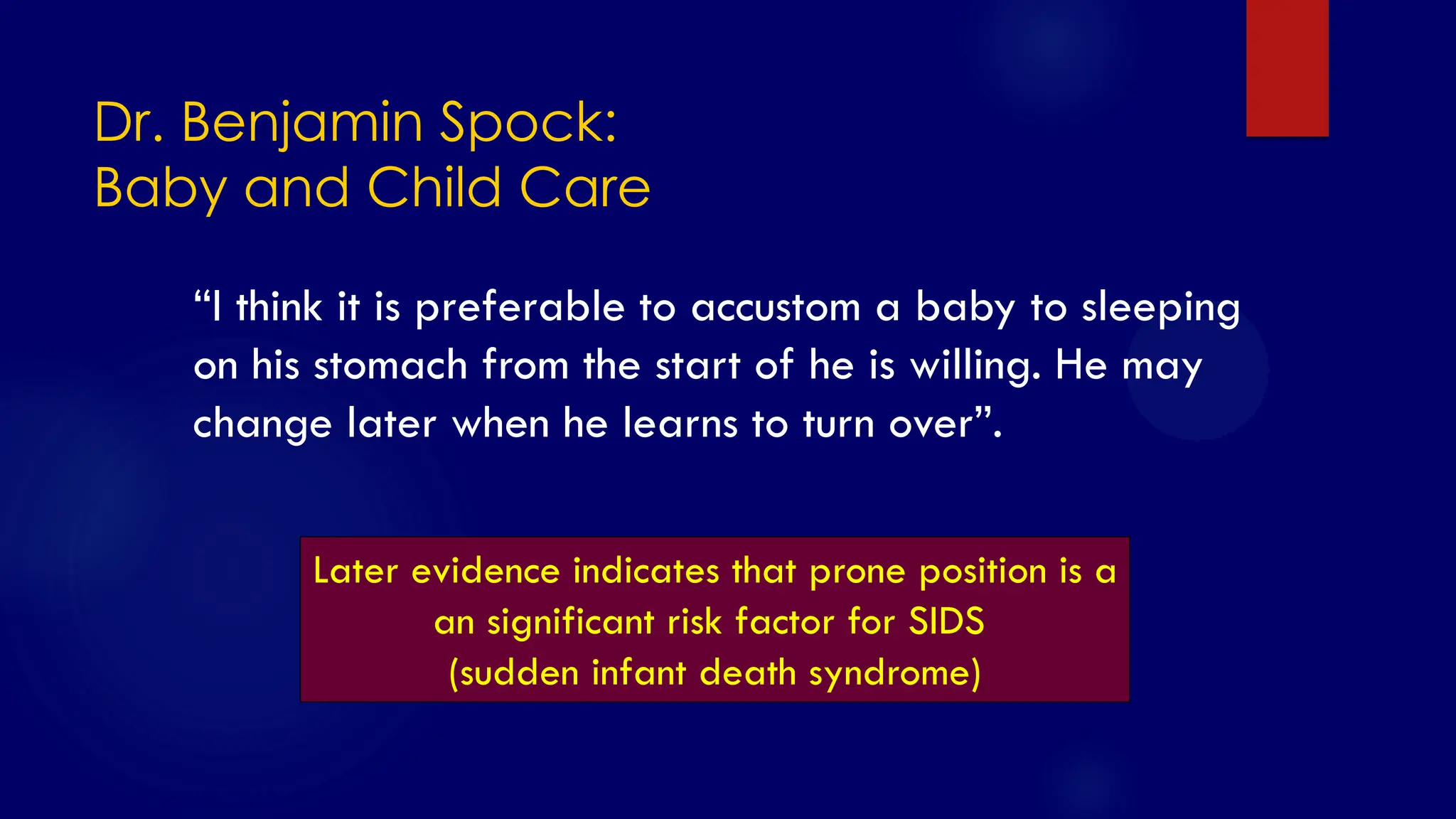
Dr. Benjamin Spock:
Baby and Child Care
Later evidence indicates that prone position is a
an significant risk factor for SIDS
(sudden infant death syndrome)
“I think it is preferable to accustom a baby to sleeping
on his stomach from the start of he is willing. He may
change later when he learns to turn over”.
SS/EBM/IKA-UDIP-2010
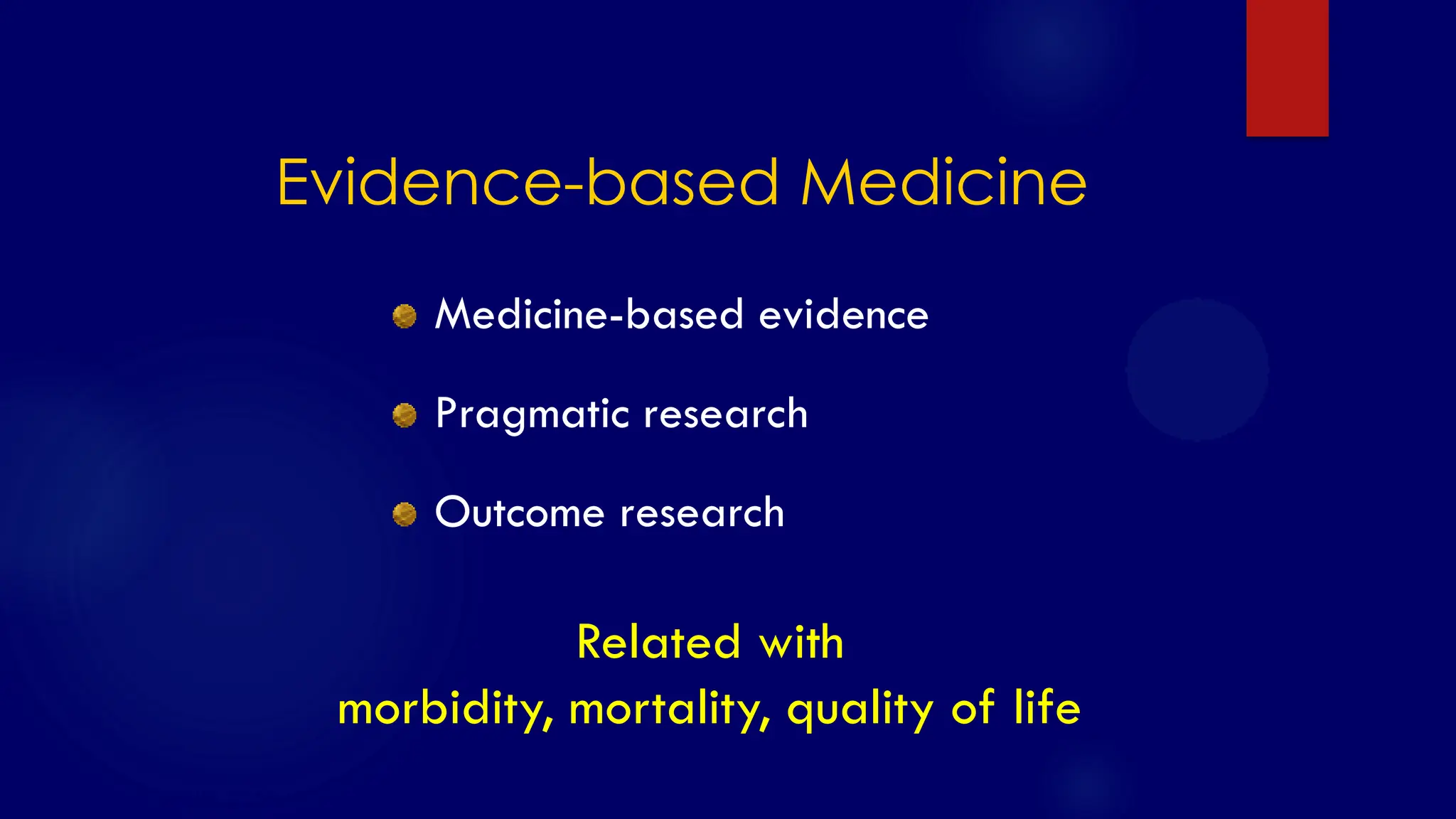
Evidence-based Medicine
Related with
morbidity, mortality, quality of life
Medicine-based evidence
Pragmatic research
Outcome research
SS/EBM/IKA-UDIP-2010
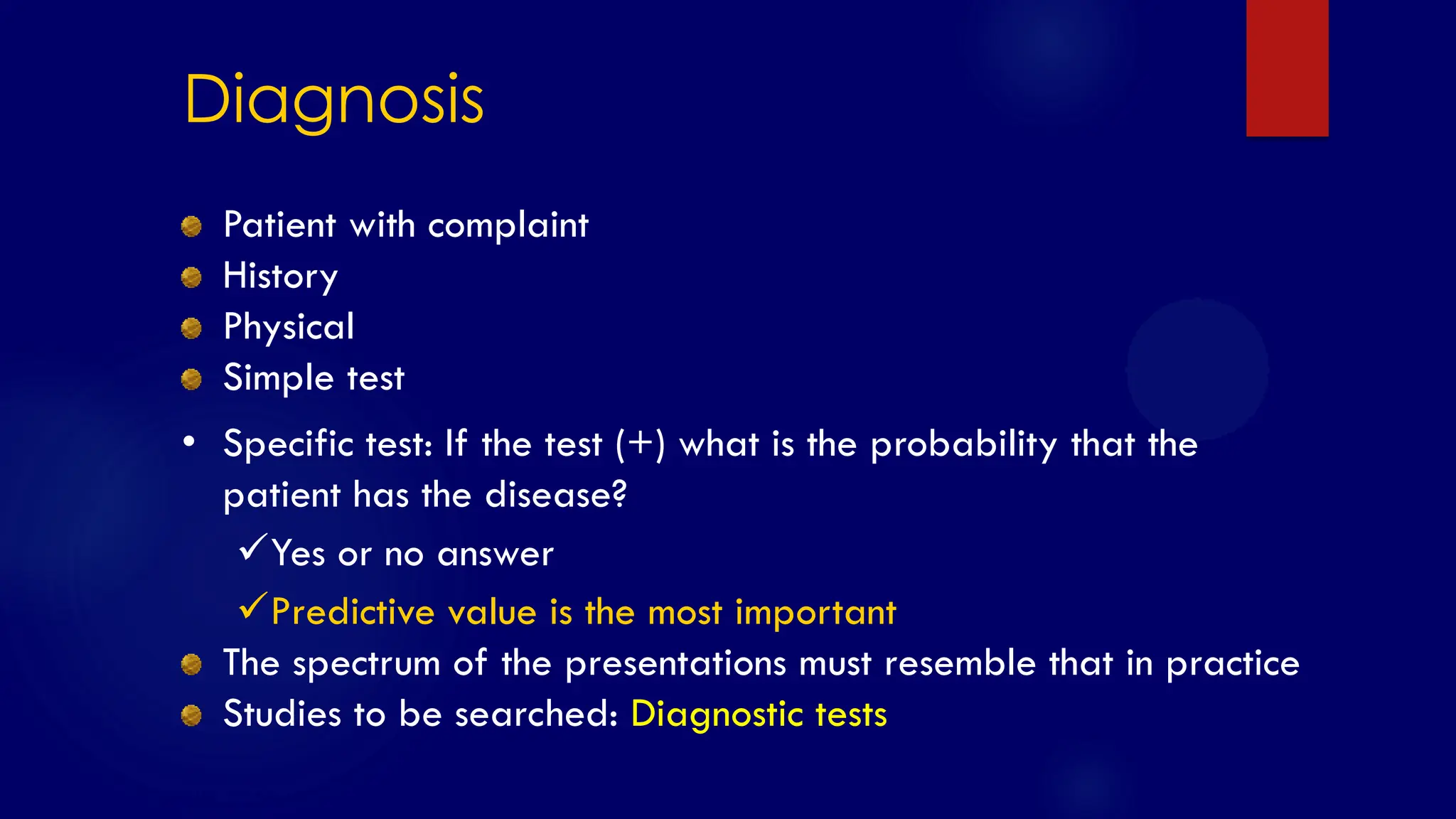
Diagnosis
Patient with complaint
History
Physical
Simple test
• Specific test: If the test (+) what is the probability that the
patient has the disease?
Yes or no answer
Predictive value is the most important
The spectrum of the presentations must resemble that in practice
Studies to be searched: Diagnostic tests
SS/EBM/IKA-UDIP-2010
Treatment
Patient with certain diagnosis: best treatment?
Is drug X more effective than Y?
Focus on the clinical outcome, rather than its explanation
(biomolecular markers, etc)
Yes or no outcome most useful
Not in studies with “idealized” subjects
 Px with DM are frequently have hypercholesterolemia,
obese, hypertension, etc
 Sudies to be searched: RCT
SS/EBM/IKA-UDIP-2010
Prognosis
Usually in cohort studies
To inform about the fate of the patient
Absolute risk is more important than relative risk
 Absolute: Your risk of having second stroke in 1
year is 30%
 Relative: Your risk of having second stroke in 1
year is 2 times than in non-smokers (RR = 2)
 Studies: Cohorts, case controls
SS/EBM/IKA-UDIP-2010
Pros : “New paradigm in medicine”
“Extraordinary innovations,
only 2nd to Human Genome Project”
Cons : New version of an old song
„Fair‟ : Nothing wrong with EBM, but:
• Be careful in searching evidence
• Meta-analyses, clinical trials, and all study results
should be critically appraised
Keyword for EBM:
Methodological skill to judge the validity
of study reports (Re. Andersen B: Methodo-logical errors
in medical research, 1989)
SS/EBM/IKA-UDIP-2010
EBM & Clinical Epidemiology
Fletcher & Fletcher: CE = The application of epidemiologic
principles in problems encountered in clinical medicine
Sackett et al: CE = The basic science for clinical medicine
Much resistance by experts
EBM: In principle – no one disagree
All major medical journals have adopted EBM
Centers for EBM all over the world
SS/EBM/IKA-UDIP-2010
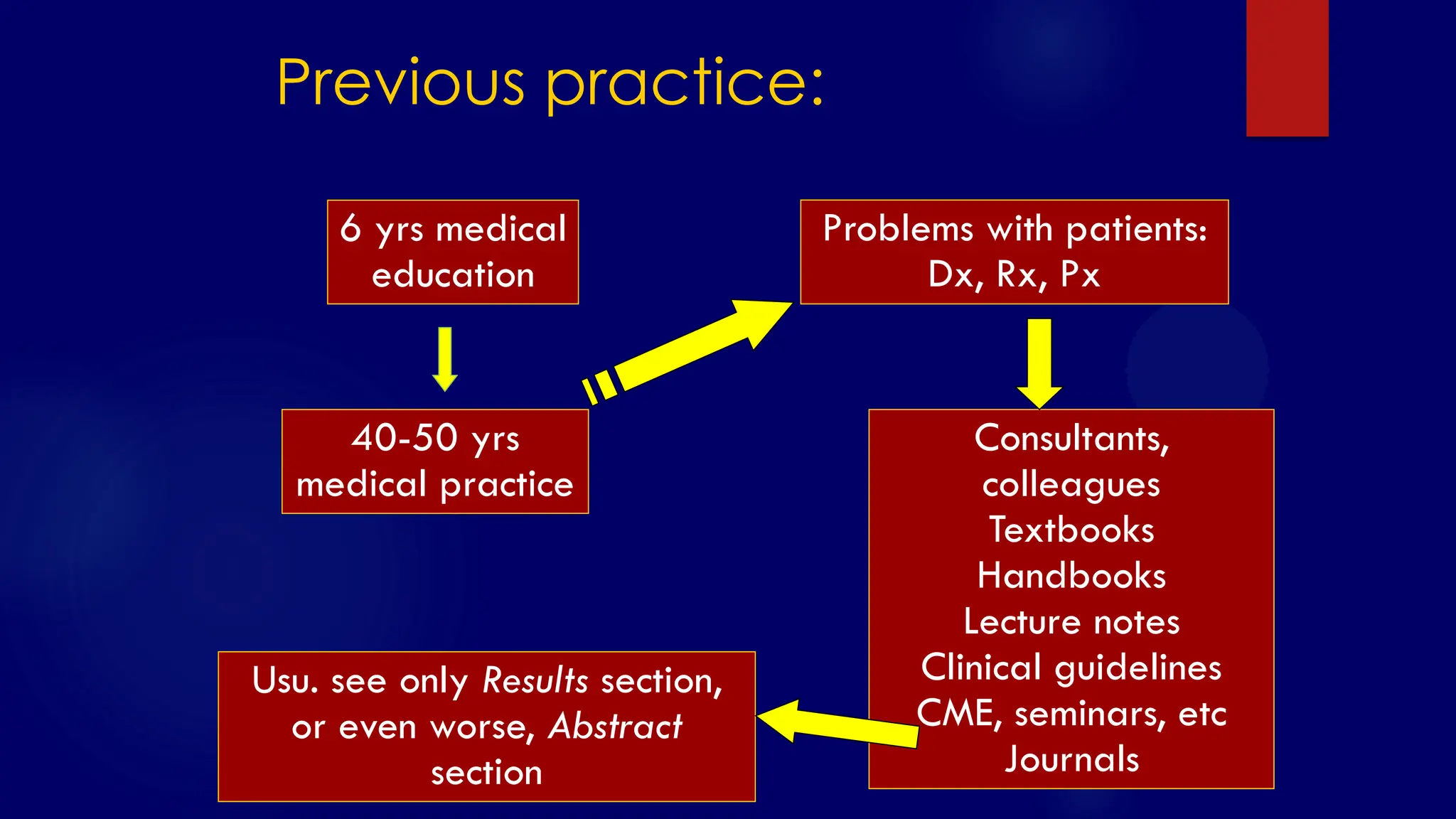
Previous practice:
6 yrs medical
education
40-50 yrs
medical practice
Problems with patients:
Dx, Rx, Px
Consultants,
colleagues
Textbooks
Handbooks
Lecture notes
Clinical guidelines
CME, seminars, etc
Journals
Usu. see only Results section,
or even worse, Abstract
section
SS/EBM/IKA-UDIP-2010
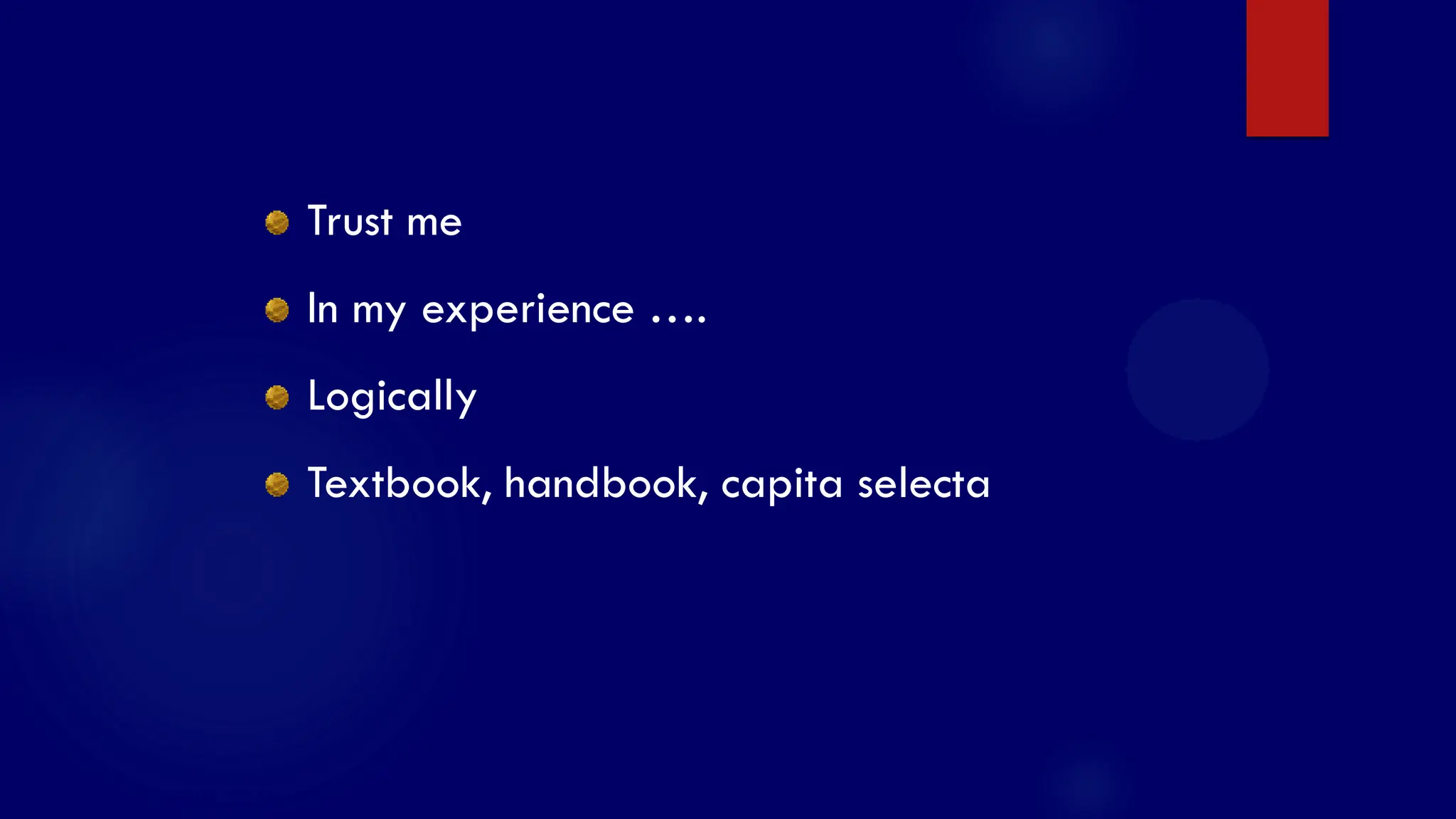
Trust me
In my experience ….
Logically
Textbook, handbook, capita selecta
SS/EBM/IKA-UDIP-2010
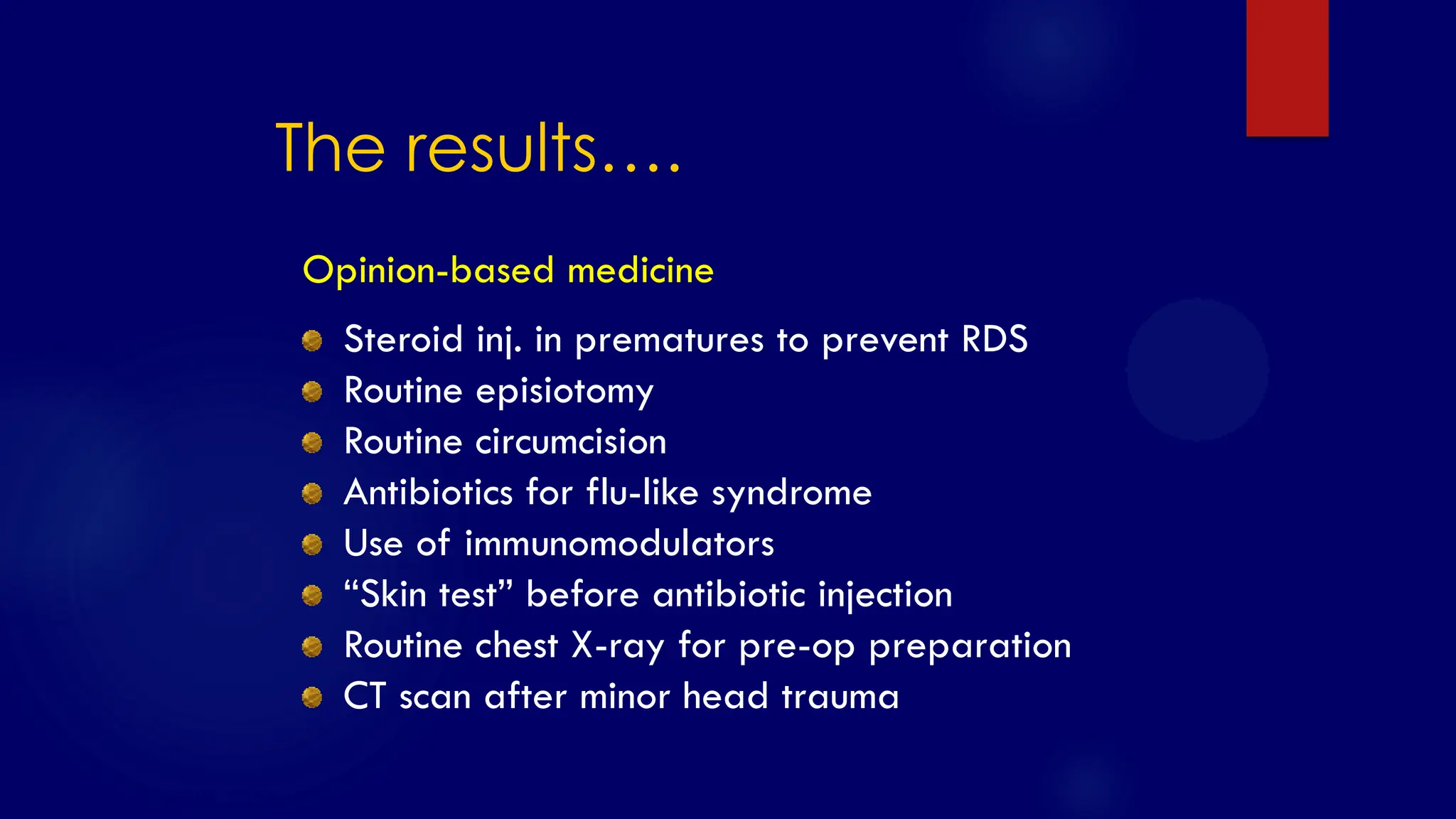
The results….
Opinion-based medicine
Steroid inj. in prematures to prevent RDS
Routine episiotomy
Routine circumcision
Antibiotics for flu-like syndrome
Use of immunomodulators
“Skin test” before antibiotic injection
Routine chest X-ray for pre-op preparation
CT scan after minor head trauma
SS/EBM/IKA-UDIP-2010
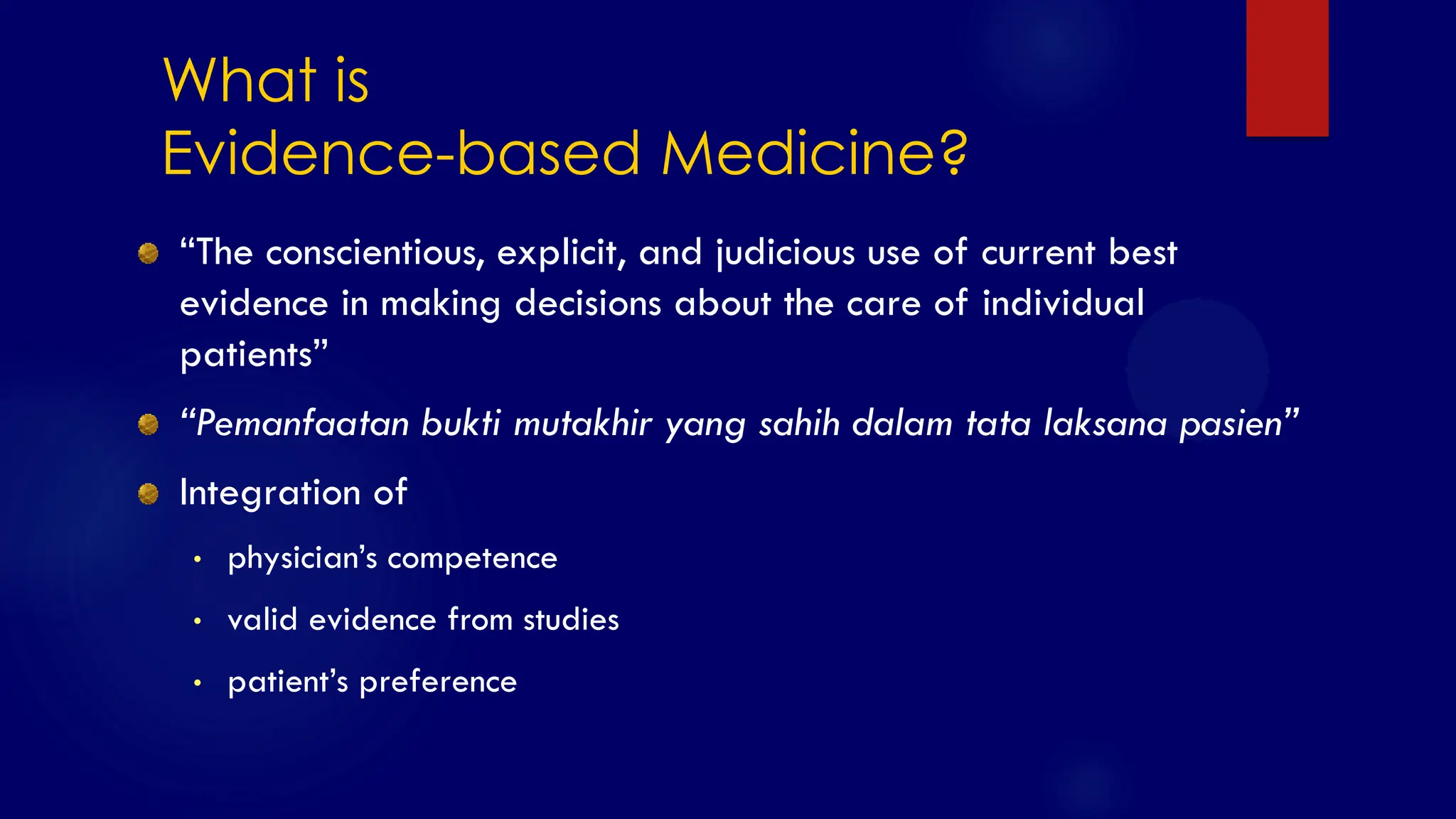
What is
Evidence-based Medicine?
“The conscientious, explicit, and judicious use of current best
evidence in making decisions about the care of individual
patients”
“Pemanfaatan bukti mutakhir yang sahih dalam tata laksana pasien”
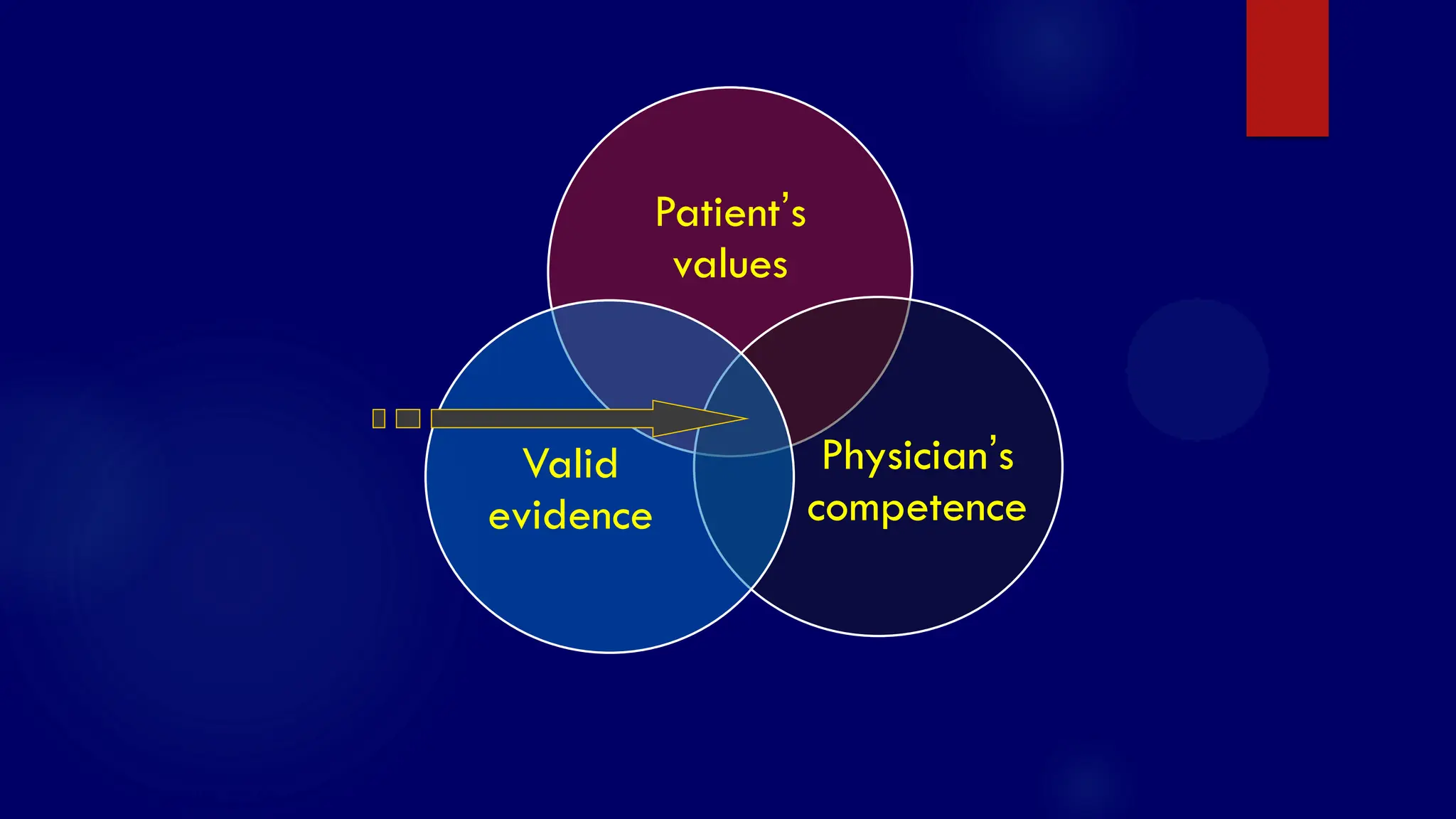
Integration of
• physician‟s competence
• valid evidence from studies
• patient‟s preference
SS/EBM/IKA-UDIP-2010
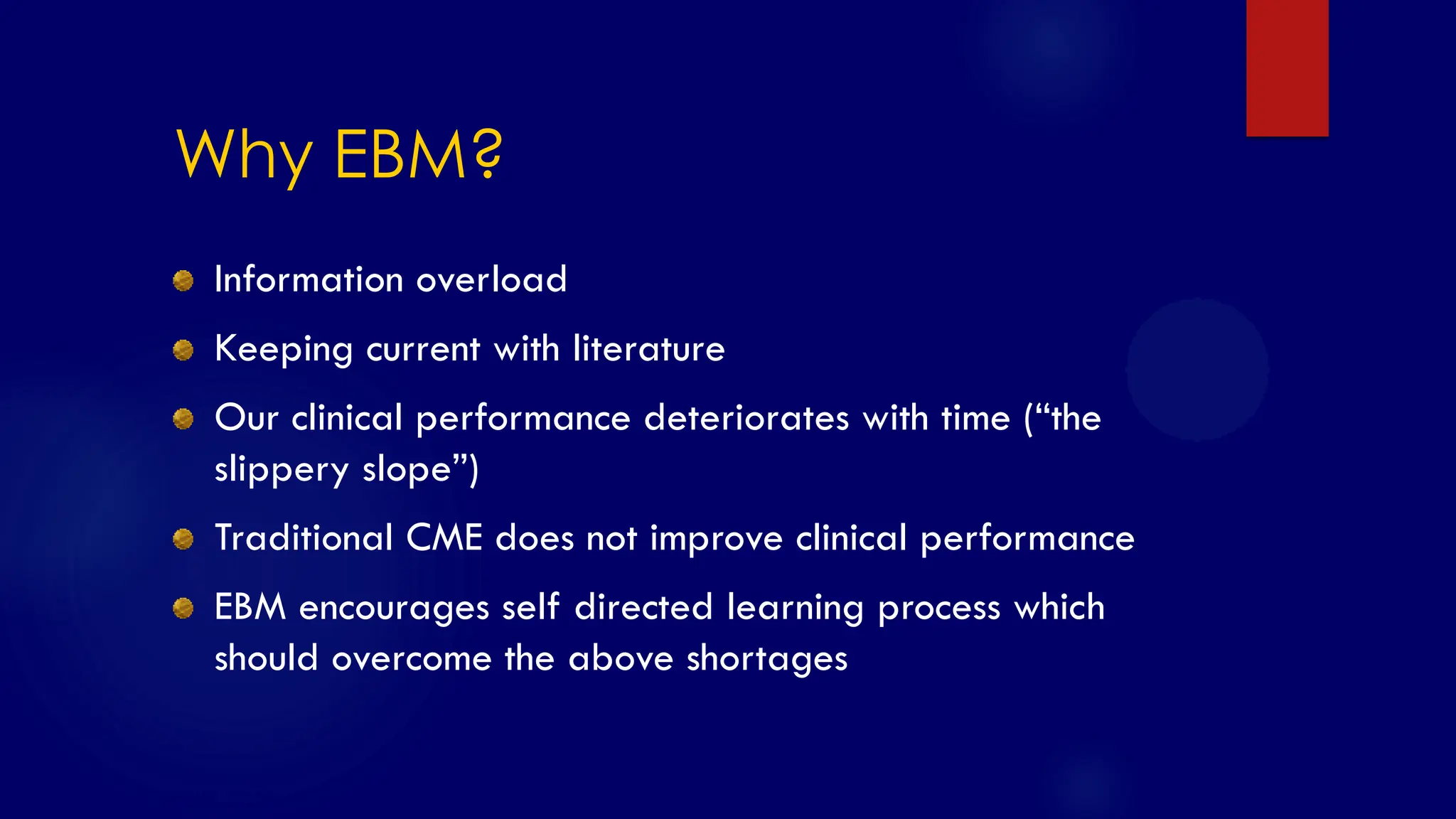
Why EBM?
Information overload
Keeping current with literature
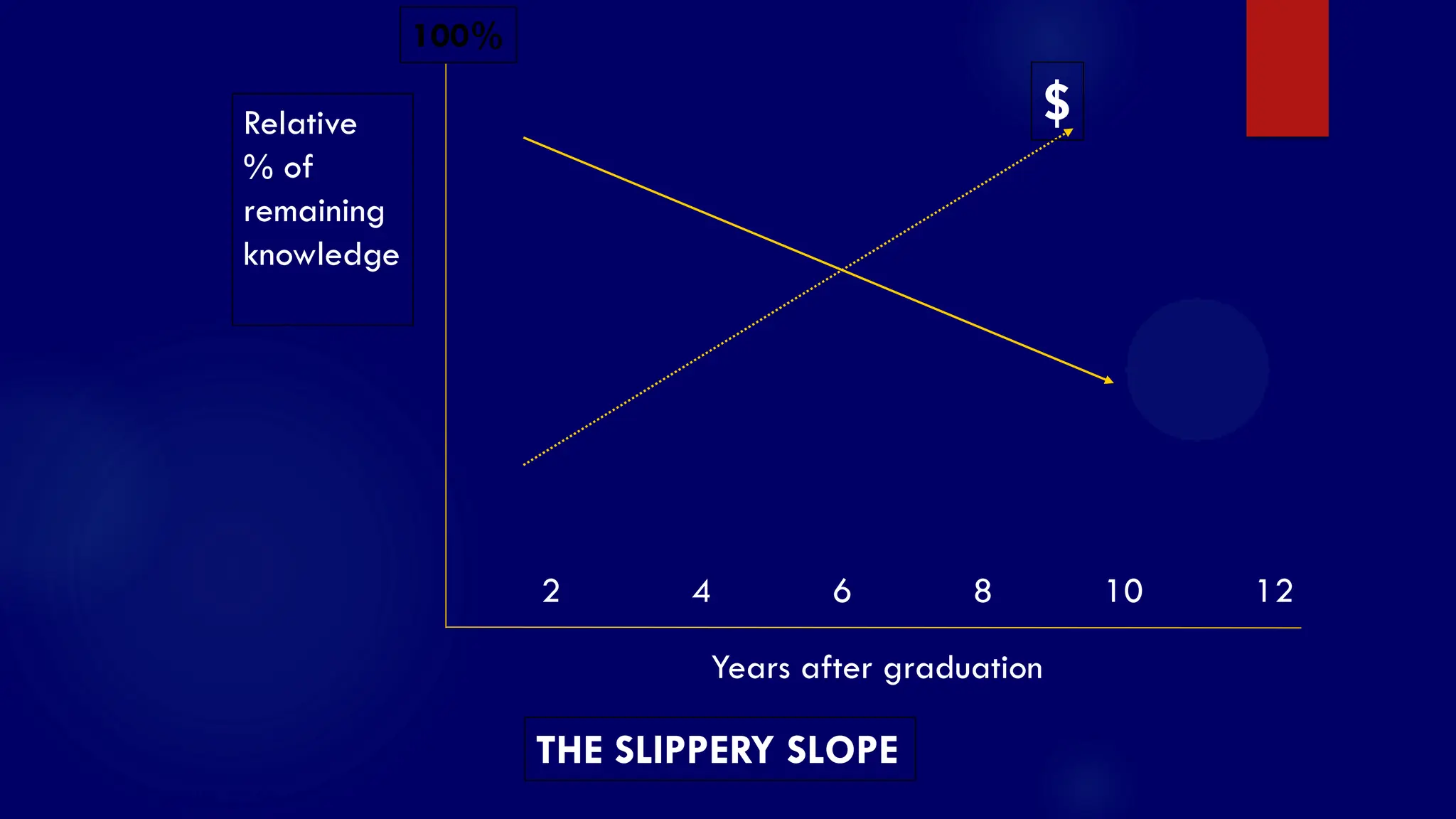
Our clinical performance deteriorates with time (“the
slippery slope”)
Traditional CME does not improve clinical performance
EBM encourages self directed learning process which
should overcome the above shortages
SS/EBM/IKA-UDIP-2010
Years after graduation
Relative
% of
remaining
knowledge
2 4 6 8 10 12
$
100%
THE SLIPPERY SLOPE
SS/EBM/IKA-UDIP-2010
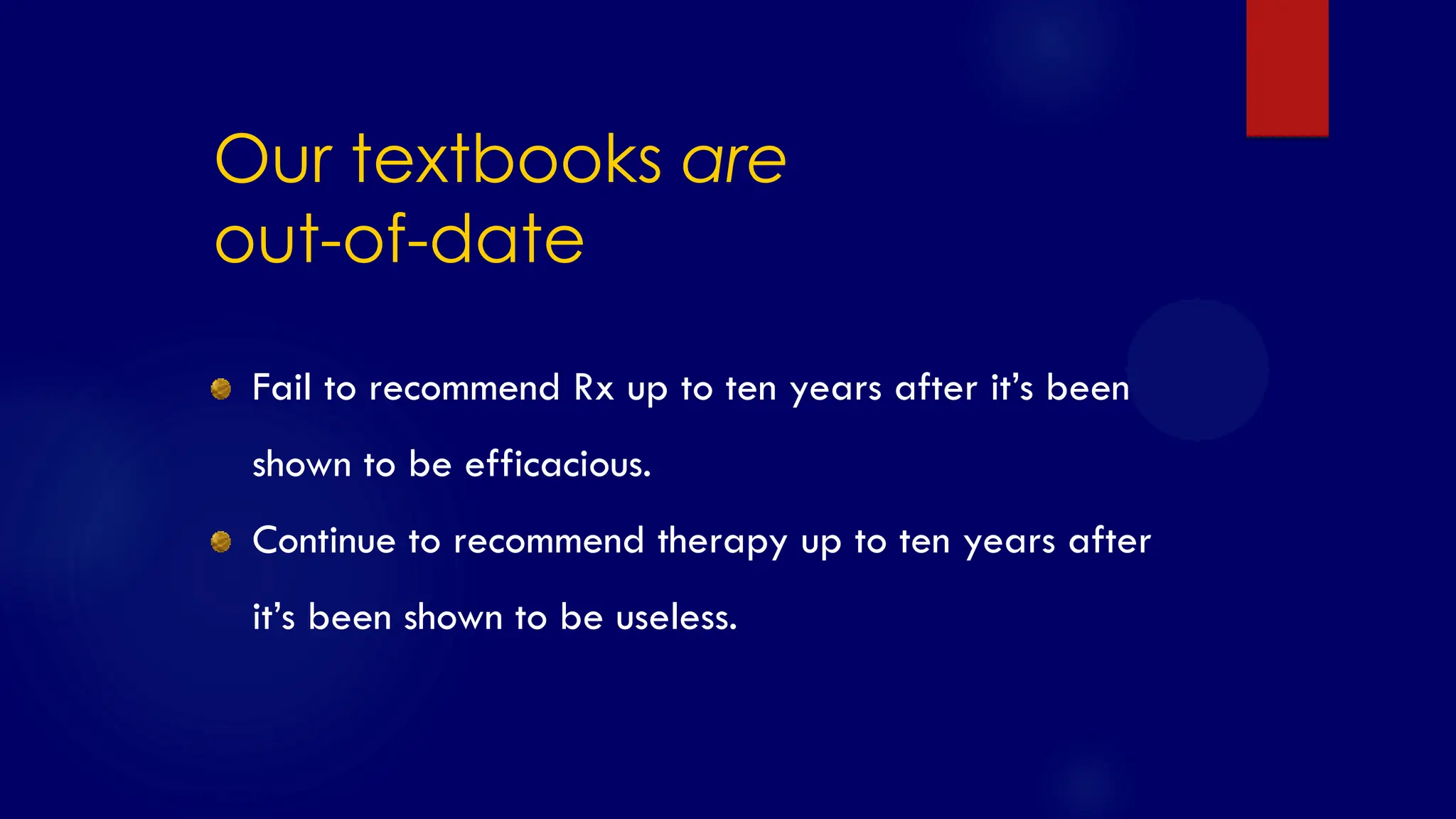
Our textbooks are
out-of-date
Fail to recommend Rx up to ten years after it‟s been
shown to be efficacious.
Continue to recommend therapy up to ten years after
it‟s been shown to be useless.
SS/EBM/IKA-UDIP-2010
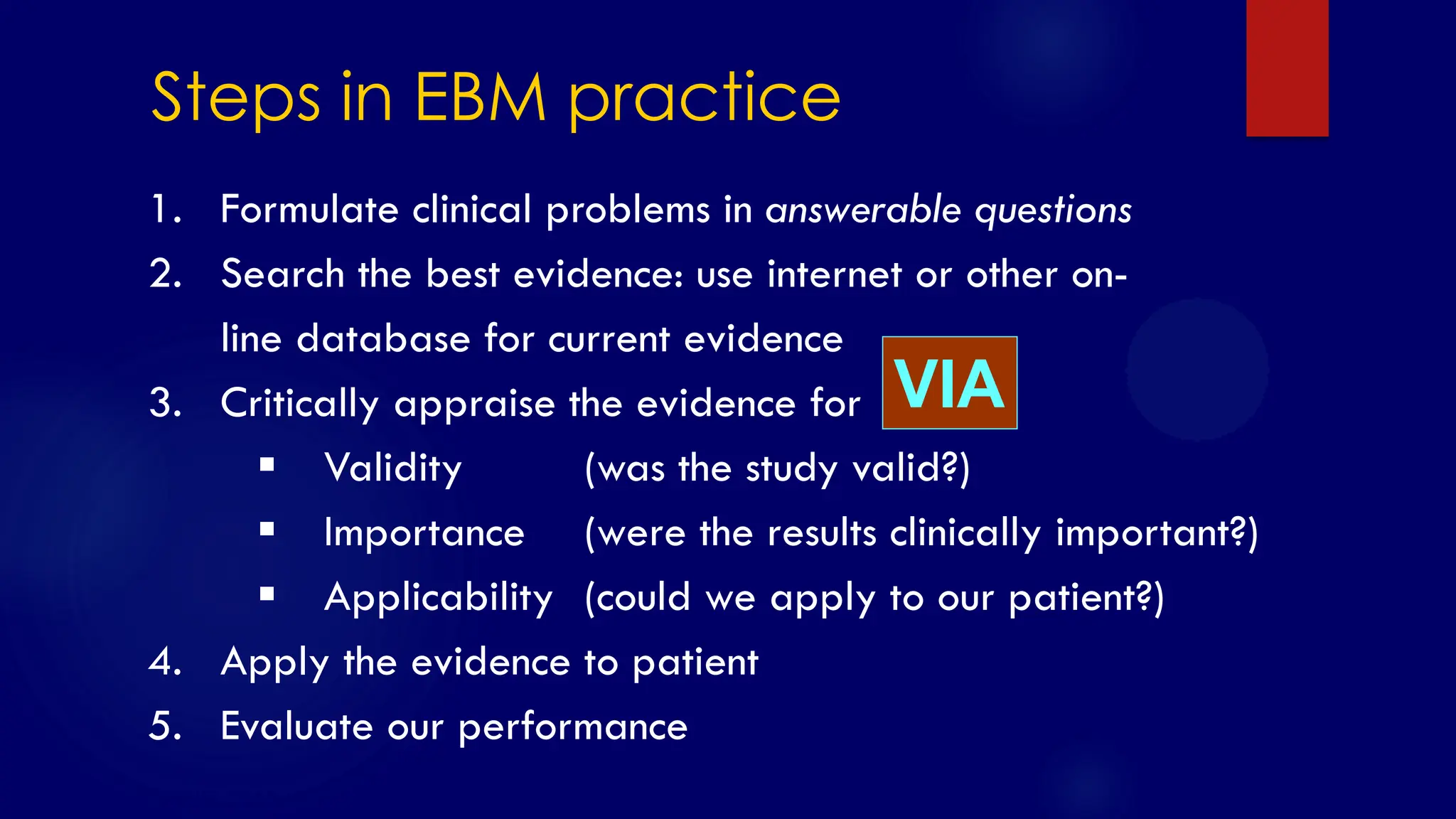
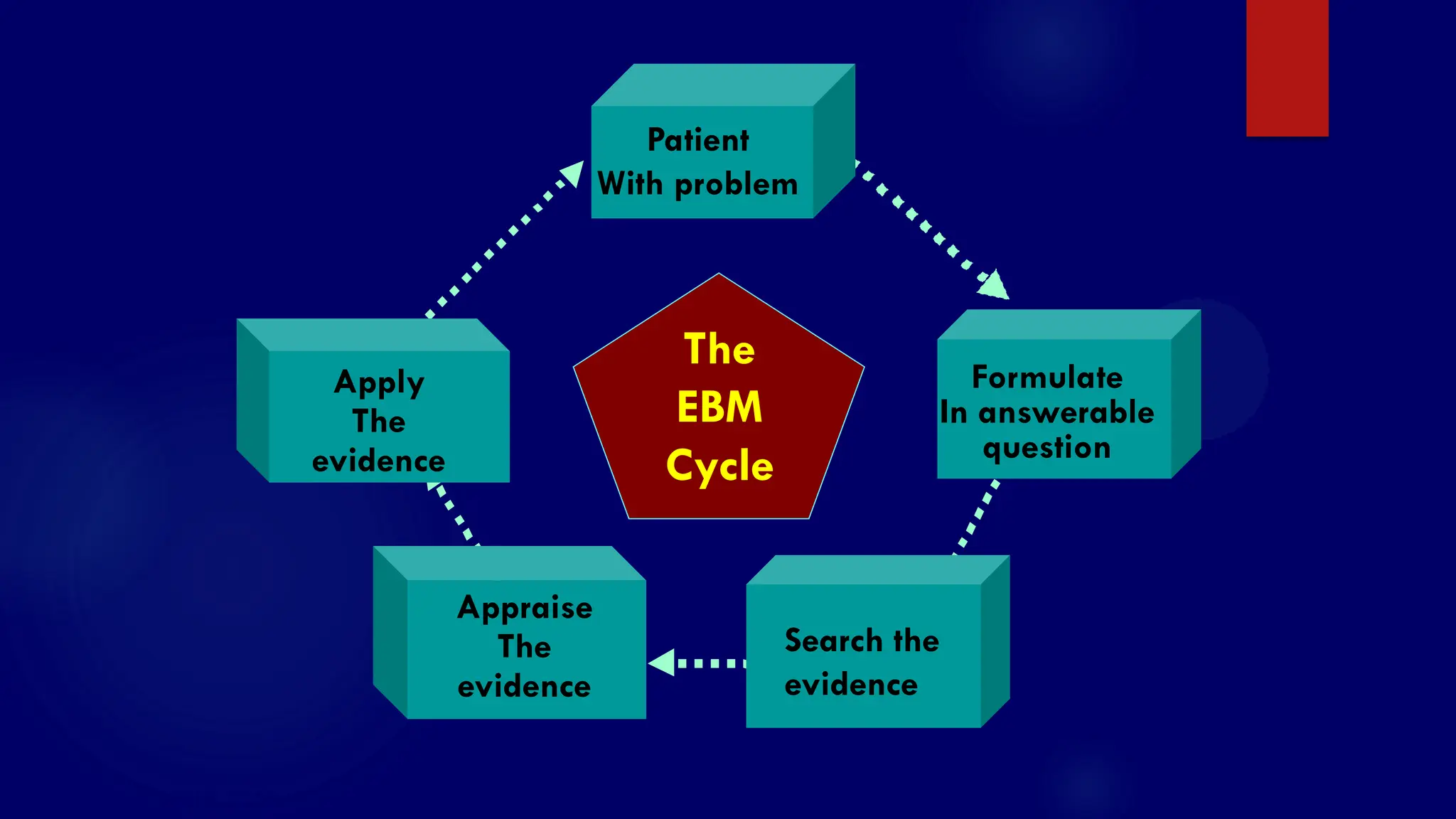
1. Formulate clinical problems in answerable questions
2. Search the best evidence: use internet or other on-
line database for current evidence
3. Critically appraise the evidence for
 Validity (was the study valid?)
 Importance (were the results clinically important?)
 Applicability (could we apply to our patient?)
4. Apply the evidence to patient
5. Evaluate our performance
Steps in EBM practice
VIA
SS/EBM/IKA-UDIP-2010
Diagnosis
(Determination of disease or problem)
Treatment
(Intervention necessary to help the patient)
Prognosis
(Prediction of the outcome of the disease)
Main area
SS/EBM/IKA-UDIP-2010
(I) Formulating clinical questions
SS/EBM/IKA-UDIP-2010
 A 2-year old boy presented with 6-day high
fever, conjunctival injection without secretion, skin
rash> blood test shows leukocytosis, high ESR,
CRP +++. He was suspected to have Kawasaki
disease. The pediatrician is aware of the use of
immunoglobulin to prevent coronary involvement,
but uncertain about the dosage or recent
developments.
SS/EBM/IKA-UDIP-2010
Medical students:
(Background question)
What is Kawasaki disease?
What is the etiology?
How it is diagnosed?
What is the treatment of choice?
Complications?
SS/EBM/IKA-UDIP-2010
House officers
(Foreground question)
In a child with KD, would immunoglobulin treatment,
compared with no immunoglobulin, reduce the chance
to develop coronary complication?
SS/EBM/IKA-UDIP-2010
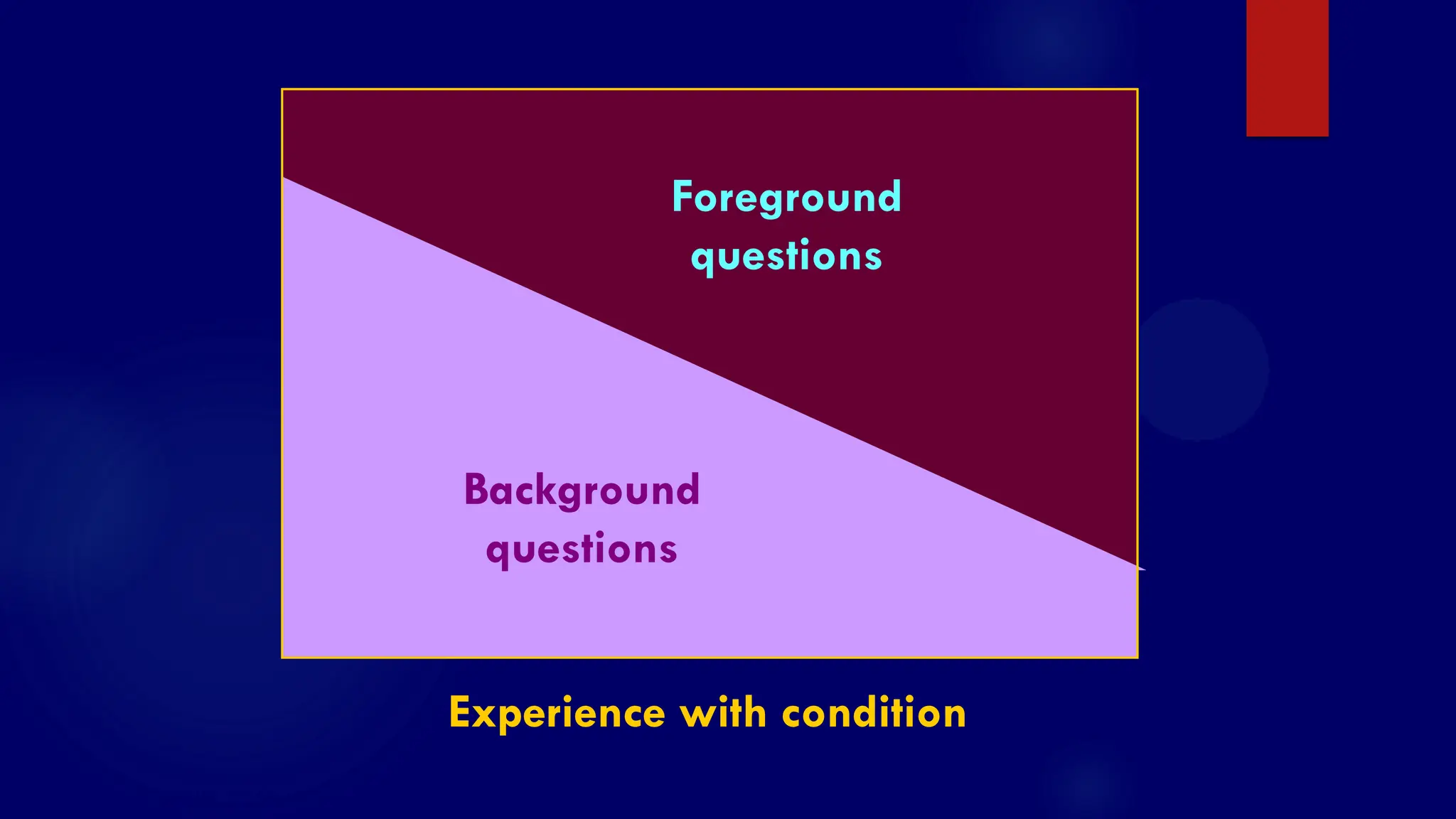
Foreground
questions
Background
questions
Experience with condition
SS/EBM/IKA-UDIP-2010
Other examples
In young women with solitary thyroid nodule, can USG,
compared with biopsy, differentiate between benign
from malignant? (Diagnosis)
In women systemic lupus erythematosus, is history of
congestive heart failure, compared with no heart
failure, worsen the prognosis? (Prognosis)
In women with history of eclampsia, would
administration of low-dose aspirin during pregnancy
prevent eclampsia? (Prevention)
SS/EBM/IKA-UDIP-2010
Four elements of
good clinical question: PICO
The Patient or Problem
The Intervention / Index / Indicator
Comparative intervention (if relevant)
The Outcome
SS/EBM/IKA-UDIP-2010
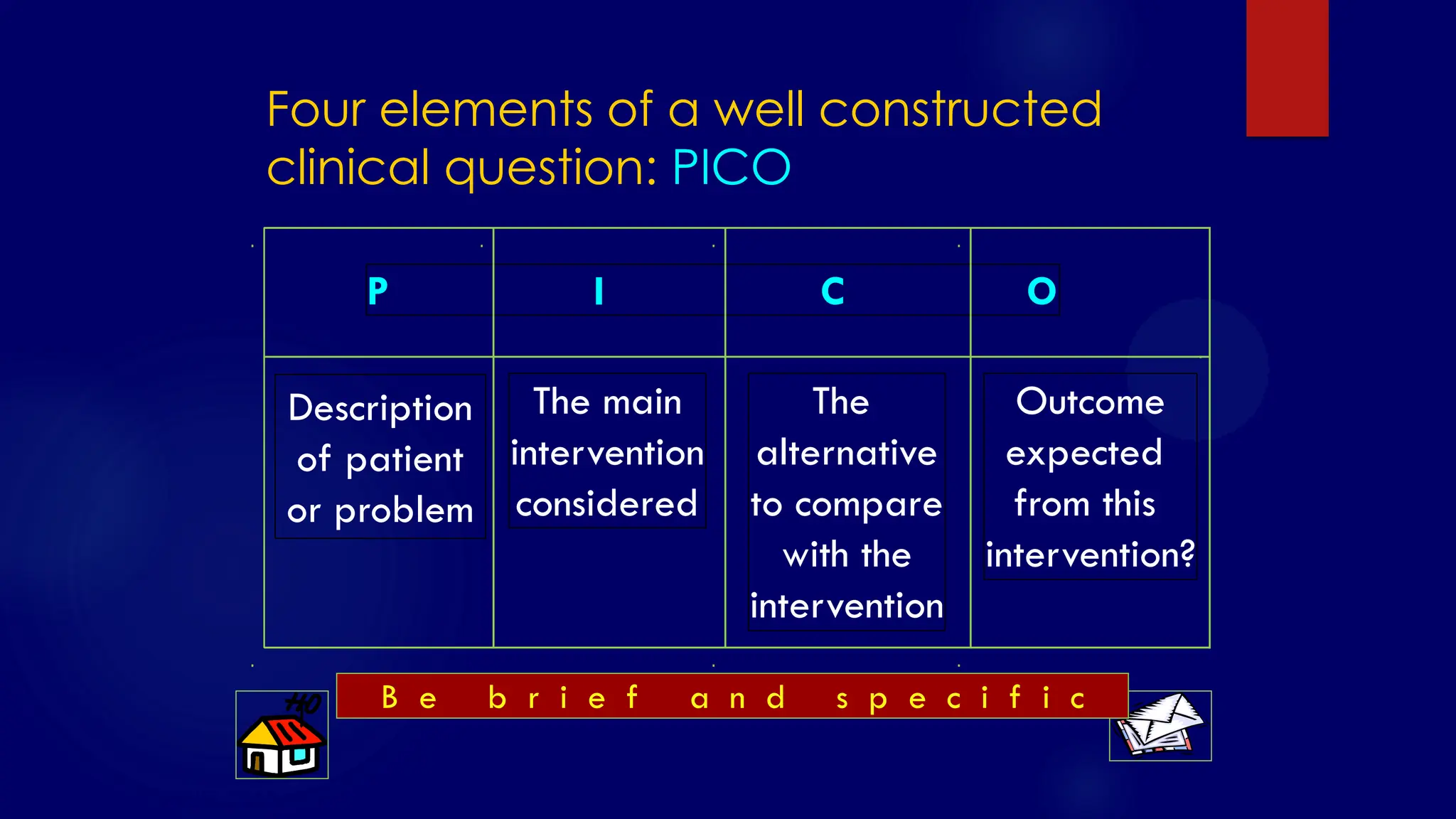
Four elements of a well constructed
clinical question: PICO
P I C O
The main
intervention
considered
The
alternative
to compare
with the
intervention
Outcome
expected
from this
intervention?
Description
of patient
or problem
B e b r i e f a n d s p e c i f i c
SS/EBM/IKA-UDIP-2010
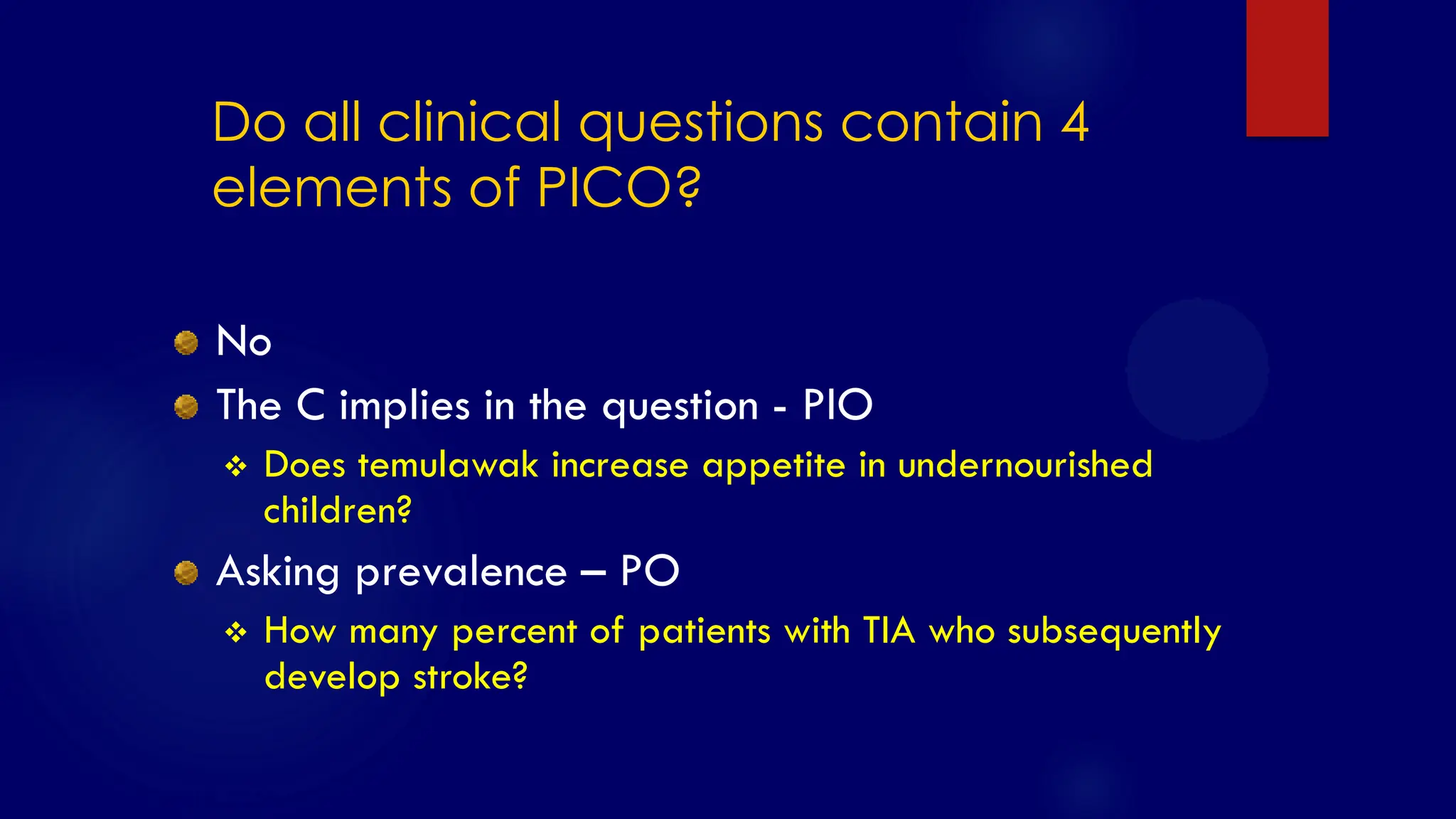
Do all clinical questions contain 4
elements of PICO?
No
The C implies in the question - PIO
 Does temulawak increase appetite in undernourished
children?
Asking prevalence – PO
 How many percent of patients with TIA who subsequently
develop stroke?
SS/EBM/IKA-UDIP-2010
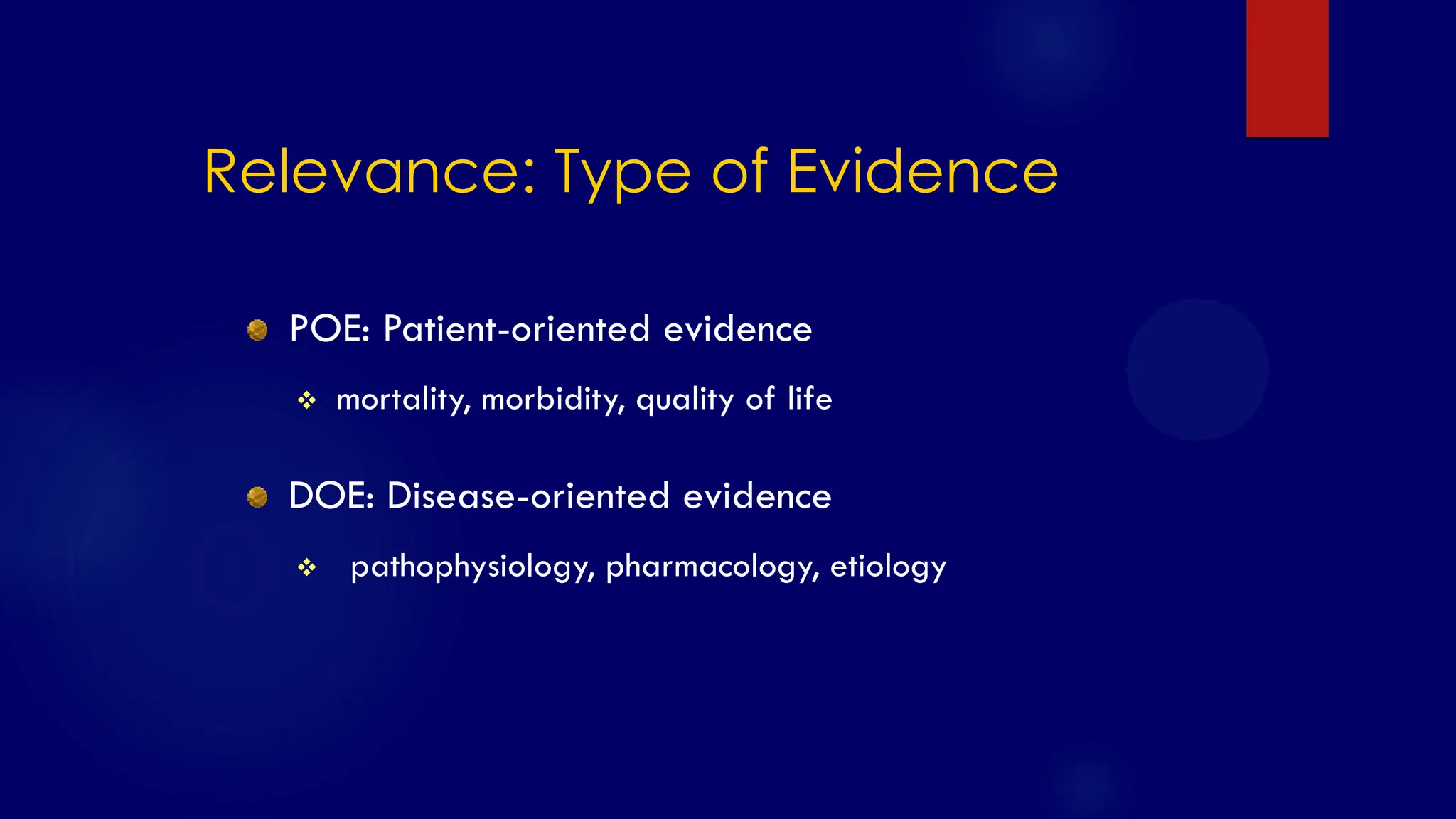
Relevance: Type of Evidence
POE: Patient-oriented evidence
 mortality, morbidity, quality of life
DOE: Disease-oriented evidence
 pathophysiology, pharmacology, etiology
SS/EBM/IKA-UDIP-2010
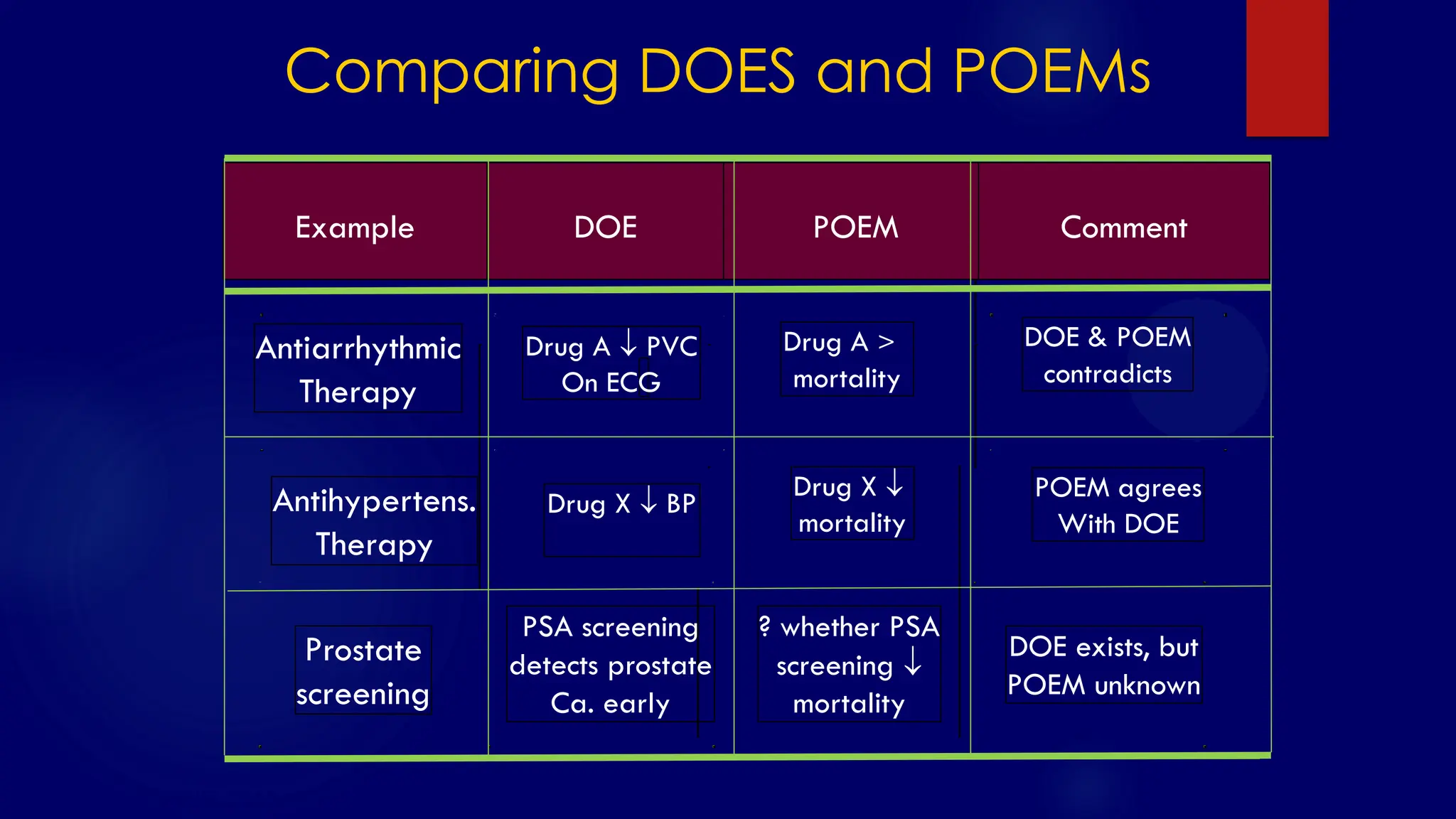
Comparing DOES and POEMs
Prostate
screening
PSA screening
detects prostate
Ca. early
? whether PSA
screening 
mortality
DOE exists, but
POEM unknown
Antiarrhythmic
Therapy
Antihypertens.
Therapy
Drug A  PVC
On ECG
Drug X  BP
Drug X 
mortality
Drug A >
mortality
DOE & POEM
contradicts
POEM agrees
With DOE
Example DOE POEM Comment
SS/EBM/IKA-UDIP-2010
II - Searching the evidence
SS/EBM/IKA-UDIP-2010
III - Appraising the evidence:
VIA
SS/EBM/IKA-UDIP-2010
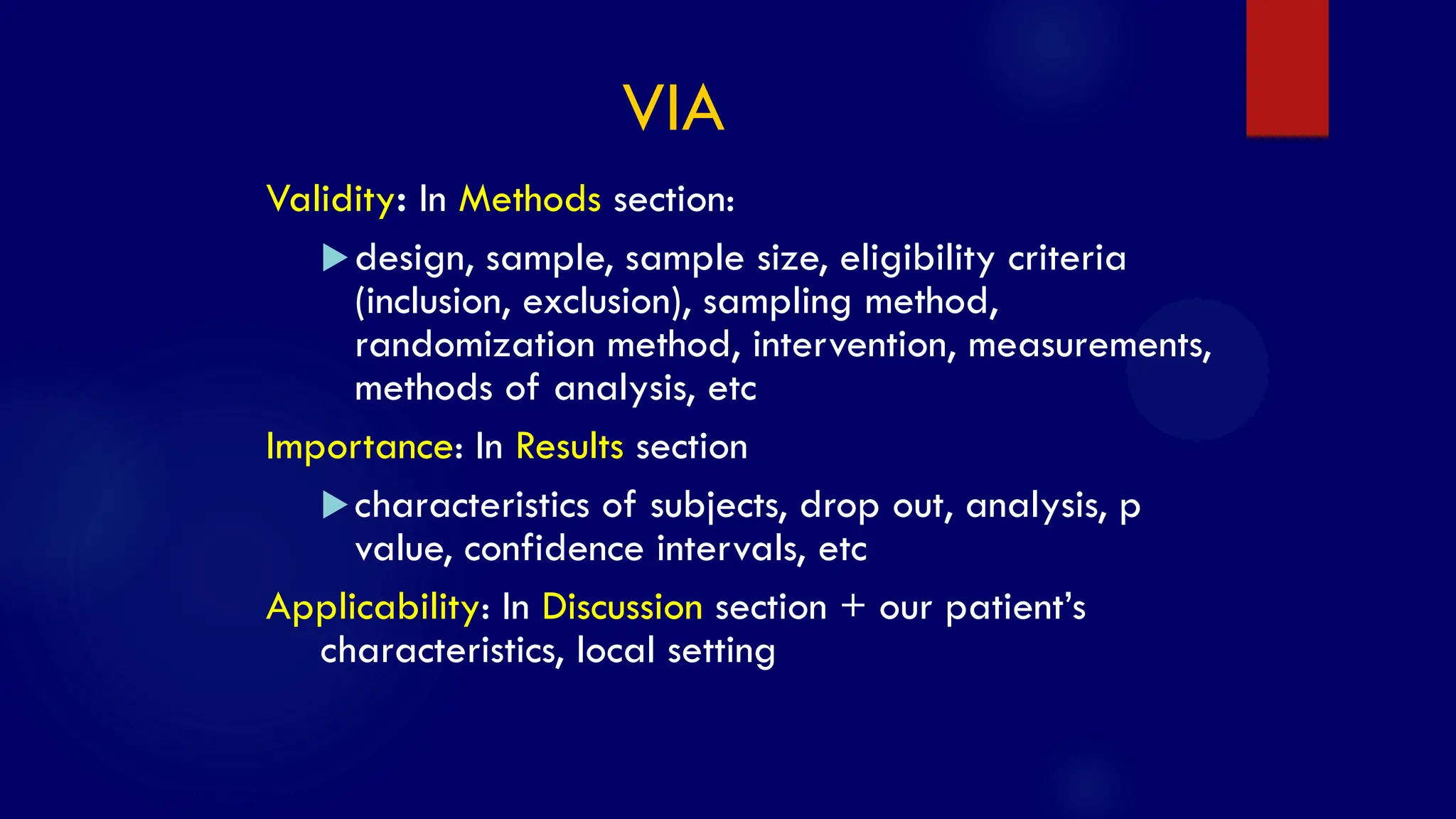
Validity: In Methods section:
design, sample, sample size, eligibility criteria
(inclusion, exclusion), sampling method,
randomization method, intervention, measurements,
methods of analysis, etc
Importance: In Results section
characteristics of subjects, drop out, analysis, p
value, confidence intervals, etc
Applicability: In Discussion section + our patient‟s
characteristics, local setting
VIA
SS/EBM/IKA-UDIP-2010
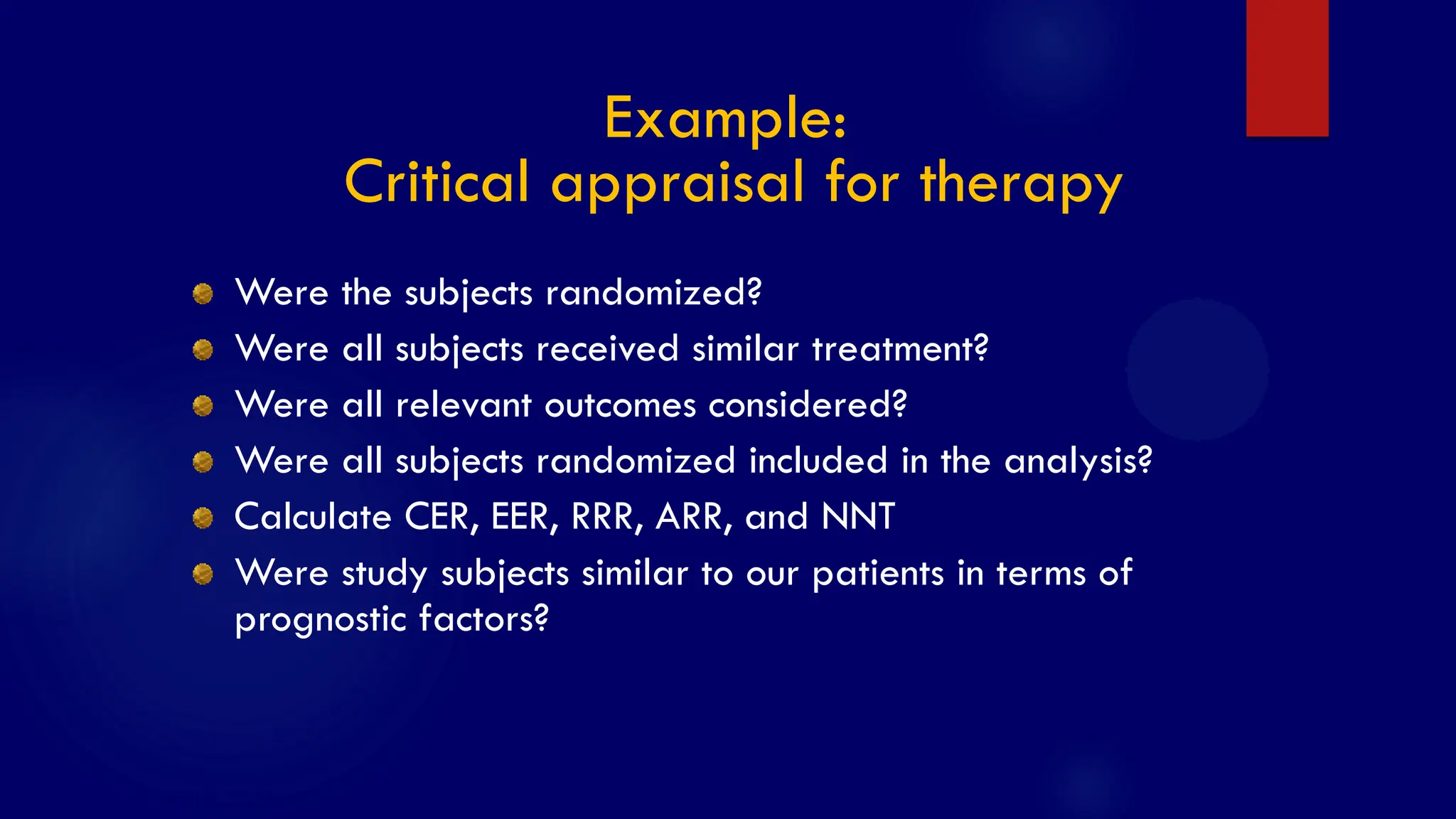
Example:
Critical appraisal for therapy
Were the subjects randomized?
Were all subjects received similar treatment?
Were all relevant outcomes considered?
Were all subjects randomized included in the analysis?
Calculate CER, EER, RRR, ARR, and NNT
Were study subjects similar to our patients in terms of
prognostic factors?
SS/EBM/IKA-UDIP-2010
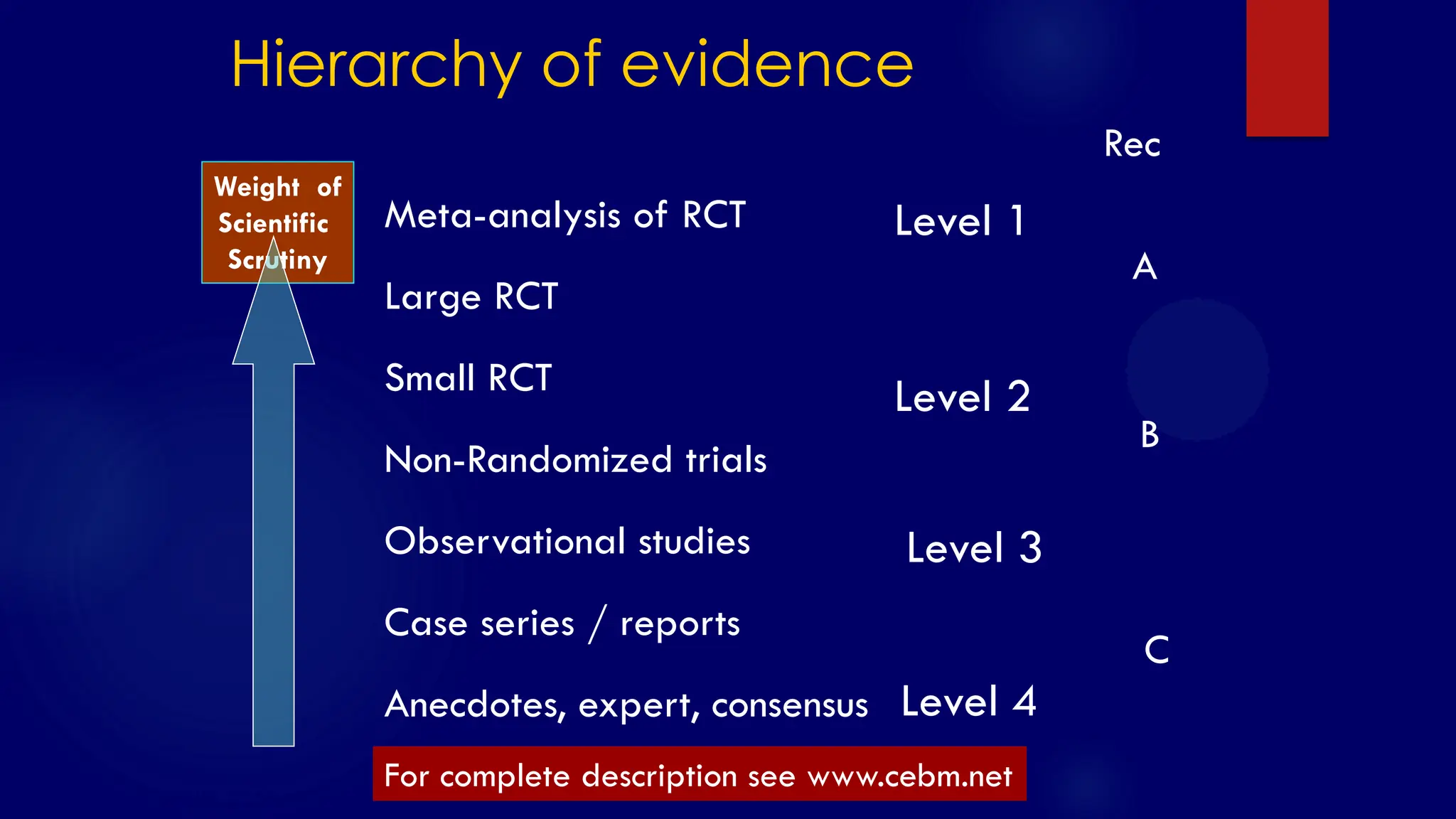
Hierarchy of evidence
Meta-analysis of RCT
Large RCT
Small RCT
Non-Randomized trials
Observational studies
Case series / reports
Anecdotes, expert, consensus
Level 1
Level 2
Level 3
Level 4
A
B
C
Rec
Weight of
Scientific
Scrutiny
For complete description see www.cebm.net
SS/EBM/IKA-UDIP-2010
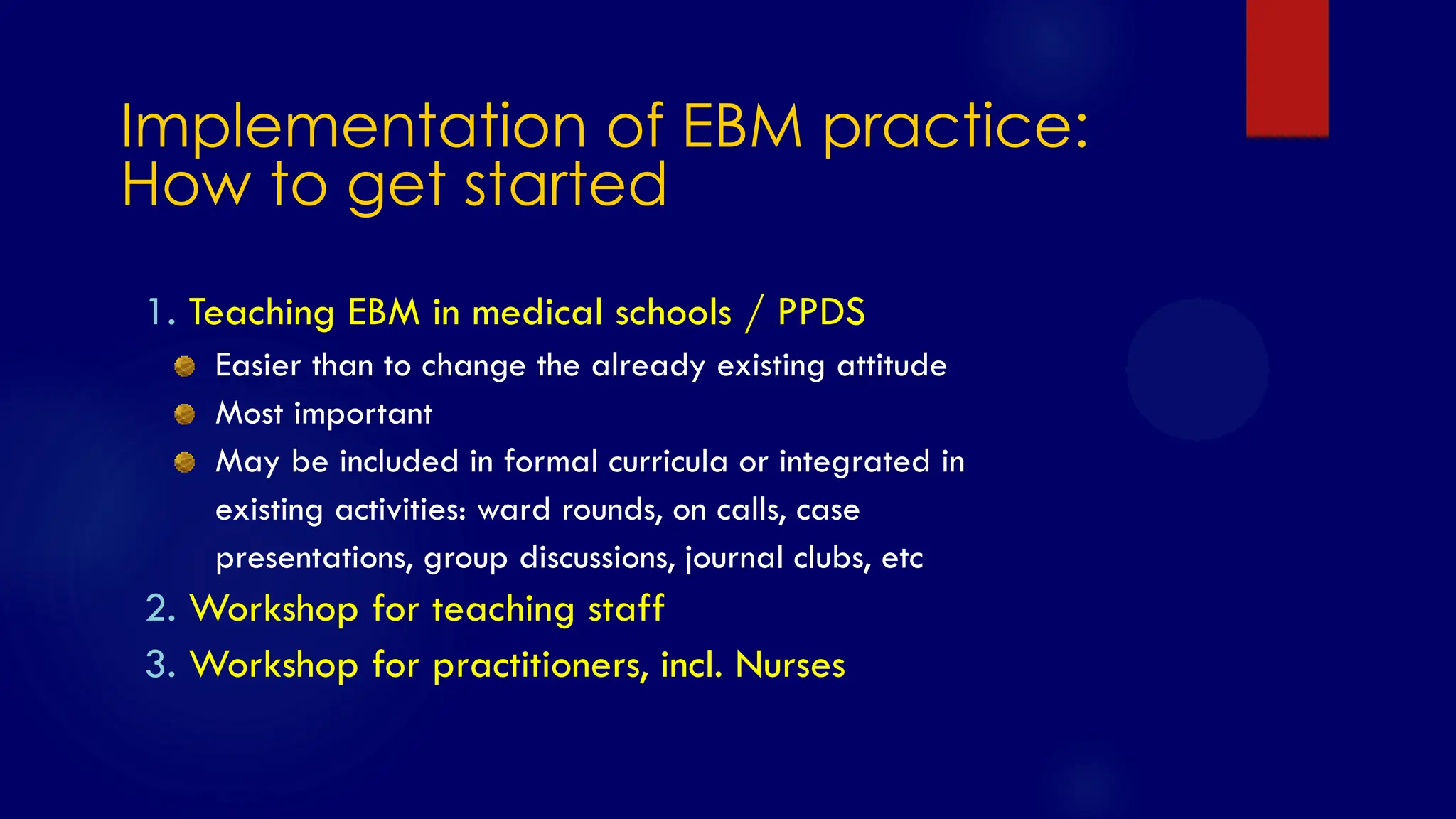
Implementation of EBM practice:
How to get started
1. Teaching EBM in medical schools / PPDS
Easier than to change the already existing attitude
Most important
May be included in formal curricula or integrated in
existing activities: ward rounds, on calls, case
presentations, group discussions, journal clubs, etc
2. Workshop for teaching staff
3. Workshop for practitioners, incl. Nurses
SS/EBM/IKA-UDIP-2010
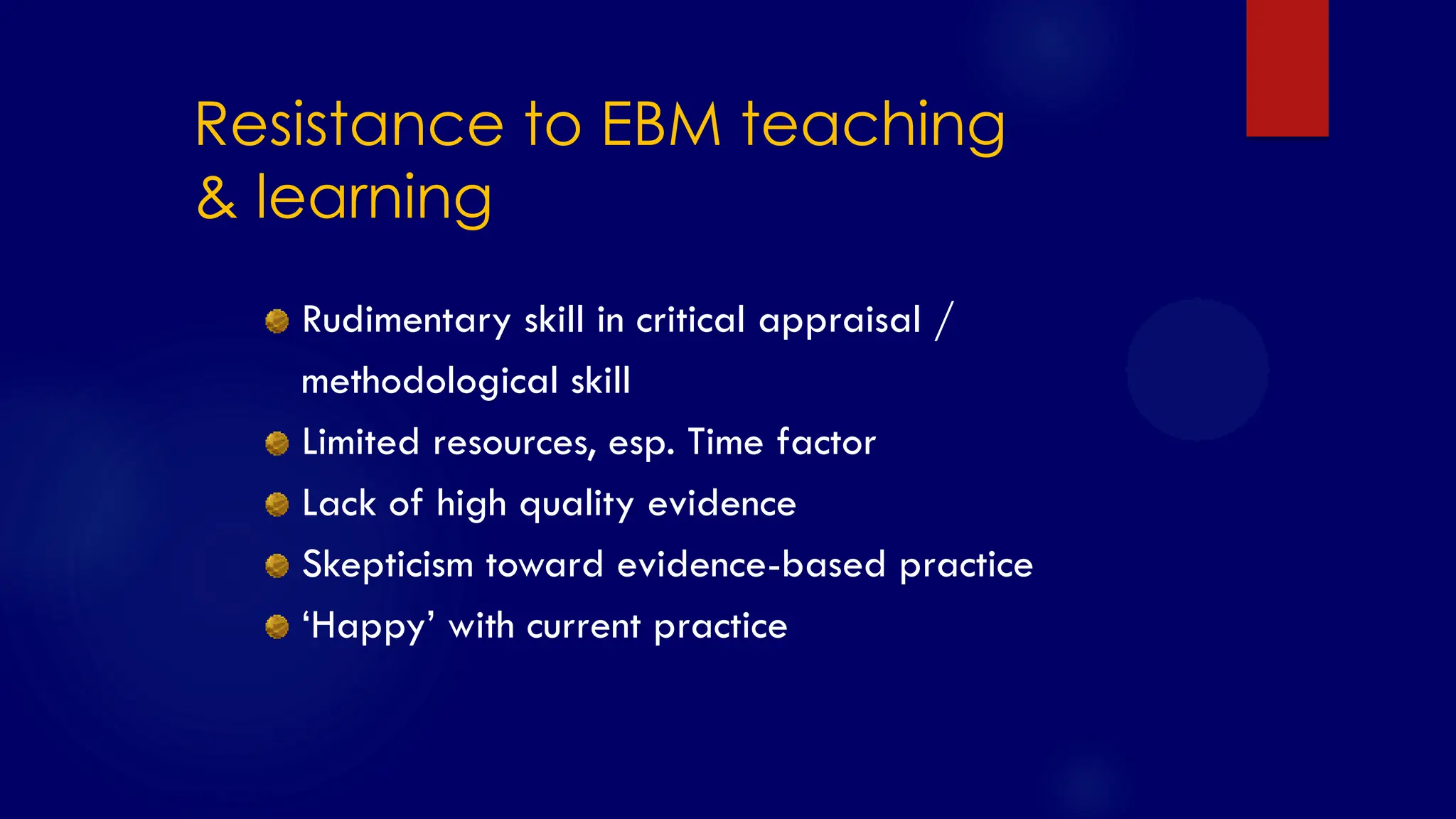
Resistance to EBM teaching
& learning
Rudimentary skill in critical appraisal /
methodological skill
Limited resources, esp. Time factor
Lack of high quality evidence
Skepticism toward evidence-based practice
„Happy‟ with current practice
SS/EBM/IKA-UDIP-2010
Patient’s
values
Physician’s
competence
Valid
evidence
SS/EBM/IKA-UDIP-2010
The
EBM
Cycle
Patient
With problem
Formulate
In answerable
question
Search the
evidence
Appraise
The
evidence
Apply
The
evidence
SS/EBM/IKA-UDIP-2010
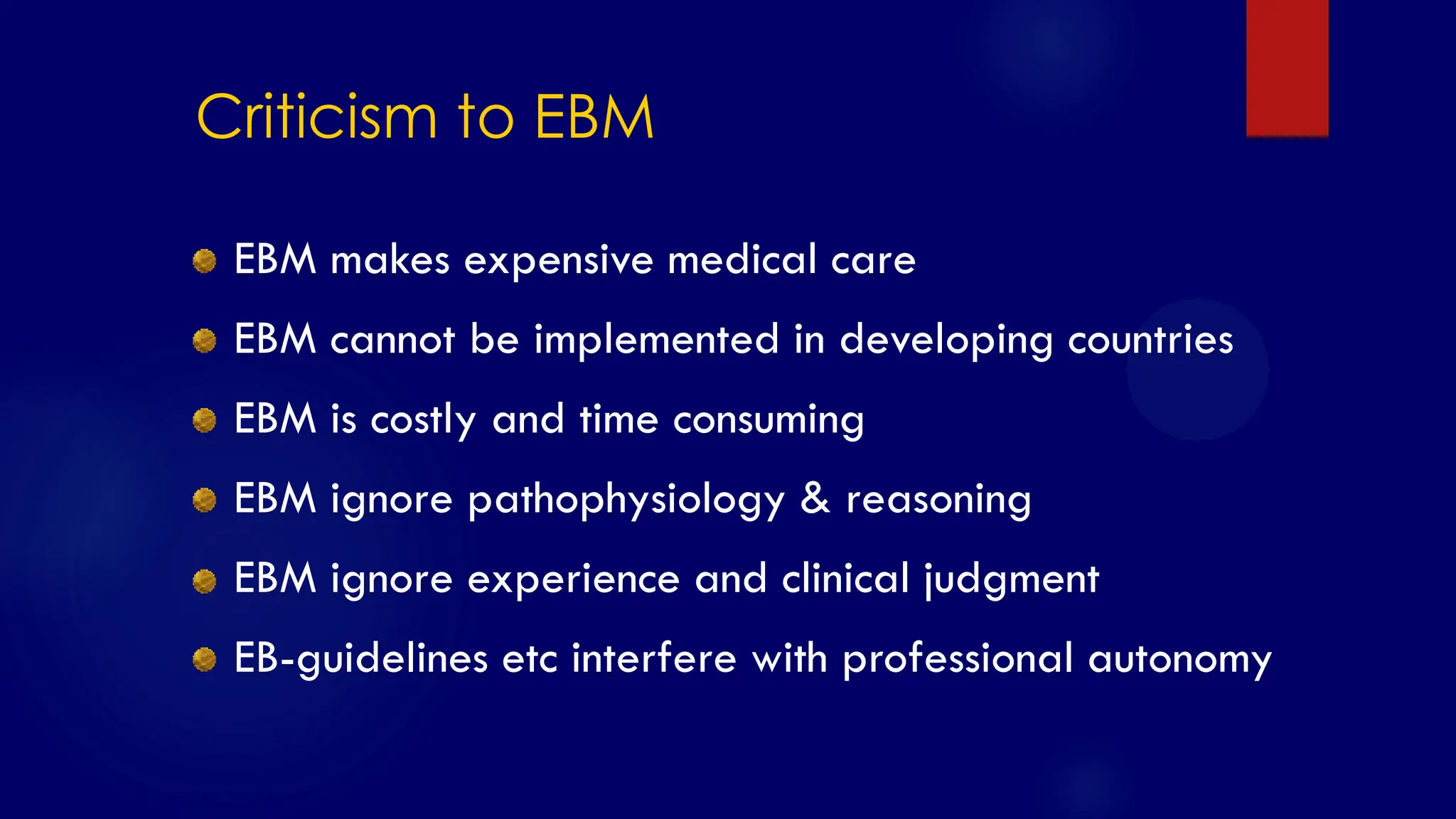
EBM makes expensive medical care
EBM cannot be implemented in developing countries
EBM is costly and time consuming
EBM ignore pathophysiology & reasoning
EBM ignore experience and clinical judgment
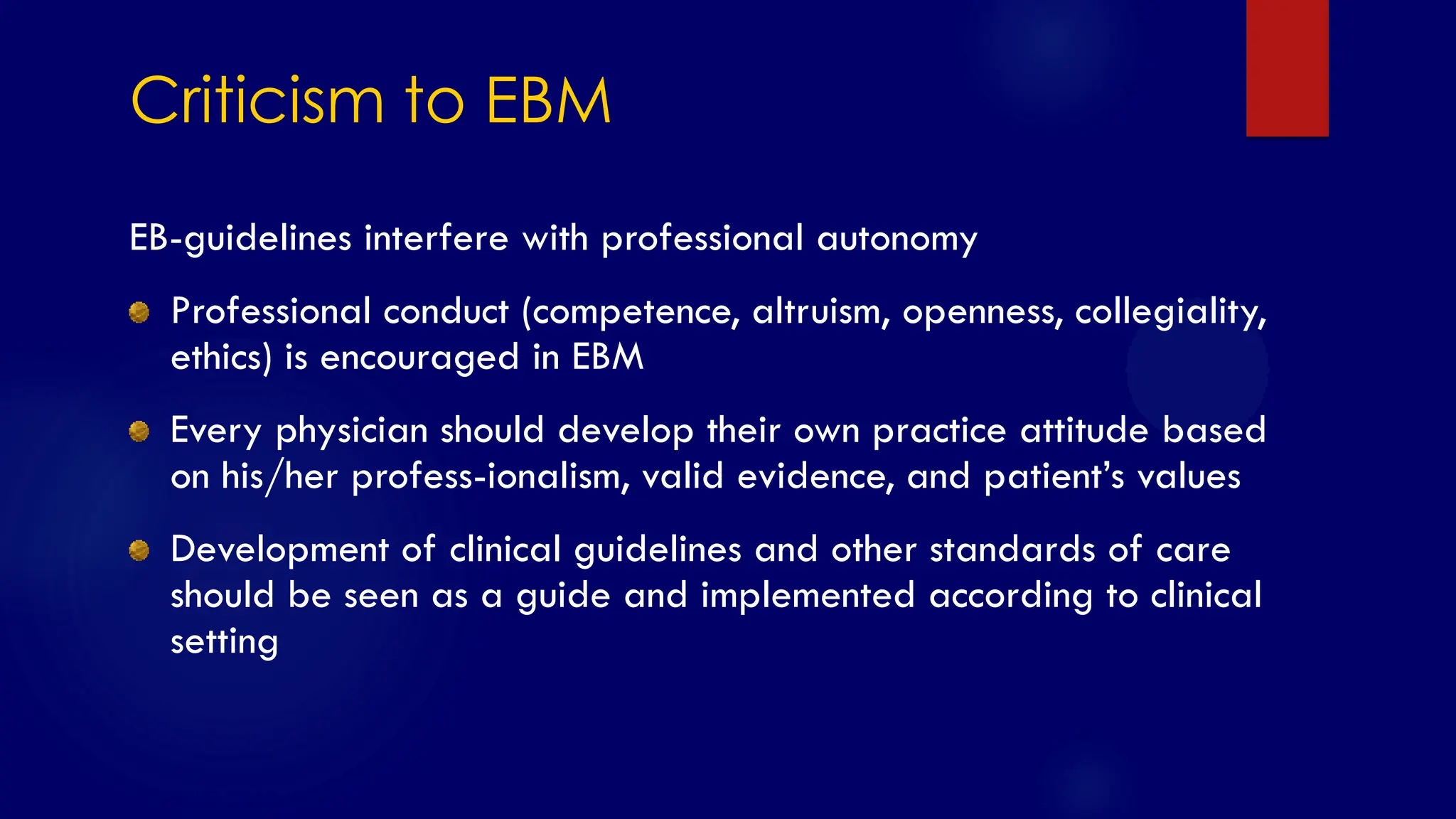
EB-guidelines etc interfere with professional autonomy
Criticism to EBM
SS/EBM/IKA-UDIP-2010
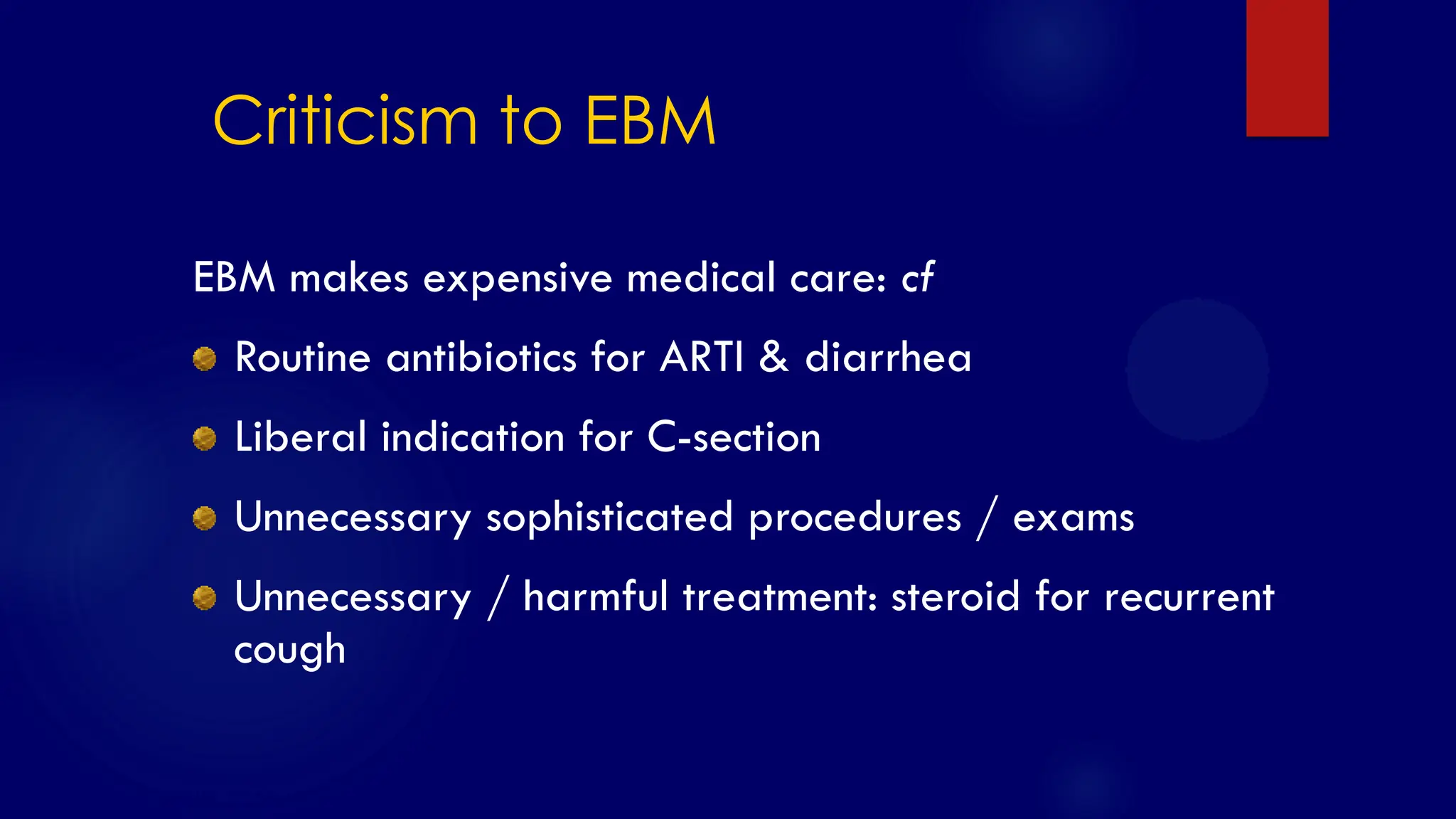
Criticism to EBM
EBM makes expensive medical care: cf
Routine antibiotics for ARTI & diarrhea
Liberal indication for C-section
Unnecessary sophisticated procedures / exams
Unnecessary / harmful treatment: steroid for recurrent
cough
SS/EBM/IKA-UDIP-2010
Criticism to EBM
EBM cannot be implemented in developing countries
By definition EBM is implemented if it is
implementable (patient‟s preference and local
condition) – for the benefit of the patients and the
community
SS/EBM/IKA-UDIP-2010
Criticism to EBM
EBM is costly and time consuming
EBM does requires facilities at the cost of quality
medical care!
Cost benefit ratio should be assessed in individual
and community levels
SS/EBM/IKA-UDIP-2010
Criticism to EBM
EBM ignores pathophysiology & reasoning
EBM encourages clinical reasoning in the light of valid and
important evidence
Pathophysiology and reasoning should be seen as hypothesis
and should end-up in empirical evidence
SS/EBM/IKA-UDIP-2010
Criticism to EBM
EBM ignore experience and clinical judgment
Personal experience and clinical judgment are by no means can
be eliminated
EBM encourage detailed and systematic documentation of
experience and judgment
EBM encourages clinical reasoning in the light of valid and
important evidence
Subjective experience should be, whenever possible, translated
into more objective measures
SS/EBM/IKA-UDIP-2010
Criticism to EBM
EB-guidelines interfere with professional autonomy
Professional conduct (competence, altruism, openness, collegiality,
ethics) is encouraged in EBM
Every physician should develop their own practice attitude based
on his/her profess-ionalism, valid evidence, and patient‟s values
Development of clinical guidelines and other standards of care
should be seen as a guide and implemented according to clinical
setting
SS/EBM/IKA-UDIP-2010
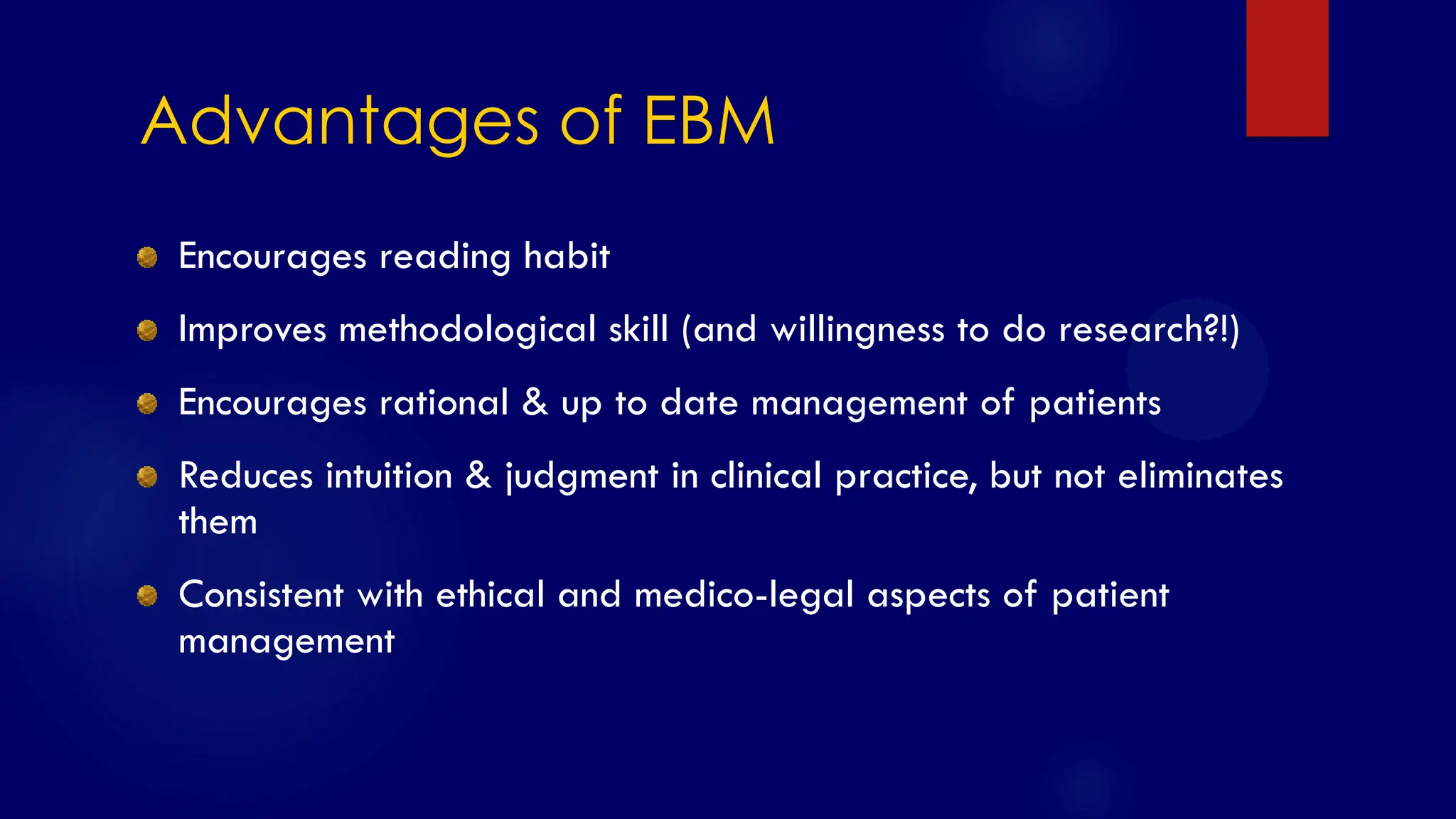
Advantages of EBM
Encourages reading habit
Improves methodological skill (and willingness to do research?!)
Encourages rational & up to date management of patients
Reduces intuition & judgment in clinical practice, but not eliminates
them
Consistent with ethical and medico-legal aspects of patient
management
SS/EBM/IKA-UDIP-2010
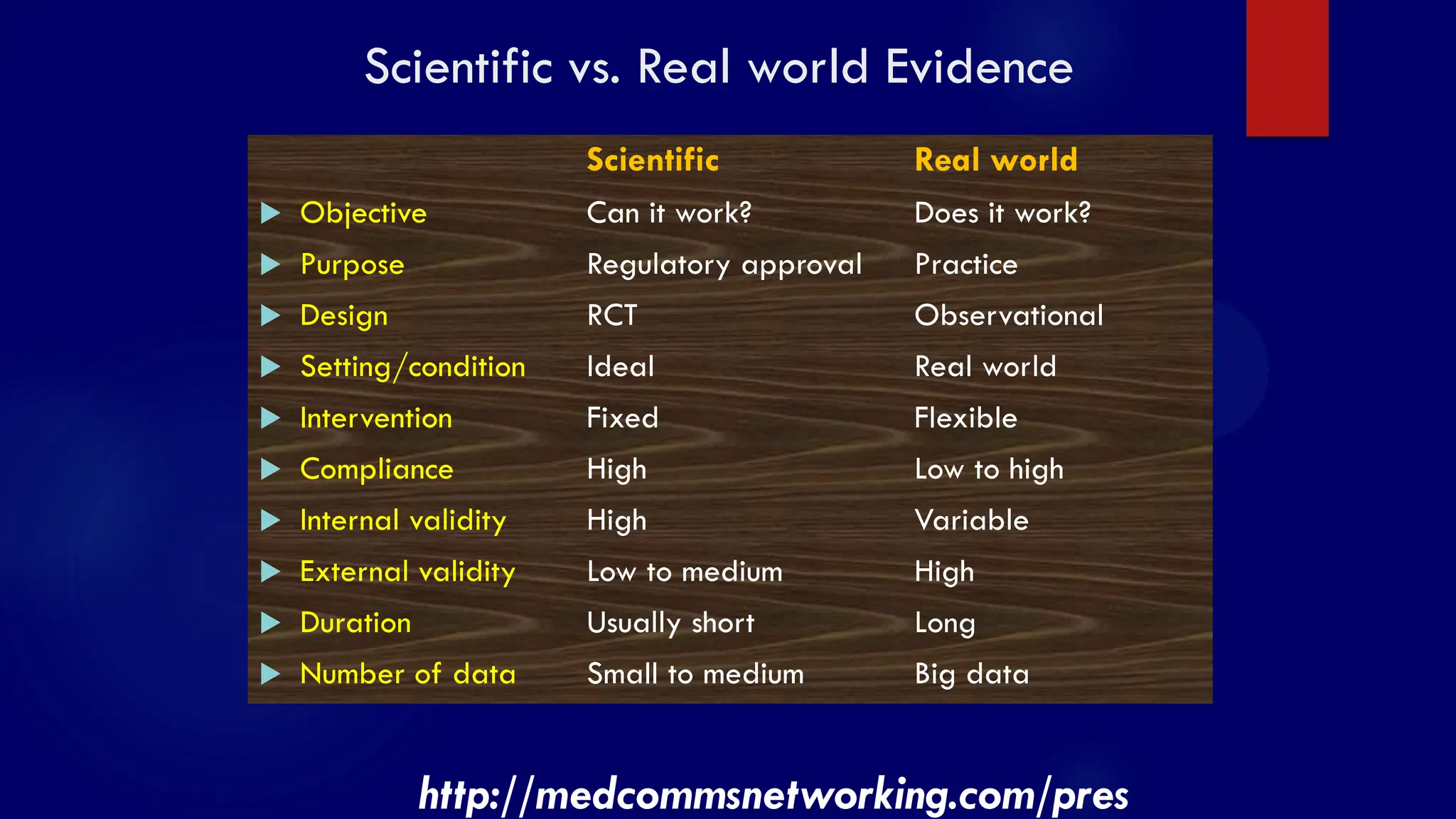
Scientific vs. Real world Evidence
Scientific Real world
 Objective Can it work? Does it work?
 Purpose Regulatory approval Practice
 Design RCT Observational
 Setting/condition Ideal Real world
 Intervention Fixed Flexible
 Compliance High Low to high
 Internal validity High Variable
 External validity Low to medium High
 Duration Usually short Long
 Number of data Small to medium Big data
http://medcommsnetworking.com/pres
SS/EBM/IKA-UDIP-2010
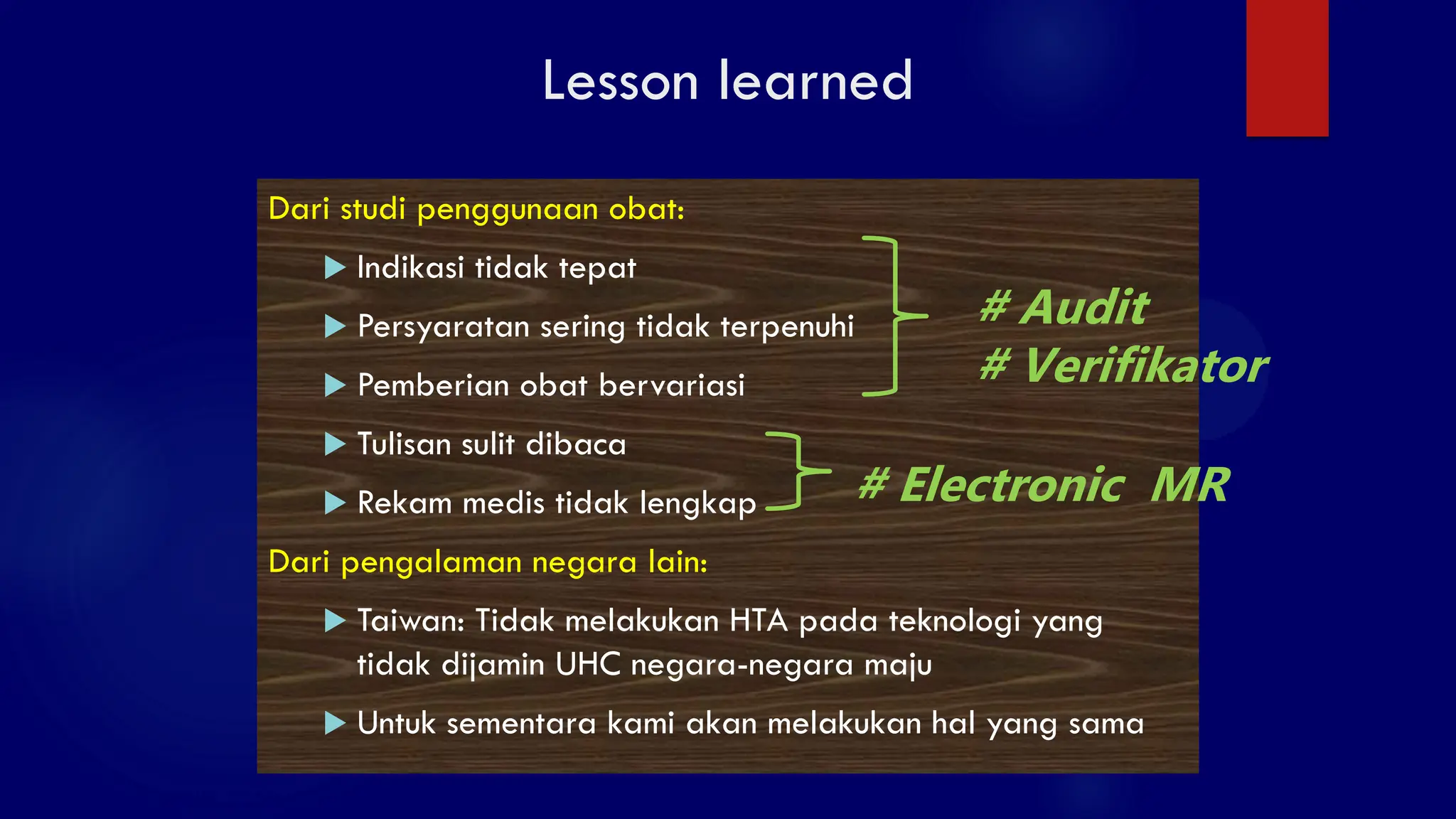
Lesson learned
Dari studi penggunaan obat:
 Indikasi tidak tepat
 Persyaratan sering tidak terpenuhi
 Pemberian obat bervariasi
 Tulisan sulit dibaca
 Rekam medis tidak lengkap
Dari pengalaman negara lain:
 Taiwan: Tidak melakukan HTA pada teknologi yang
tidak dijamin UHC negara-negara maju
 Untuk sementara kami akan melakukan hal yang sama
# Audit
# Verifikator
# Electronic MR
SS/EBM/IKA-UDIP-2010
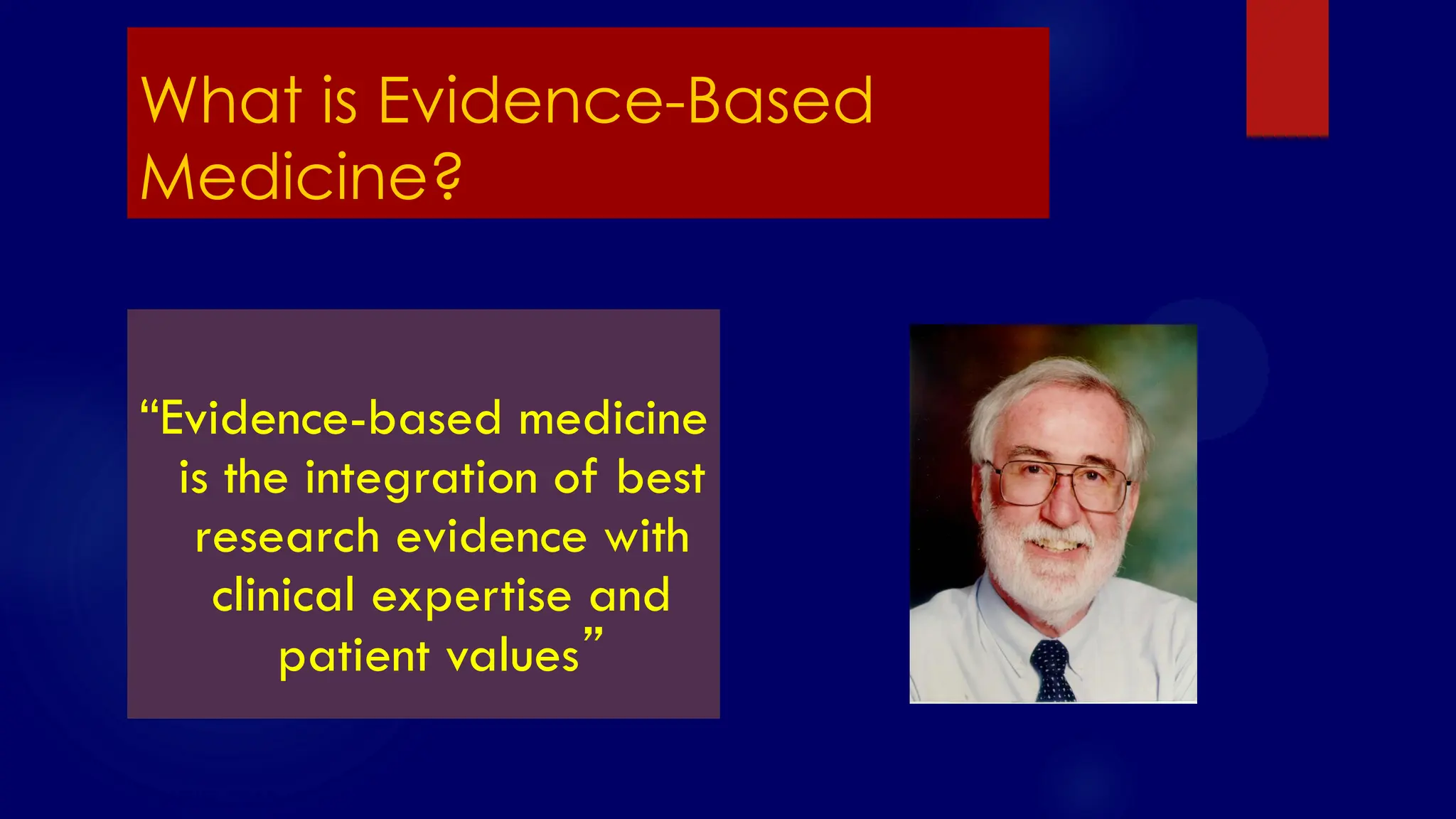
What is Evidence-Based
Medicine?
“Evidence-based medicine
is the integration of best
research evidence with
clinical expertise and
patient values”
SS/EBM/IKA-UDIP-2010
Evidence-based …
Evidenve-based medicine
Evidence-based cardiology, pediatrics, neurology, etc etc
Evidence-based clinical practice guidelines
Evidence-based clinical audits
Evidence-based health technology assessment
Evidence-based community health development
Evidence-based health policy making
Evidence-based …… anything
SS/EBM/IKA-UDIP-2010
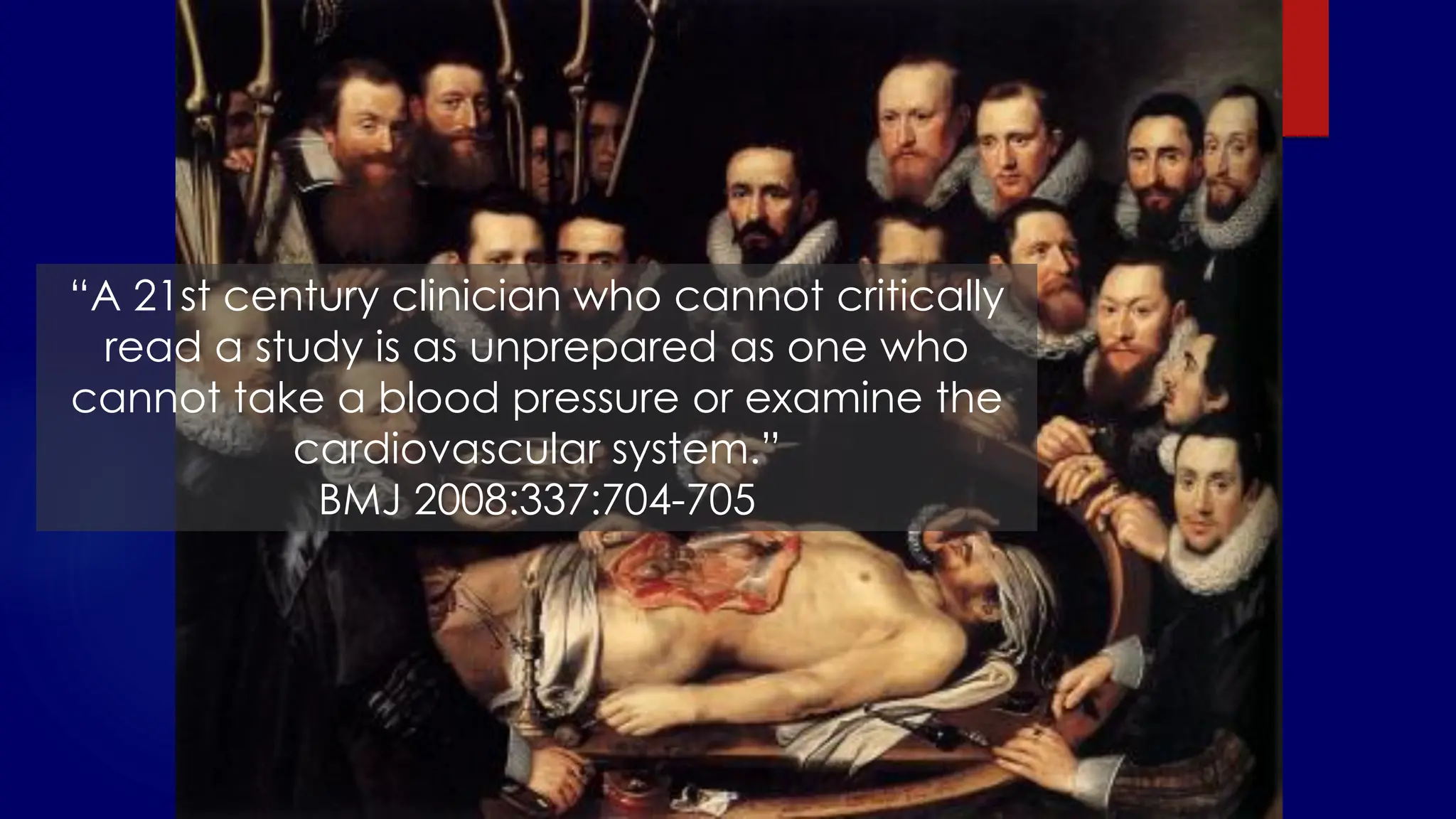
“A 21st century clinician who cannot critically
read a study is as unprepared as one who
cannot take a blood pressure or examine the
cardiovascular system.”
BMJ 2008:337:704-705
SS/EBM/IKA-UDIP-2010
Remember, however ......
Abscence of evidence is not
an evidence of absence
SS/EBM/IKA-UDIP-2010
End result
Self directed, life-long learning attitude
for high quality patient care
SS/EBM/IKA-UDIP-2010
Conclusion
EBM is nothing more than a
framework of systematic use of
current valid study results
relevant to our patient
SS/EBM/IKA-UDIP-2010

01F. Introduction to EBM FKUI 2022 abcdefgh

  • 1.
    SS/EBM/IKA-UDIP-2010 (”Bringing research evidence intopractice”) Evidence-Based Medicine Sudigdo Sastroasmoro Clinical Epidemiology and Evidence-based Medicine Unit FMUI – CMH, Jakarta
  • 2.
    SS/EBM/IKA-UDIP-2010 Asialink for CE-EBM (2007– 2010)  2 European countries  Oxford, uk  Utrecht, nl  2 Asian countries  Malaya Uni, my  UI, id  European Union, Euro 700,000
  • 3.
    SS/EBM/IKA-UDIP-2010 Evidence-based Medicine versus Opinion-based medicine Experience-basedmedicine Power-based medicine Hope-based medicine Logic-based medicine Erratic-based medicine Testimony-based medicine
  • 4.
    SS/EBM/IKA-UDIP-2010 Dr. Benjamin Spock: Babyand Child Care Later evidence indicates that prone position is a an significant risk factor for SIDS (sudden infant death syndrome) “I think it is preferable to accustom a baby to sleeping on his stomach from the start of he is willing. He may change later when he learns to turn over”.
  • 5.
    SS/EBM/IKA-UDIP-2010 Evidence-based Medicine Related with morbidity,mortality, quality of life Medicine-based evidence Pragmatic research Outcome research
  • 6.
    SS/EBM/IKA-UDIP-2010 Diagnosis Patient with complaint History Physical Simpletest • Specific test: If the test (+) what is the probability that the patient has the disease? Yes or no answer Predictive value is the most important The spectrum of the presentations must resemble that in practice Studies to be searched: Diagnostic tests
  • 7.
    SS/EBM/IKA-UDIP-2010 Treatment Patient with certaindiagnosis: best treatment? Is drug X more effective than Y? Focus on the clinical outcome, rather than its explanation (biomolecular markers, etc) Yes or no outcome most useful Not in studies with “idealized” subjects  Px with DM are frequently have hypercholesterolemia, obese, hypertension, etc  Sudies to be searched: RCT
  • 8.
    SS/EBM/IKA-UDIP-2010 Prognosis Usually in cohortstudies To inform about the fate of the patient Absolute risk is more important than relative risk  Absolute: Your risk of having second stroke in 1 year is 30%  Relative: Your risk of having second stroke in 1 year is 2 times than in non-smokers (RR = 2)  Studies: Cohorts, case controls
  • 9.
    SS/EBM/IKA-UDIP-2010 Pros : “Newparadigm in medicine” “Extraordinary innovations, only 2nd to Human Genome Project” Cons : New version of an old song „Fair‟ : Nothing wrong with EBM, but: • Be careful in searching evidence • Meta-analyses, clinical trials, and all study results should be critically appraised Keyword for EBM: Methodological skill to judge the validity of study reports (Re. Andersen B: Methodo-logical errors in medical research, 1989)
  • 10.
    SS/EBM/IKA-UDIP-2010 EBM & ClinicalEpidemiology Fletcher & Fletcher: CE = The application of epidemiologic principles in problems encountered in clinical medicine Sackett et al: CE = The basic science for clinical medicine Much resistance by experts EBM: In principle – no one disagree All major medical journals have adopted EBM Centers for EBM all over the world
  • 11.
    SS/EBM/IKA-UDIP-2010 Previous practice: 6 yrsmedical education 40-50 yrs medical practice Problems with patients: Dx, Rx, Px Consultants, colleagues Textbooks Handbooks Lecture notes Clinical guidelines CME, seminars, etc Journals Usu. see only Results section, or even worse, Abstract section
  • 12.
    SS/EBM/IKA-UDIP-2010 Trust me In myexperience …. Logically Textbook, handbook, capita selecta
  • 13.
    SS/EBM/IKA-UDIP-2010 The results…. Opinion-based medicine Steroidinj. in prematures to prevent RDS Routine episiotomy Routine circumcision Antibiotics for flu-like syndrome Use of immunomodulators “Skin test” before antibiotic injection Routine chest X-ray for pre-op preparation CT scan after minor head trauma
  • 14.
    SS/EBM/IKA-UDIP-2010 What is Evidence-based Medicine? “Theconscientious, explicit, and judicious use of current best evidence in making decisions about the care of individual patients” “Pemanfaatan bukti mutakhir yang sahih dalam tata laksana pasien” Integration of • physician‟s competence • valid evidence from studies • patient‟s preference
  • 15.
    SS/EBM/IKA-UDIP-2010 Why EBM? Information overload Keepingcurrent with literature Our clinical performance deteriorates with time (“the slippery slope”) Traditional CME does not improve clinical performance EBM encourages self directed learning process which should overcome the above shortages
  • 16.
    SS/EBM/IKA-UDIP-2010 Years after graduation Relative %of remaining knowledge 2 4 6 8 10 12 $ 100% THE SLIPPERY SLOPE
  • 17.
    SS/EBM/IKA-UDIP-2010 Our textbooks are out-of-date Failto recommend Rx up to ten years after it‟s been shown to be efficacious. Continue to recommend therapy up to ten years after it‟s been shown to be useless.
  • 18.
    SS/EBM/IKA-UDIP-2010 1. Formulate clinicalproblems in answerable questions 2. Search the best evidence: use internet or other on- line database for current evidence 3. Critically appraise the evidence for  Validity (was the study valid?)  Importance (were the results clinically important?)  Applicability (could we apply to our patient?) 4. Apply the evidence to patient 5. Evaluate our performance Steps in EBM practice VIA
  • 19.
    SS/EBM/IKA-UDIP-2010 Diagnosis (Determination of diseaseor problem) Treatment (Intervention necessary to help the patient) Prognosis (Prediction of the outcome of the disease) Main area
  • 20.
  • 21.
    SS/EBM/IKA-UDIP-2010  A 2-yearold boy presented with 6-day high fever, conjunctival injection without secretion, skin rash> blood test shows leukocytosis, high ESR, CRP +++. He was suspected to have Kawasaki disease. The pediatrician is aware of the use of immunoglobulin to prevent coronary involvement, but uncertain about the dosage or recent developments.
  • 22.
    SS/EBM/IKA-UDIP-2010 Medical students: (Background question) Whatis Kawasaki disease? What is the etiology? How it is diagnosed? What is the treatment of choice? Complications?
  • 23.
    SS/EBM/IKA-UDIP-2010 House officers (Foreground question) Ina child with KD, would immunoglobulin treatment, compared with no immunoglobulin, reduce the chance to develop coronary complication?
  • 24.
  • 25.
    SS/EBM/IKA-UDIP-2010 Other examples In youngwomen with solitary thyroid nodule, can USG, compared with biopsy, differentiate between benign from malignant? (Diagnosis) In women systemic lupus erythematosus, is history of congestive heart failure, compared with no heart failure, worsen the prognosis? (Prognosis) In women with history of eclampsia, would administration of low-dose aspirin during pregnancy prevent eclampsia? (Prevention)
  • 26.
    SS/EBM/IKA-UDIP-2010 Four elements of goodclinical question: PICO The Patient or Problem The Intervention / Index / Indicator Comparative intervention (if relevant) The Outcome
  • 27.
    SS/EBM/IKA-UDIP-2010 Four elements ofa well constructed clinical question: PICO P I C O The main intervention considered The alternative to compare with the intervention Outcome expected from this intervention? Description of patient or problem B e b r i e f a n d s p e c i f i c
  • 28.
    SS/EBM/IKA-UDIP-2010 Do all clinicalquestions contain 4 elements of PICO? No The C implies in the question - PIO  Does temulawak increase appetite in undernourished children? Asking prevalence – PO  How many percent of patients with TIA who subsequently develop stroke?
  • 29.
    SS/EBM/IKA-UDIP-2010 Relevance: Type ofEvidence POE: Patient-oriented evidence  mortality, morbidity, quality of life DOE: Disease-oriented evidence  pathophysiology, pharmacology, etiology
  • 30.
    SS/EBM/IKA-UDIP-2010 Comparing DOES andPOEMs Prostate screening PSA screening detects prostate Ca. early ? whether PSA screening  mortality DOE exists, but POEM unknown Antiarrhythmic Therapy Antihypertens. Therapy Drug A  PVC On ECG Drug X  BP Drug X  mortality Drug A > mortality DOE & POEM contradicts POEM agrees With DOE Example DOE POEM Comment
  • 31.
  • 32.
  • 33.
    SS/EBM/IKA-UDIP-2010 Validity: In Methodssection: design, sample, sample size, eligibility criteria (inclusion, exclusion), sampling method, randomization method, intervention, measurements, methods of analysis, etc Importance: In Results section characteristics of subjects, drop out, analysis, p value, confidence intervals, etc Applicability: In Discussion section + our patient‟s characteristics, local setting VIA
  • 34.
    SS/EBM/IKA-UDIP-2010 Example: Critical appraisal fortherapy Were the subjects randomized? Were all subjects received similar treatment? Were all relevant outcomes considered? Were all subjects randomized included in the analysis? Calculate CER, EER, RRR, ARR, and NNT Were study subjects similar to our patients in terms of prognostic factors?
  • 35.
    SS/EBM/IKA-UDIP-2010 Hierarchy of evidence Meta-analysisof RCT Large RCT Small RCT Non-Randomized trials Observational studies Case series / reports Anecdotes, expert, consensus Level 1 Level 2 Level 3 Level 4 A B C Rec Weight of Scientific Scrutiny For complete description see www.cebm.net
  • 36.
    SS/EBM/IKA-UDIP-2010 Implementation of EBMpractice: How to get started 1. Teaching EBM in medical schools / PPDS Easier than to change the already existing attitude Most important May be included in formal curricula or integrated in existing activities: ward rounds, on calls, case presentations, group discussions, journal clubs, etc 2. Workshop for teaching staff 3. Workshop for practitioners, incl. Nurses
  • 37.
    SS/EBM/IKA-UDIP-2010 Resistance to EBMteaching & learning Rudimentary skill in critical appraisal / methodological skill Limited resources, esp. Time factor Lack of high quality evidence Skepticism toward evidence-based practice „Happy‟ with current practice
  • 38.
  • 39.
  • 40.
    SS/EBM/IKA-UDIP-2010 EBM makes expensivemedical care EBM cannot be implemented in developing countries EBM is costly and time consuming EBM ignore pathophysiology & reasoning EBM ignore experience and clinical judgment EB-guidelines etc interfere with professional autonomy Criticism to EBM
  • 41.
    SS/EBM/IKA-UDIP-2010 Criticism to EBM EBMmakes expensive medical care: cf Routine antibiotics for ARTI & diarrhea Liberal indication for C-section Unnecessary sophisticated procedures / exams Unnecessary / harmful treatment: steroid for recurrent cough
  • 42.
    SS/EBM/IKA-UDIP-2010 Criticism to EBM EBMcannot be implemented in developing countries By definition EBM is implemented if it is implementable (patient‟s preference and local condition) – for the benefit of the patients and the community
  • 43.
    SS/EBM/IKA-UDIP-2010 Criticism to EBM EBMis costly and time consuming EBM does requires facilities at the cost of quality medical care! Cost benefit ratio should be assessed in individual and community levels
  • 44.
    SS/EBM/IKA-UDIP-2010 Criticism to EBM EBMignores pathophysiology & reasoning EBM encourages clinical reasoning in the light of valid and important evidence Pathophysiology and reasoning should be seen as hypothesis and should end-up in empirical evidence
  • 45.
    SS/EBM/IKA-UDIP-2010 Criticism to EBM EBMignore experience and clinical judgment Personal experience and clinical judgment are by no means can be eliminated EBM encourage detailed and systematic documentation of experience and judgment EBM encourages clinical reasoning in the light of valid and important evidence Subjective experience should be, whenever possible, translated into more objective measures
  • 46.
    SS/EBM/IKA-UDIP-2010 Criticism to EBM EB-guidelinesinterfere with professional autonomy Professional conduct (competence, altruism, openness, collegiality, ethics) is encouraged in EBM Every physician should develop their own practice attitude based on his/her profess-ionalism, valid evidence, and patient‟s values Development of clinical guidelines and other standards of care should be seen as a guide and implemented according to clinical setting
  • 47.
    SS/EBM/IKA-UDIP-2010 Advantages of EBM Encouragesreading habit Improves methodological skill (and willingness to do research?!) Encourages rational & up to date management of patients Reduces intuition & judgment in clinical practice, but not eliminates them Consistent with ethical and medico-legal aspects of patient management
  • 48.
    SS/EBM/IKA-UDIP-2010 Scientific vs. Realworld Evidence Scientific Real world  Objective Can it work? Does it work?  Purpose Regulatory approval Practice  Design RCT Observational  Setting/condition Ideal Real world  Intervention Fixed Flexible  Compliance High Low to high  Internal validity High Variable  External validity Low to medium High  Duration Usually short Long  Number of data Small to medium Big data http://medcommsnetworking.com/pres
  • 49.
    SS/EBM/IKA-UDIP-2010 Lesson learned Dari studipenggunaan obat:  Indikasi tidak tepat  Persyaratan sering tidak terpenuhi  Pemberian obat bervariasi  Tulisan sulit dibaca  Rekam medis tidak lengkap Dari pengalaman negara lain:  Taiwan: Tidak melakukan HTA pada teknologi yang tidak dijamin UHC negara-negara maju  Untuk sementara kami akan melakukan hal yang sama # Audit # Verifikator # Electronic MR
  • 50.
    SS/EBM/IKA-UDIP-2010 What is Evidence-Based Medicine? “Evidence-basedmedicine is the integration of best research evidence with clinical expertise and patient values”
  • 51.
    SS/EBM/IKA-UDIP-2010 Evidence-based … Evidenve-based medicine Evidence-basedcardiology, pediatrics, neurology, etc etc Evidence-based clinical practice guidelines Evidence-based clinical audits Evidence-based health technology assessment Evidence-based community health development Evidence-based health policy making Evidence-based …… anything
  • 52.
    SS/EBM/IKA-UDIP-2010 “A 21st centuryclinician who cannot critically read a study is as unprepared as one who cannot take a blood pressure or examine the cardiovascular system.” BMJ 2008:337:704-705
  • 53.
    SS/EBM/IKA-UDIP-2010 Remember, however ...... Abscenceof evidence is not an evidence of absence
  • 54.
    SS/EBM/IKA-UDIP-2010 End result Self directed,life-long learning attitude for high quality patient care
  • 55.
    SS/EBM/IKA-UDIP-2010 Conclusion EBM is nothingmore than a framework of systematic use of current valid study results relevant to our patient
  • 56.
  • 57.