Capital Asset Pricing and
Arbitrage Pricing Theory
Chapter 7
The Capital Asset Pricing Model
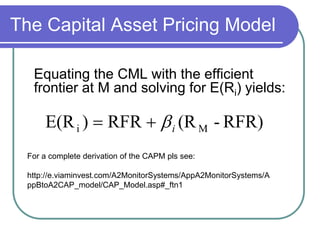
Equating the CML with the efficient
frontier at M and solving for E(Ri) yields:
RFR)-(RRFR)E(R Mi i
For a complete derivation of the CAPM pls see:
http://e.viaminvest.com/A2MonitorSystems/AppA2MonitorSystems/A
ppBtoA2CAP_model/CAP_Model.asp#_ftn1
Assumptions
 Individual investors can borrow or lend money at the
risk-free rate of return
 Investors are rational mean-variance optimizers
 Homogeneous expectations
 Single-period investment horizon
 Investments are limited to traded financial assets
 Information is costless and available to all investors
 No taxes, and transaction costs
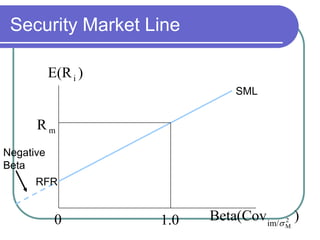
Security Market Line
)E(Ri
)Beta(Cov 2
Mim/0.1
mR
SML
0
Negative
Beta
RFR
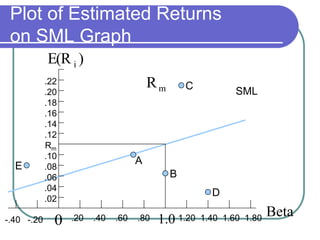
Plot of Estimated Returns
on SML Graph
)E(R i
Beta0.1
mR SML
0 .20 .40 .60 .80 1.20 1.40 1.60 1.80-.40 -.20
.22
.20
.18
.16
.14
.12
Rm
.10
.08
.06
.04
.02
A
B
C
D
E
Inputs to the CAPM
(a) the current risk-free rate
(b) the expected return on the market
index and
(c) the beta of the asset being analyzed
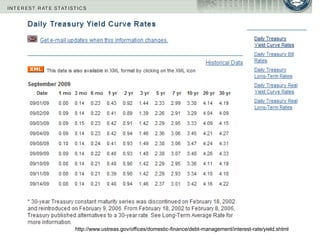
Riskfree Rate & Time Horizon
 For an investment to be riskfree, i.e., to have
an actual return be equal to the expected
return, two conditions have to be met –
 There has to be no default risk, which generally
implies that the security has to be issued by the
government. Note, however, that not all
governments can be viewed as default free.
 There can be no uncertainty about reinvestment
rates, which implies that it is a zero coupon security
with the same maturity as the cash flow being
analyzed.
http://www.ustreas.gov/offices/domestic-finance/debt-management/interest-rate/yield.shtml
Measurement of the risk premium
 The risk premium is the premium that
investors demand for investing in an average
risk investment, relative to the riskfree rate.
 As a general proposition, this premium should
be
 greater than zero
 increase with the risk aversion of the investors in
that market
 increase with the riskiness of the “average” risk
investment
Estimating Risk Premiums in
Practice
 Survey investors on their desired risk
premiums and use the average premium
from these surveys.
 Assume that the actual premium
delivered over long time periods is equal
to the expected premium - i.e., use
historical data
 Estimate the implied premium in today’s
asset prices.
The Survey Approach
 Surveying all investors in a market place is impractical.
However, you can survey a few investors (especially
the larger investors) and use these results. In practice,
this translates into surveys of money managers’
expectations of expected returns on stocks over the
next year.
 The limitations of this approach are:
 there are no constraints on reasonability (the survey could
produce negative risk premiums or risk premiums of 50%)
 they are extremely volatile
 they tend to be short term; even the longest surveys do not go
beyond one year
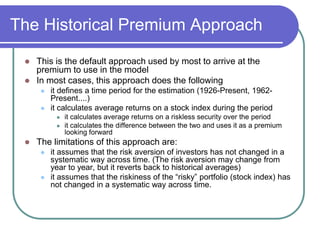
The Historical Premium Approach
 This is the default approach used by most to arrive at the
premium to use in the model
 In most cases, this approach does the following
 it defines a time period for the estimation (1926-Present, 1962-
Present....)
 it calculates average returns on a stock index during the period
 it calculates average returns on a riskless security over the period
 it calculates the difference between the two and uses it as a premium
looking forward
 The limitations of this approach are:
 it assumes that the risk aversion of investors has not changed in a
systematic way across time. (The risk aversion may change from
year to year, but it reverts back to historical averages)
 it assumes that the riskiness of the “risky” portfolio (stock index) has
not changed in a systematic way across time.
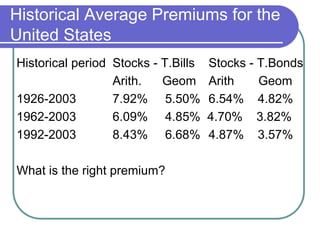
Historical Average Premiums for the
United States
Historical period Stocks - T.Bills Stocks - T.Bonds
Arith. Geom Arith Geom
1926-2003 7.92% 5.50% 6.54% 4.82%
1962-2003 6.09% 4.85% 4.70% 3.82%
1992-2003 8.43% 6.68% 4.87% 3.57%
What is the right premium?
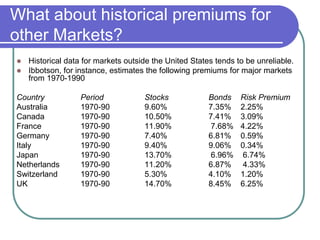
What about historical premiums for
other Markets?
 Historical data for markets outside the United States tends to be unreliable.
 Ibbotson, for instance, estimates the following premiums for major markets
from 1970-1990
Country Period Stocks Bonds Risk Premium
Australia 1970-90 9.60% 7.35% 2.25%
Canada 1970-90 10.50% 7.41% 3.09%
France 1970-90 11.90% 7.68% 4.22%
Germany 1970-90 7.40% 6.81% 0.59%
Italy 1970-90 9.40% 9.06% 0.34%
Japan 1970-90 13.70% 6.96% 6.74%
Netherlands 1970-90 11.20% 6.87% 4.33%
Switzerland 1970-90 5.30% 4.10% 1.20%
UK 1970-90 14.70% 8.45% 6.25%
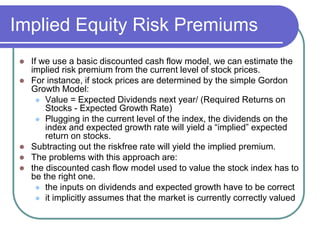
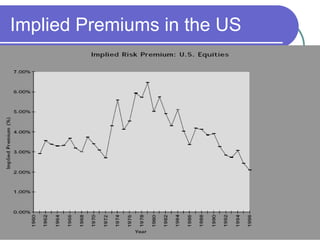
Implied Equity Risk Premiums
 If we use a basic discounted cash flow model, we can estimate the
implied risk premium from the current level of stock prices.
 For instance, if stock prices are determined by the simple Gordon
Growth Model:
 Value = Expected Dividends next year/ (Required Returns on
Stocks - Expected Growth Rate)
 Plugging in the current level of the index, the dividends on the
index and expected growth rate will yield a “implied” expected
return on stocks.
 Subtracting out the riskfree rate will yield the implied premium.
 The problems with this approach are:
 the discounted cash flow model used to value the stock index has to
be the right one.
 the inputs on dividends and expected growth have to be correct
 it implicitly assumes that the market is currently correctly valued
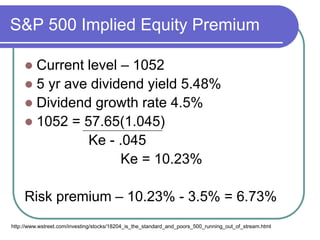
S&P 500 Implied Equity Premium
 Current level – 1052
 5 yr ave dividend yield 5.48%
 Dividend growth rate 4.5%
 1052 = 57.65(1.045)
Ke - .045
Ke = 10.23%
Risk premium – 10.23% - 3.5% = 6.73%
http://www.wstreet.com/investing/stocks/18204_is_the_standard_and_poors_500_running_out_of_stream.html
Implied Premiums in the US
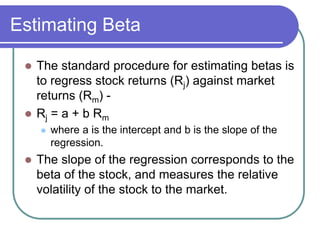
Estimating Beta
 The standard procedure for estimating betas is
to regress stock returns (Rj) against market
returns (Rm) -
 Rj = a + b Rm
 where a is the intercept and b is the slope of the
regression.
 The slope of the regression corresponds to the
beta of the stock, and measures the relative
volatility of the stock to the market.
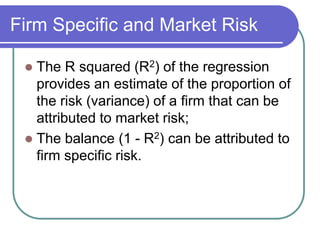
Firm Specific and Market Risk
 The R squared (R2) of the regression
provides an estimate of the proportion of
the risk (variance) of a firm that can be
attributed to market risk;
 The balance (1 - R2) can be attributed to
firm specific risk.
Setting up for the Estimation
 Decide on an estimation period
 Services use periods ranging from 2 to 5 years for the regression
 Longer estimation period provides more data, but firms change.
 Shorter periods can be affected more easily by significant firm-
specific event that occurred during the period
 Decide on a return interval - daily, weekly, monthly
 Shorter intervals yield more observations, but suffer from more noise.
 Noise is created by stocks not trading and biases all betas towards
one.
 Estimate returns (including dividends) on stock
 Return = (PriceEnd – PriceBeginning + DividendsPeriod)/ PriceBeginning
 Included dividends only in ex-dividend month
 Choose a market index, and estimate returns (inclusive of
dividends) on the index for each interval for the period.
Choosing the Parameters: Disney
 Period used: 5 years
 Return Interval = Monthly
 Market Index: S&P 500 Index.
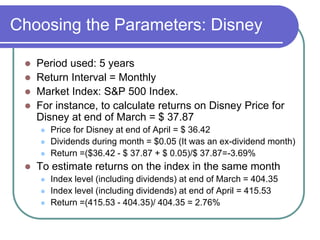
 For instance, to calculate returns on Disney Price for
Disney at end of March = $ 37.87
 Price for Disney at end of April = $ 36.42
 Dividends during month = $0.05 (It was an ex-dividend month)
 Return =($36.42 - $ 37.87 + $ 0.05)/$ 37.87=-3.69%
 To estimate returns on the index in the same month
 Index level (including dividends) at end of March = 404.35
 Index level (including dividends) at end of April = 415.53
 Return =(415.53 - 404.35)/ 404.35 = 2.76%
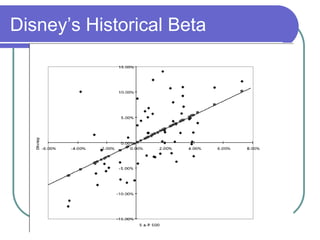
Disney’s Historical Beta
The Regression Output
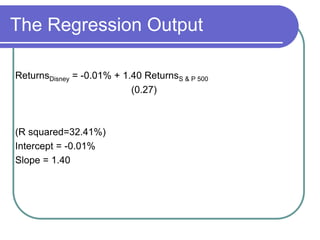
ReturnsDisney = -0.01% + 1.40 ReturnsS & P 500
(0.27)
(R squared=32.41%)
Intercept = -0.01%
Slope = 1.40
Estimating Disney’s Beta
 Slope of the Regression of 1.40 is the beta
 Regression parameters are always estimated
with noise. The noise is captured in the
standard error of the beta estimate, which in
the case of Disney is 0.27.
 Assume that I asked you what Disney’s true
beta is, after this regression.
 What is your best point estimate?
 What range would you give me, with 67%
confidence?
 What range would you give me, with 95%
confidence?
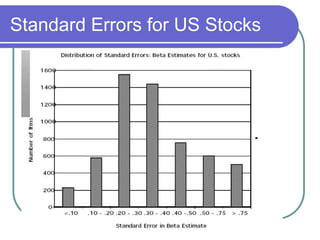
Standard Errors for US Stocks
Breaking Down Disney’s Risk
 R Squared = 32%
 This implies that
 32% of the risk at Disney comes from
market sources
 68%, therefore, comes from firm-specific
sources
 The firm-specific risk is diversifiable and will
not be rewarded
The Relevance of R Squared
You are a diversified investor trying to decide whether
you should invest in Disney or Amgen. They both have
betas of 1.35, but Disney has an R Squared of 32%
while Amgen’s R squared of only 15%. Which one
would you invest in:
 Amgen, because it has the lower R squared
 Disney, because it has the higher R squared
 You would be indifferent
The Relevance of R Squared…
 I would be indifferent, because they have
the same beta
 I am well diversified, and thus can
eliminate all firm-specific risk. If I were
not, I would have picked Disney, since it
has less firm-specific risk.
Estimating Expected Returns
 Disney’s Beta = 1.40
 Riskfree Rate = 3.50% (Long term
Government Bond rate)
 Risk Premium = 7% (Implied)
 Expected Return = 3.5% + 1.40 (7%) =
13.3%
Use to a Potential Investor in Disney
 As a potential investor in Disney, what does this
expected return of 13.30% tell you?
 This is the return that I can expect to make in the long term on
Disney, if the stock is correctly priced and the CAPM is the right
model for risk,
 This is the return that I need to make on Disney in the long term
to break even on my investment in the stock
 Both
 Assume now that you are an active investor and that
your research suggests that an investment in Disney will
yield 25% a year for the next 5 years. Based upon the
expected return of 14.70%, you would
 Buy the stock
 Sell the stock
Arbitrage Pricing Theory
•Developed as an alternative to the CAPM
•Reasonably intuitive
•Required limited assumptions
•Allowed for multiple dimensions of
investment risk
Arbitrage Pricing Theory
 Based on the Law of One Price
 Since two otherwise identical assets cannot sell at
different prices, equilibrium prices adjust to eliminate
all arbitrage opportunities
 Arbitrage opportunity
 arises if an investor can construct a zero investment
portfolio with no risk, but with a positive profit
 Since no investment is required, an investor can
create large positions in long and short to secure
large levels of profits
 In an efficient market, profitable arbitrage opportunities
will quickly disappear
APT Model
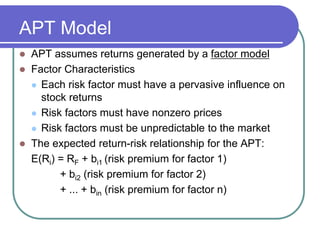
 APT assumes returns generated by a factor model
 Factor Characteristics
 Each risk factor must have a pervasive influence on
stock returns
 Risk factors must have nonzero prices
 Risk factors must be unpredictable to the market
 The expected return-risk relationship for the APT:
E(Ri) = RF + bi1 (risk premium for factor 1)
+ bi2 (risk premium for factor 2)
+ ... + bin (risk premium for factor n)
APT and CAPM Compared
 APT applies to well diversified portfolios, and not
necessarily to individual stocks
 With APT, it is possible for some individual stocks to
be mispriced - not lie on the SML
 APT is more general in that it gets to an expected
return and beta relationship without the assumption of
the market portfolio
 Unlike CAPM, APT does not assume mean-variance
decisions, riskless borrowing or lending, and
existence of a market portfolio
 APT can be extended to multifactor models
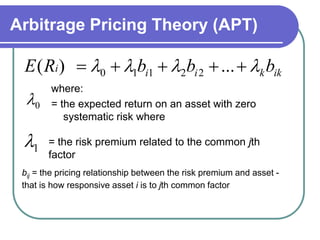
Arbitrage Pricing Theory (APT)
where:
= the expected return on an asset with zero
systematic risk where
ikkiii bbbRE   ...)( 22110
0
1 = the risk premium related to the common jth
factor
bij = the pricing relationship between the risk premium and asset -
that is how responsive asset i is to jth common factor
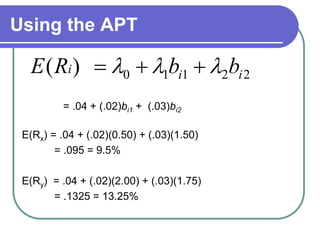
Using the APT
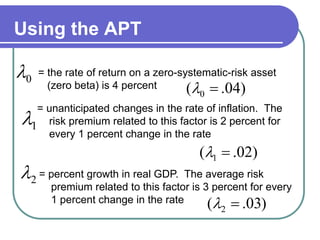
= unanticipated changes in the rate of inflation. The
risk premium related to this factor is 2 percent for
every 1 percent change in the rate
1
)02.( 1 
= percent growth in real GDP. The average risk
premium related to this factor is 3 percent for every
1 percent change in the rate
= the rate of return on a zero-systematic-risk asset
(zero beta) is 4 percent
2
)03.( 2 
)04.( 0 
0
Using the APT
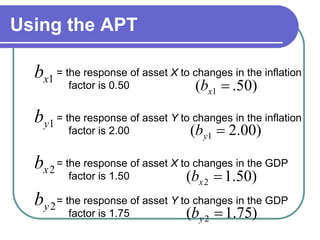
= the response of asset X to changes in the inflation
factor is 0.50
1xb
)50.( 1 xb
= the response of asset Y to changes in the inflation
factor is 2.00 )00.2( 1 yb
1yb
= the response of asset X to changes in the GDP
factor is 1.50
= the response of asset Y to changes in the GDP
factor is 1.75
2xb
2yb
)50.1( 2 xb
)75.1( 2 yb
Using the APT
= .04 + (.02)bi1 + (.03)bi2
E(Rx) = .04 + (.02)(0.50) + (.03)(1.50)
= .095 = 9.5%
E(Ry) = .04 + (.02)(2.00) + (.03)(1.75)
= .1325 = 13.25%
22110)( iii bbRE  
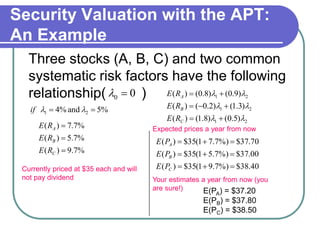
Security Valuation with the APT:
An Example
Three stocks (A, B, C) and two common
systematic risk factors have the following
relationship( )0 0 
21
21
21
)5.0()8.1()(
)3.1()2.0()(
)9.0()8.0()(






C
B
A
RE
RE
RE
%7.9)(
%7.5)(
%7.7)(



C
B
A
RE
RE
RE
%5and%4 21  if
40.38$%)7.91(35$)(
00.37$%)7.51(35$)(
70.37$%)7.71(35$)(



C
B
A
PE
PE
PE
Currently priced at $35 each and will
not pay dividend
Expected prices a year from now
Your estimates a year from now (you
are sure!) E(PA) = $37.20
E(PB) = $37.80
E(PC) = $38.50
Security Valuation with the APT:
An Example
 Riskless arbitrage
 Requires no net wealth invested initially
 Will bear no systematic or unsystematic risk but
 Still earns a profit
 Condition must be satisfied as follow:
 1.
 2
 3
0i iw
0 iji ibw
0 ii i Rw i.e. actual portfolio return is positive
For all K factors [i.e. no systematic risk] and w is small
for all I [ unsystematic risk is fully diversified]
i.e. no net wealth invested
Wi the percentage investment in security i
Security Valuation with the APT:
An Example
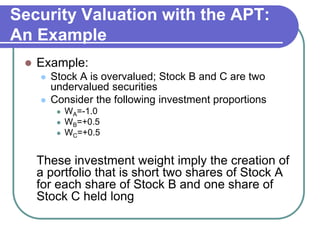
 Example:
 Stock A is overvalued; Stock B and C are two
undervalued securities
 Consider the following investment proportions
 WA=-1.0
 WB=+0.5
 WC=+0.5
These investment weight imply the creation of
a portfolio that is short two shares of Stock A
for each share of Stock B and one share of
Stock C held long
Security Valuation with the APT:
An Example
Net Initial Investment:
Short 2 shares of A: +70
Purchase 1 share of B: -35
Purchase 1 share of C: -35
Net investment: 0
Net Exposure to Risk Factors:
Factor 1 Factor 2
Weighted exposure from Stock A: (-1.0)(0.8) (-1.0)(0.9)
Weighted exposure from Stock B: (0.5)(-0.2) (0.5)(1.3)
Weighted exposure from Stock C: (0.5)(1.8) (0.5)(0.5)
Net risk exposure 0 0
Net Profit:
Stock A Stock B Stock C
[2(35)-2(37.20)]+[37.80-35]+[38.50-35] =$1.90
Security Valuation with the APT:
An Example
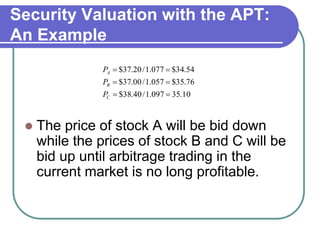
 The price of stock A will be bid down
while the prices of stock B and C will be
bid up until arbitrage trading in the
current market is no long profitable.
10.35097.1/40.38$
76.35$057.1/00.37$
54.34$077.1/20.37$



C
B
A
P
P
P
Microeconomic-Based Risk
Factor Models (Fama-French)
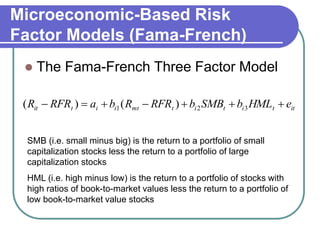
 The Fama-French Three Factor Model
ittititmtiitit eHMLbSMBbRFRRbaRFRR  321 )()(
SMB (i.e. small minus big) is the return to a portfolio of small
capitalization stocks less the return to a portfolio of large
capitalization stocks
HML (i.e. high minus low) is the return to a portfolio of stocks with
high ratios of book-to-market values less the return to a portfolio of
low book-to-market value stocks
Summary
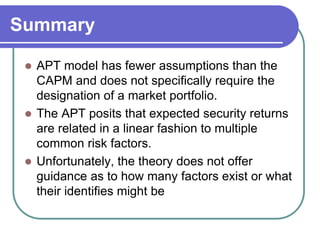
 APT model has fewer assumptions than the
CAPM and does not specifically require the
designation of a market portfolio.
 The APT posits that expected security returns
are related in a linear fashion to multiple
common risk factors.
 Unfortunately, the theory does not offer
guidance as to how many factors exist or what
their identifies might be
Summary
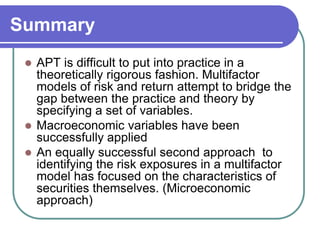
 APT is difficult to put into practice in a
theoretically rigorous fashion. Multifactor
models of risk and return attempt to bridge the
gap between the practice and theory by
specifying a set of variables.
 Macroeconomic variables have been
successfully applied
 An equally successful second approach to
identifying the risk exposures in a multifactor
model has focused on the characteristics of
securities themselves. (Microeconomic
approach)

Chapter 7

  • 1.
    Capital Asset Pricingand Arbitrage Pricing Theory Chapter 7
  • 2.
    The Capital AssetPricing Model Equating the CML with the efficient frontier at M and solving for E(Ri) yields: RFR)-(RRFR)E(R Mi i For a complete derivation of the CAPM pls see: http://e.viaminvest.com/A2MonitorSystems/AppA2MonitorSystems/A ppBtoA2CAP_model/CAP_Model.asp#_ftn1
  • 3.
    Assumptions  Individual investorscan borrow or lend money at the risk-free rate of return  Investors are rational mean-variance optimizers  Homogeneous expectations  Single-period investment horizon  Investments are limited to traded financial assets  Information is costless and available to all investors  No taxes, and transaction costs
  • 4.
    Security Market Line )E(Ri )Beta(Cov2 Mim/0.1 mR SML 0 Negative Beta RFR
  • 5.
    Plot of EstimatedReturns on SML Graph )E(R i Beta0.1 mR SML 0 .20 .40 .60 .80 1.20 1.40 1.60 1.80-.40 -.20 .22 .20 .18 .16 .14 .12 Rm .10 .08 .06 .04 .02 A B C D E
  • 6.
    Inputs to theCAPM (a) the current risk-free rate (b) the expected return on the market index and (c) the beta of the asset being analyzed
  • 7.
    Riskfree Rate &Time Horizon  For an investment to be riskfree, i.e., to have an actual return be equal to the expected return, two conditions have to be met –  There has to be no default risk, which generally implies that the security has to be issued by the government. Note, however, that not all governments can be viewed as default free.  There can be no uncertainty about reinvestment rates, which implies that it is a zero coupon security with the same maturity as the cash flow being analyzed.
  • 8.
  • 9.
    Measurement of therisk premium  The risk premium is the premium that investors demand for investing in an average risk investment, relative to the riskfree rate.  As a general proposition, this premium should be  greater than zero  increase with the risk aversion of the investors in that market  increase with the riskiness of the “average” risk investment
  • 10.
    Estimating Risk Premiumsin Practice  Survey investors on their desired risk premiums and use the average premium from these surveys.  Assume that the actual premium delivered over long time periods is equal to the expected premium - i.e., use historical data  Estimate the implied premium in today’s asset prices.
  • 11.
    The Survey Approach Surveying all investors in a market place is impractical. However, you can survey a few investors (especially the larger investors) and use these results. In practice, this translates into surveys of money managers’ expectations of expected returns on stocks over the next year.  The limitations of this approach are:  there are no constraints on reasonability (the survey could produce negative risk premiums or risk premiums of 50%)  they are extremely volatile  they tend to be short term; even the longest surveys do not go beyond one year
  • 12.
    The Historical PremiumApproach  This is the default approach used by most to arrive at the premium to use in the model  In most cases, this approach does the following  it defines a time period for the estimation (1926-Present, 1962- Present....)  it calculates average returns on a stock index during the period  it calculates average returns on a riskless security over the period  it calculates the difference between the two and uses it as a premium looking forward  The limitations of this approach are:  it assumes that the risk aversion of investors has not changed in a systematic way across time. (The risk aversion may change from year to year, but it reverts back to historical averages)  it assumes that the riskiness of the “risky” portfolio (stock index) has not changed in a systematic way across time.
  • 13.
    Historical Average Premiumsfor the United States Historical period Stocks - T.Bills Stocks - T.Bonds Arith. Geom Arith Geom 1926-2003 7.92% 5.50% 6.54% 4.82% 1962-2003 6.09% 4.85% 4.70% 3.82% 1992-2003 8.43% 6.68% 4.87% 3.57% What is the right premium?
  • 14.
    What about historicalpremiums for other Markets?  Historical data for markets outside the United States tends to be unreliable.  Ibbotson, for instance, estimates the following premiums for major markets from 1970-1990 Country Period Stocks Bonds Risk Premium Australia 1970-90 9.60% 7.35% 2.25% Canada 1970-90 10.50% 7.41% 3.09% France 1970-90 11.90% 7.68% 4.22% Germany 1970-90 7.40% 6.81% 0.59% Italy 1970-90 9.40% 9.06% 0.34% Japan 1970-90 13.70% 6.96% 6.74% Netherlands 1970-90 11.20% 6.87% 4.33% Switzerland 1970-90 5.30% 4.10% 1.20% UK 1970-90 14.70% 8.45% 6.25%
  • 15.
    Implied Equity RiskPremiums  If we use a basic discounted cash flow model, we can estimate the implied risk premium from the current level of stock prices.  For instance, if stock prices are determined by the simple Gordon Growth Model:  Value = Expected Dividends next year/ (Required Returns on Stocks - Expected Growth Rate)  Plugging in the current level of the index, the dividends on the index and expected growth rate will yield a “implied” expected return on stocks.  Subtracting out the riskfree rate will yield the implied premium.  The problems with this approach are:  the discounted cash flow model used to value the stock index has to be the right one.  the inputs on dividends and expected growth have to be correct  it implicitly assumes that the market is currently correctly valued
  • 16.
    S&P 500 ImpliedEquity Premium  Current level – 1052  5 yr ave dividend yield 5.48%  Dividend growth rate 4.5%  1052 = 57.65(1.045) Ke - .045 Ke = 10.23% Risk premium – 10.23% - 3.5% = 6.73% http://www.wstreet.com/investing/stocks/18204_is_the_standard_and_poors_500_running_out_of_stream.html
  • 17.
  • 18.
    Estimating Beta  Thestandard procedure for estimating betas is to regress stock returns (Rj) against market returns (Rm) -  Rj = a + b Rm  where a is the intercept and b is the slope of the regression.  The slope of the regression corresponds to the beta of the stock, and measures the relative volatility of the stock to the market.
  • 19.
    Firm Specific andMarket Risk  The R squared (R2) of the regression provides an estimate of the proportion of the risk (variance) of a firm that can be attributed to market risk;  The balance (1 - R2) can be attributed to firm specific risk.
  • 20.
    Setting up forthe Estimation  Decide on an estimation period  Services use periods ranging from 2 to 5 years for the regression  Longer estimation period provides more data, but firms change.  Shorter periods can be affected more easily by significant firm- specific event that occurred during the period  Decide on a return interval - daily, weekly, monthly  Shorter intervals yield more observations, but suffer from more noise.  Noise is created by stocks not trading and biases all betas towards one.  Estimate returns (including dividends) on stock  Return = (PriceEnd – PriceBeginning + DividendsPeriod)/ PriceBeginning  Included dividends only in ex-dividend month  Choose a market index, and estimate returns (inclusive of dividends) on the index for each interval for the period.
  • 21.
    Choosing the Parameters:Disney  Period used: 5 years  Return Interval = Monthly  Market Index: S&P 500 Index.  For instance, to calculate returns on Disney Price for Disney at end of March = $ 37.87  Price for Disney at end of April = $ 36.42  Dividends during month = $0.05 (It was an ex-dividend month)  Return =($36.42 - $ 37.87 + $ 0.05)/$ 37.87=-3.69%  To estimate returns on the index in the same month  Index level (including dividends) at end of March = 404.35  Index level (including dividends) at end of April = 415.53  Return =(415.53 - 404.35)/ 404.35 = 2.76%
  • 22.
  • 23.
    The Regression Output ReturnsDisney= -0.01% + 1.40 ReturnsS & P 500 (0.27) (R squared=32.41%) Intercept = -0.01% Slope = 1.40
  • 24.
    Estimating Disney’s Beta Slope of the Regression of 1.40 is the beta  Regression parameters are always estimated with noise. The noise is captured in the standard error of the beta estimate, which in the case of Disney is 0.27.  Assume that I asked you what Disney’s true beta is, after this regression.  What is your best point estimate?  What range would you give me, with 67% confidence?  What range would you give me, with 95% confidence?
  • 25.
  • 26.
    Breaking Down Disney’sRisk  R Squared = 32%  This implies that  32% of the risk at Disney comes from market sources  68%, therefore, comes from firm-specific sources  The firm-specific risk is diversifiable and will not be rewarded
  • 27.
    The Relevance ofR Squared You are a diversified investor trying to decide whether you should invest in Disney or Amgen. They both have betas of 1.35, but Disney has an R Squared of 32% while Amgen’s R squared of only 15%. Which one would you invest in:  Amgen, because it has the lower R squared  Disney, because it has the higher R squared  You would be indifferent
  • 28.
    The Relevance ofR Squared…  I would be indifferent, because they have the same beta  I am well diversified, and thus can eliminate all firm-specific risk. If I were not, I would have picked Disney, since it has less firm-specific risk.
  • 29.
    Estimating Expected Returns Disney’s Beta = 1.40  Riskfree Rate = 3.50% (Long term Government Bond rate)  Risk Premium = 7% (Implied)  Expected Return = 3.5% + 1.40 (7%) = 13.3%
  • 30.
    Use to aPotential Investor in Disney  As a potential investor in Disney, what does this expected return of 13.30% tell you?  This is the return that I can expect to make in the long term on Disney, if the stock is correctly priced and the CAPM is the right model for risk,  This is the return that I need to make on Disney in the long term to break even on my investment in the stock  Both  Assume now that you are an active investor and that your research suggests that an investment in Disney will yield 25% a year for the next 5 years. Based upon the expected return of 14.70%, you would  Buy the stock  Sell the stock
  • 31.
    Arbitrage Pricing Theory •Developedas an alternative to the CAPM •Reasonably intuitive •Required limited assumptions •Allowed for multiple dimensions of investment risk
  • 32.
    Arbitrage Pricing Theory Based on the Law of One Price  Since two otherwise identical assets cannot sell at different prices, equilibrium prices adjust to eliminate all arbitrage opportunities  Arbitrage opportunity  arises if an investor can construct a zero investment portfolio with no risk, but with a positive profit  Since no investment is required, an investor can create large positions in long and short to secure large levels of profits  In an efficient market, profitable arbitrage opportunities will quickly disappear
  • 33.
    APT Model  APTassumes returns generated by a factor model  Factor Characteristics  Each risk factor must have a pervasive influence on stock returns  Risk factors must have nonzero prices  Risk factors must be unpredictable to the market  The expected return-risk relationship for the APT: E(Ri) = RF + bi1 (risk premium for factor 1) + bi2 (risk premium for factor 2) + ... + bin (risk premium for factor n)
  • 34.
    APT and CAPMCompared  APT applies to well diversified portfolios, and not necessarily to individual stocks  With APT, it is possible for some individual stocks to be mispriced - not lie on the SML  APT is more general in that it gets to an expected return and beta relationship without the assumption of the market portfolio  Unlike CAPM, APT does not assume mean-variance decisions, riskless borrowing or lending, and existence of a market portfolio  APT can be extended to multifactor models
  • 35.
    Arbitrage Pricing Theory(APT) where: = the expected return on an asset with zero systematic risk where ikkiii bbbRE   ...)( 22110 0 1 = the risk premium related to the common jth factor bij = the pricing relationship between the risk premium and asset - that is how responsive asset i is to jth common factor
  • 36.
    Using the APT =unanticipated changes in the rate of inflation. The risk premium related to this factor is 2 percent for every 1 percent change in the rate 1 )02.( 1  = percent growth in real GDP. The average risk premium related to this factor is 3 percent for every 1 percent change in the rate = the rate of return on a zero-systematic-risk asset (zero beta) is 4 percent 2 )03.( 2  )04.( 0  0
  • 37.
    Using the APT =the response of asset X to changes in the inflation factor is 0.50 1xb )50.( 1 xb = the response of asset Y to changes in the inflation factor is 2.00 )00.2( 1 yb 1yb = the response of asset X to changes in the GDP factor is 1.50 = the response of asset Y to changes in the GDP factor is 1.75 2xb 2yb )50.1( 2 xb )75.1( 2 yb
  • 38.
    Using the APT =.04 + (.02)bi1 + (.03)bi2 E(Rx) = .04 + (.02)(0.50) + (.03)(1.50) = .095 = 9.5% E(Ry) = .04 + (.02)(2.00) + (.03)(1.75) = .1325 = 13.25% 22110)( iii bbRE  
  • 39.
    Security Valuation withthe APT: An Example Three stocks (A, B, C) and two common systematic risk factors have the following relationship( )0 0  21 21 21 )5.0()8.1()( )3.1()2.0()( )9.0()8.0()(       C B A RE RE RE %7.9)( %7.5)( %7.7)(    C B A RE RE RE %5and%4 21  if 40.38$%)7.91(35$)( 00.37$%)7.51(35$)( 70.37$%)7.71(35$)(    C B A PE PE PE Currently priced at $35 each and will not pay dividend Expected prices a year from now Your estimates a year from now (you are sure!) E(PA) = $37.20 E(PB) = $37.80 E(PC) = $38.50
  • 40.
    Security Valuation withthe APT: An Example  Riskless arbitrage  Requires no net wealth invested initially  Will bear no systematic or unsystematic risk but  Still earns a profit  Condition must be satisfied as follow:  1.  2  3 0i iw 0 iji ibw 0 ii i Rw i.e. actual portfolio return is positive For all K factors [i.e. no systematic risk] and w is small for all I [ unsystematic risk is fully diversified] i.e. no net wealth invested Wi the percentage investment in security i
  • 41.
    Security Valuation withthe APT: An Example  Example:  Stock A is overvalued; Stock B and C are two undervalued securities  Consider the following investment proportions  WA=-1.0  WB=+0.5  WC=+0.5 These investment weight imply the creation of a portfolio that is short two shares of Stock A for each share of Stock B and one share of Stock C held long
  • 42.
    Security Valuation withthe APT: An Example Net Initial Investment: Short 2 shares of A: +70 Purchase 1 share of B: -35 Purchase 1 share of C: -35 Net investment: 0 Net Exposure to Risk Factors: Factor 1 Factor 2 Weighted exposure from Stock A: (-1.0)(0.8) (-1.0)(0.9) Weighted exposure from Stock B: (0.5)(-0.2) (0.5)(1.3) Weighted exposure from Stock C: (0.5)(1.8) (0.5)(0.5) Net risk exposure 0 0 Net Profit: Stock A Stock B Stock C [2(35)-2(37.20)]+[37.80-35]+[38.50-35] =$1.90
  • 43.
    Security Valuation withthe APT: An Example  The price of stock A will be bid down while the prices of stock B and C will be bid up until arbitrage trading in the current market is no long profitable. 10.35097.1/40.38$ 76.35$057.1/00.37$ 54.34$077.1/20.37$    C B A P P P
  • 44.
    Microeconomic-Based Risk Factor Models(Fama-French)  The Fama-French Three Factor Model ittititmtiitit eHMLbSMBbRFRRbaRFRR  321 )()( SMB (i.e. small minus big) is the return to a portfolio of small capitalization stocks less the return to a portfolio of large capitalization stocks HML (i.e. high minus low) is the return to a portfolio of stocks with high ratios of book-to-market values less the return to a portfolio of low book-to-market value stocks
  • 45.
    Summary  APT modelhas fewer assumptions than the CAPM and does not specifically require the designation of a market portfolio.  The APT posits that expected security returns are related in a linear fashion to multiple common risk factors.  Unfortunately, the theory does not offer guidance as to how many factors exist or what their identifies might be
  • 46.
    Summary  APT isdifficult to put into practice in a theoretically rigorous fashion. Multifactor models of risk and return attempt to bridge the gap between the practice and theory by specifying a set of variables.  Macroeconomic variables have been successfully applied  An equally successful second approach to identifying the risk exposures in a multifactor model has focused on the characteristics of securities themselves. (Microeconomic approach)