Dilations and Similarity

Mr. Saucedo - GEOMETRY - Milby High School
OBJECTIVE:

•To identify and
construct dilations.
• A dilation is a transformation that changes the
size of a figure but not its shape.
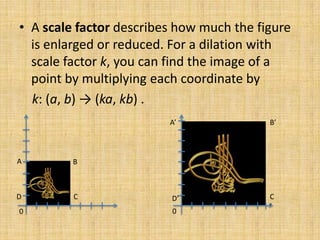
• A scale factor describes how much the figure
is enlarged or reduced. For a dilation with
scale factor k, you can find the image of a
point by multiplying each coordinate by
k: (a, b) → (ka, kb) .
A’

A

C

D’

C
’

B

D

B’

0

0
KEY CONCEPT:
• A Dilation stretches or shrinks a figure.
• The Center of Dilation never changes
position. It’s a starting point.
• The Scale Factor tells you how much the
dilation stretches or shrinks.
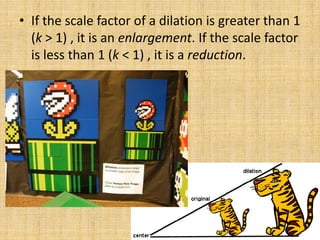
• If the scale factor of a dilation is greater than 1
(k > 1) , it is an enlargement. If the scale factor
is less than 1 (k < 1) , it is a reduction.
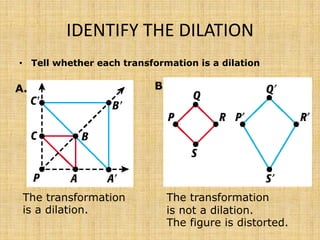
IDENTIFY THE DILATION
• Tell whether each transformation is a dilation

A.

The transformation
is a dilation.

B.

The transformation
is not a dilation.
The figure is distorted.
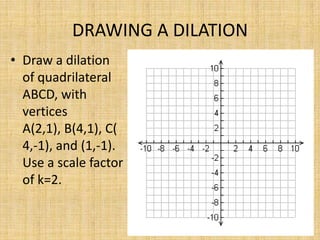
DRAWING A DILATION
• Draw a dilation
of quadrilateral
ABCD, with
vertices
A(2,1), B(4,1), C(
4,-1), and (1,-1).
Use a scale factor
of k=2.
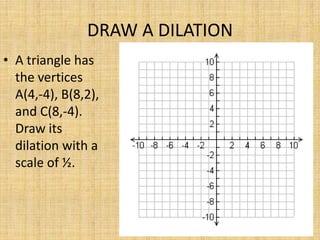
DRAW A DILATION
• A triangle has
the vertices
A(4,-4), B(8,2),
and C(8,-4).
Draw its
dilation with a
scale of ½.
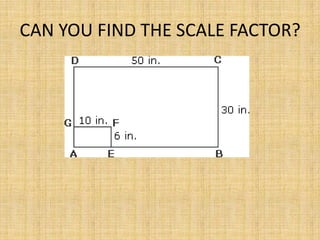
CAN YOU FIND THE SCALE FACTOR?
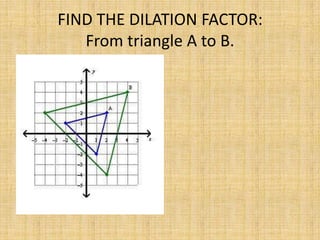
FIND THE DILATION FACTOR:
From triangle A to B.
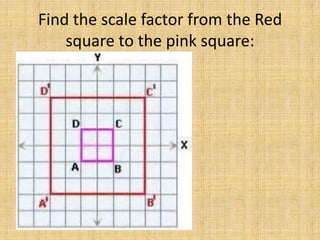
Find the scale factor from the Red
square to the pink square:
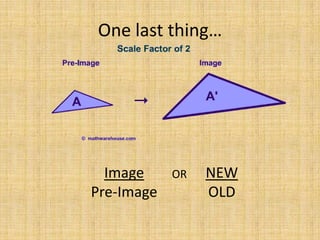
One last thing…

Image
Pre-Image

OR

NEW
OLD
INDEPENDENT PRACTICE
HOMEWORK
Workbook, Section 6.7. Pages: 121-123
Problems: 2, 4, 6, 8, 9, 10, 11, 12, 13
Pre AP: Add problem 14.

Dilations