Name :- Mansi Upadhyay
Roll no :- 18
Semester :- 2
Year :- 2018-19
Paper no :- 8 ( Cultural Study)
Topic :- Post Structuralism and
Deconstruction
E-mail :- mansiupadhyay06@gmail.com
Submitted to :- Department of English
Maharaja Krishnakumrsinhji Bhavnagar
University.
• Post Structuralism is the name for a movement in
philosophy that began in the early of 1960s and end
of 1970s and also displaced structuralism. It is closely
related to post – modernism it remains an influence
not only in philosophy, but also in a wider set of
subjects, including literature, politics, art, cultural
criticisms, history and sociology.
• In the post-Structuralism approach to textual
analysis, the reader replaces the primary subject of
inquiry and, without a central fixation on the author,
Post-Structuralism examine other sources for
meaning (e.g., readers, cultural norms, other
literature, etc),
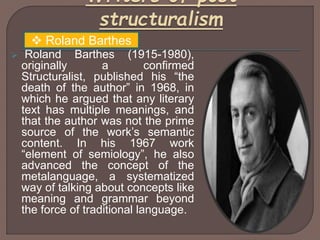
 Roland Barthes (1915-1980),
originally a confirmed
Structuralist, published his “the
death of the author” in 1968, in
which he argued that any literary
text has multiple meanings, and
that the author was not the prime
source of the work’s semantic
content. In his 1967 work
“element of semiology”, he also
advanced the concept of the
metalanguage, a systematized
way of talking about concepts like
meaning and grammar beyond
the force of traditional language.
 Roland Barthes
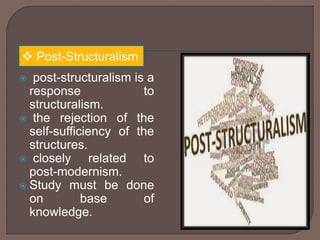
 post-structuralism is a
response to
structuralism.
 the rejection of the
self-sufficiency of the
structures.
 closely related to
post-modernism.
 Study must be done
on base of
knowledge.
 Post-Structuralism
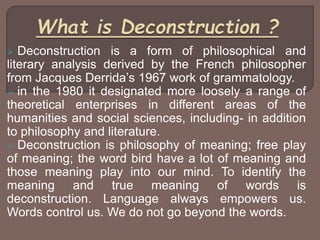
 Deconstruction is a form of philosophical and
literary analysis derived by the French philosopher
from Jacques Derrida’s 1967 work of grammatology.
 in the 1980 it designated more loosely a range of
theoretical enterprises in different areas of the
humanities and social sciences, including- in addition
to philosophy and literature.
 Deconstruction is philosophy of meaning; free play
of meaning; the word bird have a lot of meaning and
those meaning play into our mind. To identify the
meaning and true meaning of words is
deconstruction. Language always empowers us.
Words control us. We do not go beyond the words.
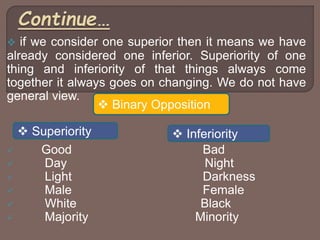
 if we consider one superior then it means we have
already considered one inferior. Superiority of one
thing and inferiority of that things always come
together it always goes on changing. We do not have
general view.
 Good Bad
 Day Night
 Light Darkness
 Male Female
 White Black
 Majority Minority
 Binary Opposition
 Superiority  Inferiority
 Majority has power position and controls others and
minority suffers, faces many problems. The way
people use words becomes more important.
Deconstruction helps us understand silence voices,
ignored things which are left out. Deconstruction
changes our way of looking towards different things
and our perspectives.
 the thing which arrives after the first thing redefines
the previous and the first thing. Idea becomes
ideology. Meaning are given in the context. The idea
of signifier and signified comes. Word have different
meanings. in written words meaning dies. Written
things are judged and examined by readers.
 in the criticism of literature, deconstruction is a
theory and practice of reading. Which questions and
claims to ‘subvert’ or ‘undermine’ the assumption that
the system of language provides grounds that are
adequate to establish the boundaries.
 the coherence or unity, and determine meaning of a
literary text. Typically, a deconstructive reading sets
out to show the conflicting forces within the text itself
to dissipate the seeming definiteness of its structure
and meaning into indefinite array of incompatibility
and undividable possibilities.
Presentation paper 8

Presentation paper 8

  • 1.
    Name :- MansiUpadhyay Roll no :- 18 Semester :- 2 Year :- 2018-19 Paper no :- 8 ( Cultural Study) Topic :- Post Structuralism and Deconstruction E-mail :- mansiupadhyay06@gmail.com Submitted to :- Department of English Maharaja Krishnakumrsinhji Bhavnagar University.
  • 2.
    • Post Structuralismis the name for a movement in philosophy that began in the early of 1960s and end of 1970s and also displaced structuralism. It is closely related to post – modernism it remains an influence not only in philosophy, but also in a wider set of subjects, including literature, politics, art, cultural criticisms, history and sociology. • In the post-Structuralism approach to textual analysis, the reader replaces the primary subject of inquiry and, without a central fixation on the author, Post-Structuralism examine other sources for meaning (e.g., readers, cultural norms, other literature, etc),
  • 3.
     Roland Barthes(1915-1980), originally a confirmed Structuralist, published his “the death of the author” in 1968, in which he argued that any literary text has multiple meanings, and that the author was not the prime source of the work’s semantic content. In his 1967 work “element of semiology”, he also advanced the concept of the metalanguage, a systematized way of talking about concepts like meaning and grammar beyond the force of traditional language.  Roland Barthes
  • 4.
     post-structuralism isa response to structuralism.  the rejection of the self-sufficiency of the structures.  closely related to post-modernism.  Study must be done on base of knowledge.  Post-Structuralism
  • 5.
     Deconstruction isa form of philosophical and literary analysis derived by the French philosopher from Jacques Derrida’s 1967 work of grammatology.  in the 1980 it designated more loosely a range of theoretical enterprises in different areas of the humanities and social sciences, including- in addition to philosophy and literature.  Deconstruction is philosophy of meaning; free play of meaning; the word bird have a lot of meaning and those meaning play into our mind. To identify the meaning and true meaning of words is deconstruction. Language always empowers us. Words control us. We do not go beyond the words.
  • 6.
     if weconsider one superior then it means we have already considered one inferior. Superiority of one thing and inferiority of that things always come together it always goes on changing. We do not have general view.  Good Bad  Day Night  Light Darkness  Male Female  White Black  Majority Minority  Binary Opposition  Superiority  Inferiority
  • 7.
     Majority haspower position and controls others and minority suffers, faces many problems. The way people use words becomes more important. Deconstruction helps us understand silence voices, ignored things which are left out. Deconstruction changes our way of looking towards different things and our perspectives.  the thing which arrives after the first thing redefines the previous and the first thing. Idea becomes ideology. Meaning are given in the context. The idea of signifier and signified comes. Word have different meanings. in written words meaning dies. Written things are judged and examined by readers.
  • 8.
     in thecriticism of literature, deconstruction is a theory and practice of reading. Which questions and claims to ‘subvert’ or ‘undermine’ the assumption that the system of language provides grounds that are adequate to establish the boundaries.  the coherence or unity, and determine meaning of a literary text. Typically, a deconstructive reading sets out to show the conflicting forces within the text itself to dissipate the seeming definiteness of its structure and meaning into indefinite array of incompatibility and undividable possibilities.