Presented by: KM KUSUM
P.C Bsc. Nsg 1st Year (MIBE GSN)
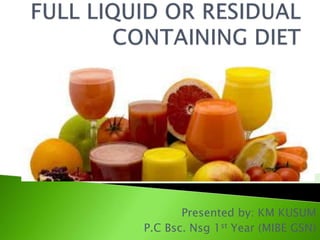
 The full liquid diet is a diet which consists of
foods which are liquid at room temperature or
become liquid in the mouth.
 A full liquid diet is made up only of fluids and
foods that are normally liquid and foods that turn
to liquid when they are at room temperature, like
ice cream. It also includes:
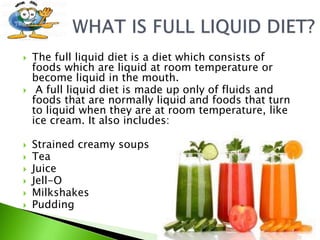
 Strained creamy soups
 Tea
 Juice
 Jell-O
 Milkshakes
 Pudding
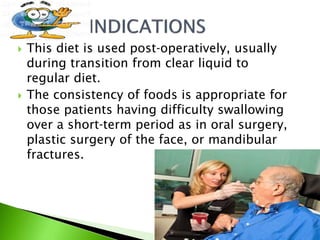
 This diet is used post‐operatively, usually
during transition from clear liquid to
regular diet.
 The consistency of foods is appropriate for
those patients having difficulty swallowing
over a short‐term period as in oral surgery,
plastic surgery of the face, or mandibular
fractures.
 You can NOT eat solid foods when you are on
a full liquid diet.
 This diet is easier to digest than solid food. It
gives you the proteins, fluids, salts, and
minerals that you need for energy.
 For most people on a full liquid diet, the goal
is to get 1,350 to 1,500 calories and 45
grams of protein a day.
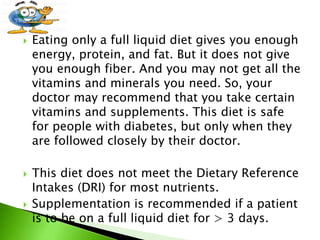
 Eating only a full liquid diet gives you enough
energy, protein, and fat. But it does not give
you enough fiber. And you may not get all the
vitamins and minerals you need. So, your
doctor may recommend that you take certain
vitamins and supplements. This diet is safe
for people with diabetes, but only when they
are followed closely by their doctor.
 This diet does not meet the Dietary Reference
Intakes (DRI) for most nutrients.
 Supplementation is recommended if a patient
is to be on a full liquid diet for > 3 days.
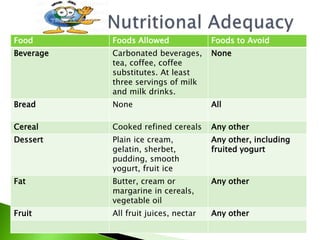
Food Foods Allowed Foods to Avoid
Beverage Carbonated beverages,
tea, coffee, coffee
substitutes. At least
three servings of milk
and milk drinks.
None
Bread None All
Cereal Cooked refined cereals Any other
Dessert Plain ice cream,
gelatin, sherbet,
pudding, smooth
yogurt, fruit ice
Any other, including
fruited yogurt
Fat Butter, cream or
margarine in cereals,
vegetable oil
Any other
Fruit All fruit juices, nectar Any other
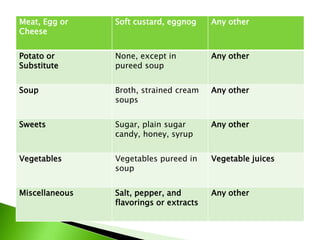
Meat, Egg or
Cheese
Soft custard, eggnog Any other
Potato or
Substitute
None, except in
pureed soup
Any other
Soup Broth, strained cream
soups
Any other
Sweets Sugar, plain sugar
candy, honey, syrup
Any other
Vegetables Vegetables pureed in
soup
Vegetable juices
Miscellaneous Salt, pepper, and
flavorings or extracts
Any other
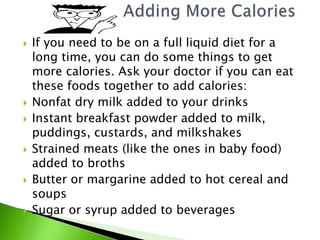
 If you need to be on a full liquid diet for a
long time, you can do some things to get
more calories. Ask your doctor if you can eat
these foods together to add calories:
 Nonfat dry milk added to your drinks
 Instant breakfast powder added to milk,
puddings, custards, and milkshakes
 Strained meats (like the ones in baby food)
added to broths
 Butter or margarine added to hot cereal and
soups
 Sugar or syrup added to beverages
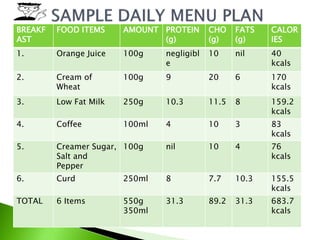
BREAKF
AST
FOOD ITEMS AMOUNT PROTEIN
(g)
CHO
(g)
FATS
(g)
CALOR
IES
1. Orange Juice 100g negligibl
e
10 nil 40
kcals
2. Cream of
Wheat
100g 9 20 6 170
kcals
3. Low Fat Milk 250g 10.3 11.5 8 159.2
kcals
4. Coffee 100ml 4 10 3 83
kcals
5. Creamer Sugar,
Salt and
Pepper
100g nil 10 4 76
kcals
6. Curd 250ml 8 7.7 10.3 155.5
kcals
TOTAL 6 Items 550g
350ml
31.3 89.2 31.3 683.7
kcals
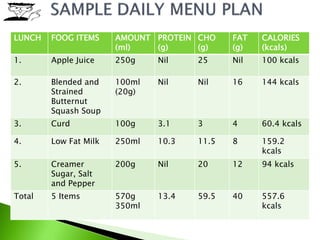
LUNCH FOOG ITEMS AMOUNT
(ml)
PROTEIN
(g)
CHO
(g)
FAT
(g)
CALORIES
(kcals)
1. Apple Juice 250g Nil 25 Nil 100 kcals
2. Blended and
Strained
Butternut
Squash Soup
100ml
(20g)
Nil Nil 16 144 kcals
3. Curd 100g 3.1 3 4 60.4 kcals
4. Low Fat Milk 250ml 10.3 11.5 8 159.2
kcals
5. Creamer
Sugar, Salt
and Pepper
200g Nil 20 12 94 kcals
Total 5 Items 570g
350ml
13.4 59.5 40 557.6
kcals
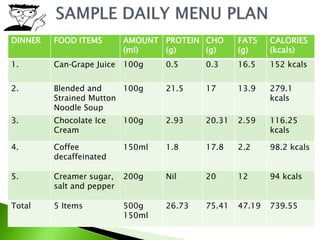
DINNER FOOD ITEMS AMOUNT
(ml)
PROTEIN
(g)
CHO
(g)
FATS
(g)
CALORIES
(kcals)
1. Can‐Grape Juice 100g 0.5 0.3 16.5 152 kcals
2. Blended and
Strained Mutton
Noodle Soup
100g 21.5 17 13.9 279.1
kcals
3. Chocolate Ice
Cream
100g 2.93 20.31 2.59 116.25
kcals
4. Coffee
decaffeinated
150ml 1.8 17.8 2.2 98.2 kcals
5. Creamer sugar,
salt and pepper
200g Nil 20 12 94 kcals
Total 5 Items 500g
150ml
26.73 75.41 47.19 739.55
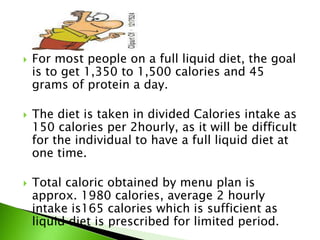
 For most people on a full liquid diet, the goal
is to get 1,350 to 1,500 calories and 45
grams of protein a day.
 The diet is taken in divided Calories intake as
150 calories per 2hourly, as it will be difficult
for the individual to have a full liquid diet at
one time.
 Total caloric obtained by menu plan is
approx. 1980 calories, average 2 hourly
intake is165 calories which is sufficient as
liquid diet is prescribed for limited period.
 Full liquid diets are frequently used as a
middle step between clear liquids and solid
foods.
 This diet meets calorie and protein needs for
your body with liquids only.
 It is important to eat a variety of liquid foods.
 If you have lactose intolerance, try lactose
treated milk such as Lactaid or Dairy Ease
 High-protein, high-calorie supplements that
are fortified with vitamins and minerals may
be ordered by your dietitian or physician.
Full liquid diet

Full liquid diet

  • 1.
    Presented by: KMKUSUM P.C Bsc. Nsg 1st Year (MIBE GSN)
  • 2.
     The fullliquid diet is a diet which consists of foods which are liquid at room temperature or become liquid in the mouth.  A full liquid diet is made up only of fluids and foods that are normally liquid and foods that turn to liquid when they are at room temperature, like ice cream. It also includes:  Strained creamy soups  Tea  Juice  Jell-O  Milkshakes  Pudding
  • 3.
     This dietis used post‐operatively, usually during transition from clear liquid to regular diet.  The consistency of foods is appropriate for those patients having difficulty swallowing over a short‐term period as in oral surgery, plastic surgery of the face, or mandibular fractures.
  • 4.
     You canNOT eat solid foods when you are on a full liquid diet.  This diet is easier to digest than solid food. It gives you the proteins, fluids, salts, and minerals that you need for energy.  For most people on a full liquid diet, the goal is to get 1,350 to 1,500 calories and 45 grams of protein a day.
  • 5.
     Eating onlya full liquid diet gives you enough energy, protein, and fat. But it does not give you enough fiber. And you may not get all the vitamins and minerals you need. So, your doctor may recommend that you take certain vitamins and supplements. This diet is safe for people with diabetes, but only when they are followed closely by their doctor.  This diet does not meet the Dietary Reference Intakes (DRI) for most nutrients.  Supplementation is recommended if a patient is to be on a full liquid diet for > 3 days.
  • 6.
    Food Foods AllowedFoods to Avoid Beverage Carbonated beverages, tea, coffee, coffee substitutes. At least three servings of milk and milk drinks. None Bread None All Cereal Cooked refined cereals Any other Dessert Plain ice cream, gelatin, sherbet, pudding, smooth yogurt, fruit ice Any other, including fruited yogurt Fat Butter, cream or margarine in cereals, vegetable oil Any other Fruit All fruit juices, nectar Any other
  • 7.
    Meat, Egg or Cheese Softcustard, eggnog Any other Potato or Substitute None, except in pureed soup Any other Soup Broth, strained cream soups Any other Sweets Sugar, plain sugar candy, honey, syrup Any other Vegetables Vegetables pureed in soup Vegetable juices Miscellaneous Salt, pepper, and flavorings or extracts Any other
  • 8.
     If youneed to be on a full liquid diet for a long time, you can do some things to get more calories. Ask your doctor if you can eat these foods together to add calories:  Nonfat dry milk added to your drinks  Instant breakfast powder added to milk, puddings, custards, and milkshakes  Strained meats (like the ones in baby food) added to broths  Butter or margarine added to hot cereal and soups  Sugar or syrup added to beverages
  • 9.
    BREAKF AST FOOD ITEMS AMOUNTPROTEIN (g) CHO (g) FATS (g) CALOR IES 1. Orange Juice 100g negligibl e 10 nil 40 kcals 2. Cream of Wheat 100g 9 20 6 170 kcals 3. Low Fat Milk 250g 10.3 11.5 8 159.2 kcals 4. Coffee 100ml 4 10 3 83 kcals 5. Creamer Sugar, Salt and Pepper 100g nil 10 4 76 kcals 6. Curd 250ml 8 7.7 10.3 155.5 kcals TOTAL 6 Items 550g 350ml 31.3 89.2 31.3 683.7 kcals
  • 10.
    LUNCH FOOG ITEMSAMOUNT (ml) PROTEIN (g) CHO (g) FAT (g) CALORIES (kcals) 1. Apple Juice 250g Nil 25 Nil 100 kcals 2. Blended and Strained Butternut Squash Soup 100ml (20g) Nil Nil 16 144 kcals 3. Curd 100g 3.1 3 4 60.4 kcals 4. Low Fat Milk 250ml 10.3 11.5 8 159.2 kcals 5. Creamer Sugar, Salt and Pepper 200g Nil 20 12 94 kcals Total 5 Items 570g 350ml 13.4 59.5 40 557.6 kcals
  • 11.
    DINNER FOOD ITEMSAMOUNT (ml) PROTEIN (g) CHO (g) FATS (g) CALORIES (kcals) 1. Can‐Grape Juice 100g 0.5 0.3 16.5 152 kcals 2. Blended and Strained Mutton Noodle Soup 100g 21.5 17 13.9 279.1 kcals 3. Chocolate Ice Cream 100g 2.93 20.31 2.59 116.25 kcals 4. Coffee decaffeinated 150ml 1.8 17.8 2.2 98.2 kcals 5. Creamer sugar, salt and pepper 200g Nil 20 12 94 kcals Total 5 Items 500g 150ml 26.73 75.41 47.19 739.55
  • 12.
     For mostpeople on a full liquid diet, the goal is to get 1,350 to 1,500 calories and 45 grams of protein a day.  The diet is taken in divided Calories intake as 150 calories per 2hourly, as it will be difficult for the individual to have a full liquid diet at one time.  Total caloric obtained by menu plan is approx. 1980 calories, average 2 hourly intake is165 calories which is sufficient as liquid diet is prescribed for limited period.
  • 13.
     Full liquiddiets are frequently used as a middle step between clear liquids and solid foods.  This diet meets calorie and protein needs for your body with liquids only.  It is important to eat a variety of liquid foods.  If you have lactose intolerance, try lactose treated milk such as Lactaid or Dairy Ease  High-protein, high-calorie supplements that are fortified with vitamins and minerals may be ordered by your dietitian or physician.